



Abstract
Although research on content and language integrated learning (CLIL) has shown that CLIL instruction may enhance students’ second or foreign language learning compared to regular foreign language instruction, there are also studies that have indicated similar language development between CLIL and non-CLIL students. However, CLIL can be organized and implemented in many different ways and thus, it is necessary to identify the specific features of various CLIL contexts when comparing learning outcomes. In this study, CLIL implementation at three Swedish upper secondary schools was explored and compared. Further, students’ development of second language (L2) English productive academic vocabulary was compared over three years between CLIL groups at different schools as well as between CLIL and non-CLIL groups (n = 230), using corpus-based methods. The results revealed significant differences in the progression of L2 academic vocabulary between CLIL groups that may be attributed to substantial differences in CLIL implementation, e.g. with regard to the time allotted for CLIL, teacher availability and the balance between first language (L1) and L2. At the school where the CLIL group’s L2 productive academic vocabulary progressed more than in other groups, both Swedish and English were languages of instruction, increasing the proportion of English over the three years; in the third year, English dominated as the language of instruction. The results indicated similar development of L2 academic vocabulary between CLIL and non-CLIL groups when CLIL implementation was very limited in scale and scope. Further, the results showed that apart from vocabulary, CLIL teachers of non-language subjects generally paid very little attention to other aspects of language.
Keywords
I Introduction
As the global use of English is expanding, proficiency in academic English is often a prerequisite for success in higher education and many professions, not only in countries where English is a native language, but also elsewhere (Corson, 1997; Cummins, 2008; Doiz, Lasagabaster & Sierra, 2011; Norton, 1997; Nunan, 2003). Thus, it is essential that education at upper secondary level provides opportunities for students to develop academic language proficiency, i.e. proficiency to recognize and use specific language forms and functions that are required for learning across and within disciplines (see, for example, Uccelli et al., 2015). Knowledge of academic vocabulary is central in academic language proficiency and hence, for academic success (Gardner & Davies, 2014).
However, acquiring academic language proficiency may pose a challenge for all students, and especially for second or foreign language (L2) learners, since academic language is not very frequent in everyday situations or in social media outside school (Cummins, 1980; Schleppegrell, 2004). Educational initiatives for enhanced L2 learning are often called for, not least concerning academic language proficiency. One such initiative is content and language integrated learning (CLIL) where the teaching of an L2 and various school subjects is integrated (see, for example, Cenoz, Genesee & Gorter, 2014; Marsh, 2002).
A number of studies have shown that CLIL education may be beneficial for certain aspects of L2 development, particularly in comparison with conventional foreign language education (for an overview, see, for example, Dalton-Puffer, 2011), but there are also results showing similar L2 development among CLIL students and students attending regular education (e.g. Bruton, 2011; Sylvén, 2004; Olsson, 2015, 2016). However, CLIL education can be organized in many different ways. The divergent outcomes of CLIL studies indicate a need for identifying more precisely the various ways of implementing CLIL, and for comparing the progress of students’ academic language proficiency not only between CLIL and non-CLIL groups, but also between groups in different CLIL contexts (see Cenoz et al., 2014; Genesee & Lindholm-Leary, 2013). In this study, therefore, the implementation of CLIL through English is explored and compared between three Swedish upper secondary schools. The development of L2 English academic vocabulary in student-written assignments is compared over three years between CLIL groups at different schools as well as between CLIL and non-CLIL groups.
II Literature review
1 Teaching and learning through CLIL
CLIL is often regarded as an umbrella term as it may be implemented in different ways. Nevertheless, most models, including the Canadian immersion programmes, are based on certain common assumptions (Cenoz et al., 2014). In CLIL, an L2 is the language of instruction for non-language school subjects to some or a large extent, language learning and academic development not being seen as separate matters, but as interdependent (see, for example, Cenoz et al., 2014; Marsh, 2002). Language exposure through CLIL is often assumed to be more substantial with regard to content than traditional language education, where, at times, language may be taught in isolation or involving more trivial topics. Ideally, in CLIL, students are exposed to the complex linguistic systems of the L2, as they encounter the language required in various subjects (see, for example, Genesee and Lindholm-Leary, 2013). The target language is the language of communication for various tasks, as proposed by Stevens’ (1983), who argued that activity-centred lessons would enhance L2 development in immersion and other foreign language learning contexts compared to more traditional, form-focus lessons.
The time aspect may also speak in favour of CLIL, as students may encounter and use the L2 more often when it is the language of instruction in different subjects, and not only in English language classes. In their overview of immersion studies, Genesee and Lindholm-Leary (2013) point out that the relationship between L2 exposure and L2 outcome is complex. They argue that pedagogical differences may be more important for L2 proficiency outcomes than the actual time of exposure to it. For instance, they report that students in immersion programmes where the L2 was the language of instruction 40 per cent of the time, and where activity-based and individualized pedagogy was used, scored higher in L2 proficiency than students in programmes where the L2 exposure was greater. De Graaff, Koopman, Anikina and Westhoff (2007) argue that there seems to be general agreement that extended exposure to meaningful foreign-language input is indeed important, but not sufficient. It has been suggested that more attention should be paid to the connection between language and content for enhanced language acquisition through CLIL (see, for example, Lyster, 2007). Research findings indicate that there is often a strong focus on content in CLIL classrooms, and so neither teachers nor students may pay much attention to linguistic issues (Genesee & Lindholm-Leary, 2013; Lyster, 2007; see also Swain, 1996). Various models for more integrated teaching have been proposed, e.g. by Dalton-Puffer (2013), who suggests a construct, based on so-called cognitive discourse functions, which identifies the language needed for the expansion of subject knowledge (see also Dalton-Puffer et al., 2018; Morton, 2020). Nikula, Dalton-Puffer, Llinares and Lorenzo (2016) point out that research on academic language has often addressed aspects of linguistic form rather than the functions of academic language in various contexts but, for example, Whittaker, Llinares and McCabe (2011) studied the development of nominal group complexity in students’ history texts written in L2 English in the Spanish CLIL context, results suggesting that an explicit focus on academic written discourse would enhance the development (see also Lorenzo & Rodriguez, 2014).
CLIL is always, some way or other, bi- or plurilingual, as the target language is either a second or a foreign language to the learner. In some CLIL contexts, all or almost all content instruction is in the L2, but the students often use their first language (L1) for communication outside the classroom and sometimes also in the classroom, for instance during group work (see Macaro, Tian & Chu, 2020). In many CLIL contexts, the instruction is bilingual since the students’ L1 is the language of instruction alongside the L2, academic proficiency in both languages being aimed for. Yet, for some students, both languages of instruction may be second languages, as they may have another L1 than the majority of the students. There are also CLIL contexts targeting three or four languages, for instance in Finland (Björklund & Mård-Miettinen, 2011; see also Eurydice, 2006; Pérez Cañado, 2016).
There have been concerns that the development of L1 proficiency and content knowledge would be impeded when a large part of the lessons are conducted in an L2. An overview of CLIL studies monitoring L1 development and content learning by Pérez Cañado (2018) showed that there is a limited number of such studies and that the findings are discrepant (see, for example, Dallinger, Jonkmann, Hollm, & Fiege, 2016; Jäppinen, 2005; Paran, 2013; Serra, 2007). According to Coyle, Hood and Marsh (2010), the ability to think in two or more languages may not only promote linguistic competence and awareness, but may also stimulate cognitive flexibility and enrich the understanding of concepts. Thus, they claim that well-planned CLIL instruction holds the potential of helping the learner to advance towards more sophisticated levels of learning (see also Jäppinen, 2005). Others, e.g. Bruton (2011), claim that groups of students risk falling behind in education based on CLIL, since it is probably more difficult to understand a subject taught in an L2. According to Bruton, selection effects could, in many cases, explain why CLIL students have been shown to progress more than non-CLIL students (see also Paran, 2013).
Especially when an L2 is the language of instruction, the teacher’s awareness of the role of language in learning is of great importance since scaffolding activities to support content and language learning are often required (Bruner, 1985; de Graaff et al., 2007; Gibbons, 2002; Llinares, Morton & Whittaker, 2012; Nikula, Dafouz, Moore & Smit, 2016). It may, however, be challenging for teachers of non-language subjects to identify themselves as language teachers and to organize scaffolding activities, unless trained to support language development (Cammarata, & Tedick, 2012; Coyle et al., 2010; Pérez Cañado, 2016). Intensive staff training is often called for when initiating CLIL, but in many cases, no such training is organized. For language teachers, on the other hand, the challenge is rather to identify and grasp the concepts and special language used in different school subjects to support the students’ development of both general and subject specific literacy (see, for example, Aalto, 2019; Pavón Vázquez, 2018) .
Ideally, CLIL provides ample opportunities for interaction through classroom activities where students’ progression in language proficiency is carefully planned and monitored (Lyster, 2007; see also Genesee, 1991). However, a major concern when implementing CLIL, identified by Pérez Cañado (2016), is the target language proficiency of the teachers. When teaching subjects through an L2, teachers sometimes use simplified language as regards vocabulary and semantics to make sure everyone understands what is said, or because their own proficiency is limited (Dalton-Puffer, 2007, 2011; Nikula, 2010; Nikula, Dalton-Puffer & Llinares, 2013). They may also be reluctant or unable to deviate from prepared drafts since it is more difficult to improvise in an L2 (Dalton-Puffer, 2011). In Canadian immersion programmes, teachers tend to be native speakers of the target language, French or English, Canada being a bilingual country. In European CLIL contexts, teachers are often required to teach through a language that is not their L1, which could be more of a challenge.
2 CLIL in Sweden
The present study was conducted in Sweden, where Swedish is generally the language of instruction at school. English is a foreign language to the majority of the population and a compulsory school subject from primary school through upper secondary school (Swedish National Agency for Education, 2011, 2018). Most children start studying English at school in their second school year, when they are eight years old, but there are also schools that introduce English in the first or the third year since only the total number of lessons at primary level is regulated. At this level, English is studied approximately 20-30 minutes per week and from school year four, two to three hours per week.
Large-scale surveys have indicated that English is regarded as a very important language to know among students and their parents in Sweden (Oscarson & Apelgren, 2005). The fact that many Swedish children and teenagers frequently encounter and use English in their spare time as well may be one of several explanations why they attribute great importance to being proficient in English, and why their level of English proficiency is high, compared to other European students of the same age (European Commission/SurveyLang, 2012; see, for example, Olsson, 2012; Sundqvist, 2009; Sylvén & Sundqvist, 2012).
All educational programmes at upper secondary level are optional and the students (and/or their parents) actively choose a programme and a school from a wide range of educational options. The autonomy of Swedish schools allows them to organize upper secondary education as they see fit, as long as the general requirements of the curriculum and syllabus are met. Thus, schools can adapt education to their specific context. However, this also means that there may be great differences between schools, for instance with regard to teaching methods (Yang Hansen & Gustafsson, 2019).
At approximately 27 per cent of Swedish upper secondary schools, some kind of CLIL programme is offered (Yoxsimer Paulsrud, 2014, 2019a). CLIL was introduced in Sweden on a small scale as early as the 1970s by individual teachers inspired by the Canadian immersion programmes (Dentler, 2007; Sylvén, 2004). In the 1990s, after a school reform made schools more autonomous than before, a larger number of schools initiated CLIL programmes, but the majority of students still choose education where Swedish is the main language of instruction. There is no specific regulation of CLIL in upper secondary school. The target language of CLIL is predominantly English, but there are also some examples of CLIL targeting other languages, such as German or French (see, for example, Terlević Johansson, 2013). Yoxsimer Paulsrud’s (2014, 2019a) survey of CLIL in Swedish upper secondary school showed that among the schools that reported offering some kind of CLIL education, four per cent organized an entire program mostly taught though another language than Swedish, 31 per cent offered some courses and 65 per cent a few lessons or days when certain subjects were taught through another language.
A survey of CLIL research in Sweden by Hyltenstam (2004) indicated that the English proficiency among CLIL students did not improve more than among non-CLIL students (see Washburn, 1997). Sylvén (2004) compared the development of vocabulary between CLIL and non-CLIL students in upper secondary school, finding that CLIL students scored higher than non-CLIL students, both in pre-tests and later on. However, other background factors, in particular students’ use of English outside school and their parents’ level of education, seemed equally influential; thus, the effect of CLIL could not be established.
More recently, a large-scale research project, Content and Language Integration in Swedish Schools (CLISS), explored various aspects of CLIL education in upper secondary school in Sweden, especially students’ development of English and Swedish language proficiency in academic registers (Sylvén, 2019). The results indicated a similar development of Swedish academic vocabulary proficiency in writing among CLIL and non-CLIL groups (Johansson & Ohlsson, 2019). However, a somewhat weaker progression of Swedish academic vocabulary was found in a CLIL group where English was the main language of instruction and the exposure to Swedish academic vocabulary very limited (Holmberg, 2019; Lim Falk & Holmberg, 2016; cf. Ohlsson, 2021). An analysis of text structure in a sample of students’ Swedish and English texts indicated a somewhat greater proficiency in the CLIL group when they started upper secondary education but there were few signs of progression in either of the groups (Apelgren & Holmberg, 2018).
Regarding English, the level of proficiency was generally higher among CLIL students already at the start of their upper secondary education (Olsson, 2015; Olsson & Sylvén, 2019; Sylvén & Ohlander, 2014, 2019). Yet, overall, the development of productive English academic vocabulary in student-written texts was not more pronounced among the CLIL students than among the non-CLIL students across three years (Olsson, 2015, 2016). As these results invite further reflection, a deeper analysis is conducted in the present study, linking a detailed exploration of the ways CLIL was implemented at different schools to the progression of productive academic vocabulary among the students. As mentioned, Swedish schools are to some extent autonomous, allowing for variation between schools. Hence, comparing CLIL education between schools is of great relevance.
Few Swedish studies have dealt with the actual implementation of CLIL. Sandberg (2019) interviewed eight CLIL teachers, finding that they had to make great efforts to find suitable practices for their communication with the students (see also Lim Falk, 2008). Some CLIL students in Yoxsimer Paulsrud’s (2014) study of two CLIL schools considered their teachers’ level of English proficiency problematic while, on the other hand, most of the CLIL teachers felt confident about their own language proficiency (see also Sylvén, 2004). Further, Reierstam and Sylvén (2019) found that CLIL teachers tended to see themselves primarily as content teachers rather than content and language teachers, and that the two aspects were assessed separately.
3 Key dimensions of CLIL
When exploring CLIL, a number of factors must to be taken into account as educational contexts vary, e.g. between countries, regions and schools (Coyle et al., 2010). For instance, the reasons for introducing CLIL may vary, as may the capacity to implement CLIL. Coyle et al. have identified two key dimensions of CLIL implementation: the operating factors and the scale of CLIL. The operating factors include teacher availability, target language fluency among teachers and students, time available for CLIL, methods for integrating content and language, networking (in the target language) with people or organizations outside the school, and the assessment process. The second key dimension, the scale or extent of CLIL, concerns two main types of instruction: extensive and partial instruction through the L2. In the extensive model, the L2 is used almost exclusively with only limited switching into the L1 when necessary, e.g. for explaining linguistic details. In the partial model, CLIL instruction in the L2 is only operated during limited periods of time (Coyle et al., 2010, pp. 14-16).
The extensive/partial distinction provides a rough instrument for describing the scale of CLIL. For more detailed descriptions of the scale and scope of CLIL practices, Met’s (1991, 1998) continuum, which identifies instruction as more or less content- or language-driven, is another legitimate instrument (see Lyster & Ballinger, 2011). In Met’s model, we find content-driven instruction at one end of the continuum, where various subjects are taught in an L2 without any particular attention being paid to language. At the other end of the continuum, we find language-driven instruction, where language teachers draw on content linked to other subjects for teaching language. In between, there are varieties that are more or less content- or language-driven.
The role and content of English as a Foreign Language (EFL) classes must be considered in the CLIL context (see, for example, Dale, Oostdam & Verspoor, 2018). The extent to which EFL classes relate to and support learning in other subjects may vary between CLIL contexts; EFL classes may be regarded as separated from CLIL or as an integrated part.
In the present study, a slightly modified version of the framework described above is employed in the analysis of CLIL implementation (see Section III).
4 Academic vocabulary
Academic language is a complex concept to define as many different aspects of language use may be included. Simply put, it could be described as lexical and syntactic resources required for learning and expressing knowledge at school or at university but less commonly used in everyday life (see, for example, Cummins, 2008; Uccelli et al., 2015). Snow and Uccelli (2008) point to the challenge for students to learn how to make adequate lexical and syntactic choices in various contexts since, for instance, each school subject or task may require the use of specific linguistic resources. However, at a general level, a number of traits have been identified as typical for academic texts, e.g. high lexical density, precision in lexical choices, and frequent use of formal expressions and abstract concepts (Snow & Uccelli, 2008; see also Whittaker, Llinares & McCabe, 2011).
In the present study, special attention is paid to the development of academic vocabulary among students. Academic vocabulary, one of the building blocks of academic language, is the kind of vocabulary that is typically used more often in educational contexts and in science than in everyday situations. Knowledge of such vocabulary is linked to academic success, as it is imperative for academic reading and writing ability (see, for example, Gardner & Davies, 2014).
Academic vocabulary is often divided into subgroups, such as domain-specific and general academic vocabulary. Domain-specific vocabulary is used within specific disciplines, e.g. biodiversity, ecosystem and species, which are typically used in the natural sciences. General academic vocabulary, such as provide, report, verify and solution, can be used across disciplines (Nation, 2013). To specify what vocabulary could be defined as academic, corpus-based methods are often applied. The Academic Vocabulary List (AVL; Gardner & Davies, 2014) includes 3,000 general academic words compiled from the academic section of The Corpus of Contemporary American English (COCA; Davies, 2012). The academic section of COCA comprises more than 120 million words from texts published in academic journals, topic-specific magazines and newspapers in the USA, covering nine disciplines. Vocabulary that occurred at least 50 per cent more frequently in the academic corpus than in the non-academic part of the COCA was included in the AVL. Further, the words had to occur in at least seven of the nine disciplines (Gardner & Davies, 2014). Thus, highly frequent words in non- academic contexts were excluded, as was highly domain-specific vocabulary. The AVL covers 13.8 per cent of the academic section in COCA and 13.7 per cent of the academic section of another extensive corpus, The British National Corpus (BNC; Nation, 2004). The extensive coverage of the AVL makes it fine-grained enough to allow for a detailed analysis of general academic vocabulary, e.g. in student-written texts (see Olsson, 2015).
5 Research questions
Based on the background accounted for above, the following research questions are addressed:
What differences and similarities in CLIL implementation are there between three Swedish upper secondary schools?
What differences, if any, are there in the development of English written productive academic vocabulary between a) CLIL groups at schools representing different types of CLIL, and b) CLIL groups and non-CLIL groups?
III Method
1 Context and participants
The design of the study is comparative and longitudinal, running over three years. It is based on data collected within the above-mentioned research project content and language integration in Swedish schools (CLISS; see Sylvén, 2019), involving students from three upper secondary schools in Sweden, here referred to as School A, School B and School C. The schools were selected as they were located in towns of various sizes and in different parts of Sweden; thus CLIL implementation in some different Swedish contexts could be studied. A total of 230 students, aged 16-19, took part in the study: 145 CLIL students (46 males and 99 females) and 84 non-CLIL students (36 males and 48 females). In all, eight classes, five CLIL and three non-CLIL, participated (see Table 1).
Overview of participating classes.
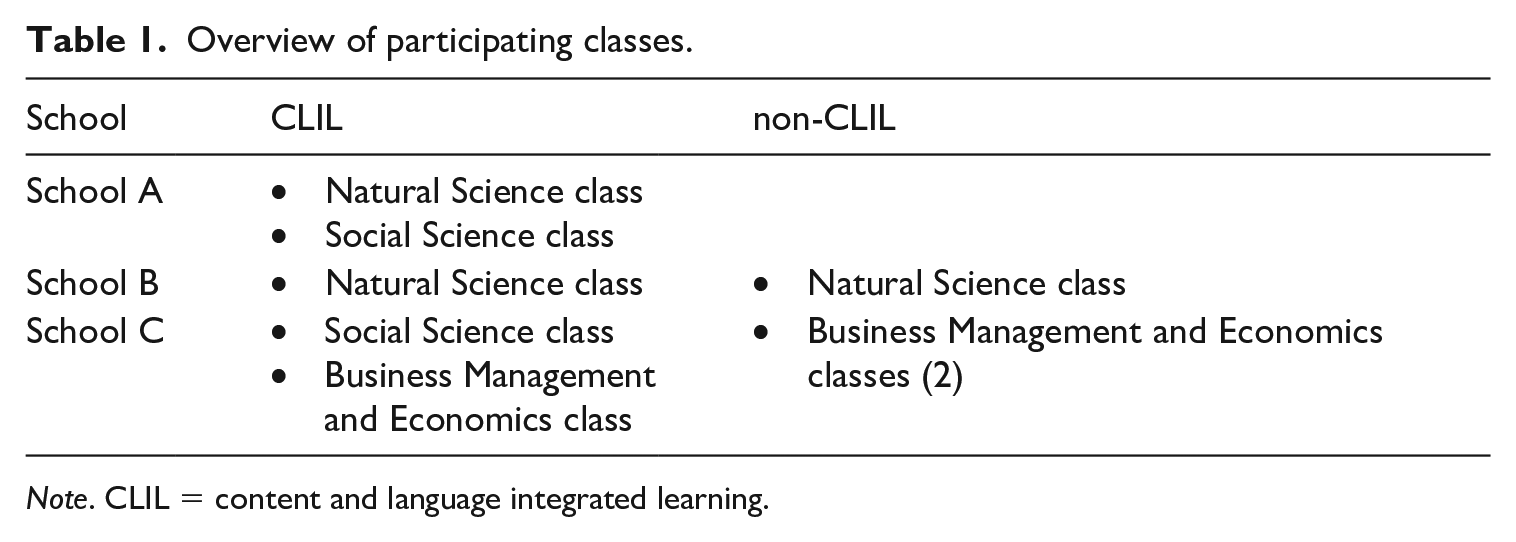
Note. CLIL = content and language integrated learning.
At school A, only CLIL classes participated, as shown in Table 1, since only such programmes were offered there. At the other two schools, both CLIL and non-CLIL classes participated. The CLIL and non-CLIL programmes were all preparatory for higher education, although with different main subjects: Natural Sciences, Social Sciences or Business Management and Economics. However, of relevance for the topics of the writing assignments (see below), all classes studied Social as well as Natural Sciences, but to various extents, depending on the profile of the particular programme. Further, all classes studied English as a foreign language 1 for two to three hours per week. In the CLIL programmes, English was also, to some degree, the language of instruction in various subjects, depending on how CLIL was organized. In non-CLIL programmes, Swedish was generally the language of instruction, except in foreign language classes. Thus, CLIL students encountered English in English language classes as well as in other subject classes, whereas non-CLIL students encountered English at school only in English language classes.
The proportion of students born in Sweden was 98 per cent in the non-CLIL group and 83 per cent in the CLIL group (Apelgren, 2019). The level of education among the CLIL students’ parents was higher than among the non-CLIL students’ parents (Apelgren, 2019). There was no statistically significant difference between CLIL and non-CLIL students’ merit points, 2 when entering upper secondary education (Apelgren, 2018).
2 Method of analysis: CLIL implementation
Information about the schools and their implementation of CLIL was collected during school visits three to five times a year during students’ three years in upper secondary school. During these visits, normally lasting a full school day or two, lessons were observed and informal interviews conducted with students and teachers; field notes were taken.
For the purpose of identifying and describing similarities and differences in the implementation of CLIL at the three schools, the key dimensions, i.e. the operating factors and the scale, as proposed by Coyle et al. (2010, pp. 14-16) and Met (1991, 1998), were explored, with some adaptations to match the aim of the study. The following factors were in focus:
Teacher availability
English fluency/formal language training of teachers
Time available for CLIL instruction
Methods for integrating content and language instruction e.g. embedded or separate language instruction, teacher cooperation across the curriculum
Balance between L1 and L2
Networking outside school
Assessment process – separate or combined assessment of content and language
It was beyond the scope of the study to assess the language proficiency of the teachers in a formal way; the analysis is based on classroom observations and informal interviews. The level of self-reported formal language training among teachers was added here, being of potential relevance for teachers’ capacity to integrate content and language instruction. In the analysis of the methods used for integrating content and language, the aspects of language paid attention to by teachers were noted, and also how language issues were addressed. The balance between English (L2) and Swedish (L1) refers to the language used by teachers and students during lessons, and to the material used, but also to the balance between L1 and L2 across the three years of upper secondary education.
Further, English language classes were observed in CLIL and non-CLIL contexts, as such lessons may be highly relevant to the development of academic vocabulary.
The analysis of CLIL implementation was corroborated by other researchers in the CLISS project who visited the same schools.
3 Method of analysis: productive academic vocabulary
For the analysis of students’ development of productive academic vocabulary in English, student texts, based on four different writing assignments, were collected. In the assignments, distributed over three years, students were asked to write argumentative or expository texts in English, covering topics mainly related to the Natural Sciences and to the Social Sciences. The text types and the topics were chosen for the specific purpose of prompting students to use academic language:
For or against nuclear power (argumentative text, year 1)
Matters of gender and equality (expository text, year 2)
Ways to political and social change – violence or non-violence (expository text, year 2)
Biodiversity for a sustainable society (argumentative text, year 3)
As the first assignment was given during students’ first term in upper secondary school, it provided baseline data, and assignment four, given during the final year, provided exit data. Each instruction included a page or two of background material, such as graphs, pictures and short factual texts about the topic, since the ability to write was in focus rather than content knowledge related to the topics. The texts were written on computers; 90–120 minutes were allowed for each assignment. (For a more detailed description of the assignments and examples of student texts, see Olsson, 2015; Olsson & Sylvén, 2019).
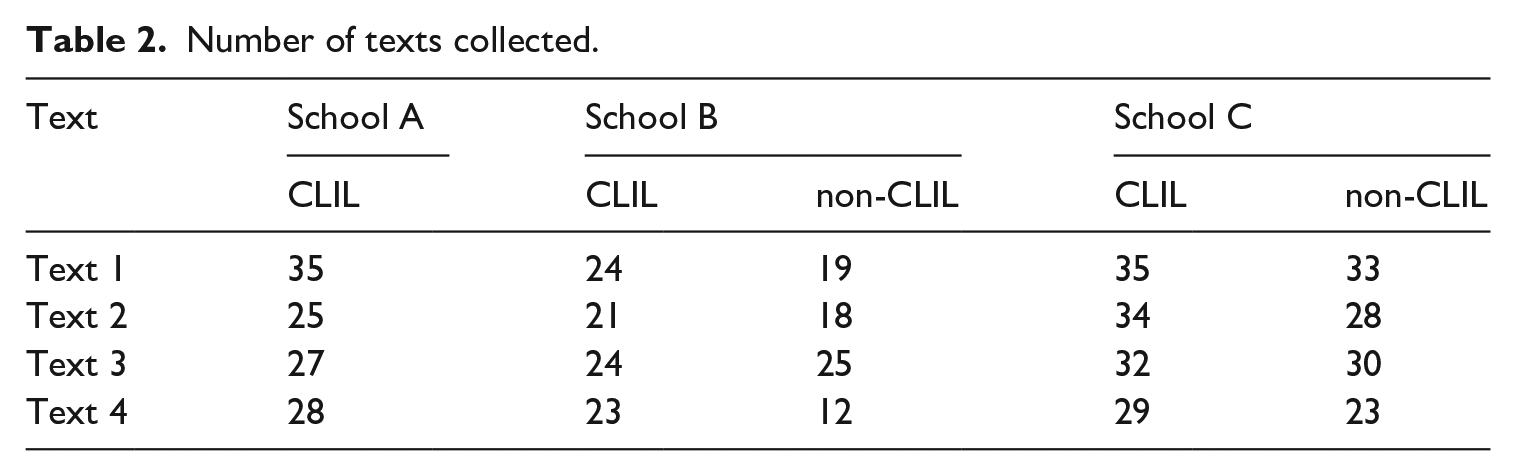
In all, 230 students took part in the study. A few students changed schools in the course of the project, whereas others were absent on some occasion, not completing all four assignments. A total of 525 texts were collected. The number of texts collected on each occasion per school and group (CLIL/non-CLIL) is shown in Table 2.
Number of texts collected.
In the analysis of the texts, general academic vocabulary was in focus, since such vocabulary is useful and necessary for academic language proficiency across various fields of study. The Academic Vocabulary List (AVL; Gardner & Davies, 2014) was used as a standard of reference. In the analysis, the proportion of vocabulary covered by the AVL was noted for each of the students’ texts, using an interface available at http://www.wordandphrase.info/academic. The calculation was based on tokens, i.e. each word was counted every time it occurred. The number of academic tokens was divided by the total number of tokens in the text.
When comparing the proportion of academic vocabulary in the texts, the student population was grouped in different ways to allow for different types of statistical analyses. Initially, students were divided into five groups: CLIL groups at schools A, B and C, and non-CLIL groups at schools B and C (see Table 2) . This grouping allowed for comparisons between all groups, e.g. between CLIL and non-CLIL groups at the same school. However, there was no non-CLIL group at school A.
In the next step of the analysis, the two non-CLIL groups were merged into one so as to enable comparisons between each CLIL group and one and the same non-CLIL group (see Figure 1). Comparisons were also made between the three CLIL groups to find out if any of them had a stronger development of academic vocabulary than the others.
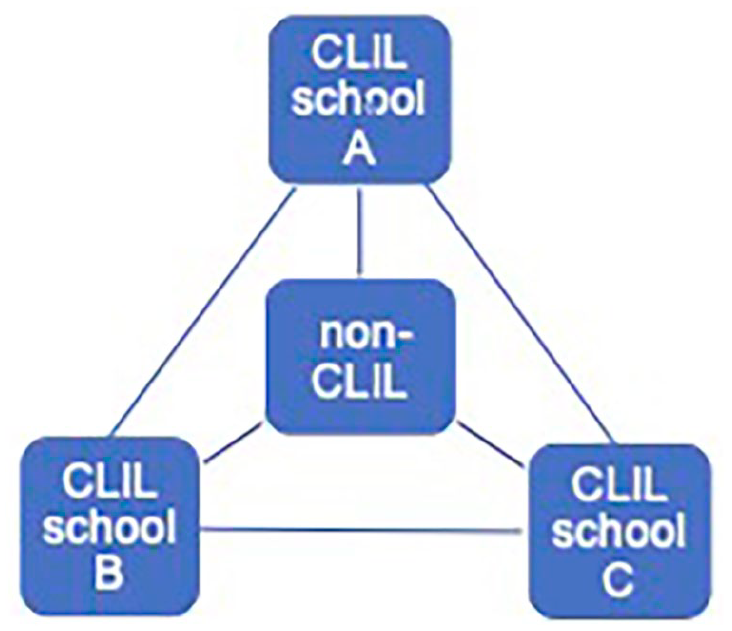
Model showing how groups were compared.
SPSS version 25 was used for the statistical analyses. First, the average proportion of academic vocabulary in each of the four assignments was calculated for the five groups. Then an analysis of variance (ANOVA) with Tukey’s post hoc comparisons was conducted to explore if there were any statistically significant differences in scores between the five groups in each of the assignments. Further, paired samples T-tests were performed to find out whether the scores had increased in a significant way within each of the five groups between the first and the last assignment. Finally, a univariate analysis of covariance (ANCOVA) was conducted to determine if any of the groups had a significantly stronger development between the first and the last assignment than other groups, when initial differences were controlled for. In this analysis, comparisons were made between the three CLIL groups and between each of them and the merged non-CLIL group. Further, the effect size, Cohen’s d (Cohen, 2013) was calculated when significant within- or between-group differences were identified in the ANOVA, the paired sample T-tests and the ANCOVA.
IV Results
First, the analysis of the CLIL implementation at the three schools is presented followed by the analysis of productive academic vocabulary.
1 CLIL implementation at the three schools
In Table 3, an overview of the CLIL implementation at the schools is offered, based on the framework proposed by Coyle et al. (2010) and Met (1991, 1998).
Overview of CLIL implementation at schools A, B and C.
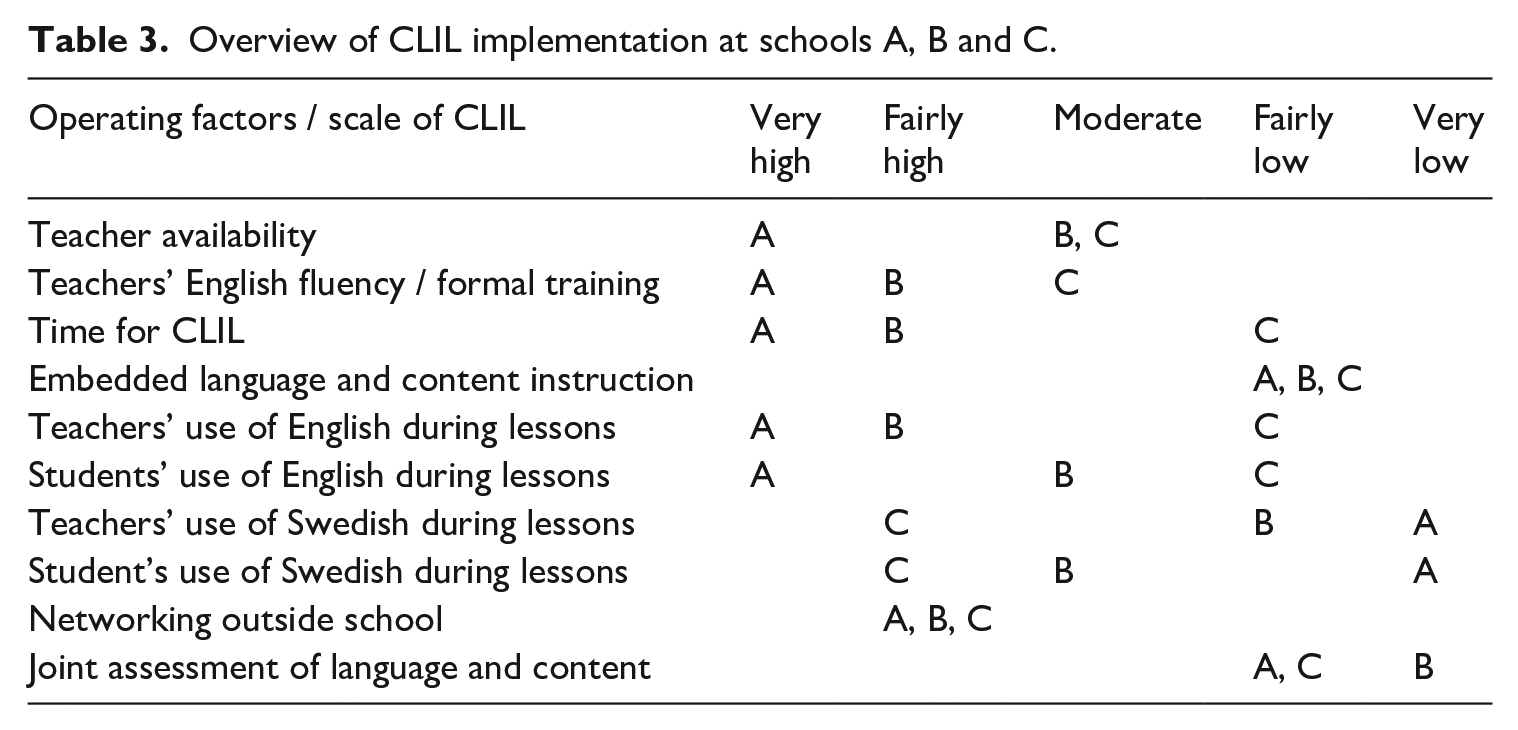
The overview in Table 3 indicates that there were substantial differences in the way CLIL was implemented at the three schools. The scale of CLIL was more extensive at school A than at schools B and C. At school A, English was the language of instruction during most lessons and Swedish was rarely used. At schools B and C, both English and Swedish were languages of instruction, although English was used to a greater extent at school B than at school C. School C represents the least extensive CLIL model of the three, with less time being allotted for CLIL. The overview in Table 3 also reveals that L2 instruction was embedded into content instruction only to a limited extent at the three schools. Another similarity is that all three CLIL programmes were engaged in some kind of networking outside school, such as school exchange programmes with other countries. Furthermore, content and language knowledge were generally regarded as separate issues in assessment practices (see Reierstam & Sylvén, 2019).
In the following sections, the characteristic CLIL features of the three schools are described in greater detail. Some attention is also paid to the English language lessons in CLIL and non-CLIL groups.
a School A
School A, situated in one of Sweden’s largest cities, defines itself as an international school; approximately 25 per cent of the students had a multilingual background. The multilingual students’ L1 included e.g. Arabic, Hebrew, Macedonian, Mandarin, Syrian and Tagalog (Apelgren, 2019; Sylvén, 2019).
English was the language of instruction in all subjects, apart from Swedish and foreign languages. Also, schoolbooks and other material were in English. Since the school is located in a large university city, recruiting qualified teachers with a high proficiency in English is facilitated. Some of the teachers were native speakers of English, among them the English language teachers. The other teachers also spoke English with ease and fluency; some of them had lived in an English-speaking country.
During lessons, subject teachers pointed out and explained subject-relevant vocabulary and concepts, mentioning synonyms or rephrasing in English. Other aspects of language use were not addressed by non-language teachers. All tasks and assignments were in English, which was generally the language of communication between students as well. Student presentations in front of the class were common in many subjects. Outside the classroom, in the corridors, English was often heard during breaks, as was Swedish.
Sometimes teachers cooperated across the curriculum. For instance, English language teachers could support students’ preparation of oral or written presentations in various subjects. On such occasions, the English teacher would bring up relevant vocabulary and useful grammar for the task.
In English language classes, great attention was paid to the specific features of different genres. Students were often given tasks where they would practise different types of writing and speaking, such as writing an argumentative text in English or making a convincing oral presentation.
b School B
School B is located in an average-sized town in the northern part of Sweden. The CLIL programme was offered alongside a large number of regular programmes, with instruction mainly conducted in Swedish. A group of teachers who had initiated the CLIL programme in the 1990s were still working at the school. Recruitment of new subject teachers comfortable with teaching in English had occasionally been difficult and some teachers in the regular programmes expressed a reluctance to teach in English. Thus, only a limited group of teachers were available for the CLIL programme; on the other hand, they shared similar views on how CLIL should be implemented. Many of the CLIL teachers also taught in non-CLIL programmes as the number of CLIL classes was limited.
None of the teachers was a native speaker of English. Apart from the English teachers, a Science teacher had lived in an English-speaking country for a period of time and studied English at university level. Some of the CLIL teachers had completed short language courses in English-speaking countries and a large majority of them expressed confidence in using English. A small number of teachers reported that they found it difficult to teach in English, but had found ways of managing, e.g. by using teaching materials in English, such as films and printed material.
At school B, a clear plan for CLIL implementation was communicated, stipulating a limited use of English during the initial part of the first year in upper secondary school, followed by a growing proportion of English in year two. In this way, students would get acquainted with each other, the new school and the basics of the school subjects under favourable conditions, and English would be introduced gradually. In year three, lessons were often conducted exclusively in English.
During lessons, expressions and concepts required for the comprehension of the subject matter were highlighted, and sometimes Swedish equivalents were given. Other aspects of language use, however, were not usually addressed by non-language teachers. Students often worked in pairs or groups with tasks where they were free to use English or Swedish in the first year; later on, English was used to a greater extent. Books and other material were both in English and Swedish, i.e. students had two books per subject. Some students explained that they read the English texts first and, if they did not fully understand them, they consulted the Swedish book. There was no regular cooperation between English language teachers and other subject teachers, and assessments of language and subject content knowledge were separated.
The content of the English language lessons was similar for CLIL and non-CLIL groups. For instance, grammar was studied and the students practised reading, discussing and writing texts of various genres. No special attention was paid to language use in other school subjects.
c School C
At School C, located in an average-sized town in western Sweden, CLIL programmes were offered alongside several regular programmes where Swedish was the language of instruction. As at school B, a small group of teachers who had initiated CLIL were still working there, but it was sometimes difficult to recruit new teachers willing and able to teach in English. Most of the CLIL teachers taught in non-CLIL programmes as well. None of the CLIL teachers were native speakers of English but a few of them had an English-speaking family member (e.g. through marriage). Non-language teachers’ formal training in English varied, but was, on average, at a somewhat lower level than at the other two schools.
The time available for CLIL was limited at school C, mainly for practical reasons. Some subjects were optional and students could choose from among a large number of courses. It would be too expensive for the school to organize CLIL groups in each optional course, and so both CLIL and non-CLIL students attended the same optional classes conducted in Swedish.
In compulsory subjects, both Swedish and English schoolbooks were provided in many subjects, and both Swedish and English were languages of instruction, although to varying extents. Some teachers spoke Swedish all or most of the time, adding tasks in English, for instance a worksheet comparing English and Swedish expressions. However, a few times a week, e.g. in history and religion classes, English was the main language of instruction. During these lessons, the teacher often gave an introductory lecture in English, supported by a PowerPoint presentation highlighting important concepts, and followed up by a task for the students, e.g. to write an essay in English.
Sometimes the CLIL teachers worked together, planning cross-curricular tasks for a limited period of time. For instance, the English teacher and the social science teacher planned a task where groups of students chose and prepared news presentations in English. The teachers also set up common goals and criteria for the assessment of the task. Otherwise, language and subject content were assessed separately.
The English language teacher of non-CLIL groups often used authentic material, such as radio programmes in English about economy, and then continuing to base several lessons on these programmes, adding a variety of tasks. Thus, the kinds of methods often used in CLIL were also employed in the English language classes of non-CLIL groups.
In summary, the analyses revealed that there were great differences in the way CLIL was implemented at the three schools, not least concerning the balance between English and Swedish as languages of instruction, as well as the time allotted for CLIL. School A represents the most extensive type of CLIL, whereas schools B and C represent partial CLIL. At school C, however, the use of English was very limited. It was also shown that, beyond vocabulary, little attention was paid to language in non-language subjects.
2 Development of productive academic vocabulary
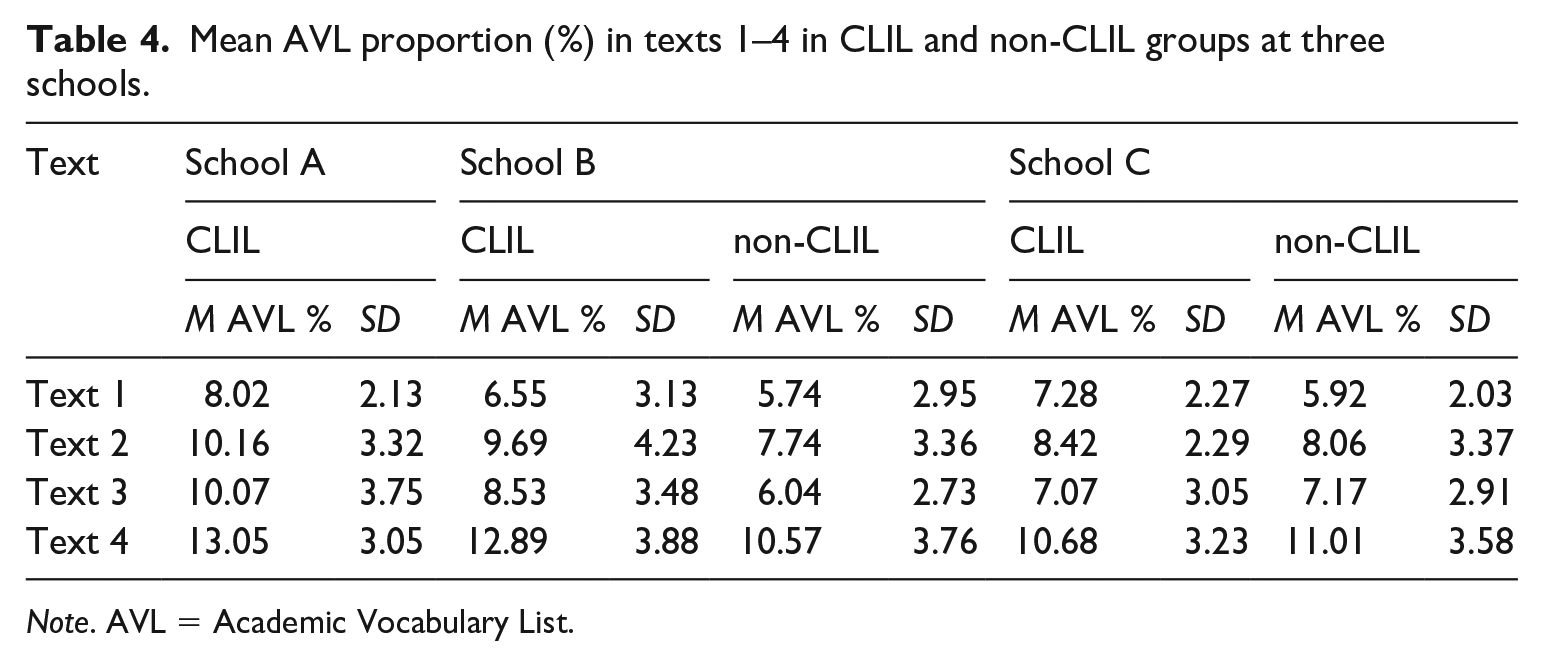
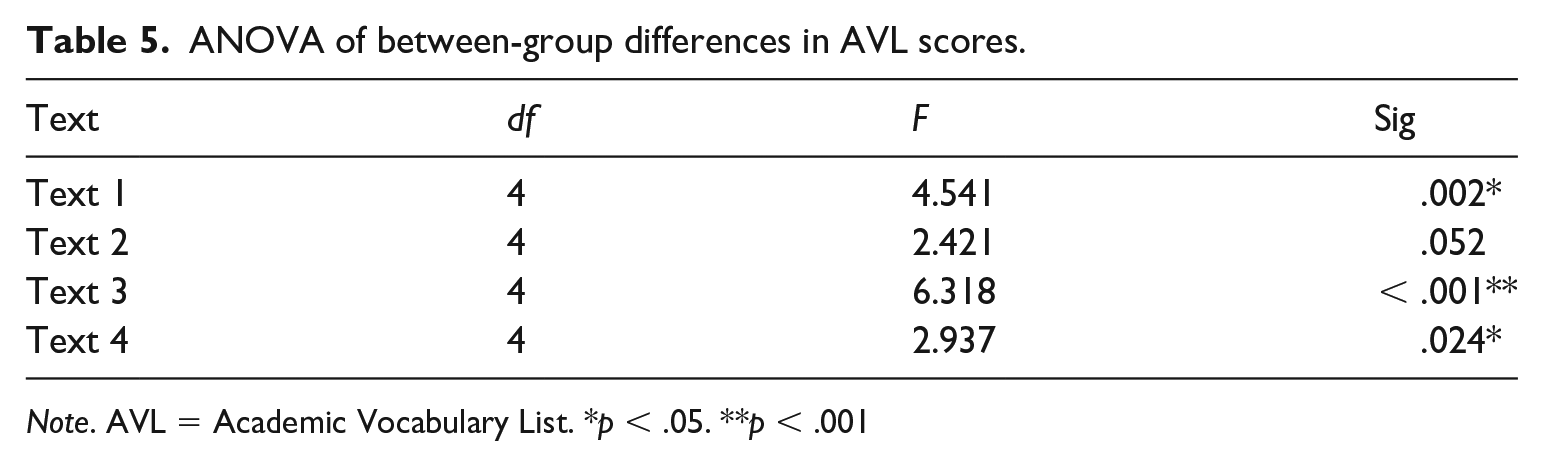
This section accounts for the development of productive academic vocabulary among CLIL and non-CLIL groups at the three schools. The analysis is based on the proportion of academic vocabulary, i.e. vocabulary covered by the AVL (Gardner & Davies, 2014), in four writing assignments over a period of three years (see Section III). In Figure 2, a visual overview is offered, illustrating the progress of academic vocabulary in each of the five groups, i.e. the CLIL groups at schools A, B and C, and the non-CLIL groups at schools B and C. In Table 4, the average proportion of academic vocabulary in each assignment is shown per group. Table 5 presents the results of an ANOVA, indicating whether between-group differences in the proportion of academic vocabulary are statistically significant in any of the assignments.
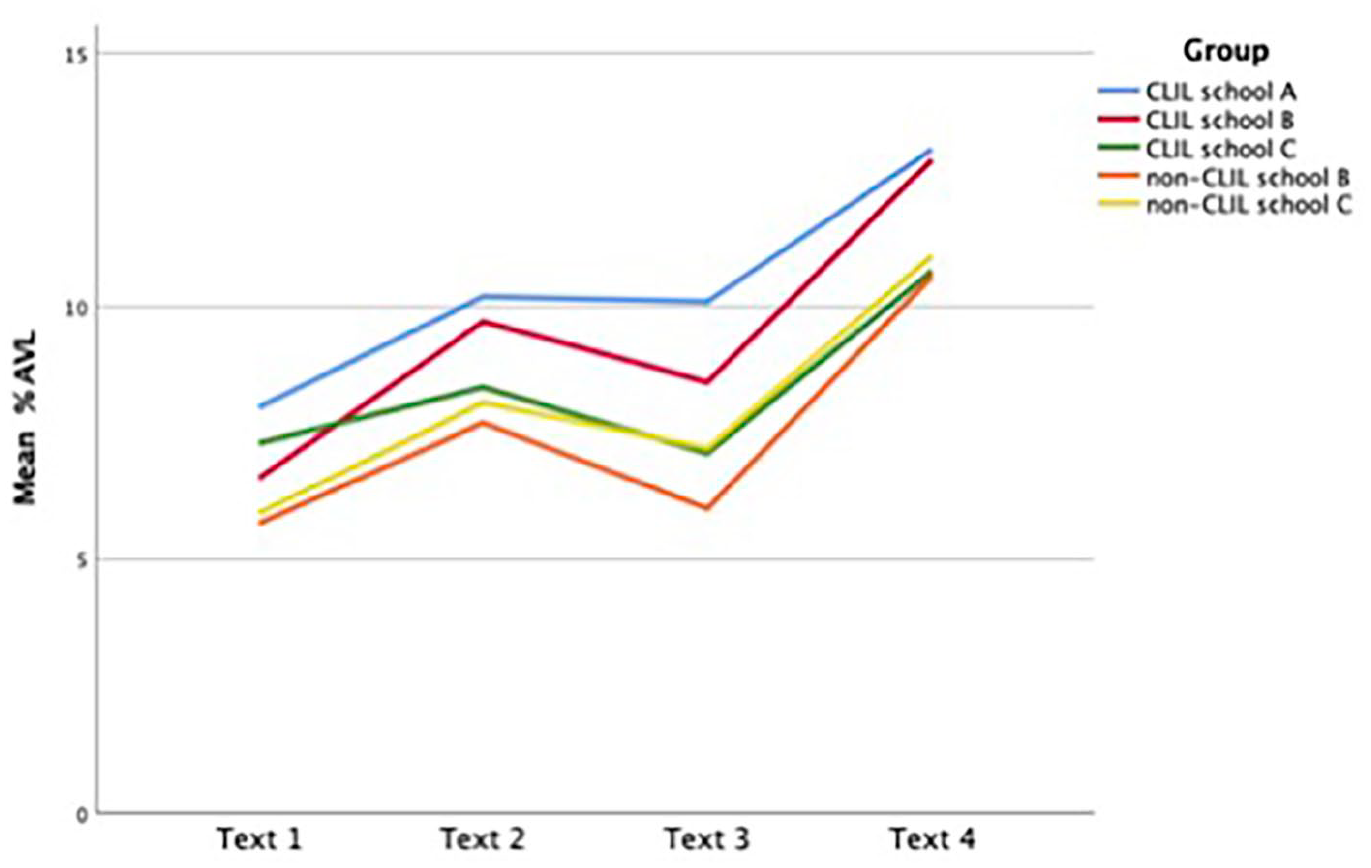
Development of academic vocabulary in CLIL and non-CLIL groups at three schools.
Mean AVL proportion (%) in texts 1–4 in CLIL and non-CLIL groups at three schools.
Note. AVL = Academic Vocabulary List.
ANOVA of between-group differences in AVL scores.
Note. AVL = Academic Vocabulary List. *p < .05. **p < .001
Figure 2 and Table 4 show that the average proportion of academic vocabulary was highest in the CLIL group at school A, in all four assignments, and that the CLIL group at school B also scored higher than the non-CLIL groups in all assignments. The initial difference between the CLIL and the non-CLIL group at school C was no longer present in the last two assignments. The ANOVA, comparing the AVL scores for each of the assignments between the five groups, revealed that there were statistically significant differences between groups in all assignments except in the second assignment, where borderline significance was indicated (see Table 5). A post hoc analysis indicated that the CLIL group at school A included a significantly larger proportion of academic vocabulary in the first and the third assignments than the non-CLIL groups at school B (text 1: p < .012, d = .89; text 3: p < .001, d = 1.23,) and school C (text 1: p < .005, d = 1.01; text 3: p < .007, d = .86). Also, the CLIL group at school A scored significantly higher than the CLIL group at school C in the third assignment (p < .004, d = .88). Other differences between groups were not statistically significant.
Further, Figure 2 and Table 4 indicate a dip in the proportion of academic vocabulary in the third assignment; possible reasons for this dip will be considered in Section V. Overall, however, the tendency between the first and the last assignments is clear; a larger proportion of academic vocabulary was included in the texts written in the final year. Paired samples tests within each of the five groups, comparing the proportion of academic vocabulary in text 1 and text 4, show that the increase was statistically significant in all groups (CLIL school A: p < .001, d = 1.33; CLIL school B: p < .001, d = 2.53; CLIL school C: p < .001, d = .87; non-CLIL school B: p < .05, d = 1.12; non-CLIL school C: p < .001, d = 1.81 ). The greatest within-group progression, indicated by the effect size (d), was found in the CLIL group at school B.
The next stage of the analysis explored if the increase in academic vocabulary was stronger in any of the CLIL groups than in the others, and if any of the CLIL groups progressed more than the non-CLIL group. In this part of the analysis, the two non-CLIL groups were merged into one to allow for comparison between the three CLIL groups and one and the same non-CLIL group (see Figure 1). A univariate analysis of covariance was conducted, controlling for initial differences between groups. The results showed that the CLIL group at school B progressed significantly more than the CLIL group at school C (p < .015, d = .70) and the merged non-CLIL group (p < .045, d = .56). No other statistically significant differences in progression were found between groups. The effect size, i.e. the progression in the CLIL group at school B compared to the progression in the other two groups, is of medium strength.
Summing up, the statistical analysis of academic vocabulary in students’ texts showed that there were initial differences in the proportion of academic vocabulary, where the texts written by the CLIL group at school A included a significantly larger proportion of such vocabulary than the texts written by the two non-CLIL groups and those written by the CLIL group at school C. The results also revealed that all groups increased the proportion of academic vocabulary to a statistically significant degree between the first and the last writing assignment. A comparison of the progression between groups, controlling for initial differences, showed that the development was significantly stronger in the CLIL group at school B than in the CLIL group at school C and the merged non-CLIL group. Thus, the results indicated that the CLIL group at school B had the most positive development of productive academic vocabulary.
V Discussion
The results reveal substantial between-school differences in CLIL implementation and in students’ progression of productive academic vocabulary. There are, however, some limitations of the study that must be acknowledged. Only three schools participated and hence, CLIL implementation at these schools should merely be regarded as examples of CLIL in the Swedish context. There may, of course, be other ways of implementing CLIL in Sweden and elsewhere. Yet, the CLIL profiles that emerged in the present study mirror the three broad categories of CLIL schools that were identified in Yoxsimer Paulsrud’s (2014, 2019a) survey among Swedish upper secondary schools (see Section II.2). Further, only the students’ English texts, not their Swedish texts, were included in the study. The analysis of the texts was limited to academic vocabulary as it was beyond the scope of this study to include other, perhaps equally important aspects of academic literacy. In the analysis, the 230 students were divided into four or five groups, depending on the purpose of the analysis. When interpreting the results, the limited size of the groups must be considered.
Moreover, different writing assignments may elicit academic vocabulary to a greater or lesser extent. Therefore, changes in vocabulary scores may not only be attributed to vocabulary growth, but also, to a certain extent, to the nature of the task. There was, for instance, a dip in the scores in assignment three. The topic – arguments for or against violence as a way to political change – may have been particularly difficult for the students since the background material consisted of photos of various advocates for political change, such as Gandhi, but without adding any additional facts about them. The other assignments included background material, e.g. short factual texts and graphs. Thus, the third assignment was not scaffolded to the same extent with regard to topic content, possibly affecting vocabulary use. Nevertheless, since four assignments were given, a clear tendency in the development of academic vocabulary was indicated over three years.
The results show that there may be great differences in CLIL implementation between schools in the same country. The framework suggested by Coyle, Hood and Marsh (2010) was a useful instrument for describing and defining CLIL at the three schools involved in the study. The analysis of the operating factors and the conditions under which CLIL was implemented indicated that many different circumstances contributed to the specific types of CLIL that emerged. The scale of CLIL, e.g. the number of subjects and the time allotted for CLIL, varied between the three schools, as did the balance between Swedish and English as languages of instruction. School A represents an extensive version of CLIL, where students encountered and used English during all lessons except foreign and Swedish language classes. CLIL implementation at schools B and C could be defined as partial, both Swedish and English being used as languages of instruction. There were, however, great differences between the two schools’ organization of CLIL and in their balance between L1 and L2. At school B, the proportion of English increased steadily over the three years; in the third year, English dominated as the language of instruction. At school C, by contrast, the proportion of English was limited throughout the period.
The analysis of academic vocabulary in students’ texts showed that even in the first writing assignment, when they had just started off on the CLIL programme, CLIL students, at school A in particular, included a larger proportion of English academic vocabulary than did non-CLIL students. CLIL students were also at an advantage from the start when results from Vocabulary Levels Tests (VLT; Nation, 2001) were compared (Sylvén & Ohlander, 2014, 2019). It may be assumed that students would not choose a CLIL programme if they were not already quite proficient in English; the results support this assumption (see Thompson & Sylvén, 2019; Yoxsimer Paulsrud, 2019b).
It is not, however, at school A, where English was the main language of instruction, that the strongest progression is noted, but in the CLIL group at school B. Thus, in line with findings from earlier studies (e.g. de Graaff et al., 2007; Genesee & Lindholm-Leary, 2013), the results suggest that not only the amount of English input is of importance for the development of academic language proficiency. It should, however, be pointed out that the CLIL group at school A scored high already on the first assignment, possibly making it more difficult to increase the proportion of academic vocabulary from an already high level.
The greatest progression was found among students in the CLIL programme at school B, where both Swedish and English were languages of instruction, used in a strategic and purposeful way to enhance subject content knowledge and academic language proficiency in both languages. When lecturing in English, the teachers would give Swedish equivalents to important concepts and when they knew from experience that certain content was complex, the support in Swedish was increased, e.g. by providing material in both languages. Further, the students were allowed to use Swedish in communication with the teacher or their peers, in contrast to school A, where Swedish was avoided as it was an international school. Swain and Lapkin (2013) argue that students in immersion programmes should be allowed to use their L1 when collaborating to facilitate understanding of the subjects studied. They also stress the importance of a secure classroom environment, where students can interact using the L2 with confidence, pointing out that teachers’ use of the L1 should be purposeful, not random. The version of CLIL implemented at school B corresponds well with the views put forward by Swain and Lapkin, and it seems to have been successful with regard to students’ development of productive academic vocabulary in English.
Turning to school C, a strategic use of Swedish and English could be identified during certain lessons, but quite often, Swedish was the only or the main language of instruction. The limited scale of CLIL was to a large extent a consequence of the limited access to teachers confident in teaching in English; hence, fewer lessons were conducted in English here than at the other schools. There were other practical impediments as well, e.g. that CLIL and non-CLIL students had to be merged into one group in certain classes where Swedish was the language of instruction. However, rich target language input is a fundamental idea in CLIL and, as pointed out by Nikula (2010), Lim Falk (2008) and Dalton-Puffer (2007, 2011), CLIL teachers who are not confident L2 speakers may resort to simplified language; further, classroom interaction may suffer. On the other hand, some of the teachers in the present study had developed strategies enabling them to teach in the CLIL programme even if they, themselves, were reluctant to speak English. Authentic video or printed material in English could, of course, provide linguistically rich input beneficial for students’ language development. Still, it should be noted that the CLIL group at school C, where the use of English was very limited, had a less favourable development of academic vocabulary than the CLIL group at school B, where English was used to a greater extent.
Further, the similarity in scores between CLIL and non-CLIL groups at school C calls for reflection. Apart from limited opportunities for the CLIL students to encounter and use English at school, the English language lessons in the non-CLIL group were, for periods of weeks, based on authentic material, such as radio programmes and newspaper articles related to Economics and Business. Thus, the English lessons for non-CLIL groups were quite similar to CLIL lessons, which may to some extent explain the similarity in development.
However, it should be noted that all groups, CLIL as well as non-CLIL, increased the proportion of academic vocabulary in a statistically significant way between the first writing assignment in year one and the last one in year three. The results indicate that the version of CLIL represented by school B was the most beneficial for students’ progression in academic vocabulary but it must be remembered that conditions may vary between contexts. When a school is open to international students, English is often the main language of instruction for practical reasons, as at school A. At other schools, where the number of teachers able and willing to teach in the L2 is limited, a partial CLIL programme may be manageable, as at school C. It could be argued that if students do not perform better in a CLIL programme than in a non-CLIL programme, as was the case at school C, why offer a CLIL programme at all? The strongest argument for CLIL in such cases is probably related to motivation, as research has shown that CLIL students are often highly motivated (Thompson & Sylvén, 2019; Yoxsimer Paulsrud, 2019b). Mearns, de Graaff and Coyle (2020) point out that CLIL students are often highly motivated already when they begin CLIL education; they found little evidence that CLIL education in itself generated motivation (see also Rumlich, 2017). However, we do not know how CLIL students’ motivation would develop without the opportunity to enter a CLIL programme. Several CLIL students involved in the present study expressed the view that school was more interesting because they studied school subjects in English (Olsson & Sylvén, 2018).
Yet, the language focus in CLIL classrooms was often quite limited. When CLIL teachers focused on language, it was mainly subject-specific vocabulary and concepts that were highlighted. Apart from that, CLIL teachers of non-language subjects paid little attention to other aspects of language (see Lyster, 2007). It has been argued, e.g. by Schleppegrell (2004), Gibbons (2002) and Ballinger, Lyster, Sterzuk and Genesee (2017), that it is necessary to scaffold language when teaching school subjects, especially in L2 contexts. Even so, it would probably be difficult for many non-language teachers to focus on different aspects of language, since their teacher training does not, in general, attend to the role of language in different subjects, or to methods for integrating content and language teaching (see, for example, Aalto, 2019). According to Oattes, Oostdam, de Graaff and Wilschut (2018), the responsibility to ensure L2 development among students may be perceived as a challenge and even a burden among non-language subject teachers. This seems to have been the case among some teachers in the present study, as they avoided using English. Yet, most teachers expressed confidence in using English as the language of instruction. It seems reasonable that teachers should have a functional level of language proficiency in the language of instruction.
VI Concluding remarks
It is necessary for all teachers, regardless of subject, to be aware of the role of language in learning and of methods for addressing language when teaching, especially in bi- or multilingual classrooms. Initiatives for including such training in teacher education and through in-service training are called for, not only from the horizon of CLIL education. Since CLIL aims at improving L2 proficiency among students to a larger extent than in regular education, it is of great relevance to continue to evaluate learning outcomes in different kinds of CLIL contexts and to initiate and monitor the effects of CLIL teacher training.
The results of the present study among CLIL and non-CLIL students at three upper secondary schools revealed differences in CLIL students’ progression in L2 academic vocabulary that could be attributed to substantial differences in CLIL implementation. The greatest progression was found among students in the CLIL programme where both Swedish and English were languages of instruction, used strategically to enhance subject content knowledge and academic language proficiency in both languages. It is hoped that the insights gained in the study may be valuable in future planning of CLIL education.
Footnotes
Funding
The author disclosed receipt of the following financial support for the research, authorship, and/or publication of this article: The data was collected as part of a large-scale research project Content and Language Integration in Swedish Schools, CLISS, funded by the Swedish Research Council (grant 2010-5376).
