




Abstract
As an effective teaching approach that allows teachers and students to interact collaboratively and actively build on each other’s ideas, dialogic teaching can enhance classroom engagement and learning outcomes. This study addresses the use of dialogic teaching for improving English language learning among Chinese children with varied levels of English vocabulary. It focuses on the effects of dialogic teaching on vocabulary knowledge and phonological awareness. Seventy-two first graders from Hong Kong primary schools were tested on English vocabulary knowledge and phonological awareness and were assigned to control and experimental conditions. A 12-week dialogic teaching intervention was implemented in daily English lessons. Results from repeated measures ANOVA showed that students in the experimental condition with dialogic teaching implemented exhibited significantly greater growth in expressive vocabulary knowledge on textbook items in both low and high vocabulary groups, and greater gain in phonological awareness in the high vocabulary group, than those in the control condition. These results suggest that dialogic teaching in English-as-a-second-language (ESL) classroom enhances English language development in young ESL learners. In addition, when assessing the effectiveness of dialogic teaching in young children’s second language classroom context, it is important to consider its differential effects on children with diverse vocabulary levels.
Keywords
I Introduction
Teacher–student dialogue is central to language teaching because it not only functions as a linguistic exchange between teacher and students but also creates a community of speakers and listeners who use the target language purposefully. For most young language learners in the Asia-Pacific region, classroom interaction is one of the primary means by which they acquire early competencies to develop target language skills such as vocabulary knowledge and phonological awareness (Gonzalez et al., 2014, 2016; Spencer et al., 2015). Past research has found that dialogic teaching – an effective teaching approach that allows teachers and students to interact collaboratively and actively build on each other’s ideas – can increase classroom engagement and enhance children’s language development (Alexander, 2008; Hammond & Gibbons, 2005; Haneda & Wells, 2008). However, it is unclear whether dialogic teaching influences language learning differently in learners with varied levels of language skills. Young language learners are a heterogeneous group with different levels of language proficiency (Humes-Bartlo, 1989). In this light, investigating the factors underlying language development in children of different ability levels can offer insight into their cognitive profiles and learning needs (Carretti et al., 2016).
For the purpose of facilitating learning of English as a second language (ESL), this study investigates the effects of dialogic teaching on English vocabulary knowledge and phonological awareness among Chinese children with varied levels of vocabulary knowledge. This study extends past research from two perspectives. First, this research is one of the few studies that examine the effectiveness of dialogic teaching among young ESL learners. Second, this study investigates the effects of dialogic teaching on language development in learners with different vocabulary abilities. Findings from this study can improve our understanding of the effectiveness of dialogic teaching on young learners with diverse language ability levels in classroom settings.
II Literature review
1 Dialogic teaching
Dialogic teaching is a pedagogical approach that allows teachers and students to interact collaboratively and build on each other’s ideas to improve learning outcomes (Hennessy et al., 2011). It focuses on pinpointing the dialogic processes wherein both teachers and students act as inquirers in dialogic exchanges during classroom instruction (Haneda & Wells, 2008; Lyle, 2008). In contrast, in traditional didactic teaching, teachers tend to disseminate information while students act as passive receivers of knowledge with limited participation in classroom dialogues (Alexander, 2008; Hennessy, 2017; Lee, 2016; Skidmore, 2006; Wells, 1999a, 1999b). By integrating dialogic teaching in the curriculum, both teachers and children can participate in the co-construction of curriculum knowledge in the target language. Thus, students and teachers work collaboratively to co-construct meanings over successive utterances to achieve teaching and learning goals. In this way, students are likely to encounter varied perspectives on a topic under discussion (Haneda & Wells, 2013).
Dialogic reading has been shown to be an effective dialogic teaching approach in facilitating children’s language development (e.g. Hargrave & Sénéchal, 2000). Dialogic reading is an adult–child reading technique that encourages the child to speak and use increasingly sophisticated language with support from adults (Whitehurst et al., 1988; Zevenbergen & Whitehurst, 2003). The principal technique of dialogic reading is the PEER sequence (prompt, evaluate, expand, and repeat) and the CROWD question design structure (completion, recall, open-ended, wh-, and distancing), which encourages the use of different question types to prompt students’ participation. For example, in language teaching, the PEER strategy starts with a teacher prompting students to use the target language to describe a picture using one of the CROWD questions. The teacher then evaluates the students’ responses, providing positive and constructive feedback. The teacher also expands on the initial response of students by adding extra linguistic components, such as vocabulary or phrases to enrich the students’ responses. Finally, the teacher asks students to repeat the expanded utterances. This dialogic approach improves the oral language skills of students in a natural and unobtrusive manner, turning them into active speakers and users (Chow et al., 2010). It provides a motivating context for children to learn word meanings effectively through extended illustrations, further clarification, repetition and reference over time, and multiple exposures to new vocabulary (Wasik et al., 2016). Similar to other approaches like Instructional Conversations and Academic Conversations, dialogic reading encourages students’ involvement. These approaches encourage teachers to actively prompt students’ contribution in the dialogue, which is guided by the students’ responses to teacher’s questions. However, compared to Instructional Conversations and Academic Conversations, dialogic reading is more systematic with its PEER sequence and the CROWD question design structure. In the PEER sequence, repetition ensures that the students understand and have a chance to practice the responses which the teacher have evaluated and expanded on. These are important in helping teachers to pursue the learning objectives.
The feasibility of combining dialogic reading with other types of strategies in language instruction has been demonstrated in previous research (e.g. Chow et al., 2008; Landry et al., 2017; Sim et al., 2014). In the present study, the addition of creative literacy activities to dialogic reading aims to promote children’s creative use of second language vocabulary. Such creative activities mainly include using creative learning materials as stimuli to generate novel and interesting teacher–student interactions (Chow et al., 2018). Creative activities allow children to critique, embellish, and develop their ideas through active classroom interaction (Hallam et al., 2011; Mayesky, 2014). Studies on language education show that a classroom context with planned creative activities can generate a dialogic context that enables children to produce novel and creative utterances (Chow et al., 2018; Hui et al., 2013). For instance, a creative activity may encourage students to imagine an ideal fictional place or situation and use the target language to describe it, providing a stimulus that may prompt a large volume of novel responses from students (Chow et al., 2018).
2 Effects of dialogic teaching on language learning
Past research has identified several key benefits of dialogic teaching in facilitating the language development of children. First, dialogic teaching provides impactful scaffolding through diverse forms of semiotic mediation to help enhance children’s language competence and develop new linguistic resources (Hammond & Gibbons, 2005; Jones, 2010; Klingelhofer & Schleppegrell, 2016). Second, dialogic teaching equips teachers with rich metalanguage to raise the linguistic awareness of students, affords opportunities for students to engage with texts in the target language, and maximizes their roles to explore meaning (Schleppegrell, 2013; Schleppegrell & Moore, 2018). Third, dialogic teaching can improve teacher–student communication by facilitating interactive exchanges, during which students can obtain more opportunities to develop their cognitive skills within their zone of proximal development (ZPD) (Alexander, 2008; Kinginger, 2002; Wells, 1999a). Fourth, dialogic teaching allows teachers to use creative activities to facilitate production of creative discourse in students (Cremin, 2009; Kremer, 2016).
Dialogic teaching is known to have positive effects on vocabulary acquisition among young children (e.g. Cabell et al., 2015; Lowman et al., 2018; Wasik & Hindman, 2014). A study conducted by Wasik and Hindman (2014) evaluated an intervention program called ExCELL, in which teachers were encouraged to use dialogic reading as the key instructional approach to teach language and literacy to a group of young children, the majority of whom were native English-speaking. The results showed that children in the dialogic reading intervention program significantly outpaced their counterparts in typical reading settings in vocabulary gains. Wasik and Hindman (2014) explained that the greater vocabulary gains were associated with increased teacher talk about the target vocabulary. Another study conducted by Gonzalez et al. (2014) pointed out that the types of dialogic reading activities played an important role. They found that extra-textual talk brought about deeper processing of the target vocabulary as compared with text-focused talk in ESL learning. In addition, a study conducted by Petchprasert (2014) on the effectiveness of a home-based dialogic reading among Thai ESL learners found that dialogic reading was useful for promoting children’s English lexical learning, as it allowed children to act as storytellers as well as masters of their own learning such that their motivation and autonomy of ESL learning increased after the intervention.
While more is known about the impact of dialogic teaching on vocabulary knowledge, relatively little is understood about its influence on phonological awareness. Mixed findings have been obtained. For instance, Whitehurst et al. (1994) found that a program with dialogic reading and sound-and-letter-awareness training did not facilitate children’s phonological skills. However, the majority of participating children in this study were from families with English as the spoken language at home. Another study conducted on a sample of largely African Americans in the U.S. found a positive effect for dialogic reading on phonological awareness skills following a 12-week dialogic reading intervention (Lonigan et al., 1999). Elmonayer (2013) also found that dialogic reading promoted Egyptian children’s phonological awareness in learning Arabic as the first language. In addition, Chow et al. (2010) reported an increase in Chinese ESL children’s phonological skills following a home-based dialogic reading program. Vocabulary knowledge and phonological awareness are two significant indicators of children’s language ability (Lipka & Siegel, 2012; Morgan & Meier, 2008; Tong & Deacon, 2017; Walter, 2008). Therefore, it is important for this study to examine the effects of dialogic teaching on both vocabulary knowledge and phonological awareness in ESL children.
3 Chinese ESL learners
Although existing research presents evidence for the effectiveness of dialogic teaching, the effects of dialogic teaching could vary due to contextual, cultural, and institutional factors (Haneda, 2017). Intervention research on dialogic teaching in second language teaching contexts remains limited, especially its application in classroom settings. In particular, the effects of dialogic teaching in young Chinese ESL classrooms remain unclear. Additionally, how dialogic teaching differentially benefits young learners with varied vocabulary skills remains unknown. To this end, the present study employs an intervention to examine whether children with varied levels of vocabulary knowledge benefit from dialogic teaching in different ways. In Hong Kong, formal ESL classes in schools are the primary means for young learners to acquire the English language. The traditional teacher-centered, direct-instruction pedagogy, in which teachers adopt an active role in imparting knowledge to the class while students passively listen, is the predominant approach to ESL teaching in Hong Kong primary schools (Cheung, 2014). This traditional pedagogical approach characterized by rote learning, tedious exercise, and grammar drilling, perpetuates in Hong Kong classrooms with an exam-oriented curriculum (Chan & Yuen, 2014). Limited interaction with peers and teachers means that students are not able to maximize classroom opportunities to communicate in English and are thus likely to remain passive in the English classroom (Cheung, 2014). This ‘one-size-fits-all’ instruction continues to prevail in school settings, and few strategies are adopted to cater for learner diversity (Wan, 2017). Learning English as a second language can be particularly challenging for Chinese children due to the wide linguistic distance between their first language (Chinese) and second language (English). Therefore, research on dialogic teaching in the Chinese context is important as it considers learning situations and difficulties that these students have, which may not be encountered by their western ESL counterparts. Given that dialogic teaching centers on establishing meaningful communication and participation in class, this line of research is prominent in identifying feasible pedagogical approaches to maximize Chinese students’ English learning.
III The present study
This study addresses the effects of dialogic teaching on ESL learning among young learners with varied levels of English vocabulary knowledge within a 12-week dialogic teaching intervention. It focuses on two aspects of ESL learning (i.e. vocabulary knowledge and phonological awareness). We aim to answer two research questions. First, does dialogic teaching enhance vocabulary knowledge and phonological awareness in Chinese ESL children? Second, does the effect of dialogic teaching differ among Chinese ESL children with varied levels of vocabulary knowledge? We adopt both receptive and expressive vocabulary as an index of children’s vocabulary knowledge of the target language. As noted by researchers, vocabulary knowledge is not only an important indicator of young learners’ reading competence (Chondrogianni & Marinis, 2011; Grøver et al., 2018) but also a significant predictor of listening, reading, and writing skills (Schmitt, 2014). By investigating the effects of dialogic teaching in children with varied levels of vocabulary knowledge, this study aims to enhance existing knowledge on the individual differences in second language acquisition and the effects of dialogic teaching on young learners with different language ability levels.
IV Methods
The participants, measures, experimental and control group conditions for this quasi-experimental study are described in this section.
1 Participants
Participants were 72 first graders (Age: M = 6.59 years, SD = .33, Min = 5.90, Max = 7.50) attending local primary schools in Hong Kong. All participants were Cantonese-speaking and were taking daily ESL classes at school. Students in Hong Kong begin formal English lessons at primary one, but most begin to listen to English stories, sing English songs, and learn English letters and words either in kindergarten or at home. Participants were selected from a larger sample of 253 first graders across two schools (school A, N = 120, school B, N = 133), both of which were typical Hong Kong primary schools that offered daily ESL classes to native Cantonese-speaking children. This study aims to investigate whether dialogic teaching influences language learning differently in learners with high and low levels of vocabulary knowledge. To achieve this aim, participants with high and low levels of vocabulary knowledge were selected and included in this study. To select children with low and high ESL vocabulary, all of the 253 first graders took English receptive vocabulary and English expressive vocabulary tests. Average z-scores of children’s performance in an English Receptive Vocabulary test and an English Expressive Vocabulary test were computed. Children who scored below the 25th percentile were assigned to the group with low vocabulary knowledge, whereas those who scored above the 75th percentile were designated to the group with high vocabulary knowledge. Given that the schools preferred having students receive the intervention, there were more students in the experimental condition than in the control condition.
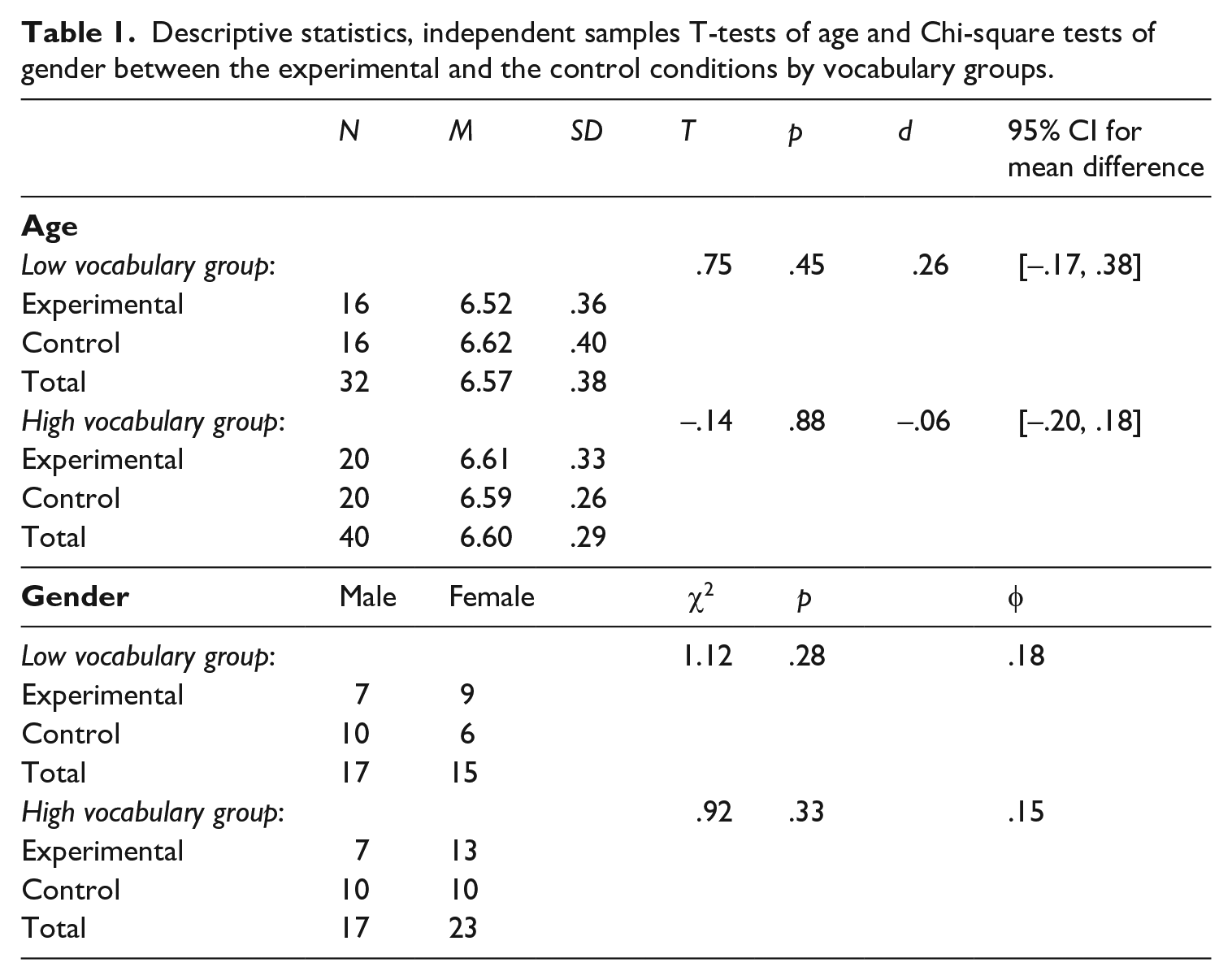
As ANOVA is sensitive to unequal sample sizes (Fitts, 2010; Howell, 2009; Liu, 2003), we used the SPSS Select Cases function to randomly select an equal number of students in each condition. This method of selecting an equal number of participants across conditions has been used successfully in past research (e.g. Sadler & Fowler, 2006; Scarpati et al., 2009). To include an equal number of students across conditions, participants in the experimental condition were randomly selected to match with the number of participants in the control condition of the corresponding vocabulary groups using the SPSS Select Cases function. As the main aim of this study is to examine the effects of dialogic teaching, statistical analyses were conducted to compare across the experimental and the control conditions (where the sample sizes of the comparison groups were equal), but not across the low and the high vocabulary groups. In this study, the group with low vocabulary knowledge comprised 32 students, including 10 boys and 6 girls in the control condition and 7 boys and 9 girls in the experimental condition. The group with high vocabulary knowledge comprised 40 students, including 10 boys and 10 girls in the control condition and 7 boys and 13 girls in the experimental condition.
2 Measures
a English receptive vocabulary
The Receptive Vocabulary test was adapted from the Receptive One-Word Picture Vocabulary tests (ROWPVT; Brownell, 2000). For each of the 20 items, the experimenter presented a word orally and students were required to select the corresponding illustration from four options. The items in this test were randomly selected from the first 60 items in the ROWPVT. Items of lower difficulty level in the ROWPVT were included because the participants were learning English as a second language and had just begun their formal English lessons at school. The items have been previously successfully administered to test receptive vocabulary in Hong Kong kindergarteners and primary school students (Wong et al., 2014). The maximum score of the Receptive Vocabulary test was 20, and its Cronbach’s α was .89.
b English receptive vocabulary with textbook items
To further investigate the effect of the intervention on the vocabulary taught during the intervention period, a test of English Receptive Vocabulary with Textbook Items was administered. The testing procedure of this test was similar to that of the Receptive Vocabulary test. For each of the 16 items, the experimenter presented a word orally, and students were required to select the corresponding illustration from four options. The vocabulary items in this test were obtained from the English textbook used in students’ English classes during the intervention period. Example items in this test include sleep, hike, bedroom and bench. These words were different from those in the English Expressive Vocabulary with Textbook Items test. The maximum score of the Receptive Vocabulary-Textbook test was 16, and its Cronbach’s α was .81.
c English expressive vocabulary
The Expressive Vocabulary test was adapted from the English Expressive Vocabulary Test–Second Edition (EVT-2) (Williams, 2007). For each of the 18 items, children were asked to say an English word that best represented the picture shown by the experimenter. These items were randomly selected from the first 60 items in the EVT-2. Items of lower difficulty level in the EVT-2 were included because the participants were learning English as a second language and had just begun their formal English lessons at school. Similar English expressive vocabulary tests have been administered to Hong Kong children in past studies (Liu et al., 2017; Yeung et al., 2013). The maximum score on this task was 18, and the Cronbach’s α was .92.
d English expressive vocabulary with textbook items
To better understand the intervention effect on the vocabulary taught during the intervention period, a test of English Expressive Vocabulary with Textbook Items was administered. This test comprised 16 items. The test approach of Expressive Vocabulary-Textbook was similar to that of the Expressive Vocabulary test. The words in this test were sourced from the English textbook that the students used in their English classes during the intervention period. Example items of this test include pond, bicycle, draw and sing. These words were different from those in the English Receptive Vocabulary with Textbook Items test. The maximum score on this task was 16, and the Cronbach’s α was .88.
e English phonological awareness
The English Phonological Awareness test consisted of 12 English syllable deletion items. The experimenter presented the three-syllable words orally one by one, following which students were required to remove one syllable from each three-syllable word. For example, ‘butterfly’ without ‘ter’ is ‘but’ and ‘fly’. Similar English syllable deletion tests have been administered to Hong Kong kindergarteners and primary school students in past studies (Chow et al., 2010; Chung et al., 2013). Testing stopped when the student failed to answer five consecutive items. The maximum score of this task was 12, and its Cronbach’s α was .85.
3 Procedure
Parental consent was sought for all students before data collection. Students were then individually tested on English receptive vocabulary, receptive vocabulary-textbook, expressive vocabulary, expressive vocabulary-textbook, and phonological awareness in a 30-minute session. Following intervention methods in past studies (e.g. Chow et al., 2018; Hargrave & Sénéchal, 2000), at the beginning of our intervention program, a 1.5-hour workshop was provided for teachers in the experimental condition to empower them to teach ESL using dialogic teaching methods. The workshop provided the teachers with guidelines containing dialogic reading techniques and detailed teaching and learning materials for interactive dialogue and creative activities. The length of the current intervention program (12 weeks) was based on the successful implementation of previous dialogic teaching intervention programs in past studies (e.g. Chow et al., 2018). In some studies on dialogic teaching, the implementation period of dialogic teaching was as short as 4 weeks (e.g. Opel et al., 2009). In this study, we considered 12 weeks to be practical for implementation and long enough to allow us to detect changes in children’s vocabulary knowledge and phonological awareness. During the 12-week intervention program, three class visits were conducted in total, with one conducted every four weeks. Furthermore, teachers were contacted regularly to ensure that they were able to smoothly employ dialogic teaching techniques in their classrooms, and that active teacher–student interaction took place in their class teaching. At the end of the intervention period, students retook the five tests on English receptive vocabulary, receptive vocabulary-textbook, expressive vocabulary, expressive vocabulary-textbook, and phonological awareness. Four out of five classes in school A and three out of five classes in school B were randomly assigned to the experimental condition. The remaining three classes were assigned to the control condition. Both conditions received the same duration of English instruction. In total, 10 teachers were involved in this study and they were not privy to items in the tests.
4 Experimental condition
Students in the experimental condition received 12 weeks of dialogic instruction that was designed to foster teacher–student interaction and discussion of topics related to textbook content. The dialogic instruction contained two major components: interactive dialogue and creative activities. Classroom learning incorporating dialogic teaching replaced the traditional school curriculum for an average of 80 minutes each week. Teachers conducted the classes using teaching and learning materials for interactive dialogue and creative activities provided by the research team. Students in the experimental condition received the same duration of English instruction as those in the control condition.
5 Control condition
Students in the control condition followed the traditional English curriculum. This curriculum focuses on the acquisition of core and concrete knowledge, such as grammar and vocabulary. Similar to typical English classes in most local schools in Hong Kong, emphasis is placed on rote learning and drilling exercises such as recitation, dictation, and other strategies focusing on vocabulary memorization (Lau & Rao, 2013; McBride-Chang & Treiman, 2003).
6 Analysis
Descriptive statistics and reliability coefficients of the tests were computed. The reliability coefficient was above .80 in all tests, indicating these tests had good reliability. Chi-square tests and independent-samples t-tests were conducted to test if the experimental and the control conditions differed in age, gender composition, and task performance before the intervention. Then, repeated measures ANOVA tests were conducted on English measures to compare inter-condition differences across time. Effect sizes were interpreted based on Cohen’s (1988) rule of thumb for effect sizes which indicates that a partial eta-squared (η p 2) value of .01, .06, and .14 corresponds to a small, medium, and large effect respectively. These analyses shed light on the effectiveness of the intervention and the differential effects that the intervention may have on students with different levels of vocabulary knowledge.
V Results
1 Pre-test measures
To test if the experimental and the control conditions differed in age, gender composition, and task performance before the intervention, Chi-square tests and independent-samples t-tests were conducted for both low and high vocabulary groups. Chi-square tests were conducted to compare gender between conditions for the low and high vocabulary groups respectively. Results showed no significant differences in gender across conditions (see Table 1). Additionally, independent-samples t-tests were conducted to compare the performance and chronological age of the two conditions at pre-test for the low and high vocabulary groups respectively. Results showed no significant differences between conditions on any of the pre-test measures (all ps > .05, see Tables 1 and 2).
Descriptive statistics, independent samples T-tests of age and Chi-square tests of gender between the experimental and the control conditions by vocabulary groups.
Descriptive statistics of pre-test and post-test measures and independent samples T-test of Pre-test measures between the experimental and the control conditions by vocabulary groups.
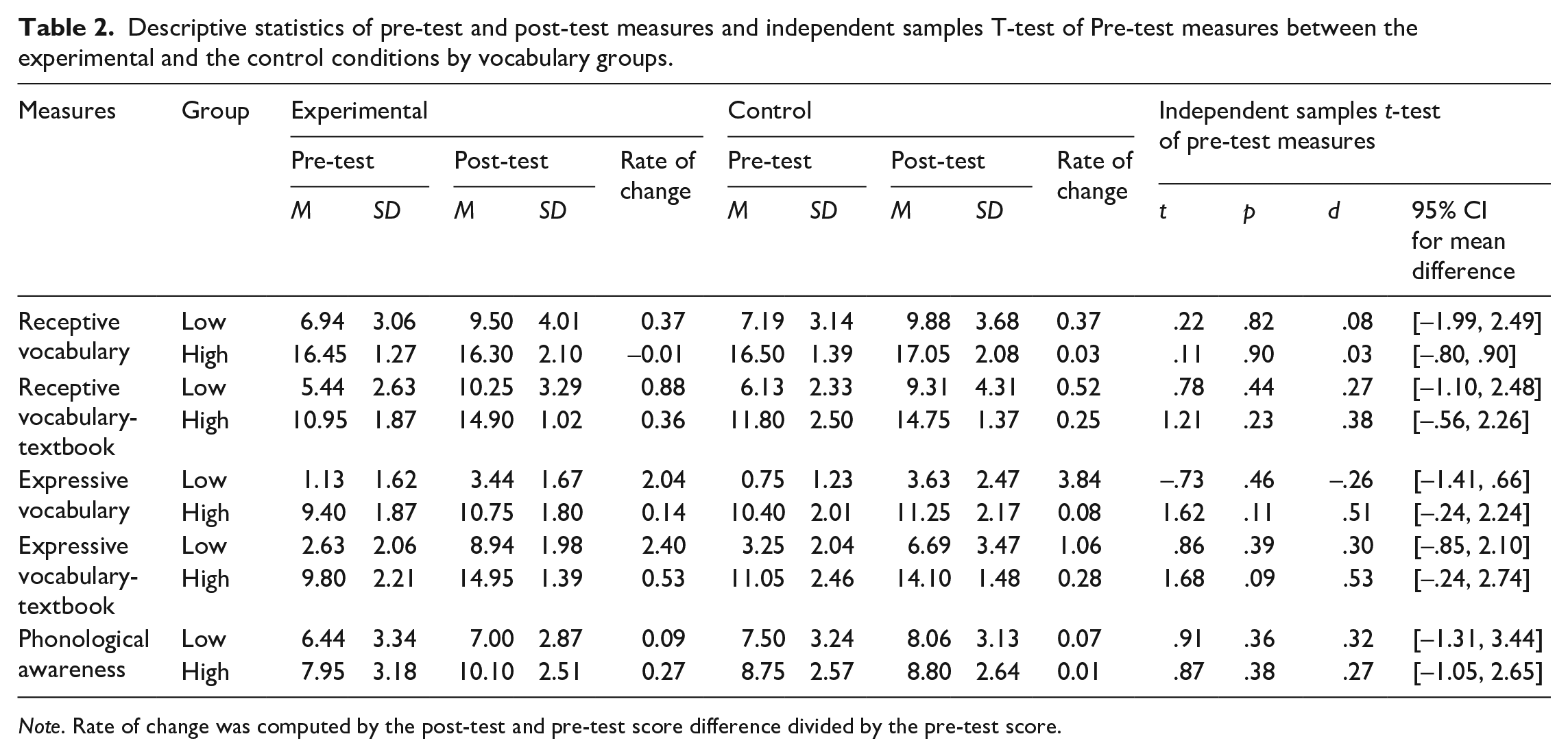
Note. Rate of change was computed by the post-test and pre-test score difference divided by the pre-test score.
2 Comparing the improvement in control and experimental conditions over time
The descriptive statistics for the post-test scores across the two conditions are shown in Table 2. These scores indicate participants’ performance in the experimental and the control conditions after the intervention. Using repeated measures ANOVA, inter-condition differences across time were compared based on results of interaction effects and effect sizes. Specifically, we examined changes across time (pre-test to post-test), differences across conditions (experimental vs. control), and the interaction between time and experiment condition. In examining the effectiveness of the intervention for the low and high vocabulary groups, five separate repeated measures ANOVAs with time as a within-participant factor and condition as a between-participant factor were carried out to assess students’ improvement in English receptive vocabulary receptive vocabulary-textbook, expressive vocabulary, expressive vocabulary-textbook, and phonological awareness before and after the 12-week intervention for low and high vocabulary groups respectively. Results showed that the main effect for time was significant for all variables, except expressive vocabulary and phonological awareness whereby the main effect for time was significant in the high vocabulary group only. This indicated that participants’ performance differed at pre-test and post-test for expressive vocabulary-textbook, receptive vocabulary-textbook, and expressive vocabulary in both vocabulary groups, and for expressive vocabulary and phonological awareness in high vocabulary group only. No significant main effect for condition was found, indicating the overall performance of the experimental and the control conditions is similar for all variables. Most interestingly, a significant interaction effect was found for expressive vocabulary-textbook in both vocabulary groups and for phonological awareness in the high vocabulary group, indicating that participants who had undergone the intervention showed greater improvement than those who had not (see Table 3). Details of the results are indicated in the following sub-sections.
Repeated measures analysis on Pre-test vs. Post-test scores between the experimental and the control conditions by vocabulary groups.
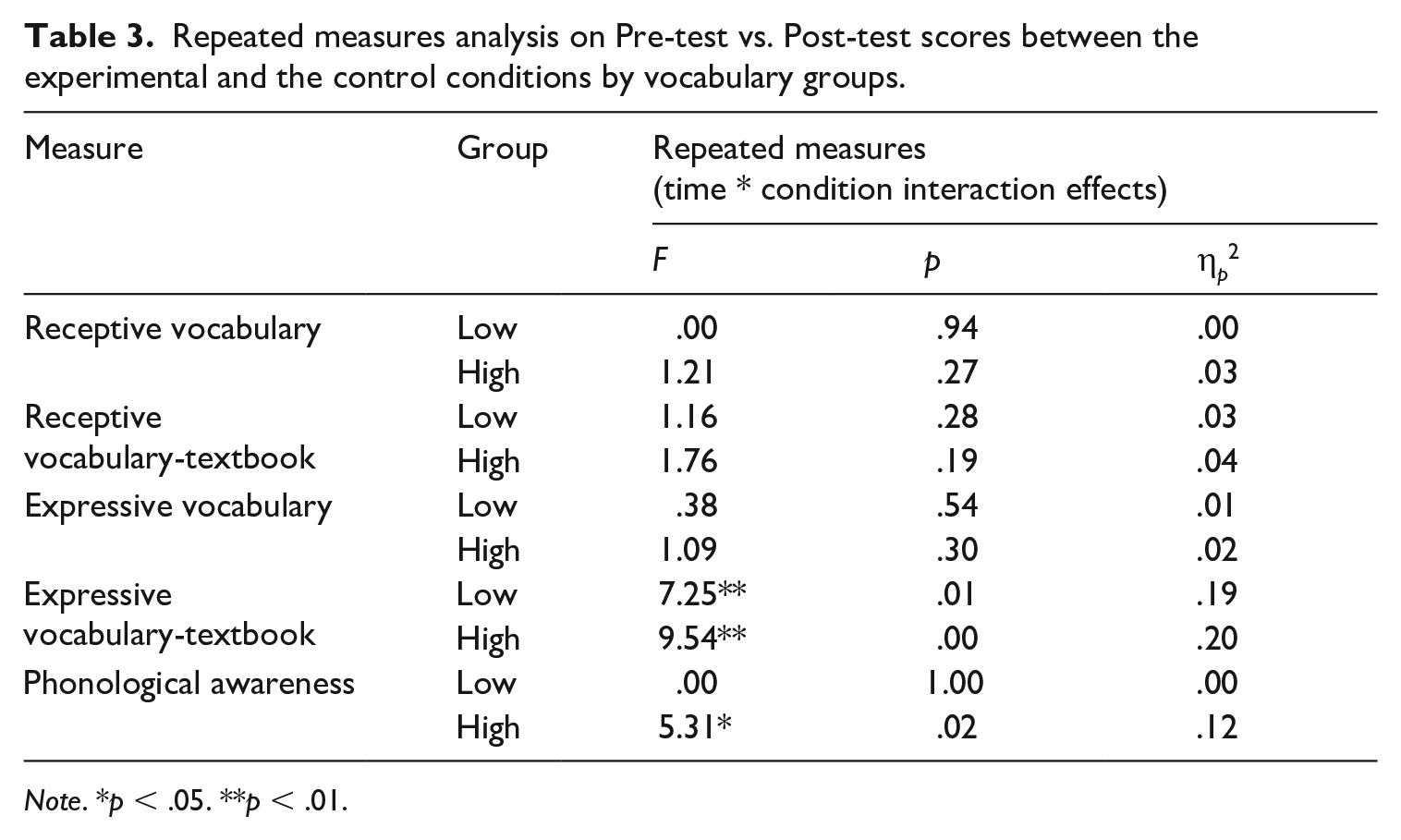
Note. *p < .05. **p < .01.
a Vocabulary knowledge
In examining expressive vocabulary-textbook, a significant main effect for time was observed in both low and high vocabulary groups. This indicated that participants’ performance improved across time, F(1, 30) = 83.45, p < .001, η p 2 = .73 for the low vocabulary group, and F(1, 38) = 145.59, p < .001, η p 2 = .79 for the high vocabulary group. The main effect for condition was not significant, F(1, 30) = 1.37, p > .05, η p 2 = .04 for the low vocabulary group, and F(1, 38) = .15, p > .05, η p 2 = .004 for the high vocabulary group. A significant interaction effect between condition and time was observed for the low and high vocabulary groups respectively, F(1, 30) = 7.25, p < .05, η p 2 = .19 for the low vocabulary group, and F(1, 38) = 9.54, p < .01, η p 2 = .20 for the high vocabulary group (see Figures 1 and 2). This indicated greater improvement in expressive vocabulary-textbook for students who had undergone the intervention than those who had not in both low and high vocabulary groups, suggesting that dialogic teaching was more effective than the traditional didactic instruction in fostering children’s expressive vocabulary of the textbook. Based on Cohen’s (1988) rule of thumb for effect sizes, a large interaction effect was observed for both low and high vocabulary groups in expressive vocabulary-textbook (all η p 2s > .14).
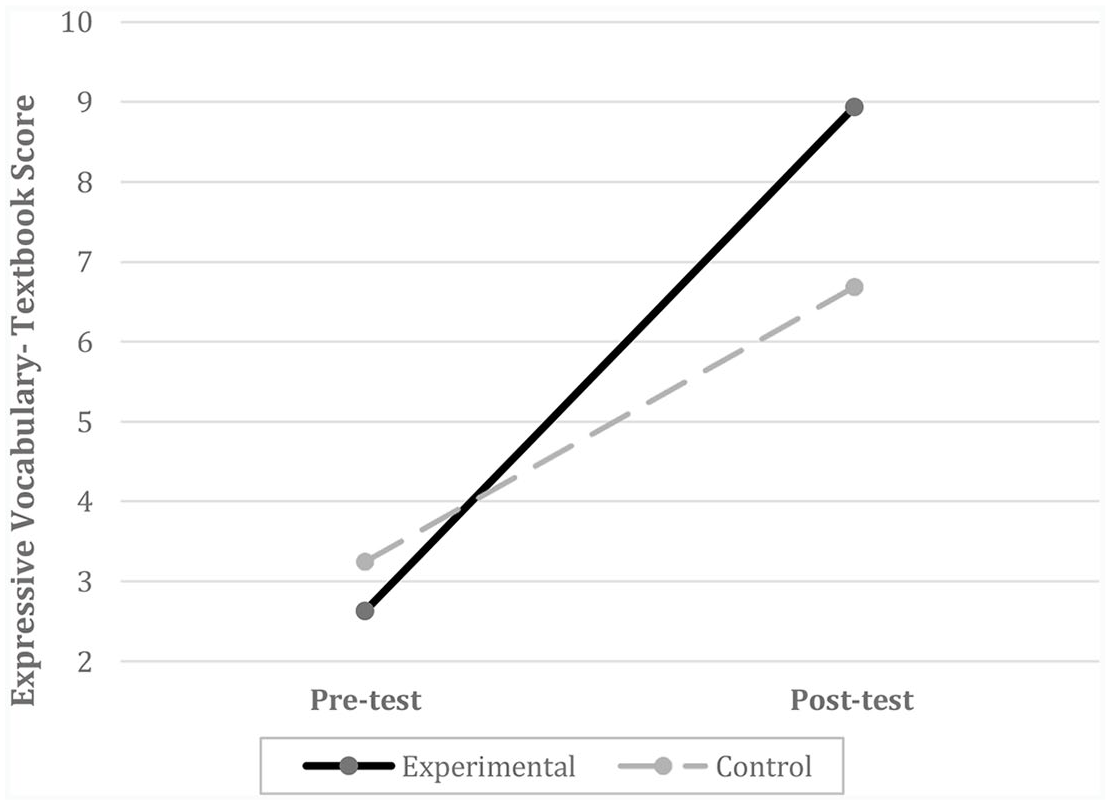
Change of English expressive vocabulary-textbook scores across time in the experimental and the control conditions in the low vocabulary group.
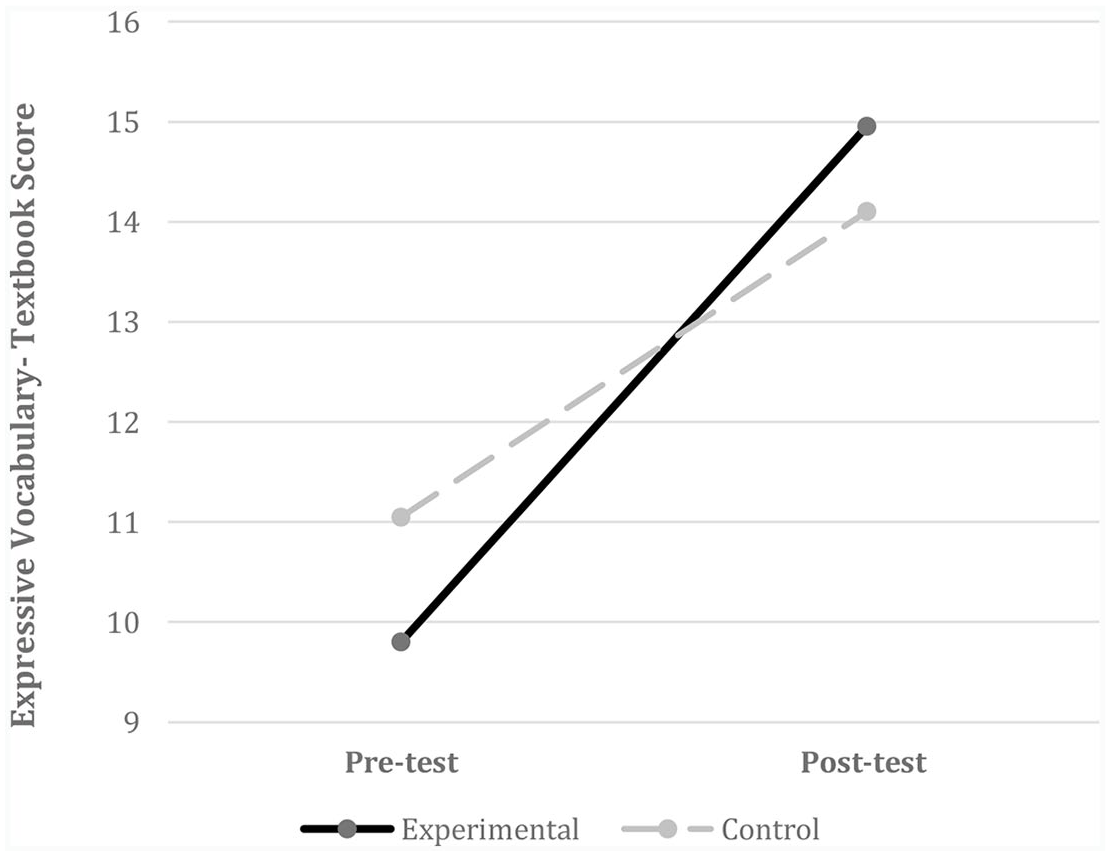
Change of English expressive vocabulary-textbook scores across time in the experimental and the control conditions in the high vocabulary group.
A significant effect for time was found for both vocabulary groups in receptive vocabulary, receptive vocabulary-textbook, and expressive vocabulary (all ps < .01), except for the high vocabulary group in receptive vocabulary, F(1, 38) = .39, p > .05, η p 2 = .01. This indicated that participants’ performance improved across time in the low vocabulary group, F(1, 30) = 9.35, p < .001, η p 2 = .23 for receptive vocabulary, F(1, 30) = 28.19, p < .001, η p 2 = .48 for receptive vocabulary-textbook, and F(1, 30) = 32.42, p < .001, η p 2 = .51 for expressive vocabulary, and the high vocabulary group, F(1, 38) = 83.79, p < .001, η p 2 = .68 for receptive vocabulary-textbook, and F(1, 38) = 21.11, p < .001, η p 2 = .35 for expressive vocabulary. However, no significant interaction effect or main effect for condition was observed in both vocabulary groups in receptive vocabulary, receptive vocabulary-textbook, and expressive vocabulary (all ps > .05). This showed that the growth in these vocabulary skills was similar for students who had undergone the intervention and those who had not. As the control condition in this study followed the traditional English curriculum, these results indicated that dialogic teaching worked as well as the traditional didactic instruction in enhancing these vocabulary skills in children.
b Phonological awareness
In examining phonological awareness, a significant main effect for time was observed in the high vocabulary group, F(1, 38) = 5.82, p < .05, η p 2 = .13. This indicated that their performance improved across time. However, the main effect for condition was not significant, F(1, 38) = .11, p > .05, η p 2 = .003. A significant interaction effect between condition and time was observed for the high vocabulary group, indicating greater growth in phonological awareness for students who had undergone the intervention than those who had not in the high vocabulary group, F(1, 38) = 5.31, p < .05, η p 2 = .12 (see Figure 3). A medium to large effect was found for this interaction effect. For the low vocabulary group, no significant effect was found for time, condition or interaction (all ps > .05).
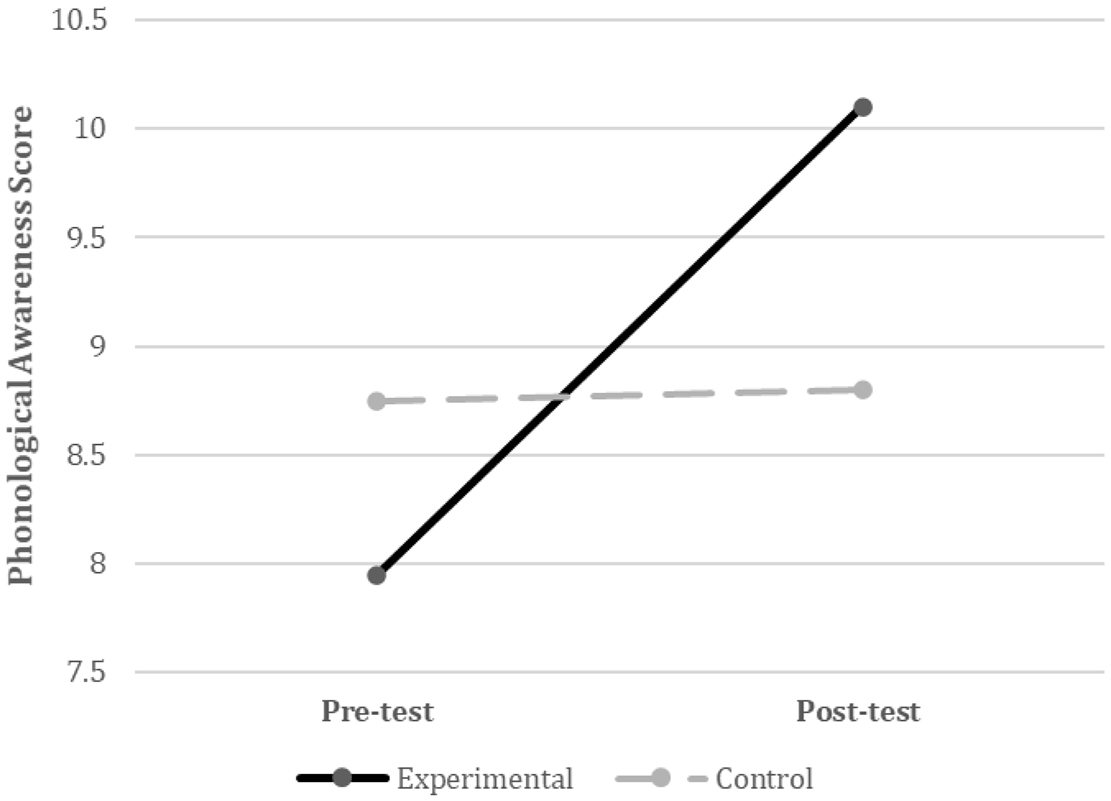
Change of English phonological awareness scores across time in the experimental and the control conditions in the high vocabulary group.
VI Discussion
This study extends previous research by investigating the effectiveness of dialogic teaching pedagogy on ESL development among first graders with low and high levels of vocabulary knowledge. The findings show significantly greater growth in expressive vocabulary knowledge on textbook items in learners with low and high vocabulary, and greater gain in phonological awareness in learners with high vocabulary after a 12-week dialogic teaching intervention program.
1 English expressive vocabulary with textbook items
Results suggest that students in the experimental condition are more successful in learning English expressive vocabulary-textbook than their control group counterparts after the 12-week intervention. In dialogic teaching, teachers are encouraged to create extended exposure to vocabulary. When teachers successfully elicit the meaning of target vocabulary from students, more interactional opportunities allow students to practice the target vocabulary, thus enhancing their vocabulary learning (Ong, 2017). No statistical differences across conditions were observed for English expressive vocabulary. As the Expressive Vocabulary-Textbook task included items selected from the textbooks students used during the intervention and the Expressive Vocabulary task included general items, this finding shows that children, including both low and high vocabulary learners, benefit more from dialogic teaching on learning textbook vocabulary rather than extra-textual ones. There is a possibility that the Expressive Vocabulary test administered in this study is not granular enough to allow detecting significant improvements in general expressive vocabulary knowledge in the 12-week intervention. Further research can confirm the finding with a more extensive expressive vocabulary test.
Findings from previous research reveal that early second language learners show typical progress in learning vocabulary from textbooks than from other sources (Davidson et al., 2008). The reason is that textbook vocabulary is more frequently used than other vocabulary during classroom instruction. This is particularly true for beginning learners who have just started receiving formal ESL instruction. Given their small vocabulary base, beginning learners tend to rely more on their knowledge of textbook vocabulary, which is more readily accessible, than extra-textual vocabulary in their interaction with teachers.
Compared with traditional didactic instruction, dialogic teaching provides children with more opportunities to use textbook vocabulary during classroom learning. As mentioned, the dialogic teaching approach can create a motivating context for children to learn word meanings effectively through extended illustrations, further clarification, repetition, and multiple exposures to new vocabulary over time (Wasik et al., 2016). Thus, their knowledge of the textbook vocabulary is enhanced through active classroom engagement. Future research can collect data on the frequency of the target vocabulary discussed in classes to examine the underlying mechanisms of the positive effects on ESL vocabulary knowledge in dialogic teaching. Another possible interpretation of this finding is that the examination-driven education culture in Hong Kong emphasizes textbook vocabulary as opposed to extra-textual ones. Even though the intervention program encouraged the use of extra-textual vocabulary through extended discussion with dialogic reading strategies and creative literacy activities, textbook vocabulary might still be more frequently used in classes. It should be noted that while students’ performance in the Expressive Vocabulary-Textbook test significantly improved over time, given the relatively small number of items of the Expressive Vocabulary-Textbook test, the absolute number of gains could be small in some groups (Low Control: 3.44; Low Experimental: 6.31; High Control: 3.05; High Experimental: 5.15). Yet, short vocabulary tests have been successfully used in past research to measure vocabulary knowledge in young ESL children. For example, Petchprasert (2014) administered a 14-item English vocabulary test on three to six year-old Thai ESL children to measure their vocabulary gains across pre-test and post-test. As the items in the test were randomly selected, the statistically significant growth differences on these items across conditions suggest intervention effects. Similarly, past research using longer vocabulary tests showed a significant positive effect of dialogic reading on children’s expressive vocabulary but not receptive vocabulary, though it should also be noted that the absolute gain is small (Expressive vocabulary: Experimental: 4.7; Control: 1.2) (Hargrave & Sénéchal, 2000). The reference to absolute number of gains is necessary for a useful interpretation of the claims and inferences. In addition, the high pre-test scores obtained in the tests in the high vocabulary group, especially in the Receptive Vocabulary test, may leave little room for growth across time. There is a possibility that the tests may not be sensitive enough to capture an increase in general vocabulary knowledge. Further research can confirm the finding with more extensive vocabulary tests. It is also important to note that in the present study, learners in both the high vocabulary experimental and the high vocabulary control conditions had similar performance on expressive vocabulary-textbook at post-test. Though no significant difference was observed between conditions in expressive vocabulary-textbook pre-test scores, there is a possibility that the slightly lower pre-test performance of learners in the high vocabulary experimental group provides more room for improvement than for learners in the high vocabulary control group. Further research is needed to confirm the finding of the positive intervention effects on expressive vocabulary-textbook in children with high vocabulary knowledge.
The present study shows significant interaction effects for expressive vocabulary gains but not for receptive vocabulary gains in both groups across conditions. Some studies on dialogic reading intervention have found that the interactive dialogue approach is particularly useful in improving expressive language skills in children (Burchinal et al., 2010; Hargrave & Sénéchal, 2000). By studying the differential effects of storybook reading in preschoolers, Sénéchal (1997) found that book reading enhances receptive and expressive vocabulary in children in similar ways. However, active dialogic interaction can enhance expressive vocabulary in children more than receptive vocabulary. A meta-analysis study has indicated that dialogic reading has stronger effects on children’s expressive vocabulary than receptive vocabulary, and this is likely because dialogic reading is particularly effective in stimulating children’s active verbal involvement (Mol et al., 2008). In this study, we have extended our findings to ESL children, adding to the results from previous studies focusing on first language acquisition. Findings support the notion that expressive language skills in children are positively correlated with their active participation in high-quality interactions (Gonzalez et al., 2014; Logan et al., 2011; Mashburn et al., 2008). According to Gonzalez et al.’s (2010) explanation, this may be because the dialogic talks particularly facilitates active verbal involvement in children, thus allowing them to practice their expressive vocabulary more frequently via their responses. Though didactic instruction does not encourage the same high level of children’s active verbal involvement and teacher–student verbal exchange as dialogic teaching does, teachers using didactic approach directly instruct English knowledge to their students through reading aloud and explaining target vocabularies, which creates opportunities for students to listen and learn these vocabularies thus enhancing students’ receptive vocabulary development. It provides a plausible explanation of why the dialogic teaching condition and the control using more didactic and less interactive instruction facilitated receptive vocabulary acquisition to a similar extent, though dialogic teaching yielded more obvious gains in expressive vocabulary in this study.
2 English phonological awareness
In the present study, greater gains in English phonological awareness were observed in students who had undergone the intervention than those who had not in the high vocabulary group. However, in learners with low vocabulary, similar performance in phonological awareness was observed for those who had undergone the intervention and those who had not. Given the relatively small number of items of the Phonological Awareness test, the small absolute number of gains observed should be taken into consideration when interpreting the results. Given that the low vocabulary group and high vocabulary group had a similar duration of exposure to English classes, the difference in phonological awareness is noteworthy. The results suggest that levels of English vocabulary knowledge appear to be particularly important for the development of phonological awareness in ESL children. Although children with low vocabulary knowledge still show similar progress in expressive vocabulary-textbook as those with high vocabulary knowledge, their phonological processing skill remains the same under the dialogic intervention. In line with previous research, this finding demonstrates that high vocabulary knowledge may support the developmental progression of children’s phonological awareness (Ouellette, 2006; Strom & Neuman, 2016; Walley, Metsala, & Garlock, 2003). Vocabulary has been always believed to be a strong predictor of language and literacy development in early years of schooling (Cheung, 2007; Chondrogianni & Marinis, 2011; Grøver et al., 2018). In beginning learners, a basic level of vocabulary knowledge seems to be fundamental in supporting in the development of phonological awareness through interactive dialogue. Without the support of a sufficient level of vocabulary knowledge, it may be difficult to engage children in interactive dialogues to an extent that promotes phonological awareness. This notion warrants further investigations to explore the extent and specific levels of overall vocabulary knowledge that can support the phonological processing skills of children.
3 Suggestions for further research
There are several suggestions for further research. First, future research may include other indexes of language skills such as reading, speaking, or writing, to provide a more comprehensive picture of children’s language development. Second, the tests used in this study consisted of a relatively small number of items and no delayed post-test was administered. These tests may not be granular enough to allow detecting significant improvements across time, especially in those with a high pre-test score. Further studies may use the full version of the assessment batteries and investigate the long term effects of the intervention. Third, future studies may consider a longer intervention period. Lastly, future research may adopt a larger sample involving more schools and conduct mixed effect model analysis with this larger sample. This will help explore random effects of higher level units, such as school, on the intervention outcomes and increase the generalizability of the results.
VII Conclusions
This study shows that dialogic teaching, an approach that focuses on interactive dialogue and the use of creative activities, can be successfully implemented in the ESL classroom. Dialogic teaching enhances English language development in young ESL learners, whether they have low or high vocabulary knowledge. Significantly greater gain in phonological awareness was also observed for children with high vocabulary knowledge who completed the intervention than those who did not. This finding indicates that the positive effects of dialogic teaching can also be extended to the metalinguistic level of children’s English language learning. Though statistically significant gains are observed, the absolute number of gains is small given the short tests used. Nevertheless, this study extends past research from two perspectives. First, this research is one of the few studies on the effectiveness of dialogic teaching among young ESL learners. Second, this study investigates the effects of dialogic teaching on the English language development among learners with different vocabulary abilities. Altogether, the findings indicate the feasibility of incorporating dialogic teaching in ESL education in schools, while taking into account children’s diversity in vocabulary knowledge. It is important for educators to consider the differential effects of dialogic teaching on children with diverse language ability levels in second language classroom settings.
Footnotes
Acknowledgements
We thank the teachers and the students for their participation in this study.
Funding
The author(s) disclosed receipt of the following financial support for the research, authorship, and/or publication of this article: The work described in this paper was supported by a grant from the Research Grants Council of the Hong Kong Special Administrative Region, China (CityU 11603819), and a grant from the Hong Kong Quality Education Fund (EDB/QEF2013/0307).
