




Abstract
In light of the growing importance placed by states on the use of authentic materials in foreign language education programs, this study explored the literary content found in the 18 English, French, and German ministry-approved language textbooks used in upper-secondary schools in Russia. The study identified 150 literary texts, following which it compared how English, French, and German textbooks differed in their approaches to incorporating literature. The findings indicate significant differences between textbooks across languages, as well as some similarities. The study discusses the implications of the findings for learner achievement and motivation, and offers recommendations regarding what can be done to incorporate literature in ways that can deepen learner interest and engagement.
Keywords
I Introduction
With worries growing about the reading skills of younger generations (Renaissance Learning, 2019), as well as declining interest in foreign language (FL) programs (Looney & Lusin, 2018), it is becoming increasingly urgent to find ways to make reading more relevant and attractive to young learners, and learning languages more engaging for them on a personal level. The frenetic pace of globalization has also created demands for individuals, preferably those proficient in multiple languages (Lüdi, 2018), who can navigate real-world situations using authentic speech and cultural knowledge, which has led to these skills acquiring more prominence in FL programs (Hall, 2015; Sharifian, 2013). This focus on developing the intercultural communicative competence of learners, including their ability to produce authentic language, has led to a renewed focus on literature as a language resource due to its role as a store of authenticity, pluricultural knowledge, and engaging content (see Bland, 2018). The FL curriculum implemented in schools in several countries – for instance, in Russia (MoE Moscow, 2012), the focus of this study, Norway (Utdanningsdirektoratet, 2013), and Malaysia (MoE Malaysia, 2013) – explicitly emphasizes the importance of literature as a language resource, describing it as helping to develop students’ intercultural competence and language proficiency. The Council of Europe, too, recognizing literature’s importance to language learning, has placed greater emphasis on it in its updated CEFR descriptors (North, Goodier, & Piccardo, 2018).
These developments can be said to represent changes in the way languages have generally been taught. Paesani (2011), discussing the language–literature divide at the collegiate level, notes that language study has often been viewed as comprising lower-level courses that focus on communicative, functional language while literary study is reserved for advanced-level students. This divide has often resulted in students not being furnished with the tools to access literary texts during the early years of study, which then makes it difficult for them to handle literature during the more advanced stages of their language education. Paesani points out that there has been a realization that such a demarcation might not be conducive to learning languages, with writers like Walther (2007) and Scott and Huntington (2007) suggesting that learners should be exposed to literature from the beginning so that they can understand how the target language works, as well as develop their critical thinking skills and ability to interpret textual content. There have also been growing calls, in this respect, to make extensive reading – which can be described as independently and silently reading a wide variety of materials including literature – a component of FL programs since it increases learners’ vocabulary knowledge and motivation to learn, and can even improve their speaking and listening abilities (Nation & Waring, 2019).
At present, FL education in schools remains quite textbook-centric in large parts of the world due to a range of factors like practicality (Allen, 2015) or the need for official approval to use certain learning materials (e.g. Calafato, 2018a). Textbooks, consequently, can serve as a good indicator of what literary content teachers are using with their learners. As for teacher beliefs regarding literature, studies indicate that they see it as a source of authentic language and cultural knowledge (Duncan & Paran, 2017; Luukka, 2017). Learners, too, consider literature to be an effective learning tool so long as it focuses on developing their language skills (Bloemert, Paran, Jansen, & van de Grift, 2019) and consists of prose rather than poetry (Akyel & Yalçin, 1990). Studies on textbook literary content, when compared to the amount of research on teacher and student beliefs about literature, have been far fewer in number (Skela, 2014; Takahashi, 2015), with most authors focusing on literature beyond the textbook (see Paran, 2008) and almost exclusively on English. Other times, studies have delved into themes like the representation of ethnicities, race, gender, and political ideologies in textbooks (Bori, 2018), which, while they can play a role in developing literature for language textbooks, are often hidden (Hilliard, 2014) and might not be readily apparent to or even understood by teachers or students.
This study assesses the literary content of ministry-approved 1 English, French, and German language textbooks used in upper-secondary schools in Russia, a country that has received comparatively little attention in terms of research on literature in language education to date. The aim is to gauge how these textbooks incorporate literature, how they approach its use, and whether there are any differences in these respects based on the target language. The study’s findings should provide important insights regarding the use of literature in language textbooks across multiple languages and what implications this might have for FL education in schools in terms of content, learner achievement, pluricultural knowledge, and intercultural communicative competence. The study also offers recommendations and a methodological blueprint that textbook publishers, authors, and even language teachers can use when selecting literary texts and creating accompanying activities for use in schools.
II The language textbook and the curriculum
1 Literature in the FL curriculum in Russia
FL education in Russia starts from the second grade, with English being the first FL that most students learn (Ustinova, 2005). Weekly lessons consist of 3–4 hours of language instruction and last until students graduate, with a second FL (two hours weekly) becoming an option for students when they enter secondary school (MoE Moscow, 2018). Textbooks are an essential component of FL instruction in Russian schools, with the federal government education standards mandating the use of at least one textbook per subject that follows the federal curriculum guidelines (MoE Moscow, 2012), which explicitly call for the inclusion of literature, specifically classical and modern fiction (domestic and foreign), alongside science, arts, music, and sports-related content. Teachers can generally only use textbooks approved by the Russian Ministry of Education (MoE Moscow) and are unable to use money from the school budget to purchase unsanctioned books (Calafato, 2018a). In requiring textbooks to contain literary texts, the MoE guidelines stress that literature introduces learners to the values of national and world cultures, instils in them a respect for these, develops their love of reading, their vocabulary knowledge and creativity, their capacity to interact using different modes (especially writing) and in diverse contexts, as well as their ability to process and analyse texts (MoE Moscow, 2012).
More generally, the guidelines state that FL instruction should focus on developing learners’ intercultural communicative competence and knowledge of different societies, their general oral and written proficiency, translation, and research skills, as well as their ability to use these in other subject areas if required (MoE Moscow, 2012). Research on literature in language education in Russia indicates that language teachers, much like elsewhere, hold generally positive views about literature, considering it effective at improving learners’ reading ability, intercultural competence, and vocabulary knowledge (Calafato & Paran, 2019). These beliefs are reflected in their classroom practices, where they report using role-play, creative writing, gap-fill, and discussion-oriented activities when using literary texts (Belkina & Stetsenko, 2015; Glatishina, 2017). These studies also indicate that students’ interests remain of paramount importance for language teachers when selecting literary texts for lessons. At the same time, research on the literary content found in school textbooks continues to be absent in the Russian context, regarding both English and languages other than English (LOTEs), which is surprising given the explicit emphasis placed on literature in the language curriculum and its mandatory inclusion in FL textbooks.
2 Authentic texts and textbook design
By including literature, textbooks can satisfy the criteria for textual authenticity since literary works are genuine and not originally produced for inclusion in textbooks. This is important because textbook language, specifically its authenticity, has received considerable attention in recent decades following a growing focus on learners’ communicative competence and the need to develop their pragmatic and cultural knowledge (Gilmore, 2007; Takahashi, 2015). Purely non-literary textbook texts can contain inauthentic, contrived language that does not always represent how language is used in real-world contexts (Richards, 2014); this, in turn, might hold negative implications for learners’ FL proficiency and motivation to learn (Clavel-Arroitia & Fuster-Márquez, 2014). Textbooks, after all, are an important educational artefact and occupy a preeminent place in education (Widodo, 2018). The presence of literary texts in language textbooks, therefore, can help learners to not only develop (and demonstrate) their intercultural communicative competence (Porto, 2014), language skills (Lao & Krashen, 2000), critical thinking (Barrette, Paesani, & Vinall, 2010), and language awareness (Isaac, 2002), but also to obtain deeper insights into other societies, ideologies, and ways of life.
Indeed, textbooks often serve as the primary link to other cultures for students, who might not have had the chance to interact with native speakers of the target language, and so they can strongly influence the initial impressions students form of the target language and its associated culture(s) (Angell, DuBravac, & Gonglewski, 2008; Nadura, 2004). The implication is that textbook publishers and authors need to be particularly attentive to what content they choose to include, making sure that it is relevant and interesting so that it leaves a positive impression on both learners and teachers and promotes language learning. To aid them in this task, a range of methodologies has been proposed by researchers. Bolitho and Tomlinson (2005), for example, propose a methodology that focuses on developing language awareness, where learners analyse texts to discover for themselves how the language is used. Other writers recommend a task-based approach (Willis & Willis, 2007), where textbook activities focus on completing a task and the goal is language development. Tomlinson (2012) favours a text-based approach where learners first read a text or texts and then provide a personal response, after which they engage in analytical activities. We feel that each of these approaches has unique advantages and that much depends on the context in which these methodologies are applied.
In terms of specifically textbook literary content, activities that accompany the text can reflect combinations of any of the three aforementioned methodologies (for an overview of additional approaches, see Paesani, 2011). At present these methodologies remain underutilized, with most textbooks adopting the Presentation Practice Production (PPP) procedure, which is a traditional approach to teaching languages that is quite form-focused, favouring low-level practice like gap-fill/matching and reading comprehension activities (Masuhara, 2003; Tomlinson, 2012). Text selection, meanwhile, requires careful thought, with publication date, genre, readability, and length being important factors. This is because including texts in textbooks that students perceive as being outdated or difficult might demotivate them (and even the teacher). Tsagari and Sifakis (2014), in their study on Greek primary school English textbooks, found that teachers of English as a foreign language (EFL) felt that these were not properly organized and contained poorly explained activities. This could have been avoided, they observed, if textbook authors worked with teachers to understand their point of view instead of relying on their own theories of what might be appropriate to include in the textbooks. The nine Russian EFL teachers in Calafato’s (2018a) study felt that there was little literary content present in language textbooks and that what had been included was not very good. Masuhara, Hann, Yi and Tomlinson (2008) and Tomlinson and Masuhara (2013), in their studies, similarly found that most current EFL textbooks rarely use literature and do so purely for simple reading comprehension tasks.
While enlightening, many of these studies adopt a completely descriptive approach to discussing textbooks that is short on details, for example, the number of literary texts included in each textbook, text type, genre, and readability. Skela’s (2014) study, in this respect, is one of the few studies to take a more systematic, empirical approach to analysing textbook literary content. Investigating seven EFL textbooks (old and new) used in Slovenian secondary schools for text type, accompanying activities, genre, and text age, Skela reports that the more modern textbooks in his study contain less literary content than older textbooks, favour prose over poetry, with plays being the least represented, and do not have a systematic approach to incorporating literature. Here, too, like in the other studies, the focus remains exclusively on English textbooks and text readability is not evaluated. This constitutes a gap in our knowledge not only in terms of LOTE textbooks, but also regarding text readability, which, as research shows, can determine reading achievement, with texts that learners perceive as difficult negatively affecting their achievement (Ho & Guthrie, 2013).
3 Research questions
At present, few studies have explored the literary content found in FL textbooks and fewer still have analysed LOTE textbook literary content. This study adopts an approach to textbook analysis that takes teacher and student attitudes towards literature in language education, as well as curriculum requirements, as its basis. We feel that such an approach has been underrepresented in studies on textbook literary content to date. We also assess ministry-approved language textbooks since these are what teachers generally use in their lessons. This differentiates our study from other research where it is not always clear if the textbooks and other materials analysed are ministry-approved nor how widely used they are by teachers. In terms of scope, this study explores the following questions as part of its focus:
How do ministry-approved FL textbooks incorporate literature?
What literary types and periods have been given preference? What activities accompany literature in the textbooks?
Has literary content been incorporated differently based on the target language?
How accessible are the texts for students?
III Methods and instruments
We used the current federal list of approved textbooks for FL education in Russian upper-secondary schools (grades 10 and 11) for our study, selecting all the 18 textbooks for English, French, and German (as an FL) included therein (MoE Moscow, 2012). We then thoroughly scanned each textbook, page by page, for texts that satisfied our definitions of literary content and authenticity. Because it very closely matches the federal education standards’ understanding of literature (MoE Moscow, 2012), we use Calafato and Paran’s (2019) operational definition of literary texts as signifying representational texts like short stories, novels, poems, and plays that engage readers’ cognitive, imaginative, and emotional faculties. As for authentic texts, we define these as texts not originally written for learning a language (Takahashi, 2015). We decided to focus on English, German, and French because these are the most popular foreign languages in Russian schools (Ustinova, 2005). Most textbooks on the official list are part of a series, with separate textbooks for each grade, each containing different language content. In only two instances (one French and the other German) was it discovered that the same textbook is used for both grades 10 and 11. Textbooks, in addition, are produced specifically for the Russian market and follow national curriculum requirements.
On finding a text that matched our criteria, we noted down the page number and the unit in which we found the text and then verified each text using specific metadata like author name, title, publication date, and literary genre. We also compared each literary text in the textbook with its original to check for any modifications. One hundred and fifty literary works were identified in this way. Each text was always accompanied by one or more activities, which we counted and entered into an SPSS dataset along with the other metadata we had collected. Activities were either prediction-based (guessing the story from the first few lines, a picture or the title, etc.), reading comprehension (reading the text then answering some questions), role-play, creative writing, discussion, listening comprehension or translation. We added two additional categories to classify activities that were: (1) gap-fill or matching exercises focusing on vocabulary and grammar (we named this category ‘language use’) or (2) required students to summarize, orally or in written form, the content in their own words (summary/recital). We included ‘recital’ alongside ‘summary’ for when the text was a poem and an associated activity required students to memorize and recite the poem. It is worth noting here that we chose to devise our own typologies in spite of the fact that there already exist typologies for analysing textbook reading activities (e.g. Rivas, 1999).
We then processed each text for word, letter, and sentence count, after which we tabulated each text’s Lix readability score using the following formula (Anderson, 1981; Björnsson, 1983):
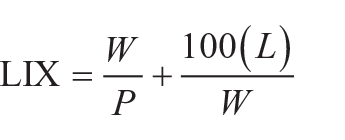
Notes. W = number of words; P = number of periods; L = number of words over six letters
We decided to use the Lix formula because, apart from being easy to calculate and interpret, it bypasses issues with syllabification, which makes it suitable for texts written in LOTEs (Anderson, 1983; Schulz, 1981). When interpreting Lix scores, we use the scale by Anderson (1983) to convert the scores to grade level. Consequently, a score of 52–55 denotes a text suitable for grade 12, 48–51 for grade 11, 44–47 for grade 10, and so on (3 points per grade level). We felt that Lix’s ability to measure readability across several languages, unlike other measures (e.g. the Gunning Fogg Index), was a distinct advantage seeing as we were analysing and comparing texts in English, German and French. In fact, Lix has already been used to evaluate text readability in English, German, French, Greek, Russian, Spanish (Anderson, 1983; Björnsson, 1983), and Chinese (Yuan & Gao, 2008), as well as in contexts of Arabic as a foreign language (Saddiki, Bouzoubaa, & Cavalli-Sforza, 2015). We would like to state that the grade levels we use in the study correspond to first language (L1) contexts and might not be completely accurate in second language (L2) and third language (L3) conditions. This means that a text with a Lix score of 44 (grade 10) could be much more difficult to read for a grade 10 student in a Russian school, for example, than for one in the USA or the UK. Still, the grade levels and Lix scores help us to compare readability between languages with some accuracy, given Lix’s use with various languages, and in a way that is not very time-consuming.
There appear to be no methods, moreover, to convert Lix scores to a language proficiency scale like the CEFR at present. This could be partly due to the nature of CEFR descriptors, which have been described as opaque and might require more subjective analysis (Sung, Lin, Dyson, Chang, & Chen, 2015) than readability formulae can currently provide. Indeed, automatic readability analysis for L2 contexts is still in its infancy due to a lack of L2 data annotated with corresponding readability levels (Xia, Kochmar, & Briscoe, 2016). These shortcomings notwithstanding, we felt that Lix offered the best combination of time-efficient readability computation and accuracy across languages. As for significance testing, we performed the Kruskal–Wallis test using SPSS 25 to analyse differences between the texts based on word count, Lix scores, publication date, and activities. During the test, we grouped the texts based on language instead of textbook series or grade because these textbooks represent interchangeable components of learners’ combined foreign language learning experience during their final two years of schooling. By grouping the textbooks in this way, we believe that we have more accurately analysed the sum total of literary text combinations that learners will potentially encounter in the FL classroom. We used an alpha level of .05 for all tests and report Hedge’s g, using the scale proposed by Plonsky and Oswald (2014), alongside p-values to indicate effect size: .40 = a small effect, .70 = a medium effect, and 1.00 = a large effect.
IV Results
The various textbooks, most of which are published by the same publisher (see Table 1), have a standard layout in that they consist of several units, often four but sometimes more, that focus on specific themes like work or friendship. Because some textbooks have more units, they end up covering more themes, although this does not mean that the number of units positively correlates with literary content since textbooks are somewhat similar in size. For example, French textbooks have notably more literary texts than German textbooks despite their generally smaller size. English textbooks, meanwhile, are more numerous than either the French or the German textbooks, which is likely indicative of how much more popular English is as an FL and the consequent need to produce a greater range of textbooks to satisfy this demand. Each textbook unit, regardless of series or language, consists of several subsections, generally five or six, with each subsection focusing on a particular skill or competence: language use (morphosyntax), listening, reading, speaking or writing. It is worth mentioning here that the French textbook Objectifs and the English textbooks series Spotlight and Starlight differ in one aspect from all the other textbooks in that they have a dedicated subsection for literature in each unit in addition to the language skills subsections (including reading skills).
Language textbooks, pages, types, and the number of literary texts they contain.
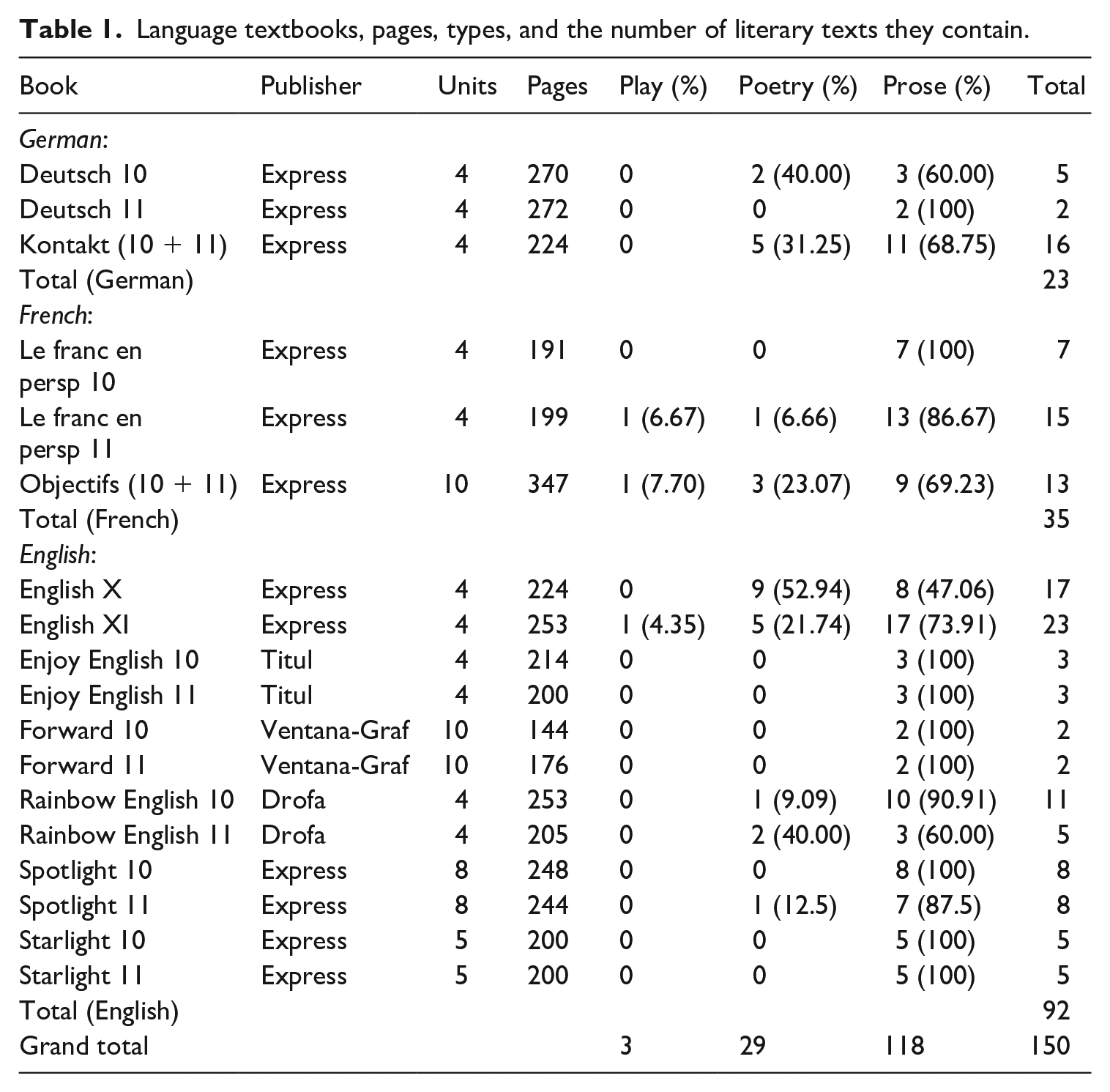
As for literary content, several textbooks contain between two to five literary texts and there is some variation in the number of texts between textbooks from the same series. In terms of quantity, English X and English XI appear to have more literary content than the other textbooks, with the Forward series containing the least amount of texts (see Table 1). The Spotlight and Starlight textbooks, because of their dedicated literature subsections per unit, have an identical number of literary texts, one per unit, for both grades 10 and 11. The Forward textbooks also have the same number of literary texts, although they do not have a dedicated literature subsection, with the two texts in each textbook appearing in different units. The English and German language textbooks contain an average of 7.67 literary texts while the French ones have an average of 11.67 literary texts. As for literary type, most textbooks contain mostly prose extracts and some do so exclusively, with poetry occurring to a notably lesser extent and plays being almost wholly absent. These differences in literary content across textbooks exist even though most textbooks, as already mentioned, have the same publisher: Express Publishing.
With regard to authors and titles, we identified 92 texts in the English textbooks, written by 59 authors, with some authors appearing more than once in different textbooks. Works by Oscar Wilde, for instance, appear 7 times across different textbooks. Other, somewhat frequently used authors include Isaac Asimov (3 2 ), Mark Twain (3), J.K. Jerome (3), Jeff Kinney (3), Jules Verne (3), W.S. Maugham (2), Catherine Alliott (2), Francis Burnett (2), Meg Cabot (2), and Louisa May Alcott (2). Some recurring titles are Diary of a Wimpy Kid (3), Three Men in a Boat (3), The Selfish Giant (3), The Princess Diaries (2), The Lost World (2), Little Women (2), The Caves of Steel (2) and The Happy Prince (2). French textbooks include the works (n = 35) of 32 authors, with only Victor Hugo (2) and René Barjavel (2) appearing more than once. Jean Cocteau, Jean de La Fontaine, Hervé Bazin, Christiane Rochefort, Benoîte Groult, and Paul Guimard are some of the other authors whose works have been used. As for German textbooks, the texts (n = 23) represent the works of 18 authors, with Mirjam Pressler appearing 3 times, followed by Thomas Mann (2), Heinrich Heine (2), and Ingeborg Bachmann (2). Johann Goethe, the brothers Grimm, and Christine Nöstlinger are some of the other authors whose works are also present.
Table 2 lists the descriptive statistics for the average publication date of texts for each textbook, as well as word count and Lix score. In most cases, texts belong to the early to mid-20th century, with only Forward 11 and Enjoy English 10 containing texts that are, on average, from the 21st century. Both the Forward and Enjoy English series also exhibit the sharpest oscillations with respect to average text age between grade 10 and 11 textbooks. It is worth noting that all the textbooks that have a dedicated literature section (Objectifs, Spotlight, and Starlight) not only contain works that were originally published, on average, over a century ago, but also generally have the lengthiest literary texts.
Publication date, word count, and Lix score per textbook.
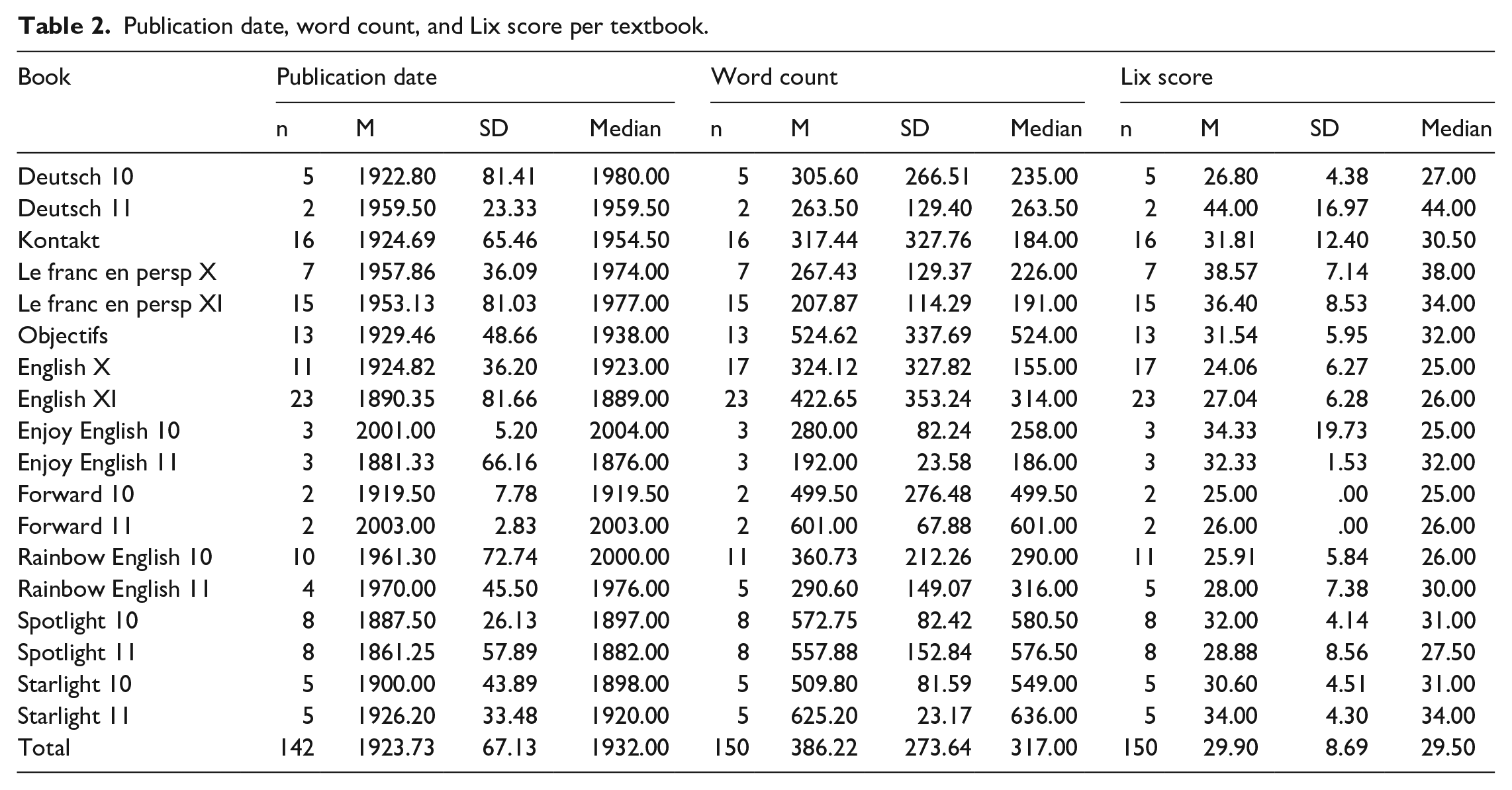
Table 3 contains the descriptive statistics for texts’ average date of publication, word count, and Lix score per language. The data indicate that English texts are slightly older, lengthier, and easier to read (grade 6), on average, than French (grade 8) and German (grade 7) texts. Here, we discovered that the French and German texts had been left untouched (they had not been modified from their original versions) while English texts had been modified to the extent that they had been made shorter. The textbook authors appeared to have done this by either deleting sentences or by fusing two sentences together by deleting bits from each, for example, the beginning of one and the end of the other, and adding a new connector (conjunction) in between. In none of the instances, however, did we find a text where sentences had been reworded. In fact, it was clear that textbook authors had overwhelmingly preferred deletion over rephrasing.
Publication date, word count, and Lix score per language.
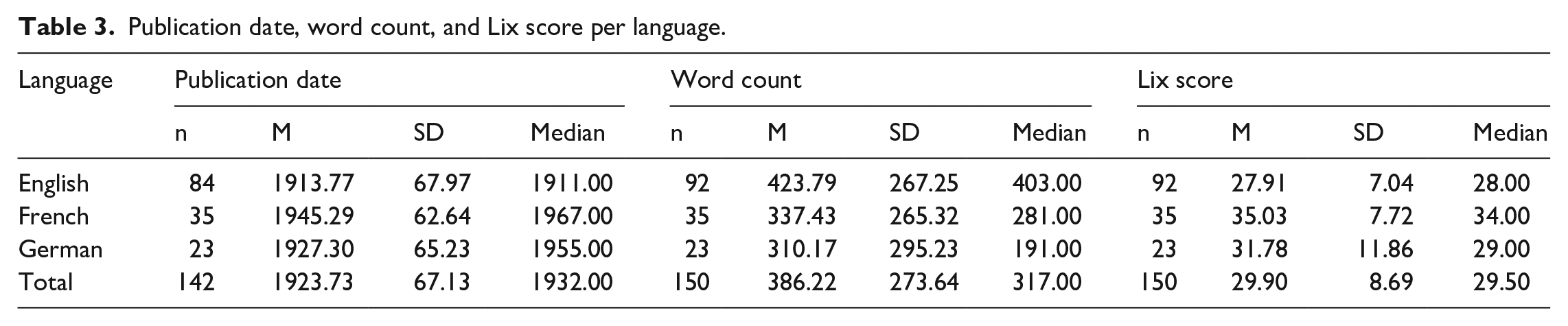
A Kruskal–Wallis test was performed to ascertain whether there was a statistically significant difference between the English, French, and German literary texts based on average text age, word count, and Lix score. The results indicated that there was a statistically significant difference between the texts regarding age (H(2) = 7.186, p = .028) and Lix score (H(2) = 18.844, p < .001). Bonferroni post-hoc tests indicated that English texts, on average, were not only statistically significantly older than French texts (p = .024, g = .471), but were also statistically significantly easier to read (p < .001, g = .979); the effect size with regard to text difficulty is large. There were no statistically significant differences between German and English texts or French and German texts in these two respects. As for word count, although the Kruskal–Wallis test reported a statistically significant difference between the texts (H(2) = 7.505, p = .023), the post-hoc test revealed that the differences were not, in fact, statistically significant between either the French and German (p = 1.00) or the English and French (p = .180) texts. With respect to the German and English texts, however, the differences were very nearly statistically significant (p = .052).
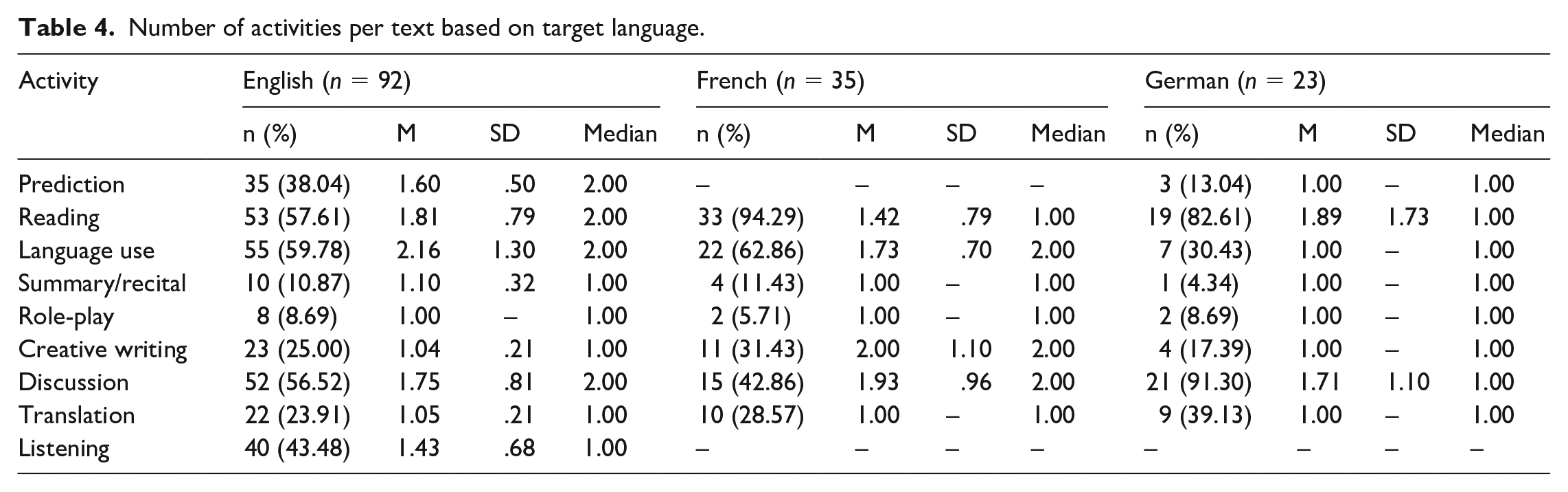
Table 4 lists the descriptive statistics for the average number and type of activities accompanying each text based on the target language (for a visual representation of the data, see Figure 1). The data indicate that most English texts are accompanied by activities linked to language use, reading comprehension, and discussion, with such activities usually occurring more than once per text. French texts appear to similarly favour reading comprehension and language use activities, although there is also a greater focus on creative writing, with almost a third of texts (n = 11, 31.43%) accompanied by an average of two such activities. German texts, conversely, tend to primarily favour reading comprehension (n = 19, 82.61%) and discussion-based activities (n = 21, 91.30%).
Number of activities per text based on target language.
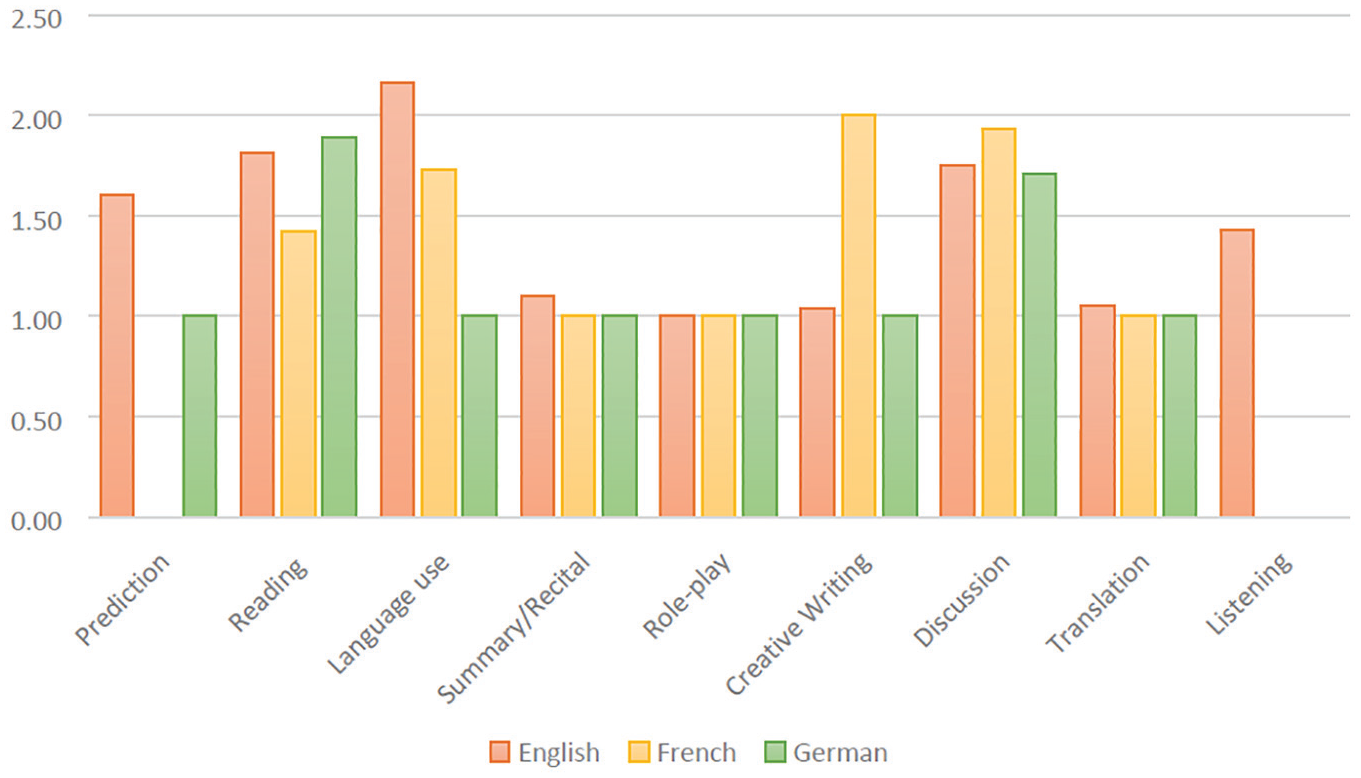
Average number of activities per text across languages.
A Kruskal–Wallis test was performed to ascertain whether there was a statistically significant difference between texts based on the number and type of activities that accompany them. The results indicated that there was a statistically significant difference between the English, French, and German texts with respect to reading comprehension (H(2) = 6.800, p = .033), language use (H(2) = 7.567, p = .023), and creative writing (H(2) = 13.667, p = .001). Bonferroni post-hoc tests indicated that English texts, on average, when accompanied by reading comprehension, include these in statistically significantly greater numbers than French texts (p = .030, g = .489); they were also found to include statistically significantly more language use activities per text than German texts (p = .019, g = .929). French texts, meanwhile, are accompanied by statistically significantly more creative writing activities than English texts (p = .001, g = 1.467) and German texts (p = .048, g = .976). The effect size in most cases is quite large.
V Discussion
1 Literary types and periods
The findings provide some notable insights into how the English, French, and German textbooks used in schools in Russia approach the inclusion of literary texts. First, it is clear that all the textbooks investigated for this study contain literary texts and activities that are mostly in line with the MoE’s FL standards (MoE Moscow, 2012), which is perhaps not surprising since they are all ministry-approved. The standards call for the inclusion of classical and modern fiction, and so we see that the textbooks contain both types, although several of them contain a large number of texts that are a century old, on average, with English textbooks containing statistically significantly older texts than French textbooks (see Table 2). Perhaps there are issues with licensing literary works, although some textbooks clearly do contain more texts from the 21st century, notably the Forward series. Since the publisher is often the same, text selection likely reflects the beliefs and preferences of the textbook authors, similar to the case reported by Tsagari and Sifakis (2014), and it is apparent that they have different views about literature and its place in language education. One possible downside to including older texts is that it might leave a negative impression on language teachers who clearly desire more modern content (Calafato, 2018b).
It might also be difficult to keep students motivated if they have to read texts that are too old and contain language and contexts that they feel are irrelevant to what they encounter in the real world. Indeed, since FL education programs often aim to develop learners’ pluricultural and plurilingual intercultural communicative competence, publishers and textbook authors need to select texts that can more effectively introduce learners to different cultures and associated language use in the present and not at some point in the distant past. It is also worth noting here that some textbooks, namely Objectifs, Spotlight, and Starlight, despite their preference for older texts, specifically devote an entire subsection per unit to literature, a design characteristic that is not found in any of the other textbooks analysed. The inclusion of literature as a specific subsection, we feel, is a welcome addition to language textbooks because it makes literary content more systematic and explicit. Moreover, since these subsections include a mix of listening, reading, speaking, and writing activities, the result is a more integrated learning format that can lead to a deeper, more meaningful engagement with the target language for students while also developing their interpretive, critical thinking, and language skills (depending on appropriate text selection, of course).
As for literary types, most textbooks have a preponderance of literary prose extracts, similar to the textbooks in Skela’s (2014) study, with less attention paid to poetry and plays even though some textbooks do contain notable amounts, percentage-wise, of poetry, for example, English X, English X1, and Kontakt (see Table 1). The MoE standards do not explicitly mention poetry or plays, only referencing modern and classic fiction (MoE Moscow, 2018), and perhaps this is one reason why prose generally tends to dominate. At the same time, it is not clear why textbooks from the same publisher, targeting the same grades, and of a similar size (e.g. English X and Spotlight 10) contain such different ratios of poetry and prose (see Table 1). It is likely that this might have something to do with the textbook authors’ personal theories and preferences regarding literature (see Tsagari & Sifakis, 2014). It might also be due to space considerations since prose might provide a higher words-per-page ratio than does poetry or perhaps it is easier to design activities around prose. In any event, the decision to focus mostly on prose can have practical benefits since studies report that students view prose positively while having a less positive opinion of poetry (Akyel & Yalçin, 1990). Teachers have similarly expressed reservations about incorporating poetry into their lessons (Calafato, 2018b), often due to fears that it might be difficult to teach (e.g. Weaven & Clark, 2013).
2 Activities and readability
Reading comprehension, language use, and discussion appear to be the most popular activities across all languages (role-play appears to be the least popular activity), although there are some differences between languages in this regard. For example, most German texts include reading comprehension and discussion, with far fewer texts employing language use and translation activities. French texts, meanwhile, similarly favour reading comprehension activities, although language use activities, in contrast to German texts, appear to be much more popular here. Creative writing also figures statistically significantly more prominently as an activity with French texts than it does with English texts (see Table 4), which tend to have the greatest diversity of activities overall, including not only listening comprehension, but also prediction-based activities. There is, nevertheless, a preponderance of reading comprehension and gap-fill/matching activities (see Table 4) in textbooks across languages, which might negatively impact learners’ and teachers’ motivation to engage with the text because of how repetitive these activities might become (Cherubini, Zambelli, & Boscolo, 2002). Furthermore, reading comprehension and gap-fill activities have often been criticized for not encouraging learners to deeply engage with texts, with the focus often being on information retrieval (reading comprehension) or a test of grammar or vocabulary knowledge that is presented in isolation of the text (Rivas, 1999; Wolf, 1993).
We, therefore, recommend reducing the number and frequency of reading comprehension and gap-fill/matching activities and increasing the variety and frequency of tasks (e.g. role-play and creative writing) that can help learners to reflect on and relate their knowledge and experiences to the text in imaginative and creative ways (see Rivas, 1999). These types of activities can not only more effectively integrate reading with the other language skills than what is possible through reading comprehension and cloze activities, but they also provide students with the creative freedom to more effectively develop their language skills (Feuer, 2011; Rivas, 1999). Role-play and creative writing, for instance, have been described as increasing learners’ language awareness, intercultural competence, and motivation, while also serving as a platform through which they can experiment and engage more deeply with the text (Brash & Warnecke, 2009; Feuer, 2011). These activities also cater to different types of learners in that there is no one right answer or outcome, unlike in reading comprehension and gap-fill tasks, and so a diversity of interpretations and expressions is possible (Brash & Warnecke, 2009). This, we believe, perfectly suits the nature of literary texts, which can be full of ambiguity and layers of meaning.
Finally, in terms of text readability, the findings reveal some notable differences. French texts, for instance, appear to be the most difficult to read (grade 8; their ratio of activities like creative writing is also higher than that found in German or English textbooks), followed by German texts (grade 7), and, lastly, English texts (grade 6), with the difference between English and French texts being statistically significant and very meaningful. Perhaps some of this variance is due to the editing that the English texts underwent, although, as already mentioned, this consisted of deleting bits of the text and not replacing words with simpler alternatives. Further research that explores literary content across languages in different countries using readability measures will likely shed more light on whether this is a pattern that distinguishes English language textbooks from LOTE textbooks. In the meantime, since text difficulty can affect student motivation and interest (Guariento & Morley, 2001), it is possible that learners will feel more intimidated by the literary content in their French and German textbooks when compared to the comparatively easier texts in their English textbooks. Of course, it is difficult to accurately predict student attitudes and performance through readability tests alone, although these can serve as an important, supplementary tool for text evaluation because they give teachers, schools, and textbook authors the ability to quickly and conveniently assess how difficult their selected texts will be for students to read. The methodology used in this study represents one possible framework to accomplish this across languages.
VI Conclusions and implications
Before proceeding to the conclusion, we would like to discuss some of the study’s limitations. First, the Lix formula (and the corresponding grade levels) used in our study was originally developed for L1 contexts, as already mentioned, and so we do not assume that the Lix scores and grade levels reported here are a completely accurate representation of text difficulty for L2 learners. It is also worth noting that Lix scores have been used somewhat infrequently until now to evaluate the readability of foreign language textbook context and that could partly be because research on language textbooks has often not focused on quantitatively assessing their readability. It is perhaps inevitable that there will arise multiple issues with an approach where one seeks to compare readability scores across different languages, although we feel that this constitutes an important area of research that requires our attention. Moreover, we would like to state that, despite the difficulties inherent in using Lix to assess readability in L2 contexts, it remains one of the only measures to have been used in LOTE contexts (e.g. Saddiki, Bouzoubaa, & Cavalli-Sforza, 2015), one that can effectively and quickly assess readability in diverse languages. We feel that this is important, especially since one of the goals of this study is to encourage teachers, who might be teaching multiple languages and do not always have a lot of free time, to use a measure like Lix to quickly evaluate and compare texts in the language textbooks they use. Moreover, it is hoped that this study will contribute to the impetus to produce a readability measure that, in addition to being more accurate and similarly convenient to use, can evaluate texts across multiple languages while also accurately mapping the scores onto CEFR scales or a similar language proficiency standard. At present, no such measure exists.
As for the study’s findings, the Lix scores, their shortcomings notwithstanding, do show a clear cline of difficulty, from English to French, and while the corresponding grade level might not be fully accurate, the statistically significant differences between readability scores based on language are quite evident and require further exploration. Indeed, the findings underscore the need for more research that evaluates literature use in textbooks across multiple languages, notably in multilingual contexts, where students are learning more than one foreign language concurrently. The textbook, given its role as one of the main educational artefacts used in schools and even universities, is likely to continue to be of vital importance for students and teachers engaged in language education globally despite technological innovations. By including more literature, learners can more effectively use this artefact to develop and display their language skills, knowledge, and experiences, as well as their intercultural competence, creativity, and motivation across languages. Should textbooks favour everyday texts over literature, students’ motivation to learn FLs will likely remain limited (and might even fade) since such texts are unlikely to engage learners cognitively or emotionally to the extent that literature can. It is, therefore, important to explore how literature is being incorporated into textbooks using a comparative approach that looks at multiple languages. This is especially important given the growing emphasis placed by countries, for example, Russia (PIRAO, 2017) and Norway (Utdanningsdirektoratet, 2019), on the learning of multiple languages at school as a way to develop learners’ pluricultural knowledge, intercultural communicative competence, and multilingual abilities. Such research would also be particularly relevant given that several countries explicitly promote literature as a component of their FL curricula at the school level.
There is, at the same time, a need for a more systematic methodological approach that allows not only researchers, but also teachers, to analyse textbooks efficiently and rapidly for literary content and accompanying activities in order to better understand the nature and likely impact of such content on their learners. Such a methodological blueprint, like the one presented in this study, represents one such approach to comparing the ways in which textbooks incorporate literary texts across different languages and countries. It could, in addition, help publishers and textbook authors (by presenting data in a uniform format) to devise ways, at the textbook-level, to make learning more engaging and interesting for learners, thereby contributing to a greater interest in foreign languages among younger generations than might exist at present (Looney & Lusin, 2018). We, therefore, hope that this study will encourage researchers to further test out and refine the blueprint presented here or to devise their own methodological framework, one that, in addition to including a convenient readability scale, is practical and easy to use with multiple languages. In this regard, some inspiration can be taken from the grading schemes sometimes used in extensive reading (e.g. Hill, 2008).
Footnotes
Author’s Note
Freda Gudim is now affiliated with ALIBRA School, Russia.
Declaration of Conflicting Interests
The author(s) declared no potential conflicts of interest with respect to the research, authorship, and/or publication of this article. The submitted manuscript has not been published previously in any form.
Funding
The author(s) received no financial support for the research, authorship, and/or publication of this article.
