



Abstract
There is now extensive theoretical and empirical literature on the place of the first language (L1) and the second language (L2) in the foreign language (FL) classroom. Although this body of work includes related teacher beliefs and practices, less attention has been paid to the factors that may influence these practices across different national contexts. Through an extensive survey of secondary school teachers of a FL in Spain and England we investigated teachers’ reported L1/L2 practices and the possible influence of pre-service training on these practices. We found that teachers in England reported greater use of the L1 than teachers in Spain across virtually all language functions. In both groups there was no evidence of the influence of advocated teaching approaches within pre-service training courses on teachers’ reported L1 and L2 use. Differences in teachers’ reported practices seem to be better explained by contextual factors influenced by and derived from national policy and the social value of the L2.
Keywords
I Introduction
There has been extensive research on the controversial question of the role of students’ first language (L1) and second language 1 (L2) in instructed language learning settings. Researchers have produced quantitative descriptions of L1 and L2 distribution in lessons and the ‘functions’ to which each language is put have also been explored, the data being collected either through teacher self-report or via classroom observation. Despite considerable research efforts, teachers’ use of L1 and L2 is a topic which continues to provoke considerable debate in school staffrooms and the published literature (Chambers, 2013).
The current study investigates secondary school L2 teachers’ self-reported language practices in Spain (in regions which have only Spanish as the official L1) and England, with a focus on teacher’s use of the (national) L1 and L2 across a range of classroom functions. We can find very little research which compares language teachers’ reported practices regarding L1 and L2 in different national contexts. This study contributes to the field by comparing teachers’ reported practices and relating these to two key aspects of national context: (1) the current and historical social value of the L2s being taught and (2) the nation’s policies in relation to L2 education. A comparison between Spain and England is of interest for the following reasons: First, although both Spanish and English (as respective L1s of those countries) enjoy a high status as ‘world languages’ with the second and third most native speakers respectively (Simons & Charles, 2018), English is by far the predominant L2 taught in Spain whereas Spanish is just one of the L2s offered by schools in England together with French, German, and Mandarin Chinese. It is of interest therefore to investigate whether the status of English as the world’s current lingua-franca has an impact on aspects of L2 pedagogy as compared to other L2s. Second, the direction of language-related government policy in these two contexts has diverged over the last decade, with Spain strongly promoting language learning whilst England’s commitment to language education appears to be faltering. Yet despite the above differences, both countries have a poor record of prior attainment in language learning (European Commission, 2012).
This article focuses on the functions for which teachers in instructed FL classrooms report using L1 and L2. Whilst there may be a great many factors that influence teachers’ declared pedagogy (explored in the review below), the article aims to investigate the possible influence of methodologies that may have been advocated within pre-service training courses. These courses almost invariably include some critical analysis of different approaches to language teaching and L1/L2 use in the classroom but there is conflicting evidence regarding the extent to which such courses may influence teachers’ subsequent practices (Macaro, 2001; Yook & Lee, 2016). Thus, an exploration of the possible influence of pre-service training on L1/L2 use (an aspect of pedagogy which is of major concern to teachers and researchers alike) within two different national policy contexts (Spain and England) offers a valuable contribution to the fields of L2 teaching and L2 teacher education. It is with a brief description of the evolution of different methodological approaches that have been advocated in connection with the use of L1 and L2 that we begin the review of previous literature.
II Review of the literature
Alternative methods to a long-standing Grammar-Translation approach to L2 teaching in Europe began to be introduced well over a century ago through the advocacy of the Direct Method and were picked up by language schools such as Berlitz (Hall & Cook, 2012; Richards & Rodgers, 2001). Whilst the visible difference between the Direct Method and Grammar-Translation was the former’s avoidance of the L1 (if not its outright banning) the underlying theoretical stance was that the vocabulary and structures of the language could be learnt implicitly or inductively rather than explicitly or by comparison with the L1. Around the 1950s the Audiolingual Method also prioritized listening and speaking via a tightly-controlled L2 only approach (Larsen-Freeman and Anderson, 2011). Further impetus to the avoidance of the L1 or, at least, to its marginalization, came with those researchers working in the broad field of input, interaction, output, and oral feedback in the 1980s and 1990s (Chaudron, 1988; Gass, 1997; Krashen, 1985; Long, 1981; Lyster, 1998; Swain, 1995). Following Hymes’ (1972) seminal notion of communicative competence (later taken up by Canale and Swain, 1980), these authors promoted a much greater emphasis on language skills as learning outcomes, rather than emphasis on declarative knowledge about the L2.
At the time of writing there has been a considerable reversal of, what we might call, the L2-only approach, or as Cook (2010) has termed it, the ‘intralingual approach’ within the published literature. This change has occurred as a result of the confluence of several different intellectual and empirically based arguments. First, there is the case of English as the ‘dominant’ language of international communication but one which is tainted with a colonial past (Canagarajah, 1999; Phillipson, 1992) meaning that where English is taught as an L2, an L2-only teaching method may seem like a further form of imperialism. Linked to this theoretical position is the fairly conclusive evidence that the ‘native speaker of English’ is given preferential treatment when applying for a job as an English language teacher (Moussu, 2006) even though, many argue, the bilingual teacher who can speak the language of the learners may be in a better position to obtain desired language outcomes (Llurda, 2005).
Second, there is an increasing assertion that in the learner’s brain the L1 and the L2 are not situated in separate modules. Rather, they are interconnected, constantly interacting in both the learning process (Jiang, 2002) and in their use. Lantolf & Thorne’s (2006) work on sociocultural theories of language learning emphasizes that learners’ private and inner L1 speech is a key tool used to develop and organize conceptual understanding of L2 systems. Researchers interested in the complex social and cognitive interplay between L1 and L2 have coined concepts such as ‘multicompetence’ (Cook, 2012) and ‘translanguaging’ (García & Wei, 2014; Lasagabaster & García, 2014) expressing this psycholinguistic process, complementing and sometimes arguing for the replacement of the sociolinguistic concept of ‘codeswitching’ (Myers-Scotton, 1993).
Third, there is a body of literature which simply asserts that in many contexts, particularly where there is limited curriculum time devoted to L2 study, students do not have the requisite level of the L2 to learn the language through the language and that teachers must resort to the L1 in order to ensure that learning does occur, or that teachers themselves are not skilled enough to be able to maintain a teaching approach which minimizes reliance on the L1 (Liu et al., 2004; Macaro, 2005).
The changing recommendations for practice drawn from the theories discussed above are likely to have permeated pre-service teacher training programmes, staffroom discussions and policy documents over time. Contemporary arguments about the place and value of the L1 in the L2 classroom have reignited a debate that L2 teachers simply cannot ignore – each individual must make decisions about which language they will use at which moments as a tool to mediate learning in their classroom.
The general pedagogical intent of a teacher as (s)he steps into the classroom to teach a language lesson may influence their use of the L1 and L2. For example, a teacher may privilege the development of communicative skills or their teaching may give status to the mechanics of the language and to comparing the lexis of the L1 and L2. One way of determining a teachers’ general pedagogical orientation was proposed by Allen, Fröhlich and Spada (1984) who developed the ‘COLT’ observation schedule. Other approaches include: recording the quantity of L1 and L2 used in lessons; recording the functions for which each language is used in the classroom; and asking teachers directly to explain their L1/L2 practices.
If taken together, studies which have examined the amount of L1 use in the L2 classroom (De La Campa & Nassaji, 2009; Duff & Polio, 1990; Hosoda, 2000; Kong & Zhang, 2005; Liu et al., 2004; Macaro, 2001; Rolin-Ianziti & Brownlie, 2002) suggest there is huge variation both between (e.g. national) contexts and even within contexts. In a collection of studies on codeswitching in Asia (Barnard and McLellan, 2014), data analysis shows that in countries such as Taiwan, Vietnam and Thailand there is a very large range of L1 use within-country which might suggest that either there is no official policy or that teachers do not adhere to a policy of L1/L2 use. Significant within-country variation has also been found in England: Hobbs et al. (2010) carried out case studies of three teachers teaching Japanese in the UK of which two were native speakers of Japanese and one a native speaker of English. Using participant background information, observations of practice and interviews, they found that the native speaker teachers used far more L1 than the non-native speaker teacher. The authors interpret this by suggesting that the cultural background (of the Japanese nationals) had a greater influence on their pedagogical practice than their native level of proficiency in the language they were teaching.
Overall, studies that have investigated the ideal balance of L1/L2 tend to conclude that the L2 should be the predominant language of classroom communication and should be used for around 80–90% of all communication (Macaro et al., 2016). Galindo Merino (2016) summarizes the balance of L1/L2 use across several studies: most of these fall within the range indicated by Macaro et al. (2016), including the data collected in Galindo Merino’s own research.
Moving beyond questions of the quantity of L1 and L2, we turn to the functions for which each language may be used in the classroom. Several researchers have described a range of common language functions in the L2 classroom (Duff & Polio, 1990; Levine, 2003; Lin, 2015; Mitchell, 1988). Lin (2015) suggests three categories of functions for which the L1 may be of pedagogical value: ideational (i.e. explaining the L2), textual (i.e. managing transitions between topics/ideas) and interpersonal (i.e. negotiating identities and cultures). Studies investigating the functions of L1/L2 use by categorizing the observed classroom teacher talk indicate that, irrespective of context, the L1 is used for a wide range of functions across all three categories (Copland & Neokleous, 2011; Galindo Merino, 2016; Gené Gil, Juan-Garau & Salazar-Noguera, 2012; Hosoda, 2000; Kim & Elder, 2005; Storch & Wigglesworth, 2003; Üstünel & Seedhouse, 2005). These include translation of L2 words or phrases, grammar explanations, class management, making jokes (as an aside to the content of the lesson) and instructions for carrying out tasks. In fact, with the exception of greetings and goodbyes in Galindo Merino’s (2016) study of university classrooms in Spain and Hawaii, there appear to be no functions to which the L1 is never put. There do, however, appear to be some common functions for which the L1 may be regularly employed across contexts, for example L1 use in relation to managing classrooms or dealing with communication breakdown in giving instructions. Furthermore, in their case study of three teachers – two teachers of English as a foreign language (EFL) and one teacher of English via a content and language integrated learning (CLIL) approach – in the Balearic Islands, Gené Gil et al. (2012) found language choices were largely dependent on whether the learning situation was planned or unplanned, with unplanned language being more likely to occur in the students’ L1.
Finally, we turn to studies which have asked teachers directly to report and explain their L1/L2 practices. Macaro (2001) categorizes overall teacher beliefs about L1/L2 use into three groups: first, the ‘virtual position’ excludes the learners’ L1 completely, seeking to create a natural L2 environment in the classroom; the ‘maximal position’ considers L1 use to be undesirable but inevitable at times; and finally the ‘optimal position’ conveys the idea that a justified use of the learners’ L1 may in fact be beneficial to the learners’ progress in the L2. The optimal position is well-aligned with recent research (reviewed above) into the social and cognitive benefits of an intentional use of some L1 to mediate L2 learning. Copland and Neokleous (2011) investigated teachers’ rationales for using the L1 for different functions by asking them to comment on them. Some of the teachers thought it was better for learners to work out the meaning of words for themselves rather than to give them a translation directly. Others felt that the use of the L1 (Greek) saved time and reduced student stress. However, why there might be such a divergence of belief was not part of the aims of the study. A comparative study of trainee teachers of EFL in Spain and Poland (Wach & Monroy, 2019) found that although Spanish trainees did not reject the L1 as a resource for language teaching, the Polish trainees reported significantly more positive attitudes towards the use of L1 for classroom management, explanations, instructions and relationship building than their Spanish counterparts. Agudo (2017) also surveyed trainee EFL teachers in Spain with similar results: over 80% of participants agreed that L2-only teaching is beneficial to learning. Some 50–60% of these same trainees however indicated that L1 could be helpful when giving complex instructions, teaching grammar, explaining unfamiliar vocabulary, and resolving misunderstandings. Interestingly, 50% disagreed that L1 is necessary for behaviour management, a function that is often identified in published research as a time when L1 use may be preferred (Macaro, 2005). Similar opinions on L1 (Spanish) use were found by Higareda, Lopez and Mugford (2009) with trainee teachers of EFL in Mexico: 86% of the trainees believed that the use of the L1 (Spanish) was justified in certain circumstances, in particular when teaching grammar and explaining vocabulary. However, the overwhelming majority said they would not use the L1 for giving instructions and classroom management.
Studies into teachers’ self-reported beliefs and practices must be interpreted cautiously as teachers may not always be fully aware of unconscious factors driving their thoughts and behaviours (Korthagen, 2016). This is a possible reason for Borg and Burns’ (2008) finding that FL teachers rarely refer to theory or methodological principles when asked to articulate their beliefs about language learning and teaching. Copland & Neokleous (2011: 271) found that teachers in their study seemed to lack awareness of their L1 use, ‘under- reporting and ‘differently’ reporting their L1 practices’. The authors suggest that feelings of guilt about (over)use of L1 may play a part in this, with teachers struggling to reconcile their pedagogical principles with the realities of their classroom contexts.
When seeking to explain L2 teachers’ espoused beliefs and practices, a range of influencing factors have been identified, including: the teacher’s prior learning experiences; their pre-service training; their level of expertise in the L2; the learners’ attitudes and proficiency level; the national and local policy context; the social value of the L2s being taught; and the assessment structure (which may reward certain pedagogical approaches) (Macaro, 2005). Of particular interest to us as teacher educators is the relationship between pre-service training and L2 teachers’ subsequent classroom practice. The strength of this relationship is contested and whilst there is some evidence of teacher education courses impacting teachers’ beliefs and practices (Brouwer & Korthagen, 2005; Postareff, Lindblom & Nevgi, 2007; Yook & Lee, 2016), there are also studies that suggest these courses have only a very limited impact (Cochran-Smith & Zeichner, 2005; Macaro, 2001; Peacock, 2001). Kagan (1992) suggests that inconsistency in the results of studies examining the impact of pre-service training on teachers’ practice may be due to differences in the nature of the training course; trainees’ personal biographies and the classroom context in which they go on to teach. In particular, conclusions about effective pedagogy drawn from personal learning experiences have been found to remain influential throughout L2 teachers’ professional lives (Borg, 2003). Teachers’ past experiences as an audience member in L2 lessons as a learner at school have been termed an ‘apprenticeship of observation’ (Lortie, 1975) or indeed, an ‘anti-apprenticeship of observation’ (Moodie, 2016), providing L2 teachers with default models of what (not) to do in the classroom. One of the few studies to have discussed pre-service training as a factor influencing language teacher beliefs and practices regarding L1 and L2 use was by Macaro (2001), who found that one of the teachers interviewed was heavily influenced to teach through the medium of the L2 by her interpretations of both national and pre-service training policy, whilst another stuck to personal beliefs acquired through her own learning process. We could find no longitudinal studies that have followed pre-service L2 teachers into later employment to establish whether and to what extent ideas and methodologies that are promoted during their pre-service training courses are reflected in their classroom practices.
The range of practice and divergence of opinion found in the literature related to L1 and L2 use indicates that further research is of continued relevance to develop our understanding of the factors that may influence teachers’ decision-making processes in the classroom.
III Research questions
We formulated the following research questions for our study:
What are the frequency and functions of L1/L2 use reported by secondary school language teachers in England and in Spain?
Is there a relationship between secondary school language teachers’ perceptions of their preparation for teaching (pre-service training) and reported use of L1/L2?
As teacher educators and researchers in Spain and England, we were interested in comparing teachers’ reported L1 and L2 use across these two countries. Spain and England are near neighbours and their respective L1s enjoy a high status as world languages. However, recent education policies and public perceptions of the status of language learning differ greatly within the two nations as explored below.
1 Spain
Attitudes to L2 teaching from both society and education authorities in Spain have changed significantly over the last four decades. From a subject bearing hardly any importance in the 1970s, today L2 teaching and learning are very highly regarded. French has gone from being practically the only L2 taught at school to being almost totally replaced by English, the social value of which has steadily increased (Tabuenca-Cuevas, 2016). Indeed, an average of 93% of students in primary and secondary education are currently learning English (MECyD, 2016).
The number of years of learning an L2 has also increased. The 1970 Education Act made an L2 compulsory from the age of 11 to 18. The starting age dropped to 8 and then to 6 with each major new education reform act, which affected all types of schools: state, subsidized and private. Although not compulsory, over 80% of students start learning an L2 at age 3 (MECyD, 2016). L2 learning takes up between 3 to 4 compulsory hours per week throughout primary and secondary education (MEC, 2006a, 2006b) and further suggests the importance of L2 teaching and learning in the curriculum.
L2 teaching methodology has also experienced a significant change from the audiolingual method of the 1970s, to the communicative approach in the 1990s. The 2000s saw a promotion of CLIL, which gave rise to the creation of special-status primary and secondary state and subsidized schools known as ‘bilingual schools’, within which bilingual programmes are often a compulsory element of the curriculum. While bilingual school attendance is optional, places at these schools are in high demand.
In Spain, secondary school language teachers must have completed a four-year university degree in the language they teach. It is also compulsory for them to have a one-year professional master’s degree in education equivalent to the British Postgraduate Certificate of Education (PGCE; see below), which is university-based and includes a 4-month school internship.
There is some diversity in the administration of education in each autonomous region in Spain. However, the Spanish Constitution reserves the legislation of some key educational matters for the state. We have focused in this study on the 12 autonomous communities which are monolingual (with Spanish being the only official language of schooling) in the country out of a total of 17. We left out the bilingual regions to avoid the influence of a variable that we were not able to compare with the English group. With respect to the 12 monolingual regions, the use and exposure to the L2 is a recurrent theme in both regional and national reports, official documents and legislation. In 2010 a report carried out by an independent group of experts to evaluate a bilingual project in Spain was published. The bilingual project was the result of an agreement signed by the Spanish Ministry of Education and the British Council in 1996 to establish bilingual education in 43 state schools throughout the country. Overall, the report recommends teaching through the L2 and states that the role of L1 Spanish is not to replace the L2 but to support it and that its use should be ‘judicious’ (Dobson et al., 2010: 32). Even the interviews with students for the evaluation report were conducted in the L2. The idea of resorting to the L1 Spanish only as an aid reappears in the current Spanish National Curriculum for secondary education (Real Decreto 1105/2014, art. 34.3; Boletín Oficial del Estado, 2015) under the heading of ‘Second additional provision’. It indicates that ‘Spanish or the co-official language only shall be used as support in the process of foreign language learning. Priority will be given to comprehension and oral expression.’ This document clearly shows that the predominant use of the L2 is mandatory in secondary education in Spain. In the regional autonomous community of Andalusia, where bilingual education has been implemented, one of the official documents issued goes even further than the National Curriculum by indicating that the L2 ‘must be used exclusively, especially in early years’ (JACE, 2008).
2 England
The English 2 education system performs poorly in international comparisons of language learning. In 2012 an international survey found only 9% of English pupils were competent in their first foreign language beyond a basic level at age 15, compared with 27% of their peers in Spain and an average of 42% across the 16 European communities taking part (European Commission, 2012). One possible reason for this has been cited as the public perception of language learning as of little social value, a perception that is shaped by the high global status of England’s L1, which may undermine motivation to learn other languages (Tinsley & Board, 2016).
At the time of writing, children in England are required to learn a FL from the age of 7 to 14. There is no prescribed minimum amount of lesson time for language learning although schools are required to meet the demands of the programmes of study published in National Curriculum documents. A recent report found that 1 in 5 primary schools in England admit they are not currently meeting the requirement to offer an FL and those schools who do offer an FL rely predominantly on non-specialist teachers to deliver an average of 30 minutes to an hour of lessons per week (Tinsley & Dolezal, 2018).
At secondary school level, the Teaching Schools Council (2016) has recently recommended that, ideally, schools should be offering at least three hours’ of L2 teaching per week. However, in the majority of English secondary state schools the learning of a language is allocated less time than recommended (Tinsley & Board, 2016, 2017; Tinsley & Dolezal, 2018). The dominant model of L2 teaching in English schools has been described as a ‘weak’ model of communicative language teaching (CLT), where the purpose of learning an L2 is understood to be communicative but the language is still usually taught as a ‘school subject’ with explicitly taught grammar, through the use of the L1, often taking a prominent role (East, 2015; Wingate, 2018). Unlike in Spain, there have been no government policy initiatives relating to bilingual education in England and CLIL programs at state secondary schools are rare.
There have been rapid changes in the landscape of secondary school L2 learning in England: Since 2004 the study of L2 has not been mandatory post-14 and the impact of this has been pronounced: a 2012 report found that against a backdrop of falling numbers taking languages to GCSE, 3 languages currently have the lowest progression rates of all subjects from GCSE to AS 4 (Department for Education, 2012). There has been a recent reduction in the availability of local and national support and advice structures previously accessible to L2 teachers in England following a decision to cut most central funding for languages and to discontinue the National Languages Strategy in 2011 (Johnstone, 2014). In 2015 the Department for Education announced its aim that at least 90% of pupils in mainstream secondary schools should be entered for an L2 GCSE by 2020. However, the government have since acknowledged that this will not be achieved.
De-regulation of the school system in England means that academies, free schools, independent schools and further education colleges have the freedom to design their own curricula and recruitment practices. In practice however, most schools still use the national curriculum (2013) as a guide and require their teaching staff to hold qualified teacher status (QTS), a qualification with an entry requirement of a university degree of 2:2 or above in the main language the trainee intends to teach. There is a choice between a plethora of school-led or university-led routes to QTS. The Postgraduate Certificate of Education (PGCE) is the traditional, university-led route into teaching and involves some academic engagement with research into how languages are learned. The School Direct programme enables schools to recruit and train teachers on the job.
Languages have been identified as a ‘shortage subject’, meaning that there are not enough L2 teachers to meet the needs of the school system in England. A range of bursaries and funded subject knowledge enhancement courses are offered to encourage students to apply to teacher training courses (see https://getintoteaching.education.gov.uk).
The current National Curriculum languages programme of study (Department for Education, 2013) emphasizes the importance of understanding the target language culture as well as developing communicative competence. Although there is no statutory requirement for L2 teachers to deliver lessons in L2, the curriculum aims to increase students’ spoken confidence, fluency and spontaneity: students should find ‘ways of communicating what they want to say’(Department for Education, 2013, p. 1) first and foremost with accuracy a secondary concern. This focus is also found in publications from the National Office for Standards in Education (Ofsted). In 2008 and again in 2011 Ofsted published reports highlighting L2 teachers’ ‘lack of use of the target language to support their students’ routine use of the language in lessons’. The most recent report advises L2 teachers to ‘put much greater emphasis on regular use of the target language in all lessons’ (2011, p. 8).
IV Methodology
1 Instrument
In order to answer the research questions, we adopted a quantitative research design through the use of an online questionnaire written in the L1 of the two countries being investigated (for questionnaire, see Appendix 1 as Supplemental material). This approach enabled us to collect large amounts of information from teachers across two contexts but we acknowledge that our data is limited in that it represents teachers’ perceptions, which may differ from their actual practice (Borg, 2003). The questionnaire had a preliminary section which provided detailed information regarding the aim and ethics of the research and a consent request. To establish the extent to which the classrooms in question were communicative, we followed the Communicative Orientation of Language Teaching (COLT) framework created by Allen et al., (1984) in the main section of the questionnaire. This consisted of 101 items covering three broad topics: Biographic information of the surveyed teachers, including prior experiences of L2 learning and pre-service training (items 1–46), questions about the content of their lessons and teaching materials (items 47–71) and questions about their lesson interaction patterns in connection to the use of the L1 and L2 (items 72–101). Due to space constraints this article concentrates on the questions dealing with the use of L1 and L2. The language functions included in the questionnaire were drawn from lists explored in previous research by Üstünel and Seedhouse (2005), and Macaro (2001). The questionnaire made extensive use of five-point Likert scales which asked respondents to mark the one number that best reflected their opinion/belief, experience or current classroom practice.
We piloted the questionnaire in hard copy with 2 FL teachers in England and 3 EFL teachers in Spain. Based on their feedback, the questionnaire was revised in terms of its length, format, content and language. The questionnaire was again piloted using this time an online format and a second group of 2 FL teachers in England and 2 EFL teachers in Spain.
2 Procedure and sample
The questionnaire was made available to secondary school teachers in 2015 and 2016 via a secure university-based web platform. We chose to focus on secondary teachers due to the current non-statutory status of primary FL education in England.
In Spain we contacted 826 secondary schools from the 12 autonomous communities which are monolingual in the country out of a total of 17. Schools were contacted through their institutional email address made available online by the educational authorities. The email was addressed to the head teachers informing them about the research and asking them for their cooperation by passing an attached letter that included the link to the online questionnaire to the language teachers in their schools.
In England we contacted the FL teachers’ subject association (the Association of Language Learning), who disseminated the survey information sheet to approximately 4,500 members from across England. To increase turnout, letters including a survey link were addressed to the Head of Languages and posted to 100 secondary schools in the South East of England.
By the cut-off date the total amount of responses received was 340 (260 from Spain and 80 from England). The data for the present study comes from a subset of 205 participants (130 from Spain and 75 from England), excluding those teachers in the original sample who said they taught curricular subjects such as maths, history, or science through the medium of an L2.
3 Data analysis
Teachers’ questionnaire responses were imported into a statistical software package (IBM SPSS). Normality of the participants’ responses was investigated using the Kolmogorov–Smirnov test to inform decisions regarding the use of parametric or non-parametric tests for comparing the distribution of means. Pearson Chi-Square tests, t-tests, Mann-Whitney U tests and correlations were calculated to explore group differences and possible associations between aspects of teachers’ reported L1 and L2 use; their reported experiences of initial teacher education; and demographic variables.
V Results
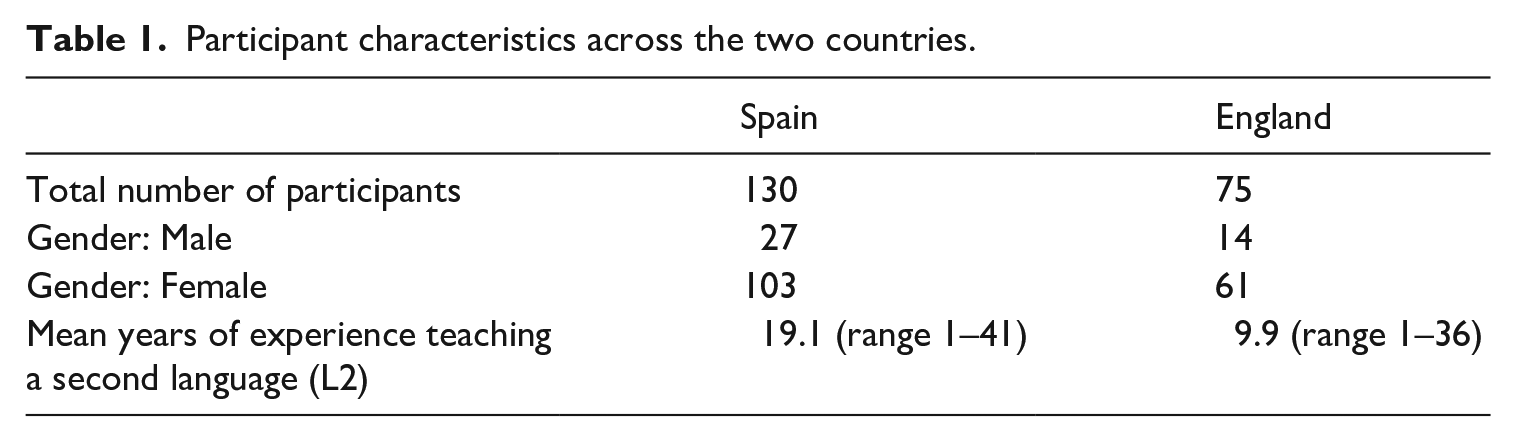
Descriptive statistics for the two groups (Spain and England) are presented in Table 1. In the overall sample of 205 teachers there were no significant differences in the proportions of female and male respondents. However, there was a significant difference in the average number of years teaching L2 for participants in Spain (M = 19.1, SD = 9.4) and England (M = 9.9, SD = 9.1); (t = 6.7, p ⩽ 0.001). The greater experience of the Spanish group may reflect the relative stability of the teaching profession in Spain as most teachers are civil servants leading to low attrition rates.
Participant characteristics across the two countries.
Research question 1
What are the frequency and functions of L1/L2 use reported by secondary school language teachers in England and in Spain?
To answer our first research question, we began by looking at general patterns of reported classroom interaction. Pearson Chi-Square tests revealed no significant group differences in the extent to which teachers in Spain and England reported that they promote oral interaction in the classroom. 77% of teachers in England and 84% of teachers in Spain reported that they often or very often promoted this skill, indicating a general recognition of its importance in the language learning process.
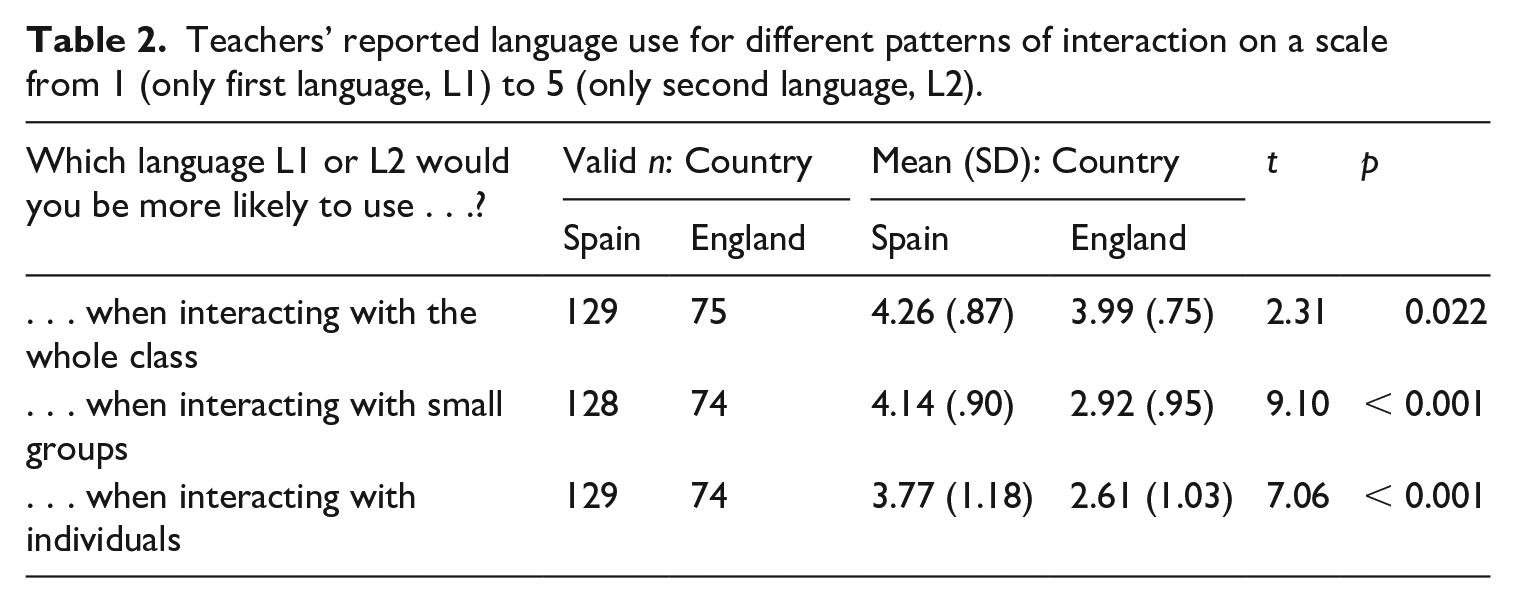
To investigate further the use of L1 and L2 by teachers in the classroom, a series of independent samples t-tests were conducted on the two groups by location (Spain and England). As can be seen in Table 2, teachers in Spain reported a more frequent use of L2 for all patterns of interaction in the classroom, with highly significant differences occurring in relation to average amount of L2 reportedly used by teachers for interacting with small groups (t(200) = 9.1, p ⩽ 0.001) and with individuals (t(201) = 7.1, p ⩽ 0.001). It is interesting to note that in both groups teachers report decreasing use of L2 when addressing fewer students.
Teachers’ reported language use for different patterns of interaction on a scale from 1 (only first language, L1) to 5 (only second language, L2).
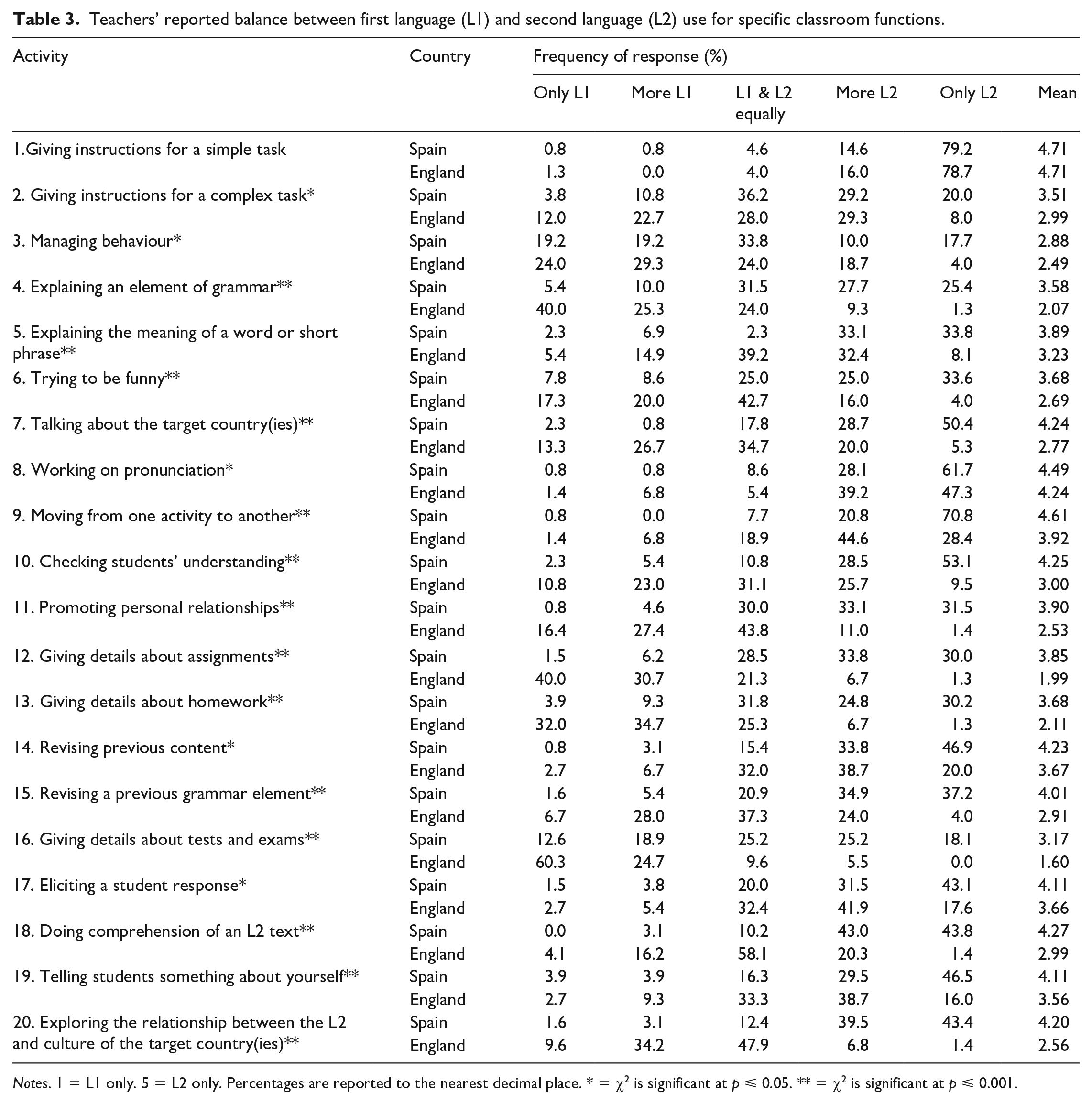
Next, the functions for which teachers reported their use of L1 and L2 were considered. Teachers were asked to indicate on a five-point scale from ‘only L1’ to ‘only L2’ which language they would usually use for a range of 20 classroom functions (for example, ‘when trying to be funny’ or ‘when working on pronunciation’). These results are summarized in Table 3.
Teachers’ reported balance between first language (L1) and second language (L2) use for specific classroom functions.
Notes. 1 = L1 only. 5 = L2 only. Percentages are reported to the nearest decimal place. * = χ2 is significant at p ⩽ 0.05. ** = χ2 is significant at p ⩽ 0.001.
Table 3 shows that on average the teachers in England report a greater use of L1 than L2 for 12 of the 20 different classroom functions (and in particular those focusing on administrative tasks, grammar teaching and behaviour) whereas teachers in Spain report a dominant use of L2 across all but one of the classroom functions: managing behaviour. A clear majority of L2 teachers in England report making regular use of L1 to teach cultural topics (83% across items 7 and 20). This is in sharp contrast to teachers in Spain who were far less likely to report regular use of the L1 for this purpose (19%). Similarly, 89% of teachers in England report making regular use of L1 when introducing an element of grammar (item 4) whereas only 47% of teachers in Spain report this level of L1 use for grammar teaching.
In order to visualize the overall group differences in average reported use of L1 and L2 in England and Spain, each teacher’s Mean score across all 20 different classroom activities was calculated. These Mean scores were subsequently categorized into low, medium and high-frequency use of L2. Figure 1 shows the percentage of teachers that fall into each L2 usage band in Spain and England: there is a clear disparity between reported practices in the two countries at either extreme, with roughly half (48.5%) of the teachers in Spain self-reporting high use of L2 compared to just 1.3% of teachers in England. The opposite pattern is observed for low overall levels of L2 use: 44% of teachers in England self-reported low use of the L2, compared to 2.3% of teachers in Spain.
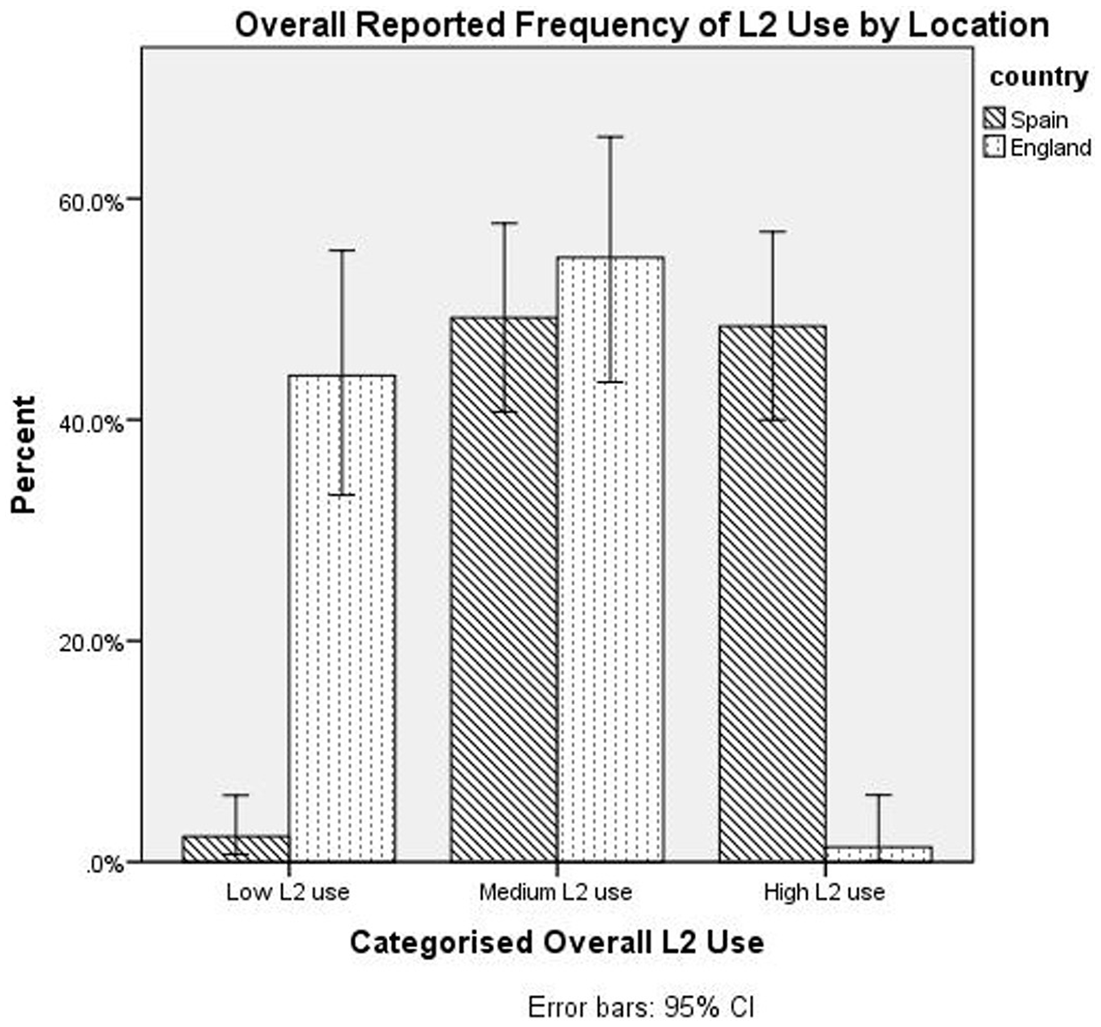
Overall use of L2 by location categorized as ‘low’, ‘medium’ or ‘high’.
In spite of these clear differences, there are some common patterns within the reported language use of teachers in both countries, especially concerning functions for which relatively more L2 is reported, as can be seen in Figure 2. The three functions with the largest mismatch between Spain and England in reported language use are those which relate to tests, assignments and discussions of culture: L1 use is much more prevalent in these cases relative to other functions for teachers in England and this is not the case for teachers in Spain.
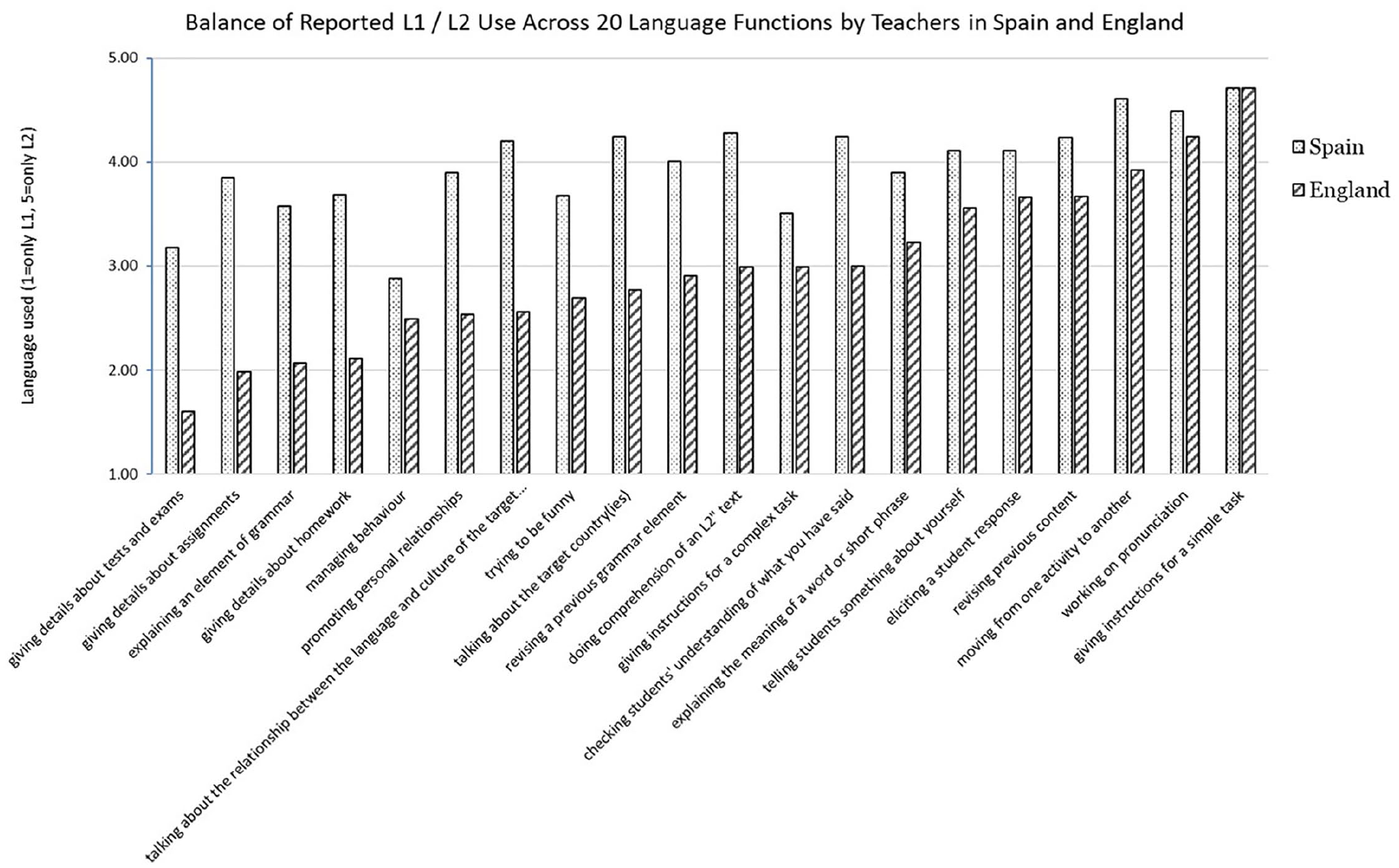
Teachers’ reported balance between L1 and L2 use for specific classroom functions by location
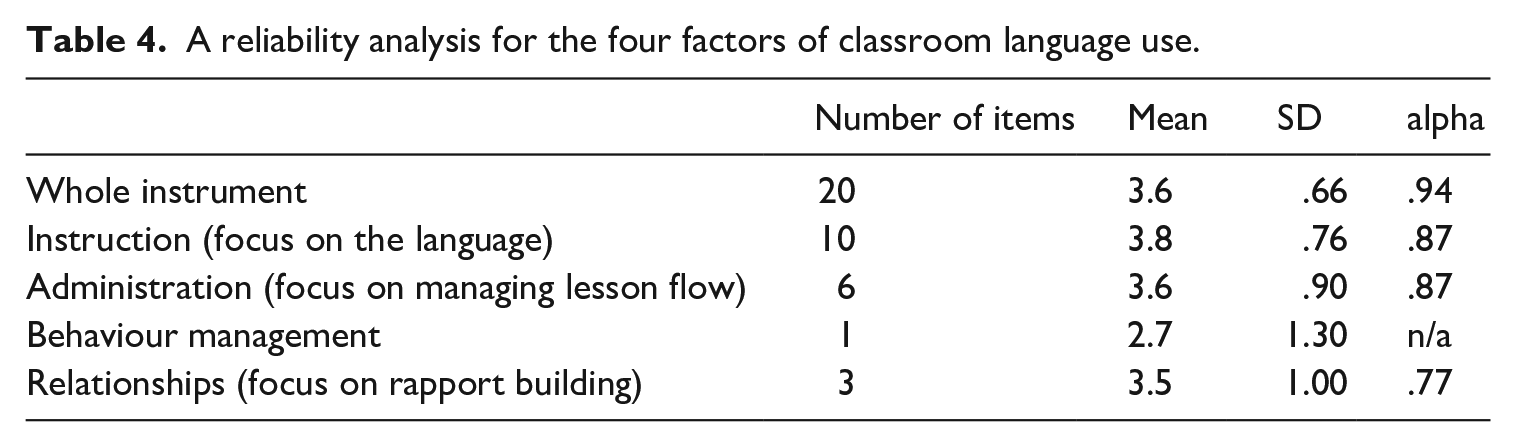
In order to identify further potential patterns in the language functions data, the 20 classroom functions discussed above (and listed in Table 3) were grouped into 4 factors based on those identified in previous research (we made particular use of Mitchell’s (1988), close analysis of L2- and L1-mediated teaching activities in four schools in Scotland). These factors were labelled ‘Instruction’ (items 4,5,7,8,10,14,15,17,18,20), ‘Administration’ (items 1,2,9,12,13,16), ‘Behaviour Management’ (item 3) and ‘Relationships’ (items 6,11 and 19). The internal reliability of these scales was tested and Chronbach’s alpha calculated (see Table 4).
A reliability analysis for the four factors of classroom language use.
The means, standard deviations, ranges and Mann-Whitney U test scores for instruction, administration, management and relationships by country are presented in Table 5. A Mann-Whitney U test showed significant group differences in the functions for which L1 and L2 were used in the classroom as reported by teachers in England and Spain. Teachers in England were more likely than their counterparts in Spain to report use of L1 across the four domains, although the difference is less pronounced (and only approaching significance) for the behaviour management function (U = 4,108, p = 0.054). As might be expected, both groups reported the highest levels of L2 use for the language instruction category, with the lowest individual score being 2.1 (predominantly L1 used). The greatest range and variability in responses across both groups was seen in relation to managing student behaviour, which is the only domain in which teachers in Spain favoured L1 use above L2 use on average. A score of 3 or below indicates that L1 is reportedly used at least half of the time or more. If we accept that a predominant use of L2 is generally considered desirable in the academic literature then we can state that on average, teachers in England report an insufficient use of L2 in their classrooms for three of the four factors in Table 5.
Teachers’ reported language use scores for different classroom functions by country.
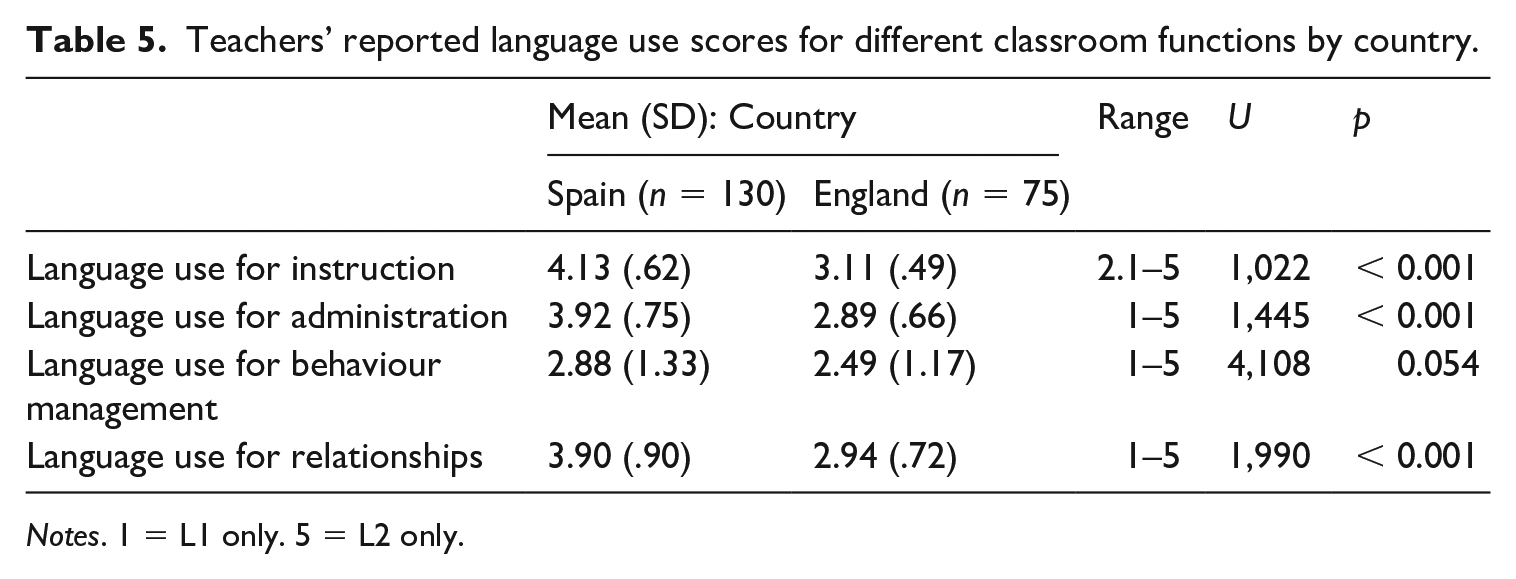
Notes. 1 = L1 only. 5 = L2 only.
Research question 2
Is there a relationship between secondary school language teachers’ perceptions of their preparation for teaching (pre-service training) and reported use of L1/L2?
Whilst acknowledging that a range of factors influence teachers’ classroom practices, we hypothesized that some of the variation among teachers’ reported use of the L1 and L2 for different functions in their classrooms might be explained by the nature of their pre-service training. 30 teachers (28 in Spain and 2 in England) were eliminated from the analysis of data related to pre-service training experiences because they indicated that they had not taken a teacher training course. The experiences of 175 teachers (102 in Spain and 73 in England) were therefore investigated. It is important to note that there is significant variability in the experience levels of participants in our data set, which means that some undertook their teacher training courses quite some time ago and may therefore struggle to recall their experiences.
First, teachers were asked about the degree of freedom and autonomy that was encouraged during their pre-service training course. Teachers in Spain reported being encouraged to experiment with a wide range of tasks and find their own style more than twice as often as teachers in England (31% vs. 14%) (t = 3.59 (153), p ⩽ 0.001). However, somewhat contradictorily, teachers in Spain were also more likely to recall encouragement to emulate the teaching style of experienced colleagues (32% vs. 17%) (t = 2.05 (154), p = 0.042).
Second, teachers were asked to respond via a five-point scale (ranging from strongly discouraged to strongly encouraged) to indicate the degree to which they recall being encouraged to adopt methods that we have linked to 5 different, commonly-used L2 methodologies with differing assumed consequences for use of L1 and L2 drawn from Nunan (1991) (see Table 6). Teachers’ responses regarding their reported encouragement to adopt the five methodologies during their pre-service training courses are summarized in Table 7.
Five commonly used second-language (L2) pedagogies, the statements used in the questionnaire to describe them and the associated focus on first language (L1) or L2 as a medium of instruction.
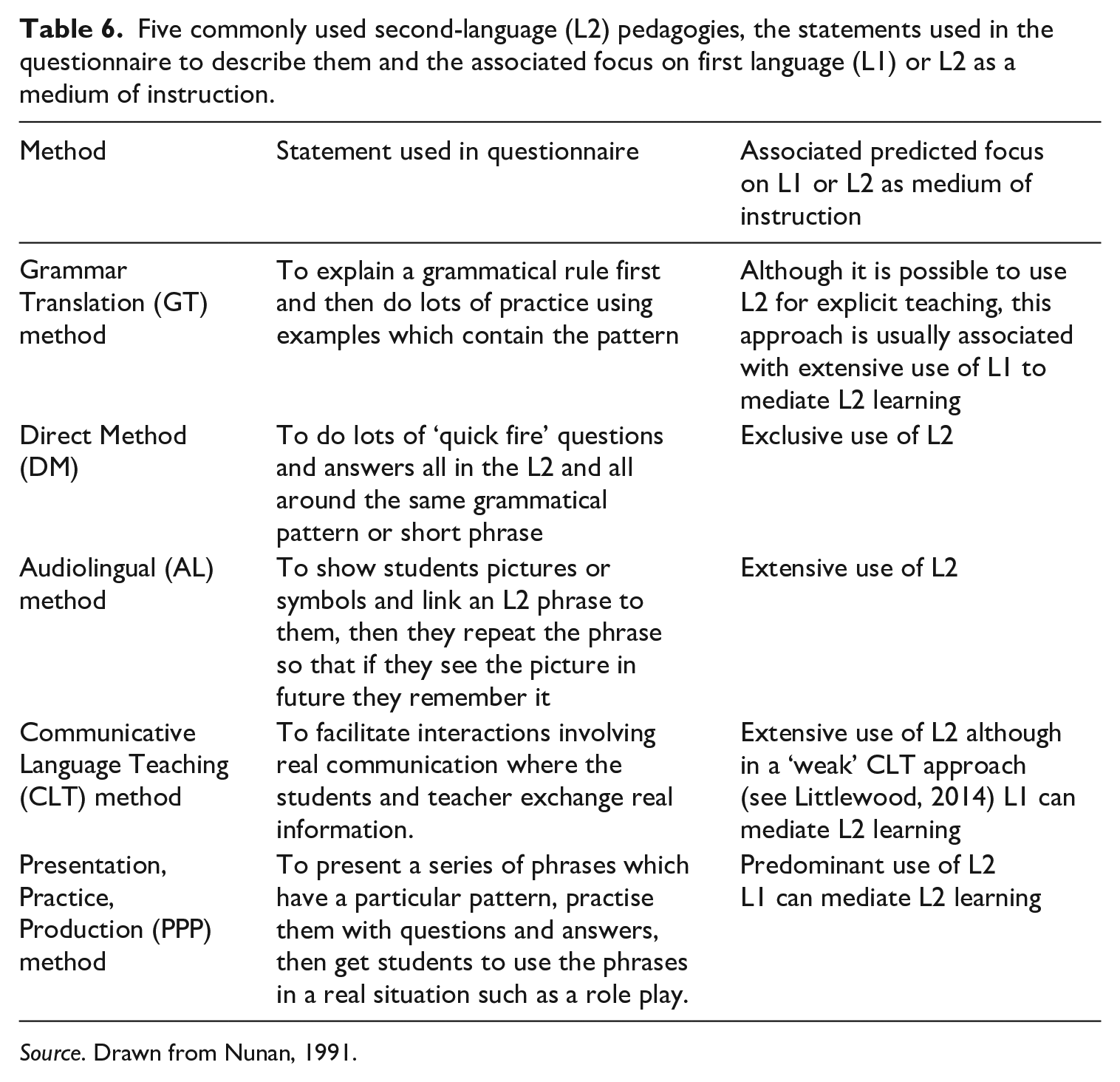
Source. Drawn from Nunan, 1991.
Summary of teachers’ reported encouragement to adopt 5 common pedagogies during their pre-service training course (percentages are reported to the nearest decimal place).
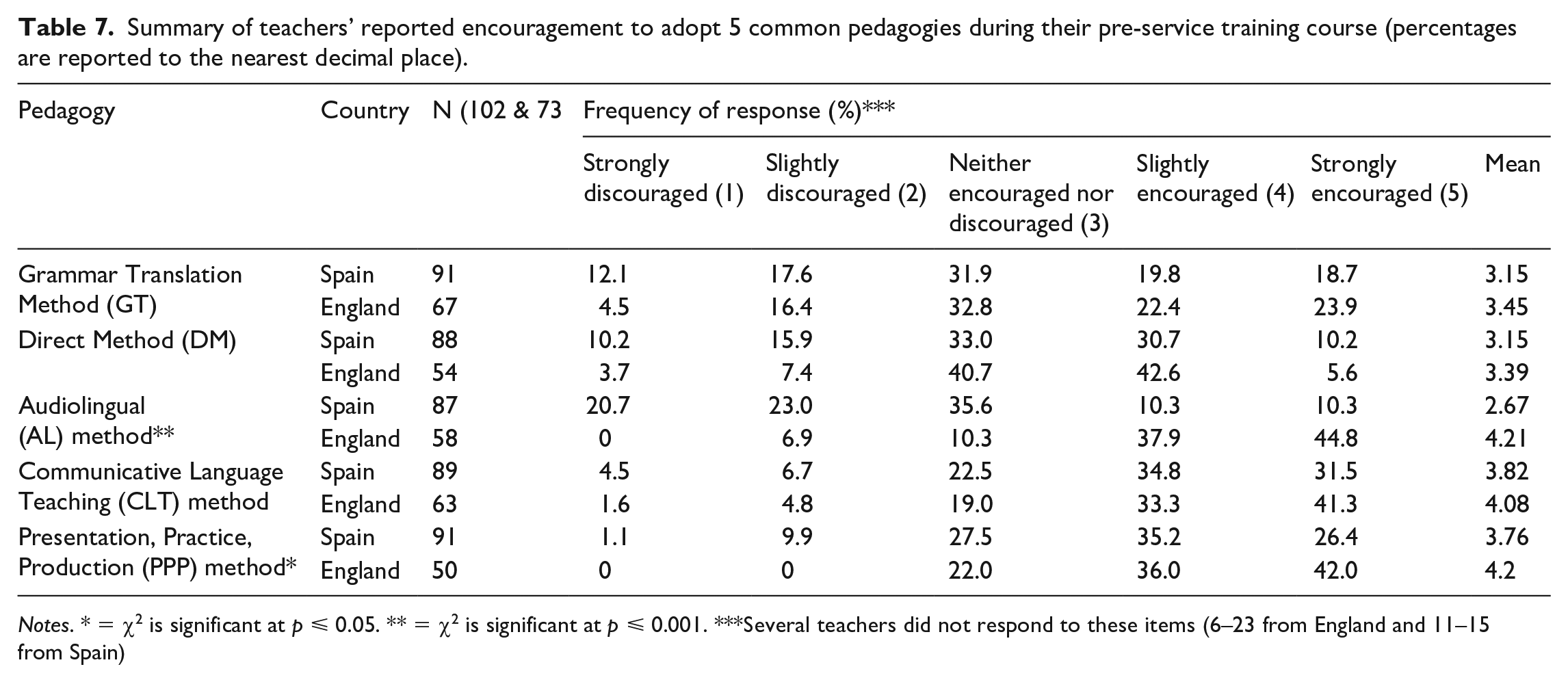
Notes. * = χ2 is significant at p ⩽ 0.05. ** = χ2 is significant at p ⩽ 0.001. ***Several teachers did not respond to these items (6–23 from England and 11–15 from Spain)
Perhaps the first thing to note about the data summarized in Table 7 is the high number of ‘neutral’ responses offered across all categories and the number of teachers who did not respond. This may indicate that respondents were struggling to remember any active encouragement or discouragement to use the methodologies presented to them (although a missing value analysis found no significant differences by country or years of experience in the teachers who did not respond to each item). In any case, the missing and neutral data indicates that the results should be interpreted with care. Overall, the highest average scores were recorded for the AL method in England and the CLT method in Spain. Teachers’ responses to the CLT and PPP method statements were positively skewed in both groups, suggesting that these methodologies were encountered as a mainstream element of languages pre-service training programmes in both Spain and England.
There was a significant group difference in teacher training experiences regarding the AL method, with teachers in England reporting they were more likely to have been encouraged to adopt it in their classroom practice (t = 8.78 (142), p ⩽ 0.001). This finding is of interest because the drilling of L2 phrases with visual cues is a method which entails extensive L2 input and yet the teachers in England report, on average, far lower amounts of L2 use than their counterparts in Spain.
Having established the extent to which teachers recall being encouraged to adopt a range of methods during their pre-service training courses, we then looked for any patterns in the data set that might be indicative of the impact of these elements of pre-service training courses on teachers’ reported practices. However, somewhat surprisingly we could find no correlations in our data between degree of encouragement to employ any of the five methods discussed and teachers’ reported use of L1 and L2 for language instruction functions in the classroom. This was the case no matter how recently pre-service training had been experienced; the data for three sub-groups of participants was explored for each group (Spain and England): Early Career (1–3 years of experience), Mid-Career (4–10 years of experience) and Experienced teachers (11+ years).
Having found nothing in the data to support a relationship between language teachers’ preparation for teaching and their reported use of L1/L2 for language instruction in their classrooms, we proceeded to conduct a post-hoc analysis to examine whether the number of years in service; the degree of prior exposure to the L2; or participants’ reported memories of their own secondary school teachers’ L2 competence and use related to their reported use of L1 and L2.
When the data set is analysed as a whole there is a weak yet significant positive correlation between number of years of experience teaching languages and the extent to which teachers report using L2 in their classrooms (r = .28, p < 0.01). However, when the data is split into the two groups (England and Spain) and re-analysed the correlation between experience and L2 use is no longer significant.
Similarly, no relationship could be found between time spent in an L2-speaking country and the extent to which teachers report using L2 in their classrooms. This suggests that teachers’ own exposure to the L2 is not a significant factor in their decisions about the extent to which they will use L2 in their classroom practice.
Finally, we investigated participants’ reported memories of their secondary school and university language teachers’ L2 competence and use (see Table 8). Whilst differences in participants’ perceptions of the frequency of their secondary school teachers’ L2 use were not significant, the results of a Mann-Whitney U test do show a significant group difference (U = 6,822, p = 0.000) between participants’ perceptions of their secondary school teachers’ L2 competence levels in England and Spain. Teachers in England were more likely to agree that their secondary school teachers were competent speakers of the L2. Perceptions of secondary school teachers’ competence in the L2 correlate negatively with participants’ overall reported use of the L2 in their own classrooms (r = –.323, p ⩽ 0.001), meaning that reported experiences of less competent L2 teachers at secondary school is associated with an increase in the participants’ subsequent use of the L2 in their own classrooms in both England and Spain.
Teachers’ reported second-language (L2) competence and use scores for their secondary and university school foreign-language (FL) teachers by country.
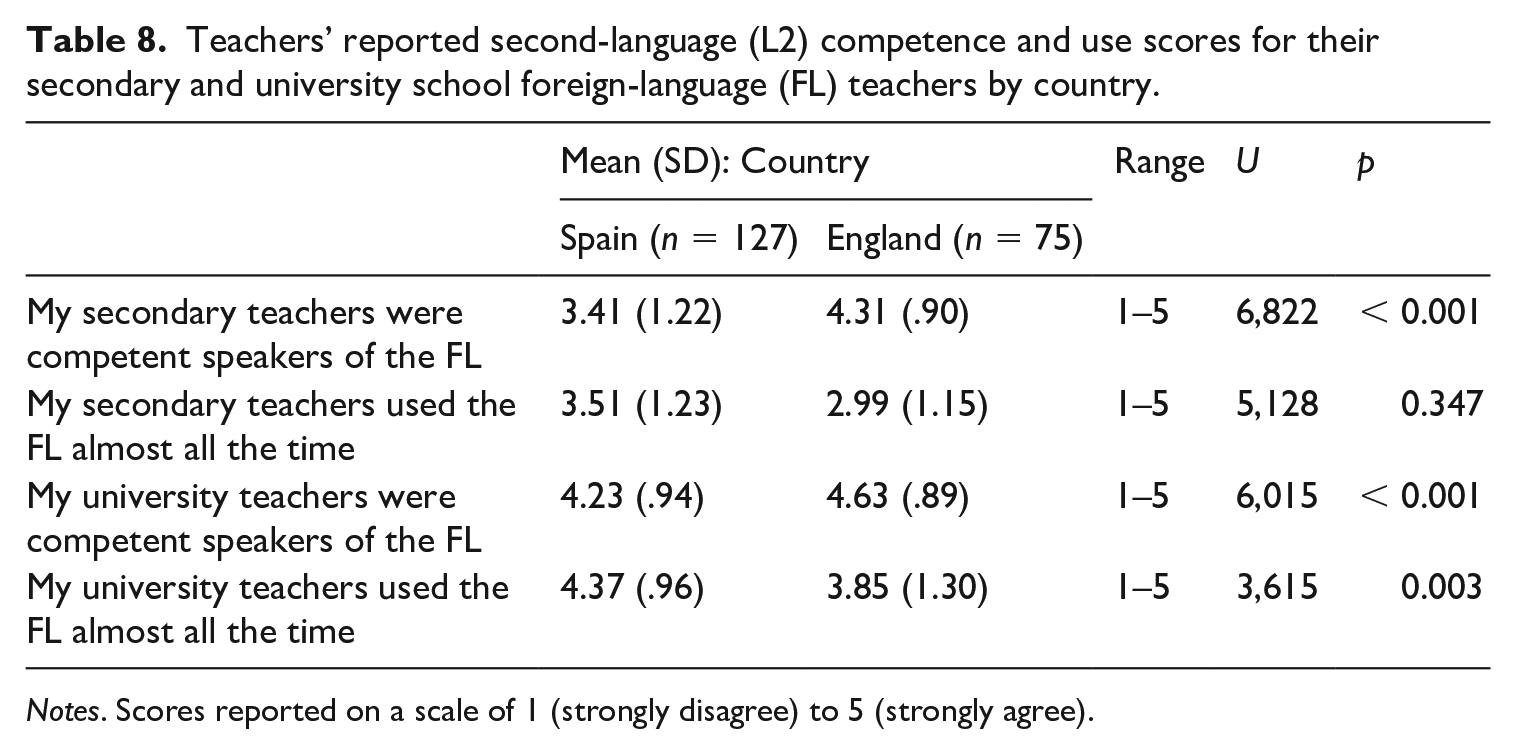
Notes. Scores reported on a scale of 1 (strongly disagree) to 5 (strongly agree).
A similar pattern is observed at university level for perceived competence of FL teachers: participants in England were more likely to agree that their teachers were competent FL speakers (U = 6,015, p = 0.000). However, at this level both groups report relatively high levels of competence on average. Participants in Spain report exposure to significantly higher quantities of L2 use from their university teachers than participants in England (U = 3,615, p = 0.003). This may be a contributory factor in participants’ increased reported use of L2 in their own practice in Spain.
VI Discussion
This study focused on teachers’ reported practices regarding the amounts and functions of L1 and L2 use in the L2 classroom and explored some of the many possible factors shaping those practices, including experiences during pre-service training, number of years in service and national context in terms of language education policy and the social value of the L2s. Our overarching finding is that teachers’ reported practices vary significantly by location (whether they were teaching in Spain or in England).
In answering our first research question, we found robust group differences in reported L1 and L2 use between teachers in Spain and England. Most notably, teachers of English in Spain report more frequent use of the L2 across all classroom language functions investigated. The most significant differences were found for grammar teaching, giving details about tests and exams, and teaching of cultural content. Use of L1 for grammar explanations is well-documented in studies in both L1 English and L1 Spanish contexts (Agudo, 2017; Galindo Merino, 2016; Higareda et al., 2009; Macaro, 2001). It is therefore somewhat surprising that over 50% of teachers based in Spain reported a predominant use of the L2 for this function. Regarding details about tests and exams, we suspect that the strong accountability culture in schools in England (Hutchings, 2015) may encourage teachers to make use of L1 in order to ensure student comprehension of critical aspects of examination technique. Teachers in England are allocated less curriculum time than their counterparts in Spain and, as has been found in previous studies (Copland and Neokleous, 2011), it may be that teachers use L1 for administrative matters in order to save valuable classroom time for more meaningful learning opportunities. Finally, turning to the issue of teaching cultural content, teachers in England reported very high levels of L1 use for this purpose and some further research is needed to unravel teachers’ reasons for this. It may be that teachers feel the L1 is more appropriate for building students’ conceptual understanding of issues of culture, which may require more complex language than beginner learners of limited proficiency are able to access.
When all classroom functions are taken together, 48.5% of the teachers in Spain reported that they make predominant use of the L2 in their teaching. This aligns with previous studies of teacher attitudes towards L2 (Agudo, 2017; Wach & Monroy, 2019) and may be due in part to the strong support in the published literature and in national reports and policy documents in Spain for the predominant use of the L2 (Boletín Oficial del Estado, 2015; Macaro et al., 2016; Ofsted, 2011). Conversely, only 1.3% of the teachers in England reported a predominant use of the L2. Perhaps the lack of prescriptive national policy guidance on L1/L2 use in England has enabled teachers to embrace the affordances of L1-mediated L2 instruction. However, it must be noted that 44% of teachers in England reported making more extensive use of the L1 than the L2 in their teaching and this very high level of L1 use is of concern given that it is unlikely to provide optimal conditions for developing communicative competence in the L2 (Larsen-Freeman and Anderson, 2011).
Although we focused our analysis on teachers of English in Spain (excluding those who teach a curriculum subject through an L2), the wider impetus in Spanish schools to teach in and through the L2 may be influential in promoting an ideology of maximal use of L2 (Macaro, 2001) in both language and content lessons. Learners’ L2 competence level has previously been found to play a major role in how much L1 was used by teachers in England (Macaro, 2001). International data (European Commission, 2012) shows that language learners in Spain consistently reach higher levels of competence in their language than their counterparts in England. This leads us to hypothesize that the greater curriculum time allocated to L2 learning in Spain compared to England 5 may enable students to make greater progress, which is likely to positively affect their motivation and sense of self-efficacy whilst also enabling teachers to use L2 for increasingly complex functions in the classroom.
As this is the first study, to our knowledge, to have compared reported L1 and L2 use in England and Spain, it raises a number of further questions which need to be answered by research: to what extent does the national education policy context shape teachers’ L1 and L2 use? How does the status of English as an L2 as opposed to other L2s affect teachers’ pedagogical decision making regarding L1 and L2 use? Why should it be that for an L2 (English) which (in general) provides students with much greater exposure outside the classroom, teachers feel they must provide additional high exposure in the classroom? The converse question, of course, also needs to be asked. However a ‘law of diminishing returns’ may be at play here: if an L2 other than English is perceived to be of lower social status or value, students may have lower levels of motivation to use the L2 and consequently teachers may adjust their own L2 use in line with their students’ expectations and motivation (an argument that has been explored by Wingate, 2018). In English-speaking contexts where instrumental motivation for L2 learning may be lower due to the perceived social value of the L2, it would be interesting to explore whether this may also lead teachers to shift the balance of their teaching to include a greater focus on L1-mediated development of intercultural understanding.
Our second research question focused on the possible impact of pre-service training on teachers’ use of L1 and L2 in England and Spain. We saw that teachers in both countries reported on average strong encouragement during pre-service training to employ methodologies entailing extensive use of L2. In Spain, high levels of reported L2 use across the language instruction functions explored indicate that education policy, pre-service education and teachers’ reported practices are in broad alignment regarding L2 use. In England, although most teachers recall encouragement to use L2-mediated teaching techniques during their pre-service education, in practice they choose to make use of the L1 to mediate their instruction. Extensive reported use of L1 in England despite encouragement during pre-service training to use L2-mediated methodologies may also be a product of less-than-ideal conditions for language teaching and learning in terms of curriculum time and student motivation (as explored above).
The findings of this study for teachers in both England and Spain align with the literature suggesting that pre-service training may have only a limited impact on teacher practices. Beyond the broad finding that teachers in Spain report relatively high levels of L2 use, we found very little evidence of any link between the methods that teachers say they were encouraged to adopt during teacher training and the uses to which they say they put L1 and L2 in their classrooms. The findings were surprising even for ‘traditional’ teaching approaches: we anticipated that teachers who were encouraged to take an explicit approach to grammar explanations during training would be more likely to make use of L1 during grammar teaching. However, only a weak and non-significant correlation suggesting increased use of L1 for this purpose was found.
The negative correlation found between perceptions of secondary school teachers’ L2 competence and our participants’ own reported L2 use may suggest an anti-apprenticeship of observation (Moodie, 2016) is at play for some of our participants, and further research is needed to investigate this factor. We were surprised that several other factors that have been identified in prior literature as influencing teachers’ practice, such as degree of prior exposure to the L2, L2 proficiency, or length of time in service were also not convincing explanations of practice related to reported L1/L2 use.
VII Concluding remarks
The fact that 98.7% of teachers in England report levels of L2 use that are below the recommended ‘predominant’ use (Macaro et al., 2016) leads us to conclude that teachers in England are not currently reporting practices that are associated with optimal conditions for developing communicative competence. This is an issue of great importance and concern for teachers and teacher educators in England. By contrast, in Spain, whilst the teachers surveyed did make use of L1 to mediate learning in some circumstances, they report a much closer adherence to the official policy of maximal L2 use. We believe that the current crisis in support and uptake for language learning in England has created conditions which impede teachers from adopting communicative approaches that may have been promoted during pre-service training. We therefore argue that urgent policy attention needs to be given to improving the status and conditions of language learning in England. For example, a set minimum entitlement to at least 3 hours of L2 lessons per week would signal the importance of languages and enable pupils to experience a greater sense of progression in their learning. A stronger statement within the National Curriculum for England about the use of the L2 as a communicative tool in the L2 classroom might also provide renewed impetus.
No clear relationship between teachers’ use of L1 and L2 and the nature of their pre-service training course can be isolated from the analysis of these data. As the researchers of this study have all been involved with teacher training and professional development, this finding is vexing and leads us to conclude that the factors shaping teachers’ pedagogical decision making regarding their use of language may be more varied and complex than our data set allows us to explore. It is a limitation of our data that we did not gather detailed information about teachers’ beliefs alongside their reported practices. Future research might focus on gathering rich, qualitative data to identify the role of alternative influencing factors such as teachers’ levels of mastery of the L2; their personal language learning trajectories; the impact of official recommendations and legislation; the impact of individual school contexts (including number of hours of teaching timetabled for each class, access to native speaker language assistants, influence of impending examinations; students’ socio-economic status etc.) and both teacher and student motivations.
Supplemental Material
Appendix_-_English_language_version_of_questionnaire – Supplemental material for Language teachers’ reported first and second language use: A comparative contextualized study of England and Spain
Supplemental material, Appendix_-_English_language_version_of_questionnaire for Language teachers’ reported first and second language use: A comparative contextualized study of England and Spain by Laura Molway, Marina Arcos and Ernesto Macaro in Language Teaching Research
Footnotes
Acknowledgements
We would like to thank the respondents who took the time to answer our survey. We would also like to thank our anonymous Language Teaching Research reviewers for their helpful and constructive comments.
Funding
The author(s) received no financial support for the research, authorship, and/or publication of this article.

Supplemental material
Supplemental material for this article is available online.
Notes
References
Supplementary Material
Please find the following supplemental material available below.
For Open Access articles published under a Creative Commons License, all supplemental material carries the same license as the article it is associated with.
For non-Open Access articles published, all supplemental material carries a non-exclusive license, and permission requests for re-use of supplemental material or any part of supplemental material shall be sent directly to the copyright owner as specified in the copyright notice associated with the article.
