



Abstract
This longitudinal research presents case studies of three English as a foreign language (EFL) student teachers showing their development regarding target language (TL) use, taking into account both the amount of TL use and the classroom situations the TL is used in. Additionally, the factors that influence their TL use are discussed. The data consist of four questionnaires, three classroom observations, and a written reflection on TL use. Results show that – similar to experienced teachers – these student teachers used the TL more in senior than in junior classes and mainly in linguistically predictable situations. On the other hand, the amount of their TL use was high, especially in senior classes, compared to earlier studies in the Dutch context. The student teachers displayed different developmental patterns concerning TL use during teacher education: two of them increased their use of English, mainly in junior classes; TL use of the other student remained stable. Teacher education appeared to mediate TL use one year after graduation for two students. TL use had changed after finishing teacher education but no coherent developments could be discerned.
Keywords
I Introduction
The future generation of Dutch foreign language (FL) teachers seems to be in a difficult and potentially confusing situation regarding target language (TL) use. Various Dutch FL pedagogues consider TL use as a quality characteristic of FL teaching (see for example, Kwakernaak, 2004, 2007; Plante, 2009). This is further emphasized by FL teacher educators who encourage student teachers to enhance their TL use during their apprenticeships (Tammenga-Helmantel & Mossing Holsteijn, 2016). However, because Dutch FL teachers predominantly use Dutch in their classrooms (Bonnet, 2002; Kordes & Gille, 2012), many student teachers find themselves in a teaching reality that is contrary to what they are taught in teacher education (see also Chambers, 2013). This potentially confusing situation raises the need to investigate how student teachers develop their TL use during their teacher education and what the effect of teacher education is on their TL use. Few studies investigated student teachers’ TL use (e.g. Bateman, 2008; Chambers, 2013; Macaro, 2001; Orland-Barak & Yinon, 2005; Tammenga-Helmantel & Mossing Holsteijn, 2016), making it a research field clearly underrepresented in foreign language teaching (FLT) and teacher education research.
Various factors influence TL use (Bateman, 2008; Haamberg et al., 2008; Hall & Cook, 2012, 2013; Kim & Elder, 2008). For instance, experienced FL teachers mention personal (e.g. their language proficiency and pedagogical skills) as well as teaching practice-related factors (e.g. learners’ language proficiency, and their reaction to TL use) as hindering them from using the TL. It remains to be explored whether these factors also hold for student teachers.
Whereas teacher education aims to provide the basis for professional pedagogical practices and attitudes (Watzke, 2007), studies investigating the impact of teacher education on FL student teachers displayed varying results (e.g. Evens, Elen & Depaepe, 2017; Kleinhenz et al., 2007; König et al., 2016). Some studies found evidence for FL teacher education influencing student teachers (see Borg, 2011; Busch, 2010), whereas others reported no change during teacher education or no long-term effect of teacher education (see Graus & Coppen, 2016; Peacock, 2001; Phipps, 2007; Pickering, 2005; Urmston, 2003). Tammenga-Helmantel and Mossing Holsteijn (2016) reported that Dutch teacher educators encourage their student teachers to use the TL in their teaching by discussing the use of the TL as well as the potential dilemmas, but also by teaching them the essential pedagogical skills. However, to what extent teacher education affects TL use, also after graduation, remains unknown.
This research intends to provide new insights into a still relatively unexplored research area, viz. the development of TL use in the FL classroom by student teachers. Concretely, this longitudinal study presents an analysis of the TL use by student teachers and explores what factors influence their developments, including the effect of teacher education. In so doing, the findings may provide FL teacher educators with further directions for their teaching practice regarding TL use. In contrast to many other studies on TL use, this study does not exclusively rely on self-report but also includes classroom observations. Because of the explorative nature of this research and the wish to intensively monitor this specific group of teachers, we have opted for case studies.
II Literature background
1 Target language use
TL use is a key concern within FL pedagogy and is regarded a guiding principle in FLT (Ellis, 2005a,b). For successful language learning, learners should receive ample comprehensible input (Krashen, 1981), occasions for output (Swain, 1995) and interaction opportunities in the foreign language. TL use fosters students learning about and through language use (Dönszelmann, 2019; Glisan & Donato, 2017; see also de Graaff, 2013), but only when teachers provide both linguistic input and a safe learning context which supports TL use (Christie, 2016; Dörnyei, 2009). Such a TL pedagogy mediates the language learning process (Dönszelmann, 2018, 2019; Glisan & Donato, 2017). Review studies show that TL use also positively affects classroom climate and student motivation (e.g. Hall & Cook, 2012; Tammenga-Helmantel et al., 2016). This entails that TL use by both teachers and learners should be predominant in a FL classroom. However, dogmatic, monolingual use of the foreign language in classroom communication is not desired; conscious first language (L1) use could also foster FL learning ‒ for instance, when classroom communication dynamically navigates between L1 and second language (L2) as in translanguaging (e.g. Garcia & Wei, 2014; Lau, Juby-Smith & Desbiens, 2017; Lewis, Jones & Baker, 2012) or in a bilingual approach, where teachers strategically plan L1 use (e.g. Butzkamm & Caldwell, 2009).
Many teachers of English as a foreign language (EFL) believe that the TL should be the predominant language in the classroom and that the learners’ own language (L1) should only be used in specific teaching situations (Hall & Cook, 2013). More precisely, L1 is used when explaining vocabulary/grammar, giving instructions and managing the classroom, and building rapport with learners. The EFL teachers’ arguments for L1 use were to relate learners’ knowledge of the new language to their knowledge of their own language and to reduce anxiety among learners. Depriving learners of speaking and listening practice in the FL was teachers’ strongest argument against the use of learners’ own language.
Compared to their colleagues in other countries, Dutch FL teachers tend to speak Dutch in their classrooms. Bonnet (2002, 106) reports that 30% of the teachers very rarely use the TL and another 50% only sometimes. Kordes and Gille (2012, 26f.) confirm these findings. Nevertheless, Dutch FL teachers do take a positive stance towards the importance of TL use (Haijma, 2013; Oosterhof, Jansma & Tammenga-Helmantel, 2014). Oosterhof et al. (2014) distributed a survey among 97 Dutch teachers of junior classes of French. They found that the French teachers used more Dutch than French in their teaching and that they were discontented with their TL use. Haijma (2013) conducted lesson observations and administered surveys among 15 teachers of English, German, French and Spanish, and 131 students from junior and senior classes. She observed that FL teaching is ‘mainly in Dutch’ or ‘half in Dutch / half in the TL’ (p. 31). However, she did notice that the teachers used the TL more in senior than in junior classes.
In addition, both studies observed that teachers viewed TL use as an essential component of FLT but that they limited the TL to only a few classroom situations, namely: situations that elicit frequent, standard utterances that are linguistically predictable (e.g. opening and closing a lesson, standard instructions), and in conveying positive information (e.g. positive feedback and compliments). The TL is hardly used when conveying new and complex content (e.g. grammar), possibly negative information (e.g. reprimands and classroom management issues), or when conversations are not directly related to teaching content (e.g. when chatting inside and outside the classroom).
However, this study concerns EFL and there are indications that TL use in EFL classrooms is more common than in other Dutch FL classrooms (Haijma, 2013; West & Verspoor, 2016), which may well relate to the special position of English in the Netherlands. English clearly has a different position than other FLs such as German and French, in the Dutch educational context as well as in society in general. English is obligatory for all junior and seniors students in Dutch secondary education whereas German and French are taught in junior classes and become optional in senior classes. Additionally, English is omni-present outside school whereas French and German input is generally restricted to the FL classroom. Related to this, students’ language proficiency levels and motivation are higher for English than for French (SLO, n.d., and Elzenga & de Graaff, 2015, respectively).
FL student teachers restrict their TL use to the same classroom situations according to Orland-Barak and Yinon (2005). They asked 14 student teachers in an Israeli university participating in an EFL methodology course on classroom discourse to reflect in a written assignment on L1/TL use in one of their lessons. The participants opted for L1 to clarify the content, to promote communication and student participation, to manage a class, and to establish rapport with learners. Similarly, Macaro (2001) studied the L1 use of six student teachers, who taught French to English-speaking learners, towards the end of their one-year teacher education program in a US university. He used questionnaires and video registration of classroom interaction. The participants in Macaro’s study used L1 when clarifying content, managing a class, and giving complex instructions. Two of them indicated that mainly a lack of comprehension among learners compromised their TL use. Therefore, they often resorted to L1 when providing instructions for activities, dealing with discipline problems, and reprimanding learners.
2 Influencing factors
Factors which have been identified as influencing TL use, be it constraining or encouraging, can be roughly classified as personal, teaching practice-related or external (analogous to Clarke & Hollingsworth’s (2002) domains of professional growth). Regarding personal factors, teachers typically mention the following: self-supposed inadequate pedagogical skills and insufficient TL proficiency, experiences as a FL learner, lack of time, and teacher fatigue (e.g. Bateman, 2008; Orland-Barak & Yinon, 2005; Tammenga-Helmantel & Mossing Holsteijn, 2016). Teachers especially mention factors related to teaching practice shaping their TL use and many are learner-related, including incomprehension among learners, learners’ refusal to use the TL, building rapport with learners, and learners’ habit to not use the TL (e.g. Bateman, 2008; Haijma, 2013; Hall & Cook, 2013; Oosterhof et al., 2014; Tammenga-Helmantel & Mossing Holsteijn, 2016). More precisely, teachers find it difficult to use the TL when learners have low linguistic competences in the TL, when learners display negative attitudes towards TL use, or when learners continue speaking their L1 and in so doing tempt the teachers to use L1 as well. Hall and Cook (2013) and Oosterhof et al. (2014) related this to learners who are inexperienced in the FL such as in junior classes. Complexity of the matter being taught affects TL use as well; complex topics (e.g. grammar rules and unfamiliar vocabulary) constrain TL use (e.g. Hall & Cook, 2013; Tammenga-Helmantel & Mossing Holsteijn, 2016). Other constraining factors related to teaching practice are TL use by colleagues, school policy, and teaching materials (e.g. Bateman, 2008; Chambers, 2013; Hermans-Nykerk, 2007; Oosterhof et al., 2014; Tammenga-Helmantel & Mossing Holsteijn, 2016). On the other hand, Oosterhof et al. (2014) also showed the potentially positive influence of school context; teachers mentioned arrangements made within the department and an encouraging school management team as factors that facilitate their TL use. Factors teachers do not have a direct influence on, i.e. external factors, which constraint TL use, are for instance governmental policy (Orland-Barak & Yinon, 2005), a critical inspection report (Chambers, 2013), or the status of FL learning (Kim & Elder, 2008).
Two longitudinal studies which thoroughly investigated TL use development among student teachers, showed that both student teachers’ TL use and the factors affecting their TL use match with that of experienced teachers. First, Tammenga-Helmantel and Mossing Holsteijn (2016) distributed surveys among 30 student teachers of German, English, and French in a Dutch university. Data showed that TL use increased during one year of teacher education, both in senior and especially in junior classes, and that student teachers especially used the TL when greeting their students and saying goodbye to them, and for providing standard instructions. In the course of the year, the TL was extended to other situations as well, viz. general and individual warnings, admonitions and punishments, and subject-related conversation with colleagues. Second, Bateman (2008) observed variation in the development of TL use among 10 student teachers of Spanish in the United States. He followed them during a methodology course of 15 weeks using pre- and post-surveys and written reflections; three student teachers displayed an increase in TL use, four a decrease and with three student teachers TL use remained at a stable and high level. To conclude, these studies displayed different developmental patterns regarding TL use among student teachers during teacher education.
The impact of teacher education on student teachers’ TL use during teaching education and after graduation is hardly studied. Chambers (2013), for example, is pessimistic about the influence of teacher education on TL use. He studied TL use of student teachers from a UK-based university through classroom observations and used discussion group data to reveal their reasons for using or not using the TL in their apprenticeship schools. Despite a pro-TL use message from their educators, student teachers did not use the TL extensively. The student teachers fall in line with the TL practice of their school colleagues, and especially their school mentors, who are both their critical friends and strongly influence the apprenticeship assessment. Additionally, curricular pressure and challenging classes hinder TL use. Several studies in other domains of FL teaching display a restricted impact of teacher education (Graus & Coppen, 2016; Peacock, 2001; Phipps, 2007; Pickering, 2005, and Urmston, 2003; cf. Borg, 2011 and Busch, 2010). The missing long-term impact is related to work experience: once being a teacher and being responsible for teaching, assessment and administration, beginning teachers revert back to old and familiar patterns of thinking and acting (Graus & Coppen, 2016; Watzke, 2007). To our knowledge, no studies have investigated what role teacher education plays in TL use and how TL use develops after student teachers graduate.
The present study intends to provide insights regarding TL use among teachers during their teacher education internships and their first year as recently qualified teachers. Watzke (2007, p. 64) affirmed that these highly formative years are largely ignored in research and called for more empirical research regarding this period. We present a detailed picture of the development of student teachers’ TL use by including the following three foci identified in recent studies on (student) teachers’ TL use: 1. the amount of TL use, 2. classroom situations in which the TL is used, and 3. factors that hinder or foster TL use. Classroom observations complement the picture provided by self-report, viz. surveys and a written reflection. Given the comprehensive, longitudinal, and explorative nature of our study, we have opted for case studies in order to provide ‘rich contextualization to shed light on the complexities involved’ (Basturkmen, 2012, p. 282, after Mackey & Gass, 2005). We followed three EFL student teachers during their teacher education and their first year as a qualified teacher, and investigated the impact of teacher education on TL use. Our study addresses the following research questions:
Research question 1: To what extent do student teachers use the TL in junior and senior classes during teacher education and one year after graduation? ○ Research question 1a: How much do student teachers use the TL? ○ Research question 1b: In what classroom situations do student teachers use the TL? ○ Research question 1c: How does TL use develop?
Research question 2: To what extent do the personal, teaching practice-related, and external domain affect student teachers’ TL use during teacher education and one year after graduation?
III Method
1 Participants
The participants in our study were three EFL student teachers who attended the teacher education program of the University of Groningen from February 2014 to July 2015. Paul, Lisa, and Sophie (all pseudonyms) took part in a previous quantitative study, which investigated the TL use of FL student teachers’ during part of their 1½-year teacher education (Tammenga-Helmantel & Mossing Holsteijn, 2016). Three student teachers managed to participate in all data measurements and were therefore selected for this follow-up study. Paul, Lisa, and Sophie were then also followed after graduation, viz. until one year after finishing teacher education.
The teacher education program of the University of Groningen consists of two stages. In Stage 1 (see Table 1) student teachers are familiarized with general, elementary aspects of teaching and teaching in their specific school subject (here: EFL). Student teachers serve an apprenticeship at a secondary school consisting of classroom observations and a minimum of 20 hours of teaching English (Apprenticeship 1), while also being offered an EFL methodology course, an educational theory course, and a pedagogy course. During Stage 2, the student teachers serve a second apprenticeship at a different secondary school. Here they are required to teach a minimum of 120 hours, resulting in approximately four to six hours per week. Besides teaching and executing classroom observations, they attend courses for further exploration and deepening of EFL teaching methodology, educational theory, and pedagogy. Finally, the student teachers execute a research project. The teacher education program prepares participants to teach EFL in secondary education at all levels, that is from vocational to pre-university level.
Overview teacher education program of the University of Groningen.
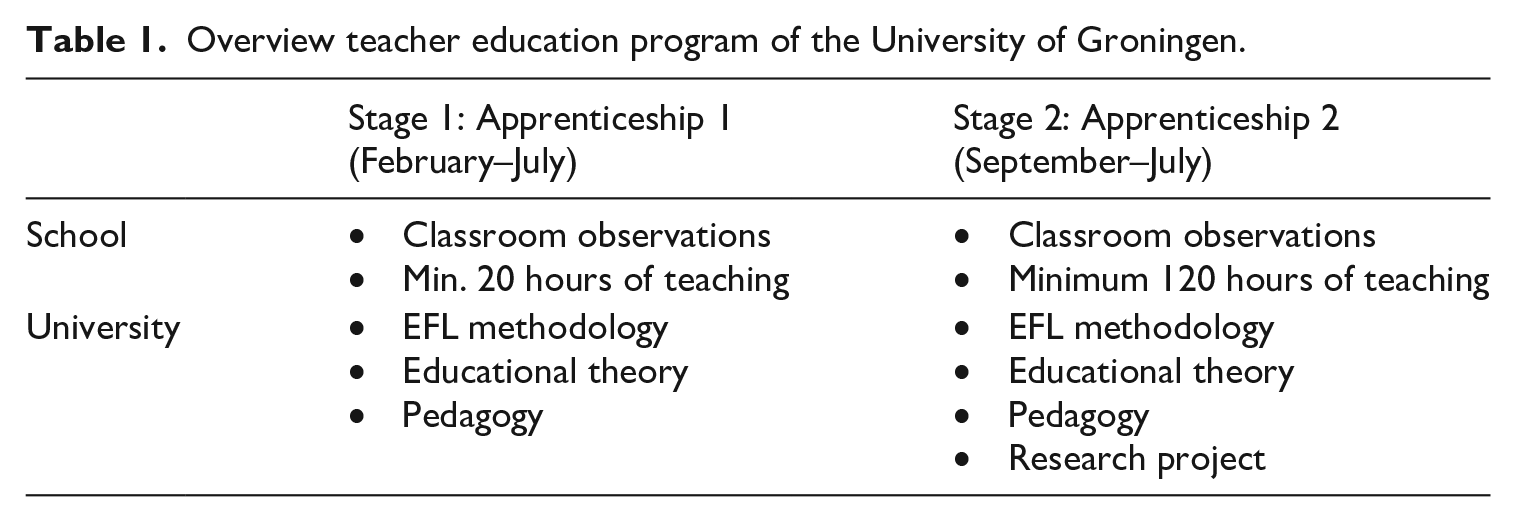
In the weekly EFL methodology course, students reflect on their questions and dilemmas related to their teaching practice and they discuss one or two general topics in FL teaching methodology, such as grammar instruction, corrective feedback, and the role of literature in FLT. The sessions are mainly student-led focusing on the students’ classroom experiences and concerns. Group discussions, micro teaching, and video analyses are used to support the development of their teaching skills.
Policy of the FL teacher educators is to encourage TL use of and reflection thereon, which presents itself in various ways. First of all, the EFL teacher educators apply the concept of modeling and use English as the language of communication in the EFL methodology course. Furthermore, one of the sessions is dedicated entirely to TL use and the topic is discussed regularly when students raise their questions and dilemmas. In addition, the student teachers familiarize themselves by writing a reflection about TL use for which they read literature on this topic.
2 Materials and procedures
Earlier studies on TL use by both in-service teachers and student teachers tend to exclusively use self-reports in their investigation, that is, with surveys or interviews (see Hall & Cook, 2013; Oosterhof et al., 2014; Orland-Barak & Yinon, 2005; Tammenga-Helmantel & Mossing Holsteijn, 2016). However, teachers tend to provide higher estimations of TL use than they actually use in their teaching (e.g. Hall & Cook, 2012; Mysliwiec, 2015; Polio & Duff, 1994). As Hall and Cook (2012) indicated, this ‘may be because of the underlying negative attitudes towards own-language use which prevail in many contexts, and individual teacher’s attitudes and belief about bilingual teaching’ (p. 285). Therefore, our design included self-reports as well as classroom observations.
The instruments used in this study consisted of a survey which was administered four times (S1–S4), three classroom observations (CO1–3), and a written reflection on TL use (REFL; for a timeline, see Table 2). The survey involved questions about TL use in junior and senior classes and intervening factors (see Appendix 1). The first administration of the survey took place at the end of Stage 1. The participants completed S2 at the start of Apprenticeship 2 and S3 at the end of their education. A fourth measurement was made one year after graduation. By that time, the participants had been employed as EFL teachers in secondary education for one year.
Timetable of instruments’ administration.
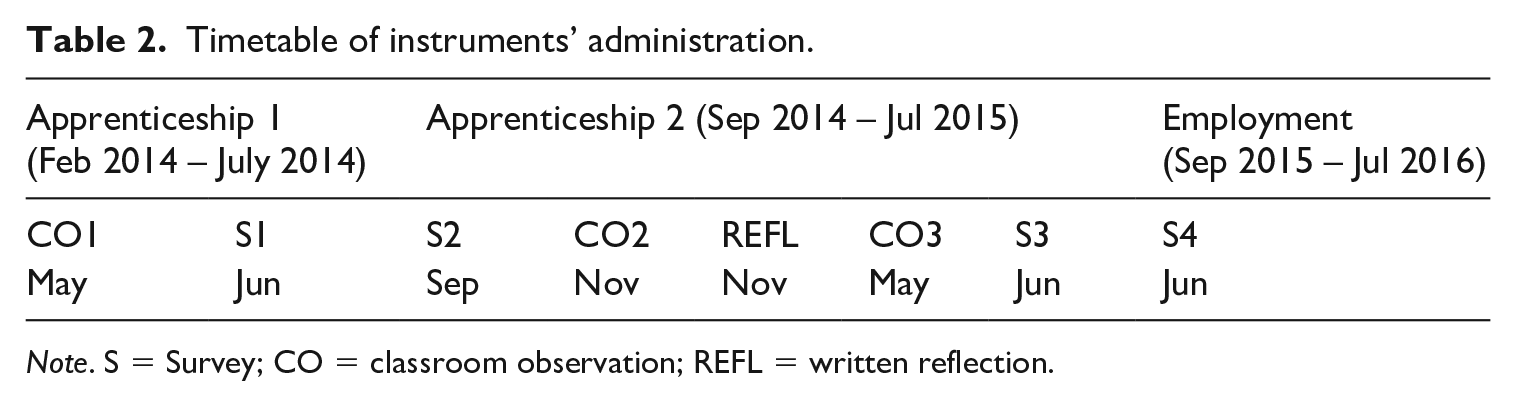
Note. S = Survey; CO = classroom observation; REFL = written reflection.
The classroom observations (COs) were executed by FL methodologists during which they filled in an observational protocol regarding general teaching skills (ICALT; van de Grift et al., 2017). In addition, they reported on the amount of TL used by the student teachers, viz. estimated TL use as percentage of the student teachers’ total speaking time. The first observation was executed during Apprenticeship 1; the two remaining classroom observations were conducted during Apprenticeship 2. The lesson observations took place in one class for each measurement. Therefore, each measurement provides information about either a junior or a senior class, which can be compared with the student’s self-report at that particular level. No specific instruction was given regarding the content of the lessons. Information was collected neither concerning the content of the lesson, the quality of TL use, nor on the role of the learners. This issue will be explored in Section V. In the written reflection, student teachers described their personal experiences in using English during Apprenticeship 2, including the perceived advantages of using the TL as well as the challenges in doing it.
3 Data analysis
Research question 1 concerns TL use and is answered by using the survey data and classroom observations. First, the amount of TL use (Research question 1a) is given in percentages as estimated by both the student teachers (in S1–S3, question 4) and the observers (in CO1–3). These results are compared to reveal potential differences between self-report and external observations; this is done as follows: S1-CO1, S2-CO2, and S3-CO3. Second, to determine in what situations inside and outside the classroom the student teachers use the TL in junior and senior classes (Research question 1b) we used − analogous to Oosterhof et al. (2014) − Kwakernaak ’s (2007) so-called ‘Target Language Ladder’ (see Table 3). The ladder distinguishes four categories and displays 16 classroom situations in roughly ascending order of difficulty. The participants indicated their TL use for each situation on a 4-point Likert scale, ranging from 1 (never) to 4 (always) (questions 2 and 3 of S1–S4 in Appendix 1). They did so for both junior and senior classes.
Target language ladder.
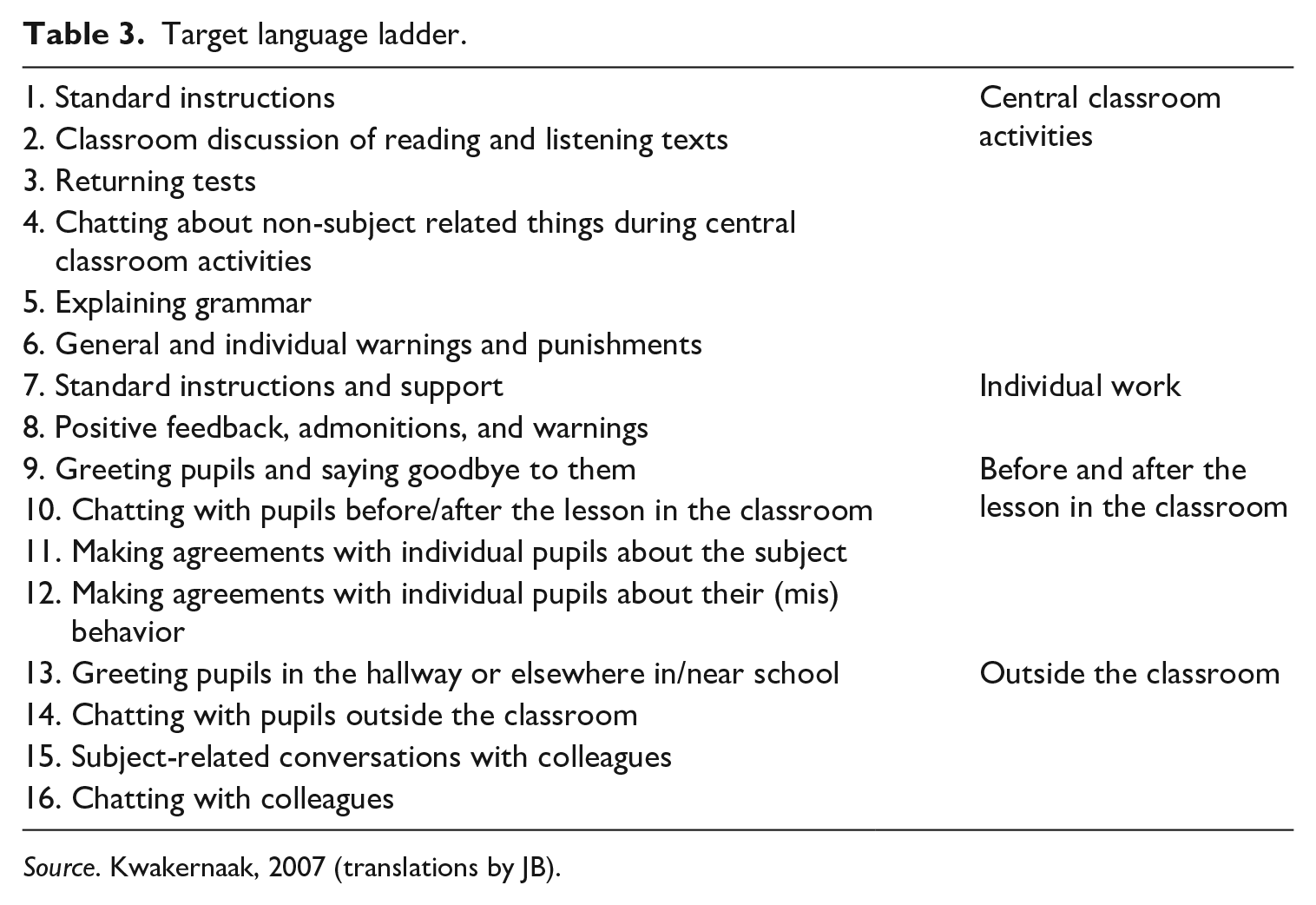
Source. Kwakernaak, 2007 (translations by JB).
Section IV describes for each student teacher the following three things: 1. the amount of TL use, 2. in which classroom situations he/she generally uses the TL and how much the TL is used, and 3. how their TL use develops regarding the 16 situations. This is done both for the period during teacher education (S1–S3) and the period after graduation (S3–S4). The analysis of S1–S3 reveals developmental tendencies and distinguishes between situations that have remained stable (no change or maximum 1 point change over three measurements), situations that have developed gradually (for example: 1–2–3 or 4–3–2), and situations that show an irregular development (for example: 1–3–1 or 4–1–3). Additionally, we compare the TL use for each of the 16 situations at the end of teacher education (S3) and at the end of the first year of teaching (S4). We also indicate for each situation whether the TL has remained the same (0), has increased (+ value), or decreased (− value).
Research question 2 addresses factors that affect student teachers’ TL use. Question 5 (in Appendix 1) asked participants to rate the influence of factors on TL use frequently mentioned by Dutch FL teachers (Haijma, 2013; Oosterhof et al., 2014), using a scale ranging from 1 (no influence) to 4 (great influence). These were extended with external factors pertaining to the teacher education program, which we label ‘institutional’. All factors in question 5 are related to three domains of influence: personal, practice-related, and external (see Clarke & Hollingsworth, 2002). The student teachers’ personal experiences as former learners in FLT are located in the personal domain (see also Kim & Elder, 2008, p. 182). The TL policy and practice of the secondary schools at which the student teachers served their apprenticeships, the teaching materials used, and learners’ responses to TL use are included in the practice-related domain. Regarding the context of our study, the external domain is restricted to the institutional subdomain. Language use in attended courses and in assignments, executed research, apprenticeship assessment, and the perceived stance of the EFL methodology teacher regarding TL use belong to the institutional domain. To show the impact of the different domains on TL use, all scores for the individual factors were averaged within each domain. These results show what domains influenced TL use, and what developmental tendencies our student teachers displayed from S1 through S4. Illustrative quotes from the written reflection (REFL) are inserted in the results showing the students’ beliefs, concerns, experiences, and motivation regarding TL use.
IV Results
Research question 1: To what extent do student teachers use the TL in junior and senior classes during teacher education and one year after graduation? ○ Research question 1a: How much do student teachers use the TL? ○ Research question 1b: In what classroom situations do student teachers use the TL? ○ Research question 1c: How does TL use develop?
1 Lisa
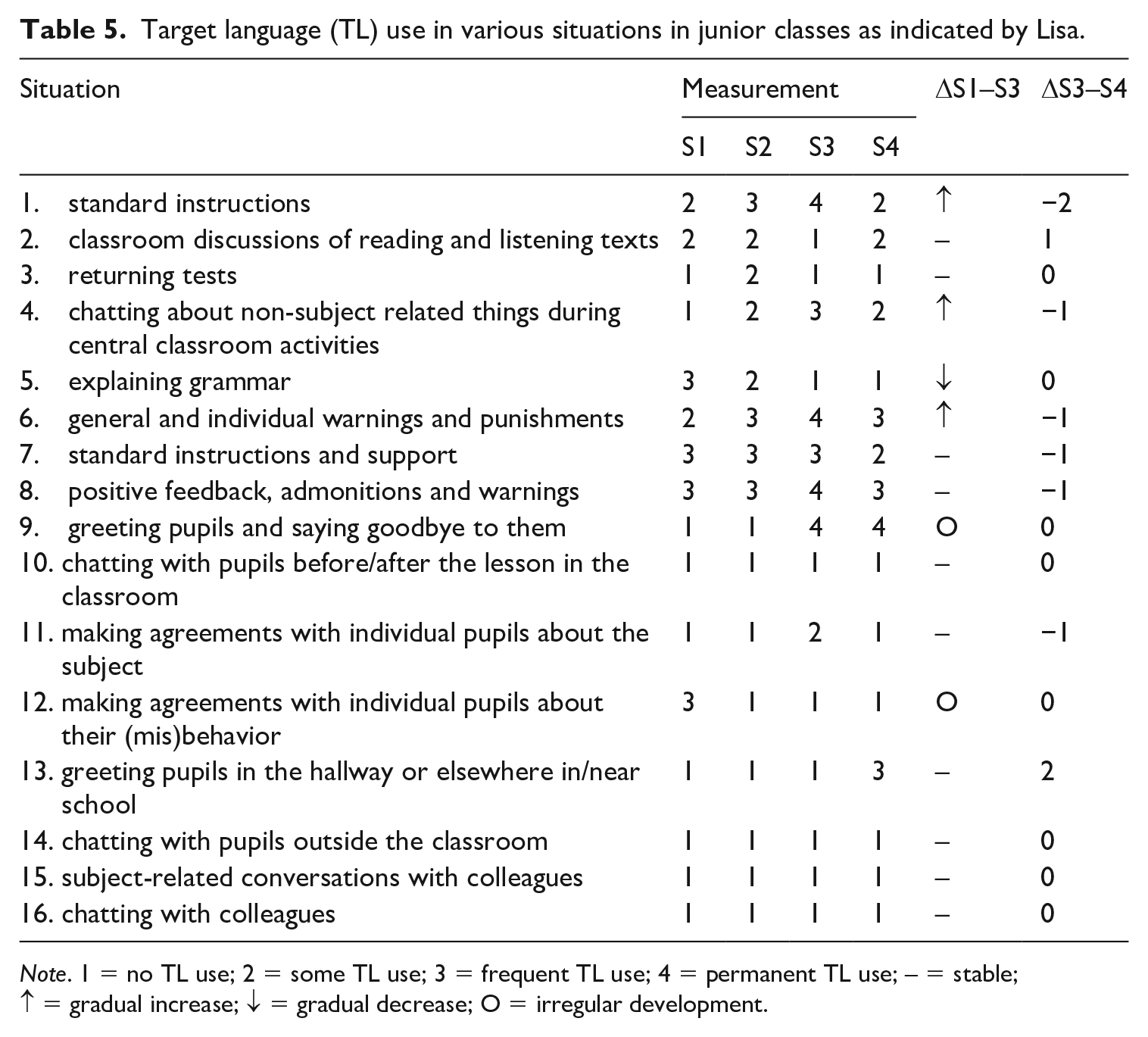
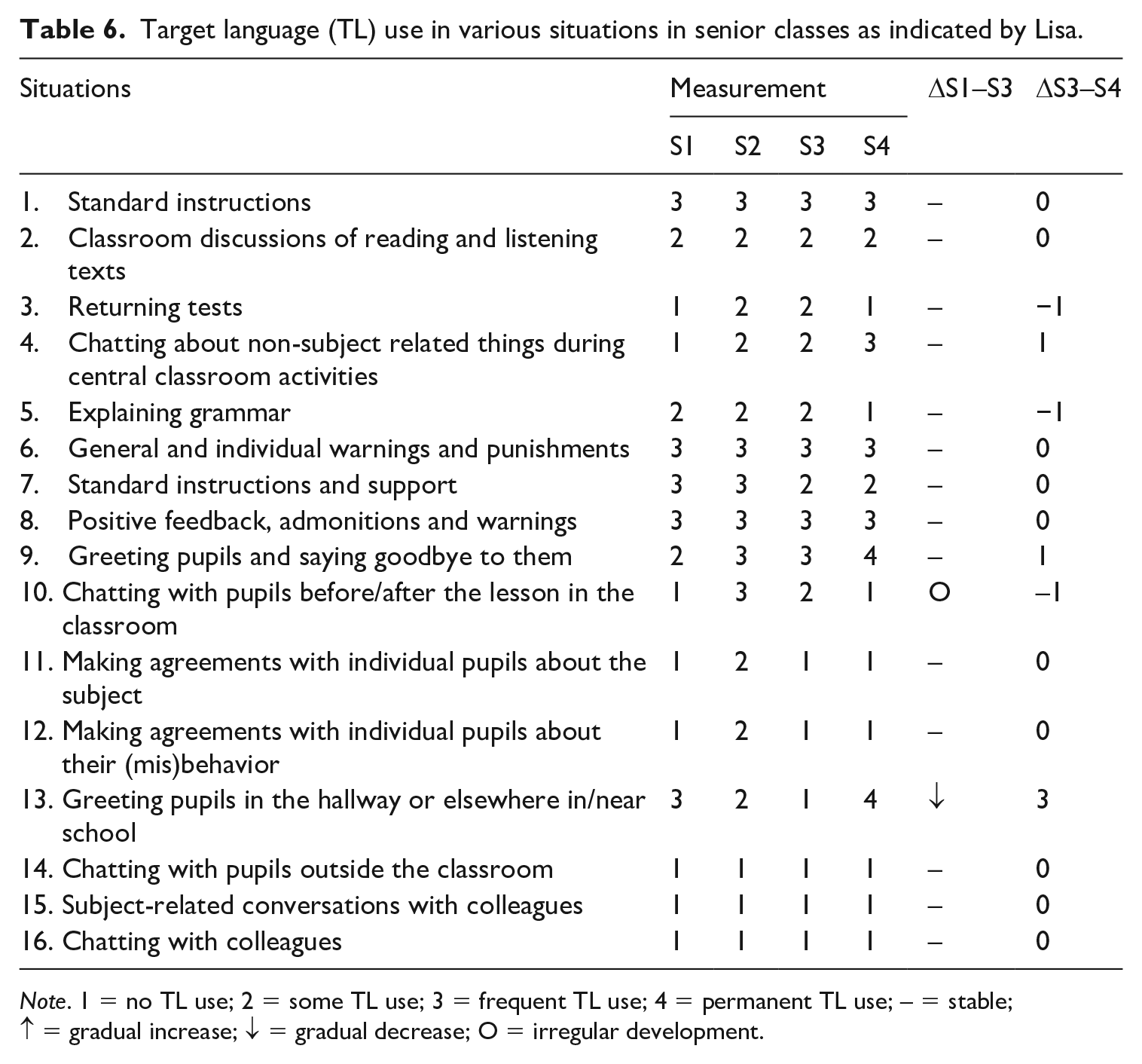
Table 4 shows that Lisa consistently employed the TL more in her senior classes than in her junior classes. In junior classes, Lisa indicated to use the TL half of her total speaking time at S1, which was reduced to an indicated 30% at S3. In her senior classes, however, she displayed a more consistent TL use of approximately 70%. Lisa’s own estimations match with the estimated values from classroom observations: at S1/CO1: 50% and 40% TL use, respectively; at S2/CO2: 75% and 70%, respectively. At S3/CO3 the percentages notably diverged: the teacher educator noted a 95% use of the TL use against Lisa’s own estimation of 70%. As regards the use of the TL in specific classroom situations, more or less the same picture emerged when analysing Lisa’s TL use in junior (Table 5) and senior classes (Table 6).
Target language (TL) use by Lisa (in percentages) as estimated and observed over time.
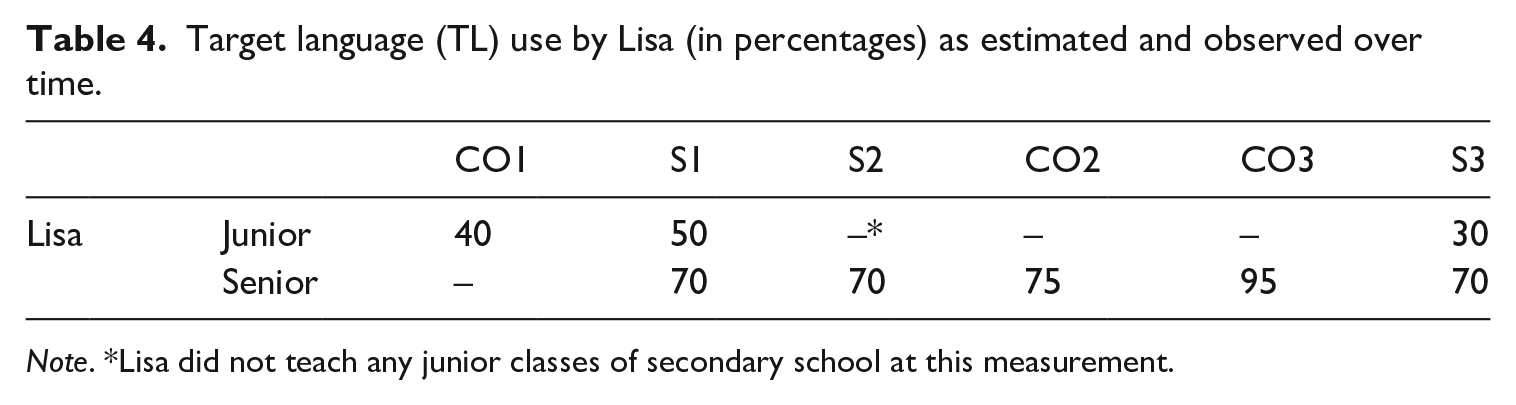
Note. *Lisa did not teach any junior classes of secondary school at this measurement.
Target language (TL) use in various situations in junior classes as indicated by Lisa.
Note. 1 = no TL use; 2 = some TL use; 3 = frequent TL use; 4 = permanent TL use; – = stable; ↑ = gradual increase; ↓ = gradual decrease; O = irregular development.
Target language (TL) use in various situations in senior classes as indicated by Lisa.
Note. 1 = no TL use; 2 = some TL use; 3 = frequent TL use; 4 = permanent TL use; – = stable; ↑ = gradual increase; ↓ = gradual decrease; O = irregular development.
Tables 5 and 6 show that Lisa typically used the TL in the category ‘Individual work’, i.e. when giving standard instructions and support (7) and when providing positive feedback, admonitions, and warnings (8). She also used the TL in the category ‘Central classroom activities’ when giving standard instructions (1) and when giving general and individual warnings and punishment (6).
1
In senior classes, she also greets pupils and says goodbye to them (9) in English. She consistently did not use the TL in conversations taking place in the category ‘Outside the classroom’, either with students or with colleagues (14, 15, and 16). Lisa discussed her decisions not to use English in conversational situations: Conversations after class can be emotional and sometimes reveal hardships that children have to deal with at home; these moments don’t serve a purpose of learning the TL. Showing pupils my sympathy has priority over acquiring the TL and during after-class conversations I feel like my sympathy comes across as more sincere when I speak our native language. Another setting in which I don’t use English is when I talk to my colleagues. This has probably to do with the fact that we speak English all day already in class, which is quite exhausting, so we’re happy to speak our native language when we’re amongst colleagues. (Lisa)
Lisa’s comments show that she uses English in the classroom to mediate the language learning process of her students. Where this is not at stake or even perceived as unsuitable, she decides to use Dutch.
As regards developments during teacher education, that is, from S1 to S3, Lisa showed a change in her TL use mainly in her junior classes. A gradual increase could be observed in three ‘Central classroom activities’: when giving standard instructions (1), when chatting about non-subject related things (4), and when giving general and individual warnings and punishments (6). A gradual decrease was observed when explaining grammar (5). Irregular patterns were found when greeting pupils and saying goodbye to them (1) (from 1 to 4) and when making agreements with individual pupils about (mis)behavior (12) (from 3 to 1). Other situations remained stable. Regarding her senior classes, Lisa gradually reduced her TL use when greeting them in the hallway or elsewhere in or near school (13). Additionally, we observed an increase from S1 to S2 and a decrease from S2 to S3 when chatting with pupils before or after the lesson in the classroom (10). All other situations did not develop during teacher education. After graduation (S4), Lisa’s TL use in junior and senior classes displayed both increases and decreases. A clear decrease was observed when providing standard instructions (1) in junior classes, whereas a steep increase was found in greeting junior and senior pupils in the hallway or elsewhere in/near school (13).
2 Paul
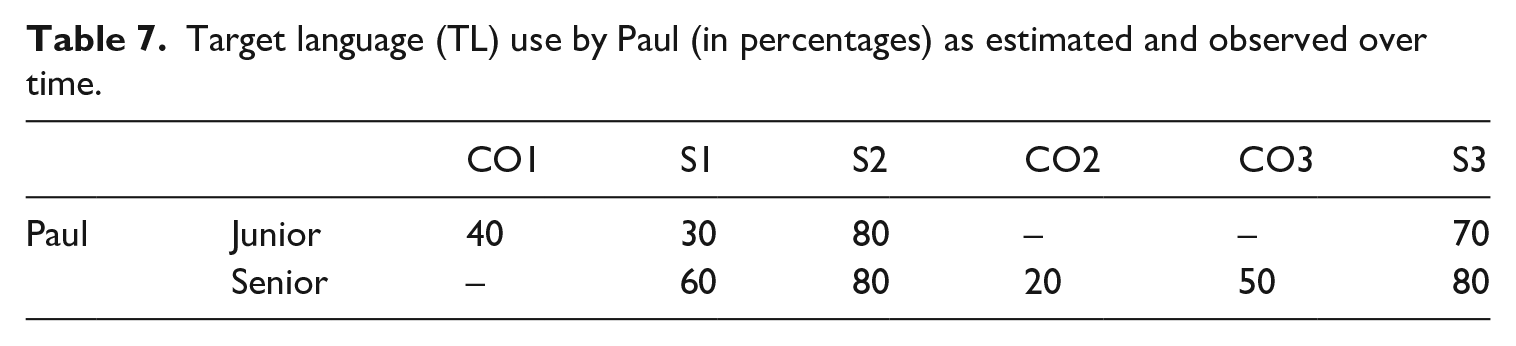
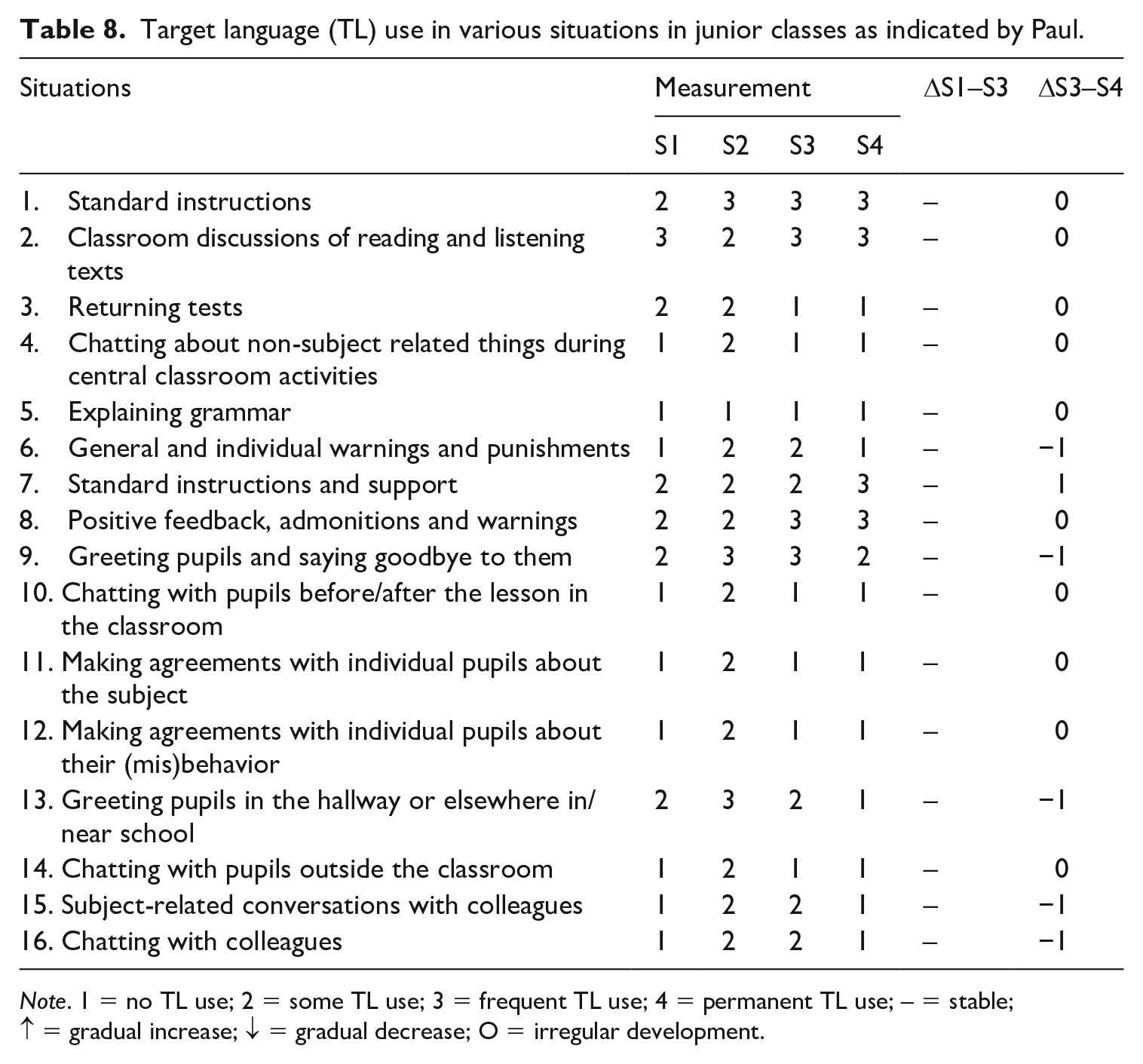
Similar to Lisa, Paul generally used the TL more in his senior than in his junior classes. According to Paul’s own self-estimation, there was an increase in TL use for both his junior and senior classes: 30% to 70% in junior classes, and 60% to 80% in senior classes (see Table 7). Paul’s own estimations regarding his TL use compared to those of the observer displayed more divergence compared to Lisa. At S1/CO1 the percentages matched (30% and 40%, respectively) but, during Apprenticeship 2, Paul’s estimations were substantially higher than what was observed in his classroom: 80% vs. 20% at S2/CO2 and 80% vs. 50% at S3/CO3. The situations in which Paul used the TL displayed parallels between junior and senior classes (see Tables 8 and 9).
Target language (TL) use by Paul (in percentages) as estimated and observed over time.
Target language (TL) use in various situations in junior classes as indicated by Paul.
Note. 1 = no TL use; 2 = some TL use; 3 = frequent TL use; 4 = permanent TL use; – = stable; ↑ = gradual increase; ↓ = gradual decrease; O = irregular development.
TL use in various situations in senior classes as indicated by Paul.
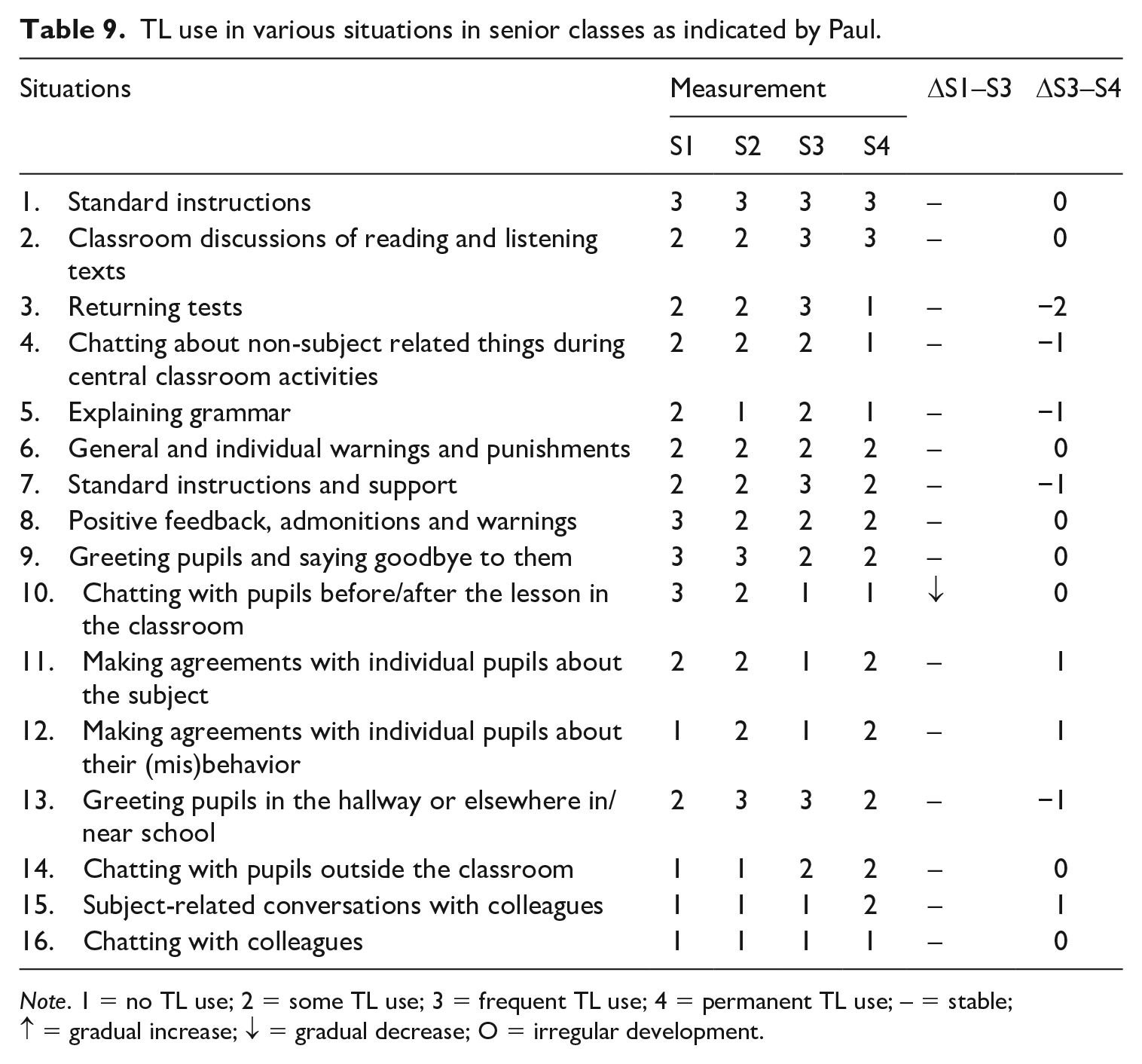
Note. 1 = no TL use; 2 = some TL use; 3 = frequent TL use; 4 = permanent TL use; – = stable; ↑ = gradual increase; ↓ = gradual decrease; O = irregular development.
Paul used the TL most when giving standard instructions (1), when discussing text materials (2), when giving positive feedback, admonitions and warnings (8), and when greeting his pupils and saying goodbye to them (9). He did not frequently use the TL when chatting either with students or with colleagues (14, 16), but unlike Lisa, he did not avoid the TL completely in these situations in his junior classes: It is possible to use English when speaking to colleagues or when discussing important matters with students, but this seems forced and seems to make these conversations less fluently and spontaneous, which is a disadvantage. (Paul)
In other words, the unnaturalness of conversation in the TL (see also Harbord, 1992; Wharton, 2007) causes Paul to favor speaking Dutch outside the classroom. Paul also uses Dutch for explaining grammar rules to his junior students: Explaining English grammar in English is often too confusing, and students seem to understand grammar better when they can discuss it in Dutch. (Paul)
The complexity of the content and the goal to get the point across (see also Chambers, 2013) are reasons for Paul to teach grammar in Dutch.
Paul showed only restricted change regarding TL use during teacher education, that is, from S1 to S3; many situations remained the same or displayed a development with maximum 1 point over three measurements. Only a gradual decline could be observed in his senior classes when chatting with pupils before and after the lesson in the classroom (10). One year after graduation, Paul reduced his TL use in junior classes, especially in the ‘Outside the classroom’ category (13, 15, 16). We observed an increase only when providing standard instructions and support (7). Senior classes displayed a more diffuse picture after graduation, having both situations in which TL increased (11, 12, 15) and situations in which TL use decreased (3, 4, 5, 7, 13). Roughly, Paul started to use more TL when making agreements with individual pupils (11, 12) and less TL in general classroom activities (3, 4, 5).
3 Sophie
Similar to Lisa’s and Paul’s situation, Sophie’s TL use in senior EFL classes exceeded her TL use in junior classes (see Table 10). The estimations of Sophie and the observer align; at S1/CO1: both 30% and at S2/CO2: 100% and 95%, respectively. However, Sophie’s teacher educator indicated 100% of TL use by Sophie at S3/CO3, whereas Sophie reported a lower percentage of 80% here. Also, her TL use increased in junior classes, whereas her TL use in senior classes remained consistently high and varied between 90% and 100%: [In senior classes], I try to use the TL as much as possible and I dare to say I use English 90–100% of the time. (Sophie)
Target language (TL) use by Sophie (in percentages) as estimated and observed over time.
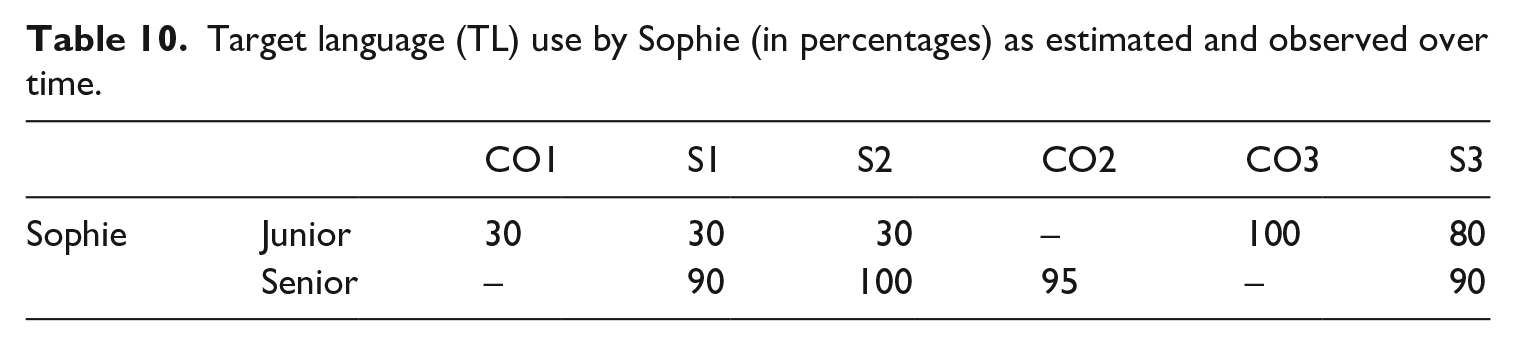
Tables 11 and 12 show Sophie’s TL use in junior and senior classes, respectively. The situations in which Sophie used the TL in junior classes were analogous to those of Lisa and Paul; they were mainly from the categories ‘Individual work’ and ‘Central classroom activities’, that is, when giving standard instructions (1), when discussing reading and listening texts (2), when providing positive feedback, admonitions and warning (8), and when greeting pupils and saying goodbye to them (9). In senior classes, she clearly used English in more situations than in her junior classes, also compared to Lisa and Paul, and she indicated that she used the TL ‘frequently’ to ‘always’ in these situations. In general, she used the TL in all ‘Central classroom activities’ (1–7), in ‘Individual work’ (8–9) and when greeting pupils and saying goodbye to them (10), including more challenging activities like warning and punishing, and explaining grammar (5): I try to use English in the general domain. Sentences like ‘good morning’, ‘please get your books’, ‘bags off the table please’, ‘now let us discuss our homework’, all work well in English. Everything inside the classroom is in English, so the introduction, grammar explanation, instruction, working in pairs, giving feedback, warnings and all sorts of do’s and don’ts. (Sophie)
Target language (TL) use in various situations in junior classes as indicated by Sophie.
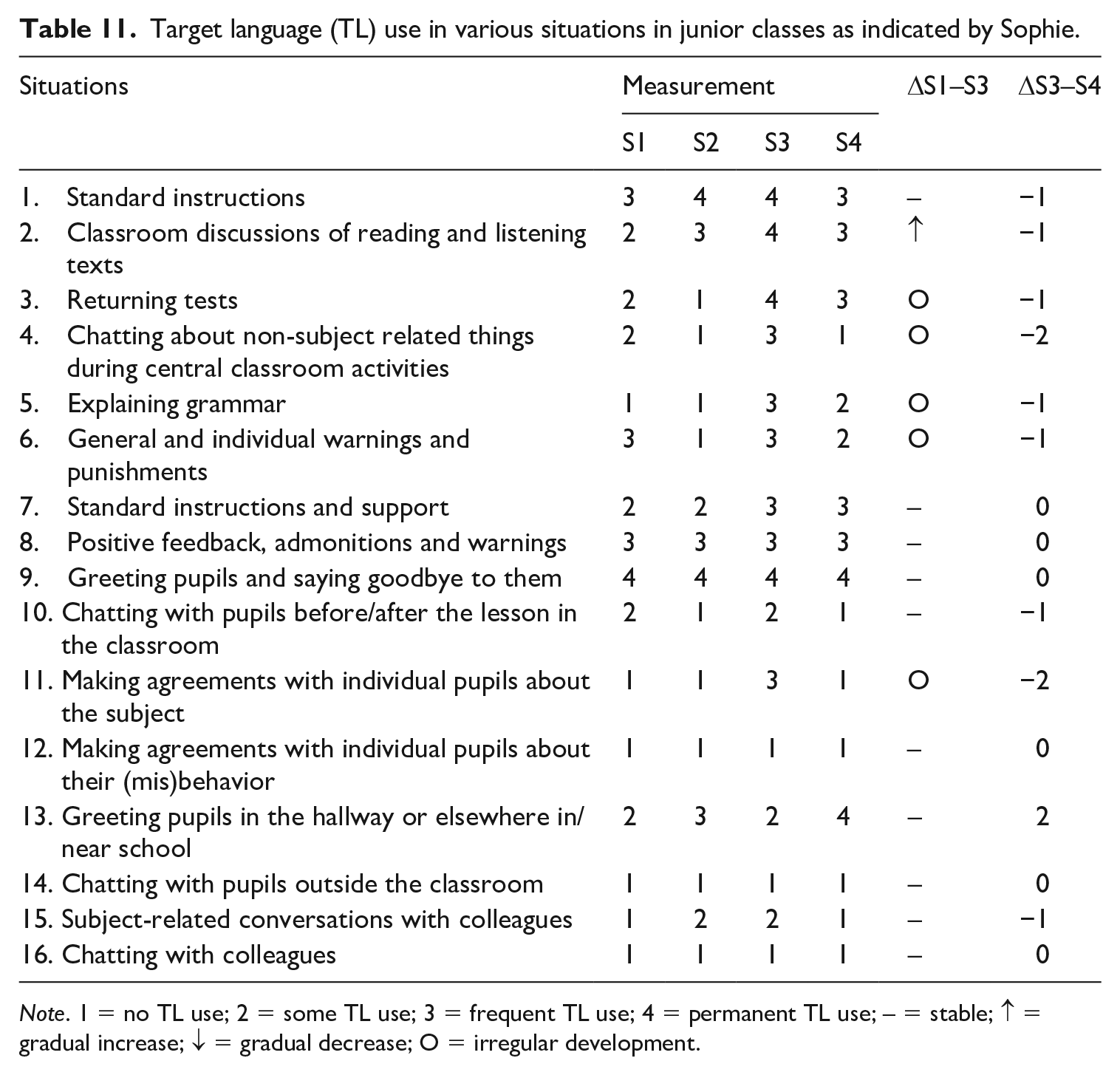
Note. 1 = no TL use; 2 = some TL use; 3 = frequent TL use; 4 = permanent TL use; – = stable; ↑ = gradual increase; ↓ = gradual decrease; O = irregular development.
Target language (TL) use in various situations in senior classes as indicated by Sophie.
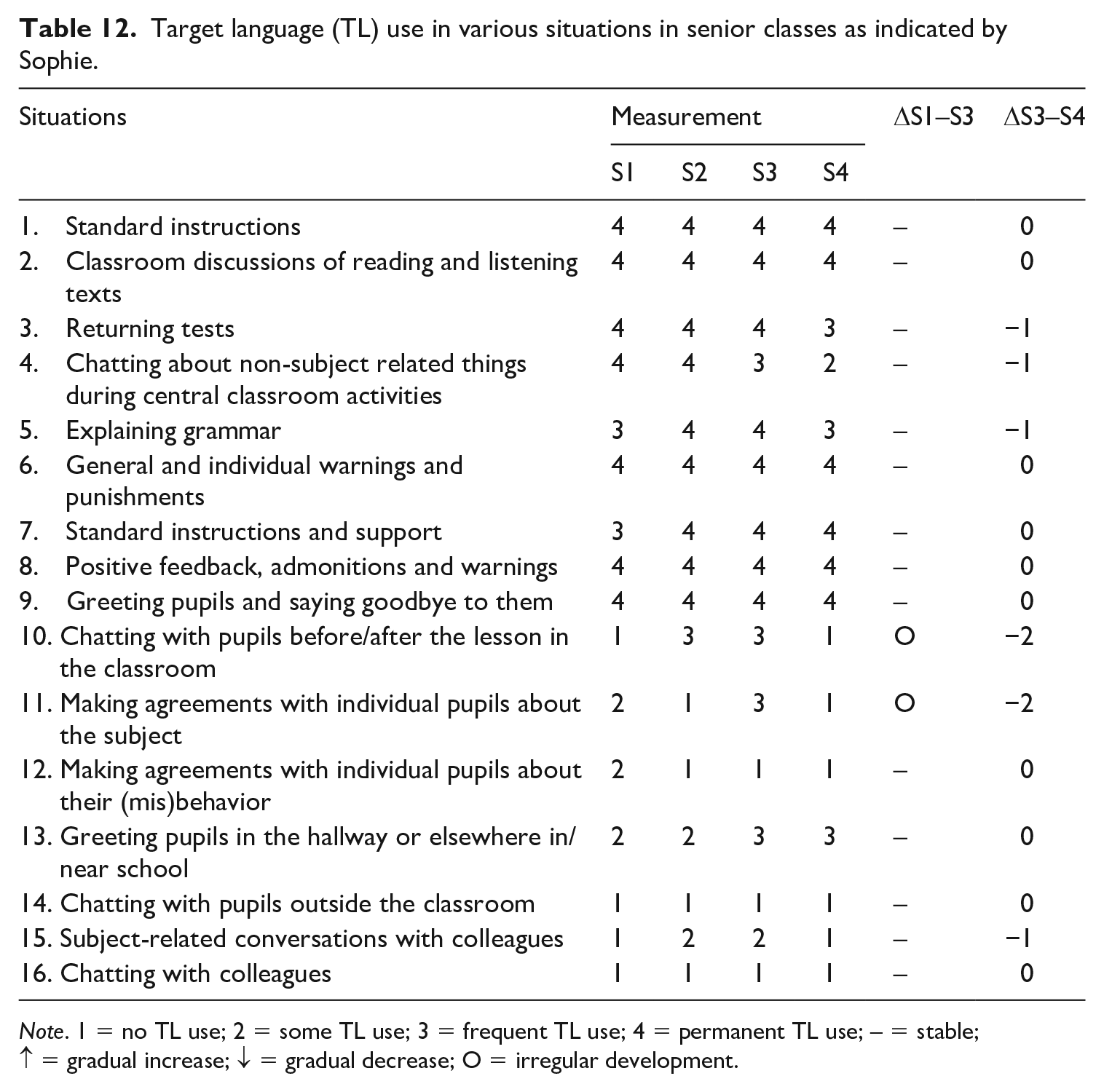
Note. 1 = no TL use; 2 = some TL use; 3 = frequent TL use; 4 = permanent TL use; – = stable; ↑ = gradual increase; ↓ = gradual decrease; O = irregular development.
Similar to Lisa and Paul, Sophie used Dutch when chatting with either her colleagues or her pupils (14, 16) and when making agreements with pupils concerning their (mis)behavior (12): I do not, however, use English in the social domain. As I am still quite new at this school and we do not have a real connection yet, I prefer to do this in Dutch. I have the feeling this makes them feel more comfortable to actually share things with me and it makes them feel more confident. (Sophie)
Thus, Sophie displays a nearly exclusive TL use in her classroom where her goal is to foster foreign language learning of her students. Where her social objectives prevail, for instance when building rapport, she switches to Dutch.
During teacher education, most developments regarding TL use can be observed in Sophie’s junior classes; we saw a gradual increase when discussing texts (2) and irregular increases in the ‘Central classroom activities’ (3, 4, 5, 6) and when making agreements with individual pupils about the subject (11). The other situations remained stable from S1 to S3. Senior classes displayed irregular increases when chatting with pupils before/after the lesson in the classroom (10) and when making agreements with them about the subject (11). No developmental changes were found in the other situations. One year after finishing teacher education, Sophie showed a general decline in TL use; for many situations she indicated that she used less English than before. More precisely, nine of the situations in junior and six of the situations in senior classes displayed a decrease in TL use. Only when greeting pupils in the hallway or elsewhere in or near the school she did so more often in English.
To summarize, Lisa, Paul, and Sophie all used the TL more in senior than in junior classes and the amount of TL use was, except for Lisa in junior classes, quite high at the end of their teacher education (S3), viz. 80% or higher. All three used the TL in similar classroom situations in junior and senior classes and all spoke English in linguistically predictable and standard situations. Paul and Sophie used the TL in more challenging situations like warning and punishing, and explaining grammar. Outside the classroom they generally did not use the TL. During teacher education, Lisa and Sophie displayed clear development in TL use; they showed changes in many classroom situations in junior classes, and most of them were increases. Their senior classes revealed hardly any development. Paul, on the other hand, did not change much regarding his TL use during his internships. After teacher education, Paul’s TL use showed increases and decreases in different situations; Lisa and especially Sophie reduced their TL use one year after graduation. We will reflect on these findings in Section V.
Research question 2: To what extent do the personal, teaching practice-related, and external domain affect student teachers’ TL use during teacher education and one year after graduation?
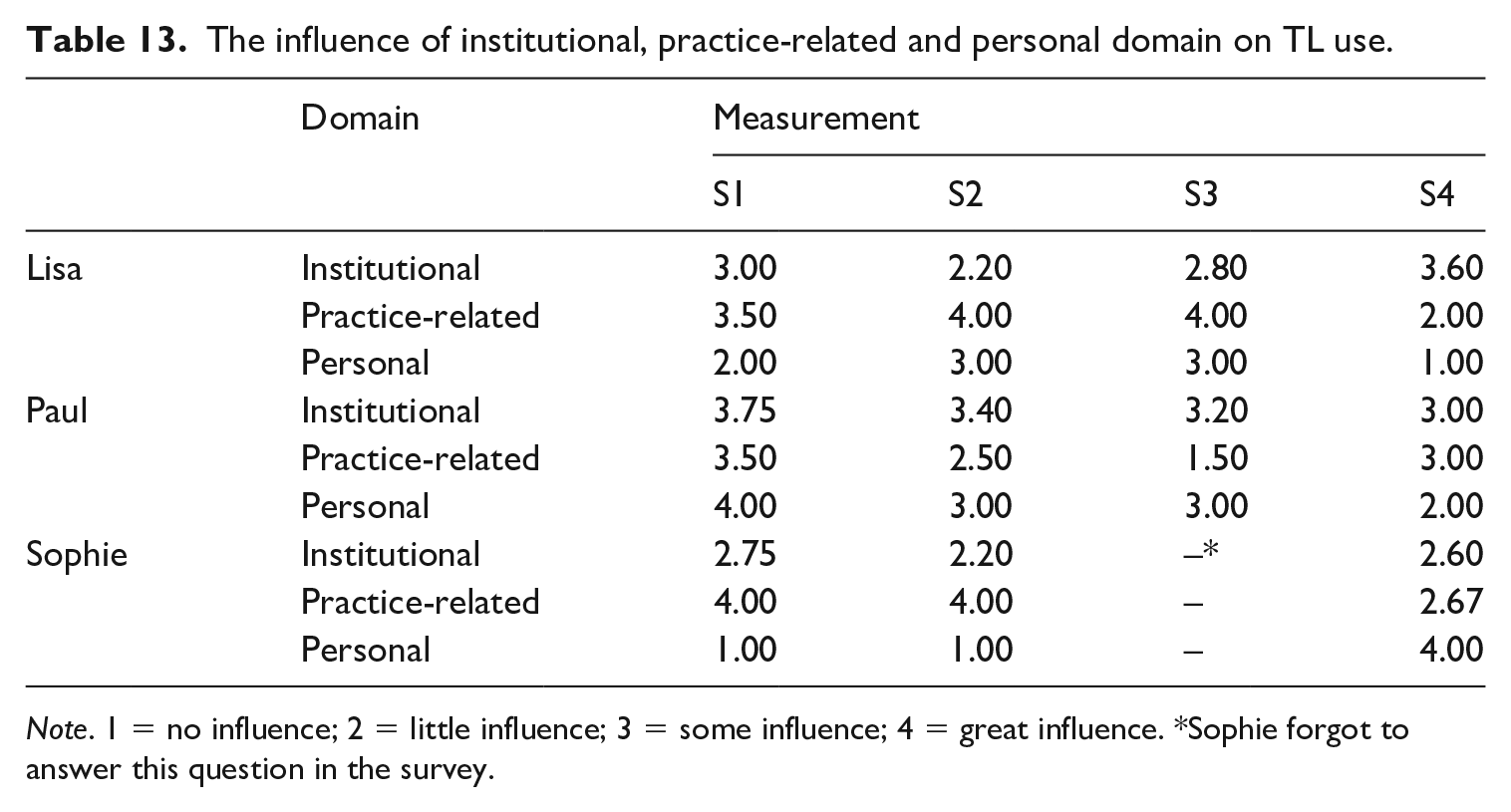
Table 13 shows the influence of the personal, practice-related, and institutional domains on the TL use for Lisa, Paul, and Sophie (S1–S4).
The influence of institutional, practice-related and personal domain on TL use.
Note. 1 = no influence; 2 = little influence; 3 = some influence; 4 = great influence. *Sophie forgot to answer this question in the survey.
4 Lisa
The practice-related domain exerted most influence on Lisa’s usage of the TL during her teacher education. This means that her apprenticeship school’s perspectives on TL use and learners’ reactions to Lisa’s usage of English played a major role in her TL use. Interestingly, Lisa demonstrated a different picture at S4, when indicating that especially factors lying in the institutional domain influenced her TL use. Put differently, a year after graduation, Lisa indicated that factors related to the teacher education program affected her TL use the most. But already during teacher education she acknowledged the impact of the program when explicitly mentioning the influence of the written reflection report on her TL use: Doing this assignment has made me realize that I see the TL as a useful tool to provide the students with English input, so using the TL serves an educational purpose inside the classroom. (Lisa)
In sum, Lisa regards TL use an essential component of FL pedagogy.
5 Paul
The institutional domain influenced Paul’s TL use most; this domain displays high but gradually declining values (see Table 13). Apart from S1, values for the other two domains are relatively low, representing little influence on his TL use. At that measurement, Paul indicated that his personal experience as a learner in secondary education most influenced his TL use. Overall, factors in the practice-related domain least affected his TL use.
6 Sophie
Whereas Lisa and Paul seemed rather stable in the domains of influence, these domains displayed more fluctuations for Sophie. At S2 and S3, i.e. during Apprenticeship 2, Sophie indicated that especially factors related to teaching practice mediated her TL use: The school’s policy is to use the TL as the instruction language as much as possible . . . In vwo 4,
2
this all goes pretty easily. They are used to lessons provided in the TL, as my predecessor implemented the rule of TL as the instruction language in the [first year of secondary school]. (Sophie)
Sophie’s comment confirms the importance and potentially fostering effect of a common policy on TL use (see also Chambers, 2013; Oosterhof et al., 2014). By the time Sophie had been teaching English for one year, at a school different from her apprenticeship schools, she indicated that now her personal experiences as a former FL learner exerted most influence on her TL use, whereas the personal domain seemed to least affect Sophie’s TL use during teacher education (S1–S3).
To summarize, different factors from all three domains affected our participants’ TL use and for each student teacher the impact of these factors changed from the start of their teacher education until one year after graduation. During teacher education, for both Sophie and Lisa, the practice-related domain mediated their TL use the strongest. For Paul, factors related to teacher education especially influenced his TL use. Lisa and Paul indicated that this institutional domain affected their TL use most one year after graduation, whereas Sophie mentioned the personal domain at that time. In addition, she said that her TL use was not influenced by teacher education during the time of the research project.
V Discussion
The present study zooms in on three Dutch EFL student teachers and explores their TL use in junior and senior classes. In general, each of the three student teachers showed high percentages of TL use in their EFL teaching practice. In so doing, their TL use deviates from the general picture that Dutch FL teachers tend to speak Dutch in their classrooms (Bonnet, 2002; Kordes & Gille, 2012). This is surprising, since TL use requires advanced pedagogical teaching skills, and student teachers generally show other concerns, mainly related to classroom management (Chambers, 2013; Kwakernaak, 2007). Furthermore, the three student teachers used the TL more in their senior than in their junior classes. Both results, i.e. the high percentages of TL use and more TL use in senior than in junior classes, might well be related to the proficiency skills of the learners. It accords with statements of beginning as well as experienced teachers indicating that low linguistic competences of pupils hinder TL use (Bateman, 2008; Haijma, 2013; Hall & Cook, 2013; Oosterhof et al., 2014). In other words, when pupils are more skillful in the TL, it is easier for the teacher to use and continue using the TL. This seems to be the case in Dutch EFL classes, especially in senior classes where the aimed CEFR levels are B2–C1.
Our results show that the three student teachers use L1 in situations that are challenging in terms of linguistic, social and, content-related factors. Hence, they match with earlier studies (e.g. Hall & Cook, 2013; Oosterhof et al., 2014; Tammenga-Helmantel & Mossing Holsteijn, 2016). On the other hand, our student teachers seemed to use the TL in more situations than reported in Oosterhof et al. (2014), who researched French as a FL, in that the use of English is more common and not restricted only to frequent, standard utterances and positive information. This ties in with observations by Haijma (2013) and West and Verspoor (2016) who found that TL use in EFL classrooms is more common than in other Dutch FL classrooms. The position of English in the Dutch educational context and in society in general could be linked to the frequent use of English in EFL classrooms. The linguistic skills of the learners and their motivation, which are higher in English than in French for Dutch secondary school students (SLO, n.d., and Elzenga & de Graaff, 2015, respectively), may well be the reason for the differences found between Oosterhof et al. (2014) and our investigation. Although we did not ask the participating teachers about their own language proficiency, this factor might well affect TL use in English and French. This aligns with Chambers’ (2013) observation: teachers’ competence and confidence in their second and third foreign languages [e.g. French] have a greater impact on their TL use than does their competence in their first foreign language [in the Netherlands: English]. Also the linguistic distance between French and Dutch, which belong to different language families, might negatively influence TL use in French classrooms (see Chambers, 2013 for reflections concerning this factor).
During teacher education, Lisa, Paul, and Sophie displayed distinct developmental tendencies, see also Bateman (2008) and Chambers (2013). Both Lisa and Sophie took steps on the TL ladder in junior classes, in which TL use was initially low and which is generally more challenging than in senior classes, as indicated before. They extended their TL use within the first three categories of the ladder, that is, in ‘Central classroom activities’, ‘Individual work’ and ‘Before and after the lesson in the classroom’. Lisa eventually used English mainly in (linguistically) predictable situations, whereas Sophie even managed to increase the amount of TL in her junior classes and extended it to more classroom situations − but no sooner than towards the end of teacher education (S3). In their senior classes both Lisa and Sophie displayed a constant, high amount of TL use. Paul’s TL use displayed only minor changes. This could indicate that he had other concerns, or as Kwakernaak (2007) put it: student teachers need their focus and energy for more urgent matters, mainly related to classroom management (p. 13).
Our data show that factors influencing TL use are not only from the well-studied personal and practice-related domains but also include factors from the institutional domain introduced in this study. Importantly, one participant experienced factors related to teacher education as having the strongest impact on his TL use. Moreover, two of the three student teachers considered this the main domain of influence one year after graduation. Based on these results, we suggest future research to investigate the role of teacher education when studying factors or domains influencing TL use. One of the issues to be clarified is the weight of the individual domains and whether they are hindering or fostering TL use.
The impact of the three domains differed between the individual student teachers and the influence of these domains on each student teacher varied over time. For instance, Lisa and Sophie mentioned the impact of the teaching context during teacher education: language policy in the school and among colleagues (see also Hermans-Nykerk, 2007; Oosterhof et al., 2014) and the reaction of their learners (see also Bateman, 2008; Chambers, 2013; Haijma, 2013; Hall & Cook, 2013; Oosterhof et al., 2014; Tammenga-Helmantel & Mossing Holsteijn, 2016). In addition, Sophie said that personal experiences as a former learner of English influenced her TL use (see also Macaro, 2001) one year after graduation. Paul, on the other hand, indicated that his TL use was most influenced by factors related to teacher education, both during teacher education and after graduation. Differences between the student teachers regarding the domains of influence are not surprising. Since the student teachers teach at different schools, a different impact of the practice-related domain can be expected. Moreover, as individuals, they bring in different linguistic and pedagogical skills and different experiences as FL learners. Changes in TL use and in the factors influencing TL use might also be related to the time of the measurement and the increased extent of the student teachers’ teaching experiences. For instance, at the start of an apprenticeship student teachers might start with high objectives regarding the use of the TL but depending on gained experiences these aims are adjusted later on (see also Bateman, 2008).
The measurement one year after graduation (S4) displayed a varied picture. Sophie’s decreasing TL use could be a case in which teaching conditions with increased work load − after relatively ‘shielded’ apprenticeships and with pro-TL use school policy − do not give opportunities to maintain time-consuming and pedagogically challenging initiatives (see also Graus & Coppen, 2016 and Watzke, 2007) such as TL use. The TL use of Paul and Lisa, on the other hand, displayed a blurred picture after graduation: some classroom situations remained stable whereas others showed either an increase or a decrease. At that time, Paul and Lisa considered the institutional domain as most influential regarding TL use. It might well be that a new school and more general pedagogical skills let them try to put into practice what had been promoted in teacher education, that is, using the TL in the classroom.
The portraits of Lisa, Paul, and Sophie show possible and different developmental tendencies in TL use among student teachers. It goes without saying that for a broader perspective, future research could include more student teachers and, importantly, also from other universities and for other foreign languages. In particular, an investigation of TL use for other languages may give different results since the position of English in the Netherlands is rather different from FLs such as German and French, both in secondary education and regarding TL input outside the classroom. These languages are optional in senior classes in Dutch secondary education and linguistic input is generally restricted to the FL classroom. Lower language proficiency of the student teachers (see Chambers, 2013) and lower status of the foreign language (see Kim & Elder, 2008) may negatively affect TL use in French and German classes in the Netherlands. Another possible extension of our study could include experienced teachers and compare their TL use with that of the student teachers to see e.g. what factors influence their TL use and whether the domains of influence shift when teachers have more years of teaching experience.
This present study provided more insights into student teachers using the TL in their teaching practice during teacher education and one year after graduation. Focus was on the amount of TL use, when, i.e. in which classroom situations the TL is used, and what factors influence their behavior regarding TL use. However, it does not report about the how of TL use. A more detailed picture could emerge if the quality of TL use is considered. Validated instruments presented in Glisan and Donato (2017) and in Dönszelmann (2019) could be adapted to conduct this type of research. Likewise, our study only restrictedly informs about the why of TL use; the design did include questions regarding intervening factors and a reflection task but especially quotes from the latter task turned out highly informative. More qualitative reflections, for instance at S4, would enable triangulation of our findings. Future studies would therefore benefit from a more qualitative perspective on TL use.
Future research on TL use should also critically reflect on classroom observations and lesson content. We included three classroom observations in our design but we are aware of the restrictions. First, the presence of an observer might have affected the student teachers’ behavior and in doing so, negatively influenced the representativeness of the observations. Second, the observations presented snapshots of teaching reality, that is, at one particular moment and with a certain lesson content. We have observed that TL use varied across teaching situations and differed depending on the learners’ FL proficiency levels. For instance, observations of a teacher providing grammar explanation to a junior class or instructing a senior class to fill out blanks exercises will provide different pictures. More observations, preferably with a standardized observation instrument, would improve the reliability of studies on TL use. Ideally, they should also include information on TL use by learners to provide a broader picture of classroom practice. As noted, our classroom observations on TL use were an ‘extra’ for the educators whose main concern was to fill in an extensive observation form on general teaching skills. If future classroom observations would also focus on the quality of TL use and TL use by learners, it would provide more precise and detailed information on TL use.
VI Conclusions
TL use is a key component of FL pedagogy. FL teachers generally subscribe to its relevance but also indicate that using the TL in teaching practice is sometimes difficult. This study analysed TL use of three EFL student teachers, and aimed to clarify what factors influence their TL use during teacher education, thus providing new insights into a still relatively unexplored research area, viz. TL use in the FL classroom by student teachers. It turned out that TL use of student teachers by and large matches the behavior of experienced FL teachers. Furthermore, we revealed another domain of influence affecting TL use; besides well-known factors from the personal and practical domain, the institutional domain influences TL use as well.
Indeed, teacher educators can make valuable changes to the FL classroom by supporting prospective teachers to make informed choices regarding L1/TL use and – importantly – by providing tools for handling TL use especially in linguistically and pedagogically difficult situations, such as teaching complex content. It is these situations that both student teachers and experienced teachers consider serious challenges when using the TL. Focused education might lead to student teachers maintaining TL use, which is considered time-consuming and challenging, beyond teacher education, that is, also in their ‘real’ teaching practice with increased work load and intensified responsibilities. This then pleads for incorporating subject-specific support for beginning teachers, for instance, as part of induction programs such as those developed by Helms-Lorenz, van de Grift, and Maulana (2016). Our explorative study identified in which situations exactly these student teachers find difficulties in implementing TL use in their teaching practice. These insights enable teacher educators to more judiciously intervene in the teaching learning process.
