




Abstract
Aims and Objectives/Purpose/Research Questions:
Previous studies have investigated if quantity of target language (TL) use predicts second language (L2) learning. The aim of this study is to understand what kind of TL use promotes host language proficiency among adults in the context of migration, operationalized as productive collocation knowledge.
Design/Methodology/Approach:
The study takes a cross-sectional quantitative approach to explore what clusters of TL activities predict language proficiency among 63 first language (L1) French L2 Swedish long-term residents in Sweden.
Data and Analysis:
Data were collected within a larger project. Productive collocation knowledge was assessed by a collocation test and participants’ TL use through the Language Engagement Questionnaire. We conducted a factor analysis to identify patterns of TL use. We then used structural equation modeling to investigate the relationship between TL use and productive collocation knowledge.
Findings/Conclusions:
Two factors emerged from the factor analysis: “Everyday Interactive Target Language Use” and “Non-interactive Target Language Use.” Only the former was related to productive collocation knowledge as evidenced by the structural equation modeling. “Everyday Interactive Target Language Use” included using the TL at the workplace, in conversations and service encounters, through text messages and emails, participating in online social network platforms, and browsing the internet.
Originality:
The study explores what specific kind of TL use promotes second language proficiency among adults in a migration context. This is a topic that has not received much attention in previous research.
Significance/Implications:
By showing that proficient L2 users engage daily with the TL through, for example, social interactions and language use at work, the study points toward the importance of a certain level of socio-economic as well as socio-cultural integration for efficient second language learning among adults in a migration context.
Keywords
Introduction
Adult second language (L2) learning currently concerns millions of migrants who—for various reasons—settle in a new country. Regardless of the migration motive, migrants face the major challenge of learning the host country’s language. While adult L2 education certainly plays a role in this learning process, scholars increasingly emphasize the importance of everyday language use outside the classroom. The last decades in L2 research have, in terms of theoretical development, been characterized by a strong interest in usage-based approaches (UBAs) to L2 learning (Ellis, 2015; The Douglas Fir Group, 2016). A central component of these approaches is that language learning, both in the L1 and the L2, is first and foremost dependent on language exposure and use. To many, not the least lay people, this seems intuitive, since this corresponds to lived experiences. The extent to which you use a language as well as the linguistic features of the input, will have a strong impact on your developing language. Studies spanning all the way from corpus linguistics to conversation analysis acknowledge the importance of language use. There has been increasing interest over recent years in empirically investigating the relationship between L2 learning and target language (TL) use (here defined as both active [speaking, writing, and reading] and passive [listening, watching TV/film] language use; cf. Sundqvist & Sylvén, 2016, p. 188). A few previous studies including immigrants in various geographic contexts have found that amount of TL use factors relates to various aspects of L2 proficiency (Dąbrowska, 2019; Dollmann et al., 2020; Forsberg Lundell et al., 2023a). These studies, however, have typically focused on composite scores of TL use (scores based on two or more TL activities) or a limited range of TL activities. An evident follow-up question, which has hitherto been scarcely explored, is: if TL use is important, what kind of TL use is the most beneficial for high-level L2 use in a migration context? The aim of this study is to respond to this question by focusing on L2 learning in the context of migration (which here refers to professional and/or lifestyle migration).
The study draws on data collected within a larger mixed-method research project on adult L2 learning in a migration context. The dataset used for this study was collected among L1 French long-term residents in Sweden, which we first analyzed in the study by Forsberg Lundell et al. (2023a), with the aim to explore the link between psychological and social factors and L2 Swedish proficiency, operationalized as productive collocation knowledge (i.e., knowledge of conventionalized word combinations such as “give birth” and “ask for help”). In the preceding study, we used a modified version of the Language Engagement Questionnaire (McManus et al., 2014) to obtain information about the participants’ TL use habits. The analysis drew on an average quantity of TL use score, based on participants’ responses to 23 items reflecting 23 different TL-mediated activities. We found that sheer frequency of TL use was a predictor of collocation knowledge in L2 Swedish. In this study, we expand the analysis of these data to contribute more nuanced insights into the link between TL use and L2 learning in a migration context, by examining if there are specific clusters of TL activities that statistically predict L2 proficiency.
Background
The study of TL use in L2 acquisition
With the increasing importance attributed to TL use for the L2 learning process, researchers have attempted to find optimal ways of documenting research participants’ experience with the TL. In several studies including adult migrants, length of residence (LoR) in the host country has served as a proxy for how much exposure an L2 learner has had to the TL. The usefulness of LoR as a measure of TL has, however, been questioned (Dąbrowska, 2019, p. 95), since the quantity and quality of learners’ TL use vary considerably even when learning takes place in the host country. Instead, researchers have inquired research participants about their patterns of language use in their everyday lives. Typically, such information is obtained through the questionnaire method where participants self-report how much or how often they use the TL. The particular design of the questionnaire often varies from study to study, including item formulation and response options. In some studies, participants are asked to estimate what percentage of the time they use the TL versus their other language(s). In other studies, participants self-report how many hours a week or how often, on average, they use the TL, either in the most general sense, or, for specific purposes. This latter is the case in one of the most widely used instruments, namely the Language Engagement Questionnaire (McManus et al., 2014). Here, respondents self-report how frequently they use the TL for 27 different purposes (e.g., watch TV, browse the Internet, have short conversations, engage in long casual conversations, newspapers). Although the questionnaire is designed to yield more nuanced information about patterns of TL use, several studies have calucated average scores for amount of TL use, based on responses to the individual items (Arvidsson, 2019; Forsberg Lundell et al., 2023a, 2023b). The methodological challenge related to the empirical study of TL use is widely acknowledged—and currently critically discussed (see Arndt et al., 2023)—and lately, the methodology used to measure language learners’ TL use has been developed further to include modern technology, such as the Experience Sampling Method (ESM), which implies that participants partake in several small surveys per day, where they register the activities they are involved with through prompts sent via a smartphone app (Arndt et al., 2023).
The link between TL use and L2 proficiency
L2 learners’ TL use and its relationship to L2 learning has been investigated by scholars since the 1990s, in different populations and in different learning contexts, including foreign language contexts, study abroad contexts and in the context of migration, where the TL is learned in a context where the TL is dominant.
In a foreign language context, it has been observed that time spent using the TL outside the classroom tends to relate to higher proficiency levels, operationalized, for example, as vocabulary size (Peters et al., 2018; Sundqvist, 2009) and collocation knowledge (González Fernández & Schmitt, 2015). In the study abroad context, some studies have observed such relationships (Hernández, 2010; Schmitt & Redwood, 2011; Zhou & Baffoe-Djan, 2023), but not all (Arvidsson, 2019). The inconclusive findings have led researchers to argue that L2 learning in the study abroad context may be a question of the quality of the TL use rather than sole quantity, in other words, rather a question of what they do with the TL than solely how much (Baker-Smemoe et al., 2014). For example, social interactions have emerged as beneficial for international students’ linguistic development, both in studies based on quantitative social network data (Baker-Smemoe et al., 2014) and in interview-based studies (Arvidsson, 2021), which aligns with theoretical assumptions regarding the benefits of social interaction for L2 development (Ellis, 2015; Long, 1996). This research, however, mainly includes school and university students whose everyday lives and opportunities for TL use may be different from those of the adult migrant, who often has other commitments and responsibilities.
Studies that concern migration contexts (i.e., that include adults who—for varying migration motives—have settled in the host country for an indefinite period), have also generally observed relationships between quantity of TL use and L2 proficiency, although it should be pointed out that these studies have operationalized TL use and L2 proficiency in different ways. For example, several studies have observed a relationship between amount of TL use and L2 phonology (Dollmann et al., 2020; Forsberg Lundell et al., 2023b; Moyer, 2004). For example, Dollmann et al. (2020) found that L2 exposure had a strong effect on accent-free speech in L2 German among immigrants in Germany with varying L1 backgrounds, who arrived in Germany at the age of 10 or later. Their analysis was based on a composite score for L2 exposure, including data on TL use with partner, TL use in family, and the number of immigrants in migrants’ immediate neighborhood (which served as a proxy for opportunity for contact with L1 speakers). Their findings suggest that TL use, not least in social interaction, is important for linguistic development among migrants. These findings align with Moyer’s (2004) observation, of a strong significant correlation between the amount of social interaction with L1 speakers of the TL (based on self-report through an in-house questionnaire), and degree of perceived nativelikeness in L2 German, among 25 immigrants with varying L1 backgrounds. The author used an in-house questionnaire where the participants self-reported their experience with TL use, including, for example, frequency of spoken interaction native speakers and frequency of non-interactive contexts for German. Similarly, Forsberg Lundell et al. (2023b) observed that the number of social relationships that were maintained in the TL French was one of the significant predictors of perceived nativelikeness in L2 French, as revealed through a regression analysis (that contained multiple individual factors). The analysis was based on data regarding the participants’ social networks obtained through the Social Networking Questionnaire (McManus et al., 2014), and also included a measure of sheer amount of TL use, obtained through the Language Engagement Questionnaire (McManus et al., 2014), which, interestingly, did not emerge as a significant predictor.
Effects of TL use on L2 learning among adult immigrants have also been observed in the domain of phraseology. In a UK context, Dąbrowska (2019) found a significant effect of TL English use for collocation knowledge (among other language variables) in L2 English among 67 participants with different L1 backgrounds. The L2-speaking participants’ LoR ranged between 3 and 42 years (M = 7, SD = 6). Collocation knowledge was tested through the Words that Go Together Test (Dąbrowska, 2019) targeting 40 collocations, where participants were instructed to select the phrase that they perceived to sound the most familiar or natural among five alternative phrases including the target collocation. With respect to L2 use, participants were asked to self-report number of hours of reading in English per week, length of education in English, and what percentage of the time they used English in their private lives (i.e., with friends and family) and at work/college/university, using the following options: less than 20%, 20%–40%, 40%–60%, 60%–80% and over 80% of the time. The author then coded these responses from 0 to 5 and created a composite score that reflected English language use. A regression analysis that concerned L2 speakers revealed that learners’ amount of everyday language use was the strongest predictor for collocation knowledge and explained over 37% of the variance in collocation scores, underlining the role of use with the TL in developing collocation knowledge.
In the study that constitutes the direct background of this study (Forsberg Lundell et al., 2023a), we investigated the importance of psychological and social factors for adult L2 learning among 59 L1 French-speaking long-term residents in Sweden, including TL engagement. To investigate TL engagement, we used a slightly modified version of the Language Engagement Questionnaire (LEQ; McManus et al., 2014), where the participants self-reported how often they used L2 Swedish to carry out 23 different activities. In the study, we used an average frequency score indicating how often each participant used the Swedish language, on a scale from 0.00 to 5.00. A regression analysis revealed that the frequency of TL engagement uniquely explained 12% of the variance in the sample—almost as much as one of the language aptitude variables.
While the above-mentioned studies indicate that TL use is crucial for developing a high proficiency in an L2, they do not reveal what kind of TL use is most fruitful for L2 learning to take place in the context of adult migration. The analyses in the studies are based on indicators of TL use in the most general sense (or on composite scores based on separate TL use categories) and do not reveal how the long-term residents have used the TL in their everyday lives to develop their L2 proficiency level. To the best of our knowledge, there is no previous study that further inquires into what kind of TL use promotes L2 proficiency in the context of migration. In this study, we seek to better understand what kind of TL exposure and use promotes high proficiency in an L2. This study draws on the LEQ data used in the study by Forsberg Lundell et al. (2023a) and analyzes in further detail what constellation of TL-mediated activities relates to higher L2 proficiency levels operationalized as productive collocation knowledge. Collocation knowledge has been observed to reflect general L2 proficiency (Forsberg Lundell et al., 2018; Prentice & Lundell, 2021) and may thus serve as a relatively reliable proxy for L2 proficiency. Before presenting the study, we provide an overview of the theoretical assumptions underlying the investigated connection between collocation knowledge and TL use.
Collocation learning
The collocation learning process is assumed to require extensive exposure to the TL (Ellis, 2002; Schmitt, 2013). Repeated exposure to collocations in the linguistic input is then assumed to gradually lead to the entrenchment of these in the learner’s memory (Ellis, 2002, 2003). While some researchers have found evidence that we tend to pick up collocations (or other categories of formulaic language) incidentally, that is, non-intentionally, during written or audiovisual exposure (Pavia et al., 2019; Puimège & Peters, 2020), others emphasize the need for the learner to notice the target word combinations in order for them to be learned (Ellis, 2002; Schmidt, 1990). Social interaction is assumed to favor such noticing since learners presumably pay attention to form when seeking to grasp meaning (Long, 1996). Also, some researchers argue that formulaic sequences (including collocations) are so closely related to the “everyday reality of the target language culture” (Dörnyei et al., 2004, p. 87) that their learning, therefore, may require that the participant socially integrates with the TL speech community. A socially integrated environment offers the kind of personally engaging exposure to the TL assumed to facilitate collocation learning (Schmitt, 2013, p. 4). It remains an open question as to what kind of TL use favors collocation learning in the context of migration.
Method
Sample
The 64 participants shared the following characteristics, which also constituted the criteria for participation:
French was their main L1 (bilinguals from birth were included unless Swedish was the other L1)
They had finished upper secondary education
They had not started learning the Swedish language before the age of 12 years.
They had lived in Sweden for at least 5 years at the time of testing. (The cut-off point for inclusion in the study was set at 5 on the basis that LoR effects tend to decrease after 5 years of residence; Cummins, 1981).
Of the 64 participants, 36 were women and 28 were men. The mean age was 41.75 years old, with the youngest participant being 27 years old and the oldest 71 years old. The mean LoR was 13.23 years (range 5–50 years).
The participants were recruited using a convenience sampling method. We posted invitations to participate in the Facebook groups French Connection and Les Français à Stockholm (French people in Stockholm). We also recruited a relatively large portion of the sample through the snowball sampling method.
Instruments
Productive collocation knowledge
Collocations are defined in various ways and their definitions tend to reflect either a phraseological or a frequency-distributional approach. In this study, we take the latter approach and preliminarily consider collocations as “combinations of words that occur frequently together in a given language” (Prentice & Lundell, 2021, p. 45).
To assess productive collocation knowledge in L2 Swedish, we used a fill-in-the-gap test targeting 39 verb + noun collocations such as ställa en fråga (eng. “pose a question”) and föda barn (eng. “give birth”). The test was developed and validated by Prentice and Lundell (2021), following the item selection procedure lined out in the studies by Forsberg Lundell et al. (2018) and Gyllstad (2007). Test items were extracted from 22 different newspaper corpora in the Swedish language bank (https://spraakbanken.gu.se) and selected based on frequency and Mutual Information (MI) scores (the MI cut-off score was set at 3, and for further details, see Prentice and Lundell, 2021). Each item was presented in an authentic context and participants were instructed to fill out the missing verb that was replaced by a line except for the first letter that was provided to restrict the number of possible alternatives.
Example sentences were found in newspaper material with the help of the search tool Korp (
https://spraakbanken.gu.se/korp
). Two example items are given below in Swedish, followed by translations into English. The full list of test items is presented in the Appendix.
1. Därför reser svenska par utomlands till länder där kvinnor får “This is why Swedish couples travel abroad, where women are allowed to 2. GP blir det första av de utländska medierna som får chansen att “GP [Göteborgs Posten] is the first of the foreign media getting a chance to
With respect to scoring principles, items were scored dichotomously (1 or 0). In the case of an alternative collocation being provided by a test taker, we only accepted this if the collocation indeed constituted a conventional collocation (according to frequencies and MI threshold detailed in the study by Prentice and Lundell, 2021). Spelling mistakes were not penalized since they do not constrain collocation knowledge.
TL use
To investigate TL use, we used a slightly modifed version of the LEQ (McManus et al., 2014), which is a self-report instrument that was elaborated within the LANGSNAP-project (https://langsnap.soton.ac.uk/). In the questionnaire, participants indicated how often they use L2 Swedish for 23 different purposes, corresponding to 23 items, by selecting one of the following responses: every day, several times a week, a few times a week, a couple of times a month, rarely and never. The 23 items target both active and passive language use, such as “engaging in small talk,” “using the TL at work,” and “watching TV and film.” The original version contains 27 items but for the version used in this study, we merged the items “read emails” and “write emails” into “emails,” “watch TV” and “watch films” into “watch TV/films,” and we dropped the item “teach classes.” The 23 items are listed in Table 1. The six response options were coded from 0 to 5, corresponding to an ascending frequency (0 = never; 5 = every day).
Two-factor model of the language engagement questionnaire (LEQ).
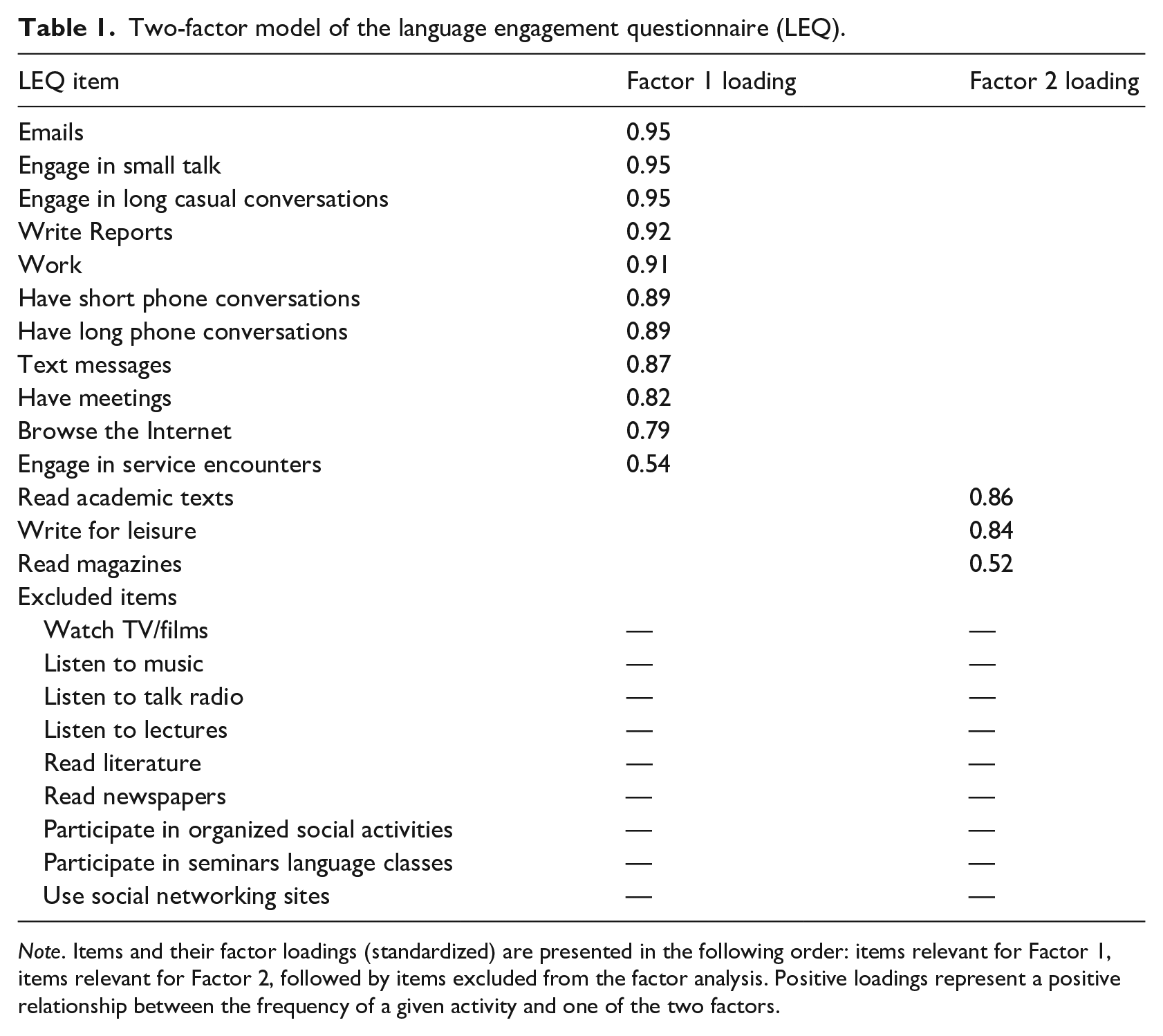
Note. Items and their factor loadings (standardized) are presented in the following order: items relevant for Factor 1, items relevant for Factor 2, followed by items excluded from the factor analysis. Positive loadings represent a positive relationship between the frequency of a given activity and one of the two factors.
Data collection procedure
The study draws on data that were collected in Stockholm, Sweden, 2019 and 2020, for a research project reported by Forsberg Lundell et al. (2023a). The first and second authors met with the participants individually, at a time and place of each participant’s choice, such as in their office, in their home, or in a quiet café. Each data collection session lasted between 1.5 and 2 hours, during which participants took tests and filled out questionnaires (for further details, see Forsberg Lundell et al., 2023a).
Data analysis
Data analysis was performed using R (R Core Team, 2018), RStudio (RStudio Team, 2020), the lavaan (Rosseel, 2012), and psych (Revelle, 2023) packages. Due to a missing answer on one of the items, one participant had to be removed from the analyses. The following analyses were performed on data from the remaining 63 participants.
Factor analysis
The factor analysis was performed in two steps. First, the optimal number of factors was chosen according to the scree plot and eigenvalues (based on polychoric correlations), and an exploratory factor analysis (EFA) was performed with the indicated number of factors to identify behaviors (items on LEQ) that contribute clearly to one or the other factor. Polychoric correlations are usually recommended when dealing with ordinal data, such as the data we collected (see Kline, 2023). Items were selected based on factor loading (⩾ 0.6 or ⩽ –0.6). More details about the EFA are available in Supplementary materials. Next, we created a two-factor model of LEQ using the selected items and did a confirmatory factor analysis using the diagonally weighted least squares (DWLS). This model of the language use scale was evaluated by looking at fit indices (root mean square error of approximation [RMSEA], standardized root mean square residual [SRMR], Tucker–Lewis index [TLI], and comparative fit index [CFI]), and Cronbach’s alpha to get an idea about the scale’s unidimensionality and internal consistency. The following thresholds were used for making conclusions about the model fit: RMSEA ⩽ 0.08, SRMR ⩽ 0.8, TLI ⩾ 0.9, CFI ⩾ 0.9 (Hu & Bentler, 1999). More details about the analysis are available in Supplementary materials.
Structural equation modeling
The results of the factor analysis were applied to look at the relationship between collocation ability (measured as performance on the collocation test) and language use behaviors. Collocation ability as a function of the two factors emerging from the factor analysis was modeled using structural equation modeling (SEM). The SEM model fit was evaluated using the same fit indices (RMSEA, SRMR, TLI, and CFI) and thresholds as for the factor analysis. Estimated standardized coefficients for the relationship between each factor and collocation performance with corresponding 95% confidence intervals are reported.
Results
EFA indicated that a two-factor solution was optimal. Based on the EFA, 13 items that contributed to either one or the other factor were selected, and the remaining 10 items were not included in the following factor analyses (EFA factor loadings are available in Supplementary materials). A two-factor model with the kept items showed a good fit to the data (SRMR = 0.08, RMSEA = 0.05 [0,0.09], TLI = 0.999, CFI = 0.999) and an excellent internal consistency (Cronbach’s alpha = .94).
Table 1 shows all LEQ items with their respective factor loadings (if included in the two-factor model) and Figure A.1 in the Appendix shows the distribution of responses to the LEQ items. The first factor consisted of items reflecting active TL use, that is, activities that require the L2 user to be active and/or productive and to rely on their own L2 skills (see Sundqvist & Sylvén, 2016, p. 188). Most of these activities were “interactive,” involving both a sender and a receiver, and were related to everyday life, including work (e.g., engage in small talk, engage in long informal conversations, have short phone conversations). Therefore, we will refer to this first factor “Everyday Interactive Target Language Use.” In contrast, the second factor included three items reflecting active but “non-interactive” TL use (i.e., activities that do not necessarily involve a receiver). Therefore, the second factor will be named “Non-interactive Target Language Use.”
Factor 1 everyday interactive TL use predicts productive collocation knowledge
The model predicting collocation knowledge from the two factors of language use showed a good fit in terms of TLI and CFI, although the SRMR and RMSEA were slightly above the desired value (SRMR = 0.10, RMSEA = 0.10 [0.07,0.13], TLI = 0.994, CFI = 0.994). The two factors of language use were highly correlated (0.66 [0.6, 0.72]; p < .0001). The model indicated that Factor 1 “Everyday Interactive Target Language Use” contributed highly to productive collocation knowledge (standard coefficient = 0.97 [0.53, 1.4]; raw coefficient = 7.04 [3.48, 10.6]; p < .0001), while Factor 2 “Non-interactive Target Language Use” seemed not to contribute to productive knowledge of collocations in L2 Swedish (standard coefficient = 0.04 [–0.61, 0.68]; raw coefficient = 0.26 [–4.42, 4.93]; p = .91; see Figure 1). In other words, each unit increase in Factor 1 “Everyday Interactive Target Language Use” was related to an average of 7 more (of the total possible 39) points scored on the collocation task (see Figure 2), and increase in Factor 2 “Non-interactive Target Language Use” was not related to higher scores.
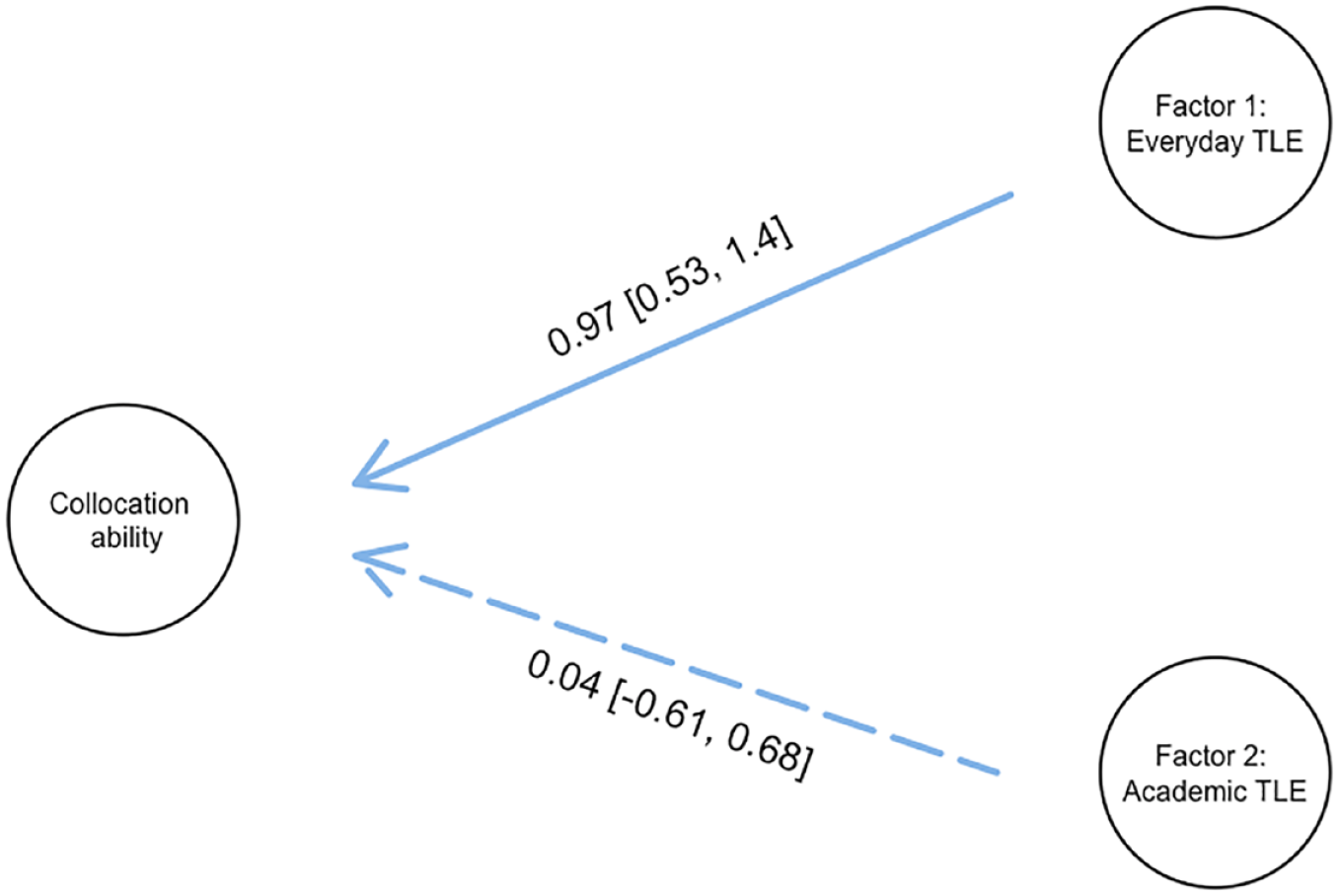
Productive collocation knowledge was predicted by the two-factor model of the Language Engagement Questionnaire.
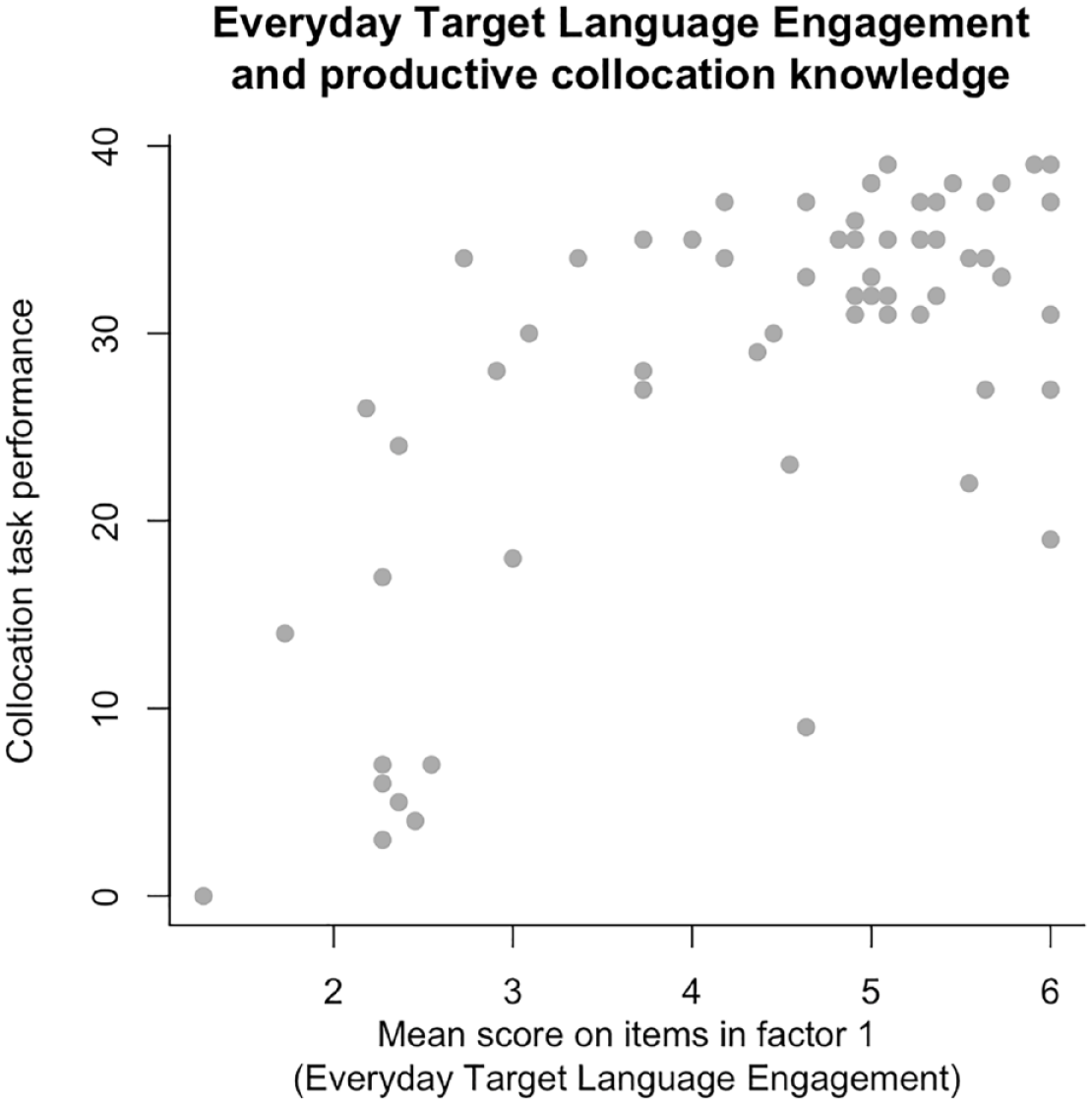
Relationship between performance on the collocation test (max score: 39) and mean score on items contributing to Factor 1 “Everyday Target Language Engagement.”
Discussion and conclusion
The study investigated a topic that has hitherto not been thoroughly investigated, namely, what kind of TL use relates to high-level L2 proficiency in the context of migration. The study concerned professional and lifestyle migration and L2 proficiency was operationalized as productive collocation knowledge. Of the two factors that emerged from the factor analysis, Factor 1, “Everyday Interactive Target Language Use” predicted productive collocation knowledge. The “Everyday Interactive Target Language Use” factor included using the TL Swedish in conversations and service encounters, through text messages and emails, to participate in online social network platforms as well as using the TL at the workplace, and—browsing the Internet. Social interaction in everyday life thus emerged as a significant predictor of L2 proficiency, adding to the accumulating evidence of everyday social interaction as an important factor in L2 learning among immigrants in varying geographical contexts (Dąbrowska, 2019; Dollman et al., 2020; Forsberg Lundell et al., 2023b, Moyer, 2004). Although it is impossible to confirm the directionality of the statistical relationship, it is reasonable to assume that the participating immigrants’ experience with social interaction in everyday life contributed to their high level of proficiency in the host language. Such an interpretation is in line with usage-based theories of L2 learning that emphasize the benefits of social interaction for L2 development (Ellis, 2015; Long, 1996; The Douglas Fir Group, 2016). Of course, the relationship may well be bidirectional. The participants’ proficiency level likely also influences the extent to which they engage in everyday social interaction. Future research would benefit from studying this relationship longitudinally, among immigrants, using mixed-methods, to understand the dynamic relationship between TL use and L2 proficiency.
The “Everyday Interactive Target Language Use” factor thus mainly included communicative activities but also “browsing online.” Previous studies have found that exposure to media in different forms is a source of incidental vocabulary learning, including collocations (Pavia et al., 2019; Puimège & Peters, 2020). This study design does not let us know to what extent the participants have been involved in learning with intent versus incidental learning when engaged in reading activities (here online), yet the findings point to the importance of this kind of TL use in developing high L2 proficiency. However, the majority of the TL activities that loaded onto the predictive factor “Everyday Interactive Target Language Use” involve social interaction, a part of which is likely to take place at the workplace. This finding is not surprising. Having regular social interactions at the workplace indicates a certain level of sociocultural integration. Sociocultural integration is argued—and observed in a few case studies—to be important in expanding one’s phraseological competence in an L2 (the proxy for L2 proficiency in the study), since phraseological units are often specific to the TL and often not directly transferable from the learner’s L1, but learned through engagement with the TL speech community (Adolphs & Durow, 2004; Arvidsson, 2021; Dörnyei et al., 2004). This study lends further support to the importance of social integration for developing L2 proficiency in adulthood. As suggested by Schmitt (2013, p. 4) with regard to the link between sociocultural integration and phraseological development in an L2, “it may not be exposure per se that is important, but the kind of personalized and engaging exposure that presumably occurs in a socially integrated environment.” Similarly, González Fernández & Schmitt (2015, p. 113) suggest that collocations that are communicatively useful to the learner may be available in exposure through daily situations. In this research context, the workplace may offer such engaging exposure since the interactions that take place at the workplace are likely to revolve around topics that are directly meaningful and relevant to the learner. Also, language use at work represents real communicative pressure, which can be assumed to trigger linguistic development (here, the acquisition of appropriate word combinations). The participants of the study who report frequent social interaction may well have developed a social network including TL speakers which has given them access to meaningful social interaction in the L2 outside of work, and promoted their proficiency level.
It is somewhat surprising that Factor 2 “Non-interactive Target Language Use” did not predict collocation knowledge, since it included the kind of TL use (reading) that has been found to promote collocation learning in previous studies (González Fernández & Schmitt, 2015; Schmitt & Redwood, 2011). This sample rarely used the TL through activities that loaded onto this factor (i.e., Factor 2 “Non-interactive Target Language Use”), which may help explain the absence of an effect of this factor.
The findings of the study confirm the importance of everyday social interaction for adult L2 learning in a migration context. The workplace appeared to be a platform for such everyday contact with the TL, and although the data do not allow us to draw conclusions regarding the participants’ social networks, it is likely that daily social interactions also took place outside work, through social relationships with L1-speakers. From a societal point of view, these findings are elucidating since they point to the essential role that the workplace and social life play in adult L2 learning in a migration context. The workplace may constitute the very gate to L2 use—an opportunity for TL use that is not accessible for the adult migrant who does not have employment. In adulthood, the workplace constitutes one of the most evident social contexts outside the family, and this study underlines its importance in providing the learner with efficient possibilities for TL learning. Using the TL for social networking online and internet browsing also appears to constitute a kind of TL use that is conducive to L2 developing L2 proficiency. This finding suggests that the individual’s own engagement and initiative are important in driving the L2 learning process forward. Online activities may be carried out in any language, yet this study indicates that migrants with a higher host language proficiency level frequently browse the web and participate in social networks online using the host country’s language. This kind of TL use is readily available to adult L2 learners in everyday life and may, as indicated, constitute an important aspect of L2 learning.
Based on the findings of the study, we suggest a few directions for future research into the topic of TL use and L2 learning in a migration context. The study emphasizes the importance of everyday social interaction in the TL in developing host language proficiency in a sample of literate and relatively highly educated long-term residents who have migrated to Sweden out of their free choice. The participants who interacted frequently in Swedish tended to use Swedish at work (and likely certainly in other social contexts). This observation merits further investigation in future research. We propose three approaches to investigate the relative importance of TL use through the workplace and social relationships for the development of L2 proficiency among migrants. First, future studies could investigate the role of the workplace in L2 proficiency development in migration populations with other educational backgrounds, literacy levels, and migration motives. For example, it would be fruitful from a societal perspective to quantitatively investigate the relative importance of formal language education versus having a job in different migration populations with varying levels of literacy since the findings may vary as a function of such sample characteristics. Ideally, studies would adopt a longitudinal research design to examine this topic and include migrants with varying lengths of residence in the host country, including newly arrived migrants. Furthermore, to better understand the affordances and limitations related to TL use in the workplace and in social relationships, studies could conduct in-depth studies of TL use and learning through qualitative research methods, including observation and interviews.
This study has certain limitations. Although this study did take into consideration what kind of TL use appears to promote L2 collocation knowledge, the items are not specified enough to allow for a detailed understanding of the participant’s use of the TL. For example, using the L2 for/at work may imply exposure to highly different registers and genres and may include language use of a more or less interactive kind. Future studies could address this by asking follow-up open questions to specific survey items and by conducting shorter interviews targeting the participant’s TL use. Also, future studies could make use of novel methods to further understand how TL use relates to L2 development, such as the ESM developed within the context of study abroad research (Arndt et al., 2023).
In conclusion, the study contributes insights into the kind of TL use that seems to promote the development of high-level L2 proficiency among migrants. The findings suggest that immigrants’ everyday social interactions in the L2 and the kind of L2 proficiency level that enables the immigrant to function autonomously in the host country are intertwined.
Supplemental Material
sj-docx-1-ijb-10.1177_13670069241298768 – Supplemental material for What target language use characterizes high-performing L2 learners in a migration context?
Supplemental material, sj-docx-1-ijb-10.1177_13670069241298768 for What target language use characterizes high-performing L2 learners in a migration context? by Klara Arvidsson, Fanny Forsberg Lundell, Marta Zakrzewska and Andreas Jemstedt in International Journal of Bilingualism
Footnotes
Appendix
Declaration of conflicting interests
The author(s) declared no potential conflicts of interest with respect to the research, authorship, and/or publication of this article.
Funding
The author(s) disclosed receipt of the following financial support for the research, authorship, and/or publication of this article: The data used in this study were collected thanks to funding from Swedish Research Council grant nr 2017-01196.

Supplemental material
Supplemental material for this article is available online.
Author biographies
References
Supplementary Material
Please find the following supplemental material available below.
For Open Access articles published under a Creative Commons License, all supplemental material carries the same license as the article it is associated with.
For non-Open Access articles published, all supplemental material carries a non-exclusive license, and permission requests for re-use of supplemental material or any part of supplemental material shall be sent directly to the copyright owner as specified in the copyright notice associated with the article.
