




Abstract
Recently the card game bridge has become a focus of sociological study including the professionalisation of the game at elite tournament level. This article, based on 11 in-depth interviews with elite bridge sponsors, focuses on playing-sponsors; amateur players who sponsor and also play alongside professional elite players. The playing-sponsor is important for the financing of elite bridge but occupies an, often awkward, role as both a sponsor/employer and a player. The bridge playing-sponsor thus has to negotiate a complex mix of identities as both employer and ‘partner’, being a relatively powerful financial benefactor while simultaneously being widely regarded as the weaker player in the bridge partnership. Such a position involves a degree of ambivalence and a complex power dynamic and status(es) which have to be navigated. This is unusual within mindsport and sport more widely. These issues are explored via a close look at the lived experience of the bridge playing-sponsor. As such it should be of great interest to sociologists of sport, work, leisure, and formalised micro-interaction more generally.
Introduction
Many sports rely on sponsorship to enhance the quality and quantity of training available for athletes and teams. Sponsorship contributes to costs of equipment, coaches, travel expenses, and events. An individual who sponsors sport is likely to be motivated given that they are normally a fan of the particular sport, and a corporation may provide sponsorship to raise awareness of their brand and advertise their products (Erb and Hautbois, 2018). The individual sponsor is typically non-playing and watches from the sidelines. However, in the mindsport and card game, bridge, those who sponsor the game, have the unusual opportunity to participate as a player. This is rare across most sports; polo, yacht racing, and motorsports, to some extent, being other exceptions.
The aim of this article is to explore the power relationships and ambiguous identities and roles when professionals, amateur players, and sponsorship come together in a mindsport. It contributes to sociological debates in leisure studies and sports studies which examine how different types of players navigate complex interactions and multiple identities in high-pressured contexts (Punch et al., 2021; Scott and Godbey, 1992). It also speaks to the literature on the blurring of work and leisure boundaries (for example, Russell et al., 2022).
The article investigates the experiences of the playing-sponsor in the world of elite bridge. Playing-sponsors pay leading bridge players to be their partner in, often prestigious, tournaments around the world. They may also pay professional partnerships to form part of their bridge team. The playing-sponsor is not only crucial to the financing of elite bridge but occupies an, often awkward, role as both a sponsor/employer and a player. The article discusses the implications of this multi-layered identity which will be of interest to sociologists of sport, work, leisure, and formalised micro-interaction more generally.
Playing bridge and being a ‘sponsor’
Bridge as a game is famed for its complexity and mental challenge, earning it the sometimes contested (Kobiela, 2018) categorisation as a mindsport (Mendelson, 2008). A game played socially and competitively (Brkljacic et al., 2021), bridge may be studied macro- and micro-sociologically. Interactions around the table and between partners provide the perfect context for symbolic interactionist micro-social analysis, while issues of sexism and gender inequality in the game’s structure allow for feminist macro-social study (Rogers and Snellgrove 2022). The experience of the elite bridge playing-sponsor provides a fruitful focus for further sociological study.
In brief, bridge involves four players working in two partnerships with thirteen cards dealt to each player, which is followed by ‘bidding’ then ‘playing’ (Scott, 1991). During bidding, partners describe the strength and shape of their hands in coded bids (Mendelson, 2008; Punch et al., 2022). The final bid represents the number of ‘tricks’ that partnership has contracted to make in play. A trick comprises each player playing one card, and the winner is the person who plays the highest card. Once gameplay begins, the aim is to win as many tricks as were bid or more.
Scott and Godbey (1994) have identified four types of bridge players, each with their own shared values: ‘occasional’ players, ‘regular social’ players, ‘regular duplicate’ players, and ‘tournament’ players. Tournament players are not a homogeneous group but are generally considered the most dedicated, serious bridge players, who hone and test their skills at tournaments (Scott and Godbey, 1994). These tournaments exist at various levels, from club to elite international. It is here that the figure of the playing-sponsor enters.
Elite international tournament players are considered to be the best bridge players. They dedicate much time to training to compete internationally, often representing their country to play in world and continental championships (Punch, 2021). Elite tournament bridge is further divisible into amateur and professional play (see Figure 1). Elite amateur players are bridge players who receive no financial compensation for their time playing bridge. Playing-sponsors are essentially wealthy (often extremely so) amateurs who pay professional players to compete alongside them, either as their partner or partnered with another professional as a sponsored team member (Russell et al., 2022). While they tend to be technically weaker players compared with full-time top-level professionals, some sponsors are high-level players in their own right who can afford to sponsor a bridge team.
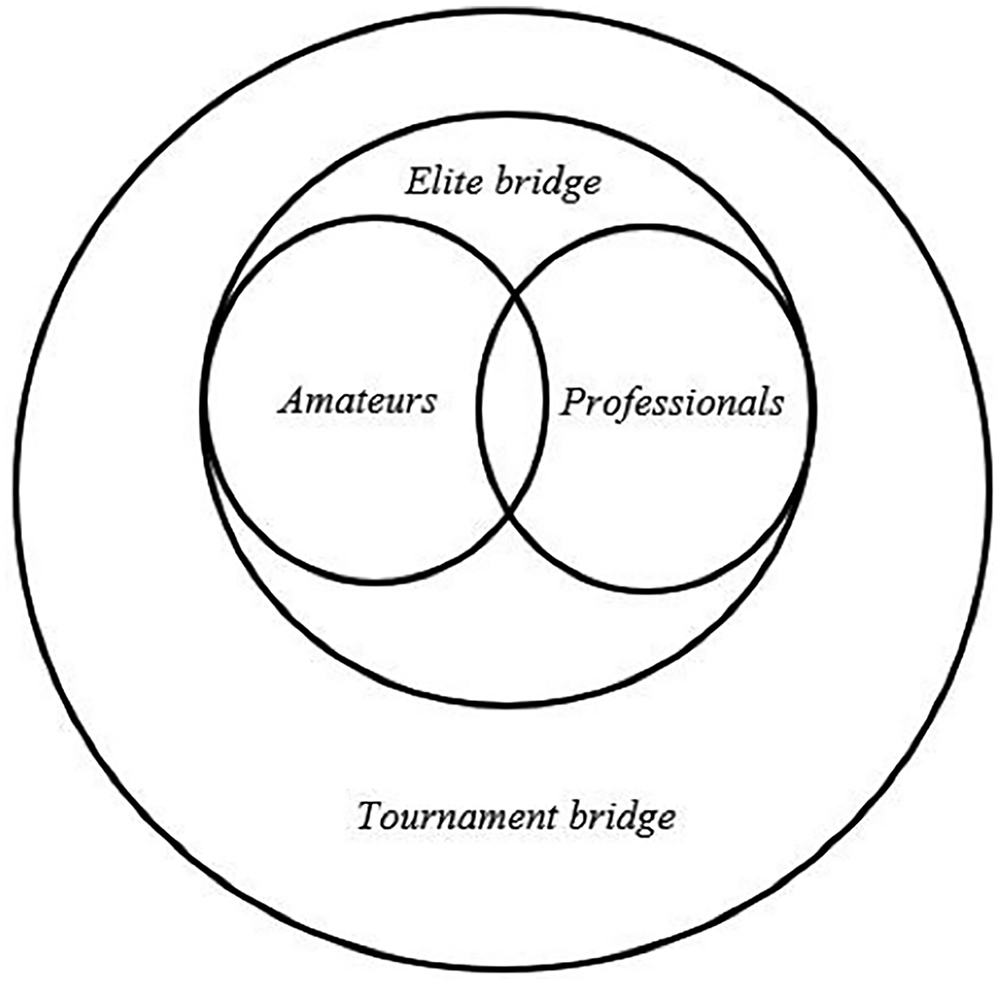
Tournament bridge’s nested social world (Punch et al., 2022).
Professional bridge players are typically more skilled than amateurs and find employment through partnering with a sponsor or playing on their team (Russell et al., 2022). The terms and arrangements of these sponsorships vary; some sponsors pay a retainer salary and expect greater loyalty from their professionals, while others play together on a more ad hoc basis. From the point of view of the professional, the sponsor is generally understood as an ‘employer’, although many of the terms and conditions that may be associated within a more typical employer–employee relationship are missing. For example, there is no holiday or sick pay and no professional body to protect their employee rights. Some have contracts but more informal arrangements are common. The lack of formalisation means that it is more like a service contract than a formal employment (Harley, 2018). Nevertheless, while recognising this is not a strict employer–employee relationship in the conventional sense, this article uses the term ‘employer’ as an identity and a social relation (rather than formalised role) as the sponsor is responsible for paying them to play and the professional relies on the payment for their livelihood (Baron, 1988).
Sponsors have been crucial in the bridge world for enabling the increasing professionalisation. Payment from sponsors allows professional bridge players to dedicate themselves to the game. By playing full-time, professional players are able to practice and develop their technical skills (Russell et al., 2022). However, professionalisation of bridge is unevenly distributed and gendered, dominated by men and concentrated in particular geographical areas (Punch, 2021). For example, the US has the most professional bridge players, largely in Florida and New York where a higher proportion of wealthy sponsors live. London attracts professional players from across the UK and Europe. Many countries, such as Norway, France, and Bulgaria have some professional players, but they will tend to work abroad for a significant amount of the year as paid opportunities are limited in their home country.
Outside of the World Championships, the most prestigious and toughest tournaments are held at the North American Bridge Championships (NABC). These last for ten days, where players from around the world compete for major titles three times a year. The world’s best players can earn up to 50,000 US dollars to play in a sponsored team at an NABC. Bridge teams usually consist of three partnerships, as one pair rests while the other two pairs compete. Thus, a top playing-sponsor may pay up to 250,000$ for a team for one 10-day NABC. Most elite teams would compete in all three NABCs, totalling 750,000$ a year for 30 days of bridge. In addition, sponsors also pay their team to enter trials to compete to represent the nation in world events. At lower levels, the rates are cheaper, approximately 10–20,000$ per professional player. Nevertheless, for these most important tournaments, a playing-sponsor needs to be significantly wealthy to fund a bridge team of professional players.
The sociological study of bridge is rapidly expanding (Punch and Snellgrove, 2020; Punch et al.,2021, 2022; Rogers and Snellgrove 2022; Russell et al., 2022; Scott, 1991; Scott and Godbey, 1992, 1994; Scott and Punch, 2024). This research builds on these studies and explores the lived experiences of the elite-level bridge playing-sponsor, a hitherto under-researched area of the bridge world. First, we explore the negotiation of the shifting and unusual power relations between professional and sponsor players. Second, the article discusses the ambivalences, stigma and often difficult experiences involved in the playing-sponsor’s identity, as someone who pays to play at the elite table.
Negotiating the dynamics of the bridge ‘partnership’
The ‘partnership’ is an integral part of the mindsport bridge (Punch et al., 2022). The ideal partnership is built on a mutual trust, dependence, and confidence that the partner will understand and operate successfully the ‘system’ agreed upon by partners (Punch and Snellgrove, 2020). A well-functioning partnership is crucial to long-term success at bridge, yet it can be fraught with tensions in high-pressured competitive environments (Punch, 2021). As a partnership game, close pairings are akin to the classic sociological dyad (Becker and Useem, 1942; Simmel, 1950). Simmel emphasised that the dyad is an inherently precarious and unstable relational form. It is the smallest social grouping and unlike other forms, such as the triad, is the only type whereupon if one member leaves, the grouping ceases to exist (Simmel, 1950). Dyads may exist in many aspects of daily life and are characterised by their aforementioned fragility and intimacy between individuals (Simmel, 1950). Becker and Useem (1942) elaborate by suggesting that to be classed as a dyad, a partnership must have interacted face-to-face enough to develop a ‘discernible pattern of interacting personalities’ (Becker and Useem, 1942: 13). These patterns often include gestures or code words only understood within the dyad. Importantly, the dyad is not necessarily equal, as shown by Laurin et al.’s (2016) study of romantic dyads.
Stebbins (2020) has noted that there is a paucity of research exploring dyadic forms of leisure. Bridge revolves around two opposing dyads, and research on the experiences of individuals in bridge partnerships is limited. Punch et al. (2022) explored this to some extent in their study of participation and motivation among elite bridge players. They found that elite players often bond closely with their partners, developing a shared play and communication style. Russell et al. (2022) looked at the professional-sponsor partnership from the perspective of the professional player. To enhance their job security, the professional is incentivised to provide a valuable service by masking their emotions and performing in a certain way. Some professional players even strive to ensure that errors in play cannot be blamed on them (Punch, 2021). The pressure to achieve good results and maintain partnership harmony can make bridge less enjoyable for the professional and potentially strain partnerships (Russell et al., 2022). Punch and Snellgrove (2023) studied bridge players who share their serious leisure activity with their intimate life partner, moving between fun, fights, and failures when playing bridge together. Despite the value of a supportive dyadic relationship, previous research has shown that power imbalances need to be negotiated as inequalities in bridge partnerships often stir up tensions and conflict (Punch et al., 2022).
Sociological accounts of power broadly draw upon linear and relational accounts (Lukes, 2005; Perkins, 2003; Westwood, 2001). Linear theories see power as one-directional, flowing down a hierarchy from the top, with the ability to influence humans or nature for personal gain (Loomer, 1976). Famously, Weber portrayed power as being essentially the ability to achieve one’s own will over the resistance of others, often by controlling critical resources (Weber, 1946). Dominant individuals or groups can use this power ‘legitimately’ through ‘authority’ when those over whom it is exercised do not contest it (Gingrich, 1999). This explanation of power is closely related to Weber’s concept of status, a measure of externally ascribed social worth based on merit or social standing (Weber, 1946). Those with greater status are typically more liked and may find it easier to exercise power, should they hold it. Weber explained power and status as being interrelated but not always correlated; one may have much power but little status or vice versa (Gingrich, 1999). Relational power was a key focus of Foucault (1978), who argued that power could not necessarily be acquired in the traditional sense but circulate variably through social relations, even those that are unequal (Foucault, 1980). This article examines the extent to which the bridge sponsor has the greater power as they are employing their partner, or whether the professional player has greater power as they are the more skilled expert in the partnership.
Seeing oneself as a bridge player can inform a significant part of the self and be a key form of identification (Punch et al., 2021). It has been well established within sociology that aspects of the self are borne out of and maintained through, social interaction (Mead, 1934; Turner, 1988). Aspects of our understanding of ‘self’ are based upon specific social roles we have adopted and the meaning assigned to them through social interaction. Goffman’s (1956) dramaturgical metaphor continues to have value in illuminating aspects of identity, in particular its fragility in certain social contexts. He suggests that the individual can be likened to a social actor, performing a role in everyday life and curating their presentation of self for an audience as though onstage. The actor takes on different roles or identities within different social settings to best portray their ‘self’ for the audience. Beyond the frontstage performance, the actor has a backstage where they may reveal a contradiction of their frontstage self as they are no longer curating an image. This has been criticised for suggesting that nobody behaves as they genuinely feel, instead they curate a desirable, albeit insincere, representation (Outhwaite, 2005).
The experience of playing elite bridge has been demonstrated as existing not only ‘frontstage’ at the table but also ‘backstage’ (Goffman, 1956) in partnership interactions and informal relationships (Punch and Russell, 2022). Punch et al. (2021) explored the identities of elite bridge players. Their study suggests that identity in elite bridge is recursive and concentrically layered; each player has four primary identities: self, partnership, team/nation, and community. These identities build and contribute to the elite player’s overall understanding of ‘self’. Each identity feeds the next in a recursive system and layers within each other; the self exists within the partnership and is also part of a team and a member of the bridge community. This article explores more fully another type of bridge identity – that of the playing-sponsor who navigates the four primary identities of bridge player, partner, teammate, and community member, alongside the additional role of being the team’s employer.
Methods
This article discusses sponsorship in elite tournament bridge, focusing on the playing-sponsors’ experiences. It is based on 11 semi-structured interviews with sponsors which Punch conducted for the ‘Bridging Minds’ (https://bridgemindsport.org/home/research/bridging-minds/) project as part of the research of Bridge: A MindSport for All (https://bridgemindsport.org/). The sample of sponsors was from the US and England, and all of them pay to play with some of the world’s best bridge players (see Table 1). Within the bridge world the skill-level of sponsors is wide-ranging, from relatively inexperienced to strong players. This study focused on the small population of elite-level bridge sponsors, partly due to the level of wealth required to sponsor a team, and this is reflected in the small sample size. Nevertheless, the length (on average 90 minutes) and depth of the semi-structured interviews provide exploratory insight into this under-researched topic.
Bridge sponsor sample.
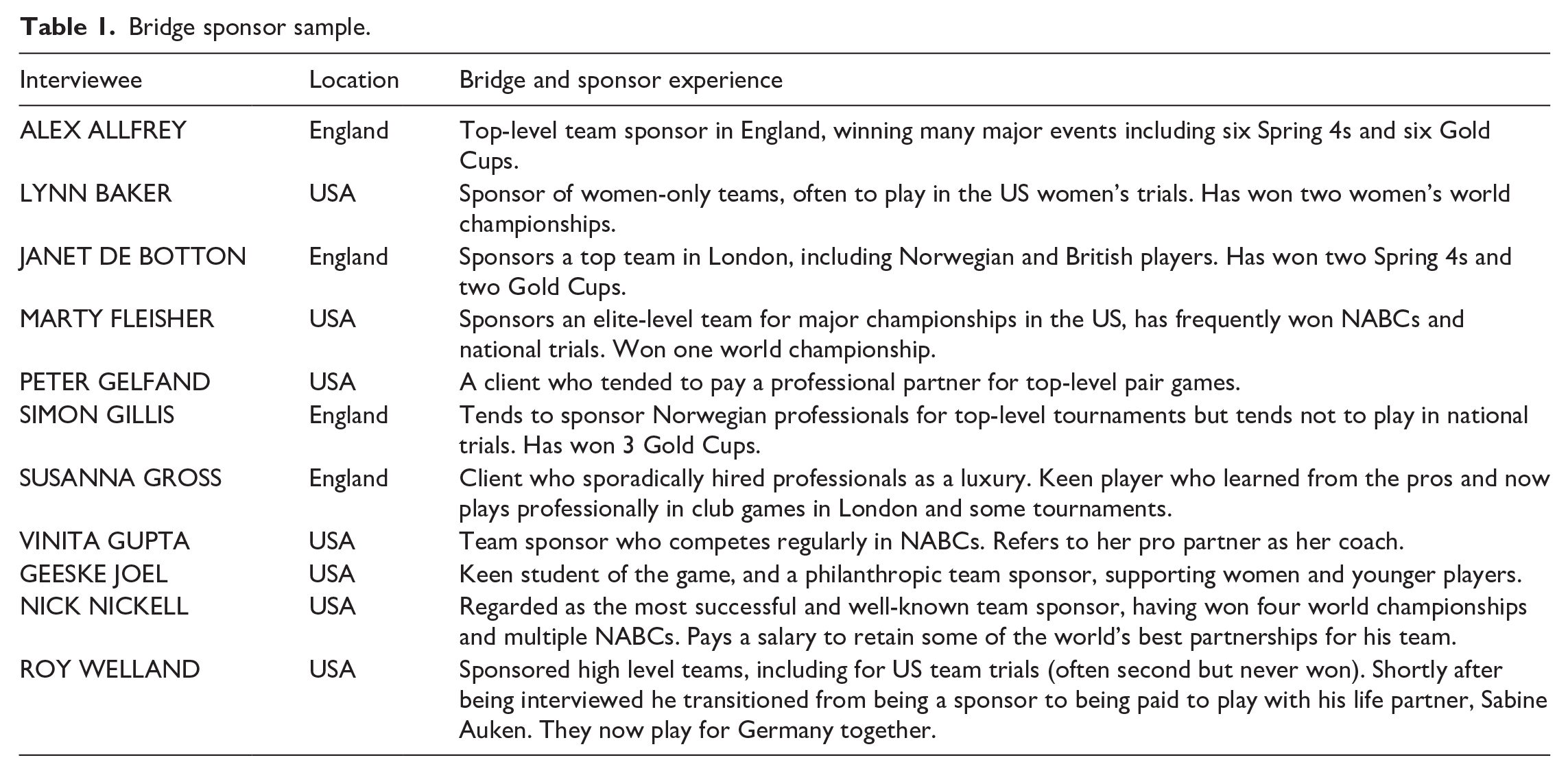
The aim of the in-depth interview was to explore the playing-sponsor’s perspectives of what it is like being a sponsor including their journey to becoming a sponsor and the associated pros and cons. The sponsors were asked about their objectives and motivations, and the qualities they seek in professional players. The players checked their interview transcripts and agreed for their real names to be used in order to enable greater research engagement with the wider bridge community. This was approved via the ethics panel at University of Stirling. The interviews were mainly conducted during international tournaments at NABCs in the US, with two carried out before a bridge event in London and two online. Since the interviews have taken place, two of the sponsors (Susanna Gross and Roy Welland) have made an unusual transition to being paid to play in some tournaments by other sponsors. While this is a somewhat difficult and uncommon transition (as it can be hard to break away from the label of ‘sponsor’), it illustrates that some playing-sponsors are good players who strengthen their own game by playing with professionals.
Punch is an international tournament bridge player, which affords her insider status when interviewing (Merton, 1972). Insider interviewers benefit from prior knowledge of the field and an understanding of the interviewees’ language and lived experiences (Brannick and Coghlan, 2007). This shared experience can often help the interviewee trust the interviewer and be more forthcoming with information (Berger, 2013). Insider researchers are liable for criticism as their emotional involvement may deplete their ability to remain objective (Brannick and Coghlan, 2007), but outsider data analysis provides a potential solution. McIntosh and Tandy have no bridge knowledge, and undertook the initial analysis of the data, evaluating what the insider, Punch, may have taken-for-granted (Hellawell, 2006). Working as an insider/outsider research team offered a way to overcome the pitfalls of being too familiar or too distant to the research topic (Snellgrove and Punch, 2022). Thematic analysis was undertaken, beginning with familiarisation, then generating initial codes for analysis and forming themes (Braun and Clarke, 2006). The clustering of codes resulted in the following main themes: negotiating various identities within the sponsor-professional partnership; managing power imbalances within the partnership; and coping with the tensions and stigma of their position as playing-sponsor.
Findings and discussion
Sponsorship itself is not unusual in sports and leisure generally (Erb and Hautbois, 2018), but the specific role of the bridge sponsor is different; they sponsor players while also playing themselves. Those who pay for a professional player to be their partner or their teammate can be referred to as the client or sponsor. Generally these terms are used interchangeably: ‘most people use the word “sponsor”, some say “client”’, (Roy Welland, USA). Some players have a preference for one term over the other.
I like ‘sponsor’ a little better. Maybe just because that’s how I feel myself in the role. Especially in the beginning, because I already felt strongly about women’s bridge. (Geeske Joel, USA)
Geeske identifies with the term ‘sponsor’ because it implies a more philanthropic position. Early in her bridge sponsorship career, she was keen to support women players, offering them opportunities to compete. Conversely, Susanna views herself as a client: I wouldn’t describe myself as a sponsor . . . To me, a sponsor is someone who regularly hires somebody, or usually a team, throughout the year, for all the main tournaments. I’m more like a client – who hires people a few times a year. It’s my indulgence, it’s my treat to myself. (Susanna Gross, England)
Sponsors tend to have greater economic capital which is ‘immediately and directly convertible into money’ (Bourdieu, 1986, pp.242), enabling them to hire a team of professional players regularly. In contrast, clients tend to hire only their partner for pair games or they join forces with another pro-client partnership for team games.
Few sponsors choose to balance their bridge sponsorship role with full-time work. Most of the sponsors balance bridge alongside flexible working such as self-employment with reduced working hours, typically later in life or after retirement. Several respondents have held high-ranking and well-renumerated company positions or worked directly with the financial markets. It can be challenging to accommodate leisure time alongside full-time employment as Lynn suggests: I have a day job and now I’m trying to schedule in a few hours each week to keep my partnership with her going. (Lynn Baker, USA)
Most sponsors own a business where they control their working hours or work part-time.
It is easier for me to work without having to go into an office, so it’s not like something I have to do as a full-time job and I still dip my toes in the trading waters once in a while. (Roy Welland, USA)
Given the need for significant wealth to sponsor a team, most playing-sponsors come to the role later in life and some, such as Peter, only become bridge sponsors after retirement: While I was engaged in my professional endeavours, I never would have enough time to accrue the knowledge that I thought would make me better. When I retired, I did believe I would have that time and space, and in 5 years, I believe my game has improved exponentially. (Peter Gelfand, USA)
Bridge sponsors who join the game in later life may be viewed as having sought serious leisure to stabilise their sense of self after moving on from a hard-working identity. A serious leisure career in bridge offers access to a social world where one can build a new identity. Hence, playing-sponsors are often older than their professional bridge partners. They tend to have held senior positions in their working lives and have accumulated a significant amount of wealth. Their economic and cultural capital and often successful careers mean that they can be used to holding positions of power and control (Bourdieu, 1984; Frane and Roncevic, 2003). They may not be accustomed to not being in charge. Finding themselves at the bridge table as the more junior partner in terms of bridge playing ability, can be a challenging situation.
Being an ‘employer’ and a ‘teammate’
Sponsors often have several social identities; an employer, a friend and a playing bridge partner. We discuss three main situations where these identities come into focus for both sides of the partnership: setting employment boundaries, playing at the table, and beginning or terminating contracts. As an employer, a bridge sponsor has expectations of how their professional players should behave when paid to work for them. Despite sponsors’ personal relationships with their professionals, like top-sponsor Marty below, they act exclusively as an employer when setting ground rules as they are striving to receive the best return from their financial investment: I tell people if they’re not prepared to make the commitment to get the best out of their ability, they’re on the wrong team. They need to know their system, they need to come to the tournament ready to play, they need to keep themselves on an even keel during the tournament. . . . People have a good time, but this is their business; I spend a lot of money, and I expect people to treat it as a serious enterprise. (Marty Fleisher, USA)
While bridge sponsors want their professional partners to have an enjoyable time, they must also ensure they take their roles seriously as devotee workers (Russell et al., 2022). Playing-sponsors may enforce some form of restriction on their professional’s behaviour away from the table during tournaments: . . . but you can go on the treadmill, or you go outside when it’s possible for an hour and walk around to just kind of get your juices going, and you make sure that you get 7–8 hours of sleep. And you should not have big meals and definitely no alcohol between sessions. (Geeske Joel, USA)
Some sponsors, like Geeske, expect their professional teammates to take care of themselves physically in order to be mentally sharp at the table, thereby recognising the integration of the mind and body for enhanced performance (Scott and Punch, 2024). While the playing-sponsor often views their professional partner as a friend, the financial outlay involved carries with it a level of expectation about appropriate behaviour in a way that can mitigate pretentions towards being friends and emphasises their role as an employer. Vinita compares hiring bridge players to recruiting employees during her professional career: You want to make sure that it is not something which is casual and that there will be a commitment from the other person’s side. Can you work with the person? (Vinita Gupta, USA)
When a sponsor plays at the table alongside a professional partner, they perform two key identities, the employer and the bridge partner, and on balance the sponsor must manage their performance to focus primarily on their role as their professional’s partner. Most social interaction does not occur between whole ‘selves’ but through processes of, sometimes enforced, identification as behaviours alter across social situations as actors approximate towards the most appropriate identity and version of the self (Goffman, 1956; Stets and Burke, 2003). This can create tensions within regulated and performative contexts such as the highly structured sets of expectations and roles involved in a game of bridge (Green and Jones, 2005). As a high-performing sponsor, Roy indicates the challenges that this can pose when his team underperforms: . . . but it’s frustrating because if you’re playing in a knockout and you lose on the first or second day . . . because you’ve spent a lot of money and you had high hopes going in and you sort of feel like they didn’t do a good job. (Roy Welland, USA)
Although as ‘employer’ they may be frustrated with the performance of the professional, they may have to mask these emotions as they are not conducive to good gameplay (Punch and Snellgrove, 2020). At the table, the playing-sponsor must endeavour to perform as a partner and this micro-emotional control can prove to be a challenge (Punch and Russell, 2022). Sponsors often portray themselves as their partner’s friend and downplay the employer role, as aspects of it may cause social discomfort. Roy highlights the social and emotional awkwardness associated with this process by likening it to soliciting a sex worker: I imagine it feels a little bit like being a prostitute . . . nobody ever wants to have any of those conversations. ‘How much for sex?’ Who wants to ask that? Or, ok, choice A is 100$, choice B is . . . who wants to talk like that. It’s demeaning. (Roy Welland, USA)
He explains that the tensions inherent in the player-sponsor identity become particularly stark when firing an employee: XXXX and I were extremely good friends. We were the closest friends and then when we stopped playing together our friendship ended at the same time. It is difficult. (Roy Welland, USA)
The playing-sponsor often finds themselves in contexts where they are acutely aware of the need for ‘impression management’ (Goffman, 1956), with associated clear distinctions between ‘frontstage’ and ‘backstage’ management. Frontstage at the bridge table, the playing-sponsor strives to perform their role as friend, partner, and teammate. During the bridge competition, they are more reluctant to perform as their professional’s employer, preferring to keep this identity backstage. At the table the ‘employer’ identity must be restricted to prevent upset and maintain partnership harmony. However, there are numerous eventualities where the backstage ‘employer’ identity comes to the fore: when managing their professional by setting expectations and boundaries, and when employing or firing professional partners. While playing-sponsors accept this requirement, it can cause discomfort when their backstage identity has to emerge.
Power dynamics in the sponsor-professional bridge partnership
Tensions in bridge partnerships are not unusual, as it is a game of mistakes and players struggle to manage their emotions at the table (Punch and Russell, 2022; Punch and Snellgrove, 2020, 2023). The sponsor-professional relationship in a high-pressured tournament environment can be intense. Bridge playing-sponsors may be perceived as holding linear power and authority (Lukes, 2005) over their professional partners because of the financial investment they have made by employing them. By holding this authority, the playing-sponsor can expect their professional partner to be patient and understanding if they make mistakes: They cannot really blame me. I’m paying them a good salary. I give them a living wage. I can beat myself up, but I feel like at least they are not going to because they know better. (Geeske Joel, USA)
For Geeske the contractual nature of the relationship can help to mitigate the playing-sponsor’s feelings of guilt when they make mistakes during the competition. Team sponsors, Simon and Nick, indicate that it allows them to pick and choose who they want to play with: I only pay people who I’ve known . . ., I only pay people who dedicate their lives to bridge and that’s it. (Simon Gillis, England) You want to play with people whose company you will enjoy. People that will be good teammates. The game is tough enough with the stress, the fact it’s a mindsport makes it tougher, at least with a physical sport you can release some of the stress. You need good teammates–they pull for you. (Nick Nickell, USA)
The sponsor-professional partnership can be understood in terms of Becker and Useem’s (1942) classic account of a supersociate–subsociate dyad, where a hierarchically separated pair work together towards a common goal. Such a partnership thrives so long as the personalities involved are aligned and work harmoniously, an idea supported in Western’s (2017) thesis on the relationship between attorneys and their legal secretaries. The bridge playing-sponsor holds obvious economic power over their professional partner and can expect their partner to defer to their wishes and treat them respectfully. The professional player can be constrained by the knowledge that inappropriate comments or behaviours are likely to have a detrimental impact on their employment and possibly on their wider career. The relationship is complex and nuanced given that, despite the employer-employee relationship, playing-sponsors are keenly aware that in terms of bridge skills they are the less experienced partner. As Alex remarks, ‘it’s clear there is a senior partner and a junior partner’ (Alex Allfrey, England). Power relations within the bridge partnership are thus riven through with complex and shifting patterns of status based on assessments of expertise and knowledge of the game as Susanna points out: I forget myself sometimes and think I know better, but I quickly tell myself that I don’t know what I’m talking about. (Susanna Gross, England)
The cultural capital and status of the professional manifests as a form of relational power (Gingrich, 1999). Relational power does not presume that a dominant individual, group or class hold power exclusively, it suggests that power is pervasive within and throughout social relations and interactions (Foucault, 1980). Those with an ostensibly low hierarchical ranking but valuable information or an extensive friend group may exercise power non-traditionally (Soga et al., 2022). Indeed at times the professional player may exercise their power backstage to their teammates when the playing-sponsor is not present, by expressing their frustration regarding the sponsor’s bridge errors; a risky strategy if the sponsor becomes aware of such backstage conversations (Punch, 2021). As Bourdieu points out, forms of cultural and economic capital can take time to accumulate, but the process of acquisition for cultural capital tends to be prolonged and ‘recognized as legitimate competence’ (1986, pp.245). Yet such forms of status can be undercut by the power the playing-sponsor accrues through contractual obligations, finance and the employer–employee relation that is a consequence of bridge sponsorship.
Although harmonious bridge partnerships are desirable, in practice partnerships are often tenuous, strained and fragile (Punch and Snellgrove, 2023). A contractual relationship between sponsor and professional can push these boundaries further as an employee–employer relationship is interjected into the heart of the most crucial relationship in the game of bridge. This employer–employee relationship in the dyad complicates the partnership’s dynamics and balance of power and status. The sponsor-professional relationship thus displays a complex and shifting set of power dynamics where obvious linear power interconnections – employee/employer – are often deflected or undone with more relational forms of power accruing from status and capital that is not primarily economic in nature of origin but is drawn from the expertise and esteem of the elite bridge player.
The tensions and stigma of bridge sponsorship
Sponsorship is viewed ambivalently in the bridge community. On one hand, it enables top players to earn a living and craft their skills (Russell et al., 2022) which in turn raises the quality of bridge at the highest levels of the game. On the other hand, it can be perceived as unfair, that weaker but wealthy players ‘buy’ their partner and teammates in order to win tournaments. Regardless of skill-level, playing-sponsors will almost always be perceived as relatively weak in comparison to the full-time professional players (Punch, 2021). This can mean that if a top team loses a tournament, the sponsor is assumed to hold much of the blame for the loss. Consequently, playing-sponsors can be stigmatised and looked upon in an unfavourable manner as Geeske suggests: The young kids, you know, when you get the feeling they are kind of looking at you. Are you a client? (Geeske Joel, USA)
The undercurrent of anti-sponsorship sentiment within the elite bridge community is displayed via negative comments towards bridge playing-sponsors. Such opinionated comments, while often indirect, allude to a consensus that sponsors are ‘weaker players’. Bridge sponsors are frequently the recipients of remarks or ‘jokes’ that belittle their role as a player: Then he said, ‘Oh yeah, right, I forgot you’re just buying your masterpoints’. (Geeske Joel, USA)
Masterpoints are awarded to players in official bridge tournaments, which are collected to earn Master Point Rankings (English Bridge Union, 2023). By suggesting that Geeske buys these points, the implication is that she is paying to qualify for and succeed in tournaments by employing a professional partner. Similarly, after a major tournament success, Janet de Botton became the focus of banter: A friend said to me there was this joke going around when I won the Gold Cup, ‘Did you play any of the boards?’ Not did I play any hands, but did you let the professionals play all the boards? (Janet de Botton, England)
This joke suggested that Janet played no part in her team securing their victory; by employing professionals for a team, she could sit out and still win. Even though there are stigmatising and dismissive comments regarding playing-sponsors, the rules require that they have to play at least half of any bridge match in order to be eligible to win the title of an event. Bridge players who cannot afford to sponsor professional players can perceive sponsorship as unfair because the wealth of playing-sponsors enables them to ‘buy trophies’ or even a World Championship title. This could be seen as breaking sporting ethics of ‘fairness’ (Brown, 2015; Pawlenka, 2015) and may partially explain why some non-sponsors can be resentful and demeaning about playing-sponsors. Consequently, the perceived unfairness as well as playing-sponsors tending to have weaker technical ability, can result in sponsorship becoming the focus of disapproving rhetoric.
The stigma often associated with the terms ‘sponsor’ or ‘client’ shapes their self-identity as a player. Few bridge playing-sponsors are happy to recognise their role in triumphs, suggesting that they have internalised the sponsorship stereotypes to some extent:
You’ve had some very impressive results.
Because I’m playing with players. (Peter Gelfand, USA)
Peter brushes off a compliment from the interviewer in a similar way to Susanna downplaying her position representing England to her mother’s friends: . . . if one of her friends comes and says ‘oh Susanna, you played for England’, I always feel I have to put it in context, explaining that I probably only qualified because I was playing with a great player, and that it’s very easy to qualify in the circumstances under which I qualified. (Susanna Gross, England)
Disapproving comments about playing-sponsors and their inability to contribute to significant bridge successes feedback to sponsors and contribute to a negative association with sponsorship generally. This can lead to the playing-sponsor also believing they hold limited responsibility for their team’s successes and can impact on their confidence (see Scott and Punch, 2024). In practice, some playing-sponsors are strong bridge players and professionals also make mistakes, yet sponsors are viewed as easy scapegoats. This negativity results in the playing-sponsor downplaying praise and attributing success to their professional partners. To what extent such a reaction may differ between frontstage and backstage arenas is unclear. Nevertheless, playing-sponsors continually have to negotiate and work through a somewhat tarnished and ‘spoiled identity’ (Goffman, 1963), despite them often paying out large sums of money for the privilege. Susanna explains the tensions involved: It’s impossible to hire someone and, if you have any self-honesty, to entirely believe the compliments that come your way when you do well. I won the Easter pairs with David Gold. As far as I’m concerned, I fluked it. David must have played brilliantly because I know I didn’t deserve to win the Easter pairs. Whereas had I been playing with someone of a lesser standing I might have allowed myself to wonder whether I had played quite well. (Susanna Gross, England)
She continues by acknowledging that she contributes to the partnership’s success: Because I am not so modest that I don’t think that if I win a big event with David (Gold) or Sally (Brock) or the best bridge player in the world that I haven’t had to do my bit. And I’m still thrilled because there are plenty of other players out there playing with sponsors and I still have to beat them. (Susanna Gross, England)
In both frontstage and backstage settings, playing-sponsors can receive considerable negativity from some bridge community members, making it hard to claim credit or accept praise. Despite the widespread negative discourse surrounding playing-sponsors, the professional players often defend the concept of sponsorship (unsurprisingly perhaps as it concerns their employers): . . . countries that lack a real professional opportunity for their players tend not to produce teams of the highest quality. If you can’t make a good living playing a full schedule of tournaments then you will likely need to find another job. If you can make a living playing then you can focus on bridge. Playing more will make the Pros and the Sponsors hiring them all into better players. The notion that these sponsors are weakening the National team is flawed. In addition to the reality that some of these players are excellent, the fact that without sponsors and the money they plow into the game, the best players in the country would be focusing on being Doctors, Lawyers, Engineers, Taxi drivers etc. (Geoff Hampson, Bridge Winners Blog, 18.12.23)
This quote provides a good summary of some of the competing arguments and tensions involved in player sponsorship and brings out many of the tensions and nuances explored above. As Nick Nickell (USA) points out, professional bridge allows the pros: ‘to focus on playing bridge without having a day job to make ends meet. The quality of play has improved as a result of being able to concentrate on playing bridge’.
Conclusion
This article has discussed the experiences and complexities as well as the benefits and drawbacks of professional-client bridge partnerships. Bridge playing-sponsors navigate multiple identities as employer, partner, teammate and friend. They are a relatively powerful financial benefactor, while simultaneously being widely regarded as a weaker player and something of a liability in terms of winning the game. To adopt a Goffmanesque vocabulary, they are reluctant to bring their backstage ‘employer’ persona to the frontstage of the bridge table. Rather than a partnership that came together more ‘naturally’ based on a mutual respect and love of the game, the sponsor-professional partnership does not fit well within the ‘ideal’ understanding of a bridge partnership or indeed sporting ethics more generally (Pawlenka, 2015). It is almost structurally flawed from the start given that the relationship is circumscribed by a contractual and financial arrangement that can mitigate against creating a partnership based on mutual respect and sporting integrity.
Power represents a paradox in the world of sponsorship bridge, as the playing-sponsor and the professional are both variously powerful and vulnerable. Within this supersociate–subsociate dyad (Becker and Useem, 1942), we see a financial linear and hierarchical power relation regarding the economic capital of the playing-sponsor versus the financially insecure position of the professional player. In contrast, there is a knowledge-based relational power regarding bridge-playing skills, where the professional embodies more cultural capital ‘in the form of long-lasting dispositions of the mind’ (Bourdieu, 1986: 243). Herein lies the complexity and, from a sociological point of view, fascination of the sponsor-professional relation. This being of particular interest to sociological accounts of work and the labour process more broadly given the above-mentioned ambiguities around the precise nature and experience of the employer-employee relationship involved (Harley, 2018). The playing-sponsor navigates roles as employer, friend and participant in a leisure activity, indicating the complexities and ambivalences of managing multiple identities at work and at play. Thus, the article also contributes to sociological understandings of the blurring of work and leisure boundaries in a sporting context (Russell et al., 2022).
The article speaks to wider issues in sport where professionals and amateurs compete in the same tournaments, and about the role of sponsorship and issues around fairness and social identity. Elite bridge sponsorship mutually benefits both the professionals and the playing-sponsors. Yet, bridge sponsorship is not universally popular, and some believe that the playing-sponsor is undeserving of their accolades or has used their financial clout to buy them. Such opinions directly impact the playing-sponsors who are aware that there are those who disapprove of bridge sponsorship. Playing-sponsors have to cope with opinionated and disapproving comments, and reconcile themselves to their often spoiled identity (Goffman, 1963). However, given that playing-sponsors are very much a crucial and continued part of the bridge world, the downsides are clearly outweighed by the positives. It would be useful to explore the extent to which these tensions are played out in other sport or leisure contexts. For example, do playing-sponsors in polo, yacht racing or motorsport also have to deal with the stigma associated with transgressing, through making payments to compete, sporting ethics of ‘fairness’ and the associated spoiled identity (Goffman, 1963)?
Given the small sample size for this study, it was not possible to explore the gendered aspects of the playing-sponsors’ role. Russell et al. (2022) have pointed to the constraints facing professional bridge players, so it would be interesting for future research to focus on a gendered comparison of the experiences of the playing-sponsors within bridge or other (mind)sports. It could also be interesting to investigate the ways that non-playing sponsors impact the lived experiences of the players they sponsor in other contexts. For example, in poker, professional players often have their tournament fee partly paid by a non-playing sponsor who is seeking a proportion of their winnings. The tensions and stresses discussed in this article could be relevant to such (mind)sport professionals whose livelihoods are supported by non-playing sponsors.
This article has provided insight into a rarely studied social world of elite sponsorship bridge. It contributes to the growing field of Mindsport Studies by exploring the lived experiences of playing-sponsors in the partnership mindsport, bridge. This case study of the micro-interactions of the sponsor-professional dyad illustrates the complex, and often problematic, power relationships that are played out at the bridge table and beyond. As such the article has drawn out the experiences, complexities, and ambiguities that are a consequence of the often ambivalent role of the playing-sponsor and explored the pitfalls and advantages of paying to be at the table.
Footnotes
Acknowledgements
Correction (January 2025):
This article has been updated with minor grammatical or style corrections since its original publication.
Funding
The author(s) disclosed receipt of the following financial support for the research, authorship, and/or publication of this article: The authors are grateful to Bridge: A MindSport for All (BAMSA), the European Bridge League (EBL), and the World Bridge Federation (WBF) for funding the bridge research.
Author biographies
 ).
).