




Abstract
Using an intersectional approach, we explore how parents in the Czech Republic coped with the increased demands of childcare and how their perceptions of childcare changed throughout the COVID-19 pandemic. Building on Nancy Fraser’s theory of the social contradiction of capitalism, we address the question of whether the pandemic situation can be viewed as an opportunity to increase recognition of care. Qualitative interviews with parents from various socioeconomic backgrounds conducted from spring 2020 to summer 2021 demonstrate ambivalent experiences of care during the COVID-19 pandemic. The first school closure in spring 2020 was perceived as a rather positive interruption to everyday affairs. As the pandemic became protracted, the long-term negative effects of care under lockdown arose, especially among mothers, which included weakening labour market position, deteriorating economic situation, and growing dependence on a male breadwinner or social welfare. Our research shows the temporality of the COVID-19 care crisis. In the first stage of the pandemic, care was (also) assessed as an opportunity, a source of purpose, and a new value. In the next period, the experiences and expectations were rather negative. Over time, gender inequality at home increased as women took on most of the increased care burden and the social inequalities deepened, with some using their resources to compensate for the risks associated with the care crisis and others facing further exhaustion and income losses. Overall, parental care did not win greater societal recognition during the pandemic.
Introduction
Social reproduction and care are currently ensured not only by nuclear families, but also by care and educational institutions. When the COVID-19 pandemic arose in the spring of 2020, the operation of these institutions came to an abrupt halt. Suddenly, all responsibility for taking care of and educating children was transferred to parents; this situation was only worsened by the fact that families could not tap into their informal support networks because of the need to limit social contact. At the same time, with the pandemic outbreak, care came into the focus of the public discourse, which emphasised the increased need to care for oneself and others (Walton, 2020).
The Czech Republic (CR) was among one of the European countries hardest hit by the COVID-19 pandemic, suffering the longest closure of school and childcare institutions in Europe (along with Bulgaria and Slovenia). In this article, we examine the ways in which the parents of younger children experienced and coped with the increased amount of care caused by school closure and how this affected their lives. From spring 2020 to summer 2021, we conducted interviews with parents from various socioeconomic and family backgrounds. Using an intersectional approach and based on qualitative inquiry, we aimed to answer the following question: How did the parents cope with the increased demands of childcare during the school closures? Especially when focusing on the first lockdown in spring 2020, the analysis revealed overall positive experiences across our diverse research sample of parents. Intrigued by these results, we conducted a deeper critical analysis, examining whether the pandemic situation could present an opportunity for greater recognition of care. This analysis pointed to the importance of temporality in the parents’ experiences, as well as the position of individual parents at the intersection of various axes of (dis)advantage and availability of compensatory resources.
COVID-19 pandemic and the social contradiction of capitalism
Fraser (2016) argued that capitalism is generally characterised by a ‘social reproductive contradiction’. On the one hand, social reproduction is a necessary condition for the accumulation of capital. Capitalism’s economic subsystem depends on social reproductive activities external to it, such as activities of provisioning, care giving, and interaction that produce and maintain social bonds. On the other hand, capitalism’s tendency towards unlimited accumulation destabilises the entire process of social reproduction. The way social reproduction is organised in neoliberalism is characterised by limiting public services, minimising the time available for care work, marketising care, shifting social reproduction towards more impoverished women, and building longer ‘care chains’ (Fraser, 2016). At the time of the pandemic COVID-19 and its lockdowns, this shifting of care was made much more difficult, especially with the ‘care chains’ being interrupted. It immediately became apparent that the economic system could not operate without care (for the sick, incapacitated, and children). Yet the same care was also viewed as a threat to the system, as evidenced by the publicly expressed fear that if parents stay home with their children, the economic system will collapse. 1
As productive work partly shifted into the sphere of people’s homes while childcare institutions stopped operating, care abruptly shifted from the ‘margins’ of societal attention into the very time and space in which paid work was performed. Many feminist authors have viewed this as a potential driver of transformation and political resistance (see, for example, Walton, 2020). The COVID-19 pandemic presented an opportunity for the ethics of care to prevail over the cold rationality of the market (Branicki, 2020; Miller, 2021) and for redefining the division between production and reproduction, as well as the gender order at large (Fraser, 2016). Based on the conceptualisation of gender justice by Fraser and Honneth (2003), Uhde (2016) argued that the recognition of care implies both a change in the patterns of economic distribution and a change in the value orientation of society, that is, recognising care as a common good. The pandemic could have provided a context in which this value change could have taken place.
Putting care into the spotlight during the pandemic, such as through community campaigns to thank healthcare workers, however, does not necessarily mean the fair remuneration or recognition of care (Wood and Skeggs, 2020). The opposite is true, as argued by Branicki (2020), because the ‘management of the crisis’ came with inherent unequal expectations about who should provide that care, and even deprived some of the access to care by shifting resources towards addressing the crisis. The negative impact of the pandemic on women and caregivers has been described in studies published as early as 2020. According to Lewis (2020), the increased workload of women in reproductive work during the pandemic exacerbated gender inequality. Fodor et al. (2021) pointed out, among other things, that new forms of work, such as working from home, could raise gender inequalities in childcare during the pandemic. A number of studies have documented the negative experiences of parents, especially mothers, during the COVID-19 lockdown: high levels of stress, guilt, isolation, and worsened mental health (Brown et al., 2020; Clark et al., 2021; Fontanesi et al., 2020; Nærde et al., 2000). However, several studies also noticed positive evaluations of lockdown experiences (Abrefa Busia et al., 2022; Krajewski et al., 2021). Somogyi et al. (2022) showed how middle-class Hungarian mothers evaluated the experiences of the first lockdown overall positively; the authors explained this by a specific context of refamilialisation and the spread of intensive motherhood ideals, in which the mothers welcomed the lockdown as a situation in which they could comply with the time-consuming intensive and neoliberal mothering expectations.
Beck (1992) conceptualised risk as a socially constructed phenomenon. The power to define risks has become the main line of inequality in modern societies. Moreover, the risk is individualised: each individual is ultimately on their own when coping with uncertainty. Nonetheless, the ways in which risks are defined are typically blind to the fact that some individuals do not have the resources and capacities to protect themselves from those risks or to minimise their impacts. Hence, catastrophes have the worst impact on disadvantaged people, who have little to no say in the definition of risk but bear most of the costs associated with that definition (Beck, 1992). Thus, an intersectional approach is particularly necessary to analyse the experiences of parents during the COVID-19 pandemic. Collins (2000 [1990]) discussed the structure of inequalities that is related to various areas of the distribution of power (p. 276). Within this structure, an individual can be simultaneously oppressed and empowered, depending on their combined status and identities (Browne and Misra, 2005). In addition, the resulting position of the individual at the intersection of the axes of (dis)advantage depends on the specific historical time and place because it takes place in a specific temporal and spatial context. Anthias (2013) talked about social location and chronographic context, which always represent a specific hierarchy of power relations. The general chronographic context for the present study is the dynamics of the post-socialist Czech welfare system. In addition, the individual waves of the pandemic and changing government measures and restrictions on the functioning of public care and education facilities, as well as some business areas, represented dynamically changing contexts in which the opportunities of people at various intersecting disadvantages and advantages changed.
Care crisis in the context of refamilialisation
The CR, much like other post-socialist countries in Europe, is a country not only with traditionally high women’s participation in employment but also with a familialist welfare system that assumes that households carry the main responsibility for their members’ welfare (Esping-Andersen, 1999: 51). Women are expected to be the primary caregiver in the family, but also to participate full-time in paid work (women’s employment rate in 2020 in the CR was 71.9% according to Eurostat, 2021), which is indispensable for the household economy (Hašková and Saxonberg, 2016). The welfare system includes 3-year-long parental leave with a rather low allowance and without significant motivation for fathers to use it, low availability of childcare services mainly for 0- to 3-year-old children, and a tax bonus for the main breadwinner if his wife is not in paid work. The result is a significant motherhood penalty (Pospíšilová and Vohlídalová, 2022) and overall strong gender inequality in the labour market (see, for example, Penner et al., 2023).
The CR was among the European countries hardest hit by the COVID-19 pandemic. Schools were fully closed for 20 weeks and partially closed for another 26 weeks, while the average length of school closures because of COVID-19 (full and partial combined) for European countries was 31 weeks (UNESCO, 2022). The closures were, however, longer in the US (71 weeks of partial closures) and Canada (51 full closures, 13 partial closures) (UNESCO, 2022). The CR also belonged to the cluster of Central-Eastern European countries with high excess mortality rates (Excess Mortality Collaborators, 2022).
From March 2020 to April 2021, the schools in the CR were closed for a period from 20 weeks for preschoolers (aged 3–6 years), 25 weeks for 6–8 years old, 35 weeks for 8–11 years old, to 44 weeks for children aged 11–15 years. After several first weeks of confusion, schools started to provide remote learning, but a national framework for remote education was not established until September 2020. Care institutions for younger children also stopped operating. The children of essential workers could attend special ‘crisis children’s groups’ that were established by municipalities and hospitals (Resolution nr. 219, 2020). The way the Czech government reacted to the COVID-19 risk reflected the familialist and gender-conservative character of the welfare system: the long-term closure of schools and childcare services, which was combined with cash support. The parents of children under 13 (and under 10 since autumn 2020) who were unable to work because of childcare became entitled to a welfare benefit amounting to approximately 80% of their salary, in which there was a significant reduction in above-average salaries (Act nr. 438/2020). However, the cash-for-care policies that were launched initially targeted only people working on standard employment contracts.
The goal of the present article is to investigate the experience of increased childcare needs from the perspective of parents taking care of children under 15 years old during the 2020 and 2021 nationwide school closures. We focus on the CR, which represents the case of a country with familialist policies and institutions and long school and childcare institution closures. We examine whether – at least on the individual level – the pandemic led to a change in value orientation that is necessary for recognising care as a common good.
Methodology
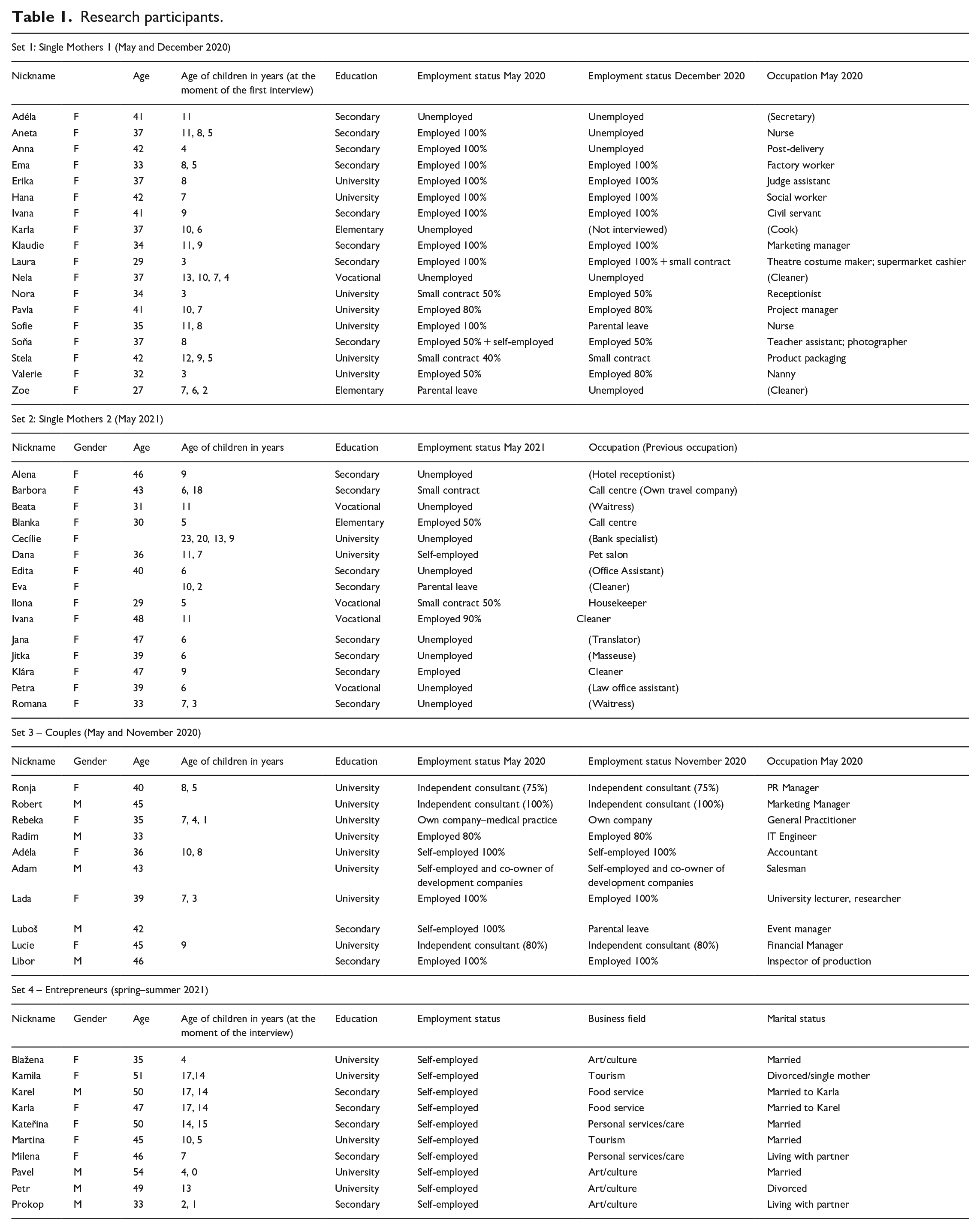
From spring 2020 to summer 2021, we conducted 80 interviews with 53 parents, including 18 repeated interviews with single mothers (two waves: May 2020 and December 2020); 15 interviews with another set of single mothers, which was conducted in May 2021; 10 repeated interviews with parents living as a couple (five parent couples), where both partners were interviewed separately (May and November 2020); and 10 interviews with self-employed entrepreneurs in business fields that were constrained by the pandemic and antipandemic government measures (four men and six women, interviews in the spring and summer of 2021).
The interviews were conducted by the authors and their colleagues 2 under several research projects, but similar guidelines were used. In the case of parent couples and self-employed entrepreneurs, we used a snowball sampling method. The couples were first interviewed during the first lockdown (May 2020) and then again during the second lockdown (November 2020). We repeated the interviews to see how the situation of the parents and their perception of the pandemic evolved, thus being able to grasp the temporality of the COVID-19 crisis. The first set of single mothers (N = 17) were clients of an non-governmental organisation offering support to parents one of the authors interviewed shortly before the pandemic COVID-19 and then recontacted in May 2020 and again in December 2020 to follow-up on their situation during the lockdown measures. We recruited the second set of single mothers (N = 15) via social media announcement, targeting those who suffered important economic hardship during the pandemic, and we interviewed them just after the third lockdown that took place in March and April 2021.
Therefore, the sample is heterogeneous in terms of the parents’ family situation, capturing parents in different economic situations and employment positions and at different times during the COVID-19 crisis. Our interview guidelines covered the following areas: impacts of the COVID-19 pandemic on paid work, economic situation, childcare, and mental health; sources of support; evaluations of the situation; and expectations for the future. The questions were asked in open-ended ways to allow the respondents sufficient time to develop their own interpretations and bring new topics into the interview.
Because the interviews were conducted during the peak waves of the COVID-19 pandemic, we paid a lot of attention to not endangering the health of our respondents and to complying with the rules and measures to prevent infection. Therefore, the vast majority of interviews were conducted remotely. Although the interviews with parents living together were conducted using online audio and video platforms, interviews with single mothers were conducted by telephone. The telephone conversation gave them more time flexibility because they were able to talk to us while attending to their children, cooking, or doing manual work for pay. Moreover, the telephone interviews did not impose further requirements on their technical equipment. To take part in the interview, the participants were offered a small financial reward to compensate for their time and willingness to share their stories. At the beginning of each interview, we informed the participants about the nature and purpose of the research and asked them for verbal consent (recorded on tape). All interviews were subsequently anonymised, and the participants were given a pseudonym (see Table 1). The interviews were transcribed verbatim by the assistant of our department and analysed using Atlas.ti software.
Research participants.
As authors, we faced a similar situation as our respondents during the COVID-19 pandemic: our children stayed at home for several months in a row as their schools were closed and they needed constant care and attention. At the same time, we tried to meet our work obligations and, moreover, quickly organised novel field research that would respond to the new historical situation. Therefore, we experienced the enormous difficulty of combining paid work and childcare. Nonetheless, we are aware of our privilege: as highly educated, White, and middle-class women living in a heterosexual couple and working from home, we had a much easier starting position than many other mothers with small children during the pandemic. This is why we reached out to women and men with different characteristics and positions, striving to understand their diverse experiences.
The analysis focused on identifying the themes related to childcare during school closures and how they were interpreted and experienced by parents. We sought to determine recurring themes and patterns to demonstrate to what extent the ways in which parents experienced and coped with the increased amount of care were shared by all parents (or the conditions shaping any differences), along with how these ways evolved over time.
In the first step, we conducted an interpretative phenomenological analysis (IPA) (Alase, 2017). This method is designed to facilitate an understanding of a person’s lived experiences and grasp a phenomenon by examining how events and experiences are perceived and interpreted by the person. The analytical process is characterised by an effort to understand experience from the respondent’s point of view and, at the same time, to perform critical interpretation (of what was unsaid or unreflected). This method is considered especially suitable for examining change or existential moments (Smith, 1999). In this way, we identified four themes expressing the positive experience of childcare during the lockdown because of COVID-19: care as an opportunity to restore and enhance relationships, care as an escape from the treadmill of paid work, care as the re-establishment of one’s value, and care as an opportunity for coping with the crisis.
Originally designed as a psychological method, IPA has been designed to facilitate the understanding of individual experiences rather than broader sociocultural aspects (Smith, 1999). This is why we have taken a second step based on the approach of critical and feminist sociology. In line with Gubrium and Holstein (2003), we ‘bracketed’ the perspective of individual interpretations and experiences, diverting our attention to what is being interpreted and experienced, with what resources, and with what implications. This helped us capture power structural effects and, thus, problematise and politicise what could otherwise be considered as merely individual and arbitrary constructions. In doing so, we applied intersectional research methods (Choo and Ferree, 2010). We demonstrated the analysed experiences’ long-term implications in terms of gender inequalities and actors’ social locations (Anthias, 2013), which included focusing on multiple sources of (dis)advantage in a particular social context. In this step of the analysis, we focused on the four main characteristics/positions that impacted the experiences of our participants – gender, partnership status, working conditions, and economic situation – and we analysed the inequalities and resources that helped the parents compensate for the losses incurred by the pandemic’s situation. This mixed approach helped us avoid the one-sided view of care and reproductive work as a burden or, to the contrary, as a resource or value.
Findings
Care as an opportunity? Experiencing the first lockdown of spring 2020
On 11 March 2020, 10 days after detecting the first COVID-19 case in the country, the Government of the CR prohibited pupils and students from attending education courses in person at Czech primary, secondary, postsecondary schools, and colleges. The closure was announced 2 days in advance and planned for 2 weeks. Eventually, the gradual reopening of schools began on 25 May 2020 (primary school grades and senior years), whereas other students did not return until the end of the academic year. Kindergartens and other childcare institutions were shut down by their operators.
This situation entailed immense growth in the amount of reproductive work for parents. Despite the stress and exhaustion described by the parents in our interviews, surprisingly positive accounts were commonplace in their evaluations of this period. These positive accounts can be examined for the potential of care as an opportunity for subversion, resistance, or transformation of values, as described, for example, by Walton (2020) or for personal growth (Ahmed, 2017). We identified four themes in the interviews in which the increased amount of care represented not (only) a burden, but also a resource or opportunity for the parents.
By having to spend more time with their children and assist them with distance learning, some parents saw care during the first COVID-19 lockdown as an opportunity to restore and enhance relationships:
Being connected like that – that doesn’t normally happen. We typically hurry through our weekends, travelling to different places, but under quarantine, the family comes together. (Robert, May 2020)
This positive aspect was emphasised by almost all parents being interviewed at the end of the first wave of the pandemic. The parents talked about enhancing and deepening their family bonds. After the families negotiated and established a set of new rules, our participants recounted how they found a new respect for their partner or realised how ‘great’ their children were. The pandemic certainly increased the demands on mothers (and fathers). However, it also provided some with the opportunity to ‘make up’ for their previous absence by being there for their children at home and fulfilling the norms of intensive motherhood ideology (Hays, 1996; see also Somogyi et al., 2022). This especially applied to higher-educated mothers and fathers who had previously spent a lot of time outside the home and who, during the lockdown, worked from home. However, it also applied to less advantaged mothers who saw the first wave of the pandemic as an opportunity to resist the pressure of welfare institutions to find full-time jobs.
Some employed mothers welcomed the lockdown situation as an opportunity to escape from the treadmill of paid work, which they had to combine with unpaid work. They won time for themselves and their children, something that they perceived positively in the first wave of the COVID-19 pandemic. This applied to low-income mothers who were employed in factories or services and could use the care allowance that replaced their incomes. Some parents who could work from home were able to reduce their workload. As many industries and activities came to a standstill, they could work less while still receiving the same pay because their employers had reduced their expectations. Moreover, these workers gained some extra time by not having to commute. This also applied to some of the fathers, who temporarily took over part of the responsibility for the care and education of the children. As a result, some mothers managed to reduce their time stress:
They just cut down on a whole lot of things. Only the key things remained on my agenda. (. . .) For example, a week before the breakdown, I went to (the capital) twice and had meetings all day long, even spending the night there. (. . .) And suddenly, chop-chop, I was at home. (Lada, May 2020)
Single mothers who were unemployed or underemployed before the lockdown interpreted their experience of childcare during the school closure in the first wave of the COVID-19 pandemic as an opportunity to strengthen their own positive identities and re-establish their value vis-à-vis both others and themselves. They could define themselves through care beyond the ordinary and customary value patterns of the world of paid work. The lockdown situation removed the stigma of social welfare and not having a paid job. The women with disadvantaging social identities perceived the lockdown as a positive timeout, suspension of pressure to find a job they were experiencing from public officials, social workers, and generalised others, but also one they had internalised:
It’s going to be ugly for some people. I get that, but I was glad that it came. Because I think it was perhaps supposed to come for the world to take a break in a way. (Karin, May 2020)
With their social incomes remaining the same, they did not experience economic cutbacks. Their lifestyles were not greatly affected by the lockdown because they were not used to travelling or participating in cultural events. Some of the mothers living with their partners even saw the first lockdown as an opportunity to ‘return to themselves’, focus more on their hobbies, and rethink what is important in life. This applied to women who already had older children and who could rely on their partner’s income.
A number of the mothers who were interviewed – but also some fathers – perceived care as a value that helped them cope with uncertainty. The care they gave their children structured their everyday activities, thus helping them better manage the crisis. The parents talked about discovering purpose within simple activities shared with their children. Despite an interruption to previous regular practices and rituals, the parents had to quickly identify new ones to respect their children’s needs. They shared their ensuing surprise of finding such new regular activities satisfying:
For example, we’d reach a body of water, a pond, and I’d sit down. My boys would just play with sticks, and they had terrific fun out there in nature. (Aneta, May 2020)
In the first period of the pandemic, most of the research participants found at least some positive aspects of the lockdown. There were some prerequisites that enabled the parents to evaluate the first lockdown positively. First, it was the reduced work demands coupled with the possibility of working from home. When the pandemic situation, on the contrary, required more time and concentration devoted to paid work, the presence of children in the household became more of a burden. Second, it was the capability to share childcare and home schooling with the other parent. The fathers in our sample belonged mostly to the upper-middle class, and most of them were able to work from home. They all temporarily increased their involvement in reproductive work during the first lockdown, although the mothers mostly continued to hold a greater share of this workload. Two fathers took over part of the care from mothers on parental leave: Luboš because he lost his job due to the lockdown and Radim because his wife worked as an essential worker: ‘(. . .) she worked with two older colleagues in her medical practice, so she decided to protect them and let them be at home. So suddenly, she had to spend much more time at work than we planned’. Thus, he reduced his work hours to 60% and took on the primary responsibility for the care of his youngest son.
Third, it was easier to evaluate the first lockdown positively for parents who were inactive and already drawing social benefits or who were entitled to a newly established care allowance while not perceiving the absence from work as a threat to their career. On the contrary, mothers who lost their jobs suddenly and were not yet covered by the welfare system had opposite experiences: the economic uncertainty overrode potential positive feelings and evaluations. The situation was also difficult for those who had to work onsite and were not entitled to care allowances (or were afraid to lose their jobs if they stayed home), especially when they lived alone with the children. Hana, a single mom who worked as a social worker, used the ‘crisis childcare group’ for essential workers. She described how she felt guilty for leaving her daughter, making her get up very early, changing care arrangements all the time, and not having time to support her in distant learning. She realised that her situation differed very much from that of other people around her:
And I also felt that some were quite ok; they were happy that, finally, the family could spend time together. I felt like I was probably the only one working. Since I met people here, biking and families going out, it seemed to me that they were all quite happy. I felt a bit like an idiot, I have to say. (Hana, May 2020)
Despite the immense burden of childcare for the parents, this first stage of the COVID-19 pandemic was perceived by most of the research participants as an intriguing experiment. The experience allowed some of them to reflect on their lives without the limitations of the labour market, reassess their priorities and distribution of time between productive and reproductive work, and acknowledge a new value of care. Yet over time, as the school closures were repeated and extended, their accounts transformed significantly.
The second lockdown: a neoliberal ‘new normal’?
After a relative easing of government restrictions in the summer of 2020, the second wave of the COVID-19 pandemic hit the CR in October and November 2020. Schools were again closed in October and November (kindergartens were kept open this time). Most of the classes did not reopen after Christmas break. Subsequently, a third strict nationwide lockdown was imposed from March to late April 2021, with all schools fully closed until mid-April and partially until mid-May:
In the first lockdown, I experienced great calm in my life, although I must say that I was also terrified of the disease. (. . .) Because, previously, I had felt a kind of pressure on myself, that despite having a small child, I should work a lot because that’s how it’s done in our field. (. . .) So it came in quite handy. It was amazing. In autumn, though, it was awful. At that time, I was so exhausted because every week people kept cancelling, someone got covid, and everyone got quarantined for two weeks. So the autumn was very depressing for me, also because we had thought in the summer that there wouldn’t be anything like that again. (Blažena, June 2021)
The dimension of time proves key to the pandemic lockdown experience. As the quotation from Blažena implies, positive perceptions of lockdown were exclusive to the first wave of the COVID-19 pandemic. The mothers and fathers no longer perceived the lockdown as an abrupt, temporary, and singular situation. In winter 2020 and spring 2021, it was no longer just a matter of deviating from the normal for a limited time span, but rather, this was a period when the end was out of sight. The second and following waves of COVID-19 presented a different context in which inequalities formed differently (Anthias, 2013).
Our data show that, over time, greater differences emerged in the ways our respondents experienced the pandemic crisis. First, most of the participants living together with their spouses experienced rising gender inequalities in how childcare was distributed between them, which was accompanied by higher economic dependence of women on their partners, family, or welfare state. Second, the interviewed parents occupied different locations in the network of (dis)advantages, which gave them different options for coping with the crisis.
Rising gender inequalities
The accounts of cohabiting heterosexual respondents showed that, in the long term, a gender-conservative arrangement and division of work and care were preserved or even strengthened in most couples. Although some fathers increased their share in reproductive work during the first lockdown, this was likely associated with perceptions of the situation as unprecedented, clearly delimited, and being seen as ‘soon to subside’.
This dynamic was especially evident in cases of self-employed women who had to close their businesses because of COVID-19 government restrictions. Martina, who was a tourist guide before the COVID-19 pandemic, had to end her business after the pandemic outbreak. She described this first period in positive terms, as a time when she could spend time with her children, a third-grader and a preschooler. At the beginning of the second wave, she found temporary employment. Her partner used the fact that she did not work full-time as an argument for why she should be more involved in childcare and household work as he continued to work full-time. The lower value of her paid work also translated into the spatial arrangements of teleworking in her home: her partner occupied the study behind a closable door, where he could work undisturbed, while Martina worked in various common quarters accessible to other members of their household, where her caretaking and professional roles blended spatially with her work functions: ‘He also works from home, has his study. I’m here, wherever I can at the moment, in the bedroom and so, but he is mostly over there in the study’ (Martina, April 2021).
Milena, who lost her business in personal services because of the COVID-19 pandemic and the government measures and whose partner was a public sector employee, explained how the increased amount of care limited her opportunity to look for other jobs: ‘Well, I couldn’t work, more or less not at all. And with that child, you need to entertain him. I devoted myself to him. I don’t regret it. I love my child. He’s a wonderful, cheerful guy, but it limited my job opportunities’ (Milena, May 2021).
The women who lost their jobs or businesses because of the pandemic economic downturn or government measures perceived that there was an expectation to focus on reproductive work. This corresponds to Walby’s (2015) observation that, in any crisis, women are pushed from productive to reproductive work (p. 147). The women in this situation became, at least for some time, dependent on their partners, broader family, or welfare state. Kateřina, who ran a hairdressing salon with several employees, had to close the business down because of the government measures in March 2020. She described how she became dependent on her husband’s income:
I find it awfully depressing. I get miserable. At night, I have dreams about the whole situation. My husband always says, ‘Come on, you’re all set. What’s the problem?’ And I tell him, ‘Well, I’m not, I don’t want to live like that’. . . I’m not happy about that because I’m used to being independent. . . . (Kateřina, April 2021)
Similarly to Kateřina, Milena described the dependency on her partner when she lost her business income: ‘But when you hit rock bottom and you’re like, if I didn’t have that guy (cohabiting partner), then—’. Karla described how her family, as well as her family business, became financially dependent on the state subsidy for businesses (employee wages compensation) and the attendance allowance for parents of children under 13 when schools closed during the COVID-19 pandemic: ‘We live on it now, but I don’t feel guilty about it, because the times are like that and I have to protect myself and my family’. She also discussed with frustration about her financial dependence on her wider family at the age of 50 that her business survival was possible only because of financial support from her partner’s parents.
Luboš was the only exception among the men we interviewed. Because of pandemic control measures, he had to shut down his business and assume the care for their two children, aged 7 and 2 years. His only income at the time of the second interview in November 2020 was the parental allowance, but he still refused to be financially dependent on his partner. He used his financial reserves to pay his share of the family expenses: ‘My financial savings are running out. (. . .) But by default, all payments, advances, mortgage and the like go from my account, and (my partner) is the one who earns and saves’. This enabled him to avoid dependence on his partner and to continue ‘doing masculinity’ (West and Zimmerman, 1987) by being the family provider, even though he was not sure how long he would be able to do it. For other men, however, the increased participation in childcare during the first lockdown (especially when they worked from home) was only temporary and later they, like Prokop, ‘just went on with my work style’.
The COVID-19 pandemic intensified already gendered care burdens for women. Our analytical process revealed that, with the children staying at home, the women accepted primary caretaker roles and arranged their involvement in paid work around care responsibilities. The trend of increasing gender inequalities in paid and unpaid work during the pandemic has been described in several studies across the globe (Craig, 2020; Hipp and Bünning, 2021; Van Tienoven et al., 2023). For our respondents, from a long-term perspective, care changed from an opportunity to a burden restricting women from participating in paid work, thus limiting the autonomy and independence that they once valued.
Compensation resources
The experiences of the parents differed considerably according to the field of their employment or business. Some were suddenly forced to reduce their paid work activity; others saw their workload increase. As stated, a dividing line was created between those who could perform their work from home and those who could not. The women who had fixed working hours and worked outside the home (like Hana) had immense difficulties coping with their care responsibilities. Parents (especially mothers) working from home had to cope with the double burden and blending of time and space for productive and reproductive work. During the first lockdown, the expected short-termness and uniqueness of this situation allowed them to better cope with the difficulties. However, once this situation became a ‘new normal’, it was usually experienced much more negatively.
Entrepreneurs were generally more flexible and able to work from home than employees, although there were gendered dynamics. Research in Germany (Graeber et al., 2021) and the US (Kalenkoski and Pabilonia, 2022) has shown that self-employed mothers were more likely to reduce paid work and lose income compared with self-employed fathers or women employees. This was mainly because of their concentration in frontline fields and fields restricted by government measures.
Our analysis has revealed that older children, who could stay at home alone when parents had to go out, were another advantage when it came to decreasing the pressure. Those with children under 10 years of age had to devote more of their time and energy to online schooling assistance. In particular, entrepreneurs stressed the independence of their children and the fact that their children were used to their parents’ high workload and unavailability, as in the case of Kateřina: ‘My daughters always knew that I spend a lot of time at work. I have never actually been on maternity leave’.
In the subsequent lockdowns, the way in which the reproductive work was lived and experienced was even more determined by the economic and social capital of the households compared with the first lockdown. Even those women who assessed the first wave’s school closure as an opportunity for destigmatising their situation of marginalisation and disadvantage were unable to perceive any positive aspects of their situation in the next waves when they had to deal alone with the need to meet their basic subsistence needs as their small reserves and resources of support became depleted:
Well, now it’s pretty hard because I was supposed to start a new job as my parental allowance ended. But now, my children are at home, so I can’t. My third daughter was just scheduled to start kindergarten, which is closed. (Zoe, single mother, March 2021)
The long-term duration of the crisis presented an impulse for those parents situated at the advantaged positions of axes of (dis)advantage to look for a more satisfactory way of coping with the pandemic situation. They possessed resources they could tap into to manage the ‘reproductive crisis’. As the fear of the new unknown disease partly subsided over time, these resources allowed them to externalise some of the burden of care by contracting services (e.g. babysitting, cleaning, food delivery). A higher quality of housing meant less stress of voluntary or mandatory isolation. Broader family and social networks presented a source of support, helping with childcare and/or negative financial impacts of the pandemic. When the vaccination became available for older age categories in spring 2021, some could turn for help to the children’s grandparents.
Ronja and Robert both worked as consultants and company executives. Although their income declined somewhat because of the pandemic, they also saved money by being unable to go to restaurants, take vacations, or travel on the weekends. During the first school closure, they opted to isolate their family, both working from home and sharing the care of their two children. In their accounts, this brought the family closer together. However, they both experienced stress and fatigue. During the second school closure, they resided in their family summer house. Ronja’s mother looked after their son, they avoided everyday cooking by ordering from restaurants, and their daughter’s private school had an efficient distance learning programme in place:
So the way we defined our routine, we’re pretty satisfied and don’t see it as a problem at all, as a stressful situation. In contrast, we take it as an opportunity to combine the way we normally operate with enjoying the countryside and nature. (Ronja, November 2020)
Our analysis of the interviews with the parents in different positions and life situations suggests that, whereas the first wave of the pandemic had a similar temporality for everyone, the second and subsequent waves were accompanied by more inequalities. Those parents who found themselves in more advantageous positions were able to tap into their resources and positions to minimise the negative impacts of school closures. In contrast, parents without these resources or positions experienced the protracted nature of the crisis, seeing negative impacts exacerbating over time.
Discussion and conclusion
The COVID-19 pandemic in the CR, as well as in other developed countries around the world, was accompanied by the transfer of responsibility for childcare from care and educational institutions to individual parents. This transfer was strongly gendered: the narratives of our respondents, as well as other available data, show that mothers took on a larger share of the extra reproductive work. Taking over full responsibility for the care and education of children in times of school closures was taken for granted by our research participants.
According to our findings, the parents had ambiguous experiences of care during the COVID-19 pandemic. The first lockdown in spring 2020 made room for a positive assessment of the experience. Subsequently, though, the ‘burden of care’ came to be experienced much more intensively in negative terms as the pandemic became protracted, financial reserves were running out, or the world of paid work was again bringing in more demands.
The difference in experiences of childcare under lockdowns can be explained by the different temporalities of the pandemic of COVID-19. Although the first wave in spring 2020 was accompanied by insecurity and fears for one’s and others’ health, it was also experienced as a limited and relatively short period when everyday affairs were interrupted and when former rules, norms, and expectations ceased to apply. Time was at a standstill. Thus, the experiences of the first wave of the pandemic partly refer to Bakhtin’s concept of the carnival, which represents a time beyond social and moral norms and when common boundaries and social differences are blurred (see Lachmann, 1987). This perception of time has opened up space for experiencing care as an opportunity to be with family, to slow down, and to free oneself from the demands of productive labour. As Suckert (2021) argued, the pandemic time opposed the temporal logic of capitalism: slowing down, patience, and waiting as opposed to measuring and commodifying time, accelerating, and expanding. Suckert warned that this ‘forced deceleration’ might lead to increased pressure on growth, acceleration and effectiveness in the near future. Many of our respondents experienced such increased pressure as early as October 2020.
Care was experienced in different ways, depending not only on time, but also on the respondent’s position at the intersection of axes of (dis)advantage. In addition to gender, the key factors included both socioeconomic characteristics (especially income, type and sector of paid work, and housing) and demographic characteristics (family type, number, and age of children). The experiences of the first wave of the pandemic, however, surprisingly, were quite similar for most of our research participants. Our findings correspond to those of Somogyi et al. (2022), who found that parents generally held positive accounts of the first lockdown. Although Somogyi et al. studied a similar familialist country context with conservative gender roles, women’s full-time work, and low work flexibility, their sample was limited to middle-class women from dual-earner couples working from home and to the first lockdown in Hungary. We add to this analysis by showing that the positive experiences of the first lockdown were not limited only to middle-class mothers, but they were also shared by low-income mothers, and single mothers and fathers, with only a few exceptions being found. Some reasons for these positive feelings were identical for all of these groups: fulfilling the norms of intensive parenthood and performing gender according to the prevalent norms. Other reasons were more specific: although middle-class professional women enjoyed more work flexibility, especially when coupled with lower requirements from their workplace, low-income employed mothers benefited from the welfare income replacement that allowed them to stay at home without much in the way of financial losses. Unemployed single mothers enjoyed the destigmatisation of their situation of nonworking caregivers. Moreover, the design of our research allowed us to confirm the tentative statement of Somogyi et al. (2022) that ‘the uniqueness and temporality of the situation was an important part of the positive evaluations of the lockdown’ (p. 15) because the second and third lockdowns brought new and different narratives.
During the second and subsequent waves, some parents fully felt the negative economic effects of the ‘care crisis’, while others used their resources to compensate for the negative effects of the lockdown situation or even took advantage of it. Our research has also confirmed that understanding the varied effects of the COVID-19 pandemic requires intersectional analyses (Maestripieri, 2021). The COVID-19 pandemic emphasised inequalities between parents based on their particular positions at the intersection of the axes of inequality. To some extent, it also changed the very course of those axes of inequality. For example, living in a rural multigenerational household became an advantage, whereas running formerly successful businesses in industries restricted by government decree turned into a fundamental disadvantage. The intersections of these axes subsequently affected how mothers and fathers experienced an increased amount of reproductive work during school closures.
The hope that the COVID-19 pandemic could provide an opportunity to redefine the value of reproductive work proved to be in vain. Although we observed a change in the value orientation from the perspective of individual parents during spring 2020, this short-term change was because of the different temporality of the first wave of COVID-19. This individual value change did not bring a change in the social value orientation necessary for the recognition of care as a common good (see Fraser and Honneth, 2003). On the contrary, it was characterised by an even greater individualisation of responsibility. If there had been a change in the distribution of material resources, it was only in a nonsystematic and short-term manner. This value change was not articulated and framed by attempts to change the neoliberal and refamilialisation trends.
The limitations of our research lie in the heterogeneity of the sample. The interviews were conducted at different time points in the period from May 2020 to June 2021, thus reflecting different stages of the pandemic, and under several different research projects, which complicated the comparisons. However, we believe that this heterogeneity also presents an advantage. Future research should focus on the changes in the course of the axes of inequality brought about by the pandemic COVID-19, which we have only partially uncovered.
Footnotes
Funding
The author(s) disclosed receipt of the following financial support for the research, authorship, and/or publication of this article: This work was supported by the Czech Science Foundation (grant Gendering the pandemic: redefinition of care as a consequence of the COVID-19 crisis? (nr. 21-13587S)).
