




Abstract
Persistent hiring discrimination as demonstrated by correspondence experiments incites immigrant job candidates and their descendants to modify their résumé to hide their immigrant status, that is, résumé whitening. To date, we have little to no empirical evidence on how common this is in practice. We test the extent of résumé whitening with a representative survey of immigrants in Switzerland (N = 7659). Around 9% of the immigrants used some résumé whitening. Immigrants appear to use résumé whitening strategically when experiencing or anticipating discrimination. Future correspondence experiments should take this into account to maximize external validity.
Introduction
Over the last five decades, numerous studies have examined the discrimination of ethnic and racial minorities in the labor market, including immigrants and their descendants. These studies generally use correspondence experiments, in which researchers send pairs of fictitious résumés – one for a native and one for an immigrant candidate – to real job openings (Baert, 2018). The immigrant status is signaled in different ways, most commonly by manipulating the name, but other explicit ethnic markers or implicit cues have also been explored (e.g. pictures, home address, interests, and hobbies; Bertrand and Mullainathan, 2004; Derous and Ryan, 2019). The findings of these experiments point to persistent and extensive discrimination against immigrant candidates (Wanberg et al., 2020; Zschirnt and Ruedin, 2016).
Anticipating discrimination in the labor market, immigrant candidates may choose strategies to present themselves in their résumés in a way to increase the chances of being invited to a job interview (Wanberg et al., 2020). Such résumé whitening describes concealing or downplaying the cues of minority status (Kang et al., 2016) or highlighting signals of belonging to the majority group in job applications. 1 The literature identifies strategies of straightforward résumé whitening and more subtle signaling: (1) removing information referring to your origin; (2) modifying your name to hide your origin; (3) providing a local address, despite living abroad; (4) adding or highlighting diploma equivalents, experience, and pastimes to signal integration (Kang et al., 2016; Liechti et al., 2019).
A few studies use experiments to investigate whether résumé whitening can attenuate discrimination. Kang et al. (2016) conducted an audit study sending whitened and unwhitened résumés to real job openings: Whitened résumés lead to more callbacks than unwhitened résumés. This difference persists when focusing on job openings using pro-diversity language in job advertisements (i.e. words like ‘diverse’ and ‘inclusive’, or a sentence like ‘minority candidates are strongly encouraged to apply’). Similarly, using a factorial survey experiment with human resources professionals, Liechti et al. (2019) find that résumés of candidates with a foreign name who omitted language skills and volunteering experiences signaling attachment to the origin country are evaluated better than résumés with such information. While not a sustainable solution to discrimination, these findings indicate that résumé whitening can increase success rates for minority candidates.
So, while in correspondence experiments, the immigrant status of a job applicant is explicitly signaled, the results of these experiments, paradoxically, incite immigrants and their descendants to do the opposite. If a substantial share of immigrant applicants conceals their origin when applying for jobs, correspondence experiments that fail to take this into account will overestimate the true degree of discrimination.
Little is known about the extent of résumé whitening in practice. We use a large representative dataset of immigrants in Switzerland to provide insights into the prevalence of résumé whitening. While Kang et al. (2016) asked students whether they would engage in any résumé whitening, we provide for the first time evidence of the actual use of résumé whitening among immigrants. Around 9% of the immigrants stated used at least one of the résumé whitening techniques surveyed, but immigrants appear to use résumé whitening strategically when they experience or anticipate difficulties in obtaining work.
Data and methods
The data are from the second wave of the Migration-Mobility Survey, a representative survey carried out in Switzerland in the fall of 2018 (Steiner and Landös, 2019). The target population consists of immigrants (people born abroad and with foreign citizenship) who moved to Switzerland between 2008 and 2018. The survey includes respondents aged 24–65 at the time of the survey, and at least 18 when they moved to Switzerland. To capture the different immigrant groups in Switzerland, the survey used a mixed-mode approach (principally online, available by telephone), and was administered in six languages: German, French, Italian, English, Spanish, and Portuguese – the official languages of Switzerland, English, and the languages of the two remaining most numerous immigrant groups in Switzerland 2 (for a review of the survey, see Steiner and Landös (2019) and Gerber and Wanner (2019)). A total number of 18,372 individuals were contacted, using official and harmonized registers as the sampling frame; a total number of 7740 replied (of which 207 by telephone), yielding a response rate of 42.2%. 3 From these responses, 7659 have complete information and form the basis for the analyses. We applied the post-stratification weights provided to account for non-response bias using nationality, residence permit, and civil status, and to calibrate to the 2018 population using strata defined by nationality and gender.
The survey asked respondents about their migratory trajectory, education and employment histories, integration, family situation, and life satisfaction. In the context of their labor market experience, we included the following question: ‘Did you use one of the following strategies when writing your curriculum vitae in order to increase the possibility of success, when looking for a job in Switzerland?’ 4 with the following answer categories, allowing multiple answers:
Removing information or photos referring to your origin
Modifying your name or surname in order to hide your origin
Providing an address (of a friend or relative) in Switzerland, even if you were living abroad
Adding some diploma equivalences or professional experiences in Switzerland
Mentioning social or volunteer activities specifically in Switzerland
Mentioning pastimes or hobbies referring to Switzerland
While the first three strategies consist of concealing immigrant status, the last three strategies aim to signal membership in the majority (i.e. native) group.
In the analysis, we first examine whether respondents engaged in any of the strategies (i.e. we create a binary variable 1 if the respondent indicated any of the strategies, 0 otherwise). Second, we look at the prevalence of individual techniques, where we first look at concealing strategies and second at signaling strategies. In the main analyses, we proxy origin by country of birth. As a robustness test, we also use self-proclaimed origin as an alternative proxy. For both these measures, we grouped countries into world regions following Norris and Inglehart (2004), though we included Nordic countries into the category of the Global North ‘Western Europe, US, Canada, Australia, and New Zealand’, to obtain six regions: (1) Western Europe, Northern America, Australia, and New Zealand (NOR); (2) Eastern Europe (EAE); (3) Latin America (LAT); (4) Middle East and North Africa (MID); (5) Asia (ASI); and (6) Sub-Saharan Africa (SUB). Immigrants from Sub-Saharan Africa tend to have dark skin, while immigrants from Asia, the Middle East and Latin America are also ‘visible’ minorities. We provide the number of observations in each group in Table A1 in the online appendix. 5
We identified two aspects of the data that may limit generalizability. First, while previous experimental studies have shown that levels of labor market discrimination in Switzerland are comparable to other Western countries (Zschirnt and Ruedin, 2016), the comparatively high share of immigrants in Switzerland may signify that our findings are a lower bound estimate. Second, the data only include immigrants who arrived in the preceding 10 years, so we cannot draw conclusions regarding résumé whitening by more established immigrants or ethnic minorities more generally – although we do not have indications that these would differ.
Given that the outcomes variables are binary, we estimate logistic regression models:


where the outcome
Nine percent of immigrants use résumé whitening – substantial variation
In a first step, we provide descriptive evidence of the extent of résumé whitening and the strategies used. Overall, we note that only a small minority of immigrants engage in any of the strategies we surveyed (9%). 9 However, as shown at the top left of Figure 1, we observe clear differences by region of origin. Compared to countries of origin in Western Europe, the US, Canada, Australia, and New Zealand (NOR) (see above), immigrants from other countries state more often that they use résumé whitening. Immigrants from the Middle East and North Africa (MID), and immigrants from Sub-Saharan Africa (SUB) – the origins which are most ‘visible’ in Switzerland – indicate résumé whitening most often.
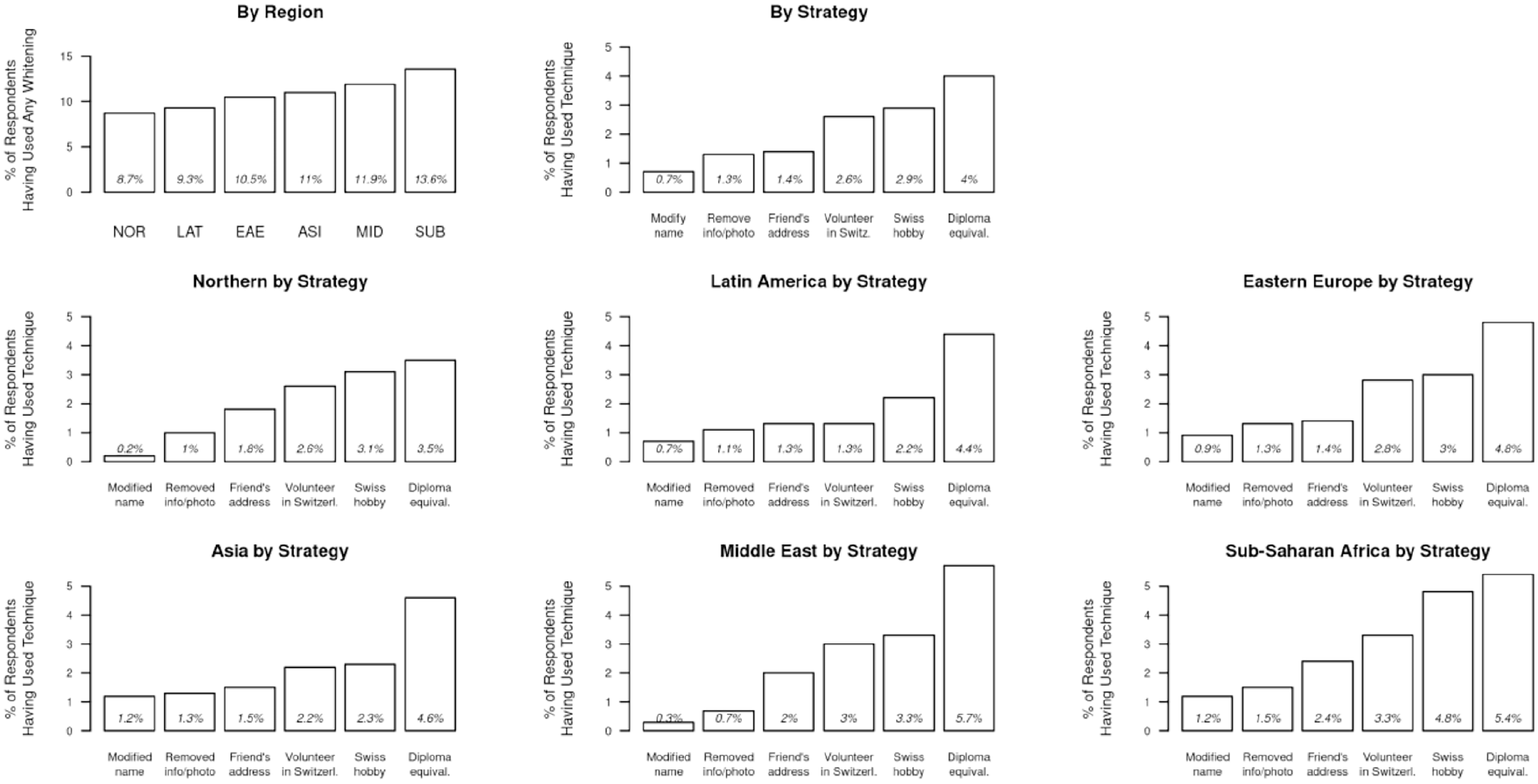
Prevalence of résumé whitening by world region of birth and strategy of résumé whitening.
At the top right of Figure 1, the distribution of individual strategies included in the survey is presented. Overall, the strategies pertaining to a signaling of integration are more widespread than the strategies aiming to conceal one’s origin. Indeed, adding diploma equivalences appears to be the most common résumé whitening technique, while the least common strategy is modifying one’s name. The panels below show that the ranking of the strategies is the same across all world regions, though there are some differences in magnitude. Of those who use any résumé whitening strategy, 71% use just one strategy, 22% use two strategies, and 6% use three or four strategies.
Résumé whitening used strategically
In a second step, we use Bayesian logistic regression analysis to predict who among the immigrants more likely engages in résumé whitening (Table 1). As suggested by the descriptive analysis above, we find that immigrants from all regions of origin are more likely to use résumé whitening than immigrants from the reference category of Western Europe and Anglo-Saxon countries. However, we can see that the use of résumé whitening does not only vary by region of origin. Indeed, the use of résumé whitening is less common among older immigrants, but is slightly higher among immigrants who have stayed in Switzerland longer. Furthermore, résumé whitening is more common among highly educated individuals.
Regression analysis of the use of (any) résumé whitening.
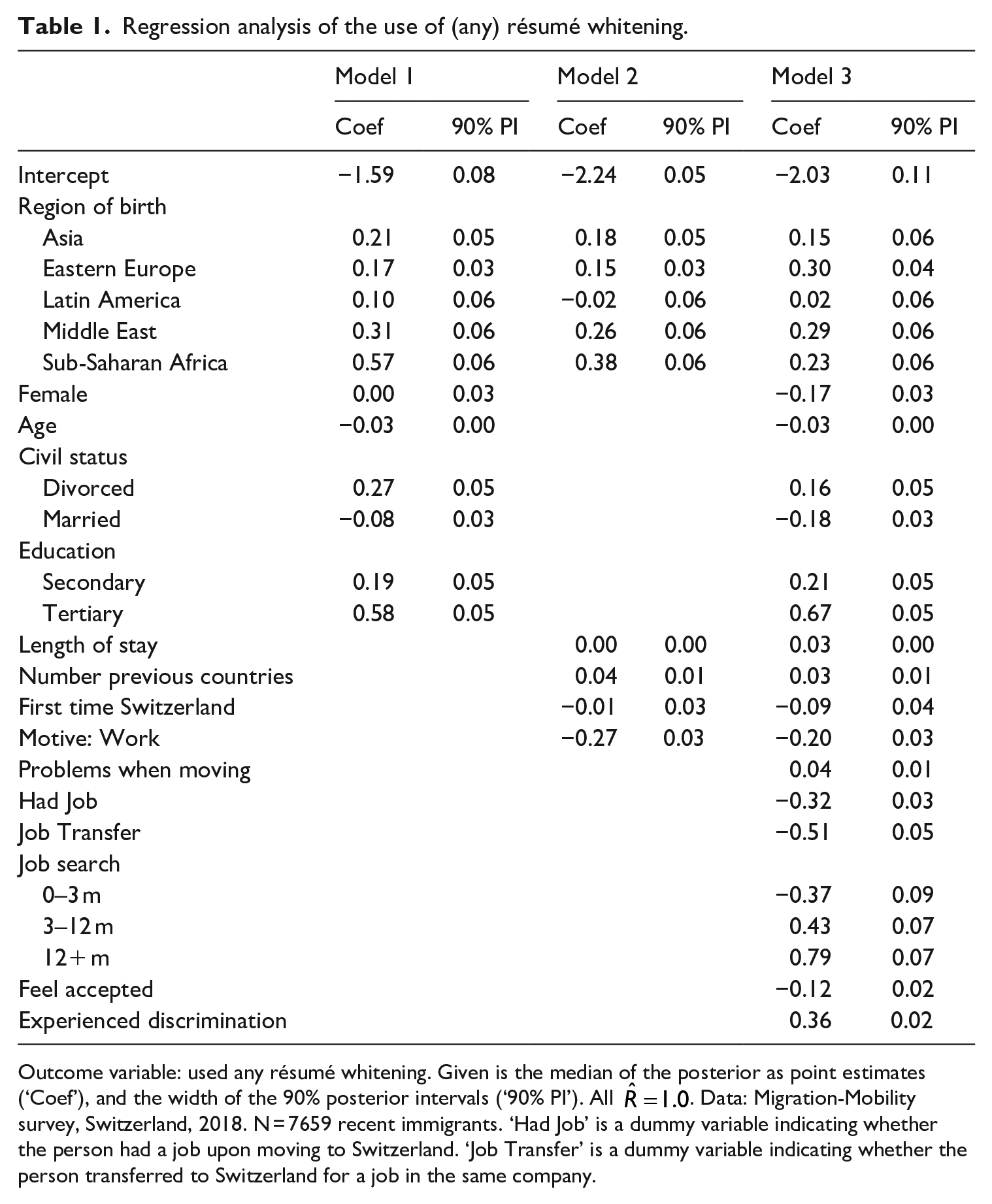
Outcome variable: used any résumé whitening. Given is the median of the posterior as point estimates (‘Coef’), and the width of the 90% posterior intervals (‘90% PI’). All
We also observe that immigrants who came to the country with the primary motive to work – as opposed to other motives like family reunification – are less likely to engage in résumé whitening, as are those who already had a job offer when arriving in Switzerland. These practices appear to be used strategically when other strategies to find work fail or when the person is afraid that they may not find work based on experience. This view is supported by the positive coefficients for longer job search and the experience of discrimination.
We re-estimate the same equations with the individual résumé whitening strategies as outcome. Table 2 shows the results for the strategies concealing one’s origin, while Table A2 in the online appendix portrays the results for the strategies signaling integration.
Regression analysis of the use of specific résumé whitening techniques: removed information, modified name, address.
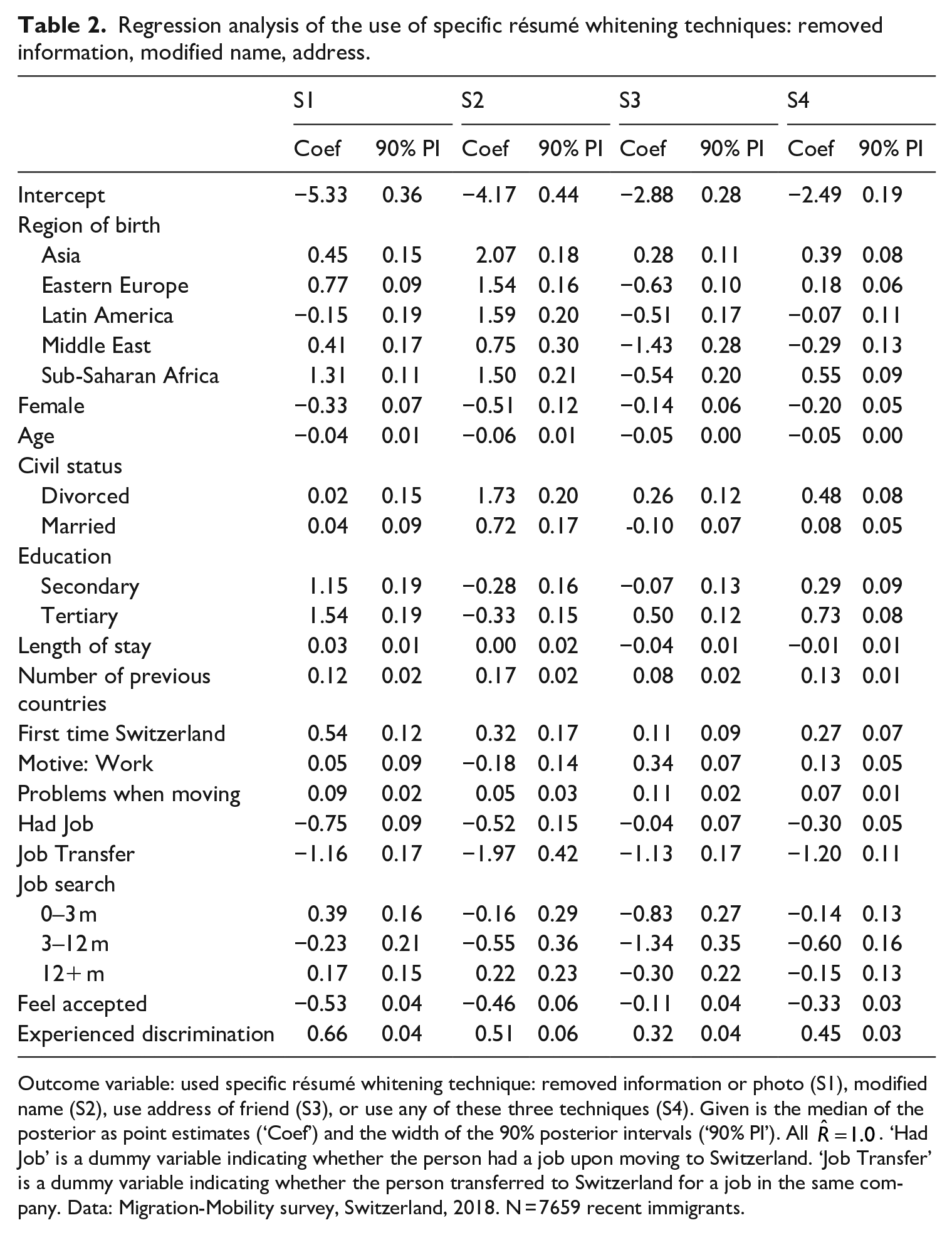
Outcome variable: used specific résumé whitening technique: removed information or photo (S1), modified name (S2), use address of friend (S3), or use any of these three techniques (S4). Given is the median of the posterior as point estimates (‘Coef’) and the width of the 90% posterior intervals (‘90% PI’). All
As is apparent from Table 2, we again find systematic differences between regions of origin: immigrants from Eastern Europe and Sub-Saharan Africa are substantially more likely to remove information from their résumé than immigrants from the reference region of Western Europe and Anglo-Saxon countries (column S1). We find that changing or hiding one’s name is especially prevalent among immigrants from Asia (column S2), but also immigrants from Eastern Europe, Latin America and Sub-Saharan Africa are more likely to use this technique than immigrants from the reference region. Immigrants from regions outside the reference region and Asia are somewhat less likely to provide an address in Switzerland even if they live(d) abroad (column S3).
For hobbies and volunteering activities that signal integration in Swiss society (Table A2 in the online appendix, columns S6 and S7), we observe less difference between regions of origin. Immigrants from outside the reference region are less likely to refer to hobbies and more likely to refer to volunteering activities to signal integration; we cannot determine whether this reflects underlying differences in having relevant hobbies and volunteering experience, or different choices. Concerning the mentioning of diploma equivalences (column S5), we find that this is more prevalent among immigrants from all regions outside the reference region.
As before, other factors beyond the region of origin affect the use of résumé whitening strategies. Women are somewhat less likely to engage in résumé whitening strategies overall, except for strategically mentioning volunteering in Switzerland and indicating diploma equivalents, where we find no substantial difference. Divorced individuals are more likely to change or hide their name compared to singles – possibly because they have the option to choose between their birth name and the name of their (former) spouse. Higher educated immigrants, on the contrary, are more likely to remove specific information, mention volunteering activities, and mention diploma equivalences.
We see that the migration trajectory and previous experiences with discrimination play an important role: unsurprisingly, the longer somebody has lived in Switzerland, the more likely they are to mention typical Swiss hobbies or volunteering experiences. Immigrants who have lived in a larger number of countries before moving to Switzerland are somewhat less likely to include diploma equivalences. The same is true for people who had a job before moving to Switzerland, who are also less likely to remove specific information, or to include volunteering experiences in Switzerland. Immigrants who transferred to Switzerland for a job within the same company, on the contrary, are more likely to mention volunteering with a Swiss organization, but they are less likely to provide an address in Switzerland. In general, individuals who moved to Switzerland for work are less likely to include typical Swiss hobbies.
In addition, the longer the job search – compared to immigrants who did not have to search for work after arriving in Switzerland – the more likely immigrants are to mention volunteer activities, hobbies, and diploma equivalence to show integration into Swiss society. Psychological factors also play a role: immigrants who indicate that they feel accepted in Switzerland are less likely to engage in any of the résumé whitening techniques. By contrast, those who state to have experienced discrimination in the past are generally more likely to engage in résumé whitening. 10 Finally, we estimate the same logistic regression where origin is proxied by the self-stated country of origin (rather than country of birth). The results (as shown in Table A3 in the online appendix) do not substantially differ from what we reported above.
Conclusion
While the experimental literature on labor market discrimination starts from the premise that immigrants do not adapt their résumé in anticipation of discrimination, the results of this same literature suggests that résumé whitening could be a fruitful strategy for immigrants looking for a job. In this article, we provide – for the first time – empirical evidence on the actual use of résumé whitening among a representative sample of recent immigrants in Switzerland.
We show that about 9% of immigrants do use some form of résumé whitening when applying for a job. While overall résumé whitening appears to be limited, it is much more common among immigrants likely to be affected by discrimination: ‘visible’ minorities, but also those who struggle to find work otherwise, and those who experienced discrimination. Among the immigrants who declared that they used résumé whitening, the most common practices were to mention diploma equivalences, hobbies, and volunteering engagements to signal integration into the Swiss society. On the contrary, the more direct résumé whitening techniques like changing one’s name, removing specific information, or providing an address in Switzerland when living abroad are less common.
We conclude that experimental studies on discrimination in the labor market that do not take résumé whitening into account likely overestimate the true degree of labor market discrimination, albeit only to a limited extent. We encourage future studies to consider the signals on résumés and similar material carefully to maintain high validity. Our findings can inform these considerations in two ways. First, the overall use of résumé whitening strategies suggests that in order to safeguard external validity, future correspondence experiments should include more realistic candidate profiles by whitening about 10% of fictitious résumés. Second, we find that immigrants tend to change implicit cues, rather than explicit markers of their immigrant status. Fictitious résumés that signal immigrant status through explicit markers are therefore more realistic than résumés exhibiting variation in more implicit cues like hobbies or volunteering experiences.
While the current study is the first to provide empirical evidence of résumé whitening, the possibility to extrapolate our findings to a more general setting is limited by the survey design. Future research should look at the use of résumé whitening by different minorities and in different contexts, including established immigrants and ethnic and racial minorities. Similarly, future research should expand to other domains where discrimination occurs, like age, religion, parenthood, disability, sexual orientation, or physical appearance (compare Wanberg et al., 2020). Moreover, while our study focuses on hiding certain information from employers, immigrant job seekers and their descendants could also choose to highlight cues of productivity in order to attenuate (statistical) discrimination (Thijssen et al., 2021). As for résumé whitening, little is known about the empirical relevance of such strategies. Finally, more research on the justification for résumé whitening among immigrants and ethnic minorities is needed, but also the side of employers deserves more attention to better understand discrimination in the labor market and decisions in job applications more generally.
Supplemental Material
sj-docx-1-sro-10.1177_13607804221094625 – Supplemental material for The Extent of Résumé Whitening
Supplemental material, sj-docx-1-sro-10.1177_13607804221094625 for The Extent of Résumé Whitening by Didier Ruedin in Sociological Research Online
Footnotes
Acknowledgements
We are grateful to Carlo Knotz, Daniel Auer, Louis Lippens, and Hannah Van Borm for their feedback which helped improve the manuscript. We would like to thank Luca Bernasconi for his support.
Author contributions
Didier Ruedin designed the study and ran the statistical analysis. Didier Ruedin and Eva Van Belle wrote the paper.
Funding
The author(s) disclosed receipt of the following financial support for the research, authorship, and/or publication of this article: This research was supported by the National Center of Competence in Research nccr – on the move, funded by the Swiss National Science Foundation (Grant Number 51NF40-182897).

Supplemental material
Supplemental material for this article is available online.
Notes
Author biographies
References
Supplementary Material
Please find the following supplemental material available below.
For Open Access articles published under a Creative Commons License, all supplemental material carries the same license as the article it is associated with.
For non-Open Access articles published, all supplemental material carries a non-exclusive license, and permission requests for re-use of supplemental material or any part of supplemental material shall be sent directly to the copyright owner as specified in the copyright notice associated with the article.
