




Abstract
The ‘omnivore’ hypothesis currently dominates the academic literature on the social patterning of taste. It argues that cultural elites no longer resemble the traditional stereotype of an elitist snob. Instead, they are more likely to be ‘omnivores’ with broad tastes encompassing both elite and popular cultural forms. The omnivore hypothesis has inspired more than two decades of research and debate, without a clear resolution. In this article, we argue that progress in the omnivore debate has been impeded in part due to an elision of two distinct interpretations of the omnivore hypothesis: a strong interpretation, which holds that cultural elites are generally averse to class-based exclusivity; and a weak interpretation which holds that, while elites have broad tastes which encompass popular forms, they do not necessarily repudiate class-based exclusion. We demonstrate how drawing this distinction helps to clarify the existing empirical evidence concerning the omnivore hypothesis.
Introduction
The distinction between ‘elite’ and ‘mass’ consumers once dominated theories of cultural consumption (Gans, 1974). However, over the last quarter century the ‘elite-mass’ hypothesis has fallen out of favour in the sociological literature, largely supplanted by Richard Peterson’s ‘omnivore’ hypothesis (Peterson, 1992). Where the elite-mass theory sets ‘snobs’ with exclusive, highbrow tastes against the mass of popular consumers, the omnivore hypothesis holds that elites do not reject popular culture as shallow and barbaric. Instead, they omnivorously embrace an eclectic mix of culture from across the ‘brow’ spectrum (Peterson, 1992; Peterson and Kern, 1996). By contrast, consumers lower down the socio-economic scale are more likely to be ‘univores’, evincing narrow, restricted tastes; for example, confining their musical consumption to one or two popular genres.
While the omnivore hypothesis has become the dominant frame through which academics understand the social patterning of taste (Chan, 2013; Lizardo and Skiles, 2015), it is not without its critics. Against the host of quantitative research supporting Petersons’ ‘inverted pyramid’ model of cultural consumption is ranged a smaller band of qualitative and quantitative studies which continue to find evidence of snobbish exclusivity among elites (e.g. Atkinson, 2011; Prieur et al., 2008; Veenstra, 2015; Warde et al., 2008). The tussle between these two sides has now been going on for more than 20 years, with no end in sight (Veenstra, 2015).
In this article, we argue that at least some measure of this division in the literature is based on an elision of two distinct interpretations of the omnivore hypothesis. The first – which we term the weak interpretation – holds simply that (1) social elites tend to be more culturally engaged than non-elites (enjoying or consuming a larger volume of cultural forms) and (2) that their tastes often cross the boundary between elite and mass culture. This broad and inclusive palette (more inclusive than that of a univore or of a classical snob) qualifies them as omnivores. By contrast, the strong interpretation goes significantly further in casting ‘omnivores’ as true cultural egalitarians who are averse to snobbish, class-based exclusion.
Consider the following pen portrait: Sarah is an aficionado of classical music and fine art. She also enjoys culture from what would traditionally be considered ‘mass’ domains: she likes Radiohead, is a frequent visitor to her local arthouse cinema, and often binges on the latest critically-acclaimed HBO drama. However, she disdains reality TV, popcorn blockbusters and other aspects of mass culture more commonly enjoyed by people with lower levels of education.
Sarah is certainly more culturally engaged than average. Her tastes also span elite and mass cultural forms. Under the weak interpretation of the omnivore hypothesis, Sarah would, therefore, count as an omnivore. By contrast, under the strong interpretation, her snobbish aversion to lowbrow culture would be disqualifying.
The strong and weak interpretations of the omnivore hypothesis make substantively different predictions about the patterns of cultural taste which should be observed in empirical research. A failure to clearly distinguish between these contrasting interpretations has therefore allowed researchers on both sides of the omnivore debate to talk past one another.
Strong and weak omnivorousness
A number of previous researchers have noted the problematic flexibility of the omnivore concept, and the issues this creates when devising tests of the omnivore hypothesis (Hanquinet, 2017; Karademir Hazir and Warde, 2015; Warde et al., 2007). As Karademir Hazir and Warde (2015: 78–79) observe in their methodological review of the literature, Peterson and Kern’s original descriptions of cultural omnivorousness were ‘neither sufficiently precise nor necessarily consistent’, leading to a ‘legacy of problems’ for subsequent research. More recently Hanquinet (2017) has argued that ‘an interpretive plasticity due in part to many different operationalisations’ is ‘an underlying problem with the notion of omnivorousness’ (p. 168).
The core of the omnivore hypothesis as sketched in Peterson and Kern’s original papers (Peterson, 1992; Peterson and Kern, 1996) is the ‘pyramidal hierarchy [of cultural taste] . . . ranging from omnivore down to univore’ (Peterson, 1992: 256). Social elites are more likely to be omnivores (broad tastes which encompass both elite and non-elite cultural forms); whereas those lower down the social hierarchy are more likely to be univores (narrow, exclusive tastes focusing on one or two non-elite forms). However, as previous researchers have noted, this sketch leaves open a number of important questions about what omnivorous tastes should look like – and consequently, what empirical observations (e.g. patterns of survey responses) would qualify as supportive or unsupportive of the hypothesis (Hanquinet, 2017; Karademir Hazir and Warde, 2015; Warde et al., 2007).
Our distinction between strong and weak omnivorousness turns on the way in which ‘cultural omnivores’ are hypothesised to relate to non-elite (in Peterson’s terminology) cultural forms. This is under-specified in the original formulation of the omnivore hypothesis (Peterson, 1992; Peterson and Kern, 1996). Crucially, the boundaries of what constitutes an omnivorous taste pattern are not defined. Does cultural omnivorousness simply mean extending one’s cultural preferences beyond the traditional bounds of legitimate culture to encompass at least a few ‘popular’ forms (thereby, failing to conform to the stereotype of an exclusive snob)? Or does it go beyond this – requiring a more thoroughgoing aversion to class-based exclusivity?
Peterson and Kern’s original papers describing the omnivore hypothesis suggest the latter interpretation. Here, they argue that the hypothesis would, if true, render ‘the image of the taste-exclusive highbrow, along with the ranking from “snob” to “slob” . . . obsolete’ (Peterson, 1992: 252); they describe cultural omnivorousness as ‘antithetical to snobbishness’ (Peterson and Kern, 1996: 904), and note that the new cultural omnivores display ‘an openness to appreciating everything’ (Peterson and Kern, 1996: 904) regardless of its brow-level. It should be noted that Peterson and Kern (1996: 904) do not argue that ‘the omnivore likes everything indiscriminately’ ; however, they do argue that any distinctions omnivores make should not be based on ‘rigid rules of exclusion’.
Taken together, these comments suggest that fundamental to omnivorousness is a repudiation of snobbish, class-based exclusion of cultural forms. This is the basis of strong omnivorousness as we define it. Snobbish exclusivity involves policing the boundaries of one’s own taste to ensure that one is not tainted by involvement in cultural forms that are too lowbrow (i.e. which are too strongly associated with low-status groups). Under our definition of strong omnivorousness, omnivores should reject such snobbish boundary drawing. They are not required to like everything – they may dislike or even disdain some cultural forms – however, this dislike should not be rooted in a systematic, class-based avoidance of mainstream or lowbrow culture (‘rigid rules of exclusion’).
By contrast, the weak interpretation of the omnivore hypothesis sets aside the notion that omnivorousness should be ‘antithetical to snobbery’. Under the weak interpretation, the sole qualifications for omnivorousness are (1) a high level of cultural engagement (consumption or enjoyment of many distinct cultural forms) and (2) consumption or enjoyment of both elite and non-elite forms.
Relationship to previous conceptual distinctions
The conceptual flexibility we describe earlier has led a number of previous authors to distinguish between different ‘versions’ of the omnivore thesis. Our strong versus weak division is related to these taxonomies, but is nevertheless distinct.
Warde et al. (2007) demarcate omnivorousness by volume from omnivorousness by composition. People who are omnivorous by volume simply ‘do and like more activities and things than others’ (Warde et al., 2007: 145); whereas omnivorousness by composition requires that tastes cross the boundary between elite and non-elite cultural forms. The distinction between omnivorousness by volume and by composition has been extremely helpful in clarifying the empirical literature. However, we hold that it does not capture the full flexibility of the omnivore concept. Specifically, Warde et al.’s (2007) taxonomy does not distinguish between versions of omnivorousness which require omnivores to abandon class-based exclusion and those which do not.
Under our proposed taxonomy, we combine volume and composition together under the heading of weak omnivorousness. In order to qualify as omnivorous even in the weak sense, we consider that elites must engage widely (volume) and inclusively (combining elite and non-elite forms). As Warde et al. (2007) themselves argue, accepting volume as the sole indicator of omnivorous consumption ignores Peterson’s explicit statements about omnivores’ appreciation for non-elite culture.
Our definition of strong omnivorousness goes substantially further by requiring that, in addition to exhibiting broad, inclusive tastes, omnivores should not engage in systematic class-based exclusion of cultural forms.
An additional set of conceptual distinctions offered by Veenstra (2015) make use of the strong versus weak terminology. Our distinction hews closest to Veenstra’s (2015) third proposed definition, which contrasts a strong version under which omnivores with broad tastes have entirely supplanted exclusive snobs among the social elite, with a weak version which ‘accommodates the existence of highbrow snobs and omnivorous elites [italics in original]’ (p. 140). However, here Veenstra focuses on whether highbrow snobs exist in combination with omnivorous elites; whereas, we focus on what makes one omnivorous as opposed to a highbrow snob.
Omnivorousness in the empirical literature
Table 1 summarises the methods, results and conclusions of 22 empirical studies of cultural taste whose authors explicitly connect their results to the veracity of the omnivore hypothesis. These studies were selected to represent a diversity of methodological approaches and conclusions, and are not intended to form an exhaustive or systematic examination of the relevant literature.
A summary of selected empirical work relevant to the omnivore hypothesis.

LCA: Latent Class Analysis; MCA: Multiple Correspondence Analysis; SEP: Socio-economic position; SES: Socio-economic status.
The empirical studies summarised in Table 1 fall into two broad groups. GROUP 1 comprises studies which principally employ coarse-grained quantitative data on cultural preferences or consumption. These studies tend to find that (1) consumers can be most clearly divided by breadth of engagement and (2) that elites tend to have broader tastes than non-elites. On the basis of these findings, they conclude that the omnivore hypothesis is supported. Examples include Peterson’s original studies, and others such as the following:
Chan and Goldthorpe (2007), apply a latent class model to data on musical consumption in England. 1 Their models distinguish two primary categories of respondent: those who are more likely than others to consume all types of music and to attend all types of live music performance (‘omnivores’) and those who listen to pop music on the radio but are unlikely to consume other genres or to attend live events (‘univores’). They find that respondents in higher status occupations were more likely to be in the former category. They find little evidence of a class of elitist consumers who restrict themselves to highbrow genres and avoid mainstream popular genres. They conclude that these results therefore ‘chiefly favour the omnivore-univore argument’ (Chan and Goldthorpe, 2007: 7).
Alderson et al. (2007), similarly apply latent class analysis to data on participation in a set of seven cultural activities in the USA: (1) going to a classical music or opera performance, (2) going to a ballet or dance performance, (3) going to see a play, (4) visiting an art museum or gallery, (5) going to a live popular music performance (such as rock, country or rap), (6) reading novels, short stories, poems, or plays, and (7) going to the cinema. Their models similarly divide respondents along the lines of broad (more likely to participate in all activities) versus narrow engagement (participate in few activities). They conclude that these findings are consistent with the omnivore hypothesis.
A number of other studies employing similar methods also fall into this group, including Sintas and Alvarez (2002), Chan and Goldthorpe (2005), Katz-Gerro and Jaeger (2013) and Okada (2017).
GROUP 2 comprises studies employing finer-grained quantitative data, and/or qualitative data. These studies are more likely to find continuing evidence of snobbish exclusion of lowbrow forms. Within GROUP 2, three sub-groups of studies can be identified.
SUB-GROUP 2A comprises studies which focus mainly on evidence of snobbish exclusion, and which conclude that this evidence contradicts the omnivore hypothesis. These include the following:
Prieur et al. (2008): This study is based on an analysis of fine-grained survey data on cultural preferences in Denmark. The results show a clear opposition between high and lowbrow tastes. They also show that the majority of highbrow consumers strongly rejected lowbrow cultural forms. Prieur et al. (2008) conclude that their results ‘provide little support to the theses about the contemporary cultural elite being omnivorous or about snobbism losing ground’ (p. 66).
Atkinson (2011): This qualitative study of musical preferences in England finds that, while elite respondents did engage voraciously with popular music, they emphasised more legitimate forms within this domain, while denigrating many mainstream genres and creators as ‘beyond the pale’. Atkinson (2011) concludes that this evidence ‘debunks’ the omnivore hypothesis.
Friedman and Kuipers (2013): This qualitative study of taste in stand-up comedy in the UK and the Netherlands finds that elite respondents make extremely strong negative judgements about lowbrow comedy and those who consume it. The authors conclude that the predictions of the omnivore hypothesis do not hold within the domain of comedy.
SUB-GROUP 2B comprises studies whose principal evidence is similar to the studies in GROUP 1. However, they also find lingering evidence of class-based exclusion, which is interpreted as inconsistent with the omnivore hypothesis. For example,
Warde et al. (2008) find that, while apparent omnivores exhibited broad tastes that included both elite and non-elite forms, they also ‘drew the line’ at certain forms of popular culture – particularly reality TV, fast-food and electronic dance music. The authors conclude that these ‘persistent forms of discrimination and disavowal of forms of popular culture’ (Warde et al., 2008: 164) displayed by apparently ‘omnivorous’ consumers ‘betray the image of pure tolerance’ associated with omnivorousness.
Tampubolon (2008) uses latent class analysis to examine musical tastes in the US. In line with studies such as Chan and Goldthrope (2007) and Alderson et al. (2007), his models principally distinguish between narrow and broad consumers. However, his ‘broad’ consumers do show evidence of disliking particular low-status genres such as country. Based on these findings, Tampubolon (2008) concludes that the concept of omnivorousness should be disengaged from inclusivity in order to deal with the ‘manifest exclusiveness displayed by cultural omnivores’ (p. 243).
Finally, SUB-GROUP 2C comprises studies whose results mirror those in SUB-GROUP 2B, but whose authors do not see snobbish exclusion as opposed to the omnivore hypothesis. Perhaps, the clearest example is Coulangeon (2005). Applying an MCA 2 model to data on musical preferences in France, Coulangeon (2005) finds that, although preferences are strongly organised according to breadth of engagement, the distinction between highbrow and popular tastes remains an important structuring factor. For example, he finds that, rather than engaging entirely openly with popular genres, elite taste is characterised by a form of ‘enlightened eclecticism’, within which a bulwark is retained against particularly lowbrow popular forms. In this way, his findings resemble those of Atkinson (2011), Warde et al. (2008) and Tampubolon (2008). However, unlike these authors, Coulangeon (2005) does not interpret his results as a challenge to the omnivore hypothesis. Instead, he argues that the exclusivity displayed by cultural omnivores reveals that Peterson’s hypothesis is a complement to the traditional ‘distinction’ model, rather than an alternative to it.
The value of the strong or weak distinction
How should the above findings be synthesised? Does the balance of evidence support Peterson’s omnivore hypothesis or oppose it? Flexible definitions of omnivorousness currently make this a very difficult question to answer. However, clearly distinguishing the predictions of the strong and weak versions of the omnivore hypothesis helps resolve this difficulty:
If the weak omnivore hypothesis is true, empirical studies should find (a) that cultural elites tend to appreciate a larger variety of cultural forms than non-elites and (b) that said elites tend to appreciate both elite and non-elite cultural forms.
If the strong omnivore hypothesis is true, studies should additionally find that elites do not tend systematically to reject cultural forms along class lines.
It is clear how this distinction would help resolve, for example, the contrasting conclusions of Coulangeon (2005) and Ward et al. (2008). By concluding that the class-based exclusivity displayed by apparent cultural omnivores ‘betrays the image of pure tolerance’ associated with omnivorousness, Warde et al. (2008) are clearly adopting the strong interpretation of the omnivore hypothesis. By contrast, Coulangeon (2005) argues that such exclusivity is compatible with the omnivorousness, and is, hence, implicitly adopting the weak interpretation.
The strong versus weak distinction also helps resolve the apparent contradiction between critical studies such as that of Atkinson (2011), and supportive studies as that of Chan and Goldthorpe (2007). This contradiction arises largely due to the granularity with which cultural preferences are measured. As Atkinson (2011) argues, the coarse-grained measures of taste employed by many quantitative studies ‘obscure patent hierarchies of legitimacy within . . . categories [italics in original]’ (p. 171). Analyses based on such measures are, therefore, unlikely to detect evidence of class-based exclusivity within popular domains. As an example, we could return to our pen portrait of ‘Sarah’. Sarah enjoys classical music and fine art, but also regularly attends Radiohead (pop or rock) concerts, and the cinema (to see arthouse films). However, she disdains popcorn blockbusters and mainstream commercial pop music. The latter cultural exclusivity would be invisible to the coarse-grained measures employed by Alderson et al., (2007) and others (e.g. Chan and Goldthorpe, 2005, 2007; Katz-Gerro and Jaeger, 2013; Peterson, 1992). By contrast, qualitative studies are able to detect such elitist exclusion. As such, Atkinson (2011) argues that such studies form a ‘qualitative counter-attack against the statistics-based thesis that musical tastes are increasingly “omnivorous” in character’ (p. 169).
A similar argument to Atkinson’s (2011) could be advanced by authors of quantitative studies which employ finer-grained measures of cultural practice (such as Warde et al., 2008 and Prieur et al., 2008). Their measures include a broader spectrum of specific cultural products, covering both the more and less legitimate poles of popular domains. As such, they are better equipped to detect evidence of class-based exclusivity.
The strong versus weak distinction offers an opportunity to reconcile these disparate findings. The coarseness of the measures employed in studies such as Alderson et al. (2007) does not prevent them from testing the two primary predictions of weak omnivorousness; that is, that elites should have broader tastes than non-elites, and that these tastes should incorporate both elite and non-elite domains. Rather than being flawed tests of a singular ‘omnivore hypothesis’, quantitative studies employing broad measures can therefore be viewed as entirely adequate tests of the weak interpretation. By contrast, studies purporting to test the strong interpretation should include more fine-grained measures.
Under a flexible interpretation of the omnivore hypothesis, the studies summarised in Table 1 represent a chaotic tangle of competing results and interpretations. Applying the lens of the strong versus weak distinction allows us to synthesise the evidence from these studies in terms of their support for each version of the hypothesis. On this basis, it is clear that studies such as those of Chan and Goldthorpe (2005) and Alderson et al. (2007) are supportive of the weak hypothesis but do not represent a sufficient test of the strong hypothesis. Studies of this type represent a large fraction of the omnivorousness literature – and together, they represent convincing evidence in favour of the weak omnivore hypothesis.
By contrast, studies employing sufficiently fine-grained (qualitative or quantitative) measures of cultural engagement are rarer. Where they have been conducted, their findings are consistent with the weak version of the omnivore hypothesis, but run contrary to the predictions of strong omnivorousness – with almost all finding evidence of persistent class-based exclusion (e.g. Atkinson, 2011; Coulangeon, 2005; Prieur et al., 2008; Warde et al., 2008 and Tampubolon, 2008). However, these studies were originally cast as tests of the under-specified, general version of the omnivore hypothesis. As we argue below, further research is needed which is designed to test the predictions of strong omnivorousness more explicitly.
Empirical illustration
Having demonstrated how distinguishing between strong and weak versions of the omnivore hypothesis can help to resolve confusion in the existing literature, we now illustrate this in practice using data from a survey of cultural practice in Britain.
For the purposes of this analysis, we use data from the Cultural Capital and Social Exclusion (CCSE) project (Bennett et al., 2008). 3 The CCSE comprised a national random sample survey of cultural participation and preferences (N = 1564), and a smaller number of follow-up qualitative interviews. Our analyses here are based on the national survey element. We chose the CCSE because the survey measures cover a much wider spectrum of cultural preferences than any other nationally representative British survey of which we are aware.
Following Peterson and Kern’s (1996) original methodology, we use data from the CCSE survey to examine the cultural preferences of highbrow consumers (henceforth, ‘highbrows’). We defined respondents as highbrow if they participated in at least two of the following activities at least several times per year: attending an orchestral concert, attending the opera, attending a play at the theatre, visiting an art gallery. According to this definition, 13.9% of the CCSE survey sample were highbrows.
For the purposes of our analysis, we focus specifically on what highbrows dislike. Reporting that one actively dislikes a particular cultural form is a manifestation of cultural rejection in a way that merely failing to like it is not. As Bryson (1996) argues, dislikes are, therefore, a more appropriate measure of snobbish exclusion (and cultural tolerance) than likes.
The CCSE survey includes measures tapping cultural dislikes in the following domains: literature (genres and specific books), music (genres and specific works), film (genres and directors) and television (genres). The survey measures used vary across items. Details of our operationalisations are given in Table 2:
Details of survey items and operationalisation of dislike.

Figure 1 shows how much more or less likely highbrows were than non-highbrows to dislike each item (after adjusting for age and gender). 4
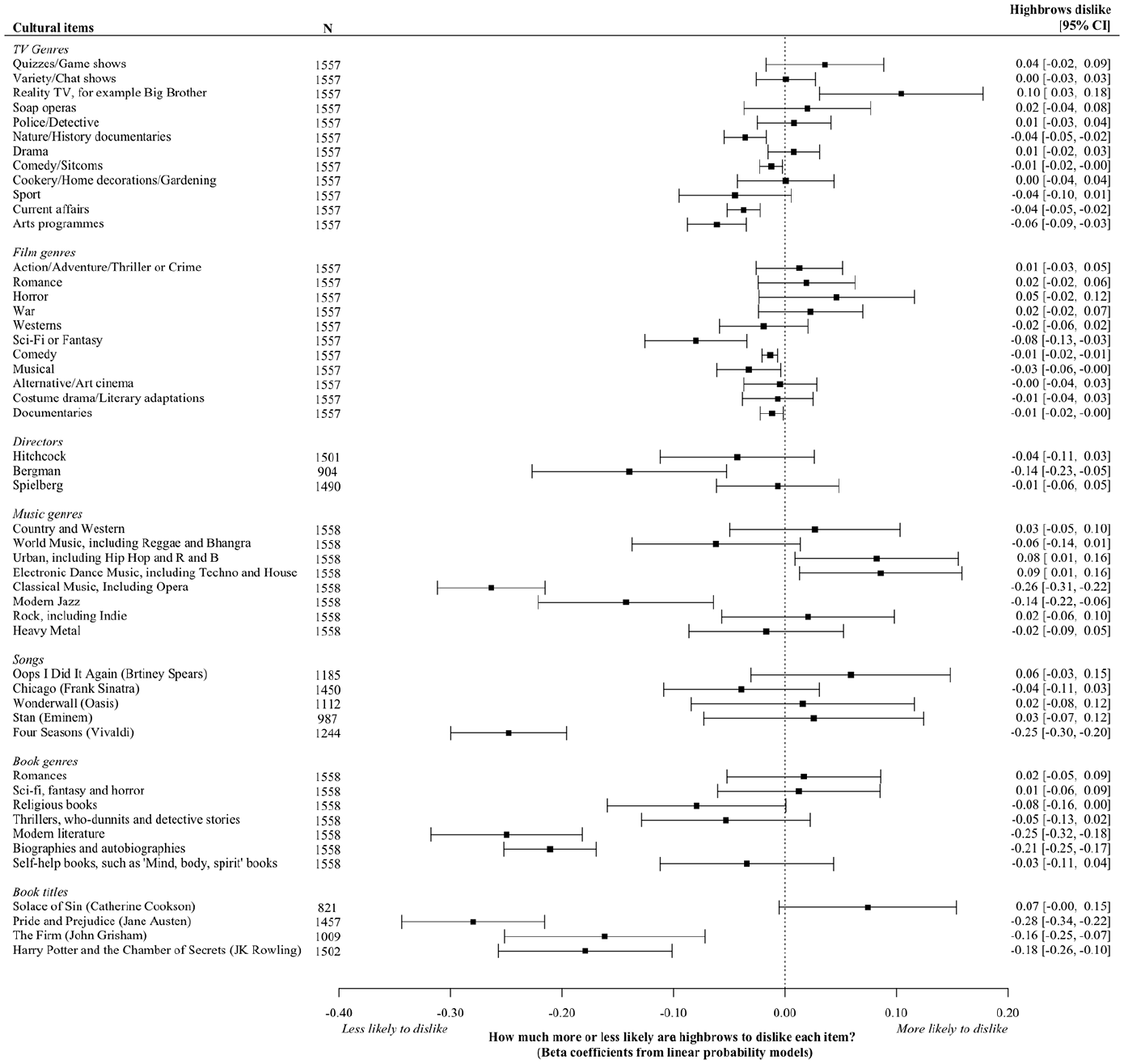
Forest plot indicating how much more or less likely highbrows are than non-highbrows to dislike each item. From individual linear probability models adjusting for age and gender.
As noted earlier, the CCSE survey is unusually detailed. Surveys employed by the majority of previous studies are typically much more limited in scope, covering a much narrower range of cultural preferences or practices. Consider a hypothetical survey which contains the following subset of items: Classical music; rock music; modern literature; thrillers, who-dunnits and detective fiction; alternative or art cinema; sci-fi or fantasy movies; current affairs television; and comedy or sitcom television. This list includes recognisably highbrow items (classical music and modern literature), items from the more legitimate end of ‘mass’ domains (alternative or art cinema, current affairs television), and clearly ‘mass’ items (rock music, genre fiction, Sci-Fi/fantasy movies, comedy/sitcom television). From inspection of Figure 1, it is clear that highbrows are less likely than non-highbrows to dislike most of these items, and are no more likely to dislike any of them. If we sum numbers of dislikes, highbrows dislike significantly fewer items than non-highbrows do (β = –0.68, p < 0.001) 5 (note that, because of how they are measured, film and TV genres cannot be summed). These results clearly show cultural highbrows as having broader, more inclusive tastes than non-highbrows. They also show that these tastes incorporate both elite and mass cultural forms.
If we expand our hypothetical survey to include a sample of items from lower down the spectrum of legitimacy, the results look quite different. For example, our survey could additionally measure dislike of urban and electronic dance music; romance novels; action, romance and horror films; game shows; soap operas and reality TV. We could also add specific works representing particularly maligned genres, such as mass-produced ‘bubblegum’ pop (Oops I Did It Again) and ‘airport’ romance novels (Solace of Sin). Inspection of Figure 1 shows that highbrows are more likely than non-highbrows to dislike many of these items. Summing dislikes shows that highbrows dislike significantly more items from this list than non-highbrows do (β = 0.35, p < 0.001). Adding these less legitimate items to our analysis suggests that, while highbrows do indeed have broad tastes, these tastes retain an element of apparently class-based exclusivity.
Figure 2 reveals the nature of this exclusivity by plotting the relative probability that highbrows (vs non-highbrows) dislike an item (the relative probabilities reported in Figure 1) against the educational composition of each item’s ‘fanbase’. The latter is computed by using linear models to estimate the relative probability that respondents who liked the item would have a low (no educational qualifications) versus high (degree or above) level of education, adjusting for age and gender. Values above one on the horizontal axis, therefore, indicate items which are more likely to be liked by respondents with no educational qualifications than by university graduates. Values above one on the vertical axis indicate items which highbrows are more likely than non-highbrows to dislike. Figure 2 shows a clear positive relationship: the greater the extent to which an item’s fanbase is dominated by respondents with a low level of education, the more likely cultural highbrows are to dislike it.
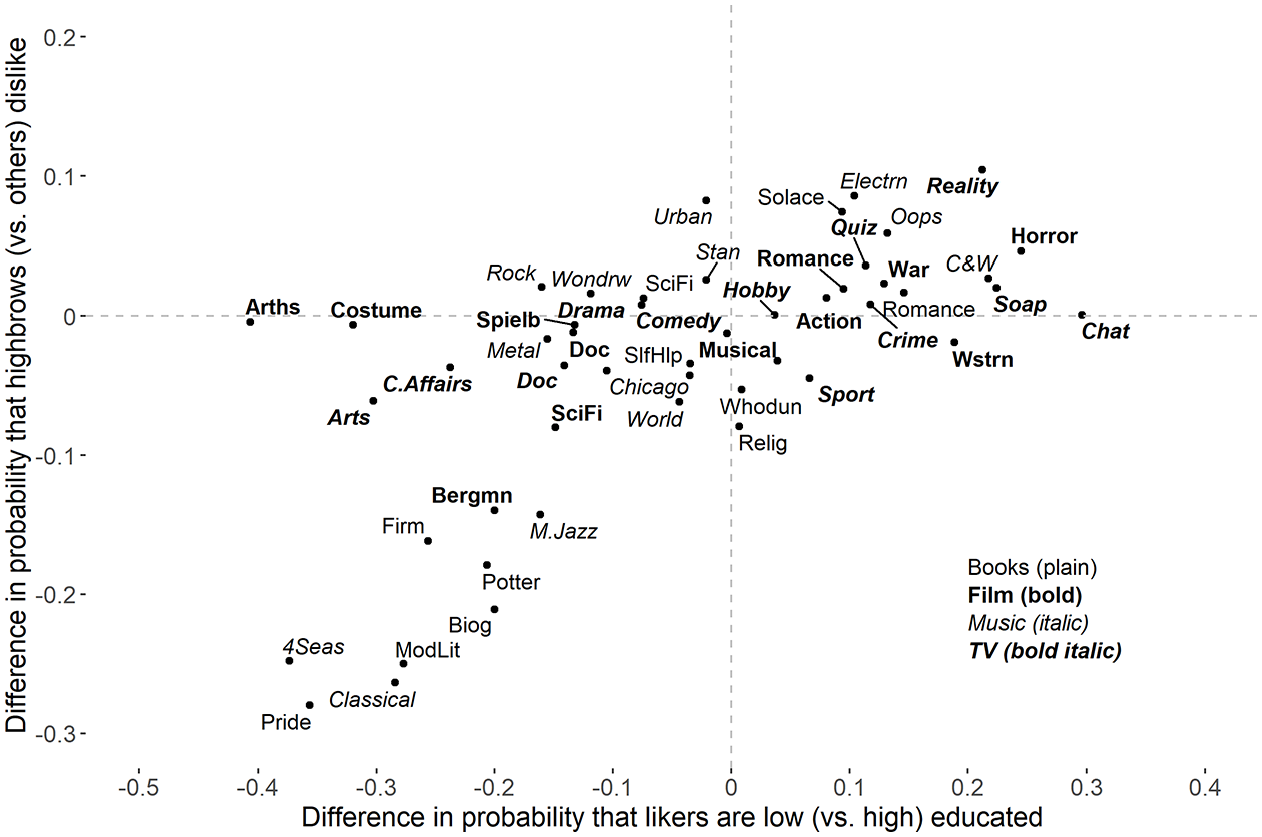
Relative probability that highbrows (vs non-highbrows) dislike each item plotted against the relative probability that a respondent liking the item will have a low (vs high) level of education.
As we argue in the previous section, maintaining a flexible definition of the omnivore hypothesis allows conflicting defensible interpretations of these results. Clear evidence that highbrows have more inclusive tastes than non-highbrows may be interpreted as supportive of the omnivore hypothesis. Similarly, clear evidence that these tastes are marked by class-based exclusivity may be interpreted as contrary to it. This provides ample scope for supporters and critics of the omnivore hypothesis to talk past one another.
Distinguishing between strong and weak versions of the omnivore hypothesis removes this ambiguity. Under the weak interpretation, the first set of results is manifestly supportive, and the expanded analysis is not contradictory (the fact that highbrows tend to dislike lowbrow items is not problematic for the weak version of the omnivore hypothesis).
Under the strong version of the hypothesis, our results are also straightforwardly interpretable. Our first, narrower, analysis does not cover a wide enough spectrum of cultural legitimacy to be considered a sufficient test of the hypothesis. Our expanded analysis reveals results which are clearly unsupportive. In this analysis, cultural highbrows appear to be engaging in systematic class-based exclusion of lowbrow cultural forms – flatly contradicting the expectations of strong omnivorousness.
Discussion
We have argued that two alternative versions of the omnivore hypothesis are prevalent in the sociological literature on cultural taste. Under the weak interpretation, elite omnivores are envisioned as highly engaged consumers whose taste for highbrow culture is combined with an appreciation for what would traditionally be considered ‘popular’ cultural forms. Under the strong interpretation, this breadth of taste is combined with a thoroughgoing repudiation of cultural snobbery. We have shown how elision of these two interpretations allows researchers on both sides of the omnivore debate to talk past one another. We have also demonstrated how properly demarcating these alternative interpretations allows for a clearer interpretation and comparison of empirical results.
In this final section, we draw out the implications of our proposed distinction for existing theories of cultural taste (particularly those of Bourdieu), and for future empirical investigations.
The strong versus weak distinction and Bourdieu
Many (if not most) researchers investigating the omnivore hypothesis have attempted to situate their results with respect to Bourdieu’s theory of cultural taste (Bourdieu, 1984). However, these efforts have been undermined both by conceptual confusion between strong and weak omnivorousness, and by competing readings of Bourdieu.
As Holt (1997) notes, many researchers adopt a straightforward reading of Bourdieu, under which cultural capital rests primarily on high cultural exclusivity. Under this interpretation, evidence that the cultural repertoires of elites have expanded to include popular forms, and that the importance of high culture has declined, is taken as a repudiation of Bourdieu’s theory (e.g. Erickson, 1996; Lamont, 1992). Hence, under this reading of Bourdieu, even evidence which solely supports the weak version of the omnivore hypothesis is deemed sufficient to contradict his theory (Chan and Goldthorpe, 2007).
However, as Holt (1997) and others (Lizardo and Skiles, 2015; Prieur and Savage, 2013; Warde, 2017) have persuasively argued, this straightforward reading of Bourdieu misses the more general nature of the framework he proposes. Bourdieu (1984) does not claim that cultural capital must rest specifically on high cultural exclusivity. Rather, high cultural exclusivity is an example of a taste pattern that, in a number of contexts, has served that function (Holt, 1997). It is entirely possible, within Bourdieu’s framework, for an entirely different taste pattern to form the basis of cultural capital, symbolic exclusion and elite reproduction. This more general reading of Bourdieu allows for a more nuanced relationship between Bourdieu’s theory and the omnivore hypothesis. It also increases the importance of our proposed strong versus weak distinction. This can be seen, for example, in discussions of the phenomenon of ‘emerging cultural capital’.
Emerging cultural capital is a term used to describe contemporary patterns of cultural engagement displayed particularly by younger people in Europe (Prieur and Savage, 2013). Where traditional cultural capital is based on high cultural exclusivity, emerging cultural capital involves a broader and deeper engagement with popular forms. These forms are not appreciated uncritically, but in an enlightened, knowledgeable and discerning way (Prieur and Savage, 2013). This may involve alternative modes of aesthetic engagement. For example, when consuming popular culture, those high in ‘emerging cultural capital’ are able to deploy a detached, Bourdieusian ‘aesthetic disposition’ (Lizardo and Skiles, 2012) – for instance, focusing on the form rather than content of a pop song, TV show or even a video game; as well as bringing to bear an erudite appreciation of the genre, and its links to other cultural forms. 6 They may also adopt an ‘ironic’ approach when consuming some lowbrow forms (McCoy and Scarborough, 2014; Peters et al., 2018).
A crucial point to note about emerging cultural capital is that it retains a strong element of discernment and distinction. This may involve the deployment of ironic distance in order to preserve status when consuming particularly illegitimate forms (McCoy and Scarborough, 2014; Peters et al., 2018), but also the straightforward snobbish rejection of such forms – such as reality TV or mass-produced fiction or pop music – that may be deemed too low status to allow for ‘aestheticizing and ironic recuperation’ (Lizardo and Skiles, 2012: 270).
Evidence relating to emerging cultural capital is clearly consistent with the broader reading of Bourdieu we describe earlier. However, its relation to the omnivore hypothesis is less clear. Are the young, educated holders of emerging cultural capital omnivores, or are they not? Here is where we believe that the distinction we draw between strong and weak versions of the omnivore hypothesis can be of use. Under the weak version of the omnivore hypothesis, emerging cultural capital (and, more generally, evidence of the increasing importance of popular culture and the corresponding decline in the importance of high culture) is consistent with both omnivorousness and Bourdieu. This understanding helps situate studies such as that of Coulangeon (2005). As we note earlier, Coulangeon’s (2005) study found that French elites had relatively broad tastes, but that they nevertheless snobbishly rejected some lowbrow forms. Coulangeon (2005) interprets these findings as ‘confirming’ the omnivore hypothesis (thus, implicitly adopting the weak interpretation). He also describes the omnivore hypothesis as a ‘complement’ to existing theories of distinction.
By contrast, the strong version of the omnivore hypothesis cannot sit so happily alongside Bourdieu. By engaging in symbolic exclusion – particularly through overt rejection of lowbrow cultural forms, but also potentially through ‘ironic’ distancing – Prieur and Savage’s (2013) holders of emergent cultural capital (or Coulangeon’s ‘enlightened eclectics’) are violating the core expectation of the strong omnivore hypothesis. Hence, those authors who implicitly adopt the strong version of the hypothesis see omnivorousness as standing in opposition to Bourdieu (with Atkinson (2011) being perhaps the clearest example).
To summarise, empirical findings supporting only the weak version of the omnivore hypothesis present little difficulty for the Bourdieusian framework. However, findings supportive of the strong version would suggest a troubling (for Bourdieu’s theory, if not for society) lack of symbolic exclusion among cultural elites. Such findings would support a Petersonian theory of cultural egalitarianism over a Bourdieusian vision of a closed, self-reproducing elite.
Implications of the strong versus weak distinction for future empirical research
A large portion of the empirical work so far conducted on the omnivore hypothesis is based on quantitative data from large-scale surveys. As we note earlier, such surveys often incorporate only coarse-grained measures of cultural consumption or participation – for example, how much respondents like or dislike broad musical genres such as ‘pop/rock’ (e.g. Chan and Goldthorpe, 2007). A key implication of the conceptual distinction we propose is that data of this kind are sufficient to test the predictions of the weak but not the strong version of the omnivore hypothesis. At this stage, little additional evidence is required from this type of data. The volume of existing research is sufficient to conclude that, for North America and a number of European nations at least, the predictions of the weak hypothesis are confirmed.
The story for the strong hypothesis is very different. The current elision of the two hypotheses has confused the issue, as evidence supportive only of the weak version is often used to make claims redolent of strong omnivorousness (e.g. Chan and Goldthorpe, 2007; Peterson, 1992). However, explicitly defining the predictions of strong omnivorousness makes it possible to assess the current evidence base (as we do above), and to devise new tests. Crucially, such tests require fine-grained measures of cultural preferences (including dislikes) within popular domains – measures that can identify someone who, for example, enjoys the horror films of Jordan Peele while strongly disliking lower-brow examples of the genre.
We are, of course, not the first to argue that studies of omnivorousness require these types of fine-grained measures (see, for example, Atkinson, 2011; Holt, 1997). However, without the conceptual distinction we introduce here, results derived from such measures will find a little purchase against an amorphous, multiply interpreted vision of omnivorousness. Explicitly defining the strong version of the omnivore hypothesis will allow these findings to connect (either in support or opposition) with clearly articulated predictions. As we have shown, applying this lens to existing studies using fine-grained quantitative measures yields little support for strong omnivorousness. The literature needs more studies like this, explicitly intended to test the predictions of strong omnivorousness.
Also needed to flesh out our understanding of the operation of distinction within popular domains is further research tapping modes of aesthetic engagement. However, we would caution against the view that snobbery is now entirely concealed beneath ironic or knowing appreciation, when there remains strong evidence of direct class-based rejection of many lowbrow forms (e.g. Atkinson, 2011; Prieur et al., 2008).
Finally, Jarness and Friedman’s (2017) study of private snobbery among cultural elites emphasises the need for research to delve below the surface of public expressions of egalitarian openness. Qualitative research in the vein of Jarness and Friedman’s study seems most apt to the task. However, we also see scope for creative application of tools developed in other disciplines to assess unconscious or concealed negative stereotypes, such as the Implicit Attitude Test (IAT; Greenwald et al., 1998).
If, as is our expectation, the results of such research run counter to the predictions of the strong omnivore hypothesis, this offers a clear way out of the impasse in which the omnivore debate is currently mired: excise the elements of strong omnivorousness from our understanding of the omnivore phenomenon, and proceed with the work of integrating the remainder into the existing body of research and theory on cultural taste.
Footnotes
Funding
The author(s) received no financial support for the research, authorship and/or publication of this article.
