




Abstract
In this study we explore how types of audience engagement (the how) align with the music that is being performed at a concert (the what), with the aim of understanding how meaning is given to this alignment as an aspect of cultural taste. Doing this we add to a growing field of research that emphasizes the importance of the modes of consumption in cultural homology. Concerts provide a unique context for understanding this as they are social activities made up of a multitude of interactions, meaning that engagement is governed by collectively understood rituals. Through interviews with 40 young adults (18–35 years old) attending concerts from three large cultural schemes (highbrow, pop and folk), we combine macro and micro sociological perspectives, using theories from interactionism to understand the preferences for music and the engagement of distinct audiences. Additionally, at each concert a survey (n=1416) was conducted to understand the average social position of each audience. The findings reveal that in concerts from the highbrow scheme consumption is centred around the music, in pop around the artist, and in folk around the atmosphere, and that these aspects are also taken into account when audience members draw symbolic boundaries. The focus and alignment of the what and the how is thus genre dependent and makes up a meaningful part of cultural taste. This study emphasizes the importance of social and interactional aspects to cultural taste, something largely overlooked in studies of distinction.
Keywords
Introduction
Music consumption has been given its fair share of attention by cultural sociologists who connect taste in music to social stratification and its reproduction (Bourdieu, 1984; Bryson, 1996; Van Eijck, 2001). In these studies, a preference for certain forms of culture is found to relate not only to one’s values, motivations, and social attitudes (Van Eijck and Lievens, 2008), but also to one’s position in social space (Bourdieu, 1984). A taste in music is then seen as socially meaningful, used to mark social position, where people draw symbolic boundaries around certain genres and their consumers. Although traditionally focusing on the types of music (and culture more generally) consumed by people in different social positions, increasingly scholars in this tradition have been paying attention to the modes of consumption, going back to Bourdieu’s original account of the embodied nature of distinction and emphasizing the importance of the ways that specific cultural audiences consume (Atkinson, 2011; Daenekindt and Roose, 2017; Jarness, 2015; Rimmer, 2012). In this line of thinking, people come to distinguish themselves from others not only through what they consume (in terms of genre or art form) but also in how they consume it, for example, seriously or ironically (Peters et al., 2017).
The argument has primarily rested on empirical analyses of preferences for specific musical genres and modes of engagement at the level of the individual (see Bryson, 1996; Chan and Goldthorpe, 2007; Savage, 2006; Van Eijck, 2001), with little attention to live music consumption (for an exception see Willekens and Daenekindt, 2022). However, when considering how people engage with music (the how of consumption), live music presents an interesting situation. In contrast to recorded music, concerts are inherently social activities, defined as a form of ‘communal consumption’ (Willekens and Daenekindt, 2022). An important part of the engagement with live music is thus defined collectively. Or in Goffmanian terms, the behaviour of a concert audience – how they engage with the music and interact with one another – is dictated by the situation specific rituals that make up the social encounter (Goffman, 1967).
In this respect, the concert experience can differ considerably depending on the genre. For example, in some concerts it is conventional to have high levels of collective engagement, where audiences sing along or wave phone lights in the air, while at others active audience participation is far less pronounced, with audiences remaining seated and largely silent. When attending a concert, audience members will take the conventional behaviour into account. They not only expect to hear a certain type of music (as they would when they play music privately), but they also visit with certain expectations of engagement, making it a primary motivation when choosing to attend a certain event. We argue that audience engagement is therefore not just a meaningful aspect of a concert, it is also a meaningful aspect of taste differences.
Adding to the traditional macro approach of Bourdieusian scholars, in this article we implement a subsequent micro-sociological perspective, drawing particularly from foundational theorists of interaction (e.g., Durkheim, Goffman, and Collins) to understand the inherently social nature of live music consumption. We pay particular attention to the micro-level processes – interaction (whether collective or individual towards the artist or one another), rituals, and the social construction of meaning – of music audiences. In combining macro and micro perspectives we follow Collins (1981) and argue that one perspective should not contradict the other, and without seeing the individual and collective experience within a framework of social and historical processes we cannot get a complete picture. With this approach we aim to broaden our understanding of consumption to encompass the social and interactional aspects often overlooked in studies of distinction.
For this study, we attended seven concerts from three large cultural schemes – highbrow, pop and folk – and conducted interviews with 40 young adults (18–35 years old). In doing so, we focused on what they have in common as members of a particular type of audience, what they expect from a concert and also what they disapprove of in a concert experience. Subsequently, to make sense of how this common engagement might operate as an aspect of socially stratified cultural taste, the data are complemented with a brief audience survey, taken at each concert, to establish the profile of its audience in terms of social position (n=1416). In this we take the analysis of modes of consumption (the ‘how’) to the collective level of live audiences in order to study differences in concert experiences, while simultaneously exploring the extent to which modes of consumption are connected to genres (the ‘what’) in meaningful ways.
Theory
Distinguishing the ‘What’ from the ‘How’
Until some years ago, studies on cultural consumption had primarily focused on the homology between people’s taste for specific cultural forms (such as genres) and their social class, with little emphasis given to the different modes of audience engagement. In other words, the emphasis tended to be on what people consume, and not how they consume it. However, cultural objects (the what) do not serve as unequivocal reflections of consumer practices (Holt, 1997). In an era characterized by cultural pluralism and fluid boundaries, traditional markers of status and prestige are being reconfigured. Individuals increasingly distinguish themselves not only through the types of cultural objects they consume but also through the meanings they attribute to their consumption practices, which are reflected in their modes of engagement. For example, McCoy and Scarborough (2014) find that distinct social groups adopt varying forms of engagement, watching the same television series seriously or ironically. Studies like that of Atkinson (2011), Jarness (2015), Lizardo and Skiles (2012) and Lahire (2008) argue that these modes of engagement are in fact more telling in understanding the principles of homology.
Studies that focus on the how rather than the what of cultural consumption suggest different reasons for why the what and the how should be studied separately. Atkinson (2011) and Jarness (2015) both argue that homology can be more readily observed by looking at the how of consumption, focusing on different aesthetic dispositions and motivations for cultural consumption. These would still be very much in line with Bourdieusian theorizing, even if the actual activities in which people engage suggest a less homogeneous cultural repertoire. Instead of arguing that more diverse taste patterns, such as those observed among cultural omnivores (Peterson and Kern, 1996), suggest a waning of cultural boundaries, they argue, with Bourdieu, that the dispositions that make up habitus can still be ascribed to a large extent to class positions and early cultural socialization. This does, however, beg the question how a potentially diverse cultural repertoire might be explained by a more distinct or bounded habitus.
The answer offered by Lizardo and Skiles (2012) is that those with a broad cultural repertoire, who are often upper-middle-class members (e.g. Peterson and Kern, 1996), apply their aesthetic disposition to both highbrow and popular culture. This retains the notion of an integrated habitus while arguing that omnivorous cultural behaviour results in the application of the aesthetic disposition to a wider range of objects. Omnivores thus seek aesthetic satisfaction in non-highbrow culture by recognizing and acknowledging its qualities, much like Bourdieu’s (1984) new petite bourgeoisie were carving out their own definition of artistic quality and ‘the good life’.
Lahire (2008) takes a very different view, arguing that dispositions are not that pervasive throughout the full range of one’s cultural repertoire, but rather that people have many different dispositions that can be (de-)activated depending on the situation. This means that people with lots of cultural capital who attend a pop concert may not enjoy it through the lens of a highbrow aesthetic disposition, but might just as well seek fun, excitement or escape in such a setting. The ability to navigate different social milieus by (de-)activating different dispositions is due to the fact that people traverse a range of social groupings throughout their lives that all contribute elements to the sum total of their socialization experiences. People are familiarized with the notion that different circumstances, or practices, call for different types of responses. Context therefore can also affect how people engage with music (DeNora, 2000; Hennion, 2003).
In this study, we consider the how as an important and meaningful part of cultural consumption. However, we do not focus on discovering consistency (in the form of homology) at the level of individual consumers, but instead we consider consumers to be part of an audience. Live music events provide a very specific mode of consumption, as they are characterized by conventions. According to Becker (1982), conventions coordinate the activity surrounding a specific cultural form, governing how it should be produced (the what), but also how it should be enjoyed by the audience (the how). As large-scale collective events, the conventions at concerts enforce a particular type of engagement. While conventions (as often unwritten rules) are open to constant negotiation, and are therefore quite dynamic, it can be assumed that they are largely agreed upon by the people attending. Therefore, we argue that this mode of engagement is a meaningful part of cultural taste.
Genre-Specific Modes of Engagement in Concerts
The conventional engagement at concerts differs considerably per genre. For example, audiences at popular music concerts are known to actively participate in the event, with the music coming secondary to the social experience. Kulczynski et al. (2016) find that out of ten motivations offered by popular music concert audiences, only three were directly related to the actual music itself (aesthetics, appreciating the musicians’ skilfulness, and hearing new music). Additional reasons were related to, for example, admiring famous artists, interacting with others, escapism or behaving in ways that are not accepted in other contexts (moshing, dancing, going crazy). In a similar vein, Willekens and Daenekindt (2022) found that entertainment-centred motivations were found much more among visitors of folk, urban, or pop/rock concerts than among classical concert audiences, who were most likely to mention music-centred motivations. The fact that popular and folk audiences tend to be less exclusively focused on the music allows for modes of participation that are not entirely geared towards the music itself. Sharing a musical experience with others, for example, is a prime motivator to attend a pop concert (Brown and Knox, 2017), where audiences are often invited by the performing artists to sing or clap along, hold up their phones as flashlights, or put their hands in the air.
Benzecry and Collins (2014), adopting a micro-sociological approach, emphasize the importance of this active audience participation in the establishment of what Durkheim defined as collective effervescence. In moments of coordinated collective movement, particularly seen through the enactment of shared rituals, individuals within a crowd can feel an intense group-based emotion. While Durkheim's original account of collective effervescence was used to describe the ceremonies of aboriginal tribes (Durkheim, 1995 [1912]), it has more recently been used to explain the experience and allure of modern-day sports and music events (see also: Berkers and Michael, 2017; Collins, 2004; Swartjes and Vandenberg, 2022; Vandenberg et al., 2021). For Randall Collins, collective effervescence is the outcome of a successful interaction ritual; an interaction where the ‘bodily micro-rhythms and emotions’ (Collins, 2004: 47) of participants synchronize in a process referred to by Collins as rhythmic entrainment (see also: Bensimon, 2012; Heider and Warner, 2010; Reddish et al., 2013). Music is particularly effective in aiding in successful interaction rituals, as participants get swept up in the beat and emotion of the song. Studies such as that of Vandenberg et al. (2021) find that particular audiences, in their case those of Dutch folk music, place the establishment of collective effervescence at the centre of the music experience.
In contrast, Abbing (2022) and Wouters (2001) find that audiences at classical concerts typically enjoy the music in a concentrated, disciplined, solemn and seemingly solitary manner. It is all about the music itself and not necessarily about socializing with other audience members (Dearn and Pitts, 2017). Benzecry and Collins (2014), speak of the ‘refined micro techniques of listening’ when describing the mode of musical participation of opera aficionados. These fans focus entirely on the music and largely ignore the surrounding audience members. They explain this form of engagement as ‘anti-Durkheimian’, where rhythmic entrainment is not with the other audience members but with oneself – an internal interaction ritual. This draws similarities to Bourdieu’s (1984: 488) pure taste, which ‘demands respect, the distance which allows it to keep its distance’, expecting the work of art ‘to treat the spectator in accordance with the Kantian imperative, that is, as an end, not a means.’ When applied to classical music, this suggests that this audience is fully focused on the music itself, much like the aficionados studied by Benzecry and Collins (2014). As a genre, classical music may be seen as more ‘demanding’ of its audience, whose wilful immersion in the music makes everything else that might draw their attention an annoying distraction. Indeed, Benzecry’s (2011: 84) ethnography shows that most fanatic opera fans distinguish themselves from other audience members through ‘their belief that, while they are listening to the same thing as other people, they are listening better’. In a similar vein, survey research by Rössel (2011) demonstrated that those audience members richest in cultural capital were most likely to listen to a classical music concert in a reflexive, analytic manner.
In our analysis, we are also primarily interested in these listening modes, rather than in people’s evaluations (Thompson, 2006) or the structure of their sensory experiences (Lembo and Martin, 2022). We would expect, nevertheless, consistent relations between elements of experience and participation modes. Seeing that experience can be defined, with Dewey, as ‘an actor’s phenomenal orientation to the world, built up over the life course through interactions with the cultural environment’ (Lembo, 2022: 61), clearly both participation modes and the ensuing experiences are dependent on one’s habitus. For example, Lembo and Martin’s (2022) experiential dimensions of femininity, complexity and density are more likely to be sought after in highbrow or classical concerts than in concerts of pop or folk music. These modes are also part and parcel of the distinctive practice of classical concert attendance as concentration and focus are indicative of the ‘better’ way of listening. This will be different for concerts that appeal less to notions of musical excellence and artistic genius, focusing on more active collective participation by an audience that may be more interested in achieving collective effervescence.
In this study we use a tripartite distinction to discuss audiences from three cultural schemes: highbrow, pop and folk. When talking about the distinct types of milieus of cultural engagement, Schulze (1992) convincingly argues that a highbrow–popular binary distinction overlooks the important difference between folk and pop. While he characterizes highbrow similarly to Bourdieu – emphasizing intellectual enjoyment and contemplation – he differentiates the importance of traditionalism, harmony and simplicity of folk from the focus on action and spontaneity in pop. Schulze (1992) and Van Eijck and Lievens (2008) also demonstrate that this implies different ways of engaging with art as each scheme is linked to specific motivations, expectations and attitudes regarding art and society. These differences are likely to accommodate distinct ways of cultural engagement.
We follow specifically the lead of Benzecry and Collins (2014) in adopting a micro-sociological lens to cultural consumption, adding an empirical grounding to their theoretical contribution, with aims of understanding how methods of engagement differ between cultural schemes (for example in terms of collective interaction). Subsequently, we explore how this connects to cultural taste. Thus, rather than studying the what and the how of cultural consumption separately to demonstrate their potential divergence and the added sociological relevance of the latter, we expect to find more or less typical relations between the what and how, with the mode of consumption being partly determined by genre conventions. In line with Bourdieu, we consider these modes of engagement as practices that – perhaps inadvertently – create boundaries between audiences as they may express very different skills and motivations. In that sense, this study attempts to offer a micro-sociological glimpse into the process of cultural distinction by exploring whether preferences for different genres imply different modes of engagement that can be explained by habitus or cultural capital.
Method
To understand how the what and how of live music consumption align and relate to cultural taste, this research compares the audience experiences, expectations and modes of participation of three music audiences attending concerts situated in one of the three cultural schemes (highbrow, pop or folk). We did so by focusing on concerts of a certain genre that belong to one of the schemes. As genres are diverse and dynamic, they are characteristic of particular schemes to varying degrees (for example, some popular forms of classical music are performed in a setting that is closer to the pop scheme, while certain pop bands use folk elements in their music). We therefore chose to focus on genres that are quite indisputably situated in a single scheme, as based on a factor analysis of genre taste by Van Eijck and Lievens (2008: 28) in Flanders (a Belgian region neighbouring the Netherlands, which has a sufficiently similar music landscape). For the folk scheme we selected ‘levenslied’ (‘song of life’ in English), a traditional Dutch music genre characterized by its emotional, narrative-driven lyrics and simple melodies. It is often compared to other European music genres, such as the German Schlager or French chanson, however, it has distinct elements rooted in Dutch culture (Vandenberg et al., 2021). Famous artists include André Hazes, Frans Bauer and Django Wagner. For the pop scheme, we focused on pop music by Dutch artists, with a specific interest in artists that sing both in Dutch and English. For example, artists such as Trijntje Oosterhuis, Anouk and Marco Borsato have achieved success both by singing in their native language and by venturing into English to reach wider audiences. These are artists that get extensive radio coverage, make the Dutch top-40 charts, and sell out large concert venues. For the highbrow scheme we chose contemporary classical music, a classical music genre that often blends traditional elements with modern influences, challenging conventional structures and incorporating innovative instrumentation and electronics. In the Netherlands you have artists such as Joep Beving and Matteo Mijderwijk.
This study focuses on young adults (18–35 years old); given that this study examines musical taste and participation in live concerts across different genres, maintaining a more focused age range allows for clearer comparisons while ensuring analytical depth within a qualitative framework. We argue that this group is particularly relevant for research on music consumption, cultural engagement, and symbolic boundary-making. Age is a key factor in shaping musical taste and modes of participation (see for example, Fishman and Lizardo, 2013; Van Eijck and Knulst, 2005), and young adulthood represents a life stage in which musical preferences, identity formation, and socialization processes are still fluid and actively negotiated (Mulder et al., 2009). Compared to older audiences, whose musical tastes may be more settled, younger individuals are still in the process of refining and redefining their cultural identities through participation in live music events (Bennett, 2000). Additionally, concerts play a central role in young adults’ social lives, used as spaces for collective experience, emotional investment, and boundary-making (Papinczak et al., 2015). This is directly reflected in their preferred modes of consumption, with young people emphasizing the importance of socialization and atmosphere at music events (Özdemir et al., 2024). Given the study’s focus on how audience engagement varies across musical genres and how these differences contribute to cultural taste, examining a younger cohort allows us to capture emerging cultural distinctions rather than retrospective or fully ingrained ones. Furthermore, as young adults are active participants in live music culture and often serve as trendsetters in cultural consumption (Michael, 2015), studying this group provides insight into how new forms of engagement and taste boundaries are formed and maintained.
As the average age of highbrow arts consumers tends to be over this bracket (Roose and Vander Stichele, 2010; Van Eijck and Knulst, 2005), contemporary classical music was chosen for the purpose of finding a younger audience. Similarly, all the artists chosen for this research were Dutch. This condition was used to limit discrepancies in experience and expectation based on the artists’ (and attracted audiences’) nationality.
Respondents were recruited at the various concerts through a brief survey carried out with a team of student volunteers. Incorporation of these surveys had a dual function for this study. First, it was used to understand the basic demographic characteristics (age, gender and education level) to get an idea of the overall composition of the audiences (see Table 1). Second, these surveys worked as a method of approaching concert attendees and inviting them to take part in an interview at a later date, thereby avoiding the need for snowball sampling and, thus, the possible recruitment within only certain active fan communities.
Survey results distinguishing gender, age and level of education of survey participants of Levenslied, Dutch pop and Contemporary classical.
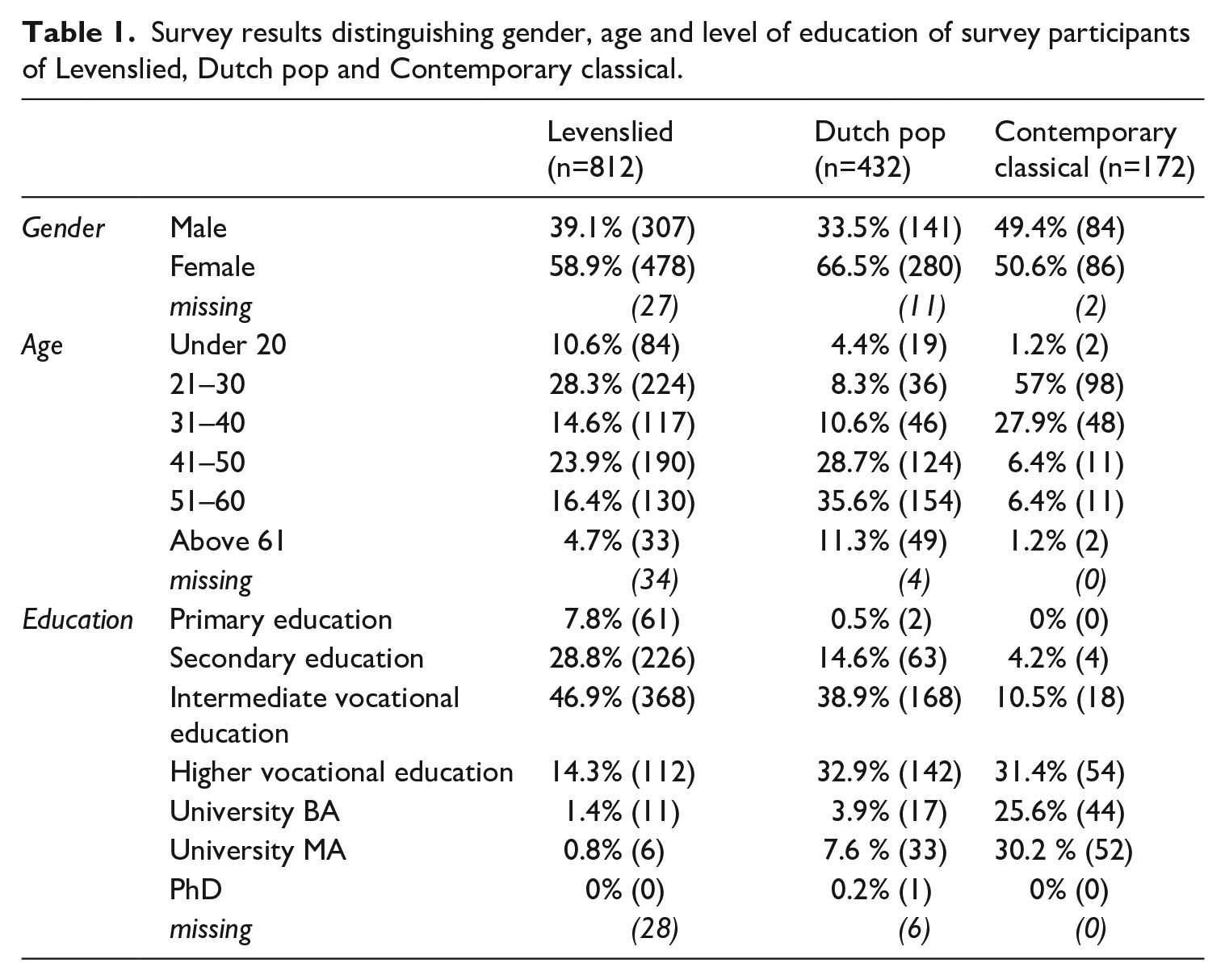
In total we attended seven live music events for this research. Three levenslied concerts (resulting in 20 respondents), two concerts of Dutch pop music (resulting in 10 respondents) and two contemporary classical music concerts (resulting in 10 respondents). As five interviews were double interviews (interviews held with a couple, or two friends), this resulted in a sample of 40 respondents and 35 semi-structured in-depth interviews. The interviews lasted for 80 minutes on average and took place between February 2018 and November 2019. All respondents were Dutch, 21 identifying as male and 19 as female. Education level and occupation differed greatly per genre and followed a similar distribution to the survey results. The interviews were conducted face-to-face, in a setting of the respondent’s choosing. Interviews were conducted in Dutch, with the quotations presented in this article translated by the authors. All participants signed a consent form and have been given pseudonyms for anonymity.
During the interviews, the questions focused on four elements: (i) experience of the concert, (ii) expectations and motivations, (iii) modes of engagement and interaction, and (iv) cultural taste. The interviews were analysed using a thematic analysis (Braun and Clarke, 2006) with ATLAS.ti. An initial open coding produced 120 codes, related to aspects of the research question. These were grouped based on a process of searching, reviewing and defining groups, which resulted in a number of overarching theoretically relevant themes. During this process we compared the audiences, focusing on similarities and differences among their arguments. To avoid unwarranted overgeneralization, we paid attention to inconsistencies among interviewees of a particular genre and also looked for aspects where the experiences at concerts from different genres aligned. The results are presented first through an empirical characterization of what each audience likes and dislikes in terms of the what and how. It then moves on to present the survey results and discuss the cultural taste of the audiences focusing on how they draw boundaries.
Results
Defining the What and the How
Before going into the cultural tastes of the concertgoers we interviewed, we present their preferred methods of engagement and their expectations of the concert in regard to the what (related to characteristics of the performance, such as the music and the performing artist, in other words ‘what happens on stage’) and the how (related to the audience engagement and interaction). In the following paragraphs, we present a brief characterization by genre.
Highbrow
For the audience members of the contemporary classical music concerts, it is very apparent that the music itself stands central to the experience. In discussing the atmosphere of the concert, the response was often about the focus of the audience on the music: Everyone was there really for the music, and everyone was really blown away. (Kasper, 27, MA) Everyone was really focused, and no one was talking to each other, everyone was really there for the music, and it was great. (Daan, 29, MA) I was just really looking forward to an evening of listening, just sitting still and letting the music come over me. (Alice, 24, BA)
The music takes centre stage, with the motivation for attending and the mode of engagement revolving around it. Echoing previous understandings of highbrow taste, the audience adopt an individual manner of engagement (Benzecry and Collins, 2014), valuing first and foremost the artistic and aesthetic quality of the cultural experience – the ‘form over function’ (Bourdieu, 1984).
Consequently, the experience and success of the concert rest largely on the perceived artistic quality of the music, and the artist’s ability. During the interview, Sam (29, higher vocational education) and Steven (30, higher vocational education) explain why they liked the artist during the concert: His concentration is in the music, and I think that is really beautiful [. . .] You see that this is a man, a person, only occupied with the music. He puts it on the internet, but he doesn’t do it for the fame. He just wants to share his art; he wants to share his sound and music with people [. . .] he is careful when he speaks to the audience because he doesn’t have the feeling that ‘they are here for me’ but he thinks, ‘I am making music and they are going to evaluate that’. He just closes his eyes while he plays. He was really not occupied with us; he was only focused on his instrument. And a sound comes out where I think ‘how is he doing that and I can really get on board with that. . . I find performance less important.
The artist here is clearly evaluated based on their skill and mastery of their music. With the emphasis placed on the individual experience, it is unsurprising that respondents rarely mention the social aspects of the event. Artist–audience interaction is not only seen as unnecessary, but it is occasionally found to even be a hindrance to the experience. During the interview, Kasper gives an example of a moment when the artist tried to involve the audience by making them clap to the beat: Yeah, perhaps it is because we were sitting, but people find clapping hard. Unless of course. . . you are being dragged along in a tight pop show [. . .] I have it often with clapping. . . it is expected of you to participate and often this works great, but no. . . this was not the setting for it. No. You just want to look and enjoy yourself, reaching almost a sort of trance, and not feel obliged to clap. It can feel like a laugh track of a TV series.
Artist–audience interaction is seen as a ‘cheap trick’ (Daan). The interviewees expect emotion and participation to be self-motivated; something not ‘forced’ upon them by external pressures. There seems to be little drive for collective rituals, marking a distinct similarity to the ‘fanatics’ described by Benzecry and Collins (2014) by presenting an ‘anti-Durkheimian’ approach to these events – individual engagement and emotion favoured over collective interaction.
There thus seems to be little ambition for forms of engagement other than concentrated listening. The how of audience engagement is presented as subordinate to and completely in service to the what, the music as performed by exceptionally skilled artists.
Pop
For the pop music audience interviewed for this research, the music similarly played an important part to the experience. Sarah (33, higher vocational education) describes: There was a moment where I just sat and cried [. . .] It was one of the songs that I really associate with the past. And that was just very, very beautiful and nice. And it made me extremely emotional.
The respondents of the pop concerts expressed a strong desire for recognizable songs, where emotion is fostered through an individual connection with the piece of music, actively shaped by past musical experiences (see also: DeNora, 2000; Lamont and Loveday, 2020). Motivation for attending, however, did not rest solely on the music, with many expressing the sheer importance of seeing the artist live – in real life. For example, Joe (29, BA) states ‘it was the first time that I saw him [the artist]. So, I thought, “Yes, now I can also say I have seen him live”’. Similarly, Tony (24, Intermediate vocational education) states: I found the experience very impressive. Seeing Marco Borsato was of course amazing. That is such an idol of mine, and that is no exaggeration. He is such an icon, everyone knows him, and there is no way that you can’t find that cool.
Furthermore, only the interviewees from these concerts consistently mentioned the outer appearance of the artist. Lucy (19, BA) observes that the artist ‘went from a beautiful blue dress, and then a black suit. Yes, that makes it exciting. Like “what’s going to come next”’. The clothes are an integral part of the show, keeping it captivating. This is also clear when Elise (18, BA) and Isabel (30, higher vocational education) describe their favourite moment of the event: The atmosphere that is there and the fact that it was an anniversary concert, that makes it already super special. But yeah, the production, with the lights and how she entered the concert in that red dress. I thought it was all very well done. I think it was the moment that she entered, and that she still fitted in that red dress. Yes, I think that that was the most beautiful moment. I thought that she did try also to give some good interaction with the audience, but it never really took off. She wasn’t like ‘now everyone start clapping’, or that everyone should put their phones in the air with the light on and wave them from left to right. That didn’t happen, so then I think that the most beautiful moment was when she entered in that red dress.
The artist has the responsibility of engaging the audience. Interestingly, the respondents mention that this can take two forms. The artist can entrain the audience through direct interaction (communicating with the audience), or through indirect interaction (the show they put on). Similar to findings of previous research, the pop audience values the entertainment of a spectacle over the music (Kulczynski et al., 2016; Schulze, 1992). A concert is successful if it comes with excitement and an element of surprise. The surprise, however, should not come from the music (appreciated most when familiar) but from everything around it – the costumes, lighting, setting, concept and so on.
Here pop music concerts seem to work much the same way as sporting events. For example, Collins (2004: 59) writes that sporting events are contrived to foster dramatic situations where collective emotion is established through the support of a favourite team and a competitive scoring system. Although not obviously competitive, concerts use novel tools – such as lighting, visuals and costume changes – to bring tension and excitement to an event revolving around favourite performers. Moments of collective emotion are then established not only through choreographed action, but through the impact of collectively experiencing a happening. Additionally, artists have a similar role to sports stars, acting like a sacred object, celebrated and venerated (Collins, 2004). There is a clear hierarchy between the audience and artist, with the artist seen as an icon. In this sense these large-scale interaction rituals are classically Durkheimian, as the concert experience is seen as something sacred, with the artist standing central as the totem of the group.
For the audience of pop music, the what is very important, as the performing artist defines the quality of the experience. However, the how, the mode of engagement or consumption, seems to be equally relevant. Audience members expect either group-based interaction (such as clapping or singing along) or an individual style of participation (experience a performance by an artist that is meaningful for them personally), sometimes looking for both during the course of one concert. In any case, the positive experience is closely connected to the relation established between the audience and the artist.
Folk
Oppositional to the previous two audiences, in interviewing the respondents from the levenslied concerts, the music was rarely mentioned in connection with an individual listening practice. A large number of respondents openly stated that they attend ‘not for the music [. . .] but for the people and the sociability’ (Mark, 27, primary education), and when the music was mentioned, it was presented as a means to generate the sought-after convivial atmosphere. Questioned about the music and the properties that give it this specific quality, Mike (25, intermediate vocational education) states: The entry level is very low [. . .] it’s just about easy music. It’s not too difficult. Some songs you have to listen to three times before you know it, and with these songs you can sing along straight away.
At the centre of these events is the audience’s desire to sing along. The straightforward ‘lyrics’ (Arjian, 29, intermediate vocational education) and ‘rhythm’ (Tino, 18, secondary education) allow the audience to easily join in with the music making. Drawing connections to Schulze’s (1992) ‘folk scheme’, they prioritize simplicity, with accessible music providing low-entrance levels to participation, stimulating a social and community atmosphere.
The role of the artist in the concert experience was seen in much the same manner, as something to contribute to the desired convivial atmosphere. After being asked what makes a good artist within this genre, Geertje (28, intermediate vocational education) explains: That they can make a social atmosphere, that’s very important. That they get people singing along and go along with the music. They should be able to make people dance, create a party, but apart from that, not much more, as I think anyone can just sing what they sing.
Geertje’s views are illustrative of a sentiment found among many respondents of this audience, where anyone is in principle capable of singing these songs, demonstrating the non-hierarchical artist audience relationship. More important than having a good voice, the levenslied artist should interact with the audience, fostering excitement and encouraging the crowd to join in. The artist thus works like a conductor, or ‘charismatic leader’ (Carlton-Ford, 1992) of the ritual, trusted with the important function of fostering collective engagement. Drawing similarities to the Dutch pop audience, this drive for collective engagement matches Bourdieu’s (1984) original account of ‘popular taste’, characterized by a preference for an emotional and participatory experience. However, levenslied differs from pop as these aspects serve a clear function of conviviality and social bonding, making for a highly successful interaction ritual (Vandenberg et al., 2021). The form of the music should merely promote the function, and for this reason the materiality of the music is praised for being simple, recognizable and accessible – all stylistic features that encourage participatory engagement.
In this mode of consumption, the what is primarily supportive of the how. Reasons to participate rest in criteria beyond the music, with the music acting as a tool for the greater purpose – collective effervescence.
Disliking the What and the How
The main preoccupations of concertgoers attending these different genres were further confirmed when they commented on what they disliked in a concert experience. Although we occasionally asked them about this directly, interviewees would often spontaneously mention aspects of which they did not approve in defining their preferences. This is not necessarily surprising, as ‘tastes are perhaps first and foremost distastes’ (Bourdieu, 1984: 56), and boundary work is an important part of cultural taste and consumption (Bryson, 1996; Katz-Gerro, 2011; Van Eijck, 2001).
For levenslied concertgoers, where a sense of collectivity was central to an enjoyable concert, a lack of an atmosphere of sociability was the main reason for not liking certain events. Concerts perceived to not accommodate the preferred form of engagement were overtly disliked. The genre most often mentioned in this respect was hardcore techno, which was seen by a large section of the interviewees as ‘dangerous’ and ‘aggressive’.
It doesn’t grab me. It’s too fast and I don’t see any meaning in it [. . .] It is mainly people who like a pill and well, yes, how should I say that, err, have a bit of aggression and bitterness towards everything. (Sammi, 21, intermediate vocational education) I think the atmosphere is very different. [The concert] was all about warm atmospheric lighting. I think that at a hardcore event there is only darkness and, uh, strobe lights that flicker all the time. Where you never know if you are really safe. (Sophie, 23, intermediate vocational education)
The interviewees position feeling safe and at home in a community of likeminded people as a precondition for a successful concert experience. What is striking about this distinction is that techno concerts have been seen as highly successful interaction rituals, characterized by the presence of collective effervescence (Vandenberg et al., 2020). Both scholars and techno fans have highlighted the ritualistic aspect and shared feeling of connectedness fostered through synchronized dancing (Olaveson, 2004). This, however, does not seem to register with the respondents of this study, either unaware of the atmosphere, or uninterested in the rituals (specific dance, substance consumption, clothing style) necessary to be part of the atmosphere at a techno event. Symbolic boundaries are thus not only drawn around the presence of collective effervescence but a specific collective effervescence established through the appropriate rituals (i.e. genre conventions).
The social and moral conservatism of this audience was further seen when interviewees commented on the attendance of perceived ‘outsiders’ at levenslied concerts. Describing the change in atmosphere when ‘Moroccans or Turks’ enter the concert, Tino states: The moment that those people come in, the atmosphere changes. Then everyone goes more into themselves. Look, now everyone can go a little crazy together and have fun. . . You do not have to be afraid. It is usually very sociable, just like you’ve known each other for years.
The desired convivial atmosphere is heavily guarded by the audience, with exclusionary practices forming around individuals who are perceived to diminish this. Barriers to outsiders, as Collins (2004) defines it, must be negotiated in the process of fostering collective effervescence, an important aspect for this specific audience. Outsiders here are people who do not fit the usual demographics, defined in a rather narrow understanding of Dutchness. It is worth noting that while an important part of levenslied is its ‘Dutchness’ – seen for example in the image of clogs and windmills in event advertisement and decorations – it is not as explicitly linked to strong nationalist feelings as seen in other similar domestic music genres such as Serbian turbo-folk (Cvetičanin and Popescu, 2011). Furthermore, hardcore techno, eschewed by this audience, has an equally strong association with Dutch identity. This further supports the interpretation that in both arguments the focus of boundary work is once more on the how – the manner of specific engagement, or perceived lack of it – and not the what – the music, performing artist or the symbolic representation.
The interviewees were not instructed to comment on specific types of concerts. Still, with their focus on engagement, it is not surprising that interviewees from the levenslied audience displayed a strong dislike for classical music. Although most had never been to a classical music concert, they perceive these events to be subdued, not providing the active participation and social atmosphere that they look for.
You are not allowed to dance or anything, yeah, I don’t think people who go there would like to dance. Or even sing along. So yeah, not for me. (Rachel, 19, higher vocational education)
The (lack of) atmosphere is directly connected to the type of audience they expect to be present at these concerts, with boundaries not only geared to the methods of engagement but also an audience they do not relate to. When describing who goes to these concerts Geertje explains: The higher, the higher educated people, say the older people, yeah, I will just call them the rich class, or so I think. They go to these concerts, the rich classes.
For the pop music audience, who placed the fame of the artist centrally, a lack of noteworthiness diminished the concert experience. The quality of the music seems to come secondary to the fame of the artist, with the success of the event resting on the artist’s popularity and status. For example, both Lucy and Fleur explained why they disliked a guest artist at one of the pop concerts despite her acknowledged vocal qualities: I didn’t know her, so that’s why I didn’t like her performance. (Lucy). These people, they are nobody yet. They are singers on YouTube and have participated in a competition. Yeah, who are you then? Nobody. Yeah, that may sound strong, but you just don’t get anything from them. They can sing. That’s it! (Fleur, 34, higher vocational education)
Moreover, many respondents from this audience spontaneously mentioned their dislike of levenslied.
I really do not like Dutch folk music. I do not get the hype of André Hazes. The whole room always just goes like [waves her hands in the air from side to side]. I just think ‘what’s happening here’. (Fleur) I don’t mind a Dutch song every now and again but having to do the polonaise and dance shoulder to shoulder all night long. . . No no, not a chance [. . .] And Dutch music is usually a little bit dumber. (Pieter, 25, BA)
Interestingly, the genre was disliked precisely for the collective rituals that are deemed so characteristic of it, with the pop interviewees disdaining aspects of audience participation such as waving arms to the beat or ‘jumping from left to right’ (Isabel). Similar to the levenslied audience’s dislike for techno music, a dissonance persists here as moments of collective interaction are appreciated in the pop concerts they attend but seen as negative in folk concerts. This suggests again that although the desired outcome may be similar (namely the establishment of collective effervescence) the distinction lies in the method of its achievement, with appropriate and inappropriate forms of engagement.
Nonetheless, the pop music interviewees did share the aversion towards classical music found among the levenslied concertgoers.
I would never go to see an orchestra on their own. I would only go if they were playing in combination with a singer. See, it just doesn’t speak to me so much alone. The performance of a singer I just find really cool. An orchestra just gives less atmosphere for me, I prefer to go to an orchestra that makes a show of it. (Lucy) I have never been to an orchestra. I just have a feeling that an orchestra would be way too boring. And I just don’t feel drawn to that. But if it’s in connection with a singer, then I would think it is very cool. Then they can play along with the music. But I wouldn’t go specifically to see an orchestra. (Sarah)
For both Lucy and Sarah, the star quality they value is perceived to be missing in such a classical music event. These statements situate classical music’s form of engagement as too music-orientated. Unlike the focus of levenslied interviewees on the atmosphere when explaining why they dislike classical music concerts, the interviewees of the pop music audience again consider a famous artist as a condition for a meaningful concert experience. Once more, the what and the how are seen as inseparable.
In turn, the interviewees from the contemporary classical music audience were characterized by a unanimous dislike for pop music.
Pop music, the Top 40 [. . .] I feel that it is just very commercial, and it misses a bit of [the] authenticity that I look for. I think about shows that are very big and spectacular, and then I think yeah, that will not touch me. (Marijke, 26, Higher vocational education) Despacito is a song that I find really bad. I really can’t listen to that. I think it’s because it is played too much. If you hear that song one time then I can already sing along with it, even though I don’t even like the song. Those songs that are made just to get stuck in your head, I really don’t like them. It’s too easy. (Steven) I don’t like the shows that just revolve around commerce. I have it with a lot of hip hop [. . .] they are more concerned with selling merchandise than the music they were playing. Yeah, I can’t really handle that so well. (Kasper)
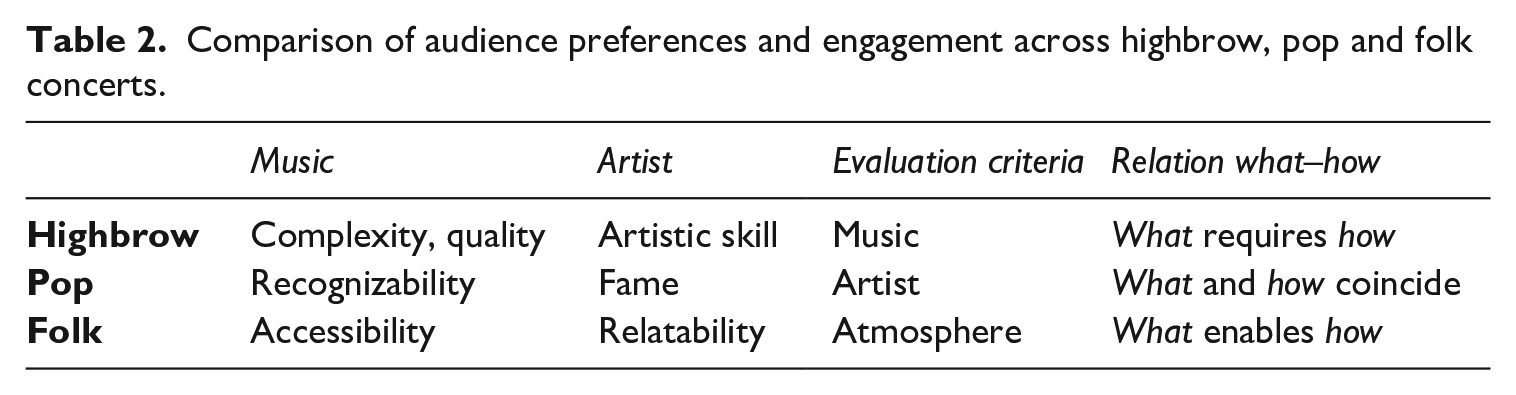
The very reasons why pop music is liked by its audience are now used as an argument against it – the spectacle, its mainstream or commercial quality and the predictability of the music. In line with the threefold distinction from Schulze (1992), pop music is perceived as not providing the levels of contemplation and complexity that the highbrow audience looks for. Accessibility is considered as incompatible with quality, which often takes the form of an argument against commercialism (contrasted by some with ‘authenticity’). In presenting their dislike for pop, the characteristics of the music are brought forward (the what), with little mention of the perceived methods of engagement of the associated audience (the how). Table 2 presents an overview of what visitors to the different types of concerts see as the crucial features of the music, the artist, the criteria of evaluation, and how the what and the how are linked.
Comparison of audience preferences and engagement across highbrow, pop and folk concerts.
Distinction along the What and the How
Although the dislikes expressed by the interviewees align with the differences in motivations, they also bring to the fore larger class politics. To understand how this fits with previous findings on the stratification of taste, it is important to understand the social composition of the audiences. As education level is considered a fundamental indicator of social status, we use it here to operationalize class differences between the audience groups.
When we look at education levels from the survey taken at each concert, we see a familiar picture. Most audience members of the contemporary classical music concerts had attained a university bachelor’s degree or higher (see Figure 1). This corresponds with past research that finds highbrow genres (such as ‘baroque, classical and contemporary classical’) to be largely consumed by higher educated audiences – specifically when consumed live (Roose and Vander Stichele, 2010: 191). By contrast, both the levenslied and pop audiences are clearly on average lower educated, in line with findings stating that genres within both these fields generally have lower educated audiences (Roose and Vander Stichele, 2010; Van Eijck and Lievens, 2008). However, there are notable differences. While the largest category among the pop music audience is intermediate vocational education, only 15.1% of these audience members were below this category, compared to 36.6% of levenslied concertgoers. The proportions of respondents having obtained higher vocational or university education are more than twice as large for the pop music audiences than the levenslied audiences, and chances of having an MA degree are almost 10 times higher in the former group.
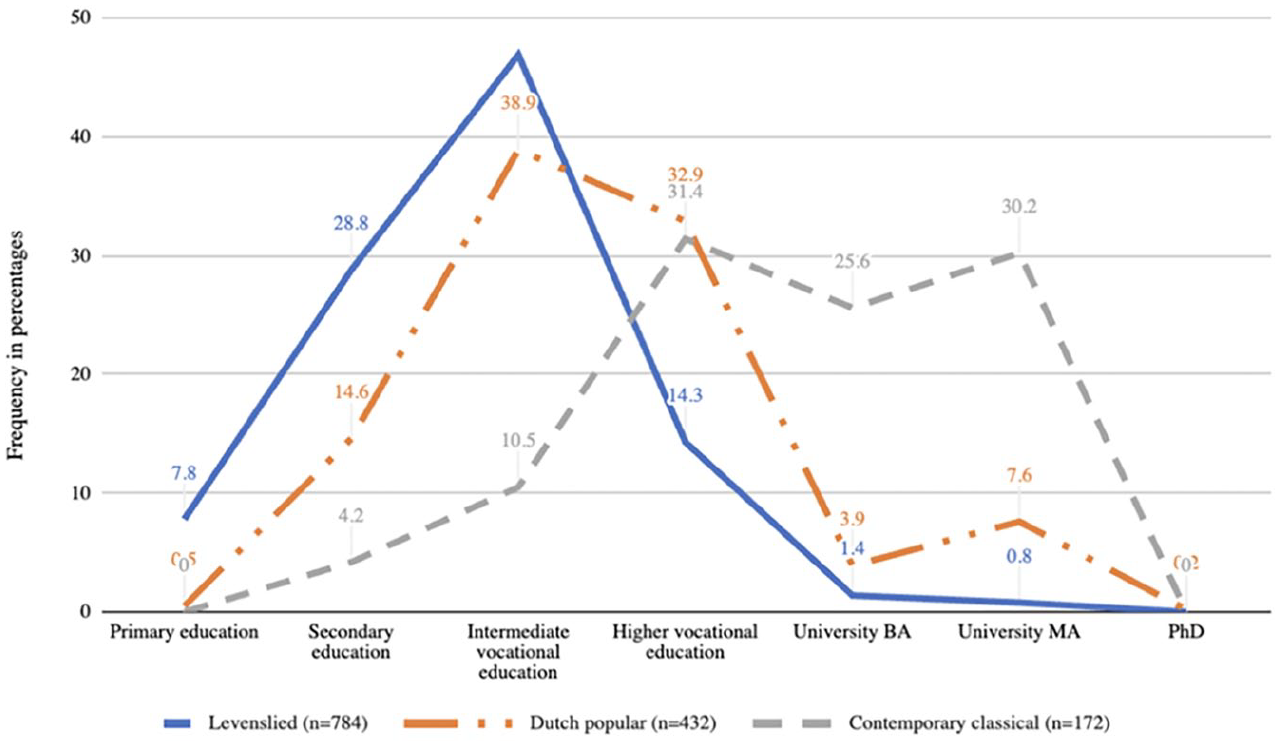
Distribution of education level per type of concert.
In the interviews, a clear classed dimension emerges, particularly evident in the ways in which members of the levenslied audiance refer to hardcore techno (traditionally associated with a working-class subculture in the Netherlands) and ‘outsiders’ (a term implicitly designating individuals with an immigrant background). In this discursive othering, they construct symbolic boundaries that serve to distance themselves from these groups (Stahl, 2018). This distancing is underpinned by a sense of moral and ethnic superiority, articulated through references to non-aggressiveness, abstention from drug use, and self-ascribed ‘Dutchness’. Notably, these targeted groups are arguably situated in close proximity to the levenslied audiance within the broader social hierarchy.
Similarly, although the pop music concertgoers do not mention characteristics of audience members when they explain their disliking of levenslied, by calling it ‘dumb’ they present their taste as superior. In doing so, they depreciate a taste that is associated with a lower level of education than their own. A comparable pattern is seen with the higher educated contemporary classical music audience who, without mentioning its consumers, look down on pop music for being commercial and too accessible. The central focus of different types of concerts (the what and the how) is here deployed as a means for distinction.
Interestingly, this distinction is not just downward. The levenslied and pop music interviewees acknowledge the association between a taste for classical music and a higher social position, but they do not recognize its legitimacy (as in Bourdieu’s original account). When calling it ‘boring’, they rather claim that it is not enjoyable, thereby confidently positioning their own taste as preferable.
While upward distinction focuses on the taste that is perceived to correspond to dominant social positions, it is noticeable that downward distinction is targeted at the taste associated with groups that are one step lower on the social hierarchy. That is to say, orientations in concert experiences are used to maintain distance from class positions that are situated quite close, but not to display superiority over all lower-positioned classes in general. This became clear when a number of higher educated respondents from the contemporary classical music audiences mentioned past experiences with live levenslied music, recognizing the atmosphere at these events.
I am not really a mega fan of a Gerard Joling, or artists within that genre, even though I think it’s great, I love standing in a bar drinking beer singing along, I just don’t put it on at home (Alice) Sometimes I feel very uneasy at ‘hip’ concerts, and that is something I did not get at this concert. It doesn’t matter how you look, how old you are, what you wear. Everyone was so welcoming, and dancing a lot, not standing idle, but really dancing. So, it was actually a really great feeling, really fun. I only just don’t really like the music. (Lieke, 28, MA)
Although both respondents mention that this is music that they would usually not listen to, they are rather sympathetic towards live levenslied events. Their arguments consider the characteristics of the music, but in contrast to the way in which they talk about classical music concerts, they actively suspend evaluation on the basis of musical quality and change criteria to the audience engagement at levenslied concerts. Although accessibility was used as an argument against pop music, unpretentiousness and simplicity are now considered to contribute to an enjoyable concert experience. These interviewees are enthusiastic about these events for something that they cannot get at ‘hip’ types of music events that they usually attend, namely the experience of a successful interaction ritual and the subsequent presence of collective effervescence.
The openness of higher educated concertgoers towards levenslied was further confirmed when, at the levenslied concerts, we encountered a number of higher educated visitors, two of whom have been interviewed for this research. When asked what it is he likes about these events, Ben (28, MA), a regular at these concerts, states the following.
The atmosphere is just great. It has something special, you can just sing along, it’s uncomplicated. It is just nice and happy. You can just switch off your brain. And I mean that in the best way. And of course, it is fascinating to look at the people. Still a little bit of tourism. But mostly, it’s just fun, something a little different.
Bas (28, MA), another higher educated respondent found at a levenslied concert, produces an argument about collective effervescence in even more direct terms.
If Andre Hazes sings, then the whole audience is dragged along. Then you create a kind of collective atmosphere, and that’s something that is hard to reach normally in the Netherlands, because the Dutch are usually quite reserved and closed [. . .] I think that along with football, Dutch folk music is one of the only ways to get Dutch people shoulder to shoulder next to each other.
When talking about ‘tourism’ and looking at the people, it is evident that these consumers understand that they do not belong, the reason for which can only be sought in their social position. However, they appreciate these events for giving them something ‘different’ that they cannot get at other concerts – a particular atmosphere. Their engagement seems genuine and cannot be discarded as merely ironic (cf. McCoy and Scarborough, 2014). They visit these concerts for exactly the successful interaction rituals and the collective effervescence that results from this.
These findings are in line with literature on the cultural omnivore, which argues that higher educated people are more likely to consume a wide variety of culture (Peterson and Kern, 1996; Van Eijck, 2001). However, it also contrasts the hypothesis of the higher educated omnivore extending their aesthetic disposition to any form of culture consumption, focusing on the formal and stylistic features of both highbrow and popular cultural products (Atkinson, 2011; Lizardo and Skiles, 2012). Rather than consuming popular culture with a disinterested, serious (Peters et al., 2017), or ironic attitude (McCoy and Scarborough, 2014), these consumers adjust to situational criteria. They seem to present a ‘dissonant cultural profile’ (Lahire, 2008: 174), participating in a variety of cultural practices with the ability to change the mode of behaviour accordingly. While they are aware of their ‘tourism’, indicating a sense of being out of place, they use these events as a cultural resource for the experience of taking part in such a successful interaction ritual, similar to the lower educated consumers. In doing so, they do not look for aesthetic perks in the music, but rather seek an immersive social experience for which levenslied concerts offer a great occasion. Dissonant cultural practices and orientations are, however, remedied in this case through the coherence of a discourse that downplays affect whether in relation to the what (the artist focused on the music) for classical music or the how (the convivial atmosphere) for folk concerts. Arguably, this is also what is meant when interviewees mention the lack of ‘authenticity’ to depreciate pop concerts.
Discussion and Conclusion
In this study we have explored how concerts from different cultural schemes are experienced by young adults, focusing on the modes of consumption (the how) and how these relate to the genre of music (the what). We find that the expectations of these audience members about the what and the how of a concert closely align, however, the centrality of either aspect differs per scheme. For contemporary classical music concerts the experience is geared around the what, where the music is clearly the most central feature and audiences present an ‘anti-Durkheimian’ sentiment (Benzecry and Collins, 2014) – collective interaction is seen as a ‘cheap trick’. Enjoyment is an individual, inner process of focused attention to the highly skilled musicians striving for perfection in their rendition of typically complex and revered pieces of music. Any social interaction or bodily form of participation would diminish the degree to which the music can be savoured. The concert experience is centred around the music itself (the what) and the mode of consumption (the how) is therefore entirely focused on optimally enjoying the what. In contrast, in the accounts of the levenslied audience the what is merely there to enable the how. The music is there only to support a greater goal – establishing collective effervescence. For pop music concerts both aspects seem important. As the positive experience is closely connected to the relation established between the audience and the artist both the what and the how align; the artist should engage the audience through their presence (the spectacle) and their ability to move the audience in collective interaction.
In line with Bourdieusian arguments, the level of accessibility decreases for concerts that are associated with higher social positions, a pattern that can be made sense of in terms of cultural capital (Bourdieu, 1984). We find that the conventions deemed defining of a concert (whether the what or the how) are used as a means for distinction. The audiences set up contrasts to stress what they find important in a concert experience, simultaneously devaluing alternative modes of engagement. In this sense, the how of musical participation proves to be as salient as the what in the construction of symbolic boundaries vis-à-vis perceived outgroups (Lizardo and Skiles, 2016). It is striking that these contrasts are often drawn not in relation to distant class positions, but in reference to cultural forms associated with groups located just below the respondents in the social hierarchy. Patterns of engagement at concerts thus appear to serve as mechanisms of differentiation from adjacent social groups, those who, by virtue of their proximity, may be perceived as posing symbolic threat to one’s own social standing. Through this cognitive process, audiences delineate what they are not, thereby reproducing a sense of superiority and reinforcing symbolic boundaries (Cerulo, 2002). Contradictory to this straightforward image of boundary work, however, we find two points that depart from this model.
First, we find that both the levenslied and pop audience not only push down, to those under them, but also up, with a dislike for highbrow music directly connected to its perceived audience. The clear anti-elitist attitude reflects a growing trend among the lower educated (see for example: Daenekindt et al., 2018). The drive for high levels of collective engagement and emotion can thus be seen as resistance to the perceived taste and mode of consumption of the elite. The highly successful interaction rituals found there also present a rare moment where dominated social groups can attain emotional energy, in a ‘market’ usually favouring the upper classes (Collins, 2014: 302). As Hesmondhalgh (2013: 109) writes, collective engagement such as dance is an ‘immensely appealing aesthetic experience [for] communities that are excluded from many more reflexive cultural forms’. Live music events thus present them with an opportunity to express their culture, in relation to the dominant culture (see also: Lamont and Lareau, 1988; Willis, 1978).
Second, As the literature suggests, the higher educated concertgoers are more open to a broader range of cultural forms and display an omnivorous taste pattern (Bryson, 1996; Goldberg et al., 2016; Van den Haak, 2014). However, they maintain distinction by avoiding the type of concerts preferred by the groups socially close to them. Their openness towards levenslied is justified in terms of the atmosphere (arguably fostered through collective effervescence) of the live events and not the music itself. This adds a third type of omnivorousness to Roose and Vander Stichele (2010: 199) grouping, where they find one group that is omnivorous in their consumption of recorded music and one group who also attends concerts but from their preferred usual listening profile. The omnivores found in this study present variation in their cultural consumption specifically in the live music they visit, with the ambition for collective interaction. Where in previous research, the higher educated omnivore has been seen to keep one form of engagement across all genres – an aesthetic disposition (Atkinson, 2011) – these omnivores switch modes. Rather than focusing on the methods of distinction – through ironic, sarcastic or guilty remarks (McCoy and Scarborough, 2014; Peters et al., 2017) – , they describe an appreciation of what these unassuming forms of engagement bring. Omnivorousness can thus be seen as not only reflecting a broad repertoire of genres, but also as the ability to shift modes of participation, resting on the capacity to understand what a diverse set of genres require from and afford for their audience (see Lahire, 2008).
These findings indicate the clear importance of adding a micro-sociological approach to traditional studies in cultural participation. Without diminishing the findings of previous studies, we argue that many exclusionary processes happen at the level of micro-interaction rituals. Especially when asked about types of concerts they would not like, these rituals, or modes of engagement, played a big role in why specific genres were shunned. Conventions regarding both the what and the how, as well as their relative weight, in the concert experience determine what is appealing to whom. For young concert attendees, highbrow concerts are all about great music, pop concerts about great artists, and folk concerts about a great atmosphere. Taking this into account offers a better understanding of what motivates and differentiates concert audiences than a more limited focus on musical preferences.
A limitation of this study is its focus on a younger cohort (18–35 years old), which, while theoretically justified, limits generalizability to older audiences whose musical engagement meaning-making processes may differ. Research suggests musical tastes and consumption patterns evolve with age (Bennett, 2000), raising questions about how genre, engagement, and cultural distinction manifest later in life. The study’s reliance on three genres and a limited number of concerts also makes the findings context-specific. For instance, the nostalgia expressed by pop concert attendees is tied to the specific artists who have decades-long careers, which may differ for younger performers. While we argue that this does not detract from our main findings, future research should examine whether life stage, generational belonging, and accumulated cultural capital shape music consumption and engagement, providing deeper insight into the long-term dynamics of cultural taste. Comparative and cross-cultural studies could further clarify whether these distinctions are unique to this context or reflect broader global trends in live music consumption.
Footnotes
Funding
The authors disclosed receipt of the following financial support for the research, authorship, and/or publication of this article: This project was funded by the Erasmus Initiative ‘Vital Cities and Citizens’. The authors are very grateful for this support.
