




Abstract
How do elites signal their superior social position via the consumption of culture? We address this question by drawing on 120 years of “recreations” data (N = 71,393) contained within Who’s Who, a unique catalogue of the British elite. Our results reveal three historical phases of elite cultural distinction: first, a mode of aristocratic practice forged around the leisure possibilities afforded by landed estates, which waned significantly in the late-nineteenth century; second, a highbrow mode dominated by the fine arts, which increased sharply in the early-twentieth century before gently receding in the most recent birth cohorts; and, third, a contemporary mode characterized by the blending of highbrow pursuits with everyday forms of cultural participation, such as spending time with family, friends, and pets. These shifts reveal changes not only in the contents of elite culture but also in the nature of elite distinction, in particular, (1) how the applicability of emulation and (mis)recognition theories has changed over time, and (2) the emergence of a contemporary mode that publicly emphasizes everyday cultural practice (to accentuate ordinariness, authenticity, and cultural connection) while retaining many tastes that continue to be (mis)recognized as legitimate.
How do elites signal their superior social position via consumption of, and participation in, particular types of culture? This question has long been central to sociological thought (Elias 1939; Goffman 1959; Simmel 1957; Weber 1915). Two perspectives dominate: (1) social emulation models posit that elites achieve distinction by continually developing ever-more expensive and elaborate tastes to guard against the imitation strategies of aspirational outsiders (Simmel 1957; Veblen 1899), whilst (2) (mis)recognition models posit that distinction pivots on elites’ ability to impose as legitimate their own arbitrary categories of cultural perception and appreciation (Bourdieu 1984). Either way, the idea that elites use culture to mark themselves off from lower social classes is a foundational assumption motivating scholarship on cultural consumption. Yet despite this theoretical importance, the empirical basis for such claims lags behind. In this article, we identify, and attempt to address, three problems in the voluminous literature on elite distinction.
First, conceptualizations of elites frequently lack precision. Elites are numerically too small to show up on the sample surveys normally used to research cultural consumption and therefore, when invoked, are typically represented by broad proxies such as big-class occupational groups or advanced education (Coulangeon and Lemel 2007; Friedman and Laurison 2019; Peterson and Simkus 1992; Savage et al. 2015). Put simply, we know of no large-scale quantitative investigation of specifically elite cultural taste ever conducted in sociology. 1 Second, proponents of different theories of elite distinction assume these generalize across time and space. Yet the empirical observations from which concepts such as emulation and (mis)recognition emerged are rooted in snapshots of particular national contexts at particular moments in time (Daloz 2009). To meaningfully unpack the historical specificities of such theories, we therefore require a longitudinal lens that can examine how elite culture changes over time. Finally, work on elite distinction faces methodological challenges. In particular, the vast majority of empirical analysis proceeds from survey or interview data where people report their cultural preferences anonymously. Yet, as Daloz (2009) notes, a fundamental component of elite distinction is “display”—the presentation of one’s cultural self in a public or interactional setting. This micro-political dimension is difficult to discern using conventional methodological tools.
We address each of these problems by drawing on a novel data source—the cultural “recreations” expressed by entrants within Who’s Who, an unrivaled catalogue of the British elite. Who’s Who documents a more precise elite, based on a selection of the .05 percent of the UK population that occupy the highest, most influential, and most prestigious occupational positions. We also have access to the publication’s entire historical database, which provides data on the cultural preferences of around 70,000 entrants born between 1830 and 1969. Finally, as Who’s Who is a public document, these data provide unique insights into how elites present their cultural selves publicly; not necessarily what they actually “do” culturally but how they deploy their tastes in social life to signal their position.
Our analysis begins by identifying a mode of aristocratic elite culture, dominant in the late-nineteenth century, that was forged around the leisure possibilities afforded by landed estates (e.g., shooting, hunting, horse riding, polo, sailing). Here elites achieved distinction via the emulation of lower yet aspirational social groups, who largely deferred to their authority as inherent cultural paragons. We then show how this mode was threatened at the turn of the twentieth century. “Nouveau riche” industrialists began to buy their way into high society, and existing aristocratic elites, battling economic upheaval, were unable to guard against this pecuniary emulation. Next, we show how a new generation of elites—influenced in particular by the Bloomsbury intellectual collective—adapted to this threat. Positioning itself against the philistinism of aristocratic modes, this new cohort championed a set of emerging “high” cultural forms (e.g., theater, ballet, classical music, abstract art) that went on to define elite culture in the 1920s, 1930s, and 1940s. This new highbrow mode was successful in delivering distinction, albeit via a different mechanism. Rather than relying on an ascribed cultural legitimacy, as in the emulation model, highbrow elites instead focused on generating a widespread (mis)recognition, via the state and allied institutions such as the BBC, of the inherent value of their own tastes and recreations. Again, though, this mode of elite culture was eventually questioned. Beginning in the 1950s, the supremacy of highbrow culture was threatened by shifts within the art-world that initially challenged the highbrow aesthetic and later legitimized certain popular cultural forms; generational value change that precipitated a decline in snobbery and deference (to elites); and the emergence of a managerial culture where access to a broad cultural repertoire functioned as a key resource.
The final part of our analysis explains how once again elites adapted to these threats, diversifying their cultural profiles and increasingly blending highbrow (and some aristocratic) recreations with popular tastes and a range of everyday practices, such as spending time with family, friends, and pets. We interpret this contemporary mode as pursuing dual aims. First, it continues to be distinction-seeking, with popular tastes still tilting toward more legitimate artists. However, the growing expression of everyday recreations, we argue, also signals something beyond distinction, and peculiar to the particular moral threats facing contemporary elites. As elites pull away economically, they face increasing suspicion from wider publics that they lack prosocial motives and, in turn, authenticity and moral character. The public expression of such “ordinary” everyday practices, therefore, with their intrinsic rather than extrinsic reward association, acts as a way to plug this authenticity-insecurity.
Our analysis not only reveals important changes in the contents of elite culture but also shows (1) how the applicability of emulation and (mis)recognition models of elite distinction has changed over time, and (2) the emergence of a contemporary mode of ordinary elite distinction that publicly emphasizes everyday cultural practice (to accentuate ordinariness, authenticity, and cultural connection) while retaining many tastes that continue to be (mis)recognized as legitimate.
The Role of History in Understanding Elite Distinction
Emulation versus Misrecognition
Elite distinction, “the necessity for dominant social groups to display cultural signs of superiority to signal their upper social position” (Daloz 2009:28), is a foundational concern in the sociology of culture and taste. Many major theorists have addressed the issue in some form, ranging from a focus on conspicuous consumption (Veblen 1899) to fashion (Simmel 1957), court society (Elias 1939), the presentation of self (Goffman 1959), social closure (Weber 1915), and taste (Bourdieu 1984).
Two broad theoretical models dominate the conversation. The first, evident in the early sociological theorizing of Tarde (1903), Simmel (1957), and particularly Veblen (1899), centers on the role of social emulation. This is premised on the idea that people generally seek to imitate others socially superior to themselves by adopting their cultural tastes and recreations. In response, elites engage in a process of what Veblen called “invidious distinction,” differentiating themselves by continually developing ever-more expensive and elaborate tastes. This establishes respectability within their own milieu and guards their position from the “pecuniary emulation” of lower, yet aspirational, social classes. At the same time, emulation theorists also point to the limits of this dynamic. Key to this is the scarcity of elite recreations, which traditionally carry strong economic barriers to entry. But, as Tarde and Simmel point out, there are also cultural barriers to entry, and attempts to mimic elites are often categorized as crude. Simmel (1957), for example, argued that as fashion trends “trickle down” to less advantaged groups they are often “vulgarized” and lose their ability to signal eliteness. 2 An exemplar of this, discussed in multiple empirical contexts, is the bind experienced by the “nouveau riche.” Although these upwardly mobile individuals may have the economic capital to adopt elite culture, they continually reveal their social origins by the “mistakes” they make in their execution of taste, or the insecurity of their conduct (Harvey and Maclean 2008; Needell 1987; Sampson 1994).
The second model of elite distinction, and significantly more influential in contemporary sociology, centers on the role of (mis)recognition (Bourdieu 1984). Here socially subordinate groups do not so much emulate elites’ culture as misrecognize their categories of cultural appreciation as legitimate. It is thus not that elites themselves are considered inherent cultural paragons, as in the emulation model; rather, they have the ability to generate widespread belief in the inherent value of their own tastes and recreations. This is achieved, according to Bourdieu (1984, 1993), by elites occupying pivotal positions in society that allow them to establish and impose the legitimacy of certain forms of culture (Accominotti et al. 2018; DiMaggio 1982; Khan 2012b). Two “agents of legitimation” are particularly important: the state, which plays a central role in consecrating culture via funding and subsidy but also actively embeds and canonizes certain cultural items in educational curricula, and cultural intermediaries, that is, tastemakers in the media, nonprofit sector, and cultural industries who generate belief in the value and prestige of certain cultural goods (English 2008; Purhonen et al. 2018). In this (mis)recognition model, then, elites have the resources at their disposal to imbue their own cultural preferences with widespread legitimacy that can then be used by themselves, and dominant social classes more generally, to demarcate themselves from other groups; elite tastes, in other words, become “widely-held high-status cultural signals” that operate as a socially valuable form of cultural capital (Lamont and Lareau 1988:156).
There are important connections between these theoretical strands. Both position elites as arbiters of taste with hegemonic capacities, for example. Yet they are also different in terms of how they see elites realizing distinction from other social groups. For Veblen, the pursuit of elite cultural distinction is a fairly conscious and intentional process. Groups within a status hierarchy largely accept the ascribed origins of class division, and therefore distinction and emulation are both logical attempts to either maintain one’s position or achieve upward mobility. In contrast, Bourdieu (1988:783) argued that his conception of elite distinction is mediated by habitus and therefore not necessarily intentional or voluntaristic. Moreover, where emulation theory arguably rests on a deference to elites, whatever the contents of their culture, (mis)recognition instead emphasizes how elites mobilize—intentionally or not—a widespread consensus around the intrinsic value of their particular tastes and recreations.
Complexities of Time and Space
Among the social theorists espousing these two models of elite distinction there has been a striking tendency toward generalization. As Daloz (2009) notes, there is a clear intention in the work of Veblen and Bourdieu, in particular, to offer theories that transcend time and space.
Yet a comparative analysis of elite literature suggests strong limitations to such claims. In terms of place, for example, studies across a number of national contexts have questioned the assumption that subordinate groups necessarily imitate the culture of elites (Weatherill 1996). In France, for example, during the ancien régime, Royon (2002; cited in Daloz 2009) argues that the provincial aristocracy accepted that they would never have the financial wealth to mimic their peers in Versailles, so instead built a counter-model of cultural value situated in opposition to the decadence of the Court, emphasizing honor and moral purity. Similarly, Fleming and Roses (2007) show that, in the pursuit of cultural uplift and antiracism, the Boston Black Brahmins carefully imitated the aesthetic sensibilities of the city’s Anglo-American elites, while at the same time working to successfully introduce and normalize black artistry.
Other scholars point to the limitations of emulation and (mis)recognition models in capturing the historical development of elite culture, particularly in terms of how its currency may have shifted at different points or how its specific contents may have changed (Elias 1939). For example, Hanquinet, Roose, and Savage (2014) note that Bourdieu’s concepts of (mis)recognition and cultural capital rest heavily on a particular modernist reading of highbrow aesthetics that is strongly connected to both the temporal period and the national context in which Bourdieu was writing—France in the 1960s.
Elites without Elitism: Enter the Omnivore?
In recent years, some scholars have even questioned whether elite distinction is still taking place at all. Central here are studies documenting the rise of the elite cultural omnivore, who eschews a purely highbrow cultural palette and instead happily grazes on both highbrow and popular forms of culture (Bennett et al. 2009; Peterson and Kern 1996). Some interpret the coming of the omnivore as evidence of (at least a partial) dissolution of symbolic boundaries, and a signal that elites no longer use culture to pursue distinction from lower-class groups (Bennett et al. 2009; Chan 2019; Erickson 1996; Warde, Wright, and Gayo-Cal 2007). Examining the social and political attitudes of omnivores, Chan (2019), for instance, finds empirical support for the argument that omnivorousness is associated with tolerance, cosmopolitanism, and openness to new cultural styles.
Yet the significance of omnivorousness for debates about elite distinction is strongly contested. In particular, two alternative interpretations have emerged. The most developed of these counters that omnivorousness simply represents the evolution of elite distinction (based on (mis)recognition), first via the selective consumption of consecrated or legitimate objects of popular culture (Bauman 2007; Johnston and Baumann 2009; Kuipers 2015; Regev 1994; Skeggs, Thumim, and Wood 2008) and, second, via the transposition of the aesthetic disposition to popular cultural forms (Flemmen, Jarness, and Roselund 2017; Friedman 2014; Jarness 2015; Khan 2011; Lizardo and Skiles 2012).
Other analysts take a different tack, arguing that omnivorousness does indicate a meaningful cultural shift, but one reflecting a wider “meritocratic turn” among elites who are increasingly keen to distance themselves from ascribed advantage and instead play up their “ordinariness” and “normality”—particularly in public settings (Jarness and Friedman 2017; Khan 2012a; Savage, Bagnall, and Longhurst 2001; Sherman 2018). Hahl, Zuckerman, and Kim (2017), for example, focus on the distinctive appeal of lowbrow tastes for elite omnivores. They argue that elites suffer from an inherent insecurity about their moral legitimacy. To offset potential public concern that they are only motivated by extrinsic rewards such as status or power, elites develop preferences for what they perceive to be more “authentic” low-status culture. Hahl and colleagues (2017:830) argue that as such culture is “produced without any awareness that it might impress elite audiences as aesthetically sophisticated, elites generally assume it was produced in a spirit of disinterestedness with respect to highbrow standards, and thus in pursuit of intrinsic rewards rather than extrinsic rewards.” By adopting lowbrow tastes, contemporary elites thus attempt to mitigate their insecurity about perceived inauthenticity by borrowing, and profiting from, the perceived authenticity of lowbrow cultural forms (Reeves 2019).
Yet although multiple scholars have suggested important rejoinders and critiques to theories of elite distinction, such studies contain limited empirical scope. Historical work, for example, has relied largely on secondary sources (Annan 1991; Cannadine 1999), and the voluminous literature on the elite omnivore has been constrained by the fact that, numerically, elites are too small to show up on the kind of standard sample surveys normally used to measure cultural consumption (Savage and Williams 2008).
The reality, therefore, is that we actually know very little about the specific tastes of elites, how these may have changed over time, and the implications of potential shifts for theories of elite distinction. In this article, we draw on a unique data source—120 years of data contained within Who’s Who, an unrivaled catalogue of the British elite—to move forward our understanding of these questions. Who’s Who not only contains biographical data on its entrants but also, crucially, asks them to input their “recreations,” 3 providing us with data on the recreations of around 70,000 entrants born between 1830 and 1969.
Stable and Expansive: The Case of the British Elite
Before we move to our analysis, it is important to explain both our choice of empirical case and our conceptualization of elites. Britain represents, we argue, a particularly rich site from which to study changes in elite culture. There are two reasons for this. First, elites in Britain were less bruised than other European elites by the political and economic upheavals of the past two centuries, and this comparative stability lends itself to the kind of longitudinal analysis we undertake here (Cannadine 1999; Savage and Williams 2008). Britain’s aristocracy were certainly embattled by piecemeal reform and economic shocks in this period, but they did not face the kind of violent revolutions or wholesale expropriation of elite institutions that so profoundly altered elite culture in countries like France and Germany (Cannadine 1999). Instead, the structure of the British elite—in terms of both its occupational makeup and the schools and universities from which it has traditionally recruited its members—stayed remarkably stable over time (Reeves et al. 2017). The British case, then, provides a unique lens on elite cultural change that is far less muddied by abrupt ruptures in the ruling classes or by radical reconfigurations of elite institutions.
Second, Britain’s colonial past means it has played an outsized role in the development of elite culture in many other national contexts (Lange, Mahoney, and vom Hau 2006). Colonial power, in particular, exerted a profound influence on the instantiation and development of elite culture throughout the Commonwealth (Potter 2012). And more widely, British elites have played a key role in the spread of arms-length public arts bodies (e.g., the Arts Council model in Australia, New Zealand, and Singapore), the proliferation of now global sports (e.g., cricket and rugby), and the dissemination of particular models of education (e.g., exclusive, fee-paying schools) (Mangan 2013; McDevitt 2004; O’Brien 2013). In this way, understanding changes in British elite culture offers important insights into how and why shifts in elite culture may have taken place elsewhere (Dooling 2005; Levine 1988).
Who’s Who: A Consecrated and Public-Facing Elite
Although elites are frequently invoked in cultural consumption research, they are rarely properly defined and conceptualized. Across the literature, for example, they are variously operationalized as individuals in high-status occupations (Peterson and Simkus 1992), with advanced levels of education (Coulangeon 2017), or with superior stocks of “capital” (Savage et al. 2015). These definitions are broad, sometimes including up to 10 to 20 percent of national populations, and therefore lack the specificity of definitions formulated by elite theorists (Scott 1991).
In this article, we draw on a tighter theoretical conception of elites that represents a powerful cross-fertilization of particularly “positional” but also “reputational” definitions. Mosca (1939) famously argued that elites are best understood as “ruling minorities,” empowered through relations of authority and usually occupying formal top positions in organizational hierarchies (Scott 1997, 2008; see also Mills 1956). Other scholars have argued that elites are more usefully identified in reputational terms as people thought to be powerful by those “in the know” (Hunter 1953) or as individuals occupying some form of centrality in high-status networks (Ellersgaard, Larsen, and Munk 2013).
We base our analyses on Who’s Who, the leading biographical dictionary of “noteworthy and influential” people in the UK, which has been published in its current form every year since 1897. Who’s Who primarily documents a positional elite: 50 percent of entrants are included automatically upon reaching a prominent occupational position. These positions span multiple professional fields (see Part B of the online supplement for a list of automatic appointment positions). For example, Members of Parliament, peers, judges, ambassadors, FTSE100 CEOs, Poet Laureates, and Fellows of the British Academy are all included by virtue of their office. 4
The other 50 percent of entrants are selected each year by a board of long-standing advisors. This part of the selection process is shrouded in mystery and the subject of much media speculation (Paxman 2007). To address this, we conducted two interviews (in May 2017 and November 2019) with Katy McAdam, Head of Yearbooks at Bloomsbury and coordinator of the selection process. McAdam explained that the selection process is not influenced by politicking and entries cannot be purchased: 5 “It’s our job to reflect society, not to try and shape it.” McAdam underscored that advisors make decisions at a series of annual board meetings where they are provided with short biographies of a longlist of potential entrants (compiled by Who’s Who editorial staff) who have recently achieved a noteworthy professional appointment or who enjoy sustained prestige, influence, or fame. Each potential entrant is discussed in turn by the board and inclusion is based on a majority vote. Individual board members have the power to veto any single decision if they wish. McAdam declined to provide further information about the board, such as their demographic makeup or average tenure, arguing that “the continued integrity of the publication depends on the total anonymity of the advisory board.” This non-automatic component adds an important “reputational” dimension to the selection process, with Who’s Who making assessments of importance based on a person’s perceived impact on British society (Part C of the online supplement includes details of the changing occupational makeup of Who’s Who).
Although Who’s Who may make selections based on a mix of positional and reputational grounds, all entrants are then united by inclusion itself, which acts as a marker of consecration in its own right. Indeed, Who’s Who does not simply catalogue individuals who attain particularly prominent positions or reputations, but it further adds to this recognition by publicly constructing them as important through their inclusion. In this way, Who’s Who plays a uniquely performative role in reflecting and actively constructing a national British elite that is widely recognized throughout British society. This legitimacy has been demonstrated in a number of ways: the book has long been considered the most valid catalogue of the British elite among elite scholars (see, e.g., Griffiths, Miles, and Savage 2008; Heath 1981; Kelsall 1955; Kirby 2016; Miles and Savage 2012; Stanworth and Giddens 1974), new entrants continue to be the subject of widespread national media attention (Fitzwilliam 2010; Paxman 2007), and the book’s title has passed into everyday parlance as a casual byword for eliteness. 6
There are three additional reasons why Who’s Who is a particularly useful source for understanding elite culture. First, it is the only data source we know of that is both specifically focused on elites and provides data on cultural tastes. Second, the recreations data are unusual because they are based on a free-text question, where entrants are free to input whatever they like. This means responses are not limited to the normal seven or eight formal categories of taste or participation normally found on standard surveys and may include usually-neglected everyday forms of cultural participation (Miles and Gibson 2017). Finally, Who’s Who is unique in that it is very much a public document. In this way, the expression of recreations within its pages does not necessarily indicate what elites actually do culturally. Instead, it is more powerful as an expression of how they perform their cultural selves, publicly, and especially to the other elites who most likely read the book (Reeves, Gilbert, and Holman 2015).
Methods
In November 2016, after extensive discussions with Oxford University Press and Bloomsbury Publishing—the two publishing companies producing Who’s Who—we successfully brokered access to all data collected by the publication since it began including full biographical details in 1897.
Who’s Who contains two separate but connected data sources: (1) Who’s Who and (2) Who Was Who. Who’s Who is the current directory of every individual included in the published version of the book. Over time its entrants have consistently represented approximately .05 percent of the UK population (or 1 in every 2,000 people). 7 When a person included in Who’s Who passes away, their record is transferred into Who Was Who. We combine these datasets and treat them as one data source, referring to it collectively as Who’s Who. Our analysis focuses on the 71,393 individuals 8 who describe their recreations (for details of the changing demographic makeup of Who’s Who, see Part D of the online supplement).
We analyze the recreations 9 data using two different methods. First, we used dictionary methods to identify the proportion of people born in a given cohort who reported participating in a particular activity by directly counting the number of times certain terms were reported. To do this, we began, inductively, by focusing on words used more than 100 times across all individuals. We then looked at the main trends among these commonly cited terms, identifying three large clusters of recreations, or cultural modes (what we call “aristocratic,” “highbrow,” and “ordinary”) that share similar trajectories across time and accord with historical and sociological literature on elite cultural consumption. As discussed in Part F of the online supplement, the vast majority of entrants used at least one of the key words coded in this analysis (for more information on our hand-coding procedure, see Part F of the online supplement).
However, there are several limitations to dictionary methods. First, although our analysis covers a high proportion of all words used, it does not categorize every word used in entries. We may thus overlook patterns in the data that exist beyond our hand-coded categories. Second, dictionary methods may struggle to reveal changes in entrants’ combination of recreations because they ignore the relationship between words. That is, by focusing on “shooting” we may fail to capture how this term is used in relation to other activities, such as “sailing” and “golf,” which together may represent a distinct mode of culture.
To address these issues, we use our second method—a semi-automated content analysis procedure (ReadMe)—to re-examine the trends in how Who’s Who entrants report their recreations over time (Hopkins and King 2010). Here we initially hand-coded 600 entries, marking whether respondents reported interests in our aristocratic, highbrow, or ordinary categories. We then recorded all possible combinations of these categories; for example, a respondent may blend highbrow activities (“the arts”) and the everyday (“spending time with my family”). Once completed, we plugged the hand-coded entries into a machine learning algorithm that then read the rest of the entries and calculated the proportion of entries (within a margin of error) in each single or combined category. We validated this method by testing how accurately it estimated our coding framework. To do this, we hand-coded an additional 600 entries and then used the first set of hand-coded entries to predict the second set. Readme is very successful, predicting the right proportions to within a few percentage points of the hand-coded results. We then again used the first set of hand-coded entries to calculate the proportion of all entries in each category for entrants who turned 20 in a given period in Who’s Who (1850 to 1859, 1860 to 1869, . . ., 1980 to 1989).
This supervised approach addresses some of the problems of dictionary methods, but it still proceeds analytically from the investigator’s own hand-coding of recreational categories. In Part G of the online supplement, we therefore use an unsupervised structural topic model to assess whether similar trends can be observed using a totally undirected approach. The advantage of this approach is that it means categories or topics emerge inductively from the correlational structure of the data. Reassuringly, the unsupervised topic model mirrors closely the results reported in the next section (for more details, see Part G of the online supplement).
Finally, to provide a more granular analysis of elite musical taste, we combine Who’s Who with another unique historical data source—the archive of Desert Island Discs, a radio show broadcast on the BBC since 1942 (Brown, Cook, and Cottrell 2017; Dean et al. 2018; Thurman 2012). The format of the show is straightforward. Each week a “castaway”—usually a noteworthy and influential elite person—is asked to choose eight songs or pieces of music they would take with them if they were to be stranded on a desert island. As over 60 percent of the people who have appeared on Desert Island Discs are also in Who’s Who, we are able to merge the two datasets to provide a more granular analysis of the music tastes of around 1,200 Who’s Who entrants.
Results
The End of the Aristocratic Era: 1900 to 1920
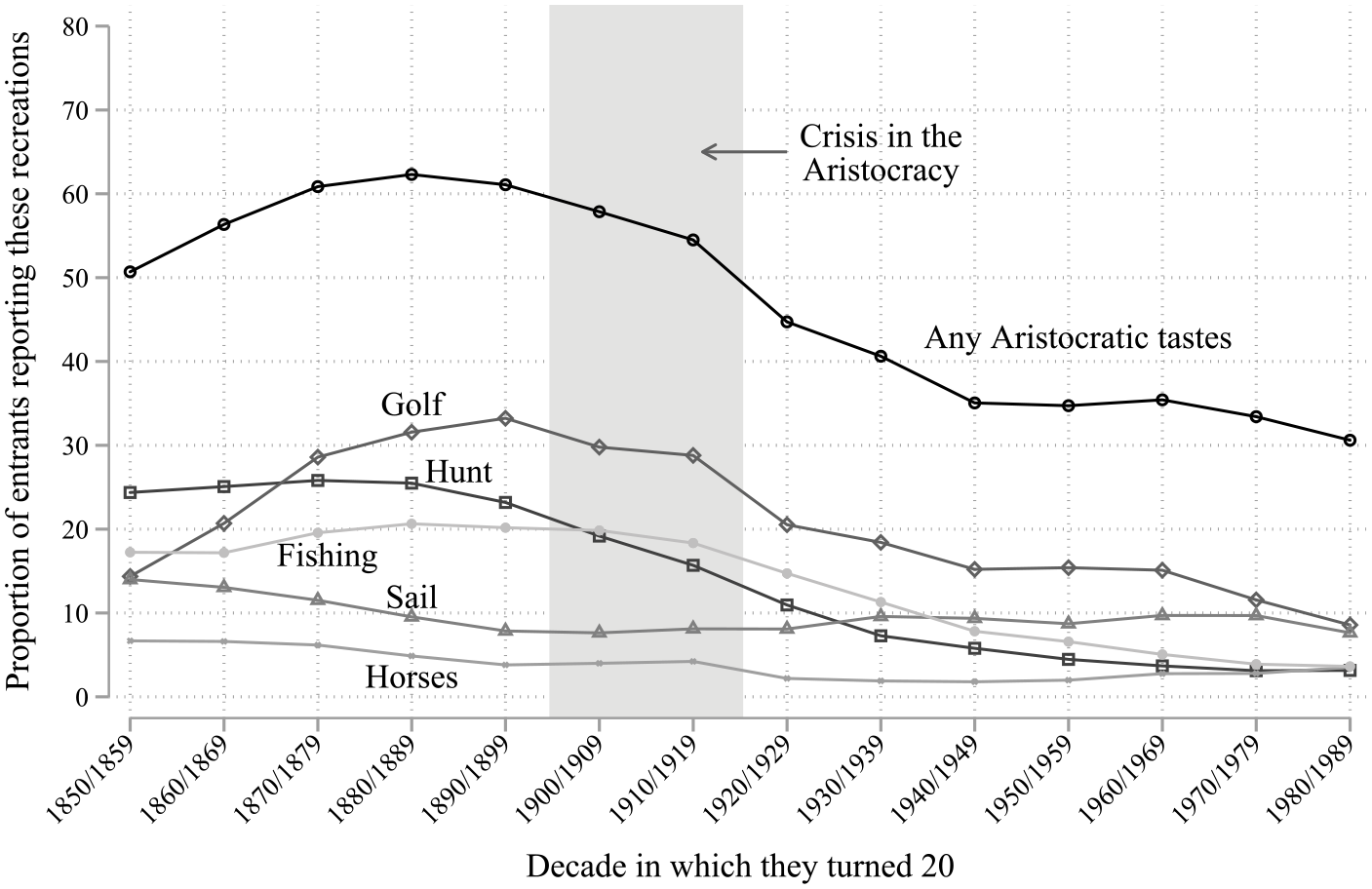
Our analysis explores the changing recreations of Who’s Who entrants transitioning into adulthood between 1850 and 1989. We display entrants’ preferences according to the decades in which they turned 20, as we know that people’s cultural tastes tend to mature and stabilize in early adulthood (ter Bogt et al. 2011; Holbrook and Schindler 1989; Smith 1994). As we will show, we see three major shifts in the contents and dominant mode of elite culture over this time period. First, we observe the initial ascendancy but swift decline of what we call “aristocratic” culture. As Figure 1 shows, early entrants show a high propensity for hunting, shooting, fishing, sailing, yachting, rowing, horse-related activities (e.g., horse riding, horse racing, polo, dressage, eventing), and golf. This reflects the fact that throughout the nineteenth century “[t]he foundations of elite social life were firmly laid in the country” (Henry 2007:320). Dominant groups would congregate at the landscaped estates of the landowning aristocracy and take part in activities like hunting, shooting, and fishing (Cannadine 1999). These activities were also institutionalized via the “Season,” 10 a set of regularized events in the elite social calendar that dominated the leisure time of the aristocracy and the landed gentry (Horn 1992; Scott 1991). Participating in the Season required vast economic resources and therefore throughout most of the nineteenth century these economic barriers ensured that aristocratic practices remained the preserve of the traditional landowning elite.
The Ascendancy and Decline of Aristocratic Culture
But, as Figure 1 shows, at the turn of the century the dominance of this aristocratic culture began to wane. Two processes are central in understanding this decline. First, American (and to a lesser extent British) industrialists, who had amassed fortunes often surpassing even the wealthiest landowners, gradually began to buy their way into high society. They purchased country estates, rented townhouses in central London, acquired the libraries and art collections of bankrupt aristocrats, and married the children of the landed gentry (Rubinstein 1981). Many traditional landowners certainly complained about these parvenus, dismissing them as “social scum and nouveaux riches” (Cannadine 1999). Yet they lacked the means to prevent their gradual infiltration. For example, the proportion of women from outside the landowning classes presented at court 11 grew from 10 percent in 1841 to over 50 percent by the end of the nineteenth century, and by 1914 there were 50 American peeresses, 12 up from four just a few decades earlier (Cannadine 1999).
The nouveaux riches entered aristocratic social circles in part because of their superior wealth. But their ascent was also facilitated by a concomitant process of economic decline among the British aristocracy. From the 1880s onward, a series of economic and social shocks weakened the position of the landed elite, leaving them vulnerable to interlopers and making it harder for them to participate in the Season (Horn 1992). In particular, the cost of labor combined with falling agricultural prices left many of the great estates bankrupt, forcing aristocratic families to sell off large sections of their land (Beckett 1986). 13 The upwardly mobile only deepened this crisis. Very soon after the “foreign” invasion, for example, the popularity of the Season declined precipitously (Scott 1991). The old elite found the extravagance of the arrivistes distasteful, and many parvenus found aristocratic practices “rigid” and “intolerably stuffy” (Cannadine 1999). A reconfiguration of elite social and cultural life began to take place, with the social and cultural centers of Britain moving from the counties to the cities, and London in particular.
The Rise of Highbrow Culture: 1920 to 1950
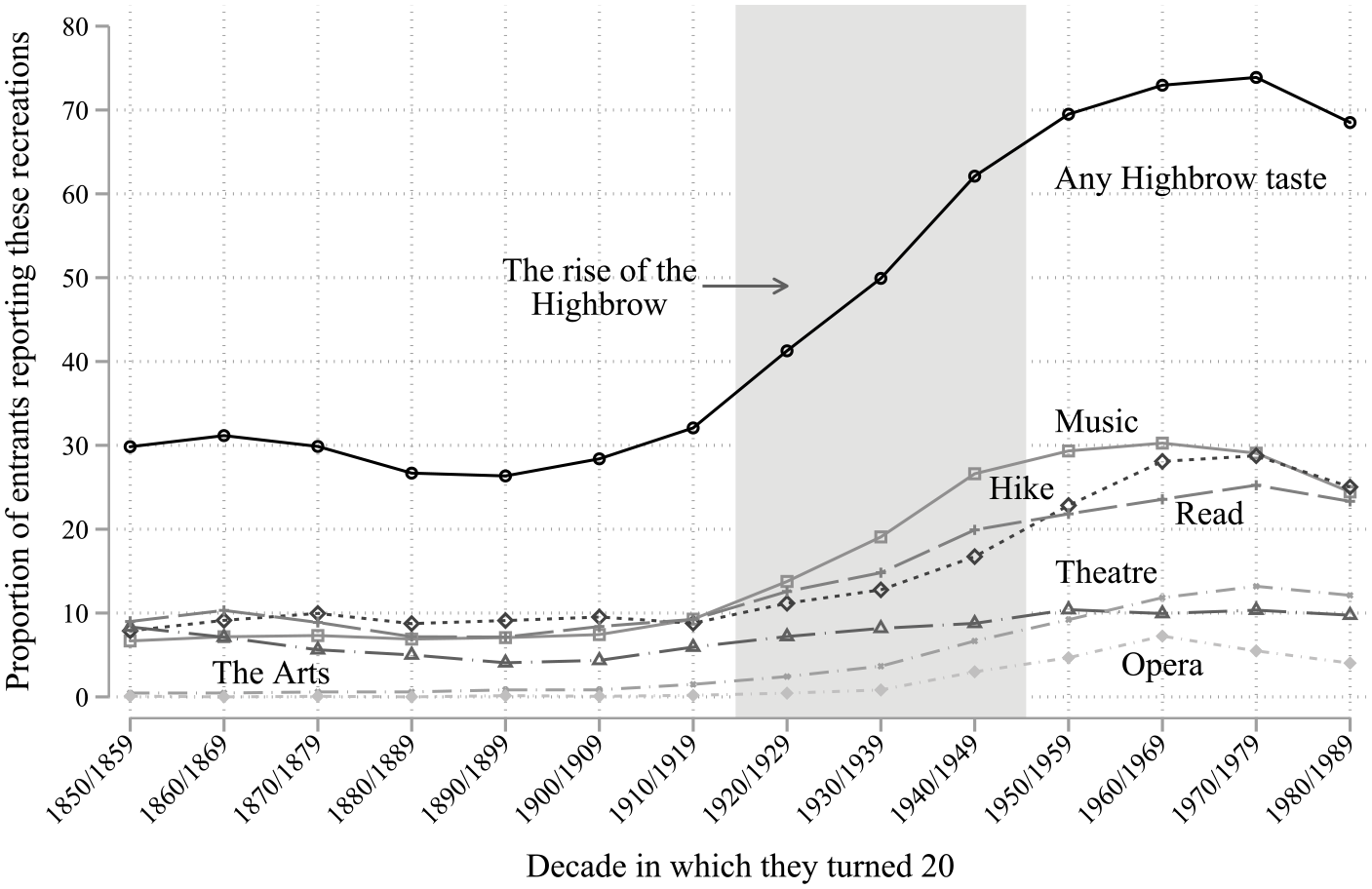
At the turn of the twentieth century, at the same time as the hold of aristocratic culture began to wane, we begin to see in our data the increasing importance of “highbrow” cultural activities. As Figure 2 illustrates, starting around 1920, before slowing down after 1950, we see a marked increase in preferences for theater, classical music, 14 literature, opera, and the arts. Alongside these more formal types of cultural participation, we also see a greater proclivity for certain outdoor recreations, such as hiking.
The Rise of Highbrow Culture
Particularly influential in understanding this shift is a generation born between 1900 and 1929 who were heavily influenced by the Bloomsbury Group, an intellectual collective that came to define a new mode of elite culture (Annan 1991; Griffiths et al. 2008; Savage 2010). Many of this new elite cohort were educated at the same institutions as earlier generations, such as elite public schools and Oxbridge, but they were strongly critical of the “philistinism” 15 of leisured aristocratic culture, where one “plays cricket, is scratch at golf and has a fine seat on a horse” but is also likely to be suspicious of “anyone who knows about art, music or literature” (Annan 1991). Instead, they embraced a set of emerging high and metropolitan cultural forms—abstract art, theater, and ballet—promulgated by prominent Bloomsberries such as Virginia Woolf, 16 D. H. Lawrence, and Roger Fry. As poet Ezra Pound proclaimed in 1918: “the old aristocracies of blood and business are about to be supplanted by the aristocracy of the arts” (Rose 2001:435).
What united these new elite cultural practices was arguably a particular modernist aesthetic premised on a “disinterested” privileging of artistic form over emotional function (Kant [1790] 1987). Highly influential in disseminating this was the philosopher G. E. Moore (1903) and particularly his book Principia Ethica. Moore emphasized the importance of “beauty” in properly realizing “the good life” and came to have a profound influence on the Bloomsberries and other tastemakers (Skidelsky 2013). However, the Bloomsberries were not snobs in the classic exclusionary sense. In fact, their vision was that elite culture should play a “civilizing” role in society. They believed art had the ability to change the human character, but to do so, to bring about human flourishing, people needed to adopt the “right” kind of stance. Under the influence of Moore’s work, the Bloomsberries and others began to institutionalize this vision. In particular, they had an enormous influence on the ethos of a number of emerging cultural institutions. For example, one of the most prominent Bloomsberries, the economist John Maynard Keynes, was the first head of what is now known as the Arts Council (the main public body responsible for administering state funding to the arts). In this role, Keynes reduced support for local cultural activities and argued stridently that “it was standards that mattered” when it came to the state-sponsored promotion of culture 17 (Mulgan 1996; Skidelsky 2013).
The influence of the Bloomsberries can also be seen in the early ethos of the BBC, and particularly its first director, John Reith. Reith explicitly rejected the lowbrow populism of American broadcasting and instead, like Keynes, turned his focus to “standards.” He aired classical music, theater, poetry, 18 and elite sports, while shunning football, and argued that the BBC’s core mission should be to share “all that is best in every department of human knowledge, endeavour and achievement” (Potter 2012:23; see also Mulgan 1996).
This belief in the civilizing force of high culture also informed efforts to standardize educational curricula. By 1950, for example, students were required to pass a humanities subject to receive their School Certificate (the first generalized, pre-university qualification). The humanities had long been valued in elite schools, but this formalized and expanded the importance of certain subjects, such as English literature and art history, and in so doing explicitly connected knowledge of high culture to educational attainment (Elliott 2011; Hewison 1995).
One further striking finding emerges from this highbrow period. Among Who’s Who entrants who turned 20 between 1900 and 1950, the propensity to report one’s recreations increased dramatically, from around 40 percent to about 80 percent of entrants. 19 Clearly, as the institutionalization of highbrow culture gathered pace, so too did the propensity of elites to express their own, increasingly highbrow, tastes in public. 20
The Decline of Deference and the Rise of the Elite Omnivore, 1950 to the Present
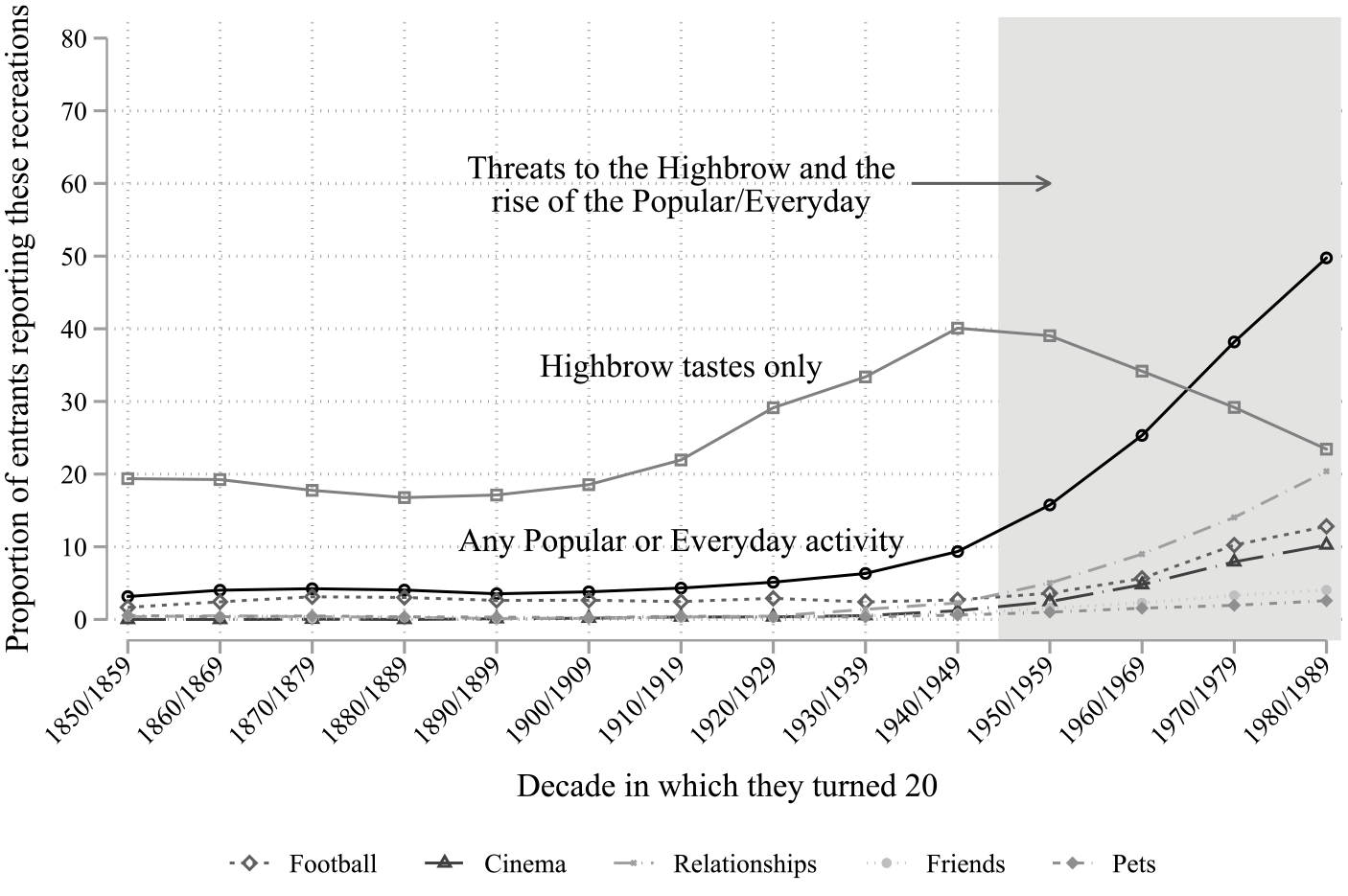
Although highbrow tastes and recreations appear to dominate elite culture in the early to middle part of the twentieth century, our data also show an intriguing break in their supremacy in the 1950s and 1960s. Figure 3, for example, shows that the proportion of entrants who expressed only highbrow recreations began to fall in the 1950s.
The Rise of Popular and Everyday Recreations
Historical accounts emphasize several factors in understanding this decline, including shifts within the cultural and creative industries that initially challenged the disinterested aesthetic and later legitimized certain popular cultural forms (Bauman 2007; Featherstone 2007; Lena 2019; Peterson and Kern 1996; Regev 1994); 21 generational value change that precipitated a decline in snobbery and deference to elites 22 (Morgan 2018; Savage et al. 2015; Sayer 2015); and the emergence of a managerial culture where access to a broad cultural repertoire functioned as a key management tool 23 (DiMaggio 1987; Lizardo 2006; Scott 1991). Certainly, the decline coincided with important shifts within many of the institutions that had previously been so instrumental in generating belief in the supremacy of highbrow culture. The BBC, for example, and to a lesser extent the Arts Council, began to change aesthetic course, increasingly promoting, programming, and funding more popular cultural content (Hewison 1995).
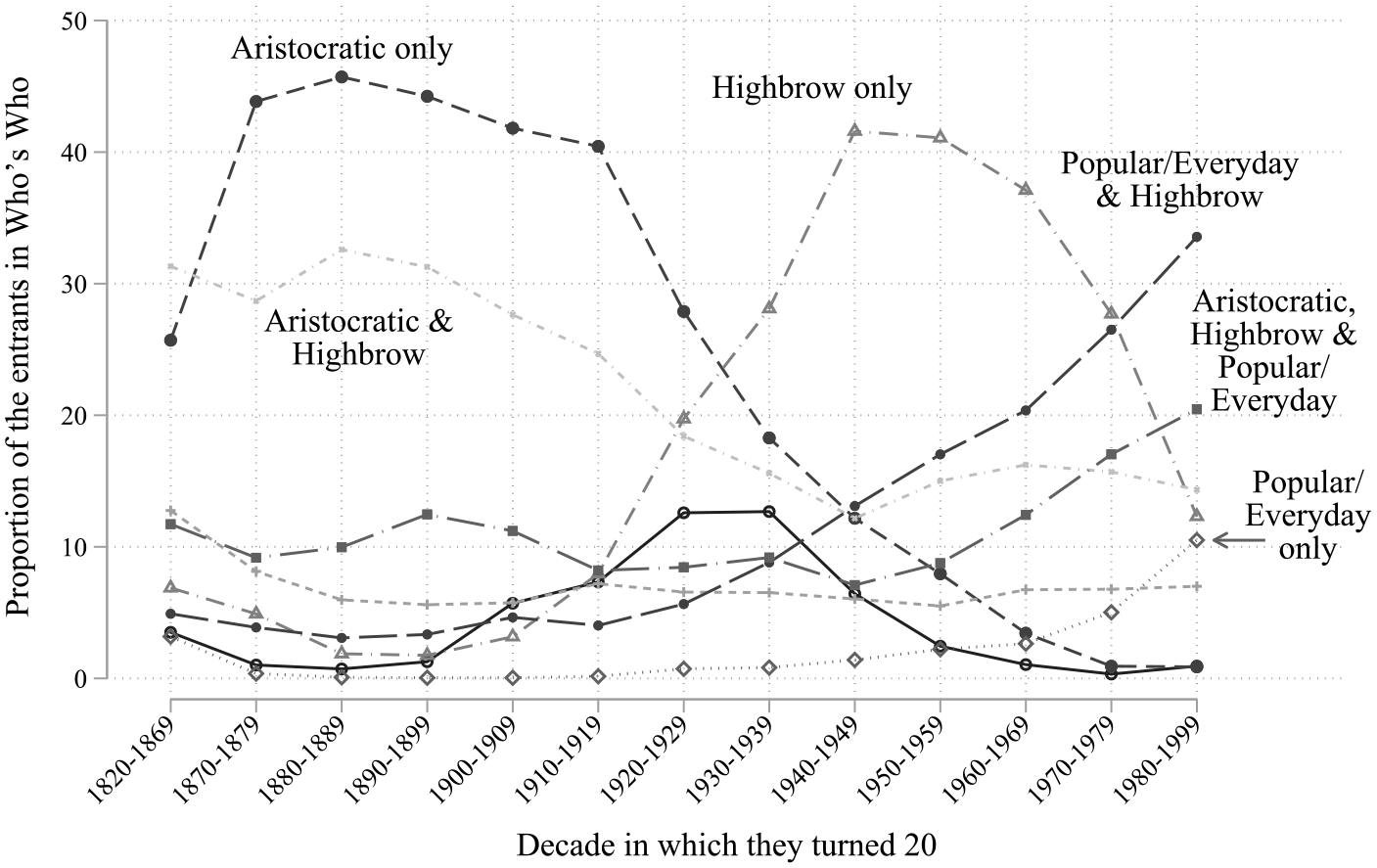
Yet Figure 3 not only details a move away from the dominance of highbrow culture, it also shows, from the 1950s onward, a rise in preferences for more “popular” cultural forms, such as football and cinema, and ordinary or everyday cultural practices, such as spending time with family, friends, and pets. These ordinary recreations may not be superseding more conventional elite pursuits (with the exception of relationships, they are not challenging highbrow activities in terms of popularity), but their significance to our analysis is rooted more in their integration with traditionally dominant modes of elite culture. Figure 4, using the semi-automated content analysis described in the Methods section, shows how emerging modes increasingly involved retaining a penchant for more traditional forms of elite culture and, at the same time, combining these with more popular and ordinary forms. The British elite, in other words, appears to have become increasingly omnivorous over the past 50 years.
The Rise of the Elite Omnivore
Unpacking the Elite Omnivore
The question, of course, is what does this omnivorousness mean for contemporary debates about elite distinction? Although this is difficult to definitively answer with quantitative data, the unique nature of the way recreations are expressed in Who’s Who can provide some clues. In particular, many people in Who’s Who choose to report their recreations in ways that go beyond simply listing types of recreations: they actively “play with the form” of their entry, describing their interests in a knowing, humorous, or slightly ironic way. Salient examples include “sailing, opera, gardening, perfecting espresso coffee” (Professor Azriel Zuckerman, academic), “applying Wittgenstein” (Anthony Ash, senior civil servant), “tennis, guitar, cycling, skipping, herb-surfing, dendron-leaping, portacenare” (Richard Addis, journalist), “loud music, strong cider” (Jonathan Ashley-Smith, senior civil servant), and simply “[the] usual” (Admiral Sir Edward Ashmore, Chief of Naval Staff). Such entries represent subtle acts of distinction, with entrants demonstrating their aesthetic confidence to knowingly play with the form. In Figure 5, using the same semi-automated content analysis described earlier, we estimate the proportion of people in each cohort expressing their recreations in this way over time. Strikingly, such playing with form is largely nonexistent among entrants who came of age before the 1950s, but in more recent cohorts it has become far more common.
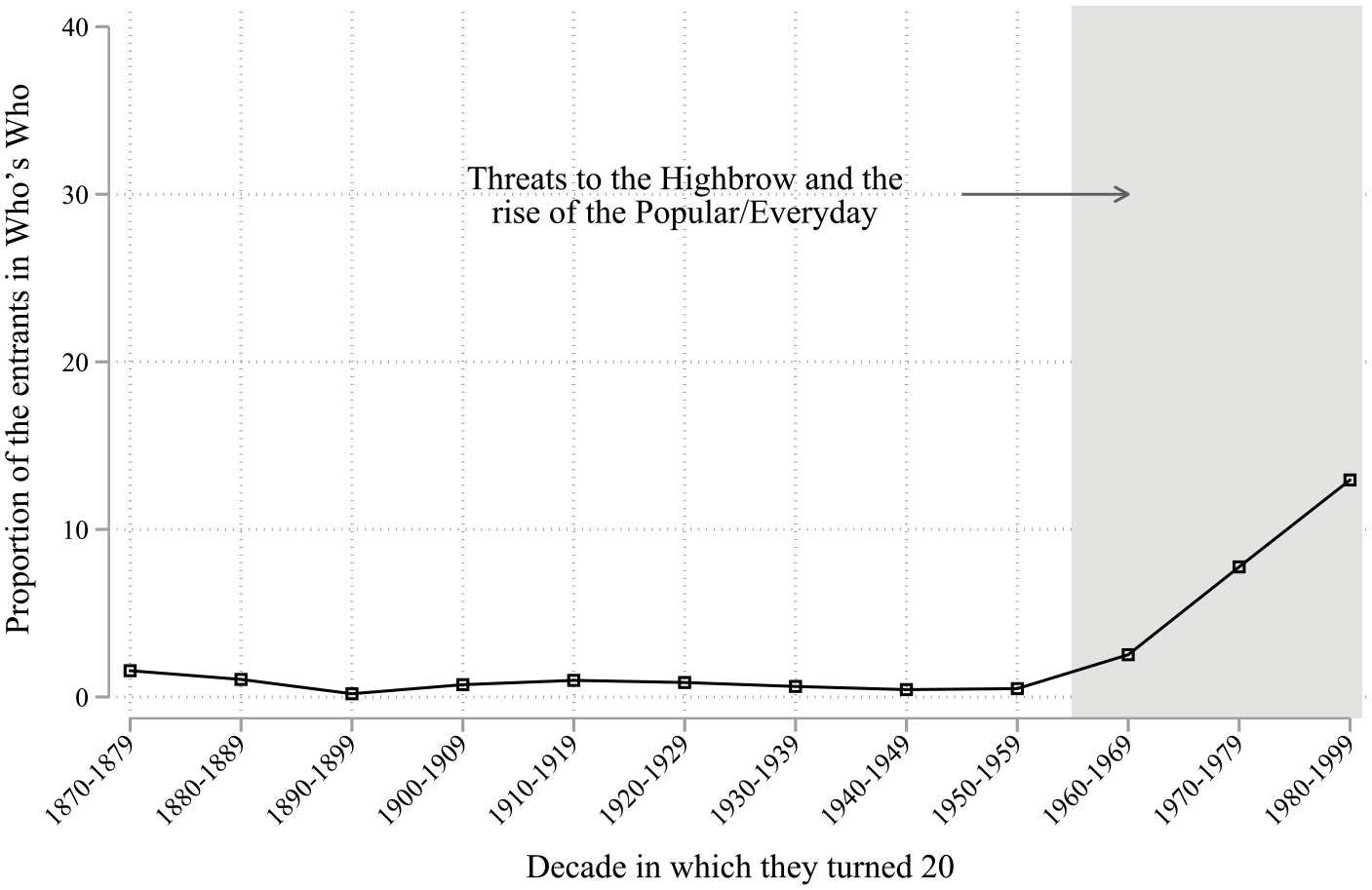
The Rise of Who’s Who Entrants “Playing with Form” in the Recreations Entry
Although significant, this practice is only ever evident among a minority of Who’s Who entrants; the reporting norm remains whole art forms or cultural practices. This makes analysis of omnivorousness difficult. Many cultural forms, such as music, 24 are ambiguous and need further specification to interpret in terms of legitimacy. To address this, we merge Who’s Who with data from Desert Island Discs (described in the Methods section) to provide a more granular analysis of the music tastes of 1,200 Who’s Who entrants. Two findings emerge.
First, we code artists into genres and examine how the songs played on Desert Island Discs changed over time and by birth cohort. This genre-based analysis echoes the trend toward omnivorousness shown in Figure 4. Specifically, the vast majority of entrants play at least one piece of highbrow classical music, but the percentage who play classical music and tracks from less legitimate genres, such as pop, rock, folk, electronic, world, and country, grows significantly over time. For example, among entrants who turned 20 between 1896 and 1939, 10 percent combined classical music with other genres. In contrast, among entrants who turned 20 after the 1960s, over 40 percent combined tracks from classical and more popular genres.
Second, we go further to examine the legitimacy of the popular music being played. Specifically, we examined the critical-acclaim of musical artists by analyzing their average score on the music website Metacritic, which aggregates reviews of albums. Figure 6 shows that the artists played by Who’s Who entrants are consistently more legitimate, in terms of their mean Metacritic score, than the average musical artist. 25 Indeed, they are consistently in the top quartile. This indicates that although contemporary elites may be increasingly integrating popular cultural forms into their cultural repertoires, the individual artists they prefer still tilt toward the legitimate and consecrated.
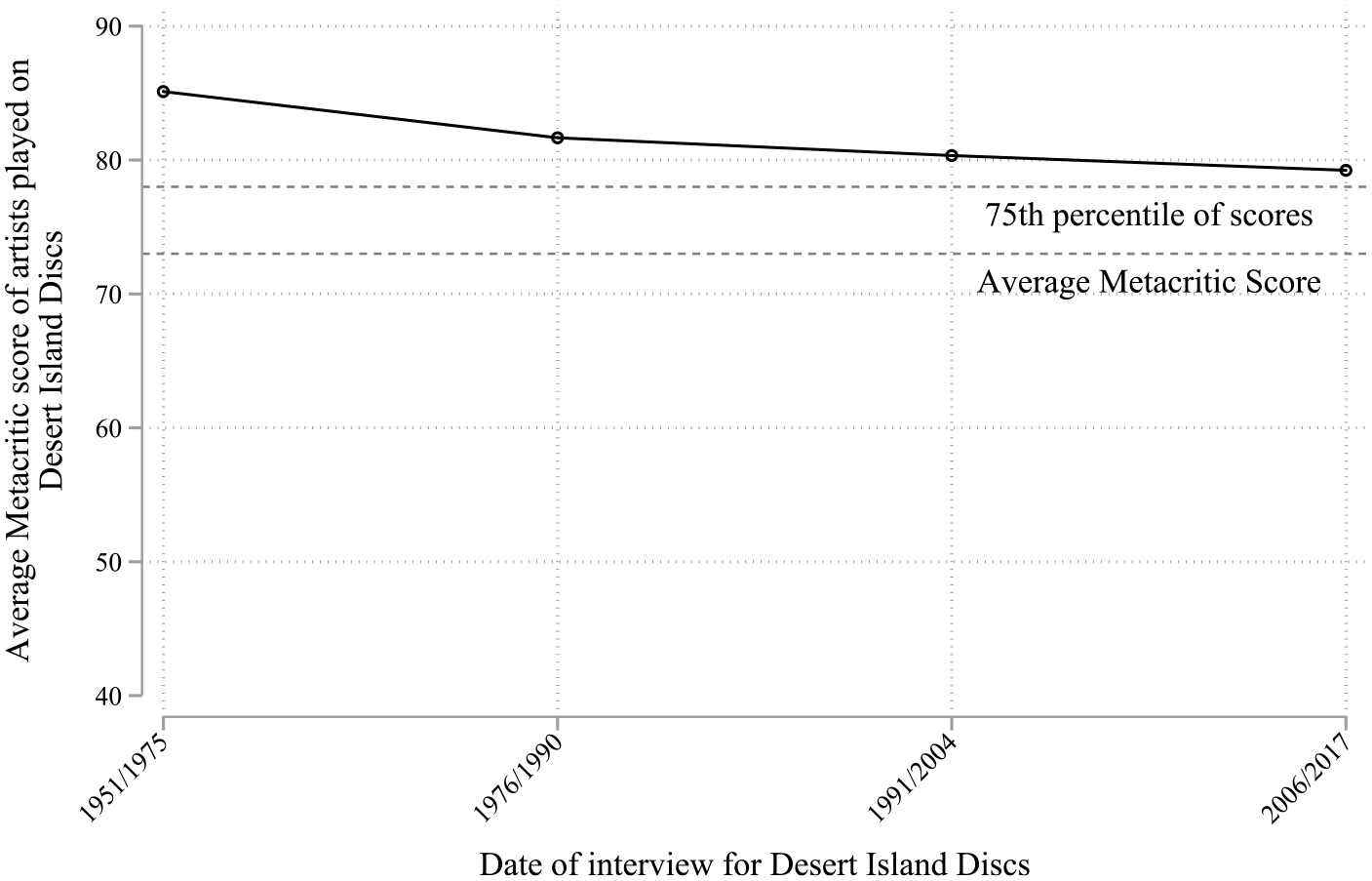
The Critical Acclaim of Music Chosen by Who’s Who Entrants Appearing on Desert Island Discs
The omnivorousness we identify may be partly explained by elites adopting tastes for more legitimate popular artists. However, it is important to recall that many of the non-highbrow recreations that emerge in Figure 3 are not forms of conventional cultural consumption. In fact, most are more ordinary or everyday forms of cultural participation, such as spending time with family, friends, and pets, that are not normally considered in debates about cultural omnivorousness (Miles and Gibson 2017). It is also striking that among the most recent entrants to Who’s Who it is these everyday recreations that are rising most significantly, and much faster than tastes for popular culture. Figure 7 unpacks this rise to look at the role of both cohort and period effects. Two patterns emerge. Younger cohorts are far more likely than older cohorts to report these everyday recreations, but such reporting increases for all cohorts over time—particularly among entrants who were added to Who’s Who after 2000. This suggests the rising expression of these distinctly ordinary recreations is not just about the generation in which elites grew up, but also the distinct period in which they enter Who’s Who and are asked to present their cultural selves in this very public way. Our results thus point to an intriguing period effect in the foregrounding of ordinariness that affects all entrants to Who’s Who from the 1990s onward. 26
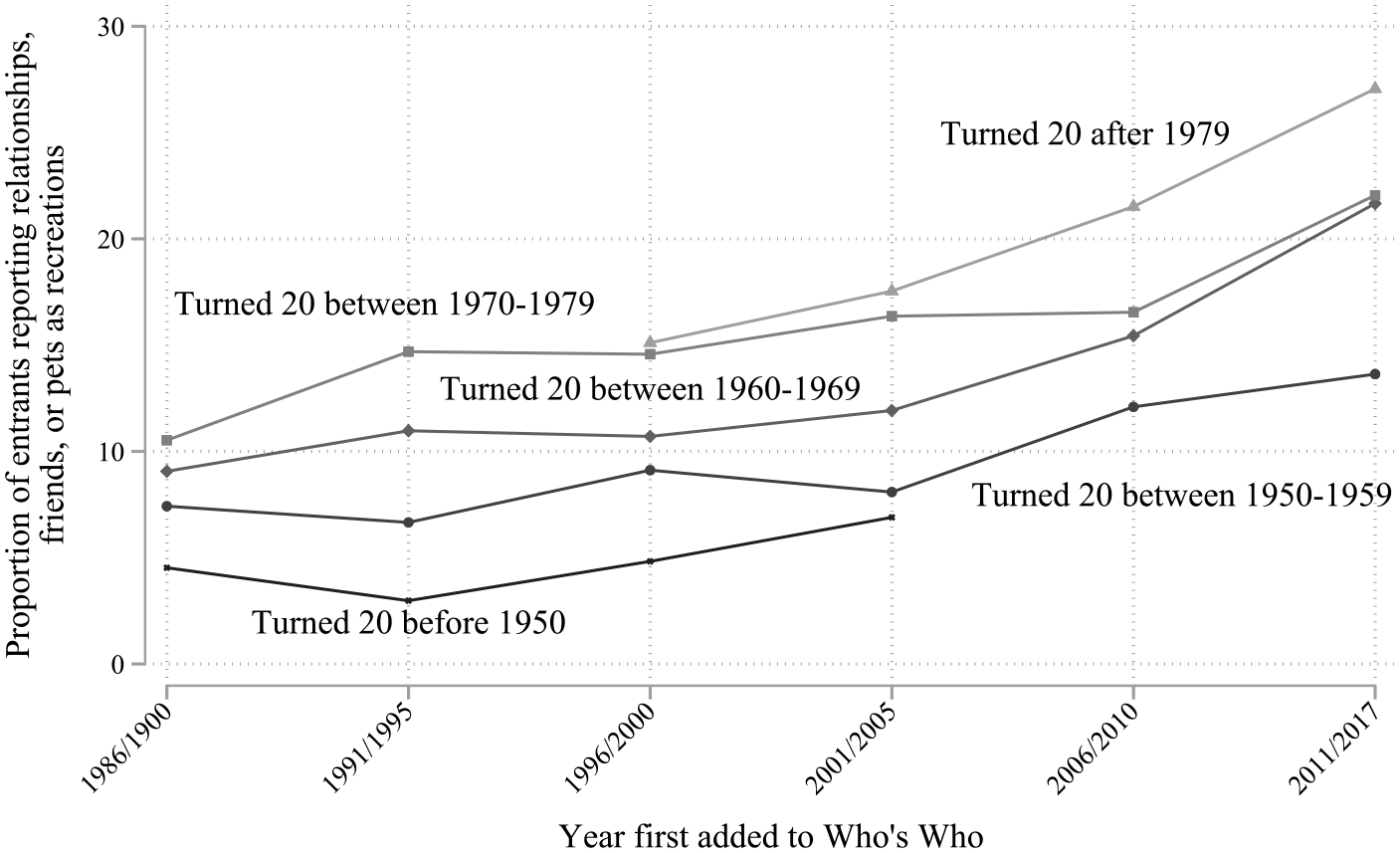
The Rise of Everyday Recreations since 1986
Limitations and Robustness Checks
It is important to acknowledge that our results raise a number of theoretical and methodological questions that our data do not allow us to fully address. First, we lack systematically collected data that would allow us to compare the recreations of Who’s Who entrants to the wider UK population, or to see how this relationship may have changed over time. This has clear implications for discussions about elite distinction, which rest on both the demonstration of class-structured differences in lifestyle as well as evidence that lower social classes emulate, or recognize the value of, elite tastes.
Although data on cultural consumption in the UK before the start of the twenty-first century are rare, here we draw on two studies—carried out at the beginning (Mass Observation 1939) and the end (Young and Willmott 1973) of our second “highbrow” stage of elite culture—to partially address these issues. 27 We then compare these early analyses with two datasets from our third period: Bennett and colleagues’ (2009) mixed-methods study of class and culture and official statistics collected as part of the Taking-Part Survey (Reeves 2015). As Figure 8 shows, throughout much of the twentieth century clear differences exist between the cultural preferences of Who’s Who entrants and other social class groups. In particular, highbrow taste was far more prevalent in Who’s Who than in other groups, including even the professional middle classes (a finding also confirmed by Bennett et al. 2009:251–3). 28
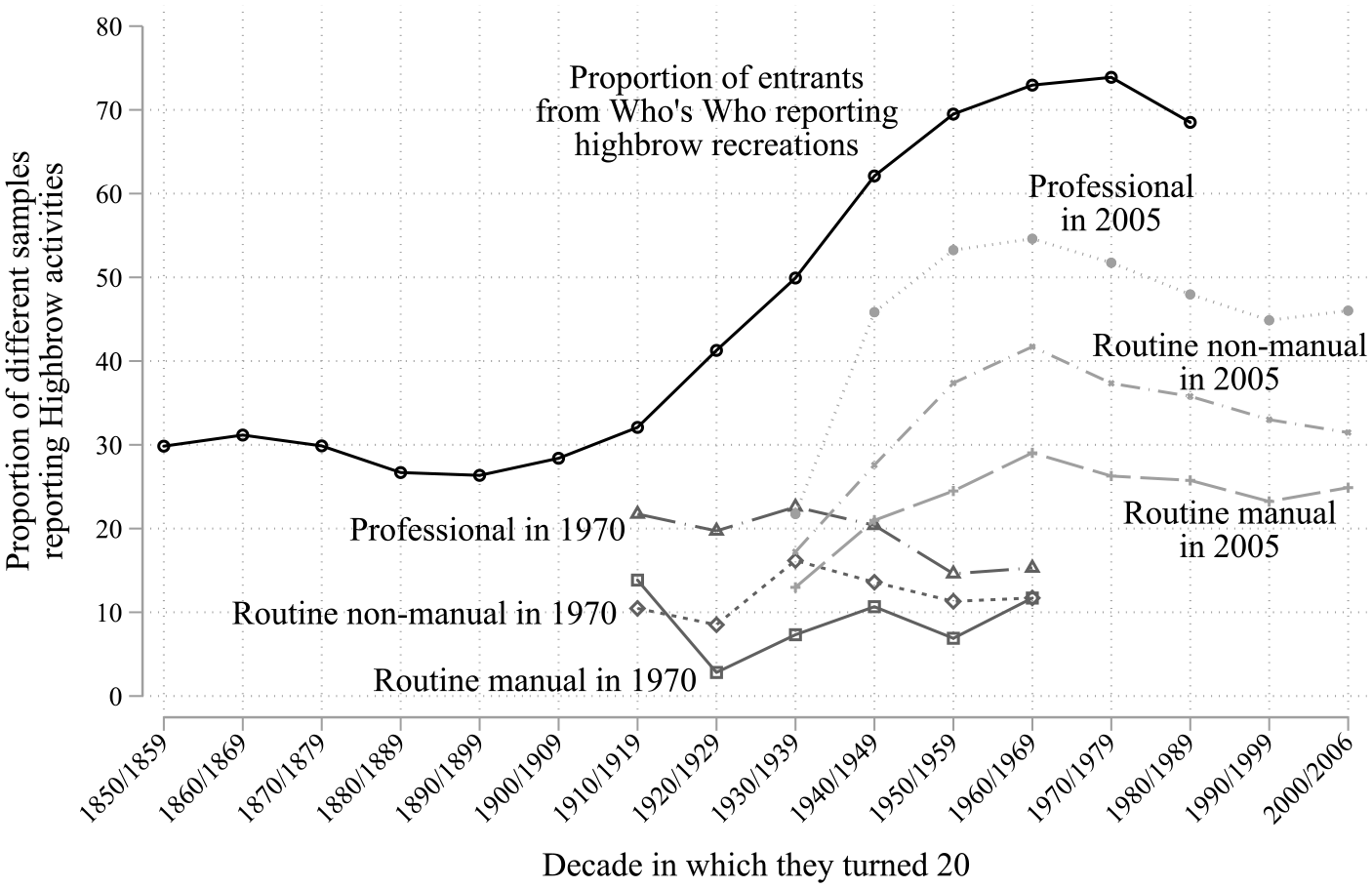
Elite Highbrow Consumption Compared to Other Social Class Groups
The second limitation of our results concerns the possible gap between what elites say they do in a public document like Who’s Who and what they actually do in practice (Jerolmack and Khan 2014). For example, Holmqvist’s (2017) ethnographic work confirms that elites often publicly emphasize investment in friends and family, yet in practice actually spend less time cultivating such relationships, due to busy work schedules and reliance on paid childcare. However, we should reiterate that our primary focus is not so much changes in elite cultural practice but changes in elite cultural distinction; in other words, how elites deploy their recreations in public to signal social position or, in this case, moral legitimacy. In this regard, we believe the public-facing dimension of Who’s Who provides unique insights into the performative dimension of distinction.
Normally, performative or interactional aspects of distinction are thought to be best tapped using ethnographic methods (Jerolmack and Khan 2014). Yet ethnographic observations tend to be rooted in specific sets of interactions between particular people located in particular settings (see, e.g., Khan 2011). What distinguishes our data is that elites are communicating their cultural tastes not to specific interlocutors, with all the contextual idiosyncrasies that flank such interactions, but to an audience of generalized others. This context, we argue, provides an important vantage point from which to understand elite distinction as a communicative process. Specifically, it may compel elites to foreground their “honorable” (Pugh 2013) cultural selves, that is, to curate their recreations in such a way that presents them in an admirable light or “which incorporate and exemplify the official accredited values” (Goffman 1959:19). 29
A third limitation of our analysis is that its focus on all entrants runs the risk of masking recreational heterogeneity within the British elite. Yet, as we explore in Part I of the online supplement, there is a surprising degree of homogeneity across potentially important subsamples. For example, we find only very small differences in cultural practice between individuals who enter Who’s Who by virtue of their position and those who enter through the selection panel, or between those who attended an elite private school and those who did not. There are, however, potentially important differences by occupation. For example, members of the military are consistently more likely to participate in aristocratic practices, whereas people from the cultural industries are much more likely to participate in highbrow activities. Importantly, however, although there are occupational differences in the popularity of cultural modes, the patterns of change between these modes are similar across all fields. Finally, we also see important differences between men and women. Women in earlier cohorts were far less likely to participate in aristocratic activities but were far more likely to participate in highbrow activities. Men eventually catch up with women, but this suggests women may have acted as first-movers in terms of the highbrow mode. 30
These distinct patterns of cultural practice among certain social groups suggest that the rise and fall of different modes of elite culture may be connected to changes in the social composition of Who’s Who. We examine this in Part J of the online supplement. First, we conducted a matching analysis, using coarsened exact matching, to identify a subset of people in Who’s Who that possess a similar set of characteristics across different cohorts; we then reweighted these matched groups to smooth differences in the size of the groups over time. Following the patterns of heterogeneity mentioned earlier, we matched on gender, social origin occupation, selection type, and a range of other variables (for more details, see Part J of the online supplement). Second, we conducted a counterfactual analysis that focuses more precisely on changes in occupational structure by estimating what the recreations of those in Who’s Who would have been had the amount of entrants from different occupational fields remained unchanged (see Part C of the online supplement). Reassuringly, both the matching and counterfactual analyses indicate that accounting for changes in the composition of Who’s Who over time leads to only very minor differences in our results.
Finally, Who’s Who only details entrants’ recreations in the last year they provided data, and therefore it may neglect changes in taste that occurred over the life course. To partially address this uncertainty, we explore the degree to which recreation entries changed over time by hand-coding the recreations data for 1,761 records that were included in both the 1988 and 2016 versions of Who’s Who. As shown in Part K of the online supplement, there is little change in the recreations reported by individuals over time, suggesting tastes largely stabilize by this point in the life course, and so any bias introduced by this aspect of the data is negligible. 31
Discussion
In this study, we have used a combination of dictionary methods and computational text analysis to examine patterns of elite cultural consumption over time. These methods are not unusual in sociology, but they have only rarely been used to analyze historical sources containing unstructured text. In this way, we hope our analysis may act as a blueprint for researchers interested in interrogating the multitude of other unstructured historical documents where elites may have left distinct textual traces (Khan 2012b). We believe such methodological tools may also be useful to cultural consumption scholars, who have hitherto largely relied on survey or interview data to uncover patterns of practice. Here we hope our use of Who’s Who illustrates the gains that flow from investigating more fine-grained sources that are now more accessible in the digital era. Not only can such sources help fill empirical gaps in our understanding of the tastes of specific groups, such as elites, but they may also begin to shed light, as we do here, on the elusive but pivotal “display” dimensions of cultural distinction.
Our results reveal three distinct stages of elite culture in the UK over the past 120 years. First, we see a dominant mode of aristocratic practice forged around the leisure possibilities afforded by landed estates (e.g., shooting, hunting, horse riding, polo, sailing), but which waned significantly in the late nineteenth century. Second, we find a highbrow culture dominated by the fine arts (opera, classical music, theater, literature) that increased sharply in the early twentieth century before beginning to gently recede in the most recent cohorts. Third, we find a contemporary mode increasingly characterized by the blending of aristocratic and particularly highbrow pursuits with more everyday forms of cultural participation. These shifts not only suggest important changes in the nature and content of elite culture but they also chart, as we go on to argue here, important shifts in the nature of elite distinction.
Why History Matters for Elite Distinction
Two theoretical concepts dominate sociological analysis of elite distinction: emulation and (mis)recognition. In this article, rather than adjudicate between these approaches, we show that both have operated in the UK context. To understand this we argue that history is key. Although both concepts were purported, by their architects Veblen and Bourdieu, to transcend time and space, our analysis indicates that their capacity to explain the sociological significance of elite recreations in a UK context depends very clearly on the temporal period being examined.
At the end of the nineteenth century, when our analysis begins, elites exercised distinction via the practice of an overtly aristocratic mode. Key to this was the scarcity of such recreations, whereby strong economic barriers to entry endowed activities like hunting or polo with a sense of rarity that set elites apart and acted as grounds on which they enacted social closure. At the same time, notions of ascribed class position prevailed in Britain, with the aristocratic elite enjoying a widespread, although not complete, deference in the eyes of other social groups 32 (Cannadine 1999; Scott 1991). Entry to elite circles in the first period of our analysis, then, largely rested on what Veblen called “pecuniary emulation,” that is, one’s economic capacity to take part in, and ape, the cultural practices of existing elites. Yet this model of elite distinction, premised on exclusivity and deference, was threatened by the wide-scale influx of nouveau riche industrialists at the end of the nineteenth century. Many traditional landowners resented these parvenus, but there was no formal way to exclude them. Economic capital was the only real barrier to entry, and with the landed estates increasingly struggling economically, the old aristocratic elite lacked the economic means to enact the kind of “invidious distinction” documented by Veblen in the nineteenth-century United States.
What followed this decline was not just a new elite culture but also a new mode of elite distinction. To understand the strong rise in preferences for high culture in the early twentieth century, it is thus imperative to consider the processes of legitimation, institutionalization, and ultimately (mis)recognition that flanked the adoption of this highbrow mode (Levine 1988). This is not to say there was not some (mis)recognition of aristocratic culture, or that highbrow culture did not feature at all in the lifestyles of earlier elites. But what is distinct about this period were the concerted efforts of a distinct set of elites, operating in the fields of politics, education, and the cultural industries, who not only acted as early adopters and first movers 33 in relation to this new, more joined-up, highbrow cultural repertoire but were also central in institutionalizing its value, 34 establishing the Arts Council (Upchurch 2004), 35 consecrating high culture through the education system, 36 and acting as tastemaking cultural intermediaries 37 —critics, journalists, publishers, scouts, agents, marketers, and so on—invested with the ability, through newspaper reviews and awards, to control the public discourse on culture (English 2008). 38
The point to underline here is that together these agents of legitimation were successful in producing an unprecedented (mis)recognition of the inherent value of highbrow elite culture. 39 It is also telling that this move toward a distinctly highbrow elite culture dovetailed with a marked increase in the proclivity of elites to report their recreations in Who’s Who. As the legitimacy of elite culture grew, it became more important to the way elites presented their biographies in public.
By combining our results with a range of historical sources it is therefore possible to discern elite distinction based on both emulation and (mis)recognition at different points in recent British history. It is also worth noting that the periods in which each of these models dominated coincide with the periods in which Veblen and Bourdieu staged their own interventions. In this way, our analysis not only underlines the importance of history for understanding elite distinction, but it more broadly stresses the importance of considering the historical context from which theoretical concepts emerge.
Toward a Contemporary Theory of “Ordinary” Elite Distinction
Although we find evidence of both emulation and (mis)recognition at different points in the twentieth century, which is more useful for understanding the contemporary recreations of the British elite? Here we would begin by acknowledging that we detect at least a residue of both theoretical modes today. For example, aristocratic recreations continue to be practiced by nearly 40 percent of current Who’s Who entrants (see Figure 1), and an enduring nostalgia and reverence for the leisured aristocracy, and the attendant “gentry aesthetic,” remains strong in sections of the British population (Smith 2016).
Having said this, we would argue that (mis)recognition remains the more useful of the two models for understanding contemporary modes of elite distinction. At first glance this may seem at odds with our findings, particularly the gentle decline in highbrow recreations we observe among individuals coming of age from the 1950s onward, and the concomitant rise in more popular and everyday forms of cultural participation. This of course connects strongly with a wider literature on the rise of the “cultural omnivore” (Peterson and Kern 1996; Peterson and Simkus 1992) and the argument that such eclecticism threatens Bourdieusian processes of (mis)recognition (Chan 2019; Erickson 1996; Warde and Gayo-Cal 2009).
Yet many other scholars have refuted that the cultural omnivore is constitutive of a pluralist shift in cultural consumption. As Lizardo and Skiles (2012) forcefully argue, omnivorous consumption of popular culture is entirely compatible with a Bourdieusian framework, as in most cases the actual mode of consumption simply represents the transposability of the aesthetic disposition to cultural objects not originally produced with an aesthetic intention (see also Jarness 2015), or a highly selective consumption of “quality” popular culture (Bauman 2007; Entwistle and Rocamora 2006; Johnston and Baumann 2009; Kuipers 2015; Regev 1994; Skeggs et al. 2008).
One theme that emerges from this literature, however, is that the aesthetic mode of cultural distinction may be changing. Whereas the traditional aesthetic disposition—notably through the model of the Kantian aesthetic—celebrates withdrawal, distance, and discernment, and classically places audiences in a relatively passive and distant position, emerging modes of consuming popular culture often use a more performative, knowing expression of cultural aptitude—an aesthetic of engagement, exhibition, and ease rather than absorption and introspection (Hanquinet et al. 2014). (Mis)recognition, in other words, may still be taking place, but it now rests on conceptions of legitimacy that have been extended to many popular cultural objects and artists, and new “ways of seeing.”
Our results compel us more toward this interpretation. In particular, we see the apparent omnivorousness of elites not so much as evidence of the dissolution of cultural boundaries but of two quite different processes. First, we see evidence of the kind of “knowing” orientation to culture. As Figure 5 shows, we see a marked increase in the number of entrants “playing with the form” of the recreations’ entry, using humor and wordplay. This may partly reflect broader cultural shifts toward self-expression and individualism (Buchmann and Eisner 1997; De Keere 2014), but we read it more as an example of the transposal of the aesthetic disposition—a self-conscious and knowing attempt to distance oneself from highbrow modes of distinction-signaling, yet still conducted to showcase a certain aesthetic ease (Khan 2011). Second, we find that legitimacy still plays an important role in understanding the popular preferences of elites. By connecting Who’s Who entrants to their more granular musical preferences, as expressed on Desert Island Discs, we see that their tastes are significantly more consecrated than the average pop artist. This suggests further support for the argument that contemporary elites continue to pursue distinction via careful expression of the “right” cultural tastes.
Yet although we interpret contemporary British elites as distinction-seeking, we also follow the recent work of Hahl and colleagues (2017) in arguing that contemporary expressions of elite cultural identity fulfill another function: authenticity-seeking. Hahl and colleagues make this argument in relation to elite cultural tastes that are not necessarily legitimate but are considered to be produced with an intrinsic, and therefore authentic, motivation. We extend this beyond popular culture to show its relevance to a wider set of everyday cultural preferences—most notably spending time with friends, family, and pets. Such everyday cultural participation is almost always absent from cultural consumption survey data, yet as illustrated in Sherman’s (2017) ethnographic work, it is pivotal to provide a richer, more complete understanding of elite lifestyles (or, in this case, how elites wish to present them in public).
The everyday recreations we identify here also share important properties with the popular culture analyzed by Hahl and colleagues (2017). In particular, they are activities widely perceived to be prosocial, pursued for intrinsic rather than extrinsic rewards, and not associated with the highbrow aesthetics synonymous with Bourdieusian processes of (mis)recognition. We thus argue that elites’ increasing proclivity to register these everyday recreations in public represents another means through which they seek to establish their authenticity, normality, and ordinariness (Savage et al. 2015; Sherman 2018), and ward off moral suspicions that their highbrow or aristocratic tastes may position them as snobbish, status-seeking, and aloof. 40
We would thus summarize the contemporary mode of “ordinary elite distinction” in the following way. First, it relies on the public display of some cultural forms, objects, artists, or recreations that are (mis)recognized as legitimate. However, such legitimate preferences are rarely articulated in isolation. In fact, they are knowingly positioned alongside more everyday cultural practices that are largely unrelated to hierarchies of legitimacy. This combination, however, is distinct from dominant interpretations of cultural omnivorousness, which tend to posit such blending as indicating either a dissolution of cultural boundaries or the transposal of the aesthetic disposition. Instead, we argue that the expression of everyday cultural preferences performs an important signaling function for elites. This is partly, as Hahl and colleagues (2017), Ljunggren (2017), and Sherman (2017) note, about establishing individual moral worth and plugging an authenticity-insecurity that elites feel vis a vis the wider public. Yet we would extend this to argue that the pursuit of such authenticity is still ultimately connected to securing distinction. As many studies demonstrate, non-elites, and working-class groups in particular, often distinguish between elites whom they see as “decent” and “accommodating towards others” and elites they see as “snobbish” and “look down on others,” with the former clearly valued over the latter (Friedman 2014; Jarness 2015; McKenzie 2015).
It is thus not so much that elites are viewed with suspicion because they are elite; rather, it is their perceived smugness, elitism, and contemptuousness that rouses negative reactions. In this way, it is possible to see the public expression of everyday preferences as a means of accentuating cultural connection and ordinariness while retaining the cultural differences traditionally tied to elite distinction. In other words, the careful manufacture of ordinary self-presentation is effective in securing distinction because it means actual cultural boundaries between elites and others—as well as the potential privileges and advantages that accrue from practicing lifestyles that continue to be (mis)recognized as legitimate—are not questioned, as individuals in lower class positions no longer see the highbrow elements of the elite taste palette as status-seeking (Jarness and Friedman 2017). This is what Bourdieu (1991:68) called “strategies of condescension”: in downplaying difference, elites can “derive profit from the objective relations of power” in the very act of obfuscating the relation.
One additional point is worth making. Our analysis indicates that the rise of ordinary elite distinction—marked by the twin pursuits of distinction and ordinariness—is most clear cut from the 1990s onward. This coincides neatly with the pulling away of the top 1 percent of the income distribution in Britain, which continued to rise following the more general increase in inequality through the 1980s (Piketty 2014). Of course, this is only an association and it is unlikely that all entrants in Who’s Who are members of the 1 percent. Yet we would speculate that these patterns may be plausibly connected. Put simply, as elites have pulled away economically from other social groups, there is evidence that they have become increasingly insecure about their moral legitimacy, and increasingly sensitive to public concern that they are only motivated by extrinsic rewards (Hecht 2017; Sherman 2018). In this context, the connotations of ordinariness that accompany practices such as spending time with family, friends, and pets may act as an effective means to shore up moral legitimacy and signal authenticity in an era of rising inequality.
Supplemental Material
Friedman_online_supplement_ – Supplemental material for From Aristocratic to Ordinary: Shifting Modes of Elite Distinction
Supplemental material, Friedman_online_supplement_ for From Aristocratic to Ordinary: Shifting Modes of Elite Distinction by Sam Friedman and Aaron Reeves in American Sociological Review
Footnotes
Acknowledgements
The authors would like to thank Dave O’Brien, Maren Toft, Charles Rahal, and Mike Savage for their useful comments on early drafts of this paper. We would also like to thank Rachel Pye for her research assistance in constructing Part K of the online supplement.
Authors’ Note
Sam Friedman and Aaron Reeves are joint lead authors of this article and both contributed equally.
Funding
Part of this research was funded by a European Research Council project (CHANGINGELITES 849960) and we would like to gratefully acknowledge the support of this grant.

Notes
References
Supplementary Material
Please find the following supplemental material available below.
For Open Access articles published under a Creative Commons License, all supplemental material carries the same license as the article it is associated with.
For non-Open Access articles published, all supplemental material carries a non-exclusive license, and permission requests for re-use of supplemental material or any part of supplemental material shall be sent directly to the copyright owner as specified in the copyright notice associated with the article.
