




Abstract
This study focuses on the political attitudes of UK citizens in the aftermath of the ‘Brexit’ vote. It has been argued that differences within electorates across Europe are found in disputes over taxes, redistribution of wealth and social welfare, as much as in divergent ideas on how to deal with globalisation, migration, and climate change. This article uses the 2016–2017 round of the European Social Survey (N = 1959) to shed light on two important issues in regard to the relationship between ‘old’ and ‘new’ politics. By using multiple correspondence analysis, we first consider the structure, or dimensionality, of the space of political attitudes in contemporary UK society. Contrary to a prevailing discourse that forwards the argument that postmaterial values constitute an altogether separate political dimension in late modernity, we observe that such values collapse into traditional left/right standpoints. Second, we discuss the connection between class (economic capital, cultural capital, and occupational class) and position-takings in the space of political attitudes. We show that class retains a limited effect on political position-takings, where educational capital plays the most important role. The divisions between the politically interested–uninterested, old–young, men–women, and rural–urban are more clearly demarcated than differences between people of different social class positions. Furthermore, polarisation is most prevalent between a highly opinionated, relatively resourceful, small minority of the population.
Keywords
Introduction
This article analyses political attitudes after the UK referendum on whether the UK should leave or stay within the European Union, held in June 2016. The final votes recorded were 17,410,742 (51.9%) to leave, versus 16,141,241 (48.1%) to remain (The Electoral Commission). The campaign leading up to and the pursuing polarising rhetoric in the aftermath of the referendum may be viewed as the epitome of the ‘postmaterial’ turn in contemporary Western politics, where issues on (national) identity, immigration, climate change, and lifestyle take centre stage.
The focus of this article is not on the outcomes and/or negotiations of Brexit, rather, its focus is on the dividing lines in the political attitudes of the UK citizenry in the aftermath of the ‘Brexit’ referendum. Indeed, it has been argued for some time that differences within electorates across Europe are found as much in disputes over taxes, redistribution of wealth, and social welfare, as in divergent ideas on how to deal with globalisation, migration, and climate change. While clashes in the political landscape are still found at the left–right divide, in late modernity we have also witnessed battles of a new kind. These have been termed postmaterial (Habermas, 1981; Inglehart, 1977), authoritarian-libertarian (Flanagan and Lee 2003; Kitschelt, 1994), and GAL-TAN (Green, Alternative, Libertarian versus Traditional, Authoritarian and Nationalist) (Hooghe et al., 2002).
To promote a deeper understanding of the UK political landscape after the Brexit vote and to understand the relation between ‘old’ and ‘new’ politics, we study the make-up of the space of political attitudes, as manifested in the aftermath of the ‘Brexit’ referendum, and how different segments of the electorate oriented in this space. We draw on the 2016–2017 European Social Survey (ESS), which provides a representative sample of the British population (N = 1959) to answer two research questions that relate to key debates in contemporary sociology. First, we ask: What is the dimensionality of the space of political attitudes? We explore this via an exploratory, Bourdieu-inspired analysis. Second, we ask: What is the class related nature of political dividing lines in UK society? Indeed, the question regarding class and political behaviour is a contested one. Our approach allows us to study how people with different occupations, educational levels, and incomes, along with other demographics, orient themselves in the space of political attitudes.
Although some qualitative research has been conducted on the political landscape in the era of Brexit using a Bourdieusian analysis (e.g. Mckenzie, 2017), little by way of quantitative research drawing on a Bourdieusian framework has been done. We seek to contribute by capturing key attitudes of a representative sample of the British population in the period of Brexit negotiations.
New politics and class
We refer to the ‘new politics’ here as the GAL-TAN dimension (Bakker et al., 2015; Hooghe et al., 2002), which is an expression of the social values and attitudes rooted in the notion of postmaterial politics, referring to issues outside of, strictly speaking, economic concerns, for example, wages and material wealth. GAL-TAN refers to a politics more broadly conceived than those pertaining to economic issues, it is concerned with what Giddens (1994) refers to as ‘life politics’. This includes attitudes oriented towards conserving what are perceived to be traditional values around, for instance, the nuclear family, control on immigration and the preservation/protection of national sovereignty. In the era of Brexit, the UK makes for an interesting case to explore how the left–right and GAL-TAN dimensions relate to each other, especially when there have been new populist mobilisations; key examples include the campaign group, Momentum on the political left, affiliated to the Labour Party, and the Brexit Party, on the political right.
While social class has played an important and contentious role in terms of the formation of political attitudes (Lipset, 1960), it has been argued that it stops short at explaining how the people in advanced industrial societies manoeuvre in the social world in late modernity (Beck and Beck-Gernsheim, 2002; Inglehart, 1997). Others, however, have empirically shown that class continues to shape people’s political orientations (Evans and Tilley, 2017; Stubager, 2008, 2009). The educational and occupational advantages among liberal individuals, compared with the generally less educated and more precarious authoritarianists, suggest not only that we are face-to-face with severe cleavages in society. They also suggest that class, as measured with educational and income levels as well as occupation, remains an important basis from which people form political attitudes (ibid). Besides the observed importance of occupation and educational levels (Evans and Tilley, 2017), researchers in the Bourdieusian tradition have shown that class, both in terms of capital volume and composition, connects to political attitudes (Flemmen and Haakestad, 2018; Harrits, 2013).
Notwithstanding the contested notions of the explanatory power of class, there is still ambiguity regarding how ‘new’ political attitudes relate to the traditional left-right attitudes. Some have argued that the GAL-TAN dimension should be understood as altogether separate from the left–right scale (Hooghe et al., 2002; Surridge, 2018). Others contend that the old and the new political disputes conflate – for instance, by observing that attitudes towards immigration and transnational governance are embedded in the left–right conflict (Evans and Tilley, 2017). Ultimately, this is an empirical question regarding the dimensionality of what we, following Harrits et al. (2010), refer to as the space of political attitudes. Following a similar line of reasoning and concerns Wheatly et al. (2014) have illustrated the merits of exploratory statistical methods when attempting to map the contemporary terrain of political attitudes. Do values connected to the ‘old’ and ‘new’ politics belong in altogether separate attitudinal constellations? How do people with different class positions relate to these set of attitudes?
In relation to these questions the Bourdieusian framework has two, interrelated, merits. First, it forwards a theory on how class – understood as an internalised and pre-reflexive set of dispositions formed by conditions of existence (access to resources and socialisation in various fields) – produces tastes and opinions that connect to particular classes of people (Bourdieu, 1984). Bourdieu famously put his theory to use in Distinction (1984), where a vast amount of lifestyle attributes were mapped onto a ‘social space’ describing peoples’ various forms of capital, and also, in additional analyses, where such social resources were traced on spaces mapping lifestyle constellations. While primarily concerned with cultural consumption, Bourdieu argued that both the strength and contents of one’s political opinions can be traced back to one’s class. The ‘ability to produce an opinion’ is connected to volume of capital (ibid; Enelo, 2012). One may thus expect more affluent segments of the population to be overall more opinionated on policy statements than people lacking capital. As for the contents of one’s opinion the prominence of so-called GAL-orientations among more well-off segments of the population may be viewed as the extension of their ‘distance from necessity’ (Bourdieu, 1984) and cosmopolitan tastes and lifestyles (Prieur and Savage, 2011). Conversely, perceived threats of globalisation and immigration may reflect a ‘taste for the necessary’ commonly found in less well-off factions of society – the so-called ‘losers of globalisation’ (Hobolt, 2016: 1265). Furthermore, underprivileged groups may be attracted to populist right-wing, nostalgia, and anti-establishment values and policy because they envision a distance from a ‘corrupt or incompetent political elite’ (Gidron and Hall, 2017: 59). Their support for anti-immigration and anti-EU policy may be understood as a strategy to take back their lost or repressed social status in post-industrial and globalised modernity (ibid).
Second, the Bourdieusian framework provides the methodological tools to study the relation between values, opinions, tastes, and so on, and class in an exploratory and relational manner via multiple correspondence analysis (MCA). A Bourdieusian approach provides a powerful yet under-utilised framework when it comes to studying the complex political landscape and the class-related attitudinal differences in UK society. Harrits (2013) has argued that ‘empirical analyses of class relations and political practices in a Bourdieusian perspective are almost non-existent’ (p. 173). Bourdieu-inspired sociologists have mostly been occupied with the realm of culture and consumption, not politics. Thanks to the upsurge of MCA in sociology over the recent years, as noted by Savage and Silva (2013), this trend has, however, started to retract. Enelo (2012), Harrits et al. (2010), Harrits (2013), Flemmen (2014), and Flemmen and Haakestad (2018) have illustrated the importance of both economic and cultural capital in the Danish, Norwegian, and Swedish political spaces, respectively. These studies found that the left–right and postmaterial values constitute two separate attitudinal dimensions in Scandinavia. Volume of capital relates to liberal/anti-liberal views, whereas capital composition (separating economic and cultural capital) is connected to the classical left–right debate (Flemmen 2014; Flemmen and Haakestad 2018). Turning to the UK, Flemmen and Savage (2017) found that a particular aspect of postmaterial politics – xenophobia – is not connected to working-class culture but rather to an ‘imperial racism’ found in the upper echelons of society. In addition, Wheatly et al. (2014) identified distinct traces of a GAL/TAN and a left–right dimension in the Scottish political space. They did not, however, study how class relates to these dimensions.
Taken together, previous research finds support for the notion of a separate, postmaterial political dimension. However, support is also found for an ‘intensity of opinion’ (Flemmen and Haakestad, 2018: 552) or an ‘activity’-dimension (Harrits, 2013; Harrits et al., 2010). For the former, this dimension yields stronger explanatory power than the ‘new’ politics dimension, which is to say that, in the space of political attitudes, peoples’ levels of political engagement outweighs the importance of their postmaterial differences. These studies come together in the overarching conclusion that class, as measured by access to cultural and economic capital as well as occupation, explain differences both in ‘old’ and ‘new’ politics.
We contribute to this body of research by employing a Bourdieusian framework to study the space of political attitudes in the UK. Previous research until now has only either primarily focused upon Scandinavian societies (see Flemmen and Savage, 2017 for an exception) or refrained from studying class in relation to the new political landscape (e.g. Hooghe et al., 2002; Wheatly et al., 2014). This article, by employing Bourdieu’s MCA to study ‘old’ and ‘new’ political sentiments, allows for the study of the contemporary dividing lines and tension in the UK space of political attitudes, and to understand how class connects to those struggles.
Data and method
We use MCA to study the dimensionality of contemporary political attitudes in the UK, conceptualised via Bourdieu (1984) as a space of attitudes, and in a second step to study how this space is shaped by class (education, income, occupation) and other demographical variables. MCA was Bourdieu’s way to ‘quantify Bourdieu’ since it matched his relational understanding of the social world (Lebaron, 2009). Akin to factor analysis, MCA is an exploratory statistical technique. It sets itself apart in that it uses a number of categorical variables as active variables to create a multidimensional space (Le Roux and Rouanet, 2010). In a second step, supplementary variables are given coordinates in the space in order to study, for instance, how access to resources connects to different value orientations (Bourdieu, 1984). MCA calculates distances between individuals ‘based on how different or similar they are in their response profiles’ (Flemmen and Haakestad, 2018: 405), which results in a ‘cloud of individuals’ and a ‘cloud of categories’. As argued above, this methodological rationale has recently proven fruitful in the study of class and politics. The advantage of an exploratory method such as the MCA is that it allowed us to construct a space of political attitudes and thus test if the ‘new politics’ dimension is, as some would hold (e.g. Hooghe et al., 2002; Surridge, 2018), an altogether separate dimension of political attitudes next to the traditional left–right dimension. In a second instance, we studied the coordinates of various class positions (as supplementary variables) in the space of political attitudes.
We used Round 8 of the ESS – a publicly available dataset comprising 1959 UK respondents selected with random probability sampling of people above 15 years of age (ESS, 2016). The UK segment of the survey was collected using face-to-face interviews in the period of 1 September 2016 to 20 March 2017. The response rate was 43%, which is lower compared with other participating countries. Data collection pursued in the wake of the 23 June 2016 referendum on the European Union membership foregrounding ‘Brexit’ – a particularly fertile ground for the study of the tensions between ‘old’ and ‘new’ politics.
We ran a, MCA on eight variables that capture citizens’ positions on the traditional left–right continuum as well as a ‘new politics’ continuum (see Appendix for details). In our ambition to capture the ‘new politics’, we adhere to the GAL/TAN-dimension (see, for example, Hooghe et al., 2002) since it is wider and more encompassing when compared with the authoritarian-libertarian dimension and more specific and less vague than the notion of postmaterial values. In choosing the variables for the construction of the space of political attitudes, we have tried to stay as close as possible to previous Bourdieusian attempts to capture both ‘old’ and ‘new’ politics (Flemmen and Haakestad, 2018; Harrits, 2013; Harrits et al., 2010). A key difference is that we have, with the exception of the subjective left–right scale, focused upon respondents’ attitudes on policy-oriented statements and not, for instance, on political behaviours and practices.
The variables in the left column in Table 1 capture a respondent’s stance in the classical debate on ‘capitalism versus socialism’ (Evans and Tilley, 2017: 68), both in terms of a ‘general’ and an ‘economic’ left–right scale (Bakker et al., 2015). Here, people can be against or in favour of policy statements on issues such as a basic income scheme, the social benefits for parents to combine work and family life, and the idea that the government should reduce income inequality. In addition to the policy statements, we used respondents’ self-placement on the left–right scale. The variables in the right column capture the ‘new politics’. That is, if people are environmentalist, cosmopolitan, and tolerant towards migration of people from different ethnic backgrounds coming into the country, if they support the right for homosexual couples to adopt children, if they are in favour of publicly funded efforts to reduce climate change, and are in favour of further European unification. Conversely, when a respondent is disagreeing to the same policy statements, these variables capture the extent to which people are traditional, authoritarian, and nationalist in outlook (cf. Bakker et al., 2015).
GAL/TAN and left/right wing variables (active variables).
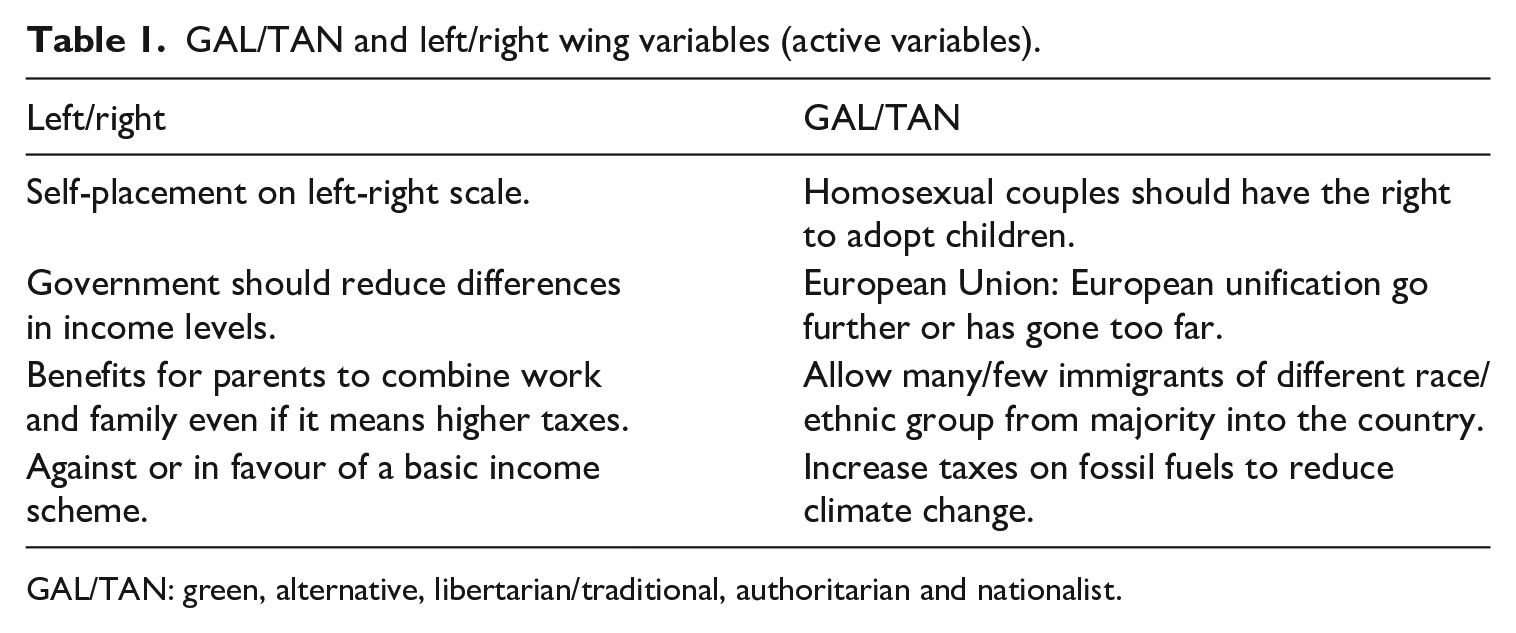
GAL/TAN: green, alternative, libertarian/traditional, authoritarian and nationalist.
In order to study if class – cultural capital, economic capital, and occupation – shapes how people orient themselves in the space of political attitudes, we use three supplementary variables. Level of education captures a respondent’s institutionalised cultural capital (Bourdieu, 1986). This variable was divided into six categories that include no formal education, apprenticeship-oriented schooling, vocational education, nursing/teachers training/university preparatory courses, 3–5 years of study at a university, and Master’s/PhD degree. Economic capital was measured by household income in deciles. These were recoded into five categories, meaning that the lowest level of income consists of the 1st and 2nd deciles and the highest includes the 9th and 10th deciles. In measuring occupational class, we followed the Erikson and Goldthorpe scheme (1992). The occupation variable in the ESS does not disclose small business owners/proprietors and thus we were limited in that we were only allowed to study seven out of the nine defined occupational classes: higher grade professionals, lower grade professionals, higher grade routine non-manual employees, lower grade routine non-manual employees, technicians, skilled manual workers, and semi/un-skilled manual workers (including farmers and fishermen since they account for less and 1.5% of the sample).
We use age, gender, area of residency (an urban–rural continuum), religious denomination, and level of political interest as additional supplementary points in the space of political attitudes. We have followed the principle that no single variable category should hold less than 5% of the observations, so as to avoid skewing the results (Le Roux and Rouanet, 2010). For this reason, the age variable was recoded into four groups (15–29; 30–49; 50–64; 65+). Gender and religious denomination are binary variables: male/female; belongs/does not belong to religious denomination. ‘Political interest’ was divided into four categories ranging from ‘not interested at all’ to ‘very interested’. Finally, ‘area of residency’ includes five categories ranging from ‘big city’ to ‘farm or house in the countryside’.
Admittedly, we are limited by relying on secondary data. While the ESS comprises a wide range of variables on political attitudes, it is less developed in terms of its capacity to measure peoples’ access to capital in the Bourdieusian sense of the term (Bourdieu, 1986). We had to rely on educational level as the sole indicator of possession of cultural capital, and household income for economic capital (for a discussion, see Rosenlund, 2015). This prevented us from constructing a space of social positions since that would demand more measurements of both economic and cultural capital (ibid). In this design, which mimics the rationale for creating a ‘symbolic space’ (ibid), class variables were used as supplementary points to get a view on how class may play out in the space of political attitudes.
Results I – the space of political attitudes in the UK
Two things stand out in the analysis of the structure of the space of political attitudes in the UK. First, in contrast to previous research on Scandinavia (Flemmen, 2014; Flemmen and Haakestad, 2018; Harrits, 2013; Harrits et al., 2010), the attitudes connected to the ‘new politics’ do not constitute a dimension in its own right. In the horizontal axis, which explains 54% of the variation among the variables, ‘new politics’ and left–right opinions collapse into one another, which is to suggest that people in the east of the map hold both leftist and GAL views and those in the west hold right wing and TAN views simultaneously (Figure 1). Put in a different way, people located in the east of the map are left-oriented cosmopolitans – they are open to immigration, homosexual couples’ right to adoption, increased taxation on fossil fuels, and they support further European unification while at the same time endorsing social welfare policy. Those in the west, in contrast, are sceptical about European integration, and they believe in individual responsibility over social welfare and they are harbingers of traditional values.
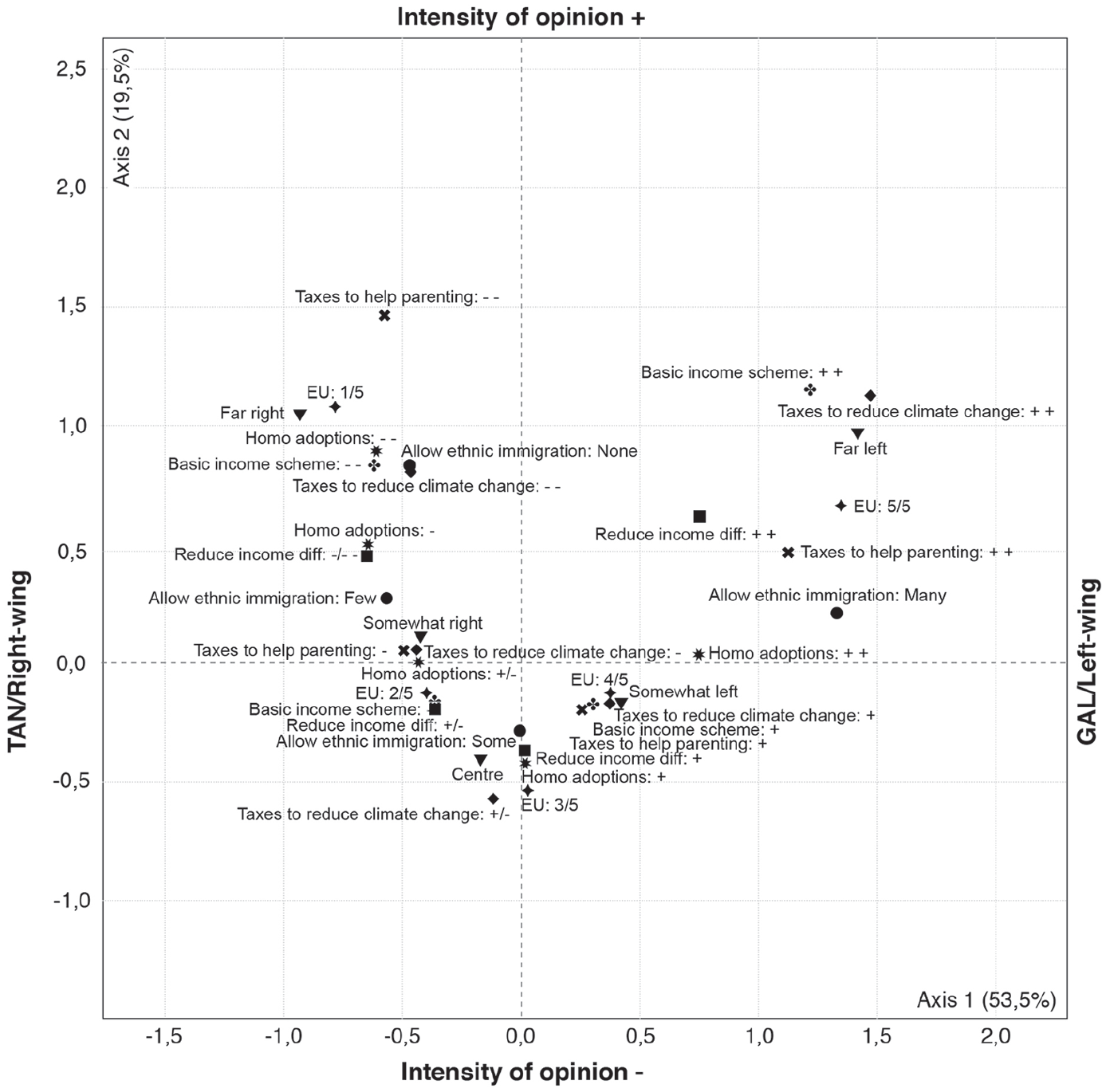
The space of political attitudes in the UK 2016-2017. MCA, axes 1 and 2.
While it is true that Hooghe et al. (2002) studied party politics rather than the attitudes of citizens, they do argue for an altogether new GAL/TAN line of political division. In contrast, Evans and Tilley (2017) contend that issues regarding EU integration and immigration should be understood as included in the left–right divide since they ‘involve economic costs and benefits that affect different types of people’ (p. 70). Similarly, Gidron and Hall (2017) found that right-wing vote corresponded with TAN-oriented dispositions. Our results go in line with this latter notion – EU unification, ‘far left’ views (self-placement), and tolerance towards immigration form a cluster in the political space. The same goes for far right-wing views, scepticism towards immigration and homosexual couples’ rights to adopt, and EU scepticism, which form constellations in the north-western part of the map.
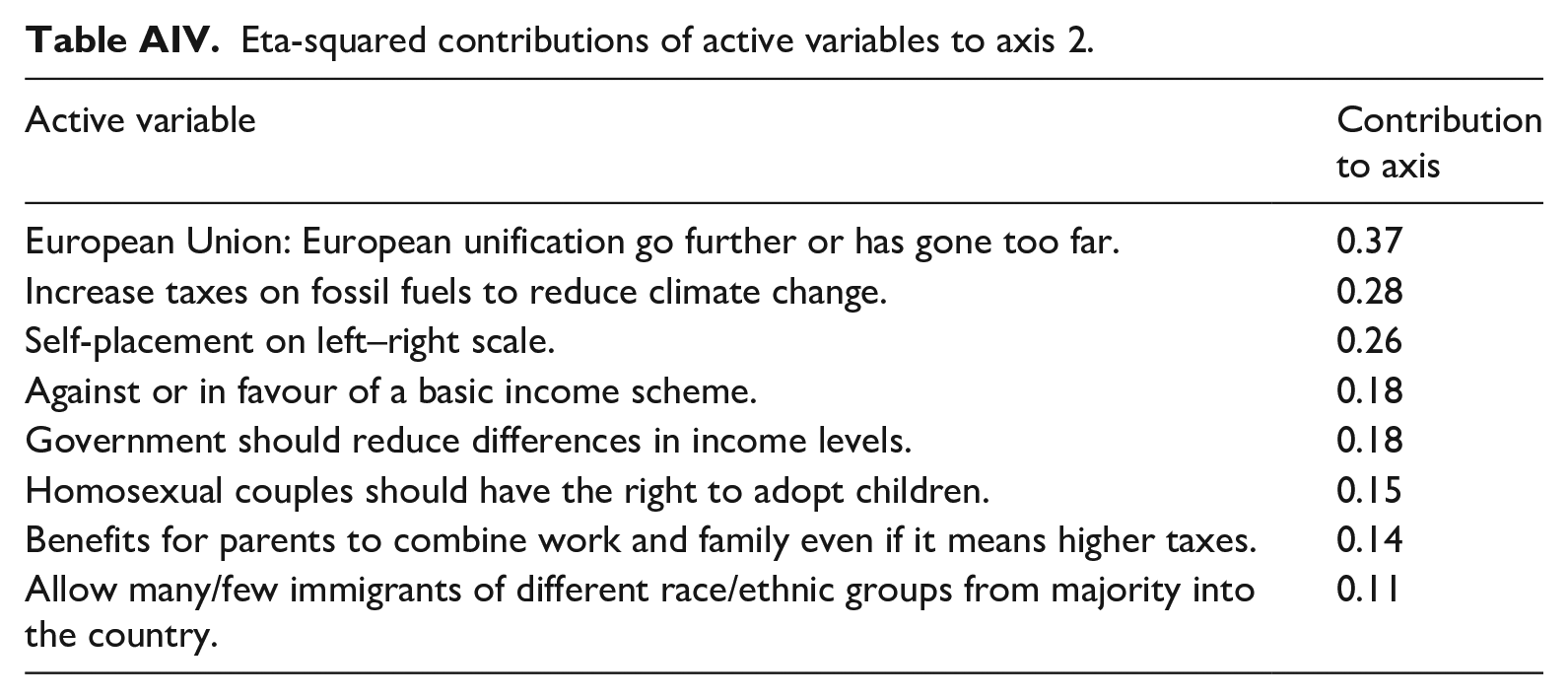
Our second main finding regarding the structure of the space concerns the intensity of the opinions that can be held regarding the policy statements under scrutiny (and the self-placement on the left-right scale). This finding resonates with previous research that, however, have chosen not to focus explicitly on this fact (Flemmen and Haakestad, 2018; Harrits, 2013; Harrits et al., 2010). Most people, when asked, are moderate in opinion. The vertical axis, which explains 20% of the variation among the active variables, differentiates between the highly opinionated and the less opinionated. People with, relatively speaking, ‘extreme’ views, for example, ‘strongly disagreeing’ on a statement suggesting that homosexual couples should have the right to adopt children, or ‘strongly agreeing’ in that taxes should be raised to combat climate change are both located in the north of the space. People less animated in their opinions are located in the south of the map. This is where the biggest portion of the sample is located, which again suggests that most people are quite moderate in their stances regarding policy statements (Figure 2).
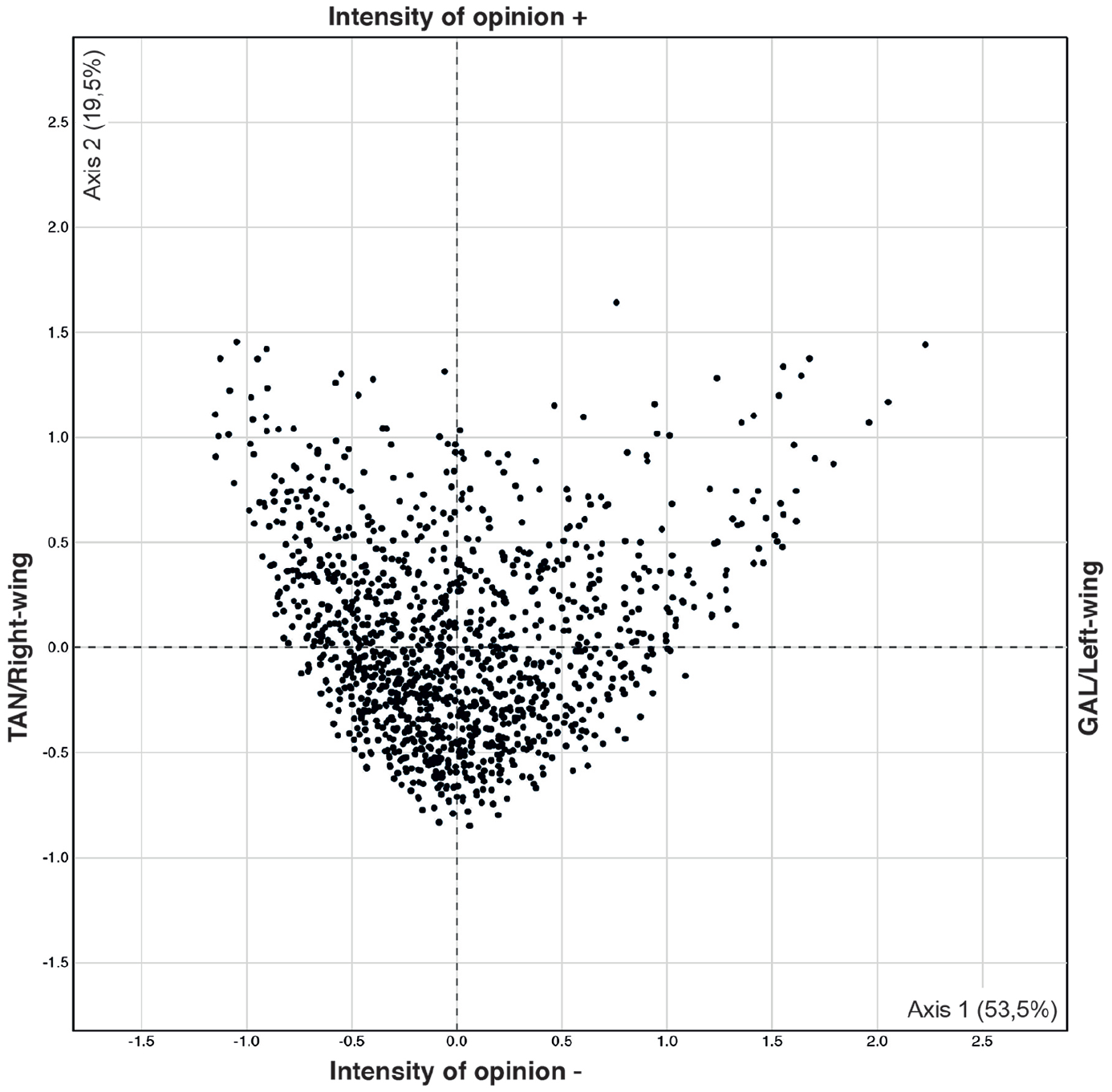
Cloud of individuals. MCA, axes 1 and 2. Comment: Missing values have been removed (n = 1332).
We learn thus that the ‘new politics’ conflates with the old left–right disputes, perhaps because people tend not to hold extreme opinions. And, contrary to popular belief, polarisation – at least as far as the UK is concerned – is mainly taking place within a highly opinionated minority of the population.
A last point in regard to the construction of the space of political attitudes should be brought to the fore. As is evident in Figure 2, the structure of the space retains the so-called horseshoe effect (Hjellbrekke, 2019). This oftentimes lead researchers to recode the data for it to better accommodate the preconceived model. Alternatively, researchers shift focus to another axis. While the third axis in our space explains 14% of the variation in the space it presents itself as variant of the first axis, where GAL/left orientations oppose a TAN/right pole. We have therefore not extended our analysis with a focus upon the third axis. We have chosen not to reconstruct the space in order to end up with a ‘better’, albeit more artificial, distribution in the cloud of individuals that perhaps would have resonated with the notion that the ‘new politics’ would constitute its own dimension in the contemporary political landscape. In the words of Marx and Engels (1974), we attempt here to transcend from ‘earth to heaven’, and not the other way around. Indeed, the founder of correspondence analysis argued that ‘the model must fit the data, and not the reverse’ (Benzécri in Hjellbrekke, 2019: 1). Staying with the original distribution arguably gives a fairer view of the actual conditions of the space of political attitudes in the UK, and this view suggests that old and new politics conflate in the UK space of political attitudes, and that the space divides in terms of peoples’ intensity of opinion. 1 Another way to put this is to say that the old and new politics, which in certain statistical analyses form different attitudinal constellations, seem to collapse into one another when we ‘control’ for peoples’ intensity of opinion. Again, readers should bear in mind that the secondary data used implies some limitations regarding the variables available. We thus call for future studies to take the discussion on the dimensionality of the space further.
Results II – political attitudes, class, and demographics
Figure 3 retains the structure of the space explored above. The space of political attitudes is formed by the extent to which people hold strong or modest opinions (north–south) and if their opinions consist of TAN/right values or GAL/left values (west–east). The active variables are now invisible and we shift focus to how class, in terms of institutionalised cultural capital (educational level), economic capital (household income), and occupational class, relates to different constellations of political attitudes. Technically speaking, we now turn to the study of the coordinates of our first set of supplementary variables.
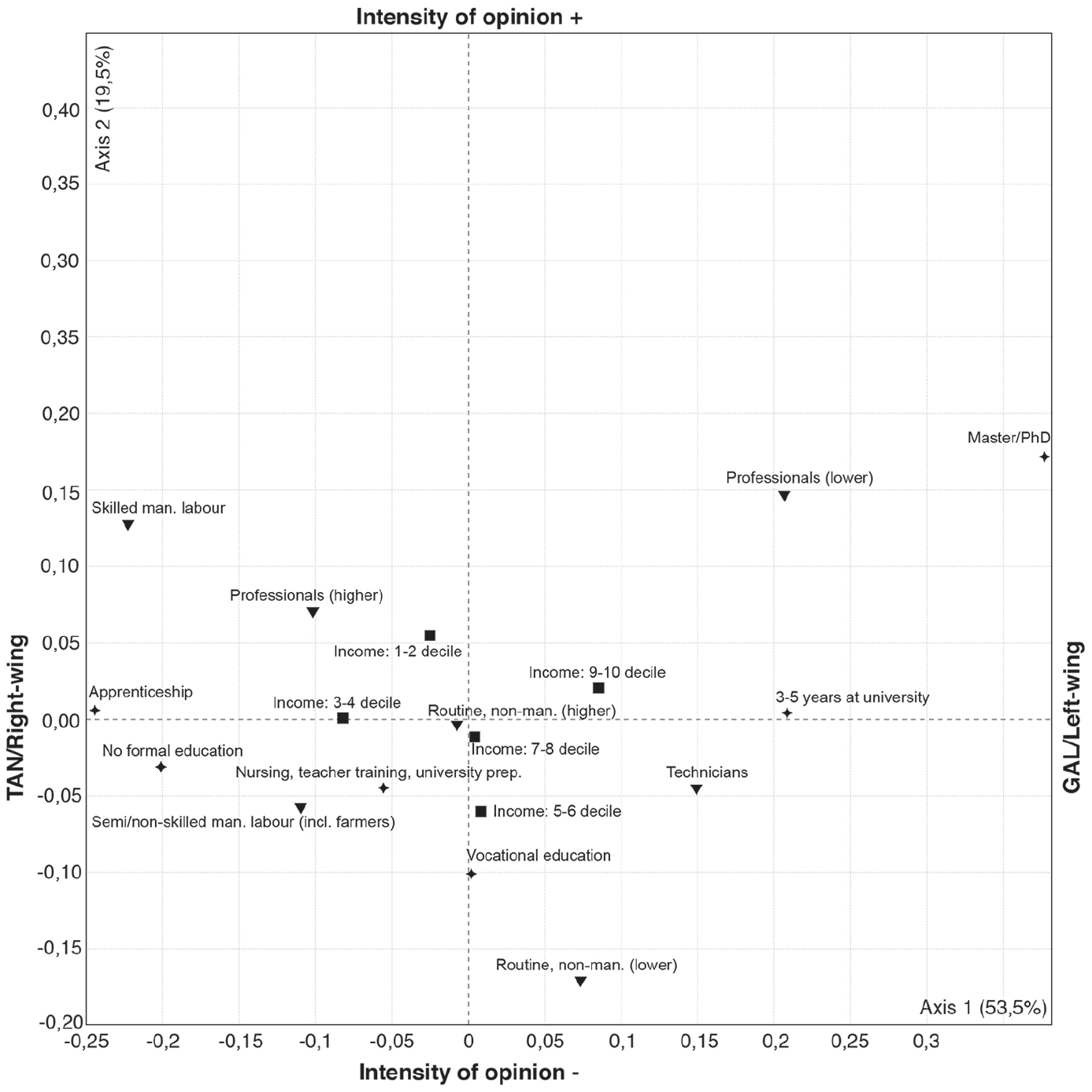
Class in the space of political attitudes (supplementary variables). MCA, axes 1 and 2.
The level of educational capital matters for how people manoeuvre in the political landscape. People holding university degrees tend to be located in the east of the map, in the GAL/left domain, whereas those with no formal educational qualifications are found to the west where TAN/right attitudes prevail. This is supported by previous research that has shown that ‘high education groups are generally libertarian in outlook, while low education groups are authoritarian’ (Evans and Tilley, 2017; see also Stubager, 2009: 206). People with vocationally oriented merits are the least opinionated.
People with the lowest household incomes are found in the north-western block of the map and are slightly in favour of a TAN/right orientation and more opinionated than the other income groups. Those with the highest incomes tend to lean slightly more to the GAL/left pole. In this space, economic capital is less of a factor compared with educational capital. Economic capital may be more clearly connected to the left–right dimension on its own (Enelo, 2012; Flemmen and Haakestad, 2018).
With the exception of the skilled manual labourers, people in lower occupational classes tend to be less opinionated than people in higher occupations. Professionals (higher and lower) and skilled manual workers are located in the northern part of the map, whereas routine non-manual workers (higher, lower), semi/un-skilled manual workers, and technicians are found in the south. Lower grade professionals are the ones most likely to hold clear-cut GAL/left views, whereas higher grade professionals and skilled manual workers are the most likely to hold TAN/right views.
The class-related variables are found between 0 and 0.25 points from the barycentre, suggesting that political attitudes are only marginally formed by class (cf. Le Roux et al., 2008). The pattern of the distribution of these variables suggests that class does, albeit to a limited extent, predict how people orient in the space of political attitudes. Relatively high volumes of capital (both economic and cultural) and occupational class (lower grade professionals) are connected to the GAL/left pole. The TAN/right pole is occupied by the highest occupational class (higher grade professionals) but also by people with the lowest household incomes and people with the lowest educational qualifications (cf. Hobolt, 2016). This may be understood in light of Bourdieu’s (1984) argument that both form (disengaged/engaged) and contents (taste/distaste for the necessary) of (political) opinions and tastes connect to class, especially cultural capital.
In Figure 4, we turn to our second set of supplementary variables. Gender is distributed along the vertical dimension – men are more opinionated than women, and tend to be slightly more TAN/right-oriented compared with women. The age groups cut across the space diagonally. The oldest group (65+) is found in the north-west and the youngest group (15–29–year-olds) is located in the south-east. As for area of residency, more than others urban dwellers are politically opinionated and tend to hold GAL/left views. People on the countryside, in contrast, are less opinionated and more likely to balance between left–right and GAL/TAN (‘farm or house in the countryside’), whereas people living in country villages tend to lean towards the TAN/right pole.
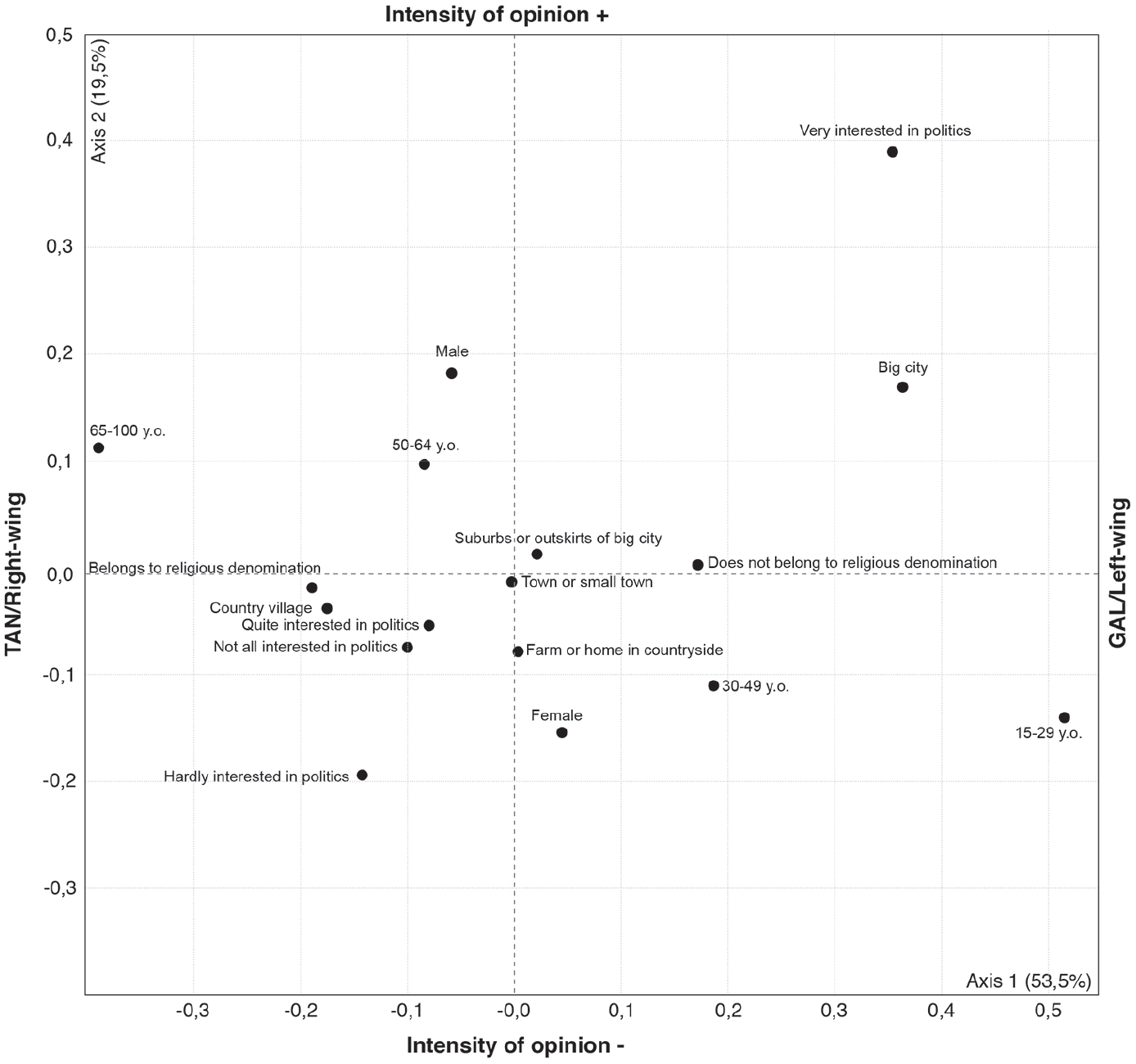
Age, gender, domicile, religious denomination, and political interest in the space of political attitudes (supplementary variables). MCA, axes 1 and 2.
It is no surprise that highly opinionated people (north) are also the most politically interested. It is interesting to note, however, that being ‘very interested’ in politics also corresponds with a clear GAL/left view. People finding politics uninteresting (which perhaps should be viewed as an extension of an anti-establishment disposition) hold less animated opinions and they tend to lean towards the TAN/right pole.
Belonging to a religious denomination is connected to the horizontal axis. Those who belong to a religious denomination tend to be more right wing and more traditional, authoritarian, and nationalist in outlook. People outside of these denominations are more likely to be left-leaning individuals who hold green, alternative, and libertarian views.
In sum, among those holding GAL/left views tend to be young people, highly educated, not-belonging to a religious denomination, and tend to live in an urban area. As for people holding TAN/right views, both manual work and higher grade professionals are more frequently represented, as well as people of old age with low educational levels and residencies outside the big cities.
Discussion and conclusion
We have studied the space of political attitudes in the UK in the aftermath of the ‘Brexit’ referendum in the UK. Numerous commentators and researchers have identified ‘the postmaterial’ as a supplementing political force next to the old disputes over the redistribution of resources – that is, the traditional left–right divide that dominated the political landscape throughout the 20th century (Habermas, 1981; Hooghe et al., 2002 Flemmen and Haakestad, 2018; Surridge, 2018). In studying how people in the UK relate to a range of policy statements capturing both ‘old’ and ‘new’ politics, we find, contrary to a prevailing discourse – but in line with Evans and Tilley (2017) – that key position-takings on homosexuality, migration, climate change, and the EU are intimately connected to left- and right-wing orientations. Regardless of the official positions assumed by the corresponding political parties, we have observed that citizens who lean to the left are more likely to endorse further EU unification, minority rights, generous migration policy, and taxation to reduce climate change. Conversely, right-wing attitudes merge with EU and migration scepticism, traditional values, and a reluctance to increase taxation to battle climate change. In the UK thus, postmaterial standpoints seem embedded in the old political disputes.
Our study suggests, furthermore, that polarisation occurs between a small but relatively resourceful minority of the population that assumes either a strong GAL/left-wing orientation with higher scholastic capital or an equally strong TAN/right-wing orientation among higher professionals. It is interesting to note that this latter group is also populated by certain segments of the working class (skilled manual labourers). Today, these groups – the educational and urban elite versus well-paid higher professionals together with certain segments of the working class – battle out their differences on social media such as Twitter. Despite its few access restrictions Twitter constitutes a pronounced elite platform (Blank, 2017; Dagoula, 2019; Larsson and Moe, 2012) that may, however, lead commentators to believe that the space of political attitudes is more divided than it actually is.
Another grand question regards the role played by class in today’s political landscape. In line with previous research (e.g. Evans and Tilley, 2017; Flemmen, 2014; Flemmen and Haakestad, 2018; Harrits, 2013; Stubager, 2008, 2009), we find support for the notion that class forms political attitudes, but only to a low extent. In fact, the political oppositions between the politically interested–uninterested, old–young, men–women, and rural–urban are for the most part more clearly demarcated than oppositions between people of different class positions. On an overarching level, however, the (weak) ‘class-effect’ aligns with Bourdieu’s (1984) argument that class shapes both the ability to ‘produce an opinion’ and the contents of that opinion (the taste/distaste for the ‘necessary’). We observe, first, that people with a high volume of capital (both economic and cultural capital) and with higher occupational status are generally more opinionated than the less well-off segments. Additionally, GAL/left-wing orientations are more common amongst highly educated professionals. The outstanding traits of people holding TAN/right attitudes are a lack of cultural capital and who often work in manual labour occupations. The by now rather well-established observation that leftist attitudes do not correspond to working class positions – much because of the middle-class turn taken by the Labour Party during the 1990s, and that the working class now ‘lacks political representation’ (Evans and Tilley, 2017: 2) – is supported here (see also Kitschelt, 1994). We have not, however, been able to discern a clear-cut effect of capital composition – educational merits and income levels do not display an inverted pattern in the British space of political attitudes (TAN/right-wing attitudes are found among people with a generally low volume of capital). This finding stands in contrast to previous research in Scandinavia (Flemmen, 2014; Flemmen and Haakestad, 2018; Harrits, 2013) but it goes in line with a preceding failure to identify lifestyle divisions along a capital composition dimension in the UK (Le Roux et al., 2008) and recent updates within Bourdieusian sociology (Glevarec and Cibois, 2020). This, along with the relatively weak associations between class and political attitudes suggests, to our surprise, that the UK political landscape seems overall less ‘classed’ than in Scandinavia, where much of the previous Bourdieusian research on the topic has been carried out.
As far as the UK citizenry is concerned, the ‘old’ political dividing line between the left and the right remains the prevailing one, and postmaterial values are mobilised within the traditional political oppositions. Class continues to be a factor that contributes to these lines of division, albeit not as strongly as in other contexts. Given that our results depart from a prevailing discourse on polarisation on two distinct, old and new, political dimensions one may ask whether researchers have been too keen on the distinction between ‘old’ and ‘new’ in the realm on politics, and to overestimate the extent of political polarisation. While it may be fruitful to theorise the material and the postmaterial, the ‘old’ and the ‘new’, as two distinct frontiers of political dispute, one should remain sensitive to the fact that they may be highly interrelated in people’s political dispositions. Indeed, our results suggest that these attitudinal constellations seem to collapse into one another when we consider people’s intensity of political opinion.
Given that we present here a snapshot of the UK space of political attitudes, we call for further research on both the make-up of the space of political attitudes itself and its connection with class. We particularly call for studies that construct a space of social positions and study the potential homologies in relation to the space of political attitudes (Rosenlund, 2015). Such studies should also take other/more variables into account, and further explore the dimensionality of the UK space of political positions. Evans and Tilley (2017) argue that opinions of postmaterial nature collapse into the left–right dimension precisely because the effect of, for instance, further European integration is believed to be of a material nature (e.g. that immigration or EU membership/expansion is costly or threatening one’s job). As such it would be useful to include cosmopolitan orientations and other attitudinal constellations that may be more clearly postmaterial than the policy statements studied here. Also, we call upon researchers to design research instruments allowing the use of more fine-tuned instruments for constructing the space of political attitudes, not least by combining self-reports with digital data from the platforms where the disputes play out. Finally, qualitative studies should be able to unravel the dynamics behind the overarching patterns identified in this study.
Footnotes
Appendix 1
Eta-squared contributions of active variables to axis 2.
| Active variable | Contribution to axis |
|---|---|
| European Union: European unification go further or has gone too far. | 0.37 |
| Increase taxes on fossil fuels to reduce climate change. | 0.28 |
| Self-placement on left–right scale. | 0.26 |
| Against or in favour of a basic income scheme. | 0.18 |
| Government should reduce differences in income levels. | 0.18 |
| Homosexual couples should have the right to adopt children. | 0.15 |
| Benefits for parents to combine work and family even if it means higher taxes. | 0.14 |
| Allow many/few immigrants of different race/ethnic groups from majority into the country. | 0.11 |
Funding
The author(s) received no financial support for the research, authorship, and/or publication of this article.
