




Abstract
This article constructs a model of the space of lifestyles in Sweden. It does so not simply to test whether its structure conforms to that discovered by Pierre Bourdieu and his colleagues in 1970s’ France, and confirmed by others across the globe, but to examine the extent to which it is wrapped up with symbolic domination. It draws on data from an unusually rich survey of consumption patterns and taste fielded in 2017–2018 (n=1,498) and deploys the technique of multiple correspondence analysis in combination with cluster analysis. Oppositions between exclusive and accessible culture and between ‘highbrow’ culture and materialistic/appearance-oriented practices are revealed and the correspondences with capital, age, gender and other factors explored. The cluster analysis suggests that the force of capital composition in differentiating lifestyles relative to age varies in proportion to capital volume. Crucially, analysis suggests it is the economically rich, rather than those rich in cultural capital, who are most confident in their tastes and lifestyles.
Introduction
Pierre Bourdieu’s (1984) thesis that there is a homology between social class and lifestyles has sparked an explosion of research seeking to test whether it holds decades on from its original formulation across a variety of nations. Much of this research, unfortunately, proceeds with methods and measures grossly at odds with the original argument, particularly those supposedly confuting Bourdieu’s thesis and proposing the emergence of the ‘cultural omnivore’ instead. More recently, though, a flourishing strand of inquiry has recognized the specifically topological conception of the social world inhering in Bourdieu’s argument and the need to marshal fitting techniques to map a multidimensional space of lifestyles and the position of social indicators – particularly measures of cultural and economic capital – within it. This article extends on and deepens this line of inquiry by constructing a new and comprehensive model of the space of lifestyles in Sweden, drawing on data from a bespoke survey fielded in 2017–2018 and applying the technique of multiple correspondence analysis, paired with cluster analysis, to do so.
The article also seeks to go beyond existing contributions, however, by returning to the very point of Bourdieu’s argument. For Bourdieu was interested in documenting the relationship between class and styles of life not out of sociological voyeurism or because it revealed the patterning of life chances, and not even because it confirmed his emerging thoughts on the relationship between capital, habitus and practice, but because it was in the correspondence of social position and symbols of taste that domination operated. Those rich in the major forms of capital, said Bourdieu, possess the power to impose their lifestyle as the legitimate one through the media, politics and education system such that it becomes widely misrecognized as laudable and its bearers seen as ‘clever’, ‘refined’, ‘successful’, ‘enviable’ and so on. There is, for sure, a struggle between fractions of the capital-rich class over which manifestation of their lifestyle is worthier than the other – that associated primarily with cultural capital or that associated primarily with economic capital. The result in any case, though, is that those against which the dominant define themselves and their way of life – those with little capital, i.e. the dominated, but also, in their own way, those between the dominant and dominated – are ipso facto misperceived, even by themselves, as lacking something, whether it be the ‘right knowledge’ or money, or as ‘lower down’ in the pecking order than others. This ‘symbolic violence’, as Bourdieu called it, has typically been neglected in quantitative inquiries because of reliance on secondary data sources that had no interest in it, and it has instead been exposed most thoroughly through qualitative research, with all the questions for generalizability that the latter style of inquiry comes with. Now, however, we have a survey primed to uncover not only the relationship between class and lifestyles but its suffusion with symbolic domination.
Social space, lifestyle space and symbolic domination
Bourdieu’s thesis, elaborated and evidenced in Distinction (1984), is founded on the premise that the class structure of capitalist societies takes the form of a multidimensional ‘social space’ defined by possession of three forms of capital: economic capital (money and wealth), cultural capital (mastery of legitimated symbol/sign systems, proxied by education) and social capital (networks and connections). The social space comprises three dimensions: volume of capital, composition of capital (economic versus cultural) and trajectory, i.e. transformation over time with shifting distributions of tokens of capital. Possession of a certain volume and composition of capital furnishes one’s conditions of existence – the possibilities and impossibilities of life – and, in adaptation, a certain habitus is generated – dispositions and tastes tailored to the possible or necessary. The end result is a space or system of symbols – the lifestyle space – corresponding with social positions and, therefore, marking out people’s ‘places’ in everyday practical perception. In Bourdieu’s research on 1970s’ France, the prime opposition in the lifestyle space was between the rare and the common, or the exclusive and the accessible, corresponding with the dominant and dominated in the social space, while a secondary opposition among the dominant and intermediate classes polarized the lifestyles of those richer in cultural capital and those richer in economic capital. Those rich in cultural capital were oriented toward ‘difficult’ and obscure forms of traditional highbrow culture (classical music, avant-garde art and plays, etc.) while those endowed with abundant economic capital, though appreciating certain forms of theatre and art, were most marked by expensive goods and practices (luxury cars, hotel holidays, etc.). The petite bourgeoisie below them were equally split by capital composition, though also by their trajectory: the young, rising cultural intermediaries working in socio-medical services and the cultural sector aestheticized newer forms of culture (cinema, graphic novels, etc.) while the old, declining petite bourgeoisie of craft workers and shopkeepers exhibited a certain backward-looking traditionalism in their tastes and ethos.
Symbolic differences are, according to Bourdieu, imbued with judgments of value because the lifestyles of the dominant class fractions are taken for granted as ‘legitimate’. The correspondence with high education levels or financial wealth – which, in capitalist societies with expansive education systems and aristocratic legacies – generates a broad sense that they denote intelligence or success and that, these being ‘good things’, consumption of highbrow arts and/or luxury goods is valuable while consumption of their opposites, the popular and the accessible, is less so. This is not to say that the symbols of cultural or economic capital are equally valued – sections of the dominant class are embroiled in a struggle, within a ‘field of power’, to impose their differing outlooks, tastes and lifestyles as the ultimate arbiters of worth. Yet the dominated and, to an extent, the intermediate class fractions still come to see themselves as generally lacking that which makes someone valuable or worthy in contemporary capitalist social orders – whether it be legitimate forms of knowledge or money – and their own lifestyle as something that is or would be looked down upon.
Many have since sought to test whether Bourdieu’s model holds outside 1970s’ France. There was a period – even after the excesses of the postmodern turn – when it was disputed and the notion of ‘cultural omnivorousness’ proffered as a more up-to-date image of symbolic domination or, in some (Weberian) versions, of social advantage (Peterson, 1992, 1997, 2005; Lahire, 2004; Chan, 2010). That thesis has now begun to look less convincing. Critics observed its overreliance on genre categories, some of which were very broadly defined, and its dependence on linear statistical techniques, which have the disadvantage of wrenching the measured objects from the relational system of which they are a part (see e.g. Holt, 1997; Wuggenig, 2007; Atkinson, 2011). In its wake a different strand of research has emerged, determined to assess the applicability of Bourdieu’s model using the same logic and techniques as the Frenchman himself, specifically multiple correspondence analysis (MCA), a variant of geometric data analysis capable of generating multidimensional spaces in which the total variance between categories of implicated variables is partitioned across several axes. Led by Annick Prieur et al. (2008) in Denmark and Lennart Rosenlund (2009) in Norway, analyses have now proliferated across the globe – though mainly in Europe – and, in all cases, the phantom of omnivorousness is quickly exorcised (see especially Bennett et al., 2009; Coulangeon and Duval, 2015; Atkinson, 2017, 2018; Flemmen et al., 2018, 2019). This is not to say that the spaces are always exact replications of Bourdieu’s model. Those that come closest, in fact, operate in a slightly different manner than Bourdieu did: they construct models of the social space using MCA and then analyze the positioning of lifestyle indicators within it (e.g. Prieur et al., 2008; Rosenlund, 2009; Flemmen et al., 2018; Lindell, 2018; Lindell and Hovden, 2018). A perfectly valid and illuminating move, for sure, though some of these spaces are constructed using indicators of car or boat value. Given cars and boats decrease in value after purchase and perform specific symbolic functions (see e.g. Coulangeon et al., 2015), these are, in fact, indicators of consumption. Bourdieu (1984: 116) himself relied on these kinds of indicators as proxies for economic capital too, for sure, though he recognized they were ‘neither entirely adequate nor entirely unambiguous’, but it could be claimed that such analyses potentially conflate the social space and lifestyle space in the same manner as those which take consumption of highbrow culture as directly constitutive of cultural capital rather than a typical – but definitely not fixed or mechanical – outcome and thus symbol of it (e.g. Lindell and Hovden, 2018).
Those that follow Bourdieu’s lead and construct spaces of lifestyles, however, often find that the opposition between youth culture and traditional culture emerges as a secondary structuring principle of lifestyle spaces, with an axis of voracious engagement versus disengagement in cultural activity, corresponding chiefly with cultural capital, forming the primary dimension (especially Bennett et al., 2009; Savage et al., 2013; also contributions to Coulangeon and Duval, 2015; see Glevarec and Cibois, 2020). This is, in part, a product of analyzing whole samples in one model rather than, as Bourdieu did, proceeding class-by-class. After all, even Bourdieu found age (or trajectory) to be the secondary structuring principle in his MCA spaces, subordinate to capital composition, and only dubbed it the third dimension in his theoretical prolegomena because capital volume had been, to use his term, ‘neutralized’. Had he have analyzed his full sample in a single model he may well have generated a space similar to those foregrounding the opposition between the young and the old. Then again, there is everything to suggest that the young/old opposition is inseparable from the capital composition principle anyway, given generational shifts in the accessibility of educational credentials and the effects of capital accumulation across the life course (Atkinson, 2017, 2020). The absence in most analyses of indicators tapping into the specific lifestyle of the economically rich – possession of luxury goods, for example, or expensive cars – is also likely to submerge capital composition since the structural opposite to the lifestyle of those rich in cultural capital is effectively missing.
The Swedish case
What of Sweden, then? First of all, there is every reason to believe that the ‘French model’ of high culture – opera, classical music, painting, theatre and so on – is also likely to define traditional ‘highbrow’ culture (finkultur) in the country since it was imported into and vigorously pursued within the Swedish court under Gustav III (r. 1772–1792) and taken over by intellectuals, but that, with the transition to a capitalist economy, the specific lifestyle of the economically rich – and not so highly educated – will have emerged as a competitor (see Samuelsson, 1968; Derry, 1979). With the neoliberal turn in Sweden and rising rates of economic inequality from the 1980s onwards, moreover, the symbols of luxury and expense may well have become not only much more prominent but more highly valued within the once famously egalitarian nation. The fact that Bourdieu’s model has been validated in both Denmark and Norway – two countries with similar cultural and welfare-regime histories to Sweden, one of which (Norway) was in union with Sweden until 1905 – also fortifies the hypothesis that Sweden will do too.
A model of the contemporary Swedish lifestyle space has, in fact, already been mapped by Mikael Börjesson (2016) using MCA. Falling into the mold seen elsewhere, it identified a prime axis of engagement/disengagement in finkultur corresponding above all with education level, and a secondary axis of new/traditional culture (with the ‘new’ being defined largely in terms of internet use) corresponding primarily with age. It thus raises precisely the same question as the equivalent spaces said to characterize Flanders, Mexico, the UK and so on: would the space come out differently if indicators of the economically expensive – ownership of pricey and prestigious consumer goods, especially those, like cars or boats, which depreciate in value after purchase, or participation in sports requiring high-priced equipment and memberships – were included? Börjesson was also unable to explore something missing, for reasons of data availability, from the vast majority of most quantitative studies of lifestyles too, even those closest to the original model, despite its centrality to Bourdieu’s whole thesis: indicators of symbolic domination. Mapping the homology between the lifestyle space and the social space (or other demographic features) is one thing, but demonstrating that this homology underpins differences in perceived (self-)worth is another. Symbolic struggles and violence are usually documented through qualitative research instead, and richly so (e.g. Skeggs, 1997; Atkinson, 2010; Jarness, 2018), but this leaves open the issue of just how imbalanced and widespread the experience of symbolic domination really is.
Data and method
The current inquiry seeks to rectify some of the identified omissions by mapping not just a brand new, comprehensive model of the Swedish space of lifestyles and its homologies in unprecedented depth but its relationship with symbolic domination too. It will do so, like others and Bourdieu before them, by deploying specific MCA to uncover the major axes polarizing indicators of taste, mastery and lifestyle, and mobilizing associated techniques of structured data analysis to examine the strength and form of any homology with social position. These techniques include Ludovic Lebart et al.’s (2006) test statistics to determine the statistical significance of coordinates on axes and examination of the standardized deviations between points (where >0.4 is considered notable and >1 is substantial) (Le Roux and Rouanet, 2004; Hjellbrekke, 2019; Le Roux et al., 2020). The MCA is paired, moreover, with ascending hierarchical cluster analysis (AHC). The purpose of AHC is to carve out ‘classes’ from the space defined in terms of maximum internal homogeneity and external heterogeneity across multiple axes on the basis of the ratio between inter- and intra-cluster inertia (Ward’s criterion), and statistical tests can then be applied to determine the most overrepresented or ‘characteristic’ features of each cluster (see Lebart et al., 2006: 291–295).
The analysis draws on a purpose-built national survey delivered in 2017–2018 as part of a larger comparative project on class structures and symbolic domination in capitalist societies. The fieldwork was undertaken by a global market research company (GfK) using a specially designed questionnaire and took the form of telephone interviews. Interviewees, all of whom were aged 18 or older, were contacted via random digit dialing, with quotas set for gender and age crossed with education to approximate distributions recorded in the latest census. Stockholm was over-sampled as a means of recruiting participants for follow-up interviews and a weight variable, combined with balances for residual discrepancies by age, gender and education, designed to account for this. The final sample size is 1,498, though those aged 18 to 24 have been set as passive in the solution because their inclusion destabilized the model (see Hjellbrekke, 2019: 76–78), leaving a total of 1,321 active individuals.
The survey contained a plethora of questions relating to various elements of taste and lifestyle across multiple domains, from television and books to sports, food and body modification. Questions cover tastes in relation to clothes, home décor, restaurants, sports (watched and played) and cultural activities, but also frequency of listening to classical music and watching television, knowledge of artists, possession of luxury items (boats, summer houses, tailored suits, jewelry/watch worth 5,000 Swedish krona (SEK) or more, personal license plates), car ownership/value and indicators of body modification (tattoos, sunbeds, cosmetic surgery, etc.). Some of these have been set as supplementary variables in the analysis, i.e. they do not contribute to the inertia of the model, because of an abundance of small-n categories (e.g. sports) or a skewed binary structure (e.g. body modifications). This leaves nine active variables in the model: frequency of listening to classical music, hours of television watched, favorite cultural activity, favorite type of restaurant, number/value of cars owned, preferred clothing style, ideal home décor, number of luxury items possessed and number of artists known from a given list (Table 1). 1 Some component categories have been combined or treated as passive due to low numbers or destabilizing effects on the model.
Relative frequency of responses within active variables.
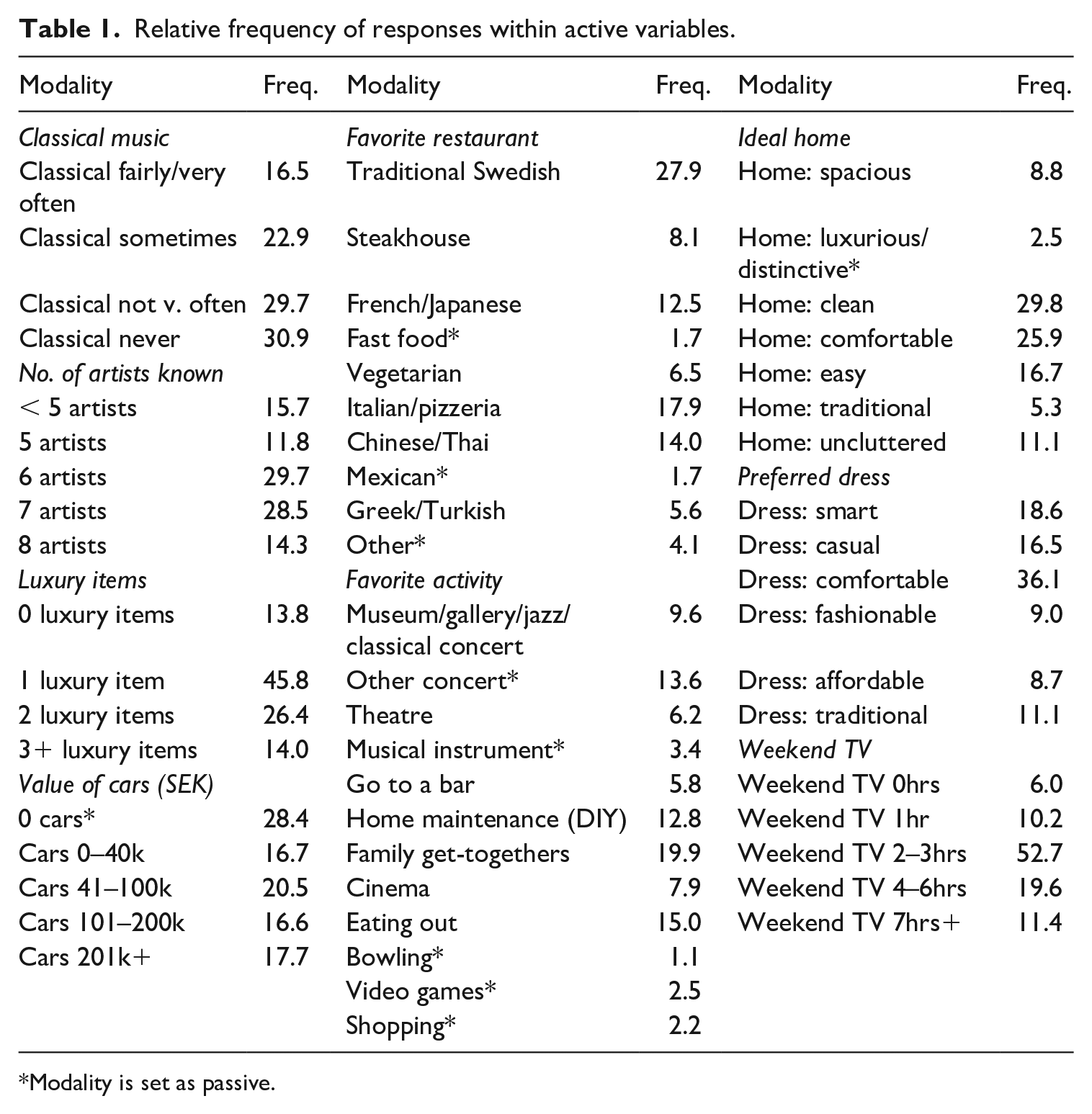
Modality is set as passive.
Indicators of social position, of which there are many, are also entered as supplementary variables. Questions asking respondents about their annual net household incomes, property, savings, shares, education level and discipline and parental education are designed to reveal capital portfolios – differences in capital volume but also, potentially, capital composition – and thus a possible homology with position in the Swedish social space. These are complemented by variables recording the respondents’ gender, age, employment status, industry or sector and occupation. The last of these was measured with the unit-level International Standard Classification of Occupations and then aggregated into a set of categories with some demonstrated ability to proxy capital volume and capital composition while incorporating the possible effects of membership of specific fields (Atkinson, 2020).
There is, finally, a duo of questions formulated to tap directly into the nexus between lifestyles and symbolic domination. The first of these asked respondents to rate their level of (dis)agreement with the statement ‘to enjoy art and classical music a person needs to know more than me’, thus gauging the extent to which people – especially those who do not consume art and classical music – believe those tastes to be tied to legitimated forms of knowledge and their absence associated with (self-perceived) lack. The second question asked respondents to rate their level of (dis)agreement with the statement ‘my tastes and interests would be looked down upon by others’ – a seemingly much more straightforward indicator of symbolic violence. The distribution of responses to both questions reveals that most people tend to disagree, though it would seem that more people (40 percent) are willing to concede they lack the knowledge to enjoy art and classical music than admit they would be looked down upon by others (Table 2). It should be acknowledged, however, that the second question is perhaps provocative and may elicit defensive or defiant answers from those who might otherwise feel shamed in specific circumstances. The fact that a fifth of people refuse to say either way may also indicate a degree of defensiveness or, potentially, a lack of confidence in answering what could be seen as a relatively abstract question – which is, of course, another face of symbolic violence. Until we examine the social distribution of responses, however, this remains mere speculation.
Responses to two questions on symbolic violence (row %).
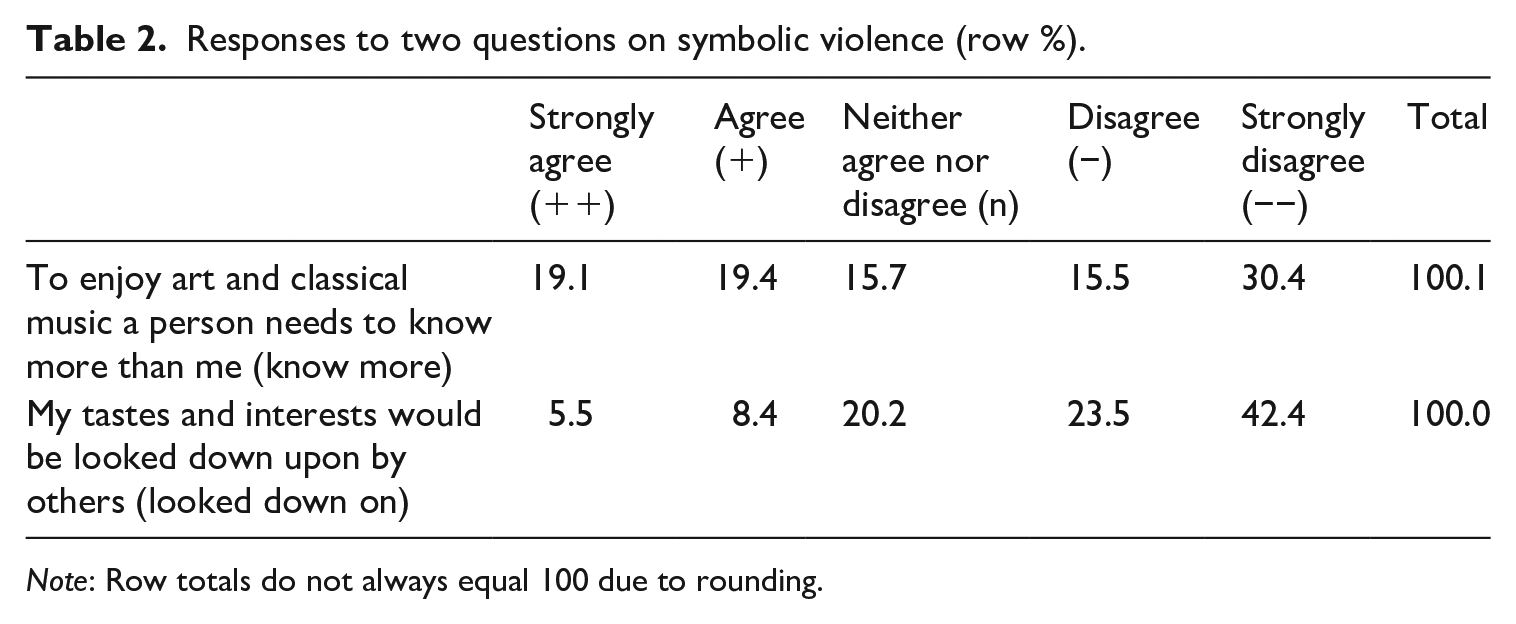
Note: Row totals do not always equal 100 due to rounding.
A space in three dimensions
The model of the Swedish space of lifestyles is structured in three key dimensions. The prime axis scores a modified inertia rate of 42 and, when looking at the contributions of individual modalities, appears to oppose the exclusive, or emphasis on form, and the accessible (Tables 3 and 4). At one end of the axis, therefore, gather the explicative modalities signifying inaccessibility by dint of either symbolic mastery or money or else stress on appearance: high artistic knowledge, a taste for classical music and museums/galleries/jazz/classical concerts but also a proclivity for French/Japanese restaurants, smart or fashionable clothes and possession of luxury items. Although they are explained rather than explicative modalities, a taste for theatre, luxurious homes, vegetarian or Italian restaurants and watching little to no television are also associated with the pole. At the opposite end of the axis gather the indicators of affordability or distance from traditional finkultur: a preference for affordable clothes, possessing no luxury items, enjoying home maintenance or gardening and eating in traditional Swedish restaurants as well as lack of interest in classical music and lower knowledge of artists. Among the explained modalities corresponding with the pole are tastes for fast food or Chinese/Thai eateries, traditional homes, playing video games, going to the cinema and inexpensive cars.
Eigenvalues and inertia rates.
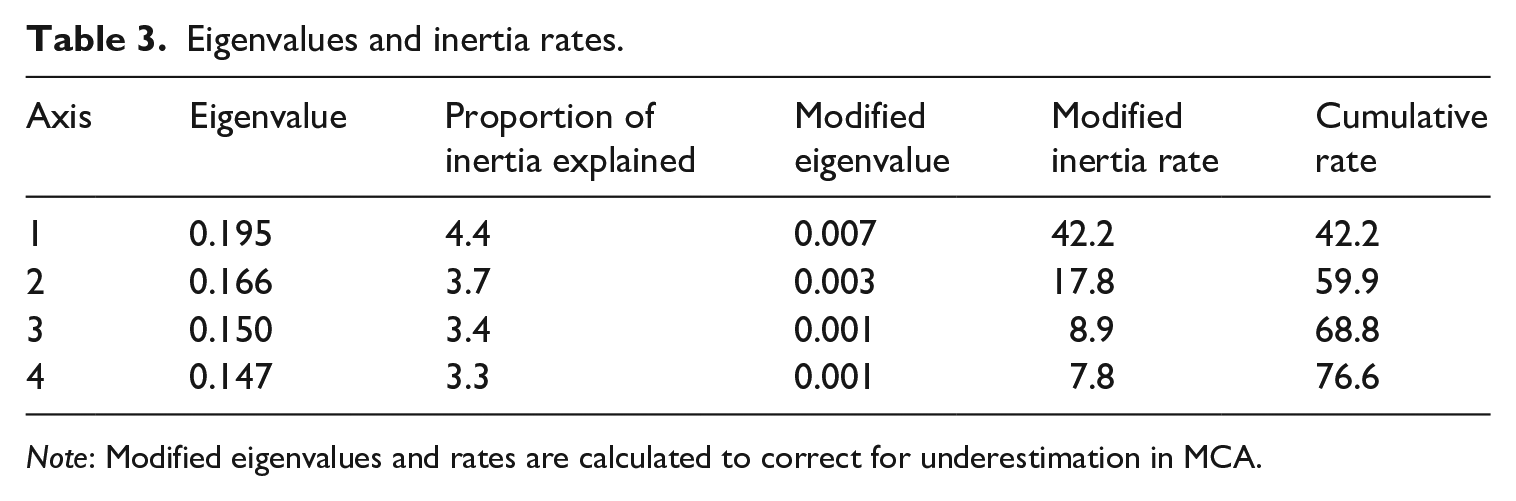
Note: Modified eigenvalues and rates are calculated to correct for underestimation in MCA.
Contributions of active modalities.
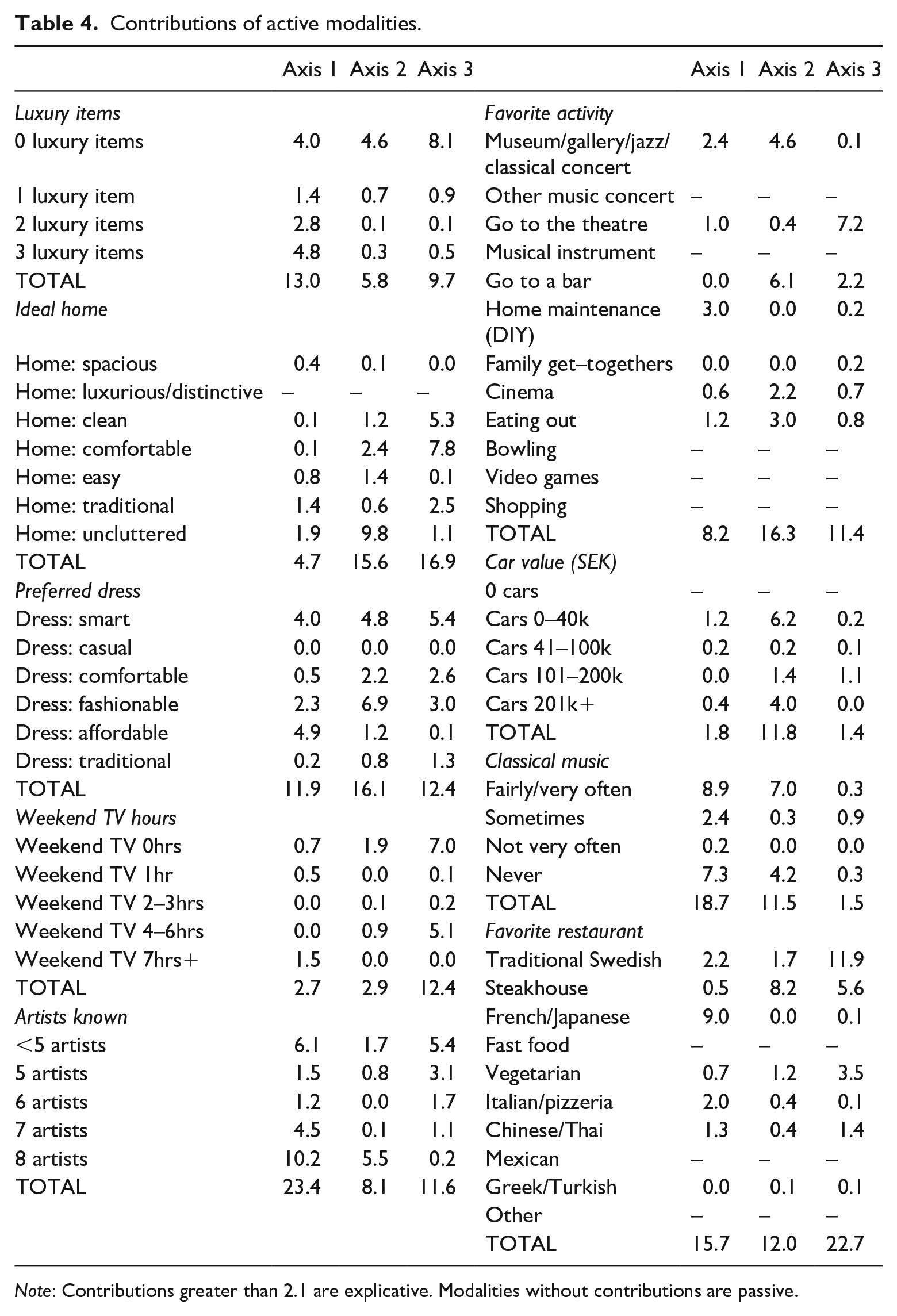
Note: Contributions greater than 2.1 are explicative. Modalities without contributions are passive.
The second axis bears a modified inertia rate of 18, bringing the combined figure for the first two dimensions to 60, and is defined by an opposition between, on the one hand, the culturally exclusive and distance from interest in appearance or luxury, and, on the other, modalities emphasizing form, economic exclusivity or, at this very least, activities unlikely to be counted as finkultur. On one side of the space, therefore, stand those with the most extensive knowledge of artists and preference for the sites and events of finkultur, but also those who prefer comfortable homes and clothes, own cheap cars and have no luxury items. Going to the cinema is also explicative at this end of the axis, but this is an ambiguous practice since it could include viewing big-budget blockbusters or art-house experiments. A love of theatre, not watching television and a preference for vegetarian restaurants – placing ethics above all else – are also associated with the pole. On the other side of the axis, meanwhile, are the tastes for smart and fashionable clothes, expensive cars, uncluttered (i.e. aesthetically pleasing) homes, eating out, dining at steakhouses (where the central ingredient is typically expensive) and going to bars as well as aversion to classical music. Although possession of three or more luxury items is not explicative, it too is associated with the pole.
Inspection of the plane of the first two dimensions makes plain the differentiation of explicative modalities on the second axis according to position on the first axis (Figure 1). The opposition between finkultur and luxury/expense, for example, distinguishes two versions of the emphasis on form and exclusivity, while the lower end of the space is characterized by a polarization according to exclusion from luxury or distance from finkultur. The middling-to-lower region of the space could be said to be comprised of an opposition between those focused on comfort, cheaper cars and cinema and those with expensive cars and a taste for eating in steakhouses and going to bars. One thing this makes clear is that cinema is not typically associated with conventional elements of finkultur.
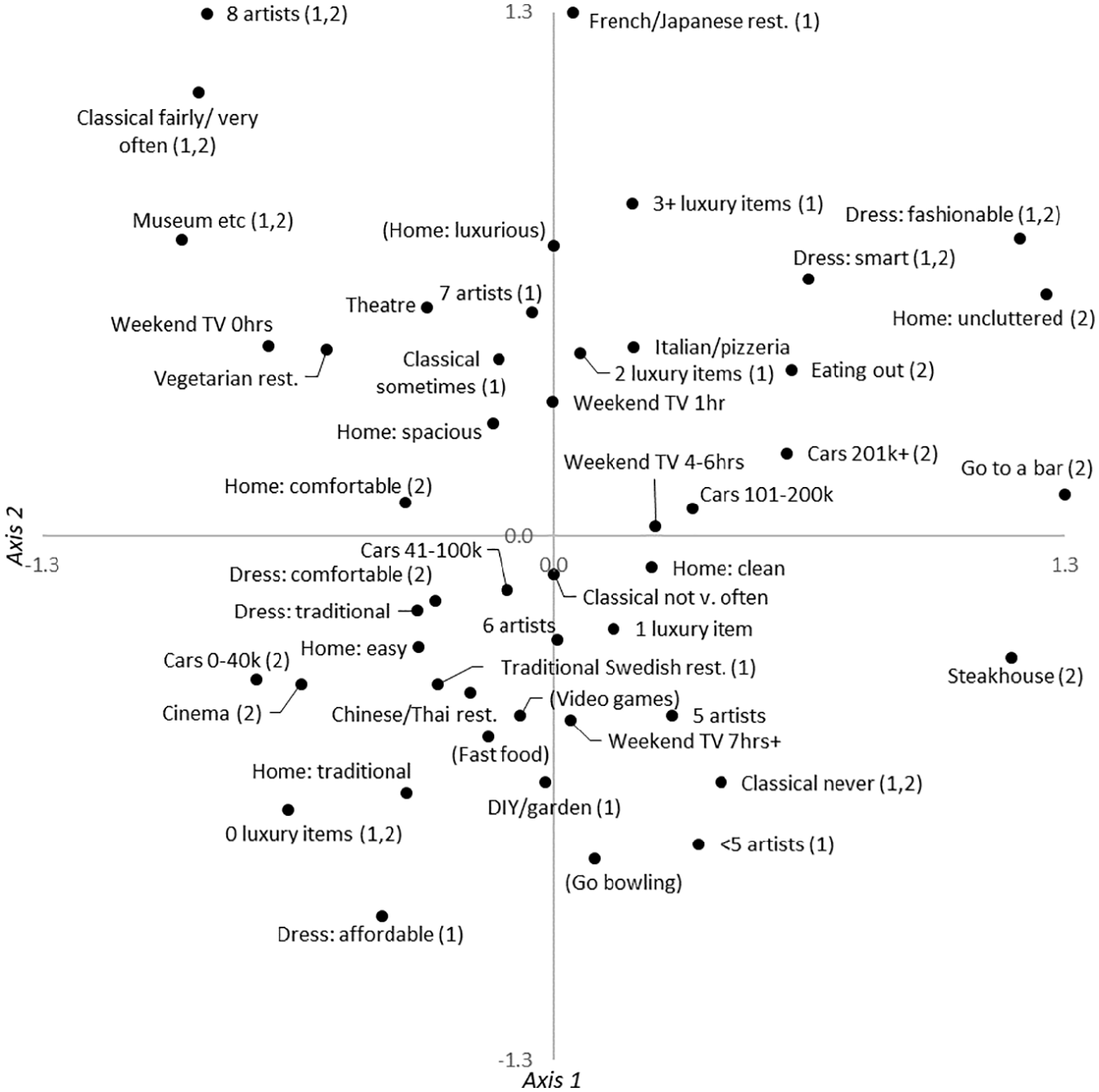
The Swedish space of lifestyles, axes 1 and 2.
Inclusion of supplementary indicators of lifestyle preferences in the space facilitates fuller characterization of the different regions (Figure 2). Thus it transpires that, as might be expected, those possessing individual symbols of luxury gather in the top-right region of the space, with ownership of tailored suits being most distinctive, but so too do those having undergone cosmetic surgery – re-emphasizing the focus on form/appearance – and citing tennis as their favorite sport to play (perhaps presupposing club membership and equipment). Those in the top-left are more likely to watch tennis, but also – as well as typically having the largest book collections – to watch and/or practice gymnastics, swimming, track and field and yoga/pilates. The bottom-right quadrant is populated by those sporting tattoos and owning few books, but also those interested in practicing or watching popular Swedish sports – i.e. soccer and ice hockey – as well as motor racing, with its emphasis on thrill. Those in the bottom-left region, finally, are more likely to refrain from sports altogether, though not watching sport is situated more in the middle of Axis 1, toward the cultural pole of the second axis. Scarcity of luxury goods in the sector is most marked by non-ownership of expensive jewelry/watches.
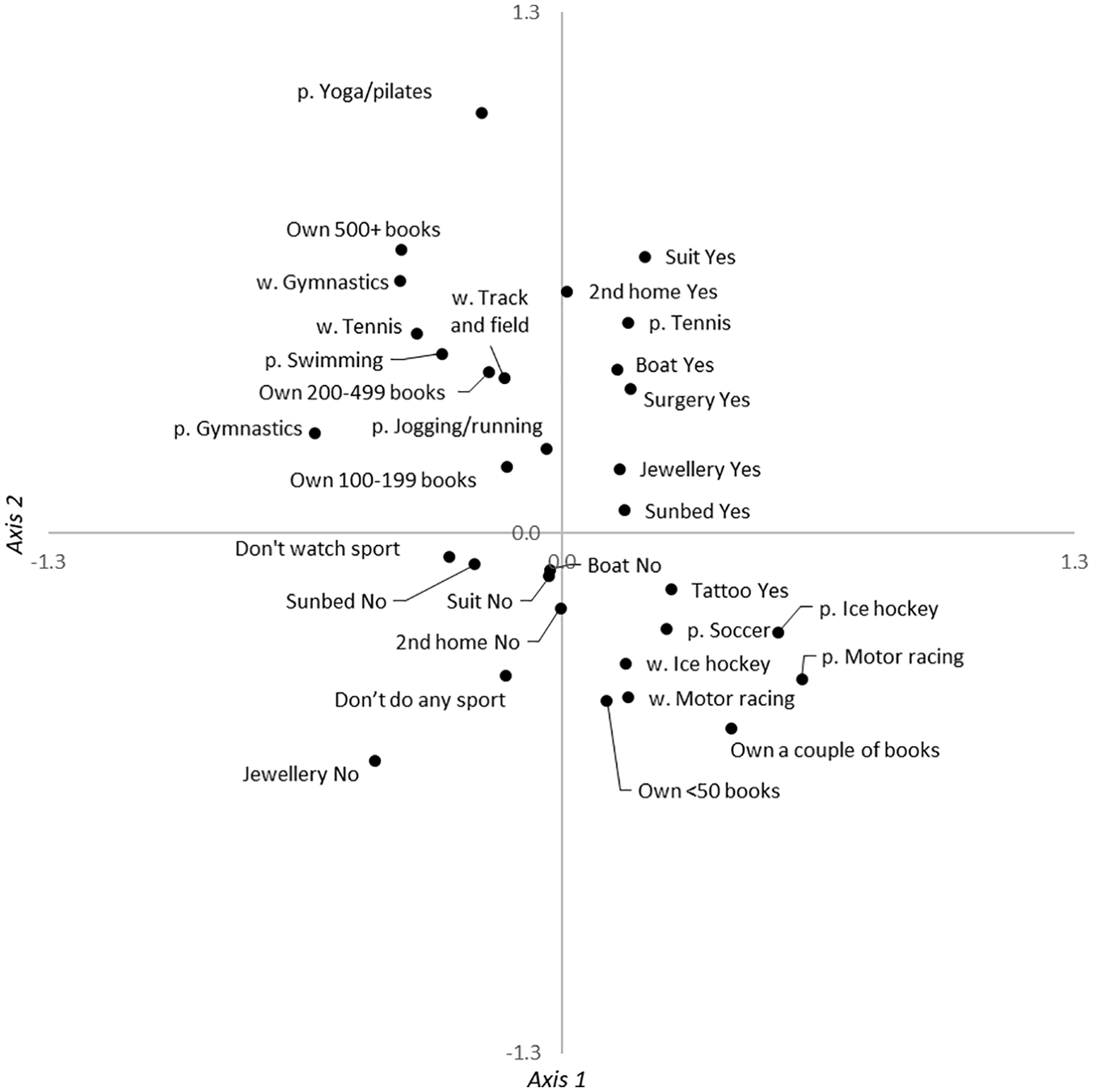
Supplementary lifestyle modalities in the plane of axes 1 and 2.
The third axis in the model has a modified inertia rate of nine – half that of Axis 2 – and is structured around an opposition between, on the one hand, those with a taste for traditional restaurants/homes and theatre and for smart dress, considerable television watching and (albeit weakly) possession of luxury goods to, on the other hand, those with no luxury items, a taste for vegetarian restaurants/steakhouses and abstinence from television and a preference for fashionable clothes and going to bars. It is, in other words, a variation on Axis 2 in which some modalities swap sides and are paired with previously opposed items. 2 The interplay with the prime axis – i.e. exclusivity/accessibility – is shown in Figure 3.
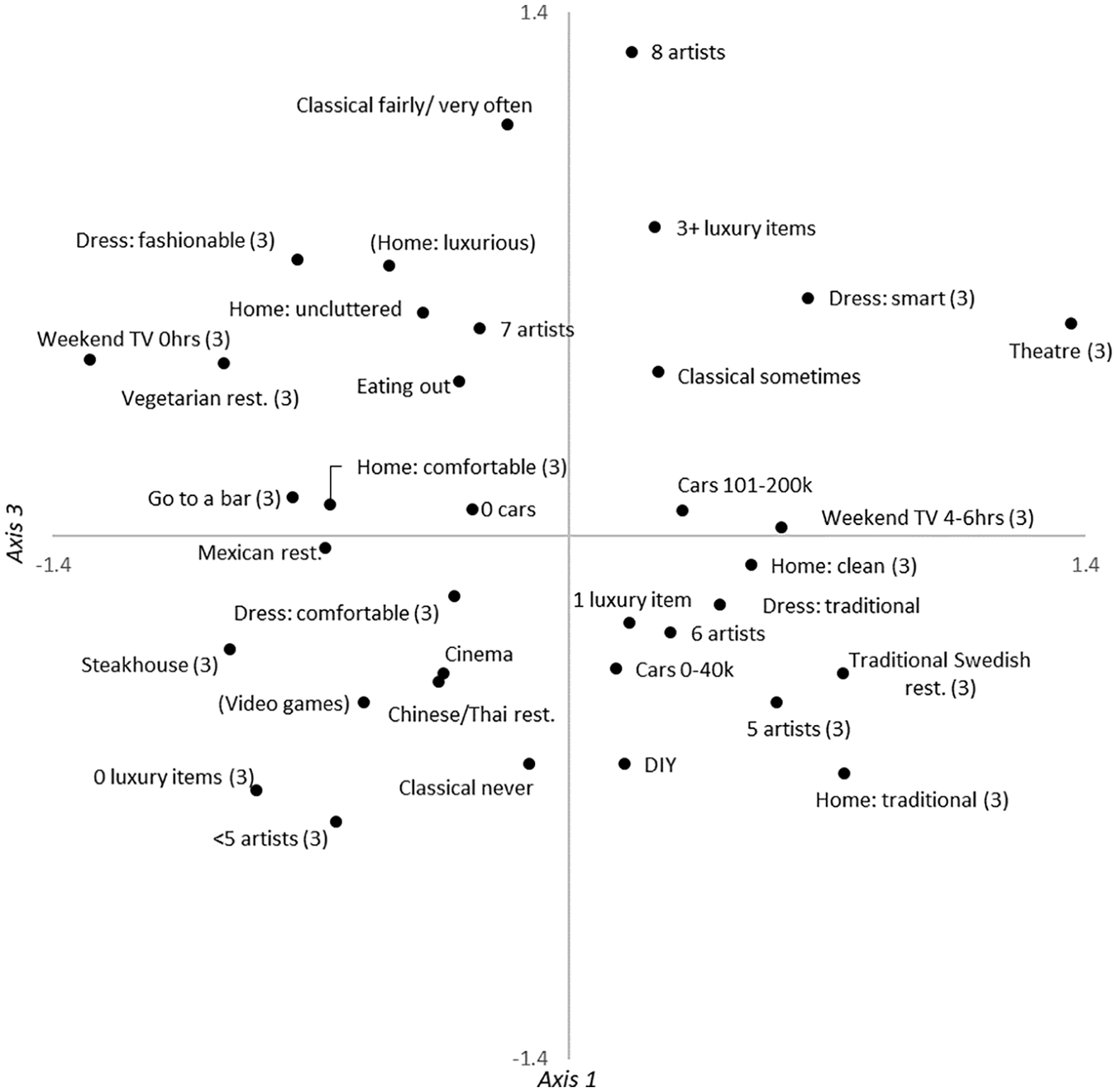
The Swedish space of lifestyles, axes 1 and 3.
The AHC analysis suggests that homogeneity and heterogeneity across the three axes of the lifestyle space are optimally summarized by six clusters, the coordinates and up to ten most distinctive lifestyle practices/possessions of which are listed in Table 5. The first cluster, judging from the coordinates, sits almost square in the middle of the space and is characterized by tastes popular in the sample as a whole: preference for comfort, Italian restaurants and family get-togethers, knowledge of six or seven artists, infrequent consumption of classical music and possession of two luxury items. These individuals might be said to represent commonplace, ‘middlebrow’ or otherwise non-distinctive tastes. Cluster 5, like Cluster 1, is located in the middle of Axis 1 and thus represents a variant on middlebrow taste. Its distinctive modalities and coordinate on Axis 2 indicate its constituents are oriented toward economic expense and appearance rather than finkultur, as well as going to bars, even if they tend to possess only one luxury item.
Features of the lifestyle clusters.
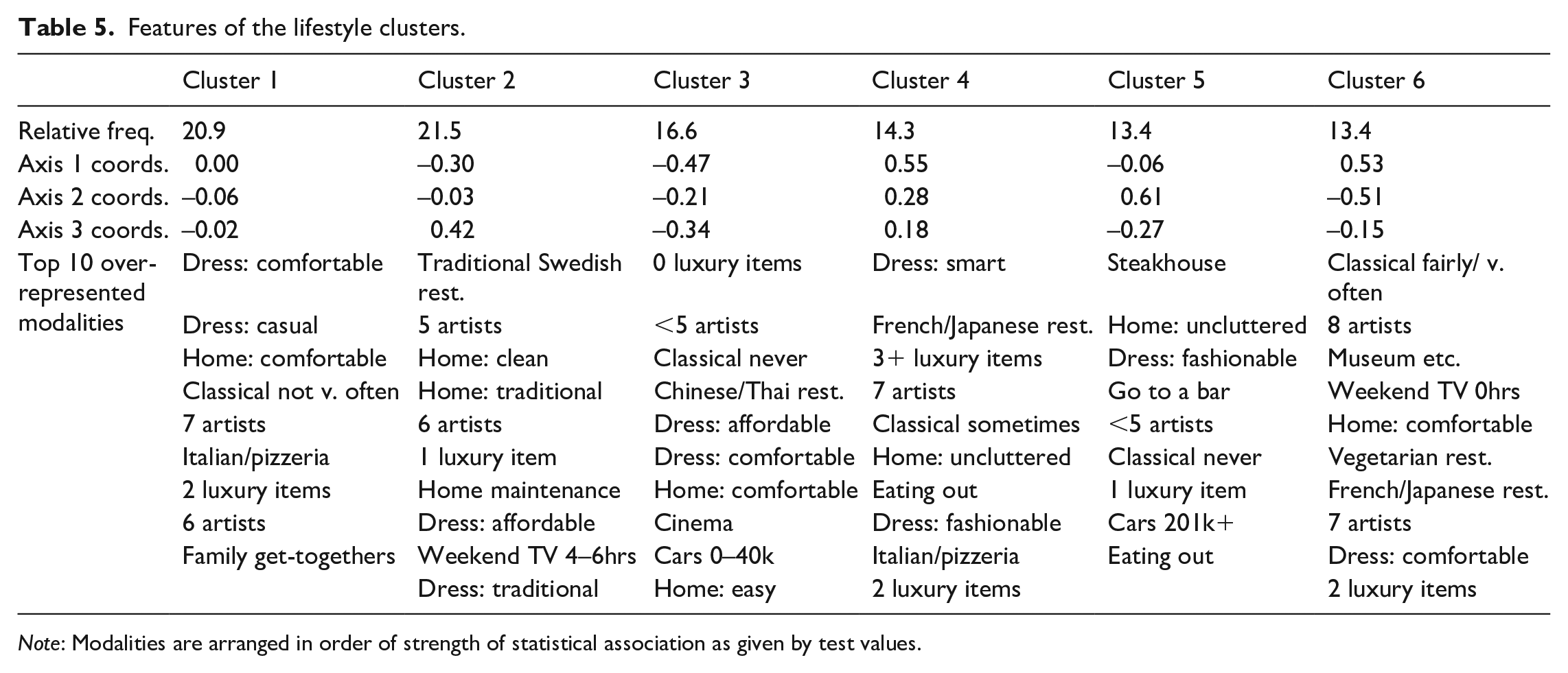
Note: Modalities are arranged in order of strength of statistical association as given by test values.
The second cluster, the largest of all, is marked by taste for tradition in all things, as well as cleanliness, affordability, watching television and undertaking home improvements, and lower artistic knowledge and possession of luxury items. Those in Cluster 3 are also typically oriented toward affordability, as well as comfort and ease, but are characterized by their greater distance from finkultur and materialistic consumption and a preference, instead, for going to the cinema. The coordinates on Axis 1 suggest that Clusters 2 and 3 are the major variants of the taste for the accessible. Clusters 4 and 6, conversely, represent the major species of the exclusive lifestyle. Cluster 4 is clearly oriented toward luxury and appearance, and only partially toward highbrow culture, whereas Cluster 6 is the cluster of finkultur (as well as comfort). Both share a taste for French/Japanese restaurants, though the mode of consumption – one valuing aesthetics while the other values exclusivity, for example – may vary (Jarness, 2015).
The social structuring of the space
Projection of the indicators of capital possession into the plane of Axes 1 and 2 as supplementary points confirms there is a degree of homology between the lifestyle space and the social space (Figure 4). The relationship is strongest on the first dimension, where capital in all its forms – income, wealth indicators, acquired cultural capital (education level) and inherited cultural capital (parental education, books in the childhood home) – follows an ascending trajectory. A partial exception is home ownership, since the modality for not owning a home is positioned above ownership of a modestly priced home. The opposition between exclusivity/form and the accessible, nevertheless, evidently corresponds with capital volume. Associated with this is a polarization of positions in the occupational division of labor: manual, skilled and personal service work are associated with low capital and, therefore, the accessible; managers and professionals gather toward the top of the space, associated with exclusivity; while socio-medical service workers and technicians sit more toward the middle, just below engineers/natural scientists and business-related professionals, respectively. Relatedly, working in finance, education and the arts are associated with exclusivity while employment in the extractive/manufacturing industries corresponds with lower capital and accessible culture. Women tend to be positioned higher in the space than men, too, though the standardized deviation between points (0.2) is not notable. Urban and rural residents, however, are much more strongly polarized across the axis (0.7).
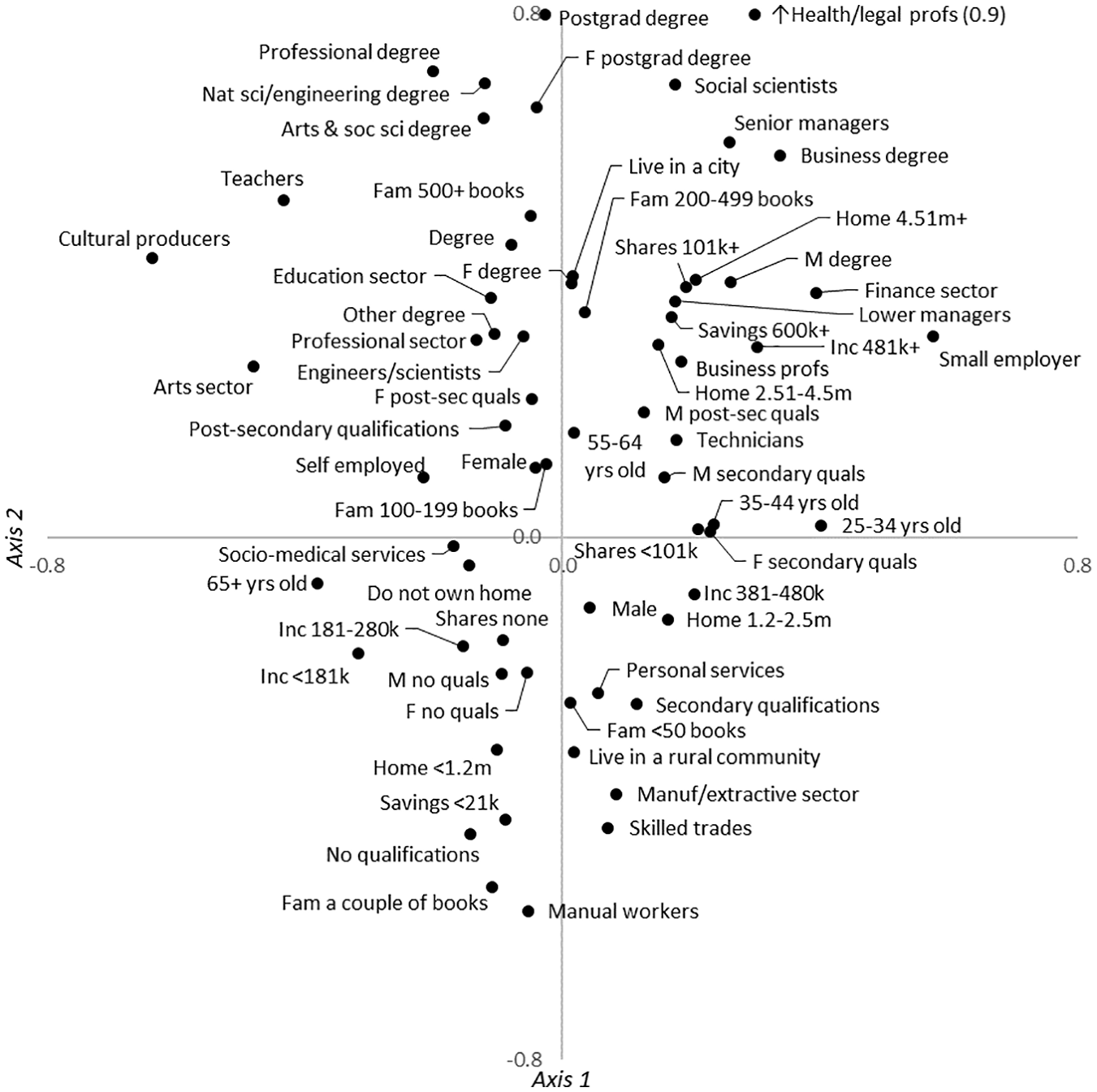
Indicators of social position in the space of lifestyles, axes 1 and 2.
The correspondence between capital and the second axis takes a different form: indicators of higher economic capital are pulled toward the right-hand side of the space while indicators of higher cultural capital and lower cultural capital sit more toward the middle of Axis 2 or just to the left. Capital composition seems to play some role, therefore, in differentiating finkultur from appearance-focused culture. By no means is its effect as strong as the force of capital volume – it appears particularly muted toward the bottom of the space – and, indeed, the coordinates of only a few of the modalities proxying cultural capital are statistically significant on Axis 2. Having a degree-educated mother, moreover, falls on the ‘appearance’ side of the space. More prominent, however, are the effects of socio-professional position and sector (or field): teachers, cultural producers and those otherwise working in the arts sector are closely associated with taste for finkultur, while small employers and those working in finance are associated with the taste for smart and fashionable clothes, eating out, expensive cars and so on. Although the coordinates of managers on the secondary axis do not quite register statistical significance, their distances from teachers and cultural producers are certainly notable (>0.4), and sometimes close to substantial (0.9 in the case of senior managers versus cultural producers). Similarly, level of acquired cultural capital is less important on the axis than discipline, since those with business degrees are associated with the top-right quadrant of the space and their distance from those with arts and social sciences degrees or professional degrees on the second axis notable (0.5). All in all, therefore, everything would seem to indicate that an opposition of fields, or at least positions in the division of labor of domination, and the necessary educational routes into them are fundamental to lifestyle differentiation in Sweden, and perhaps more fundamental than capital per se, at least as proxied here, given the relative egalitarianism and expansive educational provision of the nation.
There is more, however: the second axis is also closely related to age. More specifically, those aged 65 or over are positioned to the left of the space, close to the coordinates for tastes for comfort and tradition, while all other age groups gather on the right-hand side, where desires for fashionable clothes and going to bars are positioned, the younger age groups more so than the older ones. Three factors should be born in mind, though: first, three-quarters of the oldest age group are in the lowest income bracket, perhaps reflecting post-retirement diminution of income and, with that, an interrelation with capital; second, those aged over 65 are split along Axis 1 according to their cultural capital, with those possessing a degree corresponding closely with highbrow culture (coordinates 0.65 on Axis 1, -0.53 on Axis 2) and those not doing so located more in the zone of comfort and tradition (coordinates -0.27 on Axis 1, -0.34 on Axis 2); third, those in the 65+ category constitute a third of all those on the left-hand side of the space, compared with 25 percent of the sample as a whole, meaning that while they are certainly overrepresented on the left-hand side of the space, the pole is hardly reducible to the category. 3 Nevertheless, even with more nuanced and comprehensive variables than are typically available, age is still – as others have found before – a prominent feature in the structuring of lifestyle differences and, in particular, the taste for finkultur. Given that the chances of possessing a degree decrease with age – from 55 percent among 25 to 34 year olds to 34 percent among those aged 65 or over – it seems that age operates in part to offset capital composition as a structuring factor of the space without completely negating it.
The factors associated with Axis 3 are relevant here, however. For examination of test values reveals that those toward the traditional/smart pole tend to be older in years, and also marked by low acquired and inherited cultural capital, while those toward the non-luxury/fashion pole are younger but also non-home owners with some inherited cultural capital, i.e. degree-educated mothers and 200–499 books in the family home. 4 The interaction between age and capital composition, in other words, is split over two axes, in a manner similar to that discovered elsewhere (Atkinson, 2017), and the cluster analysis, condensing differences in inertia across the three dimensions into six classes, thus gives a sharper picture of the major fault lines (Table 6).
Top demographic features of the clusters.
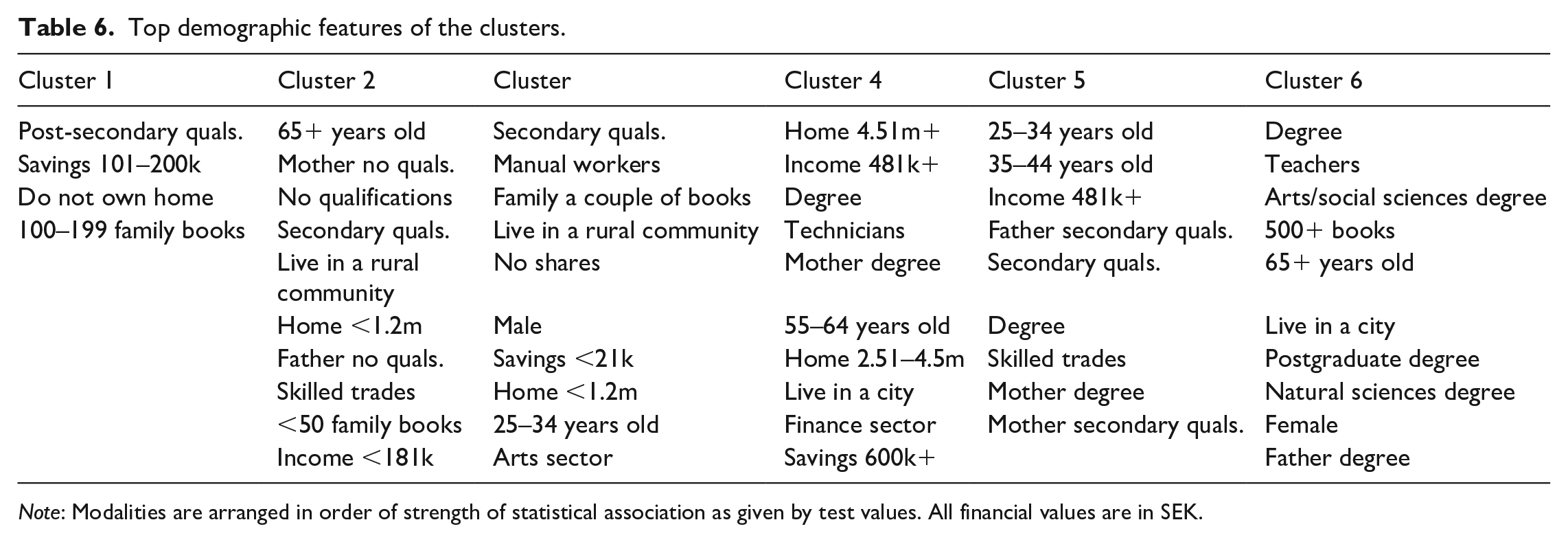
Note: Modalities are arranged in order of strength of statistical association as given by test values. All financial values are in SEK.
Cluster 2 (tradition/comfort) and Cluster 3 (accessibility), for example, as variants of the orientation toward the accessible, are both characterized by indicators of lower capital in all its forms as well as rural residence and skilled/manual work, but they are evidently divided by age. The two middlebrow clusters, moreover – Cluster 1 (middlebrow) and Cluster 5 (materialistic middlebrow) – are characterized by middling levels of capital, but those in the materialistic cluster are distinguished by not just their high income but their relative youth. Hence the conditions of possibility for expensive tastes but also the preference for going to bars. The two variants of the taste for exclusivity and form, however, are characterized by contrasting capital portfolios but similar age profiles. Cluster 4 (economic exclusivity) is typified by the highest indicators of economic capital, as well as some acquired and inherited cultural capital, while Cluster 6 (finkultur), overpopulated by women, is characterized above all by high inherited and acquired cultural capital but also a leaning towards arts and sciences and teaching as a profession. Yet people in both clusters, as well as tending to live in cities (in direct contrast to the non-exclusive clusters), are typically older in years. Without dispelling the effects of age in modulating taste, however, it is worth relaying the same caveat as in relation to the plane of Axes 1 and 2: Cluster 6 may be heavily populated by those aged 65 and over (they constitute 42 percent of the group) but it is not reducible to them (almost a quarter of the cluster are aged under 45, after all). What the cluster analysis seems to make clear, in sum, is that those at the bottom of the lifestyle space are separated more by age than by capital composition; that those in the middle are apparently separated by economic capital and age; and that those associated with exclusivity are marked by older years and high capital but split by capital composition. Put another way, the efficacy of capital composition relative to age in shaping the space of lifestyles appears to vary in relation to volume of capital.
Symbolic domination
We come, finally, to the question of symbolic domination. The six clusters, summarizing cultural difference most efficiently, experience this at different rates (Table 7). Regarding perceptions of cultural knowledge, first of all, the starkest disparity is, without a doubt, between the two clusters (4 and 6) representing exclusive taste and the rest. Around 45 percent of people in most clusters agree or strongly agree with the notion that one would need to know more than they do to appreciate art and classical music – which, given the hierarchization of lifestyles, implies a sense of deficiency – compared with only around a quarter of those in the exclusive clusters. Perhaps surprisingly, given the contrasting rates of consuming classical music and other ‘highbrow’ forms of culture, there is little to separate the money/appearance-focused cluster form the finkultur cluster. The economically advantaged are evidently confident enough in their knowledge to believe that they appreciate ‘highbrow’ culture sufficiently without necessarily engaging with it all that often or enthusiastically. If they do not engage with it more thoroughly, in other words, it is not because of a perceived lack on their behalf.
The distribution of symbolic violence across clusters (column %).
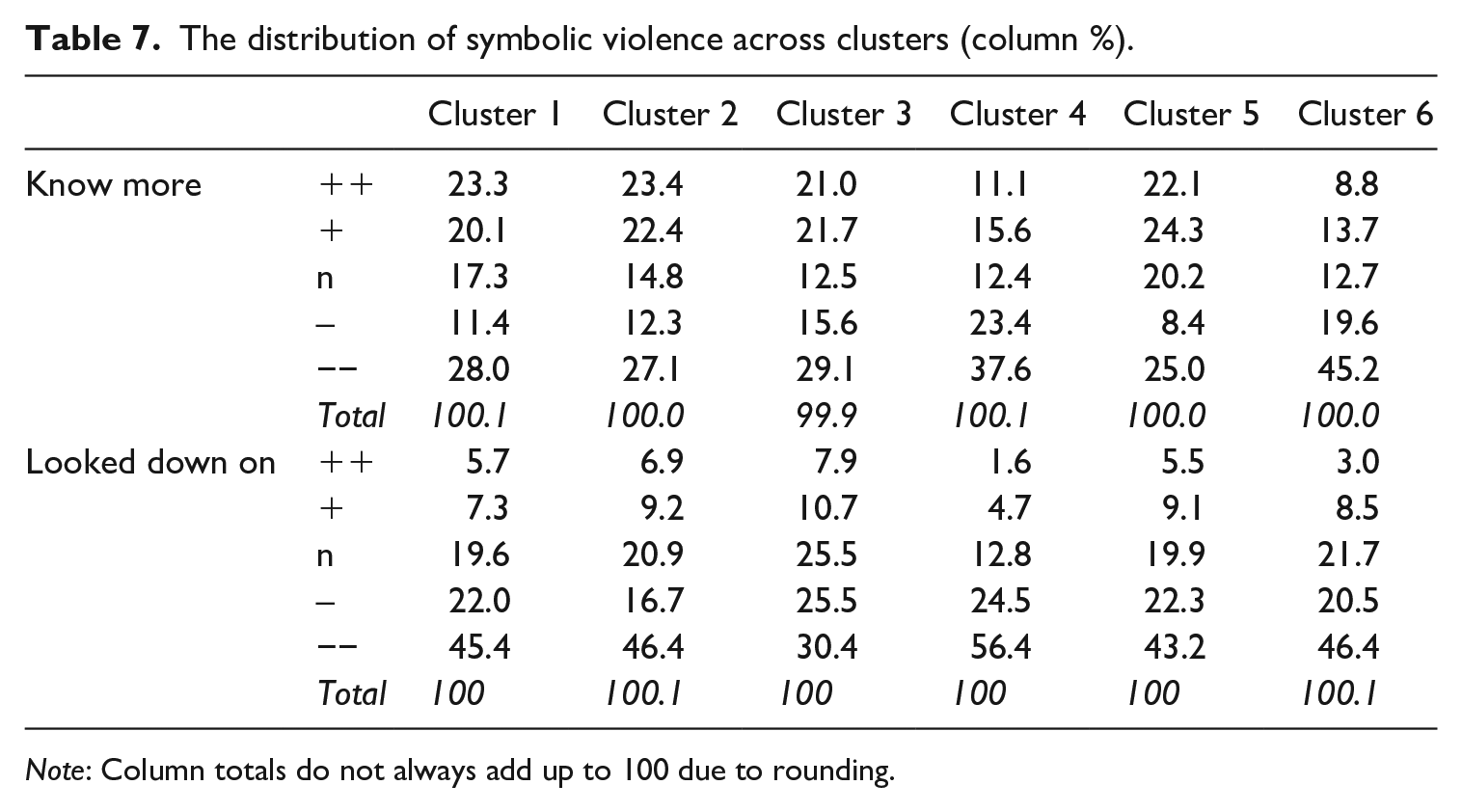
Note: Column totals do not always add up to 100 due to rounding.
A slightly different pattern emerges when it comes to the sense of being looked down upon by others. Although few agree with the idea across the board, let alone strongly agree with it, those in Cluster 3 – the most capital-deprived, younger cluster – are the most likely to. Almost a fifth do, in fact, and when combined with the potentially defensive or uncertain ‘neither’ category it transpires that 44 percent are unable to bring themselves to deny the proposition. Those in the finkultur cluster, however, are not their polar opposites in this regard. It is, instead, those in Cluster 4 – the economically advantaged and materialistic/appearance focused – that are the least likely to agree (6 percent) and most likely to disagree (81 percent) with the idea that they would be looked down upon by others, while the finkultur cluster displays a response pattern comparable to others. Everything would seem to indicate, therefore, that symbolic dominance here revolves more around the possession and display of ample economic capital than cultural capital, even if cultural capital certainly equips people with confidence in their knowledge. Could it be that this is a sign of the dominance of the economic fraction of the dominant class within the contemporary Swedish field of power – a dominance manifest not only in the progressive neo-liberalization of politics to serve their interests but a valorization of materialism, economic ‘success’ and the lifestyle of the rich as the benchmarks for judging a person’s value?
Conclusions
The space of lifestyles in Sweden is structured according to principles similar to those uncovered 40 years ago, in a different corner of Europe, by Bourdieu. Unlike many contemporary studies – including a previous analysis of Sweden – the prime dimension of difference is not engagement/disengagement, which says more about the definition of culture in existing surveys than anything else, but an opposition between the exclusive and the accessible. The second dimension opposes cultural exclusivity to economic exclusivity, the former being related to tastes for comfort or ethics and the latter being tied to a specific emphasis on surface appearance, while a third offers a variant on the second in which some practices exchange poles.
Analysis disclosed that the first axis corresponded with capital volume. Capital composition was certainly a crucial factor on the second axis, with those holding greater volumes of economic capital being associated with economic exclusivity and distance from finkultur. However, it was the discipline studied at the tertiary level and the position in the division of labor of domination that were the strongest differentiators along the second dimension, as if to suggest that level of education alone is no longer such a salient principle of internal division among the dominant class given the expansion of tertiary education across Western social orders, Sweden included. Moreover, polarization along the second dimension was heavily entangled with age, with traditional ‘high’ culture being associated with older age while the culture of expense and appearance was associated with (relative) youth, despite the specific array of active variables and refined indicators of capital possession available. The third axis was even more closely related to age, and it took the cluster analysis to determine that the shape of the space reflected the fact that the force of capital composition, and its affiliated characteristics, in differentiating lifestyles relative to age varies in proportion with volume of capital – a finding that recalls Bourdieu’s (1984) assumption of greater homogeneity of capital and related tastes among the working class as well as findings from the UK regarding gender (Atkinson, 2018). This does not mean that there are no differences by capital composition among the dominated – mapping the Swedish social space and documenting the correspondences of lifestyle indicators (the reverse of the method adopted here) would be necessary to determine that – only that, if there are, they are seemingly outweighed by age-based divergences in a way not seen among the dominant when it comes to the determination of the space of lifestyles.
Perhaps the most important finding is that the space of lifestyles in Sweden is systematically bound up with symbolic domination. Those with less capital, and especially those with less cultural capital, are both the furthest removed from legitimated highbrow culture and the most likely to see that distance as a product of their own lack of symbolic mastery – a form of power the unequal distribution of which is maintained intergenerationally by the education system. Despite it being a minority sentiment, moreover, it is those at the bottom of the class structure, exhibiting a lifestyle adapted to necessity and practicality, that are the most likely to feel themselves looked down upon, to ‘know their place’, to sense their tastes and interests are considered inferior to others, no matter how much they earnestly pursue them. Yet confidence in one’s tastes and practices – the ‘sense of distinction’ – is more common among those displaying the symbols of financial success than those pursuing highbrow culture, indicating not only the multidimensionality of symbolic domination but the dominance of the economic fraction of the dominant class. Given that the surging fortunes of the latter in Sweden with the neoliberal turn are, as Thomas Piketty (2014, 2020) has shown, part of a larger story of economic polarization in Western societies over the course of the 20th century and beyond, there is every reason to believe that this confidence attached to economic capital, and the lack of confidence its dispossession generates, will hardly be a peculiarity of ‘the elongated country’.
Footnotes
Funding
The author disclosed receipt of the following financial support for the research, authorship, and/or publication of this article: The research on which this article is based was funded by the European Research Council (ERC) under the European Union’s Horizon 2020 research and innovation program (Grant agreement No. 677055).
