




Abstract
In the Chinese context of a stratified higher education system and significant urban–rural inequality, rural students are generally facing constrained possibilities for social mobility through higher education. Despite these structural constraints, some exceptional rural students, like all the participants in this research, manage to get themselves enrolled in the urban university. Drawing on participants’ subjective narratives about their first encounters in the urban university, I argue that the rural students in this research were confronted with two levels of habitus–field disjunctures, namely, the rural–urban disjuncture and academic disjuncture. Then, through examining participants’ narratives about their hysteresis effects and emotional suffering, I suggest the sense of feeling lost and inferior reveals how various types of domination in the external structure of the field of the urban university play a part in affecting rural students’ inner emotional worlds.
Introduction
The role higher education plays in processes of social mobility is a central concern for researchers and policy makers around the world. This is especially true in China, where the country’s social, economic, and political environment has gone through significant changes since the Reform and Opening-Up policy in 1978. One year before this, the College Entrance Examination (CEE) was restored after a 10-year suspension, which marked the beginning of widening higher education access in China and the growing importance of meritocracy in enrolment. Since then, the higher education system has continued to expand, and many rural students have managed to change their life trajectories through higher education (Lin and Wu, 2010). However, inequality and stratification within China’s higher education keep increasing, and the state has itself initiated the reinforcement of stratification within the higher education system. During the expansion, public resources have been disproportionately assigned to a few top universities, in order to secure China’s positional advantage in the global competition for a knowledge-based economy (Lall and Vickers, 2009).
Although higher education expansion has been widely considered a useful tool for moderating social stratification (Haveman and Smeeding, 2006), some researchers have shown that the expansion of higher education has actually intensified and reinforced educational inequality in some developing countries (Buchmann and Hannum, 2001). In the UK context, higher education expansion has been found to widen rather than bridge participation gaps (Boliver, 2011). In China, scholars have found that the rapid massification of higher education systems has failed to reduce educational inequity (Luo et al., 2018). According to a study, rural students accounted for 11% of the total student body at an elite university located in Beijing in 2009, while the population registered as rural residents accounted for 52% at that time (Lu et al., 2016). Thus, for rural students who are the first in their family, or even the first in their village, to enrol in an urban university, their journeys to the university include a series of massive changes and successive challenges.
Rural students in Chinese higher education
When talking about rural students in China, it is necessary to discuss the hukou (household registration) system and its impacts on rural students’ access to educational resources and on their life trajectories. The major purpose of the household registration system is to differentiate between residential groups, and allow the government to control population mobility and shape state developmental priorities (Cheng and Selden, 1994). As hukou provides the ‘principal basis for establishing identity, citizenship and proof of official status, it was essential for every aspect of daily life’ (Cheng and Selden, 1994: 644). With the advent of rapid urbanisation and industrialisation in China, the long-existing inequality between urban and rural areas has strengthened significantly in terms of income, subsidies, and welfare benefits, as well as levels of educational investment (Chan, 2009; Qian and Smyth, 2008).
In terms of the socio-economic constraints caused by the hukou system, there are several associated factors shaping the disadvantaged situation many rural students find themselves in when considering their educational trajectories. First, rural students’ parents tend to have much lower educational levels compared with their urban peers. According to Wu’s (2013) research based on an analysis of the Chinese General Social Survey in 2008, since the restoration of the CEE in 1978, the impact of a father’s education level has increasingly affected the college attainment of his children. Second, limited educational resources are allocated to rural areas. Schools providing basic education in urban cities are generally much better equipped with teachers and facilities than the rural schools (Liu, 2008). Third, rural students’ hukou status and financial difficulties restrict their opportunities to attend urban high schools, where the education is considered to be of a higher quality (Tsang, 2002). Therefore, in key national universities, the number of rural students is shrinking, while more rural students are enrolled in provincial or local institutions with a lower academic reputation and quality of provision.
Such a context – a stratified higher education system, significant urban–rural inequality, and a strong likelihood of students in rural areas having disadvantaged family backgrounds – shapes rural students’ constrained possibilities for social mobility through higher education qualifications. Despite these structural constraints, some exceptional rural students, like all the participants in this research, manage to get themselves enrolled in the urban university. The existing literature examining Chinese rural students through a Bourdieusian conceptual lens has often focused on rural students’ social mobility process after entering urban universities (in most cases, elite ones), emphasising the confrontation between ‘disadvantaged rural dispositions’ and the dominant position of the urban field (Li, 2013; Postiglione et al., 2017; Xie, 2016). In some cases, studies draw upon the notion of working-class habitus to understand rural students’ experiences, and imply a Western and/or urban analytical perspectives without sufficiently recognising the complexity and distinctiveness of the Chinese rural context (Jin and Ball, 2019).
Those studies have provided useful explorations of the application of Bourdieu’s conceptual tools to the Chinese context; however, they have, to varying degrees, overlooked the significant differences between urban–rural disparities in China and class inequality in the Western context. Therefore, I argue, it is critical to reflect on the context carefully when adopting habitus to understand rural students’ encounters. This research applies Bourdieu’s conceptual tools, particularly habitus and field, to explore those exceptional rural students’ ambivalences and struggles in their first encounters with urban–rural differences. Furthermore, I argue, rural students’ journey of entering into an unfamiliar urban university field entails two habitus–field disjunctures, which lead to rural students’ hysteresis effects and emotional suffering to varying degrees.
Habitus–field disjuncture, hysteresis effects, and suffering
Habitus, as
As two ‘interrelated and interpenetrating’ concepts, the discussions of field and habitus have premised the enduring changes in the relationship between the two (Hardy, 2014: 126). As agents are mobile within and across fields, habitus is constantly structuring and restructuring itself in response to new experiences in a changing field (Bourdieu, 2000). However, as the transformation of habitus takes time, and may never be total, a certain extent of mismatch is inevitable as a result of changes, labelled as the hysteresis effect of habitus, indicating ‘the structural lag between opportunities and the dispositions to grasp them’ (Bourdieu, 1977: 83).
Usually concurrent with the hysteresis effect (or, in some cases, caused by it), moving across different fields can generate suffering to varying extents. Bourdieu (2000) once talked about how forms of bodily emotions and visible manifestations reveal how limits are enacted upon the dominated:
The practical recognition through which the dominated, often unwittingly, contribute to their own domination by tacitly accepting, in advance, the limits imposed on them, often takes the form of bodily emotion (shame, timidity, anxiety, guilt) . . . it is betrayed in visible manifestations, such as blushing, inarticulacy, clumsiness, trembling, all ways of submitting, however reluctantly, to the dominant judgement . . . (pp. 169–170)
Thus, as Reay noted (2015: 10), adopting a psychosocial understanding of habitus ‘allows for a better and richer understanding of how the exterior – wider social structures – is experienced and mediated by the interior, the psyche’. As applied in empirical research, Ingram’s (2011) research on working-class boys unveiled their psychic costs in the process of accommodating the misalignment between their identity based on their class background and their identity as an aspiring student. Friedman’s (2016) research on upwardly mobile working-class students suggested that the unending effects of individual hysteresis and a dislocation of habitus and field could lead to a divided habitus and ‘a painfully fragmented self’ (p. 132). Similarly, both Cieslik and Simpson (2015) and Stahl (2013) documented the hidden injuries and psychic costs derived from class domination across the life course. In addition, Abrahams and Ingram’s (2013) research provided a positive understanding of local students’ movement across multiple fields. They argued that those students could occupy the position of a ‘third space’, which might enable them to develop coping strategies and negotiate internal conflicts.
In the China context, Xu (2017) examined Chinese mainland students with rich economic and cultural capitals encountered with differential capital valuations in an elite Hong Kong university, and uncovered how habitus–field disjuncture revealed itself in a transborder context. Xie and Reay’s (2019) longitudinal research on academically successful rural students at four Chinese elite universities revealed ‘habitus transformation’ and ‘habitus hysteresis’ derived from the ‘compartmentalized fit’ between the students’ previous habitus and the exclusive field of top universities (p. 2).
Drawing upon Bourdieu’s conceptual tools, I intend to delve into the following two major themes in this article. First, I aim to focus specifically on rural students’ subjective perceptions of their mobility trajectories to investigate what kinds of habitus–field disjuncture (if any) they had encountered when entering an urban university. Second, through the theoretical lens of hysteresis effects and emotional suffering, I intend to examine participants’ narratives about their sense of feeling lost and inferior, and explore how various types of domination in the external structure of the field of the urban university play a part in affecting rural students’ inner emotional worlds.
Research method
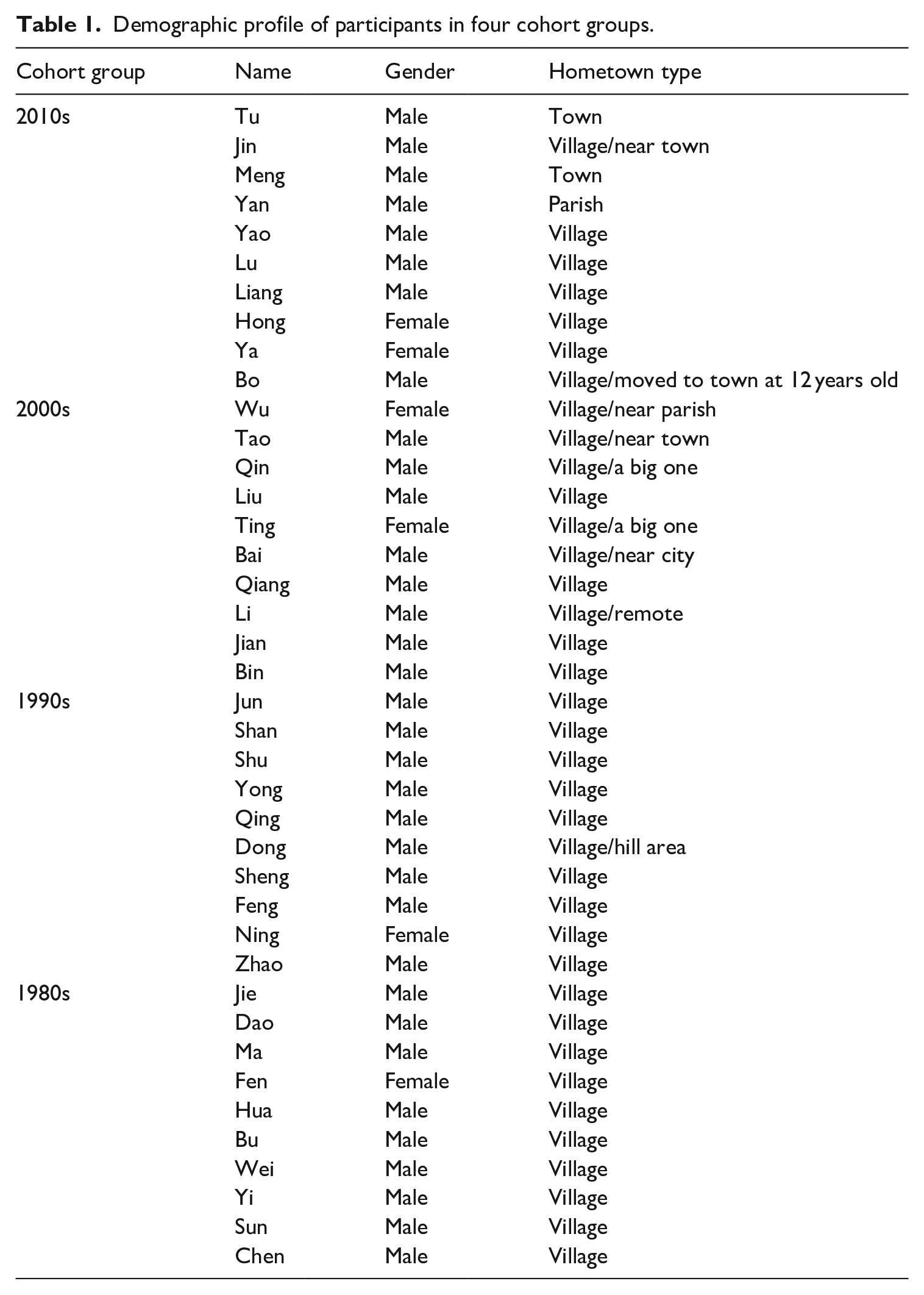
This research reports part of the findings of my PhD project on rural students’ social mobility trajectories in China. This research followed ethical guidance by the British Sociological Association, and the data collection was approved by the Research Ethics Committee of my affiliated institution. In 2018, I conducted semi-structured interviews in several cities such as Beijing, Shanghai, and Ji’nan in China. Through online advertisement, contacting town fellow associations, and snowballing, I recruited 40 university students who graduated in the 1980s, 1990s, 2000s, and 2010s, and who were now working in cities, to participate in this research. Considering the significant regional disparity between different provinces in China, this research only recruited participants originally from rural villages in one province, Shandong, because around half of the population in Shandong is registered as having rural residence, and there is a local atmosphere favouring social mobility through education, as Shandong is the birthplace of Chinese philosopher Confucius (Kipnis, 2011). The participants were further categorised into four cohort groups, with 10 participants respectively in each group. All of the participants were born and brought up in rural areas (including villages, parishes, and towns), and they had graduated from public universities and been awarded at least bachelor’s degrees. The participants’ demographic profile is shown below in Table 1. All the quotes in this research were transcribed and translated by me from Mandarin to English. I tried to keep the participants’ original meanings as much as I could, but a certain amount of information and emotion was inevitably lost in translation. Synonyms replaced all participants’ name to avoid identification of the participants.
Demographic profile of participants in four cohort groups.
In addition, a life history approach was applied to the qualitative data collection and analysis. According to Miller et al. (1996), ‘life stories’ can be described as individuals’ personal versions of their own lives. As the purpose of a life history approach is to explore the participants’ own perceptions of self and the social world, it is the discovery, in detail, of ‘what happened’ according to eye witnesses as well as ‘the inner experience of individuals, [and] how they interpret, understand, and define the world around them’ (Faraday and Plummer, 1979: 776). Therefore, the life history approach is consistent with the intention of this research to understand a cultural milieu and social world through personal narratives, and to grasp how the social context influences both narrators’ experiences and the narratives they construct. It allowed the research to provide individual and collective accounts of the educational and structural inequality in China, and brought notions of structure and agency together.
Findings
In this section, I draw on Bourdieu’s conceptual tools to analyse rural students’ encounters in the urban university. I found that most of the participants in this research experienced a varying degree of misfit due to the habitus–field disjunctures caused by their mobility from a rural school to an urban university, such as various manifestations of hysteresis effects and emotional suffering. In further exploring the dislocation of habitus and field experienced by rural students, I identified two levels of habitus–field disjunctures from their narratives, namely, the urban–rural disjuncture and the academic disjuncture. In the following analysis, I will first elaborate on habitus–field disjunctures to provide more contextual information about rural students’ mobility journey, and then move to further discussions on their hysteresis effects and emotional suffering in the urban university.
Urban–rural disjuncture
Given the complexity and stratification of the Chinese context, both the rural educational field and the urban field are not homogeneous but contain hierarchies. Due to the diversity of the participants’ origins and the destinations of their mobility trajectories, the participants in this research had achieved substantial and differentiated mobility within and across the urban field and the field of power. In order to unpack the urban–rural disjuncture further, I identified two interrelated and interpenetrating dimensions that co-affected rural students’ sense of unfamiliarity: metropolitan and cultural (geographical).
In terms of the metropolitan dimension, most participants in this research were born and raised in rural villages, located in mountain areas and close to farmland, which is both geographically and culturally distant from metropolitan life. Many of the participants had never been to a ‘real’ city before university. Access to a metropolitan lifestyle and knowledge brought both excitement and anxiety to participants to varying extents. Below is Bai’s (2000s
1
; Table 1) narrative of his first impression of a city:
When I arrived in Shenyang [city name], it was the first time I felt the city, because . . . in Ji’nan [city name], the campus was in the suburban area. I didn’t know what the city looked like. But here . . . when I walk around the campus, I suddenly felt, ‘This is the city’.
In the past, Bai had been to the city but he had never lived in a city-like environment before. After arriving at this university campus located in the ‘real’ city, he used the word ‘felt’ twice in the above excerpt, indicating his embodied and affective experience of being in a city. Drawing upon his previous undergraduate study experience in a suburban area, Bai had long been anticipating living in a city, which also worked as a driving force for him to study hard and get himself to a bigger city through further education.
However, for some other participants who went to the city for the first time, their lack of certain metropolitan knowledge brought a sense of nervousness and inferiority after a short period of initial excitement. For instance, when asked about his feeling on arriving at university, Yan (2010s; Table 1) shared his sense of embarrassment in the first few days:
I felt everything was quite embarrassing . . . I really don’t know anything, you know? When I first went there, you know there’s lift in the building, I don’t even know how to press the lift, that kind of feeling. After entering the lift, for example, if I want to go to the fourth floor, I don’t even know I should press the fourth floor [button] to go, just silly like that. I know nothing.
Yan’s narrative resonates with many other participants’ encounters in the city. As mentioned above, most of the rural students interviewed in this research were born and raised in rural areas where it was very rare to see or live in multi-storied buildings. The lack of basic metropolitan knowledge like ‘how to operate a lift’ (Yan, 2010s; Table 1) or ‘where the toilet is located’ (Fen, 1980s; Table 1) made them feel that they were losing a sense of agency in their life. Moreover, their previously accumulated knowledge related to farming and rural life was not valued in the urban field. Therefore, in the quote above, Yan blamed his own ‘silliness’ for this lack of metropolitan knowledge, and in this way, he internalised the urban–rural inequality and symbolic violence rather than developing his reflexivity against the unequal social structure penetrating his life.
In the cultural and geographical dimension, due to the scope of China and the diverse culture in different parts of the country, geographical migration is an essential dimension for understanding rural students’ mobility trajectories. In certain situations, geographical distance was closely related to cultural familiarity. For those participants who travelled more than 1000 miles to Southern China, both the local culture and dialect could be a challenge to them. For instance, Hua (1980s; Table 1) went to a top university in Southwestern China. He said, ‘In our class, about 60% are from the southwestern provinces . . . many teachers speak the local dialect in the lectures’. He missed home a lot and felt very lonely in a culturally unfamiliar context.
For participants attending a university within Shandong province, it was very likely that students from Shandong province would constitute the majority of their class. Liang (2010s; Table 1) went to the capital city of Shandong for his undergraduate study. When asked about his feelings going there for the first time, he said, ‘I don’t really have any special feelings . . . it’s not too different from our environment . . . Students are mainly from Shandong’ (Liang, 2010s; Table 1). Liang went to a second-class university mainly funded by the local government at the municipal level, where he felt a high sense of familiarity and belonging as a Shandong student. Thus, according to both Hua’s and Liang’s experience, the effects of crossing urban–rural disjunctures are significantly mediated by cultural and geographical distance.
Academic disjuncture
Based on the participants’ narratives, I considered that the mismatch between rural students’ habitus generated in the field of rural schooling and the field of urban higher education was itself one of the major disjunctures that rural students came across in their new field. To be specific, this disjuncture was caused by the abruptly changed degree of clarity and uniformity of the rules of the field as perceived by the rural students and a lack of corresponding resources to navigate the disjuncture.
As reported by most participants in this research, rural schooling generally features explicit and rigorous rules for students, with limited and restricted social space for improvisation, which has been documented in other empirical research on Chinese rural education (Kipnis, 2011; Kong, 2015). This might also be the case for urban high schools, but to a much lesser degree. From the participants’ narratives, I identified several commonly shared disciplinary approaches that were applied in rural schooling. Especially during high school, the highly intensive daily schedule, public rankings of scores in the school, and teachers’ active intervention in shaping rural students’ desire for university, all played a part in portraying meritocracy as the only and foremost concern for all rural students:
Since the first year, they [teachers] started to tell you, ‘If you don’t study hard, you might be weeded out’ or things like that, so from the first year to the last year [I] really had that feeling [of worry] about whether I would be weeded out by society. (Qiang, 2010s; Table 1)
At the beginning of high school, Qiang’s teachers gave a clear account of the rules and focus of the game and established a direct link between academic performance and chances for upwards social mobility. As time went by, Qiang tended to internalise the sense of competition and the fear of failing that was repeatedly illustrated by his high school teachers, and used it as a form of motivation for his own study. In this way, the teachers and students together, through the manifestation of meritocracy-oriented discipline, successfully turned the vague goal of ‘university’ into CEE scores and further divided the pursuit of academic success into daily manageable segments that could be handled, and into numbers that could be perceived and so measure progress. By ruling out non-study activities and squeezing the space for social interactions, the sole emphasis on effort and hard work gradually created uniformity of the field.
Moreover, the rigid schooling and discipline selected for and reinforced the ‘obedient’ part of rural students’ habitus. Many participants considered themselves as ‘obedient’ and ‘introverted’, which were regarded as virtues for achieving academic success in the context of rural schooling. Ning (1980s; Table 1) and several other participants explained their excellence in study as follows: ‘perhaps because I’m obedient. If teachers assign any homework, I’ll finish it earnestly’. The original word ‘obedience’ in Chinese is 听话 tinghua, which literally means ‘listen to the words’, and it also indicates ‘listening to seniors and teachers’. Drawing on rural students’ experiences before university, in their process of transiting from being part of a rural family to being the top students in their schools, their acquisition of dispositions in the educational system happened mainly through following teachers’ instructions. In this way, being obedient became an effective strategy that they applied to navigate in the field of rural schooling.
However, once in university, the field greatly changes. The emphasis on meritocracy and academic performance is diluted by various activities that yield more space for social interactions between students. In other words, the rules of the game become ambiguous, and there is no one there telling students what the goal is, and what to do. For instance, when asked about her anticipation of the future, Ting replied, ‘No, no career plan at all. No one has ever talked about it with me or transmitted to me this kind of stuff. My brain was completely blank’ (Ting, 2000s; Table 1). The diminishing clarity and uniformity of the hidden rules of the university made Ting and many other participants feel a sense of loss and confusion. Their previous strategy of being an obedient student did not work anymore, but this deeply embedded sense of ‘obedience’ still penetrated their lives. Ting attributed her sense of loss and confusion to not being given any instructions, which revealed that the strategy of obedience generated from her rigorous high school experiences did not fit anymore. In a given field, an individual’s strategy is structured within limits and opportunities, and determined by the amount of capital at the person’s disposal. Rural students first entering the university had not yet accumulated the resources to develop a new strategy like their urban peers to navigate the choices and ambiguity in the urban field.
Shan (1990s; Table 1) considered the intention to make a plan (or strategy) as one of the major differences between urban and rural students. When talking about his dorm mates from urban families, he said,
. . . The second difference is, in the future, when you graduate, what [are you going] to do. Perhaps there is still a gap [between urban and rural students]. Perhaps urban students will have this plan earlier . . . At that time [the 1990s], they probably don’t have a very nice plan, but they will have this intention. Like us [he and other rural students in his dorm], at least before the third year of the university, we don’t have any plan. I don’t know what to do. Perhaps more driven by interests, what I like to do.
In Shan’s narratives, what was enclosed in the idea of a ‘plan’ was the ability to grasp the rules of the game in the urban university and to strategise one’s trajectory to make the most of university life. However, as Shan noticed, rural students in his dorm were generally not able to identify the opportunities available in the field when they first arrived at the university. It took Shan two years to figure out what the rules were and how to play, while his urban peers came to the university equipped with a sense of the game and the resources to plan ahead.
Thus, in sum, I suggest there are two major challenges confronting rural students when they enter university. First is the diminishing recognition of meritocracy and the increasing complexity, diversity, and ambiguity of the field. Second is their lack of resources and capital to recognise the rules of the game and strategise their trajectories in the field of an urban university. In addition, it should be noted that this academic disjuncture is not exclusive to rural students. It might also apply to their urban peers. However, urban students may suffer this disjuncture to a lesser extent as there is less emphasis on discipline and hard work in urban high schools. Moreover, urban parents are more able to utilise their own cultural and social capitals to help their children to develop their strategies and navigate the disjunctures and further challenges in university.
Hysteresis effects
Given the circumstances of crossing rural–urban and academic disjunctures, I suggest that the rural students in this study were not equipped with the resources that would enable them to recognise the rules of game and navigate the changes they encountered when entering the new field of urban higher education. According to Bourdieu (2000), ‘in situations of crisis or sudden change . . . some of them, often those who were best adapted to the previous state of the game, have difficulty in adjusting to the newly established order’ (p. 161). Rural students in this research came across broadly similar situations when they first entered university. The dispositions they acquired and practised in their previous field were confronted with a far more complicated and diverse field. This ‘disruption in the relationship between habitus and field structures to which they no longer correspond’ usually causes the hysteresis effect and suffering (Hardy, 2014: 130).
As has been discussed in the section on ‘academic disjuncture’, some participants, like Ting and Shan, experienced a sense of loss and confusion due to the mismatch between habitus and field. As guided by their habitus generated from their previous rural schooling experiences, they hoped to look for advice or explanations given by authoritative figures to guide their university life, just as their teachers gave them in high school. However, the field in which they were located had changed greatly, and they lacked (access to) resources to help them develop certain strategies to navigate the field of an urban university. As a result of the hysteresis effect, they displayed a tendency to remain unchanged. As Hong (2010s; Table 1) commented, ‘I just go with the flow’ (Hong, 2010s; Table 1). Many participants preferred not to initiate changes.
For some others, their habitus generated from the past was so powerful that it penetrated the new field regardless of the change. ‘Studying hard’ was the hysteresis effect most widely reported by the participants, especially those who went to a top university or a university located in a first-tier city like Beijing or Shanghai. As the top students in their high schools, they were the ‘best adapted to the previous state of the game’ (Bourdieu, 2000: 161). Now, due to the prestigious status of their university, they usually needed to bridge a considerable rural–urban disjuncture and academic disjuncture. As a result of their powerful habitus, at the beginning of their university journey, the ‘habit of studying’ penetrated and pushed them continuously to work hard in university:
. . . [Before I went to the university,] I didn’t want to be that busy and tired anymore, I wanted to liberate myself, play whatever I wanted to play. But, in fact, perhaps there is the habit. In my first year, though there was no requirement to do so, at that time in the evening I’ll take my bag and study in the classroom. I feel the need to read books, I feel I need to learn something . . . In high school, because of the ranking, comparison, so the pace was quite intense. Later on, in the university, the pace was suddenly slow. I wasn’t quite used to it. (Bin, 2000s; Table 1)
Bin’s narrative displays a typical process of rural students’ experiences in the university. He felt the ‘pace’ of life has changed greatly since he got to the university and he felt ‘not quite used to’ the new ‘pace’ of university life. Although he wanted to ‘liberate’ himself from the hard work, as a result of his ‘habit’, he kept applying a hard-working strategy at the beginning of university. As . . . and when I was in my first year, because of the habit of study, I used to study very hard in the high school, so in the first year, it was actually quite easy to fulfil [the academic requirements]. But because I’m more familiar [with the environment/with classmates], in the second year, I didn’t study well. I always played during the lectures. (Qiang, 2000s; Table 1)
Qiang pointed out the reason why this ‘habit of study’ faded away. It was in the second year when he gradually familiarised with the environment and people around him. Till this point, part of his habitus had achieved certain transformations in responding to this new field, both consciously and unconsciously, which enabled him to feel safe to try a different strategy and pick up new dispositions. If we look back to his earlier experiences, when he was not familiar with the new field of the university, Qiang’s habitus tended to maintain continuity with his previous strategy and life values (dispositions). His choices unconsciously tried to protect his habitus from division and collapse under the shock of the new field, but he was not aware of the purpose of doing this.
Emotional suffering
Many participants in this research experienced crossing over the habitus–field disjuncture like a cultural shock in a foreign country, because what ‘they are objectively confronted with is too distant from that in which they are objectively fitted’, and this gives rise to negative sanctions (Bourdieu, 1977: 78). The majority of participants talked about their negative emotions in relation to their encounters in the field of urban universities, such as feelings of inferiority, fear, and being lost, lonely, and insignificant. Inferiority was the most frequently mentioned negative feeling during the interviews, and it was often associated with urban–rural differences in middle school, high school, and university as perceived by rural students. As in Bourdieu’s (1999: 716) words, ‘the most personal difficulties and apparently subjective tensions and contradictions reflect the deepest structures of the social world and their contradictions’. Rural students’ narratives of feeling inferior and the experiences related to this reveal how manifestations of an external structure are felt by the dominated in the body.
Apart from what has been discussed in the section on the ‘urban–rural disjuncture’, that rural students lacked metropolitan knowledge, their previous accumulated rural knowledge was devalued, and they felt out of place and sometimes excluded in the field of the urban university:
. . . like us who grew up in the rural village, because we don’t speak [standard] Mandarin, and I don’t look good, have no decent clothes, perhaps sometimes some of the rural students will have a kind of invisible sense of inferiority. (Hua, 1980s; Table 1)
As Hua and many other participants mentioned, I found dialect and clothes were among the most identifiable inscriptions of classed habitus. For some rural students in this research, the way they spoke and dressed made them immediately distinguishable from others. Figuring this out was a critical moment when they realised the university was seemingly not their place. Rural students’ reactions ranging from visible blushing to the ‘invisible sense of inferiority’ as articulated by Hua, are manifestations of submission to symbolic power. Rural students co-constructed the domination of symbolic power, but their submission was far from being voluntary. According to Bourdieu (2000), ‘this complicity is not granted by a conscious, deliberate act; it is itself the effect of a power, which is durably inscribed in the bodies of the dominated, in the form of schemes of perception and dispositions’ (p. 171):
In our dorm, everyone is financially different. For instance, the student specialised in basketball can quickly buy a laptop . . . the guy living next to me owned a guitar at that time. For our Shandong students . . . we barely have any knowledge about sports . . . we basically never touched a computer before . . . though now those differences look like nothing, but at that time, these tiny differences, I think actually affected people. It makes people feel inferior. (Qiang, 2000s; Table 1)
In the participants’ narratives, arts- and sports-related activities were often associated with urban or middle-class students’ privileges. As discussed in the section on academic disjuncture, rural students’ opportunities for developing extra-curricular talents were largely constrained by their tight study schedules in high school. Qiang talked about this enduring feeling of inferiority when living with his ‘talented’ dorm mates throughout university. He started by discussing his dorm mates’ financial situations, but he then quickly shifted the topic towards their cultural capital, such as the sports in which they specialised and the instruments they played. He seemed to build a direct link between economic capital and cultural capital and believed that only rich families could afford for their children to learn such talents. Not liking his dorm mates, who could gain attention easily through their talents, Qiang lacked a clear way to relieve his sense of inferiority and gain recognition:
The moment they stand in front of the crowd, their disposition and horizon, are completely not at the same level as me. From the outside – clothes – to inside, including . . . their logic, and their conversations with teachers, I realise I’m like the Ugly Duckling, returning back to the bottom, because I feel such a sense of inferiority, and they are so outstanding, and I don’t know how to strive for [improvement]. . . (Ya, 2010s; Table 1) . . . for rural students, the biggest issue, I think, is the psychological issue . . . once you go to the big cities, psychologically, there’s a sense of inferiority. This inferiority makes you . . . have no courage to do certain things, or sometimes don’t even think of doing it. (Dong, 1990s; Table 1)
Ya, Dong, and many other participants talked about urban students’ disposition, horizon, and interpersonal communication skills, which represent the most deeply embedded cultural capital and the manifestation of so-called urban habitus. As Ya herself clearly realised, disposition, horizon, and interpersonal communication skills are ‘rooted in your original family’, and Dong talked about the importance of family and early experiences in acquiring the ‘courage to do certain things’. Both of them were reflective enough to realise the conditions needed for developing and acquiring symbolic capital, and they seemed to submit to the unequal rule of domination. Bourdieu (2000) once argued, ‘produced by the transfiguration of a power relation into a sense relation, symbolic capital rescues agents from insignificance, the absence of importance and of meaning’ (p. 242). Thus, a lack of symbolic capital led both Ya and Dong to a sense of ‘insignificance and the absence of importance and of meaning’ to a certain extent, and caused an enduring feeling of inferiority and incapability.
However, very interestingly, in Ya’s narrative, she referred to a character in the fairy tale ‘The Ugly Duckling’ to describe her feeling of inferiority compared with people around her. The story of the Ugly Duckling is the story of a transformation of appearance, from unattractive to attractive and successful. Ya’s previous upwards mobility experiences had proven to herself her agentic power and her ability to change her life trajectory as she wished, though, in the excerpts above, she ran into temporary ambivalence again. The majority of the rural students who participated in this research managed to transform their habitus and better adapt to the urban field, in one way or another. The initial driving force was that they had the need and the will to accommodate the injuries and negative emotions that arose when they encountered the urban field.
Discussion and conclusion
Drawing upon Bourdieu’s conceptual tools of habitus and field, this research focused on rural students’ subjective social mobility experiences from rural villages to urban universities, and explored how habitus–field disjuncture, hysteresis effects, and symbolic violence are lived and manifested in the China context. Instead of regarding mobility across urban and rural fields as a straightforward transition of social group, this research took a step further to dig into the complexity and hierarchy embedded in rural students’ mobility process. In the process of entering a novel field, rural students experience habitus–field disjuncture at two levels: urban–rural disjuncture, which refers to the metropolitan and cultural (geographical) distance between rural students’ origin and destination, and academic disjuncture, which is marked by the changes in the rules of the game between rural schooling and urban higher education. The two levels of habitus–field disjuncture led many participants to various experiences of hysteresis effects and emotional suffering, such as a widely mentioned sense of inferiority when living at an urban university.
The rural students’ emotional suffering discussed in this research resonates with research on working-class students conducted in the Western context, in which the hidden injuries and struggles related to social mobility have been broadly reported (Granfield, 1991; Lehmann, 2014; Reay et al., 2009; Sennett and Cobb, 1972; Stahl, 2013). As discussed above, rural students’ first encounters with a metropolitan context share certain similarities with immigrants’ culture shock when entering a foreign country. The lack of metropolitan knowledge and culturally and geographically distant mobility creates a strong sense of alienation and inability. Moreover, I found the encounters of hysteresis effects and emotional suffering were widely reported by participants across all the cohort groups, which demonstrates how dominant and lasting the urban–rural inequality has been during the past decades.
This research contributes to the application of Bourdieu’s conceptual tools in a non-Western context. The existing literature on Chinese rural students generally has adopted the notion of working-class habitus to understand rural students’ experiences, and has diluted the uniqueness of the Chinese rural context where those students originally generated their habitus (Jin and Ball, 2019; Li, 2013). Through unpacking the multilevel of habitus–field disjunctures, this article strives to present the complexity and hierarchies embedded in the urban–rural inequality in China and the distinctive features of China’s social and cultural milieu. Thus, I suggest Bourdieu’s concepts should be carefully approached with recognition of the significant differences between urban–rural disparities in China and class inequality in the Western context, and mindful reflections should be conducted to challenge the long-existing Western and/or urban analytical perspectives in the study of Chinese rural students.
Further research should go beyond a narrow focus on rural students’ disadvantaged situations and explore their agentic power in accommodating habitus–field misfit and shaping the urban field. As discussed in the last case in the section on ‘emotional suffering’, Ya’s experiences proved her abilities to her and gave her the will to change her situation through enduring efforts. The hysteresis effects and suffering she experienced were not the end of her social mobility journey but a starting point for her to realise the need and will to accommodate the injuries and step forward. As Reay inspiringly suggested, ‘we begin to get a sense not only of the myriad adaptations, responses, reactions and resistances to “the way the world is”, but also of individuals struggling to make the world a different place’ (Reay, 2004, p. 437).
Footnotes
Acknowledgements
I would like to extend my special gratitude to Professor Carol Vincent, Dr Spela Godec, and Dr Caroline Oliver from Institute of Education, University College London, and two anonymous reviewers for their valuable comments on the earlier drafts of this paper.
Funding
The author(s) disclosed receipt of the following financial support for the research, authorship, and/or publication of this article: The author’s PhD project was supported by the China Scholarship Council (Grant No. 201606230261).