



Abstract
Since 2010, the language of social mobility has been increasingly utilised by UK politicians from across the political spectrum to denote a commitment to ‘fair access’ to opportunity in both education and the professions. Within this policy discourse, the default understanding of inequality is premised on a narrow notion of access to elite education and employment positions, where a deeper understanding of the politics of social reproduction and inequality, or any meaningful emphasis on redistribution, is absent. The social mobility agenda is axiomatically an equality of opportunity agenda where the focus is on ‘levelling up’ those who are considered to be falling behind. Its focus on opportunity to the detriment of outcome thus rules out considerations of structural solutions to inequalities. In this article, we unpack the discourses of social mobility that are prevalent in recent UK government papers and political talk, with a specific focus on the Social Mobility Commission (SMC) in order to consider how these shape policy approaches to education and labour market participation. We argue that the presiding ‘race to the top’ mentality undermines the very equality that the social mobility agenda claims to be seeking to achieve, and in doing so we implicate the SMC in purveying contradictory understandings of mobility that compound and conceal existing inequalities. Through a focus on graduate employment, we problematise the role of higher education in the promotion of social mobility. We consider the role of employers participating in the Social Mobility Employer Index and expose the contradictions between the performance of social mobility and the reality of corporate practices that entrench social inequalities. Our work underscores the need for a new political conversation about social mobility and a redirection of attendant education and employment policy to focus on dismantling rather than reinforcing social hierarchies.
Keywords
Introduction
The 2010s were a decade in which government discourse around inequality was centred on social mobility. The move towards a focus on ‘fair access’ to employers and universities began at the tail-end of the Labour government (The Panel on Fair Access to the Professions, 2009), but it accelerated under the coalition and subsequent Conservative governments with the creation of the Social Mobility Commission (SMC). While not actually writing government policy, the role of the SMC has been to produce research to evaluate progress on a number of measures relating to social mobility and outline policy recommendations for local and national government, universities, schools, and the private sector. The creation of the SMC formed part of a broader shift in how inequalities were approached through education policy (Lane, 2015; Spohrer, 2015). This has seen a movement away from broader notions of access, including ‘lifelong learning’, to a focus on equal opportunities of entry to elite universities and elite corporations. Alongside the SMC, a number of third-sector social mobility and widening participation organisations have pushed this agenda (for details see the recently formed Fair Education Alliance, 2020). The SMC itself has also commissioned and produced social science research on social mobility by academics, and members of the SMC have been social scientists. Academic social scientists have thus been present in the workings of the SMC, while others have criticised the limits and discourse of the commission itself and the social mobility agenda more broadly (Maslen, 2019; Spohrer and Bailey, 2020).
Politicians’ understandings of social mobility (as declining) over the 2010s run contrary to the findings of the Nuffield group’s analyses of long-term trends in social mobility (Erikson and Goldthorpe, 2010; Goldthorpe, 2013, 2016) and belies the complex shifts in social mobility patterns in the UK over this time (Goldthorpe, 2013). Rather than being in overall decline, upward social mobility fell for cohorts born during the second half of the 20th century and downward mobility increased (Goldthorpe, 2016: 96), meaning that younger cohorts were less likely to experience upward mobility but mobility overall had not declined. Goldthorpe concluded that too much political emphasis was being placed on upward mobility particularly when associated with the argument that education is the key to unlocking equality of opportunity and a ‘functioning’, ‘fair’ meritocracy.
Goldthorpe (2016) shows that the link between origins and destination has largely remained the same over successive decades despite a weakening of the link between class of origin and educational attainment. He argues that ‘any equalisation in educational attainment that may have been obtained in relation to class origins is being offset by a decline in the “class returns” that education brings’ (p. 102). In other words, despite increasing numbers of graduates and an increase in educational credentials more generally across classes, there is no evidence of change in the link between origins and destination. There is, however, a weakening link between origins and education (with more working-class people gaining qualifications than previously), but there is also a weakening link between education and destination. In short, higher level education no longer leads straightforwardly to higher level jobs; this has serious implications for considering the role of education in the process of social mobility and provides an uncomfortable truth that politicians seem reluctant to acknowledge – that is, education is no longer capable of delivering the promise of social mobility. This needs to be considered in light of changes in the shape of the labour market, or what Goldthorpe (2016) refers to as changes in the class structure. He charts the expansion of managerial and professional occupations, the ‘salariat’ (p. 90), alongside the contraction of routine and semi-routine occupations, from 1951 to 2011. This shift in the overall shape of the class structure is less to do with education and more to do with the increase in demand for professionals in ‘corporate business, central and local government, and the welfare state’, as well as the decline in manufacturing and other industries that relied on routine and semi-skilled labour. Education itself does not conjure jobs, refashion the labour market structure, or engender social mobility. It is the dynamics of the labour market itself that facilitates or constrains the possibility for movement within.
The belief in social mobility as the means of delivering equality remains as durable as ever, however, perhaps because it promises a palatable solution to complex problems that does not entail the bitter notion of redistribution. As Lawler (2017) has demonstrated, social mobility is not, and cannot be, the solution to class inequality.
In what follows, we provide a sociologically informed analysis of the social mobility agenda in the UK. We consider the political discourses of social mobility, through examining UK education ministers’ ‘social mobility talk’, government papers, and policy documents. We then relate these framings of social mobility to the existence and work of the SMC. Reviewing a decade of its existence, we discuss the contradictions of the policy discourse embedded within the reports of the SMC focussing on education policy and access to prestigious firms in the graduate labour market. The final sections focus on the graduate labour market, reviewing the work of the SMC and two associated organisations, namely, the Social Mobility Pledge (SMP) and the Social Mobility Foundation (SMF). We situate ourselves alongside the more critical sociological responses to the dominant discourses of and research on social mobility and meritocracy (Baron et al., 1981; Benton, 1974; Littler, 2017; Williams, 1960) and conclude with an argument for the need to develop a new political conversation about social mobility.
Social mobility in political discourse
Social mobility is largely accepted as something that is desirable and achievable for both society and individuals and for the last 40 years it has been uncritically utilised by governments on both sides of the political divide to claim a commitment to equality of opportunity. Under the leadership of Jeremy Corbyn, the Labour party appeared to move away from a focus on social mobility with the party vowing in 2019 to drop the social mobility agenda, adopt policies of ‘opportunity for all’, and replace the SMC with a Social Justice Commission (Stewart, 2019). This appeared to signal a shift towards recognising that the promotion of a select few from the working-classes does nothing to benefit the working-classes as a whole. Given the change of leadership within the Labour Party and the new Conservative government, there is considerable uncertainty around whether this shift will continue or if publicly questioning the legitimacy of this policy agenda will prove to be just a brief interlude.
Over 2020 what appears to have happened is an authoritarian shift in government social mobility discourse alongside retreats on certain key education policy decisions. In its current formulation, the discourse relating to social mobility and higher education has moved to what the current minister of higher education, Michelle Donelan (2020), referred to as ‘true social mobility’, deriding higher education for its failure to deliver employment outcomes for all (especially those taking ‘popular sounding courses with no real demand from the labour market’). Instead she promotes the notion of ‘true social mobility’, which ‘is about getting people to choose the path that will lead to their desired destination and enabling them to complete that path’ (Donelan, 2020). In perceiving the broken link between higher education and social mobility, Donelan finds solution in promoting the idea that working-class young people should choose educational pathways other than university. This promulgates a ‘stay in your lane’ approach to higher education and betrays an ideology that is underpinned by social reproduction, where working-class kids are encouraged to aspire to working-class jobs (Willis, 1977). This coupled with Donelan’s attack on university expansion as having fostered ‘dumbed down courses’ and ‘grade inflation’ signals a potential threat of funding cuts to arts, humanities, and social science teaching and certain post-1992 universities with ethnically diverse and working-class intakes, and may mark a new alignment of social mobility discourse with a harsher and more authoritarian politics of higher education (Donelan, 2020; Gamsu and Finn, 2020).
While we acknowledge that the ground of political talk on social mobility is shifting, we find it useful to review its legacy as a means of understanding what has led to current political positioning. In the following sections, we explore the political discourses of social mobility and the work that they do to perpetuate the social conditions under which inequality thrives while insidiously performing a commitment to equality itself. We discern three distinct ways in which social mobility is framed, and refer to these as ‘room at the top’, ‘race to the top’, and ‘resilience’ discourses, all of which hamper rather than promote equality.
Room at the top
Promotion of the idea of social mobility relies on the assumption that there is ‘room at the top’; that there is space in the labour market for those who wish to climb the social ladder to careers of higher status than those of their parents. Social mobility is presented as, a ‘good life’ that is available to all if they are only prepared to work for it through education. For example, an Office for Students (OfS) consultation paper on supporting social mobility through access and participation claims that ‘[h]igher education can be a good life in itself and a gateway to it in the future’ (The Office for Students, 2018: para 3). This problematically positions university access and widening participation not as a potential vehicle for social mobility but as an absolute marker of it, a point we will return to later. Fundamentally, the promotion of the achievability of social mobility, and by discursive association, ‘a good life’, allows government to distract attention from the lack of real opportunity for labour market reward, and mobility for all. This has strong parallels with arguments from over a decade ago made by Brown et al. (2004) in their book on graduate employment in the knowledge economy, where they argue that the idea that there is room at the top for highly skilled highly paid jobs has been exaggerated, and this misplaced belief benefits government as ‘it distracts attention from thorny political issues around equality, opportunity, and redistribution’ (p. 6). The utilisation of the ‘room at the top’ discourse has, nonetheless, persisted and inheres in political discourse around social mobility. Even within the last 10 years, successive Prime Ministers frame the concept in terms of helping people aspire to reach the promised land of ‘the top’. For example, speaking on the issue of social mobility in 2014, David Cameron, then Conservative Prime Minister advised, Don’t just open the door and say we’re in favour of equality of opportunity, that’s not enough. You’ve got to get out there and find people, win them over, raise aspirations and get them to get all the way to the top (Hills, 2017: 211).
This message fails to acknowledge that the room at the top is limited, despite this being a well-known and understood logic. It is, therefore, either an example of a political distraction from the material issues (in line with arguments of Brown et al. (2004) or an implicit evocation of competition where those who fail to reach the top will have only themselves to blame.
Race to the top
In recent years, the Conservative Party have been expressing a more unashamedly overt message of a need for a race to the top. Indeed, when she was education secretary in 2017, Justine Greening, herself a shining example of working-class social mobility, proclaimed (in a Department for Education (DfE) action plan for social mobility) that ‘[w]e want a race to the top’ (DfE, 2017: 7). This shifts the conversation from opportunity to competition, with the implicit recognition that only the best can make it. Recognising that there is actually limited room at the top necessitates the argument for competition to realise social mobility. If we want people to be mobile with only limited access to and number of top jobs then mobility has to be synonymous with competition. The problematic and unacknowledged logical corollary of this is displacement, downward mobility, and people left behind. This is the uncomfortable truth about social mobility that no government over the last two decades has been willing to bravely acknowledge; if we promote upward social mobility for the working-classes, then we need to promote downward mobility for the middle-classes. As Ken Roberts (2014) argues, ‘A more fluid society would mean more downward mobility. Where are the volunteers?’
The idea of social mobility is often wielded as an argument for providing equality of opportunity when the material conditions for allowing the upward mobility of the working-classes are absent and where there is no political will to tackle these, a point we return to below. Take, for example, Justine Greening’s further statement in the abovementioned DfE report on improving social mobility through education: Everyone Deserves a fair shot at life and a chance to go as far as their hard work and talent can take them (DfE, 2017)
When economic growth can no longer provide room at the top for an upward shift in working-class mobility, talk of fair chances is mere rhetoric, but when these fair chances are furthermore presented as being won through hard work and talent in the absence of the necessary material conditions, the rhetoric of fairness obfuscates the reality of the lack of both equality and opportunity. This reality is, of course, further exacerbated by the shrinking economy brought about by the recent global pandemic and diminishing labour market opportunities.
Resilience as opportunity: discourse slippages and slippery discourse
Within the rhetoric of a ‘fair shot’ to maximise ‘hard work’ the structural concept of opportunity is transformed into and reduced to individualist notions of resilience and talent. This was further exemplified by yet another education secretary in 2018. In a speech about social mobility and educational attainment to the Resolution Foundation, then Conservative education minister, Damian Hinds (2018), explains his ‘seven key truths’ about social mobility, the first six of which are about family and educational experience (itself problematic) and the final, seventh truth, pointing to individual character traits, a focus that has emerged more generally within English education policy, resulting in significant academic critique (Bull and Allen, 2018; Spohrer and Bailey, 2020). In instructing on social mobility, Hinds informs us that ‘someone’s personal resilience and emotional wellbeing can be as important as their exam results – and, of course, frequently linked’. The political discourse on social mobility slips between ideas of fairness, opportunity, educational attainment, and resilience in such a way that the concept of social mobility itself becomes problematically utilised as an interchangeable word for any of the above. This results in social mobility becoming a catch all term ‘gutted of all meaning’ (James, 2018), allowing for a lot of political talk without concrete political doing. In addition to his seven key truths, Hinds (2018) presents his audience with three ways of looking at social mobility. These are the following:
‘Helping people from the most difficult, troubled backgrounds, to break out of their very constraining circumstances’;
‘Nurture outstanding talent – allowing the stars to shine’;
‘Helping everyone to fulfil their potential and move on up to be able to get a better education or better job than their parents’.
These conceptualisations of social mobility belie the government’s lack of commitment to tackling the real issues faced by those who are constructed as its potential beneficiaries (i.e. the working-classes). Instead of recognising the need to change the constraining material circumstances per se (e.g. availability of good secure work for at least the real living wage), the focus is on helping limited individuals to break out and escape. It does not even occur to them to think that this leaves a mass of people behind. Likewise, the notion of nurturing so-called outstanding talent does nothing to raise the overall mobility profile of the working-classes, it simply allows for the plucking of a few individuals to the detriment of the many. The idea of ‘fulfilling potential’ is interesting and goes back to the DfE report of 2017 where notions of ‘unlocking talent’ presides alongside the one of potential. Potential and talent are presented as something residing deep within a person that simply needs to be released. Again, these rely on individualised understandings of mobility whereby the ‘key’ is the individual rather than the social structure. This further conjures notions of escape and breaking free.
New SMC, same old misguided discourses: the role of the SMC
Ideas around social mobility and its operationalisation by politicians are mediated by the SMC, a non-departmental public body which is sponsored by and maintain close links with the DfE. The SMC provides policy advice for politicians and publish annual public reports, including the State of the Nation report, providing an analysis of the social mobility progress made within the UK. The SMC was originally established as the Child Poverty Commission in 2010, before becoming the Social Mobility and Child Poverty Commission in 2012. In 2016, the Child Poverty element of the organisation’s name was dropped and it became the Social Mobility Commission. A key moment in the commission’s history, which is important to the following critique, was the resignation of the chair of its board, Alan Milburn, alongside the rest of the commissioners. As reason for his resignation, Milburn (2017) states that he has ‘little hope of the current government making the progress . . . necessary to bring about a fairer Britain’. He goes on to claim that the then Conservative government (led by Theresa May): does not seem to have the necessary bandwidth to ensure that the rhetoric of healing social division is matched with the reality. I do not doubt your personal belief in social justice, but I see little evidence of that being translated into meaningful action.
The commission’s frustration with the government is clear both in the drastic action of wholesale resignation of the board and in the sharp parting words of its chair. In 2018, a new chair and board were established to continue the work of the SMC. The new chair, Dame Martina Milburn, then resigned in 2020, stating that working 3 days a month for the commission was insufficient. This leaves the SMC in flux, and together with the signs of a new direction in thinking about ‘true’ social mobility, under the direction of Donelan, highlights the need to consider the function and powers of the organisation going forward. There is a need to move the SMC beyond playing a liminal role, on the one hand reinforcing the government’s focus on equality of opportunity, and on the other expressing occasional frustration at the government’s capacity to do even that.
Currently, the commission has no direct powers in formulating policy, but it has been key in setting the agenda for politicians when developing social mobility strategy, and while this is potentially important to a number of different governmental departments, its history and position of attachment to the DfE have resulted in education being tied with understandings of social mobility and seen as central to potential solutions to mobility issues. We argue that this has allowed a warped understanding of social mobility that has fuelled the slippery discourses, definitions, and directions highlighted in the preceding sections of this article.
The SMC defines social mobility as the link between a person’s occupation or income and the occupation or income of their parents. Where there is a strong link there is a lower level of social mobility. Where there is a weak link, there is a higher level of social mobility. (SMC, 2018)
This definition is in itself reasonable and aligns well with academic understandings of the concept. However, despite clearly articulating a workable definition, the SMC uses flawed measures when it comes to providing information on the mobility patterns of the UK. If we take, for example, the successive six State of the Nation Reports from 2014 to 2019 (which we must remember offer an annual social mobility temperature check in the UK), there are fundamental methodological issues with how they define social mobility. To tell us about the social mobility of the country, the SMC maps and compares life stage performances across regions, from early years (0–5 years) to working lives (25+). They use performance indicators (which they term mobility indicators) for each life stage then collate the scores to come up with an overall ‘SM score’ for each locality. These literally only provide a snapshot of the comparative performance of discrete generational groups at a given moment in time. It says nothing about movement from one social position to another and crucially does not measure intergenerational mobility.
While this information is useful in considering the social condition of people across different life stages in different parts of the country, it is curious that this is passed off as some sort of measure of social mobility. The fact is the annual report on the progress of social mobility does not actually measure social mobility, and yet makes claims that inform social mobility decision-making. It is beyond the scope of this article to speculate on how this came about; but it is important to highlight how problematic this is for the ways social mobility talk takes shape. There are thus tensions and contradictions between how social mobility is conceptualised within the documents produced by the commission (including by commissioned academics), as well as how they are discussed by politicians, resulting in a knotted mess of discourses. Across all three approaches, is a reluctance to discuss the deeper roots of class inequality and the political processes that surround them.
The Social Mobility Employer Index: celebrating inequality?
Education, specifically a ‘good education’ and increasingly a higher education qualification (preferably from Oxbridge or a Russell Group university), is seen as the key to social mobility and the holy grail for the working-classes who are presumed to want ‘a better life’. Within this discourse, educational achievement is often assumed to be either synonymous with social mobility or a prerequisite for social mobility, despite evidence showing that it is neither. The last decade has seen a policy emphasis shift from issues of widening participation and access to higher education to issues of employability and access to graduate professions so that the responsibility for graduate employment has been laid squarely on the shoulders of universities, related to a discourse of ‘value for money’ (Finn et al., 2021). Employability forms a key metric in the Teaching Excellence Framework (TEF) (Department for Business Innovation and Skills (BIS), 2016: 12), where universities’ teaching quality is routinely monitored and assessed by the employment destinations of its graduates. Universities have thus been refashioned from places of learning to ‘gatekeepers of opportunity’ (Milburn, 2012: 12), and are expected in both policy and in the public imagination, to deliver access to high paid employment. For example, writing in The Guardian in 2019, Justine Greening (as part of her promotion of ‘The Social Mobility Pledge’, outlined below) highlights that ‘81% of the public think universities should be measured on the impact they have on social mobility’.
However, this focus on the responsibility of HEIs (Higher Education Institutions) for the future employment of their students obscures the role of employers in shaping graduate outcomes (Ingram and Allen, 2019). Employers’ recruitment practices are not given consideration in these evaluations of universities, yet it is no secret that many ‘top’ graduate employers are recruiting from small Russell Group–shaped graduate pools that are well stocked with the country’s elite. The upshot of this is that universities that recruit students from higher social-class backgrounds deliver students with better chances on the graduate labour market, and this is more to do with unfair class reproduction than educational quality. Notwithstanding the problematic coupling of higher education with social mobility (Lawler and Payne, 2017; Payne, 2017), there are fundamental equality issues within graduate employer recruitment practices and outcomes that hamper access to the professions for working-class, ethnic minority, and female graduates, which need to be addressed, and the SMC has recently made attempts to explore these. We now turn to considering the strategies employed by the SMC with regard to graduate employers and inequalities, with a specific focus on the Social Mobility Employer Index and the celebration of companies whose records on equality are difficult to reconcile with ideas of equity or social justice.
The Social Mobility Employer Index
Graduate recruitment and inequalities within the labour market have become an increasing focus of research and policy within the SMC (2017a). In the report of summer 2017, the SMC (2017a: 64) highlighted graduate employment destinations as being a key area where universities needed to do more to help graduates from disadvantaged backgrounds successfully access well-paid, high-status employment. This followed work commissioned by the SMC, which found that graduates from more affluent socio-economic backgrounds were more likely to be in professional employment but that this gap only appeared 3 years after graduation (Macmillan and Vignoles, 2013). Other research on access to prestigious professional employment found a long-term pay gap for working-class graduates, women, and ethnic minorities who were successful in gaining professional employment (Friedman et al., 2017). These quantitative approaches have been complemented by qualitative work in this area undertaken through the commission (e.g. Moore et al., 2016).
Building on these academic analyses of inequalities in access to elite firms, the SMC (2017b) announced a ‘Social Mobility Employer Index’ in collaboration with the charity, the SMF. This index provides a ranking of 75 firms according to benchmarked scores on the firm’s activities in relation to outreach, recruitment, and selection (SMF, 2019). Benchmarked scores, which are based on a survey completed by employers, are produced by a panel with representatives from the Association of Graduate Recruiters, the Bridge Group, Royal Holloway University, and Stonewall (SMF, 2019). In addition to the Employer Index, there is now a spin-off ‘cross-party campaign’, the Social Mobility Pledge (2018), led by the former Conservative education minister Justine Greening. This pledge commits employers who sign up to meeting certain commitments around outreach to schools and colleges, work experience for young people, and fair recruitment practices.
In both cases, the criteria for assessing ‘social mobility’ are somewhat opaque. The SMP involves companies signing up to three commitments around partnership, access, and recruitment. These commitments are very broadly defined, encouraging companies to work with existing social mobility organisations to provide ‘partnership’ and outreach, providing work experience and apprenticeships (Access) and name blind or contextual recruitment (Recruitment). The Pledge is thus a very loose commitment with little binding power to require detailed action; it is rather a set of principles that employers have substantial leeway in defining.
The Social Mobility Employer Index (SMF, 2019) is more rigorous, though the ranking process is once again opaque. Employers answer questions about their actions in at least one of seven domains: working with young people; routes into work; attraction (reaching beyond the usual 5–10 elite universities); recruitment and selection; data collection; progression culture and experienced hires; and internal/external advocacy. Submissions in these domains are then marked according to a ‘strict mark scheme’ which is benchmarked within and across different employment sectors. As the Index acknowledges, this ‘does not punish employers for starting from a low base, but rather rewards them for taking significant action to improve this’. The top 75 companies (from 125 who submitted data in 2019) are those ‘taking most action on social mobility and not the 50 that are already the most representative of the country at large’. What matters is not a more egalitarian conception of equality as being ‘representative’ of the socio-economic composition of the country but rather whether companies take more or less ‘action’ towards the still rather nebulous concept of ‘social mobility’. Firms were also allowed to remain anonymous ‘to receive feedback on their strategies’ and to opt out of the published list if they were ranked in the top 75. This index appears to be both obscuring broader issues of inequality and allowing private companies to opt out if they do not wish to be publicly accountable.
Across both schemes, there is a broad and vague definition of ‘social mobility’. These commitments and indexed social mobility ‘actions’ are, as Ingram and Allen (2019: 16) have described, more a question of ‘brand image and appease[ment of] policymakers’ than about a more thorough-going commitment to measuring social mobility within companies. Companies are under no obligation to commit to social mobility but gaining validation through the Social Mobility Index (SMI) may allow them to promote a positive corporate image and to build social capital with policy-makers, both of which are arguably good for business. They can do this without actually facilitating social mobility through their company’s actions. What matters is what these firms appear to do, not whether they are socio-economically representative or whether their everyday business actions are detrimental to marginalised groups. Beneath the thin veneer, the ‘smoke and mirrors’ of social mobility (Ingram and Allen, 2019: 14), these firms are engaged in economic activities that have been damaging to working-class communities and have deepened socio-economic inequality. Expecting them to be part of the solution to inequalities requires a more radical policy approach than promoting social mobility. Given the diminishing opportunities for decent work at the bottom of the class structure and the congestion at the top of the class structure as discussed above, rewarding employers for ticking SMI boxes is an elaborate empty performance. Furthermore, it turns the spotlight away from more dubious practices that would require deeper changes to the work of these firms and the deeper structure of the economy.
Beneath the social mobility veneer: corporate firms’ everyday practice and the deepening of inequality
Despite the commitments made through these employer-focussed schemes, neither the Index/Pledge nor the SMC-commissioned research on graduate labour markets looks at how the everyday functioning of these companies affects broader forms of economic and social inequality. A more critical sociological approach to understanding social mobility would consider how these initiatives could in fact function as an ‘ideological myth to obscure and extend economic and social inequalities’ (Littler, 2017: 7). This is in keeping with the critical approach to understanding social mobility developed by Raymond Williams (1960: 350–351), Ted Benton (1974: 17–19) and the Centre for Contemporary Cultural Studies (Baron et al., 1981). What both Littler and the older sociologists and cultural theorists cited here share is a critique of the narrow focus on equality of opportunity by both sociologists and politicians. An important element of this critique is that when equality of opportunity is the focus of research or policy, it is often easy for more structural questions to become obscured; as Baron et al. (1981) argued in relation to post-war sociology of education, ‘what kind of society was in fact being produced, was not the focus of deep questioning’ (p. 138). In this final section, we build on this approach to understanding social mobility by contrasting the everyday work of highly ranked firms in the Employers’ Index with the principles and values emphasised in the SMF’s (2019, 2020) key findings report. The structural tensions and contradictions of the emphasis placed on a narrow conception of equality of opportunity become particularly obvious if we look at the broader effects of the activities of these highly ranked firms (see Table 1 for an indicative list) on job security and working conditions for many working-class people.
Top 20 employers in Social Mobility Employer Index 2019.
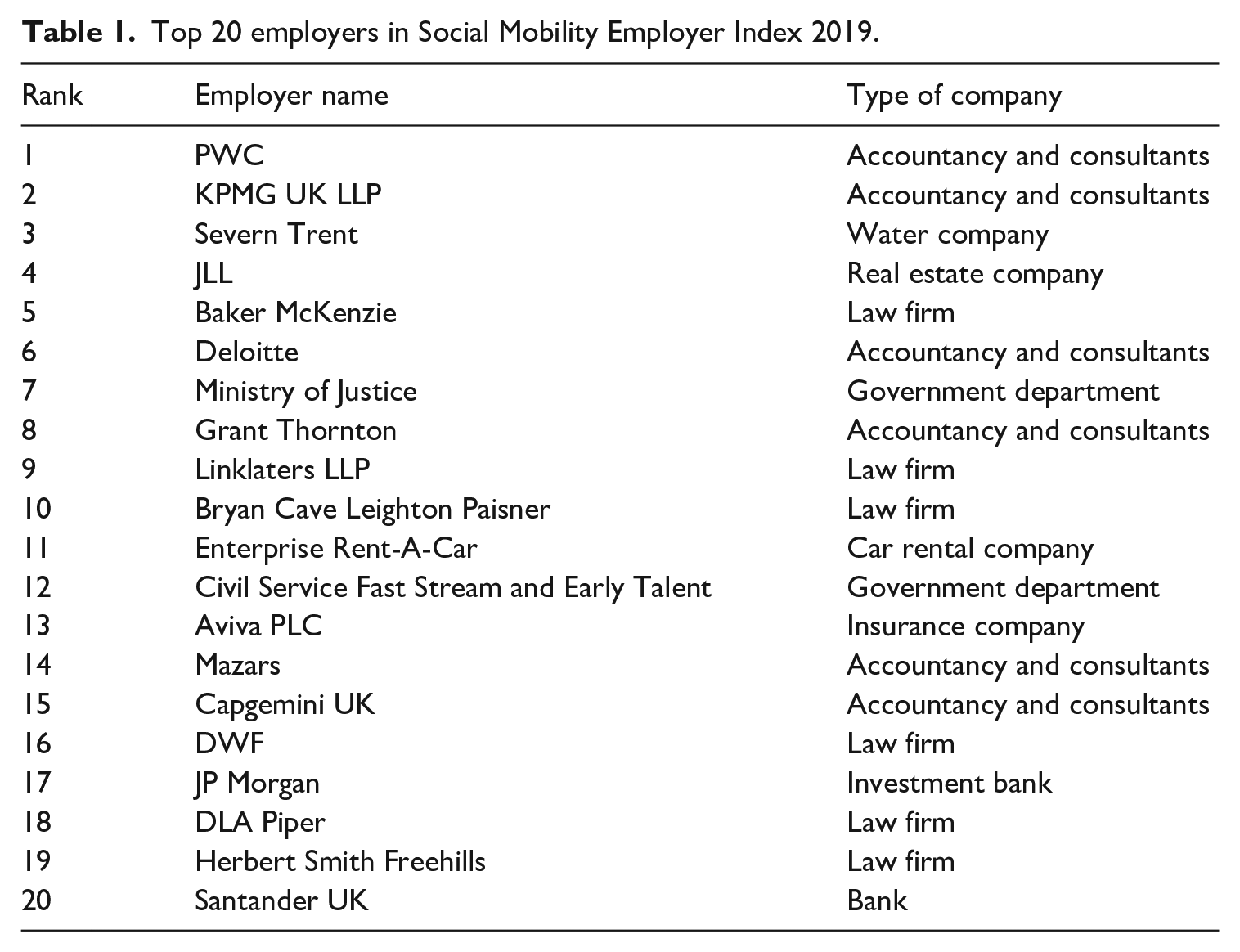
Auditing and consultancy companies have consistently ranked highly in the Employers’ Index. In 2020 and 2019, PWC and KPMG were ranked in the top three; in 2018, the top 10 included all of the ‘Big Four’ UK accountancy firms, PWC, KPMG, EY, and Deloitte, as well as Grant Thornton, another leading consultancy firm implicated in malpractice associated with job losses (Financial Reporting Council (FRC), 2019; Prior, 2017; Shillibeer, 2019). These firms have well-developed social mobility strategies. Moreover, these firms are particularly celebrated for their collection of socio-economic data and their commitment to inclusive practices and attempts to overcome inequalities that could impede social mobility within their organisations (SMF, 2020). The Employer Index involves both a questionnaire of employers and an employee survey. Not all employers participate in the survey, and in those that do, the response rate is low (an average response rate of 14% across the 39 organisations that ran the survey). The questions included in the survey relate to workplace culture and class (SMF, 2020: 41), and it is clear that there is an attempt to base the ranking on social scientific data. Juxtaposing employment practices around blinded recruitment processes, inclusive workplace culture, and internal promotion with the work that companies actually do is important if we are to consider social mobility with the broader critical sociological frame of questioning the structure of work, economy and society more broadly.
The Big Four accountancy and consultancy companies are deeply implicated in exacerbating economic inequalities through being heavily involved in processes of privatisation and outsourcing of public services and state-owned companies over the last 30 years. Accountancy firms have been central to rolling out privatisations in ports, railways, and other public sector fields in the UK and abroad; these firms profit substantially from privatisation, while employees suffer de-skilling and job losses (Arnold and Cooper, 1999; Cole and Cooper, 2006; Jupe and Funnell, 2015). For workers experiencing the privatisation or outsourcing of their employment, the process has seen the erosion of working conditions, lower rates of pay, the loss of defined benefit pensions and increasing casualisation of employment with a lack of secure long-term contracts (Hermann and Flecker, 2013; Whitfield, 2002). Arnold and Cooper (1999) examine the role of KPMG in the privatisation of the Medway port in Sheerness. The privatisation involved a dubious series of share valuations by KPMG, which meant that both the government and the workers that bought shares lost large amounts of money as well as their pension rights. The workforce was cut by two-thirds and those who kept or successfully re-applied for their jobs were on more flexible, lower-paid contracts. More recently, on 15 May 2018, KPMG hosted a large policy conference on widening participation and social mobility (All events in, 2018), on the following day KPMG was heavily implicated in a parliamentary report into the collapse of Carillion (Bhaskar et al., 2019). Carillion was a large UK-based contractor providing privatised services in schools, hospitals and other public sector areas. It collapsed in January 2018 owing £7 billion, with over 2000 jobs lost by May 2018 and huge pension liabilities (House of Commons Business, 2018). KPMG, Deloitte, EY were all heavily implicated in the report for signing off on questionable accounts for over a decade and taking advantage of the company’s difficulties to offer expensive ‘rescue’ services days before the company went into administration under PWC. The report further concluded that ‘KPMG’s audits of Carillion were not isolated failures, but symptomatic of a market which works for the Big Four firms but fails the wider economy’ (House of Commons Business, 2018: 5).
Praising KPMG, PWC, or other accountancy firms for their thin commitment to narrowing inequality of opportunity while these companies actively foster and profit from the destruction of secure employment for thousands of working-class people presents a problem with which sociologists wishing to engage critically with the social mobility agenda must grapple. KPMG (2021) claims on its website that ‘we need Inclusion, Diversity and Social Equality to be successful’, and yet their business is deeply implicated in processes that have eroded stable, well-paid forms of employment. ‘Social Equality’ that exists purely within the workplace but not in the broader social effects of the work that an employer does underlines the limits of this agenda. If what matters is not simply equality of opportunity on entry to and within these firms but their role in reproducing deeply unequal structures and forms of work more broadly, we can question the ideological role of these schemes. We argue that schemes such as the SMI or the SMP serve to ‘obscure and extend economic and social inequalities’ that are happening simultaneously (Littler, 2017: 7). The young people who are targeted by widening participation programmes of elite universities and afterwards by leading corporate firms may come precisely from those working-class and ethnic-minority families who have borne the brunt of privatisations and the reduction in labour protections that large accountancy and consultancy firms have encouraged.
Social mobility appears here to be a snake eating its own tail. While these companies seek to promote and foster social mobility for their staff, they are simultaneously engaged in eroding and undermining employment conditions for workers on a much larger scale. Certain companies that have been consistently highly ranked in the Index are deeply implicated in these processes. These issues may not affect all the companies involved in the Employers Index/Pledge. Nevertheless, the practices of firms that have been highly praised by the Index underline how the performance of social mobility obscures broader questions of political economy and the impact of the everyday business of these organisations. From a sociological perspective, what is perhaps key is that we consider the role of corporate firms is simultaneously appearing to enable social mobility and even ‘social equality’ internally while maintaining and deepening social and economic inequality and power imbalances. Measuring inclusiveness, progression, and fair access within and to these companies without acknowledging the broader implications of how these firms work within capitalist economic structures limits our sociological understanding of power, class, and the role of social mobility. A performative, celebratory discourse focussed on social justice for a successful minority masquerades the broader undermining of working-class livelihoods by some of the very same organisations. This deserves greater acknowledgement and further sociological analysis and consideration in our view.
Conclusion: a new political conversation
What is clear from our discussion above is that the social mobility agenda is the enemy of equality. It is, therefore, time for a new political conversation about social mobility and time to dispense with it as an agenda, in favour of one focussed on a deeper more structural understanding of equality. The social mobility agenda suits politicians and those unwilling to let go of their own privileges; discussion of inequality becomes narrowed to individualised trajectories of success, while the basic living needs millions of people are not met and the opportunity of secure well-paid work is denied to many. The discourse allows for blame to be apportioned to the working-classes for their failure to ascend the ladder to the ‘better life’. We have identified three framings of social mobility within political discourse: race to the top, room at the top, and resilience. As we have shown, none of these framings provide a productive means to engage critically with the fundamentals of challenging inequalities and only serve to obfuscate the material barriers to social fluidity, let alone deeper equality. These discourses support the idea that all can rise, with the right attitude, levels of resilience, and access to education, and is a convenient solution that requires limited capital investment. These framings in political debate around social mobility and the language of ‘unlocking talent’ and ‘break out’ construct the issue as one of personal escape, as if working-class people are held hostage in their communities and simply need to be shown the door and welcomed with open arms into the middle-class fold.
They preclude the need to discuss issues of redistribution and the uncomfortable reality that under current labour market and economic conditions upward social mobility of the working-classes would require middle-class downward mobility. We implicate the SMC and other social mobility organisations in generating and supporting misguided understandings of social mobility that can be wielded as political weapons against deeper forms of equality by politicians while also allowing politicians and corporate companies to perform a commitment to social justice. We recognise that the SMC and other actors maintain pressure and continue to highlight more limited forms of inequality, focussed on inequality of opportunity. In an austere and increasingly authoritarian context for education policy, this is significant, but these contributions come at the cost of maintaining and delimiting sensible notions of what equality is and can be. For sociologists, this has implications for how we position our research as it is quite clear sociological research on social mobility through the SMC, SMF, and others, is being aligned to a project that focusses on maintaining the status quo with only the very mildest of attenuations of inequality.
Through their reports and initiatives, the SMC and others shape and influence the debate and knowledge about social mobility. Not only have they helped shape discourses of equality of opportunity, competition, and resilience (outlined above) to enable social mobility performance by politicians, but they have also had a firm hand in assisting employers with their own social mobility showcase. Through discussion of the Social Mobility Employer Index and the Pledge, we have shown how firms can claim and win prestige for corporate responsibility and promotion of ‘social mobility’, through schemes that provide little clarity over what firms are specifically doing. In both these initiatives the concept itself is nebulously defined. This is a case of sociological concepts being mobilised to legitimise firms that are involved with economic activities that erode living and working conditions for working-class people while working to increase the wealth of the already wealthy. As sociologists we must consider whether this agenda, which is now over 10 years old, serves the interests of the many or in reality allows the legitimation of deep and destructive economic inequalities that benefit the few. Where do we stand? Are we to be active in producing research and policy documents that reinforce these contradictions or should we stand against a policy agenda which is riddled with tensions?
Footnotes
Funding
The author(s) received no financial support for the research, authorship, and/or publication of this article.
