




Abstract
Education in Lesotho, as in much of the world, has historically held out the promise of a ‘better future’. Success in school and the achievement of academic credentials were expected to lead to a secure future in the formal economy. With increasing school enrolment and growing youth unemployment, such futures are now illusory for most youth. In 2009, Lesotho introduced a radical new curriculum that aims to instil in young people skills and attitudes for entrepreneurship, enabling them to build their own futures in an increasingly uncertain world. Based on 9-months’ ethnographic fieldwork in two primary schools and their surrounding rural communities, we trace how the new curriculum is being delivered in schools and how it is intervening in children’s aspirations. Despite lessons intended to prepare them for livelihoods in the informal economy, young Basotho prize the security of a salaried job as a nurse, teacher, police officer, or soldier. We frame this contradiction in relation to concepts of doxic and habituated aspirations, concluding that due to the way schools deliver entrepreneurship education it both fails to displace long-standing doxic aspirations to professional careers, and fails to engage with young people’s habituated expectations of rural livelihoods.
Introduction
Globally, children’s access to education has expanded dramatically over recent decades, in large part due to international initiatives, such as the United Nations’ Education for All and Millennium Development Goals. Today, 91% of children in lower middle-income countries complete primary school (World Bank, 2019). As Snellinger (2018) observes, the ‘Education For All’ campaign sought to achieve universal schooling by selling young people, parents, and governments the possibility of social mobility through education. Formal schooling is often embedded in a future-oriented discourse of hope and progress, understood to equip young people to face uncertainties. However, schooling does not always provide what it promises (Stambach, 2017). Indeed, as educational enrolment has expanded, the link between education and employability, in particular, has become more tenuous (DeJaeghere et al., 2016). In part, this reflects inadequate investment in quality education: in many schools, very limited learning takes place. UNESCO (2012) calculates that 130 million children worldwide complete grade 4, but remain unable to read and write (more than the number that fail to reach grade 4). The formal sector jobs that education has historically promised are also scarce, as in many countries, economic growth has failed to generate such employment. Moreover, in some settings educational expansion has led to a loss of rural livelihood skills among young people (Camfield, 2011; Punch and Sugden, 2013). These outcomes have together led international institutions to seek to transform the delivery of basic education.
This article focusses on one such attempted transformation: a new curriculum intervention being implemented in Lesotho. Rather than primarily preparing young people for traditional government jobs, the 2009 Curriculum and Assessment Policy, intends that learners 1 should be able to create jobs for themselves, adapting flexibly to an increasingly unstable and insecure job market (Ministry of Education and Training (MOET), 2009). The new World Bank-funded ‘integrated curriculum’ strives to cultivate neoliberal entrepreneurial subjects – individuals who take responsibility for their own futures.
Based on 9-months’ fieldwork conducted in 2017–2018 in two rural communities and their respective primary schools, we explore how Lesotho’s entrepreneurship education is implemented and received and its effects on emerging aspirations. Despite the changes in curriculum, school children continue to prize the security of a salaried job. Neither they, nor their teachers, understand the role of school to be the inculcation of skills and attitudes for rural livelihoods. We explore this apparent ineffectiveness of entrepreneurship education in relation to a framework put forward by Zipin et al. (2015) that sees young people holding simultaneously doxic aspirations (those society idealises as worthy) and habituated aspirations (what they feel to be possible). We show how entrepreneurship has been unable to dislodge the doxic aspiration of a professional career, and also how the delivery of entrepreneurship education makes it unlikely to connect with children’s habituated aspirations.
We begin by outlining Lesotho’s new curriculum policy, which we relate to scholarly critiques of the promotion of entrepreneurship. After explaining our methodological approach and introducing the research settings, we describe a lesson that sought to encourage young people to aspire to an entrepreneurial future. We then outline our conceptual approach and use it to explain why lessons such as that described are unlikely to significantly shift young people’s doxic aspirations or engage with their habituated aspirations.
Lesotho’s new curriculum
Prior to 2009, education in Lesotho had changed relatively little from the system inherited at independence in 1966. Primary school children studied largely academic subjects, were tested at the end of each year and only those who passed could proceed to the next year. At the end of the primary cycle, they sat a national Primary School Leaving Examination, which, if passed, granted admission to secondary school for those able to afford the fees. Secondary education had minimal relevance to rural life, but was focussed on passing the Cambridge Overseas School Certificate. 2 The small minority who gained this certificate could train for a formal sector career or even attend university. The education system thus produced an occupational elite, but left most school leavers unable to find formal sector work and with a sense that their education was worth little (see Ansell, 2002, 2004).
Until the 1990s, most young men could find work irrespective of their education level, although opportunities for young women were scarcer. Relatively well-paid mine work was available in South Africa, but began to evaporate with the end of apartheid and growing mechanisation. In rural communities, recurrent droughts over the past two decades have made farming and livestock rearing unreliable. A garment industry has developed in the lowlands, but this work is poorly rewarded and often precarious, as is agricultural or domestic work across the border in South Africa. Following the introduction of free primary education in 2000, tens of thousands of young people leave school each year with minimal prospects of securing the formal sector government jobs the education system traditionally promised, and diminished access to the livelihoods that supported previous generations.
Partly in response to this situation, a new World Bank-supported Curriculum and Assessment Policy (MOET, 2009) sought to radically transform basic education through an ‘integrated curriculum’ Raselimo and Mahao 2015. By 2017, when our fieldwork began, it had reached all 7 years of primary education and was about to be rolled out to the first 3 years of secondary school. A declared aim is ‘To address the emerging issues pertaining to new demands, practices and life challenges of the modern global world’ (p. 2). The rationale is that the rise of globalisation has brought
multiple challenges such as sudden economic backlash as the world economy reduced its dependence on exploitation of raw materials and cheap labour, rising poverty levels in the face of escalating unemployment, resultant rural-urban labour force migration and the paradoxical realisation of unproductive nature of that workforce when it comes to urban demands of the modern day knowledge based economies. (p. 4)
Exactly, how the new curriculum is intended to address this situation is not spelled out in detail, but the education envisaged in the Curriculum and Assessment Policy is described as ‘a self emancipation tool from ever-threatening harnesses of poverty, needs and diseases’ (MOET, 2009: 4), providing ‘skills necessary for the competitive world “out there”’ (p. 5). The combination of skills and self-reliance reverberates through the document, which recalls a Sesotho saying,
‘Mphe-mphe ea lapisa, (molekane) motho o khonoa ke sa ntlo ea hae’, which means ‘Unless you have your own means you cannot live to your heart’s content’. This philosophy of life must be enshrined in our education system because only then can our people acquire the means for the real independence and the self-reliance they need for survival. (p. 6)
The policy sets out how this ambition is to be achieved through changes to pedagogy, assessment, and curriculum. By emphasising competencies, rather than passing examinations, pedagogy is expected to develop creativity and independence, with learners taking more responsibility for their own learning. Individual talent is fostered and children progress automatically to the next class without needing to demonstrate competence across the full curriculum. The primary curriculum itself is reduced from 11 subjects to five ‘learning areas’ that more closely align with ‘life challenges’. These are labelled linguistic and literacy; numerical and mathematical; personal, spiritual, and social; scientific and technological; and creativity and entrepreneurial.
The emphasis on entrepreneurship is a departure for Lesotho. The 2005–2015 education sector strategic plan only mentioned entrepreneurship in relation to technical and vocational and non-formal education (MOET, 2005). Again, the focus is on both skills and self-reliance: on developing production and work-related competencies including ‘entrepreneurial skills that would facilitate creation of employment and alleviation of poverty’ and ‘positive attitudes and values towards self-reliance and world-of work’ (MOET, 2009: 14). The grade 7 syllabus (MOET, 2017) explains, ‘Learners need to be creative and entrepreneurial in their current and future lives. We need learners who are action oriented and perseverant, promoting control and autonomy alongside originality and creativity’ (p. 15).
Entrepreneurship education: cultivating neoliberal subjects for uncertain futures?
Lesotho is far from unique in seeking to encourage entrepreneurship as a response to the challenges of an uncertain global economy, and its eagerness to generate self-reliant learners reflects neoliberal ideology. 3 A widespread shortage of formal sector jobs combined with diminishing rural livelihood opportunities has propelled many young people in the global south to start informal businesses to support themselves and their families (Jeffrey and Dyson, 2013). While far from the popular idea of entrepreneurs as founders of corporate ventures, such activity has been seized on as having the potential to address youth unemployment and poverty 4 while stimulating economic growth from the ground up (see International Fund for Agricultural Development (IFAD), 2019; World Bank, 2006).
International organisations’ embrace of youth entrepreneurialism assumes the neoliberal rationality that engagement with the market drives progress. The need for state investment in the economy or service provision is downplayed: through cultivating neoliberal subjects with the right skills and attitudes, growth will be stimulated and poverty ended (Gough et al., 2013; Jeffrey and Dyson, 2013; Pimlott-Wilson, 2017). Initiatives to promote youth entrepreneurship often fail to address the structural processes constraining young people at national and global levels that limit their capacity to succeed (Hajdu et al., 2013; Snellinger, 2018), leaving them to assume risks caused by economic instability and uncertain labour markets (DeJaeghere and Baxter, 2014).
An important (if oversimplistic) distinction should also be made between opportunity entrepreneurship (where individuals are drawn by perceived opportunities) and necessity entrepreneurship (a response to poverty and unemployment). Many impoverished youth fall into the latter category (Langevang et al., 2012) and cannot reasonably be expected to raise themselves or their families, let alone their societies, out of poverty. In general, the businesses young people manage to create tend to be unpredictable and unstable (Thorsen, 2013), with few generating much security. Sumberg et al. (2020) have identified the limited capacity of informal sector self-employment to provide ‘decent work’ for young Africans, in line with the Sustainable Development Goals. Moreover, entrepreneurial skills and attitudes are commonly deployed in illicit activities (Jeffrey and Dyson, 2013).
In line with the enthusiasm for entrepreneurship in general, entrepreneurship education is supported by international donors, non-governmental organisations (NGOs) and governments as a solution to both youth unemployment and poverty (DeJaeghere and Baxter 2014). It is promoted as a response to the mismatch between what young people learn in school and their employability as well as to restricted formal labour markets (DeJaeghere et al., 2016). It has mainly focussed on out of school youth (Lefebvre et al., 2014) or has been promoted through relatively small-scale NGO projects in school (DeJaeghere et al., 2016). It has, however, been introduced to schools across Scandinavia (Dahlstedt and Hertzberg, 2012; Johansen and Schanke, 2013; Korhonen et al., 2012; Seikkula-Leino, 2011) as well as Rwanda (Honeyman, 2016) and elsewhere.
Many entrepreneurship education programmes, like that in Lesotho, adopt a neoliberal human capital approach. This moves away from earlier human capital approaches that sought to create better skilled workers for the global economy, attractive to inward investment and able to secure wages to support their families and pay taxes to support public spending. Increasingly, intense globalisation and unstable markets have made labour markets more uncertain. A neoliberal approach seeks to respond to this through providing more flexible labour (DeJaeghere and Baxter, 2014). It, therefore, ‘tends to emphasize behavioural aspects of skills, innovation and risk-taking for creating and managing new businesses, and is associated primarily with the goal of self-employment’ (Baxter and DeJaeghere, 2014: 26).
Self-employment is understood to require certain forms of self-government – what Foucault describes as an ‘entrepreneurship of the self’ (see Simons and Masschelein, 2008). Referring to its presence in Swedish education policy, Dahlstedt and Hertzberg (2012) observe, ‘entrepreneurial education may be seen as a particular kind of governmentality, connecting students and their subjectivity to the rationality of the market’ (p. 242). Education is aimed at young people becoming ‘flexible, creative, enterprising and independent [and] having the ability to take initiative, solve problems and make decisions’ (Dahlstedt and Hertzberg, 2012: 242). Students are expected to acquire skills for entrepreneurship, but also to take responsibility for their learning and recognise it as something to be applied or ‘employable’ (see Simons and Masschelein, 2008). Beyond critiques of such ‘responsibilisation’ (Simons and Masschelein, 2008), entrepreneurship education seldom adequately attends to the economic and social constraints inhibiting young people (DeJaeghere and Baxter, 2014).
The creation of entrepreneurial subjects is clearly envisaged to involve instilling entrepreneurial aspirations in young people. Previous research has suggested that education is not always successful in achieving this. Yeboah et al. (2017), for instance, conducted research with high school students in Ghana that revealed tensions between young people’s imagined futures in urban salaried jobs and the entrepreneurial agricultural futures that policy makers and development professionals imagined for them. Yet little research has explored how entrepreneurship education actually intervenes in aspirations. The research we report on in this article sought to explore how young people develop aspirations through their engagement with primary school.
Methodology and the research settings
Our empirical research took place in Lesotho between January and September 2017, with a short return visit in February 2018. The fieldwork focussed on two villages and their local primary schools, one in the Maluti Mountains in central Lesotho and the other in the Senqu Valley, closer to the South African border. The aim was to examine how young people’s aspirations were shaping their engagement with education, and also how diverse aspects of the education system, including lessons on entrepreneurship, were shaping their aspirations. Household surveys gathered data concerning educational backgrounds, occupations, and household conditions. The bulk of the research was undertaken by Claire (the first author) and involved participant observation within and outside school with children and young people, teachers and parents. In addition, young people were encouraged to draw and engage in drama. One hundred and eighteen recordings were made, mostly of in-depth interviews. In both villages, the researchers were accompanied by research assistants who were more familiar with the language and customs of rural Lesotho.
Both the researchers and research assistants attempted to adopt a ‘least adult role’ (Mandell, 1988), for instance, by participating in games that were led by children, and by sitting with them in classrooms. It is important to acknowledge that our evident status as ‘educated people’ will have shaped what young people told us. It may partly explain why they drew pictures of themselves in professional jobs, said they wanted to travel to distant locations and insisted that nothing could stop them from achieving their aspirations. Moreover, our research focus on aspirations doubtless influenced teachers’ choices and performance. When Claire expressed an interest in the topic of ‘goal setting’ in the syllabus that a teacher was browsing, the teacher proceeded to teach this topic for the following three lessons.
Both villages were relatively remote, with limited infrastructure. They lacked mains electricity, and in both villages, young people were responsible for tasks, such as collecting water, cooking, and grazing animals. In this article, we refer to the smaller village (55 households) as Mabana. 5 Mabana was a 40-minute walk from the closest primary school, and most local services (secondary school, larger shops, clinic, police station) were 10–15 km away. The daily minibus was often already full when it arrived in the village, so no one could board, limiting people’s mobility. The larger village, Paleneng (118 households), had a primary school nearby and another primary and secondary school (grades 8–10) within 30- to 40-minute walk, but the children had to travel further for grades 11 and 12 (high school). The district capital was 40 km away and could be visited in a day by minibus or the local bus. However, schedules meant that children could not attend secondary schools beyond the locality while resident in the village.
Families in both villages were supported through livelihoods that broadly fall into three categories: self-employment (mainly in agriculture or small businesses); low-paid manual work; and formal sector jobs. The third, and to an extent the second, category involved migration beyond the village. Most children’s parents generated money through informal means in the villages. Farming or herding afforded little status, and were considered part of everyday life, not really jobs. Villagers often sold items informally from their homes, and many children and young people helped with this.
Labour migration was quite common. The survey in Mabana identified nine women from the village working as domestic workers in South Africa, five as factory workers in Maseru, the capital city, and six others in various casual jobs around Lesotho. Ten men had migrated from Mabana to Maseru where they worked as construction workers, bricklayers, farmers, and factory workers, and one was a builder in South Africa. This reflects the feminisation of labour migration from Lesotho since the 1990s (Crush and Dodson, 2010). Paleneng, the larger village, closer to the South African border, had higher levels of cross-border labour migration. A total of 27 women and 28 men worked seasonally on South African fruit farms. Five men were mining, while others were bricklayers or construction workers in South Africa. Most female migrants were domestic workers, 15 in South Africa and eight elsewhere in Lesotho.
Very few people from either village had achieved professional or white-collar careers. The exceptions included the local schoolteachers (most of whom were not local) and a few former residents who now worked in Maseru or South Africa: a man from Mabana worked as an agricultural researcher and from Paleneng there were two nurses, a technician, a soldier, a police constable, a pharmacist, and a restaurant cashier. The remainder of the article explores how the government’s attempt to encourage children to develop skills and aspirations beyond these formal sector careers have translated into the classroom and been responded to by young people.
Is it good to be hired?
On a cold spring morning, about 35 learners in grade 7 in a school near Paleneng were learning about goal setting. The teacher, Teboho, taught the learners about ‘Christmas goals’ and ‘long-term goals’. Christmas goals were short, and were not really goals, he explained later, but it was easier for the learners to understand a goal with a short-term trajectory using a known celebration. With long-term goals, he encouraged them to think 5 or 10 years in the future. Teboho asked them to write their long-term goals in their notebooks, and summarised these on the chalkboard (Figure 1):
I will be working as a nurse, teacher, policeman/woman I will be having a car I will be a wife I will be having a house I will be working in the office I will be having a house I want to make my own business
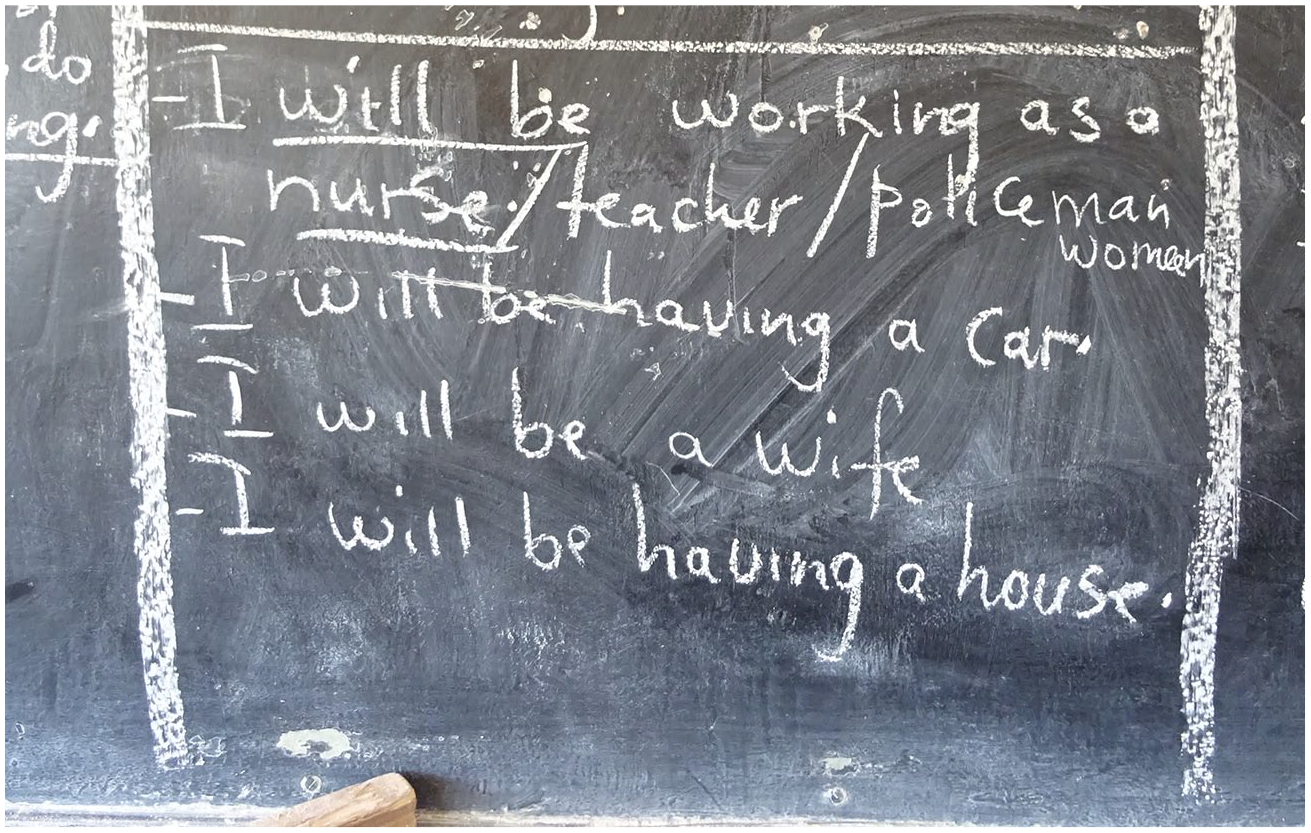
The chalkboard.
Teboho explained to the learners that a goal is something you want to achieve and asked them what a goal is and whether it is the same as wanting something for Christmas. A girl answered: ‘A goal is something that you want to achieve in future’. The teacher encouraged the class to clap, acknowledging her for answering the question in the way he expected. He continued to explain that there are stages in attaining a goal: ‘You are on stage 1; you want to get to stage 10. Every day there are things you want to get. You work with what you want to achieve’. Teboho did not explain these stages carefully, and did not mention that there might be hurdles or obstacles on the way. The discussion remained abstract, concerned only with defining the concepts.
Then the children were asked to group themselves according to their career aspirations:
‘Those who say they want to be teachers, go there. Nurses go there. Police go there. Business go there’ the teacher said, pointing at different parts of the classroom. ‘Others, those that I have not mentioned, go there’.
In the front of the classroom, five boys and one girl grouped together as the ‘teachers’. Eleven girls sitting close to the window were the ‘nurses’. The police and businesspeople grouped themselves in the centre of the classroom, where it was hard to tell who belonged to which group. There were four girls and six boys. Some wanted to be car mechanics, bank tellers, or policemen.
Teboho then asked the learners to stand up if they normally worked in the fields. He asked them this question twice, but the children sat glued to their benches. When he asked a third time, about five children, both girls and boys, eventually stood up, hesitantly, still leaning over their tables. Through silence and hesitation, the learners demonstrated that they did not want to talk about the kinds of work their parents did at home. But Teboho tried to persuade them to consider farming or other forms of self-employment. ‘Rethabile, does it mean you don’t work in the fields? Rethabile, do you enjoy working in the fields?’ ‘No sir’, Rethabile replied. The teacher asked her if she enjoyed eating the sweetcorn, and she said ‘yes sir’. ‘Do you enjoy the hard work?’ the teacher asked, and she replied ‘no sir’. ‘You don’t enjoy hard work, but you enjoy eating. We are talking about motivation. At the end of the day, you are going to eat delicious food’.
A boy in front stood up and said he wanted to be a businessman because he wanted to help other people and sell things at lower prices. ‘Do you feel grateful when you help other people?’ The boy said ‘yes sir’ and sat down, but the teacher asked him to stand up again. He was asked why he wanted to sell things and how much money he wanted. The boy answered that he wanted 100,000 Maluti (around £5500) in 5 weeks, more than a teacher earns in a year. ‘Is this possible?’, the teacher asked, and the learners answered in a chorus, ‘Yes sir, yes sir’. The teacher then said that some people earn 1 million Maloti per month (£55,000).
One of the girls now stood up and said that she wanted to be a teacher. The teacher asked her how much money she wanted to earn, and she suggested M1000 (£55). ‘How much are the clothes – can you live with this?’ Many of them replied ‘no sir’.
‘Do I really want to be a nurse and be hired? Is it good to be hired? Is it good to be employed or to be self-employed?’ Many of the learners then answered self-employed:
Which people make a lot of money? Some people make about a million a week – what are they doing? Ask the bank, I want to make a filling station, could you please help me? . . . . Not all people will be teachers. Not all of us can be nurses. We must choose a different career.
This lesson represented one teacher’s interpretation of the intention of the integrated curriculum. Based on the syllabus document and use of Google on his phone, Teboho devised a lesson that sought to encourage learners not only to consider self-employment as an alternative to a formal sector career, but to be motivated by economic reward and to value hard work and independence. While by no means all classes took this form, Teboho’s approach encapsulates the spirit of Lesotho’s entrepreneurialising curriculum.
Resisting entrepreneurship
While the children in the class described above replied ‘yes sir’ or ‘no sir’ to indicate they accepted what they were told about the advantages of self-employment, it was clear that they remained unpersuaded. They knew what they were supposed to say, but their performance as entrepreneurial subjects was unconvincing. They did not truly aspire to the futures the new curriculum sought to sell. They did, nonetheless, anticipate that rural self-employment would play a part in their futures.
To unpack what was happening in this classroom, we make use of Zipin et al.’s (2015) theorisation of how aspirations are constituted through social-cultural processes. Zipin et al. suggest aspirations take three distinct yet parallel forms. The first two draw on Bourdieu (1990, 1992). Doxic aspirations are ‘dominant norms about worthy futures’ (p. 236) circulating through media and policy discourse. Education systems reproduce doxic discourses of modernisation and progress (Ames, 2013), of ‘education–opportunity–mobility’ (Froerer, 2012), of adulthoods defined by paid employment (Posti-Ahokas and Palojoki, 2014), of the ‘backwardness’ of rural communities and of farming as a sign of failure (Morarji, 2014). The universal desirability of modern futures and possibility of realising them through hard work are taken as common sense. Yet the promise is false: as more youth are educated, competition grows fiercer putting these futures out of reach for all but a relative elite. Habituated aspirations, by contrast, are embodied dispositions grounded in biographic–historical conditions (Bourdieu’s habitus), experienced as a ‘felt sense . . . of situated possibility’ (Zipin et al., 2015: 234). Disadvantaged youth generally recognise the impossibility of their doxic aspirations, understanding that ‘people like them’, who lack the social, economic, and cultural capital needed to translate school certificates into employment, will not benefit from education. Such knowledge is generally tacit or subconscious, and shared within communities. Emergent aspirations, the third form, are ‘future-tending impulses’ (p. 242) ‘emerging among young people as their lives apprehend the present-becoming-future’ (p. 236). For Zipin et al., these unarticulated feelings that ‘entwine with habituated dispositions and populist doxa’ (p. 243) hold the potential for agency and generational transformation, albeit not inherently socially positive change.
In the three sub-sections that follow, we explore first the persistence of the doxa of education as a route to becoming a teacher/nurse/soldier/police officer. We then examine why the approach taken by Lesotho’s new curriculum, and by Teboho in his goal setting lesson, fail to establish new doxic aspirations to rural entrepreneurship. The third section examines young people’s habituated aspirations to rural livelihoods.
Persistent doxic aspirations: fixing the future through formal jobs
The children in Teboho’s class were not unusual. When asked, particularly in a school setting, what they planned to do in the future, most children spoke in the first instance of one of four jobs: teacher, nurse, police officer, or soldier. Indeed, we followed the qualitative research with a survey that asked 122 school-going 12- to 22-year-olds from other nearby villages to name their first choice of job and 71% named one of these four.
In Paleneng, a group of children were invited to draw or write on post-it notes all the jobs they could think of that they could do in the future. The children drew mainly formal sector careers (policemen, teachers, and nurses), along with a few singers, football players, and herders. None suggested a businessperson, despite the activity taking place overlooking a local shop, and the fact that the father of one of the girls traded goods including potatoes, food, gum boots, clothes, paraffin. Surprised that none had depicted their own parents’ occupations, Claire asked Malefu what her mother did for a living. With this prompting, Malefu exclaimed that she would draw her mother who picked onions in South Africa on commercial farms. Mosimola, whose father owned the local shop, explained that she had thought she would draw people ‘who were hired’ (rather than self-employed). The children understood that there were jobs they were ‘supposed’ to draw, which were associated with schooling, and other occupations that their parents, and other local people, engaged in.
The group ranked the jobs in order of preference: teacher, nurse, doctor, soldier, football player, cook, pilot, singer, dancer, salesperson, driver, policeman, onion picker, domestic worker, bricklayer, herd boy, and thief. While unanimous about the first four, and placing jobs involving manual work or cross-border migration towards the bottom, the herder’s position provoked debate. Kealeboha, 19-year old, had dropped out of school after completing grade 7 and was hoping to become a bricklayer but said he would consider other formal jobs. Currently, engaged in herding, Kealeboha was frustrated with this job:
The herding job, I have seen that I despise it mostly during the ploughing season . . . you will be tired but you will have to go to the veldt [grazing fields], and when you are at the veldt it will be hot and you end up sleeping, and during the time you sleep, the animals will get arrested,
6
and the little money that you will be having will be used to pay for those animals . . . So this one of ours of herding, when you are sick and unable to go to the veldt, you have stopped your money. Like if say you are a nurse, when you get old you are going to get a pension . . .
Kealeboha’s account echoed many other explanations of career preferences. Herding involved uncertainties, both present and future. Fines for straying livestock and loss of income at times of sickness added to the exhaustion associated with manual labour in harsh weather conditions. Migration to South Africa raised fears of succumbing to violence or HIV. By contrast, government jobs were widely envied for the long-term security they offered, including access to pensions, 7 although it was acknowledged that salaries could sometimes get delayed.
Tsebo, 15-year old, also from Paleneng, was interviewed towards the end of the fieldwork following a period of drought. Tsebo was the only person in his household attending school and stated that he wanted to be a policeman because it offered advantages relative to gardening: ‘being a policeman you don’t have to wait for the rain to fall’, and also do not have to work with your hands, making it an ‘easy’ job. When discussing businesses with children outside the classroom, they asserted that these were usually quite risky, and it was better to be employed in a formal job.
There are doubtless numerous reasons for young people to envisage futures as teachers, nurses, police officers, or soldiers. These are more visible in rural areas that most other formal employment, rewarded with regular salaries that far exceed earnings from most rural occupations, are viewed as secure and pensionable, and are also socially valued roles. But their doxic status is also attributable to their embeddedness in education. Not only was education in the past very explicitly viewed as preparation for such jobs, the new curriculum, too, gives them prominence. While creativity and entrepreneurship constitute an entire ‘learning area’, textbooks across all learning areas emphasise formal sector jobs. The grade 6 textbook for the personal, spiritual, and social learning area (Chaplin et al., 2017), for instance, pictures nurses, teachers, doctors, policemen, office workers, school cooks, and an astronaut.
We describe the aspiration to be a teacher, nurse, police officer, or soldier as a doxic aspiration, not simply because it is commonly expressed or prevalent in school, but also because it is often superficially held. Many of the children interviewed mentioned various careers, but changed their minds either during the interview, or gave a different answer another time. 8 Tsebo, the aspirant policeman, said on another occasion that he hoped to become a teacher – a job that also brought a salary and security. Outside school, young people sometimes talked of other sorts of work. Even those who were relatively consistent often had a ‘back-up’. Lemohang, 13-year old, Kealeboha’s younger brother, was in grade 7 at the local primary school and aspired to be a doctor and a taxi driver. He expressed his wish to be a doctor on several occasions: in a group activity at school where children drew jobs that they liked, in an exercise outside school where children rank ordered all the jobs they could think of, and in an individual interview. But he also said that being a driver was a useful career, which required going to school for a long time. He explained that he would get a licence and could then take passengers to town in his own car to earn money. It seems likely that Lemohang was aware that becoming a doctor was probably out of reach for a boy from his background.
Doxic aspirations – to be a nurse, teacher, soldier, or police officer, in particular – remain commonplace despite the new curriculum. They are valued because they appear to offer escape from the physical experience and precarity of rural livelihoods. However, they remain ideals rather than grounded expectations.
Entrepreneurship in school: neither replacing the doxic nor connecting with habituated aspirations
Teboho was unusual among teachers. Entrepreneurship was not widely taught with such enthusiasm. When teachers were asked what kinds of futures they hoped the children would venture into, they often repeated the curriculum narrative – that the learners’ talents should be nurtured, and that they could make use of these talents for various careers, perhaps singing, running or engaging in agriculture. The teachers were not, however, fully convinced by the new curriculum. They did not agree that children should proceed to the next class without first passing an exam (indicating their competence to progress) and they did not experiment with the children-centred pedagogies prescribed in the policy.
Some teachers insisted they had no idea what content the creativity and entrepreneurial (CE) learning area required, since they had not received training. In one school, the classes were timetabled after lunch, and the school often closed at lunch time, for instance, when weather conditions were harsh. Many teachers complained that they lacked textbooks that matched the syllabus, or necessary materials, including fences to protect crops were they to teach practical agriculture. Moreover, teachers were hesitant to talk with students about career planning, partly due to a perceived lack of time, and also their own limited knowledge. Reluctant to try teaching CE, teachers left children alone to draw whatever they wanted. These findings echo research in Finland that found teachers were unclear how to implement entrepreneurship education, particularly to take a practical orientation to it (Seikkula-Leino, 2011) and saw the promotion of entrepreneurship skills for use outside school as beyond the aims of basic education (Korhonen et al., 2012). It is noteworthy that only one lesson was observed during our fieldwork that explicitly addressed the possibility that children might engage in farming in the future, even though agriculture is meant to contribute to every learning area.
Where entrepreneurship or related livelihood and employability skills were taught, they were often considerably removed from young people’s experiences of these livelihoods in the village. Tsebo said he did not like learning about farming at school as he found it confusing to have to think about various pesticides. He preferred the idea of just watering his plants in the morning and the evening. Another learner emphasised that he preferred farming with a plough rather than a spade, which he was required to use at school (he had clearly attended a school that attempted practical farming). Going to school was about listening to expertise and obeying the teacher, not questioning or contributing ideas from one’s own experience.
A feature of Teboho’s class was that, despite the attempt to relate the idea to Christmas, it was presented in an abstract way that bore little relation either to children’s experiences or to the realities of navigating a lifecourse. Teboho suggested that with hard work and planning, anything was possible. He drew a train and railway on the board (an unfamiliar analogy given Lesotho has just 1 km of railway) to illustrate that ‘Goal setting helps us to avoid being derailed’. As in the 10 stages of planning mentioned earlier, entrepreneurship is envisaged as a linear process.
This resonates with Honeyman’s (2016) book The Orderly Entrepreneur, in which she presents entrepreneurship education in Rwanda as a paradox. Entrepreneurship is promoted, but ‘critical thinking’ is taught through pedagogy that promotes order and discipline. Using Bourdieu, Honeyman argues that entrepreneurship education has achieved a doxic, unquestioned status in which schools produce willingly ordered citizens committed to obedience, hierarchy, and respect for authority. Likewise, while Teboho wrote ‘Goal setting helps us to think critically’ on the chalkboard, his pedagogy inferred there were clearly right and wrong answers to his questions. At the end of the class, emphasising that not everyone could be nurses or doctors, he encouraged the learners to say that farming was important. Their answers of ‘yes sir’ and ‘no sir’ reflected the hierarchical structure of the classroom, and an ongoing expectation that the teacher is right.
Undoubtedly, the new curriculum sets out to establish a new orthodoxy – a new doxic aspiration to entrepreneurship for self-sufficiency. Like the doxic aspiration to a government job, entrepreneurship education seems destined to achieve no more than a superficial acceptance by primary school children, and currently it remains much less firmly embedded.
Entrepreneurship as a habituated aspiration
While young people are reluctant to embrace the idea in school that their future careers lie as farmers or businesspeople, on various occasions, they openly debated the merits of agricultural or entrepreneurial activities. In both villages, we asked children to rank various careers, and then discuss their usefulness, and whether they required education. In Mabana, we did not initially frame the activity in terms of the future, and the children interpreted the activity as an exploration of ‘local jobs’ (mesebetsi): they drew people cutting trees, a person guarding school property, a donkey with a rope, and a person collecting firewood.
When we asked learners in Paleneng what they would do if they completed their education, but had to wait for a job, they generated a long list of ways of making money in the village. These included becoming nannies, selling beer, building houses, forming societies, knitting winter hats, sewing school uniforms, dancing, making brooms, repairing shoes, selling sticks to the elderly, selling vegetables, mohair, milk, or pigs. When we asked which of these activities required schooling, they mentioned only three: cultivating vegetables, selling drawings, and playing football for prize money. Entrepreneurship was clearly something children learned primarily outside school, as Honeyman (2016) found in Rwanda, where children learned by, for instance (and paradoxically), raising money for school fees.
Moreover, while children attended ‘CE’ classes in school, they did not relate to these. We tasked a small group of children with devising a drama based on a scenario in which the school principal decided to stop the teaching of this learning area. In their performance, the children playing the learners protested to the principal that although they did not currently understand the purpose of CE, it might turn out in the future to have been useful.
As Chea and Huijsmans (2018) have argued, entrepreneurship training does not recognise that most young people in the global south gain livelihood skills in informal ways – through informal apprenticeships and informal commercial training. By formalising and standardising technical and vocational education and delivering it through formal education, it misses much of what is needed for young people to develop their capacity to operate in an informal economy (Chea and Huijsmans, 2018).
Irrespective of the curriculum, teachers drew a simple distinction between jobs that require schooling and (manual) work that does not. Itumeleng, a teacher at Mabana, for instance, suggested that ‘educated people’ would get jobs, such as policemen, teachers, and nurses. Farming, she said, was something she would do if she could not get a job. She explained that farming was practised at Mabana school in 2010. The school bought seeds, and the children learned about cultivation, and grew vegetables which they both consumed and sold. However, village livestock had grazed the plots, and in the absence of funds for a fence or security guard, the project was abandoned. A teacher at Paleneng recounted a similar experience:
. . . It is just that, you know, we were supposed to do some projects here, but the animals are destroying our plants. Because we were going to plough, so that they [the children] can produce vegetables and other things for themselves . . . the herd boys are just destroying. So, we no longer know as to what kind of project can be successful when it is done here, because these people here are lawless. (Lemoha, primary school teacher, Lesotho).
These short-lived experiments suggest two things about teachers’ attitudes to inculcating skills and attitudes conducive to rural self-reliance. First, giving children practice in growing and selling crops was not a priority. The lack of a fence seemed a lame excuse in a community where few farmers fence their fields; most rely on ‘arresting’ wandering livestock. Second, herders (‘just destroying’) are represented as the antithesis of the educated persons schools aim to produce. Mabana school prohibited children from wearing blankets or gumboots (the attire of herder), despite the cold winter weather and need to wade across a river to reach the school. This denigration of herders symbolically rejects rural livelihoods and asserts that schooling stands for something different.
When asked at school to write about his future, Tsebo wrote that he wanted to be a teacher when he was 20, and to buy animals at the age of 90. When Tsebo was at home, he said he wanted to be a policeman, both to avoid the precarity of gardening and to have his own garden so he could grow vegetables to sell. His grandmother had encouraged him to garden, and he had sold some of the vegetables he had grown, raising around M200. For Tsebo, a formal job was important for being able to maintain an informal livelihood in the village, and not the other way around. This contrasts with the textbook message that one must choose between mutually exclusive careers.
Entrepreneurship, then, is common in rural Lesotho: it is the habituated aspiration that young people know will play a role in their future lives. Yet they do not see formal education (even the dedicated CE lessons) as a means of preparing for it. Neither do many teachers see rural livelihoods as intended outcomes of schooling. Education is about a formal sector career. Such a career need not be an alternative to entrepreneurship, and indeed for many young people, it is imagined as something that will assist in an entrepreneurial future, providing money to invest.
Conclusion
Lesotho’s new curriculum is a response to a very real challenge – the irrelevance of the country’s previous primary curriculum to most rural children’s lives. Helping young people to support themselves and their families in the absence of paid employment opportunities could be of real value (Jeffrey and Dyson, 2013). However, Lesotho’s World Bank-funded innovation clearly supports a neoliberal agenda to ‘responsibilise’ the country’s young people, constituting them as agents to transform their own futures in an unpredictable world.
We have shown how young people in Lesotho resist the futures marked out for them through entrepreneurship education. Implementation rests on teachers as mediators, and most teachers too are resistant, convinced that education’s purpose is to prepare children for secure, socially sanctioned, salaried work. Entrepreneurship education is being implemented in an institutional context that has long sought to instil an expectation of a ‘better’ future and which cannot embrace rural livelihoods. Such is the resistance to the new CE learning area that had Claire not asked Teboho about the goal setting lesson, it might not have taken place.
Where entrepreneurship education is delivered through schooling, it uses the logic of formal education. It is abstract, based on principles of planning, and sits aside from local knowledges of entrepreneurship and local understandings of the function of schooling. Although the new curriculum has brought significant changes, the linear framework of schooling (progression from class to class) contrasts with local practices of entrepreneurship that embrace opportunism and making do rather than linear planning. Our findings also trouble the distinction between a formal career and an entrepreneurial future. Rather than the binary choice that is presented in school, many children, particularly boys, maintained that one needed a formal job to start a business, and that business activities would provide a secondary income, but not a route out of poverty. Efforts to introduce entrepreneurship in school thus fail to conform with how children think about the role of school or the role of entrepreneurship in their lives. Contra Honeyman (2016), entrepreneurship education in Lesotho has failed to displace existing doxa, but neither does it resonate with children’s habituated aspirations.
Footnotes
Acknowledgements
The authors are grateful to a number of people for their assistance with the project: Dr Pulane Lefoka of the National University of Lesotho has been very supportive, particularly during the fieldwork; Nthabeleng Sekese, Thabang Hloele, and Motena Samonyane provided helpful assistance in the field; Thabang Hloele accurately transcribed and translated countless recordings; and the children and adults in the two villages gave very willingly of their time.
Funding
The author(s) disclosed receipt of the following financial support for the research, authorship, and/or publication of this article: This research was funded through an ESRC–DFID Raising Learning Outcomes, grant ref. ES/N01037X/1.