




Abstract
Sociological discussions of sexual practices are often abstracted out from material constraints, with sex understood to be a private, personal matter. In this article, we use data from the third National Survey of Sexual Attitudes and Lifestyles (Natsal-3) to first investigate whether an association can be found between social class and high levels of sexual wellbeing, thus potentially calling into question the decoupling of material and class concerns from personal life. Second, our analysis builds on previous work that considered correlates of sexual fulfilment and wellbeing, but which has focused exclusively on low sexual functioning. Third, we argue that the measure of sexual function developed and utilised in Natsal-3 is more accurately described as sexual wellbeing, as it provides a composite assessment including relational factors, better suited to sociological analysis. Our findings demonstrate that respondents in managerial and professional occupations report greater odds of high sexual wellbeing, suggesting material resources play a role in the structuring of intimate life. We argue that the extension of social inequality into sexual practices is reflective of the significant impact class has on elements of everyday life.
Introduction
This article explores whether a statistical association can be found between social class, as a measure of access to material resources, and high sexual functioning, which is understood here as a measure of sexual wellbeing. Our analysis draws on nationally representative sample survey data in the form of the third National Survey of Sexual Attitudes and Lifestyles (Natsal-3).
There has been a recent ‘renaissance’ (Strangleman, 2005) of class sociology, which has manifest itself in an urgent and critical engagement with social class (e.g. Atkinson, 2015; Bottero, 2004; Devine, 2004; Dorling, 2014; Savage et al., 2013; Skeggs, 2013, 2019). Yet sexuality is often exempt from class analysis, bracketed-off as something private and individual. This can be attributed to the ‘turn to citizenship’ (Richardson, 2017), and the lingering influence of individualisation theorists (Beck, 1992; Beck and Beck-Gernsheim, 2002; Giddens, 1991, 1992) who have dominated discussions of personal life since the 1990s. These theorists essentially claimed that individuals were no longer constrained by traditional social structures such as class and the material resources these structures implied. Qualitative empirical evidence has, however, undermined these claims by demonstrating the continuing intersections of social class and sexuality (Binnie, 2011; Heaphy, 2011; Jackson, 2011; Johnson and Lawler, 2005; McDermott, 2011; Skeggs, 2013). Yet, there appears to exist a persistent ‘research gap’ between the relationships of sex and class (Taylor, 2005: 1.1). This article contributes to sociological understanding of intersections of class and sexuality by providing an analysis of quantitative data to explore the patterning of social class and sexual wellbeing.
Our analyses are based on Natsal-3 data, the third in a series of National Surveys of Sexual Attitudes and Lifestyles, carried out between September 2010 and August 2012. These are the most recent data of this form available. Within the Natsal survey data we further examine two variables that capture what we interpret to represent sexual wellbeing, namely the Natsal sexual function score, and an occupation-based measure of social class, respectively, and explore whether statistical associations can be found between them. This is achieved first through considering tabulations of social class and sexual wellbeing by age, sex, and other variables. Second, through estimation of multiple logistic regression models in which the association between social class and higher levels of sexual wellbeing is adjusted through the inclusion of a range of additional variables in the models, thereby examining whether any associations we uncover are robust to the inclusion of additional covariates in our analysis.
Our discussion proceeds as follows. First, we review existing sociological work on class and sexuality. From this discussion, we derive our main research hypotheses and describe our expectations about what the proposed analysis might be expected to reveal. We then move on to examine in closer detail the data upon which our analyses are based and the measures of sexual wellbeing and social class we have used. Our analyses are performed on a subset of the Natsal data, namely those we define as ‘prime age’ – that is, aged 25–64 years – and who are sexually active, defined by Natsal as engaging in ‘vaginal, oral, or anal sexual intercourse’.
We describe how cases meeting these criteria are selected from the Natsal sample data files. This is followed by an elaboration of the statistical methods we have used to analyse these data. A presentation of our main findings from both the descriptive analysis and logistic regression analyses then follows. Finally, we provide a discussion of our results with concluding comments.
The unique contribution of these analyses is that to our knowledge, there has been no previous analysis of high sexual wellbeing based on the Natsal sexual functioning measure, and certainly no attempt to explore associations between high sexual wellbeing and social class or other measures of social location. Rather, existing studies have examined associations between relationship quality, health, sexual activity and frequency, and low sexual functioning, with a particular concern for health and general wellbeing consequences (Mitchell et al., 2013). The research presented here suggests a positive association between social class and sexual wellbeing, and provides a basis for further qualitative and quantitative exploration of these possible intersections.
Sexual life and social class
The recent resurgence of sociological interest in class has largely ignored sexuality, which remains bracketed off in the ‘private sphere’ (Richardson, 2017), seemingly exempt from the forces of inequalities. This can be attributed to the language of sexual citizenship that emerged in the 1990s, and the influence of the individualisation thesis that focused on the apparent fluidity of late modern personal life. Following other important contributions (e.g. Binnie, 2011; Heaphy, 2011; Jackson, 2011; Johnson and Lawler, 2005; McDermott, 2011; Skeggs, 1997, 2019; Taylor, 2011), we support a class-based understanding of sexuality and sexual practices. As Yvette Taylor (2011) notes, ‘class has been under-investigated in sexuality studies just as sexuality has been frequently absent and often only implicit in class analysis’ (p. 3)
Class-based solidarity jarred with the language of sexual citizenship that emerged in the 1990s, which focused on struggles for justice and equality using the language of citizenship, individual rights, choice, and privacy (Richardson, 2017). The consequence of this was the privatisation of sexual citizenship and a focus on the individual rather than the structures that may enable or constrain people’s sexual lives. While vital in advancing LGBT equalities, this ‘turn to citizenship’ also worked to disguise rather than challenge the role of social structures in sustaining inequalities through its focus on individual rather than collective rights (Richardson and Monro, 2012). As Bell and Binnie (2000) emphasise, the power enjoyed by queer citizens is largely dependent on material resources.
Accompanying citizenship claims in the 1990s were the individualisation theorists (e.g. Beck and Beck-Gernsheim, 2002; Giddens, 1991, 1992), who heralded the freedoms of late modernity. In everyday life, this is manifest, it is claimed, in changes in intimate relationships that are marked by fluidity and choice. The transformation of intimate relationships documented by Giddens, Beck, and Beck-Gernsheim and other theorists is said to have been accompanied by changes in sexual identities, as sexuality has ceased to be a ‘fixed terrain’ (Hawkes, 1996: 106). Sexuality is an area of life in which individuals have to reflexively engage, ‘as anatomy stops being destiny, sexual identity more and more becomes a lifestyle issue’ (Giddens, 1992: 199). The idea that late modern social processes have radically transformed sexualities and personal relationships has been supported by other theorists (e.g. Roseneil, 2000; Weeks, 1995) as well as in wider public discourse with the ‘impression of a sexually freer, more diverse society reflected in representations of sexuality and intimate relations in popular culture’ (Jackson and Scott, 2004: 234).
The individualisation thesis, with its focus on ‘reflexive individualized’ post-class identities (Giddens, 1991), involved the dismissal of social class as an obsolete ‘zombie category’ (Beck and Beck-Gernsheim, 2002). Under the conditions of reflexive modernity, individuals are posited to have become disembedded from ‘historically prescribed social forms and commitments’ (Beck, 1992: 128) such as class, as traditional constraints have given way to individual agency and choice. Although capitalism still predominates in Western societies, it is, however, ‘capitalism without classes’ (Beck, 1992: 88). For Beck, this individualism offers the possibility of equality. However, as Weeks (1995) indicates, opportunities remain uneven; it is an ‘unfinished revolution’ (Jackson and Scott, 2004: 234). Duncan (2005) notes that this response emerged from a long period in British sociology during which class was dismissed as both a concept and an empirical tool, reflecting ideas of a ‘classless society’ promoted by British governments in the 1980s and 1990s.
Prominent theorists (Atkinson, 2007; Brannen and Nilsen, 2005; Goldthorpe, 2002; Skeggs, 2013) have noted empirical evidence supporting the continuing influence of class on inequality and opportunity. Nevertheless, the reshaping of personal relationships since the 1960s has led to claims that our intimate lives are the primary site of detraditionalisation within late modernity (Gross, 2005), with work on sexuality often abstracted away from material constraints. In an important intervention, Bev Skeggs (2019) claims that sociology lost its critical edge with the individualist analysis offered by Giddens and Beck. For Skeggs (2019), individualisation theorists proposed the ‘denigration of class as a key unit of analysis for sociologists; yet, analysis of class can only be wilfully ignored by those with enough privilege to do so’ (p. 28). In his critique, Matt Dawson (2012) argues that the rejection of large-scale quantitative analysis by Giddens and Beck also reduced the scope of sociology. The claims of individualisation theorists that sexual identities and practices have been detraditionalised have also been contested by feminist sociologists (see, for example, Jackson and Scott, 2004; Jamieson, 1999; van Hooff, 2015), who have challenged in particular the idea that heterosexuality is losing its associations with wider gender and material inequalities and is no longer privileged as the norm.
Generally, conceptions of class that rely on employment categories have been regarded as of limited use in discussion of ‘personal’ issues, matters deemed more ‘cultural’ than economic (Johnson and Lawler, 2005: 1.2). Despite this, research on class and sexuality has focused on the ways in which LGBT lives and identities are mediated through class (Binnie, 2011; Heaphy, 2011; McDermott, 2011). Limited work on heterosexuality and class (Jackson, 2011; Johnson and Lawler, 2005; Skeggs, 1997) has also taken a discursive approach to examine the impact of inequality on sexual life. With the discussion grounded in qualitative research, an analysis of representative survey data to explore classed patterns of sexual life has been lacking. Contemporary class analysis has challenged the centrality of the ‘economic’, inflating ‘class’ to include social and cultural formations, and reconfigure the causal model that historically underpinned class analysis (Bottero, 2004: 986). This is reflected in research on sexuality and class, which has tended to employ a Bourdieusian approach to demonstrate the combination of social, economic, and cultural capitals, ‘opening up to explorations of the gendered and sexual contexts of classed capital’ (Taylor, 2011: 6). England (2016), however, argues for the need to consider culture and structure together, and include an analysis of economic data, which this article seeks to provide.
The quantitative survey data we have at our disposal enables us to contribute to discussions of sexuality and class, through examining empirically whether an association can be found between measures of social class and high sexual wellbeing in the quantitative survey data. If sexuality is abstracted away from material constraints, then we should fail to find evidence of a social class component to sexual wellbeing – in this case ‘high’ sexual wellbeing. Conversely, if evidence of a relationship between social class and high sexual wellbeing can be found, we maintain that at a minimum the supposed redundancy of occupation-based social class with respect to contemporary sexual life is called into question.
In addition to our focus on sociological understanding, our examination of high sexual wellbeing provides new insights for those concerned with wellbeing in general, and the contribution in particular of sexual fulfilment/functioning. Previous research drawing on the measure of sexual wellbeing has focused on correlates of low sexual function (e.g. see Field et al., 2016; Mitchell et al., 2011, 2013), or sexual frequency (Wellings et al., 2019). We build on this previous work by focusing instead on correlates of high sexual functioning, while examining the association between social location (occupation based social class) and sexual wellbeing.
Data and measures
Our data come from Natsal-3, the third and most recent wave of the National Survey of Sexual Attitudes and Lifestyles. Natsal-3 is a nationally representative sample survey of the adult population of Britain aged 16–74, with fieldwork carried out between September 2010 and August 2012, using probability sampling methods.
Interviews were conducted with adults sampled at addresses contained within the small-user Postcode Address File. Postcode sectors were the primary sampling unit (PSU) and were stratified by region, population density, the proportion of the population aged under 60, and the proportion of households where the household-head was in a non-manual occupation. Within selected PSUs, addresses were further selected at random with an individual sampled at each address, again on a random basis. The total achieved sample size for Natsal-3 was 15,162 cases and the overall response rate 58%. Full details of the design of the survey, the content of the questionnaires, and other aspects relevant to the analyses of data from Natsal can be found in Erens et al. (2014).
Natsal is well suited to examining the association between social class and sexual wellbeing, as it provides a range of socio-economic indicators, and a detailed measure of sexual function, which we interpret as a measure of sexual wellbeing. We turn now to consider the measures of sexual wellbeing and social class available in the Natsal data set.
Sexual functioning or sexual wellbeing?
Typically, the biomedical model of sexual functioning places a normative, essentialist framework on sexual response and performance (Sugrue and Whipple, 2001; Tiefer, 1996). Measures based on such considerations are of only limited use in sociological understanding of sexual practices; however, an alternative definition of sexual function, based on three scripts individuals draw on to describe their sexual experiences has emerged. Sexual functioning traditionally defined in terms of ‘the biomedical script’, centred on genital function and physical release (orgasm); the more contemporary relational scripts underpinning more recent sexual functioning measures include additional relational aspects of encounter, emotional intimacy, and security as well as the ‘erotic script’ – that is pleasure, valued novelty and excitement’ (Mitchell et al., 2011: 540). The recent popular and academic focus on sexual frequency and its reported decline (Wellings et al., 2019) is also of limited use here, as we argue that these more recent and composite measures of sexual wellbeing give a more comprehensive understanding of sexual lives.
The Natsal-3 sexual function measure draws on a definition that gives equal weight to the level of satisfaction, relationship issues, and the significance of problems for participants (Mitchell and Wellings, 2013), rather than attempting an objective measure of sexual function. For this reason, and to avoid confusion with earlier, more limited measures, we use the term ‘sexual wellbeing’ to describe the Natsal-3 sexual function measure.
The Natsal sexual wellbeing measure at our disposal is a single continuous score derived from responses given by respondents in the survey interview. The total score for an individual is computed from responses to 16 questions that cover three separate dimensions: (1) individual sexual response (e.g. enjoyment and interest in sex, etc.); (2) relationship context (e.g. same level of interest in sex as a partner, same sexual preferences, emotional closeness, etc.); and (3) appraisal of sex life (satisfaction, distress, difficulties, etc.). Full details of the qualitative work conducted in developing the measure can be found in Mitchell et al. (2012) and Mitchell and Wellings (2013). The reliability and validity of the measure is discussed in Mitchell et al. (2013, 2012). This extensive development and validation work provides confidence that variations in reported sexual wellbeing are genuine, capture aspects of fulfilment and satisfaction, and are therefore less likely to result from, for example, social desirability or other potential response biases.
Previous research has considered sexual wellbeing based on the Natsal-3 measure in relation to health and general wellbeing and, as highlighted above, focused almost exclusively on low sexual functioning (for example, Field et al., 2016 and Mitchell et al., 2013). In these studies, low sexual functioning is defined as a binary response coded ‘1’ where an individual’s score is found in the lowest quintile of the relevant population distribution of sexual wellbeing for the men or women, respectively. For this present study, we look instead at high sexual wellbeing. Similarly, to previous analyses of low sexual function, and in order to maintain consistency, we define high sexual wellbeing also as a binary response. The high sexual function response variable we deploy in our analysis is coded ‘1’ where the respondent’s score on the sexual wellbeing indicator places them in the highest quintile of scores for the adult population of men or women, respectively. Figure 1 examines the observed distributions of sexual wellbeing scores for men, women, and for the sample as a whole. It can be seen that the mean score on both distributions is 0 and that scores are normally distributed.
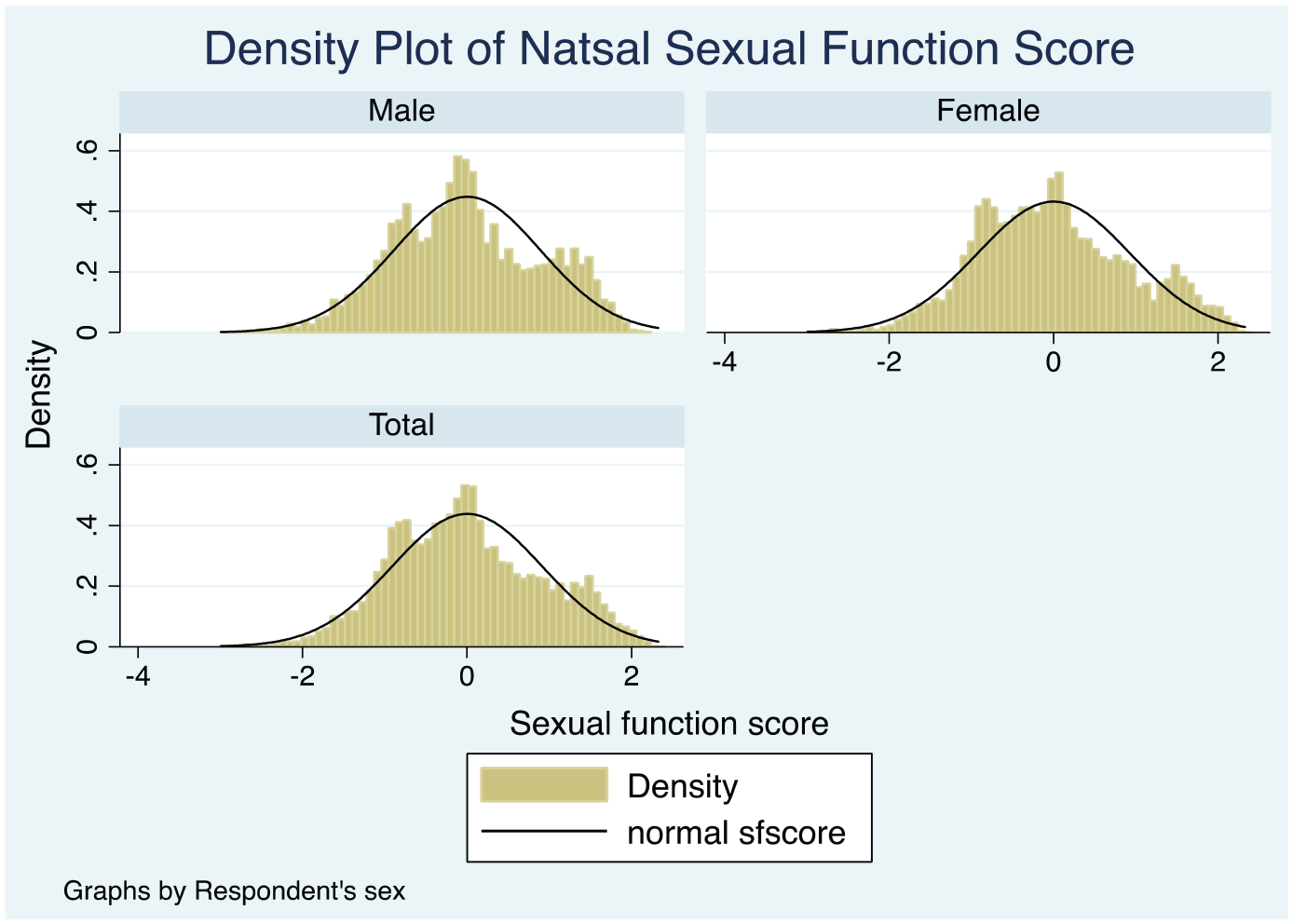
Density plot of Natsal-3 sexual wellbeing score by sex.
Whether members of the Natsal-3 sample provide a measure on the sexual function score depends on their response to certain questions on the survey questionnaire. All respondents who report being sexually active in the past year and answer the relevant questions are given a score on the measure (Mitchell et al., 2013). Some individuals, for example, those that were sexually active but not currently in a relationship did not supply answers to some of the relevant questions from which the sexual function score was computed. Their responses were imputed for these questions (Erens et al., 2013). Imputing responses in this way enables a score to be obtained from those that were not in a relationship at the time of the survey and thus ensures they contribute to the analyses. The process of imputation is somewhat complex, but involves imputing responses for the missing relationship items for those for whom they are missing, drawing on the distribution of responses for similar individuals for whom such responses are observed.
Social class
The social class measure used to analyse sexual wellbeing is the National Statistics Socio-economic Classification, or NS-SEC. NS-SEC is an occupation based measure of social class (Goldthorpe, 1996, 2000). In this study, we use a classification based on the occupation and employment circumstances of the respondent rather than the alternative classification based on the employment circumstances and occupation of the reference person in the household in which the respondent resides.
The economic measure of class provided by NS-SEC has been challenged with definitions of class reconfigured to include analysis of social and cultural capital (Bottero, 2004). Most notably, Savage et al. (2013) drew on findings from the Great British Class Survey to suggest a multi-dimensional model of social class. This new model of social class has, however, also come under considerable criticism, with researchers defending the relevance of occupation-based measures such as NS-SEC (Bradley, 2014; Mills, 2014). While acknowledging the various cultural, economic, and social factors that combine to bring class into effect, we argue that the NS-SEC measure affords an analysis of the material advantages and disadvantages of social class and possesses significant explanatory validity.
In general, the NS-SEC measure focuses on employment relations (aspects of work) and conditions of occupation (labour contract), and thereby on socio-economic position. The measure is constructed from (1) occupation of either the respondent and/or household reference person based on SOC2010; (2) whether the respondent and/or household reference person is an employee, employer, or self-employed; (3) a supervisor; and (4) the number of employees employed at their place of work. The Natsal data contain an eight-category and six-category measure of respondent social class. For the analysis presented here the eight-category respondent NS-SEC measure proved to have some categories with too few cases to support statistical analysis. As a result, our analysis is based, in the main, on a version of the six-group NS-SEC respondent measure supplied with the Natsal data.
Sample selection and statistical methods
Having considered measures of class and sexual wellbeing that provide the focus of our exploration, we turn now to describe the sample selected from the Natsal data upon which our analyses are carried out.
Sample selection
Of the 15,162 cases in the Natsal-3 data file, cases that represent sexually active, prime age adults from the perspective of economic activity were selected for analysis. We therefore excluded respondents aged less than 25 years and aged over 64 years (N = 5410) from the sample, leaving 9752 cases (64% of all cases) at our disposal. Next, we focus on those of the prime age sample that have had sex with at least one partner in the 12 months prior to the survey interview. Of the 9752 cases available, 1712 (18%) recorded no sexual partner in the past 12 months. Once these cases are excluded, we retained 8040 cases for analysis (53% of all cases). A further 37 cases from the 8040 (less than half of 1%), indicated that either they were not sexually active at the time of the survey, or they did not provide the data necessary to assess their level of sexual wellbeing. Once these cases were removed from our sample, we retained 8003 cases for analysis (53% of all cases), of which 4748 were female (59%) and 3255 male (41%; unweighted sample totals).
Statistical methods
Natsal-3, in keeping with many national surveys, has a complex sample design, with the aim of striking a balance between statistical efficiency and costs of data collection. For statistical analyses of these data to be valid, they must take account of the sample design. For this reason, weights are supplied with the Natsal-3 survey data. These weights correct statistical estimates for unequal probabilities of sample selection as well as for interview and unit non-response in the calculation of means, proportions, and regression coefficients.
Furthermore, the complex survey design also requires that our analyses take account of the clustered nature of the sample such that standard errors are adjusted appropriately for reliable statistical inference. Given the binary nature of the dependent variable (high sexual wellbeing) described above and the complex nature of the sample, multiple regression analysis is performed using logistic regression in the Survey Data Analysis module of STATA v15 statistical software, using the ‘sub-population’ command. Logistic regression enables us to evaluate the strength of associations between a range of different variables and the dependent variable sexual wellbeing. Standard errors for regression coefficients obtained from the logistic regression, confidence intervals, and p values for tests of the null hypothesis are derived on the basis of linearisation procedures described in Heeringa et al. (2017). These p values enable us to assess how far estimates of at least the size we observe in our model are consistent with null hypotheses that the true effects of the variables on sexual wellbeing are 0 (the lower the p value the less likely our results under the null hypothesis given the assumptions of our model). Confidence intervals provide ranges of possible values for the associations in our models, of which our estimates are one set of plausible values.
Analysis of association between social class and sexual wellbeing
Our analyses focus on the association between social class and sexual wellbeing from a sociological perspective. We do, however, report our results in full such that our analyses might contribute to, and act as a contrast with, health-focused literature that has until now focused on correlates of low sexual wellbeing (for example, Field et al., 2016 and Mitchell et al., 2013).
Description of the sample
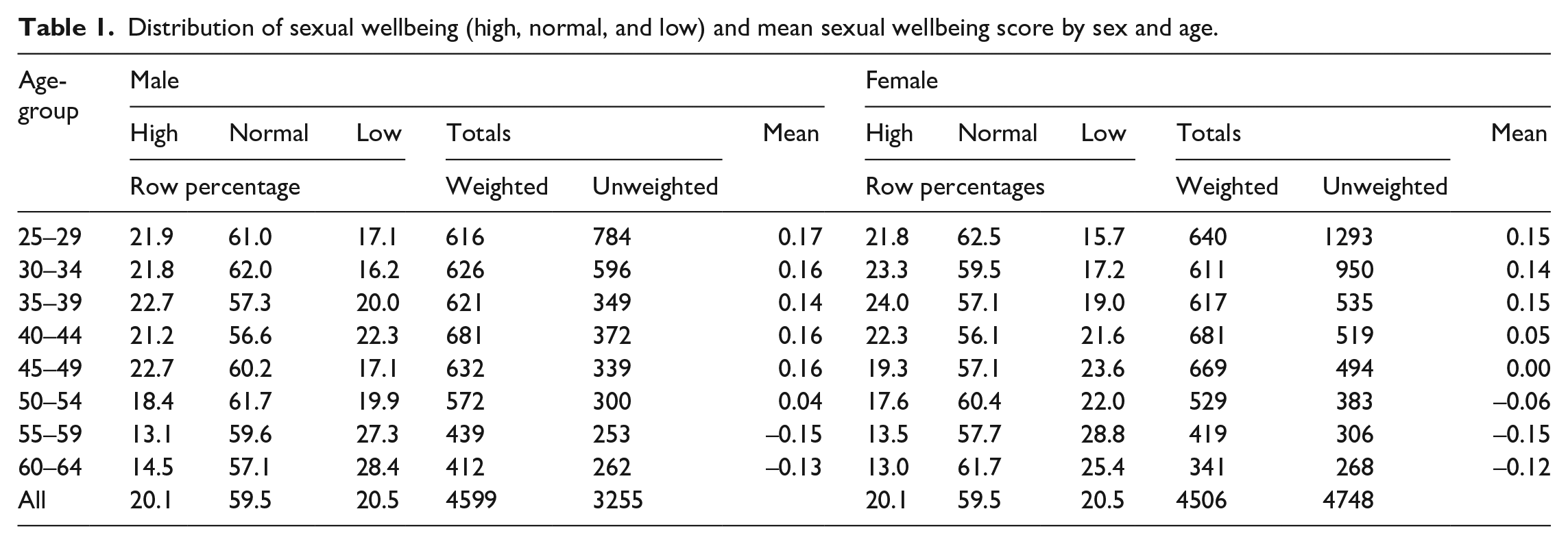
Tables 1 to 3 provide a descriptive analysis of the characteristics of the selected sample by sexual wellbeing and variables used as covariates in the regression analysis. The total weighted sample size for the descriptive analysis is 9105 cases comprising 4599 men (51%) and 4506 women (49%).
Distribution of sexual wellbeing (high, normal, and low) and mean sexual wellbeing score by sex and age.
Distribution of sexual wellbeing (high, normal, and low) by respondent social class (NS-SEC, 5- and 8-group categorisation).
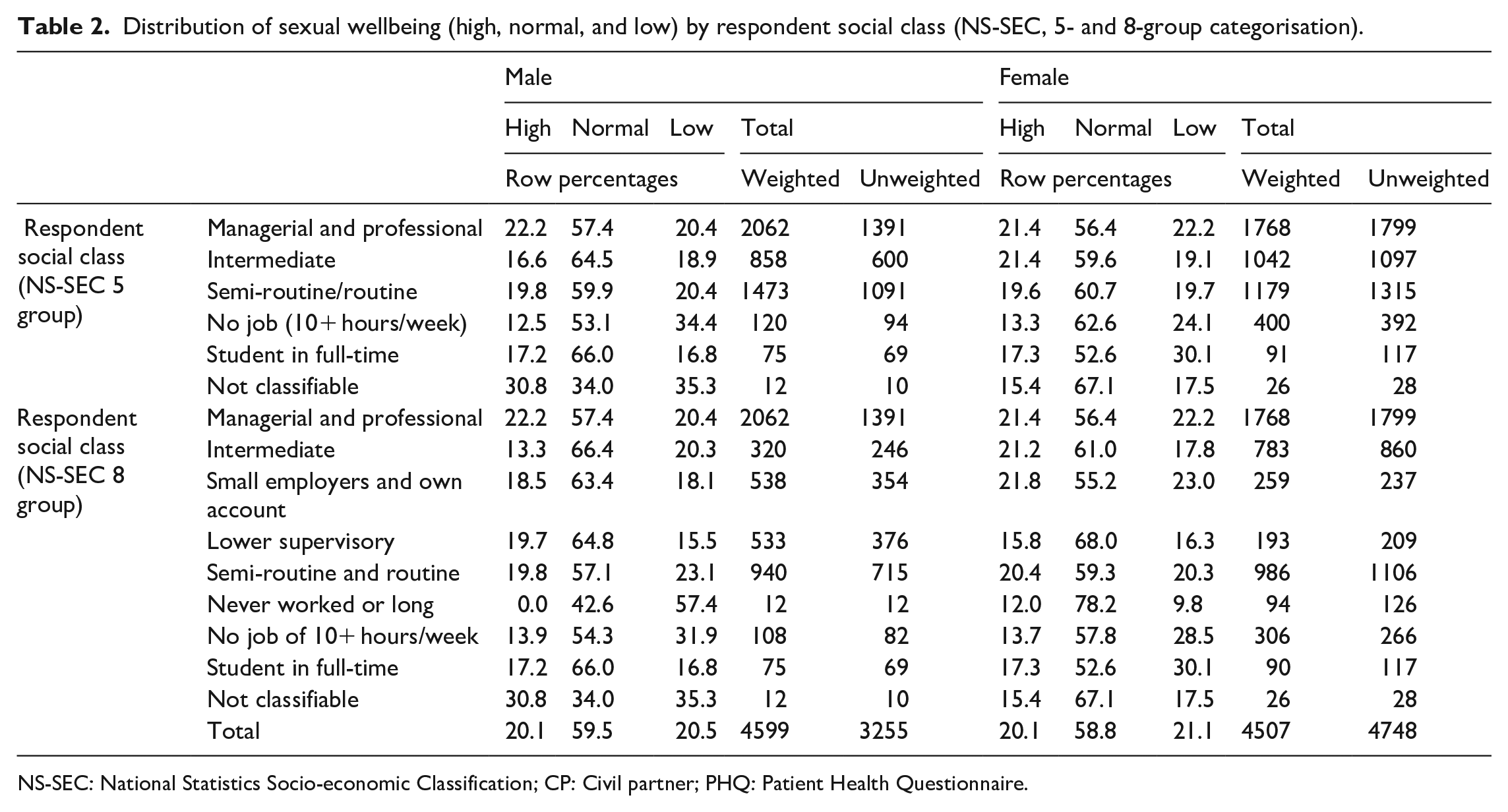
NS-SEC: National Statistics Socio-economic Classification; CP: Civil partner; PHQ: Patient Health Questionnaire.
Covariate characteristics by sexual wellbeing – bivariate analysis.
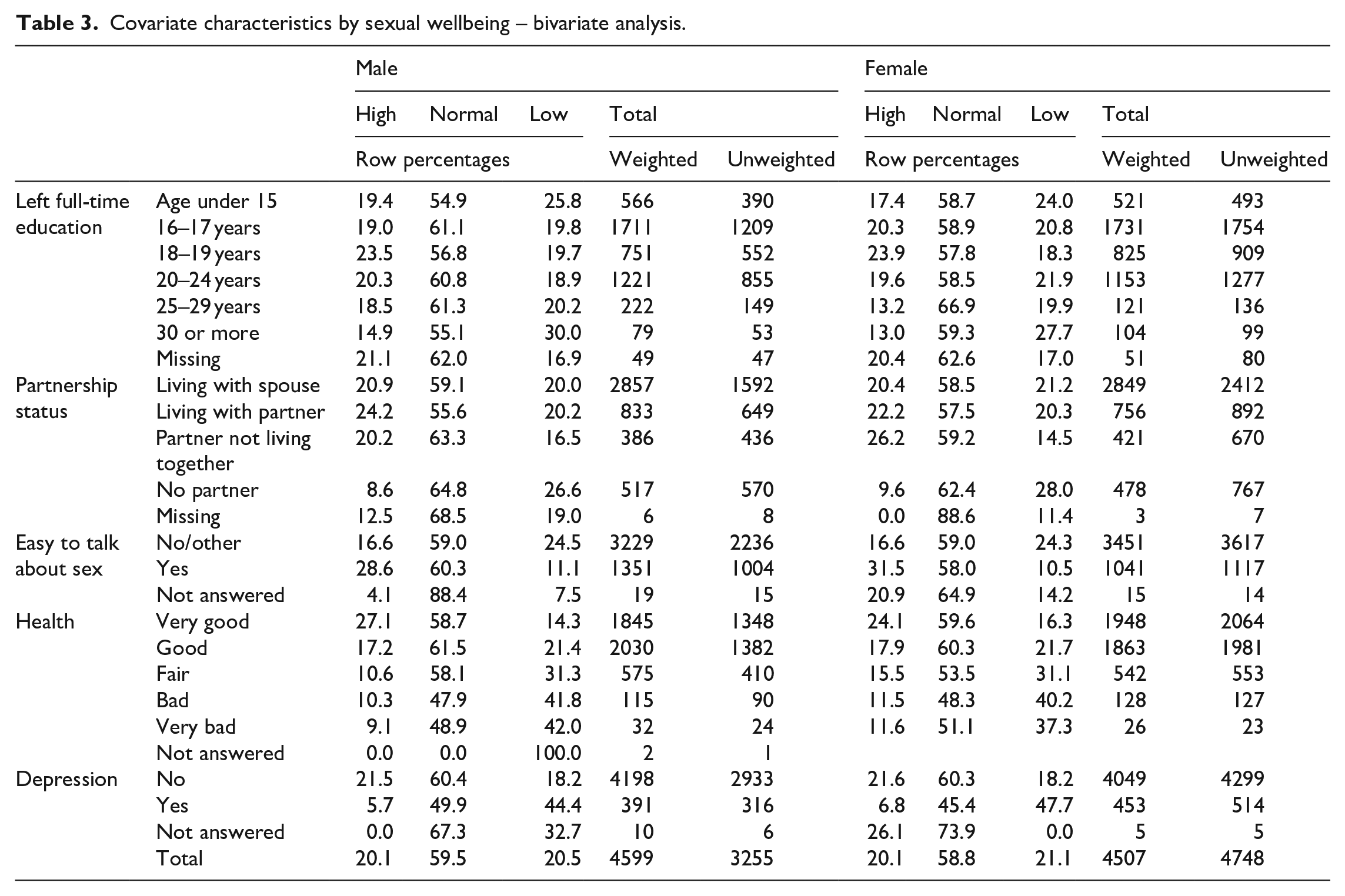
Table 1 explores the associations between levels of sexual wellbeing (high, normal, and low) and the mean score of sample members on the sexual wellbeing scale, by age and sex. Given the way sexual wellbeing is categorised, it is not surprising that roughly a fifth of men and women record either high or low sexual wellbeing. What is more pertinent, however, are the distributions across age-groups. For both sexes, we see that the proportions reporting high sexual wellbeing decline with age, from the early 50s onwards for men, and early to mid-40s for women. Mean sexual wellbeing for males is 0.16 among ‘45–49’-year-olds, 0.04 among ‘50–54’-year-olds, and −0.15 among ‘55–59’-year-olds. For women, mean sexual wellbeing is 0.05 among ‘40–44’-year-olds, 0.00 among ‘45–49’-year-olds, and −0.06 among ‘50–54’-year-olds.
Table 2 reports the bivariate associations between sexual wellbeing (high, medium, and low) and two measures of respondent social class based on NS-SEC, for men and women separately. For both men and women, respondents in higher social classes are more likely to report higher sexual wellbeing (that is, sexual wellbeing scores in the top quintile). For men, across all age-groups more than a fifth of those in managerial and professional occupations report higher sexual function (22.2%, Table 2). This is higher than any other occupation group in both the NS-SEC 5 and 8 social class classifications. For women the position is a little different. Over a fifth of those in both managerial and professional, and intermediate occupational groups (as well as smaller employer/own account group in the 8-category NS-SEC measure) reported higher levels of sexual wellbeing. This suggests that female sexual wellbeing is less sensitive to social gradient measures based on occupation. However, this gender difference is not sufficiently pronounced in order that it is a significant factor in the adjusted regression analysis set out below. There is also some suggestion in the bivariate associations that low as well as high sexual wellbeing might be greater among high social classes. 1 It is worth noting also, that although the differences in reporting high sexual wellbeing across the sample by social class are not large in relative terms, such difference can translate into quite substantial differences in total or absolute wellbeing across the population as a whole.
Table 3 provides a range of further descriptive analyses examining levels of sexual wellbeing by further covariate variables included in the logistic regression analysis reported in the following section of this article. These tables provide information on the characteristics of the sample used in our analysis. It is important to keep in mind that the bivariate analyses are likely, to some extent, to reflect different age distributions and other factors across the groups identified, as much as the associations between the two variables.
We also explored the association between sexual wellbeing and age left full-time education. Here the concern is to understand whether there is an association between education and sexual wellbeing. Those that appear to have participated in advanced study are less likely to report high levels of sexual wellbeing, though again differences between groups defined by age left full-time education are not large, with the exception of those that left education when aged 30 or more (14.9% of whom report high sexual function, Table 3; though the sample numbers within this group are quite modest). This association leaves open possibilities that those with higher education have higher expectations of intimacy and fulfilment, and when not met, consequently experience lower sexual wellbeing.
Considering partnership status, for men, the highest proportion with high sexual wellbeing was found amongst those living with a partner but not married or in a civil partnership (24.2%, Table 3), while those sexually active but without a partner recorded very low levels of high sexual wellbeing (8.6%). For women, this position is very slightly different, with the proportion recording high sexual wellbeing being greatest for those with a partner but not living together (26.2%, Table 3).
As might be expected, the proportions reporting high sexual wellbeing were greatest among both men and women who found it is easy to talk to their partner about sex. Clear patterns in the bivariate analyses were also found between high sexual wellbeing and health as well as with a measure capturing symptoms of depression (self-reported). Those reporting better health were more likely to have high sexual wellbeing and those that displayed self-reported symptoms of depression less likely to do so.
Adjusted analysis
We now turn our attention to look at the association between social class and sexual wellbeing using multiple logistic regression. We examine whether there is an ‘association’ between the two variables through fitting a series of models to the Natsal-3 data. The analysis presented here cannot be interpreted as evidence of a causal relationship between social class and sexual wellbeing. Nevertheless, evidence of a statistical association between these two variables, does we contend, raise questions as to whether material concerns and their relationship with personal intimacy can be easily dismissed as well as suggest the need for further research. Our analyses also possess the advantage of having been conducted on nationally representative sample survey data and therefore our results will be generalisable to the population at large.
Three models are reported in Table 4. In each case the dependent variable is a binary indicator coded to ‘1’ if the sample member reports high sexual wellbeing (a score on the sexual function scale in the top quintile), and 0 otherwise. In each of the three regressions, respondent social class is included as a covariate variable in the regression. In each model alongside social class, we include additional covariates that adjust the estimated association between high sexual wellbeing and respondent social class for gender and age differences as well as differences in education. In Model 2, alongside gender, age, education, and social class we include covariates capturing two dimensions of relationship quality: partnership status and whether the respondent finds it easy to talk to sexual partners about sex. These additional covariates seek further to adjust the main association of interest between sexual wellbeing and social class. Finally, Model 3 contains two variables capturing differences in respondent health status and self-reported depression that may also be associated with both social class and sexual wellbeing.
Multiple logistic regression analysis – social class (respondent NS-SEC) and high sexual wellbeing.
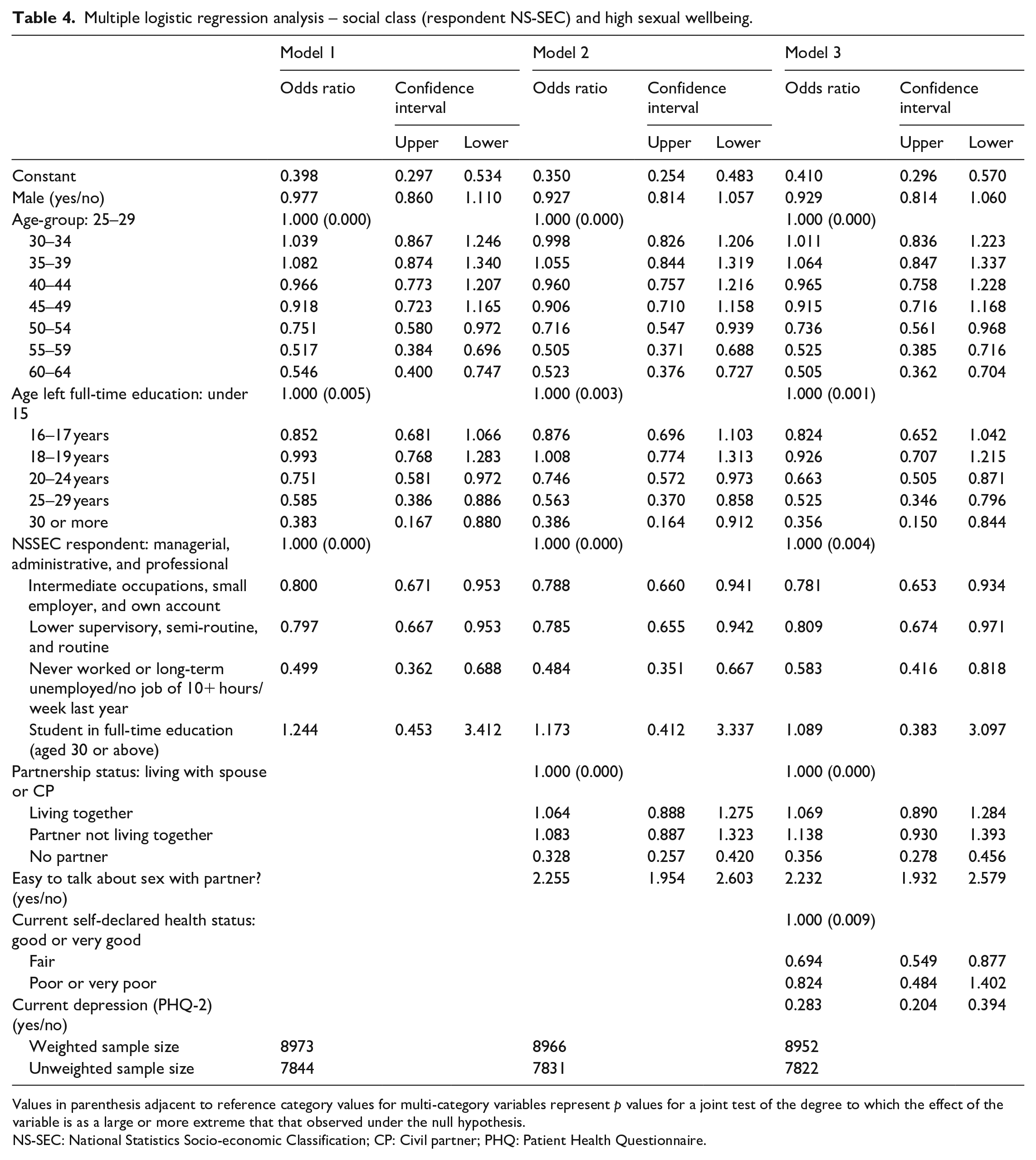
Values in parenthesis adjacent to reference category values for multi-category variables represent p values for a joint test of the degree to which the effect of the variable is as a large or more extreme that that observed under the null hypothesis.
NS-SEC: National Statistics Socio-economic Classification; CP: Civil partner; PHQ: Patient Health Questionnaire.
The associations reported in Table 4 between the various covariate variables and high sexual wellbeing are odds ratios. For each estimated association, 95% confidence intervals are reported as well as p values from a statistical test of whether a given multicategory covariate is jointly 0 with respect to high sexual wellbeing. In the table, p values are reported in parenthesis next to the reference category (set to unity) for multi-category covariates.
Looking first at Model 1 (Table 4), social class is jointly statistically significant at the 99% level and above (p = 0.000). All social classes have odds of reporting high sexual function lower than that for managerial and professional groups, the reference group. These lower odds of reporting high sexual function relative to managerial and professional groups are statistically significant at at least the 95% level.
As discussed above, Model 2 (Table 4) considers again the association between respondent social class and high sexual wellbeing, but with the inclusion of partnership status and a variable capturing whether the respondent finds it easy to talk about sex with a partner. While we find that both these variables are statistically significant in the model, their inclusion does not substantially alter the associations uncovered in Model 1 between social class and high sexual wellbeing.
Model 3, Table 4, includes the additional explanatory variables self-reported health and current depression (PHQ-2). Both variables are associated with high sexual wellbeing and improve the model fit. Respondent social class as a whole remains jointly statistically significant at the 99% level in Model 3 (p = 0.004, Table 4). Differences between social classes also remain statistically significant, with all groups recording lower odds of high sexual wellbeing relative to those in the managerial/professional group.
In sum, the association between reporting high sexual wellbeing and being in managerial and professional social class groupings, relative to other social classes, remains remarkably robust to the inclusion of additional covariate variables controlling for age, education, relationship quality, and measures of physical and mental health. In each model specification, odds ratios are less than 1 for all social class groups relative to those in the managerial and professional group (with the exception of students in full-time education). Managerial and professional groups ‘stand out’ in this regard in that between the other social class groups there does not appear to be appreciable difference in the odds of reporting high sexual wellbeing. Differences between social class groups, relative to managerial/professional social class, in terms of reporting high sexual wellbeing are consistent across regression specifications and statistically significant at at least the 95% level.
Discussion and conclusion
In this article, we have conducted a statistical analysis of nationally representative survey data to explore the extent to which there may be a social class component to high sexual wellbeing. Our analyses also contribute to existing literature, in the field of public health, that has considered correlates of sexual wellbeing/functioning. We have examined the extent to which social location and material circumstances of life place constraints on intimate relations and therefore sexual wellbeing. Our analysis shows an association between reported ‘high’ sexual wellbeing and social class, and we provide the first analysis of high sexual function in Britain, with previous research focusing on individuals reporting low sexual function.
The main results of our analysis demonstrate a consistent pattern in which social class is associated with high levels of sexual wellbeing. In particular, those in managerial and professional occupations appear to be distinctive, as they report sexual wellbeing consistently above those of other groups. The relationship is consistent across the specifications reported in Table 4. Although the differences across social classes are not large, across the population as a whole they represent substantial absolute gains/losses in wellbeing. Based on the view of sex as a private, individual matter, we should find no association between social class and ‘high’ sexual wellbeing. As we have demonstrated, there does indeed appear to be such an association and this we believe, at the very least, raises a range of further theoretical and empirical questions.
An unexpected finding from our analysis is the apparent association between education and sexual wellbeing. Those who report high levels of education (as measured by the age at which they left full-time schooling) also tend to report on average lower levels of sexual wellbeing relative to those with less education. In particular, those who have participated in advanced study are less likely to report high levels of sexual wellbeing. It appears that the statistical association between social class and high sexual function tends to be attenuated if age left full-time education is not included in any adjusted analysis. We have no explanation for this finding but note the possibility that the inclusion of education in the model might be accounting for some unobserved factor correlated with sexual wellbeing.
We argue that these results are suggestive of a social class component to sexual wellbeing and therefore provide a counter to discussions of sexuality abstracted from material constraints. In our analysis, we also note an association between being partnered and high sexual wellbeing. For men, the greatest proportion with high sexual wellbeing was found among those cohabiting (24.2%, Table 3), while those sexually active but without a partner recorded far lower levels of high sexual wellbeing (8.6%). Women who were in a couple, but not living with their partner, recorded the highest sexual wellbeing (26.2%, Table 3). This may reflect other research that suggests that heterosexual couples become overwhelmed with traditional gender roles upon cohabitation, negatively impacting on female sexual satisfaction (van Hooff, 2015). There are also links between respondents reporting good communication in their relationships and high sexual wellbeing, and clear patterns between health and sexual wellbeing, which require further exploration.
These findings will be of interest to sociologists and health researchers, as they demonstrate the continued salience of class and material resource in structuring the most intimate areas of social life. Rather than class operating as an obsolete ‘zombie category’ (Beck and Beck-Gernsheim, 2002), our analysis shows that even the most personal and private areas of life are potentially impacted on by wider class inequalities and material constraints. The association between high sexual wellbeing and class processes documented here provides a renewed impetus for greater focus on the ways in which class manifests itself in all areas of social life. We argue that the extension of inequality and class into sexual practices, as evidenced here, is an example of the way in which class impacts upon all areas of everyday life. As Wendy Bottero (2004) notes, ‘the reproduction of hierarchy is carried out every day, by us all, in the most banal and mundane of activities’ (p. 997). Further analyses, though beyond the scope of this article, might usefully explore the association between social class and the three components of the sexual wellbeing measure. Furthermore, our analyses suggest the need for more longitudinal research in order to isolate the degree to which changes in socio-economic status might lead to changes in sexual fulfilment. This analysis has also shown the usefulness of sexual wellbeing as a variable in sociological analysis of sexual practices.
Footnotes
Funding
The author(s) received no financial support for the research, authorship, and/or publication of this article.
