



Abstract
Woven straw work produced in the Caribbean in the early twentieth century represented a small but sustainable percentage of the region's exports. Following the US occupation in Haiti (1915–1934), handicrafts were promoted as economic ‘development’: commodified folklore fashioned for the delight of visiting tourists. Up until 1946 in Curaçao, as a strategy of the Catholic church's civilising mission, young women trained to plait the so-called ‘Panama hat’ at technical schools (Römer, 1977); the products of their labour were often exhibited at international expositions and exported for sale in Europe and the United States. This article argues that missionary education that claimed to modernise, industrialise and revalue local handicraft skills to the benefit of local populations in Haiti and the Dutch Caribbean has instead perpetuated colonial gendered and racialised divisions of labour that prepare and discipline students for factory work in the global textile industries. I use straw artefacts and photographs from the collection of the Dutch National Museum of World Cultures as a starting point to trace the entanglements between imperial education and ethnographic exhibitions as sites of gender production. Drawing on Jean Casimir's concept of contre-plantation (2001), I explore how histories of indigenous craft knowledge during specific periods of resistance in Haiti have nurtured disidentification with a gendered logic of labour exploitation and racial capitalism.
Keywords
‘What is this earthly paradise for our visitors? Two weeks without rain and a mahogany tan and, at sunset, local troubadours in straw hats and floral shirts beating “Yellow Bird” and “Banana Boat Song” to death.’ (Derek Walcott, The Antilles: Fragments of Epic memory. The Nobel Lecture, 1993: 31–32).
The ubiquitous ‘Panama hat’ is an all too familiar prop in tourism imagery of Caribbean landscapes and peoples. In light of how visitors from the North have archetypically reduced the region to sun, sand and straw hats in the repetition of ‘images of service that cannot distinguish one island from the other’ (Walcott, 1993), it is no surprise to find examples of natural fibre millinery in the Dutch National Museum of World Cultures (renamed Wereldmuseum in 2023). The ethnographic museums that make up the Wereldmuseum, including the Tropenmuseum in Amsterdam, the Rijksmuseum of Ethnology in Leiden and the Africa Museum in Berg en Dal, remain deeply implicated in how Europe has been ‘made to see’ and imagine the world via the material lives of the peoples it subjugated and exploited (Vázquez, 2020: 4). Turn of the century exhibitions and the white ethnographic gaze that produced colonial difference have been instrumental in how tourists and visitors came to view the Caribbean region. The straw hat, an eponymous colonial signifier of ‘going native’, worn by Dutch travellers to the Caribbean, was purchased in souvenir markets and other ‘picturesque’ sites of local labour, easily transported back to Europe, and by the twentieth century, displayed in ethnographic collections that today belong to this umbrella world museum. Goods crafted out of straw, including hats, bags and baskets had a tactile feel to them and offered lessons in the flora and fauna of the Dutch territories of Suriname and Curaçao. Inextricably linked to Dutch colonial expansion, the collection of the Wereldmuseum contains several objects and photographs, taken between 1915 and 1930, that document the ‘Panama hat’ industry and its gendered training systems in the Dutch Caribbean island of Curaçao (Figures 3–5). Well-made artefacts crafted from straw and other plant-based materials, produced through extractive ‘civilising’ education programmes, featured prominently in world fairs and early ethnographic museums in Europe.
From the late nineteenth and early twentieth century, successive international exhibitions and world fairs also showcased handcrafted goods that represented rural indigenous practices from other Caribbean countries, including Haiti. The museum's examples of Haitian straw plait work include a hat and makout woven peasant satchel. I have chosen to read these objects anew, alongside the imagery of missionary hat schools in Curaçao, as they allow us to explore: their histories within extractive and imperial regimes; how they have emerged through closely braided systems of imperial education and the ethnographic museum; their symbolism of repeating patterns of exploitative transnational textile manufacture today. There is little known about the collectors of these pieces, but since the straw hat (Figure 1) was acquired by the museum as far back as 1886, it may have been procured following Haiti's participation in one of the world fairs of this period, such as the International Colonial and Export Exhibition held in Amsterdam in 1883. Makout satchels and paniers were crafted in late eighteenth-century Saint-Domingue (Descourtilz, 1809) but the history of this satchel, as this article shows, is closely associated with peasant resistance to state control at the time of the US occupation of Haiti (1915–1934). Woven still today in rural areas of Haiti, basketry more broadly is often presented as a dying art of diminished popularity amongst younger generations. 1 The satchel in the museum collection (Figure 2) dates from the 1970s, as the museum's notes suggest, and can be imagined as a tourist souvenir. Tourism in Haiti was experiencing a renewed wave of resurgence during this period and the makout satchel likely signified an exotic folk accessory for the white gaze.
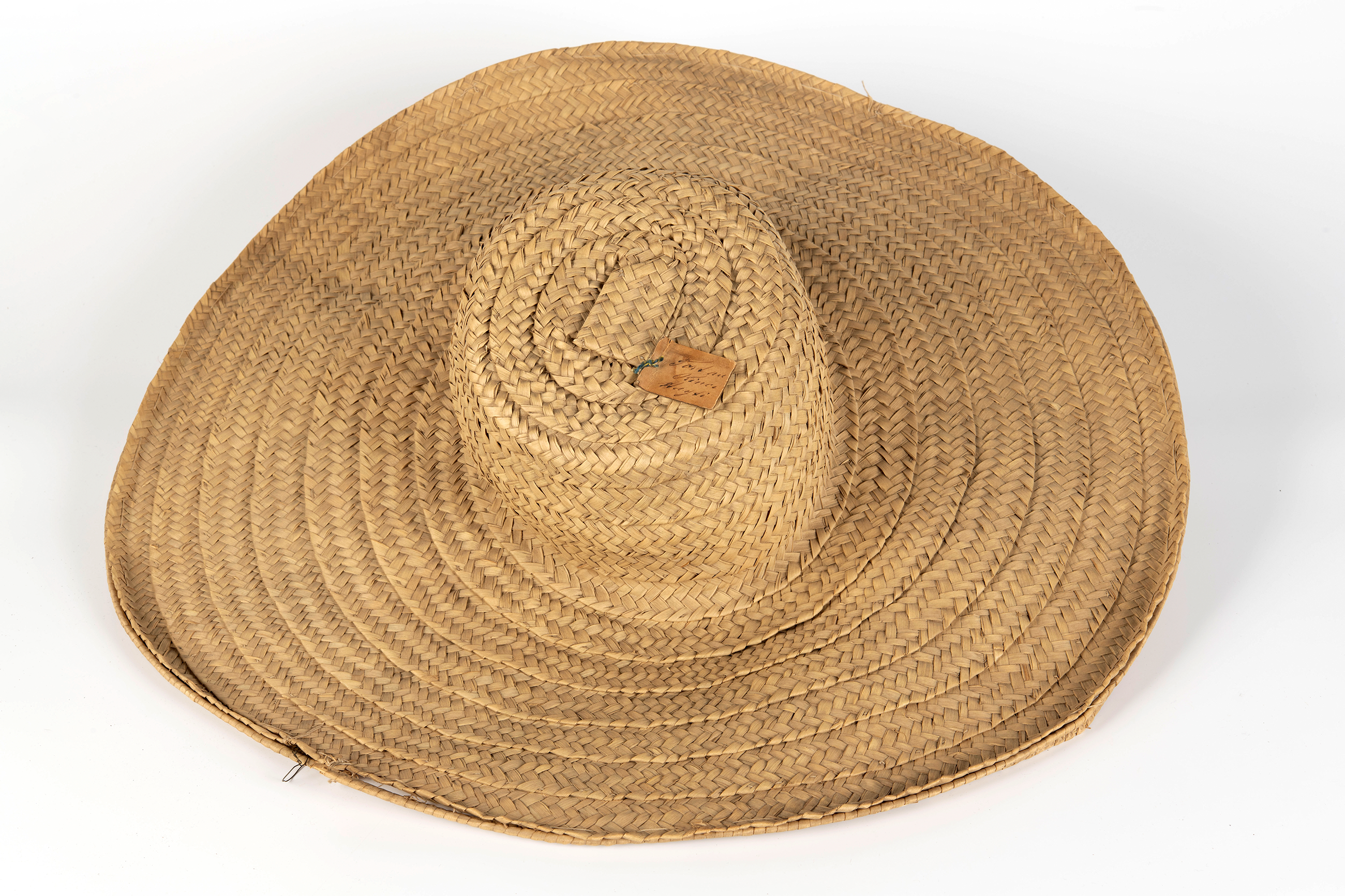
Haitian Hat, n.d. Collection Nationaal Museum van Wereldculturen Coll.nr. RV-580-22.
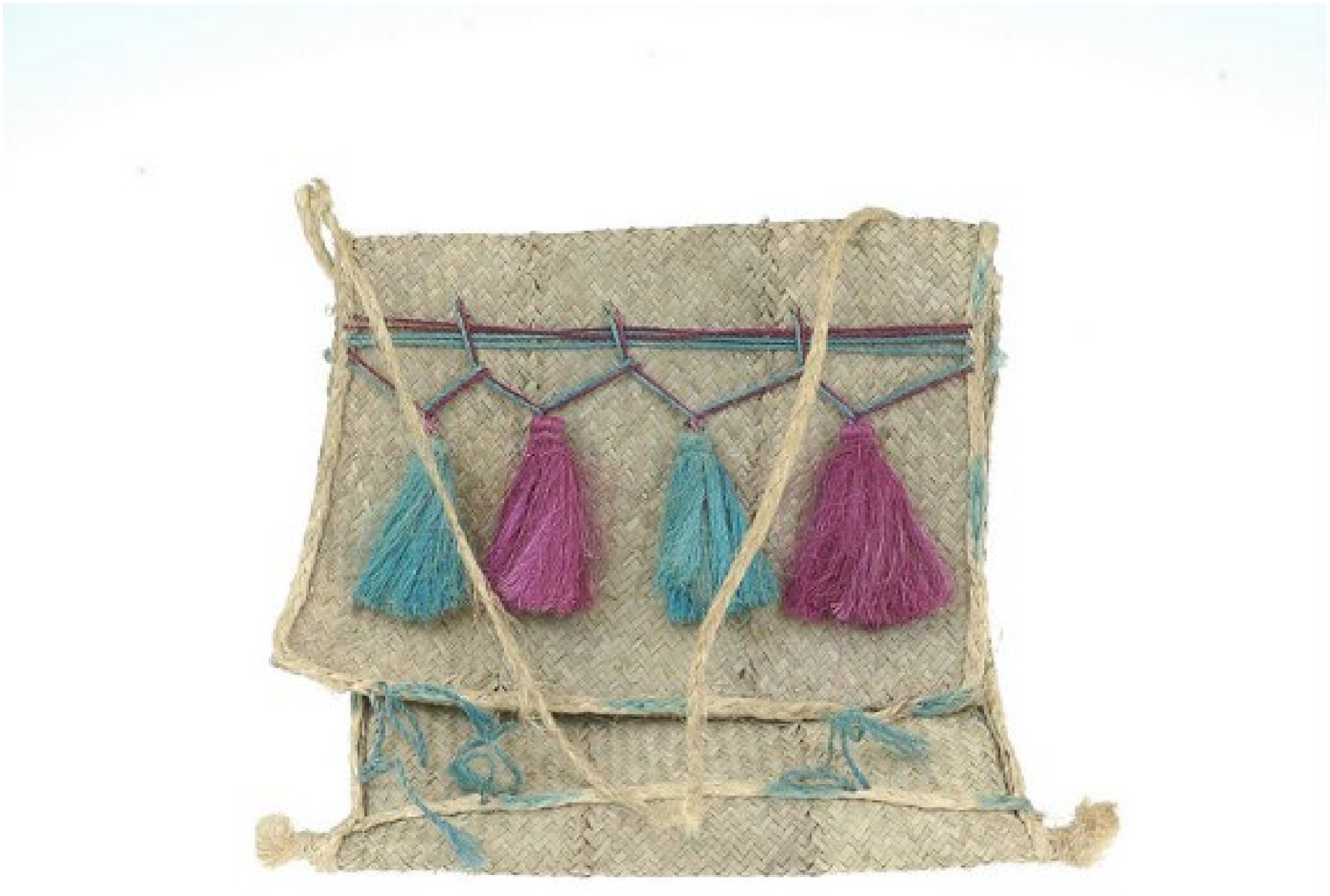
Bag (Haiti) – pre-1978. Collection Nationaal Museum van Wereldculturen Coll.nr. TM-4515-8.
The material artefacts I examine in this paper articulate how straw crafts have emerged from within gendered vocational schools and museum collections in the twentieth century, revealing a gendered logic of labour exploitation and export-based profit extraction in the fibre industry. I demonstrate how at specific historical moments of European and North American intervention, including the Haitian revolutionary period (1791–1804), post-emancipation (1863) and the industrialisation of Curaçao in the nineteenth century, the US occupation of Haiti (1915–1934) and the period of repression during the dictatorship of Jean-Claude Duvalier (1971–1986), imperial education was used to discipline workforces, engender a moral order and ‘develop’ applied arts and crafts skills in service to an external economy. In response to this racist colonial discourse that reiterated the idleness of the enslaved Black other after emancipation, craft knowledge, developed covertly on the margins of the plantation or through urban artisanal production, nourished resistance to continued attempts to restore plantation economies.
In the first half of the twentieth century, there was a renewed interest in the Caribbean for cultivating economic plants, such as sisal, for fibre production and export to the North. 2 This was due in part to the decline of other crops, including sugar, but also the increased international demand for products such as sacking, twine and rope for military use. In Haiti, the industrial production of sisal was promoted under the imperialist US occupation (1915–1934). The arrival of US agricultural firms, backed by the US military, resulted in the displacement of rural farmers from their land and migration abroad and to the capital, Port-au-Prince (Dubois, 2012: 9). In light of Haiti's history which has included European colonialism, anti-Black racial slavery, revolution, independence and imperialist occupations, there have been ongoing efforts to counteract the exploitative and extractive methods deployed in large-scale plantation production. Small-scale ‘counter-plantation’ (Casimir, 2001) straw crafts (explored in more detail later in this essay), practiced by a rural majority, have been a way to decolonise and reconnect Haitian culture to its African and indigenous origins and reaffirm Haiti's identity (Price-Mars, 2020 [1928]). Haitian historian and sociologist Jean Casimir identifies counter-plantation modes of straw work and tacit craft knowledge, that have resisted an extractive plantation system in Haiti, as tools of ‘self-defence’ against slavery and the abuses of modern colonial society (2001).
Similar to the US's imperial economic and strategic interests in Haiti, in the early twentieth century, the colonial authorities of the Dutch Caribbean colony of Curaçao focused attention on stimulating fibre production on the island (van Soest, 1975). Members of the colonial council began to collaborate with Kew Gardens in London and botanical departments in Trinidad in their technical and financial development of fibre crops for Curaçao. At international exhibitions and fairs, Curaçaoan sections displayed a surfeit of straw handicrafts and raw materials, including natural plant and leaf fibres. The expositions represented the cottage industries of the Dutch colonial enterprise in the Caribbean and played a key role in the promotion of an international industry in straw hats and its reinvestment. A report of the Brussels 1910 world exhibition describes the huge sales of both ‘simple’ and ‘finely woven’ straw hats from Curaçao that led to a second shipment quickly selling out. Conscious of the economic potential of this industry, the Dutch reporter laments the lack of funds allocated to bring several Curaçaoan women hat braiders to the exhibition ‘to better acquaint them with the requirements of the European market’ (‘Verslag’, 1912: 259). The bulletin reveals Dutch admiration for this indigenous skill and its importance, yet this respect is ambivalent. Local craft production was displaced to what Michel-Rolph Trouillot termed the ‘savage slot’ (2003), framed as outside modernity, static and unable to meet the aesthetic criteria and ‘progressive’ standards of a European market. Typifying colonialist nation-building discourse at this time, this status was further reinforced by the homogenisation and erasure of the maker. 3 Ultimately, it was foreign or colonial experts who trained the women artisans and determined the aesthetic and trade value of a shipment of the straw hats they produced.
In the early decades of the twentieth century, hat-making schools in Curaçao, run by the Catholic church, promoted straw cultivation and craft as a viable export industry. The schools focussed on training young Black women in sewing and a range of hat plaiting techniques. The church legitimised this education in a trade as an important tool to combat unemployment and instil respectability and morality in young Curaçaoan women. In the gendered production of craft skills, the ideology underpinning the church's ‘civilising mission’ touted the education of a work ethic (imposed by God) as a means to counter the threat of idleness associated with sinful activity and the post-emancipation freedom of enslaved workers in the colony (Allen, 2007: 149). Scholarly literature on these convents remains scant and offers little analysis of the colonial economic interests these schemes serve. 4 In 1913, government official H.J. Cohen Henriquez spent 6 months travelling to the Netherlands, France, Germany and the US, carrying with him samples to promote Curaçao's hat industry (Snijders, 1914: 141). During this period, it is no coincidence that the Dutch ‘ethical’ mission in its colonies developed in parallel to the economic growth of the Dutch export industry (Bloembergen, 2006: 225). Ethical imperialism targeted education as a key means of promoting prosperity in the Dutch colonies. The cultivation of natural fibres and the crafts of colonised peoples held future potential benefits to international colonialism and colonial markets.
In this article, I combine voices from literary fiction, documentary film and ethnographic fieldwork with historical object study to trace the histories of straw objects made in Haiti and Curaçao within extractive education regimes. In particular, I consider how ethnographic museums have been complicit in imperial histories of instruction and exploitative craft production, serving as training grounds to teach colonial difference and racialised gender. Using contemporary interviews and focus groups I undertook with garment workers in Haiti's transnational textile industry, I argue that colonial histories of craft and their production of gendered divisions are crucial to understanding how gendered Black labour continues to serve and sustain global fashion systems of capitalist production. The structural violence experienced by women textile labourers in our contemporary global textile and fashion trades is inextricably rooted in gendered colonial educational institutions.
Indigenous fibre knowledge and gender textility in pre-revolutionary Haiti
From early colonial narratives admiring indigenous fibre knowledge to the contemporary model of the garment assembly plant, representations of labour, particularly the labour of Black women's bodies, have tended to essentialize, homogenise and ungender workers. As Hortense Spillers argues, from the time of the slave ship's hold, African captives were counted as quantities, neither female, not male; in the fields of the plantation women performed the same hard labour as men: Because it was the rule, however—not the exception—that the African female, in both indigenous African cultures and in what becomes her “home,” performed tasks of hard physical labor—so much so that the quintessential “slave” is not a male, but a female—we wonder at the seeming docility of the subject, granting her a “feminization” that enslavement kept at bay (2009: 453).
According to a racialised colonial logic, enslaved people are relegated outside gender and outside modernity to the ‘savage slot’ (Trouillot, 2003). By reading imperial craft histories anew, we learn how a paternalistic ideology of docility is ‘taught’ and disseminated but also the potential for resistance that might involve mobilities, marronage, and what I term gender textility, whereby the practice of making has crafted more flexible gender relationships and roles. 5
In the late eighteenth century, prior to the revolution which saw Haiti defeat major European powers and secure its independence in 1804, marrons (maroons), who had fled the colony's vast plantation system, were able to blend more successively into towns if trained in a craft (Dubois, 2005: 52). 6 In the early days of the French colony of Saint-Domingue, skilled textile makers drew on Taíno fibre knowledge and weaving history, as well as African craft traditions. Writing in the early twentieth century following the shift from European observation and description to systemic archaeological excavations of historic sites, in 1935 Swedish anthropologist Sven Lovén published Origins of the Tainan Culture. Despite insufficient evidence to suggest Lovén had visited the Caribbean at all, he argues that early Taíno methods of harvesting leaf fibres from plants such as the American agave ‘must have been’ passed on to African captives and maroons via the European settlers who had acquired the knowledge from the Taínos (1935: 402). 7 On the one hand, Lovén's interpretation suggests both the self-serving fascination of colonial authorities in the material culture of the Taíno people and the ways in which Caribbean textile aesthetics and technologies have sustained and transformed themselves even under the harshest conditions: European extraction, enslavement and exploitation of indigenous craft knowledge and skill. On the other, Lovén elides the possibility of cultural exchange between the Taíno and maroon African populations, the transfer of material culture knowledge via scattered indigenous objects (found as plantation fields were planted; Pané, 1999) and the layers of local textile process that deflect and contest Eurocentric knowledge production.
Early Spanish and French chroniclers and missionaries suggest that in Taíno society, women, rather than men, spun and wove cloth and distributed valued commodities, such as fishing nets, mats and hammocks (see Buckridge, 2016: 29–30; Deagan, 2004: 601; Las Casas, 1951: 114; Lovén, 1935: 532; Ostapkowicz and Newsom, 2012: 320; Oviedo y Valdes, 1851–1852 [1535–49]: 276–278; for gendered division of weaving amongst the Caribs, see De Rochefort, 1983: 507). Women weavers were considered ‘creators’ of sacred objects such as wrapped and bound zemis, human forms made from cotton and other plant fibres from the agave family, symbolising the rebirth of ancestors (Ostapkowicz and Newsom, 2012: 320). This generative task, bringing into physical form an ancestor, contrasted with the subtractive process of wood carving. Although men were thought to be involved in the fabrication of larger wood objects, researchers believe that gender differentiated roles with regard to craft labour were not as exclusive as the chroniclers assumed. 8
The context of slavery, its violent imposition of European gender roles in colonial and capitalist production, mediated the transfer of indigenous craft knowledge and African cultural continuities. Under slavery, Haitian textile crafts became ‘westernized’, influenced by French colonial practices (Mintz, 1974: 276) and European gendered divisions of labour. The French colonial administration sought to keep separate different groups in the colony and enslaved people were classified according to their skill, age and occupation. Domestic enslaved seamstresses, seen to hold a relatively privileged position in the plantation hierarchy, practiced needlework and embroidery and would occasionally accompany planters and their wives on trips to France to apprentice in the latest couture sewing skills before returning to the colony (Moitt, 2001: 70–71; Weaver, 2012: 48). Despite the imposition of gendered textile labour roles under a racialised French colonial order, there is evidence of gender flexibility with regard to insurgent textile production. During the Haitian Revolution and War of Independence (1791–1804), Haitian historian Thomas Madiou describes male indigenous soldiers weaving their own clothing (1848: 427). 9 A necessity perhaps due to the context of the war, this nonetheless demonstrates a challenge to colonial classifications of power that sought to differentiate material skills according to gender. Makout bags and straw hats, like the example featured in the Wereldmuseum collection (acquired in 1886), plaited from latanier palms and spiralled to form the shape of the head) have symbolised indigenous resistance since the Revolution. 10 Madiou describes Black soldiers repeatedly between 1791 and 1803 as wearing a uniform of cotton smock with a hat made of straw or green leaves (1848: 77, 423).
European accounts tended to reveal a fascination with indigenous fibre work. In Voyage d’un naturaliste, French botanist Michel-Étienne Descourtilz observes both men and women of African descent weaving household items in the colony of Saint-Domingue, including a female elder weaving baskets out of bamboo (1809: 111–112) and men, described as engaging in craft activities such as braiding fishing nets, mats, bridles and bags, known as makout, fabricated out of latanier palms (109). 11 Weaving and plaiting perpetuated and embodied African, Taíno and European cultures; makers enfolded memory into the touch and smell of the material. Knowledge of the material was integral to the making process and the memory of a traumatic history of genocide, enslavement, resistance, marronage and sabotage became embedded not only in the object but recalled via the skill itself: a long repetitive creative process requiring the whole body. 12
Crafting contre-plantation in the post-emancipation period
In the wake of the Haitian Revolution in the nineteenth century, weavers (both men and women) continued to fabricate rope, cord, woven mats, straw hats and traditional makout satchels. Fishermen wove their own nets and wickerwork fish traps (Gonzalez, 2019: 244). Haiti's market women used baskets as vessels for distributing the country's food needs and also traded in a wide array of handicrafts. The rural majority sustained a small-scale cottage industry in locally crafted items, which did not secure their prosperity, but did resist against their exploitation at the hands of import taxes and elite urban merchants. Artisanal production constituted opposition to the export-oriented commodity-producing patriarchal plantation. Jean Casimir defines these craft practices (leatherwork, basketry, metalwork) rooted in the pre-revolutionary period (Mintz, 1974: 275) as tools of ‘self-defense’ against slavery and the ongoing inflictions of coloniality, a form of what he famously terms contre-plantation (2001): From the moment the captives took control of their gardens and provision grounds and demanded more free days in the wake of the general insurrection, the counter-plantation system and the institutions through which it was articulated were put into place. These included gender relations, family, the lakou, indivisible collective property, Vodou temples, rural markets, garden-towns, leisure, crafts, the arts (2020: 351).
Community knowledge of these systems that emerged in resistance to slavery continued to protect against the ‘modern/colonial world’ embodied in the post-emancipation period by the country's elite. Exclusion from this community equated to alignment with a logic of exploitation and inequality that threatened to engulf Haitian society. Despite attempts to re-establish large plantations via, for example, the rural code of 1825, which sought to control and militarise agriculture using ‘the language of the bayonet’ (Trouillot, 1990: 74), the peasant majority resisted.
As Carolle Charles (1995) has argued, the context out of which Haitian peasantries emerged following emancipation in the nineteenth century, their constricted access to more favourable, fertile land, their economic subjugation and resistance to state control necessitated the reproduction of creative and generative practices from the past. 13 This post-extractive model produced its own gendered division of labour, influenced by the central reproductive role of Black women under slavery and perpetuated what Charles refers to as a ‘distinct sex/gender system’. In order to knit together and maintain cohesion of household in the face of state control, the extended family, the lakou, relied in particular on the labour of women, who transported and traded the bulk of peasant production to markets and reproduced a family labour supply (51). 14 This gendering of Haitian labour therefore developed as a mode of resistance to the violent excavation and organisation of de/graded land under the plantation system.
On the US curation of gender in the early twentieth century
In the nineteenth century, Haiti's leaders introduced socio-economic systems that contributed to the country's political isolation and the continued economic dependence of a nation already crippled by indemnities to its former colonial master (Trouillot, 1990: 59). The nation became divided into two distinct groups: agricultural producers and the merchant class. Productivity, hampered by militarism and regionalism, remained an issue; by the end of the century, President Salomon (1879–88) had offered land grants to peasants who were willing to plant export crops and was committed to the promotion of public education. A decree from 26 July 1893 determined a gender-segregated curriculum from primary and secondary level. The main difference concerned le travail manuel; for girls, this meant needlework and dressmaking while boys would train in hat-making and shoemaking (Bellegarde, 1941: 142–143). Women's sewing knowledge therefore evolved not only through family transmission but also through public education which continued to be modelled on the French curriculum in the nineteenth and early twentieth century (Bellegarde, 1937: 71; Schmidt, 1995).
At the Haiti exhibit at the 1904 St Louis World's Fair, visitors could view ‘handiwork’ produced by the Orphan Girls’ School ‘La Madeleine’ in Port-au-Prince, run by the Rev. Sisters of St. Joseph of Cluny. An accompanying pamphlet includes a list of the lace and embroidered items on display: ‘Skirt of Luxenil lace embroidered; baby bonnet of Luxenil lace; handkerchief, necktie (…) petticoat, baby's shoes, spindle lace, and embroideries; necktie of Brazilian lace; christening dress, sheet of Colbert's embroidery, embroidered pillow cases …’ 15 The authors note as remarkable the ‘careful provision’ made for the education of girls at both religious and public schools (Corbett, n.d.). Other cases in the ‘Manufactures’ section contained hats made from palm leaves and corn husks, sisal and palm ropes, osier chairs and ‘a collection of fine shoes made in Haiti’. The makers and designers are not referenced in the pamphlet. Instead, the attention to women's labour and vocational training perpetuates a colonial vision that associates needlework and embroidery with improved productivity through virtuous and industrious activity. The contingent relationship between craft and gendered exploitation would be further solidified over the next two decades, particularly during the US occupation (1915–1934).
Following a visit to several vocational education institutions in the United States, Jean Price-Mars, who held the position of Inspector of Public Instruction at this time (1912–1915), supported the establishment of art and trade schools with agricultural departments equipped with laboratories and gardens in the different regional departments of Haiti (Pamphile, 2008: 17). Due to racial policies in the US, many Haitians were opposed to the implantation of US educational models (education was based on the French school system). When the US Marines landed in Haiti in 1915, they were not particularly concerned with education. They waited 10 years to introduce the Service Technique de l’Agriculture et de l’Enseignement Professionnel, a programme of vocational education designed to replace a classical education system in Haiti (Schmidt, 1995: 182). Influenced by policies imposed on Black people in the southern US, High Commissioner Russell's racist paternalist policies assumed that Haitians were ‘unsuited’ to formal education and favoured the development of vocational curricula to increase the industrial productivity of the country. This colonialist discourse posited Haiti's Black population as inherently inferior and in need of white instruction. Eve Sorensen (1925) described this racist education policy as the ‘Dawn of Haiti's New Era’ in its training of ‘workmen – shoemakers, carriage menders, mat weavers, sail menders, carpenters, workers in mahogany, gardeners, farmers, sugar makers, herdsmen – all manual workers’. For Sorenson, this programme, in reality, represented a strategy to quell the Caco rebellion against the invaders or, in their words, time spent ‘pilfering hordes of vagabonds with which the cities have always been infested, and the wild rovers who made the hills a terror’ (373).
The programme, which failed to appreciate Haiti's self-sufficient contre-plantation system, its agricultural and indigenous craft knowledge, listed ‘hand work’, together with reading and writing, as a core component of the curriculum between the 6th and 8th grades (Pamphile, 2008: 103). Pupils at the boys’ school École Centrale des Arts et Métiers, supervised by J.R. Hawke (graduate of the Carnegie Institute at Pittsburgh) are listed as spending 3 hours in the classroom, 2 hours in the workshops and 1 hour drill/work (43–44). The students, whose uniforms were manufactured in the school, carried out work in specialist trades including, shoemaking, carpentry, basketry, weaving and tailoring, with an instructor acting as ‘supervisor’. At the École Elie Dubois, run by a Belgian missionary order of Catholic nuns, girls were trained in home making, cutting and patternmaking, sewing, drawing and designing, among other activities (44). Intent on increasing productivity via manual work, imperial ideologies of gender informed the gendered divisions of skills at these schools. Young Haitian students were trained to become productive factory workers, artisans to white imperialism, under the guise of civilisation and industrial progress, a regime which repeats itself today in garment factories throughout the country.
Accessories of occupation and indigénisme: Makout satchels of straw
The nationalist indigénisme movement of the 1920s foregrounded the study of peasant culture, its contre-plantation potential and the African-based indigenous roots of Haitian culture. If, as Trouillot (1990: 131) has argued, the US occupation of Haiti called into question the country's political independence from France in 1804, the old categories of race and gender, and the Haitian elite's enduring intellectual rapprochement to French culture, the mouvement indigéniste provided an alternative vision. With the publication of Ainsi parla l’oncle in 1928, Jean Price-Mars, a scholar and advocate of peasant-based nationalism with family ties to the rural insurgency in the north, launched the movement. Indigéniste writers criticised the Haitian elite's attachment to Europe, and to France in particular. As Trouillot explains, … the practices of the U.S. occupiers raised questions about the Haitians’ views of whiteness. The indigéniste movement provided new answers: no culture was superior, either in savoir-faire or savoir-vivre (132).
One of the enduring symbols of resistant indigénisme during the occupation (along with the straw hat) was the makout satchel. With origins in pre-revolutionary Saint-Domingue, as Descoutilz's observations above confirm, the makout, or djakout, a satchel often worn bandolier style across the shoulder and chest became a symbol of peasant resistance to state control through the nineteenth century. The name makout/macoute is thought to originate from a Congolese word meaning ‘fabric of straw’ (Grandpré, 1801: 71). The example in the Wereldmuseum collection (Figure 2) is both a functional and utilitarian object, an ‘accoutrement paysan’ (Saint-Éloi, 2001: 95), aesthetically considered with dyed thread and tassels in contrasting blue and purple carefully placed to form half diamond patterns. The museum's description of this textile artefact notes the object's pre-1978 origins in Port-au-Prince, Haiti. Possibly produced during the brutally repressive Duvalier dictatorship of Jean-Claude Duvalier, who pronounced himself President for life in 1971, this straw bag lent its name to the Duvalier regime's notorious secret police, the Tonton Makout (literally Uncle Burlap Sack) and refers to the old peasant men of Haitian folklore, who carry straw woven sacks and kidnap unruly children from their parents (Chochotte, 2019: 930). 17 Aside from the name, this accessory represents a material signifier of the Duvalier appropriation of the indigénisme movement: the uniform of Duvalier's henchmen, the Tonton Makout, references the indigenous attire of the peasant Caco militias who organised in resistance to the US Marines during the occupation (1915–1934) and wore straw hats, denim and red kerchiefs. 18 In the postface to Ainsi parla l’oncle Price-Mars recounts a love story between Ti-Jean and Mainmaine and describes the young paysan who sets off to visit his lover, wearing a ‘halefort de latanier’, a straw bag decorated with blue aniline motifs and filled with gifts: biscuits, sweets, cakes and husks of corn (278). This functional accoutrement paysan, associated with peasant resistance to the state, provided storage for weapons, spiritual props and gifts of love.
The bag today is still popularised by Vodou practitioners and is worn by the spirit of agriculture, Kouzen Zaka, together with a peasant uniform of straw hat and denim dungarees. Practitioners use the bag to store spiritual props such as the traditional pipe associated with Zaka. Spiritual accessories, including straw bags and hats, once produced covertly on the peripheries of the plantation and deemed to be dangerous signs of resistance, return to Africa and thus rehumanisation, were used by the Duvalier regime in its staging and appropriation of Vodou for political ends (Benedicty-Kokken, 2013: 38; Dayan, 1996: 39). Following the dechoukaj/uprooting of Jean-Claude Duvalier in 1986, students waved torn pieces of the Tonton Makout uniform and palm fronds (branch bwa) as they celebrated in the streets; henceforth woven hats in straw and paper teamed with mock rifles to parody the militia became staple carnival garb throughout the country. 19
Hat-making at rifle-point
Literature on Haiti during the occupation authored by northern visitors was influenced by racist and paternalist visions that resonated with earlier years of colonial enslavement. Popular stories sought to remind North American readers of the continued need for the presence of the Marines. Accounts of Haitian Vodou were often intentionally feminised and promulgated gendered racial myths about the religion (Chancy, 1997: 54–55). In 1931, marine corps sergeant, Faustin Wirkus published his memoir The White King of la Gonave, co-authored with journalist, Taney Dudley. In the introduction, William Seabrook (author of The Magic Island, a fantastical intentionally feminised account of a Haitian Vodou priestess) explains the white masculinist fantasy of Wirkus being crowned king of a tropical island (Ramsey, 2011: 167): ‘Every boy ever born, if he is any good, wants, among other things, to be king of a tropical island …’ The memoir describes the plaited straw ‘native hats’ that proved ‘so useful’ when campaign hats were lost. Given the importance attributed to the marine uniforms, a gendered marker of status and white domination as Mary Renda argues – ‘another layer of whiteness saturated with military masculinity and emblems of national identity’ (2001: 171) – this transgressive non-regulation garb signified dangerous ‘native’ cross-dressing: Marines adopting the gendered and racialised wardrobe of the Other. In the mountain village of Pérodin, the narrator describes his encounter with a five feet high totem of straw hats, each one a tally of the Caco insurgents killed by the Marines: I came to a pole some eight feet high on which straw hats were spiked through their crowns, up to at least six feet from the ground. I was curious. I went back to camp and asked what the idea was of spoiling such a perfectly useful lot of native hats. (50)
During the 19-year occupation woven hats became synonymous with the Caco rebels, tactile and versatile objects associated, as the above example shows, with violent and imperialist encounters whilst, at the same time the occupiers controlled their manufacture for export and managed the training of a male labour force. Jacques Arcelin's (1983) documentary Bitter Cane tells a history of exploitation and foreign domination of the Haitian people, from European colonialism to reorientation of foreign investment towards the American markets. In between archival footage of coffee production and US-owned sweatshops, Arcelin, who filmed clandestinely during the dictatorship of Jean-Claude Duvalier (1971–1986), interweaves earlier archival images of the US occupation. One scene depicts a workshop of male hat weavers who work under the overseeing surveillance of armed US Marines, charged with controlling the quality of the work. The photograph is overlaid with an audio excerpt of Captain John H. Craige, installed as chief of Police in Port-au-Prince during the occupation, who states: ‘I believe we had a perfect right to go into Haiti, but I often blush at the transparent manoeuvres to which we resorted to make it appear the Haitians were accomplishing their own regeneration, in accordance with democratic principles’. This statement, questioning the legitimacy of the US vocational programmes introduced is juxtaposed with the camera's reveal of the rifle of an armed Marine as he patrols the perimeter of the hat-making workshop. The image unfolds the latent potential of the Marines to harm Haitian workers should they step out of line or slow down productivity. In the wider context of the film, this scene foreshadows Duvalier's promotion of export-oriented models since the 1970s that have allowed foreign-owned companies to run factories in Haiti without paying taxes or contributing to the Haitian economy, whilst exploiting local workers. Arcelin traces the roots of these neoliberal policies to the economic and ‘transparent manoeuvres’, including vocational schools and plantation monoculture, reintroduced under US control.
Sisal cultivation and the US occupation
The US occupation (1915–1934) utterly depleted Haiti's economy and natural resources. The 1918 Constitution drawn up under the occupation introduced a new law allowing foreigners to buy up Haitian land (Bellegarde-Smith, 2004: 19; Dubois, 2012: 269). In 1926 with the support of the US military government, the American firm DeCoppet and Doremus began the seizure of more than 12,000 acres of fertile land in the north-eastern region around Cap Haïtien (Perdue, 2000) to grow sisal or pit, a coarse leaf fibre used to make rope, cordage and for producing decorative woven textiles, including straw hats. The Plantation Dauphin de Fort Liberté, managed by former Lieutenant of the US Navy, Robert L. Pettigrew, was a vast commercial development that produced sisal for North America. 20 This major foreign investment in the north-eastern province displaced families from their land, increasing migration to Port-au-Prince or abroad, and exacerbated poverty in rural communities. The imposed plantation model of intense monoculture of one crop over the next two decades revived an invasive colonial system. It destroyed the natural ecosystem replacing subsistence agriculture and the diversity of local food production with commercial agribusiness (Bellegarde-Smith, 2004: 106). This pattern of textile manufacture, exploitation of cheap labour leading to scarcity and environmental degradation, has a long repetitious history in this region, as I signal in reference to the northern Caracol Industrial Park and its present-day garment factories later in this article.
The Dauphin plantation functioned as a typical colonial enclave with an extractive plantation system in service to the metropolitan economy (Castor, 1988: 215). 21 Despite over 300 hundred years of European efforts to introduce, cultivate and control sisal as a commercial cash crop under the guise of modernity and progress, experiments have largely failed in the region. Following Haitian independence, the peasant majority often found themselves confined to degraded, unworkable land suited to the survival and cultivation of agave sisalana and other palms used to plait hats and baskets. In Marie Vieux-Chauvet's novel Fond des nègres (2015 [1961]), a lawyer from the capital warns peasant farmers: ‘This land … it's rat shit. The only thing capable of growing here is sisal, pite. Do you know pite?’ (181). The community's Vodou hougan (priest) replies coldly ‘I know pite’, evoking the ancestral and ecological trauma that necessitated the contre-plantation system. The hougan's curt response signifies a deep ancestral and reparative knowledge of the plant, the soil and the survival mechanisms that have countered the plantation and colonial society. 22
During his fieldwork in the Fond des Nègres region of Haiti from 1958 to 1959, Sidney Mintz noted the specialist and domestic indigenous knowledge and material uses of plants and planting to ensure the spatial organisation and social and economic subsistence of the traditional household unit of the lakou in the Haitian countryside: The house plot serves principally: 1) for the growing of a few minor vegetables, which are semi-decorative, such as eggplant, hot pepper, and tomato; 2) for items which may be commercial in use but are grown near the house in very small quantities, such as cotton, sisal or vetiver; and 3) for trees which provide fruit, shade, or craft materials, such as avocados, guavas, coconut palms, and lataniers (1962: 101).
Sisal has been grown at a domestic level to protect other trees alongside or as a ‘living fence’ and for its uses in local crafts, fibre and basketry (103–104). Its long-practiced and well-honed use in this small-scale way has been a means of rejecting and repairing a degenerative and extractive plantation design and continued colonialist visions of the landscape. Enslaved peoples rekindled this material craft knowledge as they cultivated provision plots, self-sufficient sites of marginality that enabled them to counter the plantation economy and its ‘workshops’. The production of this communal craft knowledge nourished a consciousness of small-scale mechanisms of survival and shaped understandings of freedom.
Hat production and Curaçaoan women's education, 1915–1936
Unlike in Haiti, Curaçao did not have a legacy of large-scale colonial plantation monoculture. From 1912 onwards, despite some experiments with fibre production, most of the raw materials needed for Curaçao's cottage industry in straw hat production were imported from Cuba or Venezuela (van Andel, 2021; Van Soest, 1977: 56). In the formal sector, technical hat-making schools were established by the Catholic church and run by missionaries and nuns or Jewish landowners such as H.J. Cohen Henriquez who founded the hat-weaving school in Pietermaaistraat, Willemstad and became president of the cooperative of female hat makers, ‘Arbeid Adelt’, established in 1920 (Allen, 2007: 203). The schools aimed to tackle unemployment and instil colonial mores of respectability in young Curaçaoan women. In the photographs of the schools in Santa Rosa (c.1930) and Willemstad (1915–1920) in the Wereldmuseum collection (Figures 3 and 4), young Black women are not shown curved over their work, but sit with rigid upright posture and stare intently and anxiously at the camera. The high collars and pale hues of their dress denoted a formal Dutch style and advertised the assimilation of decorum and virtuous mores through ‘appropriate’ education. Given that many of these vocational schools trained orphaned children, the young women would have had little choice in whether they attended; for others, the schools represented an opportunity for upward social mobility. 23
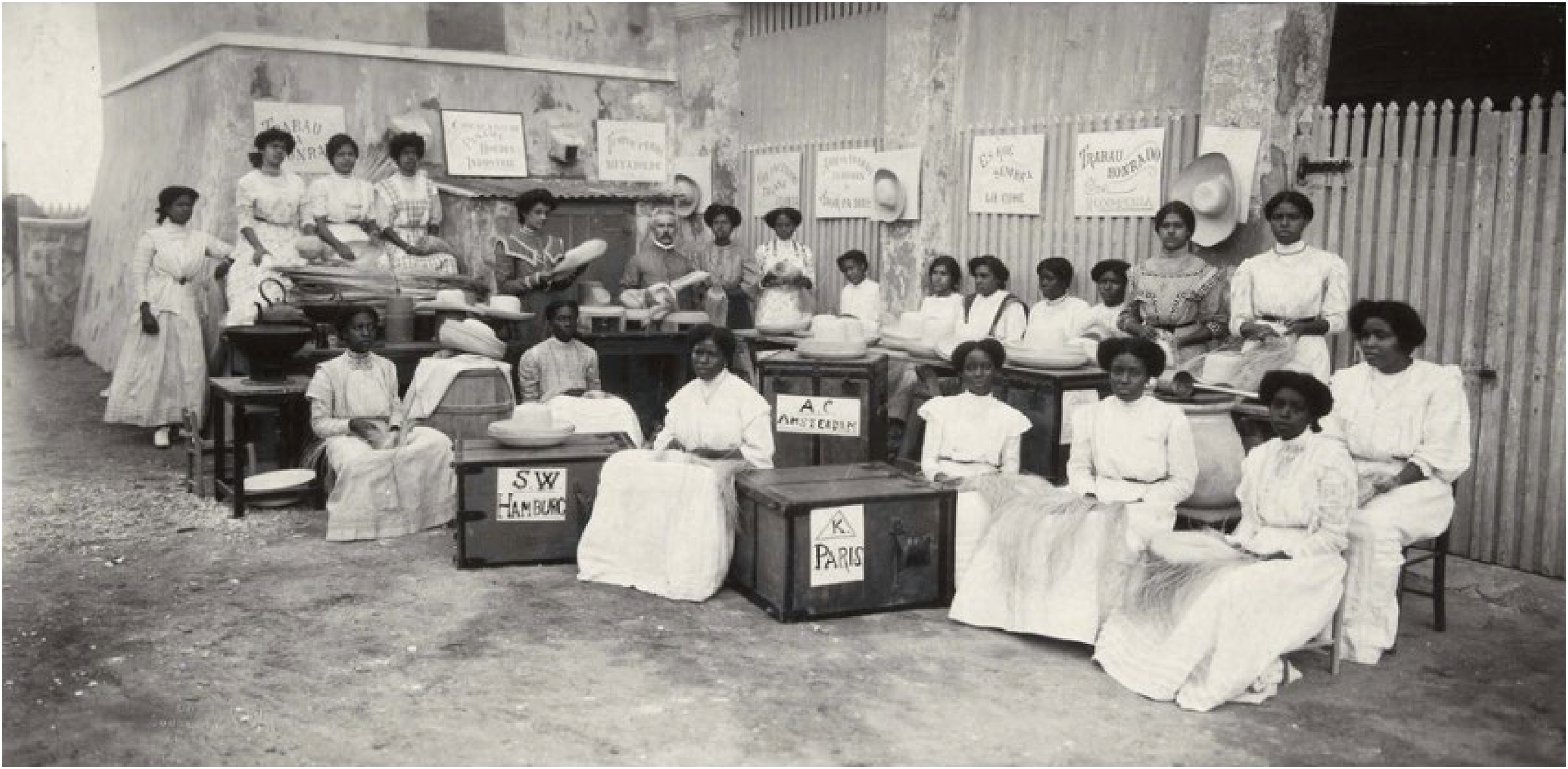
Pupils in a hat-weaving school, Pietermaaistraat, Willemstad. Photo by Soublette et fils, 1915–1920. Collection Nationaal Museum van Wereldculturen Coll.nr. TM-10030897.
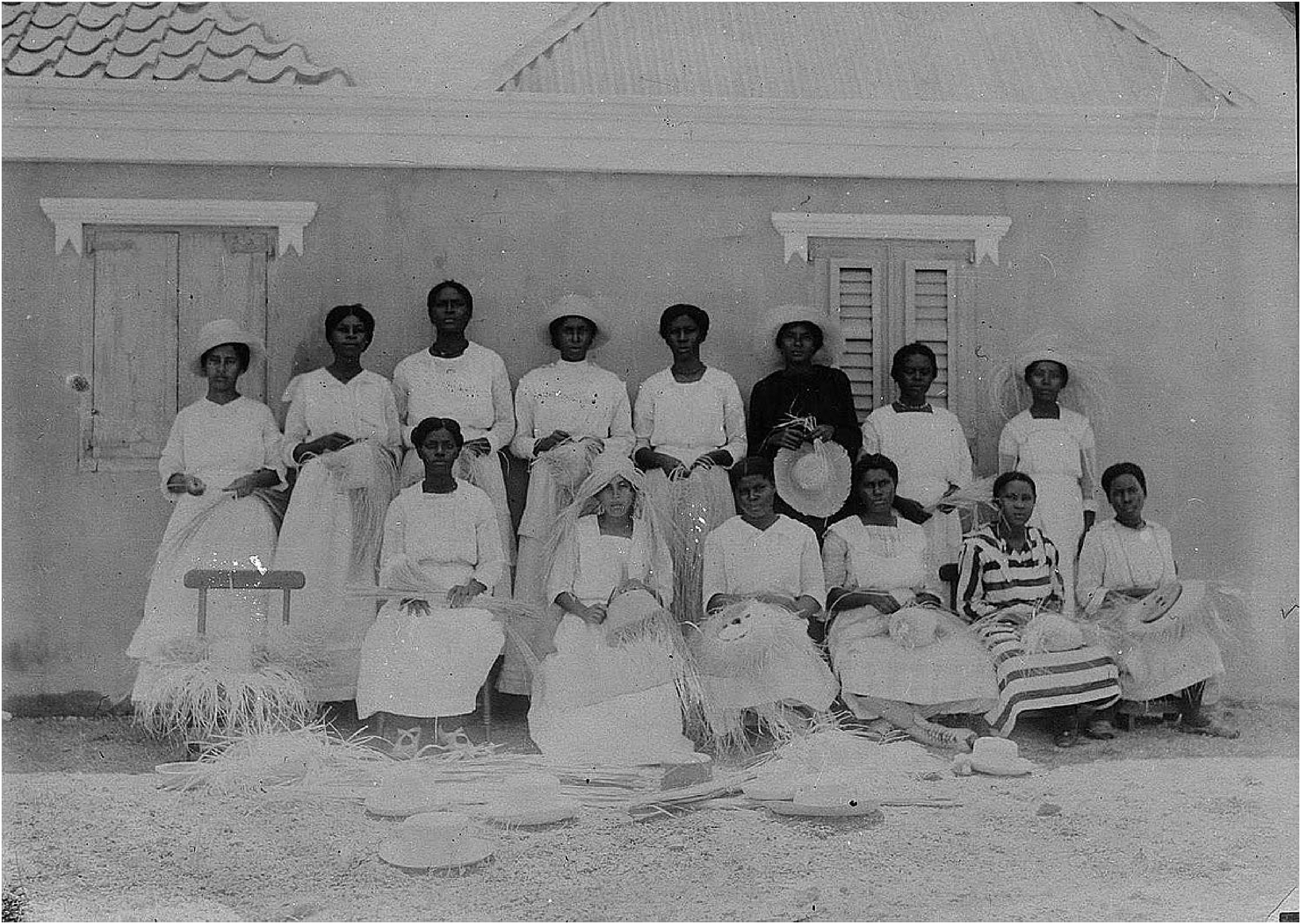
Pupils of the Santa Rosa hat-weaving school, Curaçao. Unknown photographer, c1930. Collection Nationaal Museum van Wereldculturen Coll.nr. TM-10028897.
The image of the Willemstad school was taken by Felix Soublette and his son Robert Soublette, Curaçaoan photographers active on the island at the beginning of the twentieth century. Such photos were used to illustrate books and pamphlets about the colony, sold to visitors, reprinted as postcards and exhibited at international events. 24 The images not only illustrated the instruction of young women trainees, but also, in their circulation, enacted themselves a form of visual instruction for a European public. The scenes depicted light-skinned missionaries and patrons, demonstrating plaiting techniques to local Black women, and thus enforced Dutch racial and cultural superiority on a population deemed to be ‘inferior’. In the dissemination of the end products via international exhibitions and fairs, they also taught European elites how to gaze upon colonised women as uncivilised, poor, and in need of the moral uplift that plaiting and needlework skills represented. In Figure 3, young women are surrounded by ‘samples’ of their work displayed on crates used to ship the hats abroad. The crates are labelled with European destinations – Amsterdam, Paris, Hamburg – as a reminder to potential investors of the continued European trade in the famous Panama hats, which, at the turn of the century, made up 80% of Curaçaoan exports (Nationaal Archief). In 1914, JA Snijders wrote in Neerlandia magazine that the finest varieties of ‘Panama hats’, made in Curaçao, are now sold for good prices in the cities of Europe.
These visual narratives of gendered craft production (photography, postcards) continue to circulate digitally today with limited contextual information via online archives. 25 The images’ depiction of Black women ‘trainees’ under the male tutelage of the light-skinned ‘overseers’ of these civilising missions masks the counter-plantation potential of women's labour and erases the voices of the makers themselves. Curaçaoan anthropologist, Rose Mary Allen, describes how the skill of weaving hats was passed on to rural communities and introduced new home-working patterns for women who could stay at home and look after their children while making the hats (2007: 203). At a time when women continued to undertake the same agricultural work as men but for half the wages, hat plaiting offered a stable economic income. Allen records the memories of Curaçaoan braiders who as children would help their mothers plait hats at home (see Figure 5). Syrian or Lebanese merchants would provide the straw and then sell the hats.
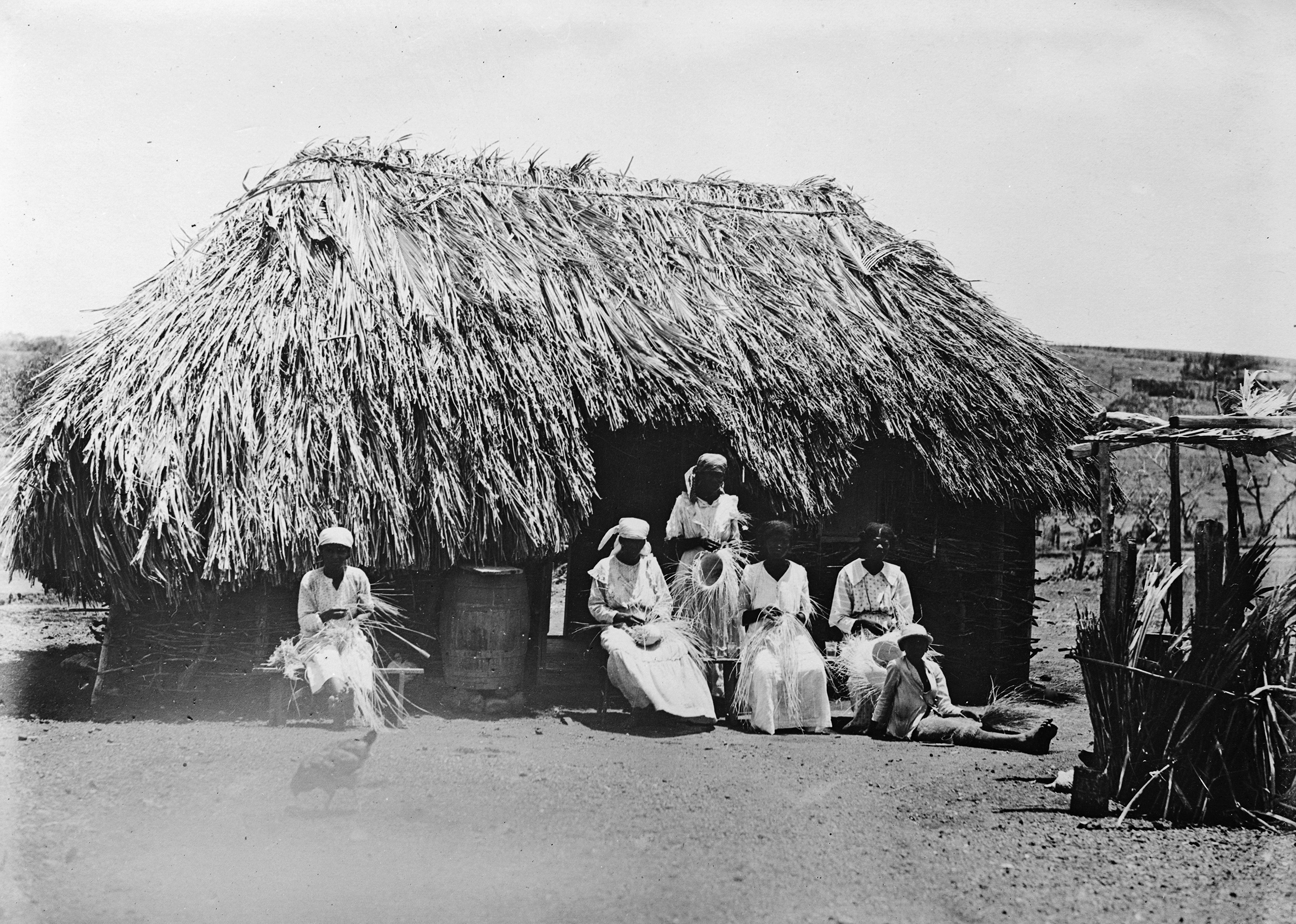
Five women weaving in front of a house, Curaçao, 1936, Photographer unknown. Collection Nationaal Museum van Wereldculturen Coll.nr. TM-10021725.
In the post-emancipation period working class women in Curaçao continued to struggle against racist patriarchal ideologies and forms of economic subjugation (Allen, 2018: 704), a legacy of slavery observed throughout the Caribbean (Scully and Paton, 2005; Shepherd et al., 1995). Women have pooled resources, bricolaged and combined small-scale craft practices, using materials from the land, as informal improvisational livelihood strategies to provide extra income for their families and enhance their own agency. 26 Where once Curaçaoan products (shoes, straw hats) were traded for European and US goods, the industrialisation of Curaçao in the nineteenth century led to the decline of women-led craft and home-scale industries (Benjamin, 2003: 58). One woman interviewed by Allen explained that earning one guilder per straw hat in Curaçao, in addition to working as a domestic servant, was not enough to provide for her family. The success of Curaçao's hat-making industry was dependent on changing fashions and competition from neighbouring countries and therefore declined over time. Histories of the appropriation of straw plaiting in vocational labour camps reveal the physical strain of hard labour and how economic subjugation and foreign extraction has been organised through gendered production. The promotion of colonial industry for European and North American markets relied on a civilising process that brought people into a Western economy through gendered productivity.
The case of Caracol: A present-day ‘factory in the field’
The gendered afterlives of historical practices of material skill extraction, control of manufacture for export and performances of docility examined above remain present in global fashion industries today. The circulation of museum objects – straw hats, bags and photographs of gendered missionary schools – reveal a continued need to re-examine these histories. A recent and controversial legacy of these imperial gendered labour regimes in Haiti has emerged via the Caracol Industrial Park, situated 40 km from the Fort Liberté former sisal plantation site in the north-east. Built in 2012 following the 2010 earthquake, the Caracol export-processing zone (EPZ) became the showcase development project for the Haitian government and international investors: the Inter-American Development Bank (IDB), US policymakers and the Clinton Foundation. 27 The majority of workers are women, forced to accept low wage insecure factory work sewing cheaply made garments for global corporations and Northern consumers. Technical training in assembly processes takes place at a nearby Trou du nord centre before workers are sent to the bolt lines.
Haitian women's bodies have historically been racialised and gendered through state violence and economic exploitation, during slavery but also as a consequence of ongoing transnational imperialisms (Charles, 1995; Schuller, 2015). Slavery controlled the circulation of fashionable European and Asian textiles, traded and valued as currency against human lives in the transatlantic slave trade. Histories of transnational textile production and traffic highlight how the global fashion industry has relied on the bodies and labour of Black women to produce wealth and how labouring Black women's bodies have been erased. Undermining a prevalent discourse in Haiti that underlines how men participate in garment labour on a par with women, particularly due to the country's high unemployment rates, women workers frequently report unequal treatment and experiences of gender-based violence (Schuller, 2012, 2015). Members of the Sendika Ouvriye Vanyan S&H Global (Valiant Workers’ Union of S&H Global), who participated in a focus group I conducted in 2017 in the commune of Limonade near the Caracol park, confirmed that Haitian women workers are regularly subject to sexual harassment within the EPZ. 28 Women employees at Caracol are defined by imported gender ideologies that characterise them as ‘mwan revandikatif’ (less rebellious) or ‘pi obeyisan’ (more obedient), less likely to rebel against exploitative labour conditions. Male union leaders, who have traditionally been more visible and vocal in organised resistance to the inequalities of global supply chains, tend to repeat and sediment this trope. One male organiser explained: ‘yo pè’ ([the women] are scared). Spokesperson for women's group Asosiyasyon Fanm Solèy Dayiti (AFASDA) contextualised this further by describing a reality whereby mothers with young children and household responsibilities, already navigating Haitian patriarchy, have more at stake if publicly seen to be affiliated to a union.
Caracol illustrates how the extractive economies and neoliberal regime of the global fashion industry, continue to circumscribe Haitian women's bodies in the reproduction of historical patterns of conquest, colonial exploitation and environmental degradation of this site. The factory can be viewed as a microcosm of past and present imperial and political occupations and their gender relations in Haitian society, particularly with regard to male control of women's bodies and productivity. Women focus group participants described oppressive work conditions characterised by gender-based violence (physical/verbal abuse, coercion, threats) from factory management and co-workers, inadequate maternity policies, threat of dismissal and the impossibility of upward mobility. When I asked about development of sewing skills, one member of SOVASHG, Denise explained that she had learnt to sew at home and learnt to fè bwòdè (embroider) in school. In the three months training prior to working in the factory, Denise learnt to manevwe machin a koud (operate a sewing machine) to fulfil one of the low-paid machinist roles more often reserved for women trainees. Scholarship on gender in the global garment supply chain has documented how workers are distributed by gender across departments, with women workers more likely to be employed in subordinate roles as machine operator or checker (Bhattacharjee, 2020: 21). In a Caribbean context, gendered education in specific skills such as sewing has long been a feature of colonial order, controlling, domesticating and preparing young girls for the servitude of factory work.
Conclusion
Histories of imperial education are closely entwined with those of ethnographic museums, particularly in their common goal to preserve and control traditional art and craft skills, connect them with markets overseas and maintain colonial power and influence. Given its problematic heritage of international colonialism and trade, the Wereldmuseum is therefore a powerful educational site for thinking through these artefacts and their histories of imperial instruction, gendered labour and museum display in the present. In the case of Curaçao's straw hat industry, the material objects produced become, what Rachel Mordecai terms, ‘sites, at which the emotional and political labours of Black women's lives are rendered not only visible but palpable’ (2021). The museum's straw pieces and gendered visual narratives articulate imperial education, state violence and indigenous material knowledge, but also gesture to reparative contre-plantation potential.
Aspects of the histories of gendered production of material straw objects in Haiti mirror that of Curaçao, where Black women have been expected to learn and master textile practices such as sewing, embroidery and hat braiding to be considered ‘respectably feminine’ (Mordecai, 2021). The moral education of young Black women in these contexts has hinged on the acquisition of material skills that determine the inclusion/exclusion of racially subjugated people in modernity/coloniality. We see how characteristics cultivated on the plantation, including idleness, docility and failure to produce, informed the gendering of a civilising process in imperial technical and missionary schools. The systemic racism of pedagogical projects has contributed to the devalorisation of working with ones hands in these contexts and, straw craft in particular, came to be viewed as ‘poor people work’ by European consumers (Burnside, 2022). Today the perceived backwardness of ‘handcrafted’ objects persists as a legitimate field of intervention for international development projects that emphasise increased production and integration into wider markets. 29 While colonial exhibitions, imperialist vocational schools and international workshops have de-individualised, in particular women, craft practitioners in the Caribbean, the generative contre-plantation potential of straw weaving has nourished material knowledge, resourcefulness and solidarity in the pursuit of liberty.
Footnotes
Acknowledgements
I am thankful to the team of curators and researchers at the Research Center for Material Culture in the Netherlands, in particular Alessandra Benedicty, Josep Almudéver Chanzà, and Wonu Veys, who have supported this article as part of the research theme ‘Un/engendering the Collections’.
Declaration of conflicting interests
The author(s) declared no potential conflicts of interest with respect to the research, authorship, and/or publication of this article.
Funding
The author(s) disclosed receipt of the following financial support for the research, authorship, and/or publication of this article: This work was supported by the Leverhulme Trust (grant number ECF-2016-284).

Notes
Author biography
Charlotte Hammond is a Lecturer in French Studies at Cardiff University. She is the author of Entangled Otherness: Cross-Gender Fabrications in the Francophone Caribbean (Liverpool University Press 2018). Her current research examines the transnational textile industry and secondhand clothing cultures in Haiti and the Dominican Republic, with a focus on worker solidarity and creative resistance. Hammond has recently worked on a creative heritage public engagement project that explored the colonial history of woollen production in Wales. This culminated in the publication of Woven Histories of Welsh Wool and Slavery, a bilingual free ebook, published in 2023 with Common Threads Press.