




Abstract
This article positions Haida, Irish, and Kwakw
Introduction
In the Spring of 2018, we met Jaad Kuujus (Meghann O'Brien) for the first time in person at a Vancouver coffee shop. Meghann is an artist best known as a weaver working in the traditions of basketry, Yeil Koowu (Raven's Tail) and Naaxin (Chilkat) textiles. We had arranged that day to work together with digital modelling artist Conrad Sly and PhD student and photographer Reese Muntean and to digitally scan and photograph Meghann's woven robe, Sky Blanket (2014), in support of her desire to reclaim the robe from the multi-year touring exhibition Boarder X (Isaac 2018) and bring it back to community for ceremony. Wanting to find a way to keep the robe's presence in the exhibition, curator Jaimie Isaac brought forward the idea of 3D printing a replica. Meghann and Jaimie reached out to us, as we had been working on the practice and ethics of culturally sensitive digital documentation and 3D scanning in museums, and using research creation as a method for collaborative media production (Loveless, 2015).
Meghann arrived at the café carrying her carefully wrapped woven artwork, but also holding her cat, Weegit, who had been lost but found her as she walked to meet us. Weegit, who had come from the late renowned artist Beau Dick, reminded us all with his re-presence that day of connections to home territory, family, and teachers. We all jumped in the car together, dropped off Weegit safely at home, and transported Sky Blanket to our studio at Simon Fraser University in Surrey, British Columbia.
We started by using photogrammetry – taking hundreds of high-resolution photographs of Sky Blanket from a series of carefully orchestrated angles – to create a high-resolution image. We also used a 3D scanner to document Sky Blanket in anticipation of creating a 3D model for printing. In the days and weeks that followed, we met with Conrad as he worked with the images to create and review iterations of a digital model.
1
We were deeply moved by the interconnecting grid-like patterns and polygons, and the emergent topographies of the woven artwork that evoked a mountain range or a sea floor. The point clouds being used to structure the 3D image called to mind constellations of stars, all of which generated wide-ranging discussion amongst our team about the intersections of materiality, time and space, cultural reclamation, environment and territorial sovereignty. We drew connections through the metaphor of the cloud, which simultaneously provides the digital computing infrastructure to render and store our complex digital model and is also the physical environmental sustenance hydrating the mountain in Extew River, Tsimshian Territory, where the mountain goat whose wool Meghann processed for use in Sky Blanket was procured. The digital transformation we witnessed resonated with Meghann's earlier experience of preparing that mountain goat wool for Sky Blanket, where in her spinning and weaving process, the wool was substantially transformed between states of matter and being. As she described: I saw that the process was transforming the wool from the mountain goat into being a robe, [and] that encoded in that is a shifting of states between all the different forms. It's like gas and liquid and solid states of water. There's something about the fact that animals live on mountains, and what's on their bodies is related to the clouds and the snow, and that those are all cycles of water. Because the wool spent so much time on the mountains, I felt intrigued and fascinated about how beautiful that was. I remember there was one point with it where I felt that energy of the material, holding it, and gradually over the course of the day I felt it building up in my hands and it started travelling up into my arms, this accumulation of that spiritual material stuff. It came into my chest area and my heart and it made this, like, beautiful full feeling, this warmth that had this gentleness to it. It's regarded as a sacred material or a sacred animal all over the coast, and it made this incredible feeling in my chest, and I was sitting there over, like, hours or whatever and, to me, it felt like this opportunity to contemplate the people who’ve done that activity before me, and it brought me into the past with ancestors and where it comes from. There was this recognition that the work that we do today, leaving behind visual objects, physical things, these are a means of communication with the people. The work we do today gets left for the people who come after us and even though there's these concepts of ancestors and descendants, through art we are connected and able to communicate with each other through it. But that feeling of a timeline was sitting in me, I guess, and it was, like, from the present, it was, like, extending in both directions into the past and future in a linear way, and then, it reached a place to me that felt like it was extremely ancient, so far in the past and future that it's not even fathomable (Turner et al., 2018: 131).
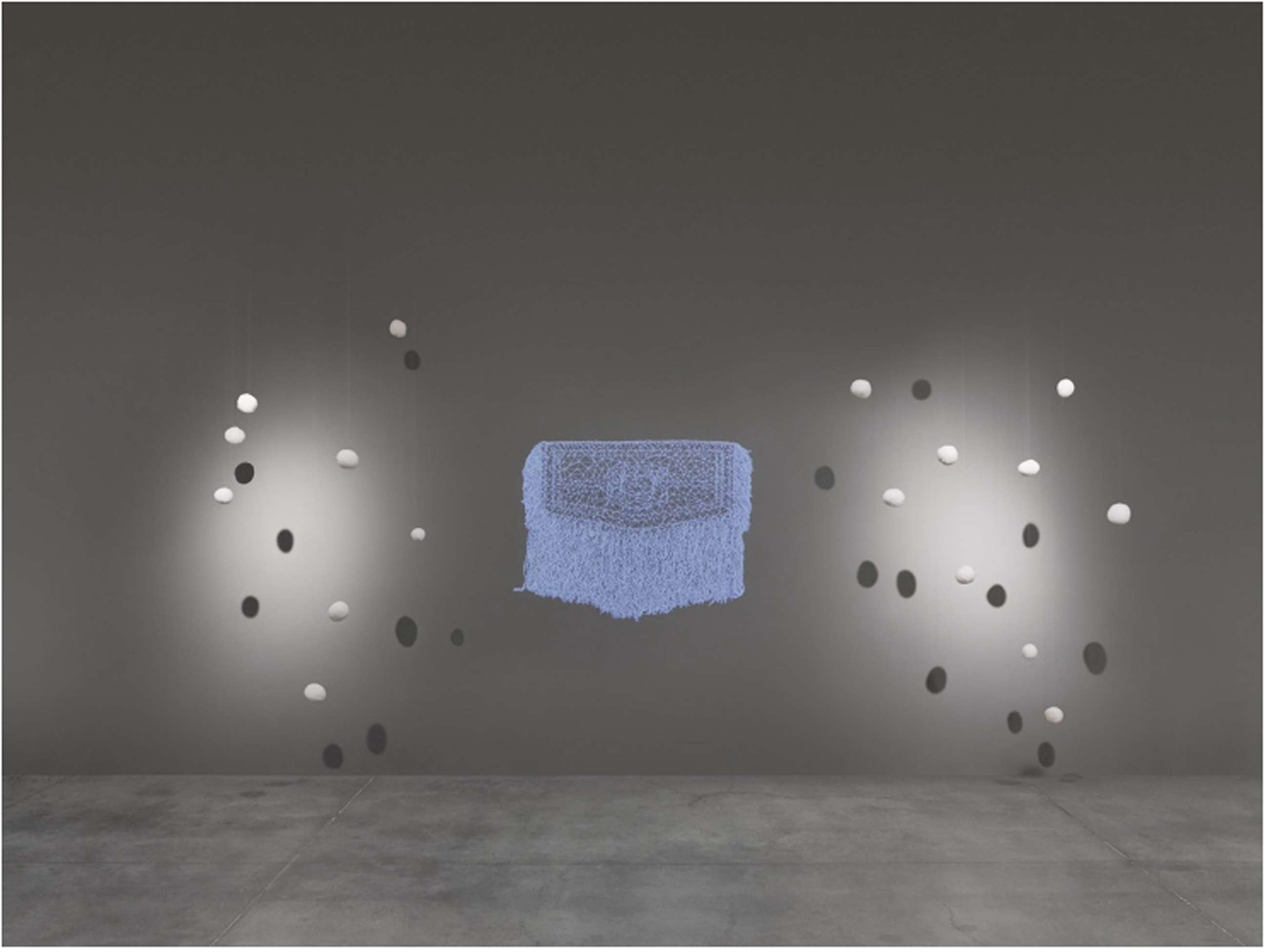
Wrapped in the Cloud, installation view. In Boarder X, Art Gallery of Alberta, 2018. Photograph by Rachel Topham.
Instead of a 3D model, the video Wrapped in the Cloud then replaced Sky Blanket in Boarder X, projected on the wall where the robe had been hung, and toured across Canada over the next three years, from Newfoundland to Edmonton to Nanaimo. While Wrapped in the Cloud did its work provoking questions about digital replication and even repatriation in contemporary art contexts, Sky Blanket was returned by Meghann into ceremonial and performative events on BC's coast, where it supported cultural continuity and artistic innovation on Meghann's home territory. A significant instance of this was when Meghann was able to return Sky Blanket home to the Big House in Campbell River, British Columbia, for the Hilugwila Feast held for K’yuusdaa Rose Davidson. Meghann's grandmother and sister danced Sky Blanket within a web of relationships that the continuities and self-determination of the community (Figure 2).
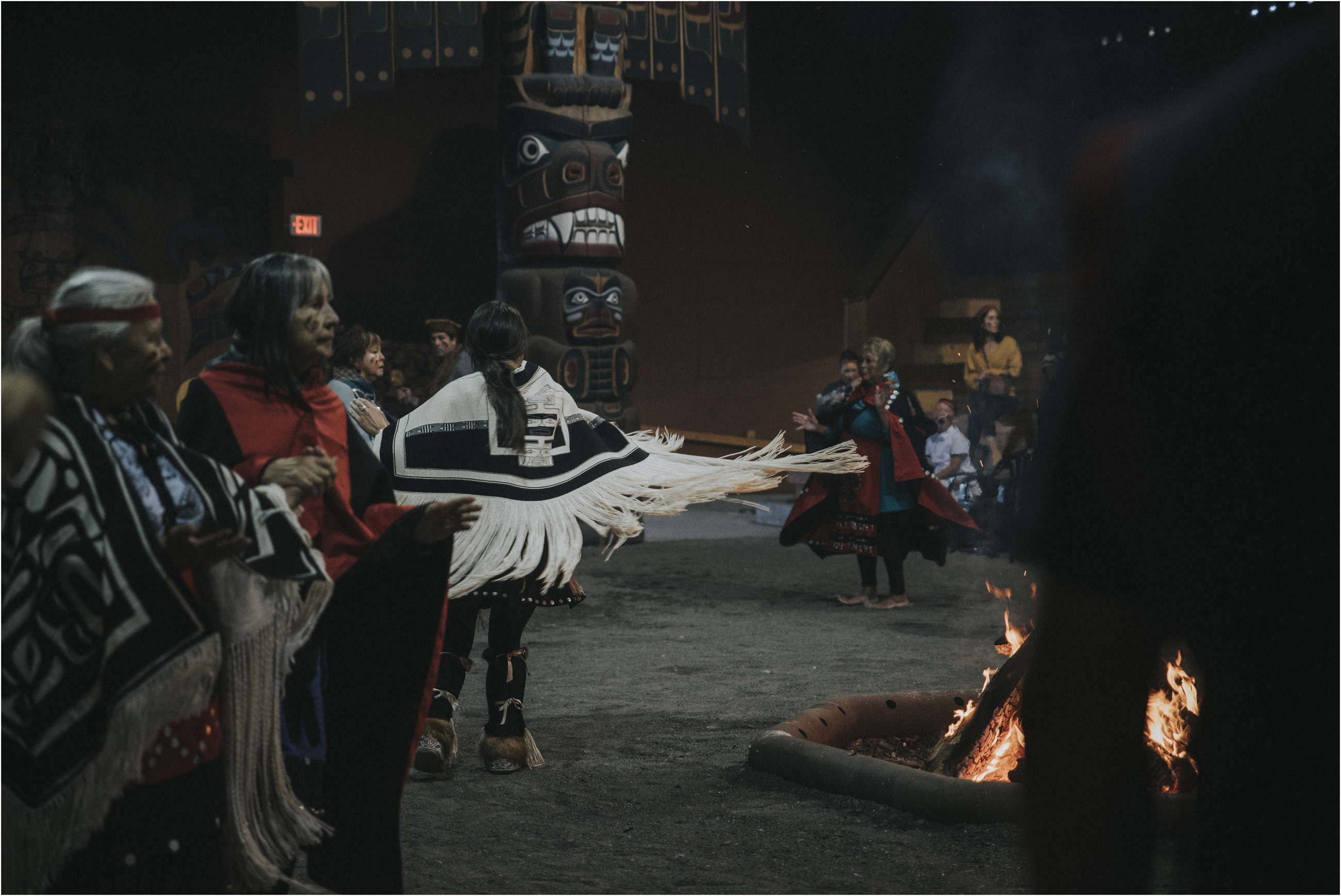
Nalaga (Avis O’Brien) dancing Sky Blanket during a Hilugwila Feast held for K’yuusdaa Rose Davidson at the Campbell River Big House. During this traditional naming ceremony a baby also receives their first name and haircut. Pictured left is grandmother Minnie Johnston with Hilda Sewid, her best friend since childhood (© Melanie April Graham-Orr, 2018).
Witnessing the impact of the creation of Wrapped in the Cloud in both the galleries and in Meghann's community, we began to understand this collaborative project as having a goal that was beyond replication of an artwork or belonging, which had been the focus of our earlier work. Rather, it was first an iterative process of transmediation as a method for drawing attention to shifting forms and matter and the continuity of Haida and Kwakw As Meghann told us, I felt through the animation of this and showing that it parallels and reveals the process of the technology, reading the physical world and bringing it into a digital form. And by showing the wireframe paths and the point clouds, that brought to life the things I love to talk about the most with the blanket and made me feel like it had more of a potential to share than the actual end object had, which was really exciting (O’Brien: 135).
Transmediation is therefore presented in this article as a method for engaging with decolonial practices in museums and archives using research-creation and collaborative media production, and also an intervention to provoke consideration of new possibilities for the digital in museum practice that moves beyond the replica (see Hennessy et al., 2024) as a generative force shifting theory and practice.
The story of the transmediation of the original woven artwork Sky Blanket from a physical, wool, cashmere, and mountain goat wool robe into a digital animation has been a starting point here for this discussion of transmediation as method and intervention. The following sections will explore how Wrapped in the Cloud and other works by O’Brien have gone on to be exhibited in online digital space that further illustrates transmediation as a generative method for asserting Indigenous continuities, relationalities, and futurisms. We focus on the virtual exhibition A Thread That Never Breaks (2021), curated by Sage Paul and Lisa Myers in the AbTeC Gallery in Second Life, to highlight how these curatorial and technological interventions can emphasise relationship building, speculative conversation, and iterative art and design-led research and production as method. We review the method by which O’Brien's artworks were transmediated for this exhibition in AbTeC's sovereign gallery space to draw attention to the unique ways in which she demonstrates, through her woven and digital art practice, how the transformation of materials and forms highlight unbreakable connections between the physical and the digital.
We then go on to draw threads between Meghann's transmediated work in this exhibition and its implications for thinking and practice around contemporary dynamics of ‘digital return’ (Bell et al., 2013; Geismar, 2018). We situate Meghann's work in relation to a history of digital tools employed in museums and shifts in perspectives regarding the generative qualities of digital, arguing that transmediation as a method and intervention can make legible the inextricable connections between the digital, land-based material practices, and cultural continuities.
Transmediation as method and intervention on AbTeC Island
The opening vernissage of the exhibition A Thread That Never Breaks, curated by Lisa Myers (Anishinaabe) and Sage Paul (Dene) as a part of the 2021 Indigenous Fashion Week in Toronto, brought guests together in an immersive, participatory virtual space – the AbTeC Gallery in Second Life. Originally planned to be installed in a physical gallery, pandemic restrictions necessitated the creative transmediation of artworks by Angel Aubichon (Cree-Metis), Caroline Monnet (Algonquin-French), Jaad Kuujus (Haida-Kwakw
During this opening event, dozens of avatars were flying and dancing in the gallery in glowing regalia and vibrantly customised outfits, moving among the artworks, chatting with each other, and gathering to listen to opening remarks by curators Paul and Myers, and the artist Skawennati. It was a novel experience for us, where the materiality of the artworks and the ongoing relationality of the artists, curators, and gallery visitors remained connected, continuous, and dynamic. While the inherent transformation from one medium to another, like the physical to the digital, is a familiar idea and practice, curators Paul and Myers used the term transmediation in a specific way. They wrote: the works have been transmediated from physical threads into pixels, polygons and lines of code that you can experience through your avatar. As it was for our ancestors before us, traditional knowledge and traditional cultural expression become tools of resilience and survival [emphasis added] (Indigenous Fashion Arts, 2021). While this digital space itself does not solve our desire to meet in person, it offers the possibility for us to meet in a space other than the physical spaces we have come to know––a multi-transversal, digital universe that bridges community, history, and a futurity that allows us to imagine sovereign spaces (82–3).
Hosting an exhibition on AbTeC island was an exciting prospect for Meghann and our team, and through our collaboration with the curators and AbTeC's team of Second Life developers and creators, we were able to transmediate three of Meghann's works for this digital space: Sky Blanket (2014), Everyone Says I Look Like My Mother (2020), and Wrapped in the Cloud (2018). This involved working with AbTeC developers to prepare digital files for integration into the AbTeC Gallery, and to create the gallery spaces themselves to best feature the work and the avatars’ experiences of the work. For Sky Blanket and Wrapped in the Cloud, this was a relatively simple process of integrating a digital image and video into the virtual gallery space, much like they had been experienced in physical gallery spaces in the past. For Everyone Says I Look Like My Mother, this required new photographic documentation and development of a unique installation for Second Life that has not been installed in real life (yet). This work for and in Second Life was iterative and collaborative, giving rise to new ideas and possibilities for Meghann's art and practice as method and intervention. In the following section we describe these three transmediated art works as they were installed as a part of A Thread That Never Breaks (Figure 3).
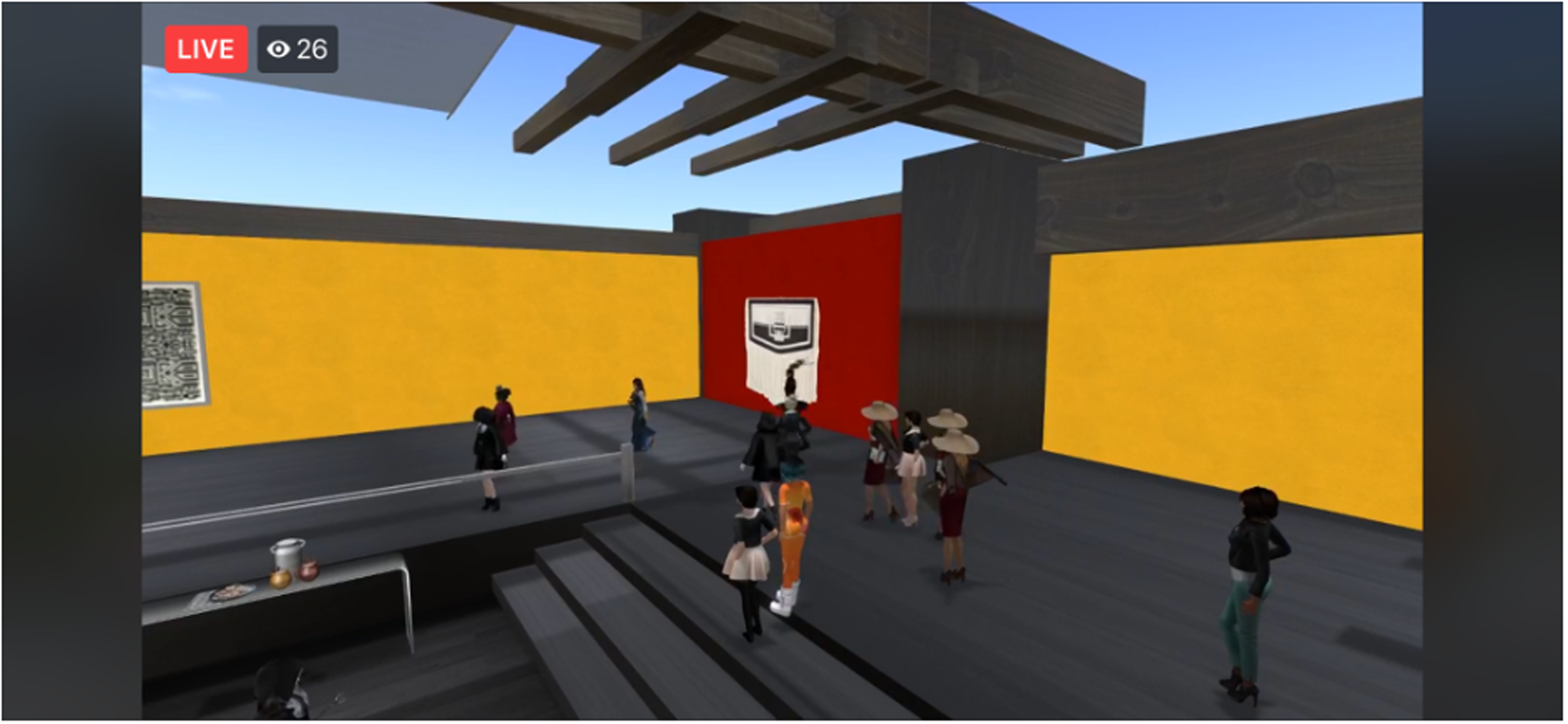
The AbTeC Gallery space with Sky Blanket displayed. Screenshot by Kate Hennessy.
Sky Blanket (2014, 2021)
The first of these three transmediations is a representation of Meghann's well-known woven work, Sky Blanket, which was completed in 2014, has since been exhibited internationally in contemporary art contexts, and is the starting point for the project at the heart of this article. Made from a blend of z-twist hand spun merino wool, commercial cashmere, and Mountain Goat wool, Sky Blanket references the constellations of Pleiades in and through the central motif which shows three interconnected ancestor faces. The robe was designed in collaboration with K’ómoks and Kwakwaka’wakw artist Andy Everson and Haida artist Jay Simeon, referencing the continuity of knowledge through Meghann's ancestral, contemporary, and future weaving relations. The transmediated Sky Blanket in A Thread That Never Breaks was created from a digital photograph and was placed on a bright red wall in the main AbTeC Gallery space, where the details of the design and intricate weaving could be viewed at high resolution when an avatar approached the artwork (Figure 4).
Installation view, Everyone Says I Look Like My Mother. Jaad Kuujus (Meghann O'Brien). A Thread That Never Breaks (2021) AbTeC Gallery, Second Life. Screenshot by Kate Hennessy.
Everyone Says I Look Like My Mother
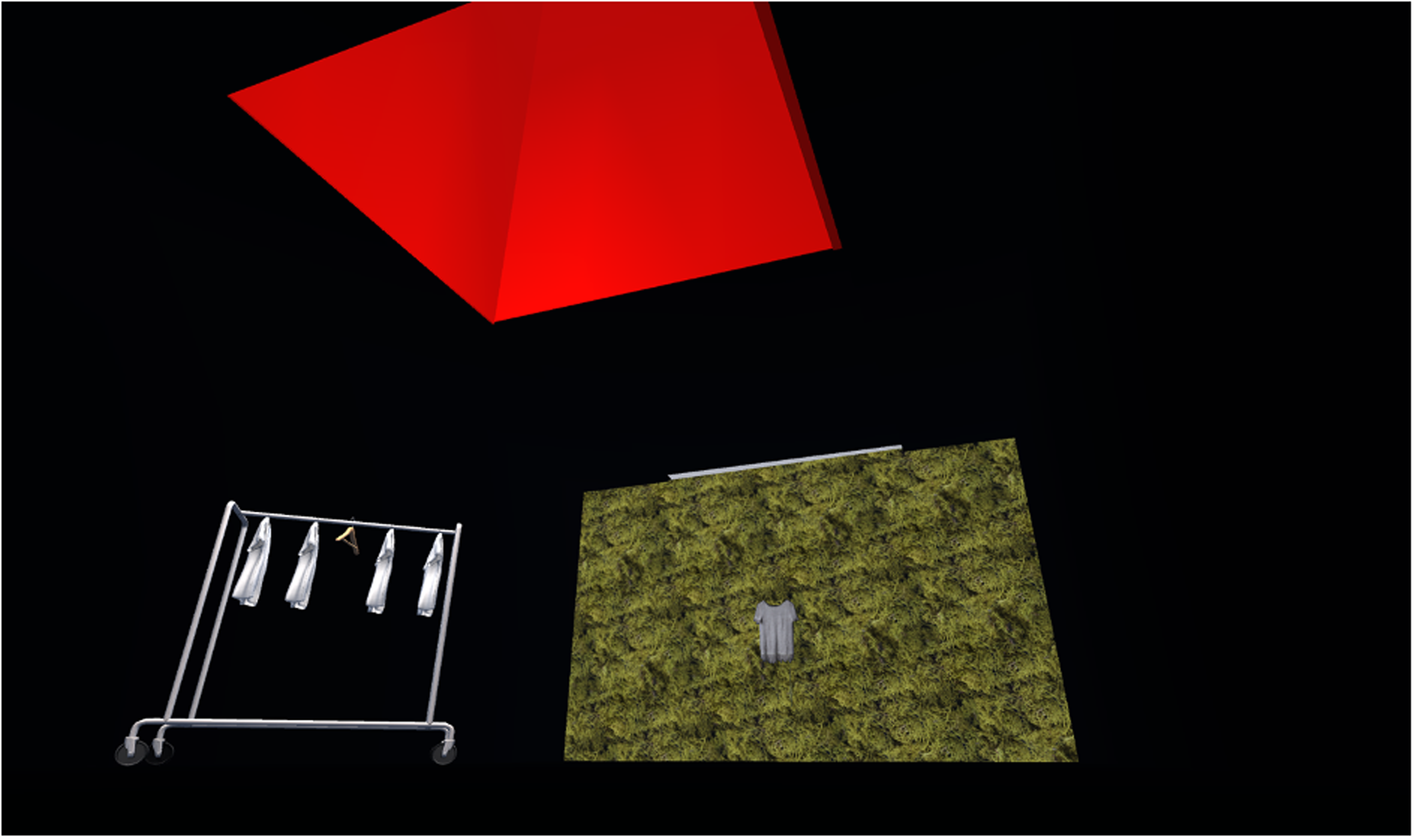
In a special extension of the gallery created specifically as a home for this work, Everyone Says I Look Like My Mother transmediates Meghann O’Brien's white woven mountain goat wool T-shirt (completed in 2020) and gives it a new installation context. Designed and woven in reference to the ubiquitous white mass produced T-shirt, the work is meant to provoke consideration of the materiality of commercial garments, the invisibility of their production and circulation, and their variable value in physical and virtual worlds. Situated at the end of a long red hallway directly opposite the transmediated Sky Blanket, the two works provoke consideration of the interconnectedness of the material and digital. The digital representation of the woven T-shirt is ‘hung’ in front of a wall of glowing yellow wolf moss collected by the artist and photographed by our team to bring into the digital space. A rack of virtual white T-shirts purchased in Second Life is placed nearby, along with one conspicuously empty hangar. Meghann's statement for this work reflects on how her mother believes that even though she herself is not a weaver, she had still passed this knowledge down to her daughter––a thread that cannot be broken. In this case, Everyone Says I Look Like My Mother uses transmediation to articulate relationalities in kinship, knowledge continuities, connection to home territories, deep entanglements with fashion economies and the materiality of the internet Figure 5.
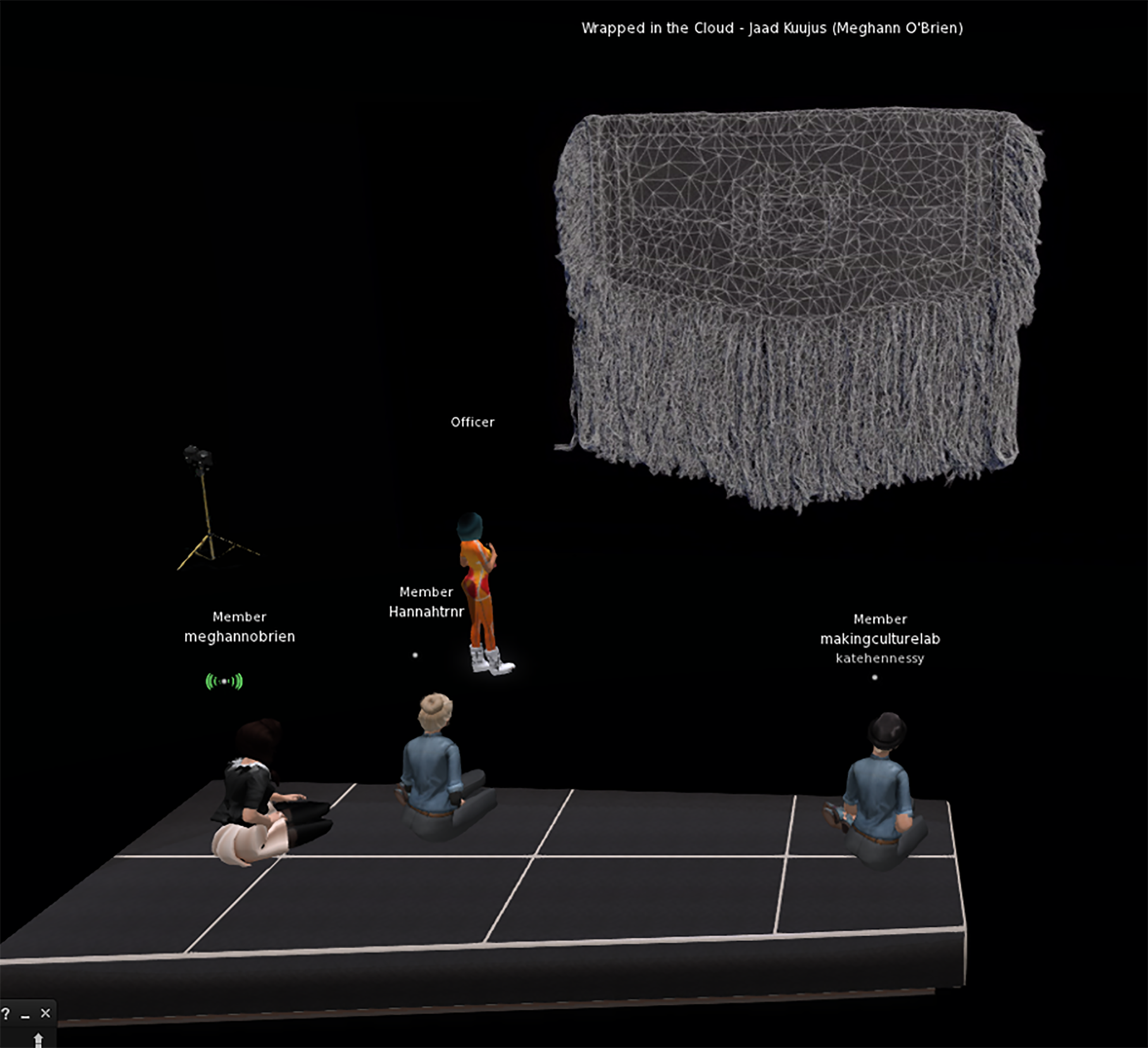
Installation view, Wrapped in the Cloud. Jaad Kuujus (Meghann O'Brien). A Thread That Never Breaks (2021) AbTeC Gallery, Second Life. Screenshot by Kate Hennessy.
Wrapped in the Cloud (2018, 2021)
Walking, flying, or dancing past the wolf moss wall, the visitor enters a dark space where the third work is embedded on the moss wall's reverse side. Further articulating Sky Blanket's digital materiality, Wrapped in the Cloud leads viewers through representations of the phases of the digital modelling process, drawing attention to the cloud-based technologies and human artistic practices associated with the transmediation of physical artworks into digital works. Embedded as a video within Second Life, and contextualised in a digital label with background on the original creation of the video to replace Sky Blanket in Boarder X, the work provokes gallery visitors to consider dynamics of collecting and repatriation; why, for example, is it important for Sky Blanket to return to community to support cultural continuity and dynamic cultural practice, and what can this digital work accomplish in the gallery in its place? Further reflection is offered regarding the materiality and ecology of Yeil Koowu (Raven's Tail) and Naaxiin (Chilkat) weaving, and collective practices of knowledge sharing between humans and in the cloud through time. In this virtual environment, transmediation functions as method and intervention for considering the ongoing relationships between the physical and the digital.
Transmediation as method and intervention towards decolonial curation
Academics, artists, and critical theorists have explored the concept of transmediation or even hyperrealism as a way to understand how artworks and Indigenous media production can open up new modes of presence and intervene in traditional artistic or museum spaces (Biddle and Lea, 2018; Fricke, 2019; Garneau, 2018; Igloliorte et al., 2016). Further, these artworks and critical perspectives offer a view into the potential for a distinctly anti-colonial museum practice that counters colonial museum practices, regimes of ownership, and the positioning of physical and digital belongings as being distinct and disconnected rather than as relational and always already entangled.
Seen one way, the transformation from one state to another implies that understanding these works is more about the relations and histories they attend to than their materiality––the form they take. Another, perhaps more expansive way to understand these works is by the work they do and the relations they foster in the gallery space, in the world, to increase and extend visibility and knowledge transmission. As Cheryl L’Hirondelle (2016) notes, ‘Though the means have changed, the message remains consistently unrelenting and unending’ (5). Rather than being understood as replicas or re-creations of physical forms, works reimagined in digital space can be seen methodological interventions that extend the original work into new territories. This resonates with the broader goals of Skawennati and Jason Lewis at AbTeC and through AbTeC Gallery, whose work has long been engaged to ensure Indigenous presence online and imagine Indigenous futurisms beyond settler apologetics (Lewis et al., 2018; Lewis and Skawennati, 2005, 2018). Using Indigenous media to imagine a world beyond capitalism is another important thread (Tedford, 2022). As David Garneau (2018) notes in his essay on the work of digital artist Jon Corbett: The wonderful thing about digital space, from an Aboriginal point of view, is that its ‘objects’ can be generated, reproduced, repurposed, collected, and shared without being hoarded or necessarily made into a commodity (81–2).
This history and ongoing reproduction of harm implicit in negotiation for museum access and digital technologies is a significant context for the work we describe in this paper and informs our perspectives. We have been focused to this point on the artwork of Meghann O’Brien and the way that transmediation of her artwork as has functioned as a method and intervention into understandings of relationships between the physical and digital in museums and galleries. We now connect the previous discussion to broader themes around the digital in museum collections to consider how transmediation may support work toward decolonial curatorial practices.
Access to ancestral belongings in collections has often remained available only to those who had access to curators and collections managers and are engaged with academic discourse or academic partners acting as intermediaries. Discussions around what counts as satisfactory access have been a part of contemporary museum work for some time but have often centred on the use of new technologies (Anderson and Christen, 2013; Cameron, 2003; Geismar and Mohns, 2011; Hogsden and Poulter, 2012; Witcomb, 2007). As Haidy Geismar has articulated in her work on understanding digital museum objects, ‘museum dialogues between digital technologies and museum collections allow us to both historicise and complicate many of our assumptions about digital technologies’ (Geismar, 2018: pg 19). In the 1960s and 1970s, punch card databases were adapted to serve the function of the western museum – to classify and document objects in collections, in the service of caring for the collections ‘in perpetuity’. Databases and computer systems were used as basic inventories, to allow specialised researchers with some limited search capacities (Parry, 2007; Turner, 2020). With mass digitisation afforded by technological advancements and growing computational storage capacities, creating access to collections not only involved bringing communities and artists into museum storage rooms as before; but greater emphasis was placed on making images and reproductions of ancestral belongings available (Turner and Greene, 2022). By the early 2000's–providing access to images of collections, acquiring electronic art, and learning to manage born digital objects became part and parcel of museum work. However, these discussions were limited by the changing nature and understanding of the ‘Internet’, and of the governance of these cyber-spaces. Seeing watermarks emblazoned across museum object images, was for example, a way for the concerns of copyright holders to limit the copying capacities of researchers and museum visitors alike. It was also a way to reassert the power and control of the institution. As the world became more connected through digital tools like search engines and email, and when funding permitted, museums and galleries began digitising their records en masse and taking high-res images of objects in collection. Renewed interest in the concept of access as part of return took hold. As we have described, new territories have been formed ‘online’ (Lewis and Skawennati, 2005), and the Internet and the ‘cloud’ as a place, and not just a series of networked technologies, has been metaphorised in the popular imagination (Hu, 2016; Peters, 2015).
By the late 2000s, a variety of collaborative partnerships arose to ameliorate, or at least make obvious, the lack of authority over museum documentation and digital images of ancestral belongings that were being circulated online. A number of emergent digital projects were developed which interrogated Western ways of looking at and accessing ancestral belongings online (Glass and Hennessy, 2022). Kim Christen's Wuparrani-Kari Archive, built on the Mukutu Digital Platform gave community specific access controls to digitised archival records (Christen, 2008); At the Museum of Anthropology at UBC, Susan Rowley and her team worked to create a cross-institutional search function for Northwest Coast belongings held in museum collections worldwide (Rowley et al., 2010; Rowley, 2013). GRASAC (Great Lakes Research Alliance for the Study of Aboriginal Arts and Cultures), a parallel initiative, was developed by a team including Ruth Phillips, Alan Corbeire, Darlene Johnston, Cory Willmott, and Janis Monture and provides digital access to both tangible and intangible Great Lakes cultural heritage, including Indigenous language (Bohaker et al., 2015).
Alongside and sometimes directly building from these collections portals and research networks, other projects have emerged that work to re-contextualise belongings for community specific purposes, which can involve re-naming and re-classifying objects, including territory mapping with belongings, and language resources and storytelling, such as the Inuvialuit Living History Project (Hennessy et al., 2013) and Sq’éwlets: A Stó:lo-Coast Salish community in the Fraser River Valley (Lyons et al., 2016). Scholars in the museum space have sought to use the digital to intervene in historical dynamics between museums and communities in significant ways. While creating digital surrogates or copies of museum objects has been an important way to increase access, beyond putting photographs online, much scholarship and collaborative work has critiqued this process, and several projects have been initiated that experiment with digital engagements and ancestral belongings that exist in museum collections (Geismar, Isaac, Bell, Christen). 2 Resonating strongly with Meghann's O’Brien's artwork, Haidy Geismar's collaborative work to engage with a Māori cloak (2018) examined the how digital tools could be used to explore new Māori materialities and unique engagements with the cloak, and to re-circulate the cloak back in New Zealand (Geismar, 2018 pp. 89).
These applied projects have also provided a view into broader infrastructural and sociotechnical engagement: in this time, the Internet emerged as a contested space with potential for re-negotiating power relations that permeate everyday lived experiences. These digital projects and networks we have complicated perceptions of the internet as space disconnected from ‘real’ territory, land, and its resources. Critical scholarship has revealed an understanding of media technologies as mutable spaces, but also as the network cables of copper, glass, plastic, gold and lithium (among many others), the server farms that hold the storage and computational power for the ‘cloud’, and the myriad of mining tools and technologies and the exploited labour of individuals (Chun, 2021; Crawford, 2021). ‘Multimodal’ work in anthropology and museum studies has also been critiqued by Takaragawa et al. (2019) for perpetuating a ‘bad habitus’ that ignores the environmental destruction and unequal relations of power under capitalism and within technoscience. Reconceptualising infrastructural care beyond colonial extraction seems impossible (Risam, 2022), where even with the best of intentions digital creation engages a myriad of tools and processing technologies that rely on these infrastructures with few if any alternatives. We suggest that transmediated works like Wrapped in the Cloud draw attention to these otherwise invisible connections, intervening in the obfuscation of the sociotechnical and ecological relations that the digital requires.
Conclusion
What is accomplished by transmediated works like those in the Second Life-based exhibition A Thread that Never Breaks, and as exemplified through the woven and digital artwork of Meghann O’Brien? In this article we have highlighted how our team has explored possibilities for transforming Meghann's work, while situating our project alongside the long-time work of museums, curators, new media producers, and artists who are also harnessing the affordances of transmediated work to enable belongings – ancestral or otherwise – to be more easily accessed and even returned to community. Using transmediation as a method, these works are intervening in perceptions of the digital as removed from material entanglements and cultural continuities. Rather, through this work we present the digital as always and already woven with contemporary communities, materiality, land, culture, and histories.
We argue for the importance of exploring new methodologies that centre relationships that extend beyond the physical/digital dichotomy and acknowledge collaboration and continuities of connection through time. At the same time, we acknowledge readily that this approach is not without concern; considering any digital or computational intervention must also consider the legacies of harm implicit in any attempt to document Indigenous cultural belongings. As curators Jordan Wilson and Karen Duffek (2021) articulate: The power (in cultural belongings) has long been subsumed, even suffocated, by external forms of power - those expressed through dominant systems of classification and preservation, and through the legalities of institutional ownership. Today, however, the journey of removal, circulation, and “return” of Indigenous objects and belongings can, and must, represent more than their ongoing displacement (39).
As we write this in 2024, the use of computationally heavy digital tools seems to be at odds with this goal of addressing connections, as the resource-heavy requirements of transmediation continue to exploit these exact relationships (Peters, 2015). However, as we have argued in this paper, Meghann O’Brien's artwork and collaborative practice make legible the transformation of states from animal to fibre to regalia and the transformation of the work in and through the ‘cloud’. In her work, transmediation as method and intervention is one way of showing the inextricable connections between digital, land-based material practices, and human relationships, including ancestral ties.
How do we, as scholars, artists, and practitioners, begin to attend to the possibilities for transmediation in the context of artistic or cultural practice while simultaneously engaging with the implicit harm produced by tools, technologies, and software that rely on capitalist and settler logics of hunger and extraction (Robinson, 2020)? Transmediation as articulated by Sage Paul and Lisa Myers, and through the works curated for A Thread That Never Breaks, offers a view into a decolonial museum practice in which land, materials, family, and relations can remain integrally connected to digital expressions and forms. Transmediation in this sense is a method and intervention supporting the creation of new relationships between curators, artists, museums, and universities (Kadir et al., 2021) who together are already making and remaking possibilities for their practice.
Footnotes
Declaration of conflicting interests
The authors declared no potential conflicts of interest with respect to the research, authorship, and/or publication of this article.
Funding
The authors disclosed receipt of the following financial support for the research, authorship, and/or publication of this article: This work was supported by the Social Sciences and Humanities Research Council of Canada (grant number 435-2021-0582).
