




Abstract
Catholic priests who sexually abused minors were transferred to other parishes without disclosing the actual reason for their transfer. Based on reports from Ireland, Germany, and the USA, and relying on Bourdieu’s concepts of field and habitus, this article demonstrates that first, the practices of denying and withholding information even to fellow priests are consequences of the repression of sexuality within the Catholic Church. The Church has not provided a legitimate language for priests to be able to engage openly about sexuality. Sexual repression as a field structure is incorporated into the priests’ habitus, resulting in self-censorship when it comes to articulating the issue of sexual abuse. Secondly, the article accounts for the change within the Catholic field and the priest’s habitus, which has resulted in the facility to verbally express sexual matters in order that the undisclosed practice of transferring abusive priests finally stopped.
Introduction
Father Patrick Maguire, a member of the Catholic Missionary Society of St Columban, was working in Japan from 1961 to 1974, at which time he sexually abused at least thirteen boys. After a nun complained about the abuse, he was reassigned to the Diocese of Raphoe in Ireland. The head of the diocese was not informed about the reason Maguire had to leave Japan and why he was relocated to Raphoe, so that Maguire was able “to say the early morning mass; he then had an excuse for getting the altar boys to stay overnight so they would be in time in the morning” (Dublin Report 2009, 221). In Raphoe, Maguire abused eight boys. After another complaint about sexual misbehavior, Maguire left Raphoe for the Archdiocese of Dublin in 1983. “The superior of the Society in Ireland wrote a letter to Archbishop Ryan [of Dublin] in which he ‘highly’ recommended F[athe]r Maguire. […] There was no mention of any problems even though it is clear that the superior did know that there were problems” (225). In Dublin, Maguire abused at least three boys. Because nobody in Raphoe or Dublin knew about his history, Maguire was able to continue to abuse boys.
The transfer of a known abusive priest to another parish or diocese without a proper disclosure of his history is not exclusive to the case of Father Maguire, or for that matter, to Ireland. The former bishop of the Archdiocese of Boston, Cardinal Law, “had moved abusive priests around like pawns on a chessboard” and “parishioners were in the dark about the predators cast into their midst” (Carroll et al. 2003, 6). Furthermore, within the German Catholic Church, 91% of the transfers of known abusive priests within a diocese were not documented correctly, so that a proper disclosure of information is, at the very least, doubtful (Dreßing et al. 2018, 308). By examining reports on the sexual abuses of minors by Catholic priests in Germany (Dreßing et al. 2018), Ireland (Ferns Report 2005; Dublin Report 2009), and the US (John Jay Nature and Scope Report 2004; John Jay Causes and Context Report 2011), a “repetitive pattern” (Frawley-O’Dea 2007, 3) of how accusations and actual incidents of Sexual Abuse of Minors (SAM) by Catholic priests were handled from 1950 to 1990 is observable. Whenever a priest was abusing one or more minors, and a complaint was made by the parents or other concerned persons, he was transferred to another parish or diocese. Typically, neither the officials nor the head of the new parish were informed about the abuser’s history, as a consequence he could again be in close contact with children—despite the complaint. Therefore, it was not an isolated incident when the Archdiocese of Boston was “quietly transferring the alleged abuser to a different parish in the Archdiocese, sometimes without disclosing the abuse to the new parish or restricting the abusive priest’s ministry function” (Reilly 2003, 59). Rather, the transferring of abusive priests and withholding information to the new parish or diocese was the standard procedure at this time. Hence, one can speak of “practices of cover-ups” (Dreßing et al. 2018, 306; my translation).
In this article, I address the concealment and cover-ups of sexual abuses of minors by Catholic priests in a twofold manner. First, I focus on the practices of withholding of information by bishops and priests to priests in other parishes or dioceses when known abusive priests were assigned to new posts. I deal with the period from roughly 1950 to 1990, because the majority of sexual abuses happened during this time (as far as we know until now, see for the US John Jay Nature and Scope Report 2004; for Germany see Dreßing et al. 2018). By applying the theory of field, habitus, and language of Pierre Bourdieu (1991a, 1991b, 1992), I elaborate on the hypothesis that there is repression of sexuality within the social field of the Catholic Church. This sexual repression affects the field-specific “unified linguistic market” (Bourdieu 1991b, 45), which leads to the silencing and denial of SAM even to other priests. The Church does not provide a legitimate (official) language to talk about sex or sexual feelings. This “culture of secrecy” (Reilly 2003, 74) is incorporated in the habitus of the priesthood; the silencing and tabooing of sexuality and SAM are inscribed on their bodies and minds. The consequence of sexual repression within the field and the related linguistic market that regulates the language available to priests amounts to a “self-censorship” (Bourdieu 1991b, 77) when it comes to sexuality, which has formed a part of their habitus. However, the practice of undisclosed transfers declined starting from the mid-1980s onwards (John Jay Nature and Scope Report 2004, 28; John Jay Causes and Context Report 2011, 75). Hence, I argue that, secondly, the practice of cover-ups by transferring abusive priests were no longer employed because of a change in the legitimate and official language regarding sexuality within the Catholic Church. By examining the seminary training process, I demonstrate on the one hand that reforms made in the seminary education mirrors changes within the Catholic field and its linguistic market, which accounts for gradually reduced sexual repression beginning in the mid-1980s. On the other hand, these educational reforms led to a transformed habitus at the seminary level and to those later ordained as priests to the extent that those who entered the priesthood internalized a legitimized language with which they can speak more openly about sexuality—even to other priests. Because priests need no longer repress the need to censor themselves, the practice of transferring priests accused of sexual offences without providing information has eventually been brought to an end.
Conceptionally speaking, I am combining Bourdieu’s theory of field, habitus, and language (Bourdieu 1992, 1998b, 2000) with insights from Sigmund Freud’s writings on repression (Freud 1962, 1964). Bourdieu’s habitus-field-theory is especially suitable because it provides a framework for analyzing the nexus between institutional repression and the actual concealing of abusive practices by individual actors as well as the changes to both. With Bourdieu, any practice is the result of the interplay between field and habitus, thus any verbal expression—in fact, also the absence of a verbal expression—can be summed up by the following model: “linguistic habitus + linguistic market [of the field] = linguistic expression, speech” (Bourdieu 1993, 78). Thereby, fields should be understood as arenas of symbolic struggles about the legitimacy of actors and (verbal) practices (Bourdieu 1996; Bourdieu and Wacquant 1992). The field structures are incorporated in the habitus of the actors (Wacquant, 2014, 2016), because the habitus is open to transformation by social fields (Bourdieu 2000). Apart from overcoming the dualistic conception of micro and macro, Bourdieu’s concept of habitus allows us to apprehend the hiding of information from parishes and dioceses when abusive priests were transferred as well as the change of that particular practice. However, structures of the field do not determine actions. Rather, the habitus should be seen as a condition that enables or restricts actions. Consequently, repression on the field level does not determine the covering up of abusive practices, and because of this the conditions that have made the denial and covering up sexual abuses possible must be addressed. This is why the structures of the field and the habitus must be examined.
The phenomenon of transferring abusive priests and the withholding of relevant information has four distinct dimensions: First, there is a transnational dimension: when it comes to accusations of abuses, we can observe uniform response patterns from bishops across countries and entire continents. The pattern of withholding information among fellow priests and bishops is not bound to national borders; the concealment of accusations is observable (at least) in the US, Ireland, and Germany (Terry 2015). Second, the concealing and cover-ups are a systemic feature of the Catholic Church. While only about four percent of priests (as far as we know until now, in the US and Germany) were sexually abusive (John Jay Causes and Context Report 2011, 8; Dreßing et al. 2018, 5), the work of denial and covering up was done by many more Church bishops and priests. Here Boston’s Cardinal Law serves again as an example: although he was not abusing minors himself, he covered the abuses of priests in his Archdiocese by transferring them to new parishes. Third, the concealing and covering up of SAM within the Catholic Church has a non-collusive dimension. Contrary to the widely held assumption that priests and bishops made an arrangement to conceal compromising information, the analyzed reports do not mention any kind of prior collusion to hide information from the public, the police, the victims, and especially, not from other priests and bishops. Neither were there any kind of orders for dealing with accusations in the way the Church did, nor was there any kind of organized conspiracy. Fourth, the pattern of transferring abusive priests is unique to the Catholic Church. Indeed, while the Boy Scouts of America and USA Gymnastics are organizations in which minors were sexually abused and which made use of practices of cover-up, these are different from those employed by the Church. For example, USA Gymnastics tried to hide from the media that its team doctor, Lawrence Nasser, abused at least 250 young women and girls. However, he was not transferred to other sport teams or schools without providing the information that he is an abuser. The Boy Scouts of America removed known perpetrators from their organization (Cubellis 2015, 57–58) and they kept “Ineligible Volunteer” files to prevent known perpetrators from rejoining the Boy Scouts at another branch (Boyle 2014, 2842). The comparison shows that only the Catholic Church transferred abusive members of the organization and withheld relevant information about them (John Jay Nature and Scope Report 2004, 159–162). Assigning known perpetrators to new posts within the organization and withholding information about them, even to its own members, is a transnational, systemic, non-collusive and unique repetitive pattern of action employed by the Catholic Church. It was one of the main features that made it possible for abusive priests to go on to sexually molest children for years. Therefore, this pattern is in need of an explanation.
In the next section, I explain the structural repression of sexuality within the Catholic Church and its consequences on the exercise of legitimate language. Priests deny and conceal SAM because they have incorporated field structures into their habitus. Subsequently, I demonstrate in third section the increased use of language concerning sexuality in seminary education and a related decrease of tabooing and censoring of sexuality, which lead to a transformation of the priestly habitus, so that they are empowered to speak about sexuality, which, in turn, leads to the discontinuation of transferring abusive priests without proper disclosure. In the last section, I will provide a discussion of the benefits and limitations of the argument with possible avenues of further research.
Sexual repression within the Catholic field and its consequences for the legitimate use of language
Professor Noel Walsh is a consultant psychiatrist who examined a number of abusive priests throughout the 1970s and 1980s. He was questioned by the commission enquiring into the Archdiocese of Dublin: As far as [Prof. Walsh] can remember, he did not get any written brief. Words like paedophile [sic] or child abuser were never used; the priest “might have crossed a boundary” was a likely expression. The priests he saw never admitted sexual activity. They might have said that they had been over affectionate. […] He is adamant that he did not hear the specific allegations against the priests. [The bishops] would say: “we are concerned about this priest, there have been certain complaints against him and we would like you to assess him … [T]here was no such thing as a specific statement F[athe]r X has been accused of this, that or the other.” (Dublin Report 2009, 368)
The religious, the economic, and the sexual dimension of the Catholic Church and its priesthood
The Catholic Church is a social field (Bourdieu and Saint Martin 1982). Therefore, I refer to this as the Catholic field. Like all fields, the Church is an arena of competition (Bourdieu and Wacquant 1992), in which priests as religious specialists produce, accumulate and control legitimate forms of religious goods and capital. On a more abstract level, they produce meaning (Bourdieu 1987, 1991a), that is, the legitimation of a concrete religious practice like physical techniques (for example kneeling while praying). By publishing religious texts or giving sermons, the specialists produce genuine religious meaning. In other words, the religious dimension of the Church is the production of religious meaning by priests and bishops.
In addition, the Catholic field is also organized along an economic dimension (Bourdieu 1998b, 112–122). Churches have to pay taxes and salaries. Special-purpose organizations sell religious books and music or offer travel packages that include pilgrimages. Although most priests are convinced that their work is a religious duty, they also get paid. The Catholic Church is at the same time both a religious organization and a commercial enterprise (Bourdieu 1998b, 113).
Relying on Bourdieu’s insights from Masculine Domination (2001) allows me to demonstrate that forms of sexuality are inscribed on priests‘ intellectual and corporeal selves.2 Beside the religious and economic dimension of the Catholic Church, the embodied sexuality of the priesthood results from a socialization process that starts in early childhood: “Early upbringing tends to inculcate ways of bearing the body, or various parts of it” (Bourdieu 2001, 27).3 How to feel one’s own body and how to use it is an activity dependent on social structures via socialization. Additionally, Freud (1964, 152–156) states that sexual life begins directly after birth. Men and women are raised, educated, and socialized differently,4 so being a man (or a woman) is the outcome of “a profound and durable transformation of bodies (and minds), that is to say, in and through a process of practical construction imposing a differentiated definition of the legitimate uses of the body, in particular sexual ones” (Bourdieu 2001, 23). These legitimate uses of bodies and minds also define sexuality, with its desires, needs, and phantasies.
What common-sense thinking attributes to biological or anthropological determinants is in fact an outcome of masculine domination: society “legitimates a relationship of domination by embedding it in a biological nature that is itself a naturalized social construction” (Bourdieu 2001, 23). In short, before becoming priests, men are socialized into societies that embed a form of legitimate sexuality and body conceptualization into them. A sexual dimension is inscribed on their bodies and minds; or in Bourdieu’s term: in their habitus. Because of socialization from early childhood onwards (Freud 1964), it should come as no surprise that sexuality cannot be completely removed (Wacquant 2016). However, the habitus is transformed by becoming a priest, by seminary training, living in an exclusive environment among other candidates for the priesthood and ongoing religious practice (see also section “Self-censorship by the Catholic Priest Habitus”). The candidates develop a religious or Catholic habitus (Bourdieu and Saint Martin 1982). They become producers of religious goods and therefore religious meaning. Consequently, being a priest has a religious as well as a sexual dimension—and thus the Catholic Church also has a sexual dimension, because it has to deal with the sexuality of these newly minted priests who are still, after all, socialized men.
Repression of sexuality: Tabooing and censorship of the Catholic field
The Church and its priesthood comprise different dimensions simultaneously: religious and sexual, as well as religious and economic. As part of the economy of symbolic goods, however, the religious dimension of the church repudiates the economic one (Bourdieu 1998b, 114). Within the religious field, there is economic repression, which, according to Freud, does not mean that the repressed is forgotten. “The essence of repression lies simply in turning something away, and keeping it at a distance, from the conscious” (Freud 1962, 147). The economic repression of the Catholic Church operates according to the logic that an economic act will not be recognized as such, so that a priest can be credible to others (Bourdieu 1998b, 115). This form of denial, that is, of the existence of the economic dimension, is the precondition for controlling the production of religious goods and meaning. Denying and tabooing this economy are constitutive features of the Catholic Church as a social field. On the one hand, the repression has consequences for single actions: one can act out of pure financially-driven motives, for example through profit seeking, but one dare not talk about it. On the other hand, the (individual form of) repression of the financial motive within the Catholic Church is constantly reproduced by a sort of self-deception or self-mystification. But this individual self-deception is sustained by a collective self-deception, a veritable collective misrecognition inscribed in objectives structures […] and in mental structures, excluding the possibility of thinking or acting otherwise. (Bourdieu 1998b, 95)
Methodologically, I employ analogical reasoning (Abbott 2004, 114–118), which implies “treating one case you know well as a model that will explain what you don’t understand about another one” (Becker 2014, 40). Based on the known pattern of the characteristics and consequences of the economic repression, sexuality is another dimension of the Church that is denied and repressed by the religious dimension. But, contrary to the economic dimension, the repression of sexuality within the priesthood is officially institutionalized: celibacy is a structure of the Catholic field that applies to every priest.5 Celibacy is legitimized christologically, ecclesiologically, and eschatologically, to ensure that celibate priests will be Christ-like (Pope Paul VI 1967). Furthermore, most priests and bishops involved in actual SAM or concealment believed in a theology that labelled any kind of sexual desire as sinful (Frawley-O’Dea 2007, 75).
Analogous to the church’s economic structure, the religious field also “rests on the repression or the censorship” of sexuality that “is based on a taboo of making things explicit” (Bourdieu 1998b, 120; emphasis added). The tabooing, which is a censorship mechanism, is part of the linguistic market. Every field is associated with a specific linguistic market (Bourdieu 1991b), which is standardized. The religious field and its linguistic market function under “a specific logic” (Bourdieu 1993, 83) that provides “all the anonymous and invisible mechanisms through which the many kinds of censorship operate” (Bourdieu 1998a, 16). Subsequently, the logic of the linguistic market of the Catholic Church regulates what can be said, what cannot be said and of how things can be said; the religious-linguistic logic has consequences for the legitimate use of language. The tabooing of the sexual dimension of the Church, which is repressed by the religious field, is therefore a consequence of the linguistic market, because the Catholic field regulates what is legitimate language (Bourdieu 1998b, 109) and thereby censors it (Bourdieu 1993, 85): “The Catholic priesthood is electively mute about the sexuality in its midst. […] There is no language, no vocabulary for talking about priests raping nuns, […] priests soothing their loneliness in the arms of beloved women or men. Further, the act of finding words, of developing a vocabulary, is prohibited” (Frawley-O’Dea 2004, 133–134; emphasis added). The priests do not and cannot talk about sex, sexual fantasies, or desires. Sexuality is censored and tabooed.
We find the censoring and tabooing in the data. In 1985, the then bishop of Dublin wrote a letter of commendation for the known abusive priest Father Vidal and “this letter made no mention whatsoever of F[athe]r Vidal’s previous activities” (Dublin Report 2009, 214). The writings and information on Father Maguire sums it up perfectly: “It was never referred to as child sexual abuse” (220). However, it is not the case that all negative habits or personal characteristics were withheld. Health issues, gambling or alcohol abuse were legitimate reasons for transferring priests (181, 356, 387), which could be legitimately and officially communicated to other priests, to lay people and within the parish. Admitting to sexuality and abuses however is repressed and hence tabooed and censored.
It is important to mention again that is the field that “has its own laws and tends to censor utterances that do not conform to those laws” (Bourdieu 1993, 85). The collective silence, the denying and tabooing of SAM stem from the Catholic field. In this respect, the concealing and withholding of information is systemic, and consequently a structure of the field. And because there is an “invisible censorship” (Bourdieu 1998a, 15) that regulates the language of the priests, a prior agreement on how to handle accusations and complaints is not necessary. The denying and withholding of information is an activity that “is without a subject, that is, no one ever thought of or wished for it as such. This is something that is observed frequently in social life. Things happen that nobody wants but seem somehow to have been willed.” (Bourdieu 1998a, 45; emphasis added) The “institutional acceptance of abuse” (Reilly 2003, 25) exists because the priests cannot discuss the issue among themselves and because they do not have access to legitimate means of (verbal) expression provided by the field.
Self-censorship by the Catholic Priest Habitus
The denying and withholding of information about abusive priests is not only sustained by the censorship of the linguistic market, that is the Catholic field. Rather, “people censor themselves—they don’t need to be called into line” (Bourdieu 1998a, 15). Catholic priests “kept secrets from themselves,” as an inactive priest mentioned (cited in Frawley-O’Dea 2007, 183). Therefore, the habitus is responsible for the denying and censorship. The habitus, in Bourdieu’s conception, is responsible for actions, tastes and thoughts (Bourdieu 1992). However, it is more than a cognitive construct; the habitus of an actor is comprised of field structures incorporated in a socialized body, that is the unconscious (Bourdieu 1998b, 81). The field structures (not: determines) the perception of the world and the actions and is inscribed in the body of the agent. A specific field is associated with a specific habitus, so when we speak of a Catholic field, we can therefore also speak of a “Catholic habitus” (Bourdieu and Saint Martin 1982), which is the outcome of a socialization process that lasts for years and starts usually by growing up in a Catholic family. However, more important is the religious education, training, and practice in a seminary.
Attending a Catholic seminary to become an ordained priest lasts six years. Most priests and bishops in the US (89,3%), who were accused of SAM or covered them up, were ordained before 1979 (John Jay Nature and Scope Report 2004, 5, 41). During this time, the “idea of exclusion from society” was central to the seminary (Oakley 2017, 224) and the daily routine was more or less uniform: lectures in philosophy and theology (before the 1960s even in Latin), meditation, prayer, and liturgy (Pring 2014). Beside the formal education, there are also—and more important—informal processes of socialization, like mimesis (Wacquant 2006, 2014). An invisible pedagogy is at work that is designed to transform the person. Therefore, seminary education and socialization must be understood as a transformation of the habitus, as an incorporation of structures of the Catholic Church in the bodies and minds of the future priests. Attending the seminary for years leads to the “mysterious efficacy” in handling all demands of the Catholic field (Bourdieu 2000, 169). The instruction and training unify the acting, thinking, and behaving of the priests.6 This is what is meant when I speak of a Catholic Priest Habitus.
Because of the Catholic Priest Habitus, the priests self-regulate the language they use and the way they speak (or not speak). The censorship of the field is internalized in the priests’ habitus; it is in their bodies and minds. As Bourdieu (1991b, 86) rightly states, “language is a body technique.” The denying and being silent about SAM is not a rational choice; rather it happens unconsciously and at the bodily level, so that it “transcends linguistic expression: it is unutterable, ephemeral, known only deep down” (Desmond 2007, 10). The Catholic Priest Habitus does not allow priests to express sexual feelings, let alone sexuality.
Finally, we must acknowledge that the denying and withholding of information is done by Catholic priests, who “are manipulated as much as they manipulate” (Bourdieu 1998a, 17). The Catholic field represses sexuality and does not provide a language to talk about sex or sexual abuses. In this respect, the field manipulates these priests to deny and withhold information. But the priests themselves manipulate, because they have incorporated the field structures (with the repression) in their habitus, so that they reproduce the field, together with the sexual repression. Denial and silence are self-sustained; they rest on structural phenomena that can be accounted for on the field level, and on the habitus of the Catholic priests, who have internalized the repression of sexuality and its consequences. The interplay of Catholic field structures and Catholic Priest Habitus on sexual repression explains the (verbal) practice of the undisclosed transferring of accused priests from (at least) the 1950s to the 1990s.
Changes in priestly education that lead to a transformed Catholic Priest Habitus
From the mid-1980s onwards, the practice of cover-ups changed and accused priests were no longer transferred to other parishes without any information conveyed about the allegations. At this time, “the complainant was taken seriously. She or he was assured that [the] Father would be removed from any ministry involved with children” (Frawley-O’Dea 2007, 4). In this section, I argue that the practice of cover-ups by transferring abusive priests is not employed anymore because of a change in the legitimate and official language on sexuality within the Catholic Church. The structures of the field and with it the legitimation of language changed, which led to a transformation of the Catholic Priest Habitus. Thus, the practice of withholding information also underwent a change. From the mid-1980s, we witness a process that leads to the recognition of the sexuality of priests, with the consequence that sexuality is no longer repressed and tabooed.
(Hidden) struggles in the Catholic field
Bourdieusian field theory claims that changes within fields, defined as changes in power relations and the legitimation of different and/or new practices (Bourdieu and Wacquant 1992), is the outcome of struggles within the field: “Every field is the site of a more or less overt struggle over the definition of the legitimate principles of division of the field” (Bourdieu 1985, 734). Ongoing (symbolic) struggles within the Catholic field are about the definition of Catholicism and about the definition of Catholic practices. What is at stake in the Catholic field, is how to define Catholic practices (and how not to) and hence what form of Catholicism is legitimate (cf. Bourdieu 1996). Priests and bishops fight about what the Catholic Church is and how it should be. An outcome of these struggles is how to speak about sexuality and which language is appropriate and legitimate to do so, because symbolic struggles affect the field’s linguistic market. However, it is highly difficult to reconstruct in detail the changes of the legitimate language because of the secrecy of the Church. The symbolic struggles, like internal conversations or disputes at conferences of bishops and between holders of different positions within the field, were held behind closed doors and are not accessible to a sufficient extent. Therefore, struggles in the Church cannot be properly observed.
So, there is another way to account for the changes within the Catholic Church. In the following, I highlight the changes in the language on sexuality within the five different editions of the “Program of Priestly Formation” (PPF) from 1971 to 2005 (NCCB 1971, 1976, 1982, 1993; USCCB 2005), which is best understood as a manual on how priests are trained and educated (or in the Catholic term: formed) in seminaries in the US. The PPF is relevant for three reasons: First, when the struggles over the right wording on sexuality and sexual desires of priests cannot be observed properly, each PPF at least mirrors these struggles because they are their direct outcome. Every edition is the result of the state of the struggles of that time, because bishops of different positions clashed over how priests should be educated and trained. Second, the seminary and the PPF have a tremendous influence on the habitus of (future) priests. It is the place where a Catholic habitus is transformed into a Catholic Priest Habitus (see section “Self-censorship by the Catholic Priest Habitus”). Accordingly, changes in seminary education (including changes in the kind of legitimate language used for discussing sexuality) will also change the priestly habitus, which affects the way priests are enabled to handle accusations of SAM. Third, changes in the PPF and the seminary have a self-reinforcing effect: priests with a transformed habitus will engage within the struggles of the field and will try to change the field related practices. Consequently, Bourdieu’s theory of practice is of a dynamic nature because change is a function of the interplay of habitus and field: struggles within the field shape the habitus and the habitus influences the way the actor engages in the struggle.
The encouragement of language of sexuality (and the decline of tabooing)
Focusing on the changes over the use of language concerning sexuality, I analyzed all five different editions of the PPF and other documents from the Vatican concerning education for the priesthood (Pope Paul VI, 1965a, 1965b; Pope John Paul II 1992). The Vatican documents are of minor importance for the purposes of actual education; however, they do show that the PPF is influenced by the transnational nature of the Catholic Church and by the ongoing struggles over the seminary. Through a close examination of the texts, it appears that the first (1971) and the second editions (1976) of the PPF are identical in all the relevant parts. The only changes between the editions do not concern celibacy and the use of language dealing with sexuality. For this reason, I deal with them as a compound text.
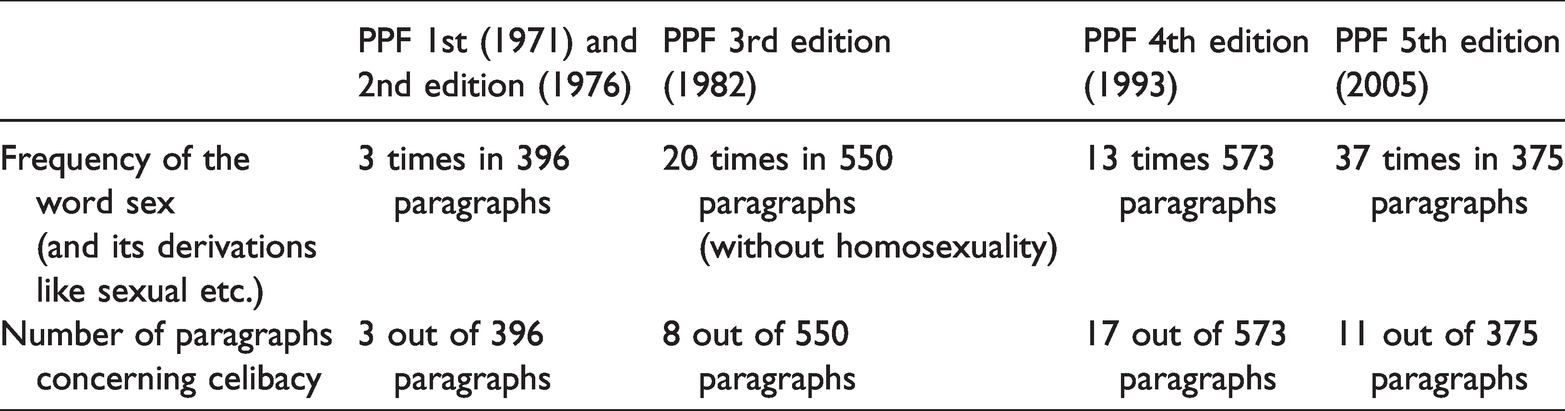
I will show how the meaning of sexuality has changed in the different editions of the PPF and how an educational culture has emerged allowing for a dialogue for priests to use, enabling them to discuss matters relevant to sexuality. Beside these qualitative changes in the PPF, there is also an expansion in the dialogue for dealing with sexuality and celibacy issues. As Table 1 shows, we witness with increased frequency the word sex (including its derivations like psychosexual, sexuality and sexual). While the first two editions mention sex only three times, it appears twenty times in the third edition. The decline in the fourth edition (thirteen times) can be explained by the concomitant rise in the number of paragraphs dealing with celibacy, from eight to seventeen. Additionally, from edition to edition, celibacy occupies more space. However, again with a decline of usage in the fifth edition. Nevertheless, this is the edition shaped by the abuse crisis within the Church, with the result that sexuality has become a major topic in the fifth edition (with 37 mentions).
Increases in language concerning sexuality and paragraphs on the topic of celibacy in the different editions of the Program on Priestly Formation (PPF).
Meaning of sex in the programs of priestly formation
What is meant, when the PPF speaks of sex or sexuality, has changed enormously through the successive editions. In the first two editions of 1971 and 1976, sex is not understood in the context of physical intercourse. Rather, the seminarian must find “his identity in sex” and he needs an “open and honest attitude towards celibacy, sex, and love” (NCCB 1971, 67, 36). Therefore, the meaning of sex is what at present could be considered as gender. Although this very brief mentioning of sex and celibacy (see also Table 1) seems surprising because of “the importance attached to the celibacy of the priesthood, and the obvious difficulties in maintaining it” (Pring 2014, 204), it can be explained as the lack of language on sexuality. This finding fits perfectly within the sexual repression existent in the Catholic Church elaborated above. In the third edition of 1982, the view on sexuality has now changed to that of an obstacle to priesthood, while in almost the same breath the PPF also acknowledges that the sexuality of seminarians and priests is a reality. On the one hand, the “value of celibate chastity must be learned” and that sexuality is a “challenge of celibacy” (NCCB 1982, 24, 25). On the other hand, seminary education “involves the realities of human sexuality as well as realistic expectations regarding human relationships, intimacy, human growth, and celibacy itself” (9). Conclusively then, seminarians “need to achieve a balanced and calm appreciation of sexuality” (102). Within these editions, we see a shift from not mentioning to acknowledging the existence of a sexual dimension in the life of a priest as one who also partakes of the human condition, but which is at the same time an impediment to attaining the priesthood itself.
A significant change, due to the decree of Pope John Paul II (1992), has led to a “franker discussion of sexuality and celibacy” (Carroll et al. 2003, 177). The notion that sexuality as an obstacle to priesthood is still prevalent in the fourth edition of 1993, but now there is a more proactive approach towards meeting the challenge of sexuality. Although the PPF acknowledges that celibacy requires abstaining from “genital sexual activity” and “celibacy is not a denial of sexuality and love but a specific way of shaping them” (NCCB 1993, 17). More to the point, there is now an explicit wording on sex and the explicit recognition of the “genital sexual activity” of men (and priests). Consequently, sexual language is not repressed in the way it was in the past, because seminarians should “speak in details about their own personal struggles and review their success and failure in living a chaste, celibate life” (57). The fifth edition of the PPF as the first one issued after the exposure of the sexual abuse scandal involving members of the priesthood highlights that “preparation for celibacy is one of the primary aims of the human formation program of any seminary” (USCCB 2005, 37). First and foremost, priestly education now incorporates protocols for dealing with the issues of celibacy and sexuality. Repressive wording has vanished; instead, sexual desires, feelings, and human sexuality per se is now officially acknowledged by the PPF. Celibacy requires (a) a knowledge of one’s sexuality and sexual desires; (b) an acceptance and valuing of one’s sexuality as a good to be directed to God’s service; (c) a lifelong commitment to growth, which means continuously integrating one’s sexuality into a life and ministry shaped and expressed by celibate chastity. (USCCB 2005, 38)
Education concerning sexuality in the programs of priestly formation
By asking how priests incorporate the legitimate ways of expressing language about sexuality, we must analyze how priests are educated to speak about (their own) sexuality, that is the development of forms of priestly education concerning sexuality. In the first and second editions, we do not find any kind of education on sexuality at all; there are only general counseling programs. The third edition, in contrast, acknowledges that “education in the realities of human sexuality is needed for seminarians” and it should deal with “such topics as the nature of sexuality, growth toward sexual maturity, marital and celibate chastity, the single state, premarital and extramarital sexual relationships, and homosexuality” (NCCB 1982, 24).
This development is amplified in the fourth edition: dealing with celibacy and especially sexuality is now an important aspect of the education of seminarians. The PPF of 1993 mentions in detail the forms and content of this education: there shall be courses in the curriculum, workshops, and conferences on “personal relationships, sexuality, celibate chastity, commitment, and interiorization [that] are essential topics for spiritual direction” (NCCB 1993, 57). In addition to the proposed instructional forms in the fourth edition, the dealing with sexuality in celibacy is best addressed in the latest edition of the PPF: “Certain habits or skills are necessary instruments on the path to effective and healthy celibate chastity” (USCCB 2005, 38); these are for example self-reflection, self-discipline and self-disclosure as well as “self mastery [sic] over one’s impulses and drives” (38). Consequently, beginning with the third edition, the importance of guidance in matters of sexuality have been augmented, employing more detail and nuance.
Towards a transformed Catholic Priest Habitus
Several consequences arise from analyzing the changed meaning of sexuality and the implementation of education on sexuality within the seminary: First, the linguistic market and with it the legitimate language on sexuality has changed from taboo and censorship to acknowledging the sexuality of priests. From the third edition of the PPF onwards, the Catholic Church has recognized that priests have sexual desires and feelings and that their sexuality is a reality. We can observe an increase in language addressing sexuality with a simultaneous decrease in censorship and tabooing that leads to a “shift in vocabulary” (John Jay Causes and Context Report 2011, 44). Second, the changed language must reflect alterations in the repressive dogma of the Catholic Church. This does not imply that sexual repression has disappeared all at once, as celibacy is still institutionalized. It is rather that these alterations must be understand as having taken place gradually and are dependent on the struggles within the Catholic field. The third consequence is a transformed Catholic Priest Habitus. The legitimate language is transmitted though courses and workshops in the seminary, and hence the ability to speak about sexuality is incorporated into the priests’ habitus, which can then become embedded in the minds and bodies of aspiring priests. Seminarians who do attain the priesthood incorporate different ways with which to deal with their own sexuality from the way they were taught to speak. The result of this relaxed approach is that structures against a free and open dialogue about sexuality no longer hold sway as they once did; therefore, there is no longer the need to self-sensor. From now on, the ability to speak with an appropriate and legitimized language about sex has replaced the antiquated language and attitude. This is why, “by the 1990s, the bishops began to shift their responses to the sexual abuse of minors” (Terry 2015, 144), making considerable improvements in their ability to manage accusations of SAM.
Discussion and conclusion
According to Bourdieu (1991a, 17), “the function of sociology, as of every science, is to reveal that which is hidden.” Working with the hypothesis of an unspoken regime of sexual repression within the Catholic Church, I have exposed the underlying and unconscious mechanisms that led to the denial, concealment, and withholding of information, especially to fellow priests and bishops. By using Bourdieu’s theory of practice and his insight that linguistic expression results in the interplay of Catholic Priest Habitus and the linguistic market of the Catholic Church (Bourdieu 1993, 78), I have demonstrated that from 1950 to 1990, the field of the Catholic Church and the linguistic market did not provide its priests with a vocabulary or a legitimate language to engage in open discussion of their sexuality. The structures of the field were incorporated in the habitus of the priests, to the extent that it led to the denial and concealment of SAM incidents without prior collusion on their part. The structures of field have changed from the mid-1980s onwards, which can be seen in the overdue changes in the education and training of the seminary incorporated in Catholic Priest Habitus.
The presented line of reasoning can account for the four distinctive features detailed in this article: the transnational, the systemic, and the non-collusive dimensions, as well as the uniqueness of the concealing and covering up practices of SAM within the Catholic Church. First, my hypothesis, which is centered on sexual repression and its consequences, additionally describes the transnational dimension, as the Catholic Church is a transnational social field (for the theory of transnational fields see Buchholz 2016). The repression, the linguistic market, and the Catholic habitus are related to the transnational Catholic field and are therefore not bound to a specific nation-state. This is why we can observe these practices and the reforms which took place in diverse countries such as the US, Ireland, and Germany, but also in Australia, Canada or Belgium (Terry 2015). Second, the denial and the cover-ups of SAM were not isolated incidents as some members of the Church would have us believe. The repression of sexuality, the linguistic market, and the subsequent use of a more authentic dialogue are structural aspects of the transnational Catholic field. Although SAM was committed by individual actors, the work of denying and covering up was a collective, systematic effort. Third, the priests, who were of different nationalities, acted in exactly the same way because of the incorporated Catholic Priest Habitus which presented a unified code for managing accused priests. There is no need for a coordinated a priori agreement on the handling of accusations. The priests themselves act unconsciously because it is inscribed in their habitus, that is in their minds and bodies. Fourth, the repression of sexuality that leads to the tacit transferring of abusive clergy stems from the “clerical culture” of the Catholic Church (Bourdieu and Saint Martin 1982), and this is the reason why this pattern is unique to the Church. Other organizations like the Boy Scouts have no institutionalized repression of sexuality, therefore there is a language available to inform other members about accusations of SAM. Additionally, changes in the clerical culture, which consists of the Catholic field, the linguistic market, and the Catholic Priest Habitus, lead to changed practices. Those structures, as already mentioned, that are peculiar to the transnational Church, repress sexuality alongside the Catholic habitus governing the clergy, incorporated repression, and are responsible for the policy of transferring abusers and maintaining silence.
Two limitations are associated with my argument that imply further research. At first, more research is needed on the Catholic Church itself and the (trans-)formation of the Catholic Priest Habitus. To provide a comprehensive explanation for the silencing and withholding of such vital information, several factors must be considered, like different forms for maintaining secrecy within the Church (e.g., Simmel 1959, 307–316), the Church’s organizational culture (and plausibly a normalization of deviance, cf. Vaughan 2016) and the obstructing bishop’s personal acquaintance with the abuser. Moreover, loyalty to the Church and the cohesion among priests add another layer of complexity. Such a multifactorial explanation is within reach by using Bourdieu’s framework. However, to achieve this, further research is necessary. Secondly, there are methodological obstacles. We have only indirect knowledge of the linguistic artifice employed during that period. The reports I have examined are based on incomplete Church archives (Dreßing et al. 2018) and on witness statements made years after the occurrence of SAM. Consequentially we remain somewhat hampered in our ability to access the language then in use over the previous decades. Therefore, the actual language employed by priests and bishops to cover up individual cases is yet to be examined. Bishop Law of the Boston Archdiocese, to name one example, called SAM committed by a priest “‘an aberrant act’ of one depraved man” (Carroll et al. 2003, 7). In-depth case studies should analyze the strategies of “practical euphemisms” (Bourdieu 1998b, 99) to deny or hide accusations of SAM (even in informal talks).
Footnotes
Acknowledgments
I would like to thank Cristina Besio, Gregor Bongaerts, Andreas Schmitz, and the reviewers of CRR for their valuable feedback and suggestions. I am especially indebted to Robert Seyfert who read the different versions of the manuscript and his critique greatly improved the argumentation and coherence of the article. Previous versions of the article have been presented at the conference “On Suspicion and the Contemporary” at the Wits Institute for Social and Economic Research (WISER) in Johannesburg, South Africa and the Annual Meeting of the Section on Sociology of Culture of the German Sociological Association; I would like to thank the participants for their comments and suggestions.
