



Abstract
Materially plastics are ambivalent. In spite of their often lauded quality of creating seemingly untethered imitations, representations and replacements, they have a materiality that leaks, off-gasses and disintegrates. They are accomplished at mimicry yet frequently unable to be remoulded. They are ostensibly resistant to microbial contamination yet absorb environmental pollutants and leach endocrine disrupting plasticisers. This article argues that, due to the material influence of plastics, their ubiquity, and the societal transformations that they have enabled, that anthropologists need to pay sustained attention to this material. Moreover, it argues that anthropological methods and theories are crucial to understanding plastics at a vital moment in their (and our) history. It articulates three ways in which anthropology can engage plastics at all stages in their lifecycles. Firstly, to study plastics challenges what it means to exist: whether or not human beings are bounded or permeable entities, experienced as individuated, collective or somewhere in between. Secondly, plastics disrupt what people know, are willing to know, or are persuaded is worth knowing about the production and disposal of the products that they consume. Thirdly, the materiality of plastics expose contemporary inequalities. Plastics can create unseen violence, both in their geographically unequal toxic distributions and in the vastness of their temporal effects.
More than a substance, plastic is the very idea of its infinite transformation; as its everyday name indicates, it is ubiquity made visible. And it is this, in fact, which makes it a miraculous substance: a miracle is always a sudden transformation of nature. Plastic remains impregnated throughout with this wonder: it is less a thing than the trace of a movement (Barthes, 1972 [1957]: 97).
In 1941, as enthusiasm for the versatility and usefulness of plastics was growing in the United States, cartoonist Jack Cole invented the Plastic Man, a new comic book superhero. Reflecting the idea of a substance that was infinitely malleable and able to resemble other things, the Plastic Man could take on any form. His origin story begins when the criminal ‘Eel’ wakes to find himself chemically altered after being doused in a mysterious unnamed substance. After being nursed back to health by Christian monks, he decides to choose an alternative life trajectory (Spiegelman and Kidd, 2001). The newly formed and reformed Plastic Man resolves to fight crime, joins the police force and abandons his alter ego entirely to spend his life full time as the Plastic Man 1 . Complemented by his dopey side-kick Woozy Winks and wearing a red outfit with a yellow and black belt, the Plastic Man was almost always seen with goggles obscuring his eyes. With his face largely covered, he emotes, not through facial expressions but through his ability to move, shape shift, bend and twist across the page. Cole expertly uses the Plastic Man’s movements to amuse readers as the character fights crime through his ability to take on impossible and absurd shapes. Elongated, he can catch criminals with his arms, legs and mouth, as they try to escape. He can shrink and grow, become hard or soft. Shifting forms and viscosity, he can repel bullets. By replicating inanimate objects, he can become nearly invisible to crooks as they easily mistake him for a piece of modernist furniture or a hanging piece of contemporary art.
The Plastic Man in many ways embodies the new enthusiasm for plastics in the 1940s and 1950s as an artificial substance unbounded by typical material constraints. Following soon after the 1938 invention of the first ever comic book superhero, Superman, the Plastic Man was a popular character of the period and one of the first comedic superheroes (Spiegelman and Kidd, 2001). Later subsumed into the DC universe, the Plastic Man has had various incarnations over an eighty years period, even his own television show. Often a light-hearted character, unlike other superheroes such as Batman he rarely engages his alternate persona ‘Eel’. He lives through representation. As in Barthes’ view of plastics, the Plastic Man appears as replication and mimesis (Figure 1).
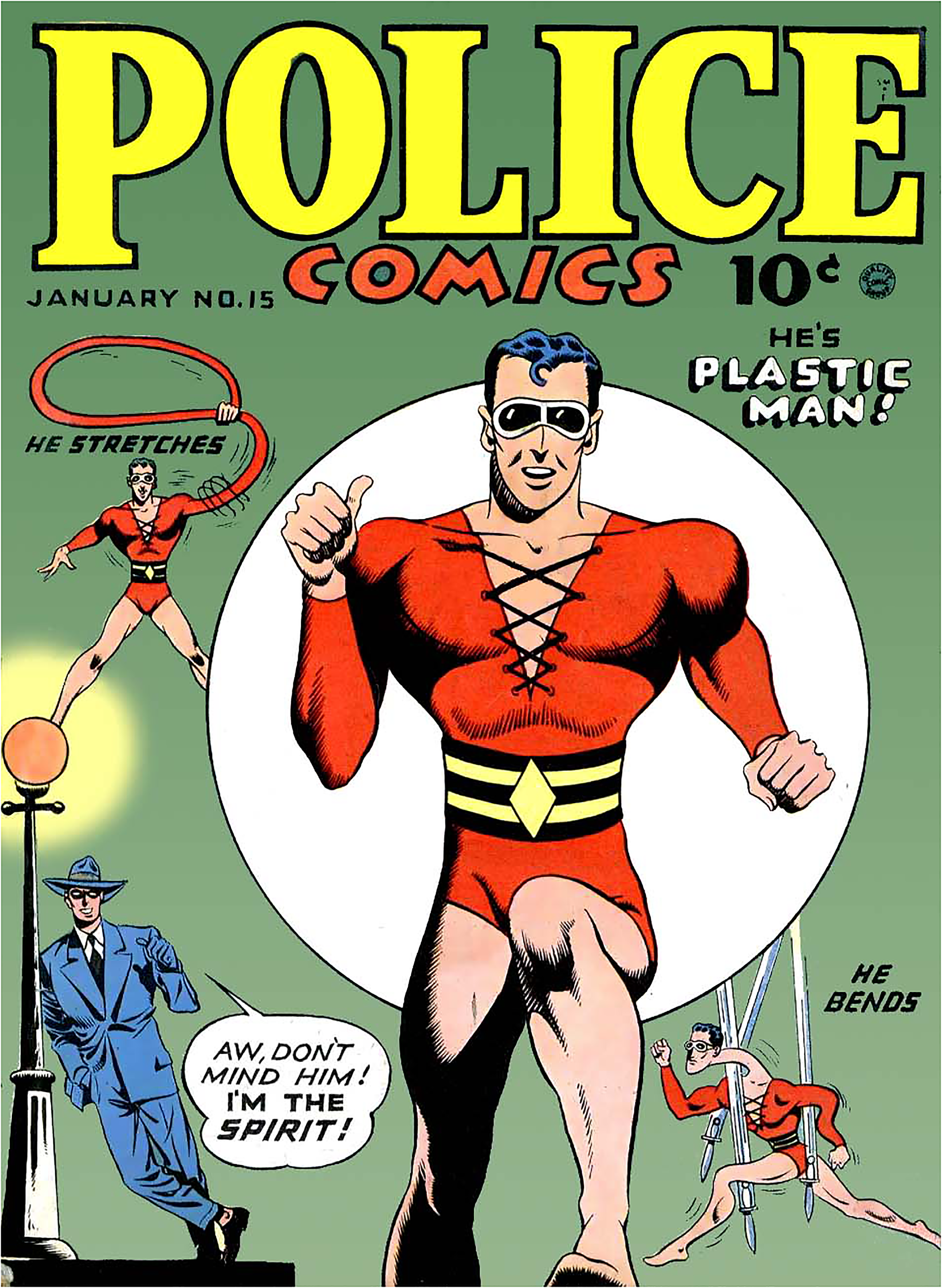
The Plastic Man on the cover of Police Comics, January 1943.
In spite of Plastic Man’s ability to take on unbelievable shapes and to be continuously remoulded, this idea of plastics as ‘infinite transformation’ (Barthes, 1972 [1957]: 96), represents a very partial view of the material. Plastics have their own identities and there are limitations on their capacity to change shape. Most plastics are moulded only once into a particular form before they are used and discarded. Indeed, at various points in their history this durability has been emphasised, for instance when Baekeland, the inventor of the first fully synthetic material Bakelite, pronounced that Bakelite was a superior material as it was ‘permanently hard, infusible and insoluble’ (quoted in Meikle, 1995: 5). Although plastics have come to be defined by their capacity to be transformed during the manufacturing process, plastics also leak, contain, infuse, disperse, break down and remain.
Materially plastics are mouldable yet brittle, durable yet fragile, seemingly unable to decay yet fractiously disintegrating into ever smaller particles. The material ambivalence of plastics, and the social transformations which have accompanied their introduction, have caused them to carry a heavy metaphorical load in many of the societies in which they appear. In many places their appearance and growing usage has coincided with radical economic changes, transformations in the foods that people eat, and increasing interactions with the non-local (Chao, 2019; McDougall forthcoming; McKay et al., 2020; Meiu, 2020; Pathak, 2020a). To be plastic can mean many things: changeable, inauthentic, domesticated, foreign, to name but a few. However, plastics are more than just symbols and metonyms: they are materially resonant (whether or not people notice, see Stanes and Gibson, 2017). At all phases in their lifecycle they have significant material consequences, including creating greenhouse gasses that contribute to global warming and causing other kinds of pollution.
This article will argue that due to the immense effects that plastics have had, are having, and will have in the future, that recognising the material and cultural influence of plastics is vital to understanding contemporary societies and that anthropology, in turn, is crucial to the study of plastics at a key moment in their history. Due to their ubiquity and their life-transforming attributes for present and future generations, I concur with Pathak and Nichter (2019) that anthropology should pay more attention to this material. They argue that whilst there is an emerging anthropological literature looking at the ways that toxicity is influencing human bodies, ecosystems and lives (see Nading, 2020), that there are relatively few studies which examine the specific challenges associated with the proliferation of plastics. Pathak and Nichter propose that an anthropology of plastics can assist policy design and mediation by responding to local contexts whilst interrogating the macro conditions which cause harm (2019: 320). By explicating different positions, anthropologists can also provide a bridge between different stakeholders (for instance industry and environmental activists) who tend to see each other as homogeneous groups rather than heterogeneous assemblages with varied interests (Pathak and Nichter, 2019).
As a ‘hyperobject’ (Morton, 2013) plastics are vast both temporally and spatially. They are ‘nonlocal’ entities, yet they ‘stick’ to human and non-human beings in various ways (Morton, 2013: 1). How should we understand this ambiguous material? Like the Plastic Man, the power of plastics lies in their capacity for mimicry: reproducing the material properties of nearly any other object. Insidiously this mimicry also appears on a molecular level, as the binding agents of plastics imitate and interfere with our hormonal systems (Liboiron, 2016).
This paper makes a case for an anthropology of plastics that, along with following plastics from their extraction to their use and afterlives (Pathak and Nichter, 2019), contributes to the study of plastics in three key ways. Firstly, on an ontological level plastics demand a reengagement with and redefinition of what it means to be human. In their ubiquity and scalar spread they infiltrate what it means ‘to be’ in new ways that transform individual bodies, social and ecological ties, along with local and global ecologies. Porous and multitudinous, plastics influence people’s sense of individuation, connection and collectivity. Secondly, relating to epistemology, plastic challenges what human beings know, are willing to know, or are convinced is worth knowing about the production, use and disposal of the products that people consume and which make up our material world. Thirdly, plastics are intractably implicated in violence. Their materiality creates toxic inequalities and environmental injustice in both the short-term and longer time scales. The unseen violences of plastics, both in their geographically unequal toxic distributions and in their temporally extensive effects transform the lives of people that live with, make, sort, use, remould, and struggle to dispose of plastics now and in the future. As a significant contributor to greenhouse gases plastics are also implicated in the unevenly experienced violence of global warming.
The ubiquity of plastics
There are very few people on the planet whose lives have not been radically influenced by the advent of plastics. As Meikle (1995: 4) notes in his extensive cultural history of plastics in the United States, the term plastic, stemming from the Greek plassein meaning to transform a soft substance, refers to the material’s ability to be moulded into a particular form. Since the appearance of the first fully synthetic plastic Bakelite in 1907 and the subsequent exponential increase in the use of synthetic plastics during the Second World War and the post war period, the term ‘plastic’ has been generally used to describe composite materials that are moulded into shape using industrial processes. Plastics are frequently made from synthetic sources, but they can also be made from semi-synthetic, and non-synthetic materials (Meikle, 1995). Plastics were initially made from non-synthetic materials. Celluloid, for instance, was prepared from a mixture of nitrated cellulose and camphor, and the hard setting Casein, still used to make buttons, is derived from dairy (Meikle, 1995). 2
In the United States, the mid twentieth century saw an increase in the diversity and forms of the types of plastics being made, in particular industrially produced synthetic plastics (Meikle, 1995). Just as the first uses of petroleum saved whales from large-scale slaughter, replacing whale oil to light lamps, early plastics reduced the reliance on products derived from animals and other living sources (Westmont, 2020: 101–102). The early non-synthetic plastic celluloid, for instance, replaced tortoise shell, which was used to make combs, and ivory, which was used to make billiard balls. The recent archaeological record of a coal mining town in Pennsylvania demonstrates how the introduction of new products made from celluloid in the early twentieth century had the effect of enabling working class residents to purchase necessary items which they were previously unable to afford (Westmont, 2020: 102). As Meikle argues, following from their initial utopian expectations, the post-war proliferation of plastics was accompanied by growing ambivalences towards the material (1995). For instance, whilst plastic flowers were advertised for their durability and utilitarian qualities, they were also criticised for their superficiality and the refusal of normal cycles of growth and decay latent in their undying blooms (Meikle, 1995). Gutpa-Nigam’s historical analysis extends this ambiguity, contending that for some middle class white Americans plastic flowers brought into the suburban home generated a sense of stability set against a sense of a world-in-crises in the postwar period (2020). As our use of plastics have exponentially increased post 1950, in the period labelled by a number of scholars as the Great Acceleration (Morton, 2013), plastics have become implicated in wide-scale ecological destruction, global warming and violence both immediate and ‘incremental or accretive’ (Nixon, 2011) for humans and non-humans.
Plastics are made from strings of polymers. In order to generate the desired form, shape and texture, additives in the form of monomers and plasticisers are introduced at varying stages of the process to assist in generating the material properties of the specific plastic (Liboiron, 2016). As Meikle writes (1995), whilst Celluloid and Bakelite were limited in form and colour, the new plastics of the mid twentieth century could become transparent, imitating substances such as glass, and they could take on bright colours that made them attractive to make unique new kinds of furniture, crockery and children’s toys. Resilient, strong and excellent at mimesis, novel plastics began to be invented making anything from vinyl seat coverings and records, to building materials and clothing. As he continues, by 1957, the potential applications of plastics were so versatile that Disneyland opened the Massachusetts Institute of Technology (MIT) collaboratively designed Monsanto House of the Future, a house made almost entirely from different kinds of plastic (Meikle, 1995: 208–214). Shaped like an x to enable easy packing and transportation, the house’s creators envisaged the future in plastic, with plastic fabrics, plastic crockery, plastic bathrooms and walls, plastic shelving and plastic protected safety glass. Science fiction movies, such as Barbarella (1968), likewise foregrounded plastic materials as clothing and on sets (Meikle, 1995: 221). For consumers of American pop-culture the future, in many ways, was being imagined in plastic.
Whilst the proliferation of plastics is generally associated with consumer capitalism, the socialist states of the mid twentieth century were just as enthusiastic for the possibilities of the new material. Following Khrushchev’s ascendency to power in the Soviet Union in the 1950s, the need for new, modern and affordable housing became a pressing concern. As Rubin writes (2008), socialist innovators sought inspiration from Le Corbusier and the new designs coming out of western Europe and the United States, including the Monsanto House of the Future. In the German Democratic Republic, as the Politburo was realising its own lack of material resources, coal-based plastics and the ingenuity to transform them into modern items for the socialist citizen were embraced to generate new building, interior design and furnishing possibilities (Rubin, 2008). Towns in the German Democratic Republic (GDR’s) Chemical Triangle that spread across Saxony and Saxony-Anhalt were able to produce the new functional and utilitarian forms that fit with the socialist design aesthetics, praising utility and the labour saving qualities of plastic. Plastics and the new aesthetic possibilities which accompanied them became priced for being futuristic, local, light weight and durable (Rubin, 2008).
In some parts of the Asia, the increasing proliferation and use of plastics from the latter half of the twentieth century onwards have been associated with modernity and economic abundance (Pathak, 2020b; Schlehe and Yulianto, 2020). In Yogyakarta, on the Indonesian island of Java, Schlehe and Yulianta have noted an exponential increase in plastic usage from grandparents to their grandchildren. Social pressures surrounding perceptions of modernity impact how people interact with plastics, as one of their interlocutors explains that they avoid taking their own bags shopping because they don’t want to be seen as ‘old-fashioned’ (Schlehe and Yulianto, 2020: 45). Yet although plastics are often seen as both a modern convenience and as a barometer of economic development, plastics maintain their ambivalence. Plastic waste is dumped next to the houses of low-income people because of, and contributing to, their low status. And, whilst expectations regarding keeping things in order in the domestic sphere mean that women must keep the domestic space free of litter, the roads that adjoin many houses contain the debris of discarded plastics (Schlehe and Yulianto, 2020: 45). In Mumbai, Pathak has described (2020b) that whilst the proliferation of plastics have been praised for enabling hi-tech solutions and utopian possibilities, plastics are also widely associated with pollution problems. Since their introduction in the 1950s and proliferation in the late 1970s and early 1980s, she reports that many Indians have mistrusted (particularly light-weight) plastics for certain purposes, such as long-term food storage (Pathak, 2020b; Pathak and Nichter, 2019). For some policy makers in India discussions around plastic pollution are famed as a problem of correct disposal and as an aesthetic disturbance, the responsibility for which falls to the consumers or ‘unruly citizens’ (Pathak, 2020b: 7) whose littered plastic bags can choke sacred Hindu cows (therein linking material pollution with spiritual pollution). For others, as a human-made synthetic substance challenging the perceived purity of ‘nature’, plastics are pollution from the moment that they are created (Pathak, 2020a, 2020b: 11). In Mongolia, where I carry out fieldwork in the capital city Ulaanbaatar, the undulations of capitalism and rising consumption patterns have created new kinds and volumes of discarded materials. In 2019 The Asia Foundation reported that the production of waste in the city had grown by a staggering seven times its number since 2009 (The Asia Foundation, 2019). Following from the Democratic Revolution of 1990, this increasing waste and concerns about how it is disposed of, along with the escalation of the city’s dire air pollution problems, has coincided with the shift from socialism to capitalism. For many urban Mongols the particulate saturated air, and other forms of problematic waste, have become associated with spiritual pollution and moral decline in the postsocialist era (Abrahms-Kavunenko, 2019, 2022).
As Meikle argues (1995), plastics have often been accompanied by critiques as well as enthusiasm. In English-speaking societies the term plastic, in addition to meaning flexible, is used to denounce something as inauthentic, artificial, and superficial. This idea of plastic pitted against authenticity can be traced back to Celluloid’s use in making films. As Meikle quotes D. H. Lawrence complaining in 1928: ‘something has gone out of the celluloid women of today’ (1995: 6). This link between plastics and inauthenticity grew as the proliferation of cheap plastics that were affordable to buy and quick to break created negative associations with plastics and rampant consumerism in the 1960s (Meikle, 1995). A decade after the Monsanto House of the Future opened and a year before Barbarella’s futuristic foray into plastics, Jacques Tati foregrounded the unnaturalness and alienating materiality of modernity through his depictions of plastics in Paris in his Italian-French 1968 film Playtime. The film’s soundtrack is largely devoid of dialogue, instead featuring the noise of squeaking shoes walking along sterile laminate floors, the sound of electricity buzzing like a neon sign in large air conditioned buildings, and the bizarre squealing sounds that occur when one sits on a synthetic chair. Playtime’s epic sets enable a stark reflection of modernity through the story of outsiders wandering into a new Paris of modernist cookie cutter residences and high rise buildings with alienating plastic interiors.
Accompanying these futuristic visions and critiques, radical changes in the design of plastics were beginning to have a major impact on global consumption patterns. In the 1950s, Meikle notes that the new possibilities of disposable plastics began to transform consumption patterns in the United States. In 1947, the squeeze bottle, made out of blow-moulded polyethylene was first used as a container for deodorant (Meikle, 1995: 190). Initially more expensive than glass, its popularity surged when the material’s manufacturing price decreased and it began to be used for packaging of all kinds, such as milk bottles, and bottles used to store detergent and bleach (Meikle, 1995: 190). As Meikle demonstrates, though originally touted for its durability and capacity to be reused, in 1956, as demand for the squeeze bottle was rising, the producers switched their messaging and design from durability to disposability. As production became less expensive, polyethylene squeeze bottles were able to undercut the cost of other widely used materials, and more and more plastic could be produced and sold at low prices (Meikle, 1995: 190). Manufacturers began designing plastics with planned obsolescence in mind, and advertisers helped shift domestic virtues in the 1960s from thrift to concerns about hygiene (Lucas, 2002). In 1956 the editor of Modern Packaging Magazine Lloyd Stouffer proclaimed that ‘the future of plastics is in the trash can’ making a call to industry that increasing plastic production rested on the design of ‘single use’ plastics (quoted in Liboiron, 2018).
This design shift and the exponential increase in the production, use and discard of synthetic plastics that followed it, has had a radical impact on the planet. Plastics, through the technological changes that they enable, have completely changed the way that people engage the materials around them. As well as being excellent at mimicry, plastics have created new material possibilities. Food can now be transported, packaged and preserved in novel ways eliminating the reliance on local and seasonal foods. Plastic’s lightness and capacity to be moulded means that it has been an excellent substance to create anything from important medical supplies, to electronics, to an endless supply of cheap to buy ‘fast fashion’. Less visible uses include the binding materials and insulation used in building and construction along with its uses for industry and transportation.
Since the 1950s when industrial scale production of plastics began, 9 billion tonnes of plastic have been produced (UN Environment Report, 2018a: vi). Each year around 300 million tonnes of plastic waste is generated (UN Environment Report, 2018a: 5), roughly the combined weight of the entire human population. This production of plastic waste shows no signs of slowing down. Indeed, plastic production is expected to double in the next 20 years (Nielsen et al., 2020). As well as being used to make relatively durable objects, in 2015 around 47% of plastics were designed for single use (UN Environment Report, 2018a: 5). For every minute that passes one million plastic water bottles, designed for single use, are purchased (UN Environment Report, 2018b). Accurate figures on the global scale of the consumption and use of plastics are often hard to quantify. The United Nations Environment Programme (UNEP), for instance, report that estimates for yearly plastic bag consumption range from 1 to 5 trillion, a rather large discrepancy, with both figures representing colossal figures varying only in the order of their magnitude (UN Environment Report, 2018a: 12). If the upper estimate of 5 trillion plastic bags is correct, the worldwide consumption of plastic bags each year would cover an area twice the size of France (UN Environment Report, 2018a: 12).
Plastics, both single use and those designed to last for longer, can pollute in many ways. This pollution can occur at the site of their extraction (i.e. on an oil rig or in a corn field), during their transportation, and when they are being moulded. They can off-gas or leach during their storage and usage. They pollute again in the process of recycling (if this happens), and off-gas and proliferate after they have been discarded (Bauman, 2019). As such, plastics create greenhouse gases that contribute to global warming throughout their entire lifecycle from ‘cradle to grave’ (Bauman, 2019). In 2019 it is estimated that plastics were responsible for 860 million metric tonnes of greenhouse gas emissions (CIEL, 2019).
Large pieces of plastic rubbish can cause problems in ecosystems as they can, for instance, choke animals and block waterways. Plastics fragment into tiny pieces to form microplastics and nanoplastics which enter ecological systems and have unknown affects (Ng et al., 2018). Whilst there is debate around the toxicity of the plastic polymers which now form the gigantic plastic gyres in the world’s major oceans and can be found ubiquitously in soils, science and technology studies scholar Liboiron notes that the additives used to give plastics their unique forms (the monomers and the plasticisers) have been linked to miscarriages, the feminisation of male foetuses, diabetes, obesity, hormonal disruption, cancer, reduced brain function, neurological problems and infertility (see Bergman et al., 2013; Grűn and Blumberg, 2009; Halden, 2010). As Liboiron continues, these additives ‘are what chemists colloquially refer to as “bad actors” because they intervene in “natural” systems, can change genetic material, easily travel and escape containment, accumulate in the environment, and do not break down, among other characteristics (2016: 89).’ Plastic additives, such as the endocrine-system disrupting bisphenol A, (BPA), easily escape their containment within plastic objects, leaking out and off-gassing. It is estimated that around 98% of plastics release monomers through off-gassing or leaching (Yang et al., 2011). Plastics can also function as a sink for attracting other toxic substances (such as flame-retardants and dioxins) which were not added during the manufacturing process. These chemicals, hitching a ride on the fragmenting plastic polymers, can pass into the animals that ingest them (UN Environment Report, 2018a: 13).
As plastics permeate and pollute unevenly, in ways that don’t necessarily conform to linear models of pollution, Liboiron has argued that it may be better to conceive of plastic pollution as a kind of miasma. Within the pre-germ miasmic disease theory, the causes of illness and disease were explained by ‘dispersed, unspecific influences within the wider environment’ (Liboiron, 2013: 134). Repurposed this concept can potentially provide a better analogy for picturing the diffuse ‘web of influence’ that the effects of plastic pollution present (Liboiron, 2013: 142). How much plastics seep and off-gas during use and after they have been discarded depends on the viscosity and temperature of the substances around them: whether they are found among solids, or in liquids, the atmosphere or within an animal’s stomach, and whether or not these environments are hot or cold, dry or humid, or acidic.
In spite of an aggressive campaign by the plastics industry to convince consumers otherwise (Sullivan, 2020), only around 9% of virgin plastics are recycled, owing to their physical properties and economic considerations (UN Environment Report, 2018a, 2018b: vi). The plastics that are recycled tend to be recycled once, as the strength of the connections between the polymers weaken through heating and reshaping. Plastic recycling when it does happen, tends to be downcycling, meaning that the plastics that are recycled are likely to be of a lesser quality than the original material (Sullivan, 2020). Recycling also creates its own forms of pollution. As Hawkins writes of the communities recycling polyethylene terephthalate (PET) bottles in Hanoi, waste and pollution ‘is evident in the materials that cannot be transformed and are dumped, in the flows of polluted water and plastic sludge running into local rivers, the toxic fumes being released and inhaled as PET is melted, and the millions of plastic chips that blow away in the process (2013: 65)’. Hawkins contends that the waste and pollution associated with the use of PET bottles is not an externality, rather, it is an intrinsic part of their value. Waste is not something that follows accidentally; they are ‘made to be wasted’ (Hawkins, 2013: 50 emphasis in original). As she writes, ‘like many plastic objects, it is rubbish from the beginning’ (Hawkins, 2013: 50).
Of the plastic waste that is not recycled, it is estimated that around 12% is incinerated and the rest, the remaining 79%, ends up in landfill or discarded elsewhere, with around 8 million tonnes of discarded plastic ending up in the oceans each year (UN Environment Report, 2018a, 2018b: 6). With production of virgin plastics increasing, the amount of plastics finding their way into the oceans and as pollution elsewhere shows no evidence of slowing. Plastics are also present in estuaries, fresh water lakes, rivers, and soils (UN Environment Report, 2018a, 2018b: vi).
Following from scholars such as Ingold, who suggest that anthropologists need to pay more attention to the materials which make up the things that we study (2010), as the scale and influence of plastics has become monumental at all stages in their lifecycle, there needs to be an effort within anthropology to look at the unique qualities of plastics. How are plastics integrated, rejected, produced, used, transformed, and discarded? How are the physical properties and symbolic resonance of plastics influencing what people are, what human beings think they are, how knowledge is produced and interpreted, and the shape of violence and harm? How have plastics, as a material that is now frequently priced for its ‘disposability’, influenced the development of planned obsolescence and increased consumption? How do plastics influence the bodies of those that use this material, or that are involved in producing, recycling or discarding plastics? Or those living in or near dumping areas? And, as this leaking, disintegrating substance finds its way into the bellies of aquatic animals and passes into the digestive tracts of earthworms and human bodies, how does this material influence the human, other-than-human-beings, and the ecological systems of the planet?
Plastic ontologies
As Latour has written (2014), anthropology is in a unique position to bring new insights and understandings into how people conceive of life in the Anthropocene. The idea of the Anthropocene clarifies the ineradicable loss of the perceived human-nature dichotomy with all of the vertiginous ramifications that follow. Attendant to the naming of the Anthropocene is the realisation that there is no place untouched by human activity, no pristine nature somewhere far away. In short there is no ‘away’ which, as Latour argues, heralds a double movement. At once people realise that human beings have influenced every ecosystem on the planet, and, that humans cannot control the outcomes of our actions (Latour, 2014). Amongst the ontological questions raised by the recognition of this state of affairs, questions concerning the boundedness or unboundedness of the person, their autonomy or enmeshment, and the extent to which there is a discrete humanity at all are writ large by a focus on plastics.
As anthropologists study the intimate relations that humans have with other humans, animals, plants, elements, forces, materials, objects and things, anthropology is in a unique position to write about ecology without utilising the dichotomies implicated in the idea of ‘nature’ (see also Morton, 2007). Through qualitative studies anthropologists, and others using qualitative methods, can look at how people physically interact with plastics whilst paying attention to the unequal toxicity that they can produce, as well examining the ways that people describe, understand, tolerate, value or ignore plastics.
As new forms of plastics have accompanied radical changes to societies, they can have powerful symbolic resonance in the societies to which they travel, sometimes constituting or standing in for a reordering of worlds. Amongst the Marind in West Papua, as Chao compellingly writes (2019), the idea of plastics have become associated with a lack of wildness, state oppression, deception, and domesticity. She tells the story of a ‘plastic’ cassowary who is found as an egg on the edge of the remains of a burnt out forest about to be transformed into a monocrop palm oil plantation. Incubated in raw rice, Rubin the plastic cassowary is cared for by the villagers who try to encourage him, without luck, to return to the forest Only interested in a diet of packaged foods, Rubin’s call invokes sadness in the village, reminding the Marind villagers of their own lack of political capacity and the lure of modernity, as capitalism and the Indonesian state infringe upon their autonomy (Chao, 2019: 832). Being ‘wild’ among the Marind does not have the same connotations of being removed from human relations as it does in the English language. Rather, it means to be autonomously embedded in multiple social and ecological relationships. As Chao quotes one of her interlocutors: This is no song, sister. This is a weeping. This is the cry of the cassowary. Can you not hear the sadness, child? Does it not rip through your heart with the speed of a hardwood ngef (Arenga pinnata) arrow? We hear only a weeping, a lament. We feel the grief of the khei (cassowary) as it seeps through our skin and bone. We hear death and mourning in its call. No longer wild (liar) or free (bebas), the cassowary has become plastik (plastic) (Chao, 2019: 830).
Rubin has forgotten to sing and instead weeps like a human, living on processed foods which make his body weak. Plastics, as well as indicating a loss of sovereignty, are associated with deception. The foods which come in shiny plastic packaging never satiate, government officials in fancy clothes deceive the villagers, and, as more plastic things enter the village, more of the village’s youth are attracted to modern life. Plastics among Chao’s interlocutors are also linked to sterility, as plastic animals like Rubin are no longer able to reproduce both physically with other cassowaries and through maintaining social and ecological ties (Chao, 2019).
In the Samburu region of Kenya, where a plastic bag ban came into force in 2017, the sterility and non-localness of plastics is likewise emphasised (Meiu, 2020: 223). Meiu describes how growing concerns over plastics in this region have also coincided with increasing homophobia and concerns about foreignness. As he writes, the arrivals of certain kinds of plastics in Kenya have come to be associated with neo-colonial and colonial dependencies, changing consumption patterns and a disrupted moral order (Meiu, 2020: 223). As bans on plastic bags have been introduced, some have used morally loaded discourses about plastics to malign homosexuality as an import which, like plastics is viewed as being a ‘moral contagion’ (Meiu, 2020: 224). He discusses the experiences of ‘plastic boys’ in Samburu, marginalised migrant men who make a small income selling cheap plastic objects. Just as plastics are agents of pollution, these men, due to their meagre living and inability to set up households (and therefore fit into normative patterns of social and biological reproduction) are believed, like plastics, to be polluting (Meiu, 2020: 226). Their status, in many ways reflects the ways that plastic is materially conceived: shiny and deceptively enticing, but ultimately contaminating. Like the ‘plastic boys’, in rural areas plastics are never able to become embedded socially as they resist taking on the ‘dirt, sweat or smell of their owners’ (Meiu, 2020: 228). Plastics arrive from outside already having a shape and purpose: they cannot grow or reproduce (Meiu, 2020).
In India, Pathak describes how concerns about toxicity leaching from plastic packaging interplays with existing ideas of pollution and permeability among the middle classes in Mumbai (2020a). She suggests that whilst some scholars have argued that modernity comes with an increasing sense of individualism and a dis-embedding from social contexts, that this focus on the body’s capacity to be infiltrated by external contaminants demonstrates that her interlocutors conceive of themselves as intermingled in an ecologically damaged world (Pathak, 2020a: 2). As Pathak points out, plastic packaging has frequently been touted in India and elsewhere as a way of ensuring purity and hygiene, obscuring the human labour involved in its production and presenting itself as untainted by human contact (2020a: 6). For many of her middle class interlocutors concerns about toxicity outweigh their fear of germs. Recognising the permeable nature of human bodies they opt to avoid the toxicity that can come from packaging and its potential harm to the body, rather than focussing on the ‘hygiene’ that plastic packaging may offer (Pathak, 2020a).
In my own work I have looked at how the increasing use of plastics in Mongolian religious rituals can cause these items to become ambiguous after use. Prayer scarves, which were previously made from silk and limited in their quantity are now made of polyester and are cheap to buy. Being a sacred item, and potentially taking on the intentions of those who offer them, prayer scarves once offered, can neither be thrown carelessly into the garbage nor can they be reused. Instead they take on a kind of mummy materiality, one which, like the anti-entropic bodies of Buddhist mummies, renders them energetically as well as materially ambivalent. Unable to biodegrade, these items can pose problems for those who interact with them as their improper treatment can result in curse-like qualities (Abrahms-Kavunenko, 2022, 2020). Other anthropologists have written about how the plastics used in religious rituals can cause similar problems due to their materiality. In popular Cuban rituals, Wirtz describes how ritual offerings that include plastics, such as plastic bags, can be mistaken for ordinary rubbish on the streets, potentially causing problems for those who tamper with them (2009). She explains that a ritual item is sometimes only identified through its ritual biography and that they can appear to be almost identical to mundane garbage. Even though they can be difficult to identify, tampering accidentally with ritual offerings can cause ill effects to those who disturb them (Wirtz, 2009). Unable to break down, the items, even though they have been left on the side of the road, still carry with them hidden potencies.
Scholars from within and outside of anthropology have discussed the ontological ramifications embedded within and leaking from the unsettling materiality of plastics. Science and technology studies scholar De Wolff writes (2017) about the purification tendencies underlining the categorical insistence of marine biologists working on plastics in the ocean. The plastisphere, where life entangles itself with plastic debris found in the ocean enabling, for instance, coral reef fish to be found in the deep sea sheltering in the abandoned flotsam of bottle crates, raises important questions about how to perceive life in relation to plastics. How are people interacting with ocean ecosystems that human-made materials permeate to such an extent that attempts to remove them also kill the life forms that have ensconced themselves within this new material reality? (De Wolff, 2017). The ontological ambiguities relating to the ubiquity of plastics raises questions for anyone researching how people navigate living in a world (or after the end of it?, see Morton, 2013) that is infused with human-made substances whose toxicity is so pervasive that it constitutes the new status quo (Davis, 2015; Liboiron et al., 2018; Nading, 2020). Cultural studies scholar Davis looks at the radical disruption to reproduction narratives, and ideas of care and gender that follow from the pervasiveness of endocrine disruptors (2015). Liboiron, Tironi and Calvillo question what it means to be living in a ‘permanently polluted world’ (2018) where the unevenness of exposure asks for situated studies that engage lived realities (see also McKay et al., 2020).
During my research in Mongolia I have found that rather than being seen as stable things, human-made artefacts and materials frequently present themselves as incomplete or partial (Abrahms-Kavunenko, 2019, 2020). The strength of anthropological studies looking at plastics lies in their capacity to do more than just follow the social lives and circulation of completed objects from their generation to their consumption, as is common within the material turn in anthropology (Appadurai, 1998). An anthropology of plastics should engage with the ambiguity and pervasiveness of a material that effortlessly overflows, befuddles and erases ontological distinctions and categories, whilst at the same time highlighting the cultural and social constellations that underpin its production, use and afterlife. Rather than trying to resolve the ambiguities of plastics, an anthropology of plastics should foreground these indeterminacies. Following from recent theories that emphasise doubt and uncertainty in the Anthropocene (Abrahms-Kavunenko, 2015, 2020; Bubandt, 2014; Carey and Pedersen, 2017; Tsing, 2015), this research should be comfortable with the ambivalences, fuzziness, murkiness and the ‘ugliness’ of life (Dalby, 2016) and in doing so create messy representations of the incredibly complex worlds that we inhabit.
On violence and agnotology
Whilst in the above cases plastics can carry heavy symbolic loads, plastics often go unnoticed. Much of their acceptance into our material world comes from the fact that they have become naturalised or made necessary, depending on one’s subject position, in ways that obscure their life histories, present influences, and future trajectories. Whilst many people in wealthy nations have heard of the problems with plastics polluting the oceans, certain industries promote the idea that this problem is due to individual consumption choices and/or that this plastic pollution is a waste management issue: all that needs to be done is to recycle more. If people are comfortable enough, their daily use of plastics may not come into consciousness very often, except for when they watch the latest documentary about the oceans or when something badly made breaks. Plastics can be seen as a problem to be managed, like other kinds of rubbish, a useful material to which no particular meaning or resonance is applied.
The extraction, use, re-use, recycling and discard of plastics do not have the same meaning for the wealthy as they do for the poor. McKay and Perez, in their research on using plastics to make baskets in the Philippines (2018), note that plastics are not a neutral substance, but rather carry meanings into the items that are made from them. They describe how, due to their marginal status relative to global capitalism, the ethnic groups labelled as the Igorot repurpose plastics out of necessity, and in doing so subvert dominant power and gender relations. For wealthy Filipinos plastics are seen as ‘the detritus of colonial globalisation’ (McKay and Perez, 2018: 177) for the poor it is ‘a pragmatic choice’ (McKay and Perez, 2018: 178) as plastics are cheap to purchase and easily repurposed. In other places, plastics may reinforce existing gender inequalities. Doing research among the rubbish pickers or ‘scratchers’ of Addis Ababa, Knowles (2017) has written of the plastic waste left over from Ethiopia’s consumption of cheap and easily broken plastic products made in Chinese factories. Here plastics reinforce gender norms, as women collect plastic waste and the more valuable waste is collected by men (Knowles, 2017). Braun and Traore have looked at how pollution caused by plastic bags in Mali has become associated with individual women’s consumer choices (and is therefore their responsibility) rather than being seen to be the result of broader mechanisms of globalisation and state waste management practises (2015).
Whilst the leaking, seeping and off-gassing toxins from our plastic usage affect almost everyone on the planet, the negative effects of plastics are invariably felt more by poor communities and lower income nations. The toxicity of plastic production and disposal is a problem that is often exported from wealthy nations to low or middle income countries. Accompanying global trends that have seen the export of dirty industries from wealthy nations to poorer ones, plastic waste, both legal and illegal, is big business, with exports of plastic waste (both recyclable and non-recyclable) sent from wealthier nations to be ‘disposed of’ in middle or low income countries (Dermatas and Georganti-Ntaliape, 2020). In addition to contributing to global warming which is unequally experienced around the world, plastics pollute unevenly, both spatially and temporally. As such, we need to extend the idea of spatially oriented distributions of violence to include temporal understandings (see also Ghosh, 2016; Liboiron et al., 2018). As Morton writes of hyperobjects, the effects of plastics are temporally undulant: existing across vast timescales but only sometimes actively experienced (2013). Like global warming, the violence of plastics can be temporally dispersed, and rather than necessarily being immediately felt, they can also be present in the unseen toxicity passed onto future generations or upwards in food chains.
Anthropologists studying plastics should be sensitive to avoid taking on the unevenness of the burden of proving harm, and in doing so ignore the harm felt (or that will be felt) by our interlocutors and their descendants (Michaels, 2008; Oreskes and Conway, 2008). Liboiron has described how contemporary ideas of pollution are influenced by two models: one which reflects Douglas’s idea of ‘matter out of place’ (Douglas, 2002[1966]), wherein all matter in the wrong place (such as a piece of plastic in the ocean) is pollution, and, the other, a threshold model of toxicity that says that given that there will always be some pollution the appropriate problematic is one of dosage (Liboiron, 2016: 94). As they write, most debates around pollution among policy makers revolve around the ‘threshold’ idea of pollution, scientists needing to prove that a threshold has been surpassed in a quantifiable and observable way if they are to claim that harm is present. The problems of requiring that the ascertainment of whether or not plastics are polluting or harmful must proceed according to the logic of the threshold model is limited in three ways: First, the chemical effects of plastics complicate the notion of allowable limits by having high effects at low doses. Second, the types of harm caused by plastics are hard to detect, as they blend in with other systems, including ocean ecosystems and endocrine (hormone) systems in bodies. Third, their modes of influence are more likely to be correlative than causal (Liboiron, 2016: 95).
The very assumption that there is a safe dose of every substance is closer to an assertion than a defensible claim (see Michaels, 2008). There are serious limitations to the current models of what constitutes ‘too much’ pollution when applied to a material that is already dispersed throughout the planet’s ecosystems. The harm caused by plastic pollution is diffuse, generally coming into effect not through a single traceable cause, but rather through the combination of multiple complex factors over long time periods (Liboiron, 2013). As plastics are near ubiquitous it becomes increasingly hard to create a control group free of these chemicals for scientific studies (Liboiron, 2016). For instance, when tested 91% of people in Canada had the plasticiser and known endocrine disruptor BPA in their urine (Bushnik et al., 2010). As Liboiron highlights, as BPA only remains in a person’s system for six hours, this study indicates that most of the population is being continually exposed to BPAs, making it impossible to test harm against a non-affected control group (2016: 96).
Anthropologists writing about plastics should also be aware that it is not through the irresistible or inevitable procession of the usefulness of the substance that plastic usage has been exponentially increasing. The plastics industry has, since its inception, continuously fought against negative perceptions of plastics. As anxieties have shadowed plastics from cancer clusters, to toddler suffocation, to airline victims suffocating on toxic plastic fumes (rather than dying initially from the crash), to fears of Teflon pans disintegrating plastic substances into food, to the piling up of plastic rubbish and on, the industry has had to fight aggressively against negative public impressions (Meikle, 1995).
If an anthropology of plastics is to be insightful, it must take into account the seen and unseen aspects of plastic’s toxicity and the unevenness with which it effects people. Reflecting Alexander and O’Hare’s ideas on waste (2020), studying what people don’t know or think about is an important aspect of studying plastics at all stages in their lifecycles. Here we can look to theories dealing with ignorance and doubt (Alexander and O’Hare, 2020; Abrahms-Kavunenko, 2015, 2019, 2020; Bubandt, 2014; Carey and Pedersen, 2017; High et al., 2012), wilful blindness (Bovensiepen and Pelkmans, 2020) and agnotology: the study of ignorance making (Proctor and Schiebinger, 2008).
As Proctor writes (2008) in Agnotology, the identification and amplification of scientific doubt (scientific doubt being a vital and necessary aspect of experiment design and scientific interpretation) has been used by various industries and lobby groups to undermine regulation. This strategy was pioneered by the tobacco industry when it successfully manipulated scientific doubt to generate a lack of clarity about the harmful effects of smoking (Proctor 2008). The amplification of scientific doubt has likewise been a strategy for obfuscating human influence in the climate crisis, as well as obscuring the known causes of acid rain and delaying action on CFCs. Specific lobby groups in the United States (and often the same individuals) have convinced the public that science has not reached consensus on these matters, well after a scientific consensus has indeed been reached (Oreskes and Conway, 2008). This strategy is now cannon in the playbook of right-wing parties and commentators all over the world. In particular it has been highly successful in debates around global warming, where the scientific community had reached consensus that global warming would happen circa 1979 (Oreskes and Conway, 2008). As Oreskes and Conway quote a leaked memo from the Republican Party of the United States in 1992: Voters believe that there is no consensus about global warming. Should the public come to believe that the scientific issues are settled, their views about global warming will change accordingly. Therefore, you need to continue to make the lack of scientific certainty a primary issue in the debate (2008: 74).
Countries like Australia and the United States still host debates about global warming, which feature top scientists arguing against ‘climate sceptics’ wherein ‘both sides’ of the scientific debate are invited to discuss whether or not global warming is real, a moot point after over forty years of scientific consensus. This strategy of weaponizing doubt is frequently utilised to generate ignorance that is favourable to a small number of wealthy people.
Agnotology and the inordinate effect of those who ‘manufacture uncertainty’ (Michaels, 2008) and encourage the abandonment of the precautionary principle (Langston, 2008) for political and economic gains are particularly salient when it comes to the kinds of violence that are implicated in plastics. It is not an accident that the messaging consistently coming from petrochemical industries from the 1970s onwards has told consumers and policy makers that the problems of plastics are best tackled at the scale of the consumer or are simply a waste management issue. This messaging is consistent because it has come from the same groups, who push the idea of recycling as a panacea for the plastics that they want to produce and sell around the world (Sullivan, 2020). In wealthy nations, the ‘hypersubjects’ (Boyer and Morton, 2016) of the petro-chemical industry have an agenda to convince the public and policy makers that the plastics that end up in the ocean or in the soils are domestic waste problems that can be fixed through proper recycling. This focus moves the responsibility from the producers and advertisers to the ‘consumer’, another tactic which has been successfully utilised to shift the burden of responsibility from industry and regulators to ‘the consumer’ in response to the climate crisis.
As anthropologists, the challenge is to listen to the perspectives of our interlocutors without causing, through our sympathetic analyses of their situations and actions, the disappearance of the actual material effects of what plastics are and do. When we look at plastics in situ, we should keep the materiality of plastic at the forefront of our analysis. These materialities produce uneven toxic effects that mirror the fault lines of global inequalities. Most plastics generate harm at some, and often several, stage(s) in their lifecycle. If a plastic item is making life easier, or producing employment at one scale or moment, what is it doing at another? What is this plastic doing to the unseen human and non-human beings of the future? How do we deal with its cultural and material ambivalence?
Conclusion
When Jack Cole imagined the physical possibilities of plastic in 1941, he saw the potential of a material that could take on any form. Always a trickster, the Plastic Man has been reimagined by many different comic creators over the subsequent decades. In Frank Miller’s unsettling vision of Batman, the Dark Knight, he amplifies the disquieting aspect of endless mimicry and existence in replication (2001–2002). The Plastic Man in this iteration is nearly all-powerful but suffers from some form of free-associative schizophrenia. In DC’s Justice League miniseries The Obsidian Age (2003) the Plastic Man is shattered after being exposed to extreme temperature fluctuations. He lies smashed and scattered across the ocean floor, only to recollected himself 3000 years later - his consciousness remaining dispersed yet present throughout. He can be fractured into infinitesimal pieces, but seems utterly incapable of dying.
Unearthing the decayed and transubstantiated matter from the deep fossil past has heralded great innovation, but through chemical transformations emerges, alongside an array of wonder materials, a suspect materiality which is now active at every scale of life on the planet. The challenges for an anthropology of plastics are complex: scholars must follow a material whose life histories may be difficult to trace, whose material effects are dispersed and ambiguous, and whose influence on the future will last far beyond the timescales that most people are used to engaging. Plastics’ ubiquity makes them a pressing material for study but also makes them impossible to constrain within one problematic or approach. Their disintegration and infusion into our soils, waters, air and bodies demands that we pay attention.
An anthropology of plastics should take into account the ways in which what it means to be human are radically and insistently called into question by a planet awash with plastics. Through their ubiquity and permeation into human bodies, plastics demonstrate our enmeshment: not just with more-than-human animals, plants, objects and forces, but also with industrial and extractive activities, economic realities, pollutants, and lived inequalities. Deeply connected to the temporally vast undulations of global warming, the material assertions of plastics challenge anthropologists to engage what materials are and what they do, as well as investigating their symbolic resonance. This is no simple task. Plastics insist themselves upon us ontologically, epistemologically and unevenly in ways that can be profoundly unnerving. Following the material realities of plastics can generate material and cultural ambiguities that resist resolution. In response, plastics necessitate a politically engaged and adaptive anthropology that embraces discomfort, ambiguity and doubt.
Footnotes
Acknowledgements
This project has received funding from the European Union’s Horizon 2020 research and innovation programme under the Marie Skłodowska-Curie grant agreement No. 890728. Many thanks to Trine Brox, Yasmin Cho, and Victoria Petersen Amargos for exploring plastics with me and for their comments about an earlier version of this article. I would like to thank Shultz Abrahms-Kavunenko for his insightful feedback and editorial suggestions. Many thanks go to the two anonymous peer reviewers who took the time to review this paper and have generously shared their knowledge on plastics in order to strengthen this paper.
Declaration of conflicting interests
The author(s) declared no potential conflicts of interest with respect to the research, authorship, and/or publication of this article.
Funding
The author(s) disclosed receipt of the following financial support for the research, authorship, and/or publication of this article: This work was supported by the H2020 Marie Skłodowska-Curie Actions (grant number 890728).

Notes
Author biography
Saskia Abrahms-Kavunenko is an anthropologist who has published on Buddhism, shamanism, postsocialism, global warming and pollution, economic anthropology, new religious movements, ignorance, doubt, and materiality. Her recent book Enlightenment and the Gasping City explores how the chronic air pollution in Mongolia’s capital city, Ulaanbaatar exist in dynamic tension with Buddhist ideas and practises concerning purification, revitalisation and enlightenment. She is currently a Marie Skłodowska-Curie Fellow within the Centre for Contemporary Buddhist Studies at the Department of Cross-Cultural and Regional Studies at the University of Copenhagen.