




Abstract
Plastics are as positively durable as they are easily breakable, almost impossible to mend and hard to get rid of. They promise eternal life, but their immortality may quickly turn them into the undead. This paper discusses the use and role of plastics in Ghanaian funerary contexts, specifically in a small-town community in the Ghanaian Volta Region. It investigates plastics’ agency as materials that may potentially either contain death successfully or become uncontained matter out of place, just as the dead may become contained or left wandering among the living. Different perspectives on plastics are brought into focus, highlighting how attributed qualities and meanings play into the making of ‘good’ or ‘bad’ death. The paper shows that plastics and persons jointly become subject to moral and temporal assessments in the realm between good and bad, finitude and durability. Beyond the ethnographic case study, the paper discusses the political potential of death and plastics within the larger global context of a cultural economy that reflects the ongoing effect of colonialism.
Ethnographic punctum
In December 2016, a few weeks into my fieldwork in Peki, a provincial town in the Ghanaian Volta Region which is mainly inhabited by people of Ewe cultural background, I visited one of the nine cemeteries in town together with my friend and assistant Collins Jamson. As we walked across the grave field, I noticed the different types of graves and the decorative gifts which were deposited on them. Many graves featured the Ghanaian variety of grave wreath: a piece of cardboard, cut into shape, embellished with reflective cellophane foil, artfully looped gift ribbon, wrapped up in a layer of transparent plastic foil which is not to be removed, even though it implies the possibility of unpacking and ‘using’ the wreaths. Their use, though, is restricted to being displayed on the grave, wrapped, or to being included in the grave, hidden from sight. When visible, these objects catch the visitor's eye with their glistering and colourful appearance whilst leaning heavily on the use of plastic materials as part of the ensemble. As time passes, their looks fade and wreaths catch dust, bleach out in the sun and rain or loose shape. During our walk, I saw wreaths in all kinds of different states of ageing, from brand new to worn and torn. Yet, even in a faded state, these wreaths retained at least a sense of their old glory, with colours toned down but still noticeable and the plastic ribbons less shiny but still reflective (Figures 1–4).
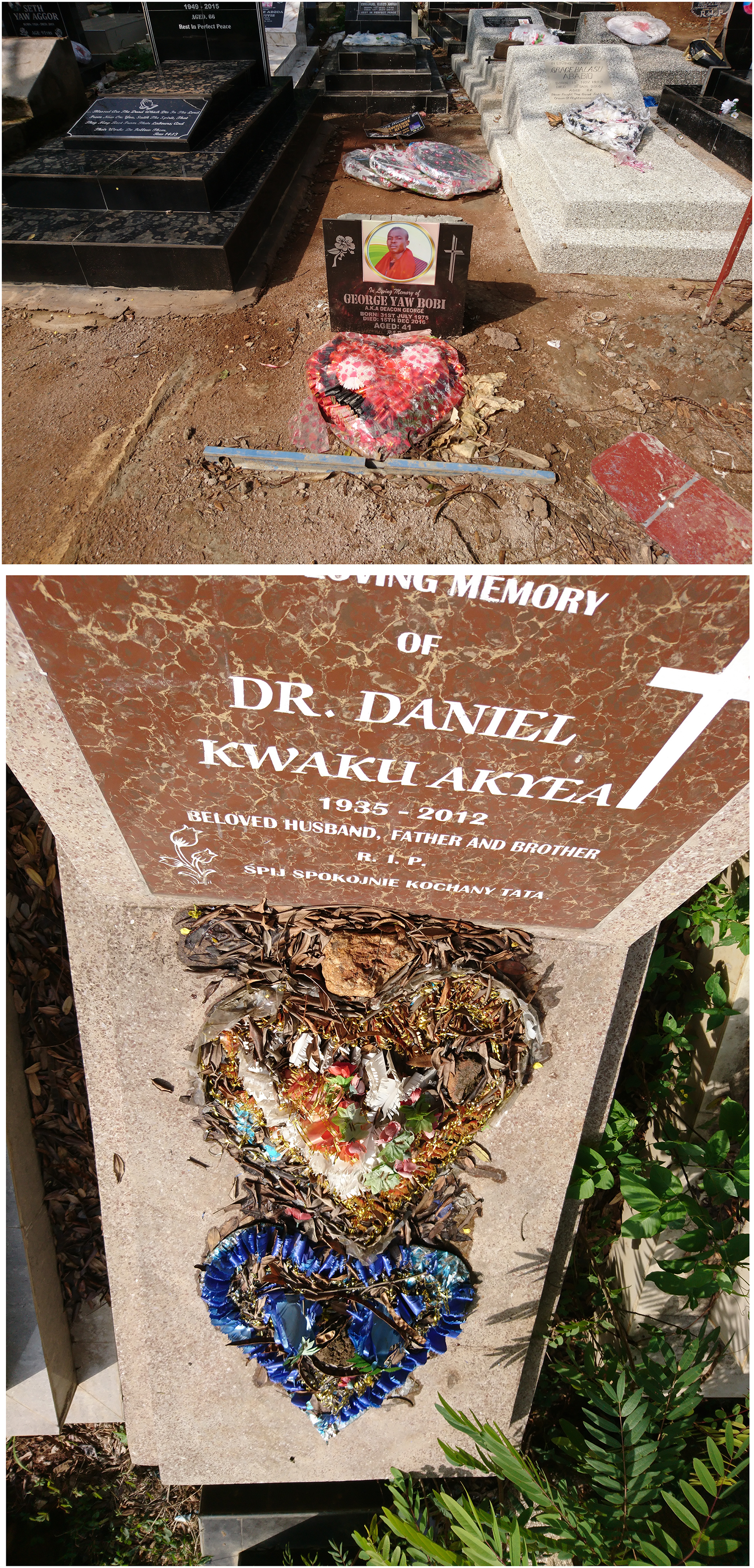
Grave wreaths made from plastic materials, in different states of transformation.
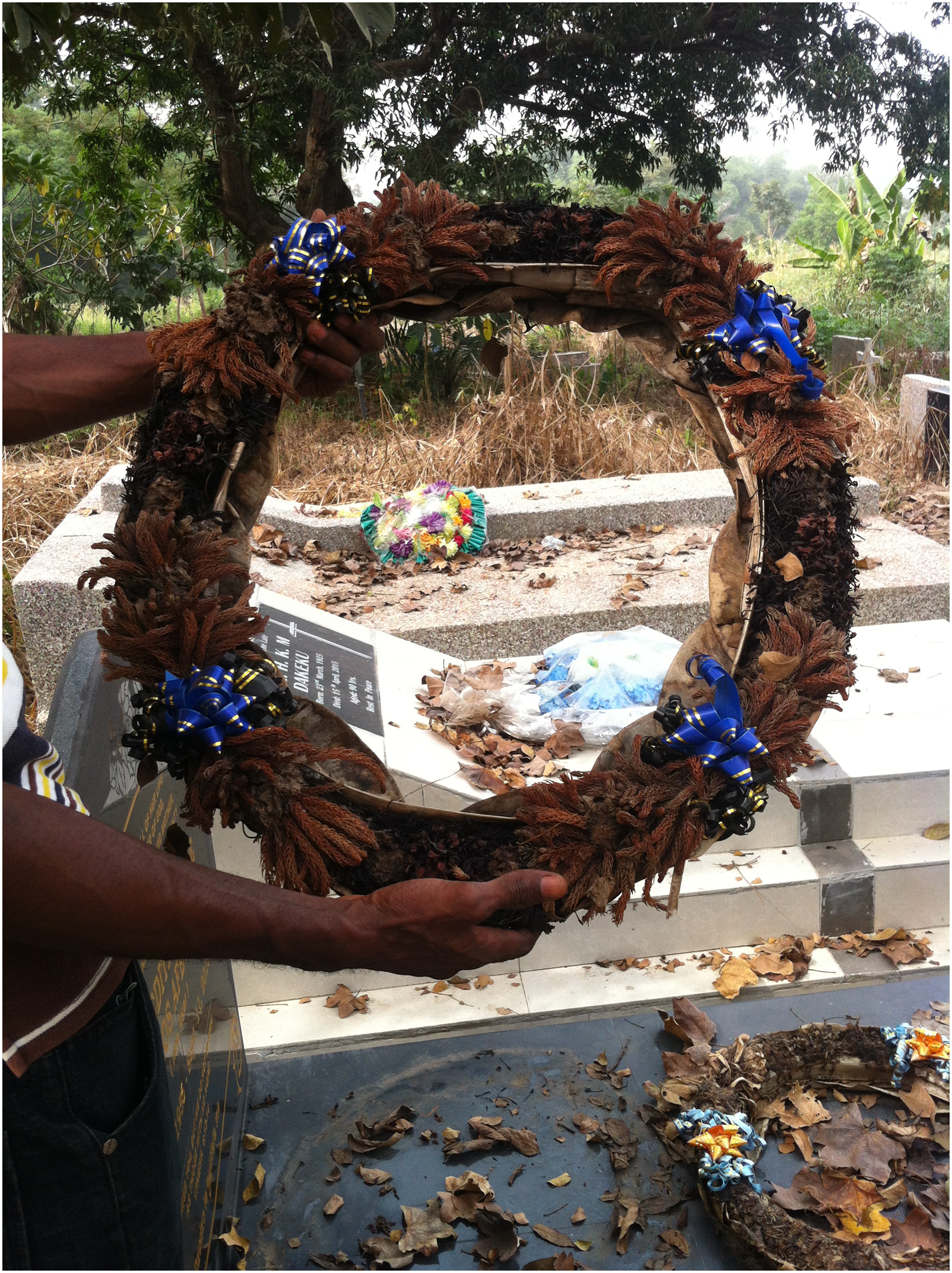
Grave wreath made from plant matter.
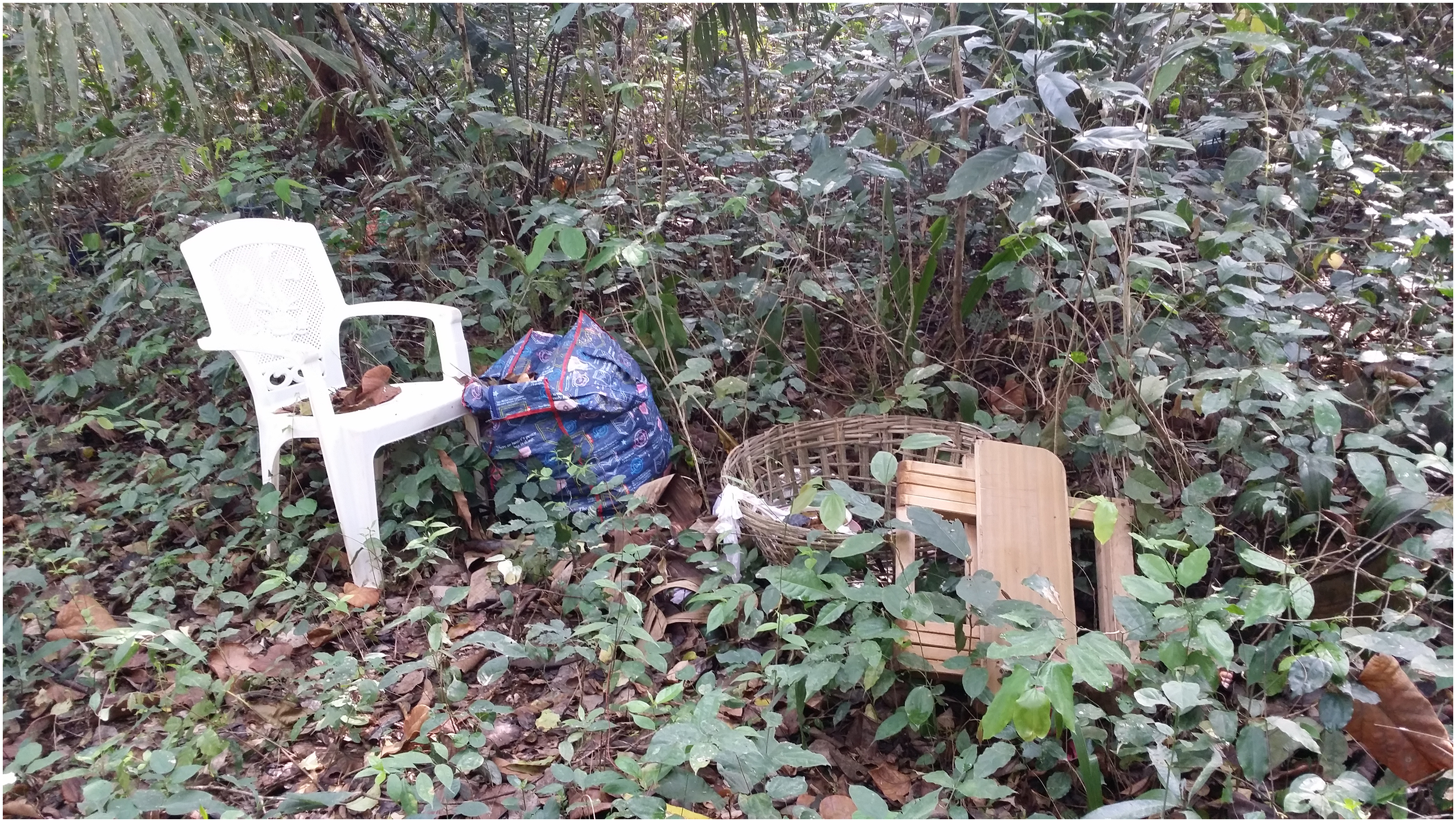
Gifts, including a plastic chair, plastic pots, a plastic zipper bag, a wooden folding table and a basket with wide holes at an agbadɔme site.
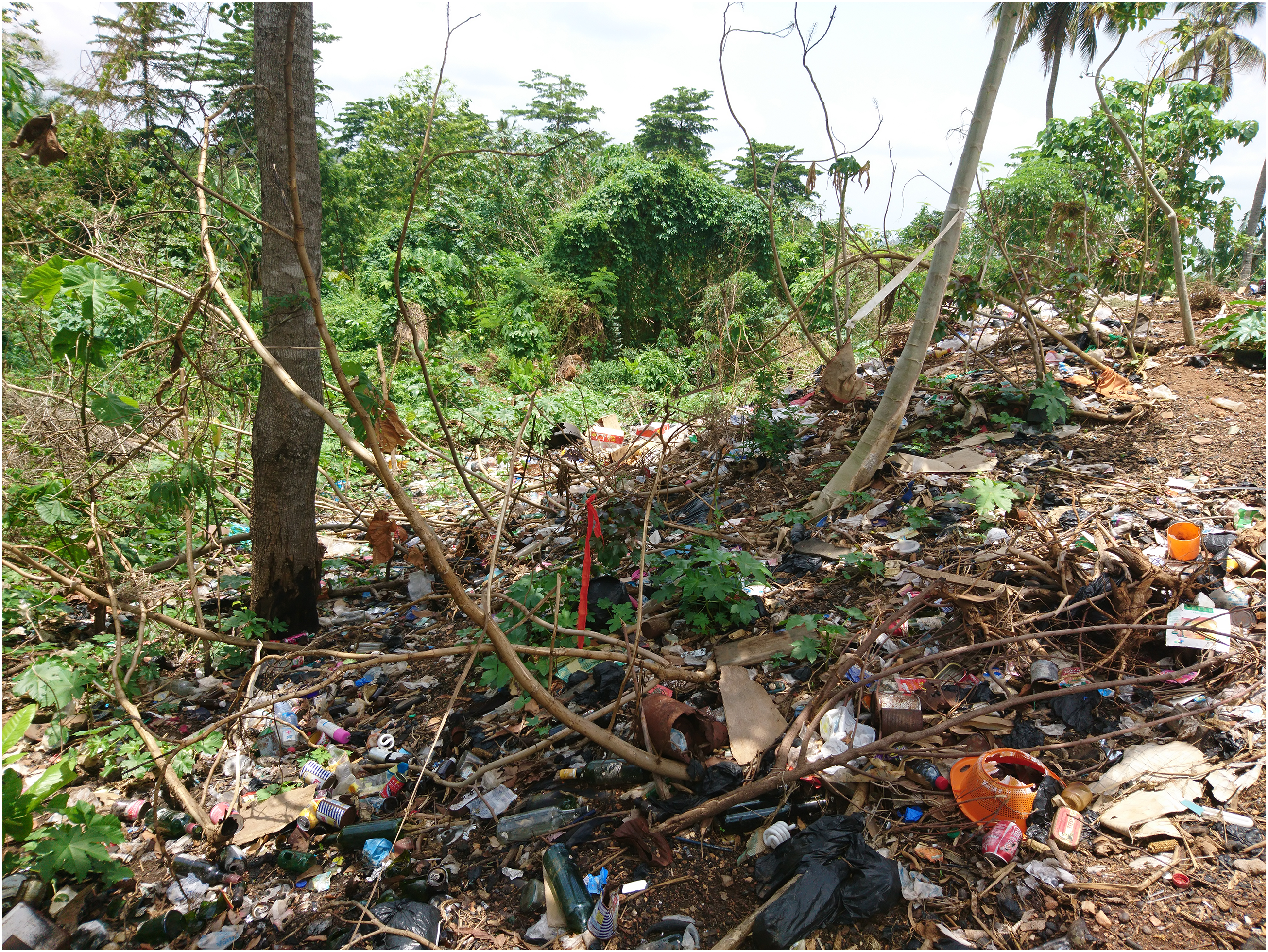
A thin thread dangling from trees divides bɔla from an agbadɔme site.
I also noticed a few graves that were decorated with wreaths made from natural plant materials, which, at the time of our visit, were already dry and brown. When I asked my friend about the different varieties of wreaths and pointed towards the organic ones, he shook his head. These are not appropriate for the dead, he told me. Why, I asked? Because they fade. To my eyes, both versions were prone to transformation and, on top of that, plastics were associated with the problem of either finding a way of recycling them or being left as trash. Collins, however, disagreed. Plastic wreaths, he stated, stay beautiful. They are forever. What becomes apparent from this conversation and similar exchanges I had with interlocutors in town is not only a difference in perspectives on materials, where my (German) perception differed from local views. Moreover, from a local perspective, transformations of polymer-based plastics, which go by the general term of ‘rubber’ in Ghana, are often evaluated as morally superior to the way in which organic materials, such as plant matter, transform.
It seems negligible to note that plastics, too, have a way of changing over time. However, the main qualities for which these wreaths are being valued in Peki, their durability and strong visual impression of being shiny and colourful, seems to implicitly dominate over whatever transformations the materials may otherwise undergo. Despite changing, the wreaths are not losing their legibility as ‘objects’ (Domínguez Rubio, 2016) but instead retain their core functions, due to a perceived dominance of some material qualities over others. Furthermore, the wreaths do not decompose and therefore remain on site indefinitely if not removed. After our walk, I wondered: what was I to take from such a difference of views on plastic materials? What collective representations informed the assessment of not just perceived material qualities but also of their morality? The exchange with Collins produced a kind of ethnographic punctum: a moment of difference in views and experience encountered in the field, which serves as an important cue. What started out as a difference in views on plastic materials in a commemorative context, would, further along in the field research, come to help me understand the similarly slippery status of existence of two seemingly very different entities: plastic objects and the deceased of the community. This paper unpacks how plastics and the dead in Ghana form a tense relationship that exists between states of control and slippage. It discusses how moral evaluations of materials are dependent on moral evaluations in the social realm in which they are meant to have an effect, here death and commemoration. Ultimately, it contextualises the political potential of death and plastics in this local setting within the larger global context of a cultural economy that reflects the ongoing effects of colonialism.
Concretely, the history of colonialism can also be linked to contemporary social structures and material traces in Ghana, and specifically so in relation to the history of administering death and the dead. Colonialism in its contemporary form is also more generally traceable on the structural level of institutional and social injustice as well as in the form of its material effects which are entangled with the former. Max Liboiron makes the endurance of colonialism in these two spheres explicit (Liboiron, 2021: 6). Their work particularly addresses colonialism in the form of ‘contemporary and evolving land relations’ which are affected by the uneven distribution of (plastic and other kinds of) pollution (Liboiron, 2016; Liboiron and Lepawsky, 2022). The title of their book ‘Pollution Is Colonialism’ sums this critique up pointedly (Liboiron, 2021). Following this entanglement of plastics and forms of domination, I will expand from observations made on a local perspective in Ghana to a larger global and historical context, revealing the points of touch between the local political economy around death in Peki and plastics as a circulating material within a global neo-colonial economy. Such contextualised ethnographic knowledge can be helpful to criticise states of disbalanced power relations as well as offer new thoughts towards understanding and shifting those. Elizabeth A. Povinelli has formulated an extensive critique of how the current ‘ancestral catastrophe’ can be understood and criticised from the perspective of anthropology and beyond (Povinelli, 2016, 2021). As ancestral catastrophe, she subsumes unjust structural distributions of wealth as well as executions of soft and hard power on a structural level, and finally global effects such as the Anthropocene. In thinking about the state of the world as neo-colonial, borrowing a term coined by the first Ghanaian president Kwame Nkrumah, I am following this train of thought (Nkrumah, 1984, 1965; Povinelli, 2016, 2021).
Good death, bad death: Moral evaluations of transformation
Despite their apparent differences, the dead and plastics in Peki are linked: by means of perspectives on material affordances and perspectives on ‘states of existence’ 1 (Povinelli, 2021) in different worlds. Both the dead and plastics are constantly at risk of meeting a ‘bad’ death, a category rooted in Ewe indigenous spirituality. As van der Geest finds during fieldwork in an Akan town in the South of Ghana, ‘bad’ and ‘good’ death are not fixed categories, but remain subject to negotiations (van der Geest, 2004). The same is also true for Peki. In cases of ‘good’ death, which normally denotes a not-too-sudden death above the age of 60 and of natural cause, there is a set sequence of events that need to be followed. It usually begins with the washing and picking up of bodies at the local morgue on Fridays. This is followed by a lying-in-state on Friday nights, ceremonies and services on Saturdays, followed by the burial and a family meeting on Sundays with further festivities within the family extending over the next couple of days or even weeks. In cases of ‘bad’ deaths, traditionally regarded as being caused by sudden events or accidents, the same sequence is followed, albeit with additions and alterations. There may, for example, be a collection of the soul (which, contrary to the things that should be made to last, is represented by organic materials such as soil and white cotton fabric) from the accident site a week after the funeral, followed by a placement of the soul in the grave and a placement of gifts for the deceased at agbadɔme, a site dedicated to lost spiritual elements of the dead. This is usually overseen by a traditional religious authority. While ‘good’ death is seen as a prerequisite to reaching ancestor status and ‘bad’ death may threaten to produce hauntings and accidents caused by fragmented parts of the deceased's spirit, both are ultimately products of negotiations taking place among the living, often involving materials and things, as I discuss elsewhere in relation to funeral banners: large commemorative obituary images printed on the sheet plastic PVC (Bredenbröker, 2024a). These banners, dedicated to community members who died ‘bad’ deaths, can in fact be materially and practically auxiliary in turning those deaths into ‘good’ deaths. Both moral categories are, as I write elsewhere (2024b), by no means stable but rather serve as reference points between which different perspectives and stakes of those involved may evolve and also imply contradictive moral assessments of a deceased.
For plastics as well as the bodies and spirits of the dead, ‘bad’ death can mean polluting the environment and haunting the community. The bodies of the dead, just like plastic waste, may be considered as possibly toxic for the environment and public health, a reasoning which has been introduced starting with the colonial effort of outlawing home burials in the Gold Coast. Here, as John Parker traces in retelling the development from house burials to cemeteries (Parker, 2021: 191–209), the argument of the colonial administration focussed mainly on the sanitary danger dead bodies were seen to pose while missionary concerns about keeping with good Christian practice played into creating the same result: a separation of the dead from the places of the living. In Peki, the connection of public health policy or rather policing and death became evident to me when I looked at how sanitation was enforced (or not) in the houses of the living and around dead bodies (Bredenbröker, 2020). These days, sanitary concerns and rules around sanitation imposed by institutions are mirrored by hand-washing instructions at the morgue or a (not often vocalised) fear of transmitting infectious diseases such as Ebola via corpses. However, the bodies of the dead are also interacted with in different ways. It is important to display them and have them present for the funerary rites. Alongside the body, plastics are not just potentially polluting but they also hold the potential of being auxiliary in the making of ‘good’ death and establishing the dead successfully and durably in their allocated place. This connection is forged by means of perspectivally framing transformation. The dead, on the one hand, will inevitably transform, both physically and spiritually. In the Peki community, their transformation is sought to take place without any visible signs of decay, preserving the body and the deceased's memory in a very material way, such as for example through embalming and long-term storage at the morgue or by printing the faces of the dead on banners made from PVC.
Physically and spiritually, the dead have a clear trajectory on which they are supposed to proceed: ‘good’ death, heaven, ancestor status, which parallels the movement from morgue, to laying-in-state to tomb. However, those dead who fail to follow that trajectory due to ‘bad’ deaths become a problem. Plastic, on the other hand, is seen to be durable. While it also transforms, its transformations are seemingly ignored. That is its immortal quality. As rubbish or simply ‘matter out of place’ though, it zombifies, unable to fully die and decay. Making use of plastics’ immortal quality in a positive way, this group of materials appears in the context of local funerals and commemorative practices and helps to preserve the dead and their heritage, transmitting durability onto them in the afterlife. Yet, plastics’ transformations and displacements that remain unaccounted for can easily also come to prolong the afterlives of those dead who fail to follow the intended trajectory and are lost between worlds. Both, plastics and the dead, can exist in a state of celebratory eternal life or they can haunt the living as the virtually undead. Plastics themselves provide a kind of temporality that exists beyond death, being counted among the ‘new immortals’ in the age of the Anthropocene (Bastian and van Dooren, 2017).
My conversation with Collins was just one of many conversations and observations in which plastic and other synthetic materials proved to be seen as locally highly valued and imbued with a positive moral status in relation to the dead. Other objects that became meaningful in relation to the dead were, for example, the aforementioned funeral banners printed on plastic, plastic objects and synthetic fabrics such as satin used for decorating bodies and rooms during a lying-in-state, plastic buckets filled with plastic-wrapped beauty products and underwear in plastic packaging, trolley suitcases and plastic bags filled with gifts for spirits, plastic body bags and even coffins which were delivered wrapped in plastic. All objects listed above are usually part of funerals which respond to a ‘good’ death, and they have come to also be used for cases of ‘bad’ death, a development which reflects that the two sequences (for ‘good’ and ‘bad’ death) are becoming more similar, with the aim being that ‘bad’ death is made good (see Bredenbröker, 2024b). Being associated with superior qualities of newness, appropriateness and durability, these materials, alongside other synthetic materials such as cement and rare, imported materials such as granite, serve the practical purpose of transforming the dead into ancestors. 2 In that sense, they are ‘good’ tools to work on transforming the dead in a controlled way. Hertz’ secondary burial model establishes that death is not just a natural phenomenon but socially and culturally produced (Hertz, 1905; Hertz et al., 1960). In handling the body and controlling its uncontrollable transformation, following Hertz, the body social reinstates its control over death. Hertz illustrates this particularly in relation to secondary burials: the body is stored for some time and its transformation is in some way controlled by humans, hereby also controlling the voyage and destination of the soul. When this has been achieved, the body can be buried in a final resting place and society can celebrate a victory over death.
Hertz's model can be applied not just to the body itself but also to the material world and things that are used to ‘make death’. Evaluations of materials have a direct influence on the kind of death that is produced and on the temporality that this death has. In Peki, controlled transformation and ‘good’ death is facilitated by first stripping the dead from connections to their former life with the help of synthetic materials and things that are marked as new and hence void of any previous social connection. Further along in the process, these same materials can then provide the dead bodies and commemorative places with a sense of durability towards eternity which also extends onto the social person of the deceased as an ancestor. Hence, the making of a new kind of durable temporality for the dead on the one hand and the association of durable qualities and moral goodness to materials used for commemorative purposes on the other hand stand out as two intertwined processes. These processes are connected, and I propose that using theoretical concepts for understanding different perspectives on materials’ moral qualities and affordances are helpful in grasping them more clearly.
Qualisigns, tendencies and preferences: The more things change, the more they stay the same
Plastics promise a kind of life and temporality which exists beyond earthly limitations, beyond death. The local perspective on plastic materials and their evaluations that I gathered from people in Peki highlights certain qualities of these materials whilst ignoring others. This is not a result of a kind of blindness but rather a reflection of a specific perspective on these materials. The temporal association with endurance which plays out in attributed qualities of lasting beauty also has little to do with factual, unshakeable properties of plastics. Instead, such a kind of framing rather reflects what Adam Drazin calls ‘material tendencies’, a term he proposes in order to ‘describe or connote the sense of possibility or probability which surrounds properties’ (Drazin, 2015: 26). This goes in line with the Peircean concept of the qualisign, as expanded on by Nancy Munn and Webb Keane: a sign by which ‘significance is borne by certain qualities beyond their particular manifestation’ (Keane, 2003: 414; Munn, 1992). In the context of death in Peki, the durable tendencies of plastics are highlighted in a way which gives preference to things staying, in their essence, the same, instead of shifting the gaze to all the tendential qualities of transformation that are inherent in plastics. Such a shared framing of certain qualities of plastics fits with what Webb Keane terms ‘semiotic ideology’, that is, ‘basic assumptions about what signs are and how they function in the world’. These assumptions, he details, determine questions of intentionality in ascribing meaning and what kinds of agents may be invoked in the process: ‘humans only? Animals? Spirits?’ (Keane, 2003: 419). Hence, ‘semiotic ideologies are not just about signs, but about what kinds of agentive subjects and acted-upon objects might be found in the world’ (Keane, 2003).
On the level of objectification, plastic materials and things made from them come to stand for opposition to change in Peki. As qualisigns, the highlighted durable tendencies of plastics in funerary contexts in Peki come to stand for eternal life. Still, they are not strictly representational in the sense of having one specific kind of meaning or property. Instead, there is always the danger of things falling out of place and transgressing the allocated boundaries, of slipping from safely fixed place and meaning to being uncontained, polluting or threatening. This applies to the dead and plastic objects alike, and sometimes to both in conjunction. In the ideal scenario, the durability of plastic objects and substances is regarded and made use of as an active material property which can help to contain the dead, to keep them apart from the living and execute political control. The tendential property of ‘staying the same while changing’ is transferred from material objects and substances surrounding the body as well as from commemorative sites onto the dead, following Hertz's model. When Keane speaks of embodiment as being the necessary material form in which a qualisign must exist for quality and sign to be recognisable, he points out that qualities must be bundled in an object or body. The highlighting of plastic's durable qualities over its more transformative qualities can be understood as selecting from that bundle, supported by a shared set of assumptions around plastics. This has a preserving effect on the dead. These dead are fixed in place, materially on earth and spiritually in the beyond, while imbued with ancestral power that ideally will be beneficial to the living because it stays within its allocated realm. Thus, agency and control ultimately may be seen to remain with the living.
Yet, the same kind of material agency that is attributed to plastics can also take a different turn and play out in an uncontrolled way. Plastic out of place may become trash that pollutes the environment for an indefinite time as litter and dumps in town come to show; elements of the dead out of place may result in danger to the lives of the community members or people who pass through sites where a death occurred. As Keane remarks, while semiotic ideologies may render things meaningful, one also must consider that the ‘openness of things to further consequences perpetually threatens to destabilise existing semiotic ideologies’ (ibid). So, in the process of trying to manage the slippery categories of undying materials and disembodied elements of persons, the embodied quality of durability as attributed to plastics must be transferred onto, and embodied by, the dead. This happens by making the dead, materially and ideologically, an index of plastic's favoured material tendency: durability. Indexicality, a Peircean term taken up by Keane and Alfred Gell in his art nexus model, is a useful concept for understanding this transfer of qualities, as it implies an embeddedness in social processes of attributing meaning through semiosis (Keane, 2003: 420) and the possibility of acquiring and channelling agency (Gell, 1998; Küchler and Carroll, 2021). For that kind of embodied transfer to occur, other social processes and concepts need to work towards the same goal, a context which Keane calls Peircean Thirdness (Keane, 2003: 414). Two core social fields of practice which become important in Peki are those of time and moral evaluations. These are always connected to the material world and ways of framing and processing it. They stand in a relationship of constant co-production of each other, intended towards producing an ideal state of containment for the dead. As Keane remarks, ‘for indexicality to be analytically useful, it must be understood to face towards possible futures as towards the past’ (Keane, 2003: 417). In the context of Peki, this is not just true of plastic materials and the transfer of their attributed qualities but also of the dead themselves, who are sought to be made into indices of social relations and power positions by means of mapping and controlling time in all directions.
Plastic time: Controlling the temporality of death
As outlined, a complex set of beliefs, temporalities and social practices is fundamental to understanding the political potential of activities around death in the community and the role that the material world and material qualities play in it. To finally contain and control the dead, their bodies need to be moved around. The choreography of movements is dependent on places and different rules attached to these places. Often, there is competition between representatives of the state, traditional political authorities, and members of kin, who all aim to cement their respective positions of influence in the process. This is organised by a delicate set of monetary demands, labour, authorisations and moral evaluations, producing a political economy through controlling ways in which the living may contain the dead and claim them as their property. But whilst there are claims for authority over making rules that limit movement and agency, these rules are re-made and challenged through different kinds of engagement with materiality in time and space.
The ways in which the living – materially, socially and cosmologically – set out to navigate the temporal trajectories of the dead can be grasped with the help of Alfred Gell's concept of time maps (Gell, 1992). Gell conceives of human concepts of time as maps: images which are determined by anticipations towards the future and experiences from the past. Time maps, because of their perspectival orientation, imply an existence of other possible worlds, which influence human actions. Küchler exemplifies how artifacts may serve to navigate between worlds and create relations by reading Cook island quilts and patchwork fabrics as time maps (Küchler, 2014). By virtue of their material properties and the ways in which they are made and circulated, these become indexical of relations beyond the nuclear family. In the case of transferring select properties of plastic materials onto the dead in Peki, they are sought to be transformed into art-like and ideal new persons, controlled by the living. As such, the dead as indices come to stand for relations between the deceased and the community, between humans and non-human entities as well as between community members.
With regards to beliefs relating to the afterlife, subjective time incorporates these alternative worlds and existences. Gell points towards the mutual influence that time and space have on human action and intentions – he calls this chrono-geography. Time and space impose constraints on human agency. Even social rules that limit people's ability to act, do, according to Gell, play out as ‘real events’ in space and time, thereby becoming equivalent with physical constraints. So, material qualities of being static or durable as opposed to changeable and mobile hence become ways to navigate in space and time, to express social intentions and to control agency. The dead may only move forward, physically and spiritually, if negotiations in the community over the moral status of the deceased have been successfully concluded, payments have been made and the right kinds of materials and objects have been gathered to guide the dead and establish them in their intended location in space and time (see Bredenbröker, 2024b). However, since the world is never perfect and an ideal state is very hard to achieve, even more so to maintain, there are multiple cases in which the instability of such an ideal state of containment becomes evident, such as the mixing of trash and gifts for spirits or the practices that intend to contain wandering elements of spirits which remain lost on earth due to a ‘bad’ cause of death.
A slippery slope: Plastic objects between worlds
While bodies in Peki are subject to sometimes very long storage in the morgue, they are eventually sought to be contained in a materially very stable tomb, including a subterranean cemented grave chamber. Plastic objects such as wreaths help to establish this status. The dead who receive these full, material honours in interaction with their body and in the construction of the grave are then safely contained. Those dead whose spirits are left in more mobile or fragmented states due to ‘bad’ deaths require different kinds of engagement. Possibly, these dead retain an undesirable degree of agency and can move in space and time, being associated with a combination of non-permanent organic and durable materials. In these cases, plastic's durability creates the unexpected problem of making wandering souls much more durable than the living would desire. The sequence of funerary events that deal with ‘bad’ deaths includes a deposition of ‘travel luggage’ for the wandering souls of these dead. These travel objects can be former property of the deceased but must, in any case, be broken or in a state unfit for use, so that they will not be stolen by the living which would cause the dead whose possessions are taken to possibly slip out of control. 3 Then, they are deposited at a dedicated site: agbadɔme [literal translation: centre of the clay bowl]. Following Hertz's secondary burial model, the final celebration is postponed indefinitely for those who have died ‘bad’ deaths, despite the burial of the dead body. While stripping the dead of their connections to the living and their subsequent re-appropriation, those who died ‘bad’ deaths are not easily de-personalised. The split between the body and the spirit makes it impossible to contain both in one place. Hence, individuality and memories of life stick to the spirit, making it hard to own or contain. Even following protocol and letting a body travel through the same stages as a decease who died a ‘good’ death is an insufficient means towards containment. Agbadɔme sites and the gifts offered there are therefore important material anchors for containing spirits within the boundaries of these places.
Peki has two agbadɔme sites, one of which is close to a big cemetery and has intact borders, meaning these, although unmarked, are not being trespassed. For the living, except those who come announced and pacify the spirits, these places may be dangerous, possibly leading to accidents or deaths. The second agbadɔme site is not as intact. A large rubbish dump has sprung up close by and is sprawling into the spirit territory. Both sites are on bushy terrain. The travel luggage items sit in this wilderness, like trash. Due to them being broken or dysfunctional, the similarity to trash is even bigger. This means that the trash sprawling over from the dump and the gifts to the deceased are almost impossible to distinguish. Objects that are part of a set of travel luggage are, to a large part, things that consist of plastic or other durational materials. Organic and more traditionally manufactured objects may be pots of clay and woven baskets, which must be chipped, broken or woven with big holes, following the same logic uf being unusable for the living that I just described in relation to grave gifts. While the pots and the baskets have a chance at decomposing, the other items do not. Like the grave wreaths, they remain, changed by humidity, sunlight and heat, but ultimately not going anywhere. It is the combination of these two categories of things, with their different temporal implications and connections to the living, which satisfies the needs of lost spirits. In terms of levels on a time-map, they make the controllable time of ‘good’ death and the more ephemeral and less containable time of ‘bad’ death available to spirits, with the possibility of switching over to the first, more desirable level. As such, the plastic objects at agbadɔme continue to claim the space for the spirits of the dead who live there, extending their presence into temporal infinity. This means that the space is permanently unavailable for use by the living.
The nature of rubbish, bɔla in local lingo, has changed quite drastically over the past decades in Ghana and worldwide. Metal cans, plastic containers and glass have become omnipresent household items. Previously, according to community elders, the dump was cleaned by community members during communal labour. The organic waste material was burned and the site swept with brooms until one could ‘lie down there and rest’. These days, things look different. Communal labour still exists, but elders perceive it as much less effective. Certainly, it does not lead to an elimination of the dump. With each piece of bɔla crossing the line between the two worlds, the living gain more rights to re-appropriate the agbadɔme place. The only visible boundary is a thin rope tied around a line of trees. So, who is attempting to make use of this reconstruction of boundaries here, and for what purposes? There were rumours that some elders planned to re-use the land of this agbadɔme site to build a palace for the sub-town's chief. This would mean that land which had previously been considered dangerous could now become a site of power for traditional authorities. Instead of being part of a ritual economic sphere, the land thus loses its association with the dead by re-introducing it into a context of exchange and use for the living – by means of plastic objects which sit awkwardly between worlds and resist decomposition. At the same time, in a reverse move of charging trash with spiritual power, there were stories circulating among community members which advised people to address rubbish dumps after having had a bad dream. This was supposed to help in cleaning oneself from a negative effect of the dream. The bɔla sites, so the stories go, are places where bad spirits come to feast, who may eat up the dream's negative content. In this uptake of bɔla into narratives that include invisible spiritual entities, the power of trash and plastics goes full circle, revealing the underbelly of a world view around waste where evil spirits yet have a cleansing power.
The merging of the rubbish with the luggage cemetery may be a helpful process for making the sites’ desecration happen, cleverly circumnavigating the problem that individual spirits in the agbadɔme sites are refusing to blend into the larger body politic. This function is now outsourced to the bɔla. As Michael Thompson notes, rubbish and power are closely associated (Thompson, 1979). Controlling the distinction between the two by means of attributing durability or transience, here particularly by using plastics, means controlling larger social distinctions and regulations, ideally making one's own things last and other's fade away. After all, the distinction between ‘matter out of place’ and matter that is in the right place is culturally and socially produced (Douglas, 2010). Plastics in funerary context in Peki serve as agents of containment in support of existing social and political structures. But their durability also counteracts these trajectories, for example, by establishing a lasting presence of spirits, which is again counteracted by the presence of plastic trash. Institutions with local governance responsibilities may be those that profit from this and may in fact succeed in owning these spirits. Due to an apparent lack of the state's presence and communal engagement, both of which fail in cleaning the bɔla sites, there is a power vacuum in the world of the living that may be capitalised on in relation to refuse management. Stories about the return of spirits or the attribution of bad events in the community to the work of spirits remain tools for challenging such power grabs. They serve to remind the living of the potential risks involved in handling the affairs of the dead. Without these spirits and without agbadɔme sites, the dead may in fact become all too well controlled by institutions, leaving no room for movement. After all, while it may be in the interests of the living to contain the dead, spirits who wander, who may suddenly appear or threaten, are potentially helpful partners for challenging the orders in which the living must exist. These spirits are a reminder that certain morals, rules or processes should not be changed for the profit of some.
Plastics and their macropolitics: A colonising set of materials
As it turns out in the case of Peki, shared perspectives on material transformations and their temporality become key for understanding the political potential of the dead. Concluding this article, I would like to zoom out and place the micropolitical context in which funerals and other commemorative practices in Peki are set within the larger macropolitical field of politics and power. In order to do so, it is important to consider that death in Peki is a hugely public affair, just as it has long been of special importance in Africa (Jindra and Noret, 2011; Parker, 2021). In Peki, funerals involve the entire community – as guests, hosts or economic agents – and are scheduled by the paramount chief for every second weekend, at times combining up to 30 funerals. The town is plastered with hundreds of obituary banners. In shops, grave wreaths, dresses for the dead and coffins are a common sight. Death has a massive material presence in public space and takes up a considerable amount of people's resources. It functions as a Maussian ‘total social fact’ (Mauss, 2011), connecting spiritual, economic, political and social spheres of interaction, charging the field of death with a proximity to power. Within this field, moral evaluations of death and materials take on an elevated significance. What becomes apparent is that different perspectives on ‘states of existence’ and religious beliefs conjunctively come to define moral evaluations of death. And while a plurality of religious practices coexists, perspectives on the potentials of plastics are connected to these. In order to understand such connections, religious plurality and the influx of non-indigenous materials and social structures must be considered before the background of their colonial past and neo-colonial present.
Decades before German administrative claims, missionaries from Bremen and Basel paved the way for German colonial administration in Peki (see Meyer, 1999, 2002). Today, most people in Peki and the South of Ghana have adopted a variety of Christian faith with a steep increase in Pentecostal churches. Traditionally, ancestors and different parts of the spirit are believed to reside in other worlds and, at times, to visit the world of the living. Christianity, in contrast, introduced a clear trajectory for the soul, namely, to rest with God and arise on Judgement Day. This implies putting the dead on hold and looking towards the future. However, as is presently the case, practices and beliefs pertaining to the afterlife co-exist and are applied as is required. Whilst a person may be believed to rest with God after death, parts of their spirit, seen from other perspectives, may also be found wandering in the places of the living or exist as an ancestral presence, marking a co-existence of beliefs.
Webb Keane gives an account of such a multiplicity of beliefs and their material consequences in his discussion of cosmological houses in Sumba. If invisible spirits may be present, the site of the house is connected to ritual speech which addresses them, hereby attributing meaning to its structure. For the spirits, ‘the space of the house must be mapped out to guide them into the presence of the speakers’, with the result that ‘the materiality of the house comes to the fore as a response to a metapragmatic response to a certain material condition – the invisibility of interlocutors’ (Keane, 2003: 421). If a person does not believe in these spirits, such as ‘self-conscious modern Christians’, this means that the spirits’ ‘invisibility ceases to be a materially objective reality’ (Keane, 2003: 421). Like in Keane's example, the applicability of perspectives in Peki and consequentially also their material reality depends on what people individually chose to believe, as well as on social pressure. If, for example, a relative's lost spiritual elements are not retrieved by a Christian family who are reluctant to organise the ritual, other community members, who believe that the soul will cause problems, may feel threatened. Hence, different temporalities of death apply, accompanied by different outlooks on how these may affect the community. This multiplicity is a product of missionary and colonial interventions which resulted in local ways of appropriating them (see Parker, 2021). In mediating and producing the reality of such beliefs and temporalities, plastic materials play an important role, yet one which depends on how these materials are framed (see Bredenbröker, 2024a, 2024b).
So how did plastics become integrated into local (transcendental) world views and social contexts? And how are these related to questions of power and governance? An understanding of local perspectives on plastics and death in Peki becomes more meaningful when framing ethnographic observations within the larger context of colonial history. Inequalities and disadvantages that stem from the colonial encounter and are perpetuated today can be grouped together under the term neo-colonialism. The production of, and trade with plastics, including the global circulation of waste, forms part of such a neo-colonial economy. Considering the presence of plastics in the community, these do not per se qualify as ‘indigenous’ materials, whilst having become normalised and omnipresent. Probably the most famous example of plastic usage in a Ghanaian everyday context is purified drinking water contained in a plastic sachet. Plastics have been acculturated. As they have found their place in local uses and sets of beliefs, they have also acquired their own perspectival tendencies. Just like Christianity, plastics arrived from outside, as in many other parts of the world. Plastics have colonised the world materially whilst fuelling a global network of production and trade. Due to their mouldability in the production process, plastics are a cheap material for industrial production. Being water repellent and not prone to rotting, they have been a huge success across the globe. They are now integrated in diverse social contexts, not only to people's disadvantages. This stands in contrast to ‘conscious’ Western perspectives which frame plastics as morally bad. The film ‘Monobloc’ (Wendler, 2021) for example shows how different instances of using plastic chairs have yielded affordable solutions to problems.
Yet, the dark side of plastics’ success story shows that the question of how to get rid of it has followed the material and now poses problems on a global scale. Hence, the death of plastics as trash is a bad death, caused by the same durability which in other contexts gives it its value. In Ghana, trash from around the globe ends up. A famous example is the Agbogbloshie electronic waste dump, situated at the centre of the capital Accra. The site has recently been the subject of a documentary film and a music video, gaining visibility on a global scale (Placebo, 2018; Weigensamer and Krönes, 2018). But apart from such conspicuous sites of scrap recycling which embody a worst-case scenario, Ghana does indeed not have a reliable, nationally implemented waste collection and recycling system. Brenda Chalfin's ethnography of labour on an urban waste dump in Ghana shows how workers of the formal and the informal sector are both physical engaged in the processing of waste whilst representing different states of officiality and precarity (Chalfin, 2019). The company Zoomlion, which also administers that dump, holds contracts for several municipal waste collection services and also administers dumps across Ghana (Chalfin, 2019: 504) while still relying on additional non-contractual workers. Yet, in Peki as a rural town, there was hardly a sight of any of these two types of waste workers, apart from obviously repurposed bikes for collecting trash which still bore the Zoomlion logo. In the wake of a state-cum-private-sector organised system, most of Peki's non-organic trash ends up in dumps in and around the community and people burn or bury it in their yards. Most of the trash collection within public space happened during communal labour. The state was largely absent in this, whilst a local unit of the Environmental Health Office patrolled neighbourhoods to inspect on possible dangers caused by unhygienic conditions in households, a practice that seemed to be working against, rather than for, the community. These local, national and global aspects of organising waste and distributing plastics are important to point out since they all show that the forces which shape local perspectives on death and plastics are as just as political as those at play in the larger picture. Community members, irrespective of pressure from authorities, acknowledge that the presence of plastics in the environment is polluting. Yet, since there is often no satisfying option of recycling or cleaning it up, it is accepted as a given.
Conclusion
In a historical and contemporary perspective, plastics, death and colonialism share an entangled, yet fragmented, narrative. Its pieces are the necropolitical policies of colonialism and neo-colonialism, the damaging effects of global late capitalism, and plastics’ entanglements in the flows and scapes of the global cultural economy (Appadurai, 1990). These relate to the organisation of waste disposal in Ghana on a national and local scale and, finally, to the process of negotiation around death and funerals in Peki, where all the above shapes political relations. In her ethnography of worshipping dead kings among the Sakalava in Madagaskar during the colonial period, Gillian Feeley-Harnik unravels the connections between forced external governance, material conditions, the dead, ideology and organisation of labour. The Sakalava, by materially and ideologically increasing the importance of dead rulers, managed to evade the grip of French colonial governance. Feeley-Harnik describes this as a ‘political economy of death’ (Feeley-Harnik, 1984). She also remarks that the Sakalava steered clear of using imported materials. Now, plastics are irrevocably entangled in global cultural and political economies, as Pathak and Nichter point out (Pathak and Nichter, 2019). In Peki, instead of avoiding plastics as colonising materials, they have been swallowed by the local political economy of death. Glitches, instances which reveal the loss of control over these materials and the spirits of the dead alike, are an adequate reflection of the uncomfortable state in which neo-colonial power and the effects of global capitalism make themselves known in the world. Brenda Chaflin makes a similarly counterintuitive observation at her Ashaiman field site and remarks that ‘rather than composing durable objects through an additive process that includes labour, capitalising on the potential of waste's material and social “plasticity” (Millar, 2014), labour is applied to aid and accelerate a process of decomposition already under way, one from which they (the workers) reap the spoils’. As Pathak and Nichter, alongside other recent research work remark (Abrahms-Kavunenko, 2021; Westermann, 2021), it is therefore a timely and fruitful endeavour for anthropology to research the social lives of plastics. This kind of research may help to understand the details of plastic's effects on local contexts and ultimately prevent drowning in a sea of plastic waste by informing policies (Alexander and Reno, 2020; Chalfin, 2019). To do so appropriately, I argue, knowledge of different perspectives and social implications around plastics in local contexts, before the larger background of colonialism and global capitalism, is crucial.
Footnotes
Acknowledgements
The research that this paper is based on was funded by the Deutsche Forschungsgemeinschaft (DFG) in the frame of the graduate training group ‘Value and Equivalence’ at Goethe University Frankfurt between 2016 and 2019. The writing and re-writing process as well as the genesis of key ideas, which also came to shape the book ‘Rest in Plastic: Death, time and synthetic materials in a Ghanaian Ewe community’, are indebted to the support and feedback of Adam Drazin and Magda Cračiun, who hosted the panel ‘Living in the plasticene’ at EASA 2020. A previous version of this paper was also presented at the EASA 2020 conference and at the UCL Material, Visual and Digital Culture Research Seminar series in Autumn 2021. Work that went into editing the paper was funded by a DFG Walter Benjamin Postdoctoral Fellowship at Hermann von Helmholtz-Zentrum für Kulturtechnik, Humboldt Universität zu Berlin. The author thanks their friend and research assistant Collins Jamson for his invaluable support during theirfieldwork. The author also thanks the anonymous reviewers for their thoughtful comments.
Declaration of Conflicting Interests
The authors declared no potential conflicts of interest with respect to the research, authorship, and/or publication of this article.
Funding
The authors disclosed receipt of the following financial support for the research, authorship, and/or publication of this article: This research was funded by the DFG (Deutsche Forschungsgemeinschaft) in the context of the Graduate Training Group ‘Value and Equivalence’ at Goethe University Frankfurt between 2016 and 2018.

Notes
Author biography
Isabel Bredenbröker is an anthropologist working between academia and art. As Deutsche Forschungsgemeinschaft (DFG) Walter Benjamin Fellow, their current research project is situated between the Centre for Anthropological Research on Museums and Heritage (CARMAH) and the Hermann von Helmholtz-Zentrum für Kulturtechnik (Humboldt Universität zu Berlin). Here, Isabel investigates the potential of queer relations for the futures of ethnographic collections. Their anthropological work focusses on material and visual culture, specifically the anthropology of death, anthropology of art, queer theory, critical reflections on the role of the ethnographer, decoloniality, West Africa, cleaning practices, field recording and ethnographic film. Their book ‘Rest in Plastic: Death, time and synthetic materials in a Ghanaian Ewe community’ is forthcoming with Berghahn in June 2024.