



Abstract
This article explores the shifting uses and meanings of Manchester civic plate, a huge silver dining service purchased in 1877 to coincide with the opening of the city’s neo-Gothic Town Hall. The authors explore how the silver collection has successively forged relations with a host of different people, places and objects, exemplifying the changing processes through which objects are understood, utilized, valued, maintained, stored and curated. Three key processes are deployed to illuminate these shifting entanglements: the use of the silver to express municipal prestige and advance particular cultural values, the maintenance procedures that have responded to the silver’s vital material constituency and practices of display, storage and curation. In accounting for these diverse and volatile processes, the article argues for the virtues of theoretical breadth in exploring the multiplicities of material culture.
Introduction
In 1877, Manchester’s enormous, neo-gothic Town Hall was completed. The building, designed by Alfred Waterhouse, symbolized and manifested Manchester’s rising prestige as ‘Cottonopolis’, the world’s foremost producer of cotton textiles as well as the wealthy industrialists, politicians and civic leaders who contributed to this dramatic rise. The Town Hall’s imposing exterior, its giant clock tower, Albert Square and the gothic Albert Memorial behind which it stood were complemented with interior grandeur: granite staircases, a sculpture court and great hall that added to the building’s theatrical power.
To amplify this opulence and to coincide with the opening of the building, a compendious silver dining service was designed for the Town Hall, with input from Waterhouse as part of his holistic vision, and a purpose-built secure storage room was created for its storage. The collection consisted of a dazzling18-foot plateau, a 74-piece solid silver dinner service and numerous electroplated utensils, all created by renowned Birmingham silversmiths, Elkington and Co. The service included 2 large candelabra, 10 smaller candelabra, 3 oval centrepieces, 10 fruit stands, 24 compotiers, 24 ice dishes, and an assortment of wine strainers, table dishes, cake baskets, salt cellars, soufflé dishes, claret and beer jugs, tea and coffee sets, soup tureens, cruet frames, vegetable dishes, sugar baskets, trays, ice pails and butter boats (Clifford, 2005).
This article explores the shifting uses and meanings of this extraordinary municipal silver collection over the 140 years since its production, following its evolving biography (Kopytoff, 1986). The collection has successively forged relations with a host of different people, places and objects, exemplifying the changing processes through which objects are divergently understood, deployed, valued, discarded, supplemented, stored, curated and maintained through time. We focus on three key processes that illuminate these shifting entanglements: its recruitment in expressing municipal prestige and advancing particular cultural values, the fluctuating maintenance procedures that have responded to the vital material constituency of the silver, and the variable practices of display, storage and curation. In accounting for these volatile processes, no singular conceptual perspective is appropriate; rather, a range of theories is drawn upon. Notions of distinction and the performance of etiquette are deployed to account for civic pride and the potent sensuous affordances of the silver are explored. Theories of material vitalism and repair are salient to making sense of maintenance, while ideas of ordering and curation are mobilized to investigate practices of storage and display. The article thus champions the virtues of theoretical breadth in exploring the multiplicities of material culture. This broad focus has entailed a mixed methodological approach that includes archival research, site visits and formal and informal interviews with Town Hall workers and silver experts.
At present, all activity in the Town Hall has been suspended since 2019, with all contents, including the silver collection, gradually moved off-site to facilitate the building’s extensive renovation. After 140 years, the crumbling, distressed interiors, empty and cluttered rooms, infrastructural elements and historical textures of the building are being given an exhaustive overhaul. The Town Hall, a continuously operating site of extensive governance, exhibition, events, urban management and ceremony has been closed until a proposed reopening date in 2024.
The 19th-century growth in silver’s popularity
Originally formed in supernovae, silver exists on Earth mostly in the molten core, with only a fraction brought within reach of humanity by complex geological processes. The process of cupellation through which lead ore is mined, separated from waste rock, crushed finely and smelted before the silver is extracted has been practised for over 4000 years. Silver’s value is underpinned by its key qualities, including its white shine, malleability, resistance to the effects of moisture, anti-bacterial qualities and its possession of the highest thermal and electric conductivity of any metal. Because of its material softness and reactivity to air, silver is typically combined with other metals, usually copper, to create a much stronger alloy, extending its utility and versatility. As we shortly discuss, this adaptability has been extended since the mid-19th century through electro-plating technologies.
Silver has been associated with numerous aesthetic, symbolic and cosmological qualities for millennia. In its mineral state it is metaphorically characterized as akin to earthly veins while, following its metabolic transformation into commodity form, it has symbolized wealth and industrial modernity, a sleek, sophisticated substance that has been cherished as an ideal gift for ‘one’s king, one’s patron, one’s brotherhood, the parish church, the local hero and one’s heirs’ (Glanville, 2006: 302). Silver has been forged into prizes and trophies, badges, drinking vessels, receptacles, coins and jewellery, and deployed in rituals varying from baptism, burial, prize giving and commemoration. This enduring popularity accelerated in the 19th century as a fashion for silver tableware and a taste for fine dining spread. Influential practices among the French elite in the late 17th and 18th centuries required several courses of food that were presented on fine silver plates, cutlery, centrepieces and candelabra, a lasting fashion from which Manchester’s silver plate collection emerged.
This 19th-century demand was fuelled by the discovery of large deposits of silver-bearing ores in Australia and North America, supplementing existing supplies from South and Central America, Germany and Spain. Silver commodities became more widely available and cheaper, and this was further advanced by the use of potassium cyanide as an effective electrolyte in the electroplating process, for which George Elkington obtained a permit in 1840. In addition to reducing price, the use of particles of silver to coat cheaper metals through this more advanced, scaled-up form of electroplating added lustre and greater structural strength and durability to products.
Having opened a factory in 1841 in Birmingham, by 1880, Elkington and Co. employed 1,000 people in six other factories where industrial production replaced many traditional hand-crafting methods, retaining others and developing new highly skilled craft practices. This expansion was also sustained by the rise of international trade exhibitions: ‘the resources and energies of the biggest firms . . . was poured into the production of works of “high art” . . . in an effort to uphold the prestige of Britain in the world of international competition’ (Wardle, 1963: 20). As Grant (2016: 52) states, the rising middle-class market conceived increasingly affordable silver-plated wares as ‘the latest in modern technology’. Employing highly-skilled European designers such as Auguste Willms, the designer of Manchester’s collection, Elkington’s flourished as their widely displayed silver-plated products gained fame and esteem.
An account from 1874 by a visitor to Elkington’s charted the stages in the production of silver objects, foregrounding the sensuous, skillful and labour-intensive work required: All works, to be executed in metal, are first sketched on paper; they are next modelled in wax or pipe clay with small, variously formed tools of boxwood . . . then cast in plaster . . . the plaster cast is worked upon with sharp steel tools, and details are thereby produced . . . (then) . . . the plaster model is coated with varnish, moulded in sand, a cast therefrom taken in brass, which is ‘repaired’ and ‘chased’, and becomes a permanent pattern to cast from in sand . . . from which moulds in gutter percha or of elastic material are made, to be used by the electro-depositor in his vats, and reproductions produced therefrom. (Culme, 1977: 54)
The style of Manchester’s silver collection reflects the fashion for gothic, classical and rococo designs that were prominent before later preferences for arts and crafts and modernist styles (Glanville, 2006). The Illustrated London News described its design as ‘Gothic, of the Early English period, with a free use of ornament based on Byzantine examples’ (cited in Glanville, 2006: 131).
Like all British-made silver objects at this time, each item was required to bear four marks. First, the sterling mark was the ‘lion passant’, a lion in profile walking to the left certifying that tests confirmed the standard of purity demanded by the assay office. Second, a symbol identified the location of the assay office, with Birmingham-manufactured objects in the Manchester collection represented by an anchor. Third, a letter of the alphabet marked the year in which the piece was assayed – ‘P’ for 1877 – and a fourth inscription signified the initials of the maker, Elkington and Co. In addition, presumably under the instructions of Waterhouse, Willms’ designs customized the Manchester silver collection so that it would be ‘in harmony with the building for which it was destined, and worthy of a great municipal corporation . . . presenting in its effect a combination of richness of appearance, harmony of proportion, and purity of ornament and form’ (unreferenced press cutting cited in Clifford, 2005: 43). The plateau and other items were engraved with the city’s coat of arms, some accompanied by inscriptions of those of the Bishopric of Manchester and the Duchy of Lancaster. Manchester’s motto, ‘Concilio et Labore’ (‘By Wisdom and Effort’) and the city’s symbol, a bee, was engraved on certain utensils, while others were inscribed with ornamental motifs of cotton leaves, seeds and plants to honour the city’s primary source of wealth. More subtly, candelabra and fruit stands incorporate columns that echo with interior doorways, quatrefoils mimic the stained glass designs of the building’s courtyard, while cake and sugar baskets are adorned with chevron patterns that resonate with the Town Hall’s interior tilework.
Silver dining as an expression of municipal prestige
A key function of many commodities is to express the status of their owners, connoting ‘good taste’, discernment, expertise, sophistication and wealth, signifying both economic and cultural capital (Bourdieu, 1984). Manchester Council’s silver service collection was a foundation gift from Alderman Matthew Curtis, the previous year’s mayor, who had contributed to and collected subscriptions to pay for it. The acquisition of what is by far the largest municipal silver collection in the UK was thus entangled with desires to broadcast civic pride and prestige. Articulating values ‘bound up in notions of self-determination, cultural identity, citizenship and belonging’ (Collins, 2016: 177), civic pride may ‘enhance the standing of a town in the eyes of outsiders, while providing moral lessons to inhabitants’ (Morgan, 2018: 597). Monumental 19th-century town halls were constructed to ‘create symbolic centres at the heart of an emptied public space as well as to affirm the collective power and presence of the provincial bourgeoisie’; Manchester’s iconic structure was similarly conceived as ‘the embodiment of architectural modernity and civic virtue’, aligned with the ‘creation of new ways of visualizing identity and authority in public life’ (Gunn, 2000: 123).
This civic pride foregrounded industrial might, scientific invention and entrepreneurial acuity in an implicit contrast to the leisurely lifestyles of the aristocracy. It signified ‘the immense financial power of urban elites who shaped (and profited from) this civic expansion – particularly the leading industrialists, businessmen and philanthropists’ (Collins, 2016: 181). These urban advances and the expressions that accompanied them, Morgan (2018: 596) asserts, were driven by an emergent wealthy class that was ‘motivated by aesthetic and cultural aspirations above and beyond the desire for making money’. Moreover, as Hill (1999: 100) insists, the formation of Manchester’s municipal pride also sought ‘to disseminate new ideals of citizenship through civic institutions’, ideals that the elite hoped would be adopted by the city’s inhabitants.
Intrinsic to the cultivation of this civic belonging were rituals, including formal ceremonies, commemorations, processions and large dinner parties. The silver collection, brilliantly displayed on tables during official town hall banquets, conveyed a material munificence and civic grandeur, but also demanded skilled performances from waiting staff and diners: it had to be arranged and utilized correctly. Accordingly, stylized performances were fundamental to the ‘formalization of new codes of public etiquette, comprehension of which was essential to middle class status’ (Gunn, 2000: 121). Amongst diners, the adoption of the appropriate comportment, polite conversation and the skillful manipulation of dining implements was critical in the co-production of a compelling dining spectacle.
As Young (2010: 133) declares, ‘dining had become emblematic of the achievement of private refinement and public politesse Practices of dining drew on all the self-controlled resources of the genteel body, beginning with an easy, elegant posture and no abrupt movements, expressions or noises. Appetite was suppressed in a show of small helpings, eaten slowly and quietly in delicate mouthfuls, leaving a discreet bit on the plate as evidence that greed had no place at this plate. (p. 141)
This genteel respectability, refinement and self-discipline intersected with the increasingly complex material culture of the table and the organization of the meal into numerous stages. Dining was subject to peer scrutiny and judgement, and informed by codes elaborated upon by numerous publications that advised about correct etiquette. Tellingly, Young explains that the silver fork was regarded as the ‘emblem of respectable manners, style and income’ (p. 138). Subsequently, the proliferation of specialist dining accoutrements, receptacles and utensils extended silver’s symbolic resonance as a prestigious material: ‘Victorians of good social standing required knowledge and adeptness at the dining table using an extensive array of specialist utensils designed for eating particular foods, especially those that were exotic, imported and expensive’ (Grant, 2016: 66). This demanded a performative skill from Manchester’s 19th-century diners, who were expected to know the utility of the melon forks, stilton scoops, salad forks, asparagus tongs and crumb scoops that belonged to the silver service. In facilitating these dining performances, the correct laying out of the silver service on table and plateau by Town Hall staff was also critical.
The fastidious staging of these civic events also underlines their spectacular and sensorial power, an aesthetic impact enriched by the silver service. As Alexander (2008: 783) notes, sensory contact with objects generates direct experiences of ‘the patterns of line, curve, and symmetry, the shadings of light and dark, the vividness of color . . . The textures of touch.’ The multisensory charge of the silver during extravagant banquets is intimated by photographs and engravings from the 1880s to the 1930s. These images feature the plateau and silverware arranged on linen-covered or highly polished wooden tables, organized to accommodate a variable number of diners. On these occasions, sumptuous lighting, paintings and comfortable furniture complemented the silver elements within a dazzling, theatrical display. In such highly aestheticized settings, silver’s sensory, emotional and affective affordances, and its relationalities with other forms of matter, bodies and light conjure a phenomenal intimacy with things that strengthen their symbolic significance.
As the most reflective of all metals, silver is widely valued for its white shine, a glowing, shimmering quality enhanced by the light in which it appears. Under the soft gas or candlelight during a Town Hall banquet, it would have glowed and appeared in myriad reflections (see Figure 1). Besides these alluring visual qualities, silver possesses the highest electrical and thermal conductivity of all metals and therefore warms to the touch. This tactile pleasure is enhanced by its soft malleability, an attribute that assists diners in avoiding the clumsy clank typically produced by the use of harder metal utensils.
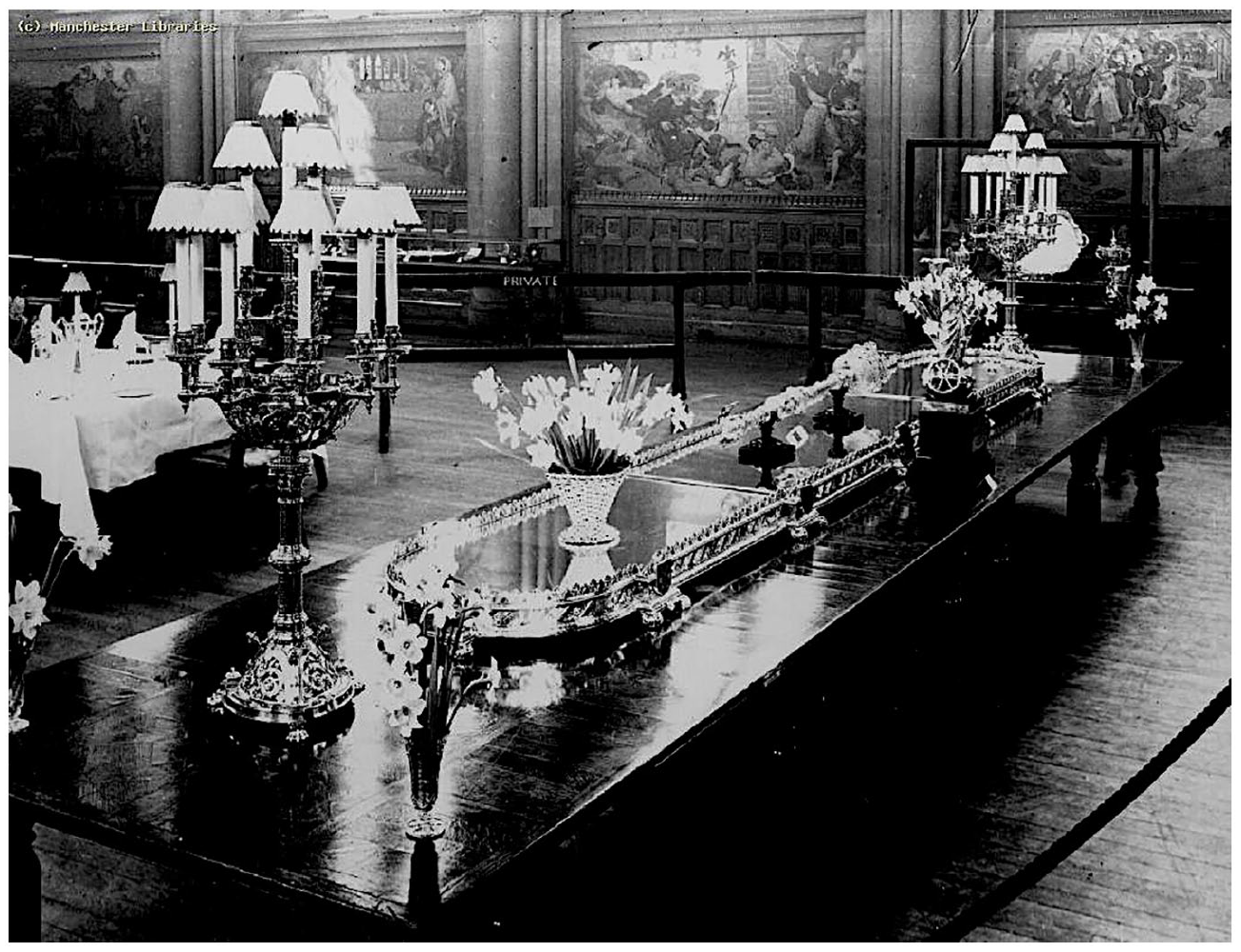
Silver plateau, dining event 1950. Reproduced courtesy of Manchester Libraries.
A grand feast marked the opening of the building and many similar events were staged in the first three or four decades of the Town Hall’s existence. Besides royal visits, banquets were held to host esteemed guests, commemorate local successes and mark momentous occasions. As the 20th century progressed, however, although these large formal dining occasions became less frequent, they continued to be staged. Consequently, the silver service continues to carry a powerful aesthetic charge, seducing the gaze with its lustrous gleam and ornamental flourishes, as Facilities Manager, Andy Haymes remarks: When you have the top table decorated, then it’s the real wow factor . . . if they’d had, say, 25 people on the top table and they had their big table decoration out and they had candelabra on them . . . fruit bowls and fruit stands . . . that really did look impressive. (interview, 23 January 2020)
More typical have been the staging of less grand events when selective silver candelabra, goblets, salvers and fruit bowls are used, as Andy details in discussing the early 1980s: ‘[the silver] was used quite a lot. And it was quite a common thing for committee services to have luncheons and dinner . . . a couple of times a year.’
During the resurgence of municipal socialism in response to the severe cost-cutting programmes carried out by the Conservative Thatcher-led central government from 1979, the local authorities of several British cities, including Manchester, sought to develop oppositional socialist-oriented local policies. A related effect of the control of the council by a hard left Labour group between the mid-1980s to the mid-1990s was that there was something of a hiatus in the use of the silver dining service. Although there were no serious plans to dispose of the collection, it was deemed ostentatious and excessively grandiose, and largely remained in its storage room. This ideological response to the display of civic wealth was subsequently rejected and the silver was most recently deployed during a visit to Manchester by the Chinese Ambassador in 2014.
Contemporary assessments continue to highly esteem the silver dining service, primarily because of its aesthetic and heritage value, as we discuss below. However, the Victorian values expressed in the symbolic role of the silver collection as an expression of civic pride have long been superseded and the class-oriented status of the 19th-century industrial bourgeoisie with which the silver is associated lacks contemporary salience. Similarly, as Grant (2016: 67) asserts, not ‘knowing how to correctly use a dining utensil like a nut-pick or grape-scissors . . . today seem socially superfluous and faintly ludicrous’ and can no longer ‘ruin one’s social reputation’. Indeed, the performance of dining etiquette more generally lacks contemporary purchase as a status-making endeavour. Although the silver retains the power to mesmerize on formal dining occasions, the compelling sensuousness of dining with silver has been superseded by other municipal spectacles such as light displays, victory parades for the city’s football teams and giant inflatable Christmas figures arranged across the Town Hall.
Maintenance and the material affordances of silver
We now focus on the ways in which the silver collection has been constantly subject to the unheralded but crucial practices of maintenance. As Harvey and Knox (2014: 1) claim, ‘subject/object distinctions are produced through the work of differentiation.’ Like all objects, silver artefacts ‘are enmeshed within a moment of change, flux, transition, rather than [a] fixed, essential or somehow “permanent” state of being’ (Casella and Croucher, 2014: 92). For, although metal objects symbolize material obduracy, they are also composed of microscopic particles that will dissolve and fragment. As Bennett (2010) considers, while metal seems impassive, resistant and rigid, it is characterized by emergent tendencies that are enacted depending upon the other forces, affects or bodies with which it comes into contact. In this regard, DeLanda (2006: 11) distinguishes between the properties of an entity – its essential qualities – and its capacities – its potential to affect and be affected by ‘other interacting entities’ within an assemblage. This highlights how objects are invariably relational, their destiny informed by their interactions with other things and bodies over time. As such, the Town Hall silver items have been continuously susceptible to entropy and disordering; as in all collections, ‘objects flake, rot, fade and rust’ (Geoghegan and Hess, 2015: 451) and the collection has had to be ceaselessly managed to retain its integrity. Maintenance has been essential in ensuring that the items out of which it is comprised remain distinct and discrete.
With silver, the key task of maintenance is to attend to any tarnishing or seek to avoid it for, if ignored, tarnishing will ultimately lead to an object’s dissolution. Because all silver is an alloy mixed with other metals to stabilize it, tarnish accelerates according to two key factors: levels of humidity and chemical reactions with elements in the environment in which the silver is stored. Even before any human handling, the exposure of silver to sulphur-containing gases may lead to a discolouring surface layer of tarnish that thickens over time, changing from yellow through red brown to blue. In industrial Manchester, we can surmise that toxic air has affected the collection through the release of hydrogen sulphide, a chemical compound that reacts with the surface of the artefacts to produce the black silver sulphide that characterizes tarnish. The silver may also have been tarnished by other material agents with which it has come into contact, such as newspaper and elastic bands, while the wood in the cabinets in which it is stored and in the tables on which it rests can release deleterious organic acid. More serious are the impacts of dining on silver. Water and particular foodstuffs can tarnish surfaces, but this is especially exacerbated by the accumulation of oils from the skin that predispose the silver to oxidization. Removal of tarnishing by over-zealous or unskilled polishing can result in the loss of silver plating. Inconveniently, tarnish tends to thrive on silver that has been freshly polished, whereas a layer of tarnish protects the silver against further tarnishing. Yet, because the imperative was for Manchester’s silver dining collection to appear impressively shiny and pristine on each dining occasion, rigorous cleaning, polishing and re-storing after each dining event were undertaken. This labour-intensive practice was usually performed in a room adjacent to the silver room.
Such unceasing maintenance procedures exemplify Farias’s (2010: 13) contention that ‘enormous effort is put into making objects achieve independency and anteriority’. They also remind us that ‘as transient subjects enmeshed and entangled in material processes of becoming, we are subject to processes and grounds that precede and thus bind us’ (Jackson, 2013: 12). For the silver has ceaselessly enrolled new generations of workers and technicians to ensure its continuing integrity through performing routine maintenance. Like cleaners, pest-controllers, electricians, plumbers, glazers and lift-repair workers, they have ensured that things have continued to ‘come together in discernible arrangements’ (Sack, 2004: 248).
Critically, although it is an indispensable part of living with uncertainty, vitality and change in a world in which multiple humans and non-humans exert their agencies, maintenance procedures and techniques invariably change. At the Town Hall, silver maintenance has forged divergent associations and enrolled different actors, technologies and institutions over time. In the 19th century, the cleaning of silver could be daunting. Culme (1977: 105) illustrates this by quoting from an 1843 issue of The Magazine of Domestic Economy and Family Review where contemporaneously favoured maintenance procedures are outlined: You should be provided with a sponge and leathers: the first should be well-soaked in water before using it, and the last soft and thick. Plate powder or whiting may be used either wet or dry . . . Rub the article, if plain, with the bare hand. Small articles such as fork and spoon can be done between the finger and thumb. The longer plate is done, the better it will look . . . Keep a clean leather to finish rubbing the plate with after it is brushed, and always dust the articles with a fine linen cloth before they are laid out on the dinner table.
These maintenance practices have been entirely superseded over the intervening years. For instance, contact with uncovered hands is now avoided to eliminate tarnishing and Andy Haymes (interview, 23 January 2020) describes how cotton gloves were always worn. Furthermore, repetitive rubbing would be eschewed to minimize the removal of silver plating in opposition to the advice provided in the quotation above.
Until recent years, the Town Hall silver was maintained by in-house operations, managed by a shifting array of people. Maintenance schedules were organized by the town hall superintendent, who was responsible for handling security, portering and the cleaning team. He was superseded by a ceremonies officer and, in addition, a curator tasked with inspecting the collection in the silver room was formerly employed. Other key personnel included the Lord Mayor’s secretaries, who informed workers about which silverware was required to be polished in readiness for certain events. However, over the past few decades, these in-house procedures have been curtailed following concerns that excessive polishing was wearing the silver plate away; these changing policy trends led to the contracting out of maintenance to a firm of silversmiths from Sheffield.
Contemporary methods for cleaning and maintaining silver include the use of foam, dip bath, polish, wadding and ultrasonic cleaners. Silver dip was formerly widely applied as a de-tarnishing solution but is now less popular since the process accelerates tarnish; once the tarnish inhibiting ingredient loses efficacy, surface depletion, especially damaging to silver plating, may advance. Moreover, the results can appear over-cleansed and too uniform, giving a lifeless appearance. Also, a recently prevalent de-tarnishing method was the electro-chemical corrosion of tarnish produced by combining aluminium and sodium carbonate in a tray. However, this tended to redistribute elements of the silver alloy across an artefact’s surface. Both techniques are now infrequently used except for certain pieces that feature deep etchings and cracks inaccessible to abrasives.
Current cleaning technologies increasingly feature a very mild abrasive pad, formerly containing fine particles of haematite, or ‘jeweller’s rouge’, but now usually utilizing the softer granular material of precipitated chalk, thus avoiding significant scratching. Also recommended, though more expensive, is the practice of keeping silver items in a vacuumed showcase to prevent the tarnishing effects of sulphide gases. Such containers may also enclose tarnish inhibitors, adsorbent materials such as activated charcoal cloth or crystals suspended in plastic that provide surfaces upon which toxic elements may adhere. Finally, valuable silver items are regularly coated with a thin, invisible layer of nitrocellulose lacquer, a plastic that acts as a barrier to oxygen and chemicals, and replaces the lacquers that were previously deployed. Lacquer deteriorates over time and requires replacement; moreover, this protective coating often aged in a way that was marked by the brush strokes made during their application. These lacquers were difficult to remove, a problem now averted by deploying acetone or steam removal before a new layer is applied. In considering contemporary aesthetic appraisals of maintenance techniques, rather than signifying unpleasant grime as in earlier times, patina is typically regarded as a valued attribute that testifies to the ageing process. Accordingly, tarnish that lingers in the recesses of objects may be retained. A concern to demonstrate these venerable material qualities also inhibits the replating of tarnished artefacts, especially where these are displayed in exhibitionary spaces.
The above summary exemplifies how decisions about maintenance techniques invariably alter over time according to changing technologies and techniques, procedures, political imperatives and aesthetic concerns. Repair and maintenance practices are contested, abandoned and superseded as practitioners seek to deal with the instability of the material world (Edensor, 2020). We have demonstrated how the maintenance process also involves the enrolment of a changing diversity of places, people and materials. Yet, critically, although these elements change, maintenance has consistently been conceived as essential because the civic plate has been esteemed as possessing a high historical, monetary, social and aesthetic value. To date, it has never been considered to have outlived its usefulness or as being beyond repair; rather, it has inspired an enduring consensus that it is worth maintaining. While most ‘artefacts are sacrificed to material decomposition over time’, Manchester’s silver, as with other cherished things, is regarded as worthy of ‘cleaning, stabilization and restoration’ (Casella and Croucher, 2014: 97). Consequently, when the silver returns to the Town Hall in 2024, it will doubtless be subject to new maintenance procedures and schedules.
Storing and curating the silver collection
As a key part of ordering the material world, potentially unruly objects are typically consigned to designated storage spaces – garages, cupboards, cellars, attics, storerooms – in which they may be neatly stowed or deposited in a pile (Miller, 2018). As mentioned, Manchester’s large silver collection was stowed in a purpose-built strong room accessible only through another outer strong room. This innermost U-shaped room is fitted with capacious wooden storage to keep the silverware in an orderly fashion. Along one side is a set of low cabinets containing an assortment of drawers, shelves and felt-lined compartments. Along the other three sides are a series of floor to ceiling cabinets with more adaptable storage for larger items. The centre of the room is occupied by a large set of cupboards with a table-like top. The room is always locked and alarmed, along with CCTV monitoring. Each of these discrete repositories is labelled and they serve as assigned, enclosed spaces that accommodated silver artefacts so that they remained both accessible and safe.
However, while these assigned locations continued to serve their original storage function, over the past 140 years some cabinets became laden with a plethora of other silver items scattered amongst artefacts from the dining service. Formerly designated as an exclusive realm in which to house the original civic plate, the room has become a storage site for a heterodox array of silver objects.
The original presentation trowel from 186 8 is accompanied by trowels used in other opening ceremonies. There are numerous commemorative wine coolers, trays, plates, goblets, sculptures, candlesticks (see Figure 2), keys, badges, inkstands, cigar caskets, teapots, trophies and caskets engraved with inscriptions that honour aldermen. Other honorary artefacts include silver caskets bestowed on those granted the freedom of the city and many items gifted by a range of industries and cultural groups. For example, a tray from 1977 celebrates the city’s 50-year-old association with Rolls Royce and Bentley automobiles, while a menorah presented in 1969 commemorates the Golden Jubilee of the Council of Manchester and Sa l ford Jews. A flagon gifted from Zurich in 1943 and a tankard presented by Lausanne in 1954 attest to the council’s wider political and cultural links. Other objects commemorate key initiatives in house building, the creation of parks, street lighting installations and educational policies, and include a pair of commemorative scissors from 1907 that cut the ribbon to open the Manchester to Oldham tram service. Numerous cups and trophies honour the ambulance service, air force and the Second World War Manchester Civil Defence Rescue Service, and there are sporting trophies awarded to crown green bowling champions, cricket teams and horse parades.
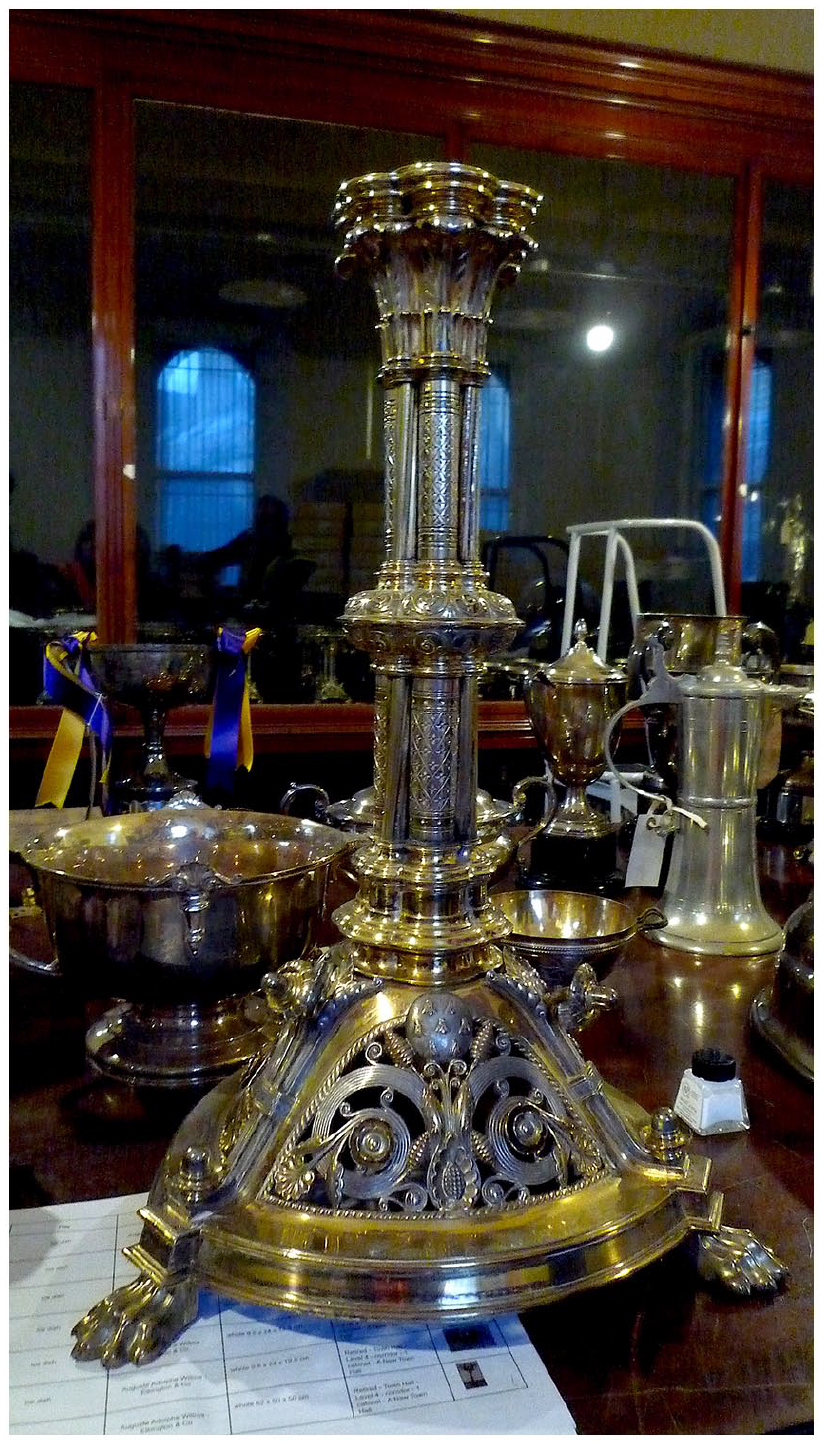
Candelabra from civic plate on a table in the silver room, along with other silver objects. © Photograph: Becky Sobell.
Particularly eccentric items stand out from this silver accumulation: two 19th-century silver-plated truncheons, an early 20th-century mayor’s hairbrush and mirror, and a plate commemorating the first non - stop transatlantic flight in 1919. A medal from 1813 features an allegorical scene of Prime Minister William Pitt encouraging the Spirit of Britain to battle the D emons of An arc h y – French Revolutionaries who have overthrown religion and royalty. An extraordinary top hat encased in glass and mounted on a silver stand honours ‘a superior’ human – a now somewhat obscure former councillor.
This array carries a powerful sensory and affective charge at variance to the civic plate, much of which remains sequestered within cabinets and drawers. Hugely variable in quality of provenance, function, design, materiality and size, these objects are impossible to classify and yet they conjure up a seething assortment of people and events, other places, historical events and council procedures and rituals over two centuries. Although the City of Manchester Ceremonies Office (1977: 3) disparagingly asserts that ‘as the scale of the collection increased, so the case became overcrowded and unsuited for displaying the collection to its best advantage’, the affective charge of this silver superfluity is exhilarating.
When we witnessed this overflowing silver scene, many objects had been placed on the central table in readiness for off-site storage. We were bedazzled by an overabundance that conjured the protean political and social exchanges of a municipal council for over 140 years. Our gaze snagged on particular artefacts but was subsequently distracted by other objects that stood out from the material profusion. The scene might be compared to a Wunderkammer, organized, according to Büscher et al. (1999: 4), in a way that avoids imposing ‘an ordered set of relationships and ways of interpreting on the user’. Weston (2009: 38) maintains that such cabinets of curiosity return us to a non-Euclidean, ‘traditional, mytho-poetic understanding of the world as a sacred hierarchy, full of marvels, mystery and magic, and only partially accessible to human intellect’. Thwarting the modern classifications and ordered categories imposed by the original storing practices, this superfluity offers ‘a form of resistance to the totalising ambitions of reason, a place where the human mind can play instead of working’ (Mason, 2000: 28). However, having been routinely placed here to linger, loitering in the silver room for decades as ‘rooted clutter’ (Miller, 2018), this relentlessly gathered assortment will be subject to a systematic re-ordering. When it is returned to the Town Hall, the collection will be stored, catalogued and displayed in new ways.
A significant development occurred in 1977, when to commemorate the Town Hall’s centenary, selective silver pieces were displayed in a ground-floor exhibition (City of Manchester Ceremonies Office, 1977). Artefacts from the civic plate collection included the plateau and candelabra, while other silver items included the mayoral ceremonial mace, granted to the city in 1895, a mid-20th-century model of a Dutch silver frigate and a 1924 scale model of the Town Hall. The bulk of this display was thereafter housed in display cases, subsequently upgraded, along a fourth-floor corridor adjacent to the Lord Mayor’s Office so that visiting dignitaries could see the silverware. This rather traditional exhibition masqueraded as objective and rational, despite Macdonald’s (1998: 2) observation that ‘the assumptions, rationales, compromises and accidents that lead to a finished exhibition are generally hidden from public view’, tidied away with those artefacts ‘for which no place could be found’.
However, more importantly, the exhibition heralded the emergence of a contemporary turn that assigns heritage value to an ever-widening range of things. In the case of the silver, its designation as part of Manchester’s heritage will shape its future destiny. When it returns to the Town Hall following off-site storage, most of the collection will be rehoused in the silver room, but selective pieces will be curated in a newly constructed visitor centre that will resonate with the greater prominence accorded to heritage, tourism and education. We might speculate whether this future display will diverge from older modes of exhibition where ‘reason, education, rationality, and the absence of the sensory’ (Geoghegan and Hess, 2015: 448) prevailed. Will it offer hands-on interactivity and sensory experiences? How will the silver artefacts be interpreted and will this include audio-visual or dramaturgical innovations? Will there be a reflexive acknowledgement of the invariably selective interpretive approach that is adopted (Macdonald, 1998)? Will the collection be pruned in response to the excess of objects, an example of the broader tendency within heritage practice to over-accumulate (Harrison, 2013)? Whatever modes of curation and interpretation are devised, it seems unlikely that the silver items will be charged with the imaginary, deeply sensual, affectual potency of the joyously excessive scene we encountered in the silver room.
The silver collection is currently in suspension, detached from its previous assignations, procedures, personnel and spaces. It has been securely stored in a ‘waiting architecture’, untouched and unused for the time being, in ‘planned stillness’ (Kühn, 2021), placed into a mode of ‘un-participation’. Through this process, procedures of storage and maintenance have intersected: stringent rules govern the packing and accommodation of the silver collection at a secret off-site facility, specifications that were delivered to the specialist art handlers given the job. These include the bespoke fabrication of strong but lightweight crates lined with pacific silvercloth and subject to the ‘Oddy Test’, a procedure devised by the British Museum that assesses the potential for chemicals to affect objects. Labels identify the correct vertical and horizontal orientation of objects and are marked ‘fragile’. No stored objects are permitted to touch each other. For security reasons, no details about contents can be indicated on crates: these must be itemized on a separate list of contents.
Conclusion
This article has focused on Manchester’s civic plate. We have explored the shifting ways in which it has been deployed to manifest civic status and undergird performative modes of citizenship. We have investigated how, as a vital material, the silver has been divergently maintained over 140 years. And we have examined how it has been subject to changing procedures of storage and display. These processes more broadly illuminate how places – in this case Manchester – are continuously reproduced through their ongoing material and spatial ordering. The changing practices and meanings that surround the civic plate highlight how things are disposed, maintained and repaired, replaced, supplemented, stored, displayed and mobilized to perform symbolic meanings according to different imperatives. Our focus on these changing functions and meanings discloses how the silver artefacts in the civic plate collection are excessive and unfixed, refuting attempts to delineate any essential qualities. Thus, knowing these objects can only ever be partial, rooted in time and culture, shaped by focus and perspective. Accordingly, in seeking to explore the multiplicity and complexity of the civic plate, we have shifted between different theoretical perspectives, following Fowler and Harris’s (2015: 145) maxim that ‘modulating between modes – continually reconfiguring phenomena in varying ways – is vital to exploring what things are and can be.’
Our account foregrounds Otter’s (2010: 45) contention that, at certain historical junctures, ‘specific materials have played a pivotal role in constituting particular forms of western urban systems’, architecturally, aesthetically and functionally. The intensified symbolic importance of silver from the 19th to early 20th century is reflected in Manchester Council’s decision to purchase an extravagant dining collection to enchant its civic events. While still a significant precious metal, and although the civic plate continues to be regarded as valuable, silver has been decentred as other metals, ceramics, wood, stone, plastics, alloys and other synthetic substances have contributed to increasingly materially variegated urban environments over time (Hodder, 2012).
We have demonstrated how the value of the silver has transformed from a material embodiment of municipal prestige to an esteemed symbol of local heritage; there is thus a time-deepened consensus that it is of symbolic value and hence persists as a discrete assemblage. Maintenance techniques to retain this value and material integrity have persistently been applied but have shifted over time. The storage practices that have surrounded the silver collection for 140 years have changed more slowly, as the formerly highly regulated silver room in which the artefacts were stored became gradually disordered by the multitude of silver items that joined an increasingly heterogeneous array. Now they have been temporarily removed to an off-site location.
These silver items ‘once occupied a place in an active web of social and material relations’ DeSilvey (2007: 407), a web that has changed over time. New connections emerging from ‘complex histories’ have come to incorporate ‘new, real, and interesting participants’ (Latour, 2004: 234), bodies, materialities, technologies and humans that have been enrolled into the practices and assessments that surround the collection. Through these processes, the civic plate has been subject to ‘continuous acts of translation and mediation’ (Hill, 2018: 1194) and been progressively disconnected from many former relations and associations.
Although these enrolments are critical, we suggest that the silver items also possess their own vital agencies. Yet, without intervention, their ‘thingliness’ would dissolve through the properties that inhere in their atomic structure and because fingers, air, food and other agents threaten their coherence. Such processes underpin Ingold’s (2010: 3) questioning of the discrete status of the object which, though it may stand before us ‘as a fait accompli, presenting its congealed, outer surfaces to our inspection’, is ‘a knot whose constituent threads, far from being contained within it, trail beyond, only to become caught with other threads in other knots’. The silver collection thus exemplifies the ongoing emergence of objects and the maintenance endeavours this provokes, disclosing an ongoing tension between material stabilization and deterioration. The temporally and spatially distributed processes through which humans, technologies and procedures have been enrolled to militate against the dissolution of the silver collection reveal how the existence of separate objects may be stabilized for extended periods of time.
Finally, although we have detailed particular historical, political and cultural contexts, we have not wanted to downplay the salience of sensory material affordances. As we have demonstrated, the Town Hall silver has been sensorially apprehended and worked with in very different ways across time. Auguste Willms, the designer of the collection, and the workers from Elkington and Co. who carried out different tasks within the production process were intimate with its creation. The Town Hall’s waiting staff developed an expertise in handing the silver, formally placing it on tables in the correct order, and diners were complicit in following established etiquette in using the implements in the appropriate manner. The rich effects produced by lighting, furniture, the noise of dining and the shimmering and tactile affordances of the silver generated compelling, sensual experiences in a temporarily enchanted space. In-house maintenance workers spent many hours assiduously cleaning and polishing the silver, and these were superseded by more advanced technical practices undertaken by specialist restorers. Those storing the implements in their designated places systematically and carefully placed them in their assigned drawers and cupboards. Curators have wielded practical expertise in selecting and presenting pieces for public scrutiny. A multitude of people have successively engaged with the civic plate for over 140 years, knowing and sensing these artefacts in very different ways. The integral roles they have played in its ongoing sustenance should not be forgotten.
Footnotes
Acknowledgements
We would especially like to thank Meg McHugh, Andy Haymes and Joanne Whalley. We are also grateful to Ann Eatwell, Purcell Architects, Kirsten Kennedy, Peter Norris and other members of the Town Hall staff.
Declaration of conflicting interests
The authors declared no potential conflicts of interest with respect to the research, authorship and publication of this article.
Funding
The authors received no financial support for the research, authorship and publication of this article.

Author biographies
He has recently authored From Light to Dark: Daylight, Illumination and Gloom (2017) and Stone: Stories of Urban Materiality (2020). He is also co-editor of The Routledge Handbook of Place (2020), Rethinking Darkness: Cultures, Histories, Practices (2020) and Weather: Spaces, Mobilities and Affects (2020).
Her background in multiple disciplines has led to an interest in inter-disciplinary working. She has collaborated with artists, scientists, engineers and other designers. Her research interests include ecological design, urban wildness, collaborative practice, art and landscape.
Address: Chatham Building, Cavendish Street, All Saints, Manchester M15 6BR.
Email: