



Abstract
Background
Research has emphasized the importance of helping children develop understandings of death that are conceptually healthy accurate and emotionally supportive. Yet, open conversations about death remain stigmatized, particularly with children. Nonetheless, children express curiosity and a desire to discuss and understand death. Adults, however, report having feelings of discomfort and being too unqualified to facilitate these dialogues. Because adults may believe these discussions are unnecessary, there is a need to clarify the depth of children’s knowledge of death.
Study Aims
This review sought to clarify what children understand about death and how they come to learn about it.
Results
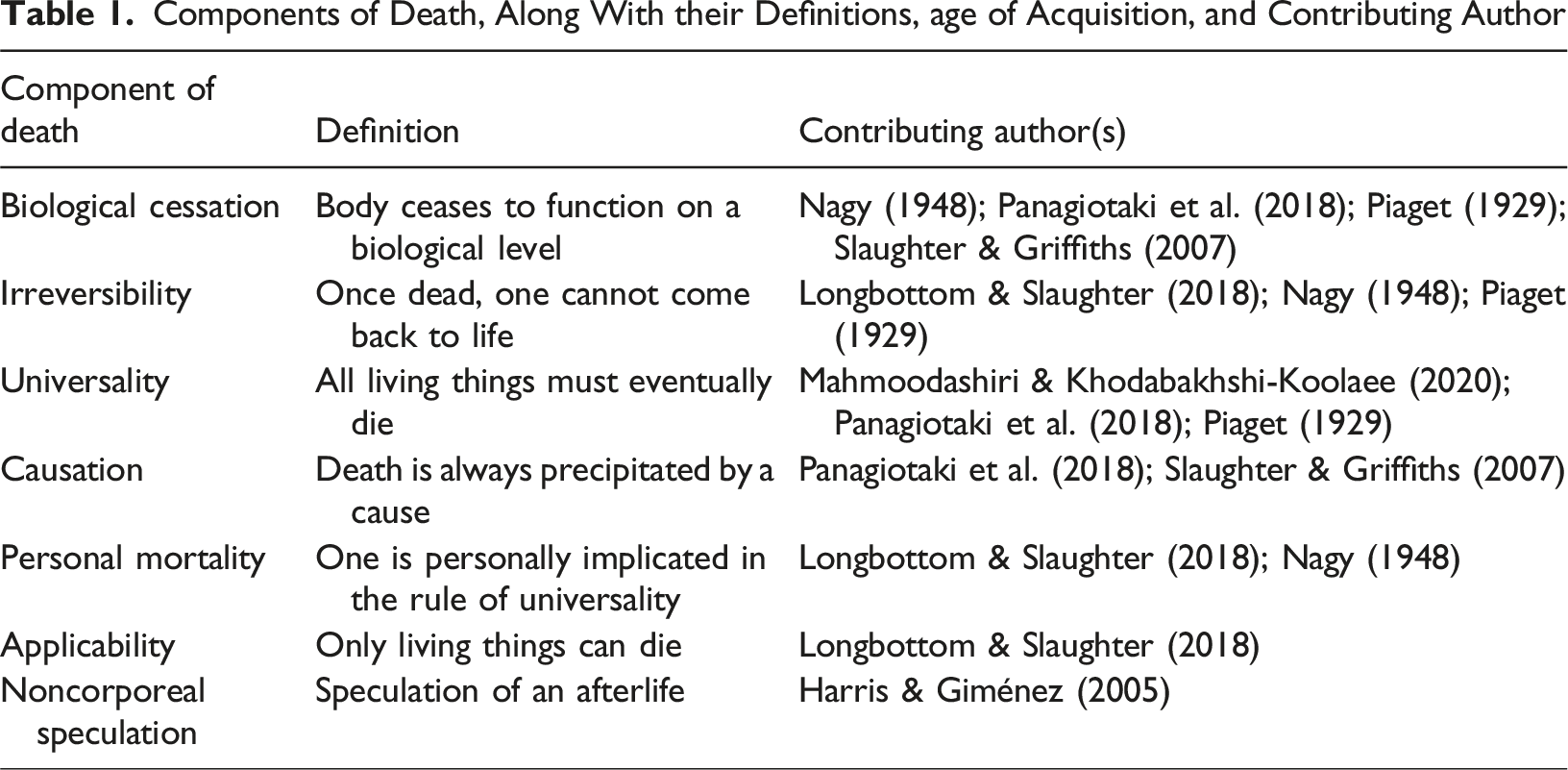
Findings suggest that children develop an understanding of death through several key components across childhood. There are three core dimensions widely agreed upon in the literature: (1) biological cessation, (2) irreversibility, and (3) universality. There are also additional components that remain more actively explored and less consistently established. These include (4) applicability, (5) personal mortality, (6) causality, and (7) noncorporeal continuation. This knowledge may be acquired naturally through cognitive development and can also be shaped by direct exposure (e.g., the death of a loved one or pet) and/or indirect experiences (e.g., media depictions). When learned indirectly and without guidance, there is an increased risk of children formulating inaccurate or distressing attitudes toward death.
Implications
Building on these insights, we offer developmentally adapted approaches for supporting children’s understanding of death within pedagogical settings.
Plain language summary
In this review, we summarize both historical and recent research that has examined how children think about and understand death. We found that most authors agree on children clearly understanding three specific components of death before the age of 12: universality, irreversibility, and biological cessation. Additional components that remain actively explored include applicability, personal mortality, causality, and non-corporeal continuation (i.e., speculations about what happens after death). With this knowledge, we explore how children can develop a healthy and accurate understanding of death by embracing open and supportive dialogues with them about it, rather than avoiding it. Doing so is theorized to be supportive of children's mental health.
Introduction
Why, you may ask, take on this unpleasant, frightening subject? Why stare into the sun? Why not follow the advice of the venerable dean of American psychiatry, Adolph Meyer, who, a century ago, cautioned psychiatrists, ‘Don’t scratch where it doesn’t itch’? … Death, however, does itch. It itches all the time; it is always with us, scratching at some inner door, whirring softly, barely audibly, just under the membrane of consciousness (Yalom, 2008).
In parts of western society, there is a normalcy for the topic of death to be actively avoided, especially in the presence of children (Miller et al., 2014). Some may argue that discussions about death can harm children and should be avoided to shield them from distressing and painful thoughts (Corr & Doka, 2025). Moreover, others may contend that children lack the capacity to entertain such thoughts, so it is futile to have these discussions in the first place (Miller et al., 2014). Although adults may say that they have the best interests of children at heart by avoiding such conversations, it is more likely that they feel unequipped and unprepared to handle the discomfort they may bring. According to Freud (1914), this avoidance could be due to fantasy thoughts that we project onto children: “we grieve the loss of our own childhood innocence to the realities and risks of childhood. This prompts us to project our narcissistic fantasies on our children who are therefore presumed to live in an enchanted realm until, alas, harsh reality eventually intrudes” (pp. 30-59). Indeed, some adults may believe that childhood should be strictly preserved for positive memories. Since the feelings some adults have about death contradict this fantasy, they choose to avoid such thoughts entirely, and children are thus unlikely to ever be given the opportunity to discuss it. In doing so, they may think that they can successfully block out the thought of death from entering children’s minds.
This attempt to shield children from death, although noble in its intent, remains ineffective or deleterious. While it is true that broaching this subject is uncomfortable – especially as it relates to deaths that adults are personally affected by – avoiding it entirely is unrealistic, as children get preoccupied by existential questions (Zanetti, 2020). Even at a young age, children strive to allocate meaning to their lives, and this requires questioning the meaning of death (Demers & Sinclair, 2015). Indeed, children report being specifically interested in death and actively seek to learn more about it (Paul, 2019). Despite this, adults – namely parents and teachers – report feeling both uncomfortable and unqualified to lead these discussions with them (Su-Russell et al., 2023). When these discussions do occur, however, it is often under the initiative of the child broaching this subject with adults (Weber et al., 2021). When adults do get confronted by children on questions about death, they are often taken aback and react in a way that invalidates the child’s curiosity (e.g., “Why would you ask such a question?”; Koole & Tschacher, 2016; Malboeuf-Hurtubise et al., 2024; Zanetti, 2020). Children are thus at an increased risk of being alone to reflect on, and learn about, death.
Given children’s natural curiosity about death, recent research has called for increased opportunities to engage children in open conversations on the subject (Malboeuf-Hurtubise et al., 2025a). These discussions may occur at home with parents or, in some cases, within educational settings. Several scholars have advocated for the broader implementation of death education, sometimes referred to as a pedagogy of death, as a means of supporting children’s emotional and existential development. Providing children with access to open, age-appropriate dialogue about death has been shown to benefit their mental health, particularly in fostering meaning-making around mortality (Fry et al., 2025; Scalzo, 2010).
Despite this call for action, the topic of death remains repressed in western cultures and stigmatized (Becker, 1973), thus limiting its wider integration into mainstream educational contexts (Corr, 2015). As a result, many adults report feeling uncertain about how to initiate or guide conversations about death with children (Cullen, 2017). This hesitancy is often compounded by ambiguity regarding what children already understand about death – and what aspects of it they are curious to learn more about (Talwar et al., 2011). This paper aims to address these challenges by synthesizing current research on children’s understanding of death and exploring how they acquire and construct this knowledge.
Study Aims
Children’s questions about death may leave some adults – such as parents, educators, and mental health professionals – feeling unprepared to respond in a way that is emotionally validating for them. This may stem from uncertainty about how children conceptualize death: what they know, when and how they learn it, and why they wish to talk about it. This narrative review thus aimed to clarify these issues by addressing the following research question: What does research reveal about children’s understanding of death, and how it is learned? Following this analysis, a brief discussion explores how supporting children in exploring these questions not only can foster their developmental understanding of death, but also their coping skills towards this complicated topic. Suggestions for methods in supporting children on the topic are also provided.
Methods
A narrative review was conducted to synthesize the latest research on how children conceptualize death. Our initial inquiry into children’s knowledge of death aimed to capture both contemporary empirical findings, along with historically significant theoretical contributions in the field to ensure a holistic conceptualization of children’s death knowledge was captured.
Search Strategy
Initial exploratory searches were conducted using Google Scholar and the Bishop’s University Library system (i.e., hosting institution) to identify general perceptions of children’s understanding of death. Subsequently, more targeted searches were carried out across databases including Taylor & Francis, SpringerLink, and PsycINFO, within their search engines, entering keywords such as “children AND death”, “children’s understanding of death”, and “death education AND children”.
Inclusion/Exclusion Criteria
We included peer-reviewed empirical studies, meta-analyses, and systematic reviews, as well as seminal theoretical works that have shaped the field (e.g., Nagy, 1948; Piaget, 1929). Studies were primarily selected on the basis of relevance, recency of publication, and overall scholarly impact. Nonetheless, some older studies were retained when they offered theoretical significance, historical insight, or findings that continue to inform contemporary conceptualizations and frameworks. Only studies involving children under the age of 12 were included. Opinion pieces and non-peer-reviewed articles were excluded.
Theoretical Orientation
To ensure methodological soundness and interpretive rigor, we also drew our theoretical approach from Sukhera (2022), who contends that narrative reviews are particularly useful for research topics that “require a meaningful synthesis of research evidence that may be complex or broad and that require detailed, nuanced description and interpretation”. This aligns with the social constructivist theoretical orientation, which posits that reality and “truth” are subjective, fluid, and constructed through multiple perspectives, rather than representing a singular, static, and objective reality (Sukhera, 2022). Accordingly, the studies included in this review were interpreted through this lens, allocating particular attention to how children’s understanding of death varies across cultural and developmental contexts. Data were thematically organized around recurring conceptual dimensions (e.g., irreversibility, finality, causality, and universality) and examined according to our interpretive framework described above.
Results
Components of Death
Components of Death, Along With their Definitions, age of Acquisition, and Contributing Author
Cognitive-Developmental Theories
In most cases, it appears that children’s capacity to learn about the components of death depends, in part, on the stages of their cognitive development. As such, much of how current literature understands children’s knowledge of death is based on the historical works of Piaget (1929), who, although did not explicitely write about death knowledge in his work, is widely perceived as a pioneer of cognitive-developmental psychology. Nonetheless, through his work on cognitive development, children’s understanding of death can be largely interpreted through four cognitive stages. The first stage is the sensorimotor stage (0-2 years), whereby infantile children are not yet aware of the concept of death. As they enter the second preoperational stage (2-7 years), however, children become loosely aware of death. Their understanding of death is mostly imaginative and based in egocentric beliefs. That is, children may feel in control of death and have the ability to determine future outcomes. If, for example, a child is angry at their sibling and says they wish they would die, and the next day this sibling dies in a car accident, they will personally feel responsible and blame themselves for this occurrence. Building on this, there is the concrete operations stage (7-12 years), whereby children have an intermediate understanding of death that enables them to develop more realistic ideas as they grow and mature. This is also largely referred to as the curiosity stage when children have the most questions about death and are most interested in learning about it. The final and permanent stage children enter is the formal operations stage (13+ years), whereby it is anticipated children have a full grasp on the fundamental concepts of death. Despite this fuller understanding, children enter this stage nonetheless perceiving death as a distant event that they will only personally experience after a long-lived life. As children enter this final stage, they also feel more inclined to seek emotional support when someone they know has died.
Although the theories posited by Piaget gained reputability over the years, and in many ways, act as an interpretative foundation to current theories about children’s death conceptualization, the validity of his theories has been contested (Lourenço & Machado, 1996). Indeed, studies attempting to replicate Piaget’s findings have at times failed to do so (Donaldson, 1987), raising questions about the universality and current relevance of his developmental stage theory – particularly in relation to how children understand complex abstract concepts like death. Therefore, while Piaget’s framework holds historical value, it may not fully capture the nuances of contemporary children’s thinking about death, especially given later advancements in cognitive developmental research. Moreover, other scholars (Babakr et al., 2019) suggested that Piaget underestimated children’s cognitive abilities; that is, children can develop their understanding of death at significantly younger ages than he originally theorized. Finally, Piaget’s (1927) theories were based on a case study conducted with his two children, which could indicate potentially biased findings and limited generalizability to a broader population, almost 100 years later. Nonetheless, these limitations have further encouraged researchers to continue exploring how children think about death, which will be elaborated on in the sections below.
Building off Piaget’s (1927) findings, Nagy (1948) further uncovered the relationship between age and a child’s understanding of death. Three specific stages of cognitive development among urban Hungarian children were outlined in this analysis. In the first stage (3-5 years), they identify death as part of a journey that someone takes but eventually returns from. The child is yet to discover irreversibility, and during this stage, their understanding of death is inaccurate. In the second stage (5-9 years), children become more aware of the component of irreversibility, but they repress it under the belief that by doing so, they can trick death and avoid it. Again, their understanding of death continues to mature as they age but remains inaccurate. Finally, in the third stage (9-10 years), a child may learn and accept death as both universal and irreversible, even for themselves (Nagy, 1948). In this stage, children’s understanding of death is advanced enough to recognize at least three of the theoretical main components of death (i.e., irreversibility, universality, and personal mortality). Although Nagy’s study is helpful for understanding the gradual process of how children develop these components of death, it does not provide a full account on the stages by which children learn about all aspects of death.
Following Nagy and Piaget’s historical and foundational works, other cognitive-developmental psychologists have attempted to fill in their understanding for which children learn about the aspects of death. Contrary to Nagy’s (1948) claim, studies have indicated that the component of irreversibility is almost always learned first among children – as early as the age of three – whereas the component of causation is almost always learned last – sometimes by the age of eight (Longbottom & Slaughter, 2018). This tendency seems to play out across cultures, which could suggest that these two aspects are immune from environmental or individual differences (Jingjing & Fuyan, 2024). In contrast to these components, however, the timetable for developing a conceptualization of three other components – universality, applicability, and cessation – as well as understanding death as a whole – do seem to depend on both environmental and individual differences (Menendez et al., 2020). In other words, children’s development of death conceptualization derives not only from cognitive development; children also develop their understanding of death through experiences.
Experience-Related Impacts on Death Conceptualization
While cognitive development is often viewed as a universal and natural process, children’s understanding of death tends to be shaped by lived experiences – and can be significantly influenced (or limited) by the presence or absence of social interactions. Nonetheless, experiences with death can be influential on death conceptualization (Menendez et al., 2020). It is what could distinguish one child to the next in terms of how they think about and understand death. Life experiences vary, and therefore, how they come to acquire their understanding of death also varies (Longbottom & Slaughter, 2018). They can occur both directly (i.e., first-hand exposures to death and/or corpses) and indirectly (i.e., second-hand experiences or confrontations with death), yet they both possess the ability to significantly shape how death is perceived and conceptualized.
Direct Experiences with Death
Intuitively, children learn through direct experiences with death (Longbottom & Slaughter, 2018). These usually occur within the context of having firsthand exposure to death and/or corpses (Astuti, 2011; Colombo, 2025). Direct experiences with death tend to vary in terms of emotional impact and proximity. They can include, but do not limit to: the death of a fish, a pet, and in more emotionally intensive circumstances, a death of someone they know personally (Jingjing & Fuyan, 2024). In other words, a direct experience with death usually entails the death of someone or something that they once had a personal relationship with, and the significance of this experience depends on the nature of the relationship that the child had with the now-deceased subject. Moreover, the impact that these direct experiences have on the child’s understanding of death depends on the closeness of the relationship with the person (prior to their death), the extent of their physical exposure to a corpse, and their overall involvement in death-related rituals (i.e., funerals, spiritual events, etc.; Longbottom & Slaughter, 2018). Although these direct experiences are not guaranteed to happen to every child in equal measure, they could still theoretically hold the potential to influence children’s understanding of death and their broader emotional and cognitive development if or when they do occur.
The impact that direct life experiences have on a child’s developmental understanding of death seems to vary (Longbottom & Slaughter, 2018). For some children, it is reported (usually by the child, parent, or teacher) that their first-hand experience had a positive association with their understanding of death (Schonfeld et al., 2024). Another study argued that direct exposures to death are the most powerful source of death conceptualization (Astuti, 2011). Conversely, there have been some instances where first-hand experiences have resulted in children further obscuring their understanding of death (Alvis et al., 2022), or no association at all (Rosengren et al., 2014). Given the mixed findings of the research, scholars have pondered whether the presence of an additional variable could influence this relationship. For example, one theory proposed that first-hand experiences and understanding of death are moderated by cognitive development; that is, children up to the age of six may not be old enough to fully grasp and process a direct experience with death (Honey & Dark-Freudeman, 2024). However, as they continue growing beyond six years of age, their capacity to understand death following a first-hand experience could increase (Matalon, 2000). Alternatively, some scholars (Longbottom & Slaughter, 2018) have theorized this can be explained by a different mediating variable, which could be indirect experiences with death.
Indirect Experiences with Death
One of the most notable and subtle influences on death conceptualization during childhood occurs through indirect experiences. They are characterized by moments when a person is exposed to ideas about death, without the direct physical exposure to a corpse, or the death of someone they know. These indirect experiences could include communication with parents, media depictions of death, or reading death literature, described below.
What children understand about death is in part determined by the communication they have with their parents. Given that children are curious and seek to learn more about death (Paul, 2019), having the opportunity to openly communicate about it is essential for having a proper developmental understanding. For example, research on Canadian children in Montreal, Quebec has indicated that approximately 75% of parents have spoken to their child(ren) about death (Renaud et al., 2014). Other studies have hinted that the actual frequency of parental communication about death with children could be overestimated; one study found that these discussions are sometimes only had if they are completely unavoidable (Rodríguez Herrero et al., 2022). These conversations include discussions on bereavement, as well as on biology and the natural world, for which death is seen as an extension of these topics (Arruda-Colli et al., 2017). If these conversations do not address the central questions that children have about death, they may turn elsewhere for answers.
When children do not have the opportunity to communicate about death, they may instead learn about it through media depictions. Indeed, research (Bridgewater et al., 2021) has found that in many cases, children are introduced to the concept of death through media like Disney films before it is ever discussed with friends, parents, or other adult figures. As such, they are often unprepared to deal with the death of a loved one, or even a beloved cartoon character in a movie (Bridgewater et al., 2021). What becomes potentially harmful, however, is when indirect experiences lead to maladaptive attitudes about death. Again, in returning to the example of media depictions, children may be led to believe that only antagonist characters deserve to die, and protagonist characters do not, since this is often how it is narrated in these films (Lammon, 2019). Moreover, Graham and colleagues (2018) argued that newer movies from Disney have further obscured the irreversible rule of death while also failing to acknowledge deaths on an emotional level (e.g., superheroes coming back to life whereas the villains always remain dead). Therefore, should a child’s loved one die, they may experience confusion regarding the finality of their death, and whether this finality depends on the moral character of the person. Thus, due to these indirect experiences, children are left at risk of formulating problematic misconceptions, such as thinking that death is reversible.
Children may also learn about death through literature (Gutiérrez et al., 2014). In recent years, there has been a notable increase of children’s books that address themes of death and dying (Öztürk & Erzen, 2023). Some of these books aim to educate children on the biological underpinnings of death, including bodily functions ceasing or the physical process of decay (Slaughter, 2005). Conversely, other literature on this topic may instead focus on the emotional experiences related to death, such as grief, mourning, and bereavement (Goering, 2014; Ordal, 1984). Such literature has been found to support the development of a healthy and coherent understanding of death, helping children process complex ideas through a developmentally adapted medium (Warren, 1989). Yet, despite their potential – along with the recent calls for a pedagogy of death in Quebec (Ryu, 2022), where the authors of this article are based – death - literature for children remains to be integrated into formal educational settings. This is theorized as being due to enduring cultural stigmas surrounding open discussions of death within pedagogical contexts (Wass et al., 1989).
Discussion
This narrative review sought to examine the latest research on children’s understanding of death. In doing so, we uncovered that there are up to 7 components of death learned by children between 3 and 12 years of age. The three consensus components include biological cessation, irreversibility, and universality (Mahmoodashiri & Khodabakhshi-Koolaee, 2020; Nagy, 1948; Panagiotaki et al., 2018; Piaget, 1929). However, other scholars have also argued for up to 4 other components, which include causation, personal mortality, applicability, and noncorporeal speculation (Fernández-Alcántara et al., 2021; Harris & Giménez, 2005; Longbottom & Slaughter, 2018). Although these aspects can come to the child’s understanding naturally through the process of cognitive development, scholars agree that their understanding of them are likely also influenced by both direct and indirect life experiences with death. These experiences can occur more blatantly by having a direct exposure to a death, and the emotional impact of this experience depends on the closeness between the witnessing child and the recently deceased (Longbottom & Slaughter, 2018). However, these experiences can also occur more subtly, which results in the child indirectly learning about death (Bridgewater et al., 2021). These indirect learning experiences often occur via communication – usually with parents – as well as through the witnessing of media portrayals and depictions of death, such as through Disney films (Bridgewater et al., 2021). Alternatively, children could learn about death through literature that explores its biological underpinnings (Öztürk & Erzen, 2023).
In this article, we have suggested not only that children are curious about death, but indeed, they can develop their own conceptualization of it, and independently from the influence of close adult figures. Since parents often feel too uncomfortable to lead open dialogues with their child(ren) (Cullen, 2017; Meyers et al., 2009), and media sources tend to involve inaccurate depictions of death (Bridgewater et al., 2021), children are at a heightened risk of being unsupported through their process of thinking and learning about it. This, in turn, can cause other side effects: (1) the child develops conceptualizations contrary to the above-described components, and/or (2) they become more distressed at the thought of death, especially if it becomes repressed (Becker, 1973; Bridgewater et al., 2021). Whether through family, the media, or educational settings, the ways in which children encounter and discuss death are shaped by broader social contexts and inherited dispositions. Understanding these influences is essential to appreciating the diversity of, and limitations to, children’s opportunities for open dialogue and reflection on death.
Fostering a Healthy Conceptualization of Death
Studies have found that embracing the questions, thoughts, and feelings that children have about death can support their learning and feeling more comfortable with the topic of death (Renaud et al., 2014). Communicating openly about existential topics (e.g., despair) is also found to promote healthy understandings and feelings about it (Malboeuf-Hurtubise et al., 2024). An effective dialogue is found to include (1) clearly stated facts about death and (2) language that avoids unclear euphemisms or jargon that can be misinterpreted at a young age (e.g., passing away; Longbottom & Slaughter, 2018). However, parents and teachers alike report feeling both uncomfortable and unqualified to lead these discussions themselves – especially when they are required to be more direct in their communication––and thus avoid them entirely (Cullen, 2017; Su-Russell et al., 2023). In some cases, when asked about death, parents and teachers may instinctively react with discomfort to such questions from the child. This, in turn, can invalidate the child’s questions and make them think that they are strange or wrong to wonder about death (Koole & Tschacher, 2016). Despite this, some parents and teachers still acknowledge these dialogues as being important for children’s development (McGovern & Barry, 2000). This can leave children in an awkward position whereby parents and teachers acknowledge the importance of having dialogues about death with them, and yet, they are still at risk of being alone to think about it.
At what specific age should adults engage in dialogues about death with children? While researchers agree on the value of implementing death education across schools, there is less certainty about how and when it should be integrated (Wass et al., 1989). Edgar and Howard-Hamilton (1994) reported a well-received 10-year research program that implemented “non-crisis death education” across Grade 5 curricula, integrating discussions of death into subjects, such as music, art, history, and physical education, and supplemented classroom learning with field trips to funeral homes and cemeteries. Importantly, both students and parents agreed upon the value of such an education, emphasizing the importance of maintaining the program for fifth graders (Edgar & Hamilton-Howard, 1994). One recent study (Friesen et al., 2020) partnered nursing students with a local palliative care team to deliver death education to children in public schools, advocating for its broader implementation. Since then, there has been minimal research investigating the efficacy of implementing death education within primary schools, despite recent calls for its reintegration (Smilie, 2021).
While it is paramount that children’s boundaries are respected, we nonetheless advocate for the broader implementation of a pedagogy of death within primary settings (Malboeuf-Hurtubise et al., 2025b). Such an approach could hypothetically ensure that (1) teachers receive appropriate training to facilitate discussions about death in developmentally sensitive and ethically responsible ways, (2) all children are afforded opportunities to engage in these conversations, including those who may not have been exposed to them previously, and (3) death-related dialogues are further normalized, thereby reducing stigma surrounding the topic. However, the specific methods by which a pedagogy of death should be implemented – as well as the developmental timelines for introducing these discussions – are beyond the scope of the present manuscript. We therefore encourage future researchers - educators and psychologists alike - to examine these questions as a critical step toward responsibly normalizing conversations about death with youth.
Art and Philosophy Interventions
In our own research, we have discovered two approaches that show promise for supporting children in fostering a healthy conceptualization of death: (1) arts-based interventions and (2) philosophical inquiry. Arts-based interventions, on the one hand, utilize creative expression – such as drawing or painting – to help children process difficult emotions in non-verbal ways, making them especially suitable for topics that are hard to articulate (Bitan & Regev, 2022; Kramer, 2016). Philosophical Inquiry (Lipman et al., 1980) – used as a proxy to Yalom’s (1980) existential therapy – engages children in guided discussions that encourage reflection on existential questions and promote personal meaning-making (Goering, 2014; Isiklar & Öztürk, 2022; Lipman, 2003). Findings from our own research team (Fry et al., 2025, 2025, in press; Malboeuf-Hurtubise et al., 2025b) suggest that children meaningfully engage with interventions that blend artistic expression and philosophical reflection when navigating existential themes, such as death and eco-anxiety. These findings align with a broader call in the literature (Malboeuf-Hurtubise et al., 2025b) for a pedagogy of death – an intentional effort to bring developmentally appropriate death education into school settings. Since many parents report discomfort or uncertainty in broaching the topic (Cullen, 2017), schools may provide an environment that fosters clearer, more adaptive conceptions of death. Art and philosophy interventions, in this sense, not only support children’s emotional processing on this subject, but also offer tools for refining their cognitive and existential understanding of death through collaborative meaning-making (Fry, et al., 2025, in press). In this way, they represent a promising foundation for shaping how children come to understand – and live with – the reality of death.
Strengths & Limitations
A key strength of this review lied in its synthesis of the multiple dimensions through which children come to understand death. By drawing from a wide range of developmental, experiential, and theoretical perspectives, this review contributes important insights into how children acquire and articulate their knowledge about death. Indeed, it clarified how this understanding is shaped both by natural cognitive development and by personal experiences, such as direct exposure to death, or more indirectly via media portrayals of death-related content.
Despite these strengths, certain limitations must be acknowledged. Most notably, the reviewed literature may not have captured the full range of lived perspectives. For instance, children outside of Western cultural contexts – or those living with terminal illnesses or traumatic experiences – may conceptualize death in fundamentally different ways than the predominantly Western, healthy, and trauma-free samples typically represented in our review. As such, the generalizability of our findings is limited. Additionally, cultural, religious, and familial influences – while they were briefly acknowledged – require further exploration to fully understand the diversity of children’s death-related beliefs and emotions.
Future Research
Future research should continue exploring how to create safe, inclusive, and developmentally sensitive environments for children to engage in conversations about death. Longitudinal and cross-cultural studies could deepen our understanding of how children’s death perceptions evolve across time and context. Special attention should also be allocated in future studies towards underrepresented populations, including children facing life-limiting illnesses, those in palliative care settings, and children from culturally diverse or marginalized backgrounds. In addition, future work should examine the role of caregivers, parents, educators, and clinicians in shaping children’s understanding of death, and how these adults can be better supported in navigating such complex discussions with compassion and clarity. Importantly, researchers should also seek to understand the psychological, cultural, and emotional barriers that make it difficult for adults to talk about death with children – barriers that could stem from their own unresolved fears, grief, or discomfort towards mortality.
Conclusion
While several reviews have explored children’s understanding of death, this narrative review uniquely (1) integrated recent developmental findings alongside a historical perspective on how children’s concepts of death have been framed across time, and (2) organized the literature according to the most empirically supported components of death understanding (e.g., irreversibility, universality, biological cessation, etc.), while also highlighting less-discussed aspects such as applicability and noncorporeal speculation. Additionally, the review aimed to bridge empirical findings with theoretical implications relevant to psychologists, educators, and mental health professionals engaging with children in death-related conversations.
In effect, we have highlighted the diverse and nuanced ways in which children understand and perceive death. There is indeed a critical need for more open, compassionate, and developmentally appropriate dialogues with children on this topic. While we propose recommendations for a pedagogy of death, it is essential that children’s questions and emotional responses be met with validation and sensitivity – not only in educational settings, but also at home. Fostering honest conversations about death can help children navigate existential questions with greater emotional clarity and resilience, while also reducing confusion, fear, or shame often associated with the topic (Malboeuf-Hurtubise et al., 2025b). Creating space for these dialogues affirms that children are not only capable of engaging with difficult subjects, but that doing so can meaningfully support their psychological well-being.
Footnotes
Acknowledgments
We extend our heartfelt thanks to the children who courageously participated in our previous studies leading to our interest in this paper. Their openness and insight continue to inspire and inform our ongoing research into this vital area.

Funding
The authors disclosed receipt of the following financial support for the research, authorship, and/or publication of this article: Funding for this project was provided through a research grant by the Social Sciences and Humanities Research Council of Canada to CMH (892-2023-2027). Funding sources were not involved in the conduct of this research.
Declaration of conflicting interests
The authors declared no potential conflicts of interest with respect to the research, authorship, and/or publication of this article.
Data Availability Statement
The data that support the findings of this review are available on request from the corresponding authors, ZF and CMH