



Abstract

What is pernio?
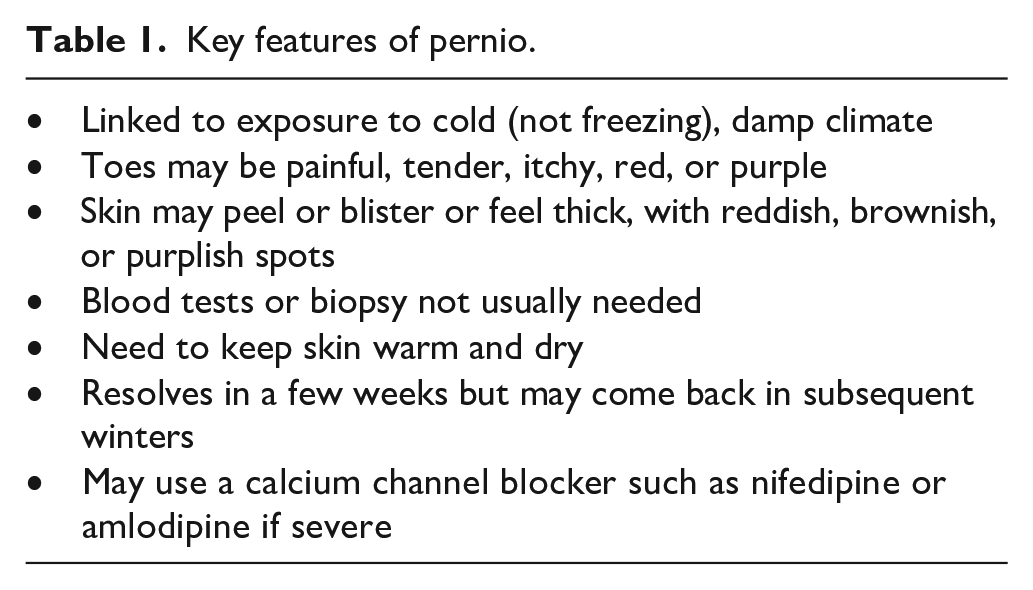
Also called chilblains, pernio is a vascular skin condition that usually affects the toes. It can cause color changes, swelling, and/or inflammation and occurs due to exposure to a cold and damp climate (Table 1). It may come on suddenly, often starting 12 to 24 hours after the weather exposure. It typically goes away on its own within a few weeks, but it may last longer and may come back the next year.
Key features of pernio.
Who is at risk for pernio?
People who live in cold, damp climates are most at risk. In the United States, it is more common in the northern and western parts of the country. It is associated with temperatures that are cold but not freezing. Years ago, a study found that up to half of participants had experienced pernio by the age of 40 in the women’s branch of the British army during the Second World War. 1 Some studies suggest it may be more common in women, people who smoke, and people with a lower than normal body weight.
Pernio is occasionally associated with Raynaud’s, which is a related vascular condition in which the fingers or toes change color due to excessive constriction or spasm of the small blood vessels. 2 Raynaud’s symptoms may be present before or after pernio symptoms start. 3
What causes pernio?
The exact cause of pernio is not known, but it seems to be an abnormal blood vessel response to cold exposure. Researchers believe that the cold exposure leads the blood vessels to constrict, which reduces the oxygen in the tissue. This reduced oxygen then leads to an inflammatory reaction. Humidity in the cold weather likely plays a role, leading to more heat loss from the skin and more blood vessel constriction. 3
Pernio may be referred to as ‘primary’ or ‘idiopathic’ when it appears randomly and no specific cause is identified. Pernio is only rarely ‘secondary’, in which case it is caused by another condition such as lupus.
What are the symptoms of pernio?
With pernio, the toes may be painful, itchy, red, purplish, and/or tender. The symptoms may vary but can include a burning feeling, blistering, or peeling of the toes with thickening of the skin with small red, brown, or purple spots (Figure 1). The toes are the most common location, but pernio can also involve the hands, ears, or face. Symptoms of pernio can start abruptly after exposure to cold and may take weeks to go away. It may also come and go, and it may come back each winter.
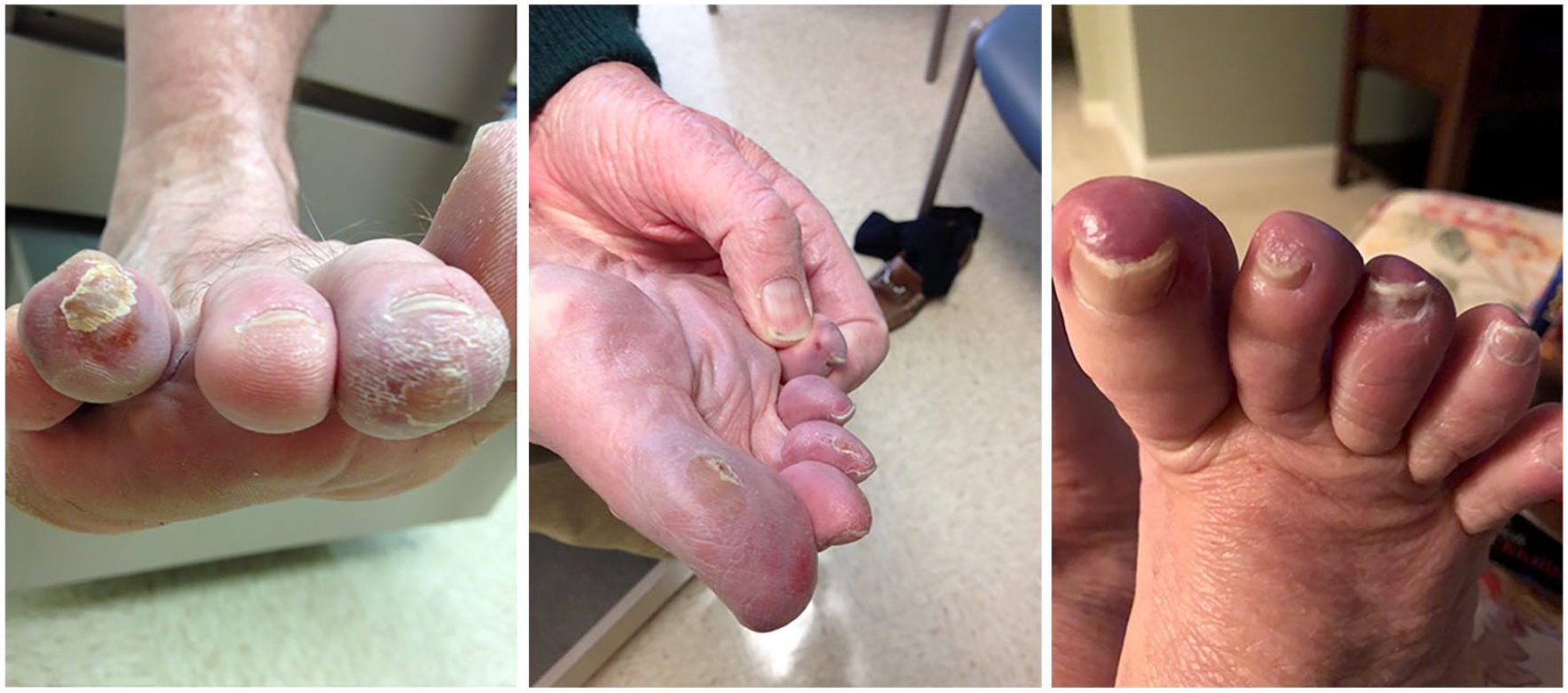
Examples of three patients with typical symptoms of pernio.
How is pernio diagnosed?
No specific test can confirm the diagnosis, but pernio is often suspected based on the combination of the exposure to cold, the pattern of symptoms, and the appearance of the toes. Lab tests and imaging are not usually needed unless there is concern about a possible alternative diagnosis. For example, if the symptoms are severe or unusual or persist for many weeks, then additional testing may be required.
Depending on the situation, blood tests may be ordered to help rule out other conditions that can cause similar skin changes in the toes. Other conditions that could be considered include vasculitis (blood vessel inflammation), hepatitis, rheumatologic disorders, or a clotting disorder called antiphospholipid antibody syndrome. 4 Blood tests may include complete blood count (CBC) to look for abnormalities in the white blood cell count; erythrocyte sedimentation rate (ESR) or C-reactive protein (CRP) to look for inflammation; ANA (antinuclear antibody) test to look for a rheumatologic or autoimmune condition; serum protein electrophoresis to look for a blood disorder; and/or antiphospholipid antibodies to look for a clotting tendency. In pernio, the ANA test is usually negative or normal, along with the other blood tests. Additional tests are tailored to the individual’s symptoms.
A biopsy is not usually needed but, if performed, the affected areas may show a characteristic pattern under the microscope with swelling and thickening of the blood vessel walls and surrounding inflammatory cells.
What are the risks of having pernio?
The prognosis for pernio is excellent. Other than the bothersome symptoms, pernio does not usually pose any significant health risk. Complications are rare, but sores or ulcers on the toes could become infected. Careful skin care is important. The skin should be kept clean, warm, and dry. Permanent damage to the skin is rare but if pernio persists over a long period of time, then the skin may become scarred or discolored.
What is the link between pernio and COVID-19?
Early in the course of the coronavirus disease (COVID-19) pandemic, doctors noticed a condition similar to pernio that became known as ‘COVID toes’. 5 Indeed, critically ill patients in the intensive care unit may have skin changes that are related to clots in the small blood vessels in the toes and/or fingers, with appearance that can be similar to pernio. Pernio-like skin changes have also been seen in patients with COVID-19 with mild or no symptoms. These findings are thought to be triggered by the immune system’s reaction to the viral infection and the associated inflammation. 5
Meanwhile, another interesting observation during the pandemic was an increased frequency of pernio symptoms among children, teenagers, and young adults who were in quarantine. The frequency of COVID-19 diagnosis does not seem to be increased in these patients. 6 However, they had been walking around barefoot on cold floors and were more sedentary with little physical activity. This finding highlights the critical importance of exercise and staying active in reducing inflammation and maintaining blood vessel function for people of all ages.
How is pernio treated?
The main initial intervention is to protect the affected areas from cold and damp environments. Walking around barefoot on cold floors should be avoided. Most people with pernio do not require medication and are able to manage their symptoms through keeping the skin warm and dry, avoiding smoking, and exercising daily.
In severe cases, the most commonly prescribed class of medications is dihydropyridine calcium channel blockers, such as nifedipine or amlodipine, which are often used in patients with high blood pressure. Sometimes patients will take the calcium channel blocker only during the winter months to prevent or manage the pernio symptoms. The calcium channel blocker may shorten the duration, decrease the severity of the symptoms, and/or prevent the development of new affected areas. Topical steroids may be prescribed to treat symptoms, but the benefits are not proven.
Of note, exercise plays a key role in blood vessel function and in overall cardiovascular health. All adults should aim for at least 30 minutes a day of moderate-intensity exercise, while protecting the toes if significant skin changes are present.
Fortunately, pernio usually resolves as soon as the weather warms up.
Summary
Pernio is an inflammatory blood vessel condition which most commonly involves the toes and is usually triggered by exposure to cold, damp conditions. It resolves on its own but may return during subsequent winters. Calcium channel blockers may be used if the symptoms are severe.
The ‘Vascular Disease Patient Information Page’ is a regular feature of Vascular Medicine. All articles in the collection are available for free online at http://journals.sagepub.com/vmjpatientpage.
The Vascular Disease Patient Information Page is provided for educational purposes only and is not a substitute for medical advice.
Footnotes
Declaration of conflicting interests
The authors declared no potential conflicts of interest with respect to the research, authorship, and/or publication of this article.
Funding
Dr. Elizabeth Ratchford’s work was supported in part by the generosity of David Kotick (1926-2021). This patient information page is dedicated to his memory.