



Abstract

Introduction
Electronic cigarettes (e-cigarettes) were originally developed in China in 2003. They have been available in the United States and Europe since 2006. They were initially marketed as a tool to help with quitting smoking. Since their development, the devices have evolved along with our understanding of their potential benefits and health risks. From a public health standpoint, there is concern that e-cigarettes may promote an illusion of safety, leading to increased nicotine use and addiction, particularly among teens and young adults.
What is an electronic cigarette?
Tobacco contains a highly addictive chemical called nicotine. Many different tobacco products are available. Traditional cigarettes, often called ‘combustible’ cigarettes, actually burn tobacco. Other tobacco products include hookah, pipes, cigars, snuff, chew, and snus (a flavored moist smokeless tobacco powder). All these tobacco products increase the risk of cardiovascular disease and other health problems, while also delivering nicotine.
On the other hand, electronic nicotine delivery systems (ENDS) deliver nicotine through a different method. These devices include e-cigarettes, vape pens, hookah pens, and e-pipes. With ENDS, a solution (called an e-liquid) is heated up enough to vaporize; the user then inhales this vapor. The e-liquid may contain flavoring and various other chemicals in addition to nicotine.
The first e-cigarettes were disposable and looked similar to traditional cigarettes. Over the past few years, devices have been developed with rechargeable batteries and cartridges. Modern devices allow the user to customize features including the flavors, the voltage, and the dose of nicotine. Figure 1 shows the wide range of e-cigarette devices available. They may look like pens or phones or even a USB computer flash drive. More than 250 different types are currently on the market.

Photographs of electronic nicotine delivery systems.
Most e-cigarettes have multiple parts including a rechargeable battery, a heating device that vaporizes the solution, and the cartridge that holds the liquid, as shown in Figure 2.
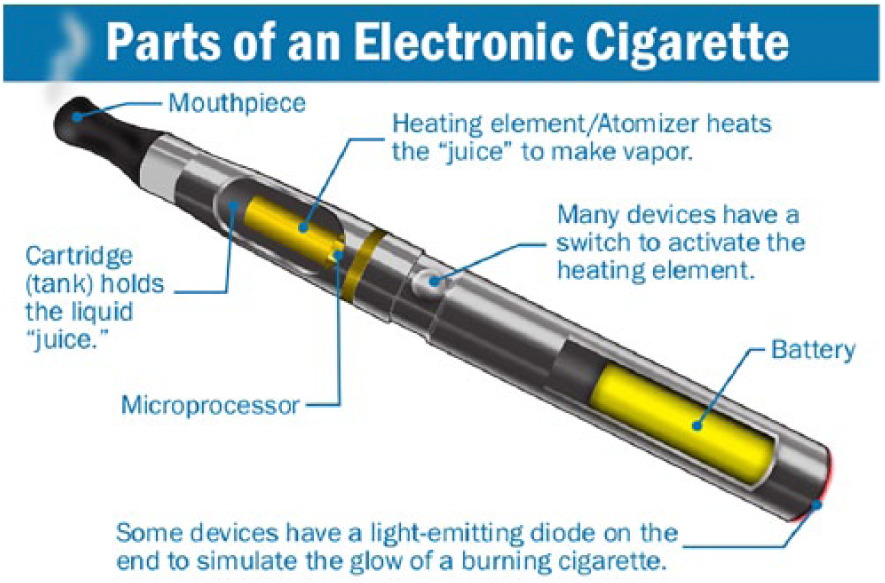
Typical design of an electronic cigarette.
Where are e-cigarettes sold? Are they regulated?
E-cigarettes can be purchased at convenience stores, gas stations, vape shops, and over the internet. A popular e-cigarette manufacturer is JUUL, which has quickly come to dominate the marketplace. JUUL is a small rechargeable device about the size of a USB drive (Figure 3) that can rapidly deliver as much nicotine as an entire pack of cigarettes. Because it can be easily concealed, it has become extremely popular among young people. In fact, ‘JUUL-ing’ has displaced ‘vaping’ as a common term for describing the use of e-cigarettes.

Photograph of a JUUL device.
The US Food and Drug Administration (FDA) issued the ‘Deeming Rule’ in 2016, which declared e-cigarettes to be tobacco products and therefore eligible for government regulation. 1 The FDA is interested in restricting the advertising and sale of e-cigarettes to minors due to the harmful effects of nicotine on the developing brain and the potential for addiction. The FDA also wants to regulate the flavors, which often lead young people to try e-cigarettes. Recently, the US Surgeon General declared e-cigarette use among youth to be a ‘national epidemic’.
Do electronic cigarettes help people quit smoking?
This question is difficult to answer for several reasons. First, e-cigarettes were never marketed as a ‘therapeutic’ product, so they did not go through the same rigorous process that the FDA requires for medications and medical devices. Extensive research and clinical trials are required to demonstrate that medications and devices are safe and effective before they can be marketed. Since this scientific study was never required, our knowledge surrounding e-cigarettes lags behind that of other approved therapies for smoking cessation. The involvement of the tobacco industry in the existing research has further complicated the situation.
One important report came from the National Academies of Sciences, Engineering, and Medicine (NASEM). This report concluded that e-cigarettes with nicotine are more helpful than e-cigarettes without nicotine for smoking cessation. 2 The report states that evidence is mixed but there is moderate evidence that more frequent use of e-cigarettes is associated with an increased likelihood of quitting smoking. 2
A study published in the New England Journal of Medicine randomly assigned 886 smokers to either nicotine replacement therapy or e-cigarettes. 3 Both groups received counseling. After 1 year, the e-cigarette group had nearly double the success rates (18.0% vs 9.9%). However, among those who quit smoking in the e-cigarette group, 80% were still using the e-cigarettes after a year. In contrast, only 9% of the nicotine replacement group was still using nicotine products. This study suggests that e-cigarettes may help but this potential benefit needs to be balanced against the potential risks.
Are electronic cigarettes harmful?
The health risks of e-cigarettes remain largely unknown, but e-cigarettes contain various components, each of which could be harmful. The flavorings contain chemicals and additives that may be hazardous, especially diacetyl or cinnamaldehyde. 2 The ‘juice’ or solvent that turns into the vapor when heated could be toxic. The nicotine itself could be toxic, especially because the newer generation of e-cigarettes can deliver nicotine doses that are much higher than in traditional cigarettes. Trace metals generated by the heating coil are released, which could also be harmful. In addition, the battery may explode and cause burns.
The current consensus of the scientific community is that e-cigarettes may contain toxic chemicals, though likely much less than traditional cigarettes. 4 Thus, the risks of e-cigarettes are probably lower than traditional cigarettes but higher than not using either one. Also, e-cigarettes are not considered safe for young people or pregnant women. More research is needed to understand both the short- and long-term risks of e-cigarettes. Since many of the health risks associated with smoking can take years to develop, the long-term effects of e-cigarettes may take many years to observe. The wide variety of devices and designs of e-cigarettes makes it challenging to study their potential health effects.
Is it OK to use electronic cigarettes and traditional cigarettes at the same time?
This approach to quitting smoking is not recommended. Current research shows that most people who use e-cigarettes also continue to smoke traditional cigarettes (called ‘dual users’). Dual use is a problem because there are cardiovascular risks even with smoking only one to two cigarettes per day. It is better to switch 100% over to e-cigarettes and completely stop smoking traditional cigarettes first, rather than using both together for an extended period.
What is the best approach to smoking cessation?
Completely quitting all forms of smoking is one of the most important steps to improve cardiovascular health. The best approach to quitting smoking is a combined approach with both behavioral counseling and FDA-approved medication. The most effective medication is varenicline. Other options include bupropion and nicotine replacement therapy. The medications are safe, effective, and usually covered by health insurance plans. 5 Many resources are available to help with smoking cessation, including the 1-800-QUIT-NOW hotline and http://www.smokefree.gov.
What are the key things to know if using e-cigarettes?
Several tips are available for people who choose to use e-cigarettes to quit using traditional cigarettes. 4 The first priority is to stop smoking traditional cigarettes as soon as possible. Dual use of both traditional cigarettes and e-cigarettes should be avoided. The user should switch completely to e-cigarettes first and then plan to taper off while gradually reducing the amount of nicotine.
Liquid nicotine is extremely harmful and potentially lethal if swallowed. Children have died from nicotine poisoning by ingesting the liquid from e-cigarettes. Thus, products should be chosen with child-resistant packaging and kept in a secured place. Since the health effects of the vapor are not known, e-cigarettes should not be used around children or pets.
The e-cigarette battery can also be dangerous, leading to explosions and burn injuries. The package instructions should be followed closely regarding how to recharge, maintain, and store the device to decrease this risk.
Summary
Electronic cigarettes may help with smoking cessation but may have long-term risks that are not currently known. From a public health standpoint, there is deep concern that e-cigarettes promote nicotine addiction among adolescents, which can act as a gateway to traditional cigarettes or other drug use in the future. Current research suggests that e-cigarettes may be a safer alternative than traditional cigarettes for tobacco smokers. However, people who have never smoked or used other tobacco products should not start using e-cigarettes. The science of e-cigarettes is rapidly evolving and much remains unknown.
More information can be found at:
https://www.cdc.gov/tobacco/basic_information/e-cigarettes/index.htm
Footnotes
Declaration of conflicting interests
The authors declared the following potential conflicts of interest with respect to the research, authorship, and/or publication of this article: Michael Blaha is part of the American Heart Association Tobacco Regulation and Addiction Center (A-TRAC), which is funded by the FDA. He has also served as a temporary member of the Tobacco Product Scientific Advisory Committee of the FDA.
Funding
The authors received no financial support for the research, authorship, and/or publication of this article.