




Abstract
Objective:
This study investigated the attitudes of Turkish adults towards the ban on smoking in public areas and compared annual smoking cessation rates before (pre-2009) and after (post-2009) the ban became law, using data from a survey of teachers.
Methods:
A self-reported questionnaire was used to collect data from teachers in Manisa, Turkey. Annual smoking rates were calculated. Joinpoint regression analysis was used to identify when a significant change occurred in the annual smoking cessation rate.
Results:
Questionnaire response rate was 79.6% (579/727); 47.8% (277) of respondents were male. Smoking prevalence among men and women was 32.7% and 24.7%, respectively, and 97.3% of nonsmokers and 75.5% of current everyday smokers supported the law changes. Results of the Joinpoint analysis showed no significant change in annual smoking cessation rate between 2001–2002 and 2006–2007; but there were significant reductions in smoking rates between 2007–2008 and 2010–2011.
Conclusions:
Teachers in Turkey have a positive attitude to the law on smoking. The smoking cessation rate in teachers was significantly increased by changes in legislation.
Introduction
Tobacco use is an important public health issue. According to the results of a national survey conducted in Turkey in 1988, the smoking rate among adults was 43.0% (62.8% among men; 24.3% among women). 1 The first legal restriction on cigarette consumption in Turkey was Law number 4207 on the Prevention and Control of Hazards of Tobacco Products, which was published in the Official Gazette of 26 November 1996, number 22829. This law prohibited the sale of tobacco and tobacco products to minors (i.e. those < 18 years of age), and banned tobacco company advertisements, promotions and sponsorships. The law also prohibited smoking tobacco and tobacco products in the following places: health, education, training and cultural premises; indoor gyms; public agencies or organizations employing five or more people; on public transport. 2
The Framework Convention on Tobacco Control, which was signed by the World Health Organization in 2003, was also adopted by Turkey and published in the Official Gazette of 30 November 2004 (number 25656). As a requisite of this agreement, the National Tobacco Control Programme was drafted in 2006, then promoted by the Minister of Health (Recep Akdağ) on 12 December 2007 for enforcement between 2008 and 2012. Smoking rates declined among Turkish adults after these measures were taken. According to the Global Adult Tobacco Survey conducted among those < 15 years of age in 2008, smoking prevalence had fallen (compared with the1988 figures), 1 to 47.9% among men and 15.2% among women. 1
Fundamental revisions were made to Law number 4207 and Law no 5727 (published in the Official Gazette of 19 January 2008; number 26761 and implemented from 19 July, 2009), when the consumption of tobacco products – cigarettes in particular – was banned in all indoor areas excluding houses, but including clubs whether or not they served alcohol. From 19 July 2009, 100% smoke-free areas were created in Turkey. 3 Two surveys were conducted nationally in 2011 and 2012 after the constitutional amendments, which suggested further reductions in the smoking prevalence among adult men and women (41.4–43.0% among men, 13.1–17.0% among women). 4
The effects of legislation on the smoking habits of adults may be considered with respect to their smoking cessation rates. 5 The few Turkish studies that have investigated whether these tobacco-related laws have affected all layers of the population show a positive attitude towards the changes within Turkish society. Evidence shows that the indoor smoking ban encouraged both the general community and some specific groups (such as teachers), to stop smoking or reduce their cigarette comsumption.5–8 In Turkey, to our knowledge, no comparisons of smoking cessation rates in the periods before and after the enforcement of the new laws have been undertaken. Although, studies indicate that the smoking ban is supported by the community in general,5,9 Turkish teachers’ knowledge and positive attitude to smoking cessation has been found to be lacking, according to one publication. 10 The present study was undertaken to discover the attitudes of teachers in Manisa towards smoke-free legislation, and investigate their smoking cessation rates in the periods before and after the enforcement of laws on tobacco use.
Materials and methods
Questionnaire
There are 54 elementary schools and 24 secondary schools in Manisa, which is an inland city on the west side of Anatolia, Turkey, with a population of 350 000. An interventional study entitled ‘The effectiveness of the peer education programme on smoking control, nutrition and physical activity among young people in secondary schools and high schools in Manisa’ was started in 2011, in 46 schools. The schools were matched according to the socio-economic status of the students, and 23 randomly selected schools were identified as intervention schools. At baseline, data on the smoking status of the students, in addition to data for the teachers, were collected. The survey was conducted in June 2011 and included all teachers (n = 727) employed at the 23 selected schools (17 elementary and six secondary schools).
Teachers were asked to fill out a questionnaire containing questions about their sociodemographic status, their smoking status, the date of smoking cessation (for those who had stopped smoking), and their thoughts on the new laws on tobacco use. Smoking status of the participants was evaluated according to criteria set out by the Centers for Disease Control and Prevention (www.cdc.gov) in the USA: the term ‘current every day smoker’ was used to describe individuals smoking at least one cigarette per day; the term ‘current some day smoker’ described individuals smoking fewer than one cigarette per day, the term ‘ex-smoker’ described individuals who had stopped smoking previously and were not smoking during the study period; the term ‘nonsmoker’ described individuals who had never smoked during their lifetime. 11 For their thoughts on the new legislation, statements of expression were listed, each of which had four possible answers: ‘certainly support’, ‘support’, ‘do not support‘, certainly do not support’. People who answered with either ‘certainly support’ or ‘support’ were classified as supporters.
Statistical analyses
Statistical evaluation of all data was carried out using SPSS® software (version 15.0; SPSS Inc., Chicago, IL, USA), and χ2-test was used for analyses. Annual smoking cessation rates were calculated, based on smoking status data obtained from the questionnaire. For each year between 2001 and 2011, the number of smokers at the beginning of the year and the number of individuals who had stopped smoking during the same year were identified. Joinpoint Regression Program (version 3.5), provided by the Surveillance Research Program of the US National Cancer Institute (2008), 12 was used to identify the points at which a significant change of trend occurred in smoking cessation rates between 2001 and 2011. Each Joinpoint denotes a statistically significant (P < 0.05) change in trend. In this study, the technique identified periods when smoking cessation rates were highest by using a series of permutation tests and adjusting for multiple comparisons. This objective and automated process avoids bias from arbitrarily defined timeperiods. We used a Bayesian information criterion approach to select the most parsimonious model that best fitted the data, allowing a maximum of two Joinpoint estimates. 13
Ethical consent
Ethical committee permission for the study was granted by Celal Bayar University Local Ethics Committee. As this was not an interventional study, consent from the study participants was not required.
Results
Descriptive characteristics of teachers from schools in Manisa who responded to a questionnaire sent to 727 teachers (response rate 79.6%) on their personal smoking history and their thoughts on legislation to curb smoking in public places.

Column percentages.
Current smoking status by age and sex of teachers from Manisa, Turkey, who completed a questionnaire on their smoking history.
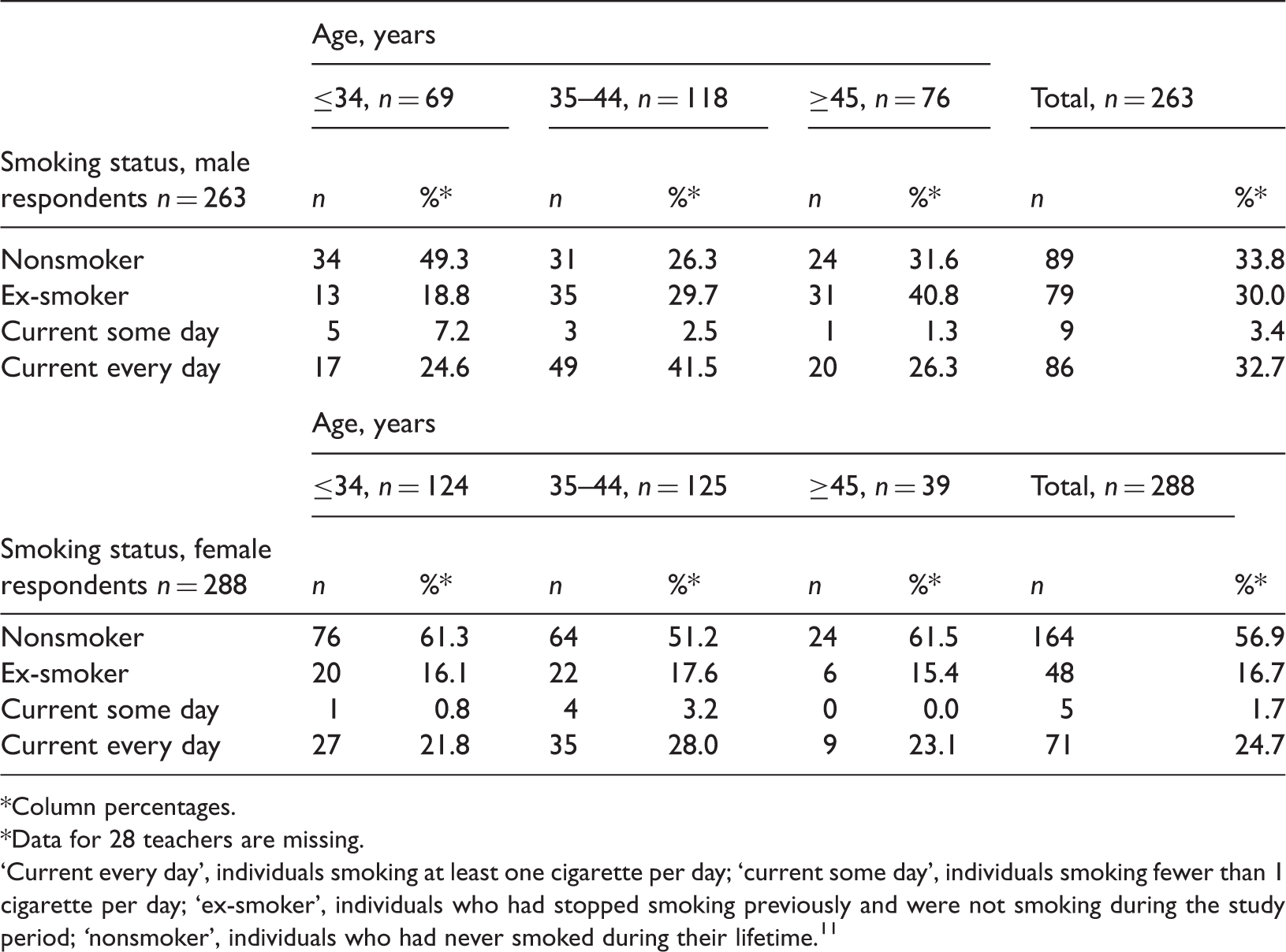
Column percentages.
Data for 28 teachers are missing.
‘Current every day’, individuals smoking at least one cigarette per day; ‘current some day’, individuals smoking fewer than 1 cigarette per day; ‘ex-smoker’, individuals who had stopped smoking previously and were not smoking during the study period; ‘nonsmoker’, individuals who had never smoked during their lifetime. 11
The proportion of teachers from Manisa, Turkey who supported the national smoking ban, stratified according to sex and smoking status; respondents had completed a questionnaire sent to 727 teachers (response rate 79.6%) on their personal smoking history and their thoughts on legislation to curb smoking in public places.a,b

Not all the teachers answered all the questions – percentages are calculated on the number who answered the question, which was not necessarily the total number.
Each expression had four possible answers: ‘certainly support’, ‘support’, ‘do not support‘, certainly do not support’. People who answered with either ‘certainly support’ or ‘support’ were classified as supporters.
P < 0.001 for smoking status, χ2-test.
P < 0.001 for sex and P < 0.001 for smoking status, χ2-test.
In smokers, annual smoking cessation rates or the periods 2001–2002 and 2006–2007 were between 1.2% and 3.4%. Smoking cessation rates for 2007–2008, 2008–2009 and 2009–2010 were 3.6%, 6.1%, and 6.5%, respectively; between August 2010 and June 2011, the smoking cessation rate was 10.7%.According to the results of the Joinpoint regression analysis, there was no statistically significant change in the annual smoking cessation rate between 2001–2002 and 2006–2007. The annual increase in cessation rate was 6. 5%. There was, however, a statistically significant increase in the annual smoking cessation rate between 2007–2008 and 2010–2011 (P = 0.02, annual increase in cessation rate, 36.7%; Figure 1). A further evaluation of yearly smoking cessation rates during 2007–2008, found the increase in quitting rates was not statistically different between men and women (data not shown).
Annual smoking cessation rates of teachers from schools in Manisa, Turkey who responded to a questionnaire on their personal smoking history and their thoughts on legislation to curb smoking in public places. For each year between 2001 and 2011 the number of smokers at the beginning of the year and the number who had stopped smoking by the end of the same year were identified. The difference beween the two numbers was plotted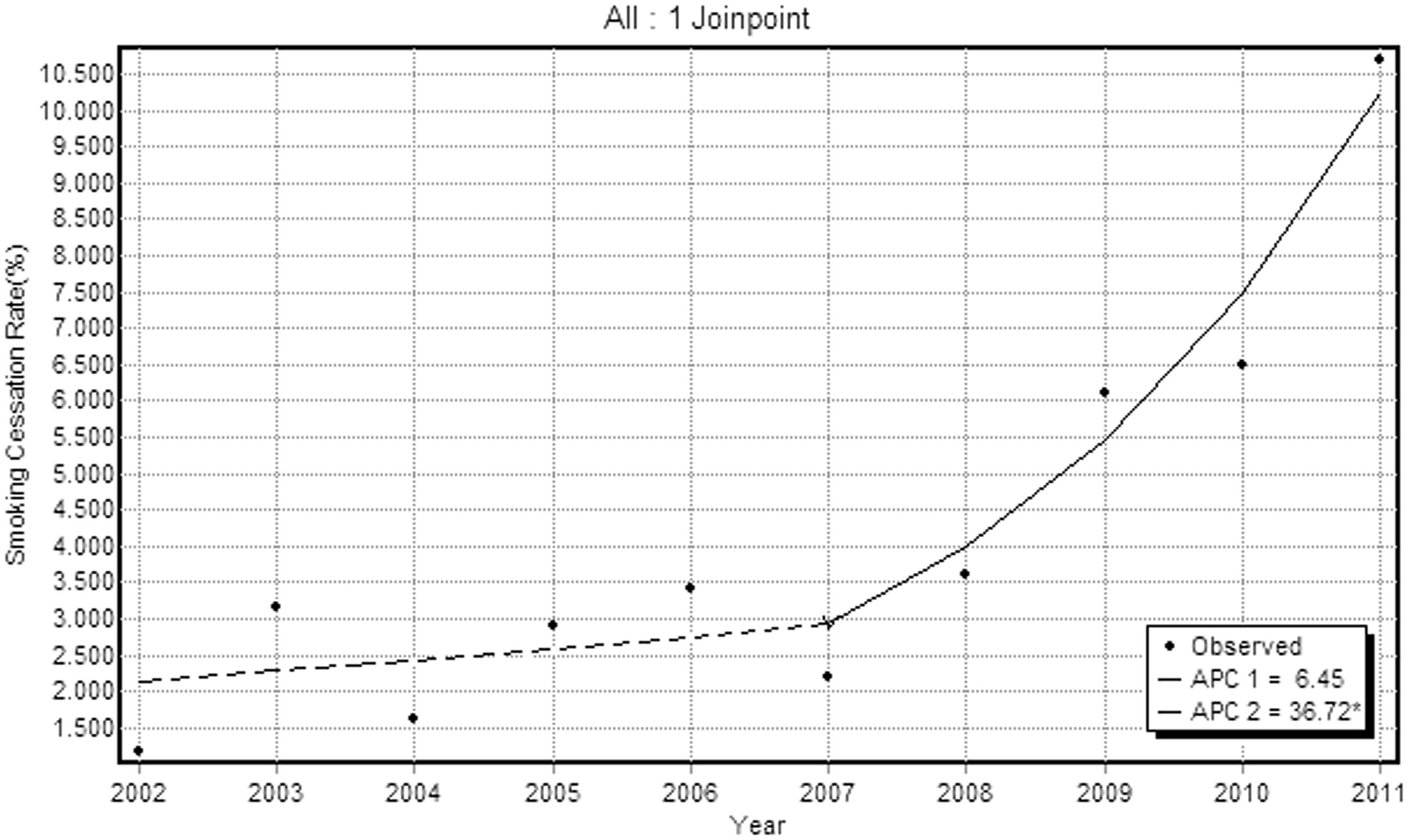
Discussion
Compared with other analyses, results from the present study show that annual smoking cessation rates increased at a statistically meaningful level among teachers, from mid-2007 onwards. This date coincides with the preparatory work of the National Tobacco Control Programme, planned for implementation between 2008 and 2012. Once the law was implemented, the previously increasing rates of smoking cessation were maintained, and a further increase was detected in cessation rate 1 year later, with one in every 10 smokers quitting the habit. The results demonstrate that even publicizing the law triggered an increase in smoking cessation rates, and indicate that this trend continued after the smoke-free legislation was introduced.
The increase in quitting rates suggests that the law achieved its desired impact. The present evaluation of teachers’ perceptions of the legislation found that nine out of 10 respondents supported the new law, believed that it generally enjoyed public support and found that the new legislation likely had an impact on reducing the problems associated with passive smoking. Despite being one of the toughest smoking bans in the world, seven out of 10 respondents stated that the law involved no threat to their individual rights. This positive approach was shared by men and women. As one might expect, regular smokers had more negative attitudes towards this law compared with other groups studied.
Other studies inquiring into public opinion about the smoking legislation also suggest that the changes have been accepted positively by Turkish society. A public survey of 1331 people was co-ordinated by the Ministry of Health between 14 February and 1 March 2008 (i.e., before the enforcement of the law) and found that 85% of respondents were in support of no smoking in indoor areas. 9 We could not identify any further studies that discussed the opinions relating to these legislative changes among professional groups.
There are limited data on smoking-related diseases and quitting rates after the smoking ban in indoor areas in Turkey was enforced. 6 Many studies and compilations have found that smoking rates in Turkey have decreased since 1998.1,4,14 However, these studies found no correlation between smoking rates and the antitobacco law. In the city of Kocaeli, the population was educated about methods to help stop smoking and the effects of smoking, in a special project. Cessation rates in Kocaeli were found to have increased in 2012 compared with 2009, and hospital referrals due to smoking-related diseases were reduced by 22.5% after the enactment of the new smoking legislation. The research team attributed these changes to both the educational activities and to the limitations brought about by the changes in law. 15
The present study, conducted on teachers in Manisa, showed the impact of the law on smoking cessation rates. However, sample size limitations meant no evaluations could be made as to whether the reduction in smoking rates was greater among men compared with women, or if the impact was greater in people of different age groups. Although not statistically evaluated, our study found a numerical increase in quitting rates among older men, but a similar trend was not observed among women. A study covering the period between 1997 and 2010 emphasized that the yearly decrease in smoking prevalence was more noticeable among men than among women. 14 An increase in smoking cessation rates with age is a predictable result, because health problems increase with age. The lack of increase in the smoking cessation rate among women is a key issue because the tobacco industry sees women and girls as an important market in Europe. 16 Therefore, targeting women as the main focus in the war against tobacco, and organizing awareness and antismoking campaigns aimed at the educated female population, may prove useful.
In this research conducted among teachers, smoking prevalence in men was below the national average level of smoking in Turkey, but in women teachers, smoking prevalence was above the national average level (32.7% and 24.7% respectively). In studies conducted among teachers between 1995 and 2007, a noticeable, marked decrease can be seen in smoking rates. In two studies conducted in male and female teachers in 2007 and 2004, smoking rates were found to be 42–47% among men and 29–36% among women.17,18 When irregular smokers were added, the smoking prevalence among teachers was 70% in men and 50% in women. 19 A study in Manisa, in 1999, demonstrated smoking prevalence rates among male and female teachers of 48.3% and 32.5%, respectively. 20 These studies underline the decrease in smoking prevalence among teachers until 2007, whereas our study particularly demonstrates the decrease in smoking prevalence that has taken place since 2007.
Within the scope of this study, ‘ex-smoker’ was used to define persons who had already stopped smoking and were not smoking during the study period. Some of the people described as ex-smokers during 2001–2011 may have started smoking again. However, a review of the long-term results of the smoking cessation clinic of Karadeniz Technical University Hospital in Turkey revealed that their success rate was 58% for the first year, 49% for the second year, 44% for the third year, 43% for the fourth year and 41% for the fifth year. 21 Thus, the achievement rate largely stabilized 2 years after quitting. The present study demonstrates that the trend in smoking cessation rates increased: the rate was 3.6% before 2007, 6.1% and 6.5% in the following 2 years and 10.7% in the final year. After corrections due to possible bias, an increase in cessation rates is apparent. Lack of evaluation of cessation rates by age and sex are further limitations of our study, however. In addition, the results may contain a slight memory bias because the study was conducted in a cross-sectional design. Further cohort studies, with larger sample sizes, would be useful.
A review of trends in smoking cessation in developing countries has shown that quitting attitude is initially seen in the upper social classes. 22 Our study only demonstrated the positive impact of the antismoking legislation on teachers. Thus, further studies should be conducted to understand how smoking attitude in different social groups was affected in the period after the antismoking law was enforced in Turkey.
Despite the constraints of the study mentioned above, in conclusion, our analysis is the first study determining smoking cessation rates in a defined subgroup of the Turkish population over a 10-year period. The results also indicate how the smoking ban instantly affected the smoking behaviour of the population.
Footnotes
Declaration of conflicting interest
The authors had no conflicts of interest to declare in relation to this article.
Funding
The study was supported by a Celal Bayar Üniversitesi Project grant (Project number 2011-064).
Acknowledgements
The authors acknowledge HAYAT (Life is beautiful being active without tobacco, the peer education programme on smoking control, nutrition and physical activity among young people in secondary schools and high schools in Manisa, Turkey) and other members of the project team (in alphabetical order): Cenk Zongur, Department of Biostatistics and Medical Informatics, Celal Bayar University Medical School, Manisa, Turkey; Gul Gerceklioglu, Vocational School of Health Services, Celal Bayar University, Manisa, Turkey; Hakan Baydur, School of Health, Celal Bayar University, Manisa, Turkey; Hilal Bati, Department of Medical Education, Ege University Medical School, Izmir, Turkey; Nilgun Vurgun, School of Physical Education and Sport, Celal Bayar University, Manisa, Turkey; Pinar Guzel, School of Physical Education and Sport, Celal Bayar University, Manisa, Turkey; Saliha Altiparmak, School of Health, Celal Bayar University, Manisa, Turkey; Selhan Ozbey, School of Physical Education and Sport, Celal Bayar University, Manisa, Turkey; Turkan Gunay, Department of Public Health, Dokuz Eylül University Medical School, Izmir, Turkey; Yavuz Yildiz, School of Physical Education and Sport, Celal Bayar University, Manisa, Turkey.