




Abstract
What are DOACs?
The term DOAC (pronounced ‘DOH-ack’) stands for ‘
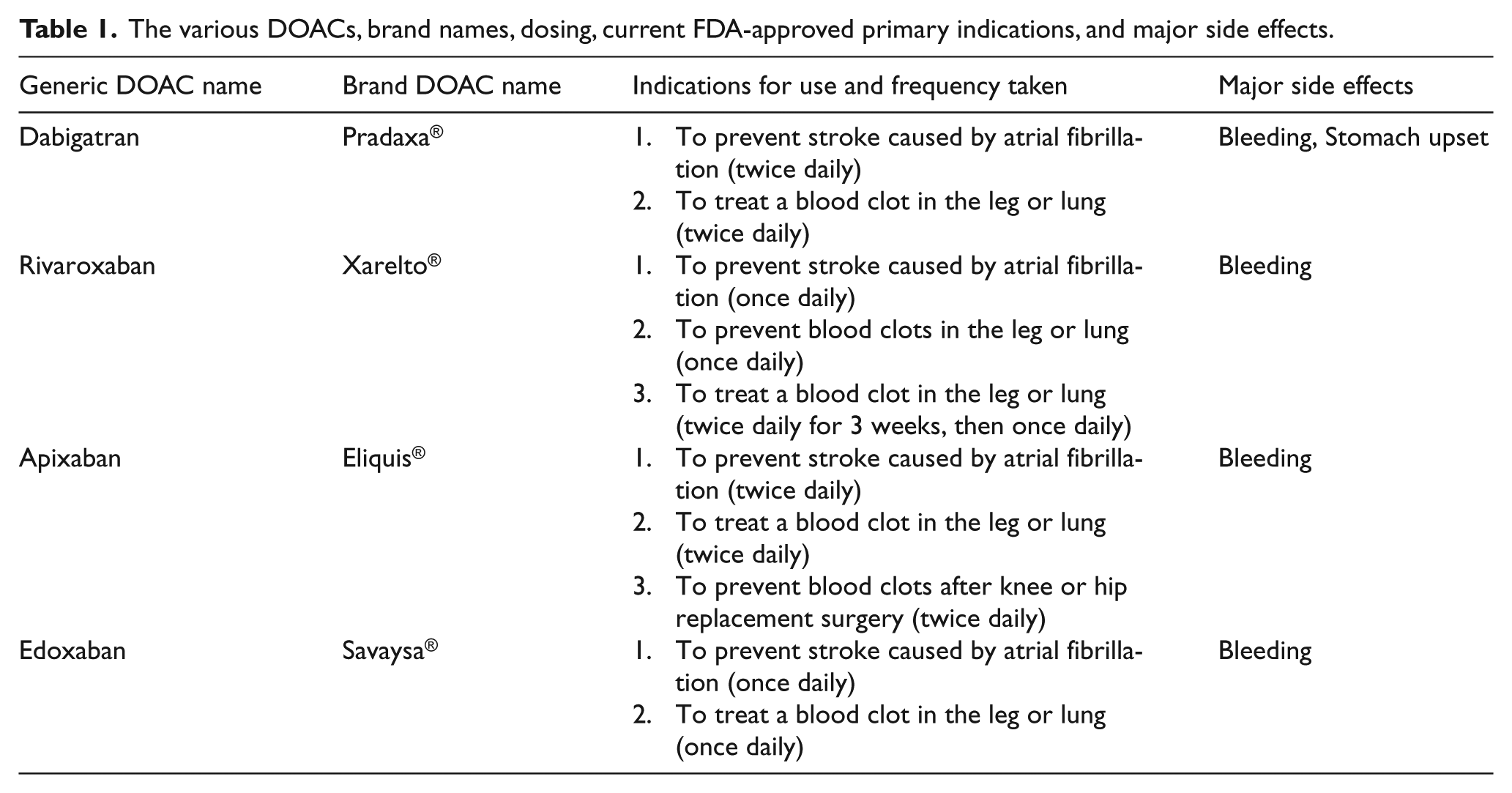
The various DOACs, brand names, dosing, current FDA-approved primary indications, and major side effects.
How do I know if I can take a DOAC?
A health care provider will consider several things to help decide if a DOAC is a good medication for each patient.
Am I taking the DOAC for the right reason?
DOAC medications should only be used for certain health conditions, such as atrial fibrillation (in the absence of heart valve disease), or for the treatment or prevention of blood clots in the leg and/or the lung (known as deep vein thrombosis and pulmonary embolism). 1 Each patient should discuss with a health care provider whether a DOAC can be used for his or her condition.1,2
Are my liver and kidneys working well?
DOAC medications do not harm the liver or kidneys. Instead, they need these organs to filter the medication out of the body. If the liver and kidneys are not able to filter out the medication, too much DOAC medication builds up in the blood and can increase the risk for bleeding. If a patient’s kidneys are not filtering well, the health care provider may prescribe a lower dose of a DOAC, or may prescribe warfarin instead, since warfarin does not require the kidneys to filter it from the body. Patients taking a DOAC should have a blood test to check kidney and liver function at least once every year.1,2
I often have trouble remembering to take medications
DOACs begin working faster than warfarin. They also leave the body faster than warfarin. For example, a DOAC thins the blood and gives full blood clot protection within a few hours after the first dose, and then it leaves the body in about a day. With warfarin both processes can take several days. This difference is important to remember. Since the DOACs leave the body so quickly, it is essential to take the DOAC every single day as prescribed.
Will I need to monitor my INR while I am on a DOAC?
Warfarin is an unpredictable medication, and there are many factors that make the dose of warfarin different for each patient. For that reason, health care providers use the international normalized ratio (INR) blood test to decide the right dose of warfarin. If a patient regularly takes his or her warfarin and gets INR blood tests but still the INR does not stay within the goal range, a DOAC may be a good choice to provide better and more consistent protection from forming blood clots. Because the DOACs are very predictable medications, patients taking a DOAC do not usually need regular blood testing to adjust the medication dose. Some patients who are familiar with taking warfarin may ask: ‘If I take a DOAC and am not getting my INR checked, how do I know if I am OK?’. The INR is specific to warfarin, and will not provide any helpful information for patients taking a DOAC. Also, many studies have shown that the DOAC dose is safe, effective, and predictable for most patients without the need for regular blood testing.
Some patients who take warfarin may have a hard time coming to a clinic or lab to get the INR blood test needed to adjust the dose of warfarin. In this case, a DOAC medication may be a good choice since no INR blood testing is needed.
Will I have to keep a consistent amount of vitamin K-containing foods in my diet?
For patients taking warfarin, providers recommend a consistent weekly amount of vitamin K foods (like broccoli, spinach, or kale) to help keep the INR in range. If a patient changes his or her diet frequently, the INR can fluctuate. In contrast, the DOACs are not affected by foods containing vitamin K. 1 The DOACs work differently than warfarin, so patients taking a DOAC can eat as many or as few vitamin K foods as they choose without it affecting the blood-thinner medication.
Can I afford to pay for the DOAC?
Before deciding to take a DOAC, the patient should find out the monthly cost of the DOAC medication and decide if he or she can afford that cost. When necessary, health care providers may help a patient find this information. Certain health insurance prescription plans may cover one DOAC but not another.
Are there medication interactions with DOACs?
Some medications may interact with the DOACs and cause the blood to be thicker or thinner.1,2 This interaction, in turn, may increase the risk of blood clots or bleeding, depending on the medication. It is important that patients taking any type of blood thinner let all of their health care providers know they are taking the blood thinner and ask the provider or pharmacist to check for interactions any time a new medication is prescribed.
Do I need to stop my DOAC before a surgery or procedure?
For some types of surgeries and procedures, patients taking DOACs will need to stop taking the DOAC before the procedure to prevent a bleeding problem during or soon after the procedure. 3 The plan for stopping a DOAC before surgery and restarting a DOAC after surgery is different for everyone. Patients taking a DOAC should talk with the provider performing the procedure and the provider who prescribed the DOAC to decide on the best individual plan.
What if I have a bleeding problem while taking a DOAC?
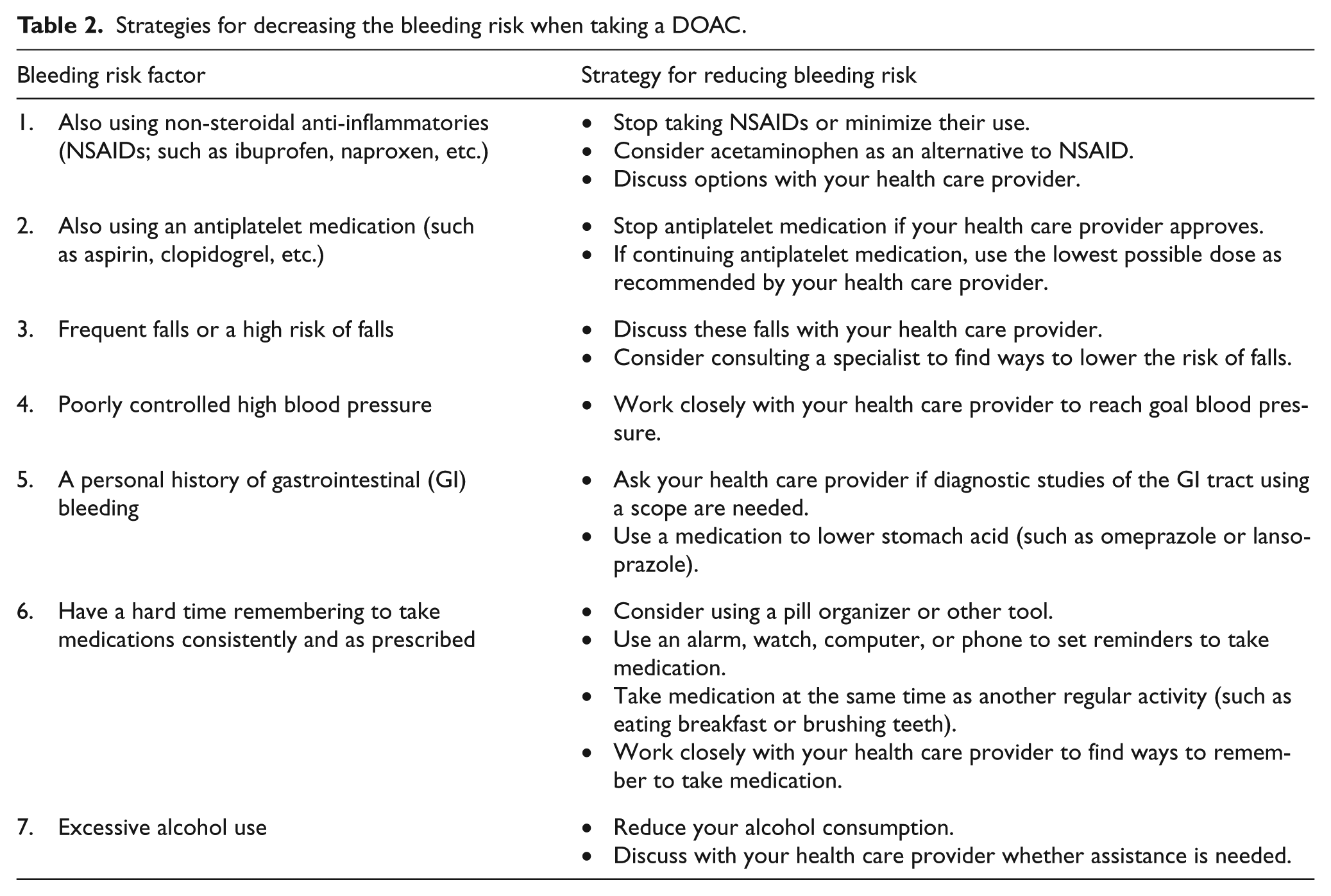
Bleeding is a common side effect of all blood thinners, including the DOACs. Several things can be done to lower the risk of bleeding while taking a DOAC (Table 2). Some bleeding problems are minor, while others are more serious and require medical attention. Patients who have a serious bleeding problem while taking a DOAC should either call 911 or go to the emergency room of the nearest hospital. Medical staff at the hospital will perform an examination and do some blood tests. It is important to tell the medical staff what time the most recent dose of DOAC medication was taken. DOACs begin to leave the body within a few hours. In a serious bleeding situation, the medical staff may give intravenous fluids and possibly a blood transfusion. Researchers are currently working on a specific ‘antidote’ for people who have a bleeding problem while taking a DOAC. 4
Strategies for decreasing the bleeding risk when taking a DOAC.
Do I still need to follow up with an anticoagulation provider if I take a DOAC?
Even though patients taking DOAC medications do not need to have regular INR blood testing, it is still important to have regular contact with a health care provider.1,5 This provider can make sure that patients have on-time medication refills, they answer questions about how to take DOAC medications before and after surgeries or procedures, they help check for medication interactions, they check kidney and liver blood tests, and they answer any questions about bleeding or other side effects from DOACs.
How do I choose which DOAC to take?
Patients should work closely with their health care provider to determine which DOAC is best. They should talk about the differences, including once- versus twice-daily dosing, the approved indications for their use, and side effects (Table 1). In addition, there may be other factors the health care provider will discuss.1,5 These could include any problems with kidney or liver function, weight, and personal preferences.
Summary
DOACs are a new group of blood-thinner medications that may have some advantages over warfarin. A health care provider will look at several different factors to help patients decide if a DOAC is a good choice. Patients taking DOACs should discuss medication changes, a plan for taking the DOAC before and after a surgery, and any bleeding side effects with their health care provider.
Footnotes
Acknowledgements
We thank Ms Kendra Richardson for her excellent editorial assistance.
Declaration of conflicting interest
Dr Vazquez has no conflict of interest to disclose. Dr Rondina has received grant funding from the NHLBI and NIA and honoraria from Janssen Pharmaceuticals for participation on a scientific advisory board.
Funding
This work was supported by the National Institutes of Health (HL092161, HL112311 to MTR) and the National Institute on Aging (AG040631, AG048022 to MTR).