




Abstract
In this article, we use an entry to an international architectural student competition on future care to explore how social norms about older bodies may be challenged by designs that are sensitive to the spatial contexts within which we age. The power of the My Home design by Witham and Wilkins derives from its hand-drawn aesthetic and thus we consider the architects’ insistence on drawing as a challenge to the clear and unambiguous image-making typically associated with digitally aided architectural designs. The hand-drawn images of My Home prompt a focus on care as enacted through the relations between material environments and things, and the atmospheric qualities these relations evoke. Throughout our analysis, we argue for greater attention to the ways in which embodied practices, everyday affects and materialities can be represented within architectural design, and the role of hand drawing as a creative methodology in this process.
Introduction
‘What happens’, Jean-Paul Thibaud asks, ‘when our aim is no longer just to design space but also to install an atmosphere?’ (2015: 39). His question takes us straight to the heart of an important aspect of our cities and buildings; namely, the engineering of affect by designers in order to prompt emotional responses among those living in, and passing through, their spaces (Edensor and Sumartojo, 2015; Kraftl and Adey, 2008). By affect, we mean the capacity for individual bodies to simultaneously ‘affect and to be affected’ by their environments, and by ‘the relations between bodies, and from the encounters that those relations are entangled within’ (Anderson, 2006: 735, 736); by atmosphere, we mean the ‘felt presence of something or someone in space’ (Böhme, 2013a). Affects are central to the production and experience of place (Anderson, 2009), and so it has been argued that we sharpen our focus on the affective qualities of place in order to understand their atmospheric qualities. A focus on atmosphere can offer ‘a means for bridging between emotion and affect, the personal and the general, and the discursive and non-representational’ (Bille et al., 2015: 36). Such a focus is important because patterns of social inclusion and exclusion can be intensified through practices of spatial design (Tonkiss, 2013) and, specifically, orchestrated through the atmospheric qualities designed into the built environment (Böhme, 2013b).
The role of atmosphere in guiding the affective qualities of architectural design is not a new matter of concern. Historically, architects have highlighted the importance of atmosphere as a way of understanding both their design practice and the experience of their designs. Le Corbusier argued that, in instances of harmonious design practice, the qualities of architectural atmospheres collapse any distinction between buildings and their wider surroundings (1945: 66). In terms of how buildings are encountered and inhabited, Frank Lloyd Wright held that people ‘actually derive countenance and sustenance from the “atmosphere” of the things they live in or with’ (2008: 350). In one of the classic statements about the lived experience of architecture, Rasmussen (1962) itemises the sensory qualities – of light, sound, colour, texture, scale and so on – that combine within individual buildings to produce their atmospheric affects. And, in one of the primary texts underpinning phenomenological approaches to architecture, Norberg-Schulz (1980) argued that individual buildings must always be understood within the distinctive atmospheres of their surrounding environments, through their ‘genius loci’.
In contemporary debates, atmosphere becomes a heuristic device for understanding the power of architecture to imbue our social practices and, moreover, to help cultivate more progressive spatial cultures in the present and for the future (Pérez-Gómez, 2016). Thus, we take Thibaud’s question at the beginning of this article as our starting point in an exploration of how care environments for later life were envisaged by architectural students, in response to an open competition on designing care homes of the future. Sensitised by our analysis of the full competition (Nettleton et al., 2018a), we use a single competition entry by Rachel Witham and Chris Wilkins, entitled My Home, to draw attention to the methods available to architects to challenge prevalent cultural scripts when they design for later life care. Previous research has highlighted the significance of environmental factors within care settings: as a typical example, Reed-Danahay (2001) argues that residential care settings are driven by institutional processes that dislocate them from anthropological markers of home. Such processes work against experiences of dwelling and the material cultures of home making practices (Latimer and Munro, 2009). In contrast to the typical institutional aesthetics of present-day care homes, the My Home design by Witham and Wilkins signals alternative points of departure in the design process. As we will go on to consider throughout the article, and as may be glimpsed in Figure 1, this design formulates an understanding of care as an art of dwelling (Schillmeier and Domènech, 2009), and helps us to understand questions of care in expanded ways, as feminist scholars have argued (Puig de la Bellacasa, 2011). The design is sensitive to the interrelation of the human and non-human in the built environment and the role of emotion, embodiment and materialities in practices of home making. The drawing alludes to a social encounter and an everyday scene, modestly suggesting the lively human contact facilitated through non-human things such as tables, chairs and playing cards, rather than offering a precise rendering of room dimensions and functions. In doing so, the drawing exemplifies an openness to how space may be used by future inhabitants, avoiding too much prescription about how the building should look or how it should perform. It is our argument that drawing, as a creative methodology, offers much scope for evoking a nuanced understanding of the intangible and emotional qualities of our social worlds (Hurdley et al., 2017).
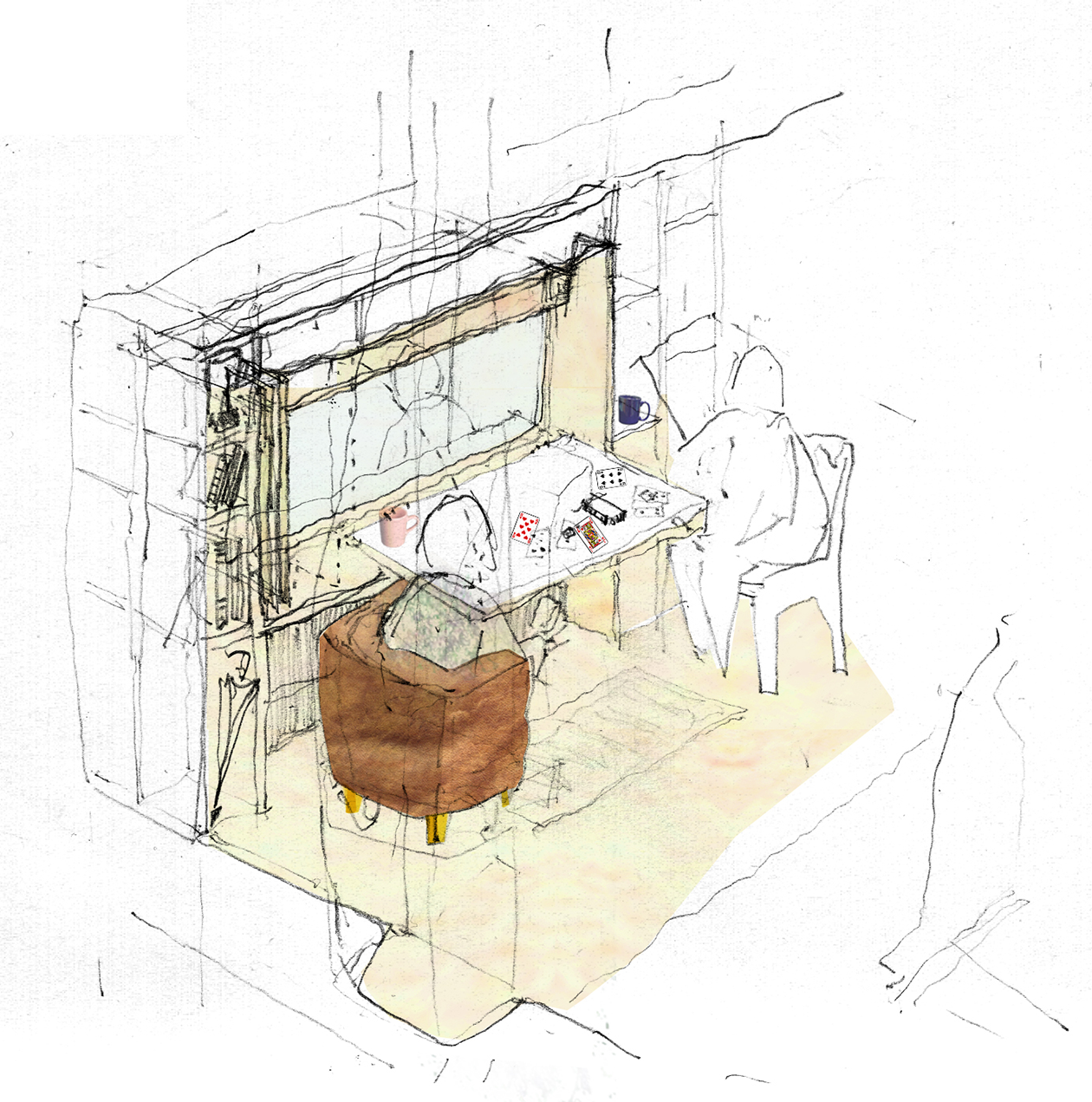
Social sketch. Source: Witham and Wilkins.
The power of this design derives, in large part, from its hand-drawn aesthetic and thus we consider the architects’ insistence on drawing as a challenge to the clear and unambiguous images typically associated with digitally aided architectural designs (Vidler, 2000). In the competition Witham and Wilkins submitted to, the large majority of designs submitted by other candidates utilised digital stock images, resulting in a range of bodies from docile and frail stereotypes to equally normative representations of physical fitness and consumerist modes of ageing (Nettleton et al., 2018a). While we do not wish to advance a deterministic reading of designs utilising software being necessarily inferior to designs drawn by hand – clearly, there is scope for sensitive software-based design practices that capture the embodied and sensory qualities of place (Degen et al., 2017) – it has been our experience that, because they use stock images, computer-aided designs tend to reproduce cultural scripts of the imagined ‘end-users’ of buildings (Nettleton et al., 2018a). Such precisely rendered stock images tend to work according to the logics of photographic technologies that are directive and definitive in the images that they make, often resulting in representations that are strangely static (Featherstone, 2010). Expressed another way, computer-generated images are contemporary iterations of the technical drawing tradition that aims to stabilise architectural and engineering plans, laying out precise measurements, room dimensions and structural aspects of the proposed building. Technical drawings, Ingold suggests, are very different from sketches, in that they ‘may encode instructions on how to move, but convey no movement in themselves’, and are thus ‘devoid of feeling’ (2013: 126). The hand-drawn images of My Home, in contrast, are tentative in their affects, avoiding overspecification in order to suggest the use of space and design in more open ways. These sketches are, we argue, more representative of a style of hand drawing which expresses ‘an anti-totalising force that enables us better to understand how lives are lived not in closed social worlds but in the open’ (Ingold, 2011a: 221).
Blackman and Venn have argued that, within body studies, the affective turn demands a ‘rethinking of the concept of embodiment’ (2010: 9); to consolidate and extend this point, we must also concentrate on the methods by which we imagine embodiment. Specifically, in this article, we argue for the potency of hand drawing in suggesting the material cultures of the everyday, and how these might be accommodated in architectural approaches that avoid overly prescriptive designs. Instead, sketching as a method helps to keep open possibilities for the appropriation of eventual designs by their inhabitants. Therefore, we analyse the techniques through which architectural professionals use sketches – of bodies, of buildings, of belongings and their intersecting relations – to populate their designs and create their affective and atmospheric qualities. The hand-drawn sketches suggest atmospherically rich evocations of everyday domestic settings and, we argue, help us to rethink design for later life away from overly prescribed built environments that serve market logics or accessibility standards in a spirit of compliance, rather than care (Nettleton et al., 2018b). These sketches imagine ageing bodies not as problems to compensate for through design, but rather in imaginative and lively ways, thus allowing us to glimpse ways of doing age differently (cf. Boys, 2014) and to think about how bodies inhabit space in less normative ways (Grosz, 2001).
Given the importance of hand drawing in our case study, we begin with an outline of contemporary debates about sketching as a creative method (Heath et al., 2018). We then discuss the importance of architectural drawing in particular (Sharr, 2009), in light of the increasing use of digital technologies at all stages of the design process (Scheer, 2014). The article continues with a brief outline of the competition brief and main themes across other entries, in order to contextualise our detailed exploration of the My Home entry. We discuss the ways in which this entry demonstrates an exceptional attention to the materialities of building design and inhabitation, in order to challenge more typical designs of caring environments in later life. We conclude by reflecting on the potential of architectural plans that focus on atmospheric qualities in order to raise aspirations for future care environments.
Drawing Out Lessons for Care
Despite its use by early 20th-century figures such as Patrick Geddes and the burgeoning interest in visual methods more generally, drawing has been a somewhat marginal practice in the methodological repertoire of contemporary sociologists (Hurdley et al., 2017). Its use has been relatively isolated within particular areas of sociological enquiry, such as research with children (Eldén, 2011). This neglect of drawing as a sociological method is widespread among other cognate disciplines with the notable exception of anthropology: in particular, Tim Ingold has argued for a more ‘graphic anthropology’ (2011b: 18), in which drawing is used as a method through which to better understand and engage with the complexities of human experience (2011a). Hurdley and her colleagues argue that drawing, as both research practice and cultural material, disrupts conventional logics and ways of knowing the social: drawing, they argue, is a slow and patient method that can afford ‘a different kind of looking, even a different mode of shaping the world’ (2017: 750). Heath and colleagues similarly argue that drawing leads to a more concentrated practice of seeing than even other visual methods, because of the ‘intense, sustained and embodied engagement between the hand and the eye’ required when sketching in fieldwork settings (2018: 726).
Drawing is, of course, a continuum that ranges from open-ended sketching towards more complete, schematic and technically precise ‘objective’ drawings (Lyon, 2020). For Heath and colleagues (2018), sketching is particularly valuable as a creative method that allows researchers to focus in on the smaller details of social encounters or environments, rather than feeling obliged to capture a total social scene. This focus results, they argue, in ‘a partial and often tentative representation of what is being observed’ (2018: 719) that is, despite its incompleteness, very attentive to the material culture of our social environments – we, as researchers, see more clearly details through sketching that our eyes overlook when surveying a particular setting. Freed from the need to provide completeness in our depiction of a landscape, a sketch allows us to observe in careful ways, ‘not so much to see what is “out there” as to watch what is going on’ (Ingold, 2011a: 223). Also, Heath and colleagues argue, sketching as a practice is a particularly apposite method for capturing the atmospheres of particular places and social encounters (Heath et al., 2018: 720). Hurdley and colleagues agree, suggesting that everyday practices of sketching can help us ‘to interpret, communicate, or share something that escapes verbal evocation’ (2017: 749). Moreover, they continue, drawing is inherently ‘democratizing’; because of its levelling qualities, sketching ‘rebalances power relations between the “expert” and the research participant’ (Hurdley et al., 2017: 749–750; see also Heath et al., 2018: 717).
Within architectural theory and practice, drawing has been considered among the primary skills of a professional architect in Europe since the Renaissance (Forty, 2000). Drawing has been seen as key to the process of problem-solving in architectural practice, and integral to the communication of design thinking (Cuff, 1980). In his historical review, Hewitt argues that we should think of architectural drawing as a ‘language of thought rather than simply a medium of expression’, given its place within the nexus of interrelated and embodied skills of ‘thinking, seeing, and drawing’ space (1985: 2, 3). Pallasmaa (2017) argues for the importance of drawing by hand because it aids the wider thought processes of architects. In Pallasmaa’s account, drawing acts as the basis of empathic and emotional architectural design (Tamari, 2017). In his famous essay ‘The Trout and the Stream’, Alvar Aalto explicitly identifies the moment of drawing, in an instinctual way, as the crux to unlocking strong design ideas from within the intractable constraints – technical issues, economic constraints, and human factors – that act as barriers to architectural projects (1948).
In contrast, others have viewed the profession’s attachment to drawing – especially technical drawing traditions – more critically. For Evans (1997), theories of architectural drawing that view the connection between imagined buildings and their representations as somehow natural are naive, ignoring the work of translation that produces images on the page, let alone buildings on the ground. For Till, architects’ commitment to drawing is a vain attempt to assert control over building processes that are inherently volatile, contingent, and over which they are often powerless (2009: 111; see also Stevens, 1998: 97). Vidler understands much contemporary architectural drawing as a protective professional code that is ‘as potentially hermetic to the outsider as a musical score or a mathematical formula’, resembling ‘little more than ciphers’ that are ‘meaningless to client and layperson alike’ (2000: 7).
Arguments against the increasingly clinical character of modern architectural drawing are intensified by the role of digital technologies in the production of plans throughout the design process, which critics view as extending and intensifying the normative aspects of the technical drawing traditions noted above (Ingold, 2013: 126). Writing at a relatively early stage of the wide use of computer-aided design across the profession, Vidler cautioned against the seductions of ‘digital topographies’, fabricated through software, that enable the simultaneous production of ‘an image as architecture and architecture as image’ (2000: 17). Between then and now, the profession has seen the development of new technologies that, for some, devalue professional modes of working, not least the practice of architectural drawing (Edwards, 2007). Scheer (2014) writes about the growing hegemony over the profession of Building Information Modelling (BIM) technologies that, in principle, enable the storing and sharing of data on architectural plans among other construction professionals, stakeholders and clients. He reflects upon his own sanguine early adoption of BIM giving rise to a creeping concern that, through these technologies, he was part of a ‘pervasive social and cultural movement towards virtualization and predictive control through digital simulation’ (2014: 2). Scheer echoes wider critiques of software-enabled practices that consolidate the logics of photographic technologies, stabilise cultural representations and attempt to elide the affective registers in which images work (Featherstone, 2010). While computer technologies have been argued to augur new possibilities for artisanal, imaginative and playful craft working (McCullough, 1996), and data visualisation software may enable qualities of animation and atmosphere in digital designs (Degen et al., 2017), cultural stereotypes can still inflect such designs. For critics such as Burch (2014), software-driven design fundamentally fosters a narrow understanding of architectural value.
While a sense of anxiety informs the place of drawing in contemporary architecture, we do not suggest that drawing has disappeared from the process of design completely – far from it. Burch (2014) detects the emergence of divergent architectural clubs, within which practices and styles of drawing are held in differing levels of esteem. So, Burch continues, BIM software is increasingly taken up by mainstream professionals in pedestrian ways, whereas elite firms use technologies as a supplement to established creative processes such as hand drawing. Questions of who gets to draw by hand, and who is charged with translating these hand drawings within software programmes to fuller building plans, speak to the internal status dynamics between different generations of architects within architectural practices (Ewenstein and Whyte, 2007; Groleau et al., 2012; Nettleton et al., 2020). Within firms, as observed in our own research, early career architects tend to be tasked with the development of computer-aided designs that derive from the hand-drawn plans of more established architects at the early concept stage. Moreover, senior architects get to draw over the digital representations and revise them during internal design reviews (Nettleton et al., 2020). In this way, drawing becomes an everyday method by which symbols of architectural distinction circulate within particular practices and in the profession more generally (Stevens, 1998).
The allusion to methods of architectural distinction is echoed in Sharr’s (2009) analysis of student drawings, where he uses Bourdieu’s theories to illuminate the educational dynamics of the architectural field, and the role of drawing within these. Sharr (2009) insists that, when used sensitively, drawings are capable of subverting architects’ roles as taste makers and taste dictators. That is, drawing can evoke understandings of place as provisional, mutable and open to ambiguity and appropriation by those who will come to inhabit them. Vidler has written of ‘the potential openness of the sketch, of the drawn line in all its subtleties’ (2000: 18). This resonates with definitions of drawing as ‘a kind of probing’ (Berger, 2011: 150), or a feeling towards eventual future spaces and their uses. For Ingold, sketches by hand are only ‘on their way towards proposition’ (2013: 126) and thus offer more engaged and engaging modes of articulation than those afforded through technologically aided drawing. While acknowledging the importance of technical drawing (and, we would add, software-aided design) in bringing the built environment into being, Ingold argues for the importance of the tradition of sketching, and outlines differences between the two types of drawing. For those who do the drawing, technical drawing is a practice of image rendering which represents previously conceived plans on paper (or screen) and results in an optical understanding of the world, whereas sketching is a practice of close observation of interaction, environment and encounter which results in a haptic relation with the world. Ingold goes further to suggest that a sketch should not even be thought of as an image strictly speaking, but rather as ‘the trace of a gesture’, and that drawing by hand is ‘a process of thinking, not the projection of a thought’ (2013: 128). The influence of Heidegger’s distinction between writing by hand and writing ‘with’ a typewriter, as emblematic of the influence of technologies on human experience, is acknowledged by Ingold (2013: 122). Indeed, there are clear resonances with earlier debates in art history too, such as Aloïs Riegl’s distinction between haptic, or tactile, modes of understanding the art of antiquity, and the optic, or retinal, modes of art appreciation from the late Roman period onwards (see Paterson, 2017).
For Sharr, the potential of architectural drawing is enhanced when it is put to the service of imagining buildings as they might be used, rather than should be used, and when drawing does not primarily function as a measure of professional distinction. Analysing a series of student designs, Sharr argues that the ‘obsessive labour put in to drawing everyday things shows that professionals can care about how buildings are inhabited’ (2009: 319; emphasis added), and thus he advocates that architectural drawings ‘take the authority that belongs to professional drafting and begin to re-ascribe it to everyday things’ (2009: 314). By not merely accommodating the everyday but taking it as its first principle in guiding design, architecture can form a basis for more socially just, imaginative and realistic spatial cultures (Till, 2009). Drawing is, of course, just a first step in much wider processes of place making which, as we have previously argued, relate to how places are used in practice, by those who inhabit them in everyday ways (Brown et al., 2019; Martin, 2016; Martin et al., 2019). So, we do not suggest that convivial places will result in a causal way because of an architect’s good intentions or how they are sketched. Indeed, we must always be mindful of the assumptions and potential for exclusionary logics informing the work of architects, even as they try to design in socially conscious ways (Boys, 2016; Imrie, 2003). Nonetheless, understanding drawing and its potential for expressing more just futures is important and so, next, we turn our attention to the designs gathered in the architectural competition for which our case study, the My Home proposal, was developed.
The Competition
This research is part of a UK Economic Social Research Council-funded project on architecture and later life, in which we explore how architects translate ideas of care into their designs of residential buildings. In particular, this article extends our analysis of an archival data set of entries to a competition which asked architectural students to envisage care in the future (set 70 years from that point in time). The competition was sponsored by a practice with an international portfolio of care homes for later life – DWA – and the RIBA in 2009, and was open to architectural students of all nationalities. The brief was succinct and not limited by technical requirements, but rather informed by socio-economic speculations about ageing populations with increasing percentages of chronic illness, changing family structures, policy climates and market responses to all of the above. The fact that these designs were unbuilt and designed by students does not detract from their value as architectural plans which encode within them prevalent cultural scripts about social categories and imagined bodies (cf. Prior, 1988). Indeed, as Larson argues, because of the lack of commercial and regulatory constraints, such architectural competitions ‘have potential for changing […] authorized notions of what architecture is’ (1994: 472) – in this case, architecture for later life care. Sixty-nine entries were judged by a panel of architects and care industry experts, with three prizes awarded alongside three highly commended entries. The entry on which this article is focused, My Home, was the work of Rachel Witham and Chris Wilkins while they were students, before moving on to professional practice. It presented a plan of extra care flats and was awarded second prize overall.
In our review of the entire data set, we drew on existing themes within debates in body studies to identify different strategies of representing ageing bodies throughout the competition entries. We found that entries often reproduced particular types of bodies when populating the architectural plans and that these were, in the large majority of cases, produced through using stock images derived from digital software. Throughout the data set, bodies were imagined in a number of different and sometimes interrelated ways, including bodies that exhibited sociobiological understandings of ageing and ailment; bodies that were reliant on technological supports to adapt to later life; bodies that were fit, active and at home with consumer culture; and bodies that were biographically positioned alongside cultural products that evoked particular historical periods (Nettleton et al., 2018a). Very occasionally, bodies were narrated through designs that started from an understanding of embodied and emotionally attuned experiences (Martin et al., 2020), as was the case in My Home. My Home was not the only competition entry which exhibited an embodied approach to design, but there were very few competition entries that did so; of those that did, My Home was the most explicit example, and most novel and far-reaching in terms of its understanding of design in a multisensory way. Above all, it was the competition entry which used hand drawing in the most pronounced way, in order to orchestrate the affective and atmospheric qualities of its design.
We therefore use My Home as a single case study which can extend the scope of what we, as researchers, can learn from the analysis of architectural drawings, plans and competition entries (Prior, 1988, 2003), specifically when seeking to understand how designers orchestrate the atmospheric qualities of the environments in which we age. Donmoyer (2000) has persuasively argued for the value of the single case in developing researchers’ experiential knowledge of social issues, in ways which encourage empathic observations and challenge taken for granted understandings of people and place. In her comprehensive review of markers for quality in qualitative research, Tracy includes the analysis of drawing as one of the hitherto neglected areas through which researchers might engage creatively with data, inspire curiosity in their audiences and develop the ‘methodological significance’ of their studies (2010: 846). She argues that methodological significance can be related to the emotional resonance of research, and its ‘ability to meaningfully reverberate and affect an audience’ (Tracy, 2010: 844). Drawing methods, Lyon (2020) argues, are emblematic of wider moves towards accessible and participatory forms of research, with drawings as material objects holding great communicative power. Drawings are not purely images, but rather evocative things, with the potential to ‘act as a bridge between researcher and non-researchers’ (Heath et al., 2018: 717). Drawing is an ‘eclectic, sociable, and undisciplined material methodology’ that can prompt us to look more slowly and closely at our areas of study (Hurdley et al., 2017: 752).
Our article builds on previous research that uses architectural competition entries as data (Andersson, 2015), including the designs of students (Gottschling, 2018). There is a tradition of scholarship in architectural theory that uses measured drawings, by students as well as established professionals, to engage practice with wider social theory (Sharr, 2009). In this article, then, we use the My Home proposal, and especially its sketches, as emblematic of a wider architectural trend towards design guided by phenomenological theories (Pallasmaa, 2014a) and conceptual understandings of atmosphere (Zumthor, 2006). Because of their hand-drawn qualities, the My Home sketches achieve a visual impact which is more-than-visual in its affects (Paterson, 2017). This gives the images a quiet power and so, in the following sections, we use these drawings as prompts to think through the potentialities of such approaches for imagining alternative spaces of care in later life.
My Home: The Materialities and Atmospherics of Care
In its opening proposition, its designers explicitly characterise their proposal as a ‘phenomenological response’ to the competition brief, for while ‘medical, technological and architectural ideas will undoubtedly advance our instinctive responses to space, form, materials – our sensory experience of place will endure’. Their entry was distinguished by its attention to material culture and its suggestion of intangible atmospheres via the use of colour, light and shade, achieved through hand-drawn sketches. We explore these themes and methods throughout our article and conclude by reflecting on how our case study’s use of sketching exemplifies the value of modest, messy and provisional designs for future care.
Materialities of Care
Looking in detail at the My Home design, each resident’s one bedroom flat is arranged in a sequence of ‘threshold’ spaces that become progressively more private. The design moves from the entrance area through a communal area for making food and being with others, past the bathroom and into the private sleeping area. The flat is arranged to condense a variety of functions within the overall area (so, there is seating within the wall, a bath neatly located in a recess and a small cubicle at the foot of the bedroom offering a window seat to views outside). But, as is evident from the plan of the flat (Figure 2), perhaps the most striking feature is the variety of accessories and small pieces of furniture dotted around the rooms – here a teapot, there a radio, a phone and a welcome mat. Elsewhere, instead of the dimensions and evacuated space of the typical architectural section, we see a colourful assembling of things that accumulate to evoke domesticity (Figure 3). Compared with the precision of the typical architectural section, here the architects seem to follow ‘techniques of deliberate imprecision’ in their drawings to capture the messiness and materialities of our social worlds (Law, 2004: 15). Of course, drawings are never neutral, but value-laden artefacts, and we do recognise that ideas of domesticity are invariably classed, gendered and normative (Blunt and Dowling, 2006; Chapman and Hockey, 1999) – as are drawings that evoke domesticity. Similarly, Boys correctly sounds a cautionary note when highlighting the implicitly essentialist logics that can be embedded within architectural approaches in design for care (2016). However, Witham and Wilkins’s plan does acknowledge the importance of material culture and everyday objects in facilitating home making practices (Miller, 2008, 2010) and, in doing so, demonstrates sensitivity and restraint with respect to the limits of architectural design to achieve care on its own terms.
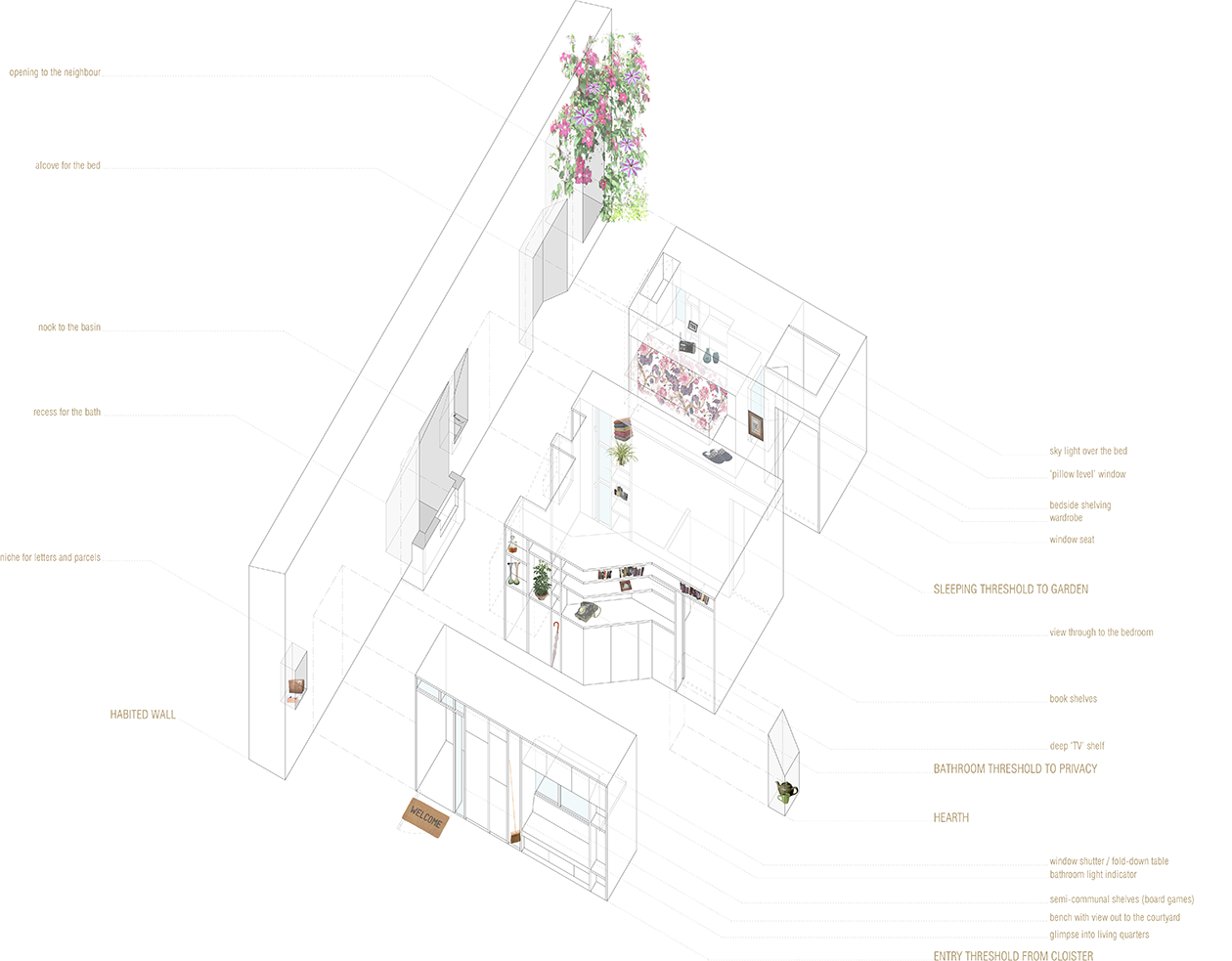
Axonometric map of belongings. Source: Witham and Wilkins.
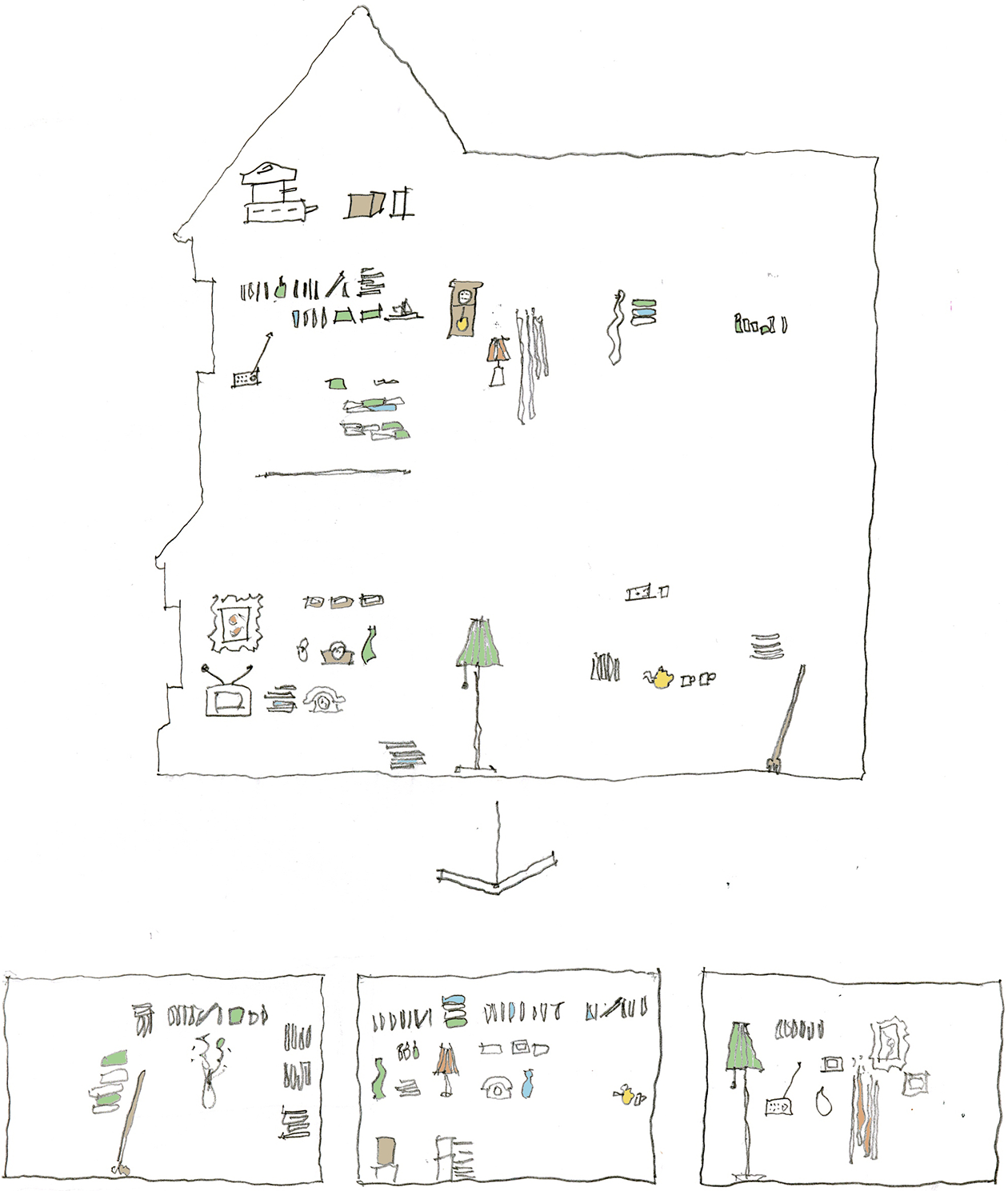
Distillation of the family home. Source: Witham and Wilkins.
The objects in My Home assemble to provide domestic atmospheres that encourage thinking about how to enable caring environments, or acts of dwelling (Schillmeier and Domènech, 2009). The architects work with an understanding that ‘what people “keep” affects their experience of dwelling’ (Latimer and Munro, 2009: 317) and, moreover, that dwelling as a notion and practice involves thinking about care in terms of the affective, and affecting, entanglement of bodies, buildings, technologies, things and emotions (Schillmeier and Domènech, 2009). Rather than being engineered into a tightly prescribed building plan, a dwelling approach to architecture would rather situate care more modestly at the intersection of embodied practice, material culture and spatial flexibility – and design accordingly. Departing from a similar dwelling perspective, Sharr (2009) advocates design practices that are concerned less with architectural conventions and more with how space is inhabited, arguing against the long-established and prevalent tendency in architectural plans to erase representations of people, furniture and clutter. Witham and Wilkins allow domestic things to take centre stage in their spatial design – much as the stuff of everyday life makes interior landscapes testament to the lives lived within our homes (Miller, 2010). There is, the architects of My Home suggest, a sense of comfort in things and the relations they mediate between individuals, their environments and an associated sense of well-being and care (Miller, 2008). Indeed, the idea of comfort and fit has informed the work of architects designing in socially conscious ways: Herman Hertzberger, the architect of one of the most celebrated 20th-century developments for later life care, the De Drie Hoven complex in Amsterdam, considered the best architecture ‘rather like clothing, which must after all not only suit you well, but also fit properly’ (2001: 174). Of course, such statements prompt questions as to whose bodies are subtly prioritised and thus fit, and whose bodies are ignored and thus ‘mis-fit’ (Boys, 2016). That noted, Hertzberger’s architecture did attempt to avoid prescriptive planning in favour of a more indeterminate approach that encouraged residents to appropriate and reconfigure their buildings, according to their wishes. In their emphasis on mundane artefacts and domestic detail over the typically evacuated white spaces, measurements and technical specifications of architectural plans (and the sometimes consumerist and aspirational imagery of other competition entries (Nettleton et al., 2018a)), the My Home drawings work to similarly subvert the status of professional aesthetics and qualify the idea that architects know how best to achieve caring environments. Their response to the question of future care is to avoid the reliance on technological solutions that characterised many of the other competition entries (Nettleton et al., 2018a) and, instead, advance an understanding of care underwritten by the stuff of the everyday, and the emotional significance of material culture (Miller, 2008).
The My Home architects write about the importance of permitting ‘as many belongings to be brought with the owner as is possible as the ability to inhabit, appropriate and personalise their room and surroundings offers the possibility of generating a new sense of “home”’. The design exemplifies Latimer and Munro’s arguments for care practices that allow for ‘giving room to things’ (2009: 318; see also Puig de la Bellacasa, 2011). To give room to things is to make space for a kind of memory work in situ, manifesting what we elsewhere refer to as the materialities of care (Buse et al., 2018) and aligning with past studies on the significance of material objects in helping care home residents to reconstruct a sense of home in institutional settings (Cram and Paton, 1993; Nord, 2013). Previous research has highlighted the dissonance between architects’ understanding of material possessions in housing for later life as ‘morally neutral’ compared with their emotional significance for residents (Fairhurst, 2000: 764), but this design articulates a surer sensitivity to the affective potency of material culture. In this design, these sketches suggest things that are homely in their affects and allude to home making practices, rather than prescribing aspirational, normative or generic markers of home (Nettleton et al., 2018b). There is an awareness of the capacity of mundane material culture to facilitate everyday social interactions that, in turn, help to build and maintain ‘enduring and evolving possibilities for the self’ (Chaudhury and Rowles, 2005: 13). In this, My Home implicitly articulates a hopeful sense of care and home settings, wherein residents are active in making new social connections through everyday objects and furnishings, and the types of social interactions and hospitality they afford (Lovatt, 2018).
Working within an understanding of affect as an intimate entanglement of emotions, objects and subjectivities (Ticineto Clough, 2010), the designers conjure an assemblage of care that is premised upon the enactment of ‘human and nonhuman encounters’ (Duff, 2016: 63), as quotidian as the act of making a pot of tea (Figure 4) or the sociability of engaging in a game of cards (Figure 1). Although drawing tends to be considered as a representational practice, we argue that these images of mundane things work in more-than-representational ways (Lorimer, 2005) through their suggestion of the haptic, embodied and material aspects of social relations and interactions. They are attuned to the tangible and intangible atmospherics of social practices as they are experienced and sensed (Mason and Davies, 2009). The relationality of these objects, aligned in dense and animated spatial networks between bodies, buildings and other objects, do something quite unusual in comparison with other competition entries we analysed; they evoke the materiality of care in heightened ways. In the submission, the designers write that the comfort of a carefully crafted timber seat or the patina, texture and smell of a leathery armchair will always bring delight. The feel of warm sunshine on your skin on a cold winter morning will forever be a pleasant sensation – just as closing heavy shutters on a dark, rainy evening will still offer security, enclosure and safety seventy years into the future.
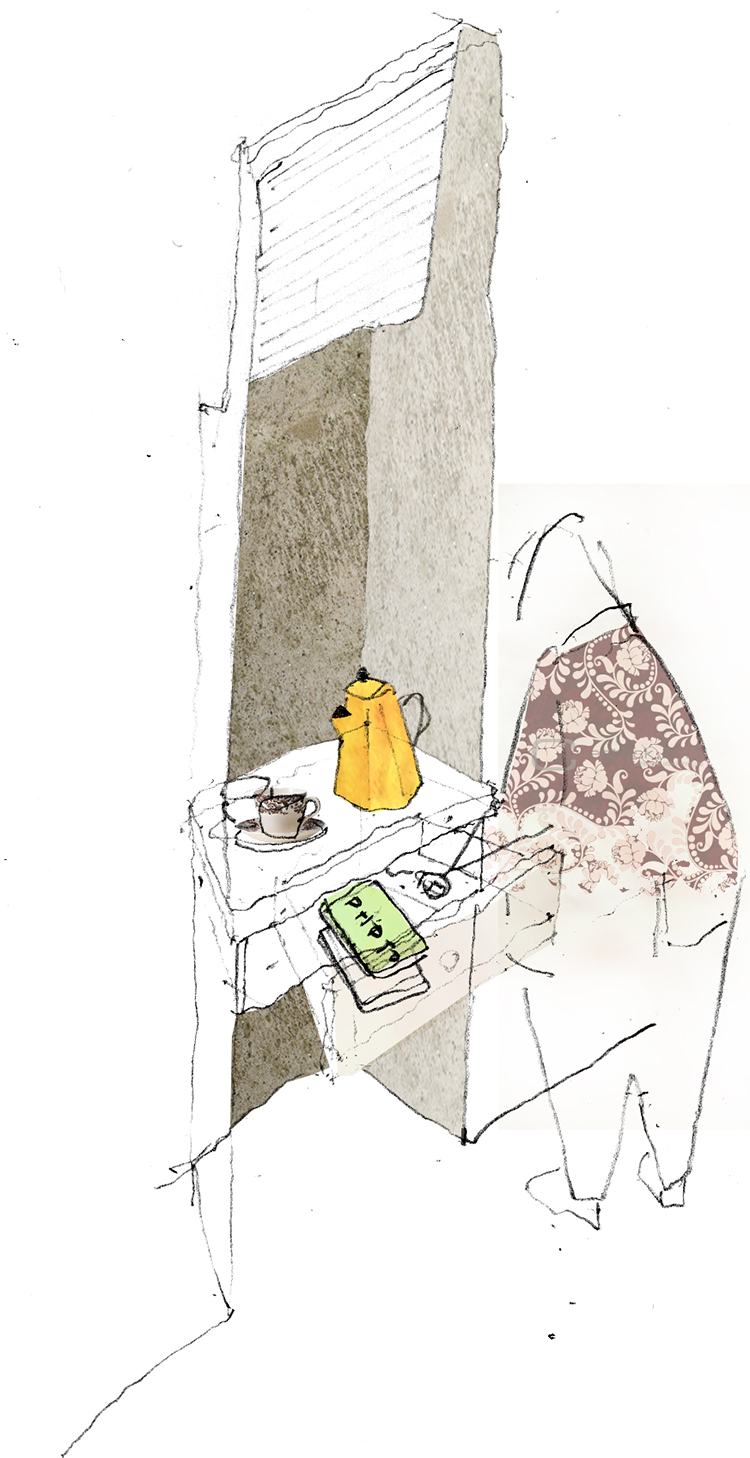
Tea. Source: Witham and Wilkins.
Notwithstanding the dangers of embedding design for care within ideas of comfort and fit (Boys, 2016), the architects’ haptic, more-than-visual understanding of architecture (Paterson, 2017) is reflected in a sensitivity to materiality throughout the plan. In their entry, Witham and Wilkins note the importance of using timber in the design that wears with time and will ‘adopt the marks of use’. The designers of My Home are working here within an atmosphere that facilitates a mode of caring through things, in which materiality explicitly helps to amplify one’s sensitivity to the atmospherics of place (Parrott, 2016). It is to this notion of atmosphere, its role in architecture and its potential in enabling alterative design practice for care in later life that we turn to next.
Atmospherics of Care
In her writings about the affective atmospherics of everyday life, Kathleen Stewart urges researchers to be attuned to the ‘oblique events and background noises that might be barely sensed and yet are compelling’ (2011: 445). The My Home design conjures up qualities of place that are intuited rather than immediately intelligible, combining environmental factors and embodied encounters (Pallasmaa, 2014a). Pallasmaa has argued that thinking in atmospheric ways for architects may not result in precisely rendered plans, but rather in ‘diffuse images, often as formless bodily feelings’ (2014b: 83). Such diffuse images indicate the complexity of sketching something as indeterminate as an atmosphere, which has been described as the shaping of the world as if ‘through a haze’ (Bille, 2015: 269), borne out of the ‘very sensuous interface of people, places and things’ (Bille et al., 2015: 37). The sketches in My Home offer exploratory lines that are redolent rather than doctrinaire in their suggested future patterns of use in the planned spaces, with embodied movements and actions more hinted at than directed. The images invite reverie rather than the performative certainties of precisely scaled plans. In Figure 5, we wonder: Are those really sheep in the drawing, and if so, what are they doing there? In Figure 5, too, we as viewers move past our initial confusion to imagine ourselves into the image, understanding the affordances for sociable interactions brokered through an architectural space that remains open to the eccentricities of the everyday. The architects’ sketches provide a setting for ambiguity, improvisation and conviviality.
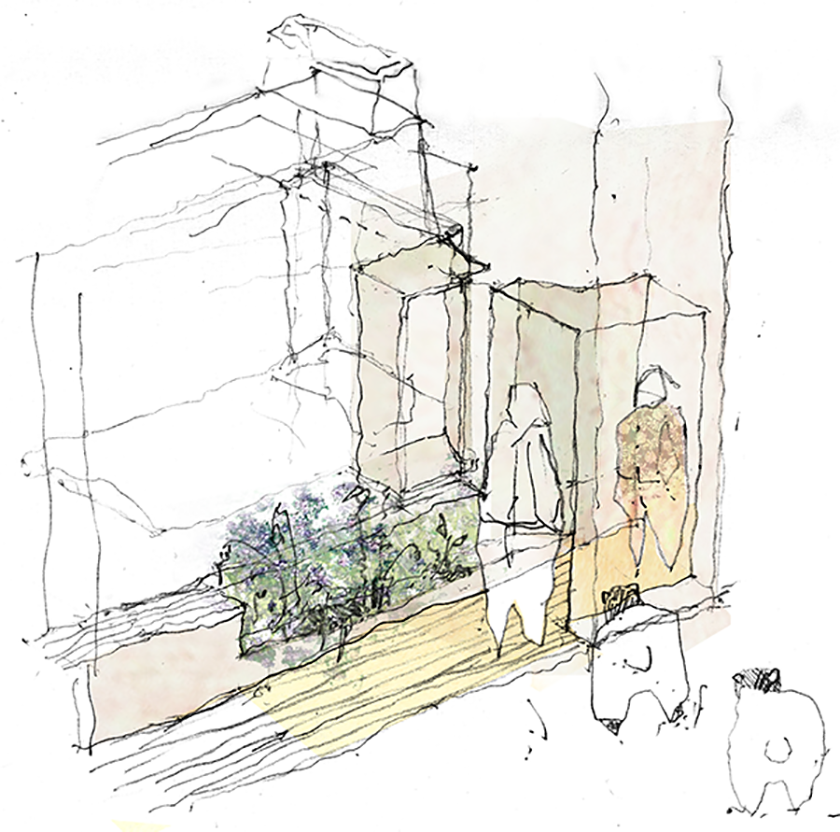
Conversation. Source: Witham and Wilkins.
The analogy of the stage set as the generator of architectural atmospheres is apt when thinking of this proposal (Böhme, 2013a; Edensor and Sumartojo, 2015). The design presents a proscenium through which we can glimpse a sense of how culturally attuned design for later life might attend to lived and embodied experiences. We can see the production of caring atmospheres through the affective qualities of lighting (Edensor, 2017), which mutes the actions of the residents in ways which emphasise the nested qualities of home (Bachelard, 1994). In this we sense the importance of shaded space (Tanizaki, 2001), and the use of light in manifesting culturally specific ideas of comfort (Bille and Sørensen, 2007). The interplay of light, materialities and bodies is evoked in Figure 6, with an almost tangible brass railing wrapping around the bathroom wall to orientate the inhabitant, who is afforded privacy and shade within the recessed bath, which is a heightened space for the negotiation of private bodies and social identities (Twigg, 1999). The architectonic dimensions disappear in light of the glow of the railing and the low key framing of the bathing body; the architectural detail dissolves in the suggestion of the intimacy of the individual experience that is, in itself, felt in relation to the atmospherics and materialities of the bathroom space. This image indicates how My Home offers muted colours that are, nonetheless, luminous in their way. While there is a significant body of work on inclusive design of spaces for later life and disability, this design reflects the importance of going beyond accessibility to considering the nuances of everyday lived experiences, materialities and ‘feeling’ (Boys, 2014; Van der Linden et al., 2016).
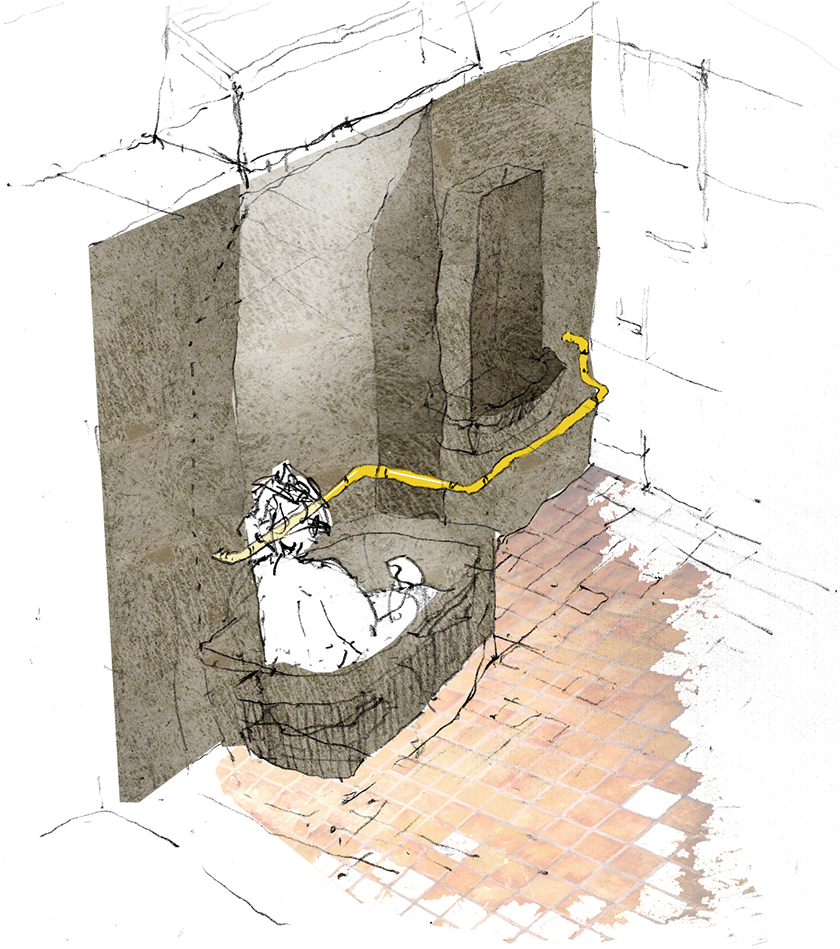
Orientation. Source: Witham and Wilkins.
My Home is attuned to the everyday practices of social bodies. Despite classic statements anchoring architectural design within a multiplicity of embodied experiences (Rasmussen, 1962), previous research has found that architects tend to design in imaginatively reductive and only self-referential ways (Imrie, 2003). Indeed, Elizabeth Grosz (2001) has long urged a different practice of architecture which is affectively attuned to somatic issues and is mindful of the lived experiences of bodies in space. In this competition entry, we see lives as much as bodies evoked in the freehand drawings of social routines and imagined interactions of this design. Previous research has highlighted the multiple barriers to self-identity and the construction of a sense of home once occupants are firmly in place and spatial practices of care are established (McColgan, 2005); My Home makes the argument that architects should avoid embedding such barriers at the early design stage, by keeping their spaces provisional rather than overly prescribed (McHardy et al., 2010). Rather than a proposal that emphasises elevation renderings of the facade, or institutionalised technologies that encode messages of social dependency, Witham and Wilkins offer a more muted design which stresses the material culture of everyday life. Designing from sketches, they use the traces of inhabitation – teapots, cards and fabrics – as the starting point for an architecture characterised by open-ended, indicative and more-than-representational qualities (cf. Salter, 2016).
These issues all coalesce within the crucible of architectural design and the challenge of working in embodied and empathic ways, by attending to the ‘generators’ of atmosphere (Böhme, 2013b: 27). Such generators of architectural atmosphere – qualities of light, colours and physical things – can be planned objectively by designers; however, they also carry qualitative meanings for those who live with, and work within, them. The generators of architectural atmosphere evoke tacit and haptic understandings of materialities (Pallasmaa, 2016), which are vital for designing environments that will, after all, be experienced through all the senses and in ways that are generative of embodied interactions and practices (Paterson, 2017). It is fitting, therefore, that architects design with a ‘care-full’ sensitivity (Boys, 2016) – that is, with a surer sense of how their spaces may be touched, felt and inhabited in everyday ways by those who may use them (Sharr, 2009), in order avoid generic visions of the ‘end-user’ (McHardy et al., 2010).
Concluding Discussion
Revisiting archives of architectural competition entries can be valuable for researchers interested in understanding how architects articulate their design philosophies and position themselves professionally (Lipstadt and Bergdoll, 1989). For Lipstadt, competitions offer architects a ‘degree of autonomy’ and room to experiment with their designs that is lost once their plans move onto construction phases (2003: 393). Indeed, competition drawings have been key to promoting architecture as a kind of artistic practice, through their publication in associated documents and exhibitions, especially for public buildings, since the Italian Renaissance (Lipstadt, 2003: 408). In this article, we analysed a specific competition entry in which the architects situated their representational strategies within these much longer traditions of architectural hand drawings (for a recent history of architectural drawing over many centuries, see Thomas, 2018). However, recent decades have seen the influence of computer-aided architectural design to such an extent that, within the context of this particular competition, the hand-drawn approach of the My Home architects was markedly different from the precise and software-driven imagery of their peers, and the different imaginaries of the older bodies that resulted from these technologies (Nettleton et al., 2018a). The affective power of the My Home proposal derives in large part from how the drawing methods of its architects challenge contemporary conventions in spatial design (Hamel, 2007). We have argued elsewhere that the atmospheric qualities of place are related to the ways in which space is used by its inhabitants, rather than the intentions of its architects per se (Brown et al., 2020; Martin, 2016; Martin et al., 2019). However, the ways in which embodied practices are imagined at the earliest stage of the design process are important in facilitating architecture that is enabling rather than prescribed (Buse et al., 2017), and hence the creative methods by which architects work are worthy of analysis.
Sectional drawings and floor plans in My Home are filled with the stuff of everyday life rather than the evacuated white space of most architectural drawings (Sharr, 2009). The architects anticipate Thibaud’s (2015) call for spatial designs that pay attention to the micro phenomena of the everyday and that transcend traditional distinctions between the design and lived experience of architecture. Their attention to the inhabitation of buildings in the future can be used to prompt questions of how care is provided more generally. That is, their design configures questions of care for future users as whole persons rather than patients (Kitwood, 1997), and works with an extended understanding of care as encompassing human and non-human agencies (Puig de la Bellacasa, 2011). Sketches are inherently provisional and malleable, as against the ‘prescribed personalisation’ of templates of good practice design (Nettleton et al., 2018b). Therefore, this design avoids a definitive proposal of spatial setting, with an overly certain representation of the presumed end-user, in favour of a somewhat vague design with only a provisional suggestion of its possible inhabitants and how they may use their space.
Bille argues for methods accepting of ‘vagueness and undecidedness’ (2015: 270; see also Griffero, 2010), which creates apprehension within architectural professionals who are trained to provide clarity rather than ambiguity (Pallasmaa, 2014a). Indeed, given the shifting modes of creativity legitimated by changing professional and technological paradigms, atmosphere holds a particularly tensed position in architectural practice because it cannot be stabilised or objectified (Pérez-Gómez, 2016: 18). Thus, thinking about architecture in terms of atmospheric affects and, moreover, generating such atmospheres through the method of hand drawing serves to challenge the definitiveness of traditions of technical drawing (Ingold, 2013). In the development from the early to later stages of an architectural project, drawings do have to become more technical; designs become pushed and pulled by different commercial and regulatory constraints, with inevitable challenges to the original aspirations for the eventual users (Nettleton et al., 2018b). Because of the need for more precise designs, technical drawings are increasingly achieved through computer programmes that are, in turn, premised on the logics, and static representations, of photographic technologies (Featherstone, 2010). In the My Home design, the images are diametrically opposed to the affects of photographic practice: these drawings invite a temporal as much as a spatial understanding, because they articulate a sense of ‘becoming rather than being’ (Berger, 2005: 124). The drawings elide questions of aesthetic style to concentrate on keeping open the possibilities of architecture as a social art. The question of openness is crucial to understanding the quiet power of these sketches in particular, and the potency of sketching as method more generally. Ingold articulates this well when he writes that in contrast to the tradition of landscape painting, where the painter works to compose as comprehensive a portrait of the phenomenal world as possible, drawing by hand is instead ‘a kind of insurance against finality and closure’, characterised by ‘anti-compositional, fluid, processual and improvisatory’ qualities (2011a: 220, 226). The My Home drawings are, of course, suggestive of the possible spatial cultures of future care but, more than that, they work within a qualitatively different temporal logic than their peers’ designs because of their tracing of the indeterminate affects, interactions and stuff of everyday life in the future.
Vidler (2000) has argued that architectural drawings can become little more than an exclusionary code among professionals, but the sketches in My Home do not share such qualities. Instead, these drawings offer a different ‘way of seeing’ (Berger, 1972) or, perhaps better, another ‘way of telling’ (Ingold, 2013: 125). These sketches are interpretive rather than legislative in their function, inviting a haptic awareness more than an optical understanding of their ideas for care in the future. Avoiding the emptied spaces of conventional architectural representations of space, these drawings focus our attention on individuals rather than architecture, affective encounters more than spatial standards and atmospheric qualities rather than quantitative measures. The result is an architecture that is more engaging and legible to non-architects than is often the case in contemporary design culture, due to the communicative potential of drawing as a creative method. The My Home design points to a more grounded practice that deflates the professional pretensions of architects, is sensitised to architecture as inhabited and seeks to collapse the different levels of expertise between architects and the users of their buildings (Till, 2009: 114).
The issue of disrupting power imbalances between architect and non-architects who use their buildings is signalled in Wigley’s argument that to ‘focus radically on the architecture of atmosphere is to displace the building and, in so doing, the architect’ (1998: 24). Decentring the narratives of architectural culture away from ideas of (mostly individualistic and male) creativity towards an understanding of how buildings are inhabited and how they feel to those that use them constitutes ‘an ethical promise’, and a prompt to architects to offer better alternatives and more liveable spaces than is typically the case (Pérez-Gómez, 2016: 191). Of course, attention to architectural atmospheres should but often does not play a sufficient part in the wider politics and economic contexts of spatial cultures (Borch, 2014; Grosz, 2001), and architectural ideas can always be pushed further in this respect. Because of physical, cultural and socio-economic barriers, not everyone will have equality of access to the spaces of sensitive design, although architectural proposals rarely acknowledge this (Boys, 2016). For example, the My Home plan has little to say about the question of where caring professionals fit into their design, and it does draw on spatial and domestic ideals that are, in themselves, socially classed and culturally specific. Nonetheless, through the designers’ sensitivity to the material cultures of the everyday, drawn throughout their plan is an atmospheric portrait of what care could be for the future. Through their attention to the material cultures that situate us as we age, they illustrate the affective power in design of introducing ‘a way of finding oneself amongst things’ (Pérez-Gómez, 2016: 195; see also Schillmeier and Domènech, 2009); through their accommodation of the everyday traces of inhabitation in their design, they edge us towards the imagining of architectures that allow for more hopeful spatial cultures (Anderson, 2006). John Berger has written of the act of drawing in terms of its radical hospitality and openness to the future (2005: 117, 124); in My Home’s sketches, we glimpse the affective atmospheres of materialities of care (Buse et al., 2018) which envision a similar openness to the future, in an area of design more often constrained by viewing its users in terms of their pasts.
Footnotes
Acknowledgements
The authors would like to thank the members of the ‘Buildings in the Making’ research team – Ellen Annandale, Siân Beynon-Jones, Lindsay Prior and Julia Twigg – for their guidance and contributions throughout the wider project. The authors would also like to thank David Beer and Nik Brown for their helpful discussions throughout the development of this article. An early draft was presented at the 2017 British Sociological Association Annual Conference (Manchester, UK), and the article benefited from comments and questions at this event. The constructive criticisms from anonymous reviewers, and the Body & Society editorial team, have improved the article considerably. The authors would especially like to thank Rachel Witham and Chris Wilkins for their agreement to reproduce their work in this article.
Funding
The author(s) disclosed receipt of the following financial support for the research, authorship and/or publication of this article: This research was supported by the Economic and Social Research Council, as part of the ‘Buildings in the Making: A Sociological Exploration of Architecture in the Context of Health and Social Care’ project (reference ES/M008398/1).
