



Abstract
Effectively a double-height or larger void internal to a building, the atrium is a familiar architectural feature the world over. The global popularity of the space in contemporary urban buildings – including hotels, shopping malls, casinos, hospitals, museums, galleries, libraries, schools, office blocks, and universities – is a somewhat puzzling development, and one ripe for sociological analysis.
Cultural political economy (CPE) helps to explain this affinity. Using this perspective guards against reductionisms of various stripes, while rigorously situating the atrium vis-a-vis the production and circulation of material and symbolic surplus value. By facilitating inquiry into how this architectural form stabilises and furthers capitalist arrangements, CPE allows for interrogation of the atrium’s distinctive role in adding momentum and cultural meaning to contemporary urban accumulative strategies.
In particular, the article draws out the atrium space’s paradoxical relationships to (i) the intensification of rentiership in very tall buildings, and (ii) with respect to the demarcation of insider–outsider boundaries underpinning elite consumption. Positioning the atrium as being reflective of attempts to both intensify and embed capitalism in the built environment, key arguments concern the meaningful, experiential and out-of-the ordinary nature of the space, As such, the article contributes to and draws from sociologies of architecture, reconciling the atrium’s materiality and meaning in a way that does not reduce either to the other.
Introduction
The idea for this article sprang from me finding myself in a lot of atriums, including the one at the university department I work at, in hotels, at my friend’s apartment block, at hospitals, art centres, academic conferences, at my nephews’ school, in shopping centres, and – more occasionally – in cafes and restaurants. Most of these were in the relatively new buildings, about 20 years old or less, in the UK and Europe. Here I set out to use sociological insights to denaturalise the atrium, deploying theory to tease out how the designed form of spaces lends momentum to accumulative strategies and practices.
The framework of Cultural Political Economy (hereafter CPE) affords analytical purchase on architecture’s entanglements with sets of capitalist arrangements while taking seriously the meaningful elements of the built environment. CPE provides a way of systematically interrogating the atrium, providing a sociological perspective on what can often be a taken-for-granted space, and in the process illuminating something about the way atriums emerge from and reinforce contemporary capitalist orders. Explaining the proliferation of this particular architectural feature, and its particular relation to the generation of surplus values of various kinds, is a deceptively challenging task; CPE helps to make sense of it.
The article unfolds in three main sections. The first describes some characteristic features of the atrium and includes a brief overview of its current popularity and geographic incidence. In the second section I justify the article’s focus on the atrium, drawing upon broader sociological analyses of architecture (Jones, 2011, 2016) to specify some productive lines of inquiry.
The third section carries the bulk of the analytically original contribution of the article. The overarching argument here is that CPE provides an apposite lens through which to view the symbiotic relationship of economic activity and architectural forms. Analysing the entangled nature of architecture and capitalist accumulation brings the temptation of reductionism; CPE avoids this problem by foregrounding a sense of architecture’s distinctive cultural character that happens within – and adds specific force to – material strategies of accumulation. The exploration here concerns how atrium architecture results from strategies to secure the ‘right’ spaces for rentier models of capitalism and associated consumption to flourish; this means carefully unpacking ways in which the built environment maximises and celebrates capital acquisitions and surplus values of different kinds.
Deploying CPE to this end, Section Three contains two subsections, each presenting a distinct but related argument. In the first of these sections I tease out the symbiotic relationship between the atrium and super-tall buildings. Understanding the role of voided space in rentier capitalism (Christophers, 2020) implicates the dual symbolic and material functions of architecture. The atrium affords significant external height to be achieved that is crucial to both. The second subsection analyses the affordances of the atrium with respect to the encouragement and intensification of consumption. In this respect, CPE directs our attention to how the atrium can add ‘additional force’ (Sayer, 2001) to capitalist arrangements by providing the ‘right’ kind of space for elite consumption.
Ultimately then, the aim of this exploratory article is to develop a coherent sociological theoretical inquiry with respect to the atrium, in the process drawing from and contributing to sociologies of architecture. In doing so, the article advocates sociological inquiry into singular architectural elements (and hopefully showcases the understandings that can derive from such a focus). The atrium is a space deserving of sociological attention, not least as it tells us much about the wider sets of arrangements within which it exists.
What is an Atrium?
Atriums – or more correctly atria (plural, Latin) – are in effect tall, voided spaces internal to a building. Albena Yaneva, a prominent sociological analyst of architecture, defines the atrium as: [a] large open space, often several stories high, covered by transparent or translucent material and usually located immediately beyond the main entrance [. . .] with vast design possibilities for creating covered interior spaces that protect users from the climate while still enabling them to enjoy the light, view the open sky, and be part of a highly interconnected communicative environment. (2009: 142)
Increased visual connectivity via expansive vertical and horizontal sightlines is key to the ‘light and airy’ feel of the atrium. The related blurring between inside and outside – allowing shelter from weather while maintaining visual connection with the natural environment – is often intensified by use of glass walls and/or roofing. In addition to presenting vantage points on the exterior environment to those inside, the atrium allows the architecture itself to become a spectacle; opening sightlines up, down and across the empty space provides a dramatic scene for those inside it. The atrium’s affordances for display of large, eye-catching objects, is thanks to the aforementioned volume of voided space. The atrium provides a relaxed-but-prestigious site for semi-formal interactions in an institutional context. Taken together, these characteristics of the atrium explain much of its contemporary popularity.
However, as the article goes on to argue, in contemporary capitalist economies, atriums are entangled with circulations of capital in a series of other, less straightforward ways. Before exploring these interconnections in more detail, my initial assertion that the atrium has become a major feature in many buildings in recent years requires support. In the absence of a register of new buildings this is a difficult thing to evidence empirically. Paradoxically though – and despite the lack of a definitive source – when it comes to the atrium, there are ‘so many examples it’s just really difficult to put your finger on any specific one [. . .] you can’t necessarily just look up atrium buildings’ (Rice, quoted in Paletta, 2020). This being the case, what evidence is there to suggest the atrium’s contemporary global popularity?
Consulting architecture publications BDOnline and Architects’ Journal suggests that the world over there have been at least 500 major buildings containing atriums built in the last decade. Exploring the sample, it becomes apparent that the buildings containing substantial atriums are in geographically disparate – but usually urban – locations, are different building types by function, scale, and style. While it would in principle be interesting to attempt to capture all of the atrium-containing spaces designed within a particular timeframe, and create a typology of their uses, this is impossible due to the aforementioned lack of a definitive register, and would not further my general point concerning the prevalence of the space, which is a theoretical rather than empirical one. So, what follows is a rather partial list, weighted towards recent high-profile buildings designed by major US and European-based firms.
A list of illustrative examples to give a sense of the contemporaneous reach of the atrium could include: David Chipperfield’s design for BBC Scotland, the renovation of Customs House in Sydney by TKD Architects, the redesigned interior of Liberty’s of London store (Universal Design Studio), the Chinese Science Museum by Zara Hadid Architects, Brent Civic Centre (Hopkins), the Korean R&D Centre in Seoul (Morphosis), an apartment block in New York’s West Village (160 Leroy by Herzog & de Meuron), Adjaye Associates’ art gallery and shopping centre on Beirut’s seafront, the Axel Springer media and technology building in Berlin by OMA, Studio Libeskind’s Museum Residences apartment block in Denver, Foster & Partners ME London Hotel, the Engineering and Technology University in Peru (by Grafton Architects and Shell Arquitectos), the National Museum of Qatar (in Doha, by Atelier Jean Nouvel), and at the University of Liverpool, by Ryder Architects (see Figure 1).
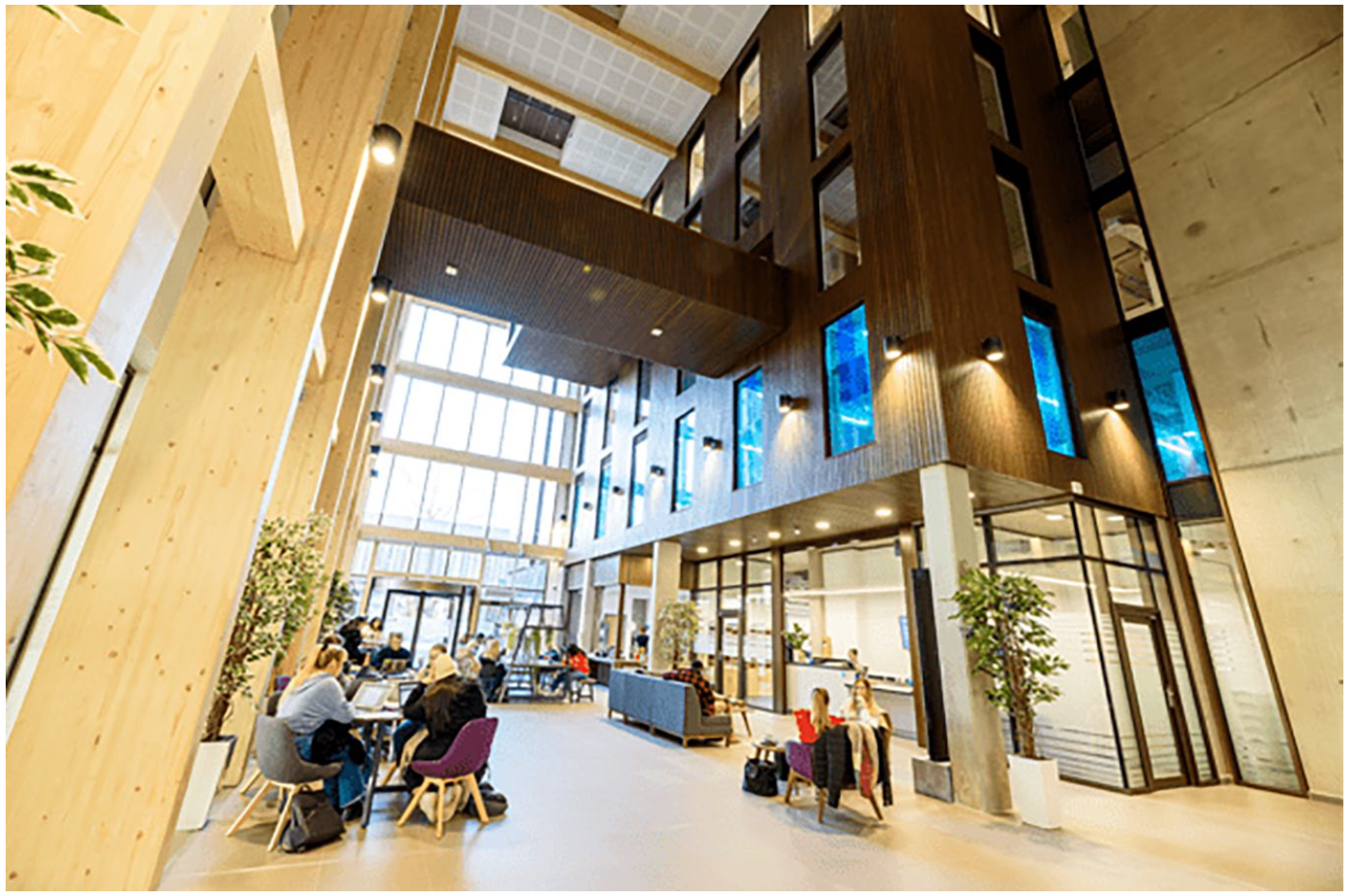
Atrium at the University of Liverpool, Ryder Architects.
Although these buildings all feature an atrium, these are different building types driven by different logics, and the atriums within them accordingly serve different purposes. While the fact that the atrium is a prominent feature of them all is in itself sociologically noteworthy, it would be a mistake to assume that the incidence of the same feature in different geographic or temporal contexts means the same thing (Jones, 2016, 2020; Molnar, 2005). Indeed, over-stabilising the social meaning of – for instance – glass (Fierro, 2006), tulip motifs in Hungarian modernism (Molnar, 2005), or parliament buildings being designed in Gothic or neo-Classical architectural style in capitol buildings (Jones, 2020) can essentialise dynamic cultural life of the built environment that is itself a complex social production rather than residing in the form itself (Steets, 2016). The atrium reflects this general issue; it cannot be assumed that the presence of this feature in ancient Rome (Boethius, 1934) means the same thing, or supports the same social practice as it does in late 20th-century hotels (Paletta, 2020; Wharton, 2001) or casinos. It is not only the time of architecture’s realisation, or the building type, that determine the meaning of the structure, which emerges from sets of perspectives, representations and practical usages that define the built environment (Steets, 2016). My focus here is quite narrowly on how in recent decades the atrium has come to be entangled with urban capitalist spatial arrangements.
Despite the recent flurry of atrium design ushered in by some of the world’s most prestigious architectural firms, the architect most closely associated with the atrium remains the US designer John C. Portman Jr. (1924–2017). Portman’s designs pushed the technical and social possibilities of the atrium to the extent that his design style has been characterised as ‘The Atrium Effect’ by critic Charles Rice (2016). In many ways foreshadowing the atrium’s contemporary popularity, Portman’s atrium designs came to typify a postmodern architectural heterotopia, with the expressive, symbolically rich, referential spaces blurring fake and real/inside and outside facilitating a superficial replacement of the city with a controlled site of consumption. Enjoying close ties to commercial development, real estate, and hotel chains, Portman embraced professional architecture’s connections to both cultural experimentation and corporate interest. His atrium spaces were unambiguously designed to lend celebrity to the buildings that housed them, and to encourage consumption of various types in and around the spaces.
Portman occupied an ambivalent position with respect to the architectural star system. On the one hand, his designs were iconic (Sklair, 2017) inasmuch as they became an aesthetic popular amongst international travellers and shoppers and came to mark out a particular space of consumption. On the other hand, arguably Portman was too close to the financial interests of the commissioners to really be considered an important architect by architects; his proximity to real estate was called into question by the American Institute of Architects, with whom he enjoyed a fractious relationship (Denny, 2018). In occupying the role of architect-developer, Portman was insufficiently autonomous from the interests of capital to attract consecration from the academy and gain the high-profile awards and non-commercial commissions that are key to field-specific architectural status (Jones, 2009).
Reflecting on this situation, Portman himself said that he ‘came to the conclusion that if I were to have an impact[. . .] I should understand the entire project from conception through completion [. . .] That led me to real estate’ (Denny, 2018). In spite of, or perhaps reflective of, this context, Portman was a brand, an architect whose fame extended beyond architectural circles (Jones, 2009; Sklair, 2005). As well as owning shares in many of the dozens of prestige buildings he designed, Portman lent his name to Portman Ritz-Carlton, Shanghai (formerly Portman Shangri-La Hotel) (Rice, 2016). Perhaps revealingly, it is only in relatively recent times that Portman’s massive collection of built work has become the object of sustained academic analysis (Denny, 2018; Rice, 2016,).
This notwithstanding, by designing distinctive, skyline-dominating, attention-grabbing high-rise hotels in cities across the world, his designs had a marked impact on cityscapes the world over. Noteworthy amongst the dozens of Portman-designed atrium-based hotels is the Hyatt Regency in Hong Kong (see Figure 2), which has a ‘twenty-two story atrium redefining the architectural, developmental, and experiential possibilities of downtown’ (Rice, 2016: 1), and the Bonaventure Hotel in Los Angeles, made famous in academic circles thanks to Fredric Jameson’s (1991) account of the hotel’s interior as a materialisation of a postmodern, late-capitalist space made for and through commodification and disruptive of all manner of otherwise-stabilised cultural boundaries. Jameson positions the hotel’s interior – dominated by a huge atrium – as an anti-urban assemblage, contingent on a partial, consumer-friendly simulacra of the social world outside the hotel’s walls (1984; also see Arkaraprasetkrul, 2016). The Bonaventura’s atrium is of an out-of-the-ordinary space, with tantalising views compounded by the attendant walkways, escalators, and concourses, emerging ‘as a distinct way of constructing [and] intervening in and thus remaking the city’ (Rice, 2016: 4).
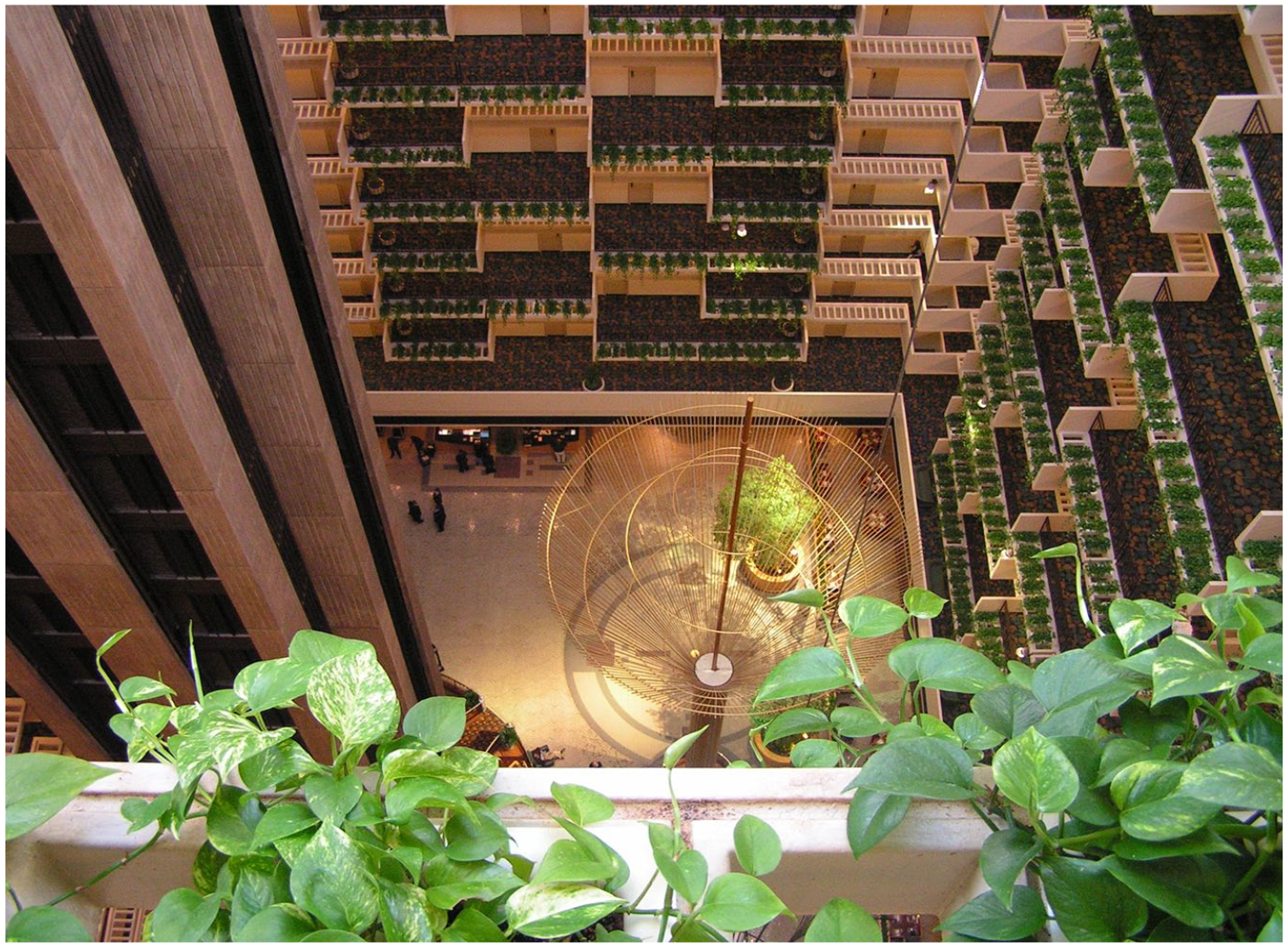
View of the Hyatt Regency atrium from the 8th floor.
Portman’s heterotopic hotel atrium interiors express a deep ambivalence to the wider city in which they exist, and a ready incorporation into the consumer practices of capitalism that was particularly popular with international hotel chains and their visitors (Rice, 2016; Wharton, 2001). It is precisely their bounded and enclosed dynamic, coupled with high-end, luxury consumption opportunities, that makes them spaces particularly well suited to this internationally focused building type. Commenting on the Bonaventure, but raising a point generally applicable to Portman’s designs, Ed Soja (1989: 234–244) saw the hotel as a ‘representation of the restructured spatiality of the late capitalist city: fragmented and fragmenting, homogeneous and homogenizing, divertingly packaged yet curiously incomprehensible, seemingly open in presenting itself to view but constantly pressing to enclose, to compartmentalize, to circumscribe, to incarcerate’. Portman’s atriums were shut off from the cities in which they existed, excluding poor visitors from the associated spectacle, and were a clear example of the ‘interior urbanism’ associated with his designs for hotel interiors (Rice, 2016). In his hometown of Atlanta, USA, Portman’s hotels like the Westin, the Regency Hyatt, and the Bonaventura, sought to innovate a profitable hotel space by embracing the fantastic, enhancing hotels’ brand (in a non-linguistic, post-national space), dominating urban landscapes, and creating memorable and breath-taking experiences for their visitors in the process (Denny, 2018; Rice, 2016; Wharton, 2001).
As with hotel chains, casino architecture – including the atrium – saw significant innovation with respect to ways to encourage consumption and gaming. In fact, the internal and external space of the casino has always been subject to experimentation with architectural themes and radical features designed explicitly to increase gambling activity (Cass, 2004; Friedman, 2003). More than a passive backdrop, the architectural space of the casino is a significant factor – amongst others, including location – affecting the propensity of visitors to gamble (Friedman, 2003: 73). Themed environments, bound up with the very social construction of gambling aim to generate a new kind of city, a bounded social reality saturated with gaming (Kingma, 2008: 36). Indeed, by now the atrium is a constituent part of the ‘othering’ of casino space, a process noted by Cass (2004) as key to understanding the production and reproduction of sites for gambling. ‘[C]asinos are identified with a glamorous and enjoyable architecture [. . .] intended and designed for consumption and entertainment purposes’ (Kingma, 2008: 38), and accordingly their architectural space is organised, and managed, in a way that frames gambling activity as part of a wider themed experience (Lai and McCafferty, 2012).
The atrium has frequently been a prominent feature of casino design in the last decades. The Luxor Las Vegas, a casino-hotel designed by Veldon Simpson in 1993, contains the largest atrium by volume anywhere in the world (see Figure 3). Measuring 29 million cu ft (0.82 million m3), the atrium at the Luxor contains over 4000 rooms, a very large volume of gaming space (9300 sq m), 29 shops, and a vast contention centre (Luxor Las Vegas, n.d.).
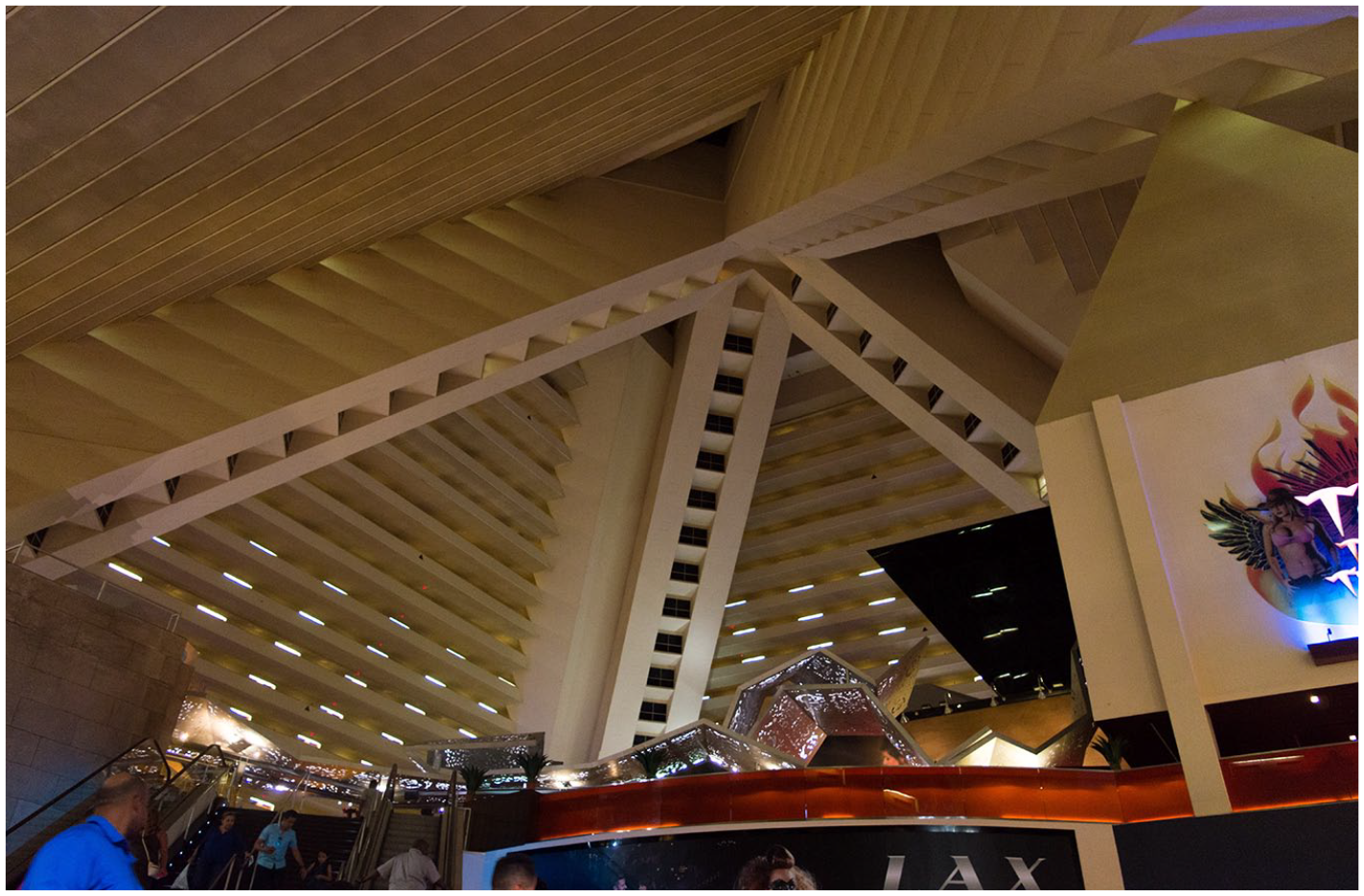
Atrium at the Luxor Hotel, Las Vegas.
The affinity between postmodern architectural design and the casino is made manifest in the themed spaces; The Luxor is named after a city – ancient Thebes – in Egypt, and its pyramidal exterior and interior includes a series of ‘campy reifications of the Oriental Other to draw customers into their spaces’ (Cass, 2004: 241). The dramatic, kitschy, use of architectural space is intended to chime with the ways in which tourists enjoy interacting with casino environments (Cass, 2004: 242).
Any associations with luxury that are added momentum by the existence of atrium space of Portman’s hotels, or casinos, are exclusionary, designed for those using a building, for those inside of it. Such a bounded insider/outsider dynamic accompanies uneven social access to privatised architecture; as a feature of this boundary, the atrium is an expression of classed hierarchies that architecture overwrites (Sklair, 2017). 1 Of course, observing the anti-urbanity, simulated elements or capital-celebratory nature of these casino spaces or Portman’s hotel designs is not to dismiss these ‘micro-urbs’ (Soja, 1989: 234) as unworthy of sociological inquiry. On the contrary, precisely because these atria express something fundamental regarding the themed spatial form that late 20th-century urban capitalism took (Arkaraprasetkrul, 2016; Jameson, 1991) – replete with its divisions and exclusions – that sociological engagement with the contemporary popularity of the atrium is necessary. Put another way, the popularity of the atrium in capitalist contexts invites critical understanding of their material and symbolic allure.
Why Study the Atrium Sociologically?
Architecture presents a beguiling form to make sense of sociologically. There are by now multiple hundreds of scholarly outputs that grapple with this challenging task, and that span the spectrum of methodological and theoretical approaches, and a wide range of topics, building types, and sites (see Jones, 2016 for a summary). Despite the intellectual pluralism in what is a thriving sub-field of research activity, a common starting point for sociologies of architecture lies in moving beyond naturalist thinking regarding the built environment, unpacking the multifaceted ways in which what is built – as distinct from the professional design practice (itself a major area of study: Jones, 2016 for a survey) – stabilises assumptions regarding users and their practices.
While this article aims to make a distinctive contribution to this research, it would be incorrect to state flatly that my article fills a lacuna in the study of the atrium from a sociological perspective. In a book chapter very important for present purposes, Albena Yaneva (2009) skilfully weaves together insights from sociologies of scientific knowledge and Actor-Network Theory, exploring how the non-technical space of the atrium in a laboratory can add momentum to the social basis of scientific inquiries. As is the case elsewhere in Yaneva’s research (for example, 2016), controversy is here used as a heuristic – the atrium is ‘the architectural space most discussed, loved, disliked, praised, and contested by clients [. . .] and the architectural community’ (Yaneva, 2009: 142) – to illuminate sets of dynamic, oppositional controversies associated with their design and use. Exploring the sets of linkages between formal scientific spaces and informal social ones, Yaneva (2009) concludes that the existence of the atrium sharpened awareness of scientific peers’ research and served to facilitate interactions between them. Accordingly, the atrium can affect the ‘cognitive conditions’ of knowledge construction – ‘the atrium and its new materiality creates cognitive conditions for new ontological mixtures’ (2009: 146). Social connections assembled in and around the material spaces of the atrium were crucial to the emergence of new research communities.
The extent to which the materiality of architecture gives stability to practical social relations – and, as a corollary, not to others – is a central question for architectural sociology (Delitz, 2017; Gieryn, 2002; Jones, 2011, 2016; Steets, 2016). Despite the contingent degree to which architectural design has been found to actually affect/condition/shape human behaviour, there are undetermined affinities between particular types of social practices and certain architectural spaces. To summarise, if maximally architectural space can directly influence social behaviour, minimally, the commission of the former implies an attempt to encourage something of the latter. My own perhaps slightly underwhelming take on this question could be characterised as a ‘weak thesis’: in certain circumstances architecture can be found to be shaping practice to an empirically open extent, but that its very commission and realisation is a materialisation of some ideas of how social life could and even should be. 2
In addition to Yaneva’s contribution, there are several social scientific publications that explore the atrium more obliquely. For instance, in one case study Kirsty Morrin sees the atrium as part and parcel of the entrepreneurial discourses that characterise academy schools in the UK (2018). Rob Smith and Michael O’Leary (2013) also briefly mention the space in their account of the symbolism of managerialism in the further education sector, whereas Xianfeng Wu and colleagues (2021) address the pedagogical benefits of students interacting in and around these spaces. In an explicitly architecturally focused intervention, Annemarie Adams et al. (2010) neatly bring together spatial analysis with a careful inquiry into medical discourse, exploring the quasi-clinical claims made – and sometimes sustained – for atriums, which at The Hospital for Sick Children at Toronto allow child patients a quasi-public visibility in otherwise-medicalised spaces, and where the atrium was highlighted by hospital staff and architects alike as ‘innovative’ (Adams et al., 2010: 661). Faulkner-Brown explores the design of libraries (1999), which often make use of the atrium as a visual centrepiece, as do museums, where the atrium’s affordances for display and memorable visitor experience suggest a particular affinity with the institutions’ purpose (Jones and MacLeod, 2016). 3
These studies remind us that architectural spaces taken-for-granted here today were not in the past, are not considered normal elsewhere at this moment, and maybe will not be considered so anywhere in the future. The popularity of the atrium in contemporary buildings is arbitrary; put another way, by definition the judgements that lead to the atrium’s commission and use are social ones, and so could in principle be different. Given this productive starting point for sociological inquiry, how are capitalist economies embedded in, and made socially meaningful through, architectural arrangements?
A Cultural Political Economy of the Atrium
Marxist and post-Marxist analysis has a particular issue when it comes to explaining the relationship between architecture and capitalism, with an observable tendency to reduce the former to an outcome of the latter (Dutton and Mann, 2000). Focus on the political-economic dimension of the built environment can come at the expense of analysis of its complex specificities, and lead to a kind of ‘plug and play’ approach, with the built environment de facto being positioned as ‘X’, that is, as the outcome of capitalist structural forces (Y) with the contingent meanings and uses of architecture flattened out. 4 On the other hand, accounts that remove architecture from its structural place vis-a-vis political and economic structures that are crucial for its commission, design, and use, are fundamentally limited. Despite the rich cultural analysis that they can offer, a lack of engagement with prevailing structural factors ostensibly ‘outside’ of architecture impoverish such accounts. Reconciling architecture’s symbiotic relationship with political economy, but not losing sight of its specific and socially meaningful character, means carefully situating the built environment to illuminate the sometimes counter-intuitive relations between buildings and society (Dutton and Mann, 2000; Jones, 2009, 2015).
The remainder of the article draws upon Cultural Political Economy (CPE) with the aim of developing a theory to illuminate key ways that the atrium is entangled with the extraction of surplus values of various kinds. While there is insufficient room here to fully do justice to the theoretically nuanced elements of the CPE framework (see Jessop, 2004, 2013; Jessop and Oosterlynck, 2007; Jessop and Sum, 2015; Sau, 2021; Sayer, 2001 for detailed developments and engagements), key lines of inquiry emerge from attempts to understand how capitalist activity is embedded in cultural meaning that, while not reducible to it, adds distinctive force to its operation.
Interrogating the role of semiosis – the ‘intersubjective production of experience’ (Jessop, 2004: 161) – in stabilising and reproducing accumulative activity means not understanding culture as merely a strategy for legitimation, but rather as an integral part of economic projects (also see Jessop, 2004; Jessop and Oosterlynck, 2007; Sayer, 2001). Analysis of the semiotic component to illuminate how capitalism is ‘discursively constituted and materially reproduced’ (Jessop, 2004: 161) opens up a wide variety of methods and sites for inquiry, of which architecture is just one. Crucially though, within CPE, the creation, dissemination, and reception of meaning and value are themselves objects of study.
How bundles of semiotic and material interventions contribute to the creation of ‘worlds’ of capitalism is an empirically open question (Jessop, 2004) and the success or otherwise of strategies in this regard varies markedly and cannot be taken for granted. If capitalist accumulation is to be successful, persuasive and effective, its operation needs to be meaningful to those practising it; cultural elements are necessarily incorporated into its articulation and the capacity of cultural forms – including architecture – to connect with lifeworlds is crucial (Jessop, 2004).
Architecture is but one practical site in which material, economically accumulative practices become meaningful and valued to those taking part in interpreting them (for example, Sayer, 2001: 688). As part of the ‘intersubjective production of experience’ (Jessop, 2004: 161), architecture both provides the spaces for surplus value to be generated from land and labour – the banks, shops, universities, apartment blocks, factories and so on – and simultaneously for these processes to be celebrated and intensified (Jones, 2015). Each social order or form of capitalist organisation supports the design and social construction of architecture in which to operate and make resonant its values. From CPE, architectural meaning is a constituent part both of the perception of capitalist activity, and a way that activity is practically assembled and made sense of. Accordingly, in general, the atrium exists through and for regimes of capital investment, particular ways of seeking to create surplus value.
Approaching the atrium as an architectural space bound up with the generation of surplus value – including in ostensibly extra-economic ways (Jessop, 2004) – directs attention to the interplays between culture and capitalist logic. From my understanding of the CPE perspective, in what follows I now develop two lines of argument with respect to the atrium in particular.
One: Build High
In this subsection, and drawing CPE across into architectural analysis, I set out to explore an unexplored implication of the atrium with respect to super-tall buildings. The general interest here is in the ways in which the atrium – an ostensibly internal feature of buildings – is key to understanding the very high massings of skyscrapers, which are densely clustered together in cities the world over.
Due to their combination of symbolic value, coupled with their potential for material exploitations of labour and extractions of rent, tall buildings are a prominent way that urban space is capitalised (Domosh, 1988; Elden, 2013; Graham, 2016; Jones, 2009; Kaika and Thielen, 2005; Parker, 2013; Sklair, 2005, 2017). Skyscrapers increase rent precisely by stacking floor above lettable floor, explaining their close connection to rentier models of extraction (Christophers, 2020). Additionally, skyscrapers’ height allows for the domination of landscape and ‘branding’ of corporations commissioning such as their headquarters, or even just letting space within.
Far from disguising capital, these are attention-grabbing bombastic buildings that dominate the cityscape; the atrium is an internal feature of these high-rise monuments to the very sets of unequal arrangements that lead to their commission (Jones, 2009). The aforementioned symbolic and material rejection of the city sees the production of controlled, highly regulated, heterotopic sites of often breathtaking scales – and associated spectacle – that allow for the external massings of atrium buildings to dominate the very urban sites that, in another way, they serve to reject and turn away from the global cities of which they are a constituent, albeit interior, part. From CPE, the attention-grabbing, distinctive, ‘starchitecture’ can become part and parcel of how cities and regions embrace boosterist entrepreneurial strategies, designed to capture footloose flows of capital (Jones, 2009, 2015; Sklair, 2005)
Thinking with CPE, the skyscraper is an economically and culturally experimental form for the production and reproduction of capital. Internally, it is often an extremely large volume of vertical void – an atrium – that allows a distinctive height to be achieved. In fact, it is the resultant internal spatial configuration, including an atrium, that allows very tall buildings to exist at all. By facilitating the design of very tall architecture – even when the actual enclosed activity does not prima facie require such a tall massing – atriums act as an internalised celebration of capital accumulation, while all the time becoming a site for its intensification. A hypothesis emerging could be thus: atria are most likely to be found in urban centres with high land value, and containing tall skyscrapers enclosing residential, office, or retail space.
The Zara Hadid Architects’-designed Leeza Soho in Beijing is a 45-storey building containing the world’s tallest atrium, which runs the whole height of the building (over 194 metres). The contemporaneous aesthetic of the Leeza – both internally and externally – is made possible by the snaking, twisting atrium (see Figure 4). Not only does it create an exciting space for those using the building, but it allows the Leeza to achieve a skyline-dominating height by emptying out a central column thus facilitating the extremely large exterior massing that is not otherwise needed. The huge volume of internal voided space creates spectacular experiences and sightlines for those inside the building, and a bombastic, skyline-dominating height externally.
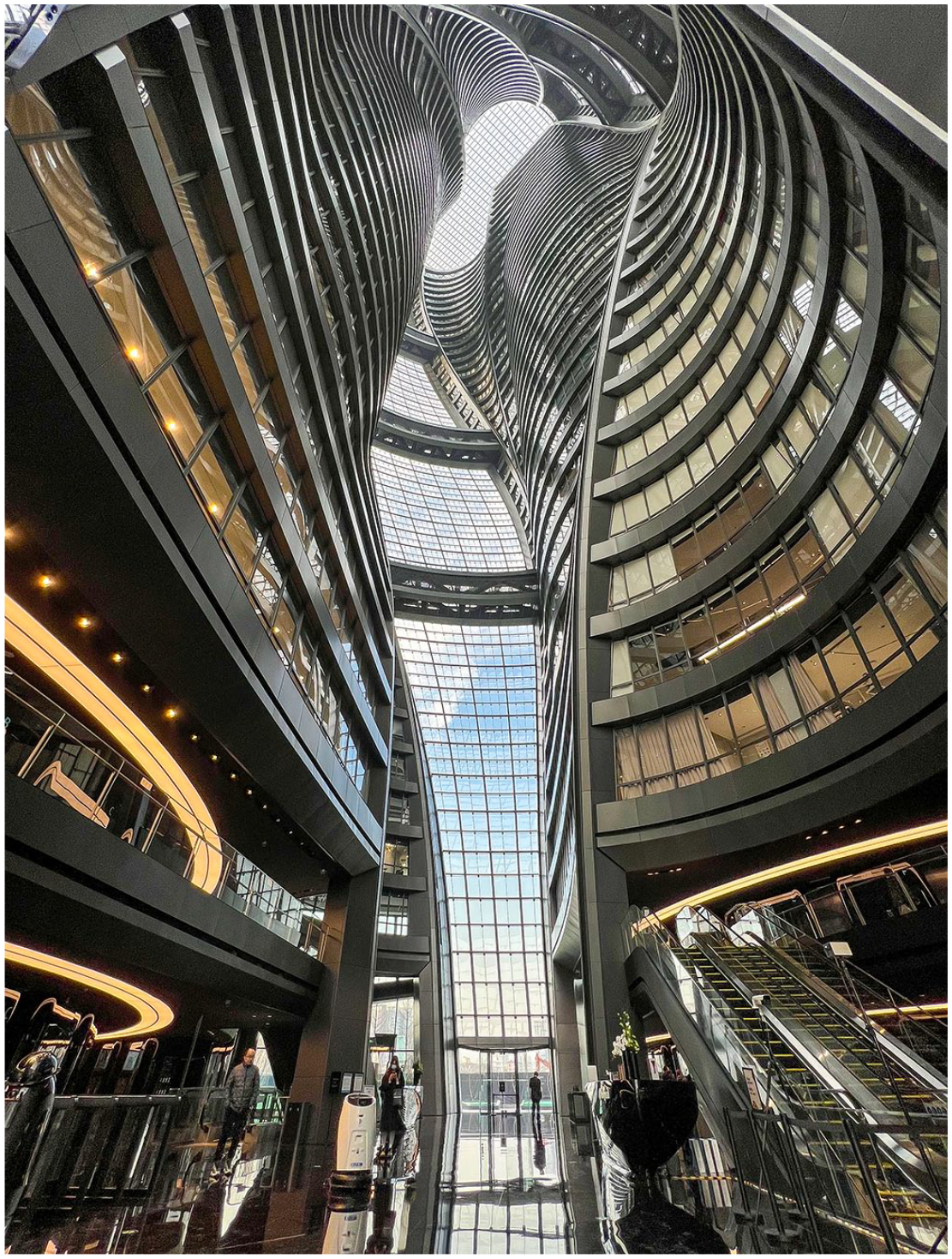
The world’s tallest atrium, at The Leeza, Beijing.
In rentier varieties of capitalism (see Christophers, 2020 for comprehensive definition and discussion), maximising rentable space on a relatively small footprint is a key way in which surplus value is extracted. While the presence of an atrium – a voided ‘empty’ space – seems to reduce rentable footprint, paradoxically it can increase both the economic and cultural value of a building. Put another way, the atrium prima facie reflects a counter-intuitive affinity with respect to these rent-to-footprint efficiencies, replacing potentially profitable floorspace with a void. Speculatively, perhaps large volumes of voided atrium space – for example as at the Leeza – do more than add meaning to and/or celebrate capital accumulation? The intriguing possibility here is that that the ‘empty space’ of the atrium serves to increase the value of neighbouring rooms, offices, and retail concessions. From CPE and following the logic of situating semiosis relative to capitalist arrangements, the presence of an atrium in buildings such as the Leeza can serve to increase the economic value of proximate hotel rooms, apartments, or offices, with ‘emptiness’ creating other sets of possibilities for the generation of surplus value. The spectacular experience of being inside the building – the views from upper and lower floors, the feeling of scale when in the lobby, are redolent of Portman’s heterotopic hotel atrium designs.
Understanding the atrium as a solely ‘rational’ economic space misses the oblique, but important, ways in which it is drawn into projects of capital accumulation. To put it bluntly, potentially economically profitable space is given over to architectural experiment and the ‘emptying out’ of space that defines the atrium. Understanding the role of the atrium relative to how land is capitalised in the context of rentier models could position the space as a counter-intuitive response to the inevitable slowing down of returns on capital. Theoretically, it is precisely in attempts to ‘fix’ – read defer – accumulation crises that sees the emergence of new, speculative capitalisations of land and space (Christophers, 2016, 2020; Elden, 2013; Jessop, 2013). As the tendency for the rate of profit to decline becomes apparent, then experiments with architectural ‘fixes’ – bigger buildings, more extravagant or potentially less extravagant spatial programmes – are the outcomes of attempts to claw back profitability. The atrium is produced and reproduced in this context,
Ironically though, through ‘fixing’, capital accumulation and its vulnerabilities are also made visible, as atrium buildings see ‘space for political contestation [. . .] opened up by exactly that failure’ (Christophers, 2016: 137). Considered thus, the atrium is something of a monument to its own fragility; precisely because it is an architectural innovation that grows from, and is wedded to, a particular model of crisis-prone capitalism, the benefits described earlier are not permanent fixes but rather, they offset the fundamentally unstable form of economic arrangements.
Two: The Affective Atrium: An Architecture for/of Consumption
In this section I draw upon CPE to make sense of the deployment of the atrium in consumer-oriented spaces internal to buildings. The entrepreneurial look and feel of the atrium derive not solely from symbolic associations, but also from sets of spatial arrangements conducive to consumption. By situating the atrium relative to the conferment of value and prestige associations for consumption, I am effectively attempting to bring CPE to bear a widened scope of research questions (arguably, the perspective has something of a lacuna with respect to study of the perspectives and motivations of consumers). In particular I am interested in some of the affordances of atriums vis-a-vis consumption; the space is in part an intervention designed to increase surplus value of the commodities that exist within it.
The atrium is designed to create a ‘wow factor’ based on the large volume of voided air that contrasts with relatively small human bodies. Creating disjuncture between architectural scale and human bodies is a technique also in evidence in much religious architecture (Kaika and Thielen, 2005), where vast spaces emphasise the glory of the metaphysical, and inspire awe amongst followers. Generally, the beguiling sense of space created by the voided volumes of the atrium is compounded by how one moves through them. The creation of large volumes of space within which both bodies and commodified objects are wrapped has the possibility of altering the values of each, supporting new forms of interaction and shifting relational values.
This is an example of what Steve Miles (2012) has referred to as ‘contrived communiality’, that is a collectivity brought together specifically to further consumptive activity. As Miles notes, the attempt to create such spaces for consumption, has a material effect on the organisation of city spaces; my argument is that the production and reproduction of the atrium is one such intervention. Not only do various types of profit-seeking activity take place in atriums, but more analytically, the spectacular volumes of the atrium are an architectural-spatial atmosphere that can add to both experiential consumption and further encourage certain types of commodifiable interaction. Thinking with CPE, attempts to maximise capital involve a set of architectural design interventions; achieving the optimum cultural sites in which to consume is a dynamic task, which implicates innovation aesthetic and semiotic elements of architecture (Jones, 2009).
As part of this experiment with creation of spaces for consumption (Miles, 2012), transit through the atrium is often by means of automated, visually permeable technologies such as glass lifts, open escalators, and winding staircases (Jameson, 1991). These functionally allow transit between floors, but also allow for new sightlines, intensifying the spectacular and creating perspectives that exacerbate the potential for visual consumption. The dynamic reconfiguration of internal perspective is both disorienting and tantalising, and in keeping with the out-of-the-ordinary visual spaces of consumption (Jameson,1991; Lanci, 2022; Miles, 2012; Soja, 1989). 5
For example, the Landmark mall in Hong Kong (see Figure 5), designed by Aedas and Kohn Peterson Fox, contains a huge, remodelled atrium space (built 2006) that overwrites the original one (initially developed in the 1980s). The atrium contains several luxury international brands located around its perimeter that benefit from the sightlines, the light, and generally the prominence that the location affords. It can be imagined that the large volume of atrium space – both vertically and horizontally – creates a significantly out-of-the-ordinary experience for those using this retail space, with bodies made relatively small, wide visual fields being opened to see and be seen, and a materialisation of the notion of luxurious retail space as involving ‘emptiness’ (Lanci, 2022).
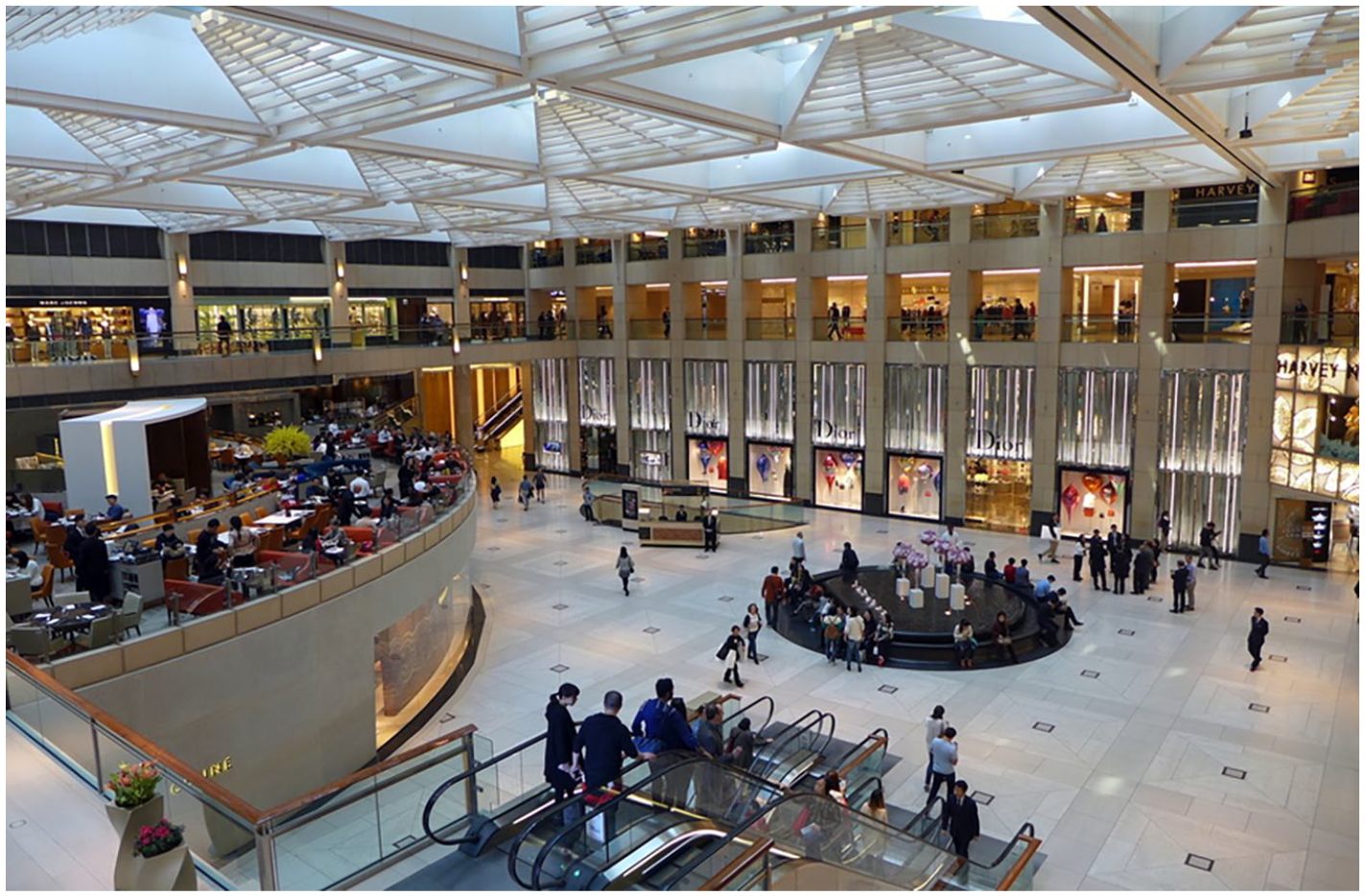
The atrium at Landmark mall, Hong Kong.
The atrium’s horizontal and vertical sightlines allow for display and associated vantage points for the gaze, for a visual consumption underpinning highly aestheticised notions of architecture as objectified commodity. But, minded by Jackson et al.’s article (2021), analysis of the atrium should not be reduced to the ocular; large massings of air, introduced sounds and smells, plants, the human-made waterfalls, and several distinctive sensorial features, are designed to be affective and to create exactly the out-of-the-ordinary environments that add a relational value to commodities and other artefacts (Lanci, 2022). The affinity between the atrium space and a variety of consumption activities is suggestive of the patterned attempts to add momentum to economically profitable exchanges by creating a cultural, interior-architectural spectacle.
It is through a combination of these features and attendant atmospheres that atriums can be said to exist through and for ‘indoor capital accumulation’ (McNeill, 2019: 859). The experience of space, the sightlines and out-of-the-ordinary spectacle, and the theming of such serves to further consumption activities and create new relations between objects and space. To reiterate, from CPE, capitalism entails many disparate forms of activity and sites meaningful to those participating in it, and across many different settings. It is only by being understood and enacted by consumers as an architectural feature supporting acquisitive activity of all kinds that allows the atrium to facilitate and enhance commercial accumulation (Sayer, 1988).
Sensory elements added to the atrium environment – for example lighting, music, and scent – have been found to be crucial in encouraging the purchasing of commodities (Miles, 2012). It has been claimed that in Indonesian shopping malls, atriums can be understood as ‘quasi-internal public spaces [that] play an essential role as an identity provider and offer spatial orientation in shopping center architecture’ (Kusumowidagdo et al., 2016: 52). Of course, this suggestion rests not on the formal ownership or governance of the sites, but rather an ‘atmosphere’ of openness and accessibility. These sensorial elements of the assemblages’ design through and for consumption suggest an interesting and potentially illuminating line of analysis for CPE. While beyond the limits of this exploratory article, it can be suggested that taking CPE upon its word (Jessop and Sum, 2015; Sum and Jessop, 2013), and addressing the sets of practices that characterise and add distinctive meaning to capitalist arrangements, could underpin analysis of consumers’ sets of aesthetic and semiotic preferences with respect to the arrangement of architectural space. Theoretically, it would be fascinating to explore the ways in which interpretations of sites – including the atrium – connect with consumption practices for, for example, particular social class factions. As an architectural form that helps to ‘embed’ capitalism, the look and feel of atrium design resonates with some people and practices more than others. In this context, the jumbling of multiple standpoints regarding people’s experience of being in or around atriums generates a ‘reductionism [. . .] an arbitrary account of the social world that ignores the unacknowledged conditions of action as well as the many and varied emergent properties of action’ (Jessop, 2009: 340). CPE would situate such cultural perspectives and practices relative to structural positions and particular formations of capital.
Atmospheres of consumption redolent of shopping malls and hotels can also be found in traditionally less-commercial locations, The current moment sees prominent atriums in a widened range of building types (Paletta, 2020), and notably including public buildings such as schools (Morrin, 2018), hospitals (Adams et al., 2010; Jones, 2015; Martin et al., 2015), colleges and universities (Smith and O’Leary, 2013), and libraries (Faulkner-Brown, 1999). The increasing incidence of the atrium – with its characteristic consumption-friendly atmosphere – in ‘public’ buildings needs to be understood in relation to the privatisation of elements of public services. Creating lucrative sites for retail, as well commercial rent-seeking, is part and parcel of the promise of the atrium, or at least the basis of promises made on behalf of the space by think tanks and policy makers (Heathcote 2018).
Take for instance the hospital, where in general in the ‘late twentieth century hospital design was driven by effective cultural rather than medical models’ (Adams et al., 2010: 666). Despite primarily – and somewhat by definition – being spaces ordered around healthcare, in recent years hospital architecture has become shaped by a range of commercial imperatives and the contemporary hospital is home to a number of major atrium spaces that contain shops, cafes, and similar. 6 The atrium also serves to de-institutionalise the look and feel of traditionally non-commercial sites like hospitals (Adams et al., 2010; Jones, 2015; Martin, et al, 2015), giving such spaces an entrepreneurial look and feel, providing somewhere enclosed to shop, eat, and drink coffee. 7
From the perspective of CPE, the structural conditions of action – albeit many and varied – in which atria flourish, and the partialities, inclusions, and distinctions that define social ordering of the consumers and non-consumers in the capitalist urban fabric, are inherent factors. Despite architects’ and design representations equating the atrium with openness and flexibility, the bounded social nature of the atrium for those enjoying the interior spectacle is a crucial element. The flexibility of the atrium – often contingent on the ‘use of moveable fixtures and glass windows instead of solid walls’ (Yaneva,2009: 141) – that wraps other commodities and interactions, suggestive of a semi-formality of the space, which in turn is ideal both for ad hoc interactions and more organised events allowing a spectacular setting for institutional rituals and self-representations to occur. But, while open-plan, ostensibly flexible structures such as the atrium may be associated with ‘openness’, ‘innovation’ and ‘transparency’ by designers and architects, it is reductive to assume that open architecture leads to open organisations.
To take one practical example from education, time capture interviews and analysis suggested that atrium spaces ‘coincided with higher frequencies of “see and be seen” activities, such as students waiting and looking around’ (Wu et al., 2021). Seemingly non-educational practices could in principle add momentum to activities more closely associated with studying; the opportunities for serendipitous encounter are again relevant in this respect. Indeed, some empirical study seems to confirm the atrium as a space materially affecting the activity that takes place within it, whether relating to scientific study (Yaneva, 2009), shopping (Marriage, 2012), gambling (Cass, 2004; Friedman, 2003) or the aforementioned analysis of student life (Wu et al., 2021). However, any claims suggesting that the architecture of the atrium de facto increases consumption, sociality, or any practice for that matter should themselves be the object of careful and critical sociological inquiry.
Over generalising site-specific findings leads to an essentialism whereby formal architectural properties are seen as determining the social practice that happens in buildings, a problematic and reductive conclusion (Steets, 2016). Rather than taking an always-and-everywhere judgement with respect to the efficacy or not of the atrium in encouraging this or that activity, sociologically it is better to treat these claims as an interesting factor of the production and reproduction of institutions themselves. Arguably, and again from CPE, rather than searching for a definitive architecture of capitalism, it is better to explore the ways architecture is deployed in the context of capitalism (Jones, 2009, 2015).
Conclusion
To mangle Mary Douglas’ famous formulation made with respect to dirt (2002 [1966]: 44), where there is an atrium there is a system. Atrium sites are systematic inasmuch as they are the result of careful architectural commission and design; this is not to say that atriums are solely reducible to capital acquisition, but they are nonetheless reflective of all manner of partial social assumptions and projections. In this article I have deployed sociological theory to explore a structural symbiosis between the atrium and elements of the ideological and material shifts that facilitate production and extraction of surpluses. Denaturalising configurations of architecture vis-a-vis the accumulative strategies that give rise to it (pun intended) is crucial in this task; the counter-intuitive popularity of the atrium in contemporary rentier economies requires analysis of the ostensibly non-economic culturally meaningful nature of the space as a ‘right’ one for capitalist activity to flourish.
The concerted application of a critical sociological imagination to architecture can unlock key assumptions concerning the interrelationship between design and sets of social arrangements. This exploratory article drawing from, and hopefully contributing to, sociologies of architecture and CPE alike, has argued that the atrium both reflects and adds meaning to capitalist arrangements; critical study of it can usefully add to and draw from the growing sociological literature on architecture and the built environment. Atriums are symbolically and materially arranged so as to support and further accumulative activity. Fundamentally, it is the dual (cultural and economic) affordances of the space that explain its proliferation in the context of rentier capitalism.
Critical research from social sciences (Arkaraprasetrkul, 2016; Delitz, 2017; Domosh, 1988; Gieryn, 2002; Jones, 2011, 2016; Sayer, 1988; Sklair, 2005, 2017) argues conclusively that economies rely on the creation of ‘correct’ types of architecture to allow surplus value to be created most efficiently; warehouses, docks, factories, shops, universities, residential developments, airports, and so on are all experiments in achieving the correct spatial and social mix for extraction to happen. Reflecting a crucial – but paradoxical – symbiosis with super-tall iconic buildings, the atrium reflects a nonetheless curious relationship with capitalism’s spatial dynamics. The intriguing possibility is that empty space – the atrium void – is itself commodified, allowing for the increase of surplus value generated by neighbouring spaces (hotel rooms, apartments, offices, etc.). In other words, an argument emerging here is that ostensibly empty space adds momentum to consumption and rentiership. One general argument here has been that the continued presence of the atrium warrants explanation, for which sociological inquiry is well positioned.
CPE assists in the denaturalisation of atrium architecture in the context of capital seeking a sufficiently persuasive and socially resonant form with which to extract surplus value. The commodification of sites in a way that is attractive to tourists and other consumers implicates architectural design. Still, possibilities of unrealised alternatives hang heavily in the atrium; the very reason that these spaces exist at all is contingent on sets of assumptions that go far beyond the architecture itself, and that are entangled with capitalist experiments in the generation of surplus value. David Graeber (2013: 89) observed that ‘the ultimate, hidden truth of the world is that it is something that we make, and could just as easily make differently’. In this spirit, atriums are made by us, and could just as easily could be made differently, or not at all.
Footnotes
Acknowledgements
This article has been a very long time in the making, and literally dozens of people have helped me shape and sharpen it. Special thanks for doing this go to Johannes Coghlan, Kirsty Morrin, Talja Blokland, Liam Ross, Anna-Mari Almila, Michael Mair, Maike Pötschulat, Charlotte Branchu, Robin Bartram, Fanny Chabrol, Rob Smith, Des Fitzgerald, Ola Nduku and Richard Williams.
Funding
The author received no financial support for the research, authorship, and/or publication of this article.
