




Abstract
Criminology has long understood architecture to be both a problem, in that design might increase the pains of an individual’s experience within the criminal justice system, and its solution. Study of the Japanese koban, or police box, reveals the ways in which the architecture and design of a built form communicate the values and objectives of criminal justice. The article draws upon recent criminological thinking about space and about the senses, in which the materiality of public space is understood to have a powerfully affective dimension, and in which meaning arises through the signifying practices of places, events and experiences. In Japan, police boxes have a lengthy history as an architectural manifestation of a mode of policing designed to surveill, reassure, and monitor. Extensive and immersive research conducted in Japan during a 2-year period investigated the ways in which koban both ‘take place’, as built forms within public spaces, and also ‘make sense’, as signifying practice designed to communicate the values and intentions of Japanese community policing and an ‘affective atmosphere’ of law enforcement.
Architecture creates places in which lives are lived, work is carried out, and, sometimes, crimes are policed or punished. Built forms exist both as venues whose uses seem predetermined and also as spaces which invite semiotic engagement with their affordances and potentialities. As Millie puts it, ‘Buildings are divided into spaces that have different access, functions or normative rules and expectations. Buildings also sit within wider spaces with which they interact, affecting emotional responses and semiotic meaning’ (2012: 1098). In criminological and legal research, it has been recognised for some time that architectural design influences the impact and experience of criminal justice. As Mulcahy (2011) has described, courtrooms did not always contain a dock in which an accused person would be confined; but since its introduction, it is generally impossible to think of a courtroom in a Western jurisdiction without one. In penal institutions, even small adjustments in the architecture of prisons can drastically alter the experience of incarceration for inmates (Hancock and Jewkes, 2011; Jewkes, 2018; McGeachan, 2018; Moran, 2015). Regarding the design of British police stations, Millie suggests that shifts in architectural style might encourage members of the public to view police stations as reassuring, rather than as repressive or controlling (2012: 1097).
Architecture has thus been viewed both as a problem – namely, how design might increase the pains of an individual’s experience within the criminal justice system – and as its solution, in that those pains might be ameliorated by revisions to the built environment and its forms. This article focuses upon a specific example of an architectural form, the Japanese koban, or police box.
Koban are familiar to Western criminological research in discussions of community policing as a possible causal factor in Japan’s famously low crime rate (Aldous and Leishman, 1997, 2001; Bayley, 1976; Johnson, 2014; Kawamura and Shirakawa, 2008; Leishman, 2007; Parker, 2001). The focus of this article, however, concerns the built environment of the police boxes themselves. It considers, firstly, some historical and social contexts in which koban exist; secondly, a conceptual and methodological framework for researching and theorising the koban; and, thirdly, suggestions as to the ways in which the architecture of community policing can create an affective atmosphere through which ‘a represented object [here, ‘law enforcement’] will be apprehended and will take on a certain meaning’ (Anderson, 2009: 79). Interspersed through the article are excerpts from field notes, offering a sensory immersion in the myriad places and moments of ethnographic research in the spaces of community law enforcement.
Beginnings: An encounter with ‘the heart of police activities in Japan’
Standing at the side of the road in Kyoto on my first research trip to Japan, I could see no traffic in any direction and so I started to cross. I had taken no more than a few steps when I heard a voice calling to me to stop. As Althusser would have predicted (1972: 174), I looked around and saw a police officer standing on the pavement, arms crossed in front of him in the gesture used in Japan to mean ‘you must not do that’. ‘Wait – no crossing’, he called out. He then came to stand next to me at the side of the road until the signal changed to indicate that pedestrians could cross. As he waved me across, I realised that he had been watching me from a small building near the crossing – a police box, or koban (小判) (Figure 1).
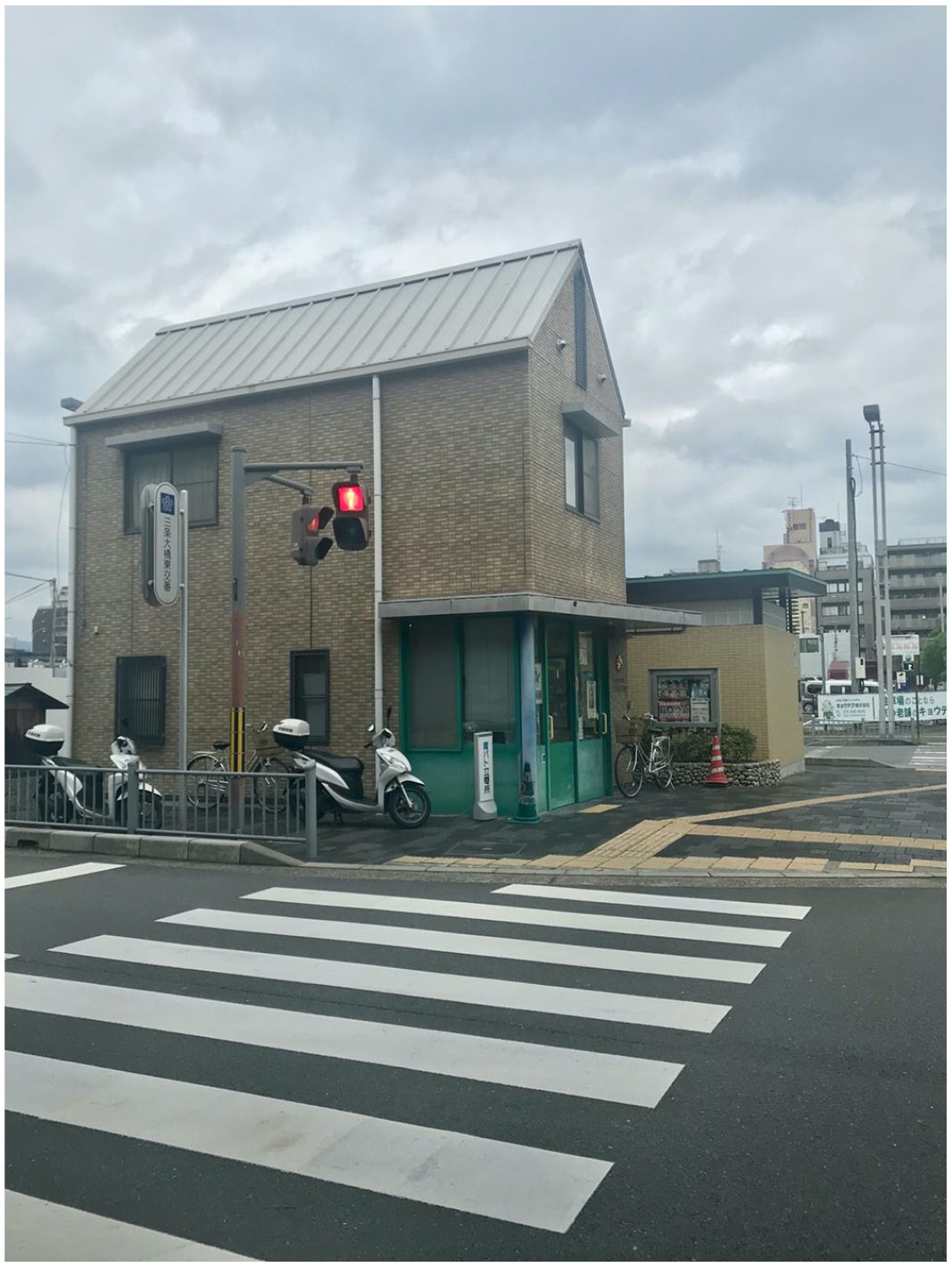
Kyoto
I was visiting Japan in order to research street art and graffiti (Young, 2016); but now I started noticing the seemingly ubiquitous police boxes. Where my encounter had involved what Althusser called the ‘mere one-hundred-and-eighty-degree physical conversion’ productive of subjectivation through turning around when hailed by an officer, many interactions were initiated by citizens themselves, and the koban provided spaces for interaction with the officers: the boxes spatially situated interpellation. Accustomed to thinking of the response to hailing as the primary moment through which one ‘becomes a subject’ (Althusser, 1972: 174, emphasis in original), these myriad everyday interactions at koban seemed to evidence a different kind of interpellation, in which the architecture and design of koban invite citizens to become subjects of law enforcement. This research builds on a recent analysis (Young, 2019) of the ways in which koban have become ‘the apotheosis of a union between “community” and “policing”’ through their generation of an ‘atmosphere’ combining surveillance and engagement through the interconnection of the activities of human subjects and the emplacement and function of non-human elements within the environment’ (2019: 769–770). To that analysis, this article contributes an extensive and immersive ethnographic account of the capacity of architecture and design to locate policing in public space and to signify its operations to the public.
The advent of the Meiji period in the middle of the 19th century ‘opened’ Japan to Western influences through the rapid move away from a shogunate-based social system to one with a legal system adopted from French and German legal codes. In addition, the Meiji period saw a consolidated police force replace the squads of warriors loyal to local shogun that had previously kept a violently enforced social order. Komiya notes that the importation of Western institutions was ‘superficial’, bringing ‘the form of a Western legal system and not its spirit’ (1999: 371, emphases in original) – and creating tensions that continue to render aspects of Japanese crime and crime control challenging for non-Japanese to understand. Researching the koban in public space offered the opportunity to engage at a deep level with one of these complexities – the extensive and deep embedding of policing into the public spaces of Japanese everyday life.
In part, such embeddedness derives from the long history of the police box, which has existed since early in the Meiji modernization. In 1874, locations were designated at which police would ‘stand watch’. These were called kobansho (a compound word, meaning ‘a place where police stand duty’) and were systematised in 1881 through the building of a box known as a hashutsujo (meaning ‘police box’ or ‘despatch station’) at each location. However, the strength of the association between the original function of standing watch and the place at which it happened meant that the hashutsujo became colloquially known as koban. In the 1990s this term was painted on to the little buildings and became their formal name.
Contemporary koban exist within a complex and highly stratified society. While Japan is conventionally characterised as conformist and dominated by convention, this framing omits much intricacy and tension. Superficially a society in which heteronormativity is dominant, recent social trends shows this to be an unstable façade: divorce rates are rising, and there is increasing recognition of the prevalence of domestic or family violence, although LGBTQI+ individuals and relationships still struggle for legal and social recognition (McLelland et al., 2007). Social conformity is also rendered less predictable in various ways, most benignly by those younger Japanese opting not to pursue traditional corporate career tracks (Toivonen and Imoto, 2012) and more troublingly by the increasing numbers of adolescents who experience intense social alienation and disconnection (known as hikikomori; see Allison, 2013; Tamaki, 2013). Famed for its post-war recovery, Japan’s late-20th century ‘bubble’ of economic wealth spectacularly burst, generating an extensive recession (Kingston, 2019; Pilling, 2014). Despite its inclination towards strong state governance, Japan’s welfare system provides scant support for the poor, the elderly, individuals with disabilities, and the chronically ill (Enoki and Katahiri, 2014; Ryan, 2015). Within its prison system, the most rapidly increasing age group of incarcerated individuals is over 60-year olds, whose recidivism rates are high (Lewis, 2016). And while Japan is celebrated for its low crime rate, Japanese citizens do not experience comparably lower levels of fear of crime: sensational media coverage of occasional highly violent events has generated high levels of anxiety about crime, and a parallel growing dissatisfaction with the performance of the police (Leishman, 2007; Leonardsen, 2004, 2010; Yoshida and Leishman, 2006).
Koban exist within this complex matrix of social attitudes and structures. Police are simultaneously the object of high levels of respect and the target of complaint arising from public perceptions of performance (Leishman, 2007: 199). Yoshida and Leishman note both the public admiration for police officers and the telling results of surveys showing declining levels of approval for community police work (2006: 233). Koban offer focal points for both approval and dissatisfaction due in part to their prominence in public places in Japanese towns and cities and also to their position as the foundational component of Japanese policing. 1 The police boxes have variously been called ‘the smallest unit of Japanese policing‘ (Yoshida and Leishman, 2006: 232) and ‘the heart of police activities in Japan’ (National Police Agency, 2018: 13). 2 There are two types of koban, and every Japanese citizen will be familiar with one or both. Situated in rural areas or regional towns, residential police boxes (chuzaisho) are staffed by a single officer who lives with their family in adjoining accommodation; non-residential koban staffed by officers on shift duty are found in metropolitan areas. 3 Around 45,000 officers are stationed at koban and 8000 at chuzaisho (National Police Agency, 2005). 4 Koban and chuzaisho are numerous, although numbers have declined a little in recent years. In 2005 there were 7600 chuzaisho and 6500 non-residential koban in Japan, with approximately 1200 of these in Tokyo (National Police Agency, 2005), but by 2018 these numbers had decreased to 6300 chuzaisho and 6300 koban (National Police Agency, 2019: 13).
In what follows, I theorise this ‘heart’ of Japanese policing by considering how the koban ‘takes place’ as an architectural built form located in public space, and how it ‘makes sense’ as a semiotic construct engaging in a range of signifying practices. Informing the conceptual framework necessary for such an investigation are two related paradigms in criminological thought. Examination of the koban in public spaces builds firstly on ideas within spatial criminology (see especially Hayward, 2012; Kindynis, 2014) in order to consider the public spaces in which koban are located not simply as agglomerations of buildings and streets but as multilayered matrices of materials, uses, adaptations, practices, histories and expectations. Secondly, understanding police boxes as semiotic forms which communicate messages through a range of signifying practices, such as architectural design, insignia, and adaptive uses by their occupants, means that koban can be regarded as spatial forms with semiotic consequences, generating meaning in the spaces they occupy.
Such an approach is also indebted to recent thinking about sensory dimensions of places, events and experiences in crime and justice (Campbell, 2013; Cooper et al., 2018; Herrity et al., 2021; McClanahan and South, 2020; Millie, 2017, 2019; Russell and Carlton, 2018; Russell et al., 2020) and the aim in this article is to consider the capacity of architecture to generate meaning, offering a ‘sense’ of place to its users (see especially Jewkes, 2018; Pallasmaa, 2005). Campbell writes: ‘“Crime” has affective power which excites, threatens, angers, shocks; it provokes an embodied experience of place and sensibilizes us to change and alterity in everyday settings’ (2013: 35) (emphasis added): while signifying practices around crime ‘excite, threaten, anger, shock’, this article extends that focus to consider the architecture and aesthetics of Japanese police boxes which, in contrast, offer the unassuming affordances of everyday order maintenance.
Following Hayward’s suggestion that ‘the territorialization of affect’ (2012: 451) is an important criminological concern, this article examines how koban architecture and design might suggest particular affective affordances. As Anderson notes, ‘to describe the characteristic affective qualities of a complex assemblage. . . risks reification of the inexhaustible complexities of affective life. Yet. . . it is worth exploring because it enables us to think further about intensive spatialities’ (2009: 80). In the ‘intensive spatialities’ of koban locations, their affective dimension is not, however, uncomplicated. Japanese citizens have complex and contradictory emotional connections to koban, both admiring and condemning the officers who work within them. As a place of community policing, koban design prompts specific interactions with and for the public which end up impeding the ability of officers to engage in substantive law enforcement. As a signifier, the koban must communicate both that everyone is safe (and, in Japan, safety is synonymous with low- or no-crime) and that crime is being policed (and the existence of crime to police potentially means that crime is increasing). Both spatially and semiotically therefore, koban exist in a matrix of subtle but intense contradictions, which underpin the ways in which the ways in which the Japanese police box takes place and makes sense as an affective architecture of law enforcement.
Field notes: Nakameguro, night
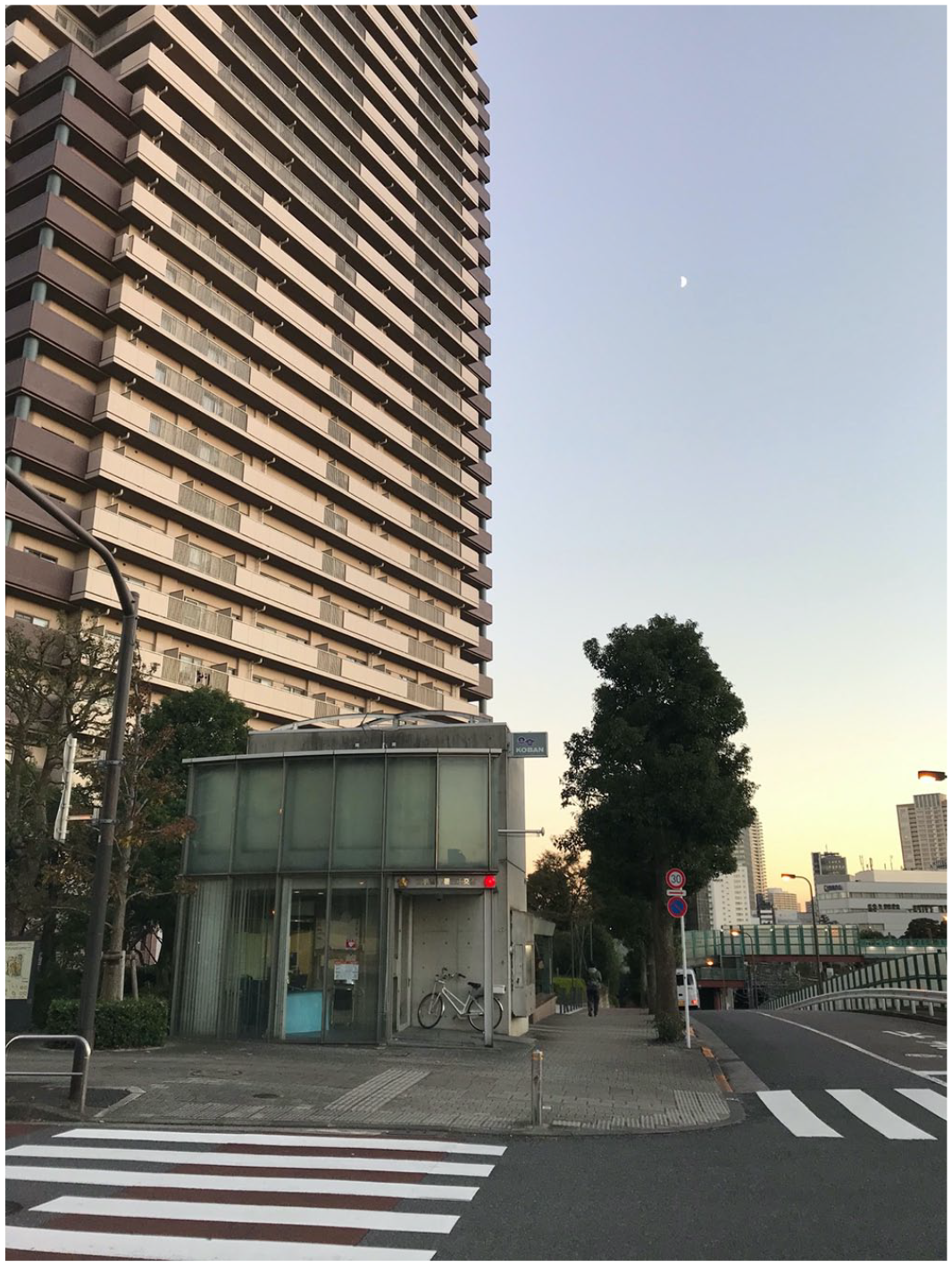
Nakameguro is a neighbourhood divided by a small river, the Meguro-gawa. On either side of the river, narrow roads with small shops encourage pedestrian strolling. Parallel to one of these riverside streets there is a major road, Yamate-dori, bearing multiple lanes of noisy fast-moving traffic. At one point it is bisected by another multi-lane road; just nearby, overhead train lines run in and out of Nakameguro station. In the midst of the grid demarcated by these transit lines there is a tall building around 17 storeys high, looming over all the other structures in the area. This is the Atlas Building, a brown hexagonal tower containing offices, restaurants, bars and apartments. Crammed into two tiny rooms in its ground floor is Nakameguro’s koban. The koban has a doorway on to the wide pavement running along the east side of Yamate-dori. Its front is narrow, with a sliding door and a small space where people might stand in front of low tables with two or three officers behind them. Living in the neighbourhood for around 6 weeks, I’m most familiar with this koban in all of Tokyo. I pass it at least twice every day, perhaps as many as 150 times in the totality of my research. Its officers engaged in various activities by day, assisting with directions, going out on patrol, helping locals. On one occasion, I saw an officer load an elderly woman’s shopping bags onto the officer’s bike, and then set off with the woman, wheeling the bike, apparently accompanying her home. At night, the area around the koban was often quiet. Traffic would rush back and forth on Yamate-dori, but pedestrians would dwindle in number. Nevertheless, I often saw an officer outside the koban, engaging in the activity associated with the koban’s origins: ‘standing guard’. Directly outside the koban door, an officer would stand, feet apart. He clasped a long wooden stick, planting it firmly on the ground (Figure 2). While standing there, he would occasionally look to each side, along the pavement. The officer always stood watch alone, illuminated only by the dim streetlights and by the red light that proclaims the koban is occupied. With the Atlas Building stretching up above the koban, supporting the sky as its namesake did in Greek legend, so the officer maintained his position outside the koban, standing guard, performing the watch.
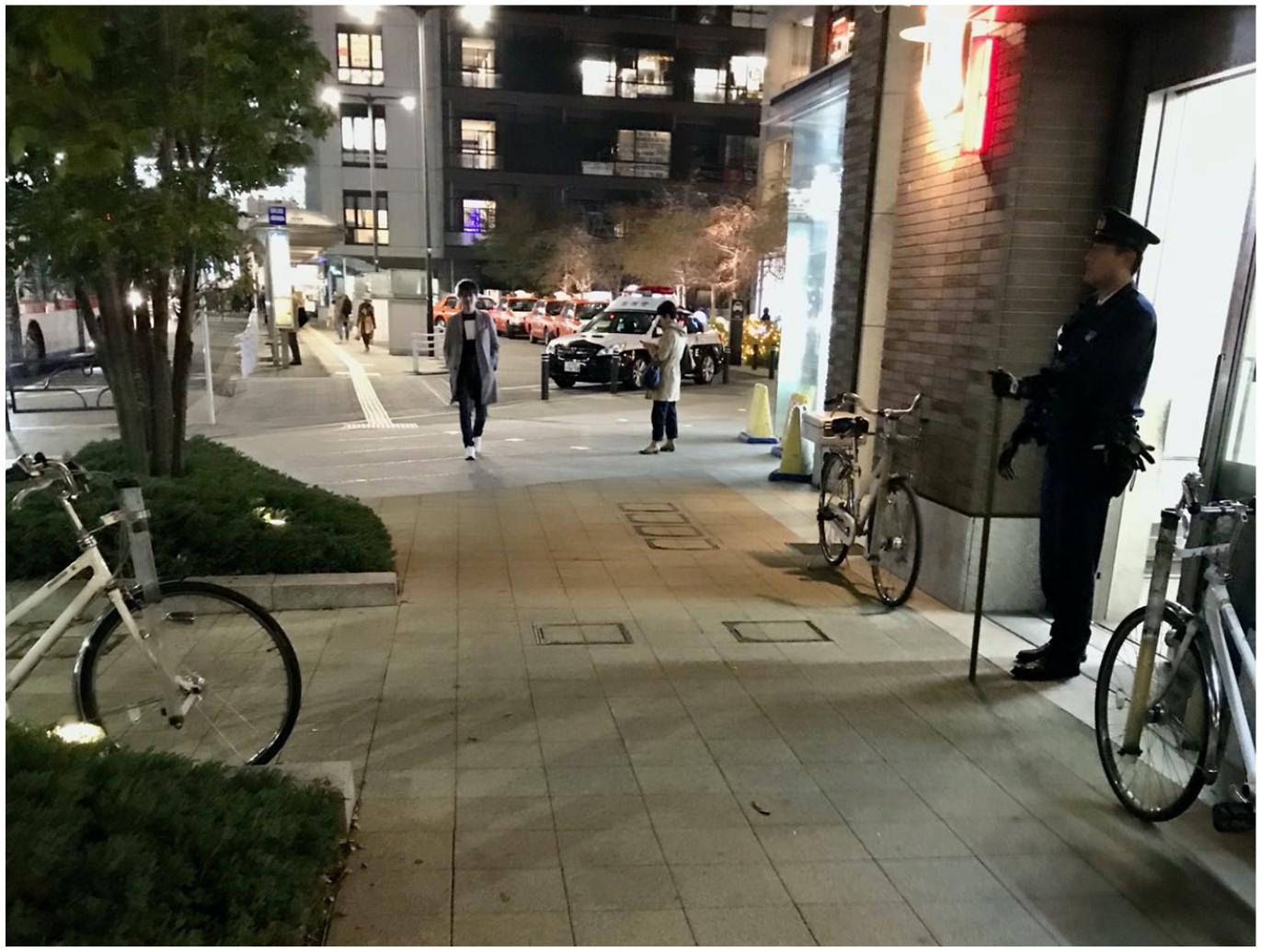
Nakameguro
Researching the koban as a built form
How do we understand the koban’s architecture and aesthetics? This project focused on ethnographic research combined with the compilation of an archive of material relating to the historical development, criminal justice objectives, and cultural significance of police boxes in Japanese society. These materials included: government papers, such as the White Papers on Policing which discuss koban as a crucial tool in promoting community safety (for example, National Police Agency, 2018, 2019); evaluations of initiatives exporting koban to other countries, such as Indonesia, Singapore, Brazil, Honduras and Cambodia (Kato, 2012; No Author, 2013), discussions of police boxes as architectural features or aspects of Japanese aesthetic style (such as The Tokyo Files and Tokyo Creative), 5 and a media analysis of news reports dealing with the role of koban, the depiction of koban in film (such as Police Station Diary, 1955), television programmes (such as the NHK-produced Home Sweet Tokyo) and manga (such as KochiKame, or こちら葛飾区亀有公園前派出所). 6 Archival footage of koban in operation during the 1950s was studied on YouTube and visits were made to the Tokyo Metropolitan Police Museum.
The resulting contextual archive provided a social, historical and cultural framework within which to locate ethnographic research conducted during a 2-year period (two visits totalling seven weeks in 2018, and two visits totalling 4 weeks in 2019): what Clifford calls ‘subway ethnography’ (1997: 217), involving numerous visits that repeatedly dip in and out of a field area. Two main techniques were utilised: first, interviews with key professionals connected in various ways to koban policing: these included senior staff in the National Police Agency, the Tokyo Metropolitan Police Department and the Kyoto Police Department; police officers with experience of working in koban, an architect who designed the most recently built koban in Japan, and a filmmaker whose grandfather, a police officer, was murdered in a koban. 7
The second technique was observational ethnographic research conducted in three cities (Tokyo, Kyoto and Kamakura) in order to investigate koban in their local settings (Ferrell, 2018; Kindynis and Garrett, 2015). An official visit to the Sukiyabashi koban, in Ginza, Tokyo, was also arranged by the National Police Agency. This visit was a highly formal affair, with two senior officials present as well as several koban officers. No ‘hanging out’ was permitted and a limited number of questions could be asked. Nonetheless, the visit allowed direct experience of the interior of a koban, as well as officers offering what would otherwise have been inaccessible information.
In contrast, the majority of the ethnographic observations involved lengthy periods of unobtrusive documentation. The koban were documented as buildings within a built environment by means of photography and short video recordings, with periods in which the researcher ‘hung out’, accumulating information as to locale and noting impressions of any interactions that occurred between police officers, or between members of the public and the police – a version of Bestor’s (2003) ‘inquisitive observation’. These periods were documented by means of contemporaneous or subsequent field notes. Field notes were detailed, following Perec’s exhortation to ‘write down what is of no interest, what is most obvious, most common, most colourless’ (1997: 50) – the easily-overlooked components of quotidian spaces (Moran, 2005).
With over 1000 koban in metropolitan Tokyo, comprehensive documentation would be extremely difficult. Sixty-two were selected for detailed examination. Fifty were located in Tokyo, eight in Kyoto, and four, of which one was a residential chuzaisho, in Kamakura, a regional town one hour from Tokyo. In Tokyo, the task of observation was divided between the primary researcher and a research assistant. One objective was to observe koban in distinctive types of neighbourhood: first, busy or ‘sensitive’ areas such as transit hubs, the vicinity of government buildings, tourist attractions or monuments of cultural significance, and highly populated areas; second, residential neighbourhoods and third, areas of mixed ethnic or multicultural populations. In addition, the oldest and newest koban in Tokyo were also included (in Tsukishima and Asagaya, respectively), and effort was made to include several koban commissioned in the 1980s and 1990s. Designed by architects such as Kazumasa Yamashita and Kazuhiro Ishii, these koban are particularly notable as built forms.
Some observation resulted randomly. Maps installed outside koban show nearby police boxes; discovery of an unexpectedly proximate koban would prompt researchers to visit it, resulting in a kind of ‘koban go’ version of Pokémon. Inclusion of koban in the project also arose as a result of recommendations from others (‘my favourite koban is at such-and-such, you must go and see it’) or from sighting one when walking in the streets, confirming what Kindynis and Garrett call ‘the potential of urban wandering, exploration and infiltration. . . as immersive spatial research methods’ (2015: 11). The resulting sample therefore combined project-driven criteria with an openness to the serendipitous encounters that arise when moving through a city.
Observation was conducted, wherever possible, according to a predetermined repertoire of techniques. Koban were photographed in a range of ways: from a distance, in full shot from front on, and from other angles. Close up shots were taken of any notable stylistic details or architectural features used in the design: in Ikebukuro in Tokyo, for example, children’s drawings about koban had been appended to the building wall and in Kyoto koban signage was quite different to that used in Tokyo. At each location, a short video recording was made, usually 30 seconds in length, in order to capture aspects such as local sounds, and any activity taking place around the koban. The researcher then spent up to 30 minutes in each location, documenting the area and its ambience (sounds, textures, smells, presence or absence of crowds, movement of people, and, in particular, the visual appearance of the koban and other buildings) in order to build a sense of place for each koban. 8
While many observations were singular, some were repeated in order to take account of temporal shifts in local ambience (e.g., ensuring there was a night-time observation as well as a daytime one). In addition, some koban, particularly those in very busy areas, were subjected to repeated observations. The researchers endeavoured to ‘blend in’ at each location while conducting observations, usually by maintaining a range of activities to look occupied and to avoid obvious watching or note-taking behaviours. Being of obviously Western ethnicity meant that, when noticed by officers, the researchers might well have been categorised as tourists, meaning that officers did not usually seek out us out for interaction. Individuals of infra-Asian ethnicities are not similarly ignored. Namba (2011) discusses the tendency of police to stop certain ‘foreign’ individuals, asking for identity documents and proof of entitlement to stay or work in Japan (so-called ‘stop and account’ practices), as an on-the-ground manifestation of Japan’s longstanding ‘war on illegal immigrants’. A survey by the Tokyo Bar Association in 2006–2007 discovered that 52% of Chinese, Korean, Singaporean and Taiwanese respondents had been subject to ‘stop and account’ policing in Tokyo, often on multiple occasions, and that this tended to occur in everyday locations such as a train station on the way to work (discussed in Namba, 2011: 434–435). 9
At some sparsely populated or deserted locations, hanging out near the koban was a potentially suspicious thing for the researchers to do, especially being an obvious outsider (a gaijin, or gaikoku-jin). In order to maintain discreet observation, it was sometimes necessary to withdraw or move away after only a short time. When conducting observations at a koban in Yutenji in Tokyo, the officer on duty, standing inside the koban, noticed the primary researcher taking photographs, and emerged suddenly from a side door, angrily demanding access to the photographs and an explanation for what was happening – necessitating the delivery in Japanese of a hasty account of the research objectives and a promise to leave the area immediately, in an effort to undo the Althusserian subject-becoming that was underway. In addition to some observations being unexpectedly truncated, other observations took place on many repeated occasions: the koban in neighbourhoods where the researchers were living or working were encountered sometimes multiple times in a day.
The process of experiencing the koban in urban space was not based solely on the accumulation of numerous singular, disconnected points on a map. Movement between locations altered the experience of the koban in any given space. At times, travel between koban took place on foot, and the journey from one location to another at ground level allowed attention to be paid to transitions between distinctive neighbourhoods, or to appreciate how the crowds that cluster around a koban at a train station would rapidly thin out in the neighbouring streets. At other times, travel through the city on public transport was necessitated. This was often underground, meaning that neighbourhood character around a koban would be experienced without preview or prior impressions being formed, sometimes emerging from an underground staircase into a busy plaza surrounded by video billboards or hurrying commuters, at other times into a space of quiet streets and dimly lit izakayas. Neither mode was preferred to another; rather, it was accepted that each had distinctive affordances, and both were necessary means for conducting this research in the largest metropolis in the world. In the end, the ethnographic observations conducted exemplified the kind of ‘unfolding process of informed improvisation’ recommended by Ferrell as a way of doing criminological research suited to knowing and living in the social world (2018: 160).
Field notes: Ginza 4-chome, day
Surrounded by tall buildings dedicated to the sale of global brands and luxury goods, the police box at Ginza 4-chome is an enigma. For a building meant to be identifiable as an assistance point, this koban appears to resist standing out. It is located at a busy traffic intersection. When approached along the main street, Harumi-dori, the building is almost invisible. As I move to cross the road, I become aware that there is a small building covered in reflective mirrors in front of a much larger building. My small adjustment in posture causes the reflection in the panels to shift. It’s like realising that there is a fully camouflaged chameleon sitting on a rock on front of you. The koban is tallish, slender, two storeys. It forms a narrow tower around 10 metres high, perhaps 4 metres wide at most, perched at the edge of the pavement. Its front is curved, transparent glass but almost entirely covered in posters showing wanted suspects. The pavement-side wall is a mix of opaque panels and mirrored glass. Later, when I sit at the first-floor window of an adjacent café, drinking coffee while filming the koban from above, I discover I can photograph a reflection of myself in one of the koban’s upper level mirrored panes. It feels meta: the object of study’s constituent element has enabled me to document myself documenting the object of study while appearing to be incorporated into the object of study as a decorative element. Such reflexive meta-productivity is this koban’s defining feature when viewed from locations like the café’s upper floor, or from the opposite side of the street (Figure 3). From other vantage points – the pavement it is built onto, for example – it is simply an irregularly shaped tower of variously sized cubes. The intersection by day is crowded with shoppers, commuters, tourists, office workers, and more; in a location as populous as this, you would expect that the koban is sought out frequently. But even at 1pm on a busy weekday, the officers were not regularly called on. In a 30-minute period, I counted seven inquiries – far less than at other central koban in busy locations. At the koban in front of Shibuya Station as many as eight officers will be continuously engaged by inquiries and incidents. Is it simply that the individuals flowing through Ginza don’t have questions for the police? Ginza 4-chome This seem unlikely: a few blocks away the Ginza Sukiyabashi koban is one of Tokyo’s daytime busiest. That koban resembles a miniaturised fairytale castle, a rounded brick building with a turret, out of which protrudes a metallic spike, announcing it as an idiosyncratic presence within the landscape. At Ginza 4-chome, where the mirror-camouflaged building is withdrawing itself from the gaze of the passers-by and where its narrow footprint seems to shrink it from obstructing their passage through the street, perhaps many individuals simply don’t realise that it is there, or what it is? Diffident and unassuming, like a Murakami protagonist in architectural form (Rubin, 2005: 5), its design renders it near-invisible on one side and its pavement-edge peripherality means that it is oddly absent in its own location.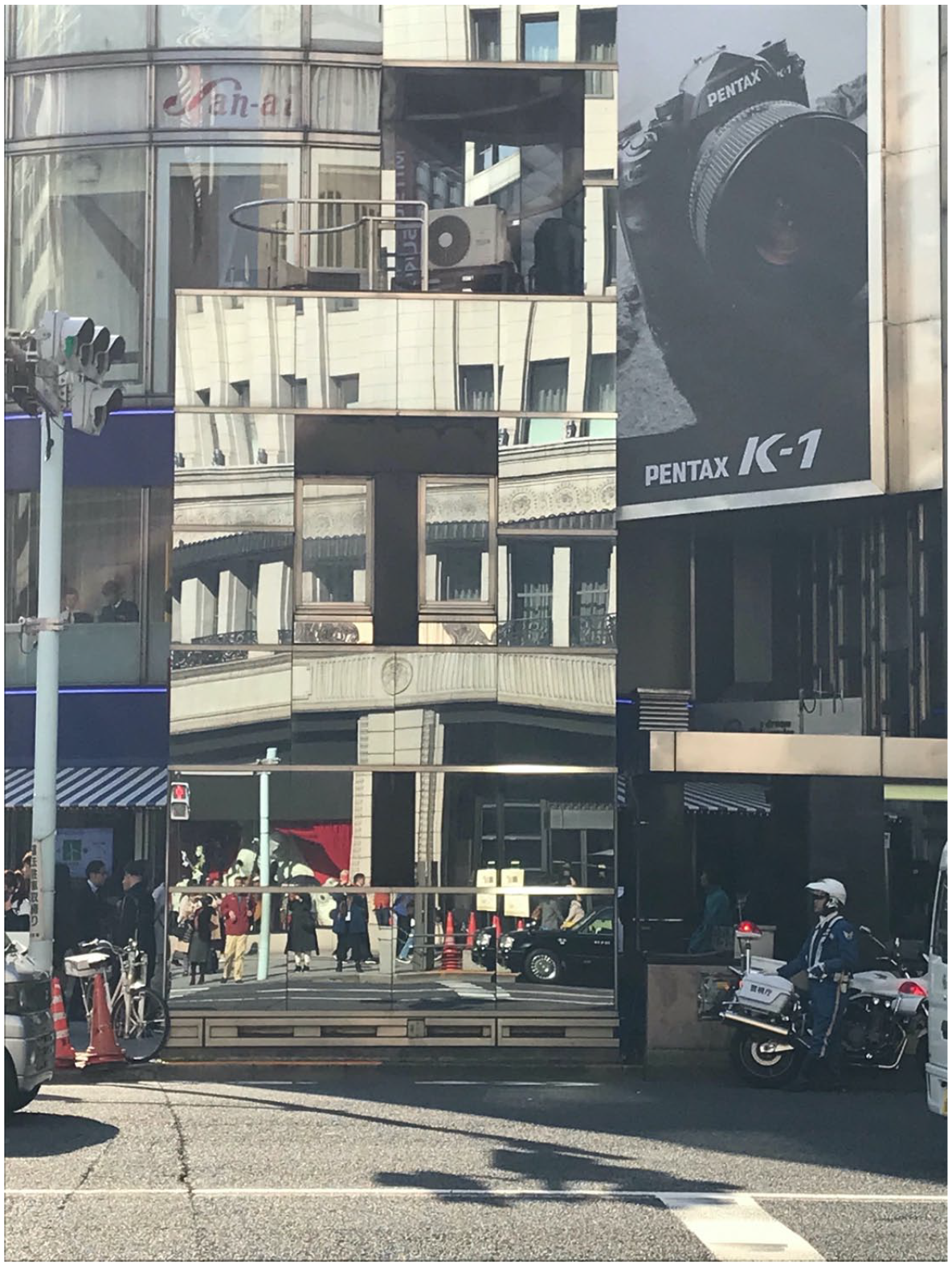
Spaces of law enforcement: How the koban takes place
Koban and chuzaisho are small. They are often only 6 or 7 m high, and narrower in width. Although Tokyo in particular is famous for examples of attention-grabbing ‘muscular’ architecture (Liotta, 2020: 28), smallness is just as important an architectural impulse: ‘the Japanese seem to conjugate smallness, both in their physical and metal spaces’ as a ‘constitutive practice of making the city’ (Liotta, 2020: 25).
Inside a koban, the front office will contain at least one desk and chairs, a pinboard, and sometimes a cupboard. Outside, notices warn citizens about wanted individuals; some of these notices may be for years-old crimes. The number of officers present at any time will vary; two would be usual but some busy koban will hold several more. When officers, go on patrol (usually by bicycle) around the neighbourhood, or are assisting in an incident, the koban may be left empty (and a sign on the door will explain that officers are on patrol).
Observations revealed that the most obvious police activity is the issuing of directions. 10 Koban are also the main place where lost property is handed in. Crimes can be reported: this probably occurs most frequently at koban located near busy train stations, where incidents of groping on trains (by chikan 痴漢) or theft of property occur. Individuals who are feeling unwell might also be brought to koban by concerned individuals. The majority of these activities take place in any open space at the front of the koban (for example, if there is a station concourse in which the koban sits) or in its front office. In our observations, relatively small numbers of individuals went inside.
Any individuals that do go inside will remain in the front office. Beyond this room, there will be one for weapons and police file storage; there will also be a room for sleeping, and a toilet and shower (at one koban in Azabu-juban, bottles of shower gel and shampoo were visible on a window-sill). One reason why koban do not routinely include female officers is architectural: NPA rules require separate toilets and sleeping space for women, a rule at odds with the convention that koban should be small. Inclusion of female officers requires a larger footprint, an altered design brief, and greater expenditure. Modernisation of the police force, however, means that there is pressure to renovate existing koban: even the architecturally renowned Sukiyabashi koban in Ginza is to be knocked down and rebuilt, because its small footprint cannot accommodate the addition of a female toilet. 11
The petite footprint and scale of koban relative to the usually much taller buildings of corporate downtown areas have become part of their architectural character. In their substantive form, koban design has a generic quality. Many are about the same size, and are roughly the same shape to which flourishes from a narrow bandwidth of architectural embellishments might be added (some smoked glass, or perhaps a round ‘porthole’ window instead of a square one). It is an aesthetic that communicates ‘municipal governance’ and ‘public facility’: a similar design framework can be identified both in local government buildings, and in public toilets which share with koban a ubiquity in public places and a small scale relative to surrounding buildings. Despite this, architectural inventiveness has been vast: ‘From traditional Japanese architecture to art deco and ultra-tech futurism, every style is represented in these quirky little boxes’ (Gianni, 2011). The uniformity of koban design, which renders them able to be recognised in their public locations for what they are, co-exists with a commitment to infinite variation within a strictly controlled genre. In Japan’s public spaces, koban therefore take place through a design that offers familiarity and predictability enlivened with tiny additions of architectural distinctiveness.
Signs of law enforcement: How the koban makes sense
According to the National Police Agency (NPA): The main characteristics of the community police are: (i) to become part of the local community and engage in activities that are closely related to the daily life and the safety of residents, (ii) to let community residents know about the presence of police officers and carry out neighborhood watch and prevention activities such as patrols, (iii) to be the first to respond to any emergencies. (National Police Agency, 2005)
With community police stationed in koban, such a statement helps us understand a police box both as an element of the built environment and as a signifier communicating through its architectural form. Here, the buildings communicate to members of the public that a particular range of policing activities are practised. Receiving lost property, helping unwell individuals, issuing directions – all are constituent activities of community policing. That such activities might not contribute to the prevention or detection of crime has been noted by commentators: Yoshida and Leishman state that the ‘over-concentration by officers on time-consuming non-emergency matters’ actively reduced their ability to engage in policing (2006: 233). Despite this profound contradiction, koban continue to be designed, staffed and organised around this spectrum of ‘non-policing police work’.
In fact, the NPA are so fully committed to this mode that they have created distinctive signage and design for the koban in order to communicate the openness of the police box and the continual availability of officers to the public. The success of their communicative strategies has led to public expectations that the existence of a koban guarantees the presence of an officer. All the semiotic labour performed by signage, prevalence and distinctive architectural form is undermined by the problem of aki koban (empty koban): in a National Police Agency survey in 2004, 56% of respondents had experienced a koban to be unstaffed when they visited it and 65% categorised it as an urgent problem that the NPA should correct (Kawamura and Shirakawa, 2008: 165).
The NPA statement also views communities as permeable by the police. The presence of koban within neighbourhoods creates opportunities for surveillance of the area and the accumulation of knowledge about the lives and habits of residents: ‘an extensive surveillant net’ (Young, 2019: 771). Familiarity with the lives of residents is partly achieved through interactions between neighbourhood residents and officers at the police box, but the absorption of police into a local community is achieved most substantially by the daily practice of ‘patrol’, whereby officers travel through a neighbourhood, often by bike, in order to visit residents in their home. 12 Koban design usually incorporates bicycle stands or racks at the side or rear of the building. The inadequacy of bike racks and the absence of car parking at most koban is the most common criticism of koban design made by serving officers. 13 The insertion of koban within very small footprints means there is often little space for these infrastructural additions. The necessity of patrol excursions means officers come and go several times a day, every day. Their sense of the inadequacy of facilities arises from daily irritation engendered for them by the performance of the task within what is experienced as a poorly provisioned space.
Efforts to achieve the NPA’s twin objectives (receptiveness to public interaction and engagement with the lives of neighbourhood residents) can be seen in the significatory strategies of koban. To facilitate receptiveness to the public, koban need to appear open. The architectural design must be porous, able to accommodate the frequent interactions of officers and members of the public. Numerous building features both bespeak and create openness. First, koban are located at ground level: stairs up to the building are rare (only three koban of 62 observed incorporated even a few stairs at the entrance). This is not about accessibility to those with mobility impairment: accessible design has not become common in Japan. Rather, as a design choice, it suggests that interaction with police will be easy, rapid, non-hierarchical.
Second, koban always include windows through which the front office can be seen (other rooms are not visible, being either windowless or having smoked or stippled glass). As with police stations in many Western jurisdictions, windows allowing the public to see police at work are not usual in the larger police stations that cover an entire district (and which do not practice community policing). Koban windows are always at least waist to ceiling height, and, in some, officers may be visible from ceiling to floor. Third, unlike in Japanese residential architecture, where doors are heavy and open outwards into a corridor (Pollock, 2015), the front door of a koban is a lightweight sliding door, a style found in restaurants and bars, and associated with ease of access (Shelton, 2012). Finally, openness has sometimes been designed into the furniture through the provision of low-level desks, which reach only to a seated officer’s waist.
The presence of koban and their openness to the public are also communicated through a range of aesthetic features. Even if they did not always include signage proclaiming their function, koban are usually immediately recognizable, by virtue of their petite scale relative to their environs (Young, 2019), their narrow spatial footprint, and their municipal aesthetic (akin to the ‘drab colours’ Jewkes criticises in standard prison décor, 2018: 321). Signage also communicates the existence of the police box. The most common exterior sign states KOBAN in romanised lettering (that is, not in Japanese characters) in a distinctive font. Sometimes the sign is simply of a police officer’s cap, draw in cartoonish style. In a country where many people do not speak English and cannot read romanised lettering, the form of the letters KOBAN nonetheless becomes recognizable as signifying ‘community police box’. Other koban signs might show a police car, or the Tokyo Metropolitan Police Department’s official mascot. Koban will also display a rosette device, the national emblem for the police and a red exterior light, either in the shape of a squat tube or narrow strip running vertically near the building entrance; this is illuminated outside the box at night to indicate that the koban is staffed (showing, for example, that even if the front office appears empty, there will be an officer elsewhere within the koban). 14 Astrid Klein, whose architectural firm Klein Dytham designed Japan’s newest koban, 900 kilometres south of Tokyo in Kumamoto, commented that the immutable necessity for the inclusion of such features was a frustrating constraint in the development of the building’s design. 15
Despite their recognizably municipal character, koban are not completely homogeneous buildings. In fact, some koban are remarkable architectural designs, especially those commissioned in the government building program in the 1980s and 1990s: within Tokyo, there are around 11 koban with dramatic style and features, such as the Ikebukuro koban designed in 1992 by Kenjiro Hayashi, which resembles an owl; the koban near Ueno Zoo designed in 1990 by Tetsuo Kurokawa, which looks like a space ship or creation from a Miyazaki film (Figure 4); and the koban in Udagawa-cho in Shibuya, designed in 1985 by Edward Suzuki, which looks like a bird of prey or the prow of a ship, and was the first koban to be regarded as a meeting point and urban landmark. The Klein Dytham-designed koban in Kumamoto has been featured in numerous architectural magazines and journals: the building is ‘a simple box structure adorned with an oversized steel parapet and a rainbow gradation painted on its inside surface, visible from street level through circular perforations’ (Kafka, 2016).
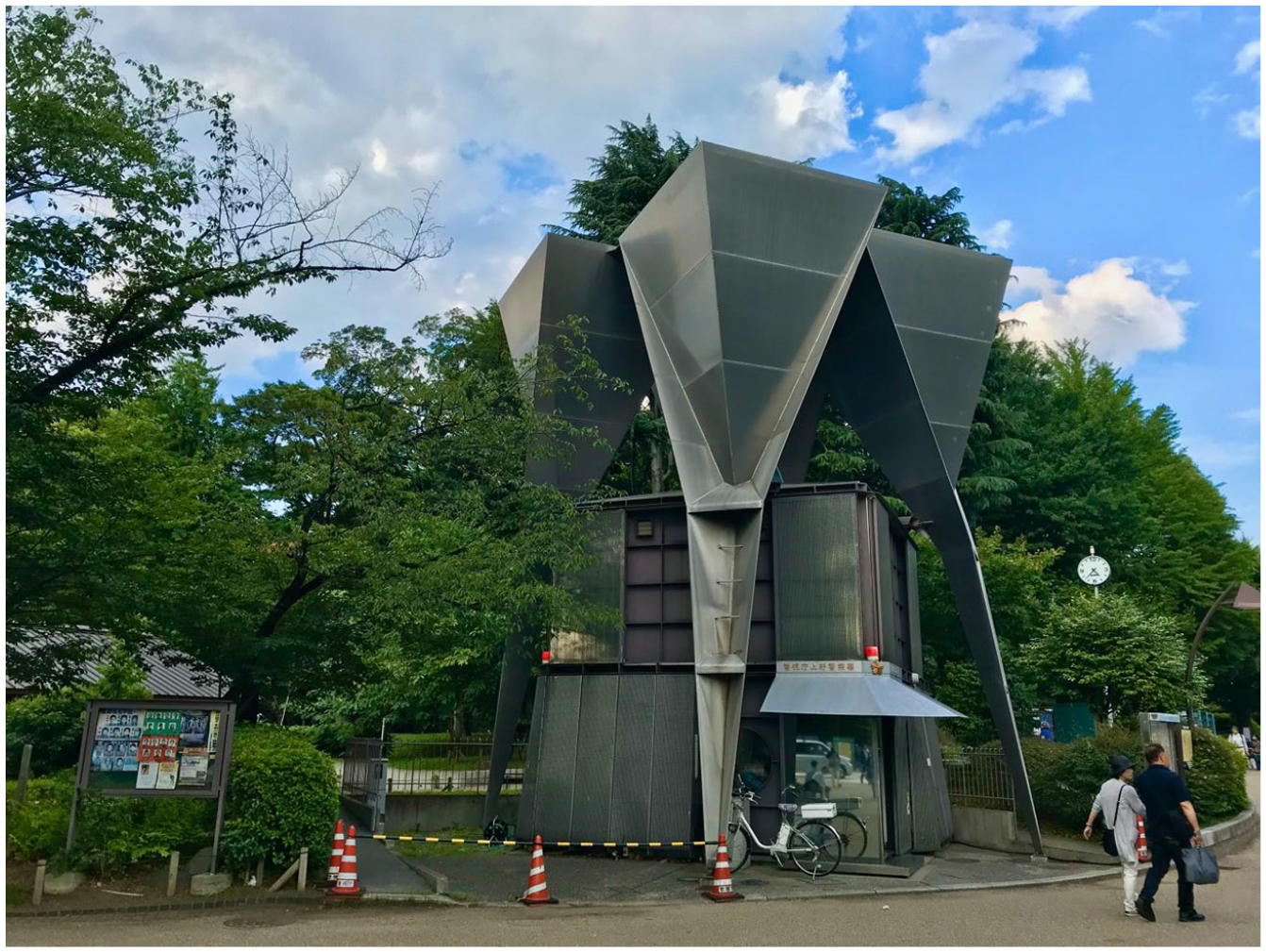
Ueno Park
That koban offer tiny permutations within a strictly constrained template has a number of effects. First, it generates a visual predictability, such that an individual might readily identify a building as likely to be a police box when scanning an unfamiliar streetscape, while still being able to generate a sense of individual character or personality suited to an area or offering visual dividends for the area’s inhabitants. To that extent, koban design creates buildings that are both – and paradoxically – iconic and generically familiar. In addition, in continuing to uphold the key objectives that animated the buildings’ inception in the Meiji period – community protection, surveillance, accessibility – koban design communicates a general message about the continuity of community safety. The activities conventionally associated with police work (interviewing alleged offenders, processing crime reports, collating evidence and so on) are done elsewhere, in the large, generically corporate buildings that house district police stations; in contrast, the koban reassures through historical continuities across time, spatial prevalence, and stylistic repetition.
Field notes: Ebisu-minami, dusk
Of the three koban in Ebisu, in Tokyo, one is located near a development of tall apartment buildings, massive rectangular blocks arranged around a sparse concreted plaza. A train line runs alongside, and two large roads form the second and third sides of a ‘square’ around the koban. Opposite the tiny koban is a museum of photography, which adjoins the rear entrances of a luxury hotel. All around is in transit: train line, road, residents walking in and out of the apartment blocks, visitors entering and exiting the museum, vans and trucks delivering goods to the hotel. Amidst this flux, the koban appears to suture the intersecting lines of transit; seated behind a desk, its sole occupant is anomalously static. As with all koban, this one is small, approximately 6 metres high. Three of its front walls are glass; the office contains a desk, chair, and filing cabinet. It is big enough to hold three people, if they squeeze in (Figure 5). Every other building in the area has a monumental scale: the apartment blocks are 28 storeys high; the museum mimics the grand brick architecture of Victorian cultural institutions. To the west of the koban, road and train lines dip downwards, etching a groove filled with moving cars, trains, and pedestrians. It is dusk on a late autumn afternoon, and cold (I can see my breath when I exhale): shops and apartments turn on their lights, as do cars; the train carriages shine like brightly lit caterpillars. The only individuals not moving through are the seated officer, visible through the koban’s three glass sides, and me, strolling back and forth, taking photographs, trying to be invisible. Nothing is happening in the vicinity of the koban. No-one steps in to ask for directions or to hand in a found wallet. There’s no sound except that of traffic, and the faint laughter of a small child with his mother. The officer does not move from his desk. Cars pass by without stopping. Pedestrians don’t give it a passing glance. Yet this stasis in the midst of continuous movement renders it paradoxically central to the space. Nothing is happening; the building is almost not even there; the officer does nothing. The koban is an almost-nothing, and yet. . . its presence creates a continuous potentiality.
Ebisu
Conclusion: Affective law enforcement and the koban
In the last decade, criminological research has burgeoned in respect of the places and spaces in which crime occurs in contemporary cities. A common theme since Hayward’s (2012) plea for ‘alternative, even imaginative, new ways of thinking about space and crime that might help extend the boundaries of current spatial/geographic criminology’ (2012: 442) has been the significance of affect in how we think about – and experience – spaces. From conceptualisations of criminal events as an ‘embodied experience of place’ (Campbell, 2013: 35) in which social actors generate performative conduits for affective responses to criminal conduct, to the theorisation of the atmosphere of particular urban locations as a ‘spatialised feeling’ (Fraser and Matthews, 2019: 2), the affective dimension of place is increasingly viewed as crucial for analysis and understanding of how we make sense of crime, criminal justice and the city.
McClanahan and South advocate for investigation of ‘the ways in which our senses connect us to crime’ (2020: 1, emphasis in original). In thinking about the architecture and design of the Japanese police box, I have taken a parallel and complementary path in order to examine the ways in which built forms connect our senses to law enforcement. Design constructs atmospheres as well as the material places we think of as buildings: ‘by creating and arranging light, sounds, symbols, texts and much more, atmospheres are “enhanced”, “transformed”, “intensified”, “shaped”, and otherwise intervened on’ (Böhme, 2006: 399). Koban design creates both the buildings that house ‘the smallest unit of Japanese policing’ (Yoshida and Leishman, 2006: 232) and also an atmosphere of policing that is an intrinsic part of criminal justice and everyday life in Japan.
If research focuses only on the activities of officers at sites such as koban, there will be a tendency for criminological analysis to be driven by the interpretation of events, attitudes and conduct. Theorisation of affective atmospheres in criminal justice settings, as this article has shown, can expand our horizon of inquiry. As the Ebisu field notes show (above), on the street corner outside the koban, if we focus on policing-related events and activities, nothing is ‘happening’. The police officer sits at the desk, pedestrians occasionally walk past, trains trundle by. But when we consider the work being done by the koban as a built form with significatory capabilities, an atmosphere of order maintenance can be sensed. Every koban generates an affective atmosphere. The physical components may vary: the officer might be writing at the desk or speaking to a pedestrian or out on patrol; the building may be near a train station or in a quiet street. Just as individual koban are designed with infinite variations interior to a firmly fixed architectural template, so the material aspects of community policing constitute fluctuating diversities within a deeply embedded and steadfastly constant affective atmosphere of community-policing-as-law-enforcement. In this way, thinking closely and critically about the built forms of criminal justice institutions, including that of the Japanese police box, can help us theorise the connections between architecture and design, sense and semiotics, affective atmospheres and social values.
Footnotes
Acknowledgements
I’m grateful to Darko Radovic for hosting me in co + labo at Keio University while conducting fieldwork, and to Sanja Zonja, my outstanding research assistant.
Funding
The author received no financial support for the research, authorship, and/or publication of this article.

Notes
Author biography
Alison Young is the Francine V. McNiff professor of Criminology at the University of Melbourne. She researches the design and regulation of public space, with a particular interest in graffiti, homelessness, political protest and the architectures of criminal justice.