



Abstract
This study extends the experiential image concept by presenting a new approach. The experiential image refers to the holistic image tourists form and retain during their visit to a destination. The research involved diverse stakeholders (professionals, academics, and tourists) and draws on a large proportionally stratified sample of 2709 tourists. Exploratory factor analysis and structural equation modeling were used to determine the relevance of tourists’ destination experiences to the formation of the experiential image. Specifically, experiential image was measured in the cognitive dimension through six factors: infrastructures, local culture, eco-friendly features, entertainment, local gastronomy, and landscape. The subsequent affective dimension was measured through three factors: joyful, family-safe, and glamorous. The results demonstrate how tourists’ experiences shape their experiential image, satisfaction, and loyalty. The study's novel approach also has considerable relevance for other similar destinations that can benefit from the tested conceptual framework.
Keywords
Introduction
Tourism experiences and tourism destination image are the essence and core of tourism activity (Tung and Ritchie, 2011). In the tourism field, the tourism destination image is considered an interactive system of beliefs, ideas, and impressions individuals have of tourism destinations (Prayag and Ryan, 2012). After many decades of research (Guo and Pesonen, 2022; Stylidis, 2022), it remains an essential concept for tourism marketing managers and scholars. Destination image serves several critical purposes, most notably in relation to the promotion of tourist destinations (Boksberger et al., 2011). According to the theories of “reasoned action” and “planned behavior,” destination image influences tourists’ perceptions and attitudes about the destination (Quintal et al., 2010; Soliman, 2021). Tourism destination image also influences the tourist's decision-making process when selecting a destination to visit or recommend (Chu et al., 2022; Lee et al., 2014; Luvsandavaajav et al., 2022; Stylidis, 2022; Tasci and Gartner, 2007), their experiences at the destination due to the image they hold (Li et al., 2021; Matos et al., 2015), and their satisfaction (Chon, 1990; Lee et al., 2014). As such, destination image is widely understood as an explanatory variable of tourists’ different behaviors before, during, and after the experience (Madden et al., 2016; Rather, 2020).
Despite the previous critical theoretical and empirical developments in the scope of destination image research (e.g., Echtner and Ritchie, 1991; Iordanova and Stylidis, 2019; Li et al., 2021; Pike, 2007; Shi et al., 2019; Tan, 2017; Trang et al., 2023), several problems have been identified with its measurement. The most relevant is the overuse of Pike's (2002) and Echtner and Ritchie's (1991, 1993) seminal approaches to measuring destination image, due to the critique that the latter's scale is insufficiently flexible to adapt to all tourist destinations (Choi and Cai, 2022). A further contention is the fact that destination image attributes typically rely on generic aspects such as safety, friendliness, nightlife appeal, and the cultural offer, among others; neglecting, for example, aspects like environmental sustainability (Bilynets et al., 2023). Furthermore, the destination image literature is fragmented since most of the extant research is focused on studying the image before the experience, and not the resulting modified image shaped through the destination experiences of tourists, that is, experiential image (EI) (Choi and Cai, 2022; Lee et al., 2023; Madden et al., 2016; Shoukat et al., 2023; Tasci and Gartner, 2007). Pertinently, experiential image focuses on the holistic tourist experience and its impact on customers (Choi and Cai, 2022). As Lalicic et al. (2021: 10) argue, “destination image design should be intrinsically related to tourists’ experiences and based on experience data.” This emphasizes the need to define, explain, and assess the experiential image concept (Li et al., 2021).
Consequently, many researchers have overlooked the fact that destinations are not commodities but experience stages that include various products and services (Ashworth and Voogd, 1994; Buhalis and Constantoglu, 2022; Pine and Gilmore, 1998; Stylidis et al., 2022). Although some associated ideas and frameworks have examined this issue, for example, experiential tourism image (Choi and Cai, 2022) and experiential image (Abuhjeeleh et al., 2018), major contributions to the experiential image concept are lacking. This is problematic as destination marketing and promotion efforts depend on understanding and leveraging the experiential image, which for tourists is composed of the intrinsic features and experiences of the destination (Achterkamp et al., 2011; Choi and Cai, 2022). By studying experiences, destination image, satisfaction, and loyalty in post-experience, Li et al. (2021) argue that greater research efforts are needed to clarify the role in situ experiences play in destination image and its influence on tourist satisfaction and loyalty. Despite the invaluable contributions of previous studies, the authors of this study believe that more research is needed to clarify the concept of experiential image and its relationship with the dimensions of the consumer experience, including interactions with the destination and the local community.
In this context, by adopting an experience marketing approach, this research aims to assess and validate the experiential image through the tourists’ Experience-Experiential Image-Satisfaction-Loyalty framework. In addition, the study demonstrates that this new experiential image approach can be applied to tourism destinations and can be used to measure and explore the effects of tourists’ experiences on experiential image, satisfaction, and loyalty. The study contributes to a valuable theoretical and practical discussion by providing: (a) an extension in approach to measuring the concept of tourists’ experiential image, differentiated from the recurrent (re)use of previously validated structured measurement techniques with a pre-defined list of attributes, which do not account for the heterogeneity of destination contexts (Guerreiro et al., 2025; Stylidis, 2020); (b) addresses a rarely-studied concept in the tourism literature (i.e., experiential image) while tourists are experiencing the destination (Choi and Cai, 2022; Matos et al., 2015).
Therefore, this study responds to the earlier calls for more research on the dynamic conceptualization of destination image (Kock et al., 2016) and highlights the value of understanding the tourists’ experiential image (Choi and Cai, 2022; deMatos et al., 2023), for both tourism researchers and destination managers. It also presents a new conceptual pathway for investigating, operationalizing, and understanding the phenomenon of the experiential image in relation to tourism destinations and tourists’ experiences. The remainder of this paper is structured as follows: The literature review and hypotheses are first examined, followed by the methodology, results, discussion, conclusions, and implications.
Literature review
Tourism experience
Tourism destinations are the stage for tourists’ consumption of services and products in the form of experiences (Buhalis and Constantoglu, 2022; deMatos et al., 2023; Stylidis et al., 2022). This highlights the role of tourism experience(s) as a critical element of the tourism offering (Coelho and Gosling, 2018). Considering that experiences are highly personal and subjective by nature (Pine and Gilmore, 1998), the tourism literature is rich in contrasting perspectives and approaches on how to capture the tourism experience (Oh et al., 2007; Manthiou et al., 2023; Rather, 2020; Ritchie et al., 2011; Tsaur et al., 2007). Nevertheless, experience(s) can be conceptualized as events lived by the tourists (Coelho and Gosling, 2018). For other authors, customer experience is a set of interactions promoted by firms to engage customers (physically, mentally, and spiritually) in a way that evokes emotions, feelings, and memories (Gallarza et al., 2015; Pine and Gilmore, 1998; Varshneya et al., 2017). Such experiences have been investigated in experiential marketing (Schmitt, 1999) due to their influence on consumers’ and tourists’ emotions, future intentions (Mostafa and Kasamani, 2020), satisfaction, and loyalty (Ali et al., 2018). Thus, theoretically, they are derived from the experience economy paradigm (Pine and Gilmore, 1998), experience marketing theory (Schmitt, 1999), and the “embracing theoretical aspects of experience consumption” (Levy and Guterman, 2021: 345). Consequently, tourism experiences can be considered one of the main signals of postmodern consumer culture, particularly in the context of tourism (deMatos et al., 2023).
Within the tourism literature, Brakus et al.'s (2009) brand experience scale represents a strand of research that has subsequently been developed by other authors. Their scale comprises four dimensions, namely sensory, intellectual, affective, and behavioral, to assess the destination brand experience in a comprehensive and holistic way (e.g., Barnes et al., 2014; Kumar and Kaushik, 2018; Srivastava et al., 2022; among others). For example, by adopting Brakus et al.'s (2009) brand experience four dimensions framework, Barnes et al. (2014) coined the destination brand experience concept and tested their individual roles as drivers of intentions to recommend revisit, and satisfaction for different destination profiles. Following the same approach, Kumar and Kaushik (2018) explored the destination brand experience empirically by testing the direct influence of its four dimensions on destination brand identification. Srivastava et al. (2022) also tested its influence on destination advocacy and Rather (2020) adopted Schmitt's (1999) five-dimensional framework to test its power as a consequence of engagement and as a driver of behavioral intentions in a destination context.
However, since the interactions with the destination and its residents are critical in the formation of an experiential destination image (Stylidis et al., 2022), it is necessary to look beyond the aspects of “feel” (emotions and moods), “sense” (stimulating the senses), “think” (cognitive processes), and “act” (physical actions and behavior), and consider the relate factor (connecting individuals to others) within the equation. For example, Stylidis’ (2022) study from Greece found that interactions and relationships between residents and service providers are crucial for tourists’ perceptions about a destination. Therefore, from a practical perspective, tourism policymakers can use resident-tourist interactions to enhance the destination's competitiveness.
Within the context of tourism studies, Schmitt's (1999) experience approach has a broad following (e.g., Maghrifani et al., 2024; Milman and Tasci, 2018; Rather, 2020). Specifically, he posits five strategic experiential modules that characterizes consumers as pleasurable experience seekers (Schmitt, 1999). These modules address the customers’ five senses (Sense), inner feelings, moods, and emotions (Feel), cognitive and intellectual experiences (Think), physical experiences and alternative lifestyles (Act), and also interpersonal interactions, incorporating self-improvement and positive perception by others (Relate). Previous studies employing these five modules have shown that the dimensions help to measure and understand individual experiences in various contexts (Haryanti et al., 2022; Maghrifani et al., 2024; Muthiah and Suja, 2017; Tsaur et al., 2007, among others). Rather (2020) also employed this approach to analyze the tourism experience as driven by customer engagement in a destination-based context and suggest that future studies explore the role of customer experience dimensions in satisfaction and behavioral intentions. For this study, the authors adopted Schmitt's (1999) SEM model, which includes the five dimensions of customer experience, namely feel, sense, think, act, and relate.
Experiential image within the context of destinations
An experiential image is understood as a mental image (Schmitt, 1999; Zimbardo et al., 2016), but one which comprises a more tangible mental representation formed by the impressions, perceptions, and beliefs about a place or destination after experiencing it first-hand (Fakeye and Crompton, 1991; Guerreiro et al., 2023). In other words, the experiential image refers to the concept of explaining how tourists’ holistic experiences shape and create mental representations or impressions based on their personal, first-hand experiences and actions and not impressions.
The origin of the experiential image concept has its roots in the concept of the destination image. Since the 1970s, destination image has been a topic of interest for prominent scholars such as Gunn (1972), Hunt (1975), Echtner and Ritchie (1991), Pike (2002), and Baloglu and McCleary (1999). More recently, other scholars such as Guerreiro et al. (2020) and Stylidis (2022) continue to find it a relevant topic. Destination image is a complicated, dynamic concept (Jani and Nguni, 2016), which is commonly considered as the (negative or positive) perceptions individuals or tourists have of a place or destination (Hunt, 1975). Such perceptions are the sum of beliefs and knowledge, emotional thoughts, and the expectations individuals hold of the place that they believe to be accurate (Lamas, 2021; Stylos et al., 2016). According to the destination image formation theory (Gunn, 1972), information sources are critical in forming the images individuals create of a tourism destination. These sources include induced aspects with commercial intent, (e.g., advertising and promotional information) and organic aspects with non-commercial intent (e.g., guidebooks, word-of-mouth) (Dogra and Karri, 2021). When tourists visit destinations, their experience generates a new image, one that is more complex, real and based on experience (Fakeye and Crompton, 1991; Gunn, 1988; Matos et al., 2015), that is, the experiential image.
The experiential image concept shares similar attributes to that of destination image since it is also dynamic by nature (Gallarza et al., 2002; Guerreiro et al., 2020) and “critically reshaped after a tourist visits a destination” (Abuhjeeleh et al., 2018: 631). The experiential image concept therefore, answers to the destination image's lack of “more abstract, intangible characteristics” to profile the mood or atmosphere of the place (Echtner and Ritchie, 1991: 42). This also corresponds to the affective or evaluative component involving an individual's destination appraisal based on first-hand experience, feelings and emotions (Choi and Cai, 2022; Tse and Tung, 2022). However, the significance of the pre-experience tourist destination image (both cognitive and affective) in relation to promotional activities should not be overlooked (Matos et al., 2015). Moreover, potential tourists rely on this image as a crucial input when evaluating and selecting their next destination during the pre-trip phase (see Eletxigerra et al., 2021).
To date, the extant tourism literature has repeatedly identified two key dimensions that collectively constitute a comprehensive understanding of the destination image concept, namely, the cognitive and affective dimensions (Baloglu and Brinberg, 1997; Tasci et al., 2022; Tung et al., 2021; Wong et al., 2021), which influence the pre/post-visit behaviors of people (Liang and Xue, 2021). However, despite its ease of measurement (Králiková et al., 2020), scholars have mostly overlooked the affective dimension in favor of measuring the cognitive dimension (Qu et al., 2011). This has typically been done through the recurrent use of a pre-defined list of destination attributes (Echtner and Ritchie, 1991) rather than through approaches to capture the affective real tourist experience. This study addresses this weakness by considering both cognitive and affective aspects of the in situ experiences of tourists to provide a more integrative and holistic measurement of tourists’ experiential image of a destination.
As Stylidis et al. (2022) noted, the visitation, interactions, and experiences within the destination and local community evoke feelings and emotions that shape the tourists’ image. Consequently, destination image is a dynamic, and thus ever-evolving process, in which the impressions formed by tourists continuously change, especially those formed by first-hand experience (Gunn, 1972, 1988). Therefore, destination experiences affect tourists’ perceptions (Choi and Cai, 2022; Lee et al., 2014; Li et al., 2021; Matos et al., 2015), which in turn affects tourists’ satisfaction and loyalty (Ali et al., 2018).
The influence of tourism experience on experiential image
Experiences at the destination can, thus, help tourists form more authentic, complex, and real destination images based on their own experiences (Fakeye and Crompton, 1991; Gunn, 1988; Matos et al., 2015). The dynamic nature (it is not static nor unchangeable) of the destination image, as highlighted by previous research (Gallarza et al., 2002; Guerreiro et al., 2020), underscores its susceptibility to change after a tourist visits a destination (Abuhjeeleh et al., 2018). The theory of embodied cognition suggests that physical experiences are connected with psychological states (Krishna, 2012) and can directly influence consumers’ attitudes and behaviors in an unconscious way (Krishna and Schwarz, 2014). It is thus recognized that multisensory in situ experiences should be considered in the formation process of the image at the destination level (Echtner and Ritchie, 1991; Trang et al., 2023), driving both its affective and cognitive components (Li et al., 2023a, 2023b).
Schmitt (1999) and Li et al. (2021) argue that marketers should consider the experience marketing approach in which customers are rational and emotional and interested in sensorial, emotional, acting, thinking and relating experiences. As a result, tourism experiences are an effective approach to stimulating tourists’ behaviors (Rather, 2020). In the context of tourism, previous studies have already stressed the role of experiences in destination image formation and the creation of behavioral intentions through mental processes of imagination (e.g., Chang, 2020; Chon, 1991, 1992; Echtner and Ritchie, 1991; Matos et al., 2015). In line with this perspective, works by Sharma and Nayak (2019) and Li et al. (2021) also confirm the significant impact of memorable in situ experiences on the formation of a realistic destination image, satisfaction, revisit, and recommendation intentions (loyalty). Considering the preceding discussion, this study proposes positive relationships between the different modules of tourism experience and experiential image, as listed in the following hypotheses:
The influence of experiential image on tourists’ satisfaction and loyalty
Satisfaction results from consumer expectations and the actual experience during the consumption of the product or service (Li et al., 2021; Lee et al., 2014; Martín-Santana et al., 2017; Oliver, 1980), which can be seen as an emotional reaction to experience consumption (Li et al., 2021). Loyalty refers to customers who maintain a positive and favorable view of a company, and actively repurchase or patronize products, services, or experiences (Oliver, 1999). Intention to return, recommend, and positive word-of-mouth are mostly employed to operationalize the construct (Martín-Santana et al., 2017). In line with this perspective, previous studies within the tourism literature confirm the significant impact of memorable in situ experiences on the formation of a realistic destination image and satisfaction contribution (Li et al., 2021; Sharma and Nayak, 2019). Furthermore, destination image influences tourists’ satisfaction and loyalty (Luvsandavaajav et al., 2022). Satisfaction therefore, can be seen as essential for loyalty. Accordingly, the following hypotheses posit positive associations between cognitive and affective experiential destination image, satisfaction, and loyalty:
The proposed hypotheses and model are presented in Figure 1.
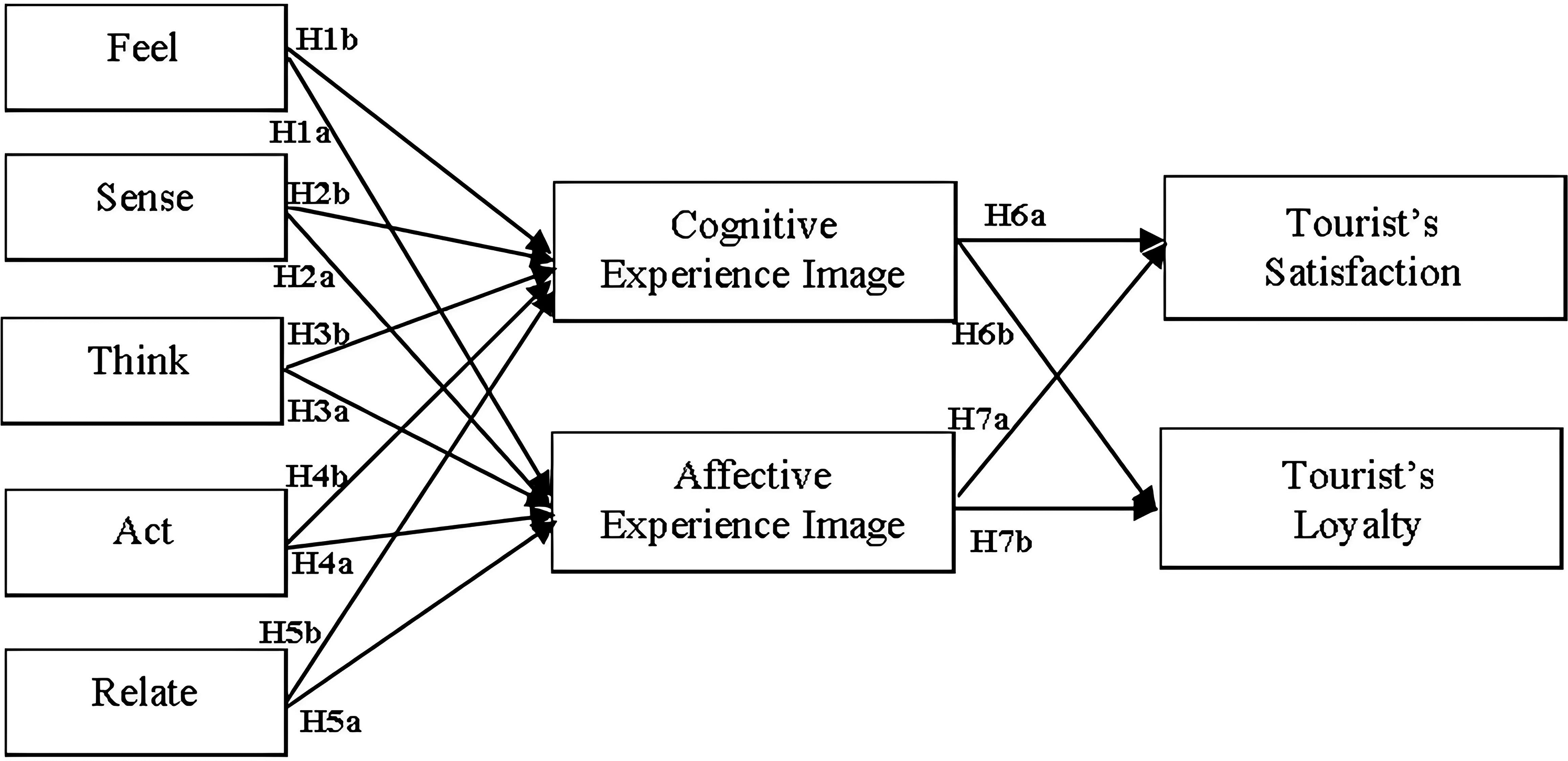
Conceptual model and hypotheses.
The study setting
The Algarve is located in the south of Portugal and includes Europe's westernmost point. Spatially, the region comprises just over 5000 km2, with 150 km of coastline facing the Atlantic Ocean (Guerreiro et al., 2025). The region is also the most well-known Portuguese tourism destination, with Faro International Airport receiving 9.6 million passengers in 2023 (INE, 2024a). It has also received multiple international accolades as a tourism destination (e.g., Europe's Leading Beach Destination in 2021, 2022, 2023 awarded by the World Travel Awards). Consequently, the Algarve is a worldwide famous and fashionable mature tourism destination that has mainly developed around sun and sea products (Guerreiro et al., 2023; WTA, 2024). In recent decades, new tourism products have been developed to diversify the region's tourist offer, namely golf, cultural touring, and birdwatching, which have reduced the negative impacts associated with seasonality (Guerreiro et al., 2023). The importance of tourism to the Algarve is also underlined by its position as the region's leading economic activity generating over 1.5 billion euros in total tourism revenue (CCDR, 2024). In terms of accommodation capacity, the region also has more than 52,000 rooms and approximately 132,000 beds in the tourism industry (CCDR, 2024; INE, 2021). The Algarve is also the main tourist destination for the Portuguese, accounting for 26.4% of overnight stays in 2023 (INE, 2024b).
For the purposes of this study, the Algarve was selected as the study setting due to its prominence as a leading tourism destination in Portugal and Europe with high volume tourism flows, its recognized tourism excellence and diversity of tourism products, and its economic relevance (Bender et al., 2024). In addition, the Algarve shares several tourism products (e.g., sun and sea products, and golf) and destination characteristics (e.g., Spain) with other Mediterranean tourism destinations (Falzon, 2012). These comparative aspects further demonstrate the study's relevance and contribution.
Study design
The study was guided by an integrated multi-phase research design (see Figure 2). Phase 1 comprised a literature review and examination of the pictorial image of the tourist destination. Phase 2 sought to validate the construct dimensions and attributes through two panel discussions (industry and academia). Finally, Phase 3 involved the testing and validation of the construct using data collected from tourists visiting the Algarve.
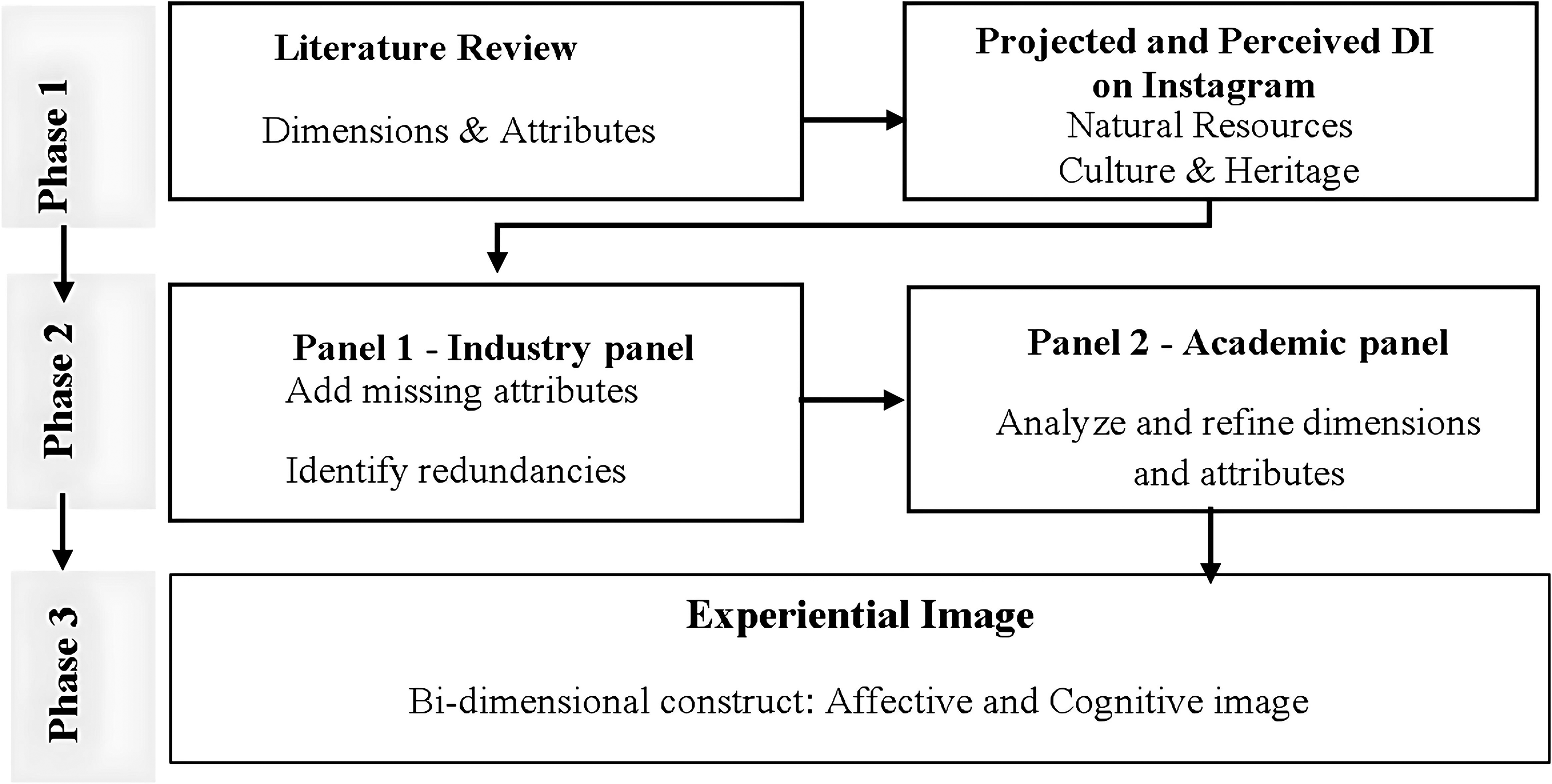
Multi-phase research design.
Phase 1—pictorial destination image
In this first phase, a comprehensive literature review was carried out to understand the multidimensionality of the construct and generate the first pool of attributes to measure the cognitive and affective components of the destination image. In this regard, the literature review focused on identifying scales developed in contexts like the Algarve (mature sun and beach destinations) and on measurements already validated for the same purpose in the region itself (e.g., Agapito et al., 2013; Matos, 2014). For example, Matos (2014) gathered data on foreign tourists’ opinions about the Algarve's tourism destination image at two different moments (before and after the holiday experience). The functional image attributes included four dimensions, namely weather, natural landscape, gastronomy, and the activities in which tourists engaged during their stay. Additionally, the psychological image, also called the atmosphere, resulted in four dimensions, namely friendliness, relaxed, entertaining/fun, and happy. To summarize, the most distinctive attractions in the Algarve are the beaches, natural landscape, food, the friendliness of the locals, attractions, sun, and the water parks.
To further explore the complex phenomenon of destination image it is recommended to embrace a visual-based approach (MacKay and Couldwell, 2004). To incorporate this aspect, the projected image by the local destination management organization (DMO) and the image perceived by tourists through photographic content shared on Instagram about the Algarve was analyzed. The photographs were collected between January 1, 2018, and July 21, 2019. The tool used to extract the data was the 4 K Downloader software. The search term for images shared by tourists was hashtag #visitalgarve. The collection of photographs published by the DMO was obtained directly through their official Instagram page, called @Visit_Algarve.
Stratified random sampling was then used to select the photographs for analysis (Bryman, 2016). After identifying the nature of the strata (tourist seasons) and the number of photographs published by each segment (DMO and tourists), the size of the respective samples was calculated using the Raosoft software (http://www.raosoft.com/samplesize.html). The photographs were randomly chosen after being numbered sequentially and entered with the respective numerical codes into the SPSS 25 (Statistical Package for Social Sciences) software using Select Cases and Random Sample Cases options. This resulted in the overall collection of 126 photographs denoting the projected image (high season 27; low season 99) and an analysis sample of 87 photographs (high season 18; low season 69), with a confidence level of 90%. For the perceived image, 17,140 photographs were collected (high season 9922; low season 7218) producing a sample of 267 photographs (high season 115; low season 112) with a confidence level of 90%.
For the data analysis, a deductive-inductive process was adopted to derive richer interpretive data through an iterative process that integrated theory and empirical evidence (Azungah, 2018; Bryman, 2016; Bender et al., 2022). The main categories and subcategories were deductively derived from Picazo and Moreno-Gil's (2019) study on pictorial images published between 1996 and 2015. Three general categories were identified: people (human presence in the photographs), type of activities (physical, mental, and leisure), and context (landscape and nature, heritage and culture, leisure and recreation, accommodation and Infrastructure). Related attributes were then coded through inductive content analysis and subsequent validation by two senior researchers in tourism and marketing.
Analysis of DMO communication and promotion of the Algarve through photographs shared on Instagram revealed a focus on the destination's specific contexts, such as natural resources and culture and heritage. Within these contexts, the most outstanding natural resources are the beach, the flora, and the sun. Within the culture and heritage contexts, monuments, handicrafts, traditional architecture, and urbanism stand out. In comparison, the photographs shared by tourists highlight the region's natural resources, culture and heritage, and accommodation. The natural resources with the most significant representation are the beach, sun, and cliffs. Culture and heritage are illustrated mainly through gastronomy, traditional architecture and urbanism, monuments, and urban art. An advantage of this inductive analysis approach is that it enabled identification of unique place characteristics (e.g., cliffs, urban art, flora). This then informed the compilation of a list of attributes that represented and characterized the destination, required for Phase two.
Phase 2—industry stakeholders’ and academics’ panels
This phase involved conducting two panel evaluations. The first panel (Industry) included six representatives drawn from public institutions (e.g., Municipality) and private (e.g., independent and hotel chain group) entities. During the panel discussion members were invited to add new items or dimensions that, in their view, were missing to capture the uniqueness of the tourism destination. Elicited attributes were then integrated into the initial list including: “tolls are very expensive,” “there are no language barriers at the destination,” “interesting artisanal crafts,” “good value for money,” “safe place to travel,” and “The destination can be easily reached.” To enhance the item's content validity, the participants in Panel 1—Industry, were also invited to independently analyze the integrated list of attributes (or items) to identify redundant and non-relevant items to the study context. A second expert panel (Panel 2—Academic Panel) comprising seven academics in the tourism and marketing fields with strong knowledge about the region as a tourism destination analyzed the resulting attribute list, and eliminated redundant attributes. The complete process produced a final list of 55 attributes, split between 18 affective and 37 functional ones. This list of attributes then informed the development of the self-administered questionnaire in Phase 3.
Phase 3—tourism experiences and experiential image pathways
Questionnaire design
A quantitative approach was used to test the conceptual model and related hypothesis, data were collected through a structured self-administrated questionnaire comprising seven constructs and 41 items. Considering the study objectives and the relevance of first-hand experiences on the formation of experiential image, a context-driven approach to measuring the destination experiential image through a multimethod design was employed. Previously validated scales were adopted to measure tourism experience, satisfaction, and loyalty. The five strategic experiential modules derived from the SEM, and validated by Rather (2020) were used to measure the tourists’ in situ experiences within the destination context. Tourists’ satisfaction and loyalty scales were adopted from Lee et al. (2014) and Martín-Santana et al. (2017). All scales were measured using a five-point Likert scale (strongly disagree = 1 to strongly agree = 5) as it was considered a more precise and readily understandable format for respondents (Dedeoglu et al., 2018). Once the data collection instrument (questionnaire) was developed, piloting was conducted with 12 tourists to assess the questionnaire for typos, errors, and any other potential difficulty that could influence respondents’ participation. The final version of the questionnaire was prepared in English and then translated into Portuguese, French, Spanish, and German. This process involved translation and revision by bilingual native speakers in each of the languages following the Back-translation process (Dedeoglu et al., 2018) before being validated by seven academics.
Data collection procedures
The survey was conducted in the departure area of the Faro International Airport in 2021. A proportional stratified sample was applied by season and the most representative inward markets of the destination. Respondents were informed about the purpose of the research, and the anonymity of answers was assured. Data collection was conducted at various times throughout the day and week to capture a diverse range of tourist profiles. During the data collection periods, all tourists aged 18 and over waiting for their flights were invited to fill out the questionnaire. In total, 2709 valid questionnaires were collected from tourists who agreed to participate, comprising 1909 responses in the high season (between July and September 2021) and 800 in the low season (between October and June 2021). The respondents’ profiles and the internal reliability of the scale were examined using IBM SPSS Statistics 26.0. The item-to-total correlation (ITTC) was also computed to identify the reliability of each item. For all items the ITTC was found to be greater than the recommended value of 0.5 (Bagozzi, 1981).
Data analysis
Data analysis involved the application of exploratory factor analysis (EFA) to scrutinize the dataset, with the aim of uncovering intricate connections among the items related to experiential image and to group items that form integral concepts within this framework (Shrestha, 2021). Specifically, EFA using the principal components method and varimax rotation was applied to the sample incorporating the 55 items of the two main EI dimensions, that is, cognitive and affective. EFA was used to determine the factor structure of each measure and assess its internal reliability (Cudeck, 2000; Fabrigar and Wegener, 2011). This type of analysis is valuable and recurrent (e.g., Yağmur and Aksu, 2022) for researchers seeking to test underlying relationships between measured variables (Norris and Lecavalier, 2010). Justification for using EFA was confirmed through the Kaiser–Meyer–Olkin index value of 0.944 (>0.70), and the Bartlett spherical test significance at the 0.01 level.
Before testing the study hypotheses, the results of the two well-known tests of normality, namely, the Kolmogorov–Smirnov and the Shapiro–Wilk were analyzed. These tests revealed that the data were not normally distributed (the significance value for all items = 0.000). In addition, the study conceptual model comprised formative second order constructs (affective image and cognitive image) and reflective first order constructs (five dimensions of tourists’ experience, satisfaction, and loyalty). The dimensions resulting from the aforementioned EFA were also used as reflective first order constructs to measure the second order constructs (affective image and cognitive image). Considering the model complexity and the non-normal data distribution, the authors used the partial least squares equation modeling (PLS-SEM) statistical approach to test the study hypotheses. This method leverages the unique ability of PLS-SEM, specifically the software Warp PLS, to handle complex models, including both reflective and formative constructs (Hair et al., 2011; Hair et al., 2019). As a first data check, a full collinearity test was used to assess for common method bias Kock (2015). The full collinearity variance inflation factor (VIF) of all constructs was found to be less than 3.3, confirming the non-existence of both vertical and lateral collinearity. In the following reported findings, drawing on Kock (2022), five criteria to evaluate the convergent validity are reported including: loading values, composite reliability (CR), Cronbach's Alpha coefficients, average variance extracted (AVE), and Dijkstra's rho_a's. Discriminant validity was assessed using the Fornell–Larcker criterion and the heterotrait–monotrait ratio (HTMT).
Findings
Sample profile
The sample (Appendix A) is mainly made up of women (60.3%) aged between 25 and 64 (68.8%) with a university degree (60.3%). Overall, most respondents were employed (61%), and their marital status was married or living in partnership with someone else (50%). The countries of residence of most respondents were Portugal (26.8%) and the United Kingdom (24.4%).
Experiential destination image—EFA analysis
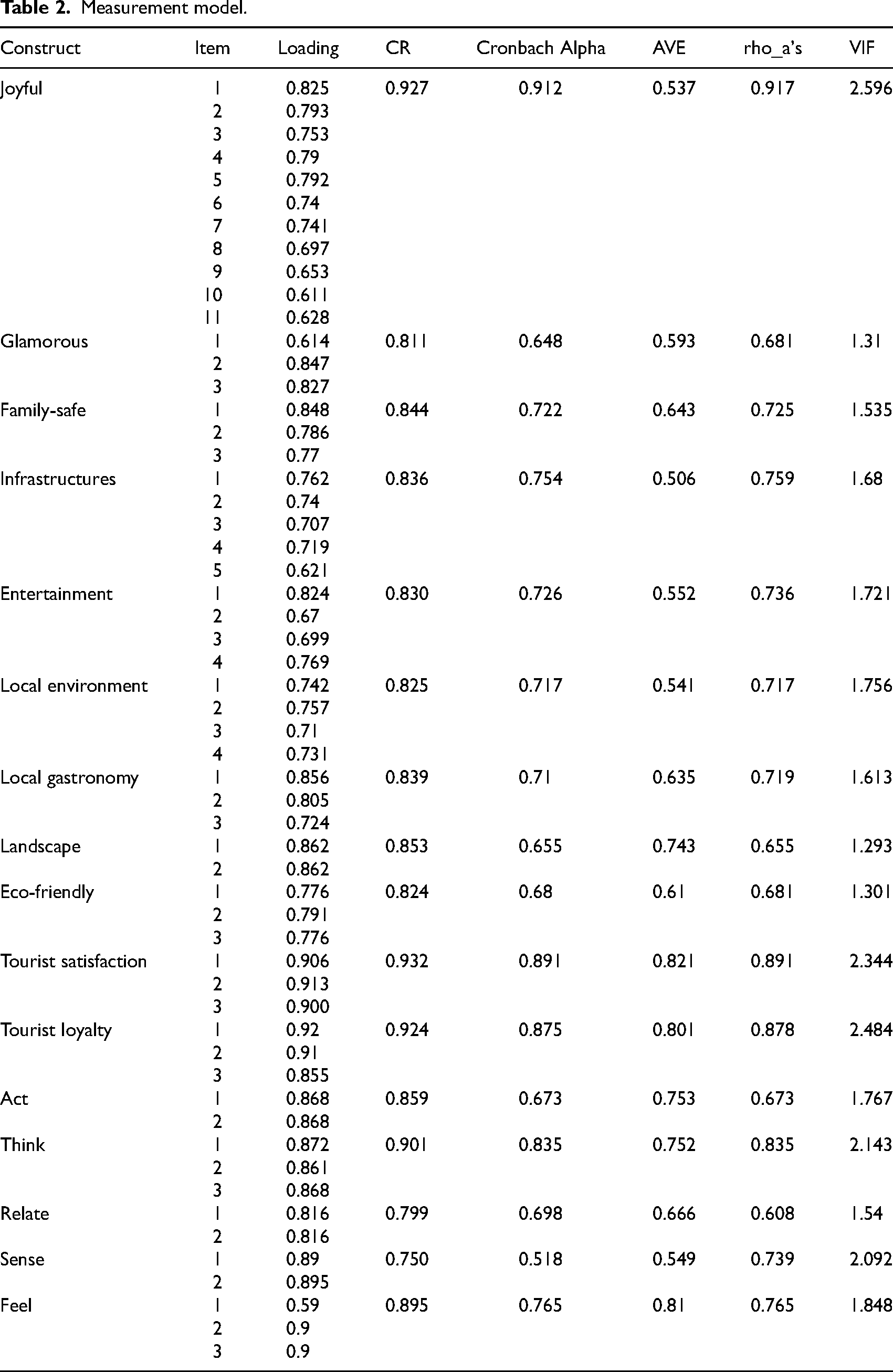
For the EFA (Table 1), nine components with eigenvalues greater than 1 were extracted after three iterations, with the cumulative variance contribution reaching 56.54%. We retained items with eigenvalues greater than one and factor loadings exceeding 0.4 on all factors. An iterative process of elimination was performed with two rounds of factor analysis, which led to 11 items being deleted (with loadings lower than 0.4) from the initial pool of 55 items. Thus, the scree plot showed a nine-factor solution with 44 optimal items. Therefore, when cross-referenced with the underpinning studies from the literature, three components labeled joyful, glamorous, and family-safe were categorized as the “affective image” dimension. Joyful contains 11 items and explains the greatest amount of the total variance of experiential image, that is, 14.13%, with an eigenvalue of 11.78. Glamorous also includes 5 items and explains 4.91% of the total variance of experiential image with an eigenvalue of 1.55. Including 3 items, the third factor of affective dimension is family-safe, explaining 4.70% of the total variance of experiential image with an eigenvalue of 1.09.
The remaining six components pertain to the “Cognitive image” dimension. The Infrastructure component comprises five items with an eigenvalue of 2.66. The Entertainment component encompasses 7 items and elucidates 6.76% of the total experiential image variance, with an eigenvalue of 2.30. Local environment, represented by 5 items, contributes to a 5.64% explanation of the total experiential image variance, with an eigenvalue of 1.79. Local gastronomy and Eco-friendly features components consist of 3 items each, explaining 4.77% and 4.75% of the total experiential image variance, with eigenvalues of 1.48 and 1.27, respectively. Lastly, the Landscape component comprises two items and accounts for 3.87% of the total experiential image variance, with an eigenvalue of 1.06.
The measurement model
Table 2 shows the convergent validity analysis of the 18 reflective variables of the study. Kock (2022) suggests loading values equal to or above 0.6 to improve the other convergent validity criteria (Chin, 2010; Hair et al., 2011). So, 6 items (Entertainment: 3 items, Glamorous: 2 items, and Local environment: 1 item) were removed due to the loading value below 0.6. Additionally, two indicators of internal consistency reliability, that is, CR and Cronbach's Alpha, should have a minimum level of 0.7 to be considered acceptable. These two indicators are accepted for all constructs listed in Table 2. Also, values higher than 0.5 of AVEs confirm the convergent validity of the variables (Hair et al., 2011). Based on the results, the variables had an AVE higher than the cut-off point. Finally, Gelhard and von Delft (2015) recommend that researchers should also report the construct reliability by using the Dijkstra–Henseler rho reliability coefficient (>0.7), this is advised because reliability is underestimated by Cronbach's Alpha and overestimated by CR. This criterion value (usually between Cronbach's Alpha and CR) was found to be acceptable for all variables. Consequently, it was determined that all variables in this research were convergently valid.
Exploratory factor analysis results.
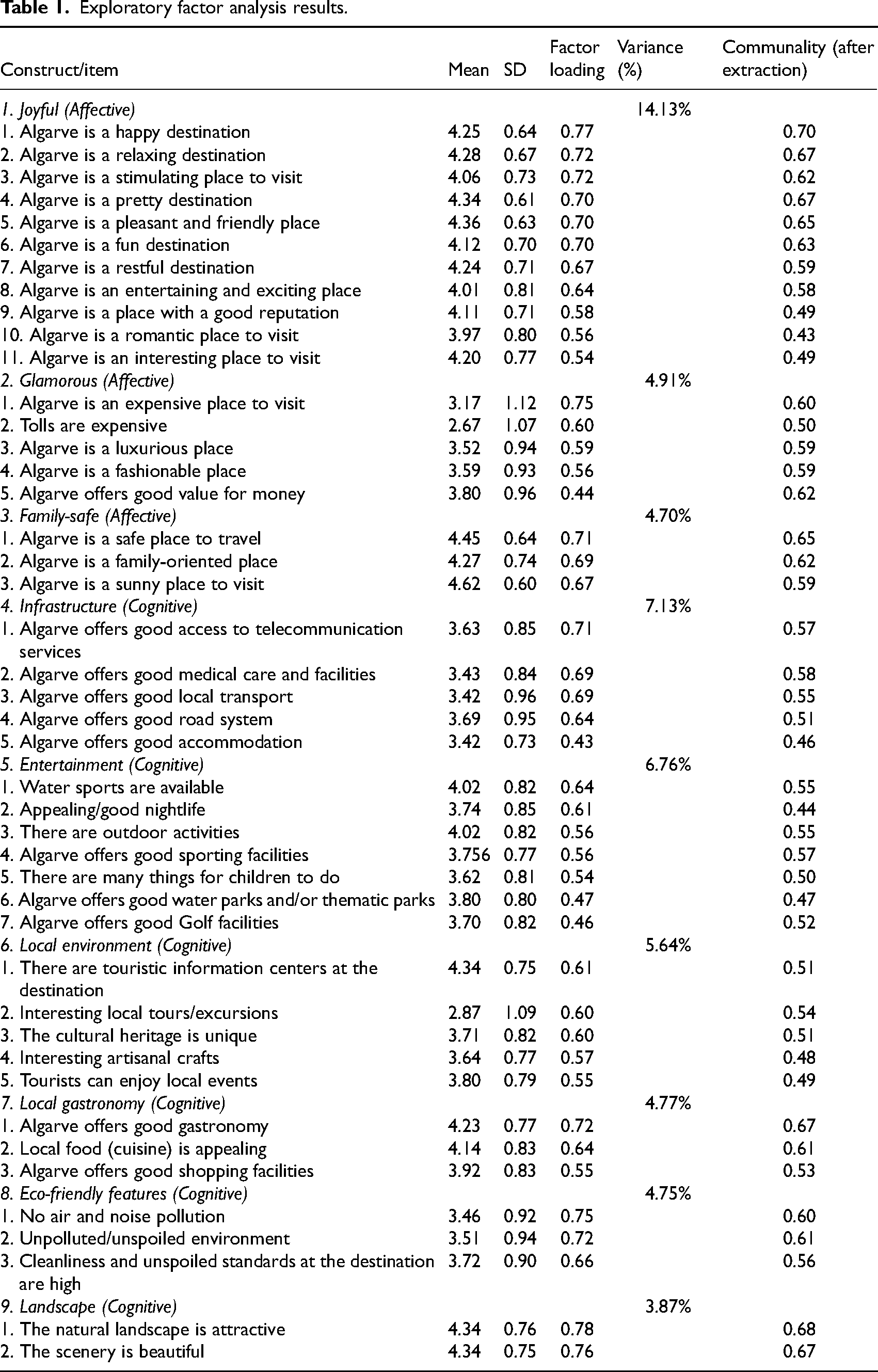
Measurement model.
Discriminant validity evaluates the distinctiveness between the model constructs (Hair et al., 2020). To demonstrate discriminant validity, the Fornell and Larcker criterion suggests that the square root of the AVE for each construct is more than the correlation with any other constructs, and the HTMT ratio is also less than 0.85 or 0.9 (Chin, 2010). The AVE values were found to be below the main diameter and less than the amounts in the main diameter (Appendix B), while the HTMT values above the main diameter (in italic font) are less than 0.9 (Appendix C). Therefore, the model is confirmed in terms of discriminant validity.
Formative constructs
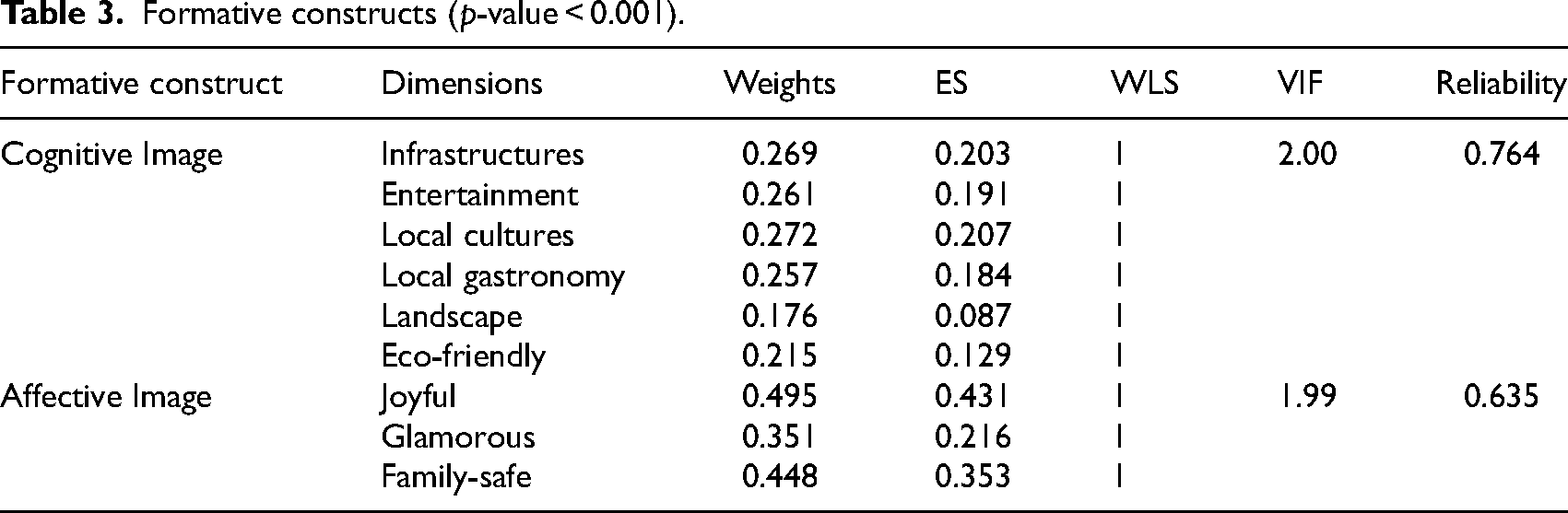
As previously stated, cognitive and affective dimensions of experiential image were defined as two composite constructs formed from six and three factors, respectively. The evaluation criteria of the formative constructs are presented in Table 3. The constructs have reliability values greater than 0.6, and all weights are significantly more than zero (at the 1% significance level). In the case of effect size (ES) evaluation, scores of 0.02, 0.15, and 0.35 are recommended as weak, medium, and strong. For this criterion, all ES values are within the threshold. Finally, the weighted least squares (WLS) result is positive, and the VIF scores are less than 2.5.
Formative constructs (p-value < 0.001).
Based on the findings and the literature review, the concept of experiential destination image can be defined as follows:
The experiential image of a tourism destination is a dual-faceted construct encompassing cognitive and affective dimensions, shaped by what tourists feel, see, hear, smell, and taste in situ. It reflects the influence of in-situ experiences on tourists’ beliefs and perceptions, derived from a variety of tangible features such as infrastructure, entertainment, local culture, local gastronomy, landscape, and eco-friendly amenities. Equally, it is influenced by intangible factors, including the joyful, glamour, and family-safe environment. These cognitive and affective signals form a holistic image of destinations.
Hypotheses testing
To analyze the relationships between the five dimensions of tourism experience and both cognitive image and the affective experiential image; and the relationships between experiential image (cognitive and affective) and tourist's satisfaction and tourist's loyalty; path coefficients (β) and their significance, Q-squared (Q2), and R-squared (R2) were considered. As Table 4 illustrates, for the first hypothesis, the path coefficient equals 0.106 (p < 0.001). Therefore, the Feel experience has a positive and significant impact on the affective experiential image (H1a). However, this relationship is not that strong, although significant, for the impact of Feel experience on the cognitive experiential image (H1b), as indicated by a path coefficient of 0.045 (p = 0.009).
Hypotheses test.
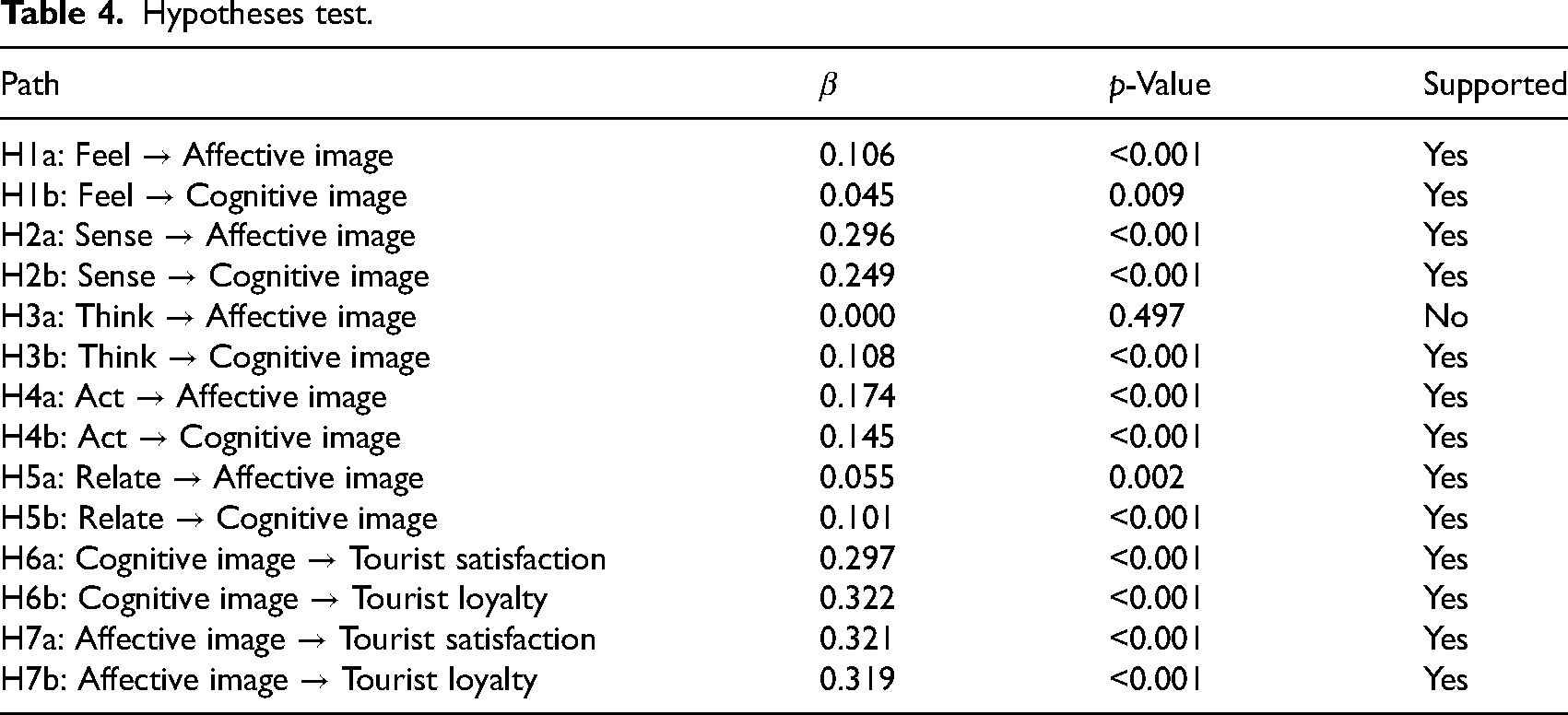
Interestingly, in this study, the effect of sense experience on both affective image and cognitive image is the strongest. Thus, H2a and H2b are significantly supported due to the path coefficients of 0.296 and 0.249, respectively (both p < 0.001). The only unsupported hypothesis of this study, H3a, shows the relationship between think experience and affective image, as evidenced by a path coefficient of 0.000 and a p-value exceeding 0.05. Nevertheless, as indicated by a path coefficient of 0.108, the impact of think experience on the cognitive experiential image (H3b) is supported (p < 0.001). Act experience has a positive and significant impact on both cognitive (H4b) and affective (H4a) experiential image, with path coefficients calculated at 0.174 and 0.145, respectively (both p < 0.001). Finally, the positive impact of Relate experience on both affective and cognitive experiential image is supported, that is, H5a and H5b. However, the path coefficient is calculated as 0.055 for the former and 0.101 for the latter, that is, the impact of relate experience on cognitive image is stronger than on affective image. The explained proportion of the variance (R2) for cognitive image and affective image, attributed to all five dimensions of tourism experience, is 0.281 and 0.276 (R2), respectively.
Additionally, the Q2, representing predictive relevance, is calculated as 0.278 for the cognitive image and 0.275 for the affective image, which is greater than the accepted moderate level (Rasoolimanesh et al., 2017). In the other hypothesis groups, the relationship between the two experiential image dimensions (cognitive image and affective image) and tourist satisfaction and loyalty were analyzed. Here, cognitive image demonstrates a positive impact on both tourist satisfaction and tourist loyalty, as evidenced by path coefficients of 0.297 and 0.322, separately. Also, affective image positively and strongly influences tourist satisfaction and tourist loyalty, with path coefficients of 0.321 and 0.319, respectively. Therefore, H6a, H6b, H7a, and H7b are supported. The R2 criterion for tourist satisfaction and tourist loyalty is 0.313 and 0.336, respectively. Furthermore, the Q2 criterion is computed as 0.337 for tourist satisfaction and 0.313 for tourist loyalty.
Model fit
As previously described, it is important to assess the model's explanatory power and predictive validity through the calculation of the most commonly mentioned fit indicators of the model. These are outlined as follows: average path coefficient (APC) = 0.181, p < 0.001 (acceptable if p < 0.001); average R2 (ARS) = 0.302, p < 0.001 (adequate if p-value < 0.001); average adjusted R2 (AARS) = 0.301, p < 0.001; Tenenhaus goodness of fit (GoF, which is a criterion of the explanatory capacity of the model) = 0.466 (low adjustment, values > 0.25 to indicate medium adjustment, and values > 0.36); and average full collinearity variance inflation factor (AFVIF) = 1.983 (acceptable if ≤5, ideally ≤3.3). Taken together, the model fit indices suggest a good predictive validity for the obtained model.
Discussion and conclusions
Grounded in experiential marketing thinking, this study developed and tested a new approach for examining the experiential image concept, one that is rooted in the context-driven destination image and in situ first-hand experiences as an agent of image formation. More precisely, the study aimed to validate the experiential image and the tourists’ Experience- Experiential Image-Satisfaction-Loyalty framework.
This novel approach also addresses a key limitation of previous research, notably the critique that studies have tended to apply generalized tourism image scales to specific destinations without considering the unique experiences and features associated with those places, consequently, neglecting the context-based nature of both constructs (Fakeye and Crompton, 1991; Li et al., 2021; Matos et al., 2015). In contrast, the approach to examining the experiential image concept put forward in this study, explains the origins of the experiential image, presenting a clear definition(s), and offering a reliable scale to analyze its application in tourism destinations. As such, this study provides a unique and comprehensive framework to enhance its understanding. In addition, the study provides a practical example from a mature sun and sea destination of how the framework can be implemented. The robustness of the study is also demonstrated through the presented integrated multi-phase approach. The first phase included an extensive literature review and background research of photos shared on Instagram both by the DMO and tourists. Phase 2 included two panel studies (industry and academia) that scrutinized local image items to evaluate existing, and determine new items that were validated to form the final list of attributes. The final phase included a questionnaire survey to gather data from tourists returning home from their visit to the Algarve.
Through the conducted analysis the experiential image construct was found to be bi-dimensional formed by six factors comprising the cognitive dimension (infrastructures, entertainment, local environment, local gastronomy, eco-friendly features, and landscape) and three comprising the affective dimension (joyful, family-safe, and glamourous). The study findings also highlight the relevance of cognitive dimensions in relation to having an environmentally oriented destination or local gastronomy. Similarly, findings of the atmosphere, or affective dimension, reinforced the need for tourists to experience a family-safe destination.
Although previous studies have examined destination image from a post-experience perspective, they lack an integrative and comprehensive process for conceptualizing the realistic destination image (i.e., experiential image), or for developing a new scale for its measurement (e.g., Abuhjeeleh et al., 2018; Vaughan and Edwards, 1999). We argue that this is the only credible way for all the factors and attributes of a place or destination to be captured, since each place or destination has its endogenous characteristics and holistic nature. Moreover, in regard to the affective component of the destination image, notwithstanding the seminal work of Baloglu and McCleary (1999), new approaches that highlight the role of emotions, imagery processing, and mental simulation call upon the need to reconsider how experiences shape and influence tourists’ behavior (Le et al., 2019). Since theories in tourism aim to provide an understanding of tourists and their behavior, along with the impacts of their activities (e.g., social or environmental) on destinations, our results can be said to address this gap effectively.
The results also align with the extant literature and the proposed conceptual model, that is, tourists’ Experience-Experiential Image-Satisfaction-Loyalty. Thus, experiential image can be a focal point of interest for the success of tourism destinations, an aspect recognized by researchers and practitioners. Specifically, the findings support that tourists’ destination experiences influence the experiential image they retain from their visit. This is partially consistent with previous studies (Guerreiro et al., 2023; Li et al., 2021). The results and all the supported hypotheses (H1a to H5b) stress the role of memorable experience and its potential effects on destination image (Anaya and Lehto, 2023; Li and Zhao, 2021). However, one of the suggested hypotheses was unsupported (H3a: Think → affective image). This result is consistent with previous studies (e.g., Barnes et al., 2014; Kumar and Kaushik, 2018). The think dimension targets consumers’ intellect by engaging them in creative and imaginative thinking, leading to cognitive experiences and sparking curiosity (Brakus et al., 2009; Schmitt, 1999). A joyful, glamorous, and family-safe (Guerreiro et al., 2023) sun and beach destination like the Algarve is particularly dominant in sensorial cues that trigger feelings, sentiments, and emotions which are not so relevant in stimulating visitors’ intellect. Since tourism is an industry of dreams (Le et al., 2019), and tourists are “hedonic vacationers” or “daydreamers” (Li et al., 2023c: 5), hedonic factors can thus be more relevant in designing tourism experiences which positively influence affective images (Barnes et al., 2014; Kumar and Kaushik, 2018).
Testing of the second hypotheses group (H6a to H7b) also provides evidence that the path model regarding cognitive and affective image influence on tourists’ satisfaction and loyalty is supported. Once again, this is congruent with previous studies (Ali et al., 2016). In conclusion, the study indicates that tourists’ first-hand experiences are particularly rich in sensorial impressions (Trang et al., 2023), enriching the concept of experiential image. Thus, in accordance with the study's findings, the experiential image concept can be operationally defined as a bi-dimensional construct influenced by tourists’ in situ experiences, comprising cognitive and affective dimensions that reflect a multifaceted, dynamic, and authentic mental portrayal of the destination.
Theoretical contribution
This study contributes to the body of tourism management and marketing literature through the following theoretical and methodological implications. Theoretically, this study demonstrates that, approaching the destination image concept through an experiential approach (i.e., experiential image) can and must be employed in the tourism context. Specifically, the experiential image resulting from the experiences tourists have at a destination has shown several critical behavioral consequences, including loyalty toward the destination in its various forms (e.g., revisit intention) (Chew and Jahari, 2014; Tosun et al., 2015) and tourist satisfaction (Li et al., 2021). In addition, since this study was conducted after the COVID-19 pandemic, it considers the various factors of the destination image formed by the personal experiences of the visitors who started traveling after a global health crisis. Tourist concerns over safety issues and uncertainty might justify the emergence of “Family-safe” as a distinct factor of the affective dimension of experiential image. Furthermore, a key strength of the current study lies in the facilitated engagement (Phase 1) that fostered greater dialogue between scholars and local stakeholders (de las Heras-Pedrosa et al., 2020; Stylidis, 2022), to identify dimensions and attributes of the experiential image concept, which were not previously addressed (e.g., experiential image) nor subject to investigation in a fast-paced society, in which, changes occur daily.
Pertinently, our study also collected in situ-data during the tourist experience, capturing how first-hand experiences transformed the experiential image. The scale of the study is also notable in its comprehensive methodological approach which incorporated a proportional stratified sample and a full-year assessment (covering both high and low seasons) of tourists’ perceptions and experiences. Thus, the study provides a novel, cohesive, and integrated understanding of the experiential image and its implications for destination marketing strategy, a previously identified need (Lee et al., 2023; Madden et al., 2016; Shoukat et al., 2023). Our findings also support that the use of overused previous scales (e.g., Echtner and Ritchie, 1991, 1993; Pike, 2002) should be carefully considered by researchers due to their limitations in comparison to more flexible, adaptable scales tailored to sun and sea tourism destinations. In summary, this study has addressed significant prior criticisms in the extant literature (Byon and Zhang, 2010) and demonstrated at scale, the value of incorporating experiential attributes and environmental aspects (Bilynets et al., 2023; Choi and Cai, 2022) into destination marketing approaches.
Managerial implications
From a management perspective, the study also makes the following practical contributions. Firstly, measuring the experiential destination image provides a more accurate and realistic place image, which is fundamental for destination branding, the design of destination attributes, positioning, and achieving a competitive advantage (Afshardoost and Eshaghi, 2020; Golestaneh et al., 2022; Mohamed et al., 2020). Such an image is essential for every destination and DMO to operate successfully in the tourism market. Secondly, the context-driven approach used to assess the experiential image in the Algarve, a mature sun and sea tourism destination in the Mediterranean, can benefit other destinations with similar characteristics (e.g., Spain, Turkey, Italy) (Soler et al., 2019). Thirdly, adopting the proposed measurement approach would enable tourism destination managers to identify differences and similarities between destinations, resulting from tourists’ perceptions, and compare their performance (Stylidis et al., 2022). Moreover, incorporating the design of marketing mix strategies (Lawal and Adejuwon, 2023; Li et al., 2023a, 2023b, 2023c)—using tools such as videos, pictures, brochures, advertisements, websites, and social media to strengthen positive sensory impressions of the destination is crucial for every destination brand. Finally, following the extensive attention of academics on the subject, we argue that tourism practitioners (managers and marketers) also need to understand the meaning, nature, and mechanisms of destination image formation, as the concept greatly reflects tourists’ perceptions and thoughts toward a place.
Limitations and future studies
The current study has some limitations which need to be acknowledged. Firstly, the study focused on a single destination (the Algarve) with a specific context and lifecycle (mature destination) and addressed a recurring type of tourism product (sun and sea). Furthermore, new items related to the experience of the destination, such as the five senses, should be generated by future researchers to assess the experiential image. By following the scale development protocol (Churchill, 1979), future studies should also develop a new measurement for experiential image. For example, future studies could use other rating scales, including semantic differential, bipolar, and Gutmmen, and conduct a multitrait–multimethod (MTMM) proposed by Campbell and Fiske (1959) to improve the construct (discriminant and convergent) validity. Finally, researchers can use more qualitative approaches, such as interviews and open-ended questions, to capture tourists’ holistic impressions and experiences.
Supplemental Material
sj-docx-1-jvm-10.1177_13567667251335045 - Supplemental material for Unveiling the impacts of tourist experiences on experiential image, satisfaction, and loyalty: A study in Algarve, a European premier beach destination
Supplemental material, sj-docx-1-jvm-10.1177_13567667251335045 for Unveiling the impacts of tourist experiences on experiential image, satisfaction, and loyalty: A study in Algarve, a European premier beach destination by Manuela Guerreiro, Patrícia Pinto, Nelson deMatos, Fatemeh Bagheri, Bernardete Dias Sequeira and Ana Parra in Journal of Vacation Marketing
Footnotes
Acknowledgments
The authors thank Neil Ormerod for his valuable and constructive comments while revising the draft of the manuscript.
Author's note
Fatemeh Bagheri is currently affiliated with Instituto Superior de Lisboa e Vale do Tejo (ISCE), Lisbon, Portugal.
Data availability statement
The datasets generated during and/or analyzed during the current study are available from the corresponding author on reasonable request.
Declaration of conflicting interests
The authors declared no potential conflicts of interest with respect to the research, authorship, and/or publication of this article.
Ethical approval
All the procedures performed in studies involving human participants were in accordance with the ethical standards of the Declaration of Helsinki and its later amendments or comparable ethical standards.
Funding
The authors disclosed receipt of the following financial support for the research, authorship, and/or publication of this article: This paper is financed by National Funds provided by FCT- Foundation for Science and Technology through project UIDB/04020/2020 with DOI 10.54499/UIDB/04020/2020 (https://doi.org/10.54499/UIDB/04020/2020) and it is an output of the project TurExperience (SAICT-ALG/39588/2018).
Informed consent
Informed consent was obtained from all individual participants included in the study.

Supplemental material
Supplemental material for this article is available online.
References
Supplementary Material
Please find the following supplemental material available below.
For Open Access articles published under a Creative Commons License, all supplemental material carries the same license as the article it is associated with.
For non-Open Access articles published, all supplemental material carries a non-exclusive license, and permission requests for re-use of supplemental material or any part of supplemental material shall be sent directly to the copyright owner as specified in the copyright notice associated with the article.
