



Abstract
With rapport building growing in significance, this investigation of its role in attitude and behavioural intention in the group tour context used a multi-methods approach (a video experiment, a photo experiment and a survey). Group attentiveness was also examined as a moderator in the attitude–behavioural intention relationship. Three studies were conducted on the Australian tourism industry in which group tours are common. The first study (a video experiment) and the second study (a photo experiment) were conducted with participants living in Canberra, Australia, while the third survey-based study was conducted on domestic tourists visiting anywhere in Australia on a group tour for the purpose of generalisation. Results from the partial least squares method confirmed the crucial role of rapport in developing a positive attitude and behavioural intention, with the combined effect of rapport and social interaction higher than their individual impacts. Group attentiveness was also found to be a significant moderator.
Introduction
As an individual's consumption behaviour in the group context is different to that in the individual context in various scenarios (Albrecht et al., 2017; McFerran et al., 2010), rapport building behaviour can be significantly different on group tours. Rapport refers to pleasant interaction with others and comprises two dimensions: personal connection and enjoyable interaction (Gremler and Gwinner, 2000). Personal connection refers to a strong bond, whereas enjoyable interaction refers to enjoyment in service encounters (Gremler and Gwinner, 2000). Rapport in this study refers to personally connected and enjoyable interaction from customer to customer and from customer to tour guide in a group tour context. Early studies on rapport have mostly tested its impact on relationships in the individual consumption context (Fatima et al., 2020; Lin and Lin, 2017; Lindsey-Hall et al., 2021), with only limited studies in the existing literature conducted on rapport building behaviour in the group consumption context.
As rapport varies considerably depending on the social context (Grahe and Bernieri, 2002), it is essential to understand how it is influenced by social interaction. Using social exchange theory (Blau, 1964) as a theoretical lens, it can be concluded that social interaction is an exchange of feelings, emotions and information (Lin et al., 2020). Individuals who undertake group tours are found to interact with each other to fulfil their psychological needs and self-interest (Lawler and Thye, 1999); therefore, this study explores social interaction between group tour customers and their interaction with their tour guide. Interestingly, the ways in which individuals build rapport on group tours and how this is affected by their social interaction with each other are still not fully explored, Thus, the current study addresses this gap by examining the impact of social interaction on rapport in the group tour context.
Rapport may also be influenced by relationship dependency as individuals may need to compromise their individual preference in favour of the group's preference. In fact, customers’ influence on each other when involved in group service interaction is often intense through direct encounters as part of being in the same business environment (Baker, 1987; Wu, 2007). With consumers having diverse types of necessary and unavoidable interaction in group consumption (Kim et al., 2019; Lee et al., 2021), accommodating everyone becomes a real challenge. However, little is known in the existing body of literature about the role of relationship dependency in rapport building on group tours, which is the motivation for the current study to investigate the effect of relationship dependency's antecedent role on rapport.
Social interaction and rapport are the key drivers of positive outcomes, such as satisfaction, word of mouth, communication and friendship between group members and service providers, as claimed in the previous literature (Boninsegni et al., 2020; Fatima et al., 2017; Lin and Lin, 2017; Pangarkar et al., 2022). The theory of planned behaviour (TPB) (Ajzen, 1991) is a useful theoretical framework for examining the impact of these constructs, that is, social interaction and rapport, on both attitude development and behavioural intention in the group tour context. While the TPB has been used in various contexts (Fatima et al., 2017; Juschten et al., 2019; Leung and Jiang, 2018), only a few studies have sought to explain the roles of rapport and social interaction in the attitude–behavioural intention connection using this theory as a platform.
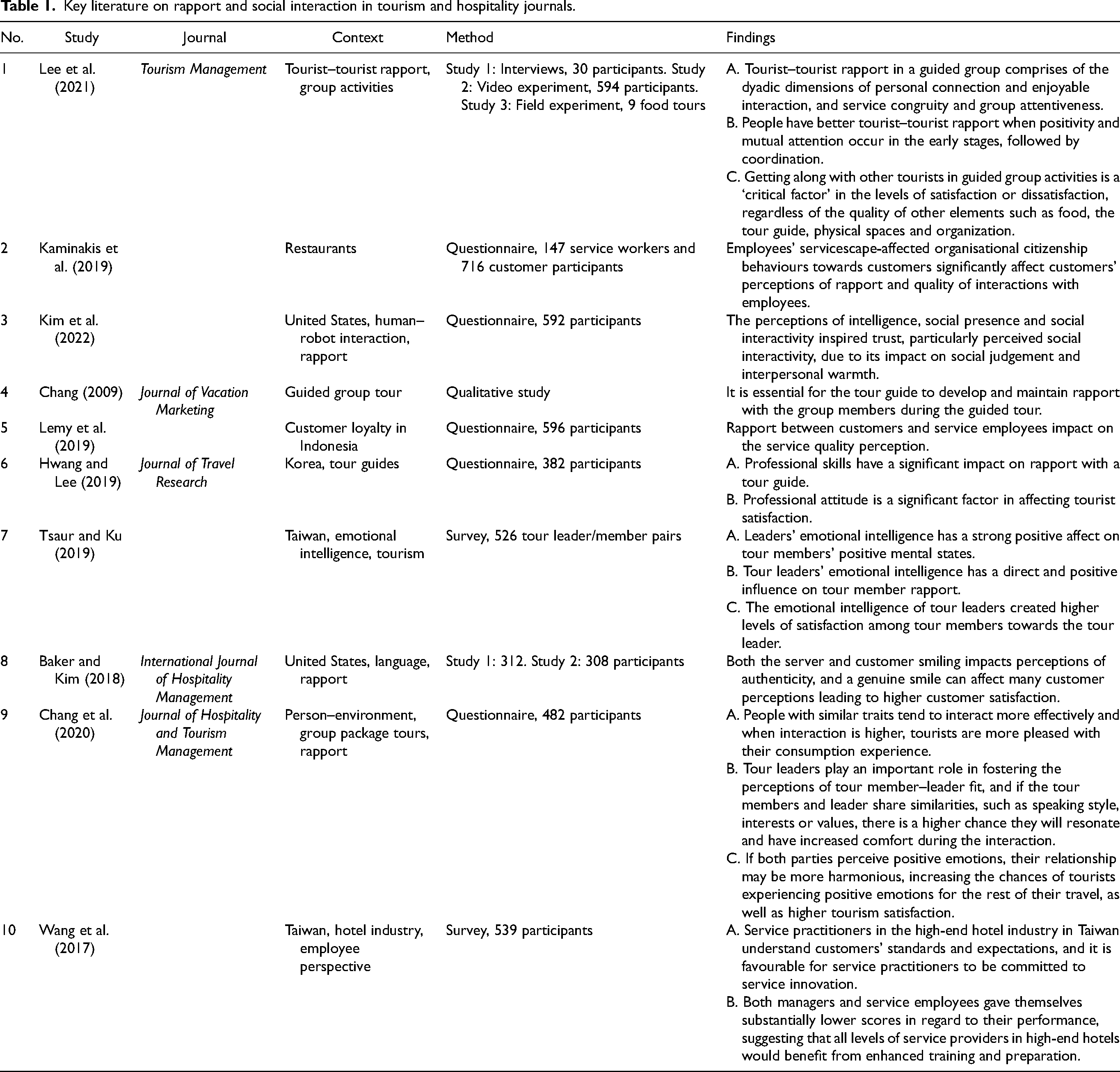
Table 1 summarises the discussions in prior studies on rapport and social interaction, with both having been examined from various aspects, including that of group tours, to identify their impact on service quality, satisfaction, loyalty and commitment (Baker and Kim, 2018; Chang et al., 2020; Lee et al., 2021; Lemy et al., 2019; Tsaur and Ku, 2019). However, past studies have not thoroughly examined the influence of these two key relational factors on attitude and behavioural intention towards participation in group tours. The significance of social interaction and rapport between customers and between customers and service provider (in the current study, the group tour guide) have also been elaborated in prior studies (Chang, 2009; Hwang and Lee, 2019; Kim et al., 2022) and have been highlighted as crucial factors.
Key literature on rapport and social interaction in tourism and hospitality journals.
The service relationship literature has a narrow understanding of the moderator role of group attentiveness in the attitude–behavioural intention link. Group attentiveness is often defined as a spatial behaviour expressed in an individual's reaction to other group members’ activities (Lee et al., 2021; Spoor and Kelly, 2004). Thus, different levels of group attentiveness may moderate the relationship between an individual's attitude and his/her behavioural intention to participate in group tours. The current study sought to address this gap by using group attentiveness as a moderator in the attitude–behavioural intention link.
The study, therefore, sought to answer the following research questions:
Overview of the studies
To answer the research questions, three studies were conducted on the Australian tourism and hospitality industry using the multi-methods approach. This approach has been popular in previous tourism studies (Llodrà-Riera et al., 2015; Smith et al., 2015) for its inherent significance and higher validity as well as its practicability, including the avoidance of self-reporting bias. Study 1 used a video experiment to explore the impact on behavioural intention of various combinations of rapport with the service provider and social interaction. In considering the crucial role of rapport with a service provider, Study 2 used photo experiments (rapport with the service provider vs. no rapport and social interaction vs. no social interaction) to understand attitudes to participating in group tours. Study 3 used the survey method conducted among domestic tourists to test a conceptual model comprising rapport with the service provider, social interaction and group dependency to determine the attitude–behavioural intention relationship in the group tour context, with group attentiveness as a moderator of this relationship. These studies (Studies 1, 2 and 3), using different data collection methods, were conducted in the order determined by the research aim and the specific methodological requirements for addressing the research questions. While no pre-testing with a small sample was carried out, several initiatives were undertaken as an alternative, for example, peer review, literature search and refinement of the questionnaires and procedures in accordance with previous related studies. Standard ethics procedures were also undertaken as recommended by the university's ethics committee.
The structure of the article is as follows: Study 1 (video experiment) is discussed first, followed by Study 2 (photo experiment) and then Study 3 addresses the survey and its results. Finally, the Discussion section highlights the key summary of the findings from all three studies, with the Conclusion section comprising the study's theoretical and managerial contributions along with its limitations.
Study 1
Data
Study 1 used an experimental design (2 × 2 design, rapport with the service provider vs. social interaction) involving 36 participants in Canberra, Australia, to answer RQ1. Participants of various ages, different genders and different ethnic backgrounds were chosen. While participants had previously experienced tourism-based group tours, no time restriction was placed on when they had their group tour experience, as behavioural intention was measured based on their overall experience, not on a specific service encounter.
Procedure
Four different types of videos (Types 1–4) were shown to four distinct groups of participants. To reduce bias, one participant at a time undertook the experiment and each could only access his/her allocated video, not the other videos. All videos were in the tourism and hospitality industry context, with each undergoing a specific manipulation. Each video's content characteristics are summarised in Table 2. A follow-up short survey questionnaire on behavioural intention was then filled in by participants. Three items on behavioural intention were taken from existing tourism studies (Byun and Jang, 2015; Erul et al., 2020) and highlighted ‘make an effort’, ‘willing to use’ and ‘I will plan again’, with the range being from 1 = ‘highly disagree’ to 5 = ‘highly agree’.
Study 1: video content characteristics.*
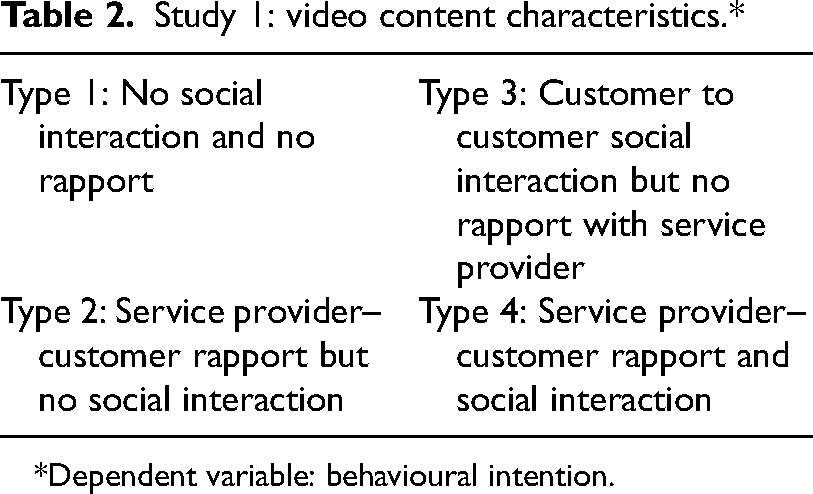
*Dependent variable: behavioural intention.
Results
The results showed that the combined effect of social interaction and rapport with the service provider in Type 4 (social interaction and rapport with service provider, mean [M] = 4.25, standard deviation [SD] = 0.46) had a higher level of positive impact on behavioural intention compared to the individual impact of rapport with the service provider in Type 2 (no social interaction and rapport with the service provider [M = 3.38, SD = 0.65]) and social interaction in Type 3 (social interaction and no rapport with the service provider [M = 3.33, SD = 0.59]). Type 1 (no social interaction and no rapport with service provider [M = 3.95, SD = 0.45]) had a medium level of impact on behavioural intention. Furthermore, post-hoc analysis revealed that participants watching Type 2 and Type 4 videos (significance [sig.] = 0.023 at the 0.05 level) and those watching Type 3 and Type 4 videos (sig. = 0.007 at 0.05 level) had significantly different opinions. With Type 1 having the highest mean value, it can be concluded that both social interaction and rapport with the service provider are crucial antecedents for developing a positive behavioural intention in the group tour context. However, perceptions between the no rapport/social interaction group (Type 1) with either rapport or social interaction present (Type 2 and Type 3) showed little impact due to the small difference in the mean values of these three types.
Study 2
Data
Study 2 used the same participants as Study 1 but with different stimuli. With the growing significance of rapport with the service provider, this study used a photo experiment (2 × 2 design, social interaction vs. rapport with the service provider) to examine attitudes towards the service provider.
Procedure
Firstly, participants were divided into four randomly chosen groups to see four different combinations of photos (Types 1–4), highlighting rapport with the service provider and social interaction. They then filled in a short 5-point Likert-type questionnaire on attitude towards the group tour with the established scale items: ‘I like the tour’, ‘opinion of the tour is favourable’ and ‘overall, I consider [the tour] as a good thing’ (Ramaprasad, 2001).
Results
Analysis of variance revealed that Type 3 (no social interaction, rapport with the service provider) produced the highest level of positive attitude (M = 4.40, SD = 0.46), followed by Type 1 (social interaction and rapport with the service provider [M = 3.78, SD = 0.82]). Type 4 (social interaction and no rapport [M = 3.54, SD = 0.77]) received a higher rating from participants than Type 2 (no social interaction and no rapport [M = 2.59, SD = 0.70]). The post-hoc analysis results further illustrated the significant differences between Type 1 and Type 2 groups (sig. 0.005 at the 0.05 level), between Type 2 and Type 3 groups (sig. 0.000 at the 0.05 level) and between Type 2 and Type 4 groups (sig. 0.040 at the 0.05 level). Based on these findings, it can be concluded that rapport with the service provider and social interaction are both essential for developing a positive attitude.
Study 3
Hypotheses’ development
In group tour consumption, customers are in a better position to understand other customers’ emotions in terms of physical proximity (Lee et al., 2021) and can influence each other in service encounters (Baker, 1987; Wu, 2007). One of the outcomes of social interaction between customers is to fulfil customers’ hedonic expectations by exchanging enjoyment and pleasure (Lin et al., 2020; Voss et al., 2003), with this being a primary steppingstone for building rapport., Previous studies have claimed that social interaction is a positive antecedent for building rapport (Kim et al., 2022; Nomura and Kanda, 2016). In the group tour context, it is assumed that social interaction would help to build rapport from customer to customer as well as from frontline employee to customer. Therefore, the current study hypothesised that:
In the relationship literature, customers’ dependency refers to a psychological situation in which customers are assured that replacing the current service provider is difficult (Gao et al., 2005). Customers’ psychological aspects and needs (Pangarkar et al., 2022) also need to be considered when explaining rapport building in the group tour context. For instance, dependency helps to reduce uncertainty in decision making (Gao et al., 2005) and acts as a mental switching barrier. This may encourage rapport building in the group tour context, considering that customers (i.e., travellers) need to accommodate the needs and expectations of their fellow customers, with the help of social bonding. Thus, the study proposed the following hypothesis:
When individuals spend time together in a group tour context, rapport with others helps them to better understand service quality and thus increases their satisfaction (Hwang and Lee, 2019; Hyun and Kim, 2014). With its two core dimensions (i.e., personal connection and enjoyable interaction), rapport plays a crucial role when participating in group tours (Chang, 2009; Hwang and Lee, 2019). Pleasant conversations and close relationships with others, in fact, develop a positive attitude towards the group tour as a whole. Previous studies (Hwang and Lee, 2019) also demonstrated that the experience of positive rapport makes individuals feel better about others, with this helping to build positive attitudes towards the group tour overall. In addition, a social context (e.g., a group tour) provides an opportunity to easily and promptly assess non-verbal behaviour of others which helps to develop future decisions about affiliation and to provide a basis for rapport building (Ambady and Rosenthal, 1993; Jiang et al., 2010; Lim et al., 2017). This study therefore hypothesised that:
While attitude leading to behavioural intention (Tsang et al., 2023) has been tested in different contexts using the TPB (Ajzen, 1991), the scarcity of studies in the literature exploring group tour consumption has made it difficult to be conclusive about the attitude–behavioural intention link. For instance, Lee and Moscardo (2005) examined the attitude–behavioural intention link among ferry travellers heading towards an island. Considering the TPB assumptions and support from related early studies (Fatima et al., 2017, 2019), the current study hypothesised that:
Group attentiveness as a moderator
Group attentiveness involves individuals’ overall spatial behaviours as demonstrated to others, such as responses by eye contact, leaning towards others and smiling (Bernieri et al., 1996; Lee et al., 2021; Spoor and Kelly, 2004). Thus, the individual's attitude–behavioural intention relationship may be moderated by group attentiveness. Group attentiveness characteristics are very influential on individual group members and increase their focused involvement (Lee et al., 2021; Tickle-Degnen and Rosenthal, 1990) in the group tour context. Therefore, it is assumed that a lower level of group attentiveness may increase the influence of attitude on strengthening behavioural intention. Thus, the study hypothesised that:
Method
Research context and participants
Study 3 considered group tours in the tourism context, as developing rapport, social interaction and relationship dependency often play significant roles in group tours. The online survey was conducted among 177 Australian participants with group tour experience; however, the final sample size was 169 (with eight participants not fully completing their questionnaires).
Measures
Rapport: it refers to bonding with the tour guide and other tour group members. Six items (‘close relationship’, ‘bond’, ‘personal interest’, ‘enjoyed interacting’, ‘comfortable interacting’ and ‘related well to me’) were used to measure rapport (Gremler and Gwinner, 2000). Cronbach's alpha value = 0.862.
Social interaction: it refers to being pleasant in conversation and interaction and the participant being understood by other tour group members in a group tour context. Three scale items (‘pleasant conversation’, ‘pleasant when interacting’ and ‘other members understand me’) were taken from Kim et al.'s (2022) study. Cronbach's alpha value = 0.725.
Relationship dependency: it refers to an individual participant's dependency on the group tour. Three items (‘dependent on tour guide and other members’, ‘difficult to switch’ and ‘hard to find a replacement’) were borrowed from Styles et al. (2008). Cronbach's alpha value = 0.708.
Group attentiveness: it refers to the perceived importance by the participant of talking to the tour guide or to others as a tour member. Three scale items (‘tour guide and other members like to talk to me’, ‘they like to talk to each other’ and ‘they are helpful’) were borrowed from Lee et al. (2021). Cronbach's alpha value = 0.727.
Attitude: it refers towards the group tour was measured using three items (‘like the tour’, ‘opinion is favourable’ and ‘group tour is a good thing’) borrowed from the study by Ramaprasad (2001). Cronbach's alpha value = 0.846.
Behavioural intention: it refers to the participant's intention to undertake group tours again in future. Borrowing from the studies by Byun and Jang (2015) and Erul et al. (2020), this study used three items to measure behavioural intention. Cronbach's alpha value = 0.864.
Data analysis and results
The largest age group (around 66%) was the cohort from 18 to 30 years, with 44% of participants being male. When travelling, most participants (53%) reported that they travelled with family members: the rest either travelled alone (17%) or travelled with friends and colleagues (around 30%). In terms of group tour experience, most participants had recent experience (approximately 34% had been on a group tour in the previous 2 years), while the remainder had experienced participation in group tours at least 5 years previously.
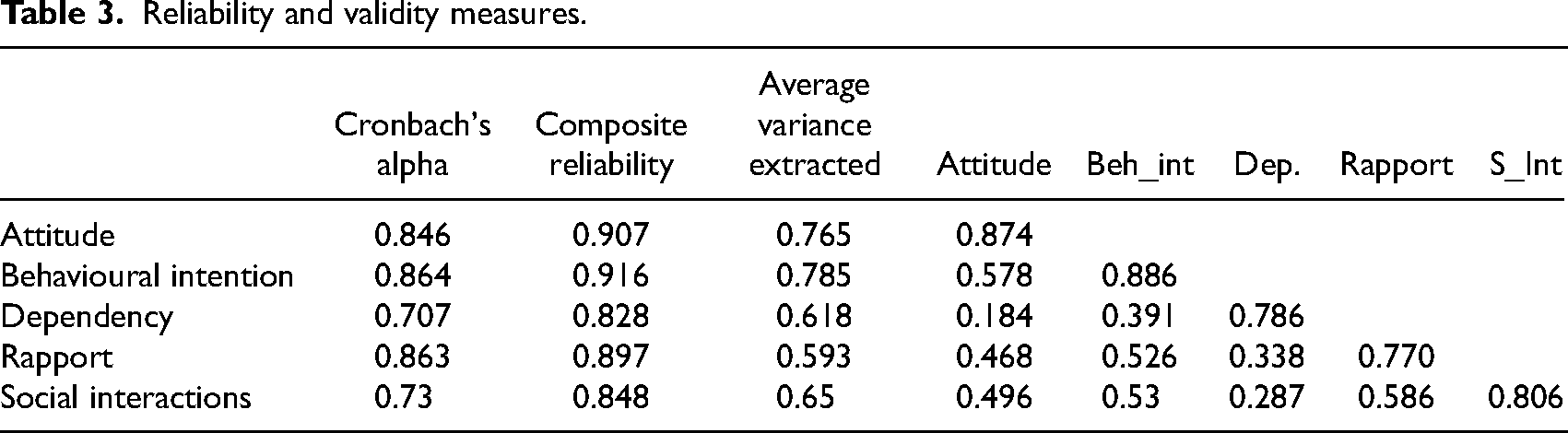
To examine common method variance, single-factor analysis (Harman, 1976) was conducted, and the result was satisfactory (at approximately 38.72%). The results from partial least squares (PLS) analysis (Ringle and Sarstedt, 2016) indicated satisfactory validity and reliability measures for the items used (Nunnally, 1978) as shown in Table 3. Discriminant validity was also established with correlation values found to be lower than the relevant average variance extracted (AVE) values (Fornell and Larcker, 1981).
Reliability and validity measures.
The hypotheses’ testing results (Table 4) showed that both relationship dependency and social interaction significantly impacted on rapport (H1: t-value = 7.96, p-value = 0.000; H2: t-value = 2.83, p-value = 0.005), resulting in the acceptance of H1 and H2. Rapport was found to be a significant antecedent of attitude (H3: t-value = 6.75, p-value = 0.000) and also had a significant influence on behavioural intention (H4: t-value = 9.06, p-value = 0.000), leading to the acceptance of both H3 and H4.
PLS output.

Moderation analysis
Moderation results showed that group differences between a low level of group attentiveness and a high level of group attentiveness were significant (t-value difference = 2.426, p-value difference = 0.016). A low level of group attentiveness had a higher t-value (t-value = 8.173) than a high level of group attentiveness (t-value = 3.126).
Mediation analysis
Considering that several underlying mediation relationships existed in the conceptual model, the current study used the bootstrapping method (Preacher and Hayes, 2004) to check these relationships. The results in Table 5 showed that rapport had a significant mediation impact on the relationship between social interaction and attitude (approximately 27.83%) as well as in the relationship between relationship dependency and attitude (20.35%). Additionally, the rapport–behavioural intention relationship was found to be significantly mediated by the attitude towards group tours (approximately 39.91%).
Mediation output.

Discussion
This study aimed to explore the role of social interaction and rapport in the group tour context in developing travellers’ positive attitude and behavioural intention. To achieve this aim, three separate studies were conducted with different data collection methods. Study 1 confirmed that a combination of rapport and social interaction would create a more positive behavioural intention among individuals to participate in group tours than the other types (i.e., no rapport/social interaction and only rapport or social interaction). This finding supported previous claims of the significance of social interaction (Fatima et al., 2017; Kim et al., 2019) in the group service scenario. Considering that interaction in group consumption has received very limited attention in past studies (Lee et al., 2021), the current study highlighted the significance of social interaction and rapport in the group context.
Interestingly, Study 2 reported that group participants who watched photos in which social interaction and rapport were present had the second highest score, whereas the highest score was among group participants who watched photos in which rapport was present but that showed no social interaction. This reinforced the significance of rapport (Baker and Kim, 2018; Bernieri et al., 1996; Eroglu et al., 2022) in group tour consumption as the presence of rapport on its own often acts as a crucial factor in developing a positive attitude.
In addition to investigating the impact of social interaction and rapport by conducting a self-reported survey, Study 3 also examined the antecedent role of relationship dependency and the moderation influence of group attentiveness on the attitude–behavioural intention link. Interaction between consumers in the group context, given their diverse backgrounds, often creates discord (Lee et al., 2021; Wu, 2007). However, Study 3's findings provided evidence of an alternative viewpoint, with a lower level of group attentiveness having a higher impact on the attitude–behavioural intention relationship.
The mediation analysis in Study 3 revealed that rapport has a higher mediation impact on the social interaction–attitude relationship than on the relationship dependency–attitude link. This finding was consistent with claims in previous studies that customers’ interaction with others can holistically change their perceptions about an entire business (Martin, 1996; Wu, 2007). With their characteristics of empowering individuals and cultivating affectionate feelings (Akman et al., 2019; Fyrberg and Jüriado, 2009), social interaction and rapport, when combined, have a stronger impact on attitude development.
Conclusion and implications
Theoretical contributions
This study contributes to the body of knowledge in several ways. Firstly, the study applies social exchange theory (Homans, 1958), a widely accepted theoretical platform (Boninsegni et al., 2020) used to explain the reciprocal exchange of activities (Kim et al., 2022). This theoretical framework has been applied in the sparse number of studies in the literature on rapport development and social interaction in the group tour context. Supporting the previous claim that rapport offers peace of mind, relaxation and security during social interaction (Tóth et al., 2022), the current study's findings confirmed social interaction and rapport as key players in developing positive attitudes and behavioural intention, testing this viewpoint in its three studies (Studies 1, 2 and 3).
In addition, a few previous studies have sought to explore the dynamics of relationship dependency from geographical, political and environmental aspects and from the perspective of local community support (Chaperon and Bramwell, 2013; Lacher and Nepal, 2010). However, what remains vague is how relationship dependency influences rapport development in the group tour context. The current study's contribution, in this case, to the existing body of knowledge is by confirming relationship dependency's role in rapport building between customers and between customers and the service provider (in this study, the tour guide), as relationship dependency often plays a major role in customers’ experience and their future decision making.
The study also extended the TPB by employing it to explain how rapport and social interaction can influence individuals’ attitude and behavioural intention on group tours. While past studies extensively used the TPB for pro-environmental behaviour, destination marketing or social media contexts (Fatima et al., 2017; Juschten et al., 2019; Leung and Jiang, 2018), the use of this theory to explain attitude and behavioural intention in the group tour context is limited.
The study's methodological contribution is that it sought to overcome the self-reported bias in relationship studies by employing the multi-methods approach (video experiment, photo experiment and survey) to test the relationships. Even though a limited number of early studies used various data collection sources (Llodrà-Riera et al., 2015; Smith et al., 2015), this approach is comparatively inadequate in the group tour context.
Finally, the current study's interesting addition to the literature is that group attentiveness was found to significantly moderate the attitude–behavioural intention link. While group attentiveness had previously been tested in different scenarios (Lee et al., 2021), the current study is among the primary attempts to explore its moderation role in the impact of attitude on developing positive behavioural intention in the group tour context.
Managerial contributions
The current study has implications for practitioners involved in the provision of group tour services. Given the significance of rapport building, it is essential that practitioners ensure smooth rapport between service providers and customers as well as between customers. Rapport acts as a relationship building block for future attitude and behavioural intention. Therefore, marketers should plan strategies when designing their service blueprint that encourage frontline employees and customers to freely communicate so they can build rapport. In this competitive era (Khan, 2008), frontline employees are widely highlighted in previous service-based studies (Di Mascio and Fatima, 2018; Fatima and Razzaque, 2012) as they play a key role in building rapport with customers (Fatima et al., 2020).
Offering industry-specific training and informing frontline employees about their customers’ profile (in brief) would help these employees to build rapport in a more effective and time-saving way. A short talk initiated by a frontline employee based on common interests, familiar topics or recent local events may spark pleasant conversations with a customer and begin their interaction with each other. Almost every organisation today has an online presence: in the group tour context, this presents an opportunity to communicate online to enhance social interaction and rapport building (Akman et al., 2019) between service providers, customers and other potential customers. This could involve posting photos on social media, sharing personal stories, etc. In today's era of e-commerce (Su et al., 2022), this would be an efficient strategic move. Even though social interaction has been identified as crucial, unfortunately, management usually pays less attention to understanding social interaction (Martin, 1996) and its role when designing a successful servicescape (Moura e Sá and Amorim, 2017) for group tour consumption. Finally, introducing visual aids as well as fun facts, and sharing the historical significance of the destination, its services or the local community would help to capture a higher level of group attentiveness among all customers to enhance their behavioural intention.
Limitations
In terms of limitations, the three studies did not differentiate regarding industry, organisation size or other relevant organisational factors, with this possibly having an influence on the relationships investigated. The study's findings were not tailored to address any specific demographic customer group, such as senior citizens, or any purchase motive, such as a work or personal purchase, etc. While a previous study (Du et al., 2014) emphasised group size and familiarity, the current study did not limit group size and did not consider prior familiarity of group members (e.g., a formal group, such as cruise travel, vs. an informal group, such as travelling with friends and family members). Thus, future research initiatives could address these gaps while investigating rapport and social interaction in the group tour context.
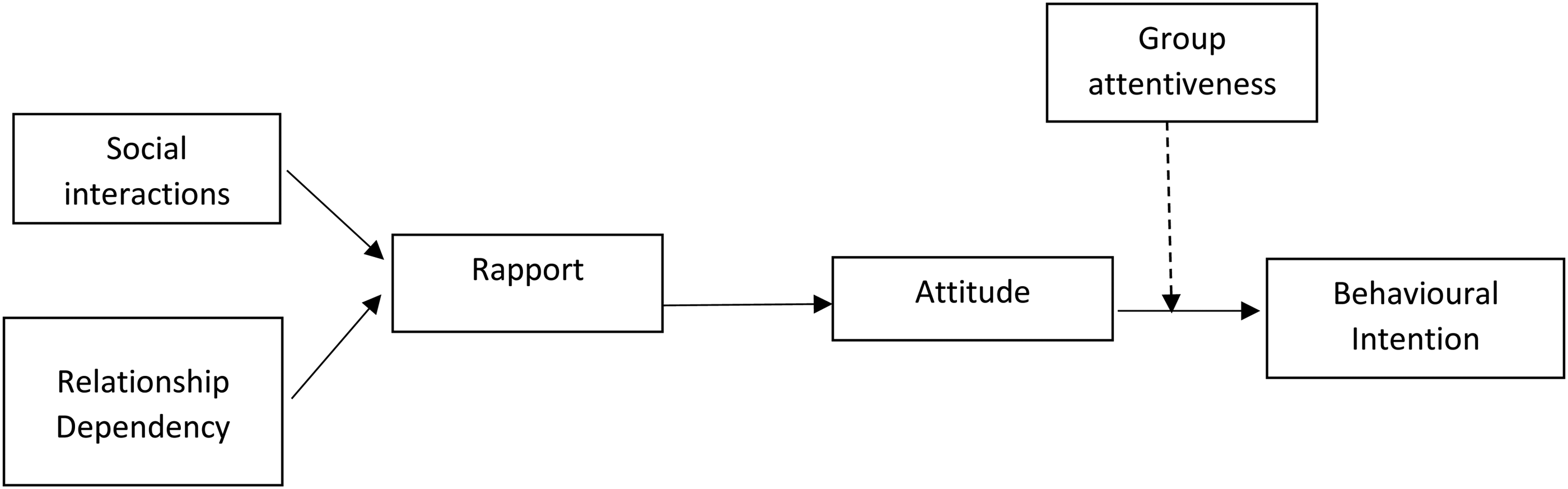
Conceptual model.
Supplemental Material
sj-docx-1-jvm-10.1177_13567667231219024 - Supplemental material for Does it matter to have rapport and social interaction on a group tour?
Supplemental material, sj-docx-1-jvm-10.1177_13567667231219024 for Does it matter to have rapport and social interaction on a group tour? by Johra Kayeser Fatima in Journal of Vacation Marketing
Footnotes
Acknowledgement
www.pexels.com. Visual materials were taken from this copyright free website.
Declaration of conflicting interests
The author declared no potential conflicts of interest with respect to the research, authorship, and/or publication of this article.
Funding
The author received no financial support for the research, authorship, and/or publication of this article.

Supplemental material
Supplemental material for this article is available online.
References
Supplementary Material
Please find the following supplemental material available below.
For Open Access articles published under a Creative Commons License, all supplemental material carries the same license as the article it is associated with.
For non-Open Access articles published, all supplemental material carries a non-exclusive license, and permission requests for re-use of supplemental material or any part of supplemental material shall be sent directly to the copyright owner as specified in the copyright notice associated with the article.
