




Abstract
Adventure tourism is considered a cornerstone of the tourism industry by United Nations Tourism and has experienced rapid growth before the COVID-19 pandemic. This growth was facilitated by ever more diversified consumer demand for adventure tourism, with a fusion of traditional Western and emerging Eastern markets that increasingly seek active outdoor experiences. Yet, research examining consumers’ adventure tourism perceptions and factors influencing their decision-making across cultures remains scarce. This qualitative study engages 67 participants, comparing the perceptions and attitudes towards adventure tourism among Chinese youth in comparison to their Australian and German counterparts. The findings of this study contribute an in-depth understanding of adventure tourism and youth consumer behaviour, highlighting the crucial role of culture in shaping intentions to engage in adventure tourism. Practically, the study offers valuable insights for marketing and product design strategies that consider culturally diverse values, attitudes, and behaviours.
Keywords
Introduction
Youth tourism was one of the largest and fastest-growing segments in the international visitor market before the COVID-19 outbreak (pre-2020), with travellers aged 15 to 29 representing 23% of the one billion travellers annually (United Nations Tourism, 2016). United Nations Tourism (2022) predicts a youth-led global tourism recovery post-pandemic. In the highly competitive marketplace following the pandemic, destinations worldwide are keen to target the sizeable and expanding youth visitor market. Youth travellers highly desire adventure tourism experiences because they are perceived to potentially involve risk and danger, thrill and excitement, challenge, and physical activity and are often undertaken in a natural environment (Janowski et al., 2021). Adventure tourism, therefore, encompasses a broad range of tourism experiences, from walking in nature to a flight into space (Swarbrooke et al., 2003). Adventure tourism has become a cornerstone of destination marketing and experience development for many destinations worldwide (UN Tourism, 2014).
Historically, adventure tourism has been particularly popular with youth travellers from Europe and North America (Adventure Travel Trade Association, 2019). Reports from the United Nations Tourism in 2014 indicated that a significant majority of international travel originated from these regions, with Europe, North America, and South America accounting for vast expenditures in adventure travel. However, there has been growing interest in adventure tourism from emerging Eastern travel markets in recent years (Bui and Kiatkawsin, 2020; Tsaur et al., 2020), signalling a shift in the dynamics of adventure tourism markets. Because of the historical focus on Europe and North America, the existing body of research tends to reflect a Western-centric viewpoint, leaving a considerable gap in knowledge about how non-Western consumers perceive and engage with adventure tourism. This study aims to bridge that gap through an in-depth cross-cultural exploration.
Schema theory from psychology offers an instrumental theoretical lens to comprehend how individuals form their understandings of the world around them. A schema is a mental framework that individuals use to organise information and interpret experiences (Zhang and Scott, 2024). Schemas are built on memories of the past and experiences in life, representing ‘packets of information stored in memory representing general knowledge about objects, situations, events, or actions’ (Cohen as cited in Nishida, 1999: 755). These pre-established cognitive structures shape how consumers react to new opportunities and experiences, and accordingly, schema theory has been applied to study travel behaviour (e.g. Mou and Brito, 2024; Park et al., 2011).
Anchored in the schema theory, this study seeks to investigate the cross-cultural perceptions of adventure tourism and understand the cultural traits that shape these perceptions. By studying youth consumers from Western (i.e. Australia and Germany) and Eastern (i.e. China) countries, this study will also highlight the similarities and differences between these target markets of youth consumers. This understanding is particularly important to destination marketers and managers who design adventure tourism experiences and marketing campaigns to target a particular nationality of youth.
Literature review
The state of adventure tourism literature
In line with industry growth, adventure tourism research interest and scope expanded and progressed over the past decades. Several notable studies have revolved around the concept of adventure tourism and its multiple elements. For instance, risk has been discussed as intrinsic in some instances (Carnicelli-Filho et al., 2010; Lee and Tseng, 2015; Wang et al., 2019; Weber, 2001) and as peripheral in others (Buckley, 2012; Cater, 2006; Gyimóthy and Mykletun, 2004; Peacock et al., 2017). Additional themes that have surfaced in adventure tourism literature include nature (Martin and Ren, 2020), novelty (Giddy and Webb, 2016, 2017, 2018), challenge (Cheng et al., 2018), thrill (Buckley, 2016; Schlegelmilch and Ollenburg, 2013), excitement (Cater, 2006), physical activity (Sung, 2004; Swarbrooke et al., 2003), achievement (Morgan et al., 2005; Pomfret and Bramwell, 2016), play (Gyimóthy and Mykletun, 2004) and social interaction (Lindberg and Jensen, 2020).
Another body of work explored the socio-demographic characteristics and segmentation of adventure tourists. Accordingly, age remains a conflicted attribute, with some claiming that younger-aged people are more likely to participate in adventurous activities than older-aged people (Nezakati et al., 2013; Page et al., 2005) and others arguing that adventure tourists span all age groups (Naidoo et al., 2015; Patterson and Pan, 2007; Reynolds and Hritz, 2012; Swarbrooke et al., 2003). Gender is another contested variable, with Schneider and Vogt (2012) suggesting that adventure travellers are predominantly male, whereas others identify a rise in female participation and roughly equal distribution of the sexes (Cater and Cloke, 2007). Psychographic segmentation has seen comparably limited research attention, but was, for example, considered by Pizam et al. (2004), who analysed attitudes towards risk-taking and sensation-seeking.
The existing literature on adventure tourism has been criticised for its Western-centric orientation (Cheng et al., 2018; Rantala et al., 2018). According to Williams et al. (2017), it predominantly centres on the experiences, values, and expectations of Western travellers, failing to adequately capture the rich diversity of perspectives that could arise from non-Western cultures. While increasing attention to non-Western samples in recent years signals a positive trend in view of diversifying adventure tourism demand, studies were not comparative nor comparable. As the industry is broad and dynamic, every adventure tourism research context, with its unique environment, risk/challenge level, etc., is distinctive and not directly comparable to another seemingly similar context. Even within one form of activity, there can be substantial differences. For instance, river rafting in China is different from Western-style river rafting (Buckley et al., 2014). Thus, any study with a culturally homogenous or cross-cultural sample that neglects to identify cultural similarities/differences misses an opportunity to advance knowledge of the increasingly diversifying adventure tourism demand side. For instance, although the study by Ponte et al. (2021) stands out in that it notes cultural differences between domestic Portuguese tourists and foreign tourists, it does not specify the nationalities of the foreign tourist sample. Furthermore, it provides only a relatively shallow cross-cultural insight, namely that ‘Portuguese tourists seem to prefer fully managed experiences compared to foreign tourists, which may reveal that cultural differences result in different perceptions and idealizations of adventure’ (Ponte et al., 2021: 10).
Cultural considerations in adventure tourism literature
Two notable exceptions where cross-cultural comparison was more thoroughly made are the quantitative studies by Williams et al. (2017) and Gardiner et al. (2023). Williams et al. (2017) compared a Japanese to a mixed Western sample across five value drivers – functional value, price value, emotional value, social value and novelty value in the context of a four-wheel drive tour in Western Australia. The authors advocate for culture-specific adaptation rather than standardisation of the marketing mix, despite only identifying minor cultural differences. Gardiner et al. (2023) explored relationships between self-identity and adventure tourism participation across youth-consumer samples from Australia, China, Singapore, and Germany. Their quantitative study also yields similar results amongst the four countries, suggesting market homogeneity.
While not providing an empirical comparison to other cultures, several studies have examined Chinese adventure tourists and informed the current research. Buckley et al. (2014) demonstrated that culture and domestic adventure tourism experiences influence the expectations and experience of outbound Chinese tourists. Jin et al. (2019) explored Chinese tourists’ adventure tourism motivations. They convey that Chinese tourists prefer to conduct adventure tourism overseas rather than domestically for better-perceived safety and security, service, overall quality, and longing for escape and prestige. However, geographic convenience and cost efficiency could still be drivers of domestic adventure tourism. Other identified motivations include intelligence-seeking, such as learning about the environment/themselves, mental and physical relaxation, and socialising.
Gardiner and Kwek (2017) examined Chinese international students’ perceptions of water-based adventure tourism activities. Unique socio-cultural characteristics that influence adventure tourism notions were identified. These include ‘filial piety’ – ‘a virtue that advocates respect, obedience, and care for one's parents’ (p. 498) that results in young Chinese often seeking parental approval before adventure tourism participation; limited knowledge and exposure to outdoor adventure activities; and low self-efficacy, meaning low confidence in their ability to perform adventure tourism successfully. Inadequate swimming abilities, fear of extensive exposure to the sun, an inclination towards indoor activities like shopping and dining, and extensive family obligations were some more nuanced, underlying traits of influence on the Chinese sample. Due to such socio-cultural factors, the Chinese students’ cognition of water-based activities is generally adventurous and daunting. Gardiner and Kwek (2017) encourage further qualitative research in a broader adventure tourism context and across cultures.
While not directly concerning adventure tourism, the Pizam and Fleischer (2005) study reinforces the importance of culture in tourism activity choice. Preferences for active/passive tourist activities of 1429 international students were measured across eleven countries via a survey to identify cultural correlations. National cultures were categorised according to the three cultural dimensions of individualism/collectivism, uncertainty avoidance, and masculinity/femininity (Hofstede and Hofstede, 2005). The study confirmed that national culture affects the choice of tourist activities. Due to purely quantitative analysis and the reliance on Hofstede's scores for comparison, results remained high-level without identifying more nuanced relationships between cultural characteristics and activity preferences.
Sulaiman and Wilson (2018) affirmed the importance of cultural differentiation regarding tourism activity preferences and showed how this could translate into adventure tourism marketing. Differences between Anglo- and Malay cultures were identified, the former being action-oriented and the latter being relaxation-oriented. This difference was not considered by Tourism Australia, whose English-language website emphasises action and aims to put the reader into the shoes of an adventurous traveller who undergoes seemingly exciting physical outdoor activities. The Malay-language version, a direct translation, was found to not resonate positively with the Malay perception of an enjoyable travel experience.
Implications for the current study
While the above adventure tourism studies inform our understanding of different national markets, they do so in the context of a single adventure activity and/or neglect cultural empirical comparison. To date, no studies discern a more holistic overview of perceptions towards adventure tourism across cultures. Given the limited discovery of cultural differences in the aforementioned quantitative studies by Williams et al. (2017) and Gardiner et al. (2023), the question of appropriate epistemology and methodology to discern cultural differences in adventure tourist behaviour arises. As such, it is timely to qualitatively explore and contrast diverse markets from a constructivist stance, and to thereby strive for richer insights. In doing so, this study seeks to advance understanding of cross-cultural perceptions on adventure tourism.
Materials and methods
This research proposes a constructivist paradigm that believes in multiple subjective and contextualised realities. Accordingly, an inductive and qualitative approach aims to retrieve detailed, in-depth perceptions and generate rich data through interaction with participants. The constructivist approach is appropriate when researchers seek to gain a holistic understanding of individuals’ perception and experience. Qualitative methods have become increasingly relevant and gained prestige in tourism research generally since the 1980s (Wilson et al., 2020). They are particularly recommended for understanding consumers’ subjective adventure tourism mindsets (Dahl et al., 2025; Gardiner and Kwek, 2017).
Individual online interviews with a total of 67 participants were conducted in late 2020 until data saturation was achieved. The western markets of Germany and Australia were selected for this study because they are avid adventure travel markets listed in the top 10 countries for adventure travel, ranked second and seventh, respectively (Adventure Travel Trade Association & George Washington University, 2016). One of the lead researchers for this project was German and lived in Australia. He had a cultural understanding of these markets, which influenced their selection for this study. For the Eastern market, China was selected because of the size and importance of Chinese youth tourism (Gardiner and Kwek, 2017). Although the Chinese youth market is becoming increasingly adventurous (Sparks and Pan, 2009), research on this market in adventure tourism remains underdeveloped (Cheng, 2017; Jin et al., 2019). Thus, research is needed to investigate Chinese youth consumers’ perceptions of adventure tourism and compare them to those of more traditional adventure tourism markets. United National Tourism (2014) defines youth as travellers aged 15 to 29. This study was particularly interested in adult youth travellers, so participants were recruited between the ages of 18 and 29.
Purposive sampling was employed, meaning that shared group characteristics were specified (i.e. age, nationality, and residence in their respective home country) and respondents were recruited accordingly. Purposive sampling ‘relates to the anticipated use of the selected criteria in making comparisons once the data have been generated’ (Barbour, 2007: 58). Further criteria for recruitment were the strive for spatial diversity of participants within their home countries, a balanced student/workforce ratio, and gender balance of the sample, thus bringing it close to the ‘typical’ youth consumer of each national culture and ensuring transferability. All interviews were conducted in English, and recruitment was thus limited to participants with at least basic English language capability. With the lead researcher not speaking mandarin, this hindered eliciting insights from some interviewees and increased the required number of Chinese participants to reach data saturation. As the lead researcher is a German native, this was less of an issue with the German sample, where interviewees could resort to German whenever a specific term needed to be conveyed.
Participants were sourced through personal contacts, social media, and snowball sampling. The video conferencing tools Zoom (primary tool), WeChat, FaceTime, and Skype were utilised to interview participants in their respective home countries. Since schemas rely on drawing on memories and understanding a person's schema helps understand how they will respond to stimuli (Nishida, 1999), tourism marketers often use images to elicit responses and reveal the underlying knowledge structure or schema. Participants were presented with photos of adventure tourism activities to help stimulate discussion and develop a common understanding of the type of activities to be discussed. It is acknowledged that some participants might have little or no experience and, therefore, memories of the experiences. They were then asked about their perceptions of adventure tourism to explore their mental schema of these activities. Probing questions assisted in describing cultural viewpoints and rationales for their responses.
Interviews were recorded with the software-internal recording option and/or an external voice recorder and transcribed verbatim by the researcher or the professional transcription service rev.com. Interviews ranged between 17 and 52 min, with most interviews being around 40 min. Language comprehension issues between the interviewee and the interviewer forced the briefness of the 17-min interview which was included, because it still yielded minor relevant insights. The research participants comprised 19 Australian interviewees aged between 19 and 29, 28 Chinese aged between 19 and 28, and 20 Germans aged between 21 and 29. Gender balance was reflected in the sample, with an almost equal gender distribution within each cultural group and a total composition of 35 females and 32 males.
In line with other contemporary qualitative adventure tourism research (Dahl et al., 2025), data were thematically analysed using NVivo 12 software. The data were first open-coded, and preliminary analytical categories or codes were created, which was consistent with the approach proposed by Neumann (2014). Next, axial coding and, finally, selective coding (Neumann, 2014) were conducted. Constant comparison between the data and the literature was applied throughout the coding process to develop and refine the interpretation of results (Corbin and Strauss, 2014). A code-all-data approach was chosen over coding only seemingly salient portions to avoid missing possibly relevant information. Intermediate data analysis was conducted after around one-third of all interviews to ensure the meaningfulness of the data in light of the research objectives. The usage of NVivo software supported a transparent and reflective coding process, enabling the researcher to trace codes or quotes within their textual context. While the frequency of occurrences was noted, the emphasis remained on the salience and depth of meaning within the various codes and their overarching themes through an iterative and reflexive engagement with the data.
In qualitative research, the researcher's role and any characteristics of the researcher that qualify him/her to undertake the research or impact the research process should be acknowledged (Wilson et al., 2020), including experiences, assumptions, and possible bias. This is because of the unique role of the qualitative researcher as a human instrument that data is mediated through (Denzin et al., 2024). The first author – who was principally responsible for the data collection and analysis – was born in Germany and resided in Australia for five years during the study. He also lived and studied in Hong Kong's SAR, which shares some cultural traits with mainland China. This enabled him to make Chinese friends and visit the mainland several times. As such, he is familiar with the research context and sample cultures, which helped him gain a richer and deeper understanding of the research matter. His personal background and adventure tourism experience aided him in building rapport and eliciting and understanding interviewees’ perceptions towards adventure tourism. The second author is an Australian tourism scholar with vast experience in youth consumer research and cross-country data analysis. The third and fourth authors are Australian tourism scholars of Singaporean and Malaysian descent, respectively, and are highly experienced in qualitative tourism research. All authors worked closely on the coding and interpretation of the data, and their varied backgrounds, experiences and related assumptions resulted in a subjective view (Punch, 2013) of the data, but also contributed to the richness of the findings.
The trustworthiness of a constructivist qualitative study can be evaluated through four criteria: credibility, dependability, confirmability and transferability (Denzin et al., 2024; McGinley et al., 2021). Credibility was established through sustained engagement with research participants even before the interviews, fostering rapport and trust. The participants’ perspectives were verified through member checking, ensuring the credibility of the researchers’ interpretation. Interview questions were occasionally reframed, repeated, or expanded to enhance credibility. Dependability, which pertains to the consistency of findings (McGinley et al., 2021), was ensured through an audit trail facilitated using Nvivo software, where the coding process and the decision-making pathways were documented through memo-taking. This audit trail, reinforced by member checking and reflexivity, further safeguarded the study's confirmability, ensuring that the findings were not unduly influenced by the researcher's prejudices, interests, and viewpoints. Lastly, recognising that qualitative research is situationally unique and not generalisable, transferability was addressed by ensuring the representativeness of the participants through intentional purposive sampling.
Findings
This study aimed to understand the dimensions of adventure tourism and how culture influences the perception of those dimensions. The following sections report the findings of this study relating to these two objectives.
Dimensions of adventure tourism
Nine themes, or ‘dimensions of adventure tourism’ emerged from the data and are evident across the three nationality groups, expanding on Janowski et al.'s (2021) study of adventure tourism literature, which identified five core dimensions. The nine dimensions are the natural environment, novelty, risk and danger, challenge, thrill and excitement, physicality, fun and enjoyment, learning, and achievement. The study compares the salience of each dimension and the depth of discussion of these dimensions to understand the cross-cultural similarities and differences. Table 1 presents these findings.
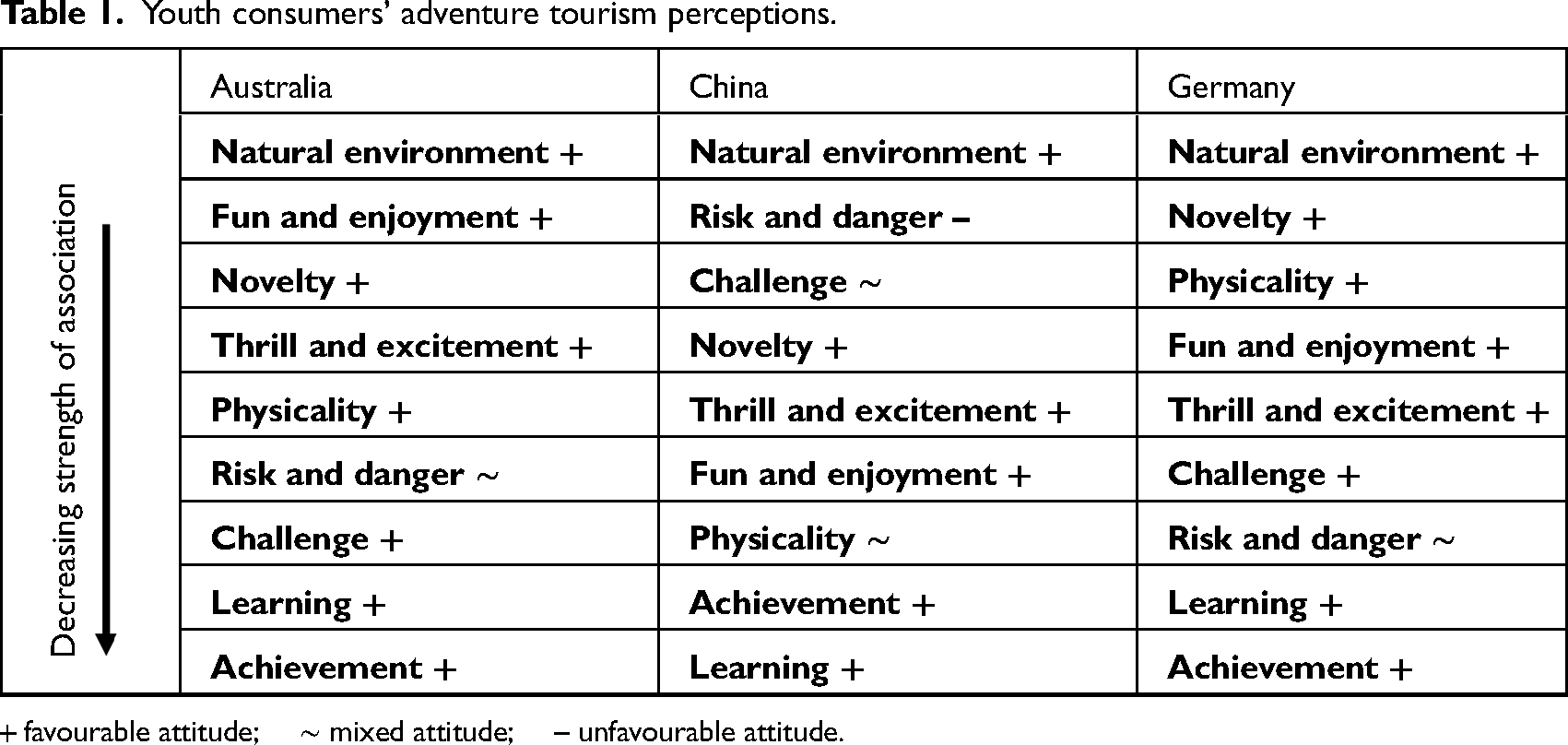
As indicated by the arrow on the left in Table 1, the top-most dimension, the natural environment, is the strongest associated dimension across cultures. The closer to the bottom of the table a dimension is listed, the weaker its association with adventure tourism from the perspective of the respective national culture. The plus, minus and wave symbols specify the markets’ attitudes towards that dimension, whereas the plus indicates a favourable attitude, the wave a mixed attitude, and the minus a negative attitude. Table 1 thus presents the themes that emerged from interviews, indicates the strength of the three markets’ association of these dimensions with adventure tourism, and overviews the markets’ attitudes towards the dimensions. Subsequently, the nine dimensions and their relevance across the three markets are discussed.
Natural environment
The findings suggest that the natural environment is the most strongly associated dimension across cultures. This is exemplified in the following responses from Australian, Chinese and German participants, respectively: ‘When I think of adventure tourism, it mainly does have a nature pull’; ‘I think it's outdoor activity and close to nature’; and ‘When I think of adventure, I always think of nature’. Immersion in nature is highly sought across all cultures. For example, one Australian participant states, ‘It's also that connection to nature that I love that makes me feel like centred and grounded’. Chinese participants have similar sentiments and particularly highlight that being in nature provides a soothing, often spiritual escape that contrasts their otherwise urban-centred lifestyle. For instance, a Chinese participant comments, ‘If you connected with nature, your body and your spirits will be relaxing all the way’. Another Chinese participant elaborates: Because now in the city's life, we are busy, and it's important for us to, to study or to work (…). And that place (adventure tourism) is very close to nature. You can find your, your definition to life and then you can know the protect the environment. (…) And the important, I think, is to relax you, to enjoy the difference from the life now. When you are like outside, you feel the wind and you can smell the environment and all these things (…) And I think that's like what I really like about it. That you are like experiencing every step that you take, with the rocks under your feet and all these small things, you smell it and (…) you touch things.
The current study further extends the literature by identifying cross-cultural differences in the value of the natural environment in adventure tourism. Australian and German youth consumers were found to seek immersion and interaction with nature for mental relaxation and an emotive and/or sensory experience, meaning the touch, smell and feel of being in nature. Chinese seek to escape from their urban-centred lifestyles and spiritual experiences that the natural environment can facilitate. This implies a want for more tactile interaction with nature from the former consumer markets and a somewhat more passive, nature-appreciation approach from the latter market to trigger feelings of serenity, spirituality, peace, and freedom. This confirms findings from Martin and Ren (2020), who found that Chinese adventure travellers to Greenland were attracted to the destination's natural sights rather than physical activity. Yet, while Chinese youth consumers do not seek physical interaction with nature quite to the same extent as Australian and German youth consumers, they still want to be directly, physically immersed in nature. This demonstrates a transition of Chinese demand for more immersive, authentic tourism experiences over traditionally favoured non-immersive, dis-involved tourism experiences (Du et al., 2016).
Novelty
Another commonality across cultures is the association of ‘something new’ – discoveries, environments, and experiences – with adventure tourism and a shared longing for novel experiences. This suggests that novelty is a key driver of adventure tourism participation. For example, one German participant describes adventure tourism as follows: ‘To make some new sport or new activities you never done before, or places you’ve never visited before’. These two spheres of novelty, a new activity and a new environment, are apparent throughout the data as central to youth consumers. When asking an Australian participant why he is very interested in scuba diving, he responds, ‘Specifically, just a new experience’. Another Australian affirms, ‘It is a fun thing in saying I’ve done something completely new and scary’. Chinese youth consumers also show a strong drive towards novelty. For instance, one Chinese participant expresses: I would love to try these things because it's a bit of novel. It's not very popular, not very common in our daily life. You know if I can engage in this kind of stuff, it can broaden my horizon (…) I want to try it, because it's novel, it's interesting, it's not something I’m familiar with.
Risk and danger
The dimension of risk and danger is where cultural discrepancy is most apparent, regarding the strength of association and the attitude towards the dimension. Chinese youth consumers strongly associate adventure tourism with risk and danger. They express, ‘For me, adventure tourism equals risk’, and ‘Adventure. Yes, it's adventure. I have to risk my life. (…) It's a risk. I think maybe I will lose my life’. Activities perceived as dangerous are often categorically ruled out by Chinese youth consumers. When asked why skydiving is not interesting, one participant exclaims, ‘No, no, wait. Oh, no. That is too dangerous for me. No, no it is very difficult for me to accept it’. The researcher then enquired about rock climbing, receiving a similar response: ‘I think this is the most dangerous activity in the world, rock climbing’. An overarching importance of risk avoidance and the strive for safety is prominent throughout almost all interviews with Chinese participants, as illustrated in the following statement: ‘Safety is the most barriers. If I think it's not that safe, I will not go. I must ensure it’.
Australian youth consumers sporadically voice risk concerns and express that risk could be a barrier ‘if it goes beyond exciting to utterly insane’ or ‘if it's an inherently dangerous thing’. However, their perceptions of adventure tourism are not as risk-focused or strictly risk-averse as those of young Chinese. Instead, Australians convey that ‘a little bit of risk is fun’, and that they are ‘after that adrenaline rush (but) don’t want to actually nearly die’. Thus, while high physical risk is a barrier to Australian youth consumers’ adventure tourism intentions, some ‘don’t really care about safety as much’, as one interviewee states.
This study found that German youth consumers have similar risk perceptions to Australian consumers. For instance, one participant states, ‘Having an adventure is always a little bit critical. (…) So, if that element is given, then I have an adventure. Otherwise, it's safe. So, it's not really an adventure’. Young Germans predominantly expect and accept some risk as illustrated by one participant explaining her fascination with scuba diving as follows: You can’t really control stuff down there. So if the oxygen runs out, you’re basically screwed. So it's scary for me, but I still like it to explore it (…) It shouldn’t be too risky (…) but a little bit risky is okay for me.
Challenge
As with risk and danger, the dimension of challenge in adventure tourism is noticeably more prominent in Chinese minds than Australians and Germans. While risk has a negative connotation, challenge is actively sought by many young Chinese. One Chinese participant uses the following metaphor to voice his thoughts: ‘Some of the activities require good strength and endurance, like climb mountains. And I think it is an embodiment of the value of life (…) because it requires some challenges and you have to face it and solve it’. Self-development, as a consequence of overcoming challenges, is one of the desired outcomes of Chinese adventure tourism participation. For instance, in a snorkelling context, one interviewee says, ‘I think I’d do it just because I want to challenge myself, because I’m not good at it. But I want to try it and learn a new skill’. However, findings reveal that there are also contradictory opinions on physical challenge, which numerous Chinese want to avoid: ‘I feel this is very tough, and it's very challenging and need a lot of exercise. I don’t like to do that’. While only few Chinese youth consumers seek physical challenge, psychological challenge, meaning a mentally stimulating hurdle, is a more universal Chinese push factor towards adventure tourism intention. This is especially evident when discussing skydiving. When asked why skydiving is interesting to them, Chinese participants convey, ‘Cause I’m so afraid for the height. (…) I want to solve this problem’; and ‘I’m a timid person and I want to be more courage and to challenge myself. So, I think that skydiving can bring some more fresh feeling for my life. I think it's very challenging’.
While not front-of-mind, challenge is also associated with and sought by Australian and German youth consumers. For instance, Germans express that ‘challenge is the part that makes the adventure an adventure’, and that ‘everybody's trying to challenge themselves’. This is in line with Cheng et al. (2018), who identify challenge as a distinguishing factor of adventure tourism from other forms of nature-based tourism.
Thrill and excitement
The dimension of thrill and excitement is also sought-after in adventure tourism activities. For example, a Chinese interviewee proclaims, ‘young Chinese (…) prefer to do some exciting adventure tourism’. Remarkably, even tandem skydiving is not thrilling enough for one Chinese participant, a very experienced international traveller: ‘I liked it, but I don’t think that was satisfying. I didn’t think that was thrilling enough. So my kind of dream is to do solo skydiving so I can be a certified solo skydiver someday’.
Most Australians also consider themselves ‘to be a bit of a thrill-seeker’ and ‘would never say no to like anything thrilling’. These findings confirm that thrill and excitement are vital drivers for adventure tourists, as previously conveyed by Buckley (2006), Beckman et al. (2017) and Schlegelmilch and Ollenburg (2013). The dimension of thrill and excitement strongly links with novelty as evidenced by the following comments from an Australian, German and Chinese interviewee, respectively: ‘Adventure brings to mind thrilling, exciting, out of your comfort zone, something that you wouldn’t do in your everyday activity type of activities’; ‘I picture something that is like at some point like super excites me about it, like some, something out of the ordinary which I would not do in my, let's say, daily life in Germany’; and ‘it shows much difference from our daily or normal life, because it makes me feel exciting’. Thus, it is often novelty that triggers the feeling of thrill and excitement. The positive sentiments towards this dimension across youth consumer markets support Cater's (2006) recommendation for tourism businesses to facilitate thrill and excitement with their adventure offering and to promote these aspects accordingly.
Physicality
Physicality refers to a bodily activity or physical action and is another highly associated dimension of adventure tourism. This reiterates both academic literature which classifies physical activity as fundamental (Gyimóthy and Mykletun, 2004; Sung, 2004; Swarbrooke et al., 2003), and grey literature that identifies it as one of three core elements of adventure travel (Adventure Travel Trade Association et al., 2011; UN Tourism, 2014). For instance, an Australian comments, ‘adventure tourism is going out and doing things’. Australians have a favourable attitude towards physicality and want to get physically involved. Another Australian reiterates this and argues that quad biking is not interesting, because ‘you’re not doing anything really. You’re relying on the machine’. German youth consumers similarly associate and value physicality. They state that ‘adventure tourism always has the relation towards some sort of physical activity that you do while travelling’, and that ‘it's a physical activity, that is somehow connected to adrenaline, that is something you really enjoy doing’. Chinese participants also connect adventure tourism with physicality, as exemplified by the following comment: ‘What makes me adventurous … when I physically, yes, do some, do some sports’. However, while few Chinese seek it – ‘I love some physical activity’ – unfavourable attitudes towards physicality are more common among young Chinese who convey that they ‘don’t like that kind of, strongly related to your physical abilities, that kind of activities’. This is in line with Jin and Sparks’ (2017: 213) interpretation that ‘[g]ood experiences to Chinese tourists are those that they could get without expending much physical energy’.
Self-efficacy, the perceived lack of skills and/or strength, is of profound concern for young Chinese. This is exemplified by comments such as ‘I just can’t do it’; ‘biking is too exhausted (…) it will be quite tiring’; and ‘I think that's barriers for me for some activities. (…) Just the skills and (…) yeah, fitness level’. Some Chinese participants consequently seek adventure tourism experiences that do not require prerequisite skills or above-average physical fitness, which reaffirms findings by Gardiner and Kwek (2017). Australians and Germans show less concern about self-efficacy.
Fun and enjoyment
The dimension of fun and enjoyment is often neglected in the academic literature on adventure tourism (Janowski et al., 2021). Yet, this study reveals relatively high relevance of fun and enjoyment for the Australian youth market, and moderate relevance for the Germans. Australians express that adventure tourism is ‘just like sort of evoking emotion of joy’, and ‘something that's exciting and fun’. Germans similarly associate adventure tourism with ‘something you really enjoy doing’ and something that is ‘always connected to (…) having fun’. Chinese also seek fun and enjoyment but associate it to a lesser degree than the other two cultures.
Learning
There is evidence that learning is a favourable adventure tourism dimension across cultures. Two spheres of learning are apparent, one relating to physical skill and the other to education (e.g. gaining historical or environment-related knowledge). This is exemplified in Chinese comments, such as, ‘I think snorkelling (…) I’m not good at it, but I want to try it and learn a new skill’; and ‘I have gone to jungle adventure trip. I think it helped me to learn more knowledge about nature’. An Australian similarly appreciates ‘a historical aspect of it as well. That was really interesting to me’, while German participants are also ‘always eager to know much more about this nature we have’, and seek ‘learning and developing’ as an outcome of adventure tourism participation.
Yet, learning is a relatively peripheral dimension and not at the core of youth consumers’ adventure tourism perception and intention. This finding supports Gyimóthy and Mykletun (2004), who also find learning to be a peripheral motivation, but opposes Jin et al. (2019) and the Adventure Travel Trade Association et al. (2017), who found that gaining insight and knowledge is central in adventure tourism. As the latter studies’ sample groups span across broader age groups, it could be presumed that learning is more relevant for older adventure tourists than for youth consumers.
Achievement
Achievement is another notable dimension that is closely related to challenge, confirming findings from Morgan et al. (2005), den Breejen (2007), and Pomfret and Bramwell (2016). For example, one Australian points out that adventure tourism is all about ‘going out and, you know, achieving things with nothing to assist you (…) nothing but your own body’ to ‘get a sense of your achievement in the most direct way possible’. A Chinese interviewee sustains that achievement is a motivating factor in adventure tourism: ‘Adventure. So if I try it, I can, maybe I can show off to my friends, I think, like, it's achievement’. Looking back at her rock-climbing experience, a German participant conveys, ‘When you reach the top (…) you have an amazing view, you can look down and see ‘wow, that's what I’ve accomplished’ and, yeah. It's a lot of fun to do. (…) it's always about the achievement’. Thus, achievement, or a sense of achievement, is a favourable outcome of adventure tourism both in the moment and post-experience.
Cultural factors that influence youth consumers’ adventure tourism perceptions
In this study, national culture is predominantly classified and compared via cultural dimensions (Hofstede and Bond, 1988). In contrast, family culture concerns relevant customs, morals and traditions of the sample's immediate and extended family and ancestors (Sillars, 1995). Table 2 lists cultural factors that shape youth consumers’ adventure tourism perceptions and intentions.
Cultural moderating factors.
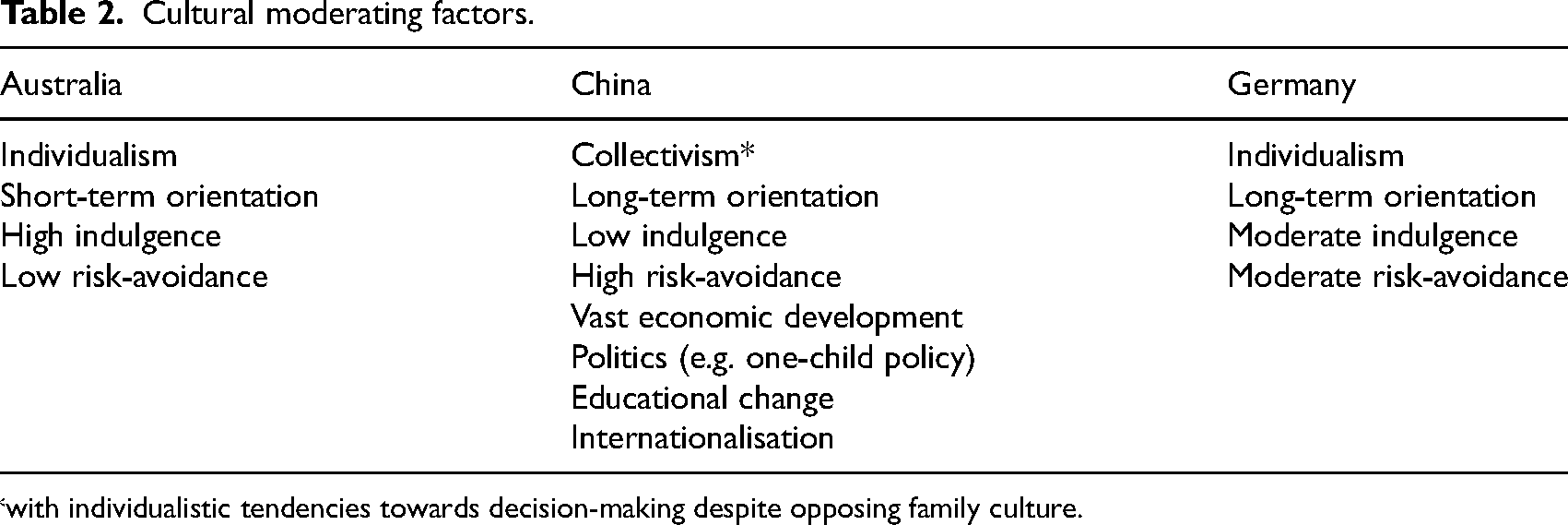
with individualistic tendencies towards decision-making despite opposing family culture.
Australian culture
Australian family culture supports and even encourages adventure tourism intention. When asked about their parents’ attitude, Australian interviewees stated, ‘They’re definitely for it’; and ‘I think that, yeah, my mum is very adventurous. (…) She likes skydiving, she loves bungee jumping, all that sort of stuff. So she has a big influence. She's always encouraging me to go and do these things’.
These comments illustrate that Australian youth consumers and the broader Australian demographic are familiar with and open towards adventure tourism. Often, physical outdoor activities are engrained in Australian families’ lifestyles. For instance, one Australian interviewee conveys: My family and I really enjoy water and being in the water, especially living in such a warm climate. (…) snorkelling and hiking and bike riding and that type of thing is things that I partook on weekends with my family as family activities.
Australians furthermore state that they are very familiar with and open to adventure tourism, which is readily available and widespread: ‘Australia is known definitely for its adventure, particularly like the outback, and up north in the rainforests and even in the water, heaps of activities. So yeah, I think it's something Australian culture values’. This viewpoint is shared among other interviewees, who state that ‘it's something that we definitely value as Australians’, and that ‘Australians are pretty outgoing people, so their willingness and confidence to do things out of their comfort zone is probably a bit higher than other nationalities. (…) it's all pretty much available to us in Australia’.
The Australian outdoor environment, including the outback, rainforests, mountains, beaches and marine ecosystem (Booth, 2012; Metusela and Waitt, 2012), and a pleasant and attractive climate (Amelung and Nicholls, 2014), facilitates a wide variety of land, water, and air-based adventures. Physicality is part of Australian lifestyles and contributes to youth consumers’ adventure tourism affinity, as Reynolds and Hritz (2012) previously established. Thus, Australians’ proximity and exposure to adventurous activities differentiate them from other national cultures.
A short-term oriented, indulgent, risk-taking nature of Australian culture (Hofstede Insights, n.d.) fostering the popularity of adventure is also evident: ‘Australian culture puts value on that sort of activity. It's considered … there's this self-image of Australians as adventurous, as bold, as outgoing and risk-taking. So people do like to do it’; and ‘I think that the first part is that Australians generally have that very laid-back attitude, which then translates into adventure tourism quite well, because it's like, “Oh yeah, I’ll give it a shot. I’ll give anything a go”’. Findings therefore unanimously depict a highly active, outdoor-oriented and impulsive Australian lifestyle that fuels the popularity of adventure tourism. As such, family and national cultures positively affect young Australians’ perceptions and intentions.
These findings extend quantitative results from Pizam and Fleischer (2005), who connect a preference for active, dynamic tourism activities with the cultural characteristics of masculinity, individualism, and low uncertainty avoidance. Yet, the authors acknowledge that their results do not reliably identify which of these cultural dimensions causes active preferences in some of their sample cultures (Pizam and Fleischer, 2005). Although Australian culture is highly individualistic, it is not particularly masculine nor uncertainty avoidant (Hofstede Insights, n.d.). As such, the current study suggests that individualism and indulgence rather than masculinity and uncertainty avoidance are the dominant cultural dimensions to indicate a propensity to physical tourism experiences.
Chinese culture
Contrasting Australia, Chinese family culture impedes youth consumers’ adventure tourism intentions. Findings show that the safety of their one child is Chinese parents’ overarching concern. For instance, when asked how their parents would react to their intention to participate in adventure tourism, Chinese respond: ‘I think my parents will not support me. (…) They always, they always, consider about the safety, the safety, or the safety. So, everything is about dangerous I think maybe we just disagree. But I want to adventure’; and My parents, they are very conservative, and they cherish me very much. The top concern of them is my safety, whether I’m safe enough, not whether I’m happy enough. So, for these people, adventure tourism is a threat for them. They worry a lot that I engage in these activities. (…) I would like to hide my adventure tourism from these people.
Yet, somewhat against expectations, many Chinese commented that they would disregard their parents’ concerns and still engage in adventure tourism, given an opportunity: ‘I would not listen to my parents. If I had the opportunity, I will still do that’; ‘I won’t listen to them, I will stick to do it’ and ‘I will judge it by myself’. These findings challenge expectations of deference of Chinese youth consumers towards their parents. To avoid conflict, young Chinese would keep their adventure participation a secret from their family and/or would only tell them post-experience. When asked about how her parents would react if she wanted to go skydiving, one participant answered, ‘They will kill me. They won’t let me go. If I go, I won’t tell them, you know. I just keep secret, I won’t tell them’. Thus, Chinese family culture negatively impacts the intention of some, but not all, Chinese youth consumers.
Adventure tourism is an abstract concept for the broader Chinese population. Traditionally, Chinese tourists seek relaxation and more passive tourism experiences rather than adventure tourism which is outside of their value system and comfort zone (Jin and Sparks, 2017). Mainland Chinese lead a risk-averse lifestyle, have little exposure to adventure tourism and value other activities instead: ‘I think it is not popular. (…) Because the people around me, they are always like me, just don’t like something dangerous. It is Chinese culture maybe’; ‘I feel like Chinese people are more … probably (…) do shopping instead of like adventure tourism’. The overarching theme emerging from the data is the Chinese culture's striving for risk avoidance. Yet, liberating economic, political, and socio-cultural changes in China have fuelled Chinese youth consumers’ desire for adventure tourism. These changes include growing exposure to western media, fostering of international contacts, increasing travel opportunities, financial affluence, and internet affinity, as expressed in this Chinese interviewee excerpt: The internet environment, they can connect with the Western and their awareness maybe be more open. And I think the adventure tourism in China will have a bright future. So, it will unavoidably become more popular. (…) They are very good at social and they are good at use the cell phone, especially they have some friends are from the Hong Kong, Macau or Taiwan, or the Western world, and they gradually influenced by the foreigner or the other people. And I think their thoughts or some behaviour may be out of their parents’ anticipation. So, they are not traditional, and they are rebellious, and they want to try. Not only are people more educated, the world is more integrated so they get to see information from outside. (…) Also, teachers in China are adopting the Western way of education, so children nowadays are more encouraged to follow their hearts, try new things and things like this.
German culture
German family culture is more ambiguous towards adventure tourism than the supportive Australian and obstructive Chinese family cultures. Some young Germans perceive their parents to be risk-averse and not in favour of them doing adventure tourism. These Germans would exclude their parents from their decision-making process, not necessarily out of fear of their veto, but to not worry them. For example, one German commented, ‘I think my family would be scared, especially my mom. (…) I would probably not tell her because I know she would be worried’. Yet, contrary to the Chinese and in line with Australians, many German interviewees convey their parents’ support and encouragement as exemplified by this interview excerpt: I feel that they would all support it. Yeah, I mean, fun fact, I think I did not have, I would not have done the skydiving if it would not have been for my parents (…) I was like “okay, I’m broke, I can’t do it”. But then my parents were like, “No, it's a once in a lifetime thing. You’ll do it. I give you money”.
As with family culture, German societal perceptions towards adventure tourism are mixed. Some German interviewees indicate adventure tourism-averse viewpoints when asked about general sentiments: ‘Germans are more cautious. (…) I feel a lot of Germans see more the risks than the fun at first. So I feel it's not as common as for other countries maybe’; and ‘People in Germany are much more looking for safety and security and everything has to be regulated like to the smallest point and that makes it difficult to have this experience’. This is in line with the highest uncertainty avoidance score of all three sample cultures (Hofstede Insights, n.d.). Other German interviewees indicate increasing German adventure tourism interest, for example, stating: ‘It's getting quite popular (…) especially the Germans, are more open-minded to it and they definitely would consider it, I would say, more than a few years ago’. Yet again, others express a highly positive, adventure-embracing German culture, commenting that Germans are ‘very adventurous’, and that ‘basically everyone (is) open to it’. This latter viewpoint corroborates that Germans are indeed interested in adventure tourism and seek more supply of exciting activities (Gross and Sand, 2016). It also substantiates perceived traits of western tourists as typically having an affinity for nature, physical activity, and challenge (Cheng et al., 2018; Walle, 1997; Xu et al., 2009). The mixed insights convey that Germans fall between the highly adventure-affine Australian and the predominantly opposing Chinese populations. This trajectory in adventure tourism propensity of the three sample cultures is illustrated in Figure 1.
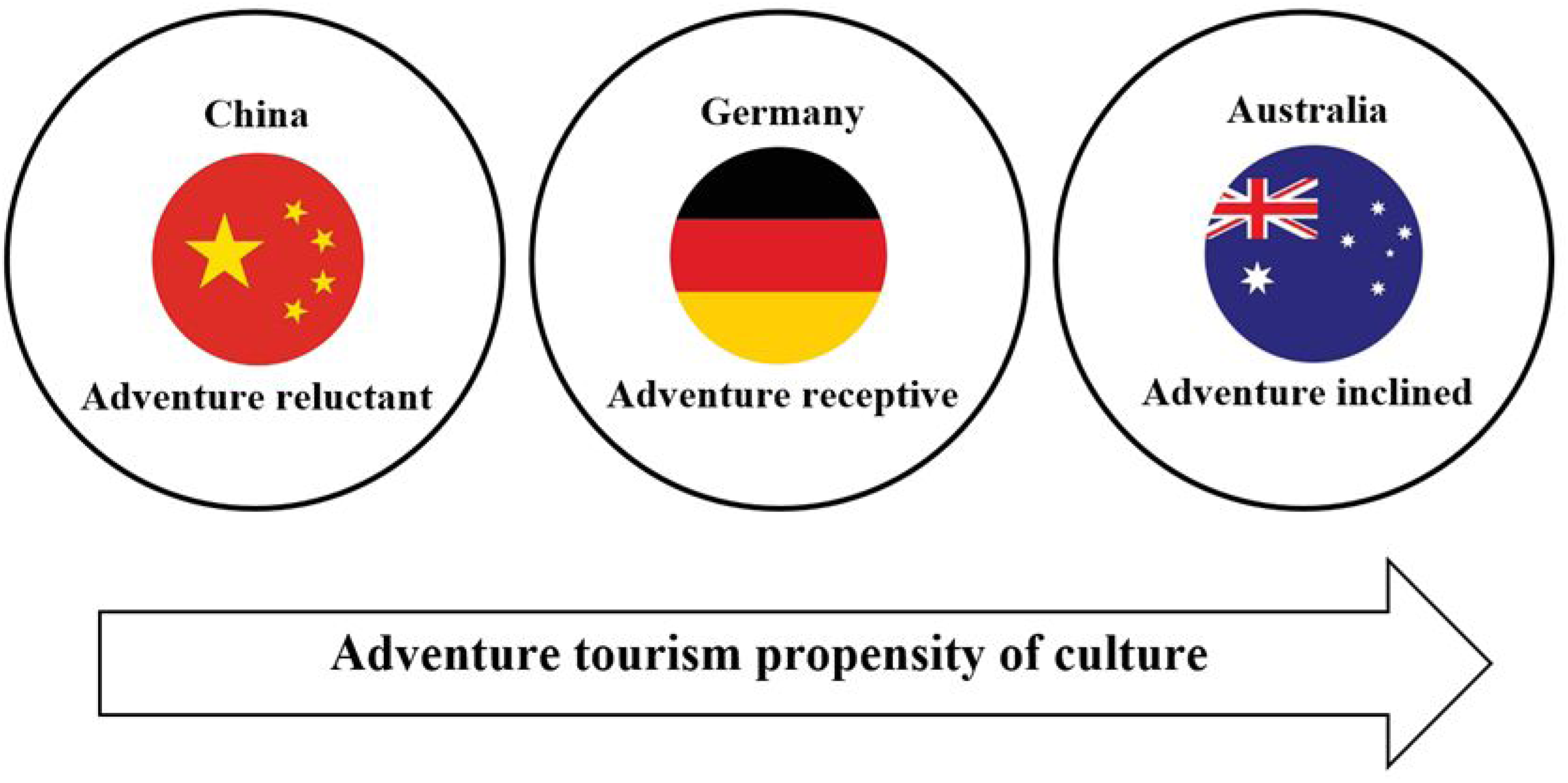
Cross-cultural continuum of adventure tourism propensity.
Conclusions
Adventure tourism spans several continuums and has previously been defined and conceptualised in various ways. Yet, this was mostly done from an industry or individual researcher's perspective and lacked an empirical, consumer-based foundation (Williams et al., 2017). Utilising schema theory, this study addresses this gap by determining the dimensions of an adventure tourism experience from a consumer perspective. For instance, findings establish that a natural outdoor setting is essential to conduct adventure tourism. This defies Peacock et al.'s (2017: 307) conceptual claim that ‘adventure tourism can also take place in urban or man-made environments’. High association with novelty, thrill and excitement, challenge, physicality, and risk and danger further advance the contemporary understanding of adventure tourism. The emphasis on novelty-seeking is particularly thought-provoking because adventure tourism definitions and conceptualisations rarely feature novelty. This study proposes the following consumer-derived definition: ‘Adventure tourism comprises physically and/or mentally challenging tourism activities in the natural environment that provide a sense of novelty, excitement, and enjoyment, and which may contain risk elements’.
Amidst the background of increasing popularity and diversifying market demand, this study also identifies cultural differences in the perception of adventure tourism that impact intention. Important practical implications are derived. Given the strong, highly favourable association with nature and novelty across cultures, adventure tourism experiences must be designed around an immersive natural setting and should feature a unique selling proposition as a point of differentiation from competitors. Depending on the target market(s), it is important to incorporate physical challenges and/or more passive periods of unhurried, reflective moments. Since risk can pose a barrier to the Chinese market, operators might go beyond required safety standards and assurances when targeting Chinese clients and similarly risk-avoidant cultures. This could be accomplished through extensive safety equipment, in-depth safety briefings, translated safety information to guarantee understanding and comfort, and effective communication of guides’ experience and qualifications to build trust and reduce perceived risk. Due to differing perceptions of and desire for a physical and mental challenge, it is advisable to offer adventure tourism products with varying levels of challenge to match consumer expectations with the actual adventure experience. Having beginner-friendly products in the portfolio that appeal to first-timers with self-efficacy concerns is advised to attract the emerging Chinese market.
This study bears several limitations, most notably its scope, which is limited to the three sample nationalities – and their respective national cultures – of Australia, China and Germany. Therefore, future research to extend the findings to other nationalities is warranted. Other limitations evolve around the research being conducted in English and its purposive recruitment approach (nationality and age criteria), which involved convenience- and snowball sampling. This led to a Chinese/German sample that is perhaps more travel experienced and fluent in English than the average youth consumer. Yet, several interviewees had limited English capabilities and/or no international travel experience, which eases concerns of negative impact on findings. Lastly, although focussing on contrasting cultures, this research acknowledges individual differences within national cultures. Findings are thus an overall indication of the respective markets’ perceptions and characteristics in an adventure tourism context, not a universal truth that applies to every individual of that culture.
Future research could apply longitudinal research that investigates a sample over several years to determine whether and how quickly (youth) consumers’ adventure tourism perceptions and intentions change over time. This is particularly relevant given the fast-changing Chinese market and the fact that the existing literature remains at odds on whether age determines adventure tourism intention. Future research may also explore possible gender differences, collect data in the native language of research participants to overcome sampling- and language aptitude limitations, and investigate adventure tourists to overcome hypothetical bias. Additionally, while cross-cultural interviews provided useful insights, they may not fully capture the more embodied or affective dimensions of adventure tourist perceptions. Future research could consider adopting more creative, embodied methods to explore these aspects and to further elicit the nuanced cultural influences on tourist behaviour. Lastly, future research could extend this study's concept with its many components to other national cultures of interest.
This study's findings portray a rapidly evolving Chinese market that increasingly seeks personal enrichment and differentiation, social capital, and escape from cultural confinements through adventure tourism experiences. The industry needs to keep up with culturally influenced tourist perceptions, needs, and wants and strive to preserve the natural environment as the most fundamental dimension of adventure tourism in order to capitalise on what appears to be considerable future demand. Youth travellers are vital for international tourism, will arguably be at the forefront of the global tourism industry's retrieval, and will shape future generations’ travel behaviour. As such, this study assists the industry's recovery and longevity in the aftermath of the COVID-19 pandemic through cultural consideration and differentiation.
Footnotes
Data availability statement
The data that support the findings of this study are available upon reasonable request from the corresponding author. The data are not publicly available due to their containing information that could compromise the privacy of research participants.
Declaration of conflicting interests
The authors declared no potential conflicts of interest with respect to the research, authorship, and/or publication of this article.
Ethical approval and informed consent statements
This study was approved by Griffith University's Human Research Ethics Committee (GU Reference No. 2019/840). An information sheet that provides research participants with information on the research purpose and ethical clearance and a consent form were disseminated to participants via email prior to interviews. Consent to participate was obtained verbally at the beginning of each interview session.
Funding
The authors received no financial support for the research, authorship, and/or publication of this article.
