



Abstract
Trauma-informed education has gained attention across schooling, yet physical education (PE) remains under-developed in this area. This study examines how educators in a Scottish Educational Support Centre understood and enacted trauma-informed pedagogies in PE following the school-wide adoption of the neurosequential model in education (NME). Using conversational inquiry, semi-structured interviews were conducted with six educators trained in the NME, including PE teachers, classroom teachers and support staff. Analysis generated three findings: relationships were understood as the foundation of trauma-informed practice in PE, flexibility was central to responding to daily unpredictability and contextual constraints, and the NME functioned primarily as a reflective framework rather than a guide for lesson planning. Educators rarely planned lessons around the NME. Instead, they relied on knowing students well, adapting activities in the moment, and responding to shifts in the affective atmosphere of the gym. The study suggests that trauma-informed PE is enacted less through fidelity to models and more through context-responsive, relational practice that requires sustained structural support.
Keywords
Introduction
There is an underlying assumption that physical education (PE) is a subject for building strong bodies (Kirk, 2010) and not necessarily a place for providing emotional support. For the young people who have experienced trauma, however, the gym can be a daunting place (Walton-Fisette, 2020). The sharp echo of a whistle or the loud bounce of a ball. The closeness of bodies. The demand to perform skills or exercises, as well as to have their bodies on display. These are not neutral experiences. They can provoke the very responses trauma-informed education aims to mitigate, including withdrawal, aggression and dissociation. Despite this, trauma rarely features in research about PE practices (Quarmby et al., 2022).
The lack of trauma-based practices in school-based PE settings is striking given the rapid growth of trauma-informed frameworks across education (Brunzell et al., 2016). In Scotland, like other countries, the recognition that students may have adverse childhood experiences (ACEs) has shifted how schools think about learning, behaviour and wellbeing (Scottish Government, 2024a). Trauma is now understood not as an individual burden but socially patterned and institutionally produced. It is shaped by poverty, discrimination, systemic neglect and many other factors (Stratford et al., 2020). As a result, various trauma-informed models have emerged to help teachers create safer, more responsive learning environments (e.g. Avery et al., 2022).
While teachers in education more broadly are using trauma-informed pedagogies, these approaches have only brushed past the gym. PE remains on the edge of these conversations, a site more likely to be associated with competition and control (Landi, 2025) than co-regulation or care (Ellison and Walton-Fisette, 2022). This oversight has very real consequences for young people. PE is intensely embodied and relational (Castro-García et al., 2026). It asks students to move their bodies and work with others in a very public forum. For students living with trauma, these demands are not only uncomfortable but can be dysregulating. When PE fails to acknowledge this, it risks becoming another site of exclusion, or worse, harm (Lynch et al., 2023).
A growing body of scholarship suggests that movement, rhythm and routine, all core elements of PE, can support emotional regulation and build trust (Hemphill and Wright, 2024; Martinek et al., 2006). These elements mirror many of the key tenets of trauma-informed practices, and there are hints, in recent work, that PE can be reframed as a space of healing, not just health (Ellison et al., 2020; Quarmby et al., 2022). But so far, much of this research remains theoretical. So, we know what the trauma-informed principles are, we know what should happen, but we know little about what does happen when teachers are asked to use these practices in their teaching.
In this article, we focus on a school that took a bold step: embedding a trauma-informed framework, the neurosequential model in education (NME) (Perry and Szalavitz, 2006), across all aspects of its teaching. Developed by Dr Bruce Perry and rooted in neurodevelopmental theory, the NME outlines principles (Neurosequential Network, 2013) that are grounded in insights about how the brain learns, heals and connects, when disrupted by trauma (Perry, 2009). This offered a rare opportunity to examine how a trauma-informed framework, designed in clinical contexts, played out in one of the most embodied, relational and unpredictable subjects in the curriculum: PE. Here, we offer a complex portrait of how trauma-informed pedagogies were understood, adapted and enacted in PE.
Schools, ACEs and trauma-informed pedagogies in PE
Schools are meant to be safe havens, nurturing the growth of all young people, but for many, especially those who have experienced trauma, the school environment can be another place where their needs are misunderstood or unmet (Herzog and Schmahl, 2018). The concept of ACEs was developed in the United States through a landmark epidemiological study (Felitti et al., 1998). ACEs have gained international attention as a population-level framework for understanding how early adversity is associated with later health, developmental and educational outcomes. Many schools across the world use ACEs to help identify students with trauma.
Yet, ACEs have been criticised for the use of cumulative ACE scores, which risks oversimplifying complex social issues and framing children through a deficit lens (Edwards et al., 2019). In response, some educational contexts have moved away from ACE-based identification and towards broader trauma-informed and relational pedagogies that focus on universally supportive practices rather than categorising pupils according to their experiences (Maynard et al., 2019). In Scotland, policies have explicitly addressed this debate by adopting a trauma-informed approach that goes beyond ACE scoring. The Scottish Government's (2024a) ACEs guidance, alongside the National Trauma Transformation Programme (Scottish Government, 2024b), positions trauma as a social issue that requires a coordinated response across multiple sectors. Education Scotland (2018) has also adopted a focus on nurturing and relational pedagogies, where the emphasis lies in creating safe and consistent environments for all learners. Within this context, ACEs are understood as one aspect of a broader approach that aims to build resilience, equity and wellbeing through trauma-informed practices.
Teachers, however, are the ones on the frontlines, usually without the training or tools to respond to students experiencing trauma (McCuaig et al., 2022). Compassion, while essential, is not enough. Trauma intersects with complex social factors like poverty, racism and other inequities that complicate how it manifests in schools (Stratford et al., 2020). The impact of trauma can include impaired development, disrupted relationships, poor self-regulation and learning challenges (Herzog and Schmahl, 2018). While schools expect teachers to manage these needs, they often lack the resources to do so. In response, a range of organisations have developed toolkits and frameworks to help teachers work with trauma-affected young people (see e.g. Avery et al., 2022). As Quarmby et al. (2022) have argued, however, PE is a space that is often overlooked in this respect.
The untapped potential of PE
PE holds a unique place in the school curriculum. PE has the opportunity to foster emotional regulation, social interaction and a sense of embodied identity (Hemphill and Wright, 2024; Quennerstedt et al., 2025). In Scotland, the Curriculum for Excellence locates PE within the Health and Wellbeing area, positioning it as a space intended to support students’ safety, engagement and wellbeing (Scottish Government, 2009). Yet many students, particularly those with ACEs, find PE alienating. Compounding this are structural issues that make PE a difficult space for marginalised students, including those from diverse racial (Blackshear and Culp, 2021), gender and sexuality (Landi, 2025), Indigenous (Fitzpatrick, 2013) and disabled communities (Haegele, 2019). As a result, PE has struggled to respond to young people's cultures (Zuest, 2022).
Still, PE holds promise. Martinek et al. (2006) argued that PE, when approached thoughtfully, could be a site of healing. Ellison et al. (2020) echoed this, suggesting PE environments can nurture students when framed through trauma-informed lenses. In fact, Sandford et al. (2024) have highlighted the developmental capacity of this space for trauma-affected youth. Yet very little is known about what trauma-informed PE looks like in practice.
Over the past few years, scholars have begun to explore this gap. Quarmby et al. (2022) proposed a set of principles, such as promoting safety, establishing routines and listening to youth voices, as foundations for trauma-informed PE. Much of the literature since, however, has focused on theory or practical suggestions (e.g. Ellison et al., 2020; Quarmby et al., 2025). There is a pressing need, therefore, to understand how trauma-informed pedagogies are currently being interpreted and enacted by teachers on the ground, particularly in PE.
Towards an inclusive framework
Historically, physical educators have engaged with issues of equity through different pedagogical frameworks like critical pedagogies (Fitzpatrick, 2019), social justice pedagogies (Gerdin et al., 2022), transformative pedagogies (Quennerstedt, 2019), restorative practices (Hemphill et al., 2018), and activist approaches (Oliver and Kirk, 2015), amongst others (Castro-García et al., 2026). These approaches often aim to centre marginalised voices and foster more inclusive learning spaces. Trauma-experienced students, however, often remain on the periphery of these discussions (Quarmby et al., 2022).
While equity-orientated pedagogies overlap with trauma-informed principles (e.g. trust, care, voice, responsiveness), there are no empirically based pedagogical models, 1 that we are aware of, that address trauma in PE. Emerging studies from sport and youth work provide some insight into these practices. For example, Quarmby and Luguetti (2023) found that using Freirean critical pedagogies is useful with care-experienced young people to build relationships, promote a sense of freedom and provide clarity of purpose in sport settings. Yet there are some spaces that make it particularly difficult to achieve these results. For example, alternative provision schools have a range of unique factors that influence PE enactment (Quarmby et al., 2025) and these barriers have made some scholars label these spaces as unjust (Maher et al., 2025a).
Despite this, many teachers are on the frontline tailoring these experiences to meet students’ needs (Maher et al., 2025b). These teachers are often working in isolation though without broader support (Souers and Hall, 2018). This article extends previous research by exploring how trauma-informed pedagogies are understood and enacted by PE teachers in a Scottish Educational Support Centre (alternative school) that teaches young people that have experience of a minimum of one ACE. At the time of the study, the entire school had adopted the NME to work with these young people.
Neurosequential model in education (NME)
The neurosequential model was not born in a classroom. It began in the clinic. Originally developed by Dr Bruce Perry in therapeutic settings, the neurosequential model in therapeutics was designed to support young people living with the effects of trauma, especially those in child protective services (Perry, 2006, 2009). Drawing on research from neurodevelopment and therapeutic practice, Perry built a framework that helps adults understand how trauma disrupts children's development and how healing can be supported through patterned, relational experiences.
Over time, the model evolved. Educators began to take notice. Through the work of the Neurosequential Network (2013), and popular texts like Perry and Szalavitz's (2006) The Boy Who Was Raised as a Dog, the framework was translated and adapted for school contexts. It has since found a home in classrooms across the world, from Australia to the United States, Zambia, and many other countries, particularly in schools supporting students with ACEs. At the heart of the NME are six principles, known as the Six Rs: Relational, Relevant, Repetitive, Rewarding, Rhythmic and Respectful. These principles may sound intuitive – almost obvious – but each of them is grounded in deep insights from neuroscience about how the brain learns and repairs itself:
Relational refers to the foundational role of trust and safety in any learning environment. Before a student can engage, they need to feel seen and supported (Perry and Szalavitz, 2006). Relevant means learning must be developmentally appropriate and tailored to the needs and realities of each young person (Neurosequential Network, 2013). Repetitive speaks to the brain's love of pattern; learning that sticks is learning that returns, over and again, in predictable ways (Perry, 2009). Rewarding does not mean stickers or treats. It means cultivating intrinsically positive experiences that make students want to come back, to try again, to stay connected (Perry and Szalavitz, 2006). Rhythmic involves activities (e.g. movement, music, breathing) that align with the body's natural patterns, helping to regulate emotions and behaviours (Perry, 2006). Respectful reminds educators to honour a student's full humanity: their culture, background, identity and story (Neurosequential Network, 2013).
What makes the NME relevant to this study is that it was adopted by the school in 2018. It was embedded into the policies and shaped all the practices right down to daily routines. Teachers received professional learning twice annually on the model during all-day retreats. The training went over the Six Rs, specific practices that integrate these principles, and facilitated scenarios teachers face. With this context, our research aimed to address these three research questions:
How do teachers who were trained in the NME model describe their beliefs about trauma-informed pedagogies in PE? What do approaches to enacting trauma-informed pedagogies ‘look like’ in PE when informed by the NME? What do teachers identify as the key influences and barriers they experienced while implementing trauma-informed pedagogies in PE?
By exploring these questions, this article not only seeks to understand how the NME plays out in one specific subject area, but also what happens when a model designed in therapeutic contexts is taken up, adapted and lived out in PE. Although the NME shaped the school's approach, the experiences described by teachers suggest that the real work of care in PE occurs in the affective space between planned pedagogies and what happens in gyms. It is in this space, where feeling, relation and embodiment intertwine, that affect theory becomes a useful lens.
Turning to ‘affect’: Rethinking trauma-informed pedagogies
Affect theory invites us to think differently about PE. Instead of asking what pedagogical practices are, it asks what those practices do. It shifts attention from frameworks and onto forces, those flickers of feeling and intensities that move between bodies (Massumi, 2015). Think of the increased heartbeat when a whistle blows, or the comfort felt from a teacher's nod. These moments are not background noise. They are the forces that can open up or shut down opportunities for young people.
As Landi (2025) notes, affect theory is not the same as the affective domain. The affective domain in PE tends to treat emotion as an outcome, something that can be learned (Teraoka et al., 2020). The affective domain is about motivation (Chen et al., 2014), self-concept and identity (Kirk and Tinning, 1994) and how emotions are expressed and/or managed (Hellison, 1995). These constructs are valuable, yet they position emotions and feelings at the individual level and as a set of traits that can be learned, measured and improved. Affect theory, on the other hand, sees emotions and feelings as part of a broader network of forces (Fox and Alldred, 2017).
Affect theory posits feeling is not a possession someone has, but as relational, constantly under construction and as a force that travels between bodies (Massumi, 2015). These are those gestures, the silences and the shared atmospheres (Landi, 2025) that shape what bodies can and cannot do. Firstly, affect is deeply embodied (Ahmed, 2004). It shapes how teachers physically enter a room, how they speak and listen to others, and how they take up space. Second, affect is pre-cognitive (Massumi, 2015). It is felt in those moments when a teacher senses something has changed, that registered gut feeling, before they know or can put words to what happened. Third, affect is an ongoing affective attachment (Ahmed, 2010) to people, to ideas, to objects and to the ideals that keep us coming back. In this way, affect theory helps us feel the texture of what it means to enact trauma-informed practices in PE.
Using affect theory recasts PE not simply as a pedagogical site, but as an ‘affective atmosphere’ (Landi, 2025). It is a space charged with histories, sensations and social relations. Understanding trauma-informed pedagogies in this light allows us to see teaching not as a checklist of strategies. Instead, it is a felt, embodied practice that unfolds moment by moment through touch, tone, presence, forces and relationships.
Research methods
Given the aims of the study were to understand teachers’ stated beliefs, Dillon and Oli decided that conversational inquiry (Leavy, 2017) would be an appropriate approach for the study. This is because this genre of research is used to listen to stories and beliefs as a way to make meaning of lived experiences.
Context and participants
The research took place in a Scottish Educational Support Centre (alternative school) that works with students aged 12 to 16. All of these students have been identified as having experienced at least one ACE. Since 2018, the school had embedded the NME into its practices, and all employees were trained in its principles. We were granted access to this school because Andrew was a former Inclusion Support Aide there. Using convenience sampling (Marshall and Rossman, 2016), six participants (Table 1) volunteered to be interviewed for the study based on their connection to PE, availability and willingness to participate. Two of the participants were PE teachers, two were classroom teachers, and two were support aides (one for sport/PE, one for classroom).
Demographics of participants.
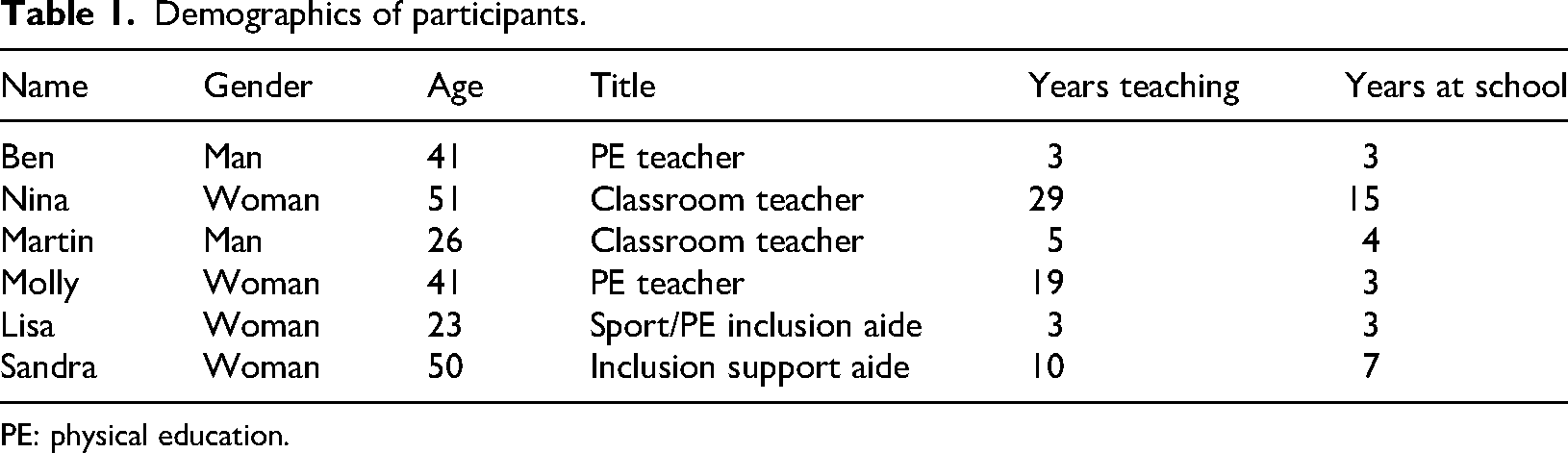
PE: physical education.
Data generation
To explore these educators’ experiences, Andrew conducted individual semi-structured interviews (Marshall and Rossman, 2016) with each participant. The interviews were guided by questions around their beliefs, practices and perceived outcomes in using trauma-informed practices in PE. These questions were developed by Andrew based on his experiences. He then received feedback from Dillon and Oli about the questions and revised them to align to the research questions and literature. Some of the questions were specific to the model (e.g. Can you provide an example of an activity where you use the Six Rs model in PE? Why do you feel this is aligned?), others were about trauma-informed practices in PE more broadly (e.g. Can you give an example of how PE is different than other subjects when it comes to trauma-informed practice? How about an example of when it is similar to other subjects?), and other questions asked teachers to reflect on their own practices (e.g. Can you provide an example of things that you do as a teacher that you feel are trauma-informed that's not represented in the NME?).
These interviews were not rigid. They unfolded like conversations (Kvale, 1996) where the participants were encouraged to reflect, provide examples and explore tensions. This helped generate thick, layered descriptions (Charmaz, 2002) about the interconnected role of beliefs, practices and reflections of trauma-informed pedagogies. Each of the interviews lasted between 52 and 71 minutes. They were audio-recorded, transcribed verbatim and anonymised. Andrew also spent time observing six PE classes to take field notes (Emerson et al., 2011). These notes were not used as data for the article (because the focus was on teachers’ perspectives), but they did help to enrich the researchers’ understandings of trauma-informed practices and capture the rhythms and routines that framed participants’ stories.
Data analysis
Analysis began with slow, attentive reading. Andrew moved through each transcript line by line, not to code but to listen. He noted early reflections, words that lingered and ideas that seemed to stick. Only after this close reading did the formal analysis begin. The first step was holistic coding (Saldaña, 2016). Andrew gave broad, preliminary labels such as relationships, barriers and trust to excerpts of data. These early codes acted as signposts, helping him make sense of what participants were saying.
Once this layer was complete, Dillon reviewed the codes and data. He noticed the analysis could move closer to the article's aims and suggested a second round using structural coding (Saldaña, 2016). Here, each code was connected to a research question, examples included beliefs (RQ1), teaching activities (RQ2) and barriers (RQ3). After Andrew completed this stage, Dillon reviewed the work again.
At this point, Dillon proposed a third layer called values coding. Drawing on Miles et al. (2015), this approach captured not only what participants said but what their words revealed about their beliefs, values and feelings. Examples included relationships as foundational and trauma-informed teaching reflects good practice as beliefs. Values included adaptability, advocacy and stability. Feelings included compassion, fatigue and pride. These three rounds of coding, holistic, structural, and values, gave the analysis both structure and depth.
When the data were coded through all three layers, Andrew and Dillon compared codes and excerpts side by side. The holistic codes offered context. The topic codes anchored the analysis to the research aims. The values codes revealed the underlying emotions and commitments. Through this comparison, three clusters emerged: (a) building relationships, (b) context limitations, and (c) teacher planning. These clusters became the foundation of the themes.
For each cluster, Andrew wrote analytical memos to think through the data and write towards understanding (Richardson, 2000). Each memo explored how the data aligned (or not) with the NME principles. The aim was to interpret meaning and consider what these moments revealed about teaching, trauma-informed pedagogies and PE. Once the memos took shape, Andrew drafted initial themes and shared them with Dillon and Oli. Their feedback reshaped the analysis. Dillon questioned context and assumptions, while Oli challenged ideas through literature. These discussions led Andrew back into the data to clarify arguments. Finally, Andrew, Dillon and Oli worked together to revise the findings and build a discussion that connected these insights to the wider body of research.
From critique to clarity: Revising through reviews
Anyone who has been through the review process knows that a single comment can sometimes change how we see an entire paper. For us, three points stayed with us. Reviewer One noted that we mentioned ACEs in the background but never explained what they were or how they connected to our work. It was one of those moments that makes you pause. They were right. Skipping over ACEs was not a small omission. It shaped how we justified the study and how our results connected to previous research.
The second point came from both reviewers and the editor. They observed that our article lacked a clear theoretical framework. At first, we thought the NME itself could serve that role. We hoped to use the data to explore how the model's Six Rs might apply to trauma-informed PE and to test its usefulness in this context. But that plan did not work, and for a while, we were not sure what to do next.
Then we re-read Reviewer Two's comments, which cut deep in a good way. The first said, ‘Unless the authors are adopting a new materialist perspective, this needs to be refined’ and ‘It sounds like trauma can be carried like a handbag and put down or picked up at will’. Another note read, ‘Depending on your theoretical perspective, this statement could be problematic’. In those lines, we saw the real issue: the assumptions of the NME did not align with how we framed the literature, analysed the data or interpreted our findings. Further, our thinking and writing had been influenced by an ontological perspective all along. There was a fracture between theory and practice.
Yet both reviewers noted the strength of the data, which gave us confidence. We did not need to start over. This time, we turned to affect theory. Through that lens, we could see how trauma-informed pedagogies are embodied, how they create attachments and how they respond to affective atmospheres. We then re-analysed the findings and discussion abductively, linking them to the revised literature and affect theory. In the end, the article was transformed. What began as critique became an invitation to see our work more clearly and to let the teachers’ voices speak with greater depth.
Positionality and trustworthiness
As a former staff member at the school, Andrew approached this research with familiarity and responsibility. He was an insider to this place (Landi, 2024). This helped him build trust and understand the culture of the school, but it also raised ethical questions that went beyond the scope of a formal ethics review. Andrew's prior experiences sometimes clarified participants’ meanings, but they could also narrow his perspective. This is where Dillon and Oli were vital. They challenged Andrew's assumptions and encouraged him to think beyond his own experiences.
Trustworthiness in this type of research is not about objectivity but about depth, reflexivity and rigour (Strom and Martin, 2017). We aimed to build credibility by being transparent about our process and by continually questioning our own positions through discussion and engagement with the literature (Castro-García et al., 2026). Andrew also maintained ongoing conversations with participants beyond the interviews. These were not to validate claims but to deepen understanding and explore nuance (Smith and McGannon, 2018). We do not claim to offer a universal truth about trauma-informed pedagogies in PE. Instead, we present a window into the experiences of educators at one school that serves young people with ACEs, in the hope that their insights can inform how the broader field approaches trauma-informed practices.
Results
The analysis revealed three findings: (1) Relationships are everything, (2) The need for flexibility, and (3) The NME model: Inspiration or afterthought? These three findings highlight how the educators understood and enacted trauma-informed pedagogies in PE.
Relationships are everything
Among the Six Rs of the NME framework, one principle dominated every educator's account: relationships. Indeed, ‘relational’ is the first R principle and our educators consistently positioned it as the essential foundation upon which all other trauma-informed practices are built. Relationships were not viewed as a gateway to pedagogy, but rather as the embodied practice of pedagogy itself. As Ben explained: Yeah, your relationships are going to see benefits and give you the mobility to do the rest of the Rs. But at the very heart of what we do, it has to be relationships and building trust with children, which will be very difficult for some given the ACEs they've had.
This was not abstract rhetoric. It reflected the day-to-day experiences of the teachers. Nina captured the emotional cost of this work: Many of our students have experienced severe trauma and reject forming relationships because they don’t want to suffer disappointment or re-traumatisation. My major recommendation would be to just really try and understand the children you work with and get to know them … You might also help the parents do a CV and you’ll be with the child every step of the way when preparing them for a volunteer experience. You might attend meetings with these children, where really big decisions are made…
The commitments these teachers exhibited extended to families and caregivers. Teachers described building rapport with parents, siblings and social workers to better understand students’ worlds and adjust their practices accordingly. These cross-contextual relationships filled gaps that are left by a fragmented care system. For some students, their relationship with their PE teacher became one of the few stable anchors in their lives. This anchoring was not expressed through grand gestures but through the daily repetition of inside jokes, predictable routines and persistent care. These small affective gestures created atmospheres of safety, allowing trust to grow not through instruction but through feeling.
So, relationships were not understood as just one principle of a broader trauma-informed approach. They were the trauma-informed approach. As teachers noted, without trust, no lesson plan – no matter how creative or engaging – would stand a chance. But the effort to build these relationships came at a cost. It required time, emotional labour and an institutional culture that recognised and supported this affective work. As the next section shows, that support is not always guaranteed.
The need for flexibility
The teachers believed in the value of the NME model, but belief does not guarantee explicit and intentional enactment. The daily reality of working in a school serving trauma-experienced students meant that even the most carefully designed frameworks had to bend to circumstance. Ben captured this tension: It still has to meet the level where the kids are … you’re having difficulty in terms of behaviour. You could be working on that for 6–8 weeks with little progress. Whilst it's great having these [the Six Rs] here, it can only be used by where the kid is on his or her journey.
The teachers also described a range of constraints that included fluctuating class sizes, transport issues, staffing shortages, weather changes and the absence of a permanent facility. These challenges demanded a kind of professional flexibility that went well beyond standard teaching adjustments. Nina offered an apt description: You have got to be uber, uber flexible. Cos you’ve got this plan, but the child might not be in the right place to fulfil original plans. You need to have … backups and be ultra-responsive based on the child. You know, I've got this plan, but I also need to have A-B-C plans and I’m going to deliver this. You also have to change based on the groups you’re delivering to, the venues you are delivering in, and transport issues … In many schools, flexibility might mean adjusting a lesson if a student forgets their kit. Here, it meant rethinking the entire plan based on who showed up, what space was available and how each student was feeling.
The teachers described days when formal PE lessons were abandoned altogether because a student needed one-on-one support: a walk outside, a quiet chat or a coffee together. These moments were not seen as failures. They were the work. They reflected a shift from curriculum delivery to human responsiveness, a pedagogy that lives in presence and attunement rather than prescription. Lisa noted the demands of teaching in small groups: Because we work with smaller groups, we can get them doing a lot more or less because everything's so individualised.
There was also the challenge of space. Without a dedicated gymnasium, classes were often displaced. A booking conflict might mean shifting from a planned 2v2 volleyball session to a walk around the neighbourhood. This demanded more than logistical skill. It required imagination and a sensitivity to atmosphere that no framework could provide. In this sense, teaching became an embodied negotiation with shifting conditions, where planning met presence and theory gave way to feeling. So, while the NME approach offered useful principles, its enactment had to be interpreted through the lens of daily unpredictability. Flexibility, not fidelity, was a defining feature of trauma-informed pedagogies.
The NME model: Inspiration or afterthought?
All the teachers and aides in the study received formal training in the NME approach. They valued it and believed in its core message, but when asked how it influenced their teaching, the answer was often the same: not much. Molly was particularly candid: It doesn’t change it for me because I think I’ve always done it … I think the 6R model is just the basics of good-quality learning and teaching. I wouldn’t say it's particularly revolutionary … I feel the overall values of sport and PE include those benefits or principles anyway. You could say that PE and the delivery of it were there first and that we fit our teaching back to NME, or that NME fits in with what we do in PE…
Several teachers described how the NME gave them a language to explain their practice to colleagues, senior leaders or external agencies. In this way, the model acted less as a guide for planning and more as a grammar for professional learning. It allowed teachers to justify decisions that are hard to quantify: walking a student out of class to calm down, adjusting a lesson mid-flow or holding space for a child on the verge of withdrawal. These gestures, subtle yet charged with feeling, illustrate how pedagogies operate through atmospheres that models can never fully contain.
Still, this symbolic utility came with limitations. If the model merely names what experienced teachers already do, it risks becoming performative. It is a tool cited to meet institutional expectations rather than improve practice. The deeper concern here is about innovation. If frameworks like the NME do not augment practice, especially in embodied fields like PE, their transformative potential is diminished. The absence of transformation may not be a failure of the model, but a reflection of context. Teachers in this study were already doing high-level relational work. Their critique of the model was not cynical but competent. The NME was not useless. It just was not enough. It functioned as an attachment, a familiar anchor that helped teachers make sense of their work and stay connected to a shared professional identity. The framework was not rejected, but re-tooled. It became a language of validation and a reflective tool, but it did not change what teachers did, nor did it need to for them to feel its significance.
Discussion
Trauma-informed education has gained attention across education, yet PE remains under-developed in this respect. As Quarmby et al. (2022) have argued, the gym can be both a site of risk and of support for young people with ACEs. This depends largely on the approach of the teacher and the ‘affective atmosphere’ (Landi, 2025) of the gym itself. We extend this conversation by offering grounded insights into what happens when a trauma-informed model like the NME is taken up as a framework for practices. What we found was not a neat application of a six-part framework, but a set of embodied, relational and improvisational acts that reshaped what trauma-informed pedagogies can look like in PE.
The educators in this study did not reject the NME framework. Instead, they re-purposed it. The NME principles were not used as blueprints for planning but as mirrors for reflection. The Six Rs already aligned closely with what these teachers valued in quality teaching: trust, care, rhythm and responsiveness. As Martinek et al. (2006) have long suggested, the core ingredients of pedagogy that are supportive for young people with ACEs often already exist in social movement and PE spaces. Our findings support this view, but with an important caveat. Recognising the presence of these ingredients is not the same as knowing how to work with them in moments of uncertainty or distress.
This distinction matters because the teachers in this study did not rely on the NME principles when planning their lessons. Their work centred on knowing their students, adapting lessons in response to context (Maher et al., 2025b) and, critically, attuning to the shifting affective atmosphere (Landi, 2025) of the gym. Teachers described noticing slight changes in body language, movement patterns that felt unfamiliar or a shift in the room's energy. These moments often prompted an immediate pause in the lesson. Sometimes this meant taking a quiet walk with a student. At other times, it involved introducing simple routines such as daily check-ins. These were not formalised strategies drawn from the framework. They were situated responses grounded in attentiveness and presence. These practices reflect a sensitivity to pre-verbal cues and intensities (Massumi, 2015) that circulate between bodies and shape what students can do in a space (Ahmed, 2004).
The overlap between trauma-informed pedagogies and what teachers described as ‘good’ teaching presents both promise and challenge. On one hand, it suggests that those educators already using relational and student-centred pedagogies may already be enacting elements associated with trauma-informed work (Quarmby et al., 2022). On the other hand, it raises an important question: what makes these practices specifically responsive to young people with ACEs? As Quarmby and Luguetti (2023) argue, pedagogies for care-experienced young people must account for the ruptures and mistrust that trauma often leaves behind. Simply being relational is not sufficient. What distinguished the practices in this study was teachers’ explicit attention to how and why trust in adults had been fractured, and their willingness to respond in ways that prioritised repair and consistency over efficiency or curriculum coverage.
This brings us to the issue of enactment. The original neurosequential model (Perry, 2006) was not designed for the complexity of schools, let alone PE. While the framework was translated into educational contexts, it was not transformed by them. Its roots remained firmly clinical. As a result, the NME became something teachers used to make sense of their decisions after the fact rather than a tool that shaped planning. This may also reflect an educational orientation of PE that centres empowerment and learning (Quennerstedt et al., 2025). It is also possible that teachers drawn to this work already held relational orientated dispositions, which may partly explain their choice to work in alternative school settings. In moments of heightened stress or unpredictability, professional instinct consistently took precedence over principle. These instincts were not arbitrary. They were shaped over time through experience and repeated engagement with young people living with adversity.
The embodied nature of teaching practice (Standal, 2015) was evident throughout the findings. Teachers spoke about cramped spaces, shifting rosters and emotional volatility. These are not peripheral details. They form the conditions within which trauma-informed practices are enacted. As Stratford et al. (2020) argue, trauma-informed pedagogies are not a matter of importing a framework but of adjusting to a constantly shifting landscape. In this sense, flexibility becomes a defining feature of trauma-informed pedagogies. When teachers walked a student around the block instead of running a planned activity, they were not deviating from trauma-informed principles. They were enacting them in response to the moment.
At the same time, these practices are difficult to sustain without support. As McCuaig et al. (2022) note, responsibility for students’ health and wellbeing cannot rest solely with individual teachers. Quarmby et al. (2024) similarly highlight the challenges faced by physical educators working with trauma-affected students. In this study, teachers frequently described practices that extended well beyond instructional delivery, often filling gaps left by fragmented systems of care. This begins to resemble what scholarship has described as trauma-invested practice (Souers and Hall, 2018), where responsibility is not limited to awareness or accommodation, but involves an ongoing school-wide commitment to responding to young people. Without adequate infrastructure, there is a risk that this responsibility is placed on individuals (like PE teachers) rather than shared across networks (Walton-Fisette, 2020).
The call, then, is not for more trauma-informed frameworks, but for better scaffolding. As Casey and Kirk (2021) remind us, principles without architectures are like maps without roads. What trauma-informed PE requires are architectures that can guide, sustain and evolve the work that is already occurring. These need to be open and flexible rather than prescriptive or recipe-like (Landi et al., 2016), and they must move beyond retrofitting existing models such as Teaching for Personal and Social Responsibility (Ellison et al., 2020). Instead, they should emerge from the work of teaching movement in contexts shaped by trauma.
What these educators were doing was not ordinary. It was responsive, embodied and demanding. Yet they rarely described it as anything exceptional. This is problematic because when this work goes unnamed or unnoticed, it is unlikely to be resourced or sustained. The central lesson from this study is that the future of trauma-informed pedagogies in PE does not lie in adopting new models. It lies in building the conditions and affective atmospheres (Landi, 2025) that allow relational and responsive practices to endure.
Conclusion
This article was not a story about trauma-informed models in PE. It was a story about teachers who enacted trauma-informed pedagogies through how they noticed, responded to and moved with young people. We entered the study expecting to see how the NME approach would shape practices in PE. What we found was more complex and more meaningful. Teachers were not looking to the NME for moment-to-moment direction. They were drawing on years of experience, professional judgement, hard-earned relationships and a strong belief that every young person needed at least one adult who would stay attentive to them.
The NME approach was not irrelevant. It provided teachers with a professional language, shared reference points and legitimacy to explain their decisions, but it did not lead practice. It followed it. As one participant suggested, it was ‘a way to explain what we’re already doing’. A mirror, not a map. This distinction matters. PE is often left out of trauma-informed conversations, despite being one of the most embodied, relational and emotionally-charged environments in a school. If trauma is experienced and remembered through the body, then PE should be central rather than peripheral to trauma-informed efforts.
What we observed was not a model guiding change, but teachers navigating shifting situations with sensitivity and care. Flexibility was not an added skill. It was the pedagogy itself. Relationships were not strategies. They were the ground that made participation possible. Teaching unfolded through small adjustments, pauses and decisions made in response to how students arrived on a given day. These practices were rarely framed as innovative by the teachers themselves. They were described simply as ‘good teaching’.
That humility is admirable, but it also warrants caution. When this work is treated as ordinary, it becomes easier to overlook and harder to sustain. What appears routine from the outside often involves sustained attention, ethical judgement and ongoing responsibility. Without adequate recognition and support, trauma-informed PE risks becoming dependent on individual commitment rather than embedded within school structures.
The work is already happening in daily check-ins, in lessons that change mid-stream, and in walks taken instead of games when the moment calls for it. The question is no longer whether teachers can enact trauma-informed practices in PE. The question is whether schools and systems are willing to build the conditions that allow this work to continue. Trauma does not remain contained within classrooms. It enters gyms, routines, and relationships. Responding to it constructively does not require a perfect model. It requires recognising that the best maps are drawn from the routes teachers are already walking and ensuring they are supported to keep walking them.
Footnotes

Funding
The authors received no financial support for the research, authorship, and/or publication of this article.
Declaration of conflicting interests
The authors declared no potential conflicts of interest with respect to the research, authorship, and/or publication of this article.