



Abstract
Children and youth around the world are experiencing trauma to the extent that it has been labeled a global health concern ( O’Toole, 2022). Physical education (PE) teachers, among others, are attempting to respond to this concern by implementing research-based trauma-informed practices (TIPs). The purpose of this paper was to conduct a scoping review to gather and synthesize the literature on TIPs appropriate for the PE context within the K-12 school system in the Global North. Following the five-stage scoping review protocol outlined by Peters et al. (2020), the process returned 34 articles that met all inclusion criteria. The majority of the literature (18 articles) was found in practitioner-focused journals and centered on providing knowledge and broad advice for PE teachers. Most of the remaining work included qualitative research and focused on exploring the experiences of PE teachers working with students who had experienced trauma. Only four studies included an intervention. In addition to discussing the available research, this article explores the various conceptions of trauma that have recently appeared in the research as well as the implications of trauma's and TIPs’ infusion into school culture. The review clearly demonstrates a need for continued discussion around trauma, more research in the area of TIPs (specifically related to PE), and continued professional development for teachers.
Introduction
Across North America, the incidence of childhood trauma is noteworthy. For example, the United States Substance Abuse and Mental Health Services Administration (SAMHSA, 2024) has reported that more than two-thirds of American children experience at least one potentially traumatic life event before they leave high school. The Public Health Agency of Canada has shared commensurate findings. For example, over one-third of Canadians experience childhood maltreatment such as physical and/or sexual abuse (Campeau et al., 2020), while researchers have also found at least two-thirds of Canadian children are subjected to adverse childhood experiences/events (ACEs; Afifi et al., 2020; Campeau et al., 2020; Joshi et al., 2021). Similar findings have been reported in many other Global North nations, including Australia, England, France, Spain, and Wales, among others (see Bendall et al., 2018; Lewis et al., 2019; Perada et al., 2014; Schäfer et al., 2018). Moreover, this is not a regional issue that is unique to the Global North. International research has revealed more of the same, or worse—with a greater percentage of some countries’ children experiencing potentially traumatic life events (Benjet et al., 2016; Little and Akin-Little, 2011). Indeed, childhood trauma has been recognized as a serious global health concern (O’Toole, 2022).
Examples of potentially traumatic life events are complex, varied, and plentiful. They may include, for example, “psychological, physical, or sexual abuse … witnessing or experiencing domestic violence … sudden or violent loss of a loved one … [or] refugee or war experiences” (SAMHSA, 2024: para. 2). Additionally, others have broadened conceptualizations of what might lead to trauma, expanding upon the list of possible ACEs, including some that extend beyond the home yet have the potential to negatively impact health and well-being in the short term and later in life (Boullier and Blair, 2018; Smith, 2018). These “beyond the home” ACEs include experiencing racism, living in an unsafe community, holding low socioeconomic status, and being rejected or bullied by peers, among others (Quarmby et al., 2022; Smith, 2018).
Three key and common elements are considered necessary for events to be classified as traumatic: subjectivity (trauma is an individual subjective experience); overwhelming (trauma overwhelms or has the potential to overwhelm an individual's ability to cope); and lasting effects (trauma can lead to long-lasting physical, emotional, and psychological impacts; Herman, 1997; van der Kolk, 2015). With respect to subjectivity, it is important to note that what might be experienced as traumatic to one individual may not be experienced as traumatic to another (Black et al., 2012). Also, when children are overwhelmed, the lasting physical, emotional, and psychological impacts can result in a host of possible disorders, including post-traumatic stress disorder and other psychiatric disorders, including generalized anxiety disorder, depressive disorders, and eating disorders (Downey and Crummy, 2022; Lubit et al., 2003).
It is also important to recognize the existence of trauma-related literature that questions the understandings of trauma described above (Zembylas, 2024; Zoromba et al., 2024). Zembylas (2024: 584) argued that educational researchers ought to rethink their current understandings of trauma to reconceptualize their research practices to “pay attention to the catastrophic effects of colonialism on individuals and communities,” while Zoromba et al. (2024: 9) noted limitations in traditional models of trauma and called for a “more holistic, multidimensional approach to trauma.” Zoromba et al. also underscored the existing discrepancies between adult perceptions of trauma experiences and prevalence rates in the United States to bolster their finding that trauma currently may not incorporate broader cultural understandings. Despite this particular discussion within trauma literature, our current focus is limited to the Global North and its contemporary understandings of trauma.
Trauma-informed practices (TIPs)
Given the current understanding of the prevalence and impact of traumatic life events, school communities have been called upon to develop and offer responsive and supportive environments for students (Thomas et al., 2019; UNESCO, 2019; Wiest-Stevenson and Lee, 2016). Certainly, this attention has been heightened and the responsive actions have been bolstered by recent national and global events, such as societal mass shootings, police brutality, the migration of refugees, terror attacks, and the worldwide COVID-19 pandemic (Egharevba, 2017; Seitz et al., 2021; Singletary, 2020; Schäfer et al., 2018; Schilling et al., 2017; Wiest-Stevenson and Lee, 2016). One of the most widely recognized school-based responses has been the implementation of TIPs, sometimes also referred to as trauma-informed approaches or trauma-informed pedagogies (Maynard et al., 2019; Thomas et al., 2019). Although there are various definitions of TIPs (Sloan et al., 2020), SAMHSA’s (2023: vii) definition of a trauma-informed approach is familiar to many within the education sector, particularly within North America: A program, organization, or system that is trauma-informed realizes the widespread impact of trauma and understands potential paths for recovery; recognizes the signs and symptoms of trauma in clients, families, staff, and others involved with the system; and responds by fully integrating knowledge about trauma into policies, procedures, and practices and seeks to actively resist re-traumatization.
Herein, TIPs are also understood to be related to “models of care and support provision that consider the prevalence of childhood trauma and its subsequent impacts on development, learning, and well-being” (Record-Lemon and Buchanan, 2017: 288). Similarly, TIPs involve “educational and behavioral perspectives on childhood trauma to both meet individual need for treatment and create a system-wide culture that embraces the impact of trauma on learning and works to ensure all students feel safe and supported” (Chafouleas et al., 2019: 42). Key aims of TIPs are to help teachers regulate students’ disrupted attachments and emotions for better academic and behavioral outcomes (Blaustein, 2013; Dorado et al., 2016). TIPs often include increased focus on empathy, maintaining healthy relationships, and supporting “time-in” rather than punitive out-of-class consequences (Avery et al., 2021).
TIPs and physical education (PE)
Although there is a 25-plus-year history of TIPs in school communities (Maynard et al., 2019; Thomas et al., 2019), they have only recently begun to gain some serious attention, consideration, and application within PE. Given the unique PE environment and related student experience, it is possible that TIPs ought to feature prominently within PE, certainly if TIPs are meant to be purposeful features within a school. For example, Ellison et al. (2019) have observed the PE environment can be loud and overwhelming to students who struggle with stress or self-regulation. Moreover, the largely public performance-based nature of PE can cause serious angst for those who do not feel emotionally or physically safe being on full display to many (Ciotto and Gagnon, 2018; Dyson et al., 2021; Wright et al., 2020). So, this newfound attention, consideration, and application are warranted.
This relatively new focus upon TIPs within PE might be best highlighted by two occurrences. First, as a dedicated feature series, most articles in the Journal of Physical Education, Recreation & Dance's final issue of 2020 focused on trauma in PE, with repeated attention given to TIPs. That issue (indeed, almost every article within it) provided PE teachers (i.e. practitioners) with basic information and “ready to use” ideas to improve upon their TIPs. The concentration of trauma-related articles within one of the discipline's most recognizable practitioner-focused journals signaled a clear focus upon an emergent issue/topic within the field. The second occurrence was a trauma and PE-themed symposium at the 2024 Association Internationale des Écoles Supérieures d’Éducation Physique International Conference—perhaps the discipline's most highly attended and regarded global gathering of researchers. There, a panel of researchers presented their pioneering work related to pre-service PE teacher education (PETE) students’ trauma-related learning (Gray et al., 2024), the necessity of focusing on self-care in PETE (Sandford et al., 2024b), and enacting TIPs with PETE students (Quarmby et al., 2024b; Sandford et al., 2024c). The symposium drew a large and eager audience's attention to a topic within PE that was in many ways in its infancy. In these researchers’ symposium presentations as well as in some of their related publications (e.g. Quarmby et al., 2022, 2023), they often utilized the term “trauma-aware” rather than “trauma-informed” in their description of pedagogies and practices related to recognizing and responding to trauma. They also rightfully recognized that their research was novel, observing that: there are few in the field of PE (and sport/physical activity more broadly) that examine the role of trauma in shaping children and young people's engagement and learning, nor which identify principles that physical educators could adopt to help tailor their pedagogies to better reflect the diverse needs of those who may have experienced trauma. (Quarmby et al., 2022: 441)
Objective
The purpose of this scoping review was to gather and synthesize the literature on TIPs in the context of PE in the K-12 school system in the Global North. Specifically, we aimed to: canvass the existing literature in the field to determine the volume, nature, and characteristics of available research and scholarship that uses specific pre-defined TIP phrases; summarize the main findings from this research and scholarship to identify action possibilities to embrace TIPs within PE; and identify any gaps in understanding of TIPs and PE, so as to inform future research and practice considerations and directions. Additionally, this review exercise aimed to build upon the limited knowledge base previously made possible by the lone review of trauma-informed physical activity programs (where PE was referred to as one possibility among many; i.e. Berger et al., 2024). By narrowing the scope to PE as delivered through school curricula, this review aimed to provide a more detailed and context-specific understanding of how TIPs are conceptualized and implemented in educational settings, thereby addressing a critical gap in the current literature.
Scoping review
Methods
The purpose of a scoping review is to provide a “preliminary assessment of potential size and scope of available research literature which aims to identify the nature and extent of research evidence” (Campbell et al., 2023: 2). Given the purposes shared above, a scoping review was well-suited for this exercise. This review adhered to the methodological framework first provided by Arksey and O’Malley (2005) and later built upon by Levac et al. (2010) and Peters et al. (2015, 2020). More specifically, our five-stage scoping review protocol included the following steps: identifying the research question and aligning the objectives; identifying relevant studies and aligning inclusion criteria with the research question; selecting studies by establishing inclusion/exclusion criteria with an iterative team approach to selection and data extraction; charting the data using qualitative thematic analysis and numerical summarization; and collating, summarizing, and reporting, as well as identifying the implications of research and scholarship findings for policy, practice, or research (Peters et al., 2020).
Eligibility criteria
To be eligible for inclusion, articles must have: focused upon PE (and not on extracurricular sports, intramural programming, and/or daily physical activity initiatives; they may also have used the similar subject terms “physical and health education” or “health and physical education”); focused upon K-12 education contexts (normally ages 5–18 within a public, private, or charter/independent school); been about TIPs as defined by SAMHSA (2023) and the other related sources cited above; been written within and/or about a Global North nation/context (i.e. nations with high-income economies, advanced technological infrastructure, and strong global influence—United States, Canada, most of Western, Central, and Northern Europe, Japan, South Korea, Taiwan, Israel, Australia, and New Zealand; Pike et al., 2014); detailed an empirical study utilizing qualitative, quantitative, or mixed methods research (or offered a practical/applied consideration/application related to TIPs); and been written in English.
Information sources and search
A search strategy was created to search for the two concepts of TIPs and PE. Due to the inconsistent way that TIPs are described in the literature, this concept was searched broadly and included terms about ACEs and post-traumatic disorders. The search filter on post-traumatic stress by Campbell (2018) was consulted, and the search strategies used in published reviews by Konrad et al. (2023) and Lorenc et al. (2020) were also reviewed for any additional relevant terms.
The search was initially developed in ERIC on ProQuest and included subject headings and database-relevant syntax. This search was peer-reviewed using the CADTH PRESS checklist (see McGowan et al., 2016). Subject headings and textword queries were adapted for each database's indexing, field codes, and subject areas. Review Accelerator's Polyglot Search Translator was consulted for the translation of the textword queries from MEDLINE to EBSCO databases PsycINFO and SPORTDiscus. The search was run on December 4, 2024 in Sociological Abstracts on ProQuest, PsycINFO on EBSCO, and MEDLINE on Ovid, and on December 6, 2024 in ERIC on ProQuest, SPORTDiscus on EBSCO, and Web of Science by Clarivate. Full database search strategies are provided in Appendix B, in the supplementary materials.
Supplementary searches were conducted by reference tracking of items included in the review (n = 31), both backwards and forwards, using Web of Science. Furthermore, any relevant reviews (n = 1) identified in the search were reference tracked using Web of Science on January 15, 2025. A total of 32 items were used for reference tracking. The following journals were also manually searched by one author using the word “trauma” for any additional missing items: Curriculum Studies in Health and Physical Education, European Physical Education Review, Journal of Teaching in Physical Education, Physical Education and Sport Pedagogy, Quest, Revue phénEPS/PHEnex Journal, and Sport, Education and Society.
Selection of sources as evidence
Citations identified through the search were imported into Covidence, a web-based platform used to facilitate screening and data extraction for scoping and systematic reviews, for deduplication and study selection. Study selection was conducted in two phases of title/abstract and full-text review. Attending to the eligibility criteria, articles were initially screened by a review of titles and abstracts, completed independently by two authors. When no or insufficient information was available on a citation, it was sent through to full-text screening. The second level of screening involved a full-text review, where four authors screened items for relevance according to the eligibility criteria. Two authors worked together and independently from two others, who also worked together (to ensure two PE subject experts and two TIP subject experts reviewed each item). Reasons for exclusion were recorded at this level. Disagreements were resolved by bringing the four researchers together to reach consensus. The supplementary screening of reference tracking searches utilized this same process.
Data charting process and data items
An extraction template was developed by two authors, and then independently piloted on four articles by six researchers before final extractions were independently completed by two others. Disagreements were again resolved by consensus. Data were extracted in the following categories: bibliographic details such as author, journal, year, and country; type of study and methods of study; the population delivering the program and the participants of the program; TIP language used and program details that describe the TIPs; and any declared conflicts of interest and funding sources. This extraction process adhered to many of the recommendations (e.g. related to team process, extraction principles, and analysis) offered by Pollock et al. (2023). The full extraction template details are available in Appendix C, in the supplementary materials. Subsequently, a thematic analysis was conducted by four researchers, who systematically coded data from the finalized sources to identify recurring patterns and themes relevant to the scoping review objective. These themes were then organized and refined to provide a structured understanding of key concepts and gaps within the existing literature.
Summary of search process and results
The database searches retrieved 1413 citations that were exported from the six databases into Covidence for deduplication and study selection. The supplementary searches added 524 citations for a total of 1937 citations. Covidence removed 250 duplicates, one duplicate was identified by the team, and 1686 citations were screened (title/abstract) individually by two reviewers in Covidence. This excluded 1636 citations as irrelevant. The remaining 50 were subject to consideration at the full-text screening level, completed by four reviewers. Of these, 16 were excluded as irrelevant. A total of 34 articles were ultimately included in the review and subjected to extraction (see Figure 1). A summary of all 34 articles is provided in Appendix A, in the supplementary materials.
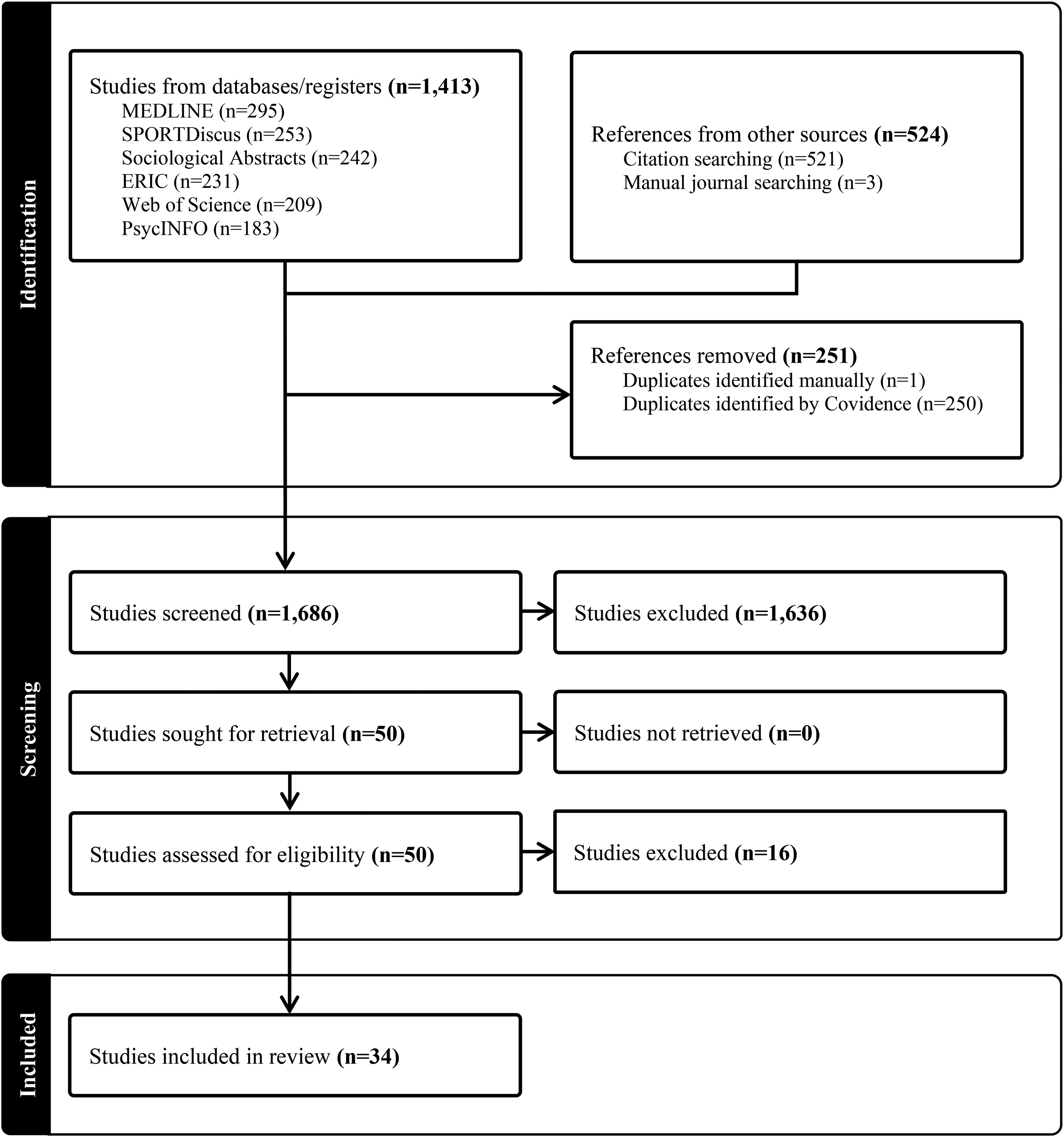
Search results.
Results
These 34 articles included 19 within practitioner-focused journals, including the Journal of Physical Education, Recreation & Dance (n = 12), Strategies: A Journal for Physical and Sport Educators (n = 3), and Palaestra (n = 2). Given the focus of these practitioner-focused journals, 18 of the 19 articles were practical/applied in nature (only one provided results of a [very limited] research endeavor). The other 15 articles were within 12 different research/scholarly journals. The only journals with multiple articles were Physical Education and Sport Pedagogy (n = 3) and European Physical Education Review (n = 2). It is also important to note that 13 of these 15 articles were related to research (the other two were practical/applied). Of these 13 articles, research insights appear related to only nine unique studies, as six of these articles were seemingly related to two separate research projects (see Davis and Aylward, 2023; Davis et al., 2022, 2024, as well as Gray et al., 2023; Quarmby et al., 2022, 2023).
Qualitative research predominated this literature (n = 11), followed by quantitative and mixed methods research (n = 1 each). Some research studies involved PE teachers and other teachers (n = 5), with total participants ranging from 1 to 30. Others involved students or youth (n = 3), with total participants ranging from 18 to 63. One involved pre-service PE teachers with 22 participants, one involved a multidisciplinary expert panel in physical activity with 14 participants, and one involved LGBTQIA+ PE teacher educators with four participants.
The qualitative research involved a wide range of data sources, including interviews (n = 4), surveys (n = 3), reflections (n = 3), and recorded workshops and training sessions (n = 2), with focus group interviews, online conversations, panel discussions, responses, and clarifying email correspondence each appearing once. One of the 11 qualitative research methodologies involved an autoethnography (Lynch et al., 2023) and a related collection of artifacts and autobiographies. Quantitative data included the measurement of high school student cortisol levels in one research project (i.e. Davis et al., 2024; Davis and Aylward, 2023).
Of the 34 articles, three made recommendations for future research, including a call for identifying promising trauma-informed frameworks for working in PE settings (Altieri et al., 2021), more rigorous experimental designs to demonstrate the effectiveness of TIPs (Folger et al., 2023), and school-based participatory action research to understand how to build students’ resilience to trauma (Goodwin, 2020). Two articles called for system reform (Cordova et al., 2023a; Lynch et al., 2023), several discussed the need for outside or specialized supports to assist teachers (Cordova et al., 2023a; Folger et al., 2023; Lynch et al., 2023; Martinek et al., 2006), and most implied—or directly called for—TIP-related training and/or professional development for pre-service and in-service PE teachers.
The specific language related to TIPs varied widely within the 34 articles. “Trauma-informed” was the most commonly used term, alongside “approach(es),” “practice(s),” and “strategy/strategies.” Additionally, a small number of authors also introduced and/or utilized other terms with “trauma-informed,” including “care,” “pedagogy/pedagogies,” “programs/programming,” and “yoga.” The next commonly used TIP-related language was “trauma-aware,” alongside “approach(es),” “pedagogy/pedagogies,” and “practice(s).” A very small number of authors used the language of “trauma-invested” or “trauma-sensitive” “practice(s)” (see Table 1).
Language of trauma-related responses (used within two or more articles).
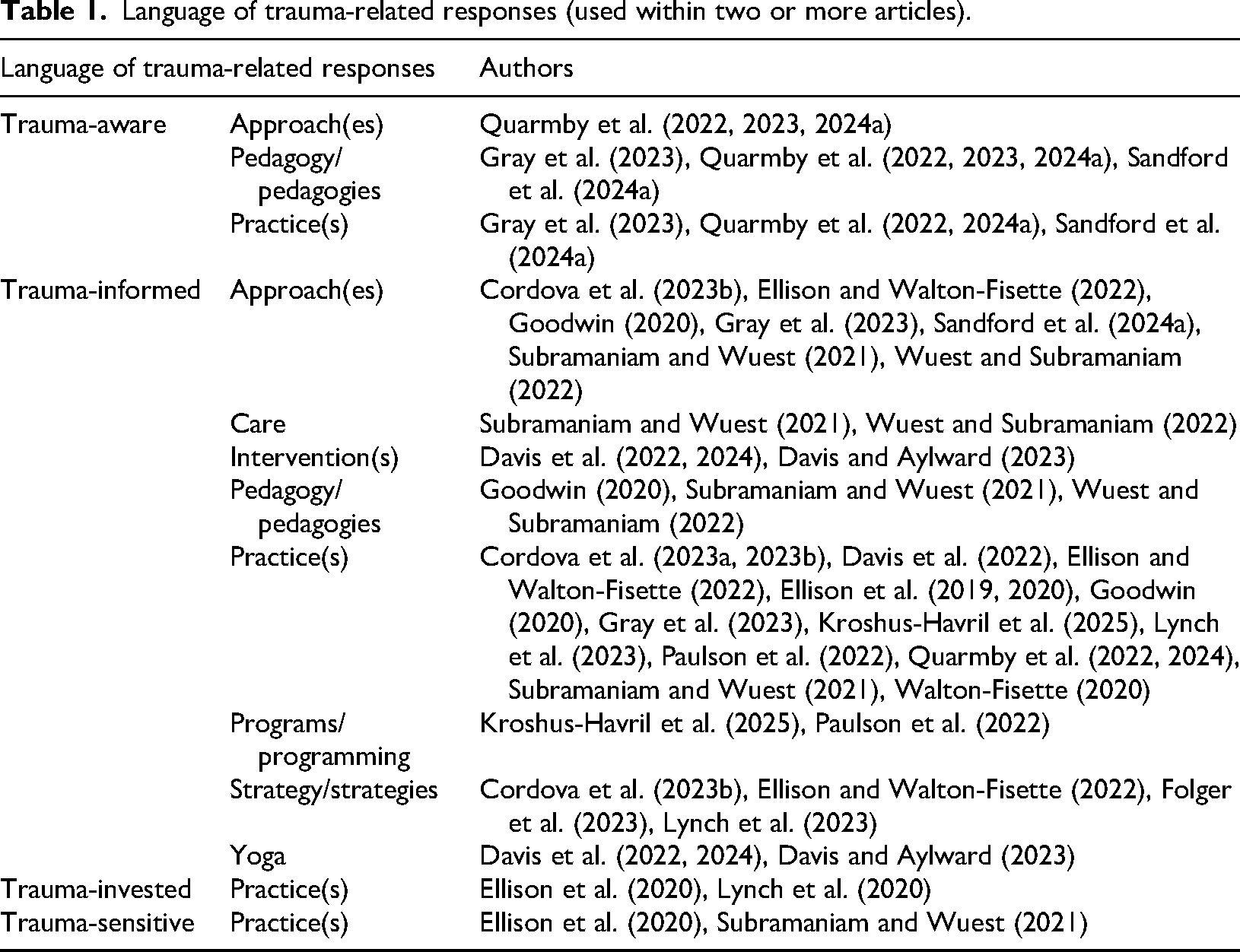
Of the 34 total articles, 27 were published from 2019 onward. Concomitantly, the specific use of trauma as a compound word (e.g. “trauma-informed”) began to appear in the literature in 2019, with almost every article after 2019 (n = 23) using this specific grammatical practice. The four articles published after 2019 that did not specifically use the word “trauma” or any of its compound permutations used “suicide prevention” (Whisenhunt et al., 2022), “child protection training” (Güler and Güler, 2024), “resilience” (Wuest and Subramaniam, 2021), and “strategies” (Sutherland and Parker, 2020). Of the seven articles published before 2019, “abuse,” “neglect,” “bullying,” and “healing” were the most commonly used terms.
More specifically, authors using “trauma-informed” spans from 2019 to 2024, with several authors using a range of combinations of “trauma-informed” language within single articles—such as “trauma-informed approaches,” “trauma-informed care,” “trauma-informed pedagogy,” “trauma-informed practices” (Subramaniam and Wuest, 2021), and “trauma-informed strategies” (Cordova et al., 2023b). Ellison and Walton-Fisette (2022) engaged with the language similarly. Notably, only three studies did not include “trauma-informed practices.” Authorship using “trauma-aware” is recent and largely led by Quarmby et al. (2022, 2023, 2024a), followed by Gray et al. (2024) and Sandford et al. (2024a)—though it is worth noting many of these authors worked closely together in the same or similar projects.
Combined, these 34 articles contain a long list of TIPs for PE teachers to utilize (see Table 2). In all, 13 TIPs were mentioned within two or more articles. Some of the most mentioned TIPs included: create inclusive learning environments that are physically and emotionally safe spaces (n = 12); empower students’ voice and choice/develop student responsibility (n = 10); foster positive/caring relationships (n = 9); and focus upon teacher self-care/compassion (n = 6). When combined, there are several important TIP macro-categories worth noting. Clearly, those TIPs involving overall classroom culture (i.e. learning environments, student choice, and caring relationships) predominate the list (n = 31). Another important combination centers around students’ ability to regulate their emotions, known as “self-regulation.” Arguably, mindfulness, yoga, movement therapy, and other physical activities (n = 8) all serve students’ self-regulation (n = 3); when combined, this macro-category is the second most mentioned (n = 11). TIPs directly pertaining to teachers’ self-focus (i.e. self/emotional regulation and teacher self-care/compassion) represent the third most mentioned macro-category of TIP suggestions (n = 9), along with TIPs involving professional responsibilities to recognize and/or report signs of trauma (n = 9), followed by TIPs involving physical activities (i.e. yoga or movement; n = 8).
TIPs suggested by authors (within two or more articles).
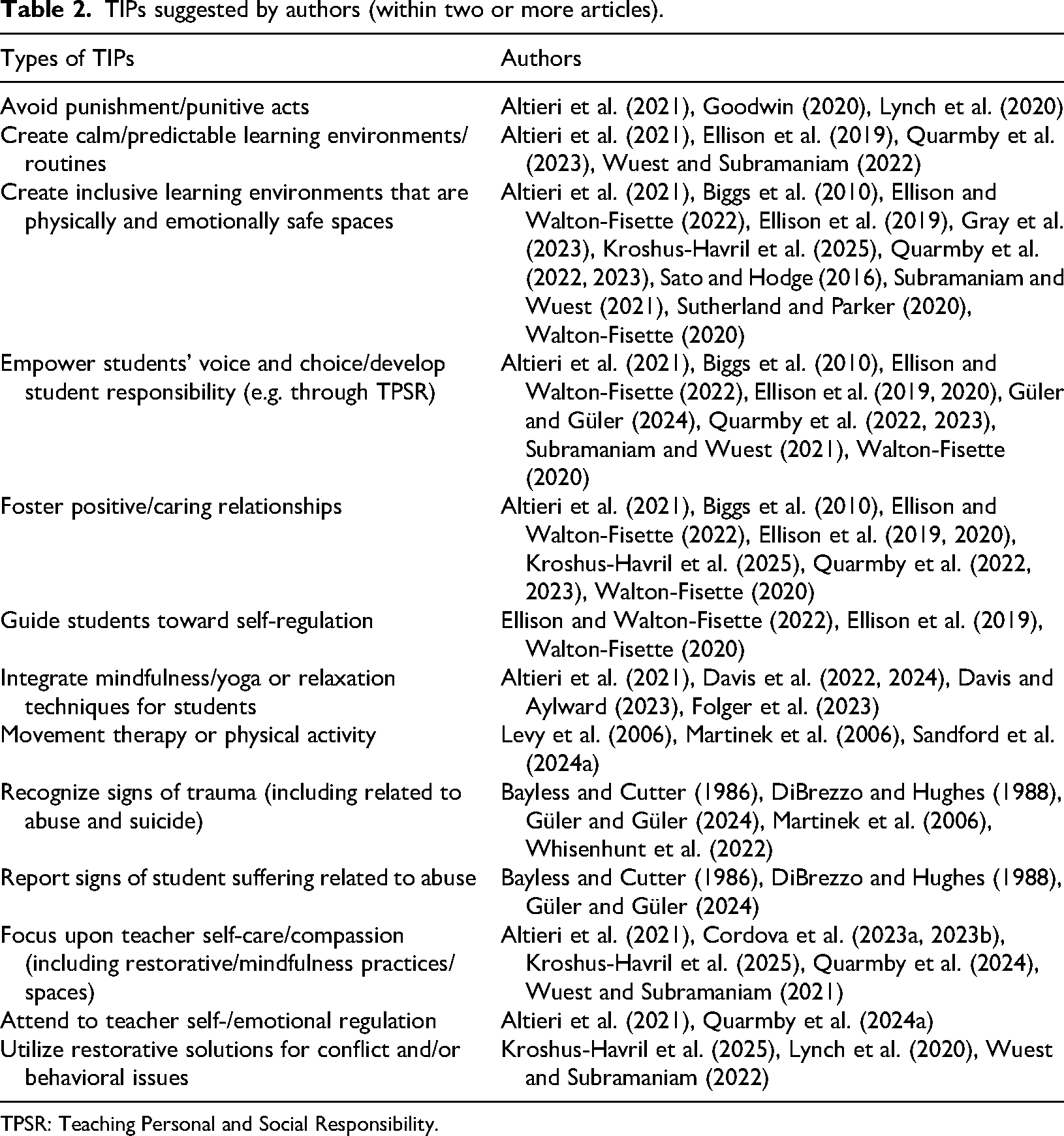
TPSR: Teaching Personal and Social Responsibility.
Discussion
Considering the prevalence of trauma and the increasing number of schools that have intentionally focused on providing TIPs (Watson and Astor, 2024), it is surprising that research and writing in this area, specifically related to PE, has been relatively limited—though we do recognize the momentum related to this topic that seemingly exists. We begin this discussion with some comments on the limited body of research related to trauma and PE, and offer a commentary regarding TIPs specifically related to PE.
Research on trauma in PE
This scoping review returned only 34 articles related to PE and trauma. Studies exploring the efficacy of an intervention were limited. Of the four intervention studies, three used trauma-informed yoga (Davis et al., 2022, 2024; Davis and Aylward, 2023) and one used mindfulness (Folger et al., 2023), all within normally scheduled PE classes. All four studies reported positive findings related to decreased anxiety and/or stress, as well as other markers.
Non-intervention research heavily focused on the experiences of pre-service and in-service teachers as they taught groups of students who had experienced trauma (Ellison and Walton-Fisette, 2022; Gray et al., 2023; Quarmby et al., 2024a) or who were English language learners (Sato and Hodge, 2016). Overwhelmingly, these studies provided broad suggestions of possible TIPs that could be incorporated into practice and called for more professional development that would equip teachers with additional strategies to address students’ needs. Other non-intervention studies explored the extent to which teachers could recognize trauma (Güler and Güler, 2024) and the potential of PE and sport to positively impact the lives of trauma-experienced youth (Sandford et al., 2024a). One study focused on the experiences of marginalized groups within PE spaces, specifically LGBTQIA+ professors and teachers within the PETE community (Lynch et al., 2023) and the need for safe spaces.
Of the limited qualitative and quantitative studies conducted, only the series of studies led by Davis (i.e. Davis et al., 2022, 2024; Davis and Aylward, 2023) and the study by Folger et al. (2023) involved working directly with school students. The body of work led by Davis appears to be part of a larger study with the same 18 high school students participating in all three studies. Folger et al.'s mindfulness intervention was conducted with elementary students. Clearly, sparse intervention studies examine the effect of TIPs within school PE. Certainly, the individualized nature of trauma and resulting students’ needs make intervention studies difficult. Due to the public nature of PE, there is the possibility that individualizing a PE program or instituting a particular intervention for a single student might compound the trauma. It is also possible that the lack of intervention studies may be due to the broad nature of the TIPs offered in the general literature. For example, the three most common TIPs provided in the PE literature included creating inclusive and safe spaces, empowering students through voice/choice and responsibility, and fostering positive relationships. Not only are these practices foundational to all teaching, regardless of grade level and subject area, but they are also often context-specific and thus difficult to study as an intervention.
Most of the articles (20) were classified as practical/applied, focusing on knowledge about trauma, identifying signs of trauma, trauma's effect on students’ behavior and actions, and providing PE teachers with general strategies to improve relations with their students and to make the teaching space a safe environment. While this sort of information may be helpful to practicing PE teachers, much of it is presented without serious attention to foundational research or theory. That is, there is a lack of research that introduces a theory or specific practice and rigorously tests the effects of said theory or practice. Instead, the action possibilities that are presented are broad in nature. For example, suggesting that teachers teach, model, and reinforce self-regulation strategies does not really provide much direction. Without the research literature base we are suggesting is both absent and necessary, PE teachers (and researchers) might reasonably ask a number of questions, including, “Are there specific self-regulation strategies that have been shown to work better with certain groups of students (elementary, secondary, those who have experienced war, or those who have experienced neglect or abuse), specifically within PE settings?” and “Have there been any suggested pedagogical practices that have been repeatedly found to foster these self-regulation strategies (e.g. role playing, exploring case studies, individual or group instruction) within PE?” PE teachers would find it additionally helpful if more specific suggestions were provided with respect to how to teach and implement these strategies in a PE setting/context. Moreover, many of the TIPs suggested might leave these same PE teachers wondering how those suggestions differ from their current practice(s) and pedagogy.
Movement in general, and yoga in particular, were identified as TIPs that can help students calm the nervous system and possibly offer a focus on something other than their trauma. At the same time, and as noted, the public nature of PE (i.e. everyone can easily observe each other's performance) may be trauma-inducing for some students. In an effort to capitalize on the power of movement to aid in trauma recovery, PE teachers can move away from traditional instructional delivery models and embrace other models that can better accommodate trauma-affected students. For example, the use of consistent teams and assigned roles in Sport Education (Siedentop et al., 2019) offers the potential to build relationships with other students and assume responsibility, two TIPs suggested in the literature. Additionally, the use of the Personalized System of Instruction (PSI; Metzler and Colquitt, 2021), where students progress through a series of learning tasks at their own pace, allows students to master content under less stressful conditions. Working within this model, students are provided autonomy and responsibility to progress through the unit and master the content at their own pace. In doing so, they can potentially experience a sense of pride in their accomplishments (another TIP suggestion). This model also allows the PE teacher to interact more regularly one-on-one with students, which potentially helps build strong relationships. Lastly, strategies outlined in Hellison's (2011) Teaching Personal and Social Responsibility (TPSR) model can be used to foster personal values and pro-social behavior, as the model is focused on teaching students to recognize, accept, and take responsibility for their actions.
PE teachers themselves are at risk of experiencing secondary traumatic stress from interacting regularly with those who experience trauma, and the general education literature has begun to address this issue (see Essary et al., 2020; Luthar and Mendes, 2020; Rankin, 2021). Three articles (Cordova et al., 2023a, 2023b; Quarmby et al., 2023) in this review covered this issue and suggested ways PE teachers could identify, address, and respond to the emotional challenges of working with students who have experienced trauma. This is an important contribution, because focusing on self-care may help reduce PE teacher burnout, decrease the number of teachers leaving the profession, and increase job satisfaction (Cordova et al., 2023a; Quarmby et al., 2024a).
TIPs and PE
Included studies draw from what appear to be generally consistent definitions and conceptions of trauma, including the SAMHSA (2023) definition, the inclusion of ACEs, and different recognized forms of trauma (e.g. acute, chronic). This consistency is important if we accept the current calls for an awareness of trauma and its impacts on those in education because it is essential for the development and effective implementation of TIPs. However, this shared understanding has been and continues to be contentious and complex.
“Trauma-informed practice(s)” has emerged as the dominant term within the literature related to PE, and this reflects the early history of the topic in education overall (Thomas et al., 2019). This consistent terminology demonstrates the topic's pervasiveness and overall uptake. Perhaps in the most basic sense we can assert that those writing on the topic in PE know the existing educational literature relating to trauma.
From a practitioner lens, the synthesized TIPs in PE (see Table 2) relate to the physical, social/relational, emotional, and temporal environment. Practices within the physical domain were related to movement therapy or physical activity (e.g. Levy et al., 2006; Martinek et al., 2006; Sandford et al., 2024a). Social/relational practices supporting the development of supportive relationships included avoiding punishment/punitive acts (e.g. Altieri et al., 2021; Goodwin, 2020; Lynch et al., 2020), fostering positive/caring relationships (e.g. Biggs et al., 2010; Ellison and Walton-Fisette, 2022; Kroshus-Havril et al., 2025), empowering students’ voice and choice/developing student responsibility (e.g. Ellison et al., 2020; Güler and Güler, 2024; Quarmby et al., 2022; Subramaniam and Wuest, 2021), and utilizing restorative solutions for conflict and/or behavioral issues (e.g. Kroshus-Havril et al., 2025; Lynch et al., 2020; Wuest and Subramaniam, 2022). Emotional well-being and regulation were prioritized in considering practices related to the emotional domain and included guiding students toward self-regulation (e.g. Ellison and Walton-Fisette, 2022; Ellison et al., 2019; Walton-Fisette, 2020), integrating mindfulness/yoga or relaxation techniques for students (e.g. Altieri et al., 2021; Davis and Aylward, 2023; Folger et al., 2023), teacher self-care/compassion (e.g. Cordova et al., 2023b; Kroshus-Havril et al., 2025; Quarmby et al., 2024a), and teacher self-/emotional regulation (e.g. Altieri et al., 2021; Quarmby et al., 2024a). Finally, in the temporal space, practices centered on creating stability and safety, including calm/predictable learning environments/routines (e.g. Ellison et al., 2019; Quarmby et al., 2023; Wuest and Subramaniam, 2022), and inclusive learning environments that are physically and emotionally safe spaces (e.g. Biggs et al., 2010; Gray et al., 2023; Sato and Hodge, 2016; Sutherland and Parker, 2020).
Additionally, there is a theme of recognizing and responding to trauma. This literature is about teachers’ awareness of signs of trauma (e.g. related to abuse or suicide; Bayless and Cutter, 1986; DiBrezzo and Hughes, 1988; Whisenhunt et al., 2022), as well as the importance of reporting signs of student suffering related to abuse as a professional responsibility (e.g. Bayless and Cutter, 1986; DiBrezzo and Hughes, 1988; Güler and Güler, 2024). Taken together, these interconnected practices suggest the need for a comprehensive approach to trauma-informed PE (Kroshus-Havril et al., 2025). Comprehensive trauma-informed programs such as Head Start Trauma Smart or Bounce Back (Berger, 2019) have found increased understanding and teacher competence as well as improved emotional, behavioral, and academic outcomes for students. Further research on the long-term impact of TIPs in PE could address a gap in the literature, while also offering potential research-based suggestions related to the implementation of TIPs within PE.
Of note, the TIP PE themes identified above largely reflect applications of broader trauma-informed education principles. For example, foundational practices such as building relationships, creating safe and predictable learning environments, and supporting emotional regulation are widely recognized as essential in educational settings and have shown positive outcomes for students (Berger et al., 2024). However, while these general approaches provide a valuable foundation, they may not fully address the distinct, movement-based, and socially interactive nature of PE (Quarmby et al., 2022) or be sufficiently descriptive for application in a PE setting (Altieri et al., 2021). So, there is an opportunity and need to further examine, understand, and develop TIPs—particularly as they relate to the physical domain as well as social dynamics—to address the unique challenges and occasions related to PE (such as physical safety/risk, peer dynamics, and the public nature of performance). At the same time, PE teachers should remain integral contributors to multi-tiered and whole-school trauma-informed models, ensuring consistency and cohesion across the educational environment as part of a comprehensive commitment to student well-being.
Conclusion
It is clear that more research investigating the interplay of school-based PE and trauma is necessary, despite the challenges of engaging in this sensitive work. While the existing literature has begun to provide broad suggestions and specific examples of TIPs, many of the suggestions and examples provided have long been considered “simply good pedagogy” within education generally and/or PE specifically. We reiterate, then, there is an immediate need within the field for more intervention studies for students that examine specific practices and their related effects within PE settings. Most recommended TIPs came from PE practitioner-focused journals/articles, and while many TIPs were cited in those journals/articles, there is a need to ascertain the evidence-base supporting those TIPs. Future research must also address the types and measurement of “effects” schools are trying to achieve, whether they be emotional, behavioral, and/or academic outcomes. Taking a whole-school approach by adequately equipping all school-based staff with research-based approaches for creating trauma-informed and sensitive schools will potentially help ensure all students, regardless of their trauma history, demonstrate healthy resilience and thrive. Lastly, we support the recommendations (e.g. Cordova et al., 2023a, 2023b; Goodwin, 2020) for more professional development for pre-service and in-service PE teachers, as this will be the primary way we effect evidence-informed change related to TIPs in PE.
Supplemental Material
sj-docx-1-epe-10.1177_1356336X251370270 - Supplemental material for Trauma-informed practices and physical education: A scoping literature review
Supplemental material, sj-docx-1-epe-10.1177_1356336X251370270 for Trauma-informed practices and physical education: A scoping literature review by Daniel B Robinson, Christopher Gilham, Kaitlin Fuller, Lynn Randall, Ellen Carter, Sherra Rogers, and Chloe Vukosa in European Physical Education Review
Supplemental Material
sj-docx-2-epe-10.1177_1356336X251370270 - Supplemental material for Trauma-informed practices and physical education: A scoping literature review
Supplemental material, sj-docx-2-epe-10.1177_1356336X251370270 for Trauma-informed practices and physical education: A scoping literature review by Daniel B Robinson, Christopher Gilham, Kaitlin Fuller, Lynn Randall, Ellen Carter, Sherra Rogers, and Chloe Vukosa in European Physical Education Review
Supplemental Material
sj-docx-3-epe-10.1177_1356336X251370270 - Supplemental material for Trauma-informed practices and physical education: A scoping literature review
Supplemental material, sj-docx-3-epe-10.1177_1356336X251370270 for Trauma-informed practices and physical education: A scoping literature review by Daniel B Robinson, Christopher Gilham, Kaitlin Fuller, Lynn Randall, Ellen Carter, Sherra Rogers, and Chloe Vukosa in European Physical Education Review
Footnotes

Funding
The authors received no financial support for the research, authorship, and/or publication of this article.
Declaration of conflicting interests
The authors declared no potential conflicts of interest with respect to the research, authorship, and/or publication of this article.
Supplemental material
Supplemental material for this article is available online.
Author biographies
References
Supplementary Material
Please find the following supplemental material available below.
For Open Access articles published under a Creative Commons License, all supplemental material carries the same license as the article it is associated with.
For non-Open Access articles published, all supplemental material carries a non-exclusive license, and permission requests for re-use of supplemental material or any part of supplemental material shall be sent directly to the copyright owner as specified in the copyright notice associated with the article.
