



Abstract
This paper focuses on beginning teachers’ reflections on the transformation and use of ball games knowledge in the transition from physical education teacher education (PETE) to physical education (PE) practice. The aim is to provide an understanding of the recontextualisation of ball games as pedagogic discourse in the transition from PETE to PE from the perspective of beginning teachers. Basil Bernstein's concept of pedagogic device comprised the theoretical framework. Semi-structured interviews were conducted with 12 beginning teachers. The participants had graduated from two PETE institutions in Sweden and had between 1 and 3 years’ teaching experience. The findings reveal that recontextualised elements of the pedagogic discourse of ball games were: (1) having a learning purpose with ball games in PE; (2) adapting teaching to all pupils; and (3) varying one's pedagogy based on a technical approach with concepts from game-based approaches. The findings also reveal that the teachers were missing knowledge about how to plan, implement and assess ball games. The findings further illustrate how contextual factors regulated the pedagogic practice of ball games teaching. These factors included: (1) the heterogeneous groups of pupils; (2) pupils’ expectations of specific content; and (3) material conditions and facilities. The conclusion from the study is that while PETE provides beginning teachers with some knowledge that is useful and relevant, other practical knowledge that would be useful is not addressed in PETE and some knowledge that is addressed proves difficult to put into practice.
Introduction
The question of if and how physical education teacher education (PETE) matters has proven persistent over the last three decades (Backman et al., 2021b; Chróinín and Coulter, 2012; Schempp and Graber, 1992). Research on teacher socialisation generally suggests that the influence of PETE has been limited (Graber, 1991; Templin et al., 2016). Pre-service teachers’ previous experiences in school physical education (PE) and sport seem to lead to perceptions of teaching that are difficult to change within PETE (Curtner-Smith, 2016; Ferry, 2018). Even if pre-service teachers develop new knowledge in PETE, research suggests that workplace conditions and challenges in the first years of teaching can lead beginning teachers to abandon what they have learned in PETE and revert to pedagogies that they saw when they were younger (Schempp et al., 1993; Woods et al., 2016).
A number of researchers have proposed ways that PETE might have a greater impact on pre-service teachers (MacPhail and Hartley, 2016; Tolgfors et al., 2021). Richards et al. (2013), for example, suggest that PETE programmes must do two things to enhance the impact of PETE. First, they must help pre-service teachers to reflect and critically examine their perceptions of teaching. Second, they must prepare pre-service teachers for the realities of teaching PE in schools. MacPhail et al. (2023) claim that modelling in PETE is important. They suggest that modelling good practice with instructional alignment with practical examples of learning outcomes, assessment and instructional practices in PETE is a promising way to prepare pre-service teachers for their professional lives.
In this article, I consider beginning teachers’ reflections on the recontextualisation of ball games knowledge in the transition from PETE to PE practice. Beginning teachers are in a formative phase in becoming teachers (Woods et al., 2016). They have recently graduated from PETE and can therefore be expected to have up-to-date teaching knowledge. This includes knowledge and pedagogies related to ball games teaching. However, ball games are often a significant part of PE teachers’ biographies, and research suggests that earlier experiences of ball games can interfere with educational perspectives and pedagogies encountered in PETE (Dowling, 2011; Harvey et al., 2015; Mordal-Moen and Green, 2014). Drawing on the work of Basil Bernstein, the broad aim of the investigation is to provide an understanding of the recontextualisation of ball games as pedagogic discourse in the transition from PETE to PE from the perspective of beginning teachers. Three specific research questions guided the investigation: (1) What aspects of knowledge and instruction do beginning teachers see as prominent in the pedagogic discourse of ball games in PETE? (2) Which of these aspects do beginning teachers consider useful and relevant in school PE? (3) How is beginning teachers’ pedagogic practice of ball games teaching regulated by evaluative rules? To address these research questions, in-depth semi-structured interviews were conducted with beginning teachers who had graduated from two PETE institutions in Sweden.
Ball games teaching in PE
Ball games continue to be a common element of PE programmes worldwide both in primary and secondary schools (Hardman, 2013), reflecting their popularity in contemporary physical culture (Kirk, 2010). The place of ball games in curricular documents has changed over time and differs across national contexts. In the UK, for example, playing competitive games is clearly stated among the main goals of PE (GOV.UK, 2013) while in Sweden, ball games have not been specified as a goal or mandatory content since 1994 (SNAE, 2022).
The teaching of ball games in PE practice, however, seems to take place in a similar manner regardless of PE context. Ball games have often been associated with a multi-activity and technique-oriented form of PE (Casey and Kirk, 2020; Kirk, 2010), a form that has sustained considerable critique for failing to provide students with opportunities to develop knowledge and competence due to short units of lessons (Ennis, 1999) and excluding students who lack previous experience of games or are less ‘able’ (Casey and Kirk, 2020; Standal, 2016).
In a Swedish context, teaching of ball games occurs in a similar manner and pupils are expected to try different sports and play cooperatively, but the educative dimension is less pronounced (Larsson and Karlefors, 2015; Larsson and Quennerstedt, 2016). More recent studies suggest that PE teachers can focus on either learning techniques and the understanding of games or generic knowledge such as the ability to cooperate (Modell et al., 2024; Mustell, 2024). Swedish scholars have also pointed to challenges in relation to gender and specifically how ball games teaching tends to favour boys over girls (Larsson et al., 2011; Oliynyk, 2021).
Ball games education in PETE
The somewhat discouraging findings in previous research highlight the need to scrutinise the preparation provided in PETE. Ball games education in PETE has historically had a focus on developing technical skills in different sports (Oslin and Mitchell, 2006). The development of different game-based approaches (GBAs) such as Teaching Games for Understanding (TGfU), however, has provided alternatives to technique-based teaching (Harvey et al., 2015). Common features of GBAs include a focus on tactical understanding, the use of modified games, the incorporation of challenging tasks, and the posing of questions to provide a learner-centred pedagogical environment (Morales-Belando et al., 2021). These pedagogies have been positively received by PE teacher educators and are often included within ball games education in PETE today (Pill et al., 2023; Ronglan et al., 2009; Ward et al., 2018).
Ball games education in PETE is also shaped by broader discourses surrounding PE, public health and educational policy. A recent study in Sweden shows how PE teacher educators working with ball games legitimise their knowledge with elements of a sport discourse (Mustell et al., 2024). This knowledge includes tactical and embodied understanding of ball games, and elements from an educational discourse, such as using ball games to reach curricular goals and adapting the teaching to include all students (Mustell et al., 2024). Contrary to studies in other national contexts that show that sporting biographies result in fixed understandings of ball games (Dowling, 2011; Mordal-Moen and Green, 2014), Swedish studies indicate that pre-service teachers generally accept educational discourse in PETE (Backman et al., 2021a; Mustell et al., 2023).
Research on the transition from PETE to PE
Research on PE practice shows that despite being a common element in PETE, GBAs are used relatively rarely in school PE (García-López et al., 2019; Harvey and Pill, 2016; Roberts and Fairclough, 2011). Studies examining PE teachers’ use of GBAs have primarily addressed the challenges associated with their implementation. Casey and Dyson (2009), for example, investigated the implementation of TGfU combined with Cooperative Learning. They claimed that the shift from teacher-led and behaviouristic notions of teaching to constructivist and more student-centred approaches was a challenge both for the teacher and the pupils. Other studies have focused on how newly qualified teachers implement TGfU in PE teaching (Díaz-Cueto et al., 2010; O’Leary, 2014). These studies showed that teachers mixed behaviourist and constructivist learning approaches and continued to focus on technique divorced from the game context (Díaz-Cueto et al., 2010; O’Leary, 2014). Finally, Harvey and Pill (2016) compared researchers’ perspectives on GBAs with the perspectives of PE teachers. While the researchers appreciated GBAs for the holistic perspective on which they are based and their emphasis on understanding and critical thinking, PE teachers found the numerous versions of GBAs confusing and required more hands-on guidance. They also expressed concern about their limited content knowledge in certain sports and viewed traditional teaching methods as a significant barrier to overcome (Harvey and Pill, 2016).
What is largely missing from this research is the perspective of beginning teachers and their reflections on how PETE has prepared them for teaching ball games in Swedish PE. What aspects of ball games education from PETE prove relevant and useful for beginning teachers and thus transferable to PE practice? How do the teachers recontextualise what they learned in PETE? Which factors seem to influence on the recontextualisation of ball games knowledge? These are important questions in relation to whether and how PETE matters.
Theoretical framework
In order to understand what happens with ball games instruction when teachers transition from PETE to school PE, Bernstein's theory of the pedagogic device (Bernstein, 2000) is used. This theory is useful for understanding ball games as an educational content area and how ball games teaching is affected by cultural factors outside of school. The pedagogic device has been used in other studies on PETE (see e.g. Backman et al., 2021b; Svendsen and Svendsen, 2016). The pedagogic device refers to the ordering principles in which knowledge is converted into pedagogic communication. The pedagogic device provides the generative principles or rules that regulate the production, the recontextualising, and the reproduction of discourse that takes place in different fields (Bernstein, 2000).
With respect to ball games, new knowledge is constructed in sport in the field of production and through research at universities and innovations. At the level of production, the boundaries for thinkable and unthinkable expressions of ball games knowledge are regulated through distributive rules (Bernstein, 2000). New sports such as padel or pickleball, or new techniques within sports, for example, open stance forehand in tennis, are examples of innovations in sport. Research in PE, for instance, on model-based practice (Casey and Kirk, 2024), exemplifies how universities construct new pedagogical knowledge that can inform and reshape the production of discourse in PE.
A first transformation of knowledge takes place in the recontextualising field. Knowledge from the production field is reordered and transformed into pedagogic discourse (Bernstein, 2000). Pedagogic discourse is made up of a discourse of skills and competences (an instructional discourse), which is embedded in a dominating discourse of social order (a regulative discourse). The recontextualising of knowledge into a pedagogic discourse takes place within two subfields. Within the official recontextualising field, the official pedagogic discourse is constructed as curricular policy at departments of education. Within the pedagogic recontextualising field, teacher educators, writers of textbooks and specialised media are important agents who can have an impact on the pedagogic discourse (Singh, 2002). The pedagogic discourse of ball games in a Swedish context is arguably more influenced by agents within the pedagogic recontextualising field than the official recontextualising field, since ball games are not emphasised in the curriculum. According to Bernstein (2000), pedagogic discourse always involves a transformation and when a discourse moves from one field to another, decisions must be made by agents in the field, and ideology comes into play.
A second transformation of knowledge occurs when pedagogic discourse is realised in pedagogic practice in schools in the field of reproduction. Evaluative rules in Bernstein's (2000) framework refer to the criteria used to assess whether knowledge, skills, or competencies have been successfully acquired by learners. These rules are a core component of the pedagogic device, as they shape how teaching and learning are measured and what is deemed legitimate in an educational context. This paper focuses on beginning teachers’ reflections on the recontextualising of knowledge from PETE to pedagogic practice in school PE.
Methodology
To examine the impact of PETE and the recontextualising of ball games knowledge in school PE among beginning teachers, I employed a qualitative research approach involving semi-structured interviews. The research project followed the ethical guidelines set out by Swedish law and the Swedish Research Council (2017), and all participants provided informed consent before data collection started.
Participants
Twelve beginning teachers who had graduated from two PETE institutions in Sweden took part in the study (see Table 1). PE teacher educators and beginning teachers from the two institutions had taken part in a larger investigation on ball games that I had been conducting over 4 years, and I was thus familiar with the ball games education at the two institutions. I had not, however, encountered any of the participants in the current study earlier in the project. Purposeful sampling (Patton, 2015) was used to select participants. To be included in the study, participants needed to have: (1) graduated from one of the two PETE institutions between 2018 and 2020; and (2) between 1 and 3 years of experience of teaching PE in Sweden. This experience span was chosen since the participants would be in a formative phase of professional development but still have their PETE experiences in recent memory. Additional considerations were an aim to achieve a balance between male and female teachers and between the two PETE institutions.
General demographics of the participants.
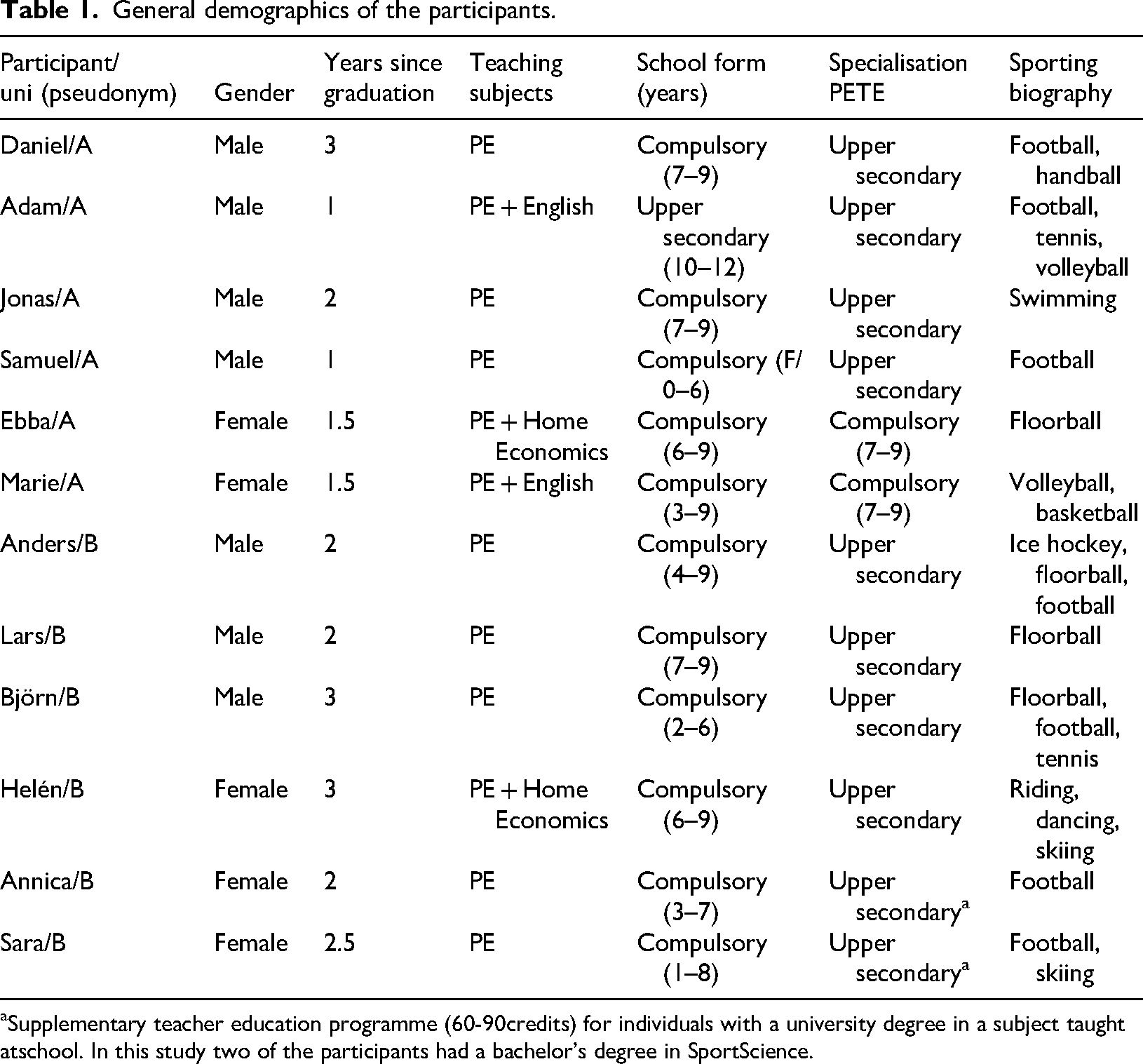
Supplementary teacher education programme (60-90credits) for individuals with a university degree in a subject taught atschool. In this study two of the participants had a bachelor’s degree in SportScience.
Recruitment started after access to contact information for former graduates had been given by the universities. Approximately 120 potential participants were contacted through paper letters, e-mail, phone and SMS. 12 participants were finally recruited, seven men and five women, six individuals from each PETE institution. Eight of the teachers had completed their degree with a specialisation in upper secondary school teaching, which includes two teaching subjects in a 5-year programme. Two teachers had completed their degree with specialisation in compulsory school teaching (grades 7–9), which includes three teaching subjects in a 4.5-year programme. Two of the participants completed bachelor's degrees in Sport Science (3-year programmes), followed by 1 year of supplementary training to become upper secondary school teachers. While qualified to teach two or more subjects, most participants were only teaching PE at the time data collection took place.
The PETE institutions are referred to in this paper as Universities A and B. University A offered 48 contact hours of ball games instruction, covering invasion, net/wall, and striking/fielding games. The ball games education was embedded in two thematic courses. In the first course, basic tactical and technical aspects of different games were introduced within the framework of Teamball (a GBA developed in Denmark) (Halling et al., 2005). The second course, placed later in the programme, focused on tactical understanding in invasion games based on TGfU (Butler, 2016; Thorpe et al., 1986). The course assignments indicated that, in addition to fostering pupils’ learning and understanding of games, pre-service teachers should be able to connect their teaching to curricular goals and research.
University B offered 126 contact hours of ball games education, covering invasion, net/wall, striking/fielding, and target games. The programme began with a course introducing basic didactic strategies and modified games. It then progressed to different teaching strategies, mainly game-based versus technical approaches, in net/wall and target games. A third course, placed later in the programme, focused on invasion games. Major games, such as football, handball, and basketball, were covered in six lessons each, with an emphasis on teaching for understanding using, for example, the Tactical Games Model (TGM) (Mitchell et al., 2020) and Teamball (Halling et al., 2005). The assessment of pre-service teachers addressed both their ability to foster pupils’ learning in relation to curricular goals and their own ability to play.
Of great importance is the fact that four of the participants had different paths to their qualification to PE teachers than the other eight. Two of them (both graduated from University A) had completed a PETE programme towards compulsory school, and two others (both University B) instead did complementary studies to get their degrees. This means that these four participants (Ebba, Marie, Annica and Sara) experienced a different ball games education, covering less content and fewer types of games within a smaller number of teaching hours. This is important to consider when looking at these participants’ views on their preparation in PETE.
Data production
Semi-structured interviewing (Brinkmann and Kvale, 2018) was used to generate insights into how PETE influenced the participants’ views and teaching practices regarding ball games. Interview questions covered the participants’ biographies, PETE experiences, workplace conditions, and how they worked with ball games in PE. The interview guide included questions such as: Which aspects of the ball games education have been particularly useful in your teaching? Is there something you feel was missing or that you should have learned more about during the ball games education in PETE? Is there anything from the rest of your teacher education, for example, your experiences from school placement, general pedagogy courses or courses in PE, that has proven useful when teaching ball games? In line with the semi-structured approach (Brinkmann, 2013), all participants received the same questions, but the interviewer followed up certain responses with probing questions that allowed participants to elaborate. The interviews were conducted and recorded using a cloud-based video conferencing service (Zoom). The interviews were held between May 2021 and December 2022 and lasted 32–58 minutes.
Analysis
Thematic analysis, inspired by Braun and Clarke's (2013) six-phase approach, was employed in order to capture shared meanings among participants. In the first phase, familiarisation, I transcribed the audio recordings from the interviews verbatim and then read through the data and noted down initial ideas. In the second phase, I systematically coded features across the entire dataset related to the three research questions. In the third phase, initial themes from the coded data were generated. In this phase, I used Bernstein's (2000) theory of the pedagogic device by posing the following theoretically grounded questions:
Which elements of the pedagogic discourse of ball games in PETE are perceived to be useful and relevant? How are these elements recontextualised in school PE? Which aspects of knowledge and instruction do teachers find useful and relevant for school PE, but which are not sufficiently addressed in PETE? How do evaluative rules and contextual factors in schools regulate the reproduction of the pedagogic discourse of ball games?
In this phase, I compared the transcripts with the background information about the ball games education at the two PETE institutions. In this way, the analytic approach became linked to my personal reflexivity about the pedagogic discourse at the two PETE programmes, including similarities and differences. In the fourth phase, I checked if the preliminary themes captured the coded extracts and were consistent with the entire dataset. In the fifth phase, the themes were refined and named. Finally, in the sixth phase, the findings section was written, and I selected representative extracts for each theme (Braun and Clarke, 2021). In this last phase, the extracts were translated into English.
Findings
The findings are organised in three parts. First, recontextualised elements of the pedagogic discourse of ball games in PETE that appear in the beginning teachers’ reported practice are presented. Second, aspects that the beginning teachers claimed were missing from PETE that would have been useful and relevant are outlined. Third, contextual factors regulating the reproduction of the pedagogic discourse in PE practice are presented.
Recontextualised elements of the pedagogic discourse of ball games
The beginning teachers claimed that the following elements from PETE were useful and relevant: (1) having a learning purpose with ball games in PE; (2) adapting teaching to all pupils; and (3) varying one's pedagogy based on a technical approach with concepts from GBAs. The three elements were thus interpreted as aspects of the pedagogic discourse that the teachers could recontextualise in their school PE practices.
First, many of the beginning teachers suggested that the ball games education they had encountered within PETE had instilled in them the importance of having a learning purpose with ball games in PE. They referred to learning purposes at different levels, both with individual tasks and with respect to an overall purpose with ball games in PE: The university was very clear that you should not teach ball games for their own sake, but because they can help pupils develop different capabilities. You can foster different capabilities through ball games. That's what I have taken with me the most. (Anders, University B) To always think about why we are doing this. The purpose of using the ball. What is the aim of this particular moment? (Annica, University B) What I have learned from the university is that ball games should be a means to reach the goals of physical education and health. (Samuel, University A)
The second element of the pedagogic discourse that the teachers found useful and relevant was adapting teaching to all pupils. This theme, reflecting values in teaching and thus an important feature of regulative discourse, was something that all beginning teachers referred to in the interviews, regardless of university or sporting background. Daniel and Samuel, both with backgrounds in competitive ball sports, described how the university had influenced their thinking with regard to ball games and inclusion: The university helped me to think about individual adjustments … considering inclusion and adapting [ball games] so that as many pupils as possible can participate according to their abilities. I also learned how to change the rules during a lesson, depending on what happens. Sometimes some of the boys dominate, so I have to adapt the rules to better support other pupils. (Daniel, University A) Yes, to make sure that all pupils can participate – that they can take part according to their abilities with the game adapted to them. This could involve changing the ball, adjusting where pupils are positioned, or allowing more time. And also encouraging them to stop and reflect. (Samuel, University A)
The third element of the pedagogic discourse recontextualised in PE practice was a varied pedagogy based on a technical approach with concepts from GBAs. Several of the beginning teachers referred to approaches and pedagogical models they had encountered in PETE and found useful in their practice: At the university [B], it was very clear that we worked both by starting with the game and then having discussions. But we also worked with ‘Me and the ball; you and me and the ball’. I thought it provided a clearer progression, and you could see how people were developing. As a PETE student, I found it clearer and easier to use than game-based approaches which is why I have adopted it in my own practice. (Anders, University B) Pedagogical rules and discussions about movements – for example, that a shot with a floorball stick and a golf swing can involve similar types of movement. And also how to design a game that involves all pupils. That is something I have carried with me from the education. (Annica, University B)
Useful and relevant ball games knowledge missing from PETE
The beginning teachers stated that they were only missing one element of ball games knowledge from their PETE, but that was a significant one: how to practically implement ball games in schools. They, in this case, mostly beginning teachers from University A, claimed that the PETE programmes missed important aspects relating to how to plan, implement and assess ball games in a working unit or over a whole year: We focused a lot on gender, intersectionality and ethnicity, and compared physical education with competitive sports in society, but there was very little hands-on knowledge about how to construct different teaching units. Many of my friends from the university have struggled to create a semester plan. How much time is reasonable for this particular moment? (Jonas, University A) The planning of a teaching unit and the evaluation afterwards… What would it look like? How long does this particular moment take? What do the pupils need to know? How should it be assessed? It is the wholeness I am missing. (Adam, University A) I often feel that I am missing guidance on ‘what should I fill my lessons with?’… How do you plan for a year? Or, if we work with a five-week unit, how do we structure the content and build a progression? And how do we connect to the grading criteria? (Annica, University B) School placement was absolutely the most useful and educational period, as you met supervising teachers who really explained how things are! (Daniel, University A) Everything I now use in my profession I learned during the school placement. That is where you plan an entire lesson and a full four-week unit… (Marie, University A)
Contextual factors regulating the pedagogic practice
Related to elements that the teachers believed were missing from PETE were contextual factors that affected how they believed they could use knowledge from PETE in their pedagogic practice. The following contextual factors, related to evaluative rules, were regulating the pedagogic practice of ball games teaching: (1) the heterogeneous groups of pupils; (2) pupils’ expectations of specific content; and (3) material conditions and facilities.
The first contextual factor affecting the pedagogic practice of ball games teaching was the heterogeneous groups of pupils. Most of the beginning teachers described student diversity as a major challenge when using ball games knowledge and pedagogies from PETE, challenges that they were not fully aware of during teacher preparation: In a typical class, you have pupils who love ball games and others who think they are the worst thing imaginable. That was a bit of a shock when I entered the profession. In PETE, the skill levels among pre-service teachers were generally high and more homogeneous. In the ball games courses, we taught different parts of lessons to our classmates. Maybe it would have been good if school classes had been invited instead. (Anders, University B)
The second contextual factor is the pupils’ expectations of specific content. Many of the beginning teachers claimed that pupils’ experiences in sports clubs affected their expectations of what ball games instruction would be like in PE lessons. The sports most frequently mentioned among the participants were football and floorball, the two most popular youth sports in Sweden: It actually depends on the ball sport. Football is most difficult to teach because of all the opinions about it, and because both the boys and girls who play football tend to go all in! (Ebba, University A) It doesn’t matter if we keep score or not. As soon as it's a ball game, for them it's life or death! (Helén, University B)
The third contextual factor was material conditions and facilities. Some of the beginning teachers described how restrictions regarding indoor and outdoor facilities and materials, including, for example, the number of balls, affected what was possible to achieve in their teaching. Several of the beginning teachers from University B also mentioned specific content that they had encountered in PETE that was difficult to reproduce in schools due to costs and transportation: There are a few ball games that I would like to try now as a physical education teacher. Like golf, which we played at the university. But it's more difficult to do in practice. Some of my pupils would love to try golf on a driving range, but it's not the easiest thing to organise. (Björn, University B)
Discussion
I would like to discuss three issues related to the impact of PETE on beginning teachers’ views and teaching practices of ball games. First, I consider the beginning teachers’ views on the realisation of pedagogic discourse in practice. Second, I discuss how evaluative rules and contextual factors affect knowledge from PETE. Third, based on critical reflections, I propose some implications for PETE that can be drawn from the findings.
The beginning teachers considered three aspects of the pedagogic discourse in PETE particularly useful and relevant. These aspects were: having a learning purpose with ball games in PE; adapting teaching to all pupils; and varying one's pedagogy based on a technical approach with concepts from GBAs. The first two aspects were equally represented among all participants, indicating that the beginning teachers seemed to accept the educational discourse prominent in curricular documents and educational research (Larsson and Nyberg, 2017). This finding reflects other investigations with pre-service teachers in Swedish PETE (Backman et al., 2021a), which also suggest that educational ideas such as having clear learning outcomes and including all pupils are readily accepted by the majority of pre-service teachers. In contrast to much existing research (Larsson, 2009; Mordal-Moen and Green, 2014), the beginning teachers’ sporting backgrounds did not constrain their adoption of educational discourse. Swedish PE teacher educators have long emphasised distinctions between sports in clubs and sports in PE, underscoring the need to avoid competitive values when doing sporting activities in PE (Larsson and Karlefors, 2015; Lundvall and Meckbach, 2008). In fact, this tradition appeared to make it difficult for the beginning teachers to draw on their sporting experiences when teaching PE (Curtner-Smith, 2016).
The reproduction of the technical approach of ball games teaching is interesting in relation to issues of inclusive teaching. The beginning teachers reported enthusiasm for the technical approach, which they claimed provided a ‘clear progression’ in different ball games and which they claimed was more inclusive than GBAs. This suggestion is noteworthy in light of an abundance of research that claims that GBAs are more inclusive than technical approaches (Bunker and Thorpe, 1982; Harvey et al., 2015; Harvey and Jarrett, 2014; Oslin and Mitchell, 2006). This finding may be explained by the fact that PETE programmes in Sweden often present the technical approach and GBAs as alternative but equally valuable strategies (Mustell et al., 2024). In Sweden, research has also shown that the multi-activity approach remains popular (Larsson and Karlefors, 2015; Redelius and Larsson, 2020). It may be that the teachers experienced similar forms of ball games teaching in PE as pupils (Curtner-Smith et al., 2008; Green, 1998) and find a technical approach compelling and ‘fair’. Still, it is questionable if a lesson or two introducing basic technical skills in a particular game constitutes an inclusive education (Evans, 2014) in the long-run, even if all pupils are participating in the short term. Notably, the beginning teachers who had graduated from University B reported that they used concepts from GBAs more frequently, providing more varied pedagogy in their ball games teaching.
Second, since evaluative rules bring the what and how of pedagogic discourse together, defining the standards that pupils are expected to reach, questions about teaching and assessment are foregrounded. The finding of this study that should be seen as most problematic is that most of the teachers reported that they lacked knowledge regarding the practical implementation of ball games in schools. If teachers can reproduce aims and certain aspects of inclusive teaching but struggle to transform these ideas into concrete units of ball games teaching, the risk is that learning outcomes, instructional practices, and assessment will lack in coherence (MacPhail et al., 2023). If this occurs, then it is unlikely that the aims will be achieved, even if they are clearly stated. The evaluative rules help to explain the challenges teachers experience putting ball games teaching knowledge from PETE into practice. The heterogeneous nature of pupil groups in schools seems to be a general challenge for all teachers, regardless of their preparation in PETE (Ennis, 2014). Similar to findings from previous studies, pupils’ strong expectations of specific (sports) content affect the teachers’ pedagogic practices (Harvey et al., 2015; MacPhail et al., 2008), sometimes to the extent that teachers select different ball games to work with. Finally, material conditions and facilities deviating from the standards at PETE posed other challenges in using knowledge from PETE. The teachers in this study claimed that the lack of preparation within the ball games education was, in a way, compensated for by school placement. Knowledge and advice from the cooperating teachers were often reproduced by the beginning teachers, which is perhaps unsurprising since this knowledge comes directly from the reproduction field. These findings are also in line with previous research (Standal et al., 2014; Velija et al., 2008).
Third, there are some implications and critical reflections in relation to PETE that can be drawn from the findings. Richards et al. (2013) suggested that PETE programmes should help pre-service teachers to reflect and critically examine their perceptions of teaching and prepare them for the realities of teaching PE in schools. In relation to the first task, it appears that the beginning teachers formed conceptions of teaching during PETE that correspond with current PE policy directions and educational research (Larsson and Nyberg, 2017). However, the alignment between the ball games education in PETE, PE didactics and school placement needs to be addressed. Alignment between different components has been argued to be a key feature of exemplary teacher education programmes (Darling-Hammond, 2006; Graber et al., 2016). In line with previous research (Standal et al., 2014; Velija et al., 2008), many of the teachers appreciated the practical knowledge of cooperating teachers instead of theoretical knowledge. A risk here is that beginning teachers reproduce well-established practices instead of becoming change agents. A shared pedagogical vision between teacher educators and supervising teachers is crucial to ensure coherence and continuity in how teaching is understood and practiced across PETE and school placements (Graber et al., 2016).
In relation to the second task, however, the findings suggest that there is a significant gap, and that the beginning teachers are not fully prepared for the realities in terms of material conditions, pupils’ different levels of competence, and their strong expectations on how ball games should be played. The results also suggest that, while the teachers possess a range of pedagogical ‘tools’ for teaching, they lack sufficient preparation for planning, implementing, and assessing ball games units. A conclusion is that the intention of teacher educators in PETE is to provide pre-service teachers with different perspectives on teaching, such as different models and ways to include pupils, and how to use ball games in relation to curricular goals. However, the transition to implementing these ideas into actual teaching seems to be a major challenge for many of the beginning teachers. The suggestions from MacPhail et al. (2023) that PETE should model good practice with instructional alignment with practical examples of learning outcomes, assessment and instructional practices are therefore worth considering. Practical examples of units of ball games teaching that at the same time address realities of teaching PE could be a way to improve ball games education in PETE.
Conclusion
In this paper, I have examined beginning teachers’ reflections on the recontextualisation of ball games knowledge in the transition from PETE to PE practice. The main conclusions are that several aspects of the pedagogic discourse of ball games in PETE were considered useful and relevant and were reported to be reproduced in PE practice. However, the beginning teachers lacked important knowledge related to the practical implementation of ball games in schools. Some of the challenges in reproducing knowledge from PETE in PE practice can also be explained by evaluative rules combined with contextual factors. There are two specific limitations that should be considered in interpreting the findings of this study. First, since the findings are drawn from interview data, there is a risk that the beginning teachers’ description of their practices and how they use knowledge from PETE were interpreted in a ‘positive way’ and that other methods, for example, observations, would have led to other conclusions. Second, four of the participants experienced a different ball games education, covering less content and fewer types of games within a smaller number of teaching hours. This is important to consider when looking at these participants’ views on their preparation in PETE. The insights from beginning teachers’ reflections on the recontextualisation of ball games knowledge from PETE to school PE can inform the improvement of future PETE curricula, for instance, by ensuring stronger instructional alignment and better preparation for the realities of school practice. Further research on the transition from PETE to PE teaching may contribute to a more nuanced understanding of if and how PETE shapes professional practice, both in relation to ball games teaching and other areas of the subject.
Footnotes

Funding
The author received no financial support for the research, authorship, and/or publication of this article.
Declaration of conflicting interests
The author declared no potential conflicts of interest with respect to the research, authorship, and/or publication of this article.