



Abstract
Scholars have long questioned the impact of teacher education programmes. Persistent claims are that pre-service teachers have fixed ideas about pedagogy when they enter training and that they become enculturated once in the profession. Within physical education (PE), similar concerns have been raised with respect to ball games. Research suggests that pre-service PE teachers typically have substantial experience of ball sports and find it difficult to implement non-traditional ball games pedagogies when they enter schools. Against this background, the aim of the study is to explore how pre-service teachers recontextualise ball games as pedagogic discourse in their transitions from university to school placement. Bernstein's pedagogic device and pedagogic discourse are employed as the theoretical framework. The investigation focuses on a Swedish PETE programme and the participants are six pre-service teachers. The empirical material consists of written assessments, observations of the pre-service teachers’ lessons during school placements, and individual interviews. Findings suggest that the pedagogic discourse of ball games at the university was aligned with course learning outcomes and included the need to communicate goals, adapt and modify teaching, and combine different approaches. The pedagogic discourse at school placement involved traditional ball games, minimal curriculum references, progression in two or three lessons, and inclusive, enjoyable lessons. Factors that regulated the discourse were: familiarity with the pupils; the conceptualizing of inclusive teaching; norms regarding ball games in PE; expectations of the pre-service teachers; and the framing of ball games education in PETE. Recontextualising rules highlight challenges in transitions related to ball games.
Introduction
The impact of teacher education programmes on pre-service teachers has been questioned for decades (Cochran-Smith, 2004; Feiman-Nemser, 1989). A recurring assertion is that occupational socialisation either counterbalances or outweighs the impact of pre-service teachers’ teacher education (Lortie, 1975; Veenman, 1984). A growing body of literature has, however, suggested that teacher education can impact pre-service teachers, and has examined how this impact occurs. One line of research has concentrated on how theory and practice can be integrated within teacher education (Brouwer and Korthagen, 2005; Loughran, 2006). The importance of a strong alignment between courses at the university and school placement has been highlighted (Darling-Hammond, 2006).
Research on the impact of physical education teacher education (PETE) has also been growing. Some of this work has reinforced the significance of teacher socialisation and shown how pre-service teachers’ acquired teaching preferences – based on earlier experiences and knowledge of sport – are difficult to change (Ferry, 2018; Kirk, 2010; Larsson, 2009; Mordal-Moen and Green, 2014b). Other research has focused on specific ‘interventions’. MacPhail et al. (2013), for example, examined how pre-service teachers can be prepared to teach through constructivist pedagogical principles (MacPhail et al., 2013). Others have concentrated on learning in transitions from university to school placement, both in relation to general teaching (Standal et al., 2014) and in relation to teaching specific content (Hordvik et al., 2019; Macken et al., 2020; Tolgfors et al., 2021). Despite the development of research on the impact of PETE on pre-service teachers, there is still a need to develop the ‘chain of evidence’ that strengthens the link between teacher education programmes and pre-service teachers’ learning (Cochran-Smith, 2005).
In this paper, we contribute to existing research by examining what happens to pre-service teachers’ understanding of a particular content area when they move from university courses to school placement. We focus specifically on ball games since: (a) ball games are common content often associated with the persistent multi-activity and sport technique-based form of physical education (PE) that has been criticized for not being inclusive generally (Casey and Kirk, 2020; Kirk, 2010), and excluding low-skilled individuals (Ennis, 1996; Roberts and Fairclough, 2011) and girls (Larsson et al., 2011; Wright, 1997) in particular; (b) ball games are part of physical culture and are often a significant part of pre-service teachers’ (and PE teacher educators’) biographies (Larsson, 2009; Mordal-Moen and Green, 2014a); and (c) game-based approaches (GBAs) (Harvey and Light, 2015; Harvey and Pill, 2016) have been developed in PETE as an effort to challenge traditional ball games teaching. Drawing on concepts from Bernstein (2000), the aim of the study is to explore how pre-service teachers recontextualise ball games as pedagogic discourse in their transitions from university to school placement.
School placement and PETE
School placement has been seen as a key site of learning for pre-service teachers (Chambers and Armour, 2011). School placement settings and the cooperating teachers in those settings can make significant contributions to PETE programmes (Mordal-Moen and Green, 2014b), and ideally there is an alignment between the learning objectives of university courses and school placement experiences (Backman et al., 2021b). Transitions from university to school placement, however, appear to present challenges to pre-service teachers. A general challenge is the ‘theory–practice divide’, where pre-service teachers experience difficulties putting theoretical knowledge from universities into practice (Lunenberg et al., 2007). Within PE, Rovegno (1992: 79) suggested over 30 years ago that ‘knowing that in university settings is not that same as knowing how to teach content in schools’. More recent research on how pre-service teachers learn to teach specific content draws similar conclusions. Hordvik et al. (2019), for example, found that pre-service teachers learned to teach Sport Education in complex and non-linear ways, and that their teaching practices varied according to their biographies, their contexts and their pupils. Tolgfors et al. (2021) maintained that the ways pre-service teachers learn to use assessment in school placement settings are regulated by factors such as the assessment culture, teaching traditions, and how well the pre-service teachers know the pupils. Connecting theory and practice and matching teaching to the unique conditions of school placement are thus important issues in understanding how pre-service teachers might recontextualise ball games as pedagogic discourse in their transitions from university to school placement within PETE.
Ball games in PETE
Ball games are common content of PE worldwide and are often associated with persistent multi-activity and technique-based forms of PE (Kirk, 2010). Ball games as a content area within Western PETE contexts share similarities but cultural differences also exist. In this section, we address three issues that have potential relevance to pre-service teachers’ understanding of ball games in a Swedish context.
First, ball games in PE and PETE are related to sport in physical culture (Kirk, 2010). In an important respect, physical culture provides the raw, non-pedagogical materials out of which school PE is constructed (Kirk, 1998). Different kinds of knowledge and meanings are produced in physical cultures outside of schools and are transferred – along with the values of particular social groups – into PE (Kirk, 1998). The influence of sport in physical culture on PE has been shown in relation to assessment (Svennberg, 2017) and gender (Larsson et al., 2011). In the Swedish context, sport in physical culture is organized in the sports movement. 1 From the 1960s to the 1990s, sports movement affiliates – generally people working for sports clubs and organisations – had a legitimate influence over PE and offered career development courses and supporting literature for PE teachers (Lundvall and Meckbach, 2008). In the 2020s, the influence is less visible. Lecturers teaching ball games in the mandatory courses in PETE are expected to use research-based literature in their courses and be up to date with new ways of thinking around ball games. Still, lecturers often have backgrounds in the sports movement and use materials from different sports to complement their teaching. In addition, many pre-service teachers have extensive experience in competitive ball sports (see Larsson, 2009; Mordal-Moen and Green, 2014b), ensuring a degree of continuity in how ball games are understood (Mustell et al., 2022)
Second, different GBAs such as Teaching Games for Understanding (TGfU) are now usually integrated into ball games education in Western PETE contexts (Harvey and Jarrett, 2014; Howarth and Walkuski, 2003; Ronglan et al., 2009). GBAs provide an alternative to teacher-led and technique-based approaches that are still common in PE practice (Kirk, 2010). GBAs comprise constructivist, learner-centred practices that use modified games, questions, and challenging tasks as key features (Kirk, 2017; Morales-Belando et al., 2021). Research indicates that pre-service teachers usually find GBAs compelling but challenging to implement (Stolz and Pill, 2014). Multiple influencing factors have been identified such as the attitude of cooperating teachers towards GBAs, situational constraints relating to time, space, facilities, and pupils (McNeill et al., 2008; Wang and Ha, 2013), as well as pre-service teachers’ content knowledge and pedagogical content knowledge about GBAs (Harvey and Pill, 2016). In another investigation, Harvey et al. (2015) suggested that pre-service teachers can struggle due to: fragile understandings of GBAs and strong beliefs in the need to develop skills first; contradictions between traditional behaviouristic notions of teaching and the constructivist orientation of GBAs; and teachers’ and pupils’ expectations to continue ‘as usual’. The authors suggest that PETE programmes need to consider different strategies to ensure that GBAs become part of pre-service teachers’ reality (Harvey et al., 2015).
Third, pre-service teachers’ educational understandings of ball games are affected by dominant discourses about PE/PETE (see Backman et al., 2021a). As in other countries, a public health discourse that emphasises the value of physical activity is dominant in Swedish PE (Ekberg, 2016; Larsson and Nyberg, 2017). In addition, Swedish PE is influenced by an educational discourse that foregrounds questions about learning, and especially equitable learning (Larsson and Nyberg, 2017), and a complementary sport discourse, where PE is seen to provide a valuable intermediate step towards participating in sport culture outside of school (Larsson and Redelius, 2008; Lundvall and Meckbach, 2008). With respect to ball games, research suggests that (a) the educational discourse has a significant impact on PE teacher educators’ (Mustell et al., 2022) and pre-service teachers’ (Backman et al., 2021a) understandings, and (b) the complementary sport discourse also affects what comes to be seen as legitimate ball games knowledge (Mustell et al., 2022).
In sum, the place of ball games in physical culture, the increasing popularity of GBAs, and broader discursive developments affect pre-service teachers’ understanding of ball games. Scholars have argued for more empirical studies on how particular content areas in PETE are constructed, transmitted, and transformed during pre-service teachers’ journeys from PETE to school PE practice (Backman et al., 2021b). This study focuses on pre-service teachers learning to teach ball games in the transition from university to school placement.
Theoretical framework
We make use of Basil Bernstein's (2000) concepts of pedagogic device and pedagogic discourse. The pedagogic device describes the process by which knowledge is produced and transformed into pedagogic discourses and realised in pedagogic practice. Bernstein suggests that the potential meanings of a discourse that will enter an educational setting are produced outside of that setting in a ‘field of production’. The field, or more accurately fields, of production for ball games knowledge is research institutions and sport cultures (see Kirk, 1998). The transformation of this ball games knowledge into a pedagogic discourse takes place within official and pedagogic ‘fields of recontextualisation’. In our study, policy and curricular documents are formulated at national agencies of education (SNAE, 2011), while syllabi and study programmes that concern ball games education are put together at PETE institutions. The construction of pedagogic discourse is essentially the movements of meanings from one place to another and the reconfiguration of the discourse (Moore, 2013). For Bernstein (2003), the pedagogic discourse consists of (a) a discourse of skills and competencies (instructional discourse) that is embedded within (b) a discourse of social order (regulative discourse). Singh (2015: 367) proposes that a pedagogic discourse is a ‘regime of rules or principles of power and control by which knowledge is selected and organised for pedagogic purposes’. PE teacher educators are important actors in the construction of pedagogic discourse and can influence how beginning teachers interpret and select research, policy, textbooks, and teaching content. Finally, the pedagogic discourse is transformed into pedagogic practice in schools. In this ‘field of reproduction’, evaluative rules regulate pedagogic practice as they define the standards which must be reached (Bernstein, 2000). In this study, we focus on pre-service teachers and explore the recontextualisation of ball games as pedagogic discourse in the transition from university to school placement.
Methodology
To address how pre-service teachers recontextualise ball games as pedagogic discourse in their transitions from university to school placement, we employed a qualitative research approach. The design of the investigation is based on three different sources of empirical data, written documents, observations and individual interviews, generated with pre-service teachers in a PETE programme.
Context
The context of the study was a five-year PETE programme at one of the eight universities that provide PETE in Sweden. The programme specialises in teacher education for upper secondary school (grades 10–12), but graduates are also qualified to teach PE within compulsory school. The programme includes courses in general pedagogy, courses in PE plus another specialist subject, and placement studies. The pre-service teachers in this study were midway through their five-year teacher education and had just finished their last course on ball games when data collection started. The PETE programme includes seven higher education credits of ball games as a content area: two credits in courses in PE and health didactics in years one and two, and five credits in the course ‘Ball games’ in year three. The learning outcomes for the first two credits are related to general outcomes about teaching and learning (didactics). The learning outcomes for the five-credit course are that pre-service teachers should: Critically discuss ball games teaching in relation to perspectives on learning, health, and inclusion; critically discuss ball games teaching with schools’ steering documents as a starting point; and teach and instruct moments in a sample of invasion games and net/wall games. (Örebro University, 2021, authors’ translation)
Participants
Recruitment of participants was done in person by the first author during an ongoing course of ball games. From a class of 22, six individuals, five male and one female, agreed to take part in the investigation. The intention was to use a criterion-based case selection sampling strategy (Patton, 2015) to secure variation among participants regarding earlier experiences of ball games but since only six pre-service teachers volunteered, all were included in the study. All six participants had extensive experience with different ball sports. This characteristic affects the claims that can be made from the investigation and is a point to which we shall return in the conclusion.
Data collection procedures
The empirical material consists of: (a) written assessment tasks from the five-credit ball games course; (b) 17 observations of lessons at school placements (50–75 minutes); and (c) individual interviews after the school placement (approximately 35–60 minutes).
Each participant's written assignments were used to identify the pedagogic discourse of ball games in the context of the university course. In the assignment, the pre-service teachers were asked to (a) problematise ball games teaching from didactic challenges identified in the literature in relation to perspectives of learning, pupils’ different needs and abilities, and health, and (b) develop their thoughts about how ball games can be used to help pupils reach the goals and aims of the curriculum.
Observations of the pre-service teachers’ lessons generated data on ball games as pedagogic discourse in the school placements. The observations took place at different upper secondary schools within the region. The supervising teachers at each of the schools were contacted, informed about the study, and asked for permission to conduct the study. Observations were conducted by the first author, who took field notes following an observation protocol (see Figure 1). The observation protocol had been trialled and developed in advance and focused on the pre-service teachers’ actions in terms of content (the ‘what’) and teaching strategies (the ‘how’) in relation to key concepts of instructional and regulative discourse. The pupils in the classes were not considered participants in the study, although their actions and responses affected the pre-service teachers’ actions.
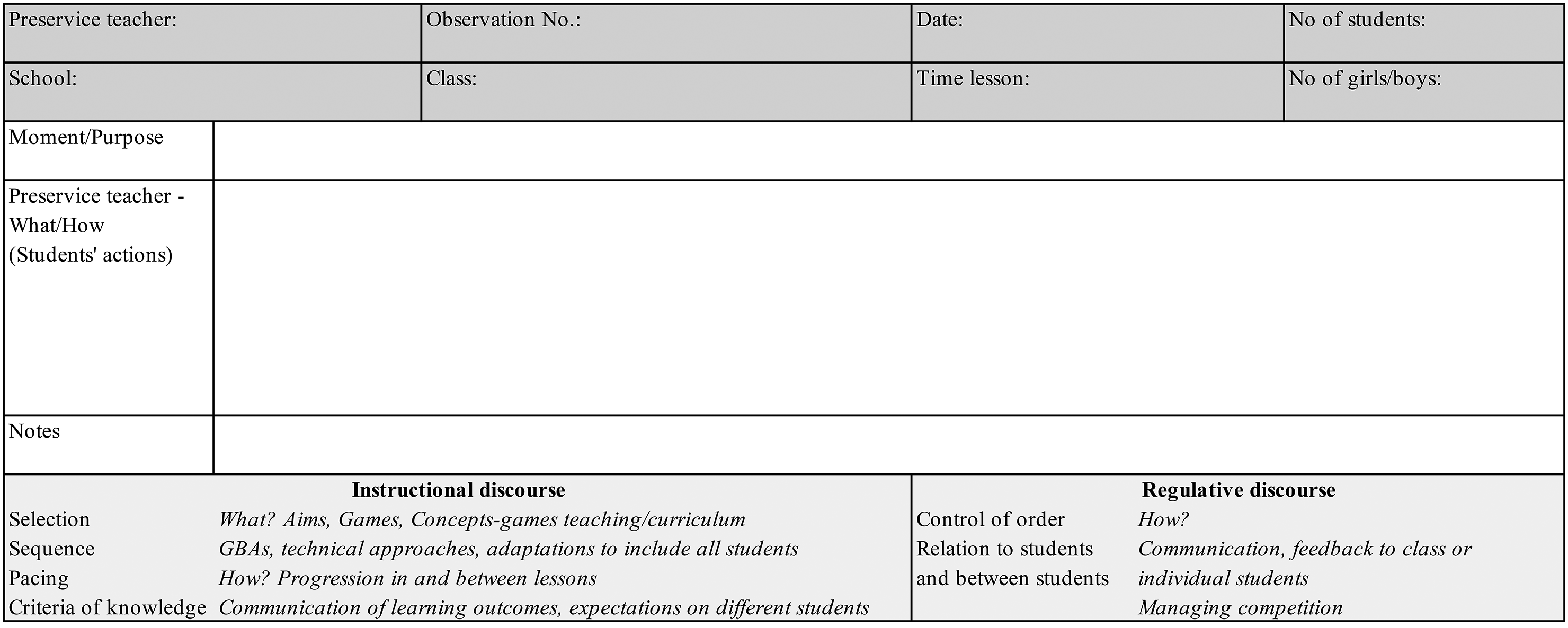
Observation protocol.
Verbal and email communication with the pre-service teachers and supervising teachers provided contextual information about the schools, classes and pupils. The pre-service teachers and the supervising teacher were asked to select lessons where ball games were part of the planned content. The supervising teachers made suggestions based on the class sizes and facilities. The pre-service teachers planned and taught the two or three consecutive ball games lessons that were observed (Table 1).
Observed lessons in school placement. The grey shadowed boxes show lessons that were a part of the planned progression but were not observed.
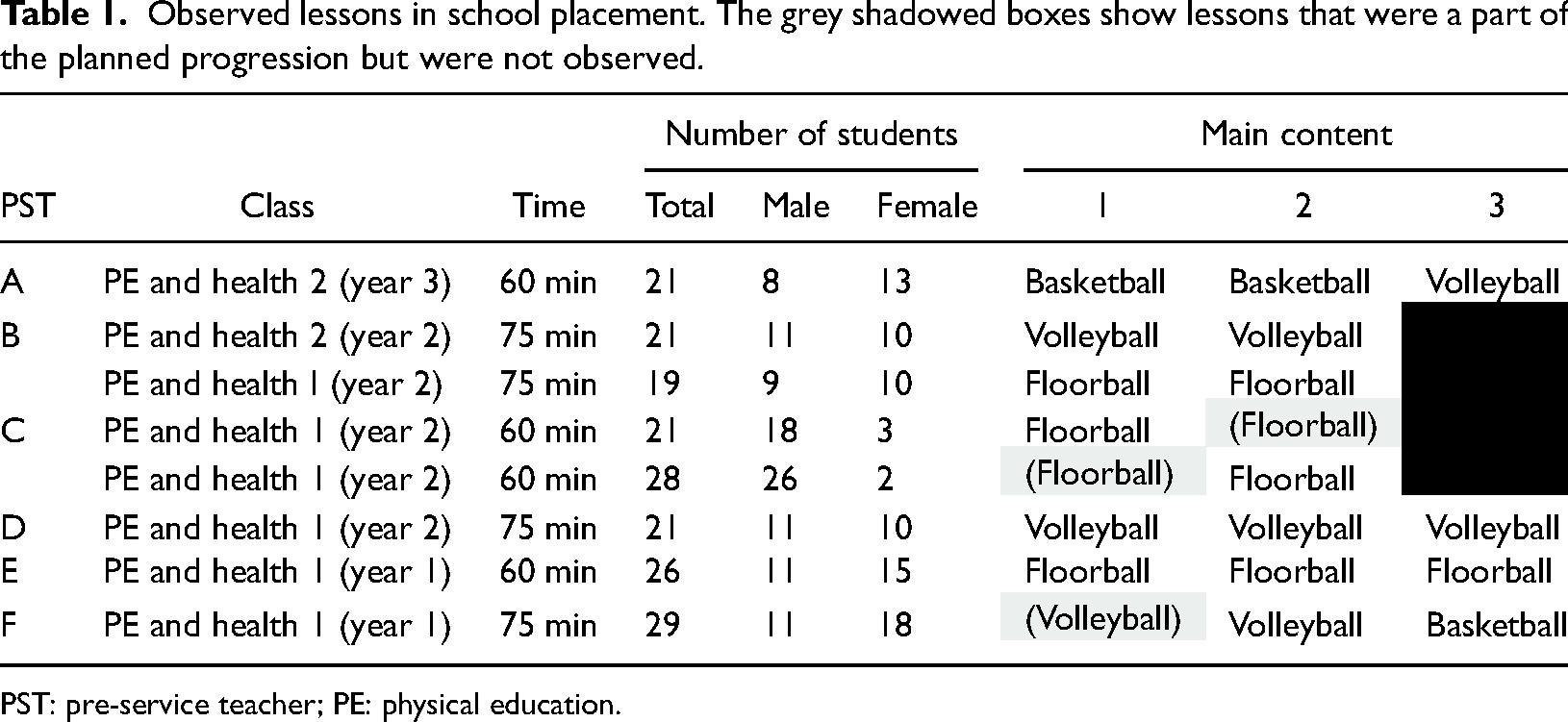
PST: pre-service teacher; PE: physical education.
PE and health 1 is a compulsory course for all pupils in upper secondary school. The course consists of approximately 100 hours, usually taking place once a week in the first two years of upper secondary school (pupils aged 16–17). PE and health 2 is an optional course of approximately 100 hours, usually taking place once a week in years two and three.
Individual interviews provided data about continuity and change in ball games as pedagogic discourse in different educational contexts. The interviews were conducted at the university two weeks after the completion of the school placement course. An interview guide was created for each individual teacher based on the observations, although the same general topics were covered: (a) earlier experiences of ball games in and outside of school; (b) perceptions of ball games in PETE; (c) events observed during the school placement; and (d) connections between the pre-service teacher's written assignments and school placement.
Analysis
Field notes from the observations were rewritten by the first author after the completion of each lesson, with elaborations and reflections being added. Audio recordings from the interviews were transcribed verbatim. Analysis of the material involved both inductive and deductive analysis (Patton, 2015) and was conducted in three main steps.
The first step involved familiarisation with the collected data and, in line with inductive analysis, involved identifying patterns in the data (Patton, 2015). This was first done with the written assignments, then with the rewritten field notes and finally with the interview transcripts. The second step was deductive and involved considering how a pedagogic discourse of ball games was constructed by the pre-service teachers, first in the context of the university course, and second in the context of the school placement. Drawing on Bernstein's (2000) concepts, the analytic question that helped us to identify the instructional part of the pedagogic discourse was: what content and knowledge structures are identifiable in the written assignments and in the observed lessons? The analytic question that helped us to identify the regulative part of the pedagogic discourse was: how is the order of the instructional discourse and social order produced in the observed lessons? In the third step, Bernstein's (2000) concept of recontextualising rules was used. Here, inspired by the work of Tolgfors et al. (2021), the analytic question to capture what regulates the pedagogic discourse in the transition from university course to pedagogic practice in school placement was: what rules are identified that enable or constrain the transmission of pedagogic discourse? All collected materials were used in this part of the analysis. Translation of specific data excerpts included in this paper (from the original Swedish) took place after the analysis had been completed. The translation was made by the authors with the aim of staying as close as possible to the participants’ intended meaning as opposed to a word-for-word translation.
Ethical considerations
The research project followed the ethical guidelines stated by Swedish law and the Swedish Research Council (2017). Written consent from all participants was obtained by the researchers before the data collection. The first author was responsible for the university course of ball games and was involved in teaching but not in the assessment of the pre-service teachers’ coursework. Knowing the pre-service teachers and familiarity with the content in courses in PETE can be seen as advantageous in the analysis (see Casey et al., 2018). We were also aware that power relations might affect the pre-service teachers’ choices to participate in the study and their actions. Some of the pre-service teachers agreed to take part while others declined the invitation. Our sense was that the pre-service teachers did experience the invitation to participate as voluntary. As noted, the school pupils in the classes were not considered as participants, although they were informed about the project by the supervising teachers. They were able to direct questions about the project to both the pre-service teachers and the first author.
Findings
Our findings are organised in three parts. First, we present how the discourse of ball games is constructed by pre-service teachers in the context of the university course. Second, we present how the discourse of ball games is recontextualised in the school placement course. Third, we present the recontextualising rules that regulate the discourse of ball games in the transition from university to school placement.
The pedagogic discourse of ball games within university
In the written assignments the pre-service teachers were invited to relate ball games teaching to curricular goals. From this task, the following aspects of the pedagogic discourse were identified in the pre-service teachers’ responses: (a) the aims and goals of ball games must be communicated to the pupils; (b) the teaching of ball games needs to be adapted and modified for all pupils; and (c) the teaching of ball games should involve the use of both GBAs and a technical approach.
A recurring feature in the written assignments was the importance of communicating the aims and goals to pupils. Pre-service teacher D, for example, claimed that ‘it is of the greatest importance that the aims and goals of the movement activity are communicated and clarified for pupils before and during the activity’ (written assignment). The communication of aims and goals appeared to be particularly important when traditional ball sports were the focus of the teaching. Pre-service teacher F maintained that ‘there is a risk that norms that belong to competitive sport take place in teaching because many pupils are active in competitive sport in their leisure time’ (written assignment).
Several of the pre-service teachers stressed that, to secure meaningful experiences for all pupils, it is necessary to modify and adapt the teaching of ball games. The pre-service teachers proposed many ways to do this. Pre-service teacher F suggested that: ‘The teacher must create a safe environment where pupils can be seen and accepted regardless of their capabilities’ (written assignment). Pre-service teacher D stated that: ‘To create learning and meaning, the teacher not only needs knowledge about the activity, but also knowledge about the pupils and their background and earlier experiences’ (written assignment). Some of the pre-service teachers gave direct examples from the literature: We can use pedagogical rules and then manage the teaching so it will be meaningful for all pupils and even out what pupils bring to the game. We can also use the different logics of practice for example practicing and playing, instead of competition in school. (Pre-service teacher E, written assignment)
Many of the pre-service teachers discussed didactic models and GBAs such as Teambold and TGfU. Teambold was often mentioned in relation to cooperation, while TGfU was mentioned in relation to problem solving and understanding games. Several of the pre-service teachers related the classification system of Teambold to inclusion: ‘To be able to reach as many pupils as possible, we need to use a variation of chaos games (invasion games), net/wall games and target games. Depending on the purpose and goals, different games can be more suitable’ (Pre-service teacher D, written assignment). Several of the pre-service teachers also proposed more traditional ways of teaching ball games, starting with learning technical skills before moving on to gameplay. The notion of ‘me and the ball; you, me and the ball; we and the ball’ (Wiorek, 2009) was often cited with justifications such as: ‘The method is based on the idea that the participants first learn the technical bases to later be able to participate in the games fully. This progression can create security for the less experienced pupil’ (Pre-service teacher A, written assignment).
The pedagogic discourse of ball games in school placement
The pedagogic discourse of ball games took the following forms during the pre-service teachers’ placements: (a) traditional ball games; (b) activity without explicit reference to curricular learning objectives; (c) progression from basic skill movements to adapted play; and (d) inclusive teaching combined with an emphasis on fun.
The content of the 17 observed lessons comprised seven lessons of volleyball, seven lessons of floorball, and three lessons of basketball (see Table 1). This content could be described as traditional in a Swedish school context (Sandahl, 2005). Volleyball and basketball had received the most attention in the PETE courses (five and four lessons, respectively). One pre-service teacher explained his choice in the following way: We quickly decided on volleyball because we had worked with it at the university. So, it was fresh with a lot of drills. We had many lessons with volleyball. Volleyball, for me, can also be inclusive. There is no physical contact, and the game is democratic, everybody can hit the ball back. Then you can construct a lot of drills that all pupils can be involved in at the same time … (Pre-service teacher B, interview)
Only two lessons had been spent on floorball during the PETE courses and the three pre-service teachers who chose floorball as the main content all had a background playing the sport.
Curricular learning objectives were seldom visible in practice. Although most of the pre-service teachers had underscored the importance of relating teaching to curricular goals in their assignments, few did this in practice. A ‘typical’ example of an introduction to a lesson was provided by pre-service teacher E: We will have three lessons of floorball, each with a different focus. Today, we will mostly focus on technique … Next time we’ll focus more on play. (Pre-service teacher E, observation lesson 1)
In one case, the pre-service teacher communicated the learning goals for the sequence of lessons and related the goals to both curriculum and learning outcomes in the game: We will have volleyball for three lessons. The goals [also presented in PowerPoint presentation] are that you will have developed a good and all-round movement capability within volleyball so that you can together with your team create an independent and creative play where all are involved. You should also understand the concepts of time, communication, and space for the mutual game. (Pre-service teacher D, observation lesson 1)
The structure of the observed lessons across the six participants was similar and consisted of two or three lessons in which the pre-service teacher started with basic game skills and then moved on to adapted game play. Lessons focusing on basic skills usually included two to three drills of techniques such as the overhand and underarm passes in volleyball, and dribbling, passing and shooting in basketball. The pre-service teachers often progressed from individual practice and drills to pair and group practice and drills. They gave instructions and engaged in formative assessment around effort and how to improve: ‘Try to pass higher … Communicate, a lot of talking! … You need to be on your toes’ (Pre-service teacher B, observation lesson 1). Lessons with adapted play usually included games with modified rules such as allowing the ball to bounce in volleyball or special rules for how to handle the stick in small-sided games of floorball. In the one case where goals were made explicit, the goals for each lesson were also related in a progression from individual technique and creating time to communication and roles in the team to defensive play and covering space. The sequence involved a progression through many smaller tasks and, in each task, the criteria for enacting skills and competencies were clearly communicated. The pre-service teacher's feedback to the pupils was also clearly related to the stipulated goals of each lesson.
All observations showed attempts at inclusive teaching combined with efforts to make the lessons enjoyable. At the same time, the learning objectives in these lessons were generally unclear. A striking feature of the observed lessons was how the pre-service teachers achieved social order through humour and positive comments. The pre-service teachers also adapted drills and play forms so that all pupils could participate, and were cautious not to push their pupils. The pre-service teachers’ feedback to the pupils at the end of the sessions often concerned effort, conduct, and the experience of fun rather than learning or knowledge. Pre-service teacher C provided a typical example, concluding the lesson with: ‘I hope you enjoyed it! That is the most important thing’ (Pre-service teacher C, observation lesson 2).
Recontextualising rules that regulate the discourse of ball games in the transition from university to school placement
The following categories regulated the pedagogic discourse of ball games as represented in our data: (a) knowing the pupils and the group; (b) teaching in an inclusive manner; (c) adapting ball games teaching to local school norms; (d) expecting that pupils must find ball games lessons fun; and (e) framing of ball games education in PETE.
The first recontextualising rule is that knowing the pupils and the group is crucial for the use of GBAs in PE. Many of the observations showed that when pre-service teachers moved into their school placement, they adopted a technical approach and eschewed the GBAs they had learned in PETE. A typical explanation was: When you don’t know the group you have to be a bit careful starting to play at once. Maybe two pupils will take over and others become scared. So, it is maybe a bit of security for yourself maybe, and you want to be sure you can see the skills. (Pre-service teacher A, interview)
In this way, the pre-service teachers maintained that the school placement context constrains their pedagogies.
The second recontextualising rule is teaching in an inclusive manner. The written assignments, observations and interviews aligned in relation to how the pre-service teachers conceptualized inclusive teaching. In the written assignments, the pre-service teachers communicated an ambition to provide meaningful experiences and create a ‘safe environment’ for all pupils. The overall goal of teaching inclusively was to get all pupils involved, especially those with little or no experience of ball games outside of school. In practice, the observations suggested that inclusive teaching comprises tightly controlled technical drills and adapted forms of play, that are organized by the pre-service teacher, who expresses a caring attitude and overtly expresses a desire to ‘look after’ all pupils. The teachers’ attempts to teach inclusively did, nonetheless, tend to interfere with the communication of learning outcomes. One pre-service teacher stated that there were no intentions of learning in the game in the two lessons of floorball because: ‘The purpose is not to play a game, the purpose is that they should be interested in ball games and get a positive experience and a feeling of “I could be a part of this”’ (Pre-service teacher B, interview). Only one pre-service teacher (D) combined inclusive teaching with communication of learning outcomes and learning in games.
The third recontextualising rule involved adapting ball games teaching to local school norms. Observations and interviews revealed different norms in the schools in relation to ball games. At two of the schools, supervising teachers told the pre-service teachers that they rarely spend three consecutive lessons working with one ball game and that learning in games is not compatible with the aims of the upper secondary school national curriculum. Instead, their focus was more generally on health. The supervising teachers said that if they do work with ball games, they concentrate mainly on cooperation. As a consequence, one of the pre-service teachers felt that the planned lessons in volleyball were too technically demanding and that other movement activities such as basketball worked better with this particular group of pupils (Pre-service teacher F, interview).
The fourth recontextualising rule is expecting that pupils must find ball games lessons fun. The conceptualisation of ‘fun’ seemed to be related to pupils’ attention and activity, and was seen through busy, focused pupils. Several pre-service teachers were concerned about boring their pupils by doing the same thing more than twice within a unit or by persisting with an activity that some of the pupils did not like. The pre-service teachers justified their concerns, noting that many upper secondary schools have one 75-minute lesson per week. Some of the pre-service teachers chose to have two lessons with the same content but changed focus in the third lesson. Pre-service teacher A reasoned: I think pupils definitely have expectations and if a pupil really does not like basketball, it can be difficult to go deep into it and to motivate the pupil … In a way, you want to stop when it's still fun … So instead of playing 40 minutes, you play 20 with good activity and everybody is happy ….
The fifth and final recontextualising rule is framing of ball games education in PETE. The observations revealed that many concepts and activities from PETE were used. Even if the pre-service teachers did not adopt GBAs entirely, they still referred to concepts from their education. Concepts such as space, communication and time were employed in different ways, and several examples of drills and adapted play forms were common. The choice of activities was closely connected to the content they had experienced in PETE. Still, two of the pre-service teachers were quite clear in the interviews that they chose floorball because they had personal experience of the sport, even if the way they taught the content appeared to be affected by their PETE experiences (e.g. using adapted play forms).
Discussion
The aim of the study was to explore how pre-service teachers recontextualise ball games as pedagogic discourse in their transitions from university to school placement. Our findings illustrate the transformation of pedagogic discourse and the impact of PETE on pre-service teachers’ ball games pedagogies. In this section, we focus on three aspects of significance: (a) at university, the pre-service teachers’ rehearsals closely resemble the official pedagogic discourse, (b) in school placement, the pre-service teachers’ rehearsals of the pedagogic discourse emphasise inclusive teaching, but obscure learning objectives, and more generally, (c) PETE has an impact on pre-service teachers but in different and unpredictable ways.
The pre-service teachers constructed the pedagogic discourse of ball games in the university setting in remarkably similar ways. When describing how they would work with ball games in future teaching, they all described actions such as clarifying aims, making connections to curricula, modifying and adapting teaching to pupils’ needs, and using a combination of didactic models and technique-based teaching. These findings are aligned both with an educational discourse visible in Swedish curriculum and research (Larsson, 2016; Larsson and Nyberg, 2017; Redelius et al., 2015) and with the principles of GBAs (Harvey and Jarrett, 2014). That the responses to the written assignment reflect the learning outcomes of the university course is perhaps not surprising. We would add though that, in line with previous research (Backman et al., 2021a), the aspects of the educational discourse do not appear to be confronting or controversial for pre-service teachers in Sweden today. On the contrary, the pre-service teachers employ the official discourse despite having backgrounds in competitive sport, and despite the prominence of the public health discourse. This was unexpected in light of previous literature that suggests that pre-service teachers’ biographies are stable and prevent them from using new pedagogies (Larsson, 2009; Mordal-Moen and Green, 2014b).
Second, when moving from the university course to school placements, the regulative function of the pedagogic discourse becomes visible, which is expected when subject-matter knowledge enters the classroom (Chouliaraki, 1998). The pedagogic discourse of ball games still involved inclusive teaching but was combined with an emphasis on having fun, while learning objectives were typically obscured. We would propose that the pre-service teachers’ emphasis on inclusion and fun can be understood in relation to the regulative function of the pedagogic discourse and the framing of power relations between the pre-service teachers and the pupils. Starting with drills and moving to adapted play forms, a progression at odds with the GBAs emphasized in the university courses, can also be explained by the dominance of the regulative discourse over the instructive. Rather than pre-service teachers having fragile understandings of GBAs (Harvey et al., 2015) or lacking content knowledge in games (Kirk and Houssin, 2021), we would contend that the regulative function, especially when the pre-service teachers do not know the group, can explain the pre-service teachers’ decision to eschew GBAs. This contention would also support Harvey et al.’s (2015) observation that pre-service teachers tend to stick to ‘safe’ drill-based approaches instead of employing ‘riskier’ GBAs where learning outcomes are more difficult to predict (Harvey et al., 2015). In addition, the absence of explicit learning objectives is congruent with existing research on PE practice (Larsson and Karlefors, 2015; Larsson and Nyberg, 2017; Redelius et al., 2015; Ward and Quennerstedt, 2016).
Finally, we propose that PETE does impact pre-service teachers’ practices but in different and sometimes unpredictable ways. The obvious similarities regarding the pedagogic discourse of ball games within PETE, and the pedagogic discourse within school placement, combined with individual differences among the pre-service teachers is in line with previous research (Hordvik et al., 2019), which underscores the complexity in pre-service teachers learning to teach. The transition from university to school placement involved constraints for all pre-service teachers (Tolgfors et al., 2021). The recontextualising rules identified in this study provide insightful illustrations of such constraints. Broad ideas regarding instructional models and lesson content from PETE, for example, were observed in the pre-service teachers’ lessons. However, as in other research (Hordvik et al., 2019), unfamiliarity with the pupils and the school cultures constrained the pre-service teachers’ pedagogies (see Harvey et al., 2015; Tolgfors et al., 2021). Some GBA concepts were employed but the central principle of starting with the game was ignored. The idea of inclusion and expectations that lessons must be fun ruled out the wholesale use of GBAs, which is ironic given that GBAs were introduced as an inclusive and engaging alternative to traditional drills teaching (Thorpe et al., 1986). From the perspective of integrating theory and practice within teacher education (Brouwer and Korthagen, 2005; Loughran, 2006), however, missing the central tenet of GBAs when teaching ball games in schools can invite critique, or at least questioning, of PETE's impact. Macken et al. (2020) highlight the importance of providing pre-service teachers with opportunities to observe practices implemented in realistic contexts to facilitate the transfer to school placement. The ball games education in this study covers different perspectives on how to teach ball games but gives few opportunities for pre-service teachers to observe GBAs or inclusive teaching in school contexts.
Conclusion
The investigation shows that PETE can have an impact on pre-service teachers’ ball games practices and that the transition from university to school placement involves constraints. Our findings demonstrate that the pre-service teachers’ rehearsals of the pedagogic discourse were closely aligned with PETE offerings and aligned with both an educational discourse and the GBAs introduced in university courses. In school placement though, the pedagogic discourse retained an emphasis on inclusive teaching and fun but lost its focus on learning objectives. Most of the pre-service teachers in this study felt safer progressing from skills to different play forms. They avoided using more extensive versions of GBAs that arguably would have provided pupils with more opportunities to learn and develop competence in ball games. Recontextualising rules and the dominance of the regulative discourse over the instructional discourse in practice can explain at least some of the changes to the pedagogic discourse. The recontextualising rules in the transition from university to school placement are thus important to consider in PETE in order to strengthen the link between teacher education programmes and pre-service teachers’ learning (Cochran-Smith, 2005). Further research on transitions from university to school placement may develop a more nuanced understanding of how theory and practice can be better integrated within PETE.
Footnotes
Declaration of conflicting interests
The authors declared no potential conflicts of interest with respect to the research, authorship, and/or publication of this article.
Funding
The authors received no financial support for the research, authorship, and/or publication of this article.
