




Abstract
Teaching approaches in ball games in school physical education (PE) have traditionally focused on technical proficiency. Technical approaches have been criticised for being teacher-centred, exclusive, and lacking meaning. Game-based approaches (GBAs) have been presented as an alternative way to teach ball games. Employing GBAs is, however, not without challenges. Scholars have pointed to teachers’ limited content knowledge of games, their poor understanding of GBAs, and cultural expectations of ball games as factors that constrain teachers’ work with GBAs. The aim of this article is to provide an understanding of how beginning teachers describe ball games as a pedagogic practice in Swedish PE. Semi-structured interviews were conducted with 12 beginning teachers who had graduated from two physical education teacher education (PETE) institutions. Bernstein's concepts of classification and framing were used to analyse the teachers’ descriptions of pedagogic practice. The findings illustrate how the classification of ball games knowledge varies. Some of the beginning teachers aimed to develop pupils’ understanding of games while others instead used ball games as a means for developing general movement capability or cooperation. Ball games teaching was characterised by a combination of GBAs and technical approaches. The influence of competitive sport outside of school was seen as a challenge, and the beginning teachers used strong framing and different teaching strategies combined with assessment to manage this challenge. The findings raise questions about ball games education in PETE in relation to specific national contexts.
Introduction
Originating in British private schools in the late nineteenth century, ball games have been a central component of school physical education (PE) since the mid-twentieth century (Kirk, 1998; Rossi, 2006). Despite being prevalent both in primary and secondary schools (Hardman, 2006), the ways that teachers work with ball games have received considerable critique. Early teaching approaches focused on technical proficiency and the acquisition of skills. These approaches were widely criticised for being teacher-centred, exclusive for those lacking prior experience in the particular ball game, and not meaningful for all pupils (Bunker et al., 1986; Kirk, 2010). Game-based approaches (GBAs), such as Teaching Games for Understanding (Bunker and Thorpe, 1982), were created as a response to the criticisms levelled at technique-based approaches and provided an alternative approach to games teaching (Oslin and Mitchell, 2006). Teachers employing GBAs have, however, been criticised for having insufficient content knowledge (Siedentop, 2002) or inadequate understandings of the principles underpinning the approaches (Harvey et al., 2015). Traditional notions of the teacher's role and of ball games also appear to constrain the use of GBAs in practice (Brooker et al., 2000).
In this article, I consider beginning teachers’ ball games teaching in Swedish PE against the backdrop of this critique. Beginning teachers constitute a particularly important group to investigate because they are expected to have up-to-date teaching knowledge. Furthermore, the first years of teaching involve professional socialisation and have proven to be formative in teachers’ careers (Fessler and Christensen, 1992; Woods et al., 2016). Drawing on the work of Basil Bernstein, the aim of the article is to provide an understanding of how beginning teachers describe ball games as a pedagogic practice in Swedish PE. A Bernsteinian perspective facilitates an investigation of (1) ball games as educational content, and (2) how ball games teaching is connected to wider discourses and cultural factors outside of schools.
Ball games teaching in PE contexts
Since the advent of mass secondary schooling in the 1950s (Kirk, 2012), ball games teaching has been teacher-led with a focus on ‘technical proficiency’ (Oslin and Mitchell, 2006). In this approach, the acquisition of basic skills was considered a prerequisite for more complex movements, and it was thought that the learner should be able to execute closed motor skills before attempting to apply them in game-based environments (Rink et al., 1992). Technique-based approaches have received critique from scholars for decades. In the 1980s, Thorpe et al. (1986) noted that children often failed to transfer techniques practised in drills to game play. A focus on sport techniques or decontextualised skills (Kirk, 2010) has also been closely associated with a multi-activity approach to PE. This approach that comprises short units of work (Ennis, 1999) has proven problematic in two related ways. First, the limited amount of time devoted to each activity rarely offers pupils opportunities to develop competence and knowledge (Casey and Kirk, 2020). Second, and as a result, pupils lacking extra-curricular experience of these activities are disadvantaged or excluded (Casey and Larsson, 2018; Ennis, 1999). Since ball games are often conceived as a traditionally masculine activity, it has been girls and some boys who have suffered (Larsson et al., 2011; Wright, 1997).
GBAs, such as Teaching Games for Understanding (Bunker and Thorpe, 1982), are learner-centred, built on constructivist theories of learning, and aim to produce ‘thinking players’ (Kirk, 2017: 6). Although there are variations across GBAs, common features include the use of modified games, challenging tasks, and teacher questions that stimulate student reflection (Morales-Belando et al., 2021). GBAs have been associated with guided discovery teaching and productive (as opposed to reproductive) teaching styles (Mosston and Ashworth, 2008). In practice, however, teachers frequently decide which tasks students will do and provide feedback afterwards. Depending on the students’ previous knowledge, the same task can provide opportunities for some students to produce or discover new knowledge while other students may simply be recalling and reproducing knowledge (SueSee et al., 2016).
Despite advocacy for GBAs in physical education teacher education (PETE) and in PE scholarship, GBAs are still not widely accepted in school contexts (Harvey and Pill, 2016). PE researchers have investigated why pre-service teachers and in-service teachers experience difficulties in implementing GBAs (see Barba-Martín et al., 2020; Miller, 2015; Morales-Belando et al., 2021). One issue concerns teachers’ limited content knowledge of games (O’Leary, 2012). Indeed, PE teachers have indicated that a lack of understanding of games constrains their teaching, even when they have technical skills (Brooker et al., 2000). A second issue proposed is that teachers have fragile conceptual understandings of the approaches themselves (Harvey et al., 2015; Harvey and Pill, 2016). Butler (1996: 19), for example, claims that some teachers struggle to escape the idea that ‘students need to learn skills before they can play the game’. Harvey et al. (2015: 246) confirm that this belief is common among teachers and is manifested in a ‘misinterpretation of the links between skill, technique and games concepts’. Related to these two issues is that teachers can have difficulties with constructivist pedagogies and prefer to stick to traditional behaviouristic notions of teaching (Harvey et al., 2015; Rovegno, 1994). One explanation for this is that beginning teachers tend to replicate the teaching they experienced when they were school students in PE and participants in school sport (Curtner-Smith, 1999; Lawson, 1983; Schempp and Graber, 1992). Unlike technical approaches, GBAs often require teachers to work responsively to events taking place during lessons (Hastie and Curtner-Smith, 2006). This can prove difficult when teachers are accustomed to ‘transmitting’ knowledge to pupils (Butler, 1996). Fourth, scholars have noted that teachers working with GBAs tend to be concerned about behaviour management and controlling pupils (Brooker et al., 2000). GBAs offer less control than technique-based approaches (Butler, 1996), and again, may result in teachers resorting to teacher-led approaches. A fifth issue concerns cultural factors such as institutionalised traditions around competitive games with, for example, expectations from pupils to play ‘the real game’ and lack of support from colleagues limiting the use of GBAs in PE practice (Brooker et al., 2000; Harvey et al., 2015).
In short, early technique-based approaches to ball games teaching received considerable critique. Yet, as an alternative, GBAs have at times proven difficult to work with and scholars have pointed to a number of factors that prevent teachers from using GBAs. These factors include teachers’ fragile understandings of GBAs and difficulties teachers have in shifting to constructivist pedagogies. Teachers are also affected by their students, colleagues and school traditions, and their own schooling experiences. Researchers have paid less attention to cultural factors affecting ball games practice or the characteristics of ball games as educational content. Bernstein's notions of pedagogical discourse, classification and framing are particularly useful in the analysis of teaching and learning and how these processes are connected to wider socio-cultural and political processes and changes in physical culture ongoing outside of schools (Evans et al., 2012). This study focuses on beginning teachers and how they work with ball games. Beginning teachers have recently graduated and are expected to have acquired topical knowledge, skills and values in PETE, both in relation to ball games teaching and PE in general. In the induction phase, beginning teachers are learning to teach and some of the central tasks are to learn the context, create a classroom learning community and enact a beginning repertoire (Feiman-Nemser, 2001). Focusing on beginning teachers will provide insights into how teachers negotiate with pupils and work with ball games in a formative phase of their professional socialisation.
The Swedish context
Official Swedish PE policy does not make reference to specific sporting activities. Ball games feature, but are not emphasised, in curricular documents. According to the current curriculum for compulsory school (students aged 6–15 years), the main purpose of PE is to help pupils ‘develop all-round movement capability and an interest in being physically active and spending time outdoors in nature’ (SNAE, 2022, 48). Pupils should also get ‘opportunities to develop their ability to cooperate and show respect to others’ (SNAE, 2022: 48). Games are mentioned in the description of core content, which includes ‘complex movement in games and sports and other movement activities, indoors and outdoors’ (Years 7–9, i.e. 13- to 15-year-olds). Ball games per se are not stated as an area for assessment. According to the grading criteria, pupils should, by the end of Year 9, be able to: ‘carry out movement activities containing complex movements in different physical conditions and adapt their movements […] to the purpose of the activities’ (SNAE, 2022: 52).
Research on Swedish PE in general shows that ball games are common in PE lessons (Sandahl, 2005; Lundvall and Meckbach, 2008); however, teachers often incorporate them as examples of physical activities (Larsson and Karlefors, 2015) that pupils can try out rather than cultural practices that require the development of knowledge and dispositions (Annerstedt, 2008). Swedish PE teachers also tend to prioritise joy of movement over sport proficiency (Larsson and Nyberg, 2017), probably reflecting the Swedish curriculum's emphasis on non-competitive cooperation (Larsson and Quennerstedt, 2016).
Ball games teaching in Swedish PE has also received critique from scholars. Scholars have claimed that: ball games are sometimes taught in narrow ways that reproduce the competitive culture of sport clubs (Ekberg, 2016); they tend to privilege pupils with prior knowledge from outside school (Londos, 2010); and they favour boys over girls (Larsson et al., 2011; Oliynyk, 2021). Being ‘good at ball games’ has been shown to be of importance in assessment even if this is not in accordance with grading criteria (Svennberg et al., 2014), and pupils often miss opportunities to develop ball games competence in PE (Wiker, 2017). Instead, ball games are often part of a ‘looks-like-sport’ practice (Ward and Quennerstedt, 2016), where pupils are expected to either try different sports and play cooperatively (Larsson and Karlefors, 2015) or increase their activity levels (Öhman and Quennerstedt, 2008). Finally, research on ball games in Swedish PE shows the complexity of learning to cooperate and how pupils’ actions and agreements must harmonise with the purpose of the task to enable learning (Teng, 2013).
Theoretical framework
To understand ball games as educational knowledge and as a pedagogic practice, I draw on Basil Bernstein's work. Bernstein's (2000) pedagogic device describes the process by which knowledge is produced and constructed as pedagogic discourses and transformed into pedagogic practice. Pedagogic discourse is a set of rules which regulate the transmission and acquisition of knowledge and values. Bernstein (2000) points out that pedagogic discourse consists of two discourses, an instructional discourse of skills and competences, and a regulative discourse of social order. The instructional discourse is embedded in the regulative one. The regulative discourse is the dominant discourse. According to Bernstein (2000), the transmission of knowledge and values cannot be separated and there is only one discourse. In PE, the outside influence of sport discourses on the pedagogic discourse, with its focus on performance and differences between individuals, has also been recognised in relation to gender, class, ethnicity and ability (Aldous and Brown, 2010; Evans and Davies, 2004). Bernstein (2003) argues that educational knowledge can be realised as pedagogic practice through three message systems: curriculum, pedagogy and evaluation, where ‘curriculum defines what counts as valid knowledge, pedagogy defines what counts as a valid transmission of knowledge, and evaluation defines what counts as valid realisation of this knowledge by the students’ (Bernstein, 2003: 77). Similar to previous PE scholars (Hay and Penney, 2012; Penney et al., 2009; Svennberg et al., 2014) the term ‘assessment’ is used instead of ‘evaluation’ in this article.
In this study, Bernstein's concepts of classification and framing are used to analyse the underlying structure of the three message systems related to ball games as pedagogic practice in school PE. Classification is used to analyse the basic structure of curriculum and refers to the what of pedagogic discourse. Classification is related to power relations that create, legitimise and reproduce boundaries between different categories of knowledge or groups (Bernstein, 2000). Classification concerns the boundaries between different discourses and relations between spaces, such as teacher space–student space and student–student spaces (Morais and Neves, 2010). Classification can be strong or weak. When classification is strong, the insulation between different categories is clear and the discourse has its own specialised rules of internal relations (Bernstein, 2000). Modern sports in associations and clubs (Guttmann, 2004) consist of highly specialised discourses and have clear boundaries between gender, age and/or ability levels of participants, and between different sports. They therefore provide quite a good example of strong classification. Ball games in PE, on the other hand, are potentially characterised by a weaker classification with co-educational groups, little distinction between ability groups, and, when GBAs are employed, broad systems of differentiation such as ‘invasion games’ and ‘striking and fielding games’ (Almond, 1986) rather than ‘sharp’ distinctions between specific games.
Framing is used to determine the structure of pedagogy and refers to the control of pedagogic communication and ‘who controls what’ (Bernstein, 2000: 12). Framing is about the how of pedagogic discourse and concerns discursive rules regarding the control the transmitter (usually the teacher) has over the communication, sequencing, and the pacing of knowledge, and the criteria used to evaluate it. Framing can also be strong or weak. When framing is strong, the teacher has explicit control over choices related to knowledge; when framing is weak, pupils have more apparent control over the communication. Bernstein (2000) notes that the framing of different aspects of lessons can vary. For example, pupils might control the sequencing and pacing of the lesson while the teacher controls how knowledge is evaluated. Framing also concerns hierarchical rules regarding teacher–pupil relations or relations between pupils. Using the concepts of classification and framing will provide deeper insights into what is taught and how the teaching of ball games occurs in a Swedish context.
Methodology
To examine beginning teachers’ descriptions of ball games as a pedagogic practice, I employed a qualitative research approach involving a purposeful sampling strategy and semi-structured interviews. The research project follows the ethical guidelines set out by Swedish law and the Swedish Research Council (2017) and all participants provided informed consent before data collection started.
Participants
Twelve beginning teachers who had graduated from two PETE institutions in Sweden took part in the study (see Table 1). The institutions had been part of a larger investigation on ball games, and I was thus familiar with the ball games education although I did not have any prior relationship with any of the participants in this study. Familiarity with the education was important for contextualising the findings from the current study (see below). Purposeful sampling (Patton, 2015) was used for the recruitment of participants. Two criteria were used for selection. First, participants needed to have graduated from one of the two PETE institutions between 2018 and 2020. Second, teachers needed to have between one and three years' experience teaching PE in Sweden. Additional considerations, though not part of the selection criteria, were an aim to achieve a balance between male and female teachers and between the two PETE institutions. Of the 12 participants, seven were men and five women. There were six from each PETE institution. Eight of the teachers had completed their degree with a specialisation in upper secondary school teaching (grades 10–12), which includes two teaching subjects in a 5-year programme. Two teachers had completed their degree with specialisation in compulsory school teaching (grades 7–9), which includes three teaching subjects in a 4.5-year programme. Two of the participants completed bachelor's degrees in Sport Science (3-year programmes) and then 1 year of supplementary training to become upper secondary school teachers. While qualified to teach two or more subjects, most participants were only teaching PE at the time data collection took place. The ball games education within the two PETE institutions’ programmes for specialisation in upper secondary school had similar goals and content. Both institutions included GBAs and technical approaches to teaching. However, the teaching hours differed between the institutions. University A offered 48 contact hours of ball games instruction and covered invasion, net/wall, and striking/fielding ball games. University B offered 126 contact hours and covered invasion, net/wall, striking/fielding, and target games.
General demographics of the participants.
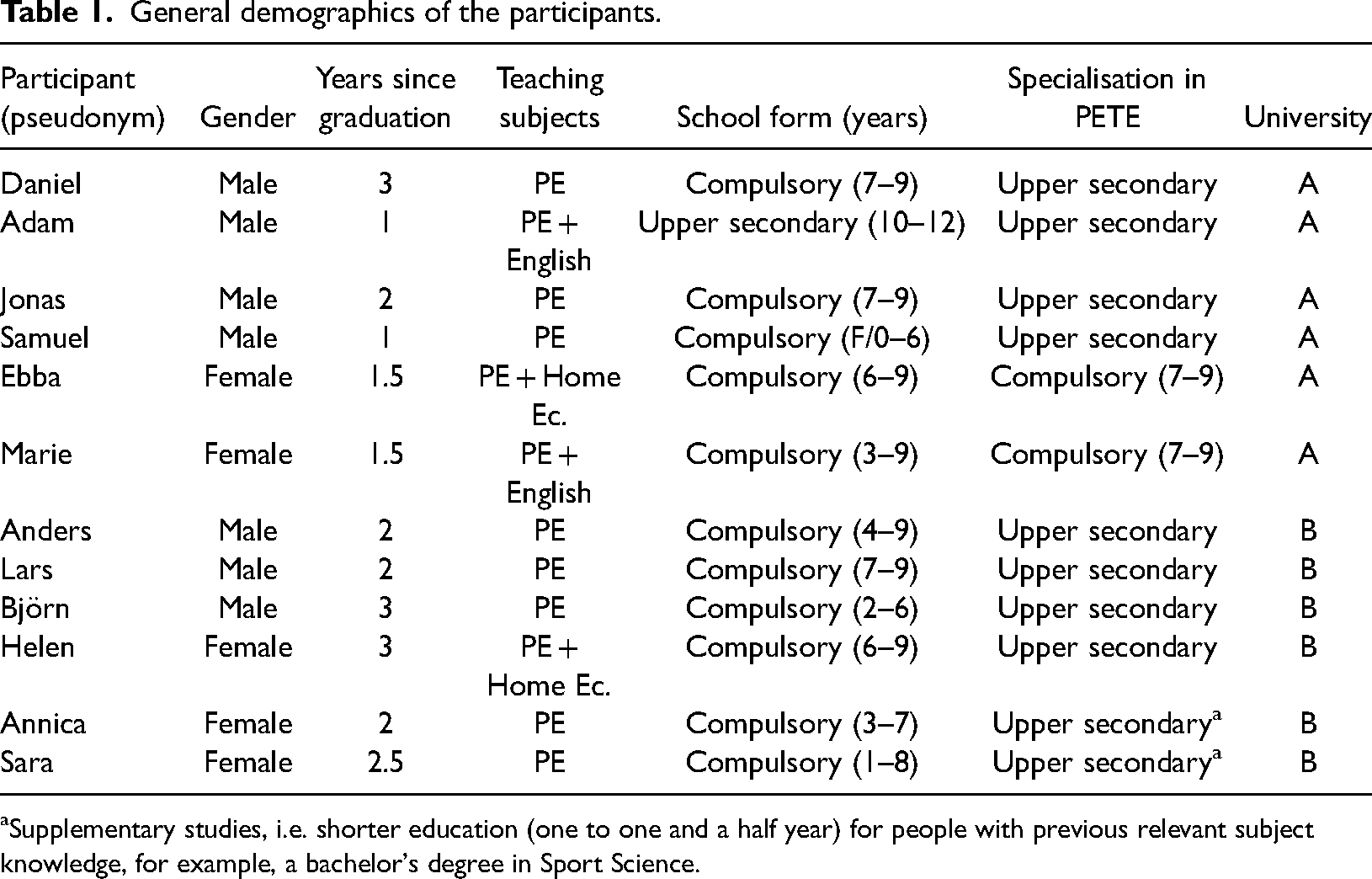
Supplementary studies, i.e. shorter education (one to one and a half year) for people with previous relevant subject knowledge, for example, a bachelor's degree in Sport Science.
Data collection
Semi-structured interviewing was used to generate insights into the participants’ descriptions of ball games as pedagogic practice. Semi-structured interviews seek to obtain descriptions of the interviewees’ lived worlds with respect to the interpretation of the meaning of a described phenomenon (Brinkmann and Kvale, 2018). Interview questions covered the participants’ biographies, workplace conditions, how they worked with ball games in PE, and their PETE experiences. Interview questions included but were not limited to: How prevalent are ball games in your teaching? What do you want the pupils to learn within ball games? How do you look at ball games in relation to the curricular goals of PE? Can you describe the teaching practice of a unit with ball games? How do you work with assessment in relation to ball games? Any special challenges involved in ball games teaching? Although all participants received the same questions, the semi-structured approach (Brinkmann, 2013) enabled the interviewer to follow up certain responses with probing questions that allowed participants to elaborate. The interviews were conducted and recorded using a cloud-based video conferencing service (Zoom). The interviews were held between May 2021 and December 2022 and lasted 32–58 minutes.
Analysis
Audio recordings from the interviews were transcribed verbatim by the author. Analysis of the transcripts involved three phases. In the first phase, the author read through the transcribed interviews and searched for patterns regarding the realisation of educational knowledge in ball games within the following categories derived from the subject areas of the interview guide: (1) prevalence of ball games in PE; (2) objectives of ball games teaching; (3) ball games in relation to the curriculum; (4) general description of ball games teaching; (5) specific challenges in ball games teaching; (6) assessment of ball games. During this phase, the author read the transcripts multiple times, highlighting essential extracts within each category and writing down reflections in relation to the extracts. These reflection notes contained impressions related to, for example, patterns in the data and rare or contradictory features.
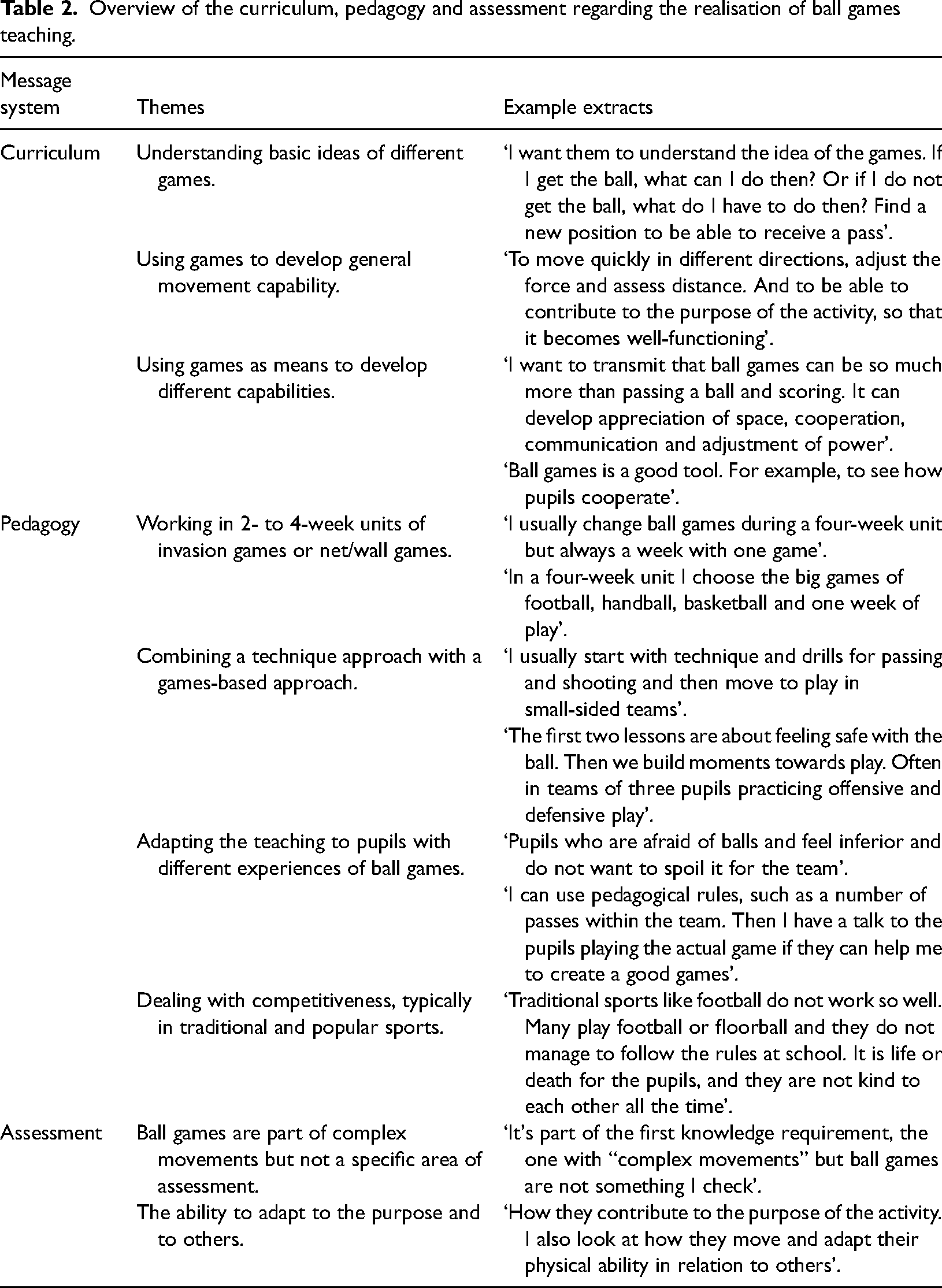
In the second phase, the author compared the extracts within the different categories identifying general themes (Patton, 2015). The author used Bernstein's concepts of the three message systems: curriculum, pedagogy and evaluation as sensitising concepts to provide a direction for what to look for (Blumer, 1986). This process involved matching extracts with the general features of each message system. An overview of the three message systems is presented in the Findings section (see Table 2).
Overview of the curriculum, pedagogy and assessment regarding the realisation of ball games teaching.
In the third phase, the author used deductive analysis based on Bernstein's (2000) concepts of classification and framing to identify the teachers’ descriptions of the pedagogic practice. Two analytic questions aligned with the focus of the study and guided the process: (1) How do the teachers classify ball games knowledge in relation to other discourses and relations between spaces? (2) How do the teachers frame the ball games teaching in relation to discursive and hierarchical rules? This process involved more readings of the extracts by the author and an interpretation of the data through Bernstein's concepts. In this process, qualitatively different ways of classification and framing were of interest.
Findings
This section is structured in accordance with Bernstein's three message systems of curriculum, pedagogy and assessment. The first part consists of an overview of the beginning teachers’ descriptions of ball games as pedagogic practice. The second part provides an in-depth analysis of the described pedagogic practice based on the concepts of classification and framing.
Overview: curriculum, pedagogy and assessment of ball games teaching
From the initial analysis, general patterns in several of the beginning teachers’ descriptions of the pedagogic practice of ball games were identified. Table 2 contains an overview of the three message systems of curriculum, pedagogy and assessment.
Curriculum
The findings reveal that what counts as valid knowledge regarding ball games varied among the participants and seemed to be related to the classification of ball games knowledge. The beginning teachers’ classification of ball games knowledge varied from strong to weak. Strong classification appeared when the teachers explicitly aimed to teach ball games in a competitive form similar to that practiced in sport clubs: The goal after five to ten lessons is to reach game play. We start with the ball and then it's a progression. The final goal is the competitive form. If you want, you can then try to find a club. (Lars)
In the example above, ball games knowledge in PE is defined as being able to play the game and becomes closely connected to the differentiated knowledge produced and reproduced in sport clubs. The conception of ball games knowledge is thus aligned with competitive sport and strongly classified but is not based on curricular documents.
Many of the beginning teachers used ball sports common in sport clubs, aiming to develop the pupils’ understanding of games but (1) reduced or abandoned the competitive dimension of the sport and/or (2) modified the rules in order to include all pupils: When I get the year 7 classes they’re usually very focused on winning and how many goals they score. And then I explain to them very quickly that I don’t care how many goals they score or who is winning… But if we take floorball as an example. If I see that you do a good cutting action and make yourself available, then if you get a pass or not, it doesn’t matter. Or you get the pass and miss. That doesn’t matter either. I see what you’re trying to do, I see that you’re doing good! It usually takes a year before they let go of this with competition. Some never do, but the majority do. (Jonas)
By reducing the focus on winning and modifying rules to include all pupils, the beginning teachers weakened the classification of ball games. The pedagogic discourse of ball games thus included competences and skills related to the understanding of games. A decreased focus on competition and winning is part of the regulative discourse and changes the expectations on pupils’ behaviour in relation to each other. According to the beginning teachers, many pupils have difficulties adopting this weaker form of classification and want to continue with strong classification that they have experienced outside of school. Several of the teachers claimed that the biggest challenges they faced occurred when they used football (soccer) and floorball, the most popular games in Sweden: Football is more difficult to teach because of all the opinions about it and how the football boys and girls are. They go all in. (Ebba)
Some of the beginning teachers divided their classes into two subgroups: experienced and non-experienced pupils during ball games lessons. This insulation of different experience levels can be seen as a way of making classification stronger. One of the teachers had seen this strategy during school placement and used it in her own teaching: I often divide the court in two and say ‘those of you that are experienced and want to play … [over there] and you who are a bit less experienced and want to practice more on your technique… [over there]'. (Ebba)
In the example above, the two groups occupied different locations but importantly, the ‘teaching’ potentially led to very different learning experiences. One of the teachers questioned, for example, whether it was even appropriate to teach ball games to all pupils. The teacher, working in Years 6–9, claimed that: The pupils who like ball games, they’re doing them. Many stop during secondary school and know what they need to know for the future. I think that the pupils you want to ‘pick up’, you need to meet in other activities that can be of use in the future. For those who are planning to go on with football, floorball, or basketball, they know the stuff already. (Helen)
Weaker classification of ball games knowledge appeared in two further ways. Some beginning teachers focused on learning specific movements through ball games instead of learning about the games themselves. One teacher explained how she works with the throwing motion in different ways: Annica: We start in the autumn with a theme around athletics and there we do small ball throw. How far can you throw the ball and hit different targets? … I try to get the pupils to understand that they use this movement in different activities, such as in rounders and when we go inside and play ghost ball. [I want them to] recognize the movement, and that it's the same movement when we’re playing badminton. Researcher: What are the pupils supposed to learn in ball games? Annica: Eye-hand coordination… How much force do I need to get the ball there? And get the pupils to understand that it's the same movement that we use when throwing javelin or throwing in ghost ball or playing badminton.
Several of the beginning teachers justified using ball games as a context for learning other skills, essentially weakening the classification of ball games knowledge by referencing the Swedish national curriculum. The teachers most frequently referred to ‘all-round movements’ in different physical contexts, complex movements and contribution to the purpose of the activity, but they could also discuss risk and injury prevention in relation to ball games: It's a lot about their movement capability. Being able to change direction quickly, being able to adapt the force and distances. And contributing to the purpose of the activity, so that the activity runs smoothly. (Samuel)
In sum, what counted as valid content regarding ball games varied and was related to the classification of ball games knowledge. The beginning teachers strengthened and weakened the classification of ball games in different ways. Strong classification was seen when ball games were taught as competitive sports and when pupils were divided in relation to prior experience. Most beginning teachers aimed to develop pupils’ understanding of ball games but weakened the classification using modified and less competitive forms of ball games. Some beginning teachers used ball games as a means for focusing on learning movements or specific curricular concepts. This way knowledge from ball games and PE curriculum were brought together, resulting in a weaker classification.
Pedagogy
The valid transmission of ball games knowledge is related to the framing characteristics in the teaching. In this investigation, there were more similarities than differences regarding how the teachers organised the teaching of ball games. Most teachers planned for a sequence of ball games teaching once or twice a year. The ball games units usually lasted 4–10 lessons. The following example illustrates several issues related to framing: A period of ball games can be 8–10 lessons and I usually work with three different ball games during this period. I can start with football, 3–4 lessons. The first lesson will be an introduction and here I try to ‘read’ the group… How is the group? Is it homogenous or not? Next lesson, I select a level, what can we aim for? Does the group need to be comfortable with the ball? Then we start with technical progression, ‘me and the ball’ and so on. If the group is more homogenous, then I can start more with the game. We usually try to talk about concepts like ‘time’ and ‘play with’ or ‘play against’… Then I usually add some pedagogical keys, for example a certain number of passes within the team. I usually talk to the pupils who play the game outside of school and ask if they can help me in different ways. (Anders)
The teacher above described how he controlled the selection and sequencing of knowledge, adapted the pedagogy in terms of whether it is game-based or technical progression, and selected the criteria in relation to the specific group. The framing was strong since the teacher controlled the instructional context. At the same time, he negotiated and involved pupils with knowledge of the games in the teaching process, resulting in a weaker framing of the regulative context. Sara provided a similar example: The first two lessons are about ball control and feeling comfortable. Bounce the ball in different ways and protect the ball. What do I need to think about then? Or when I move more quickly with the ball. The second week I build towards play in different ways. Often in small teams, three pupils in each team… I always use pedagogical rules, like three passes within the team, or a bounce behind a line… That's so everybody should get the ball. Then, when we’re doing small-sided games, I usually stand on one court and stop the play with a signal or by saying ‘freeze’. ‘How can I ever get the ball when I am standing there?’ And then I explain how to move and use the concept of making yourself available. (Sara)
These two examples demonstrate the combination of both game-based and technical approaches, and the wide use of pedagogical rules. The beginning teachers had encountered this combination in PETE. Notably, however, none of the teachers claimed to embrace full versions of GBAs. One teacher described his difficulties when starting with the game: A four-week period of ball games can consist of major ball games such as football, handball and basketball and finally a week of ball play. We usually start with technique and then move to play forms in small-sided teams. I initially tried to work with Teaching Games for Understanding but it didn’t work for me. The unexperienced backed away. We always play in small-sided teams, and we never focus on winning. Instead, I highlight the importance of a good game, a good passing game with good teamwork where everybody feels that they can participate. (Daniel)
By starting with small-sided, modified games and de-emphasising competition, this teacher controlled the selection, sequencing and evaluation of knowledge. The teaching was thus characterised by strong framing.
In sum, the teachers framed ball games instruction in similar ways. Many of the teachers applied some GBA strategies, such as using small-sided games and focusing on key concepts. Most, however, used technical approaches with heterogenous groups, claiming that technical approaches provide a more inclusive environment for pupils who have less ball games experience. The focus on cooperation instead of competition was often articulated among the teachers and reinforced with strong framing of selection and sequencing, and weak framing of hierarchical rules involving experienced pupils in the teaching.
Assessment
The message regarding valid realisation of knowledge reveals that ball games is one part of the curricular concept ‘complex movements’ (SNAE, 2022: 50), but this part was not emphasised by any of the beginning teachers. One teacher described his view on assessment in ball games: It's part of the first knowledge requirements, the one about ‘complex movements’. Ball games are part of that. But ball games are not anything I check, like ‘now we’ve had ball games, and you got a C in ball games’. It's a part of complex movements. (Jonas)
Another teacher emphasised the all-round aspect of movement capability that pupils should develop and demonstrate: It's included in this with being all-round… I maybe don’t assess how they move with the ball but more how they move with both smaller and bigger balls… I don’t focus on what we do in football for four weeks but more what we do during a whole year. (Annica)
Several of the beginning teachers referenced the exact wording of the grading criteria, ‘adapt their movements to the purpose of the activity’, from the curriculum: I look at how they [the pupils] contribute to the purpose of the activity. And the participation. I also look at how they move and adapt the physical ability in relation to others. (Samuel)
Some of the teachers stated that they explicitly communicated the assessment criteria to the pupils, reflecting strong framing of both the evaluation of knowledge and the regulative context.
In sum, the assessment of ball games knowledge was similar among the beginning teachers. Ball games were seen as a part of complex and all-round movements, but not as an area to assess on its own. The pupils’ ability to adapt to the purpose of the activity and to other pupils was important for many of the participants. Assessment functioned as valid realisation of ball games knowledge in relation to social order and the regulative discourse.
Discussion
In this section, I discuss three issues related to the realisation of ball games teaching in a Swedish context. These issues concern: (1) different views on ball games knowledge in PE; (2) the challenges in managing sport as regulative discourse; and (3) the use of combined approaches in games teaching. In the final section, broader conclusions and implications for PETE are raised.
The beginning teachers’ descriptions of the pedagogic practice reveal different views on ball games knowledge in PE and how to use ball games in relation to curricular goals. The beginning teachers covered different aims and, besides focusing on understanding and participating in games, used ball games as a means for developing capabilities such as coordination and cooperation. From a Bernsteinian perspective, these different views constitute differences in classification. Previous research suggests that PE is a weakly classified school subject that is open to different agents and discourses (Lundvall and Meckbach, 2008). Ball games, nevertheless, can be strongly classified with, for example, clear boundaries regarding gender, which is often the case in sports clubs. In PE, classification is usually weaker. Studies on PE practice, however, reveal that sport discourses often have more influence than educational discourses (Backman, 2011; Hunter, 2004; Larsson and Nyberg, 2017). In this study, ball games are strongly classified when they are taught in ways reminiscent of ‘the real game’, reflecting many beginning teachers’ previous experiences of sport and PE (Curtner-Smith, 1999; Lawson, 1983). Many of the beginning teachers aimed to weaken the classification with adaptations and modifications to create positive experiences among all pupils. Some of the beginning teachers also proposed that the Swedish curriculum, with its main purpose to ‘develop all-round movement capability’ (SNAE, 2022: 48), encourages different interpretations of ball games knowledge and a weaker classification. Accordingly, some of the teachers did not have ball games ‘in the centre’ of their lessons, instead using ball games in relation to the learning of general or specific movements. In these cases, the boundaries between ball games and other PE content became blurred. This weaker classification clearly reflects current research on movement capability as an overarching concept in a Swedish context and alternative to traditional sport skills (e.g. Nyberg and Larsson, 2017).
Second, a common challenge in the teaching was to manage the influence of sport as regulative discourse. Most of the beginning teachers emphasised the distinction between ball games in PE and competitive sport outside of school, which is in line with some previous Swedish PE research (Lundvall and Meckbach, 2008; Quennerstedt et al., 2008). However, the influence of competitive sport was noticeable and many of the teachers claimed that their pupils have difficulties appreciating this difference. The teachers maintained that pupils expect to play ‘the real game’ (see Brooker et al., 2000) and the challenge was most obvious when the content was football or floorball, the two most popular ball sports for youth in Sweden today. The beginning teachers described different strategies in their pedagogic practices to deal with these challenges. One common strategy was to combine strong framing, where they communicated valid knowledge in relation to assessment, with weak framing, where they negotiated with pupils with previous experience to create a less competitive practice. Most beginning teachers stated that ball games are not a specific area of assessment. However, the use of the assessment criteria, ‘adapt their movements […] to the purpose of the activities’ (SNAE, 2022: 52), together with cooperation with pupils with ball games experience, form a governing perspective (Öhman and Quennerstedt, 2008) of how to be a good pupil in ball games in PE. Some beginning teachers used a strategy, especially with popular invasion games, where they divided the pupils according to previous experience, essentially creating two different practices: one ‘real-game’ practice, where the pupils are playing the game and one ‘trying the activity’ practice, where pupils can focus on developing basic techniques or their understanding of the game. A final strategy, adopted by several of the teachers, was to avoid popular games and instead focus more on unfamiliar games (see Jones et al., 2023). The different strategies used to manage the influence of sport in PE practice affect the amount of contact pupils have with different games and it is possible that some pupils do not encounter popular ball games at all in PE.
Third, most of the beginning teachers described using a combination of different approaches in their teaching. None of the teachers in this study worked with ‘full versions’ of GBAs, which reflects findings in other countries (García-López et al., 2019). In line with previous research (Butler, 1996), the assumption that pupils need to learn technique first was persistent. The teachers’ main arguments were that a technical approach: (1) provides a better learning environment for pupils with less ball games experience and (2) prevents tension between more and less skilled pupils occurring in competitive situations. These claims are surprising in light of a main argument for the introduction of GBAs: that they are more inclusive than a technique-based approach (Thorpe et al., 1986). Advocates for GBAs usually suggest, however, longer teaching units of at least eight lessons, since the tasks require a higher level of thinking and reflective processes than many traditional practices in PE (Stolz and Pill, 2014). The teachers in this study devoted relatively few lessons to ball games, even if the units were longer than typical Swedish PE units of two lessons with the same content (Redelius and Larsson, 2020). A risk is that by combining different approaches and devoting limited time to ball games, opportunities for pupils to develop deeper competence and knowledge in ball games are constrained (see Casey and Kirk, 2020; Harvey et al., 2015; Morales-Belando et al., 2021). However, the beginning teachers also appeared to negotiate a Swedish PE culture of ‘trying out physical activities’ (Larsson and Karlefors, 2015) and experiencing the ‘joy of movements’ (Quennerstedt et al., 2008) within an educational discourse that emphasises learning for all (Larsson and Nyberg, 2017).
Conclusion
The aim of this article was to provide insights into beginning teachers’ descriptions of ball games as pedagogic practice in Swedish PE. The findings illustrate that what was taught differed between the beginning teachers. Some teachers aimed to develop pupils’ understanding of ball games, while others aimed to develop pupils’ general movement capabilities or cooperation. The different use of ball games reflects differences in classification from strongly classified forms, with ball games in the centre of the pedagogic practice, to weaker forms, where participation in ball games is a means rather than an end. Furthermore, the findings revealed that the how of teaching was characterised by the use of less competitive forms of ball games adapted for all pupils, and a combination of technical and game-based approaches. A major challenge with ball games as content was to manage the cultural influence from competitive sport. The beginning teachers employed different strategies such as cooperating with experienced pupils, separating experienced and non-experienced pupils, or avoiding certain games. The framing was often strong and combined with assessment of valid realisation of ball games knowledge in PE. These ways of working with ball games in PE practice appear to be legitimate in a Swedish context even if they may constrain pupils’ opportunities for developing deeper competence and knowledge in ball games (see Casey and Kirk, 2020). These findings have implications for ball games education in PETE. The use of ball games as a means for developing capabilities beyond ball games requires further consideration among PE teacher educators. Furthermore, advances in research regarding GBAs (Harvey et al., 2015) forms a foundation for thinking about ball games education in PETE but might need reconsideration within specific national contexts. Do ‘thinking players’ (Kirk, 2017: 6) or ‘physically literate (educated)’ pupils (Lundvall and Gerdin, 2021: 142) differ between national contexts? Would British beginning teachers, for example, face the same challenges when teaching ball games as their Swedish counterparts? These questions warrant further attention.
Footnotes
Declaration of conflicting interests
The author declared no potential conflicts of interest with respect to the research, authorship, and/or publication of this article.
Funding
The author received no financial support for the research, authorship, and/or publication of this article.
