




Abstract
This study examines the links between the first grade in physical education (PE) and Swedish adolescents’ aesthetic and functional body image and functional investment, referring to self-reported physical activity engagement, across time. We hypothesized direct links between body image constructs and PE grade (H1), an indirect effect of body image constructs on functional investment via the mediation of grade (H2), and stronger effects for girls than for boys (H3). We assessed 447 adolescents over three time points (T1–T3) in their sixth school year (age 12). Results from multigroup maximum likelihood structural equation models supported the hypotheses for girls. T1 higher functional and appearance satisfaction and T1 lower social physique predicted higher PE grades (measured at T2) (H1). The first PE grade mediated the association between each aspect of body image and changes in girls’ functional investment across time (H2). For boys, T1 higher functional satisfaction was directly associated with higher PE grade, but there was only limited evidence of mediation, thus lending partial support to H1 but very slight support for H2. Since the findings were consistent with the hypothesized models for girls but less so for boys, the third hypothesis was also supported. This unique longitudinal study provides novel evidence that both aesthetic and functional aspects of early adolescent girls’ body image are linked to academic achievement in PE, which in turn may impact girls’ functional investment across time.
Introduction
A major challenge in contemporary society is decreasing physical activity participation among young people (van Sluijs et al., 2021). In addressing this challenge, school is considered an important arena for the promotion of physical activity (van der Wurff et al., 2024). School physical education (PE) is often seen as a positive force in promoting adolescents’ physical activity due to its mandatory status and its inclusion in many curricula worldwide (Jaakkola et al., 2016; Sallis et al., 2012). In Sweden, the cultural context of the present study, the curriculum for compulsory school attributes PE a lifelong importance for children and adolescents, stressing that it should aim toward the promotion of students’ interest in physical activity, healthy habits, and positive body image (SNAE, 2024).
While PE is designed to shape young people's interest in physical activity and positive experiences of their bodies, adolescents’ own opinions about PE tend to be divided between enjoyment and dislike (Larsson, 2016). Barker et al. (2023) argued that dominant health and fitness norms, emphasizing a physically competent and toned body, may cause some adolescents to experience shame, embarrassment, and discontent within the PE setting. Indeed, body image issues have been recognized as a critical barrier to physical activity (Peng et al., 2023), including in the PE setting (Lunde et al., 2023). Although the body is important in other school subjects (such as arts) too, the fact that the body is at the center of pedagogical practices—and at the forefront of judgment and evaluation—arguably makes PE different from many other subjects in school.
Contemporary research views body image as a multidimensional construct encompassing evaluation and investment in both the aesthetic (how the body looks) and functional (what the body can do) aspects of the body (Abbott and Barber, 2011; Alleva and Tylka, 2021). In this study, we seek to explore if and how the first-ever grade in PE, which is given at age 12 in Sweden—a developmentally sensitive time in adolescents’ lives (Steinberg, 2005)—is associated with body image. Relying on relevant theory (self-worth theory; Covington, 2000) and previous empirical evidence (e.g. Neumark-Sztainer et al., 2006; Niven et al., 2009), we focus specifically on the associations with of the first grade for the so-called functional investment dimensions of body image, which can be translated into adolescents’ self-reported behavioral investment in physical health and physical activity. To this end, we conducted a three-wave longitudinal study with 447 boys and girls from 13 different schools over the course of one school year.
Implications of grades for early adolescents’ self- and body image
Although there are variations in terms of if and when students are first graded in PE across the globe, receiving the first grade has both symbolic value and real implications for young people's academic achievement (Klapp et al., 2016). Grades serve informational and motivational functions, such as providing feedback to students, parents, and teachers about achievement and progress. They are also believed to enhance student motivation and encourage students to exert more effort (Klapp et al., 2016). From the student perspective, grades are seen as an achievement-based reward (Klapp et al., 2016). In addition, grades are intimately tied to students’ self-concept, and the rationale goes that students who have positive self-beliefs will accomplish more than those with negative self-beliefs (see e.g. Marsh et al., 2005). Reciprocal effects between grades and self-concept variables have also been supported (Marsh et al., 2022). Variations in self-concept have been shown to result in differences in grades, which in turn reinforce young people's views of themselves as either good or bad students in different school subjects (Marsh et al., 2005).
The above associations can be understood from the perspective of self-worth theory (Covington, 2000). Self-worth theory postulates that all individuals have the need for attaining and maintaining a sense of self-worth and belongingness in a society that values achievement and competency. In line with the theory, grades have an impact on young people's developing selves through impacting their sense of self-worth, as grades are seen as an unmistakable measure of their worth as students (Klapp et al., 2016). Self-worth theory has further been used to explain the different effects of grades for high- versus low-achieving students. For high-achieving students, grades will serve to strengthen self-perceived competence and self-worth, whereas low-achieving students risk experiencing lowered perceived competence and a loss of self-worth. Although there are gender differences in grades in favor of girls, boys often have higher self-perceived competence in sports and PE—and PE is the only school subject in Sweden and elsewhere where boys tend to receive higher grades than girls (Svennberg, 2017). Furthermore, there appears to be a gender difference in terms of the effect of grades on students’ sense of self, with girls attributing grades to internal factors (e.g. being capable or incapable oneself) rather than external factors (e.g. a teacher who is fair or unfair) (Klapp et al., 2016). This implies that grades may have stronger consequences for self-concept outcomes in girls compared to boys.
The complex relationships between body image and physical activity
In early adolescence, body image becomes an increasingly important aspect of adolescents’ sense of self-worth. Following pubertal, cognitive, and psychosocial changes, both girls’ and boys’ body image undergoes significant mean level change during this time (Frisén et al., 2015; Sabiston et al., 2022). Cross-sectional, and some longitudinal, work further shows that body image is closely and complexly intertwined with physical activity engagement and outcomes. On the one hand, positive relationships between physical activity, exercise, and body image have been reported in the literature (Babic et al., 2014; Bassett-Gunter et al., 2017; Hausenblas and Fallon, 2006). One suggested explanation for the positive link between physical activity and body image is that the physiological changes following physical activity, such as attaining a stronger or more toned body, lead to a more positive view of one's body (Hausenblas and Fallon, 2006). An additional explanation is that physical activity increases people's sense of physical competency, which in turn may explain why physical activity is positively linked to body image (Allen et al., 2019). It should be noted that this literature has mostly focused on adult populations, although a recent systematic review confirmed moderate medium-sized effects between physical activity levels and lower body dissatisfaction in adolescent populations too (Gualdi-Rosso et al., 2022).
On the other hand, some studies indicate that not all people's body image benefits from physical activity. The abovementioned systematic review highlighted a few studies showing that physical activity interventions may instead have a negative effect on body image, especially for adolescent girls who are physically inactive (see Gualdi-Rosso et al., 2022). It is well established that the views young people have of their bodies may be a significant barrier toward engaging in physical activity (Babic et al., 2014; Barker et al., 2023). In the specific context of PE in school, Lunde et al. (2023) showed that early adolescents who reported unexcused absence from PE reported less autonomous forms of motivation toward PE and greater appearance anxiety. Indeed, some adolescents may find the PE environment triggering for concerns related to their bodies. Triggering situations that are often reported include undressing and showering in front of others, wearing form-fitting exercise clothes, and perceived social scrutiny from teachers and peers during lessons (Kerner et al., 2017). Conversely, adolescents with a more positive functional body image (i.e. a positive view of their functional abilities) have been found to both enjoy and perform better in PE (Allen et al., 2019). Although it should be noted that studies focusing on physical activity levels cannot be compared to PE in school—due to its mandatory nature—it has also been suggested that normative increases in body image concerns contribute to the general decline in participation and enjoyment of physical activity observed in the transition from childhood into early adolescence (Cairney et al., 2012; Finne et al., 2011).
The current study—exploring the associations between body image and PE grades
In view of the Swedish curriculum emphasizing the potential lifelong importance of PE for all students’ engagement in physical activity and positive body image (SNAE, 2024), the overarching purpose of the present study was to shed light on if and how the first PE grade relates to early adolescents’ body image. In line with a holistic perspective on body image, which includes evaluative/emotional and cognitive-behavioral dimensions of young people's views of their bodies from both an aesthetic (appearance) and functional point of view (Abbott and Barber, 2011), the focal body image constructs in this study were appearance and functional satisfaction (evaluation). Additionally, the constructs included social physique anxiety (emotional) and functional investment (cognitive-behavioral). Appearance satisfaction refers to the degree of satisfaction with one's body and physical appearance, whereas functional satisfaction refers to the degree of satisfaction with physical abilities and performances (Abbott and Barber, 2011). Social physique anxiety refers to anxiety experienced when individuals believe they are judged and evaluated by others based on their physical appearance (Hart et al., 1989). Functional investment is a cognitive-behavioral body image component centering on behaviors such as seeking out opportunities to be physically active and challenging oneself during physical activities. A few previous studies have shown that appearance and functional satisfaction and social physique anxiety are related to adolescents’ physical activity experiences and outcomes, both concurrently (Allen et al., 2019; Lunde et al., 2023; Sicilia et al., 2016) and over time (Neumark-Sztainer et al., 2006; Niven et al., 2009). For example, a cross-sectional study conducted in Australia showed that children who held more positive attitudes toward PE and were members of sports clubs had more positive functional body images (Allen et al., 2019). In another study, using two-wave data, Niven et al. (2009) found that British 11-year-old girls’ decreasing physical activity levels paralleled increased social physique anxiety over a period of 6 months. In a 5-year longitudinal study, Neumark-Sztainer et al. (2006) showed that lower levels of appearance satisfaction predicted several negative health outcomes, including lowered physical activity, in U.S. adolescent girls and boys.
Based on the above empirical findings and the tenets of self-worth theory, the present three-wave longitudinal study was designed to investigate the associations between evaluative or emotional dimensions of body image (appearance and functional satisfaction and social physique anxiety) and functional investment, via the potentially mediating effect of PE grades, over one school year. Based on previous findings (e.g. Allen et al., 2019; Marsh et al., 2005), we hypothesized that body image would be associated with the first PE grade (H1), so that early adolescents with a more positive view of their bodies would have better grades and vice versa. We further explored grades as a mediator between evaluative/emotional body image dimensions (appearance satisfaction, functional satisfaction, social physique anxiety) and early adolescents’ functional investment across time, while controlling for baseline levels of the outcome. In line with the tenets of self-worth theory, suggesting that students who have more positive self-beliefs accomplish more and are encouraged by being graded, we expected that adolescents with higher appearance satisfaction, higher functional satisfaction, and lower social physique anxiety would report higher functional investment at the end of the school year, via mediation of the first grade in PE (H2). Furthermore, and in light of previous research indicating that being graded may have stronger consequences for girls’ self-concept (Klapp et al., 2016), and previous research showing gender differences in the importance of body image for self-concept (Nelson et al., 2018), we expected stronger associations between being graded in PE and body image for girls compared to boys (H3). As the first study to address these issues, the present study will further the knowledge about the potential behavioral impact of being graded in PE, thus providing important knowledge for schools, educators, and policy makers.
Methods
The data used in this study were collected as part of a longitudinal project named BEEP (Body image, Exercise, and Enjoyment in PE) conducted at the University of Gothenburg. Data were first collected at the beginning of the fall semester when participants were in sixth grade (12 years old, T1), then at the beginning of the spring semester (T2), and finally at the end of the spring semester (T3). Invitations to participate in the study were initially distributed to principals at 35 schools, situated within an approximately 3-hour traveling distance from Gothenburg. Recruitment of schools was terminated when we concluded that we would reach the predetermined goal of 500 participants. An a priori power calculation using G*Power (version 3.1.9.7) showed that the sample size would be adequate to test the hypotheses (80% power, medium effect size, a = 0.05) (Faul et al., 2007). Cohen's general guidelines were used to determine the effect size (Cohen, 1988). This resulted in a total of 13 schools being included in the project (one private school and 12 public schools).
Data were collected in school during regular school hours. Legal guardians provided informed consent before data collection commenced. The students were informed by their teacher about the study one week ahead of the data collection and again by the research team on the day of the data collection. Students provided informed consent at the time of data collection. Data were collected using a digital questionnaire. Ethical approval for the study was granted by the Swedish Ethical Review Authority (reference number 2021-04006).
Participants
A total of 535 students participated at T1 (48.3% girls, 49.4% boys, and 1.7% identified as neither girl nor boy, T1 mean age = 12.28 years, SD = .31). Ninety-two percent of the children were born in Sweden, 11.2% reported that they had one parent who was born outside of Sweden, and 11.5% reported having two parents who were born outside of Sweden. Because of their small number, participants who identified as neither girl nor boy were excluded from the analysis. At T2, 84.1% of the boys and girls in the T1 sample was retained in the study (n = 450), and 83.6% was retained at T3 (n = 447). Thus, the final analytic sample consisted of 447 boys and girls who participated throughout the entire study.
Materials
The questionnaire included the same set of instruments at each time point. For the purposes of the present study, key constructs were grades, appearance and functional satisfaction, social physique anxiety, and functional investment. Grades were only measured at the second time point, as this represented the first time grades are given to Swedish school children.
Grades
Students’ grades in PE were self-reported at T2. The first grade reflects the student's level of achievement on a criterion-based scale ranging from F to A, with F being a failing grade and E to A passing grades in ascending order. Participants were asked the question “Which grade did you receive in PE this semester?” with the response options being F, E, D, C, B, or A. In data analyses, grades were coded ranging from 1 (F) to 6 (A).
The embodied image scale (EIS)
To measure appearance and functional aspects of body image, the EIS (Abbott and Barber, 2011) was used. The EIS measures both the appearance and the functional aspect of body image along evaluative and cognitive-behavioral dimensions. For the present study, three subscales were used: appearance satisfaction, functional satisfaction, and functional investment. The scales use a five-point Likert scale ranging from 1 (not at all true for me) to 5 (very true for me) and include items such as “I very much like the way I look” (appearance satisfaction), “I am very happy with my performance in physical activities” (functional satisfaction), and “I take part in physical activities any time I get the chance” (functional investment). The scale has been shown to be a valid and reliable measure of body image among 12- to 17-year-olds (Abbott and Barber, 2011; Allen et al., 2019). For each time point, Cronbach's alpha for the functional investment subscale ranged from .79 to .85, .88 to .91 for functional satisfaction, and .91 to .93 for appearance satisfaction. Test–retest reliability of the functional investment subscale between T1 and T3 was evaluated using the intraclass correlation coefficient (ICC), based on a two-way mixed-effects model with absolute agreement (ICC (3,1)). The ICC was .703 (95% confidence interval [CI] [.653, .747]), indicating moderate to good temporal stability (Koo and Li, 2016).
Social physique anxiety
The unidimensional Social Physique Anxiety Scale (SPAS) (Hart et al., 1989) was used to measure participants’ social physique anxiety. Social physique anxiety has been defined by Hart et al. (1989) as “a subtype of social anxiety people experience in response to others' evaluations of their physique” (p.94). In this study, we used the seven-item Swedish version of SPAS (Lindwall, 2004) for use among adolescent samples. As our sample consisted of 12-year-olds, we chose to make minor adaptations to the items to make them better suited and more easily understood by early adolescents. For instance, the item that originally read “I wish I wasn't so up-tight about my physique or figure” was changed to the corresponding Swedish phrase for “I wish I weren't so worried about my body.” Similarly, the item “Unattractive features of my physique or figure make me nervous in certain social settings” was changed to the corresponding Swedish phrase for “I feel nervous about my body when I am with other people.” The adaptations were inspired by the children's version of SPAS by Fender-Scarr et al. (2003; cited in Stadulis et al., 2014). All items were measured on a five-point Likert scale ranging from 1 (fully disagree) to 5 (fully agree), including a middle alternative (in between). In the current study, Cronbach's α for SPAS was .88, indicating good internal consistency. Higher scores are indicative of greater social physique anxiety.
Although only the T1 scores of the SPAS were used in the present analyses, test–retest reliability was assessed to evaluate the temporal stability of the modified scale. ICC was calculated based on a two-way mixed-effects model with absolute agreement (ICC (3,1)) across T1, T2, and T3. The ICC was .770 (95% CI [.738, .800]), indicating good reliability over time (Koo and Li, 2016).
Data analyses
Data were analyzed using R (R Development Core Team, 2019). Missingness patterns were inspected both concurrently and over time. Little's Missing Completely At Random (MCAR) tests of covariances and correlations indicated that data were missing non-randomly (p < .001). Assumptions of normality and linearity were also checked before analyses by inspecting distributions, skewness statistics, and intercorrelations (Spearman's rho) between study variables across time.
To test the hypotheses, we used structural equation modeling using maximum likelihood (ML) estimation and full information ML to handle missingness. Due to multicollinearity between the body image constructs, three separate models were specified for functional satisfaction, appearance satisfaction, and social physique anxiety, respectively. All models were specified as multigroup models with gender (girls and boys) as the grouping variable, allowing parameters to be estimated separately for girls and boys.
In each model, functional satisfaction, appearance satisfaction, and social physique anxiety at T1, respectively, predicted functional investment at T3 through grade in PE (T2), controlling for functional investment at T1. Controlling for functional investment at T1 was considered important for establishing effects beyond the baseline level of the outcome. Each mediation model was specified as a multigroup model using ML and 1000 bootstrap samples to estimate the standard errors. Confirmatory factor analysis (CFA) with ML estimation and bootstrapped standard errors was used to assess the goodness of fit of each model to the data. Goodness of fit was assessed using the robust comparative fit index (rCFI; values of .90 or higher indicate adequate fit), the standardized root-mean-square residual (SRMR; values less than .10 indicate an adequate fit), and the robust root-mean-square error of approximation (rRMSEA; values less than .08 are an adequate fit). A series of CFA models were specified to assess metric measurement invariance across gender and across time.
Results
Table 1 shows the means, standard variations, and zero-order correlations for the variables in the mediation models for boys and girls, respectively. A notable difference between boys and girls was that PE grade was significantly correlated with all body image constructs for girls, while it was only associated with functional investment for boys.
Participant information.
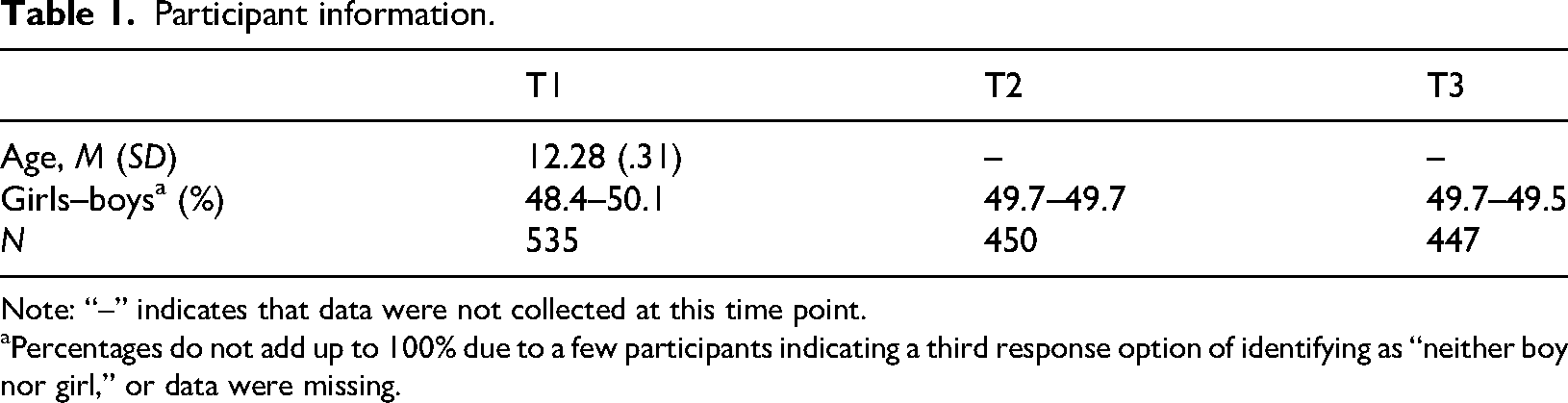
Note: “–” indicates that data were not collected at this time point.
Percentages do not add up to 100% due to a few participants indicating a third response option of identifying as “neither boy nor girl,” or data were missing.
The measurement models
Results of the CFAs indicated that all three measurement models exhibited a good fit to the data (the functional satisfaction model: rCFI = .974, SRMR = .043, rRMSEA = .081; the appearance satisfaction model: rCFI = .987, SRMR = .041, rRMSEA = .059; the social physique anxiety model: rCFI = .967, SRMR = .062, rRMSEA = .061). The factor loadings of all indicators were significant (p < .001), suggesting that the latent variables were appropriately measured by their items. The measurement models were subsequently tested for metric invariance across gender by constraining the factor loadings to be equal across gender. A ΔCFI < .01 (Cheung and Rensvold, 2002) and significant chi-square tests of difference indicated that all models exhibited metric invariance across gender. Similarly, the functional investment latent variable exhibited longitudinal metric invariance across the two time points.
The structural models
The results of the mediation analyses are summarized in Table 2 and graphically depicted in Figures 1–3. All path coefficients below are standardized β values.
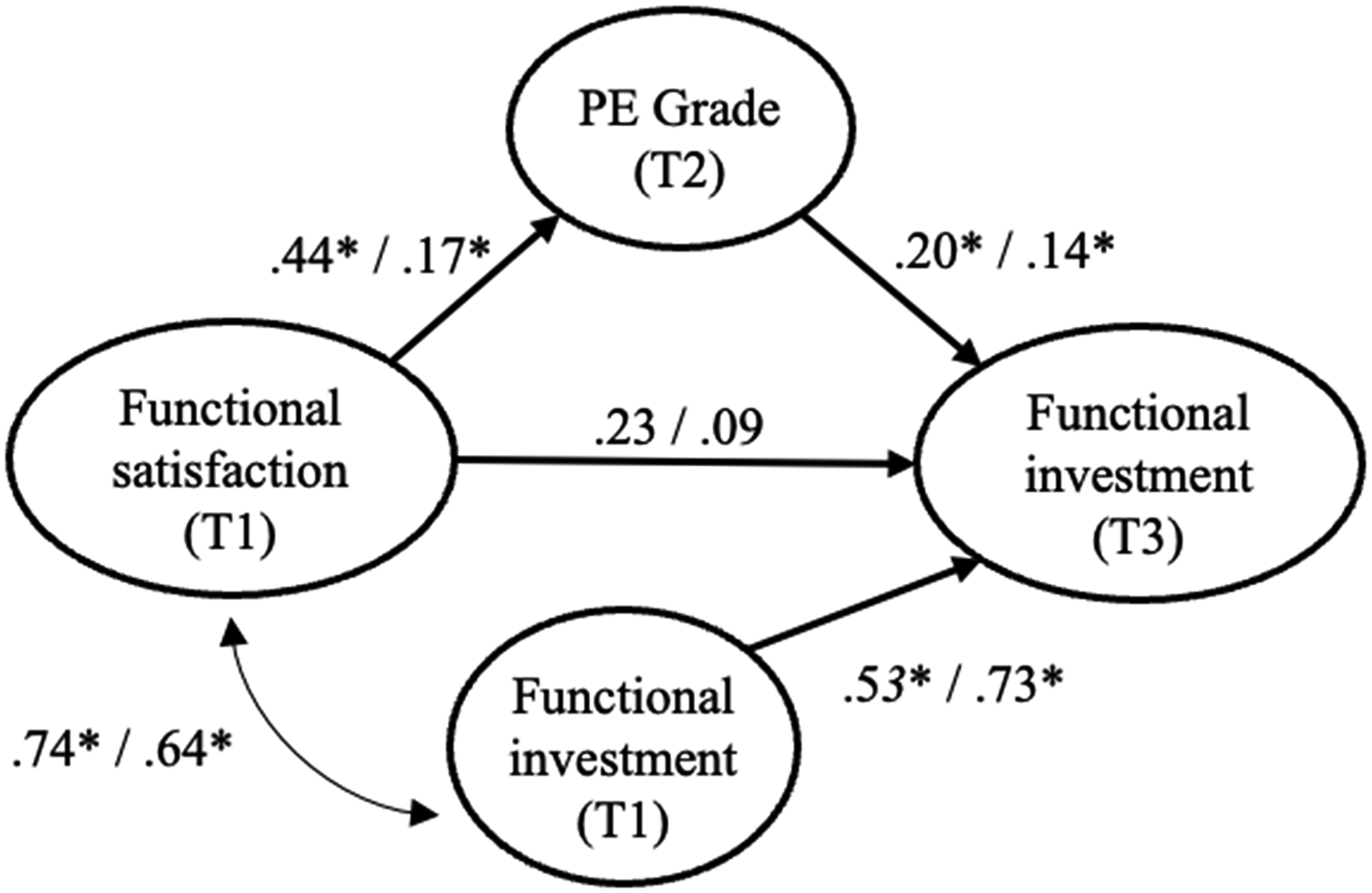
Structural mediation model for functional satisfaction.
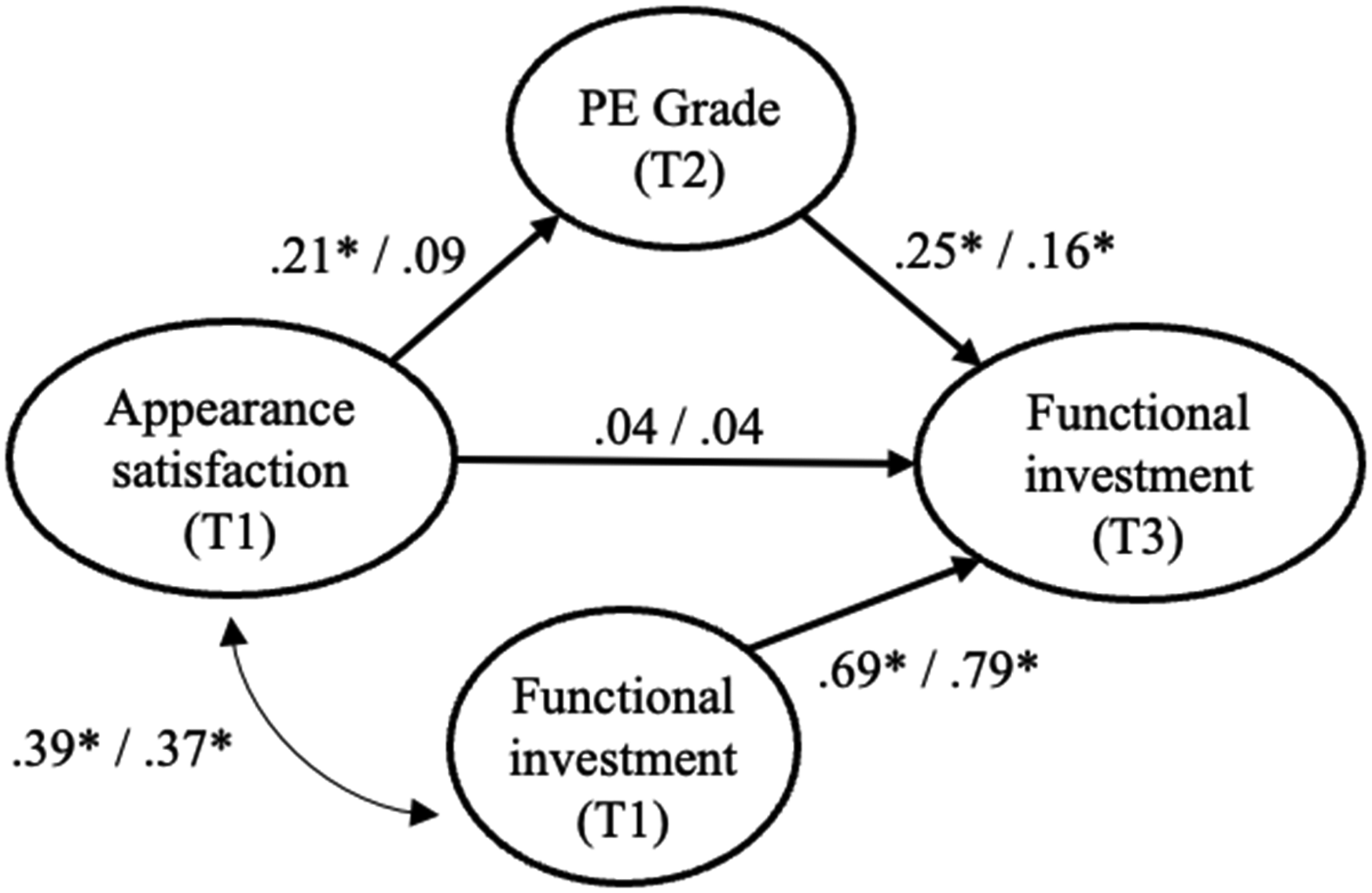
Structural mediation model for appearance satisfaction.
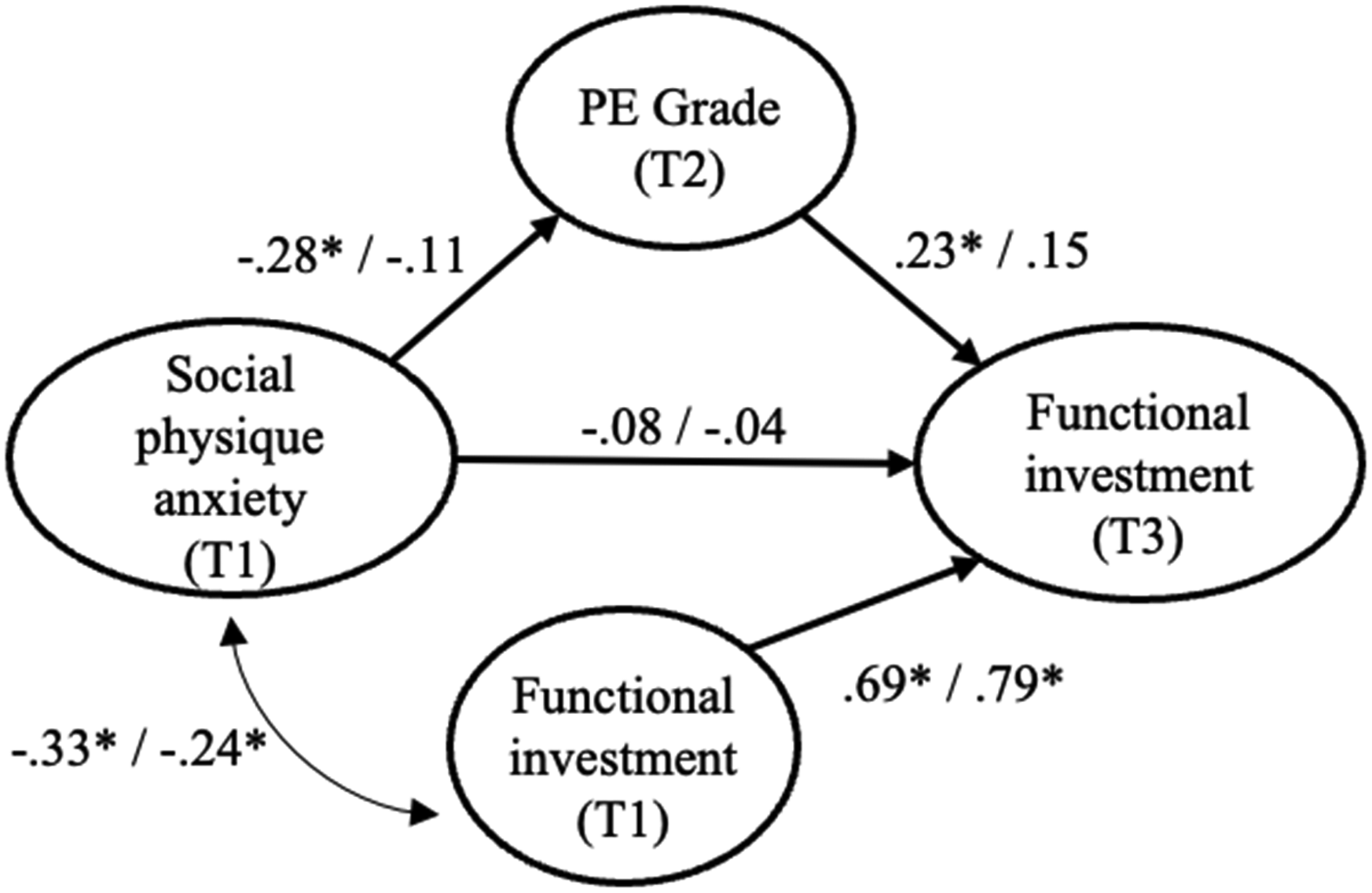
Structural mediation model for social physique anxiety.
Descriptive statistics and correlations for composite scale scores.
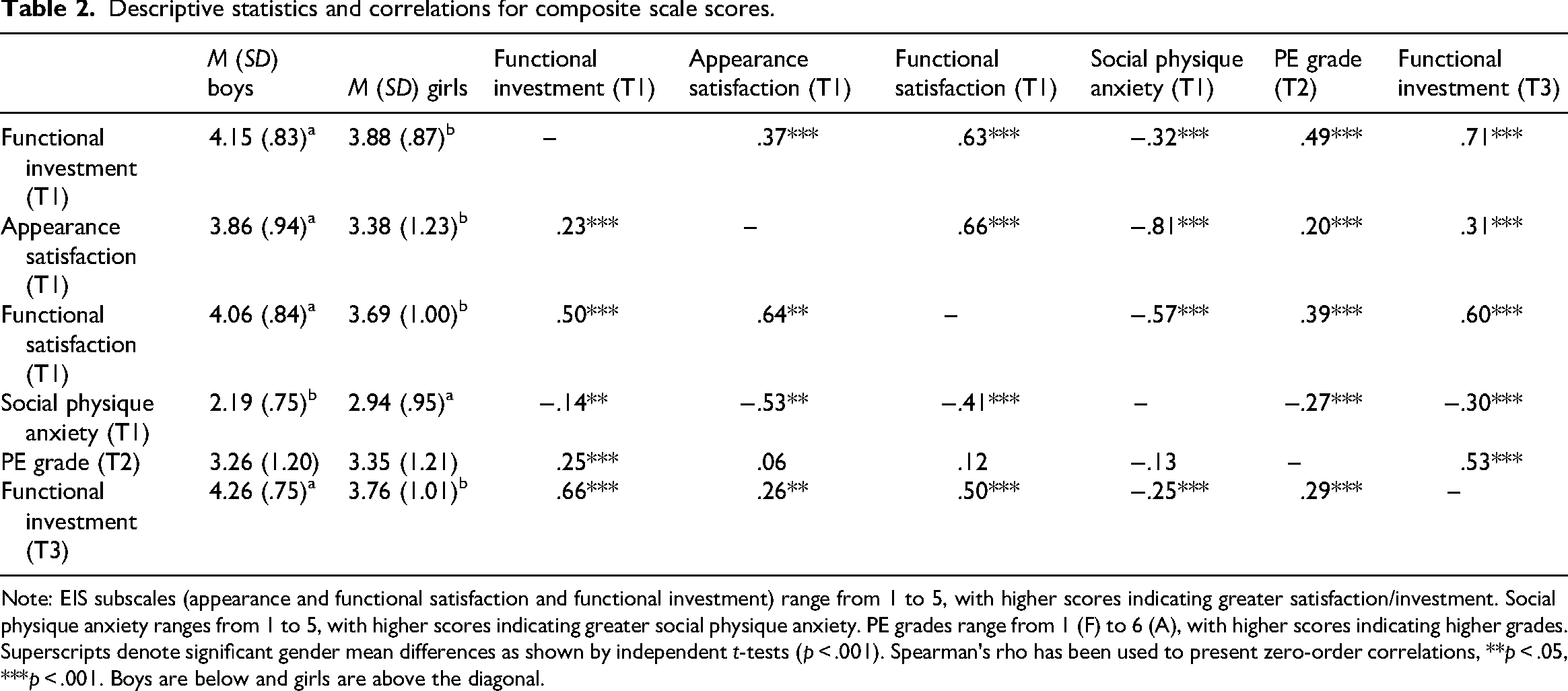
Note: EIS subscales (appearance and functional satisfaction and functional investment) range from 1 to 5, with higher scores indicating greater satisfaction/investment. Social physique anxiety ranges from 1 to 5, with higher scores indicating greater social physique anxiety. PE grades range from 1 (F) to 6 (A), with higher scores indicating higher grades. Superscripts denote significant gender mean differences as shown by independent t-tests (p < .001). Spearman's rho has been used to present zero-order correlations, **p < .05, ***p < .001. Boys are below and girls are above the diagonal.
Functional satisfaction
The structural model for functional satisfaction demonstrated acceptable fit (rCFI = .961, SRMR = .058, rRMSEA = .088; 90% CI [.069, .106]). For girls, all paths were significant (p < .05) except the direct path from functional satisfaction at T1 to functional investment at T3. Controlling for functional investment at T1, functional satisfaction at T1 significantly predicted grades at T2 (β = .44), which in turn predicted functional investment at T3 (β = .20). Functional investment at T1 also strongly predicted functional investment at T3 (β = .53). For boys, functional satisfaction at T1 predicted grades at T2 (β = .17, p = .02), but the direct path to functional investment at T3 was not significant (β = .09, p = .55). Both grades (T2) (β = .15, p = .02) and prior functional investment (T1) (β = .73, p < .01) were significant predictors of functional investment at T3.
Bootstrapped 95% CIs indicated that the indirect effects of functional satisfaction at T1 on functional investment at T3 via grades at T2 were significant for girls (β = .09). The direct effect was also significant for girls (β = .31). For boys, there was no significant total effect and only a very slight indirect effect of functional satisfaction at T1 on functional investment at T3 via grades at T2 (see Table 3). A model in which the indirect effect was constrained to be equal across groups showed a significantly worse fit, suggesting that the mediated effect differed between boys and girls. The direct effect was similarly assessed and also differed between boys and girls (p < .05). For girls, the significant direct and indirect effects suggest that functional satisfaction at T1 was associated with functional investment at T3, and this effect was partially mediated through the grade they received at T2 (see Figure 1).
Total and indirect effects for girls and boys for each model.
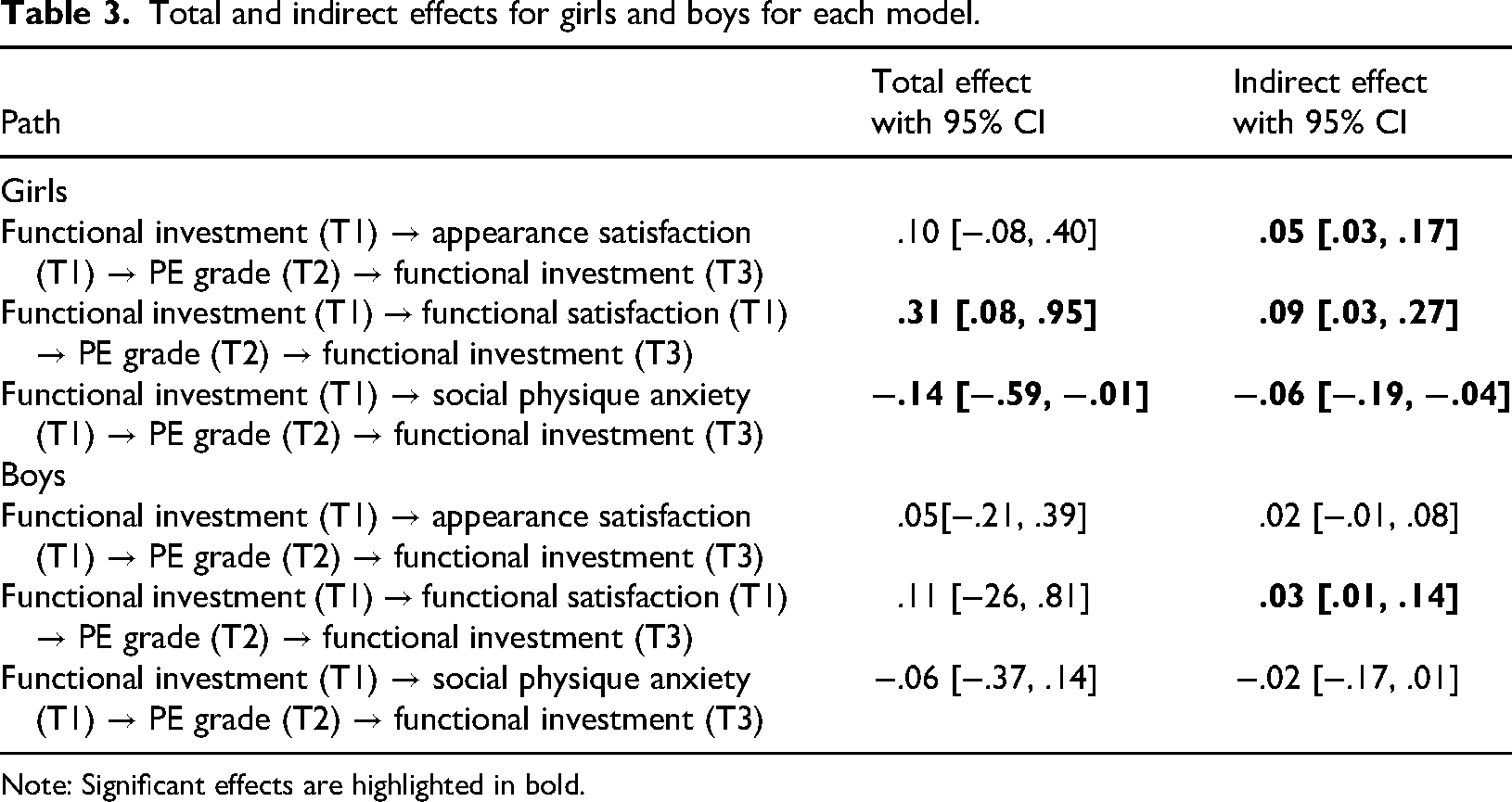
Note: Significant effects are highlighted in bold.
Appearance satisfaction
The overall model fit was acceptable, with robust CFI (.960) indicating good comparative fit and SRMR (.084) falling just within the acceptable range. However, the robust RMSEA was somewhat elevated (.090, 90% CI [.072, .109]), suggesting possible misfit. Given the theoretical relevance of the model and the acceptable fit on other indices, we decided to proceed with the analyses despite the elevated RMSEA. For girls, all paths in the model were significant (p < .05) except the direct path from appearance satisfaction (T1) to functional investment (T3). Controlling for functional investment at T1, appearance satisfaction (T1) predicted grades at T2 (β = .21), and grades (T2), in turn, predicted functional investment at T3 (β = .25). Functional investment at T1 also significantly predicted functional investment at T3 (β = .69). For boys, no paths from appearance satisfaction (T1) were significant. Controlling for functional investment at T1, only grades at T2 (β = .16, p = .03) and prior functional investment (β = .79, p < .01) significantly predicted functional investment at T3.
For girls, the bootstrapped 95% CIs indicated that appearance satisfaction at T1 had a significant indirect effect on functional investment at T3 via grades at T2 (β = .05). For boys, the indirect effect was not significant, suggesting no mediating effect of grades. An additional model was assessed in which the direct and indirect effects were constrained to be equal across groups. A chi-squared difference test indicated that the direct and indirect effects did not differ between girls and boys. For girls, the significant indirect effect suggests that greater appearance satisfaction at T1 was associated with better grades at T2, which in turn were associated with greater functional investment at T3 (see Figure 2).
Social physique anxiety
The structural model for social physique anxiety had adequate model fit, with rCFI = .944, SRMR = .083, and rRMSEA = .073 (90% CI [.061, .086]). For girls, lower social physique anxiety at T1 significantly predicted higher grades in PE at T2 (β = −.28, p < .01), which in turn predicted higher functional investment at T3 (β = .23, p < .01). The direct path from social physique anxiety to functional investment was not significant (β = −.08, p = .34), indicating a mediated rather than direct association. Functional investment at T1 was also a strong predictor of functional investment at T3 (β = .69, p < .01). For boys, social physique anxiety at T1 did not significantly predict either grades at T2 (β = −.11, p = .12) or functional investment at T3 (β = −.04, p = .55). As expected, functional investment at T1 was strongly associated with functional investment at T3 (β = .79, p < .01).
For girls, the bootstrapped 95% CIs indicated that social physique anxiety (T1) had a significant direct effect (β = −.14) on functional investment (T3), which was partially mediated by grade (T2) (β = −.06). The indirect effect showed that girls’ lower social physique anxiety at T1 was associated with higher grades at T2, which, in turn, was associated with higher functional investment at T3. For boys, neither the direct nor the mediated effect was significant. An additional model was assessed where the indirect effect was constrained to be equal between girls and boys. A significant chi-squared difference test showed that the fit of the constrained model was significantly worse, indicating that the indirect effect was significantly different between girls and boys (see Figure 3).
Discussion
This study is the first to explore the associations between PE grades and different dimensions of early adolescents’ body image, focusing specifically on the effects of grades for adolescents’ functional investment across time. For girls, findings were in line with the first hypothesis, showing that greater satisfaction with one's body in terms of appearance and function was positively associated with PE grade. Similarly, girls’ lower social physique anxiety was associated with higher PE grade. In line with the second hypothesis, the association between girls’ T1 body image and T3 functional investment was mediated by PE grade, which suggests that girls’ emotions toward and evaluations of their body have implications for their performance in PE (as measured by their PE grades), which in turn is associated with girls’ functional investment across time. For boys, there was only limited support for the hypothesized models, with the most convincing evidence suggesting a direct effect between boys’ functional satisfaction and PE grade (thus partly supporting the first hypothesis). This direct effect can be viewed as the most expected for both boys and girls, as the associations between functional satisfaction and grade may reflect the perception of one's own physical abilities in PE, which in turn should reflect on grade.
The impact and importance of body image concerns are often highlighted as a gendered issue. Indeed, this is also reflected in the current study and its findings. Even though there is no doubt that boys too struggle with body image concerns (see e.g. Lacroix et al., 2022), girls’ views of their bodies seem to have more profound effects for a number of behavioral, well-being, and academic outcomes (see e.g. Karazsia et al., 2017). This study provides novel evidence that adolescent girls’ relationships with their bodies are important both for their achievement in PE and for their functional investment, which reflects their behavioral investment in physical activity. Since we controlled statistically for baseline levels of functional investment, we could establish that the effect of each body image construct was uniquely associated with change in functional investment over one school year. This further suggests that girls who are struggling with appearance anxiety and low appearance and functional satisfaction may disengage from participating in physical activity settings, which may have detrimental long-term effects for their academic achievement, health, and well-being. These findings also align with the tenets of self-worth theory (Covington, 2000), suggesting that girls may be prone to believe that grades reflect their worth as a person, hence having a stronger impact on girls’ than on boys’ self-perceptions—in this case self-perceptions about the body's appearance and functionality.
For boys there were no direct effects, nor a mediating effect via grade, between the appearance aspects of body image (i.e. appearance satisfaction and social physique anxiety) and functional investment. There were, however, significant direct links between these constructs and PE grades, and between PE grades and functional investment. This suggests that PE grades play an expected motivational role for boys, but without interference from early adolescent boys’ appearance satisfaction or social physique anxiety. Here, the potential impact of puberty for body image and physical activity outcomes should be noted. Previous studies have shown that pubertal status and timing are important determinants of both body image concerns and declined physical activity (see e.g. Finne et al., 2011). As boys enter puberty approximately two years later than girls do (Skoog, 2023), it is premature to rule out a role of appearance-related aspects of body image due to the relatively young age of the present sample. It could be that concerns over one's physical appearance, for example in terms of discontent with “lean muscularity” (Baker et al., 2019), become a more salient influential factor for physical activity engagement as adolescent boys progress through puberty. Future studies could also evaluate the role of different types of body image concerns (e.g. weight concerns vs. muscularity concerns) as gender-specific patterns in the relationship between body image and physical activity outcomes may emerge (see e.g. Grimminger-Seidensticker et al., 2018).
An important study limitation includes the use of self-report of functional investment. We also used self-reported PE grades instead of collecting official records of individual participants’ grades. Due to norms associated with physical activity and a tendency of self-enhancement, research participants may overreport their functional investment (see e.g. Gråstén and Watt, 2016). It should be noted that functional investment is not physical activity per se, but rather self-reported behavioral investment in physical activity and health. Similarly, academic grades are also often over-reported (Kuncel et al., 2005). To remedy the shortcomings of self-report, future studies may want to use objective measures of physical activity, such as accelerometer or pedometer data, and to collect students’ academic grades from official school records. Although this approach might be more intrusive and more time- and resource-consuming, it could provide valuable insights.
Another limitation of the study concerns the exclusion of physical appearance investment, which is conceptually relevant but was not included due to the psychometric limitations of the two-item appearance investment subscale (Abbott and Barber, 2011). Future research could incorporate a psychometrically sound measure of appearance investment to evaluate the role of appearance investment for grades and functional investment. Some prior work suggests that being preoccupied with physical appearance diminishes academic performance (Fredrickson et al., 1998), but this proposition has yet to be systematically tested in adolescent populations. We further encourage future studies to investigate chains of development and the psychological processes underlying the observed findings. For example, it may not be PE grades per se that affect functional investment, but changes in self-perceived physical competency following being graded, which in turn may lead to changes in functional investment across time. Furthermore, early adolescents’ more positive body image may also reflect higher physical competency, which in turn is reflected in higher grades (Allen et al., 2019). Yet, the importance of individuals’ self-perceived physical competency should also be recognized, which stresses the importance of strengthening both actual motor competence and perceived physical competency in all children (Bourke et al., 2025). These limitations aside, the present study yields novel knowledge since it is the first to investigate the associations between academic grades in PE, body image, and functional investment. Strengths include the longitudinal design, a relatively large early adolescent sample, and low attrition across time.
Practical implications and conclusions
In view of the curriculum for Swedish compulsory school (SNAE, 2024) stating that PE should promote an interest in physical activity, healthy habits, and the development of a positive body image, the current findings suggest that being graded appears to benefit students who are satisfied with their bodies and disadvantage those who already experience lower appearance and functional satisfaction and higher social appearance anxiety. This seems particularly true for the early adolescent girls, with results showing that body image may interfere with girls’ academic achievement. These observations are in line with theoretical assumptions (Covington, 2000; Fredrickson et al., 1998) and previous research showing more detrimental effects of being graded for self-concept outcomes among girls and students with more negative self-beliefs (Marsh et al., 2005). Being graded in PE may potentially discourage girls with lower body satisfaction from functional investment in their body, which counteracts the Swedish PE curriculum's goal to foster an interest in lifelong physical activity. Future studies would benefit from incorporating both PE teachers’ and students’ perspectives on how to assess PE learning outcomes in a way that safeguards body image and fosters intrinsic motivation for physical activity.
Consequently, physical educators need to be mindful about the effects that PE grades can have on young people's developing body image, viewing body image as an important component of young people's self-concept and a critical pedagogical issue in PE. Importantly, grades in PE should not only assess physical capabilities but also take a broader perspective on students' physical health competencies. Although this broader perspective is already emphasized in the Swedish curricula for PE in compulsory school (SNAE, 2024), students themselves may perceive that sport motor competencies are the only thing that matters in PE (Larsson, 2016). Further integration of educational content aiming to support positive body image development should be considered. Lessons could include topics on body diversity, media literacy, self-acceptance, and positive role models, as well as an overall emphasis on enjoyment of physical activity rather than appearance and performance. We also suggest an increased focus on body functionality from a wider perspective than physical competency, encompassing everything that the body enables young people to do (Alleva and Tylka, 2021). This would require increased knowledge and awareness of the issue among PE teachers, which underscores the importance of providing training for PE teachers on the psychological aspects of body image and its impact on young people's attitudes toward PE and physical activity overall. Furthermore, grading adolescents during this developmentally sensitive period necessitates a delicate balance between the objective assessment of student performance and the avoidance of negative impact on the student's self- and body image. It is crucial that teachers adopt a supportive and encouraging approach, demonstrating trust and confidence in the student's physical abilities. The present findings also warrant the implementation of early interventions for students who might be at risk of developing negative body image and a subsequent negative relationship to PE and physical activity.
Footnotes
Acknowledgments
We are grateful to all the adolescents who enabled this research.

Funding
The authors disclosed receipt of the following financial support for the research, authorship, and/or publication of this article: This research was supported by a grant from the Swedish Research Council for Sport Science (Grant No. P2021-0149).
Declaration of conflicting interests
The authors declared no potential conflicts of interest with respect to the research, authorship, and/or publication of this article.