



Abstract
Various attempts have been made to emphasise the educational purpose of physical education (PE). Ennis (2011) has noted that understandings of content shift depending on curriculum. The aim of the paper is to explore what the enacted content becomes when the Practising Model is implemented in PE. Four PE teachers, in two Swedish secondary schools, enacted the Practising Model with five classes for 10–17 lessons. Qualitative data were generated in the form of video recordings of lessons, interviews with students and teachers, and student-produced material. The findings are presented as three main content areas: (a) general-subject content, typically teacher-initiated and involving planning and evaluation; (b) subject-specific content, largely student-initiated and encompassing the adoption, appreciation, exploration, understanding, and grasping of movement qualities; and (c) persona-developing content, focusing on character development through persisting and daring. A discussion of the findings using Categorical Bildung is presented, illustrating the added value the enacted content may bring students in terms of their Bildung. The study highlights the diversity of content engagement and the fluidity between content categories. This diversity also introduces a challenge in the changing relationship between content and teaching. The organising centre for PE and its relation to content are discussed. The paper concludes with suggestions for future research.
Introduction
Physical Education (PE) curricula tend to be based on either recreation, sport, public health, or education (Ennis, 2011; Kirk, 2009; Tinning, 2012). In an educational curriculum, PE content consists of knowledge that can be gained in, through, or about (Arnold, 1979) physical activities. In many countries, various attempts have been made to emphasise the educational purpose of PE (e.g. Casey and Kirk, 2020; Quennerstedt, 2019). Such an ambition has been associated with challenges regarding the conceptualising of ‘content’. What should be considered as content in a school subject is never given and instead depends on which curriculum constitutes the teaching of the subject (Ennis, 2011). A curriculum brings a certain perspective on the purpose of education, what is done in education, and what can be seen as valuable knowledge.
Some scholars have used content as a synonym for activities such as tennis, football, and even a collection of activities such as ball games (e.g. Casey and Kirk, 2020; Mustell et al., 2022; Ward et al., 2017). Demonstrating this use, Metzler (2017: 10) proposes that ‘physical education instruction is typically based on content – the activity being taught to students’. Here, Metzler (2017) suggests that school curricula are organised according to content-as-activities and that, as a result, considerations about learning have tended to disappear. Following this argument, content itself has been viewed as a problematic term that conceals the educational mission of PE. Researchers have claimed, for instance, that organising PE by content is problematic and that content should not provide the structure for the school subject (Casey and Kirk, 2020).
Within the framework of an educational curriculum, the aim of PE is to contribute to a general education of all students. However, as the teaching practice of PE often draws from specific sports, the language that accompanies it tends towards the education of sporting specialists (read: athletes) rather than generalists (e.g. Ward et al., 2015). Several different ways of reinforcing an educational curriculum have been proposed, of which the Practising Model is one (Aggerholm et al., 2018; Barker et al., 2018). The Practising Model, in part because of its invitation to students to choose different skills to practise, provides an opportunity to shift PE's focus from activities to educational content. In reality, however, enacted content is never fixed, nor can it be pre-determined – it is always in a process of becoming. This becoming is explored in the current study. 1
Content within the Practising Model
The Practising Model has four critical elements related to pedagogy. These are: ‘(1) acknowledging subjectivity and providing meaningful challenges, (2) focusing on content and the aims of practising, (3) specifying and negotiating standards of excellence, and (4) providing adequate time for practising’ (Aggerholm et al., 2018: 203). At its core, the Practising Model is about the improvement of the self (Aggerholm et al., 2018). Lindgren and Barker (2019: 535) have described it as ‘radically’ student-centred because students are invited to select what they will practise and how they will practise it. Aggerholm et al. (2018: 201, emphasis added) describe content in the model in the following way: [T]hough some activities are arguably more suitable to facilitate practising than others, the content of practising can relate to all parts of the content of physical education, for example practising a particular move or technique (doing a handstand), practising ways of engaging in a game (playing fair), practising to trust the receiver when performing a salto mortale, or practising ways of perceiving phenomena in nature (being receptive), for example.
The authors propose that practising is a way of learning and is not connected to any particular content, a view shared by other scholars (Aggerholm, 2020; Brinkmann and Giese, 2023; Vlieghe, 2013).
In an empirical investigation, Askildsen and Løndal (2024: 3)claim that ‘it is not the content of PE that changes when applying this model, it is the way students relate to content’. In their work, content is used to refer to different aspects of pedagogy, for instance, content-as-activities, content-as-the structure of the Practising unit and furthermore, content is also viewed as knowledge content stemming from French didactique (see also Askildsen and Aggerholm, 2024). In trialling a movement-oriented version of the Practising Model, Lindgren and Barker (2019) provide a somewhat narrower definition of content. They propose that in the context of PE, ‘content comprises embodied knowledge of moving’ (Lindgren and Barker, 2019: 535). The authors go on to suggest that: ‘It is likely that students will participate in different activities during [the Movement Oriented Practising Model] lessons. Irrespective of activity, it should be possible to articulate the knowledge to be learned at any point’ (Lindgren and Barker, 2019: 535). In summary, content within the Practising Model has been described in ways that are in line with an educational curriculum (Ennis, 2011); however, in practice, what it becomes remains exceptionally open. To consider what content becomes, we turn to the Bildung theory on which the Practising Model is partly based (Aggerholm et al., 2018; Barker et al., 2018).
Bildung as a theoretical framework
While well-known in German and other continental European educational circles, Bildung theoretical perspectives have gained popularity in PE scholarship published in English in recent times (e.g. Brinkmann and Giese, 2023; Ruin and Stibbe, 2021; Wibowo et al., 2023). Bildung is a broad cultural and philosophical idea tied to education. It is mainly derived from prominent German philosophers such as Johann Friedrich Herbart (1776–1841), Wilhelm von Humboldt (1767–1835), and more recently Wolfgang Klafki (1927–2016). Founded in the Enlightenment movement, the key goal of Bildung is an emancipated subject who takes responsibility for her life and the lives of others. Education cannot with certainty, however, create Bildung for students. Instead, ‘Bildung is a process realized by individuals as they perceive, interpret, and respond to their realities and, in turn, shape the world in which they live’ (Wibowo et al., 2023: 235).
As distinct from education, Bildung focuses foremost on the evolving child and the process of activating her potential rather than the learning of pre-determined knowledge (Sjöström and Eilks, 2020; Willbergh, 2016). Thus, Bildung can be seen as a process which lasts an entire lifetime (Klafki and MacPherson, 2012). Further, Bildung has an uncertain outcome, making the learning that takes place in Bildung difficult, if not impossible, to examine or measure. In this sense, Bildung has more similarities with the English ideas of self-growth, self-cultivation, and self-formation that are connected to personal emancipation (Hudson and Meyer, 2011), than with education.
A Bildung perspective of teaching encourages educators to consider why different content is taught. In this regard, it is important to consider how content may help students understand themselves and their world in the immediate sense, as well as in their futures (Hudson and Meyer, 2011; Klafki and MacPherson, 2012). From a Bildung perspective, no content is overtly prescribed. Instead, the teacher must choose content and connect it to students’ present lives and their futures, thus making it educational (Klafki, 2006).
Bildung can be divided into different types stemming from different schools of thought and understandings but Klafki often discussed two: Material and Formal (Klafki, 2014). In Material Bildung, objective content is prioritised over students’ subjective development. Objective content can, for example, be seen as knowledge that is considered significant in cultural objectivation such as the rules, tactics, and techniques of different sports. In Formal Bildung, students’ different skills, competencies, and knowledge to master life and live as a ‘good’ citizen take precedence over objective content (Klafki, 2014; Willbergh, 2016). For Klafki, however, Material and Formal Bildung should take place hand in hand (Sjöström and Eilks, 2020). He uses the term Categorical Bildung to set Material and Formal Bildung in dialectical relation to one another (Madsen and Aggerholm, 2020). According to Willbergh (2016), Categorical Bildung refers to: A ‘double unlocking’: the knowledge is unlocked and the student is unlocked. What is essential here is that both the elemental and the fundamental are aspects of content applied in teaching practice: The elemental is content prepared for children in teaching, conceptualised by an adult. The fundamental is content brought into function in teaching, what the child does with it and how his or her perception of things is changed […]. The strength of the theory is its compatibility with teaching practice. It is a content based theory of knowledge-learning, and not a psychological one (Willbergh, 2016: 115).
In this regard, the double unlocking of student and knowledge is imperative in the student's emancipation and self-discovery of the world.
While Klafki (2006) provides a useful way of thinking about content generally, Schneuwly and Vollmer's (2018) exploration of Bildung expands and connects many of Klafki's ideas in a subject-specific way. They suggest that content can be divided into three categories (Schneuwly and Vollmer, 2018: 46):
Learning of or within a subject (knowledge, skills, and subject-specific competencies). This means the reconstruction of content and practices that are specific to a subject. [Subject-specific content] Learning alongside a subject (transferable skills and competencies). This means identifying and using what is generalisable and applicable in other contexts. [General-subject content] Learning through a subject (long-range educational effects that result in Bildung). This means the construction of the individual and social self in dealing, while dealing or through dealing with a specific subject or problem/topic. [Persona-developing content]
These three categories will be used in our data analysis in the first step to identify enacted content. Categorical Bildung will later be used as a way to discuss the findings and conceptualise the potential of enacted content. The way we use Categorical Bildung as an analytical concept will be further elaborated upon in the methodology section.
Clarification of key terminology and aim
In this paper, it is important to distinguish between some key terms that will be used. We use ‘activity’ to denote categories of ‘doing’ in PE lessons. Activities include, for example, gymnastics, basketball, or dance. Important here is that ‘activity’ does not say anything about knowledge or learning. We use ‘knowledge’ to refer to declarative and procedural materials that are needed for successful participation in activities (Nyberg, 2015). We use ‘learning’ to refer to the process where groups and individuals develop an embodied relationship to the declarative and procedural materials that are needed for successful participation in activities (Nyberg et al., 2021). Finally, we use ‘content’ to describe the knowledge that teachers will attempt to teach and students will attempt to learn in official educational contexts. To bring these terms together, students might be involved in a gymnastics lesson (activity), attempting to develop an embodied relationship relating to rotation and centre of gravity that will allow them to perform a forward roll, through processes of learning that involve trial and error, observation of others and so forth. Because a teacher is attempting to teach this knowledge and students are attempting to learn it within an educational PE curriculum, we can consider the knowledge to be content. This knowledge is usually prescribed by a national or state curriculum. As alluded to earlier, a practical risk of confusing content with activities is that teachers become focused on managing activities, rather than teaching particular content. A multi-activity approach increases this risk allowing teachers, at best, to cover content ‘an inch deep and a mile wide’ (Kirk, 2009: 7). Further, there is a difference between intended content (i.e. planned content usually based on official policy) and enacted content (i.e. what students are practising and what teachers are teaching). In this sense, what content becomes is not just a matter between the teacher and the students, but also the curriculum.
While we see potential in the Practising Model to help practitioners focus on educational aspects of PE, to date, only four empirical studies have researched the model. Furthermore, they have either focused on students’ learning and experiences (Askildsen and Aggerholm, 2024; Lindgren and Barker, 2019), teaching (Askildsen and Løndal 2024) or both simultaneously (Askildsen et al., 2024). Content has thus been left essentially unexamined. The aim of the paper is to explore what the enacted content becomes when teachers and students implement the Practising Model in Swedish PE. In the Practising Model students are supposed to practise something and that something could be seen as content. Thus, the Practising Model becomes a method for us to view enacted content. To achieve this aim, we use the previously mentioned three categories of subject learning presented by Schneuwly and Vollmer (2018) as what teachers try to teach and what students are practising, to identify enacted content. In addition, we will discuss the findings using Klafki's concept of Categorical Bildung to conceptualise a potential added value the enacted content may bring students.
Methodology
Data were produced with five PE classes where the Practising Model was enacted. In this section, we include a detailed description of the settings, ethical considerations, participants, model enactment, data generation, and data analysis. The study involved a pedagogical intervention with a collaborative approach, where the first author established a close professional relationship with PE teachers. The researchers identified the issue of concern and aimed to empower the teachers with specific knowledge about the Practising Model and thus enable new ways to teach through a practising approach (Braunack-Mayer and Louise, 2008). A systematic, cyclic process of reflection led to changes in teaching (Ulvik et al., 2018) and the teachers ultimately decided on a specified direction after joint reflection or joint lesson evaluations (Casey et al., 2020).
Settings
Two secondary schools (students aged approximately 13–15 years) from a city in Southern Sweden constituted the settings for the investigation. In School A, each class had three 55-minute PE lessons per week. Two of the lessons were ‘practical’ and took place in the gym, while one focused on ‘theory’ and was taught in a classroom. In School B, each class had two 65-minute PE lessons per week, both of which took place in the gym. In both schools, students from all genders were taught together in PE, as is typical in Sweden.
Ethical considerations
Ethical approval was granted by the Swedish Ethical Review Authority (2022-02600-01). The Swedish Research Council's ethical principles were followed. All participants were informed of the research project in advance and signed individual written consent forms. Students under 15 provided written consent from their guardians. Students were able to take part in the study and cease participation at any time without any consequences. If students chose not to participate in the investigation, they were still required to take part in the lessons but were not part of the data collection. All participants are named with pseudonyms and schools have been assigned letters.
Participants
Teachers and students were purposively selected (Patton, 2014). To be included in the study, teachers needed to: (a) have worked in a Swedish school for at least one year and (b) have completed formal teacher education. Three male teachers and one female teacher were selected. The four teachers chose classes with which they wanted to enact the model, and for students to be considered eligible to take part in the study, they needed to be part of the selected teachers’ classes. One teacher, TJ (four years’ teaching experience, School A), worked with two grade nine classes and enacted the model for 16 lessons with one class and 17 lessons with the other. Ellen (13 years’ teaching experience, School B), Charlie (two years’ teaching experience, School A), and Theo (25 years’ teaching experience, School A) worked with grade eight classes and enacted the model over 10, 12, and 14 lessons, respectively. None of the teachers had previously used pedagogical models in their own teaching and only Charlie and TJ, the most recently qualified teachers, had read about and experienced working with pedagogical models during their teacher education.
Model enactment
The Practising Model was enacted in two phases: pre-implementation and implementation. The first author acted as an organiser, establishing contact, and deciding with the teachers when implementation would be feasible. He was also present at all planning meetings (N = 9) and most lessons (N = 66 out of a possible N = 69 lessons). Therefore, the first author was highly personally involved in this process. The two co-authors also took part in the model enactment but to a lesser degree. Teachers were treated as experts in their field and were continually invited to make decisions regarding implementation (Casey et al., 2020).
Pre-implementation phase
The pre-implementation phase consisted of three planning meetings over six weeks. At the first meeting, the teachers received an introduction to pedagogical models and the Practising Model. Information on the Practising Model was based on three research papers (Aggerholm et al., 2018; Barker et al., 2018; Lindgren and Barker, 2019). In the second and third meetings, the teachers were invited to: (1) read the above-mentioned papers; (2) discuss the Practising Model with the first and second authors; and (3) create a plan for implementation with the first author.
Implementation phase
During the implementation phase, teachers trialled the practising plans that they had developed. During lessons, teachers: asked students to choose goals they were not yet capable of accomplishing; helped students to identify intended learning objectives; and guided students in goal setting that incorporated standards of excellence. In general, the teachers enacted the model in line with the five task-specific activity suggestions provided in Barker et al.'s (2018) text. The task-specific activities involved students: (1) producing a ‘movement history’, which encouraged them to reflect on movement norms; (2) selecting a skill that they would like to learn and estimate how far they would come; (3) locating personally relevant sources of inspiration and instruction for their skills; (4) using the collected sources to help them practise their skills in a series of lessons; and (5) presenting their ‘learning journey’, focusing specifically on aspects of change in their learning. The only difference between the teachers’ enactment of the model and the suggested activities was that three of the four teachers did not use the movement history introduction.
All students chose an aspect of movement knowledge to practise. Students mainly chose skills that their teachers had presented as inspiration. One student chose to practise ‘not giving up’ but practised this through various movement activities. All other students chose movement skills summarised in Table 1.
Table of aspects of movement knowledge chosen by students.
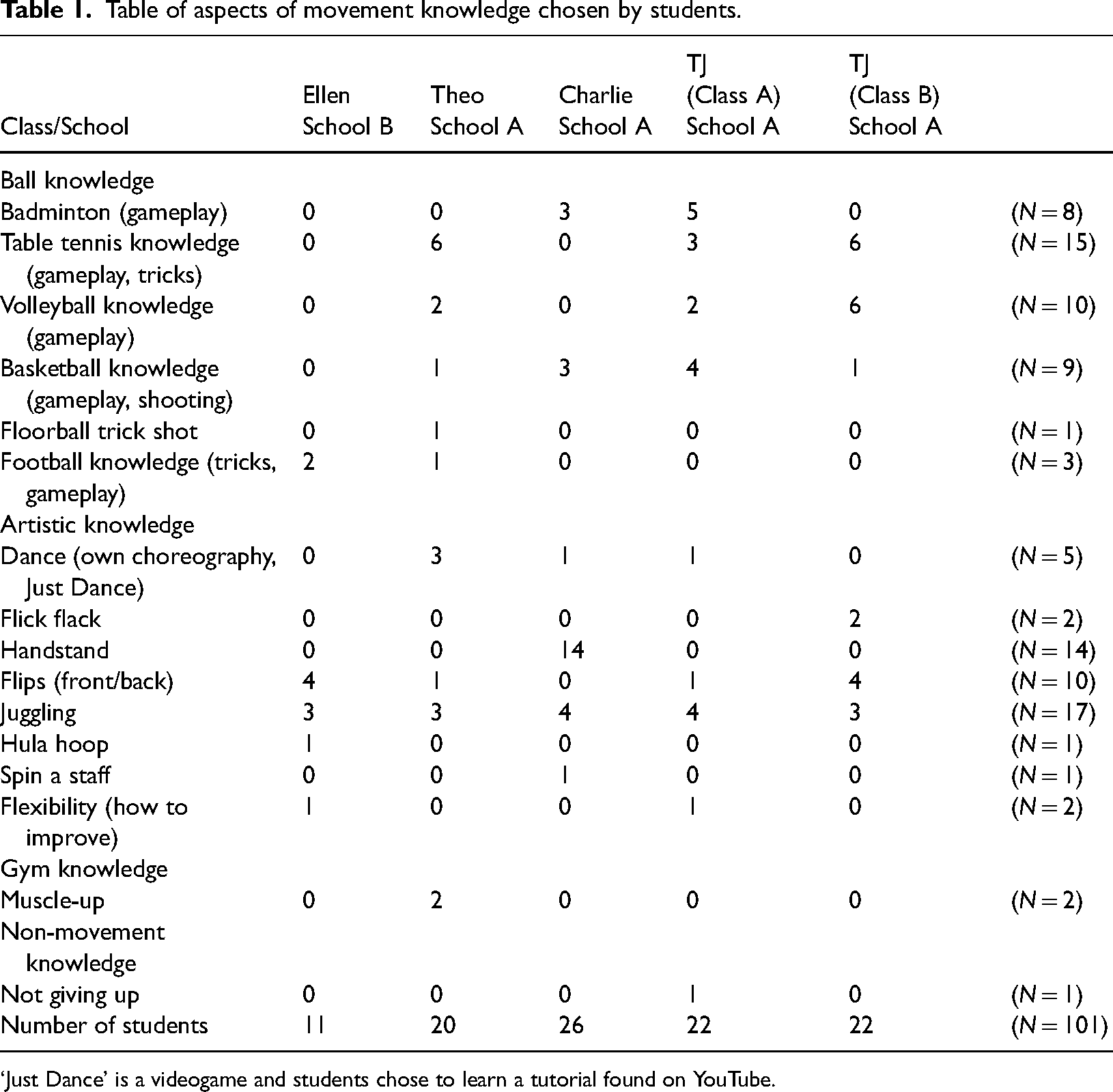
‘Just Dance’ is a videogame and students chose to learn a tutorial found on YouTube.
Data collection
Data collected during the pre-implementation and implementation phases included: (a) video and audio recordings of observed lessons (N = 66); (b) interviews with students and teachers and they included transcripts produced from informal meetings, teacher evaluation interviews (N = 4), and student focus group interviews (N = 5); and (c) student-produced material, including student goal-setting texts (N = 101), self-recorded videos (N = 125), and student evaluations (N = 101). The collected data were used for triangulation where different data sources were brought together to provide complementary perspectives and consequently to deepen our understanding of the topic (Abdalla et al., 2018; Jentoft and Olsen, 2019).
Video and audio recordings from observed lessons
Lessons were recorded with a handheld, wide-angled-lens action camera with an attached microphone for optimising audio quality. Video captured with the camera focused on teacher and student interactions, what students were practising and what teachers tried to teach. Video focused solely on the teachers when they were presenting or talking to groups. At all other times, the camera was manoeuvred to capture students practising and their interactions with the teacher. Approximately 30 minutes of video material was produced per lesson.
Interviews with students and teachers
Focus groups were used for data collection because of their potential to stimulate responses through interaction (Patton, 2014). A focus group interview was conducted with six to eight students per class from each of the five classes after the implementation phase. Four focus groups lasted approximately 55 minutes, and one lasted 40 minutes. The focus group interviews covered students’ experiences of goal setting, documentation, and practising within the unit. All focus group interviews were conducted at each school, and later transcribed verbatim, by the first author. Two of the three authors were present during the first and second focus groups. The first author asked questions and managed the flow of the conversation whilst the second researcher took notes and checked that all questions were covered. An example of a question was: ‘Can you compare how it feels today to perform your movements with the first time you attempted them? Discuss with each other’. The rest can be seen in full in the Supplemental Material.
Informal interviews were also conducted with students and teachers (Patton, 2014). Informal interviews with students were spontaneous conversations and most often initiated by the researcher. They occurred during lessons and provided insight into what the students believed they were learning. Students were asked, for instance: ‘What do you experience as the hardest thing to do at the moment?’, ‘What do you find easy?’, ‘What have you learned?’, and ‘What do you think is going to be the next step in your development?’. These questions allowed students to articulate what they were trying to practise and the obstacles they faced when practising. Informal interviews with teachers were used in iterative discussions while the teachers enacted the Practising Model. In these discussions, teachers often talked about what they experienced as challenging or frustrating and what they felt was working well.
Teacher evaluation interviews were undertaken at the conclusion of the units once teachers had had time to assess the student evaluations. These interviews were semi-structured, lasted approximately 60 minutes, and were transcribed verbatim by the first author. They were conducted individually and in person, at each school. An example of a posed question was: ‘In your perspective, what opportunities have arisen from using the Practising Model in teaching?’ All questions are included in the Supplemental Material file.
Student material
The student material consisted of the students’ goal-setting and evaluation texts, and their practising videos if these were uploaded to the school's learning platform. The students frequently filmed each other but uploading was not required in most classes. Ellen's students also completed entries in a reflective diary for each lesson. A small number of students were present in lessons and were not practising in any recognisable sense. These students were not included in the analysis (N = 7).
Data analysis
In the data analysis, we used investigator triangulation where all three researchers took part and attempted to reach consensus (Campbell et al., 2020). The first author was most involved in data collection and occupied a leading position in the analysis. The second and third authors provided critical points of view (Timmermans and Tavory, 2022). Although data analysis is presented in a linear fashion here, it involved both induction and deduction, in an interpretative way that could therefore be considered abductive (e.g. Earl Rinehart, 2021; Thompson, 2022; Timmermans and Tavory, 2022). Once interview data were transcribed, transcripts were read through for a first impression of what teachers were attempting to teach and what students were attempting to learn. During this phase, segments and key phrases were coded inductively and openly, and recurring features were noted (Timmermans and Tavory, 2022). The student material, goal-setting and evaluation texts were also analysed inductively and followed the same procedure as the interview data. We then worked deductively with the video data, student-produced videos included, to identify instances of learning and teaching. Coding was done with an attempt to conceptualise content in a different way than in terms of (being able to do) the activity. Here, we used Schneuwly and Vollmer's (2018) three types of student learning to code the video data. Codes were collected into three over-arching themes: (1) general-subject content; (2) subject-specific content; and (3) persona-developing content.
Combining the results of the analyses of the interviews, student material, and video recordings, we then searched for patterns within each of the three over-arching themes. We compared and contrasted how the data related to each other and early versions of sub-themes, or what we refer to below as ‘content groups’, were generated (Timmermans and Tavory, 2022). To assist this part of the analysis, we developed a diagram which acted as a discussion tool for the authors concerning how content groups were connected. The first author led the process and presented analysis drafts to the two co-authors, who acted as critical friends. The process was repeated multiple times, whereby the resulting content groups were refined as some codes were moved or merged (Timmermans and Tavory, 2022). The result of this process is presented in diagrammatic form in Figure 1. Each content group contained several thousand words of data. The first author developed interpretative summaries of each content group by synthesising and condensing the original texts. These summaries form the basis for the Findings section below. A final analysis was made in the discussion section where we use Klafki's (2014) Categorical Bildung to conceptualise the potential of what is taught and learned when the Practising Model is enacted in PE.
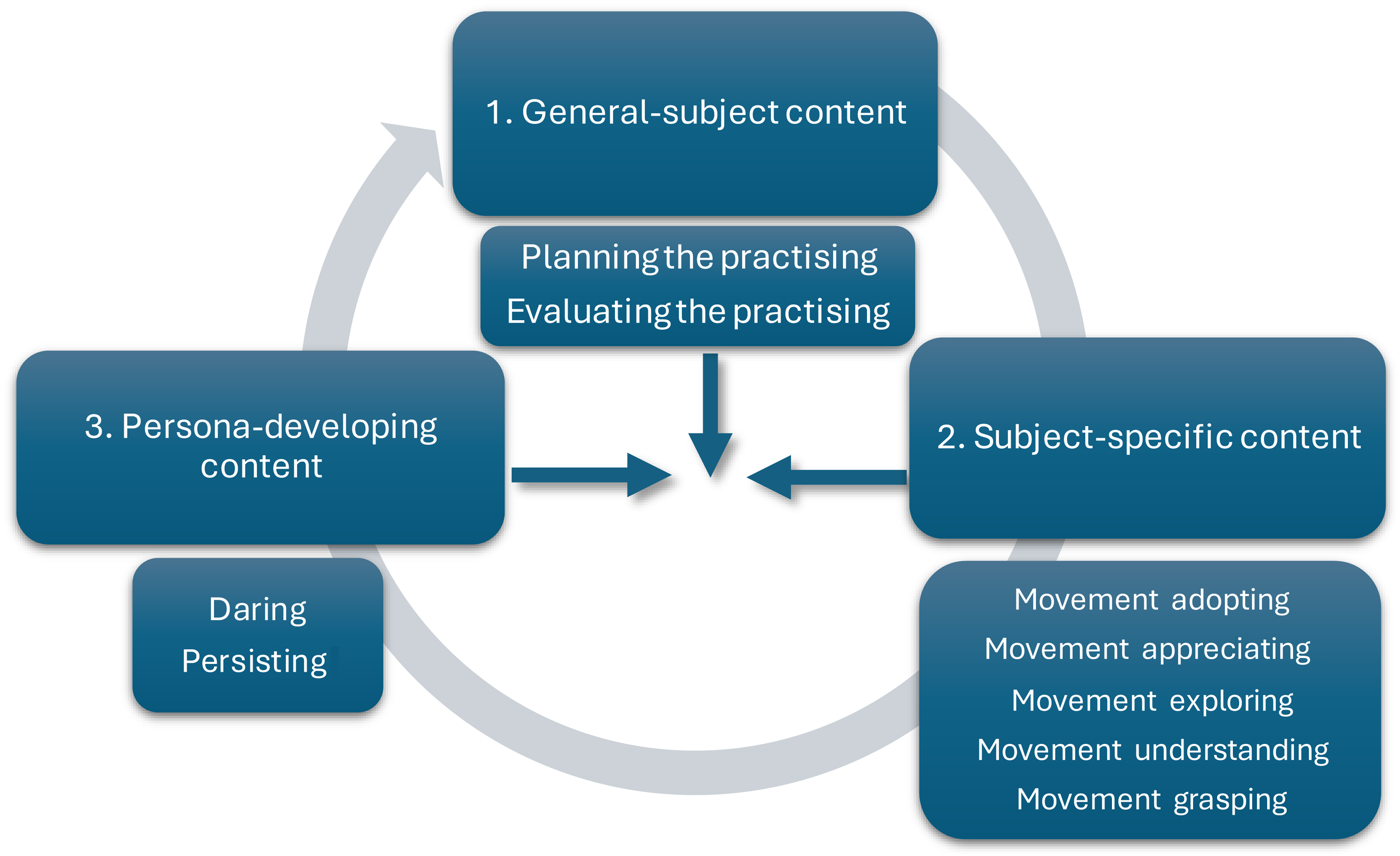
Overview of the enacted content in the Practising Model.
Findings
In this section, we present what enacted content becomes when the Practising Model is implemented in PE (see Figure 1 for an overview). Schneuwly and Vollmer's (2018) three types of student learning helped us to specify the types of enacted content. While the content groups are presented in separate categories, in practice, there was a great deal of overlap as well as reiterations of content groups. Each week students evaluated previous events and enhanced their plans based on their experiences and ideas for improvement, which allowed for new movement adoption and persisting. In practice, the enacted content occurred ‘simultaneously’, but we have tried to identify the dimensions of the content. The findings will be presented in the following order: (1) general-subject content, (2) subject-specific content, and (3) persona-developing content.
General-subject content
The general-subject content enacted during implementation was typically teacher initiated and used to guide the lessons within each unit. This content tended to be introduced and related to in a given order. The general-subject content consisted of procedural knowledge and closely resembled the task suggestions provided in Barker et al. (2018). This content was considered general since the knowledge could also have been introduced and related to other school subjects. Identified content groups here were: (a) planning the practising and (b) evaluating the practising.
Teachers initiated planning by presenting two types of goal setting. The first was described as ‘feeling-driven goal setting’, which involved identifying a movement and breaking it down into smaller parts. The teachers suggested this type of goal setting was appropriate for students who wanted to develop movement knowledge that was difficult to measure. This type of goal setting was outlined by Aggerholm et al. (2018). The second type was referred to as SMART(A) goal setting (e.g. Johnson et al., 2014), which was presented as a systematic process of paying attention to details. SMART(A) is an abbreviation for Specific, Measurable, Attainable, Relevant, Timebound and Adjustable. In line with the central aspects of practising, teachers asked students to choose movement knowledge they had not already acquired and that was personally relevant.
In most classes, the teachers described both types of goal setting and allowed the students to choose which type of goal setting they preferred. One student stated: I've used SMART goals before. Setting up goals is something I like to do because you get an inner drive that pushes you to achieve the goal. What I will take with me to future goals is to really think through what it is I should start with in order to be able to develop what I want (Beatrice, volleyball).
This view was typical, and most students described goal setting as useful. Few students returned to their goals after the first few lessons in an explicit manner. However, as students progressed, they adapted their plans with their goals in mind. One student said: I did not change my goal during lessons because I have learned it's not the goal but the way you approach the goal you need to adapt (Anton, handstand).
The teachers asked students to create practising plans, emphasising that students should have a clear idea of what they would do in each lesson. In School A, students used their classroom lessons to plan for the coming two practical lessons. One student's evaluation assignment illustrates how this occurred: I planned each lesson in Thursday's theory class. It often started with stretching exercises and then different exercises to get up and feel what it felt like to stand on your hands. We did various exercises, for example, the plank, rolling wrists and standing on your hands against a mattress for 20–30 seconds. I thought I learned well from standing on my hands against a mattress because I felt how it would feel to stand on your hands and how you should, for example, breathe and where to look (Sebastian, handstand).
During the classroom lesson in School A, students were able to assess their progress and use their assessments in future planning. Some students also identified new exercises to use when looking for inspirational material on YouTube, TikTok, or instructional websites such as WikiHow. For instance, two students who wanted to become more proficient in badminton chose new inspirational videos as they progressed, often using professional badminton matches to identify specific aspects of gameplay to practise. These students continuously discussed and compared the inspirational video and their self-recorded videos. The teachers also noted that many students took inspiration from each other when planning. Most students’ plans comprised brief lists at first, but they expanded over time as they used sources such as WikiHow to adapt their plans.
The second type of general-subject content involved evaluating the practising. All teachers created their own evaluation criteria for the students to use, but these were based on ideas provided by the first author in the pre-implementation phase. Students were able to do oral or written assignments. All bar two students chose written assignments. Their answers were often brief, even though they had one lesson to answer all questions (see the teacher evaluations in the Supplemental Material). A typical evaluation of the movement learning looked like this: The practising went quite well. The first time we were going to practise, I didn't dare push myself up into a handstand position because I was afraid of losing my balance and falling over and hitting myself. The hard part about practising the hand-standing for the first time was being in a straight position. When I got up, I was like a snake but after I practised a few lessons, my straightness got a lot better and that was the least I had to worry about. At the end of my practise, the most difficult thing was keeping the balance, so I might have to practise more on that to succeed in my handstand. […] What I would need to be able to stand on my hands is more time because then I could practise my balance and after that I'm pretty sure I could do it (Karl, handstand).
Karl's quote was typical and the students frequently described challenges and how they overcame them. The responses also contained reflections on areas that required improvement and how improvement could be achieved. Student self-evaluation proved valuable for the teachers, with several noting that it helped them see their students in a new light. Theo, for instance, noticed a different attitude to the project than he anticipated and reflected on the benefits of the evaluation. In the interview, he said: When reading evaluations afterwards. […] Some of the ones that I kind of thought would be negative were quite positive. It's mostly those students who may struggle a bit with sports. […] Their experiences I can say generally, they were quite motivated. But that wasn't really what I saw during class time. So, it's probably important that it's not just what you see. But you also have to talk to them and read evaluations to also understand their experiences (Theo, teacher).
Students who were relatively passive in the gym displayed positive attitudes in their written evaluations. It is of course possible that students wrote what they believed their teachers wanted to hear, but the students’ self-evaluations were not only about their effort. TJ, for example, claimed that students expressed a deeper understanding of volleyball tactics and technique in their evaluations than they showed while playing volleyball. He was surprised by the depth of knowledge his students were able to express in words with regard to tactical ideas, techniques, and communication on the court.
Subject-specific content
In the subject-specific content group, content was to a greater extent initiated by students themselves while practising. The five groups of subject-specific content we generated based on the data were: (a) movement adopting; (b) movement appreciating; (c) movement exploring; (d) movement understanding; and (e) movement grasping (in an embodied way).
All students ‘adopted’ aspects of movement knowledge when they started practising. Adoption entailed finding meaningful ways of practising. This was done in both subtle and overt ways. Students rarely received specific instructions from the teachers about how to practise. There was considerable variation in the ways the students created practising routines. Some copied practising movements from their peers, others adopted movement routines from their inspirational videos. Some students created warm-up sessions based on different drills in a sequenced fashion, while some listened to music whilst doing a task related to their chosen skill. Others focused on simply trying to perform their aspects of movement knowledge directly. One student said, for example: I think the best way for me to learn is just to be practising and not do a bunch of activities (Emma, juggling).
A few students created routines in groups whilst most students preferred to start out practising by themselves.
Movement appreciating was a second type of subject-specific content. Teachers spent time helping students to use video to reflect on their movement practising. Teachers also discussed with students how to analyse their movement, both in the gym and the classroom. TJ, for example, showed his students a video of himself playing golf. He talked about seeing the movement pattern and dividing it into parts and recommended using slow motion. Students claimed that viewing videos of themselves was very helpful. One student said: I think the filming was a great help since you can re-watch the video as many times as you want and see what you need to practise more and what you are already good at (Mia, badminton).
Movement exploring constituted a third type of subject-specific content. The exploration involved experimentation and again there was variation with some students trying out many alternatives and some trying just a few. Two students in Theo's class were practising a muscle-up.2 They experimented with grip width and position, and timing of position changes. They worked with plyometric bands and peer support. Between attempts, they performed strengthening exercises. In Ellen's class, a boy and a girl worked on juggling together. They challenged each other with new patterns of tossing the balls and new rhythms, and experimented with implementing tricks whilst juggling. In these ways, they took inspiration from one another in their learning.
A fourth type of subject-specific content was movement understanding. This content involved an embodied understanding of the biomechanics of the movement. Students enacted this content in similar ways to movement appreciation, as discussed above. Movement understanding, however, included an even more nuanced understanding of their learning, and it was possible for students to appreciate movement principles without necessarily being able to perform the movement. Demonstrating this idea, one student said: I hit my digs in volleyball wrong which led to the ball not ending up where it should have been. In order to do a good dig, you should have tightly held hands with the palm facing up and with ball contact on the lower arm. As you can see on the video, that's what I try to do but the ball almost hits my face and it's very low. It's because I held my arms wrong (Anna, volleyball).
The final type of subject-specific content is movement grasping, in an embodied sense. This content involves performing movement – or moving – intelligently. The teachers approached this content through incorporating much of the already mentioned content groups. The teachers all stressed, for instance, the importance of adopting movement knowledge, seeing nuances, as well as exploring when practising in order to perform movements with better quality. For example, when working with the students who practised front- and back-somersaults from the trampoline, TJ changed the conditions for the students with respect to speed, distance, height when using the trampoline or not, different forms of tucking, and use of arms. However, some students were able to perform a movement without being able to discern the specific ways they were moving. In this regard, there are distinct qualitative differences between content groups, even if they are closely related and at times dependent on each other.
Persona-developing content
In the third category, persona-developing content, two content groups were identified which both involved character. We termed these two content groups: (a) persisting and (b) daring.
Regarding ‘persisting’, most students – in line with the teachers’ instructions – stayed with their chosen movement goals for the duration of the unit. Still, several students switched goals and a handful lost interest and engaged in off-task activities. Many students who persisted reported that competition, either with others or with themselves, helped them to remain focused on the knowledge they had selected. Students were sometimes frustrated about not being able to perform movements as anticipated. In these cases, students described persisting as particularly difficult. The student practising ‘not giving up’ tested different ‘ways of thinking’ when she tried a variety of exhausting exercises such as the ‘plank pose’, ‘sitting 90 degrees against the wall’, and the ‘beep test’. In an excerpt of her evaluation after 16 lessons of practising, she reasoned: I was practising on what I should think in order to continue, e.g. ‘you will not be satisfied if you stop now’. […] Another sentence I thought about was ‘There's not much left now’. Then I tricked myself into continuing to fight […] I think these sentences worked but I would like more time to try it (Josefin, not giving up).
Several students mentioned that ‘acceptance’ was important for persistence. For them, achieving their goals was not as important as putting in effort. Patience was also mentioned by both students and teachers. Both groups stressed that development takes time and if you are patient, you will eventually become better.
In the content group ‘daring’, we identified students who wanted to learn a movement which included some aspect they found particularly challenging or scary. These movements included handstands, somersaults, and flick flacks, where students perceived potential danger if they did not perform the movement safely. The teachers tried to help students overcome their fears by suggesting ways to practice. For example, the teachers suggested adjusting the speed of the run up to the trampoline and adding obstacles to increase height in the vertical jump. One student reflected on what he experienced as difficult whilst practising the back somersault: [T]he most challenging thing for me has been to dare. In the beginning, I had great difficulty daring to tuck and to even throw myself backwards (Leo, backflip).
Students who were practising other movement knowledge within activities such as volleyball, juggling, or dancing also worked with overcoming fear but in a different sense. Some needed to dare to perform their movement in front of others. Others needed to dare to trust in their own ability. For these students, practising was about overcoming fear of failing to achieve a particular goal or not being able to perform well in relation to narrow (and mainly implicit) standards.
Discussion of findings using Categorical Bildung
We set out to explore what content becomes when the Practising Model is enacted. Seven types of enacted content were found that could be divided into general content, subject-specific content, and persona-developing content. In this section, we use Klafki's (2014) Categorical Bildung to discuss the findings. Categorical Bildung allows us to consider how enacted content can affect students’ self-growth. As previously stated, all enacted content should be understood as interdependent, overlapping, and (at times) happening simultaneously, although, for analytical reasons, we have presented them as separate and sequential. The concept of Categorical Bildung allows us to consider the ways in which the enacted content can open the world for the student and the student to the world. Metaphorically, Categorical Bildung can be considered such a ‘double-unlocking’ (Willbergh, 2016). Therefore, Categorical Bildung becomes relevant to use as a lens and the findings suggest one area in which it potentially can take place. This area for students’ actualisation in inner development is their capability to act responsibly. Figure 2 illustrates the iterative enacted content, the intersection, and the potential of Categorical Bildung.
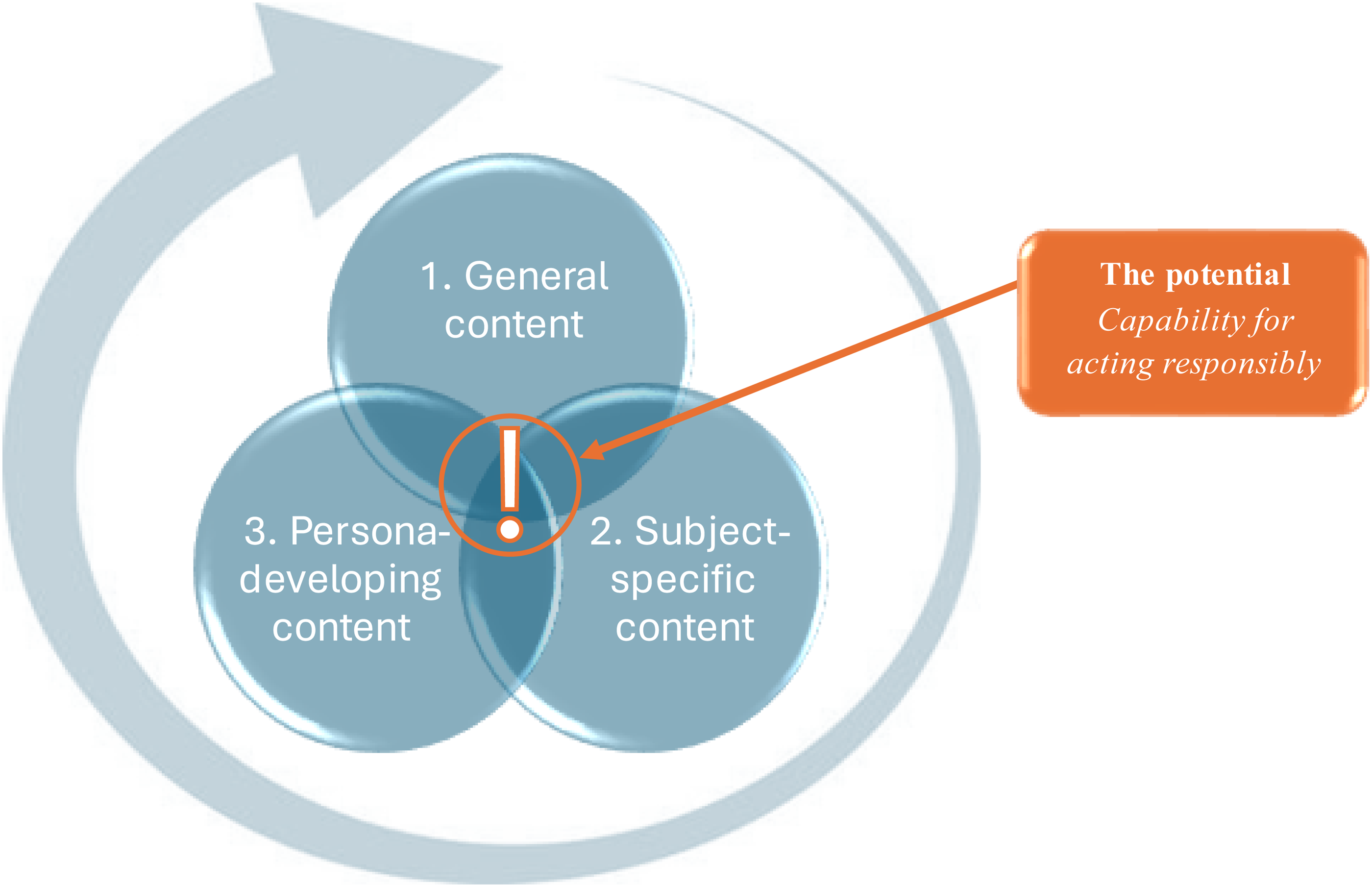
Enacted content from the Practising Model and the potential of Categorical Bildung.
In the intersection of the enacted content in the Practising Model, there is one explicit aspect of potential self-growth for students: capability for acting responsibly. The Practising Model has a clear focus on being agentic, that is putting effort into improving oneself. This is realised by students taking responsibility for choosing something to improve, actively participating in the lessons, and exploring the uncertain which represents the other. The connection between self and other may help students find their chosen skill meaningful (Klafki, 2006). Responsibility to make choices, to focus on oneself, to help other classmates, and to put in effort, even when a task is scary and success is not guaranteed, are crucial when enacting the model. Additionally, discontinuity and risk have been noted to be important for further personal growth of students (Askildsen et al., 2024). These aspects seem important for the students’ futures and it is possible through Klafki's (2006) perspective to suggest this content is educational. Further, when students are exploring ways of practising, through evaluating the practising, and persisting in practising, they have to constantly manage their responsibility. In a sense, responsibility seems to be a subtle yet ever-present aspect of schooling (Biesta, 2015; Quennerstedt, 2019). For Klafki (2014), responsibility is also something students must understand and in the Practising Model, it takes a prominent role.
The teacher is unable to ‘serve’ students with knowledge when it comes to practising. This does not mean that teachers should be passive or are not needed. Instead, the amount of engaging with each student needs to be made individually by the teacher, especially since students are differently capable of taking responsibility. As we see it, all content is needed for the potential to be reached. For this to happen, content needs to be made visible to the students; otherwise, it is unclear what they should take responsibility for.
Concluding thoughts
In this paper, we have examined what content becomes when the Practising Model is enacted. The main challenge in understanding content in the Practising Model is that the distinction between teaching and content becomes blurred. In traditional PE, the teacher teaches ‘the content’, which is often simply movement executions or techniques. However, if content is viewed as verbs such as planning, exploring, and daring, then the teacher is involved in a different type of teaching. The teacher must engage in multiple kinds of teaching. They must be knowledgeable in different kinds of knowing (Nyberg, 2023), rather than have knowledge of only techniques. Further, as suggested in other research, both teachers and students can find it difficult to work in a setting with a strong student-centred character, especially if they are used to working with teacher-centred pedagogies (Casey, 2014).
Content may be used to denote different aspects of educational contexts. Even closely related theoretical perspectives such as French Didactique (e.g. Askildsen and Løndal (2024), German perspectives of Bildung (e.g. Wibowo et al., 2023), and Klafki's Categorical Bildung provide different views of content. Due to these potential differences, we believe it is important to reflect on how physical educators understand content. In our view, content can and probably should provide the organising structure of PE if it is understood from an educational perspective. If activities or sports act as organising centres for PE, we risk missing the place of knowledge within the subject. Activities and sports, and indeed pedagogical models, may of course help in the forming of an educational curriculum; however, a curriculum does not automatically become educational simply because it is based on models (Casey and Kirk, 2020). Enacted content only becomes educational when it becomes meaningful for students (Klafki, 2006). Therefore, the promise of the Practising Model is the premise of capturing meaningful content for students. We believe future research could use Bildung theoretical perspectives to analyse enacted and becoming content in other models. We also see a general need to develop understanding in relation to the Practising Model in PE regarding content, teaching and learning.
Supplemental Material
sj-docx-1-epe-10.1177_1356336X241298629 - Supplemental material for Exploring the enacted content of the Practising Model: A Bildung theoretical perspective
Supplemental material, sj-docx-1-epe-10.1177_1356336X241298629 for Exploring the enacted content of the Practising Model: A Bildung theoretical perspective by Robin Lindgren Fjellner, Håkan Larsson and Dean Barker in European Physical Education Review
Footnotes
Acknowledgements
The authors extend their sincere gratitude to Øyvind Standal for insightful critique during the development of this paper.
Declaration of conflicting interests
The authors declared no potential conflicts of interest with respect to the research, authorship, and/or publication of this article.
Funding
The authors received no financial support for the research, authorship, and/or publication of this article.

Supplemental material
Supplemental material for this article is available online.
Notes
Author biographies
References
Supplementary Material
Please find the following supplemental material available below.
For Open Access articles published under a Creative Commons License, all supplemental material carries the same license as the article it is associated with.
For non-Open Access articles published, all supplemental material carries a non-exclusive license, and permission requests for re-use of supplemental material or any part of supplemental material shall be sent directly to the copyright owner as specified in the copyright notice associated with the article.
