



Abstract
In many countries, fitness testing is used in physical education (PE). Advocates of fitness testing maintain that testing promotes physical activity and has long-term health benefits. Other scholars question using fitness tests for children in educational contexts and describe them as demotivating, embarrassing, and humiliating. The purpose of the study is to contribute to this educational dilemma with knowledge on the use of “fitness tests” in PE practice. This is done by exploring a pedagogical intervention in Sweden where tests were used to teach from a norm-creative perspective and considering how bodies with different weight and form could be included. We draw on “new materialist” methodologies, asking what tests do and can do in PE practice. In our analysis, we brought together six affective elements of what tests do. Many tests produced traditional PE practices, and there were apparent silences regarding body hierarchies, which often render big bodies invisible. Teaching tests paradoxically, however, also produced opportunities for creativity in moving and opportunities to reflect upon norms about justice and “normal” bodies. This analysis highlights the potential of teaching with the test in order for fitness tests to become educational.
Introduction
In countries such as Australia, the UK, and the USA, the use of fitness testing and tests of physical literacy or motor development are common aspects of the physical education (PE) curriculum (Alfrey and Gard, 2014, 2019; Cale et al., 2014; Keating and Silverman, 2004). Advocates of fitness testing in PE maintain that testing promotes physical activity and that it has long-term benefits regarding healthy lifestyles (e.g. Silverman et al., 2008; Simonton et al., 2019). Keating et al. (2020: 552) contend that “if used appropriately in schools, youth fitness testing can play a significant role in promoting a physically active lifestyle among school-age children.”
Some research also suggests that teachers and students experience fitness testing in positive ways. For example, Fredrick and Silverman (2020) report that teachers in their study displayed a positive attitude toward fitness testing in school and that teachers’ attitudes had a positive relationship with students’ performance in the tests. O’Keeffe et al. (2021) also highlight that, in their study, students had a positive attitude toward fitness testing, and Liu and Keating (2021) conclude that fitness education could improve in order to develop more positive attitudes among students toward health-related fitness tests.
Fitness testing in PE has, however, proven to be a contentious issue (see e.g. Alfrey, 2024; Alfrey and Landi, 2022; Larsson and Quennerstedt, 2012; Simonton et al., 2019). Several scholars question the validity and rationality of fitness tests for children in an educational context and describe testing as demotivating, embarrassing, and humiliating (e.g. Alfrey and Gard, 2014; Cale and Harris, 2009; Safron and Landi, 2022). Problematic practices, such as weight or body composition monitoring, including skinfold measuring and fitness testing to grade students, are strongly criticized (Cale et al., 2014). Silverman et al. (2008) also propose that fitness testing can be and is being conducted in ways that are damaging to children and young people, making them less likely to be physically active.
Critical researchers have further paid attention to the consequences of testing fitness. Cale (2021) argues that the links between testing and promoting physical activity are weak. Yager et al. (2021) state that students may experience a decline in self-esteem due to testing regimes, while Safron and Landi (2022) describe negative experiences of diverse students when tests like the beep test are used in school settings. Using a figurational lens, Alfrey and Gard (2019) further highlight how scientization and shaming become consequences of fitness testing in PE, despite the lack of evidence of positive outcomes. Recently, Alfrey (2024) explored students’ experiences of fitness testing in PE. Alfrey claims that fitness testing becomes a source of fear and embarrassment and that testing lacks meaning for young people. Students recommended changing when, how, and with whom the tests were conducted to minimize comparisons and public exposure.
Despite criticism, fitness testing in school PE takes place, and we contend that testing, or indeed testing in certain ways, are educational choices that have political and moral implications. Heavily inspired by the scholarship of Alfrey and Landi (2022), Alfrey and Gard (2019), as well as Safron and Landi (2022) and their collective scrutiny of fitness testing, our broad ambition is to contribute with knowledge on how tests can be used educationally. Following Alfrey and Landi (2022), we focus on what students learn, if the tests are just, what is measured in the tests, as well as letting students create their own personally relevant tests. The purpose of the study is to contribute with knowledge on the use of “fitness tests” in PE practice. This is done through an exploration of a pedagogical intervention in a school in Sweden where tests were used to teach from a norm-creative perspective in relation to how different bodies could be included. During the pedagogical intervention, the students tried different tests, discussed if they were just, and created their own tests. In our analysis, the focus was on what tests and testing do in the practice of PE.
Theoretical considerations
In the design of the pedagogical intervention, we used norm-critical and norm-creative strategies to disrupt what tests and testing can be in PE. Over the years, different critical, norm-breaking teaching approaches have emerged. These generally constitute attempts to develop methods of democratic or anti-oppressive education. Kumashiro (2000), for example, calls on educators to critically examine the everyday decisions of teaching and learning. He proposes that teachers can design anti-oppressive education through critical reflection and thereby affirm social justice.
Following Kumashiro, we worked with a PE teacher to create teaching using tests from what has been called a norm-critical perspective (Bromseth and Sörensdotter, 2014), with a focus on norm creativity (Vinthagen and Zavalia, 2014). According to Bromseth and Sörensdotter (2014), norm-critical pedagogies are about the process in which norms create and establish hierarchical difference. Change is, among other things, assumed to be achieved through the practice of undermining and disturbing oppressive norms. However, the practices of norm creativity take us beyond a norm-critical analysis into processes of (re)creation and transformation. While norm criticism unmasks, names, and challenges dominant norms, norm creativity also helps us to explore, shape, and test out possible new practices (Wikberg Nilsson and Jahnke, 2018). Furthermore, we assume that not only language but also materialities have a significant role in the production of and undermining of norms, as well as in the creation of new ones.
When developing the pedagogical intervention with the teacher, Kumashiro's (2000, 2004) paradoxical ideas of teaching were also imperative. Kumashiro proposes that teachers can challenge dominating social norms, in our case regarding body weight and body form in PE, by teaching paradoxically. Kumashiro (2004) argues that instead of aiming to change students so that they can challenge norms, teachers’ focus should be on changing their teaching. As Kumashiro (2004: 113) explains: “one barrier to anti-oppressive teaching is the very notion that good teaching happens only when students respond in ways that we want them to respond.” 1
Analytical framework
While in the design of the pedagogical intervention, we used norm-critical and norm-creative strategies, this approach did not fully help us in the analysis of our data. In line with Kumashiro's anti-oppressive teaching (2000) and the norm-creative approach we used, we looked for an approach that could help to explain how events close down and stay the same, as well as how events open up for new possibilities, particularly since we were interested in the “role” of tests and testing as materialities (see e.g. Alfrey and Landi, 2022; Rotas, 2014). Hence, in the analysis, we draw on “new materialist” methodologies as introduced by Alldred and Fox (2017), Fox and Ward (2008), and Fox and Alldred (2022) (and used in PE on fitness testing by Alfrey and Landi, 2022). Building on the theories of Deleuze and Guattari, these authors provide a way to understand issues of, for example, health or body weight as a dynamic relation between culture and biology, focusing on events encompassing “the material effects of both nature and culture that together produce the world” (Alldred and Fox, 2017: 1163).
“New materialism” is often described as an ontology that is monist, relational, and focused on matter. As such, it helps shift researchers’ attention to events in which different elements (human and non-human bodies, as well as social and abstract entities) assemble and interact. The elements of these events affect and are affected by each other, producing capacities to desire and act. The concept of “assemblage” captures how an event is a coming together of affective forces, both “forces produced in the present event and accumulative capacities that bring together affective forces from previous events” (Andersson et al., 2020: 7). Affect is here understood as a performative force that moves the elements in the assemblages in different directions and produces a change of state or capacities (physical, psychological, emotional, or social) of an entity, human or non-human (cf. Fox and Alldred, 2016: 24). Simply put, affect is, as Fox and Alldred (2016: 24) remind us: “the capacity to affect or to be affected.”
Monism in this context entails a rejection of predetermined, metaphysical dualisms such as mind/matter, body/mind, or micro/macro. Instead, any event that is being explored is understood as part of broader assemblages in terms of affective relations and engagements. Hence, the focus of analysis is on the “production of the social world at the level of the everyday event” (Fox et al., 2018: 114). For us, “new materialism” is used as an analytical toolkit helping us in making tests used in PE in terms of a “testing-assemblage” the unit of analysis rather than exclusively focusing on the actions of teachers and students.
From this perspective, we conceive tests in PE, and indeed research itself, as local events that are part of broader, more-than-human assemblages. Within these events, bodies, activities, relations, material objects, ideas and so forth do not have single fixed meanings. Instead, they can be understood and explored as a “testing-assemblage” in terms of relations of different bodies and elements affecting each other and being affected by each other, creating an “affect-economy.” Here, we turn to Fox and Ward's (2008) suggestions for exploring health and, in particular, their questions regarding what bodies do, what bodies can do, and what else bodies can do. However, it is not only the materialization of bodies that is of interest but also the material aspects of the event. Such events include, for example, the agential contribution of locality, equipment, and, in our case, tests.
In the discussion, we also draw on the related concept of the micropolitics of material forces within an assemblage (Alldred and Fox, 2017; Fox and Alldred, 2022). Here we discuss micropolitical consequences of the “testing-assemblage” enabling or constraining actions in PE. We then draw on the idea of territorialization, which is a process of specification defining the borders of the assemblage in terms of what bodies or tests can do, and de-territorialization, which is a process of generalization that opens up the borders of the assemblage, producing new possibilities in terms of what else bodies or tests can do. De-territorialization thus opens up for a discussion regarding new capacities to move and act and, in our case, how tests produce agential capacities in PE.
Method
The context of the study is Swedish PE. Larsson and Karlefors (2015) propose that Swedish PE focuses on trying out different activities in noncompetitive environments, experiencing joy of movement, being physically active, and enhancing social relations. In relation to tests, Larsson and Quennerstedt (2016) also argue that in Sweden, fitness testing with the purpose of promoting physical activity and healthy lifestyles is relatively uncommon. Larsson and Quennerstedt contend that when tests are used, they are usually used to provide students with possibilities for reflection, rather than to measure students against standards. As Larsson and Quennerstedt (2016: 78) maintain, “fitness tests are thus regarded as any other activity in PE, which in a similar way to sport, are to be presented and experienced as enjoyable.”
Setting and participants
The study is embedded in a larger project where we investigated how teachers in Swedish PE articulate, practice, and reformulate obesity discourses (Barker et al., 2020, 2023). From the previously conducted interviews, we contacted one of the teachers who showed a particular interest in working with and counteracting discourses of body weight in his teaching practice. The teacher had 10 years of experience in teaching PE. During the study, he was teaching students ranging from 13 to 15 years of age in a city with approximately 35,000 inhabitants in Sweden. From our initial discussion with the teacher, two classes with students aged 15 were selected for the study. Each class contained approximately 25 students in mixed-gender groups.
Pedagogical intervention and data generation
The study was guided by a collaborative approach involving discussions where the teacher is placed at the center (see e.g. Larsson and Karlefors, 2015). In the collaboration, the researchers and PE teacher worked together to develop norm-creative practices in relation to body weight and body form.
The first step in our collaborative approach started with a meeting between the research team and the teacher. We discussed how we could develop and try out new ways of teaching, focusing on norms about bodies and the inclusion of overweight students in PE. After our first meeting, we did two classroom observations to see how the teacher worked to get a sense of the context for PE teaching in the school. The observations were followed by an interview with the teacher, focusing on overweight and large bodies in PE teaching.
In the second step, we presented and discussed introductory teaching material for norm-critical and norm-creative work with the teacher. The material included short explanations of concepts such as norms, norm critique, and norm creativity. It included suggestions for general strategies and methods, as well as concrete exercises and lesson planning.
The third step started with determining a relevant design for different lessons. Different content areas were discussed, with one area being tests. The researchers introduced examples of tests that could challenge prevailing norms in PE. Here, norm creativity was guided by the following questions: How can tests become inclusive, safe, and meaningful? How can pupils be given possibilities to explore and critically examine tests, and what kind of qualities of movement are tested? From these collaborative discussions, the teacher developed a set of “alternative” tests as well as more traditional tests, which were to be used both in classroom teaching and in the gym. Tests used by the teacher were: (i) Stationary jump, marking the height of the jump in centimeters, (ii) Running the same distance twice in the same time, (iii) Moving like a cat (evaluated by peers), (iv) Remaining in the plank position for as long as possible (measured in seconds), (v) Throwing a match stick as far as possible (measured in centimeters), (vi) Following-the-leader (follow movements of peer as exactly as possible), (vii) Lasso throwing (performance based on whether the lasso caught the target), (viii) Being able to drop a pencil that is tied on a string around the waist into a bottle without using hands (performance evaluated on whether the task is achieved or not), (ix) Picking peas with a clothespin (measured in the number of peas), (x) Throwing a ball into a bucket (distance 2 meters), (xi) Doing five strides with equal distance between them, (xii) Hanging on wall bars (measured in seconds).
In the following lessons with the two classes, the teacher used norm critique to discuss norms with the students and asked them to discuss what a fair test might look like. The students were then invited to create “fair” tests in groups. These tests were then tried out in the gym and evaluated. Between the sessions, we conducted short follow-up conversations with the teacher and a more extended conversation after the whole set of teaching sessions was over. The process ended with two focus group interviews with students participating in the sessions, lasting approximately 40 minutes each. The focus group interview guide was organized around the issues of justice, qualities of movements, body norms, “other bodies,” testing of other qualities of movement, and the significance of breaking the norm. Examples of interview questions were: do you think tests in PE generally are fair, and are there tests which are more fair than others? When you designed your own tests in the class, did you consider what they were measuring? When you created your own tests, what were your thoughts regarding equity and fairness? Were there any of the created tests which worked particularly well in including everyone? What was your experience of testing other types of movements in PE than the usual ones?
During the focus group interviews, images of bigger bodies involved and active in PE or performing physical exercises and different movements were used with questions like: if these people, with these bodies, had been part of the class and had tried the different tests, were there any tests they could not have been able to participate in, or others they would have been able to participate in, on equal terms?
Overview of generated data:
Notes from preliminary discussions with the teacher ahead of teaching. Interview transcripts from two interviews with the teacher ahead of teaching for the pedagogical intervention. Field notes from two observers of classroom teaching on tests and norms (two classes, year 9). Field notes from two observers of the gym-based lessons where students tried out the teacher-developed tests (two classes, year 9). Field notes from two observers of classroom teaching where students created their own tests (two classes, year 9). Field notes from two observers of the gym-based lessons where students continued to develop, present, and try out student-generated tests (two classes, year 9). Transcripts from two focus groups with nine students in total.
Data analysis
In order to investigate what tests as events do as a “testing-assemblage” in the practice of PE, we used Fox and Ward’s (2008) suggested steps for analysis adapted to our analysis regarding the agential contribution of the tests. In this way, we were open to the more-than-human as well as flows of affect in the events (Fox and Alldred, 2022).
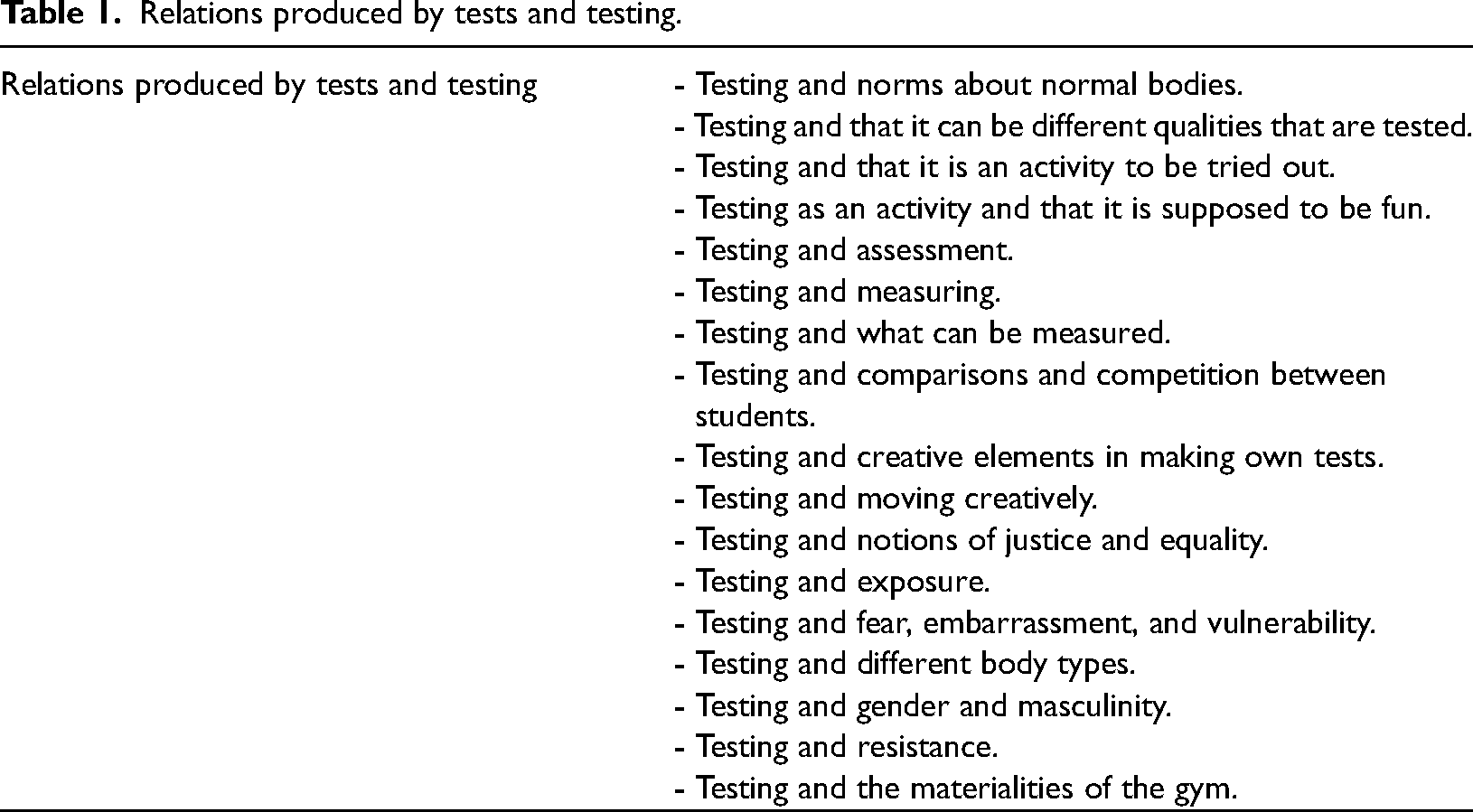
The first step involves transcribing data fully. In our project, we transcribed teacher and student interviews verbatim. After taking observation notes in PE practice, we fleshed the notes out with reflective comments from both observers so that a thorough report from the observations could be analyzed. In the second step, all generated data were read closely to identify relations and affects produced by the tests. The relations were then brought together with a keyword or short phrase (see Table 1).
Relations produced by tests and testing.
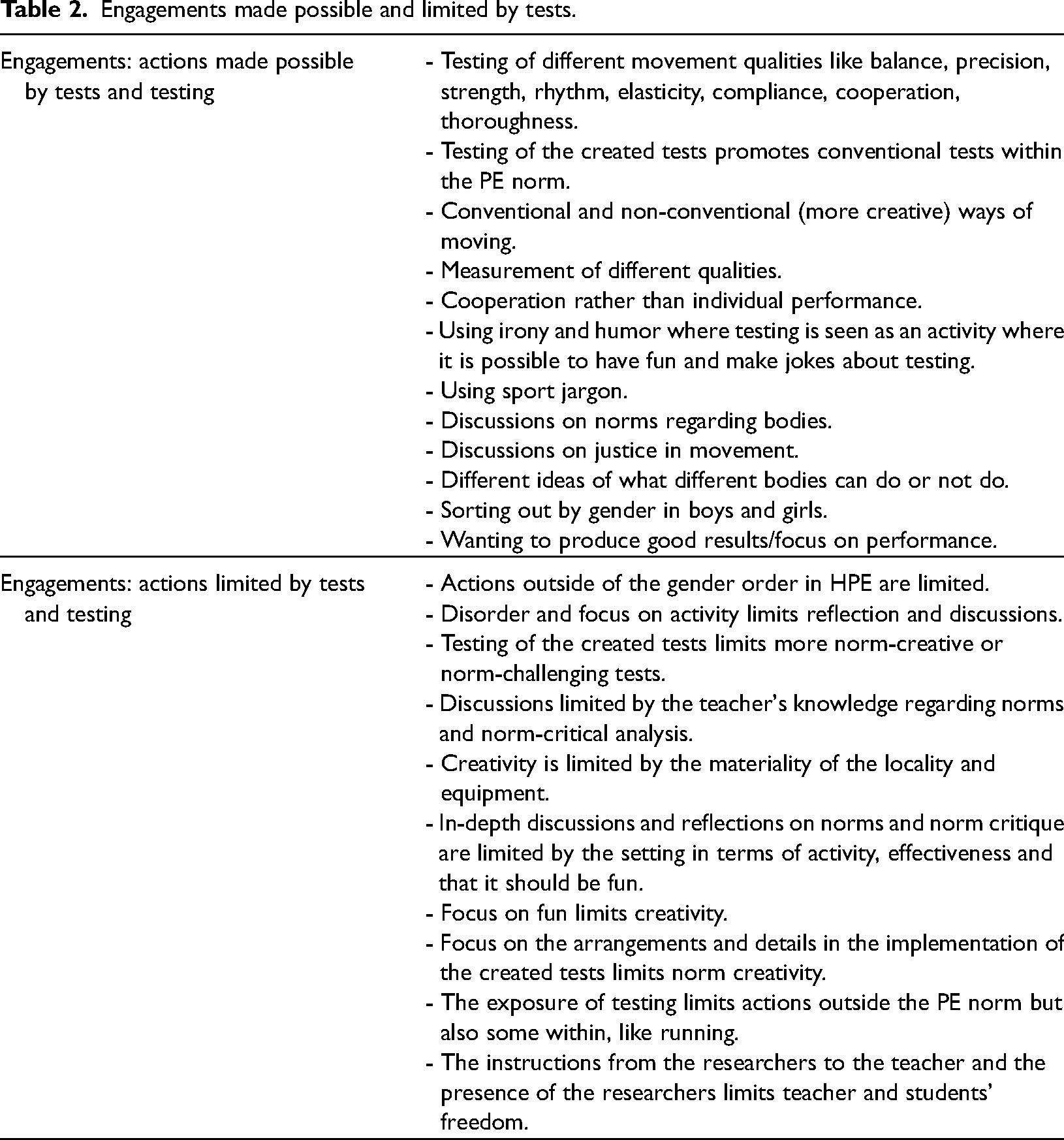
In the third step, suggested by Fox and Ward (2008), positive and negative engagements tests have with students were noted, including how these engagements make different actions possible or how they limit action (see Table 2).
Engagements made possible and limited by tests.
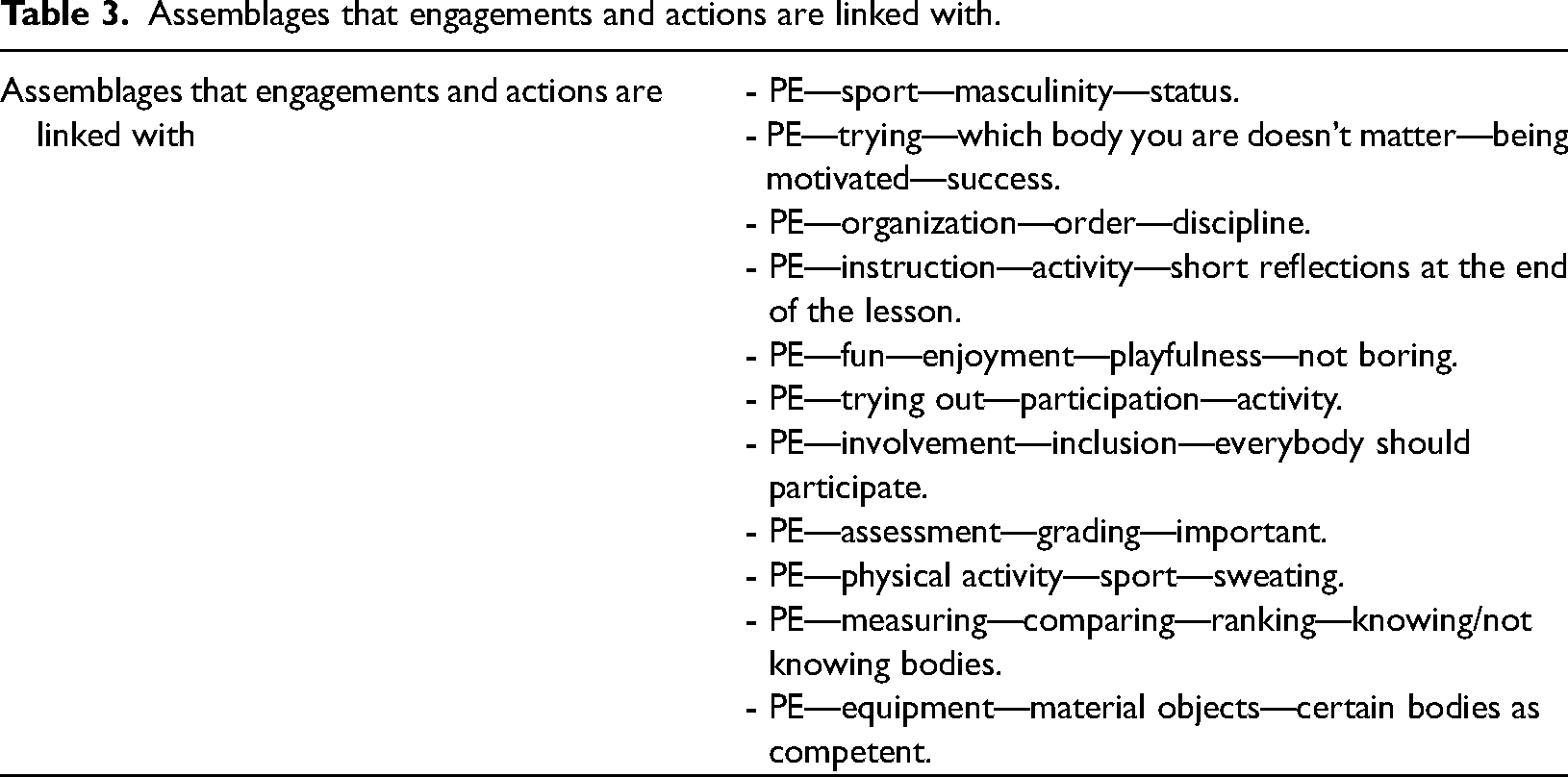
In the fourth step, possible links were made between engagements and actions in the “testing-assemblage” with elements of other assemblages in terms of networks “…of habitual and non-habitual connections” (Fox and Ward, 2008: 1009) variously constituting the conditions of possibility for what tests produce (see Table 3).
Assemblages that engagements and actions are linked with.
In this step, we followed Fox and Ward's (2008: 1014) advice that “this is a reflexive activity and may benefit from discussion in the research team.” As researchers, we were part of a research assemblage, and we affected and were affected during the research process. More specifically, our previous experiences as PE teachers (two of us), teacher educators (four of us), researchers in education (two of us), researchers in sociology (two of us), one of us self-identifying as “fat,” our interest and commitment to norm critique and norm creativity, as well as our willingness to work collaboratively, affected the project. This also implies that we specified and drew up boundaries for the project. One might say that our desires, materialities (e.g. texts and our physical presence in the classroom and gym), actions, and events (conversations, observations, and interviews) territorialized the testing-assemblage. These different experiences affected how we designed the study and worked with the data in terms of relations, affects, and engagements. Through these steps, we brought together six different affective elements of what tests do within a “testing-assemblage” when taught paradoxically. These elements “re-present” what our data show in terms of relations and affects produced by the testing-assemblage that, in turn, produce and reproduce different capacities. In the fifth and final step of our analysis, the opportunities and limitations of the tests produced in PE practice were discussed. Here we asked the question: what else can tests do in PE practice in terms of territorialization and de-territorialization?
Results
In this section, we present our findings regarding the affective elements of what tests do when taught paradoxically. These elements illustrate the relations, engagements, actions, and assemblages that resulted from our analytical steps. We refer to these combined elements as a “testing-assemblage.” This testing-assemblage, in turn, produces relations and affects on students, teachers, and the PE practice (see also Tables 1–3). All names used are pseudonyms.
Testing produces a traditional PE in terms of doing sports, sweating, being active, and enjoying moving
Much like other activities in PE practice, we found that the use of tests taught paradoxically affected the idea of what PE should be like in terms of doing sports and physical activity, as well as the importance of enjoyment and becoming sweaty. The teacher instructed the students that it was easier to do the testing practices if they tried hard, pushed themselves and performed as well as they could. Also, mental aspects of doing one's best in PE were capacities produced: Interviewer: Is it possible to imagine more tests like these [fair tests] in PE? Student 1: Well, I don’t think moving like a cat [one of the tests] is that good in relation to sports. You move, but it's not … well, PE, I think. You should sweat and do stuff. So, moving like a cat is not a test anyway. You more like think about what you do. I mean, you don’t exert your body that much. Interviewer: So, PE is about exerting your body? Student 1: Yes! Interviewer: What do you say, Johan and Per? Student 2: Well, it could be stretching. And PE is not only about the physical. It is also psychological. Interviewer: What do you mean? Student 2: It's also mental aspects, sort of. You must have the will to do things, and sometimes you may feel unsafe pushing yourself when exercising really hard and exposing yourself to a lot of exercise.
Creating the tests in the classroom produced capacities for discussing justice and fairness in relation to different body types. However, when practised in the gym, norms regarding equitable conditions were not affected in the same way, resulting in justice becoming a “theoretical” issue. For example, one boy showed the test they created, climbing up the ropes as high as possible using his arms. “This is yet one example of a test where a ‘boy’ with an athletic body sets the norm” (observation protocol). This test affected ideas about who is able or not in PE in a traditional “masculine” sense of able bodies. Hence, the different materialities of the classroom and the gym produced different affects that made tests different things in the classroom and the gym.
As in PE in general, the testing tended to produce a relatively gendered practice with the affect that “boys” and “girls” separated themselves into different parts of the gym. “The ‘boys’ activated themselves with equipment like balls and focused on shooting balls at the goal on the ‘boys'-side’ of the gym or throwing balls to each other across the gym. The ‘girls’ tried to follow the tests’ instructions.” There was a lot of noise and movement in the gym but no discussion about what was being tested or the demands of the tests (even though that was part of the task). “The boys throwing balls were very active in the classroom discussions of justice in testing. This connection now seems to have vanished, and the teacher doesn’t remind the students about the purpose of the lesson” (observation protocol when students tried the created tests).
Testing was also produced as a typical PE activity affecting students to exert themselves, where participating and being included were also capacities of importance. Enjoyment was also an affect, making the pedagogy less about student learning. One student reflected on the lesson, commenting: “Yes, I probably learned something, but the only thing I remember is that rolling like a log in the test was fun” (student in focus group).
Testing produces measurements, comparisons, and competitions between students
Testing further produced ideas about measurements, assembled through what is and can be measured, which we found affects what tests do to students in terms of comparisons and competitions. Even if the teacher in the classroom insisted that he wanted the students to reflect on the qualities demanded by the tests rather than their performance, the affect was that tests that provided no clear yardstick to measure performances against soon became meaningless since the students did not seem to have anything to strive for. These tests were produced as non-tests in some respects (observation protocol).
We found that the tests also produced comparisons, with the affect of separating those with a capacity to move in a certain way from those without: Student 4: We have done the beep test where you should run from one spot to the other […] with shorter and shorter intervals between the beeps. Interviewer: Is that a fair test? […] Student 4: Well, Lewis always wins so no I don’t think it is fair. Student 3: It's about aerobic capacity and if you don’t have that it's difficult. Student 2: I’m thinking, what tests are fair, actually? If you are to test something, then people will be different, and then somebody has an advantage and others don’t. Like in the beep test, then it's aerobic capacity and some speed. But that doesn’t mean that it's unfair … I mean, everybody can participate and test themselves since that's what tests do, actually. Student 4: The whole point with tests surely is to see who knows something and who doesn’t know. Student 2: Yes, exactly!
Here, our data show how tests affected ideas about fairness and that, for the students, a key part of testing concerned categorizing and establishing hierarchical difference. Testing also produced a relation between tests and grades. When discussing one of the tests, the students were asked how it would have been if tests like this were part of grading in PE. The students were quiet for a moment, and one girl answered: “Then we just would have learned how to do the tests … how to move like a cat.” Another girl added that it would be fine and that she would just look up how to do it on YouTube before the test (observation protocol).
Testing produces exposure, insecurity, and embarrassment
Just as in previous research on the use of fitness tests in PE, we found that testing taught paradoxically affects and is affected by exposure, insecurity, and embarrassment. Here, the visibility that the testing entailed produced awkwardness. In a discussion where visibility and clothing were referred to, students highlighted the issue in general: Interviewer: So, that [visibility] can hinder—the type of exercises? Student 4: It depends on the person […] if you’re insecure or not. Student 4: In PE, you have to have clothes for sport … and they might be tight […] Student 2: I have never been comfortable in PE and with these assignments. I know that nobody cares. […] Student 4: For example, he might not care, but someone else cares a lot. Say, if I am really insecure and say, I have tights on and a short T-shirt and I do one of the exercises and see if anyone is looking and wonder what they think of me and how I look. Many feel like that, while others don’t even care if others stare at you.
In relation to more traditional tests like the beep test, some students also expressed discomfort, affecting their experiences in and of PE. Running in front of others produced negative affect through the sense that their body and abilities were being exposed and judged: Student 4: I think most tests felt comfortable to do. But I don’t like running—I don’t like running in front of people. I don’t know … I just feel uncomfortable. […] Interviewer: The test where you should run and then stop and be still. Was that uncomfortable? Student 4: No, but that was not much running. Student 2: You could also walk on that one. Student 4: True, I felt comfortable most of the time. It feels like people don’t care what you do anyway. They don’t look at you when you run … but I think like that anyway.
Through the engagements and actions that were made possible or not, the tests that involved the most norm-critical elements became dangerous and a risky space because of the affect embarrassment and awkwardness produced in doing the test. As one student expressed, in order to do them, “you have to dare to humiliate yourself!” While traditional tests, such as the beep test made non-athletic students insecure and humiliated, the tests that challenged traditional PE norms had similar affect on all students.
Testing produces ideas about different movement qualities that can be experienced and tested
One affect the tests had when taught paradoxically in our study was producing different ideas about what it is to move in PE. This entailed different movement qualities being tested, with the teacher stressing that “the purpose of the lessons was to identify the qualities that the tests were measuring” (observation of the teacher during the lesson). The affect of using tests to measure non-traditional movement qualities was an attempt to open up for new ways to value movement in PE.
In the classroom and later in the gym, more traditional movement qualities (like speed and cardiovascular endurance in the beep test, explosivity in the vertical jump, or muscular endurance doing the plank) were tested and discussed. Also, more non-traditional qualities were tested, identified, and later expressed by the students, like rhythm and pacing (test: running the same distance in the same time twice), timing (test: throwing a match), compliance, cooperation, and observance (test: mirror a friend's movements), precision (test: lasso throwing), patience and fine motor skills (test: picking up peas with a clothespin), and agility, flexibility and creativity (test: moving like a cat). The students were very engaged in sharing their “findings” after doing the tests, and after this discussion, the following conversation was observed: Teacher: What do we normally measure in tests? Researcher notes: Here the teacher makes a much needed connection to what was discussed in the classroom regarding norms and normativity, making the discussion of fair tests more comprehensible. Student: Intelligence! Teacher: What about physical tests? Student: Strength and aerobic capacity! Student: Agility! Student: Speed! Teacher: What about a test with qualities we don’t usually measure? […] Student: Moving like an animal! I think that should be the norm … the only test in PE I have been good at!
Testing produces opportunities for creativity in moving and in making own tests
The norm-creative approach provided the teacher and students with possibilities to reconsider what a test is, affecting what creativity means in moving and how the creation of alternative tests can generate interesting learning opportunities. The assignment students discussed in groups in the classroom was how to create a test in PE that was just, where advantages gained from certain body forms, including height or weight, would be minimized. Most students took the assignment seriously, and the task affected discussions about what was fair in relation to different types of bodies, including height, form, and various disabilities. However, in the observations, it became evident that the students were not familiar with such tasks. One student stated: “I remember that it was really difficult to come up with a test that didn’t include something with the body where you performed better in the test the more physical you were” (student in focus group).
At the start of the second lesson in the gym, the teacher reminded the students about the task: Teacher: Now we discussed some ideas around tests. You had the instruction that the body should be the focus and that you should think about it in terms of justice, who can do the test. Now we can see what you have come up with. Student 1: Here, we should move from point A to point B in the most creative way. Teacher: Good! Student 2: Here you should hold your breath for as long as possible holding your nose and closing your mouth. Student 3: Here you should roll like a log for 15 meters. Student 4: But pleeeeease! That's tough … but how fun! Teacher: Good! Student 5: Here you should climb in zigzag on the wall bars following the marked course. Teacher: Exciting! Student 5: …and it is on time holding a ball on the head. […] Student 6: Here we walk as long as possible with shorter and shorter steps.
Other tests created and discussed in terms of being just, and thus affecting capacities for creativity, were, for example: (i) jumping twice equally high (discussed as more equitable than jumping as high as possible), (ii) throwing a ping-pong ball into a mug (discussed as just but too difficult), (iii) kicking a football and hitting the crossbar of the goal (discussed as not just since it privileged those who already play football and therefore mainly boys), and (iv) walking with as even length steps as possible (discussed as just since everybody potentially can be good at it).
Testing produces opportunities to discuss and reflect upon norms about bodies, justice, normal bodies, and ways of moving
In line with teacher–researcher discussions ahead of creating the norm-creative practices, the teacher introduced the idea of societal norms regarding bodies with the students. This introduction covered norms within sports and embodied norms in society, relating to ideas such as the Body Mass Index and 10,000 steps. The teacher also talked about what a norm is and what following or not following norms entails. These teaching inputs created engaged discussions but mainly affected discussions around biological norms like physical disabilities rather than social norms like body form. The teaching also affected reflection and problematization of norms about bodies in society. As one student concluded: “Is there such a thing as a normal body, the answer is the same in all categories, it depends, normal doesn’t exist” (observation protocol).
Opportunities also opened up regarding tests and testing affecting discussions on just tests: Teacher: We can talk about what we did last week. Were those tests just? And what was the norm in the test? Jumping high, for instance, was that just? Student: No, body height! Teacher: Yes, if the test is to jump as high as possible, then height is an advantage. But we tried to even it out, didn’t we, by measuring how high you jumped regardless of height. Student: Because then it is the individual ability. Teacher: Is that just? Student: No … if you can’t jump. No legs? Student: Problems with your knees! Student: I think sport is unfair, everybody has different preconditions. You can be short and exercise a lot and jump higher than someone who is tall. […] Student: Sport can never be fair or just. Sport is about deciding who is the best.
In the follow-up focus groups, the students also put forward how different types of bodies are suited for different sports and how different kinds of prejudice about different bodies affect how activities in PE can be just or not. In relation to the rope climbing test: Student 3: It depends on how heavy you are. Student 2: Yes, but I mean that if you have really strong arms, say that you are overweight, a really thin person might not have any arm strength, but not so much weight in total. Student 1: So, it evens out? Student 2: Well … not really. There are more body parts than arms. If you weigh a lot […] weight is more important than strength. Student 4: But it also depends if you’re overweight or if you’re big because of big muscles. People exercise. Then they’re bigger, but it's not fat, it's muscles. Interviewer: That's right! Student 4: If you exercise it's easier but if you’re only overweight then it's more difficult to do stuff. I mean just because you’re bigger doesn’t mean that you’re stronger.
Discussion
When looking at the literature, there seem to be two different “testing-assemblages” that repeatedly produce relations and affects on students, teachers, and PE practice. One is a “testing-assemblage” with the capacity to create healthy lifestyles, which produces relations and affects related to physically active lifestyles, promotion of physical activity and health, motivating young people to be active, and preventing inactivity through tests (e.g. Silverman et al., 2008; Simonton et al., 2019). The other one described in the literature is a “testing-assemblage” with the capacity to create negative affect, producing relations and affects that make tests embarrassing and humiliating, with public exposure creating negative affects like fear and anxiety. The latter is also described as lacking educative purpose and relevance for students (e.g. Alfrey, 2024; Alfrey and Landi, 2022; Cale and Harris, 2009; Safron and Landi, 2022). Both “testing-assemblages” entail micropolitical consequences territorializing (i.e. specifying) what bodies, and indeed tests, do in PE regarding body norms (Alfrey and Landi, 2022; Safron and Landi, 2022).
As a contrast, and in line with Alfrey's (2024) and Alfrey and Landi's (2022) suggestions, we explored a “testing-assemblage” with the capacity to produce new norms in PE when taught paradoxically. However, many of the tests in our study territorialized traditional PE practices in much the same way as reported in the literature, producing relations and affects relating to sport, masculinity, physical activity, ranking, comparisons and embarrassment (e.g. Alfrey and Landi, 2022; Safron and Landi, 2022; Silverman et al., 2008). This is not that surprising since norms about what PE is, norms about the physically active and sweaty student, as well as particular material objects such as ropes, boxes, and balls in the tests, all worked as territorializing elements which stabilized a coherent and traditional “testing-assemblage.” These affects, in many ways, hamper opportunities for de-territorialization of what PE is and what a student can or should do and become in PE.
There are also obvious silences producing body hierarchies within the explored “testing-assemblage,” with the affect of making big bodies absent or invisible. In this sense, the invisibility of big bodies is territorialized as a micropolitical consequence, particularly in the gym but also in society at large (Fox et al., 2016; Gailey, 2014; Johansson, 2021). Hence, the invisibility both affects and is affected by the purposes, content, and pedagogies of teaching PE (Quennerstedt et al., 2021). In the classroom-based lessons, openings for de-territorialization occurred in discussions about testing in PE being just and issues about the inclusion of all bodies. These de-territorializations have the opportunity to affect discussions beyond simply including or tolerating big bodies toward an affect regarding how big bodies can attain a rightful presence in PE (see Calabrese Barton and Tan, 2020).
Furthermore, the “testing-assemblage” also produced opportunities for creativity in moving, norms about normal bodies, as well as prompts to reflect upon norms about justice. This produced possible de-territorializations for new capacities to move and act differently than those traditionally provided in PE. The question of what else tests can do in PE is thus a question about how tests can open lessons up for creative events and for doing things differently, both in terms of the affect on students and PE as a school subject.
In the study, we could identify examples of micropolitical processes of de-territorialization in the gym in some of the affective elements. For example, some of the new tests introduced by the teacher or created by the students presented new elements, which formed a “testing-assemblage” with capacities to produce new norms. These elements challenged normative assumptions of behavior and ways of moving in PE. The “walking creatively” test created by the students did not measure speed, flexibility, or strength, for example. Instead, the test introduced the idea of creativity as a new element. This test clearly produced new relations and affects in the testing-assemblage. However, as in the “move like a cat” test, the students became uncertain and insecure. They did not know how to move, how to relate to each other or where to go. For a few seconds, the testing-assemblage was de-territorialized and open for change. But soon it was re-territorialized, and the students left the test and found their way back to relations and affects they recognized.
In yet another example, the “hold-your-breath test,” also created by students, the students could be said to practice new forms of connecting to their breathing by focusing solely on their breath. In a de-territorializing sense, they also formed new connections with the materiality of the gymnasium as they, in contrast to a physical activity discourse, sat still on the floor. Also, in this test, new relations and affects were produced, but this time, the students stayed in them, and moments of reflexive small talk developed.
Another example of potential de-territorialization occurred in a student-created obstacle course. The obstacle course was not in any way different from regular ones, and the material objects used in the test were conventional, with boxes, benches, and so on. The movements the students were instructed to perform were also typical for an obstacle course in PE: in this sense, territorializing the test. However, instead of carrying out the testing as an individual task, one pair of girls introduced the element of cooperation instead of doing the course with a focus on time. In this case, one girl helped the other to get up on the box and balance a ball on her head while moving forward. The students acknowledged that they were performing the test in a new and creative way, shouting to the teacher, “Nick, we came up with a great way!”
As Alfrey and Landi (2022) and Alfrey (2024) contend, there seems to be a potential for de-territorializing in making tests as events in PE meaningful and educative through student influence and testing out possible new practices. This involves space to discuss and critically scrutinize norms regarding bodies, movement, and testing regimes in PE as well as in society. In this way, we observed several more opportunities for de-territorializing through norm-creative events regarding body weight and form in the observed lessons. However, these seldom affected the educational situation, nor were they recognized by the teacher during the lessons. These missed opportunities highlight the importance of not only using but teaching with tests, as well as the importance of both teachers and students being aware of paradoxical moments if they are to become educational (see Larsson et al., 2014). Awareness of how education affects and is affected by paradoxical moments is, of course, a challenge but is not impossible in PE practice. We contend that since opportunities occurred in the norm-creative teaching of tests, there is potential for de-territorializing tests and testing in PE. This would involve teachers paying attention to how different pedagogies and content are related to norms regarding, for example, body weight and body form and unpacking how students can explore, discover, challenge, and change these norms.
Footnotes
Author's note
Dean Barker is also affiliated at Örebro University, Sweden.
Declaration of conflicting interests
The authors declared no potential conflicts of interest with respect to the research, authorship, and/or publication of this article.
Funding
The authors disclosed receipt of the following financial support for the research, authorship, and/or publication of this article: This work was supported by the Vetenskapsrådet (grant number 2017-03476).
