



Abstract
Ability has been positioned as a crucial concept in the construction of a subject that is inclusive of and meaningful for all students. Almost two decades since Evans ( 2004) called on the field to re-engage in discourse concerning ability, how ability is conceptualised by physical education (PE) teachers remains relatively unexplored. Furthermore, relatively little is known about how understandings of ability are enacted through curriculum, pedagogy and assessment in PE. This research explored these issues with lower secondary PE teachers in Western Australia through self-recorded audio responses to two research questions. Data from 38 participants revealed the struggles that PE teachers had in articulating meanings and representations of ability in PE in their curriculum, pedagogy and assessment practices. Findings illustrated a tendency for many teachers to privilege a performative view of ability and focus on the physical domain in discussing ability in PE. While some teachers made reference to skills and dispositions beyond this domain, data affirmed the dominance of narrow conceptualisations of ability in PE and pointed to limited understandings of how broad, fluid and inclusive notions of ability may be embedded in curriculum design, pedagogy and assessment practices. Summative assessment was the most frequent aspect of practice referred to in teachers’ explanations of how understanding of ability was expressed in their practice. The study points to the importance of professional learning and initial teacher education directing attention to ability as a focus for advancing equitable practices in PE and the need for further research exploring enactments of ability.
Introduction
Two decades ago, Evans (2004: 95) argued for greater engagement with the ways in which ability is ‘recognised, conceptualised, socially configured, nurtured and embodied in and through the practices’ of physical education (PE). In doing so, Evans positioned ability as a central consideration amidst intentions to advance equity in PE. Subsequently, theoretical works exploring the social construction of ability in the field have contended that ability is frequently conceptualised as an inherited trait, expressed through performance in physical activities that are often contextualised in historically male-dominated sports and realised in competitive contexts (Evans and Penney, 2008; Wright and Burrows, 2006). Further expansion of research centring on ability in PE has come with empirical studies foregrounding various issues, including students’ conceptualisation of ability (Nyberg et al., 2020a; Watkins et al., 2019), the abilities considered legitimate in the curriculum (Nyberg et al., 2020b), the messaging implicit in assessment tools regarding ability (Tidén et al., 2017) and the representation and communication of ability in PE in pedagogical practice (Aasland et al., 2020; Wilkinson and Penney, 2022). Arguably one of the most important points of commonality in these works is that they consistently highlight the significance of ability in relation to international and national commitments to equity and inclusion in PE (Australian Curriculum, Assessment and Reporting Authority [ACARA], n.d.a, n.d.b; Department of Education, Skills and Employment, 2019; United Nations Educational, Scientific and Cultural Organisation (UNESCO), 1978, 2015). At the same time, however, international research continues to indicate that PE remains challenged to deliver on such commitments (Alfrey and Jeanes, 2023; Flintoff and Dowling, 2019; Parri and Ceciliani, 2019) and suggests that, as a field, PE still lacks clear understandings of how pedagogic practice can appropriately recognise, respond to, and value the varied abilities that students bring to the subject and have the capacity to develop.
In the Australian context specifically, the Australian Human Rights Commission (AHRC) welcomed the intent inherent in the Australian Curriculum: Health and Physical Education (AC:HPE), to establish ‘inclusive practices that recognise the strengths and ability of all students’ (AHRC, 2012: 6). With this policy backdrop, the research reported in this article seeks to extend understandings of the conceptualisation and expression of ability in the pedagogic practices of PE, which we define as encompassing the planning and enactment of PE curriculum, pedagogy and/or assessment in schools (Penney et al., 2009, 2018).
Theoretically, the research recognised and sought to explore ability as socially constructed and communicated in and through curriculum, pedagogy, and assessment, which are understood to constitute inter-related message systems of schooling (Bernstein, 1990). As we discuss further below, this aligned with calls for ability in PE to be problematised and contested with awareness of the ways in which it simultaneously reflects and frames understandings of the nature and purposes of PE (Evans, 2004; Hay and lisahunter, 2006; Penney and lisahunter, 2006; Wright and Burrows, 2006). Additionally, it reflected Penney et al.'s (2009, 2018) identification of curriculum, pedagogy, assessment and their interrelationship as key mechanisms via which ability discourses are expressed and parameters for equity and inclusion are shaped in PE. Hence, in this study, the construction of knowledge through curriculum, pedagogy and assessment in PE is inherently also about the construction of educational opportunities and learner identities in PE, including the identity of students as able or not in PE. Previous research in the field has acknowledged that we have limited insight into how PE teachers are conceptualising ability and the ways in which understandings of ability are expressed in their curriculum, pedagogy and assessment practices (Evans, 2004; Nabaskues-Lasheras et al., 2020; Wilkinson et al., 2013). Aasland et al.'s (2020: 490) recent investigation of how ‘able’ and ‘less able’ students are constituted in and by PE teaching practice in Norway concluded that ‘PE educators could make an important contribution to contemporary education and teaching values if they re-examined and revised their construct of an “able” student’.
This research, located in Western Australia (WA), was designed to provide both a foundation and prompt for professionals to engage in reflective interrogation and re-visioning of ability, and by association, inclusion in PE. The study focused specifically on lower secondary PE, which in WA comprises School Years 7–10 (students aged 11–12 in Year 7 through to aged 14–15 in Year 10). Further details of the curriculum context are provided below. The study probed firstly, teachers’ understandings of ability, and secondly, their enactment of ability in their PE curricula, pedagogy and assessment practices. Critically exploring current conceptualisations of ability and the implications of these for the construction of learning in lower secondary PE in WA was framed as an essential foundation for both teachers and researchers to consider ways to enhance provision for all learners in PE. The following sections expand upon the theoretical perspectives and past research informing the inquiry.
Problematising ability/ies in PE
Interrogating judgements about ability/ies in PE can vividly reveal tendencies for abilities to be considered as possessed and largely fixed, rather than inherently fluid, and always socially and culturally constructed and situated (Evans, 2004; Hay and Penney, 2013). As Evans and Penney (2008: 39) illustrated, the curriculum and pedagogical implications of this conceptual shift are powerful; ‘abilities are considered transient, subject to change and teachers are encouraged to observe the dangers of making inelastic assessments of children's potential at a particular age and phase of their school career’. Research internationally highlights, however, the bounded and often narrowly focused orientation of judgements of ability in PE. For example, the frequent privileging of aspects of performance in a limited range of physical activities quite openly contradicts the many instances in which PE positions itself as a subject that holistically develops knowledge, skills, understandings and dispositions across physical, social, affective, and cognitive domains (Bailey et al., 2009; Flintoff, 2015). According to UNESCO, a Quality Physical Education curriculum ‘promotes development across the range of learning domains (physical, lifestyle, affective, social, and cognitive), and presents opportunities for pupils to develop core skills, such as leadership, communication, and teamwork’ (UNESCO, 2015: 76). Yet, perhaps all too often, students are required to display high levels of fitness and advanced levels of motor skills in the privileged sports and games selected by PE teachers (Nabaskues-Lasheras et al., 2020). Aasland et al.'s (2020) research affirmed that expectations encompassing fitness, specific sport skills, and gendered performative discourses relating to privileged activities variously contributed to particular students being recognised as able in PE, or in contrast, identified as less able. Green (2002) and Wilkinson et al. (2013) have also noted how a dominating sport discourse underpins performance-based sport and competitive team games being positioned as the legitimate forms of movement to be at the fore of the subject. As Nyberg et al. (2020b) identified, framed in this manner, PE privileges some students and marginalises others from acquiring the knowledge, skills and understandings that form the basis of judgements and identities associated with being able in PE. Longstanding tendencies for particular activities to be privileged in many PE curricula are thus inseparable from the systemic framing of ability in relation to those activities. Correspondingly, other activity contexts and forms of movement are marginalised or excluded as foci via which abilities in PE may be recognised, extended, and celebrated. As O’Connor et al. (2024) recently observed, abilities developed through myriad movement cultures, such as dancing, gymnastics, surfing, or skateboarding, are frequently not recognised as worthy abilities in PE, and these movement playgrounds themselves are not recognised as valuable contexts for the development of abilities.
Other research identifies that the display of certain attitudes and dispositions, including high levels of effort (Hunter, 2004) and/or the appearance of being keen and eager (Redelius and Hay, 2009), or in some instances, aggression (Hay and Macdonald, 2010b), may mean that students are rewarded by being labelled as more able than similarly skilled but not as positive or enthusiastic counterparts (Wilkinson et al., 2013). In short, research indicates that PE frequently can be seen to unjustly privilege, legitimatise and reward certain ways of relating, behaving and performing (Tidén et al., 2021; Wilkinson et al., 2013). Other studies identify gender (Redelius and Hay, 2009), social class (Hay and Macdonald, 2010a), race (Flintoff, 2015; Pang and Hill, 2018) and disability (Alfrey and Jeanes, 2023) as factors associated with students experiencing injustices in PE because of narrow notions of ability. Considerable research, therefore, points to the need for further insights into how teachers are understanding and enacting ability in PE. Following Evans (2004), we identify PE as a field that is bound by constructs such as its curriculum, pedagogical and assessment practices and by teachers’ beliefs and expectations about ability (Hay, 2005; Wilkinson et al., 2013).
Enacting ability through curriculum, pedagogy, and assessment
In 2013, Penney reminded the PE profession that conceptualisations of ability and how they are reflected in and through the teaching practices of curriculum, pedagogy and assessment are integral to defining the subject, and critically, who is positioned as able and enabled to learn. Emerging from the work of Basil Bernstein (1990), the three message systems of schooling are recognised for making ‘explicit ways in which education, and more specifically, normalised curriculum structures, pedagogical practices and assessment processes are shaped by dominant discourses’ (Penney et al., 2018: 1064). As Penney et al. (2018: 1064) stressed, they ‘simultaneously serve to reaffirm or challenge those discourses and the social relations that they privilege’. Consequently, content selection, pedagogical decisions and assessment practices all constitute ways in which particular notions of ability can become reproduced, taken for granted and normalised, or in contrast, critically explored and challenged (Penney, 2013a).
Curriculum decisions overtly delineate and embed in official policy what are and are not considered legitimate knowledge, skills and understandings, with Wilkinson et al. (2013) recognising that in many instances a dominant sporting discourse has positioned competitive games and performance-based sport at the fore of curriculum frameworks and planning processes. As lead writer of the AC:HPE Shape Paper, Macdonald (2013: 97) highlighted that the field and profession needed to ‘lift its gaze’ to possible futures and ensure students are being prepared for these. Sport policy in Australia has subsequently affirmed that participation futures need to be recognised as prospectively taking many forms, with for example, The Future of Australian Sport report (Cameron et al., 2022: 5) highlighting that ‘the ways in which we engage with sport and physical exercise, are being transformed by new technologies, changing environmental conditions, shifting value systems, new habits and lifestyles and the increasing diversity of the Australian population’. Amongst the megatrends described in this report is the growth in so-called non-organised forms of physical activity. While this growth is frequently associated with activities such as running, cycling and gym-based participation, Jeanes et al.'s (2019) research has highlighted that many team-based sports now have an important participation base outside of formal club structures. O’Connor and Penney’s (2021) subsequent exploration of the abilities, skills, knowledge, and understandings that align with informal sport participation drew attention to the importance of social skills and understanding of movement cultures, as well as movement abilities, in enabling individuals to access and sustain this form of participation. As O’Connor and Penney (2021) recognised, this prompts review of the extent to which the content selection that currently shapes PE programmes and lessons (and furthermore, privileges particular skills, knowledge, and understandings as central to ability in PE) aligns with many young people's prospective participation futures.
Alongside and inter-relating with content selections, teachers’ pedagogical decisions routinely contribute to defining what it means to be able in PE. Research highlights, for example, the importance of effectively drawing on a range of pedagogical models to ensure that teaching provides students with opportunities to extend their learning in multiple domains (Fernandez-Rio and Iglesias, 2024). However, whilst there has been an accumulation in support for models-based practice in PE, there remains a tendency to label and position models that seek a shift or rebalancing of the teaching and learning focus (towards, for example, the social domain) as alternative pedagogical forms (Casey, 2014). Other aspects of pedagogy, including grouping strategies, have also been shown as inherently linked to the privileging of particular skills, knowledge and understandings and hence, notions of ability in PE (Wilkinson and Penney, 2022). Wilkinson and Penney's (2021, 2022) research and other studies that have pursued issues of equity in PE (Alfrey and Jeanes, 2023; Flintoff and Dowling, 2019; Guerrero and Guerrero Puerta, 2023) collectively illustrate the many ways in which pedagogy in PE expresses and communicates notions of ability that, in many instances, are also gendered. This includes but is not limited to the structure, focus and anticipated pace of progression in learning sequences, instructional language, and strategies used in the organisation and management of students. In looking to opportunities for pedagogy to be a focus in developments that are directed towards extending understandings and representations of ability in PE, we particularly foreground one of the key ideas that seeks to provide pedagogic direction for teachers’ enactment of the AC:HPE; Focus on educative purposes (ACARA, n.d.a, n.d.b, 2024). Underpinning this tenet is ‘a reminder to be focused on – and keep asking the questions … who is learning what? and who is being enabled to learn what?’ in HPE (Lambert and Penney, 2020: 385). This project recognised teachers’ understandings of ability in PE as important in shaping their pedagogy and hence, the answers to these questions. It acknowledged the need for educative discourse to be at the fore of professional discussions about ability and the ways in which learning activities, environments and goals are framed (and may be re-framed) in PE (Hovdal et al., 2023).
Turning to assessment, a body of work has established a powerful link between judgements made in PE and acquired understandings of ability by teachers and students (Hay, 2005; Svennberg, 2017). Assessments reflect judgements about the knowledge, skills and understandings of greatest worth, and signal the types and levels of abilities students should arrive at class possessing (Hay and Penney, 2013; Tidén et al., 2017) and furthermore have the resources (social and physical capital) to develop out of school (Aasland et al., 2020). Exploring assessment practices in England, the USA and Australia, López-Pastor et al. (2013) noted a focus on motor skill competence and fitness levels which reflected a version of PE that privileges selective physical abilities and sporting performances. Combining these assessment practices with an emphasis on historically male-dominated sports has been shown to simultaneously advantage those students who already possess high levels of fitness and these motor skills, and position some learners as lacking ability (Tidén et al., 2017). Aasland et al. (2020: 490) further revealed ‘that students who lack experience in particular (team) sports outside school have limited or no opportunity to achieve the highest marks [in PE assessment]. In this respect, as currently taught, PE is not a subject that provides all students with opportunities to learn, improve, and be assessed as “able”’.
While ability in PE is recognised as a contestable concept, this study reflected that it also remains at risk of being glossed over, with dominant, normalised conceptualisations and enactments of ability continuing unquestioned. This inquiry positioned the trilogy of curriculum, pedagogy, and assessment as a critical focus in efforts to better understand how ability is conceptualised and enacted in secondary PE, and a means via which to prospectively challenge and extend teachers’ understandings and expression of equity in PE.
Contextualising this inquiry
In WA, educational policy falls under the governance of the state's School Curriculum and Standards Authority (SCSA). Within the federated Australian policy context, the Western Australia: Health and Physical Education curriculum (WA:HPE) (SCSA, 2017) aligned with the AC:HPE (ACARA, n.d.a) while also reflecting the reworking, streamlining and repositioning of various curriculum elements. Perhaps most notably, the AC:HPE foregrounded an integrated approach to curriculum planning addressing content articulated in relation to two strands, Personal, social and community health and Movement and physical activity, and presented achievement standards for HPE in two-year bands of schooling across Years 1–10 (ACARA, n.d.a, n.d.b). The WA:HPE (SCSA, 2017) presented HPE in more dichotomous terms, with health education (HE) and PE explicitly compartmentalised in achievement standards articulated for these two subject areas and also for each year level. Table 1 presents the achievement standards for Year 7 and Year 10 to illustrate the types of understandings and skills that are, respectively, identified with HE and PE, and the anticipated growth in these over the lower secondary years. We present these as evidencing ability/ies being written into official curriculum such that curriculum specifications speak to the legitimation of particular abilities as central to PE. The comments provided in the middle column direct readers to these features of the achievement standards for HE and PE in WA. With PE routinely considered a distinct subject in WA, this study focused specifically on lower secondary teachers’ understandings and enactments of ability in PE and did not extend to HE and/or the HPE learning area considered holistically. The standards pertaining to HE are retained, however, to illustrate contrasting discourses being privileged in statements that communicate learning expectations and hence, ability/ies that are the focus in teachers’ formal reporting of students’ achievement in WA.
Year 7–10 achievement standards in the WA:HPE curriculum (SCSA, 2017).
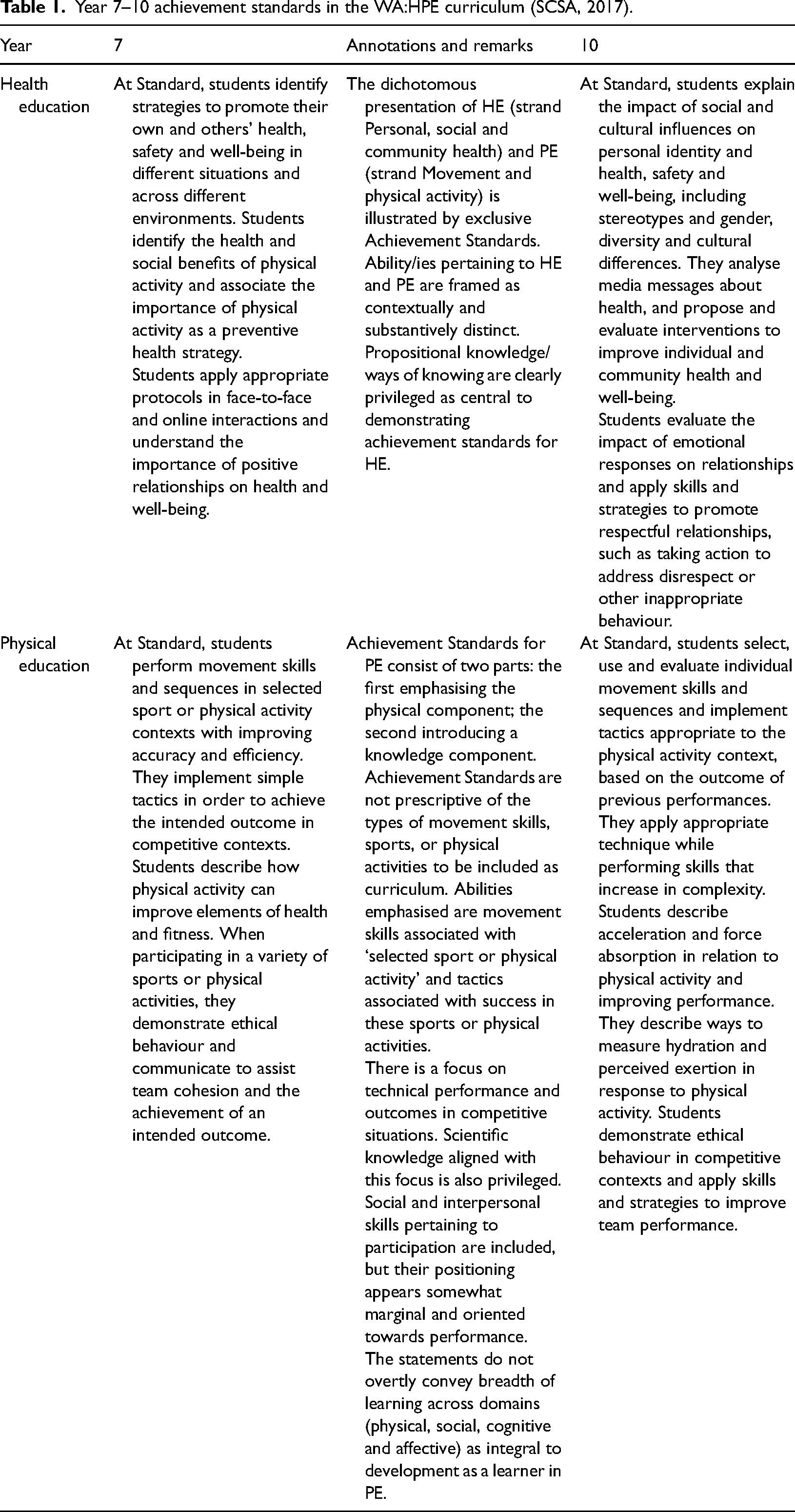
In considering enactments of ability in PE in WA, it is also pertinent to acknowledge that the WA:HPE curriculum specifications provide considerable flexibility for teachers to shape PE programmes, units, lessons, and students’ experiences of assessment. The WA:HPE does not, for example, stipulate the sport or physical activity context in which students must demonstrate achievement of the standard. Rather, SCSA (2014a) stresses that ‘consistent with a strengths-based approach, a successful HPE programme is one where teachers select ongoing contexts that are accessible and meaningful to students as a focus for building on their particular strengths and interests’. Guidance on assessment is similarly generic in nature, promoting teacher selection of assessment strategies and types of evidence aligned with the specific purpose and context of assessment (SCSA, 2014b).
This study therefore recognised that the formal curriculum specifications for lower secondary PE in WA are by no means prescriptive, but nevertheless remain an authoritative point of reference for teachers. Teachers’ enactments of these specifications in lower secondary PE programmes, lessons, pedagogy and assessment tasks may consequently express, privilege and/or marginalise various discourses that collectively shape how ability in PE is communicated. The study represented a first and foundational phase in a broader research project which is seeking to explore developments in curriculum, pedagogy and assessment that reflect and promote inclusive notions of ability in PE.
Methodology
This first phase of research was designed with an exploratory agenda and an intent to foreground teachers’ voices in extending understandings of how ability is currently being conceptualised and expressed in lower secondary PE in WA. Participants were recruited at the Australian Council for Health, Physical Education and Recreation: Western Australia (ACHPER:WA) 2022 State Conference. This conference was selected as it represents the state's largest gathering of PE teachers, from schools representing all educational sectors (Government, Catholic Education, and Independent), diverse localities (City and Regional) and varied socio-economic status. Thus, the conference represented an opportunity to gather insight from a broad spectrum of PE teachers in WA (98 attendees, with 55 identifying as secondary PE teachers).
During the opening house-keeping session for the conference, attendees were informed about the existence of the audio booth, the broad purpose of the study and the need to be a current practicing lower secondary PE teacher to be eligible to participate. The specific questions to be responded to were not shared at this time. Attendees were notified that informed consent would be implied through their decision to proceed with recording of their responses. The information sheet in the audio booth reiterated this and directed participants to limit their spontaneous response to 3 minutes. Attendees privately self-recorded their responses to two direct questions:
Can you define ability in relation to PE? Can you discuss how this definition of ability is reflected in PE curriculum, pedagogy and/or assessment practices in your school?
The adopted procedure was designed to elicit participants’ immediate response to the above questions, without extended time to formulate answers. This aligned with previous studies that have highlighted the importance of ‘gut feeling’ in relation to teachers’ judgements about students’ level of achievement in PE (Annerstedt and Larsson, 2010) and our desire to consequently capture participants’ first thoughts about the concept and practice of ability in PE. Hence, upon entering the audio booth, participants could read an information sheet which provided recording instructions on one side. The flip side of the sheet provided participants with their first sight of the two questions and gave a prompt to press record when they were ready to respond. In presenting and discussing the data below, we foreground that a limitation in the adopted methodology was the absence of opportunities for participants to engage in extended dialogue about the issues being explored. Furthermore, it precluded us from asking participants clarifying questions and hence, probing understandings and intended meanings. However, we also highlight that the method adopted offered important pragmatic considerations pertaining to prospective recruitment of teachers. Specifically, the audio booth was considered likely to reduce a barrier to participation, as it allowed teachers to privately share their views without being socially critiqued in the context of sharing their perspectives (Einarsdottir et al., 2022). The format also minimised the time commitment required for participation, which was considered vital for recruitment, particularly during a busy conference schedule.
38 lower secondary PE teachers voluntarily entered the audio booth to record their response. This represented 39% of all conference participants. The average response time was 1 minute 13 seconds which contained an average of 152 words. Recordings were captured via a RØDECaster Pro, saved to a microSD card and transferred into Otter for transcription. Recordings were randomly allocated a participant number for reporting purposes. After checking the authenticity of the transcripts, they were transferred to NVivo (QRS International, version 12) verbatim to assist effectiveness and efficiency of data analysis (Jackson and Bazeley, 2019).
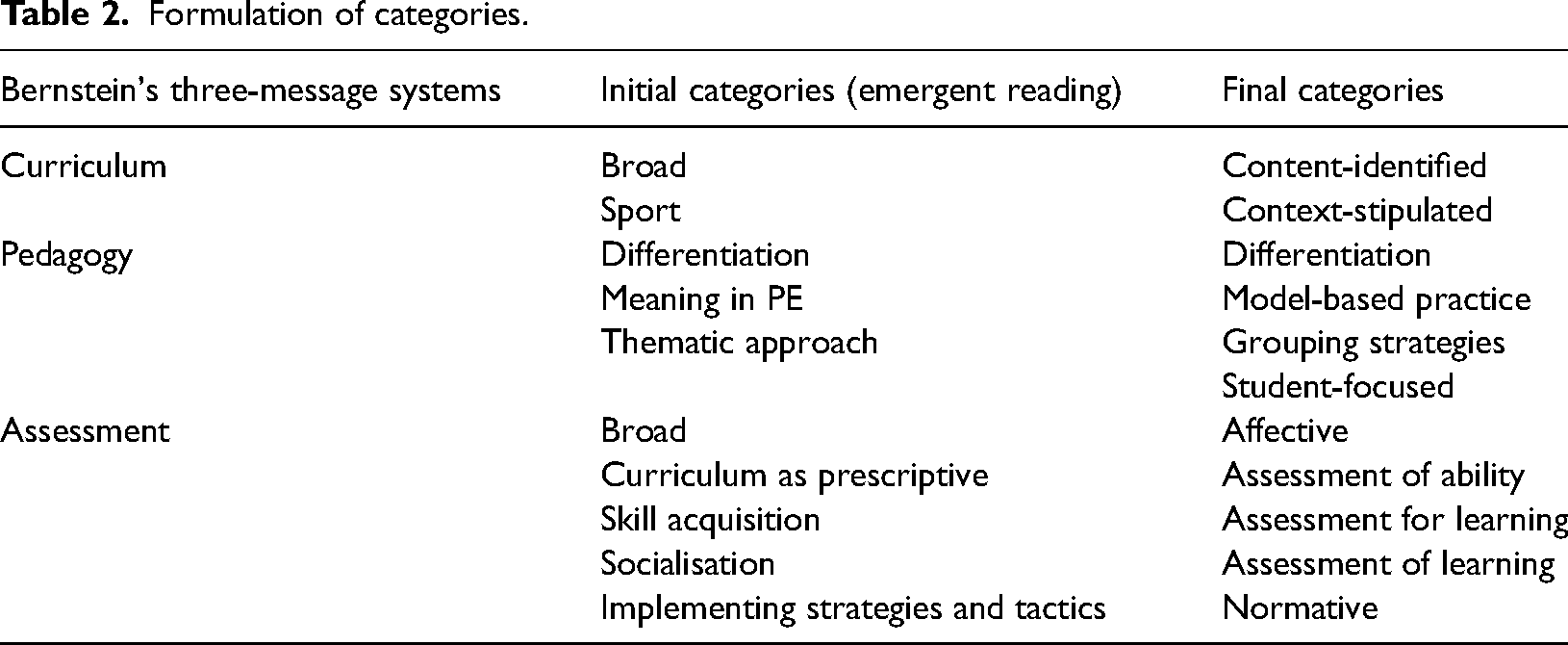
An open-ended and structured approach to analysis was applied, first seeking to understand participants’ views without prejudice and then in relation to the theoretical frameworks which underpin the study. The open-ended reading employed inductive analysis, in a reflexive, iterative approach of analysis and interpretation (Bogdan and Biklen, 1997). In relation to Question 1, an emic, or emergent, reading of the data was undertaken with a categorisation system of conceptualisations of ability developed around participant responses. Statements were arranged into uniform categories representing meaning themes (Lee et al., 1995). An NVivo word frequency query was undertaken to supplement the emerging categories. Preliminary categories were examined and compared to identify common elements and amalgamated into more definitive categories. In an etic approach to Question 2, data were coded in relation to the theoretical foci of message systems, and thus responses (or part thereof) were identified with curriculum, pedagogy, and/or assessment data tags. Curriculum, pedagogy and assessment data sets arising were further divided into sub-categories using an emergent reading of categorised answers. Table 2 provides an overview of the initial categories formulated by the first author and the final categories determined after further interrogation of data and discussion between the three investigators.
Formulation of categories.
Findings and discussion
Three main findings provide the focus and organising structure for reporting and discussing the insights arising from the study. First, attention is directed to the difficulty that lower secondary teachers had explaining their understandings of ability and how their view of ability was reflected in their current pedagogical practices. While this finding can in part be associated with the immediate responses that participants were required to make in the audio booth, we contend that this characteristic of the data also points to an absence of professional debate and critical engagement with ability discourses in PE. The second sub-section reflects that much of the data gathered also supported the dominant perception that ability in PE is synonymous with a performative view of ability and focuses on the physical domain. When viewed in conjunction with the first finding, this orientation emerges as a commonly adopted ‘default position’ on ability. As indicated above, it is also an orientation evident in the official articulation of achievement standards for PE in WA. The third sub-section probes findings centring on how ability is expressed and enacted through teaching practices in lower secondary PE in WA.
Teachers’ struggles to articulate ability/ies
The open-ended reading of the transcripts generated a strong appreciation that lower secondary PE teachers struggled to formulate a clear definition of ability, and similarly struggled to clarify how ability is enacted in their teaching practices. Several responses echoed literature in openly recognising that ability in PE is a challenging concept to engage with. Comments included: ‘very difficult question’ [Participant 12], ‘hard questions’ [Participant 16], and ‘I think that's a very vague and loose term’ [Participant 10]. Further indicative evidence of the challenges that the questions posed for respondents came from the distinct pauses and interjections contained in participant responses, with a total of 54 distinct pauses and 175 ‘umm’, ‘argh’ or ‘yeah’ recorded. Participant 32's response illustrated such hesitancy while seeking to convey aspects of complexity associated with ability in PE: Okay, so ability in relation to PE. I would say that [pause] ability would be defined [pause] by how proficient someone is at something. So, depending on what you're looking at, depends on how proficient someone is able to be at the minute. I'd say it's affected heavily by participation -umm- [pause] -yeah-. Definition of ability is reflected in PE curriculum, pedagogy and/or assessment? [pause] No, I can't discuss how that would be defined. (Participant 32)
Participant 32 was not alone in being unable to describe how ability was enacted through their teaching practices, with six other respondents similarly stating that they were unable to do this. Furthermore, there was only one response in which a teacher attempted to discuss all three teaching practices: The curriculum tells us exactly what we need to do and the pedagogy is kind of the how we are aiming to improve the ability of the student. So, they work together in relation. And essentially, at the end of the day, the assessment is what is the outcome of that work of the curriculum and the pedagogy combined. (Participant 31)
The difficulty that teachers had expressing their thoughts about ability is arguably indicative of Evans’ (2004: 96) concern that the field has ceased discourse as to the ‘nature of physical education, educability, educe and ability as processes and goals altogether’. If understandings of ability are central to the social construction of just forms of PE and, more specifically, the realisation of Australia's educational goals, these findings have important implications. They add weight to previous calls for the field to re-engage in dialogue about how ability is, and can be, conceptualised (Evans, 2004; Penney, 2013b). Taking normalised notions of ability for granted in PE may allow outdated and exclusionary teaching practices to endure, despite persistent calls for PE teachers to consider the ways in which such understandings and teaching practices serve to marginalise and exclude students from learning (Evans, 2004; Nabaskues-Lasheras et al., 2020).
Performative views of ability
As indicated above, past literature in the field has highlighted tendencies for notions of ability in PE to be narrowed to the physical domain. The standards of achievement for PE in WA have also been identified as privileging this domain (see Table 1). Responses from some participants countered this emphasis to some extent and provided some evidence of broader conceptualisations of ability. Thirteen participant statements made reference to leadership, self-management, communication and/or teamwork, and in so doing, evidenced abilities from the social, affective and cognitive domains being considered. For example, Participant 1 commented: There's a lot of different ways we can think about abilities relating to PE. It's not necessarily how skilled somebody is with a ball or a bat or using their body. I think there are a heap of roles that you can be really successful in PE without necessarily using your body … we can look at those who lead people and guide people and organise teams and help get equipment and you know, that we need the umpires and the team managers.
However, the centrality of performance in physical activities to notions of ability was evident in eight of these nominally broader responses. Phrases such as ‘it's not only the skill’ [Participant 2] and ‘So ability to me in relation to PE is … it's pretty broad. I think, obviously, the most obvious being the sporting side of performance’ [Participant 26] carry a sentiment that whilst ability was conceptualised beyond the physical domain, performance in physical activities remains central to conceptualisations of ability. This was encapsulated by Participant 30 who acknowledged the privileging of skill execution when labelling students as able: I think listening skills, ‘teach ability’, ability to show good task management, whether they can stay on task long enough to complete a set of skills. But of course, there are people with high level game skills that probably end up being defined as having more ability than others.
A majority of responses (from 25 participants), directly aligned performance in physical activities to notions of ability in PE, as illustrated by this response from Participant 9: I feel that the definition of ability in relation to PE has been whether or not a student can actually perform specific skills or acquire specific skills. So their ability would be reflected in: can they run? Can they throw? How accurately?
These data support previous contentions that PE teachers’ understandings of ability will invariably align with performance in the physical domain. It is also notable that seemingly fixed judgement calls about ability are prominent. Again, this has important implications for how PE is socially constructed and who is enabled to learn in the subject (Evans, 2004). Several responses further suggested that teachers were drawing on a normative approach to inclusion and/or a fixed view of ability, with both being linked to exclusionary outcomes (Penney et al., 2018; Warburton and Spray, 2017). A normative approach features in DeLuca's interdisciplinary framework for inclusion and reflects the inclusion of minority(ies) being conditional upon their willingness to assimilate to the dominant standard (DeLuca, 2013). Participant 1's response above could be interpreted in this light, where success in PE is narrowed to include those students who possess the physical and technical skills deemed essential and central to ability. Peripheral roles are created or assigned to those students deemed as lacking ability defined in these terms. Identifying peripheral roles for students to experience success may also be based on a belief that these students are not capable of success with the bat, ball, or body, as defined as being able by Participant 1. A tendency to adopt a fixed view of ability is apparent in Participant 9's line of questioning, ‘Can they run? Can they throw?’ Observing ability through a dichotomous able/unable frame signals to students that certain skills – and more specifically, skills currently privileged in evidencing ability in PE – are possessed by some, but not all students. This is counter to an educative orientation with the pedagogical purpose being to support students’ varied and progressive development of abilities through teaching and learning in PE.
While speaking strongly to performative discourses, data arising from this study also affirmed that judgements of ability in PE are not solely based on a student's performance in the physical domain. Several comments illustrated that, for some teachers, the dispositions of effort and engagement are privileged and signalled as important through their incorporation into assessment practices. Participant 27 commented that: We have a score of 10 for how able they are and how they reflect that in skill and then we have another score for participation and effort.
This sentiment was prominent in three other responses. In addition, four participants noted the importance of a student's willingness to participate ‘to the best of their abilities’ as a crucial aspect to learning in PE. As highlighted earlier in this article, these dispositions are possibly valued for reflecting back the values and attitudes of the PE teacher. Hunter (2004) notes how the positioning of a ‘good student’ in PE, through the emphasis placed on the subjective traits of engagement and effort, has resulted in the marginalisation of some students from learning in/of PE. We suggest that a shift in orientation, from focusing on students’ demonstration of current skills and/or dispositions, to foreground progressive growth in abilities through an inclusive learning process, is needed to meaningfully advance concerns for greater equity in PE. This concern is explored further below in relation to assessment.
The expression of ability/ies in PE
When describing how ability is expressed in their teaching practices, the PE teachers in this study appeared to be more comfortable talking about ability in relation to assessment. 26 participants discussed assessment practices, compared to 10 responses referring to curriculum or pedagogy. Participant 22's comments reflected the relative dominance of assessment in teachers’ responses: How I discuss the definition of ability, and its reflection in PE curriculum would be, you know, as educators -umm- you know,
Drawing upon the Australian Institute for Teaching and School Leadership (AITSL) Standard 5.1, at a graduate level, teachers should demonstrate an ‘understanding of assessment strategies, including informal and formal, diagnostic, formative and summative approaches to assess student learning’ (AITSL, 2017). Of the 26 respondents, who represented a cross-section of teaching experience, the majority were seemingly not aligned with this expectation. In discussing assessment, only three teachers talked about the formative or diagnostic aspects to assessment, and understandings of assessment for learning (one response) and/or assessment as learning (two responses) were also noticeably rare in the data. Rather, the prime emphasis was clearly on what Earl and Katz (2006: 14) refer to as traditional assessment practices, where summative assessment is used to measure ‘learning after the fact, using the information to make judgements about students’ performances, and reporting these judgements to others’.
A normative understanding of ability, where an understanding of ability is grounded in comparison to others or a predetermined standard, was also evident in comments. Judgements of and about ability through formalised or standardised rubrics, reference to standards and/or comparison to fellow students were reflected across participant responses, with the following comment capturing the combined points of reference frequently cited: And then their ability is defined by how well they can do that versus other people in a particular class or against a set of standards. And if I look at assessment practices, obviously, we look at ability in terms of how well they meet what they should be able to do for the year level. (Participant 7)
Table 1 above articulates the scope of the expectation for what students should be able to do at a level (i.e. the achievement standard). We have suggested that the achievement standards in the WA HPE curriculum do not express as much breadth as may be desirable to promote notions of ability that encompass all domains of learning in PE and, ultimately, enable more students to be recognised as, and feel, able in PE. At the same time, we note that much of our data points to further reductionism occurring as teachers necessarily articulate and enact an understanding of the standards and of ability/ies in PE.
Evans’ (2004) recognition that abilities are developed in socially constructed environments and valued uniquely in discursive fields would suggest that normative assessments, that assume students arrive to class with similar and equal opportunity to develop their abilities in class, are unjust. As previous research has emphasised, students arrive at PE classes with socially acquired skills and abilities and are not provided equal access to learning in the subject (Evans, 2004; Nabaskues-Lasheras et al., 2020). Furthermore, our study has highlighted that many students may be positioned as lacking capacity to develop skills and abilities as learners in PE. Drawing on Evans (2004) and Bernstein (1990), Penney (2013b: 17) noted how equitable and just forms of PE are dependent upon ‘how we conceptualise ability, and how that conceptualisation is represented in curriculum, pedagogy and assessment…’ and foregrounded these ‘…as arguably the defining issues in physical education’. The findings from this inquiry indicate that lower secondary PE teachers in WA appear in many instances not to be consciously utilising notions of ability(s) to construct their teaching practices and/or are unable to clearly articulate the ways in which a conceptualisation of ability shapes their practice. We suggest that an inability to not only articulate the nature of ability, but furthermore, how ability is addressed in and advanced through the design and enactment of curriculum, pedagogy and assessment, is indicative of a lack of professional engagement with the means via which the abilities to be developed in PE are selected and progressed. We further suggest that the likely consequence is the uncritical reproduction of established dominant discourses of ability in lower secondary PE in WA, that are reflected in both the official curriculum text (see Table 1) and much of our data.
Several scholars (Ives, 2014; Rovegno, 1995; Tinning, 2011) have noted that a PE curriculum focused on technical performance and outcomes in competitive situations results in a PE with universal hallmarks: the selection of traditional sports distilled to essential skills which become the foundation for learning; lessons that are teacher-centred; the adoption of direct instruction as the dominant teaching style; a focus on technique mastery; and a dominance of block practice in decontextualised situations. Students who can execute sport-specific skills and tactics in competitive situations and/or display the requisite dispositions have their ableness affirmed – this form of PE resonates with their experiences outside of school and reaffirms the values and dispositions positioned as important (Walsh, 2019). As Evans (2004) vividly highlighted, other students may find this form of PE disengaging, demotivating or demoralising, and called upon the field of PE to explore notions of ability as a vital aspect of the equitable and just construction of PE. Berkshire et al.'s (2024) recent commentary further affirms the need for the field to engage in advancing forms of PE that move away from the dominant discourses and structures of PE-as-[traditional, competitive, gendered] sport. We suggest that support for teachers in re-conceptualising and re-framing ability in PE is an integral and essential part of any such developments.
Concluding comments
This research reflects that PE teachers’ understandings and enactments of ability remain relatively unexplored. This inquiry has illustrated an elusiveness to an understanding of ability that in many respects mirrors limited wider professional and academic dialogue about ability in PE. The murkiness of the concept was evidenced in the struggles that PE teachers had in articulating meanings and representations of ability in PE. Without exploring and problematising understandings of ability, an assumed, common conceptualisation is perpetuated which has resulted in the narrowing of ability to privilege performance in the physical domain. As this narrowed understanding has been linked to exclusionary consequences, this research highlights a need for professional learning with PE teachers to broaden their understandings of ability (Nabaskues-Lasheras et al., 2020; Wilkinson et al., 2013).
The lack of clear expression and shared understanding of how ability is enacted through curriculum, pedagogy and assessment practices is a significant concern if equitable PE programmes are to be constructed and delivered in line with national and international commitments to quality and equity. Content deliberations have previously been signalled as crucial in forming a student's attitude towards PE (Banville et al., 2021). A curriculum, for example, that does not set out to develop specific abilities associated with contemporary forms of physical activities may negatively influence the future physical activity habits of its students (Wintle, 2022). We therefore echo recent research advocating for developments that more overtly respond to contemporary participation trends (O’Connor and Penney, 2021). In this study, pedagogical discussions failed to draw on any of the pedagogical models linked to improved outcomes across the various domains PE sets out to improve abilities in (Fernandez-Rio and Iglesias, 2024). While we reiterate the absence of opportunity in this research for teachers to engage in in-depth discussion about pedagogy, we nevertheless share Casey's (2014) concern that these pedagogical models may represent a white elephant rather than a realisable hope of advancing pedagogy in PE. Furthermore, the emphasis that teachers placed on normative and formative assessment practices privileges those students who already possess developed movement skills and game-play strategies associated with competitive sports (Evans, 2004; Nabaskues-Lasheras et al., 2020). This practice has been associated with disengaging and disenfranchising students (Ennis, 2014) and stands in sharp contrast to calls to give students greater agency and ownership of learning and assessment in PE (Hay and Penney, 2013; O'Sullivan and MacPhail, 2010).
As indicated, a limitation of this inquiry was the inability to explore issues further in dialogue with participants. Consequently, participant responses are read through our frames, which we recognise may result in some statements being interpreted in unintended ways. However, it is clear from participant responses that the academic work that seeks to broaden notions of ability has not reached the audience that matters most: that is, the PE teachers who determine what PE and ability in PE are seen and experienced to be, by students in PE classes. This inquiry calls upon the field of PE, through professional bodies such as ACHPER and through work in PE teacher education programmes, to critically explore notions of ability with those delivering PE programmes. Our hope is that such work will mean that all students are supported to develop their abilities in PE and the inclusive goals of the WA:HPE and Australian education more broadly can be realised.
Footnotes
Declaration of conflicting interests
The authors declared no potential conflicts of interest with respect to the research, authorship, and/or publication of this article.
Funding
The authors received no financial support for the research, authorship, and/or publication of this article.
