




Abstract
This paper presents theoretical insights and empirical findings from research in Western Australia (WA) that explored the concept of ‘integrated theory and practice’ in the context of the introduction of a new examination physical education course. The lack of conceptual clarity associated with attempts to embed ‘integration’ into curriculum developments in examination physical education internationally provided a stimulus for this research. Focusing on a new Physical Education Studies course in WA, the research foregrounded the concept of policy enactment and used Arnold’s framework of learning in, through and about movement as a critical frame to investigate the specific notions of integration that were embedded in the official curriculum text and expressed in pedagogical practices in schools implementing the new course. The paper reports findings from the investigation of the pedagogic meanings that four teachers gave to ‘integrated theory and practice’. The data illustrate the varied meanings teachers gave to ‘integration’ and the differences consequently arising in their curriculum planning, teaching and assessment practices associated with the new Physical Education Studies course. Analysis of the data identified opportunistic, structured and investigative ‘integrated’ pedagogies. Data associated with each approach are presented and the expression of Arnold’s dimensions within each approach explored. Discussion pursues the conditions enabling different pedagogical practices to emerge from the new Physical Education Studies course and the learning opportunities provided to students by the different pedagogical approaches. The paper presents a case for further engagement with the pedagogical expression of Arnold’s framework by curriculum developers, researchers, teacher educators and teachers.
Keywords
Introduction
For over two decades, international scholars have suggested that the concept of ‘integration’ and the associated intent of ‘integrating theory and practice’ in the curriculum, pedagogy and/or assessment of examinable physical education, are features that have often proved to be problematic pedagogically for teachers charged with enacting course specifications and visions (Brown and Penney, 2013, 2017, 2018; Kirk et al., 2002; Penney and Kirk, 1997; Thorburn, 2007, 2010). This paper reports on empirical research that sought to extend insight into the challenges associated with the ‘integration of theory and practice’ in examination physical education and, specifically, in teachers’ pedagogic practices (Jones, 2017). The context for the research was senior secondary physical education in Western Australia (WA). The curriculum development that this research focused on, a new Physical Education Studies (PES) course in WA, was part of a wider reform of senior secondary education in the state. It was explicitly stated that the ‘integration of theory and practice’ would be ‘central to studies’ in the course (Curriculum Council of Western Australia, 2009: 2). The following sections expand on the key features of the new course specifications and the policy context that shaped it. The focus of this paper is, however, on the ways in which the emphasis that the new official text gave to ‘integration’ was interpreted and ultimately enacted by physical education teachers. Data and discussion, explores the different meanings that teachers gave to integration and what this then meant for pedagogical practices in senior secondary physical education. Throughout, the intent of the paper is to productively grapple with the tensions between theoretically well-founded visions for pedagogy in physical education and how these could ultimately be expressed in practice. In presenting original data and utilising particular theoretical lenses, the paper seeks to make a valuable contribution to academic and professional debates addressing the knowledge relationships that are central to curriculum design, pedagogy and assessment in examination physical education. The data from this research speak strongly to the need for more research that directly involves teachers in a shared process of exploring ways in which an explicit focus on developing notions of ‘integration’ can advance teaching and learning in physical education.
Theoretically, the research was informed by the concept of policy ‘enactment’ developed by Ball et al. (2012: 6). As Ball et al. (2012) explain, this perspective contrasts sharply to the straightforward process implied by talk of ‘implementation’. The data that we present reaffirm the need to acknowledge enactment as a complex and creative process that sees teachers interpreting official texts in differing ways, positioning them in relation to their past and current practice, and actively exploring the many possibilities for pedagogic practice that official texts, local contexts and personal perspectives, collectively offer. Ball et al.’s (2012) articulation of the creative ways in which teachers navigate, exploit and yet are simultaneously constrained by texts and contexts, underpinned our desire to explore teachers’ enactment of ‘integration’ as a specific feature of the new PES in WA.
The research also used Arnold’s (1979) framework of learning in, through and about movement as a critical frame to interrogate the notions of integration embedded in the official curriculum text and being expressed in teachers’ pedagogical practice. As previous literature reflects, Arnold’s work has had a sustained impact on curriculum development in senior secondary and examination physical education internationally. More particularly, Arnold’s (1979, 1988) work has been widely recognised as a useful reference point for ‘situating physical activity as a site for learning and assessment, and promoting integrated thinking about content and contexts of learning in PE’ (Hay and Penney, 2009: 393) and pedagogy to support it (see Brown, 2013; Brown and Penney, 2013, 2017, 2018; Macdonald and Brooker, 1997; Thorburn, 2007; Thorburn and Collins, 2003). Brown (2013) has previously pointed out that components of Arnold’s conceptualisation ‘namely education “about and through” movement appear to resonate with physical educators’ (p.22). It has been a conceptualisation and framework that has arguably gained significance in conjunction with commentary on the ‘academicisation’ of the discipline (Green, 2005). As we will discuss further, we recognised that each of Arnold’s dimensions and their combination in the holistic framework could provide a structured and rigorous basis for systematically examining the nature and extent of the relationships that were established between different bodies of knowledge and ways of knowing, amidst reference to the ‘integration’ of ‘theory’ and ‘practice’. The following section of our paper provides necessary background about the new curriculum development in WA before we expand upon the theoretical underpinnings of the research and clarify the terminology associated with ‘integration’ that was used in this study.
The new PES in WA: an agenda to promote the ‘integration of theory and practice’
As indicated in the previous section, the new PES course in WA was part of a wider reform of senior secondary education in the state. The reform was a response to calls for better continuity in curriculum through the progression from kindergarten to primary, secondary and senior secondary education. It also sought to simultaneously achieve the standardisation of senior secondary course structures and extend the range of courses that students could take as a pathway to tertiary studies (Curriculum Council of Western Australia, 2002; see also Penney and Walker, 2007; Penney et al., 2012). Importantly, the WA reforms removed a long-standing distinction in WA between tertiary entrance and non-tertiary entrance subjects and created a portfolio of some 50 new senior secondary courses, all written to standardised specifications. Hence, for the first time in WA, PES was a subject that could ‘count’ towards tertiary entrance. This ‘status issue’ and the accompanying course history is important in relation to the particular issues that were the focus of our research. Most notably, the development of the new PES course had to balance desires to retain features that were regarded as underlying widespread popularity of the old non-tertiary entrance course (particularly, a strong practical orientation) with a requirement to align course expectations with the new tertiary entrance status. All new senior secondary courses would feature external assessment and the new course content needed to be regarded as appropriate for the tertiary entrance status, and try at the same time to retain the strong appeal that the practical emphasis of the old course held for many students. In many respects, this combination of agendas represent the origins of discourses of ‘integration’ in the new course development and the explicit statement in the rationale of the new course that the ‘integration of theory and practice is central to studies in this course’ (Curriculum Council of Western Australia, 2009: 2).
Early iterations of the new PES syllabus established the intention that course design would pursue such integration. At least to some extent, they also indicated that Arnold’s (1979) conceptualisation of learning in, through and about movement was informing thinking about how this intention would be articulated in the official text. For example, the PES Syllabus (Curriculum Council of Western Australia, 2005) stated that ‘The emphasis is on learning through movement and personalised learning experiences’ (p.3, our emphasis). Units within the new course 1 were each required to incorporate content relating to each of the three ‘areas of content’ that the course encompassed: (a) movement, skills, strategies and tactics; (b) physiological dimensions of physical activity; and (c) psychological and social dimensions of physical activity (Curriculum Council of Western Australia, 2005: 7). This aspect of the course design and curriculum ‘configuration’ thus directly promoted consideration of interrelationships between ‘different knowledges’ in physical education. It was expected that knowledge about movement, drawn from multiple disciplinary bases, would consistently be drawn together, with increasing depth and sophistication as students progressed through the course (see Penney et al., 2012). Practically based learning experiences and assessment tasks were foreseen as a key mechanism via which this integration could be achieved, and via which students would simultaneously be afforded personalised opportunities to learn ‘in’ and ‘through’ movement (Jones, 2017).
The new PES course also left open the choice of physical activity contexts through which course content should be taught and/or assessed for the school-based component of assessment. Hence, the course specification encouraged and expected teachers to make local decisions about the physical activity contexts that they would incorporate to explore various course content and enable students to extend and ultimately demonstrate their learning. In important respects, therefore, teachers’ exploration of ‘integration’ would be localised. As we explain below, the exception in this regard was the specification for the practical element of the external examination.
In arrangements similar to those in many examination physical education courses, both school-based and external assessment contributed to student grades for the PES. Requirements relating to both components set important frames for teachers’ initial engagement with the new course and what they recognised as legitimate possibilities for the ‘integration’ of ‘theory and practice’. Notably, the specifications for school-based assessment detailed in Table 1 explicitly reaffirmed an expectation for the integration of theoretical and practical dimensions of learning in assessment tasks. Each of the three types of assessment detailed – ‘performance/response’, ‘investigation’ and ‘response’ – anticipated that students would be required to draw together theoretical and practical learning in some format. Teachers were specifically required to utilise the three types of assessment and align their assessment plans with the weightings assigned to each type (Curriculum Council of Western Australia, 2008: 9), as detailed in Table 1. 2
School-based assessment framework (adapted from Curriculum Council of Western Australia, 2008).
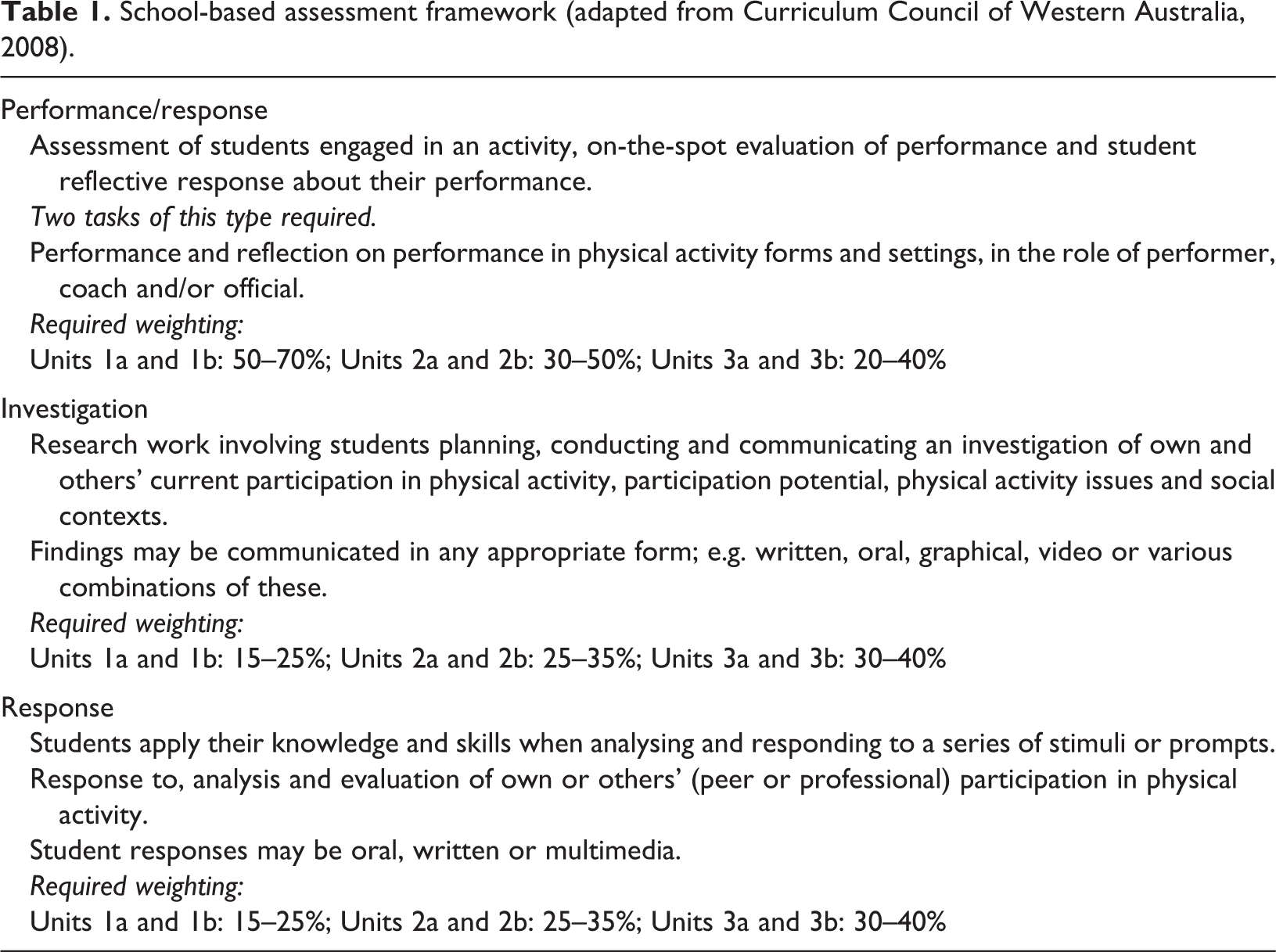
The requirements associated with the external assessment contrasted sharply to the school-based assessment requirements, in that they drew a clear distinction between assessment addressing theoretical content and performance-based assessment. External examination comprised a written component (with a weighting of 70% of the examination mark) and a practical component (weighting 30% of the total examination mark). The two-and-a-half-hour duration written examination included multiple choice and short- and long-answer questions. The practical performance examination required students to attend an ‘Examination Centre’ on a given day and to perform prescribed ‘Static’, ‘Dynamic’ and ‘Conditioned’ skill-based drills and activities in their chosen sport selected from a list of 14 sports available. 3 The chosen sport could be the same activity as that featuring in the units studied at school, or a different activity.
Our investigation of ‘integration’ thus acknowledged that the new PES course presented both clear pedagogical opportunities in relation to the ‘integration of theory and practice’ and prospective tensions emanating from the specification for external assessment. Also significant for this research was the absence of a definition of ‘integration of theory and practice’ in the course specification and, similarly, the absence of expanded commentary or illustration of a feature that was identified as ‘central’ to the new course. A further absence in the official text was any direct reference to Arnold’s work as a framework to prospectively assist teachers in giving meaning and direction to their development of ‘integration’ in curriculum planning, pedagogy and/or assessment. Below, we draw on literature to critically explore the association between Arnold’s framework and notions of integration in senior secondary physical education. It is pertinent to first note that the absence of official expansion on either the intended meaning(s) of integration in the new PES course and the accompanying absence of explicit mention of Arnold’s framework need to be understood in relation to the curriculum history of senior secondary physical education in WA. The previous senior secondary course in WA was a non-tertiary entrance course that made no reference to Arnold’s framework and positioned ‘practical performance’ and ‘theory’ as two quite distinct course components. This history stands in contrast to some other jurisdictions (particularly, Queensland), where Arnold’s framework has been explicit as a curriculum foundation and where the dimensions of learning in, through and about movement are embedded much more strongly in the curriculum history and, therefore, teachers’ discourse and practice (see, for example, Macdonald and Brooker, 1997; Queensland Studies Authority, 2010).
Learning in, through and about movement: a framework for integration?
As Brown and Penney (2013, 2017, 2018) noted, several contemporary curriculum developments in senior secondary and examination physical education have made direct or indirect reference to Arnold’s (1979) conceptualisation, as has much of the associated research. In some jurisdictions (such as in Queensland; see QSA, 2010) there is an established history of Arnold’s concepts being used to inform and critique developments in senior secondary physical education. The Leaving Certificate for Physical Education in Ireland (National Council for Curriculum and Assessment, 2015) also made this theoretical underpinning explicit. While limitations of space preclude detailed commentary on these and other developments internationally, it is important to acknowledge both the standing of Arnold’s work in senior secondary physical education and concerns associated with appropriations of it. We particularly acknowledge the concerns voiced by Thorburn (2007), Brown and Penney (2013, 2017, 2018) and, most recently, Stolz and Thorburn (2017), regarding limited understandings of Arnold’s work. As Stolz and Thorburn (2017) highlighted, arguably the most significant of these concerns is the propensity for the in and through dimensions to be merged and ‘the about dimension to disproportionately dominate’ (p.385) in senior school examinable courses, with little more than ‘lip service’ (p.385) paid to the true essence of the in dimension (see also Brown and Penney, 2018). Particularly in the light of openly varied understandings of Arnold’s work, we clarify the conceptualisations employed in this research. In introducing Arnold’s (1979) three dimensions, we identify each dimension and, critically, Arnold’s (1979) emphasis of their interconnectedness, as pertinent to notions of ‘integration’ in physical education and, more specifically, investigation of ‘integration’ in the PES in WA.
Education in movement is primarily concerned with movement and physical activity. The experience is one of actualisation in what are described as ‘distinctive and bodily orientated contexts’ where one can thereby learn about themself and the world around them (Arnold, 1979: 176). The dimension brings to the fore the participatory perspective of the individual. Brown and Penney (2013) summarise learning in as having ‘experiential outcomes, where students directly acquire knowledge, understandings and skills as a result of thoughtful participation in physical activity (e.g. applying tactics and strategies in a game, appraising the physical capacities and requirements of an activity)’ (p.43). Similarly, Thorburn (2007) explains that learning in is where students acquire understandings as a result of learning the prerequisite skills for effective participation in different games and sports (p.168). Integration of knowledges is thus inherent in education in movement.
Education through movement aims to develop extrinsic learning objectives, and is ‘where students indirectly acquire understandings, capacities and attitudes as a result of studying and participating in physical activity’ (Arnold, 1988: 176). These include physical, emotional, intellectual and social aspects of an individual through participation in selected and directed physical activities. The knowledge relationships and notion of integration offered by this dimension is, thus, different to that described above. Brown (2013) describes this dimension as using ‘the activity/movement in physical education as a way of meeting another aim/goal or objective, as a means to an end’ (p.26). Thorburn (2007) explains that ‘learning “through” is where students acquire understandings as a result of active participation in different activities, for example, understandings about fitness, values, attitudes, and aesthetic appreciation’ (p.168, our emphasis).
Education about movement presents a further distinct perspective on teaching and learning in physical education. Brown (2013) refers to education about movement as being concerned with rational or propositional enquiry, which is informed by anatomical, biomechanical, physiological, sociological, psychological and/or philosophical perspectives. Examples of education about movement that are highly recognisable in many examination physical education courses include: understanding heart rate thresholds for improving cardiovascular endurance, examining the impact of gender stereotypes on participation in physical activity, and planning psychological strategies for pre-match preparation. Knowledge that is central to education about movement is, thus, often a focus for thinking about prospective ‘integration of theory and practice’ and, as indicated above, has often appeared to be privileged in examination physical education course specifications.
In engaging with Arnold’s work, we echo others (Brown and Penney, 2013, 2018; Hay and Penney, 2009) in highlighting Arnold’s (1979) emphasis of the interconnectedness of the three dimensions, such that while ‘conceptually discrete but functionally related, each dimension is not exclusive of the others, but overlaps and merges into them’ (Arnold, 1979: 177). This emphasis of interconnectedness was central to our utilisation of the framework to critically examine the ‘integrated’ approaches to teaching, learning and assessment arising in the context of teachers’ enactment of the new PES course in WA. In taking this stance we were also cognisant of Stolz and Thorburn’s (2017) observation that rather than the desired integrated curriculum, the appropriation of Arnold’s concepts has meant that we are often ‘left with demarcated “silos” that operate independently from each other in practice’ (p.385). In addition, we drew upon the views that multiple authors (Brown and Payne, 2009; Brown and Penney, 2018; Kirk et al., 2002; Tinning, 2008) have expressed, in highlighting the potential of the conceptualisation even in its most simplistic and pragmatic form, to provide possibilities for the development of pedagogic arrangements that integrate theory and practice, within the context of examination physical education courses.
Before turning the focus onto our research, it is also important to acknowledge that, historically, a number of terms have been used, sometimes interchangeably, to address ‘theory and practice’ relationships in physical education, including ‘integration/integrated’, ‘interrelated’, ‘interconnected’ and ‘interdisciplinary’. For clarity, we summarise our use of terms as follows. The term integration, when used in the context of the ‘integration of theory and practice’, refers to the two-dimensional nature of theory and practice, or the integration of theoretical principles and concepts to practical settings (Penney and Kirk, 1997). The terms interrelated and/or interconnected in this research refer specifically to the inherently interdependent relationship between Arnold’s (1979) conceptualisation of learning in, through and about movement that Arnold (1979) and, subsequently, Brown and Penney (2013) have stressed. Following Thorburn (2008), interdisciplinary relates to sub-disciplinary or interdisciplinary content that typically constitutes the ‘propositional knowledge’ of high-stakes examination and senior school physical education. This links closely to education ‘about’ movement, encompasses bio-physical and socio-cultural discipline knowledge, and is typically associated with biomechanics, human anatomy, exercise physiology, motor learning and sociology.
Acknowledging these complexities associated with terminology, this research adopted a particular working definition of ‘integrated theory and practice’ as: an understanding about theoretical knowledge and principles, ‘developed and utilised’ (Hay and Penney, 2009) in and through authentic practical activities, contexts and situations. As such, theory and practice are integrated and interrelated (Jones, 2017). The relationship is conceptualised as dynamic and two-way, encompassing Arnold’s dimensions as necessarily interrelated in a coherent framework. It seeks to counter tendencies to narrow or reduce visions of integration to (only) the application or applied exploration of theoretical concepts in ‘practical’ tasks and/or contexts. This working definition informed the exploration of the notion of ‘integrated theory and practice’ articulated in the official texts associated with the new PES course in WA, and in teachers’ interpretation and enactment of the new course. An analysis of official texts (including exemplar materials, sample examination questions, supporting materials for the practical examination and resources used in professional learning events) is reported elsewhere (Jones, 2017) and is only drawn upon here as is directly pertinent to our focus on the ‘integrated’ pedagogical practice developed by teachers. This paper specifically reports data associated with the research intent to critically examine how, as a stated central feature of the new PES course, ‘integrated theory and practice’ was developed in the curriculum, pedagogy and assessment practices of teachers enacting the new specifications and drawing on accompanying support materials.
Methodology
Ethical approval for this research study was gained through the lead author’s institution. The research was qualitative and interpretive, utilised multiple methods and included multiple phases that collectively sought to address the complexities of curriculum development and enactment (see Jones, 2017). Data reported in this paper arise from a series of school-based case studies that utilised documentary and interview methods to explore teachers’ interpretation and enactment of ‘integration’ in the context of the new PES course. The selection of case study schools was directly informed by the preceding phases of the research. Specifically, interview data from key actors in the course development process and individuals with a lead role in supporting teachers’ understanding and enactment of course specifications (including curriculum authority staff, representatives from each of the three education systems (government, catholic education and independent schools) and members of the PES examination group), pointed towards prospective case study participants. Interviewees variously identified some specific teachers and/or schools who, in their view, would be good to approach for involvement in case study research. This included schools that had attained what were regarded as ‘good results’ in the new PES course, and teachers who had been involved in professional learning and/or who had shared materials and samples of work that reflect ‘integration’ at local network meetings. Selection also took into consideration the desire to feature variation in terms of student cohort size, teachers’ experience in teaching senior secondary physical education, metropolitan/rural location and representation of each of the education systems in WA (Jones, 2017).
Four schools were approached and agreed to be case study schools. One teacher from each school was approached through the principal, to be interviewed and to provide documentary material pertinent to the research. Documentary data comprised unit plans, details of learning activities and assessment tasks, and marking keys and/or rubrics. Table 2 provides a profile of the case study schools and teachers. For the purpose of this paper, the case studies are referred to as Schools 1, 2, 3 and 4. The teachers’ names are also replaced with a pseudonym.
Case study school profiles (adapted from Jones, 2017).
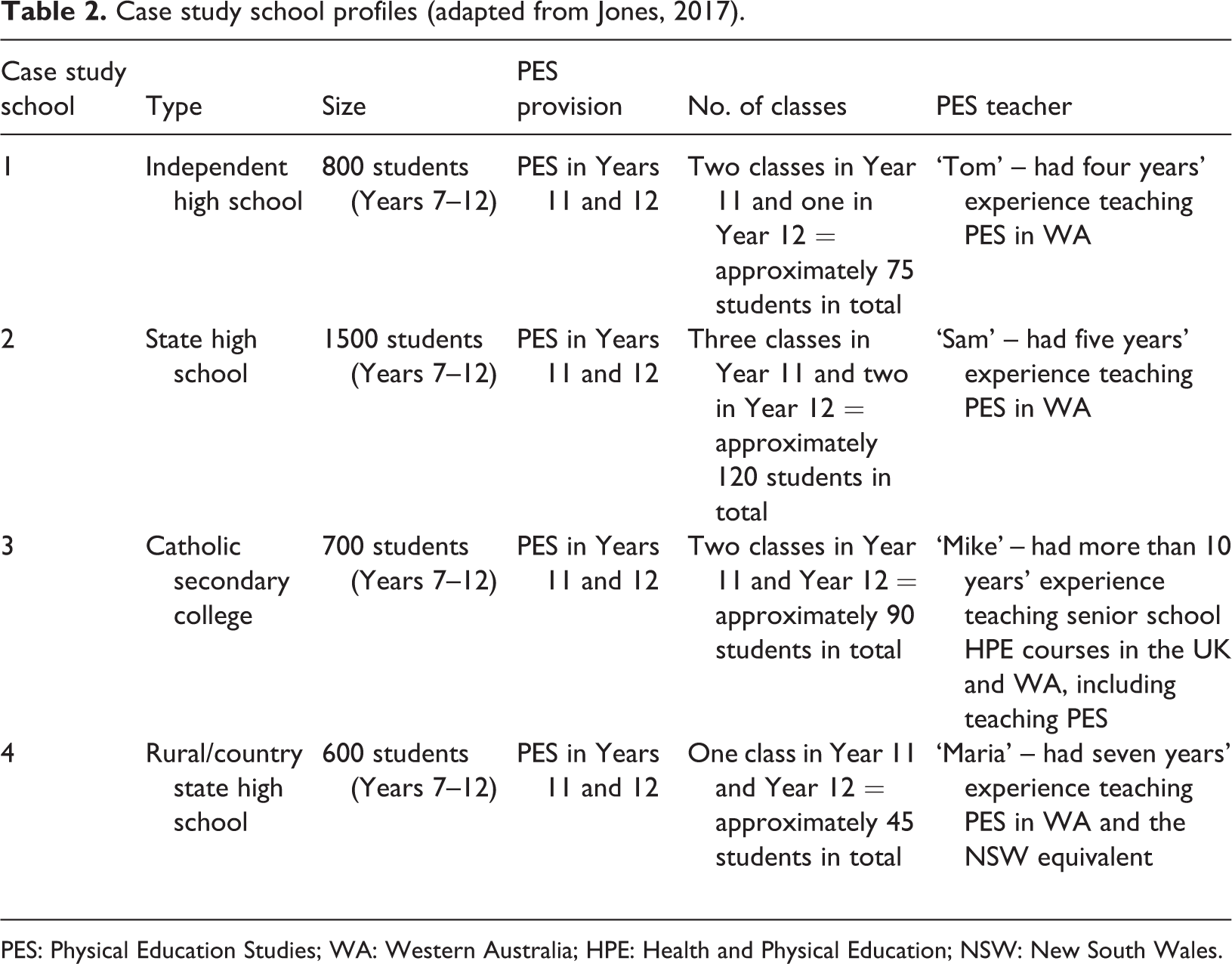
PES: Physical Education Studies; WA: Western Australia; HPE: Health and Physical Education; NSW: New South Wales.
Semi-structured interviews with the teachers were conducted at a time convenient for them and lasted approximately one to one and half hours. The interviews addressed a series of lead questions, with further questioning and prompting employed as appropriate in the light of initial responses. The key issues addressed included: teacher’s philosophical approach to PES; understanding of the phrase ‘the integration of theory and practice’; views of the PES syllabus and the external examinations; planning and pedagogical practice; the role of practical performance in the delivery of syllabus content; and PES course texts used and employed. All interviews were recorded and transcribed. Field notes were also taken during the interviews to supplement transcriptions, and documentary materials relating to curriculum planning were sourced from the participating teachers.
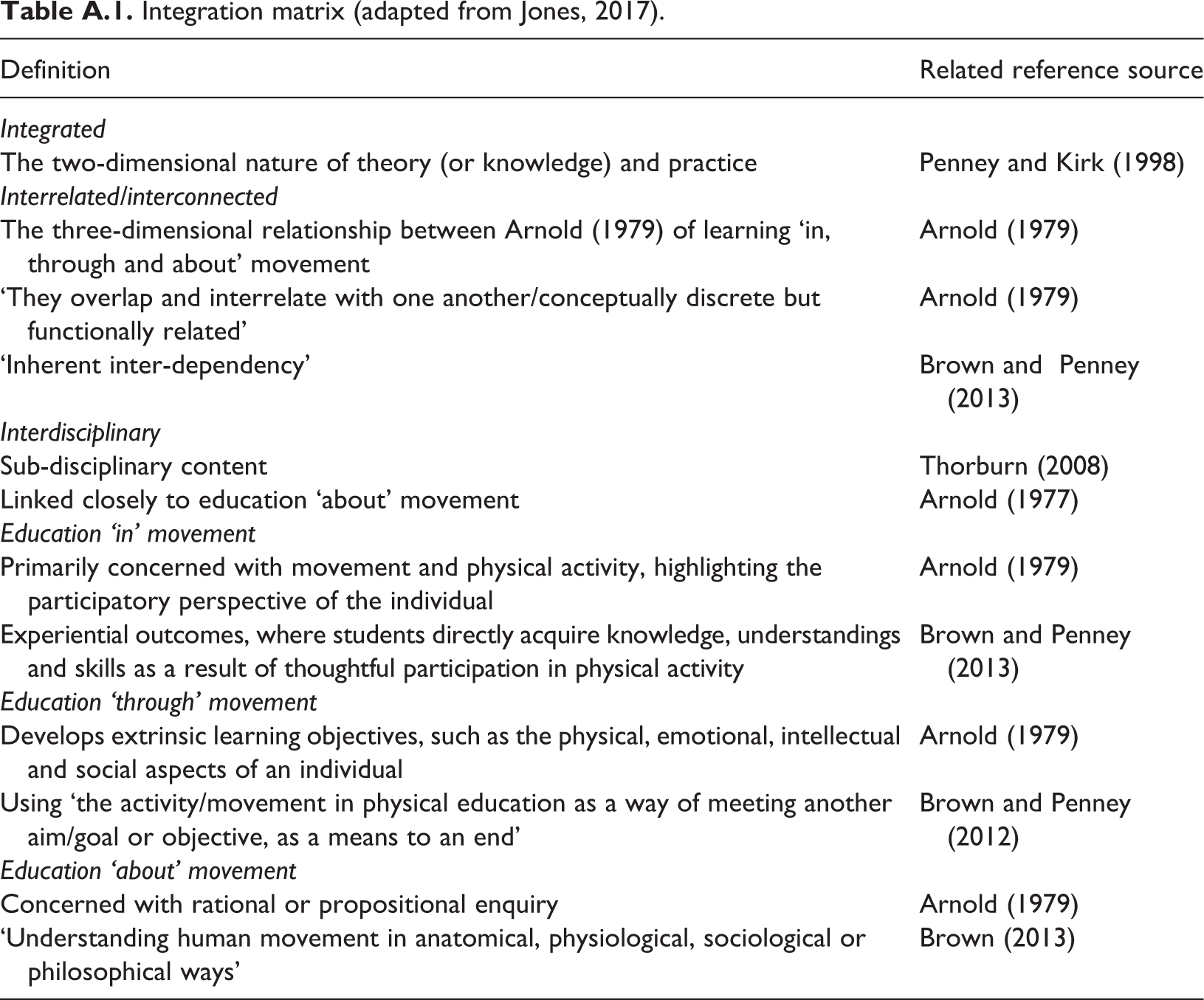
Data analysis of interview and documentary data explored the ways in which ‘integration of theory and practice’ (Curriculum Council of Western Australia, 2009: 2) was being interpreted and enacted in each of the schools. Analysis specifically sought to firstly identify and distinguish different types of pedagogical approach associated with ‘integration’ and, secondly, examine the various ways in which Arnold’s dimensions were represented in each of the pedagogical approaches identified. This process involved systematic repeat readings and progressive coding of data, firstly for familiarisation, secondly with a focus on understanding what the focus of integration was (particularly in relation to course content) and how it was being enacted pedagogically, and thirdly to interrogate data directly in relation to expression of Arnold’s dimensions. Appendix Table A.1 provides the matrix that was used as a point of reference in the process of categorising and coding of data. To ensure credibility of data, the case study summaries that were generated from the analysis process were returned to each teacher for member checking. Teachers were specifically asked to confirm that their pedagogical practice was accurately represented. The following sections bring together findings from the analysis to discuss teachers’ enactment of this feature of the new PES in WA.
Integration in teachers’ pedagogic practice
It is not as easy as simply ‘moving in from the “cold” of gymnasium and playing field and into the “warmth” of the classroom’ (Casey and O’Donovan, 2013: 354).
Variously, the teachers in the case study schools acknowledged the integrated and interrelated nature of theory and practice. They tended to refer to a two-way relationship and pedagogic process, between content knowledge (‘theory’) and practical experiences and/or activity (‘practice’), rather than making explicit reference to the interrelatedness and interconnectedness of Arnold’s (1979) three dimensions. As previously indicated, this aligned with the history of senior secondary physical education in WA. The interpretation and application of integration as a feature of the PES (and, hence, the expression of Arnold’s concepts in their pedagogical practice) was also clearly mediated by contextual and highly pragmatic considerations. One teacher referred to a ‘split personality’, reflecting that: at the back of your mind you know it’s [the integration of theory and practice that is ‘central’ to the course] always there, but in reality, especially in Year 12, you only have so much time. One side of you wants to do it [adopt integrated approaches], but you end up doing another. (School 2)
Given the statement made about integration in the course rationale, an important finding was that there was little or no sign of an established or consistent ‘integrated theory and practice pedagogy’ across the schools. While there was evidence of ‘some’ or what might be called ‘modest’ (Brown and Penney, 2013) examples of integrated theory and practice shaping teaching and learning arrangements and approaches in the case study schools, the extent and nature of links developed varied considerably. Most obviously, the pragmatics of addressing assessment requirements in what were perceived to be effective ways, and addressing time and accountability pressures, often led to compromises in the teaching and learning approaches being employed within the case study schools.
Returning specifically to Arnold’s framework, the case study data illustrated that the participating teachers interpreted the ‘integration of theory and practice’ in ways that broadly linked with and reflected aspects of the framework. For example, Maria (School 4) commented that ‘I use Arnold as the background for everything I teach, it’s the basis for the course, so everything links to the three parts’, and Mike (School 3) stated that ‘we learn about the knowledge of the course in and through practical application’. There were significant variations in teachers’ comments on Arnold’s three-dimensional conceptualisation of in, through and about, and, in many instances, reference to the concepts was somewhat simplistic and/or incomplete. Teachers acknowledged the fundamental importance of physical experiences and/or pointed to the value of experiential learning, to support the view that kinaesthetic awareness in and through movement attaches or transports meaning and knowledge (Thorburn, 2008). The teachers also specifically emphasised the importance of students ‘doing’ or participating in physical activity, as compared to simply engaging with examples in a pictorial or visual form. Findings thus reaffirmed other research (Brown and Penney, 2018; Stolz and Thorburn, 2017) that has identified ‘in, through and about’ as a familiar yet arguably problematic discourse in examination physical education, particularly because of the varied and partial nature of understanding and application of the framework. However, as previously indicated, in this instance the limited understanding and pedagogical expression of Arnold’s concepts needs to be seen as not surprising, with curriculum development and discourses in WA acknowledged as not previously foregrounding learning in, through and about movement.
Further detail with regard to the different ways in which Arnold’s concepts were individually and collectively expressed was drawn out in pursuing the distinct approaches to integration that were identified through analysis. The following section reflects the findings emerging from the interrogation of the data to specifically distinguish contrasting approaches to ‘integration of theory and practice’. This analysis led to three categories of ‘integrated pedagogic practice’ being identified: Opportunistic, Structured and Investigative/Guided (Jones, 2017). These terms reflect key features evident in the different planning processes that teachers were engaged in. The discussion that follows clarifies the meaning of each term, provides data that illustrates the approach in practice and examines the varied expression of Arnold’s concepts.
Opportunistic arrangements for integrated theory and practice
Opportunistic arrangements for integrated theory and practice was the term used to refer to approaches whereby on an impromptu basis, and in an ‘ad hoc yet planned’ way, teachers took up opportunities to use movement to illustrate a theoretical principle and/or concept at a time deemed pertinent within a lesson that is practically based. The approach reflected awareness of, and planning to make the most of, pedagogic opportunities to illustrate, reaffirm and extend understanding of specific content knowledge evident and being applied ‘in practice’. The intent of the opportunistic pedagogical arrangement was to make the most of situations as they occurred. However, the likelihood of these occurrences was enhanced by planning generative activities. The teachable moment, while necessarily spontaneous, was planned in the sense that the teacher can be assured that if certain conditions are put in place, the moment or experience will occur.
Tom (School 1) referred to the approach as ‘flip flopping’, while Maria (School 4) referred to ‘stop/starting’. For the purpose of this discussion, we use the phrase ‘flip flopping’ to refer to both approaches. ‘Flip flopping’ referred to the use of open movement situations and ‘teachable moments’ to move between and link interdisciplinary content knowledge, in contexts of practical exploration/application. Importantly, lessons were planned to express the ‘flip flopping’ in an opportunistic way; that is, the teacher recognised ‘teachable moments’ (or opportunities) that could arise in a physical activity context, planned the activity in a way that enabled the opportunities to arise and was ready to respond, exploiting the teachable moment as an instance that allowed specific interdisciplinary knowledge (such as exercise physiology, functional anatomy and motor learning) to be brought to the fore. ‘Flip flopping’ between sub-disciplines (for example, biomechanics, exercise physiology, motor learning and human anatomy) allowed students to relate previous or new theoretical understandings to the personal physical experience in the moment.
Mike (School 3) explained his approach in the following way: Something happens, I stop it, recall or replay it, perhaps ask why I stopped it, or what happened, explain and off we go again. It can be a bit random, but I know that over a period of time sooner or later I’ll see examples.
The opportunistic approach was thus designed to optimise the inherent value of practical experiences implicit in (Arnold, 1979) and through movement and provide a reference point for reflection on learning that was either distinctly new to students, or that may be familiar to them. Hence, the essence of the engagement in physical activity and ‘doing’ in this context typically revolved around learning about; that is, an explicit connection is made to propositional knowledge described in the PES course syllabus. As indicated earlier, this is somewhat contrary to Arnold’s notion of learning in which does not focus on the use of physical activity for the purposes of engagement with ‘other (external) learning’. ‘Flip-flopping’ was, however, identified as a pedagogic arrangement that contextualises and simultaneously ‘opens up’ understanding about the course content. It required teachers to have explicit knowledge of the course content and the dynamics of the pedagogical arrangements for it to be effectively employed. Teachers also recognised that it needed to be employed in conjunction with other arrangements in order to consolidate and deepen students’ conceptual understandings.
Structured arrangements for integrated theory and practice
The Structured approach relates to teachers employing a teaching and learning framework or structure, which underpinned their efforts to develop students’ understanding of a theoretical principle or concept through a practical experience, illustration or task. Typically in this approach, teaching was directive and the learning arrangements prescribed and closed in nature. The approach commonly focused on application, requiring students to use and apply their understandings to affect performance. As we illustrate, particular propositional knowledge was, therefore, central to this notion of ‘integration’. The examples that follow relate to planning and pedagogy in the context of a single lesson and/or multiple lessons. Structured pedagogic frames were linked to developing knowledge and understanding of specific theories and ideas. Variously, all teachers across the case study schools used practical experience and/or illustrations to systematically underpin their efforts to develop students’ understanding of a particular theoretical principle or concept. While the teaching and learning experiences were sometimes linked to assessments, such as investigations (see Table 1), they were not directly used for assessment purposes.
The first example of the structured approach used a framework that has three parts: ‘practical experience/applied theory/practical application’ or prac/theory/apply. As Mike (School 3) explained, his starting point was ‘an experience’, and the experience formed the basis for introducing theoretical understandings, which were then extended through application/exploration: I start most, but not all lessons with a practical based example, like a demo in my skill based PE lessons. I demo what I am going to focus on. It might be a few balls spinning or a bit of YouTube. Whatever, it’s something practical that they see or do. I then give them some theory inputs, then we apply it to a situation or sport, so its practical, theory, apply, that’s the basic plan. (Mike)
Prac/theory/apply ‘structured’ arrangements (adapted from Jones, 2017).
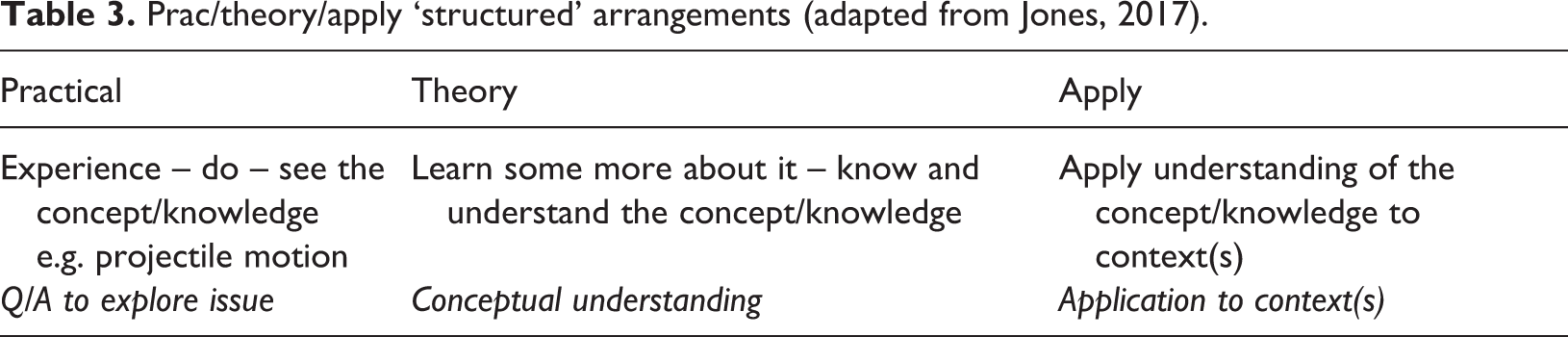
The second example of structured approaches employed a similar frame to the previous one, and similarly involved particular learning about movement being brought to the fore within a practical setting. In this instance, Tom (School 1) explained a lesson starting with students playing a three-on-three game of half-court basketball. The content focus in this instance related to the ‘Motor Learning and Control’ section of the PES syllabus. As the game progressed, Tom would ask a student to note down on a whiteboard the various skills being used in the game; for example, lay-up, set shot, pass, dribble, etc. At a break in the game, all students were then prompted to consider the range of skills listed on the board and add any that may be missing. Tom explained that he would then provide an introduction to ‘Open and Closed Motor Skills’, explaining the distinction between the two categories and the notion of ‘open’ and ‘closed’ being positioned at either end of a continuum, and then ask the class to consider the list of skills in relation to the two categories and plot the skills on a continuum. He would then extend the task by asking students to identify sets of skills from a range of other sports (e.g. rugby, football, badminton, swimming, athletics, etc.) and, similarly, plot them on the continuum. Tom would then facilitate class discussion by questioning students’ positioning of skills and seeking consensus on where skills were placed on the continuum. This discussion was designed to extend students’ awareness and understanding of the range of skills that they will use in different game contexts and circumstances. The students then went back into the game of three-on-three half-court basketball. Tom would stop the game at particular points and take students through the stages of play and the skills employed. He would again ask students to plot on a whiteboard where they thought the skills were on the continuum, with the task enabling understanding to be checked and reaffirmed.
The third example of structured arrangements is termed ‘through the examiners’ eyes’. Mike (from School 3) explained that: …part of my theory and practice teaching, in both the classroom and outdoors, is getting the kids to do that ‘through the examiner’s eyes’. That’s what I call it with them. Let’s experience and practically do the examiner’s role. I think it saves some time, opens eyes. We design or I give them the marking key or some points to address and they consider their own and each other’s work and performance. (Mike) Teaching and learning inputs Setting of task and marking criteria established Task completed (attempt 1) Student observation and peer marking Discussion and feedback Possibly attempt 2 (as homework if written).
In this instance, ‘chaining’ 4 (content within Motor Learning and Coaching, Unit 3A; Curriculum Council of Western Australia, 2008: 29) was the focus for ‘integrated’ teaching and learning in a practical context. Mike explained that he would plan a short or extended task (depending on time allocated) that required students to use their understanding of ‘chaining’ to design coaching/training activities to improve performance in selected skills. With support, the students would design marking criteria or observation points for the chaining task. Working in groups of six or seven, students would then carry out the task, with the chaining activities observed and marked by peers. Mike would then facilitate discussion with the students, exploring their assessments and giving feedback. If appropriate, he would allow a second attempt to be undertaken. In the learning activity, students therefore had the opportunity to reflect on their performance and interrogate their understanding through multiple lenses (designer, performer and marker). Mike termed this approach ‘through the examiners’ eyes’. ‘Integration’ is developed from a performer and an assessor (examiner) perspective. Returning to Arnold (1979) in a practically applied context, the interrelatedness and interconnectedness of the dimensions of in, through and about is expressed to some degree. Again, however, learning about was the ‘driver’ of ‘integration’, with learning through and in movement framed in relation to this dominant focus.
Investigative/guided arrangements for integrated theory and practice
What was termed the ‘Investigative/guided’ approach usually took the form of an assessment-based task or ‘lab’. This involved students collecting and analysing experiential data in a performance task, and their theoretical understandings being developed firstly through prompted questioning and then through application back to the performance task or an alternative practical scenario. The approach was designed to enable the teacher to confirm or assess understandings of specific content knowledge featured in the PES syllabus. In contrast to the structured approach, here the students are cast as active agents (investigators) and the teacher is cast in the role of guide (a guided discovery agent). The following examples illustrate this in practice.
The lab activity: Exercising in the Heat (School 1) involved students having ‘hands on’ experience during data collection and being challenged to generate suggestions for adjustment to training programmes in the light of data gathered. In the task students gathered data by running laps of a 400-m track simulating different heat levels by dressing in different types of clothing. Data relating to heart rate and body temperature were recorded and an exertion scale was used as a baseline to measure effort. Students were required to plot the data on a graph and then use this to respond to a series of questions addressing the effects of heat on different data sets, the potential dangers of activity in heat and asking them to suggest adjustments to training programmes.
A second investigative example was the Motor Learning and Coaching – ‘Ultimate Frisbee’ game performance analysis of self and others (School 2). This investigative/guided task addressed course content focusing on learning and skill development in relation to the correction and improvement of self and others, and required students to design a game notational analysis system. They determined the important elements of the game and subsequently created the notational analysis system that would allow them to describe and evaluate performance. The students were required to collect data on themselves and others, then work in pairs to analyse and reflect on skill and strategically related strengths and weaknesses of performance. Finally, they provided feedback to the performer, and then, prompted by some questions, they created training activities that were designed to improve the performance of self and others.
Both of the these tasks involved students working across and thus ‘integrating’ ‘theory’ and ‘practice’, with structured investigation guiding students’ systematic exploration of particular aspects of performance in ways that teachers regarded as authentic. This approach presented the potential for significant interrelated and interdisciplinary links to be explored and for students to learn in, through and about movement. However, again it is important to acknowledge that the three dimensions were not explicit in the task design or learning expectations, and that the prime focus was learning about specific movement concepts that were foregrounded in the PES course. The interrelationship between dimensions is, thus, one in which learning through and learning in movement are ‘servicing’ particular learning about movement.
In summary, the case study data generated evidence of specific pedagogic approaches being employed by teachers, each of which represented a particular interpretation and expression of the ‘integration of theory and practice’ as a central feature of the new PES course. Analysis drawing upon Arnold’s (1979) framework serves to highlight a narrowness and specificity to the ‘integration’ being pursued, which centres on the privileging of learning about movement in the official text and in pedagogic practice, and an accompanying tendency for the focus to be on the application of theory in practical contexts. Thus, there is both an imbalance in the theory–practice relationship and an imbalance in the relationships between the dimensions of ‘about’, ‘through’ and ‘in’. In presenting this summary, it is important to stress that we are not being critical of the teachers’ approaches. To the contrary, we recognise teachers as acting strategically and pragmatically in the ways in which they express ‘integration’. Their enactment is carefully framed within the context of the PES course specifications, the associated assessment requirements and arrangements, and within pedagogical constraints associated with time, resources and external pressures to focus on students’ examination performance. They recognise and have each exploited distinct pedagogical opportunities for ‘integration’ in their teaching and assessment.
Before finalising our discussion, it is also important to acknowledge the limitations of this study that are evident in the data presented. While we believed that four case studies would produce plenty of examples of varied pedagogic practice, this was not the case. In part, the absence of further examples reflects the small number of teachers involved. Expanding the teacher sample and, at the same time, extending beyond those schools that were regarded by authoritative figures as ‘good cases’ for this research to examine, may prospectively have produced greater variation in the pedagogical practices reported. The relative absence of variety also reflects, however, a lack of observation in the ‘classroom’ setting during the case studies that may well have revealed further practices and nuances in practice associated with ‘integration’. Such observations may have provided the basis for a deeper level of conversation in the semi-structured interviews. Observational research and other extensions of research methods to directly engage with students’ articulations and understandings of ‘integration’ are, therefore, recommended as avenues via which future research can seek to extend insight into the knowledge relations and pedagogic relations developed in and through examination physical education.
Conclusion: implications and pedagogic possibilities
This research illustrated curriculum enactment as a process that features the complexity and negotiation of possibilities for teaching and learning in physical education. The project deliberately directed attention towards something that was explicitly identified as ‘central’ to the new PES course in WA: the integration of theory and practice. The data presented has highlighted the importance of creating conditions to enable different expressions of ‘integrated and interrelated pedagogic practice’ to be pursued, and demonstrated the ways in which those conditions are shaped by both official texts and the contexts within which they are read. In the case of PES in WA teachers’ exploration of ‘integration’ was seemingly inhibited by a strong pragmatic discourse (itself privileging discourses of accountability) and the lack of explicit and in-depth development of the concept of ‘integration’ in the official text.
Both the official PES text and teachers’ pedagogic practices have been shown to align in some ways with Arnold’s (1979) framework of learning in, through and about movement. At the same time, our data lends weight to others’ observations that physical education curriculum developments and teachers have yet to systematically explore the full potential of this framework to broaden the ways of knowing and learning that are valued in physical education, and that shape pedagogy (Brown and Penney, 2013, 2017, 2018; Stolz and Thorburn, 2017; Thorburn, 2007). However, we stress that tendencies to view the course development and/or teachers’ responses to it critically need to be tempered by recognition that the data speaks to both the complex realities of curriculum development and the potential that the framework presents for the development of conceptually well-grounded and pedagogically ‘rich’ ‘integrated and interrelated’ pedagogic practice. From a policy perspective, our research has particularly drawn attention to the need for course designers to develop official texts that have a clear narrative reflecting key conceptual frames, including a coherent and balanced curriculum, assessment and pedagogic narrative that can ultimately serve to counter or mediate discourses of accountability and pragmatism. Assessment requirements are particularly pertinent to this intent and design, as the case of PES in WA reaffirms the ways in which assessment discourses (and, specifically, high-stakes assessment discourses) will be a prime point of reference for teachers’ endeavouring to be strategic in their enactment of curriculum specifications.
Further, we suggest that our data reaffirms the need for further research with teachers that foregrounds Arnold’s framework as a means of extending and strengthening the expression of ‘integrated theory and practice’ in physical education and proactively exploring the different pedagogic meanings that can be developed from new curriculum texts. In this regard, we stress that the links created need to foster dialogue and the sharing of insights about how Arnold’s framework can be (re-)interpreted in ways that better engage with contextual pragmatic realities. We reiterate that teacher educators and professional associations have important roles to play in supporting both new and experienced teachers to be innovative and creative in their curriculum development work in contexts of externally generated ‘reforms’.
Footnotes
Acknowledgements
This paper draws on doctoral research that is reported fully in the first author’s thesis (Jones, 2017). The support provided throughout the research by Associate Professor Paul Newhouse and Dr Ken Alexander, as members of the supervisory team, is acknowledged. Thanks also go to the anonymous reviewers who provided detailed and very helpful feedback on earlier drafts of this paper.
Declaration of Conflicting Interests
The author(s) declared no potential conflicts of interest with respect to the research, authorship, and/or publication of this article.
Funding
The author(s) received no financial support for the research, authorship, and/or publication of this article.
Notes
Appendix
Integration matrix (adapted from Jones, 2017).
| Definition | Related reference source |
|---|---|
| Integrated | |
| The two-dimensional nature of theory (or knowledge) and practice | Penney and Kirk (1998) |
| Interrelated/interconnected | |
| The three-dimensional relationship between Arnold (1979) of learning ‘in, through and about’ movement | Arnold (1979) |
| ‘They overlap and interrelate with one another/conceptually discrete but functionally related’ | Arnold (1979) |
| ‘Inherent inter-dependency’ | Brown and Penney (2013) |
| Interdisciplinary | |
| Sub-disciplinary content | Thorburn (2008) |
| Linked closely to education ‘about’ movement | Arnold (1977) |
| Education ‘in’ movement | |
| Primarily concerned with movement and physical activity, highlighting the participatory perspective of the individual | Arnold (1979) |
| Experiential outcomes, where students directly acquire knowledge, understandings and skills as a result of thoughtful participation in physical activity | Brown and Penney (2013) |
| Education ‘through’ movement | |
| Develops extrinsic learning objectives, such as the physical, emotional, intellectual and social aspects of an individual | Arnold (1979) |
| Using ‘the activity/movement in physical education as a way of meeting another aim/goal or objective, as a means to an end’ | Brown and Penney (2012) |
| Education ‘about’ movement | |
| Concerned with rational or propositional enquiry | Arnold (1979) |
| ‘Understanding human movement in anatomical, physiological, sociological or philosophical ways’ | Brown (2013) |