



Abstract
This paper provides a rationale for The Spectrum of Teaching Styles (The Spectrum) as a pedagogical model in teaching physical education (PE). Building on prior discussions/debates ( SueSee et al., 2021), we will contest the view that the concept of teaching styles is different from that of a pedagogical model. In doing so, we highlight the most central aspects of The Spectrum and explain fundamental characteristics that warrant its representation with existing pedagogical models. The paper demonstrates for teachers how The Spectrum details the ‘how’, ‘when’ and ‘why’ of their pedagogical decisions, in understanding how they may meet educational outcomes for increased curriculum alignment, or successful enactment of models-based practices. The contention we present is The Spectrum is valuable to PE teachers in understanding the context-specific realities of teaching episodes and therefore improving teaching and learning practices in PE by helping teachers align their pedagogy with their desired learning outcomes.
Introduction
In this paper, a rationale for a pedagogical model is given to challenge the scope and understanding of how models-based practice (MBP) is considered and therefore enacted in physical education (PE). Specifically, we make a case for The Spectrum of Teaching Styles (The Spectrum), an approach centred around decision-making between the teacher and the learner about the ‘how’, ‘when’ and ‘why’ of their pedagogical decisions (Mosston, 1966), to be a recognised pedagogical model in PE. The genesis of the paper lies in critique and debate in the discipline to the authors through ongoing conference dissemination surrounding confusion with terminology and application of The Spectrum's legitimacy in MBP. Specifically, the argument given to us is that The Spectrum is not a pedagogical model and therefore should not be included in compendiums of MBP. Dyson et al. (2016) posited key features of models and categorised them on two levels, the curricular or instructional level. A curriculum model ‘provides a program with its mission, primary content, identity, and infrastructure – all for the purpose of allowing more students to achieve its priority long term learning outcomes’ (Dyson et al., 2016: 297). In contrast, instructional models provide scaffolding on ‘key instructional practices like class management, learning activities, social learning, pedagogical decisions, and assessment with specific unit and lesson objectives’ (Dyson et al., 2016: 297). Collectively, these two model levels are often focused on multiple foci (Metzler, 2011), where the emphasis is placed on the subject matter, the ‘what’ to teach. We suggest The Spectrum fits into neither of these levels defined.
However, similar to earlier works (Haerens et al., 2011; Jewett et al., 1995; Kirk, 2013), we agree a third level of MBP is required, pedagogical models, to successfully implement the two aforementioned model levels which aim to enact the ‘relationship between teaching, learning subject matter, and context’ (Aggerholm et al., 2018: 198). Pedagogical models have one organising structure: Each with its unique and distinctive learning outcomes and its alignment of learning outcomes with teaching strategies and subject matter, and each with its non-negotiable features in terms of what teachers and learners must do in order to faithfully implement the model. (Kirk, 2013: 979)
An assumption taken by the authors in writing this paper is that a historically assumed understanding of PE pedagogy and approaches (e.g. MBP) exists in the extant literature. We now revisit ‘how’ pedagogies are selected and utilised, or not, to achieve the expectations of MBP and how The Spectrum may offer a pedagogical approach to ‘bring to life’ MBP that is consistent with theory and reality.
MBP is a response to a desire to change long-term social processes
There continues to be a pressing need to address what has gone before in shaping our discipline, which has been attributed to long-term social processes associated with order, routine and compliance and schooling for a certain type of citizen (Kirk, 1998, 2006, 2010; Pill, 2016). This citizen is historically healthy, compliant and productive (Kirk, 1988), a consequence of desiring being busy, happy and good (Placek, 1983) students in PE. Achieving these PE ambitions is associated with a historical discourse in prioritising the common PE method in delivering PE curricula (Metzler, 2011). Metzler (2011) described this method as direct instruction of learners undertaking mostly repetitive ‘drill’ practice tasks of skill patterns often taught in isolation from the context of their application. As explained by Mosston (1966) and Tinning (2009), the assumed PE method is a narrow band of teaching styles executed by the teacher as demonstrating and explaining concepts and movement tasks for learners to replicate and refine in practice activities under the direction of the teacher. The PE teacher is in control of all decisions related to content selection, content experience, the timing and pacing of the learning experience (Mosston, 1966; Tinning, 2009).
The limited pedagogical selection of the described historically typical PE method is explained as a behaviourist-aligned teacher-centred practice (Pill, 2016). This PE method is considered to centralise and privilege technocratic, technical skills-based learning and performance pedagogy, excluding other ways of knowing and doing (Brown and Penney, 2013; Gard, 2006; Kirk, 2006; McKay et al., 1990; Tinning, 1988; Wright et al., 2004). As such, a historical discourse bound in privileging a culture of the acquisition of prescribed sport-specific skills is hegemonically reproduced in curriculum iterations (Kirk et al., 2000; Lave, 1997; Pill, 2016). Moreover, this PE method focuses predominantly on one dimension of physical literacy, the physical, thereby limiting critical inquiry, self-determination and other learner-centred approaches, restraining learners’ potential for broad learning and the acquisition of lifelong physical literacy as intended in PE curriculum frameworks (Bowe et al., 1992; Penney and Evans, 1999). Consequently, a narrow focus on educative purpose in addressing (or not) the breadth of school curricula becomes evident (Kirk, 2010; Pill, 2016). Learning is thus prone to be decontextualised from applications beyond the PE setting (Drummond and Pill, 2011).
Decontextualised learning in PE, the consequence of long-term social processes that have informed PE curricula and teaching (Kirk and Kinchin, 2003), has created a marginalisation of certain learners over other students and types of learning in PE. For example, celebrating hegemonic masculinity (Nilges, 1998; Wright, 1997) whilst disadvantaging femininity (Flintoff and Scraton, 2001; Williams and Bedward, 2001) and other gendered, ethnic (Benn, 1996; Vescio et al., 1999) or able-bodied learners (Kosma et al., 2002). This begs the question, how might PE offer more teachable ‘moments’, ‘episodes’ or ‘units of work’, embracing the notions of learning ‘in’, ‘through’ and ‘about’ movement (Arnold, 1979) and the development of physical literacy (Dudley, 2015)?
A solution to meet the various objectives in PE is MBP, the use of different units of work, each with its own distinct features and specific learning outcomes (Casey, 2014). Despite the many benefits of MBP, a challenge is when models based on content (the ‘what’ to teach) become narrowly focused, restrictive, and require modification (Casey et al., 2020; Pill and Stolz, 2017), are watered down (Curtner-Smith et al., 2008) or develop a ‘versus’ approach (Mosston and Ashworth, 2008). The Spectrum does not seek to define content or teaching objectives (SueSee et al., 2021). We suggest this is the main difference and reason why The Spectrum is not discussed in MBP, as it is more a pedagogical model than a curriculum or instructional model. To our knowledge, an academic argument has not been made to support why The Spectrum is not a model potentially due to the assumption that The Spectrum lacks reference to content or the ‘what’ to teach. We suggest any argument made regarding The Spectrum lacking content may be weak as others have outlined that content (in MBP) is not always agreed on and, at times, is watered down, where model fidelity is questioned, and sometimes models are suggested as being a collection of teaching styles (Casey, 2014; Metzler, 2011; Pill and Stolz, 2017; SueSee, 2020). We acknowledge that some models (in MBP) have very clear outcomes (e.g. sport education model (SEM) and game-based/tactical models). However, others (e.g. direct instruction, inquiry teaching, peer teaching or cooperative learning) doubtfully can claim to have distinctive content, and we argue that most content can be taught using these approaches. It seems that focusing on content as an argument for inclusion as a model is not the most pertinent factor and has not been considered when discussing some models’ inclusion in MBP. Similarly, others have argued the ‘use of the term “model” implies that content is not the sole organiser for program planning and development’ (Casey and Kirk, 2021: 17) and seem to suggest that focusing on content too much is not desirable. In contrast to the historically common PE method, The Spectrum's ‘non-versus’ approach to pedagogy values all teaching styles for curriculum outcomes they can achieve (Mosston and Ashworth, 2008), thus encouraging teachers to choose pedagogy to create learning experiences to meet educational outcomes across the domains of physical literacy.
An overview of The Spectrum
The premise of The Spectrum (Mosston and Ashworth, 2008) is that teaching is a chain of decision-making. When teaching is viewed this way, 11 teaching styles (called Landmark styles) can be identified, representing two cognitive capacities by learners: the capacity for reproduction thinking and production thinking. The Spectrum is not the curriculum or the ‘what’ to teach, nor does it attempt to influence or inform the ‘what’ to teach. Instead, The Spectrum refers to pedagogical knowledge and describes the behaviours between the teacher and the learner(s) in each of the 11 Landmark styles. (For detailed descriptions of the 11 styles, please read further here https://spectrumofteachingstyles.org/). In the next section, we highlight the numerous aspects of The Spectrum that align with Metzler's (2011) framework for a model.
Methods
In this section, we align features of The Spectrum with Metzler's (2011) MBP framework describing pedagogical models by three elements: its foundations, teaching and learning features, and implementation needs. This demonstrates that The Spectrum meets the ‘criteria’ of a pedagogical model for PE (Table 1).
Metzler's (2011) framework to describe a pedagogical model.
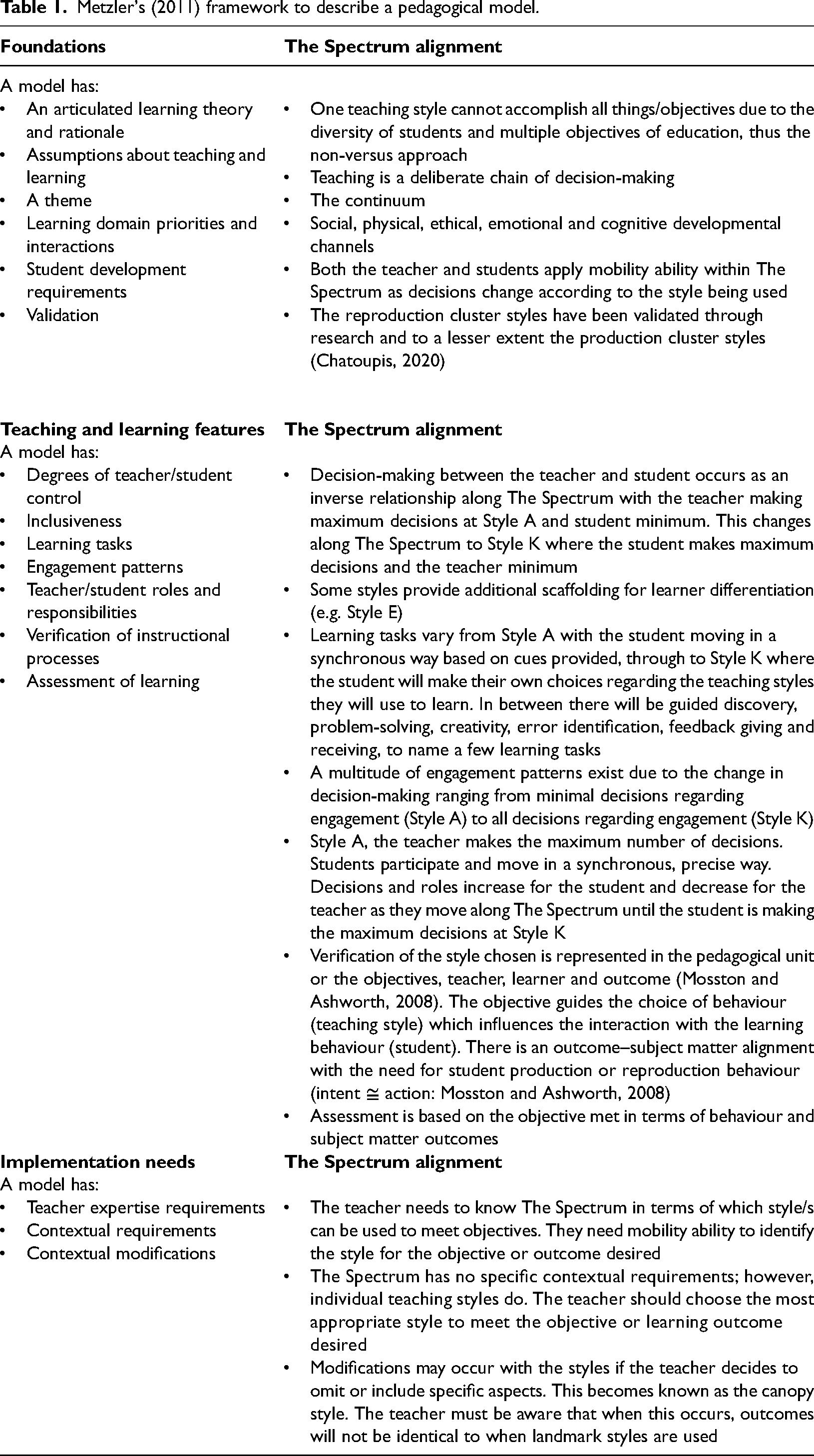
As The Spectrum encompasses 11 Landmark teaching styles, it can achieve a wide variety of objectives when compared to other models mentioned by Metzler (2017) due to their specific curriculum or content focus. The Spectrum's premise, that teaching is a chain of decision-making, is about pedagogical knowledge or the ‘how’ to teach, and not the ‘what’ to teach or content (Mosston and Ashworth, 2008).
Discussion
Kemmis (2019) argued teaching practice could be considered from macro-, meso- and micro-levels. With respect to MBP, Casey and Kirk (2021) proposed macro as the model itself, meso as conduct with a model and micro as teaching and learning as it unfolds as the practices of the model are performed. We will similarly consider The Spectrum as a pedagogical model using this practice architecture. Kemmis et al. (2014) used the term practice architecture to describe the numerous factors that shape (and which are shaped by) each other and, at the same time, constrain and enable practice. In our discussion, we acknowledge these concepts.
The Spectrum, by defining teaching as a chain of decision-making between the teacher and the learner, enables the micro-pedagogy or combination (cluster) of teaching styles to be seen in detail. The congruence of curriculum alignment that is relevant, and contextualised to the learner's pedagogical needs, can be guided by understanding The Spectrum with the metaphor of the onion, as a layered methodology (Figure 1). Each layer represents a different lens from which to understand The Spectrum. Each layer is part of the array of affordances (Hutchby, 2003), which are the conditions to interpret how to apply The Spectrum to any teaching episode. It is an assumption of this discussion that PE lessons are a cluster of teaching episodes. Figure 1 illustrates the teacher, when considering a learning episode, would think about the learner in terms of ‘what’ is the pedagogy (e.g. based on student prior knowledge, skills, capabilities and teacher’s understanding of curriculum deliverables) to meet the anticipated lesson learning outcomes and ‘what’ the learner brings to the episode. For example, both the Australian Curriculum for Health and Physical Education (Australian Curriculum, Assessment and Reporting Authority (ACARA), 2016) and the Society of Health and Physical Educators in America (2014: 58 and 18) Grade-Level Outcomes for K-12 are associated with receiving and responding to feedback: ‘responding to teacher and peer feedback to enhance performance’ and ‘gives corrective feedback respectfully to peers (S4.E3.5)’, respectively. A teacher informed by a social constructivist perspective (macro-pedagogy) would recognise students may not have had the opportunities to develop the skills of giving and receiving feedback and therefore decide a reciprocal style (micro-pedagogy) teaching episode is appropriate to scaffold the outcome (Penney, 2003; Pill, 2012). However, if the teacher decides to use the reciprocal style with a criteria sheet and not directly teach the skills of giving and receiving feedback, the episode is likely to be a challenge for students not ready for the teaching style and hence the episode does not achieve the social interaction inherent in the required outcome.
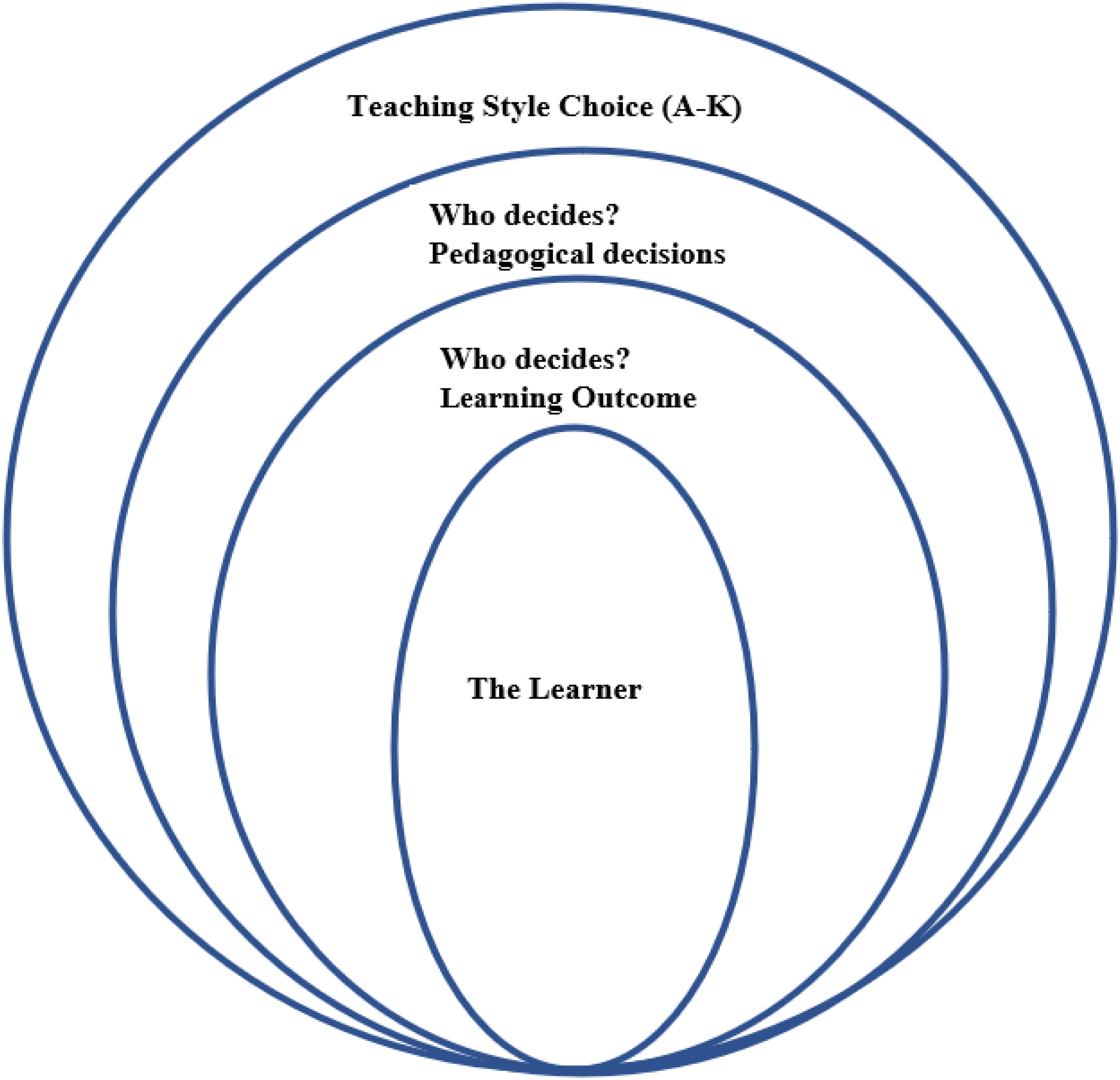
The Spectrum of Teaching Styles (The Spectrum) as a schema for aligned learning planning.
In relation to the previously illustrated example (Figure 1), by considering the learner first (e.g. the learner has limited experience with reciprocal style ‘peer’ teaching) and then the learner's connection to the expectations of learning (e.g. the need for the developed social skills of giving and receiving feedback), the teacher may choose to modify the reciprocal style, to create a canopy reciprocal style. For example, the teacher could use the practice and self-check styles to offer time for individual, self-directed ‘deliberate practice’ of movement skills or patterns, problem-solving or tactical decision-making in games and sports early in the teaching episode. Thus, the teacher has enacted teaching and learning features that constitute a pedagogical model for PE (Metzler, 2011) including the foundations, teaching and learning features, and implementation needs (Table 1). To achieve this, a criteria sheet with limited written criteria and additional pictures of the desired elements of the performance to aid movement identification could be provided. Thereby, the criteria sheet facilitates student reflection on their own skill, movement or tactical decision-making competencies (e.g. implementation needs of a model). Additionally, it would provide the teacher opportunities for timely feedback where they could model to students how to provide giving educative feedback. Then, once students have acquired the fundamental understanding of the lesson's skill, movement or tactical concepts, the teacher could introduce a reciprocal style, where students are asked to watch their partner perform and give visual feedback simply based on ‘thumbs-up’ and ‘thumbs-down’, or by using a similar criteria sheet to aid peer feedback. To assist communication between students, the teacher may also suggest ‘sentence starters’ (e.g. ‘I like the way you…’ or ‘Next time you need to…’), allowing students to navigate giving educative feedback. This example would represent a small, but simple, introduction to some of the decisions of the reciprocal style, based on the skills and attributes of the learner, the desired outcomes and the characteristics of the teaching style. This episode is a modification (or canopy style) of the reciprocal style chosen as a beginning point based on the learner's strengths. The style had the essential decision-making structure of the reciprocal style but was not identical to the Landmark version of the reciprocal style. For a more detailed explanation of canopy styles, we suggest Ashworth (2020).
The Spectrum may assist teachers in two ways with the dilemmas they face implementing different models and navigating the ideologies of pedagogical prescription. Firstly, one of the tenets of The Spectrum is a ‘non-versus’ approach (or ‘all valued’) (Mosston and Ashworth, 2008), which means all 11 styles have potential utility in student learning. In contrast, a versus perspective occurs when ideas are ‘played off’ against each other and teachers are asked to abandon ideas not consistent with the ideology (Ashworth, 2020). The Spectrum's non-versus approach places equal value on each teaching style, and the pedagogical knowledge of the teacher is characterised by mobility within The Spectrum (Figure 1) to meet task intention with pedagogical choice (Mosston and Ashworth, 2008; SueSee, 2020).
Adopting a non-versus philosophy, teachers are not concerned with notions such as ‘Have I watered down the model?’, ‘Have I left part of the model out?’ or ‘Have I maintained fidelity with the approach?’. The Spectrum's non-versus philosophy allows teachers to focus on ‘Can I apply a pedagogy (e.g. an appropriate cluster of teaching styles) to create a learning experience to help my students meet the curriculum outcome?’ From this perspective, it has been argued that The Spectrum's ‘non-versus’ perspective addresses Casey et al.'s (2020: 2) suggestion to move beyond a ‘for or against models debate’ regarding model variations (SueSee et al., 2021).
The second way The Spectrum may be implemented as a ‘non-versus’ perspective is as micro-pedagogies combined to create teaching episodes. We have already alluded to the many models existing in the PE methodology literature. However, the ‘how’ to implement often lacks clarity. As The Spectrum is based on the premise that teaching is a chain of decision-making, from planning through to implementation of teaching and then reflection on the impact of the teaching, it consequently provides the ‘how’ to and the ‘why’ (SueSee et al., 2021) that is necessary to connect the idea of a model of teaching to its ‘happening’ (Casey et al., 2020).
The use of the terms micro-pedagogies and macro-pedagogies may assist in reducing the confusion around terms such as pedagogical frameworks, pedagogical models, teaching models or MBP. For example, some (Pill and Stolz, 2017) highlighted the confusion with teaching games for understanding being an instructional model and a curriculum model and the possibility that it is both. Further, Lund and Tannehill (2015) use the language of the curriculum model to describe a similar construction to Metzler's instructional model. Metzler (2011: 228) stated, ‘Cooperative learning is not really a model by itself. It encompasses a set of teaching strategies’. Whilst curriculum models and instructional models are interrelated, they are not the same.
Others (Casey and Kirk, 2021; Kemmis, 2019) have begun this discussion and suggested the term macro-pedagogies represents the models themselves (e.g. the SEM or inquiry model), and the term micro-pedagogy refers to the specific moment-by-moment talk and interaction between the teacher and student/s required to implement a ‘macro’ model. Another way to think about it is that macro-pedagogies (MBP) are underpinned by multiple foci directing the ‘what’ to teach, whilst micro-pedagogy facilitates congruence to ‘how’ to ‘bring to life’ MBP in practice. For example, the SEM aims to develop a competent, literate and enthusiastic sportsperson, through its key features of seasons, affiliation, formal competition, culminating event(s), recording keeping and festivity. Similarly, the macro-pedagogy features of the cooperative learning model aim to actively involve students in the learning process, by focusing on learning teams, using team rewards, individual accountability and equal opportunity for success (Metzler, 2011). To achieve the outcomes of these MBP (as defined by Metzler, 2011), micro-pedagogies or teaching styles must be used: that is, a series of learning episodes (micro-pedagogies) is the enacted curriculum designed to achieve outcomes which lead back to the goal or goals of the MBP or curriculum framework (macro) chosen by the teacher. Using the SEM as an example, if a student was to become a competent sportsperson, a series of practice-style episodes could be used for skill acquisition, as could divergent discovery-style episodes to provide learning opportunities for the students to use creativity or discovery to produce multiple solutions to a problem or challenge from a game situation. Further to this, if the teacher desired students to develop the skill of giving and receiving feedback from peers and comparison of motor patterns against a set of criteria, the reciprocal style could assist teachers in creating such episodes. Clearly, one style could not achieve such diverse outcomes and Mosston recognised this, stating The Spectrum ‘will serve as a contribution to more effective teaching of free students and indeed will lead the learner from command to discovery’ (1966: xiv). According to Professor Ashworth, Mosston's use of the word ‘free’ is alluding to what he perceived at the time as an overuse of the command style and the desire to free students so that they would experience other ways of learning (personal correspondence, 2011). The term ‘free’ also suggests what macro-pedagogy would be if it has an aim. We earlier argued The Spectrum is not the ‘what’ to teach (content knowledge) but is pedagogical knowledge – the ‘how’ to teach (Mosston and Ashworth, 2008). However, we suggest that whilst The Spectrum does not have content in the same way as the SEM, its overall aim may be a student (taught through the 11 landmark styles) who experiences a wide range of decisions in their learning and ultimately (if they desire) can become ‘free’ from the teacher being the only person who sets the objectives, teaching behaviour, learning style, learner behaviour and outcomes during their learning. Debates that put models or theories against each other convey ideological contests when the reality of teaching is more complex. The issue is not which model is more ‘ideal’ than another, but rather determining which scaffolding conditions achieve the desired learning or behavioural outcome. Depending on the context of the lesson and the needs of the students, all teaching styles can be valid and impactful. In this consideration, teaching styles are complementary, not competing (Gore, 2022; Mosston, 1966).
Implications for games and sport teaching in PE
No one teaching style encompasses all learning eventualities; therefore, an effective teacher must have the capacity for mobility and transition between various teaching styles during lessons (Hewitt, 2020). Further, the multi-dimensional and diverse goals of curriculum documents cannot be achieved through one cluster style alone (SueSee and Barker, 2019). If Hewitt's (2020) suggestion that a range of teaching styles is required to meet the reality of the complex and situated nature of the PE setting is accepted, failure to utilise a pedagogical ‘spectrum’ means the holistic development of students (i.e. physical literacy) can be compromised, and curriculum documents may not be taught in ways intended, as teachers teach to what they think is needed (an idiosyncratic style: Mosston and Ashworth, 2008) rather than what the curriculum intends. A standpoint highlighted previously is that curriculum documents have little impact on pedagogical practice and often lack strong alignment between teaching styles and syllabus goals (Pill and Stolz, 2017; SueSee et al., 2018).
We recommend further research with the use of a systematic observation instrument to identify the teaching styles being used by teachers and to ascertain if they align with stated goals or desired outcomes. For example, more styles from the production cluster (Styles F to K) need to be researched to verify if these achieve their associated curriculum claims. Secondly, there is a need to verify if the use of styles from The Spectrum can meet outcomes concerning the social, ethical, cognitive, emotional and physical channels, described by Mosston and Ashworth (2008), and the domains of physical literacy (Dudley, 2015). There is some work in this regard (Byra, 2006; Goldberger and SueSee, 2020; Sanchez et al., 2012), but none in relation to the tenets and domains of physical literacy and contemporary quality PE.
Teaching for effective learning
The Spectrum is proposed here as valuable to PE teachers’ pedagogical content knowledge. As such, The Spectrum provides the PE teacher with a pedagogical ‘spectrum’ (Pill et al., 2012), offering a variety of teaching styles available to teachers to choose from, be that the most appropriate approach or combination of approaches required to complete the teaching objective, based on their knowledge of the learner, the desired learning behaviour or outcome. Practically, it is argued the concept of micro-pedagogy ‘brings to life’ The Spectrum perspective that teaching, and learning, is based on ‘a single unifying process: decision-making’, where ‘every act of deliberate teaching is a consequence of a prior decision’ (Mosston and Ashworth, 2008: 8). This underlying principle is important, because knowing ‘who’ is deciding in a particular teaching episode provides direction about ‘what’, ‘when’, ‘where’, ‘why’ and ‘how’ information, knowledge or movement is recalled or replicated (which The Spectrum refers to as reproduction learning), created or discovered (production learning) (Mosston and Ashworth, 2008). Identifying these decisions enables an effective learning environment, opening possibilities between the teacher and learner beyond the assumed common PE method (Metzler, 2011). However, herein lies the challenge for PE teachers. Knowing ‘what’ to adopt with the vista of teaching models in MBP is challenging to navigate at the macro-level. This macro-level challenge limits the teacher to applying theories according to their personal understanding – a pragmatic (Stolz and Pill, 2014) and interpretative ‘everyday understanding’ (Green, 2000). Interpretation contributes to an idiosyncratic approach to the implementation of pedagogy (Mosston and Ashworth, 2008). Many examples of this have been identified by researchers. For example, SueSee and Barker (2019) investigated Swedish PE teachers’ use of teaching styles to ‘provide opportunities for students to meet educational objectives relating to creativity, problem solving, personal responsibility and independence as described in the Swedish compulsory curriculum document’ (2019: 13). Whilst the teachers in the study reported using a range of styles, this was not observed. Similar findings have also been reported in Australia (SueSee et al., 2018), demonstrating the challenge some teachers face in aligning outcomes with appropriate pedagogy.
Conclusion
In the past decade, the recognised common PE teaching (instructional) model (Kirk, 2013; Metzler, 2011) has been challenged through a requirement to increase educative relevance. In other words, although directive command and practice-based approaches popular amongst teachers have a place in student learning, the educative purpose these approaches offer to PE is considered in need of rebalancing, as the dominant use of a narrow selection of teaching styles constrains teaching and learning possibilities. Alternatives to the recognised common PE teaching (instructional) model are urged (Crum, 1993; Kirk, 2010; Locke, 1992; Metzler, 2011; Pill, 2016). MBP (Metzler, 2005) and a multi-model curriculum (Siedentop and Tannehill, 2000) were suggested to overcome the limitations of a reliance on a narrow common pedagogical emphasis and to address arguments regarding PE's value and future relevance in school curricula (Kirk, 2013).
This paper has highlighted how The Spectrum provides opportunities to close the distance between the ‘hope’ and the ‘happening’ of MBP in PE (Casey et al., 2020), a phrase which has been contemporarily featured in the PE literature as an answer to the failings of the historical PE instructional model's narrow cluster of teaching styles, where the dominant behaviour of the student is to reproduce the demonstration and explanation of the teacher. However, here, it has been argued The Spectrum provides knowledge and skills in micro-pedagogy (Kemmis, 2019), providing a heuristic to guide the choice of teaching styles within the collection of teaching episodes that combine to create any lesson. In this way, The Spectrum provides the ‘explanation of the utility of teaching episodes that collectively create PE “lessons” in any situation’ (SueSee et al., 2021: 9). Our argument is, therefore, by its foundations, the teaching and learning features, and implementation needs, The Spectrum is a pedagogical model for PE. Moreover, The Spectrum is useful in aligning the idea of contemporary quality PE (Williams and Pill, 2019) and concepts considered of value (the ‘hope’) and the enactment of PE curriculum frameworks (the ‘happening’).
Footnotes
Declaration of conflicting interests
The author(s) declared no potential conflicts of interest with respect to the research, authorship and/or publication of this article.
Funding
The author(s) received no financial support for the research, authorship and/or publication of this article.
