




Abstract
Despite calls for injury prevention exercise programmes (IPEPs) to move to school settings for the general adolescent population, current research has had mixed outcomes regarding their efficacy in schools as many of the traditional barriers to IPEP implementation still exist, for example, lack of engagement with the programme. A games-based approach may negate some of these barriers as it has been shown to increase participation and adherence to activity. The aim of this study was to achieve consensus on the fundamental framework for the development of a games-based IPEP for physical education (PE) class. Nineteen academic and practitioner experts in the areas of PE, injury prevention and adolescent coaching took part in a four-round Delphi poll, consisting of an opening exploration round followed by three subsequent rounds of questions. Agreement of at least 67% was required for consensus to be deemed achieved on outcomes. Agreement was reached on the key components of an IPEP and potential layouts of the programme. Requirements for an activity/exercise to be deemed games-based and key outcome measures for a games-based IPEP for PE class were established. Finally, PE teacher supports and resources required for implementing a games-based IPEP in PE class were determined, including supports for PE teachers and IPEP location within the class. The recommendations of this study provide a fundamental framework for the development of future games-based IPEPs that could be applied internationally as it provides the flexibility to be adapted to suit various constraints of PE classes across the globe.
Introduction
Injury prevention exercise programmes (IPEPs) are a well-established means of reducing injury rates in adolescent sport (Kelly and Lodge, 2018; Rössler et al., 2014; Soomro et al., 2016). Many IPEPs have been developed for specific sports by their respective organisations (e.g. FIFA11+ (FIFA), Activate (World Rugby), GAA15 (GAA)), with considerable overlap in the components and aims of each programme. The majority of programmes include running, balance, strength, plyometrics, and speed and agility components (Hislop et al., 2017; Miley et al., 2017; Slauterbeck et al., 2019). This suggests that the key components for injury risk reduction are relatively consistent across sports. It is thought that improvements in movement technique and subsequent modifications in intrinsic risk factors during these various components are a key influence in reducing the risk of injury among those who perform an IPEP (Hanlon et al., 2020). Worldwide, approximately one in three adolescents suffer a musculoskeletal injury annually, both in and outside of sport (Fabricant et al., 2020; French et al., 2020; Kamper et al., 2016). This can result in a physical, psychological, and financial burden on both the person, their legal guardians, and the state (Feldman and Nahin, 2021; Fulton et al., 2014; Rosenfeld et al., 2018; Roth-Isigkeit et al., 2005). As many of these injuries occur outside of the sport-specific environment, calls have been made to move physical activity-related injury prevention upstream to the general population (Emery and Pasanen, 2019).
Post-primary schools (students aged 12–18 years) may not only provide an opportune environment in which to access the general adolescent population (Emery and Pasanen, 2019), but may also negate many of the traditional barriers that hinder successful implementation of IPEPs in sporting contexts, for example, compulsory attendance, dedicated timeslots for physical education (PE) class, highly skilled PE teachers, and appropriate facilities (Nathan et al., 2022; Naylor et al., 2015). Furthermore, a recent Irish study by Devereux et al. (2023), examining PE teachers’ practices and attitudes towards IPEPs in PE class, suggests that should a suitable IPEP be available, they would be willing to implement it within their class. However, in Ireland, fewer than one in five PE teachers used an IPEP with their PE students within the last two years. Of those who did, none used an existing IPEP exactly as intended, with most adapting an existing sport-specific programme or using a self-designed programme (Devereux et al., 2023). This adaptation or self-design of programmes leaves question marks around the efficacy and reproducibility of the interventions used and the suitability of sports IPEPs for the general student population. Despite the relatively low implementation rate, the findings of Devereux et al. (2023) reinforce the idea that PE class could be an appropriate environment for an IPEP; however, a PE class specific IPEP appears to be warranted.
Post-primary school-based IPEPs are relatively novel, with only two existing programmes being reported in the literature, to the authors’ knowledge (Emery et al., 2020; Sommerfield et al., 2021b). In New Zealand, a 23-week school-based IPEP was shown to have a cumulative preventative effect on injuries in adolescent females (Sommerfield et al., 2021b). While there was no significant difference in injury incidence between the intervention and control groups, the intervention group did report significantly higher training and competition hours than the control. This suggests that a preventative effect may have been present as it was surmised that increases in exposure hours in the intervention group would have led to an increase in injury incidence if no preventative effect was present. This programme was progressive, beginning with a 10-minute intervention and culminating in a block of 40-minute sessions utilising external resistance (Sommerfield et al., 2021b). However, the sustainability of this programme is questionable as the need for external equipment poses a potential barrier to IPEP implementation (Donaldson et al., 2019). Additionally, in an Irish context, 10–15 minutes was the maximum duration PE teachers were willing to dedicate to an IPEP (Devereux et al., 2023). This is in line with other IPEPs, for example, FIFA11 and GAA15, which are designed to be completed within 15 minutes (Kelly and Lodge, 2018; Sadigursky et al., 2017).
In Canada, the 15-minute iSprint neuromuscular programme demonstrated a significant reduction in injury incidence among female, but not male, adolescents when implemented for 12 weeks (Emery et al., 2020). This was possibly due to a floor effect regarding the potential protective effect of neuromuscular training in male students, that is, it was not challenging enough to stimulate adaptation in male participants (Emery et al., 2020). This highlights one of the key challenges in providing a suitable school-based IPEP: it must allow for vastly heterogeneous ability levels of the general adolescent population and provide an adequate challenge to stimulate development in all participants. In addition to these findings, a study of 2210 younger children (aged 10–12 years) by Collard et al. (2010) found that an eight-month intervention (iPlay) consisting of exercise during PE class and educational resources for parents led to a significant injury reduction (50% reduction in total injuries) among less physically active participants. This further substantiates the idea that programmes must be adaptable to suit large heterogeneous populations to have the best chance of being successful across demographics. This has been reinforced by Richmond et al. (2020), who found that ‘adaptability’ was a key facilitator for the implementation of a school-based IPEP.
To ensure an effective and sustainable IPEP for all students, potential barriers must be addressed, while facilitators should be supported. One of the key barriers to traditional IPEP success is the lack of exercise fidelity, which can strongly influence the adherence to and subsequent outcome of an IPEP (Räisänen et al., 2023). This is supported by Fortington et al. (2015), who noted that only 67% of participants of the ‘FootyFirst’ programme performed the exercises correctly. It was postulated that the reasons for this lack of fidelity may have been due to over- or under-estimating physical activity levels of the participants. If this is a valid reason for poor exercise fidelity, then the development of a games-based IPEP may enable us to move away from the traditional prescriptive model of IPEPs and may allow students to self-regulate the challenge provided by the activity or exercise. The inclusion of qualified PE teachers implementing the programme may further enhance fidelity, as many sport-specific IPEPs are implemented by skills coaches with varying degrees of physical literacy. In addition, the introduction of a game-based element to an exercise or activity may enhance enjoyment and promote participation compared to traditional IPEPs, where boredom or lack of enjoyment has been cited as a reason for poor uptake of the programmes within the sport settings (Donaldson et al., 2019; Møller et al., 2021). Razikin et al. (2017) reported that gamification can improve attitudes towards and enjoyment of exercise, while enjoyment during exercise has been shown to increase adherence to physical activity and results in significant increases in exercise levels (p < 0.01) and health-related quality of life (p < 0.02) (Hagberg et al., 2009; Jekauc, 2015).
The aim of this study was to elicit the opinions of academic and practitioner experts in the key areas associated with the development of a games-based IPEP for PE class through the systematic approach of a Delphi method to define (a) IPEP requirements, (b) games-based approach requirements, and (c) PE class requirements.
Methods
The Delphi method is a structured and organised process that aims to distil and correlate opinions from a panel of experts concerning a specific topic (Alarabiat and Ramos, 2019). The process typically requires experts to complete a series of questionnaires, with controlled feedback, until a consensus is reached (Alarabiat and Ramos, 2019). Ethical approval was granted by the Dublin City University Research Ethics Committee (REC/2022/017).
Recruitment and participants
The participants were identified as potential experts if they were either: (a) an academic with expertise in PE-based programme development or delivery, (b) an academic with expertise in IPEPs, (c) a post-primary PE teacher with experience delivering exercise-based programmes, (d) a Certified Athletic Therapist or Chartered Physiotherapist based in Ireland with experience implementing IPEPs with adolescents, or (e) a strength and conditioning coach with experience implementing exercise-based programmes with adolescents. Considering the multi-faceted nature of this study, special consideration was given to experts who met multiple inclusion criteria. Potential academic experts were selected through a search of electronic databases (PubMed and Google Scholar) to identify academics who authored peer-reviewed papers. This search included keywords such as ‘injury prevention exercise programmes’, ‘adolescent injury risk reduction’ and ‘PE programme development’. Additionally, potential practitioner experts were identified based on our research group's network and knowledge of personnel within these environments.
A total of 24 invitations were sent to potential experts, of which 19 agreed to participate in the study (11 males, eight females; six practitioners only, seven academics only, six both) (Table 1). The exploration round had a response rate of 100% (n = 19), while rounds 1–3 had a response rate of 95% (n = 18). This overall response rate is above the 70% recommended for the findings to be valid (Walker and Selfe, 1996).
Details of expert demographics and area of expertise.
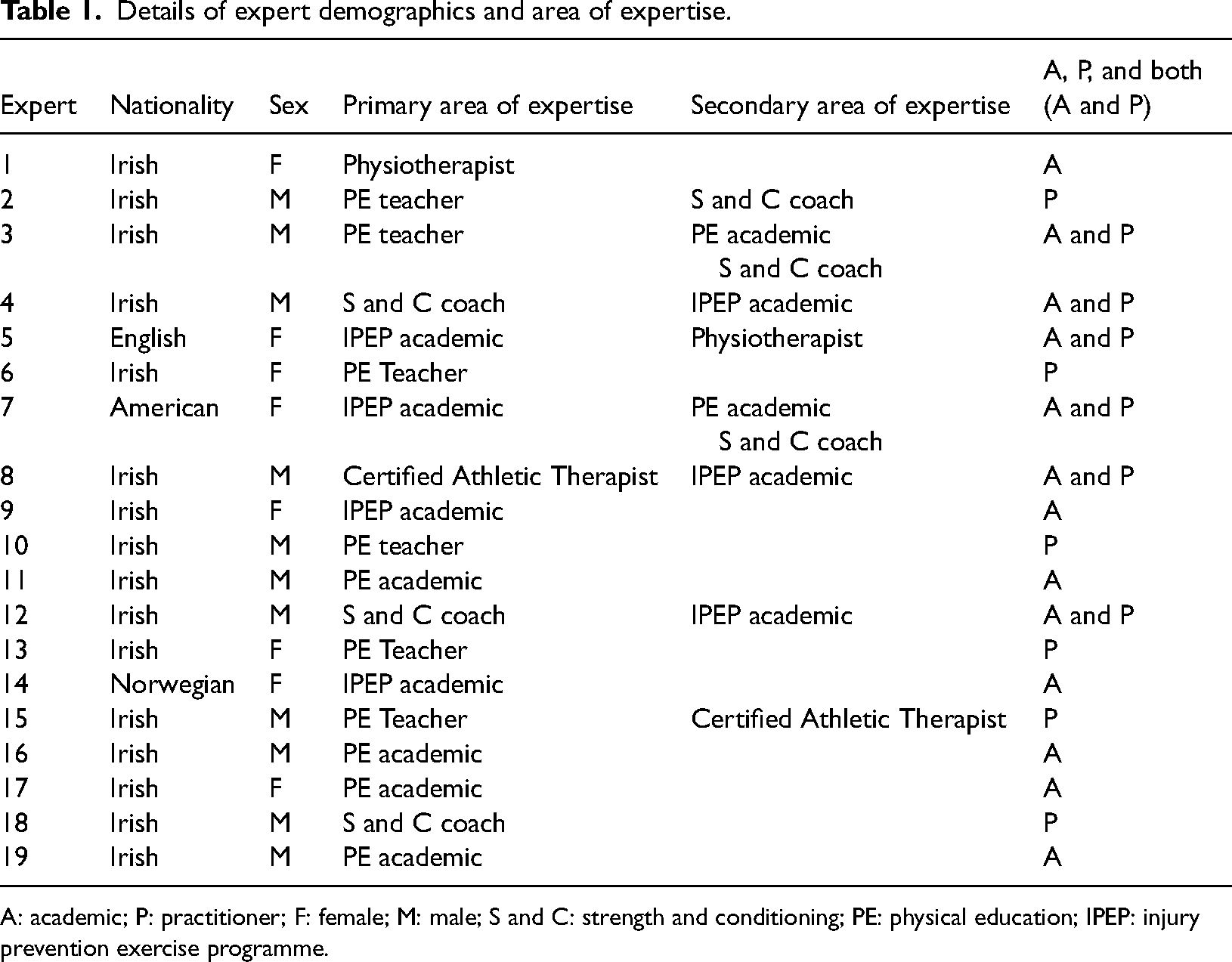
A: academic; P: practitioner; F: female; M: male; S and C: strength and conditioning; PE: physical education; IPEP: injury prevention exercise programme.
Delphi procedure
Consensus criteria
This Delphi study consisted of an initial exploration round, followed by three rounds of questions that were distributed using the online survey software Qualtrics (SAP America Inc., Seattle, WA). The responses for each round remained anonymous to the other experts. After each round, a brief clarification questionnaire was sent to experts to ensure stability of responses prior to the creation of the subsequent round. The Delphi study took place over three months. While no definitive percentage to determine that acceptable agreement exists, given the variances of topics explored (injury prevention, games-based approach, and PE settings), and the number of experts involved, unanimous agreement on responses is not feasible. Therefore, in keeping with previous literature, a consensus was deemed to be achieved if 67% or more of experts rated a Likert-scale type question as either ‘Strongly agree’ or ‘Agree’, or a specific item was selected by 67% or more of experts in multiple choice questions (Gavigan et al., 2022; Kleynen et al., 2014; McCall et al., 2020). To ensure stability of responses, any response that scored between 50% and 75% in the initial questionnaire was included in the subsequent clarification round, whereby it was required to achieve 67% or greater for consensus to be considered achieved.
Delphi content
Prior to the distribution of all surveys, questions were screened by all members of the research group, which included members who may have been considered experts and eligible to participate in the study had they not been part of the research group. An initial exploration round was used to assist with the formulation of the opening round of questions for the Delphi poll. This consisted of open-ended questions that required the experts to detail: (a) the requirements for an IPEP; (b) current understanding of a ‘games-based approach’; and (c) potential barriers and facilitators to the implementation of a games-based IPEP in PE class. For each subsequent round, questions were subdivided into the following categories: IPEP components, structure, and layout; games-based approach components and delivery; and PE class layout, teacher supports, and school supports (Table 2).
Table outlining the progression of the Delphi poll, including the response rate, aims, and key outcomes of each round.
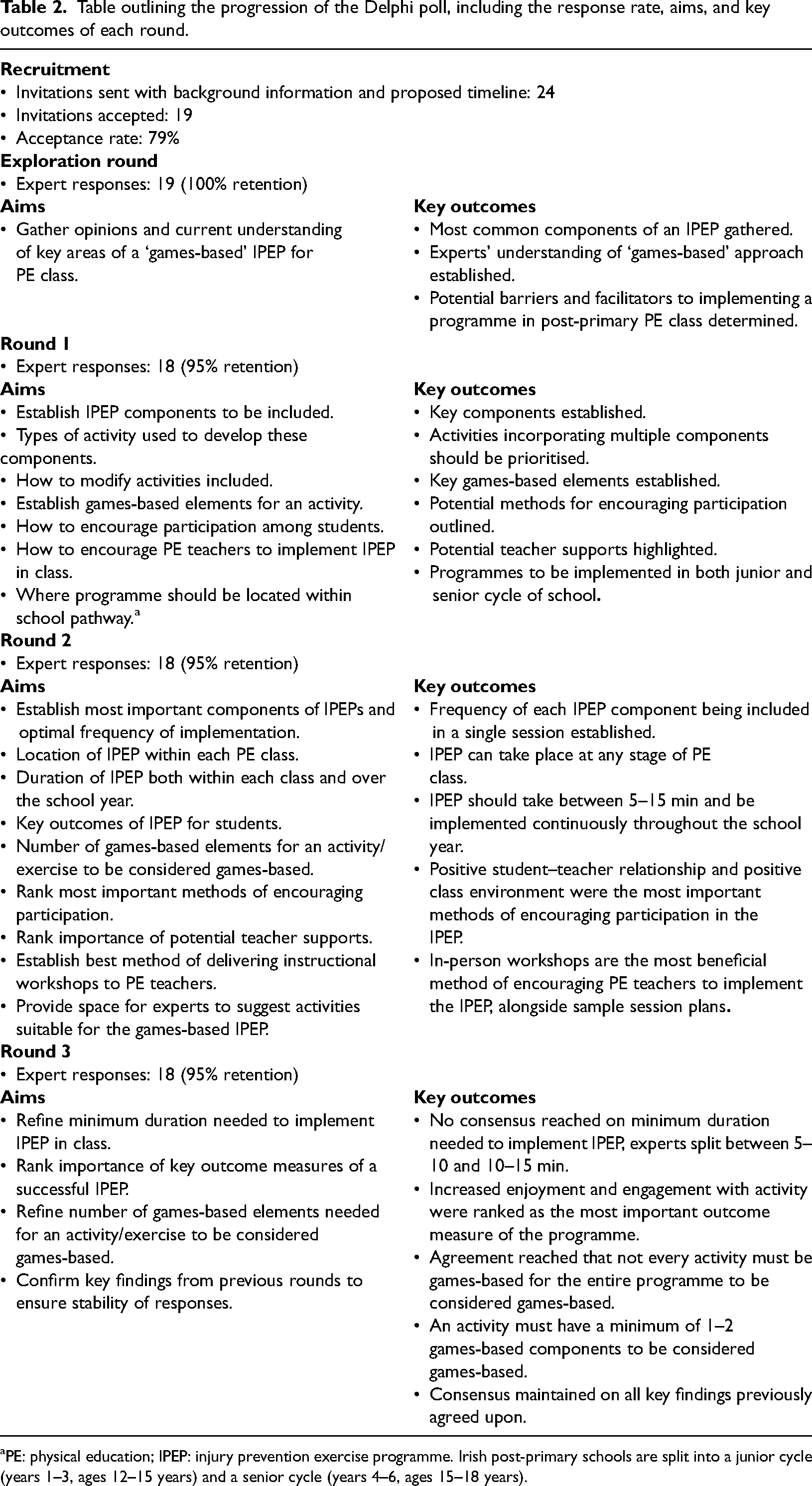
PE: physical education; IPEP: injury prevention exercise programme. Irish post-primary schools are split into a junior cycle (years 1–3, ages 12–15 years) and a senior cycle (years 4–6, ages 15–18 years).
Round 1 consisted of 24 questions, which aimed to establish the key components of an IPEP, the types of activity used to develop these components, and the inclusion of multiple IPEP components within a single activity (e.g. combining speed and agility and plyometrics in a single activity). For games-based requirements, questions were asked around components necessary for an activity to be considered games-based. It also included questions on how to encourage participation and effort in those less physically active or who fear judgement from others during activity. PE class requirement questions related to types of teacher support, location of programme within school, and PE curriculum needs.
Round 2 consisted of 27 questions aiming to rank the most important components of an IPEP, the order of each component within a programme, and confirm when it should be implemented within a PE class. The games-based approach questions aimed to rank the most important components of a games-based activity and the most important outcomes of a games-based IPEP programme. PE class requirements questions included the most important methods of supporting teachers, confirming the location of the programme within the school and establishing resources required within the school. Experts were also provided with an option to include ideas for games-based activities that may be suitable for inclusion in the programme.
Round 3 consisted of 14 questions, including the minimum duration an IPEP should be in PE class for it to be effective, how frequently the IPEP should be carried out, and whether each activity needs to be games-based in order for the programme to be considered games-based. The clarification for round 3 also included questions to check for agreement for a third time on the key areas of the programme to ensure stability of responses.
Data analysis
The responses were downloaded and a content analysis was performed. For open-ended questions, this included creating tags of meaningful information received, followed by organising them into categories (McPherson et al., 2018). A category with four or more mentions was included in the subsequent clarification round to check for consensus. For open- and closed-ended questions, such as multiple choice or Likert scale questions, at least 67% of experts needed to be in agreement for a consensus to be considered achieved (Gavigan et al., 2022).
Results
IPEP requirements
Exploration round
The most frequently reported requirement for an exercise to be classed as an injury prevention exercise was that it should be specific to a target area (eight mentions). This included statements such as: …look at what injuries adolescents are experiencing in various sport and try to include various exercises and/or movements to help prevent these. (Participant 12)
Other reported requirements included mirroring demands of the sport/activity (four mentions) and evidence-based (two mentions). Three participants named specific components that should be included in an IPEP for it to be classed as an IPEP. Specifically mentioned were ‘strength’, ‘balance’, ‘jumping and landing mechanics’, ‘plyometrics’, and ‘knee/ankle stability’.
Round 1
The expert panel achieved consensus on the following IPEP elements. The key components to include in an IPEP are: jumping and landing technique (94% agreement), strength (94%), balance (94%), plyometrics (89%), reactions (88%), and speed and agility (83%). Multiple components could be combined within a single activity/exercise (94%). The activities/exercises used to develop these components should be changed to allow for progression and increase adherence (94%). However, including the same activities/exercises for a number of weeks may be beneficial to students to allow for mastery or development (71%). Appropriate methods of adapting activities/exercises in an IPEP are the inclusion of progressions/regressions (100%) and modifying the variables of the activity (88%). The IPEP should target both areas of underlying physical deficiencies (94%), and specific locations of common injuries among adolescents (76%). The IPEP could be implemented at any stage in the PE class (88%).
Round 2
In round 2, the expert panel achieved consensus on the following IPEP elements. Jumping and landing technique (100%), balance (94%), strength (89%), and speed and agility (68%) components should be implemented in every or most IPEP sessions, while reaction and plyometric components should be implemented in most or some IPEP sessions (89% and 78%, respectively). There was no consensus on the order in which the IPEP components would be implemented (56%). The IPEP could be implemented either all at once or split up throughout the PE class (89%), to allow teachers the flexibility to fit it into their class plan, without reducing its effectiveness. Sustained participation (94%), repeated exposure to the demands of the activity/exercise (89%), and consistent technique (89%) are important when performing the activity/exercise. No consensus was achieved on the importance of perfect technique (50%) or having variability of movement (39%) when performing an activity/exercise. The IPEP should be implemented continuously throughout the students’ school cycle to allow long-term benefits (72%). Important outcome measures for the programme to be considered successful include the following: increased knowledge among students on the importance of injury prevention (100%), increased participation and effort with activity/exercise (94%), reduced risk factors for future injuries and a reduced injury rate among students (both 94%), and increased long-term participation with activity/exercise (89%). ‘Improved athletic performance’ was not deemed an important outcome for an IPEP to be considered successful among the general student population (39%).
Round 3
In the final round, 89% of experts agreed or strongly agreed that outcome measures relating to enjoyment and participation with activity/exercise are more important than outcome measures relating to injury prevention in the general student population.
Experts ranked the below outcome measures of a successful IPEP in the general student population in order of importance (most important first):
Increased enjoyment and engagement with activity/exercise. Increased sustained participation with activity/exercise. Reduced injury rates among students. Increased active participation and effort with activity/exercise. Increased knowledge among students on the importance of injury prevention. Reduced risk factors for future injuries.
A consensus was not reached on the minimum duration of an IPEP session required for it to be effective in PE class (56% 10–15 minutes, 44% 5–10 minutes). When asked to provide a rationale for their choice, seven experts said greater than 10 minutes would take too long out of class time, while seven experts said less than 10 minutes would not be long enough to be effective. A consensus was not reached on the optimal frequency of IPEP implementation throughout the academic term. Weekly was the most popular choice (11 mentions, 58%), and a 4–6-week block per academic term was the second most popular choice (five mentions, 26%)
Games-based approach to an IPEP
Exploration round
The most frequently reported requirement for an activity or exercise to be considered ‘games-based’ was that there was an element of engagement or fun included (nine mentions). This included statements such as: Games-based should be all about children having fun while still doing activity/exercise. This can be accomplished through play that's designed for kids to use their bodies and minds to reach/accomplish a specific goal. (Participant 7)
Other frequently reported requirements were that it should replicate a game/sport/activity (eight mentions), include an element of competition (five mentions), and require an element of decision-making (four mentions).
Round 1
The expert panel achieved consensus on the following games-based elements. The most important characteristics of a games-based activity/exercise are: an element of fun (100%), incorporating multi-directional or multi-planar movements (94%), interaction with other students (89%), a challenge both physically (83%) and mentally (78%), and a competitive element (78%). The activity/exercise should be modifiable to allow adaptation for the varying levels of ability (100%), and this can be achieved by including progressions/regressions (100%) or changing the variables of the activity/exercise, for example, Space, Task, Equipment, People (STEP) principle (94%).
Encouraging participation in students who may fear judgement can be achieved by promoting a positive class environment and student–teacher relationship (94%), giving students choice or input into the activity/exercise (94%), using groups or teams (88%), and taking the focus off individual students (82%). Encouraging participation in students who are less physically active can also be achieved by promoting a positive class environment and student–teacher relationship (100%), including progressions/regressions for activities (100%), and giving students choice or input into the activity/exercise (82%).
Round 2
In round 2, the experts reached a consensus on the following games-based elements. An element of fun is the most important component of an activity/exercise to consider it games-based (100%). The other most important components for a games-based approach include a means of progression/regression, a challenge for students physically and interaction with other students (83%). Between one and three games-based elements are needed for an activity/exercise to be deemed games-based (77%). A positive class environment and student–teacher relationship is the most important method of encouraging participation in a games-based IPEP, while using groups or teams is the least important method (83%). Taking the focus off individual students may encourage participation in those who fear judgement from others, while including progressions/regressions may encourage participation in those who are less physically active (both 83%).
Round 3
In the final round, the experts agreed that not every activity/exercise must be games-based in order for an IPEP to be considered games-based (94%). A consensus was not achieved on the percentage of activities/exercises within a single IPEP session that must be games-based in order for it to be considered games-based, with 26–50% of activities being the most frequent choice (55%), while 1–25% was the least frequent choice (9%).
PE class setting requirements
Exploration round
Several themes arose that could be seen as either a facilitator or barrier to the implementation of a games-based IPEP in PE class, depending on how they are considered during the programme development. The most frequently mentioned theme was the role of the PE teacher (24 mentions). The PE teacher, as the chief implementor of the programme, was mentioned as a possible facilitator to implementation 11 times, and a possible barrier to implementation 13 times. It was apparent that engagement with PE teachers and supporting them was considered a crucial step in implementing an IPEP. Some statements that reflect this include: PE teachers are the people working on the ground, they must be convinced that this is a good idea and that it works. It must also be planned so that teachers don't have too much extra work. (Participant 12)
Teacher CPD – to upskill teachers on the programme, provide them with resources which can be easily accessed and used in class. (Participant 13)
Another key theme that arose was the PE curriculum and how a programme would fit within it. This was mentioned eight times, again with some viewing it as a possible facilitator or barrier to implementation: …link to the new JCT PE spec (Junior Cycle for Teachers PE), SCPE (Senior Cycle PE) and LCPE (Leaving Certificate PE) specifications so that teachers could provide a rationale as to why it is being done in the PE setting. This is easily done as LCPE has a specific section on injuries and injury prevention, while the JCT and SCPE have links to self-care and lifelong physical activity practitioners. (Participant 10)
Curriculum overload – schools currently implementing LCPE, SCPE, upcoming new JC (Junior Certificate) – can seem like a lot to take on and schools can often be reluctant to take on something new again. (Participant 13)
A third theme that frequently occurred was the consideration of programme design, which was mentioned 13 times, again as potential barriers or facilitators to implementation: Make it interesting so the predominant focus is on the actual game itself, but the necessary components can be reinforced (such as technique) can be reinforced as required. (Participant 3)
Time – eating into class time. (Participant 9)
Round 1
The expert panel achieved a consensus on the following PE class elements. The games-based IPEP should be implemented in both the junior and senior cycles of post-primary school to promote the long-term health and development of the students (88%) and allow for early intervention (76%). There are links to both junior and senior cycle curriculums, most notably the games strand in Junior Certificate PE. Providing the school with support and resources would encourage school management to facilitate the programme (88%). Teachers could be encouraged to implement the games-based IPEP by providing resources and upskilling them (100%), providing background on the benefits of the games-based IPEP (94%), making the programme easy to deliver, fun and engaging (94%), and highlighting links to the PE curriculum (88%). The most likely supports to improve teacher confidence and ability to implement a games-based programme with their PE classes were in-person workshops (94%), sample games-based IPEP lesson plans (78%), and online video resources (72%).
Round 2
Providing teachers with resources and upskilling them to be capable of implementing a games-based IPEP was considered the most important method of encouraging them to implement a games-based IPEP, alongside making the games-based IPEP easy to deliver in PE class (83%). Regional workshops (83%) or hybrid online and in-person workshops (83%) may be successful in getting PE teachers to attend and interact with IPEP workshops, while online only workshops would not be successful. In-person workshops would also be the most important teacher support, alongside sample games-based IPEP session plans and access to online video resources (100%). In total, 78% of experts agreed that equipment resources would be required for schools to be willing to implement a games-based IPEP.
Round 3
There were no PE class setting-specific findings from round 3 as all aims had been achieved in the previous rounds.
Final confirmation
At the end of the round 3 clarification questionnaire, confirmation was sought on the key outcomes for the entire Delphi process to ensure stability of responses. Consensus was maintained on all key outcomes included below in Table 3.
Summary of key findings from rounds 1–3 of the Delphi poll.
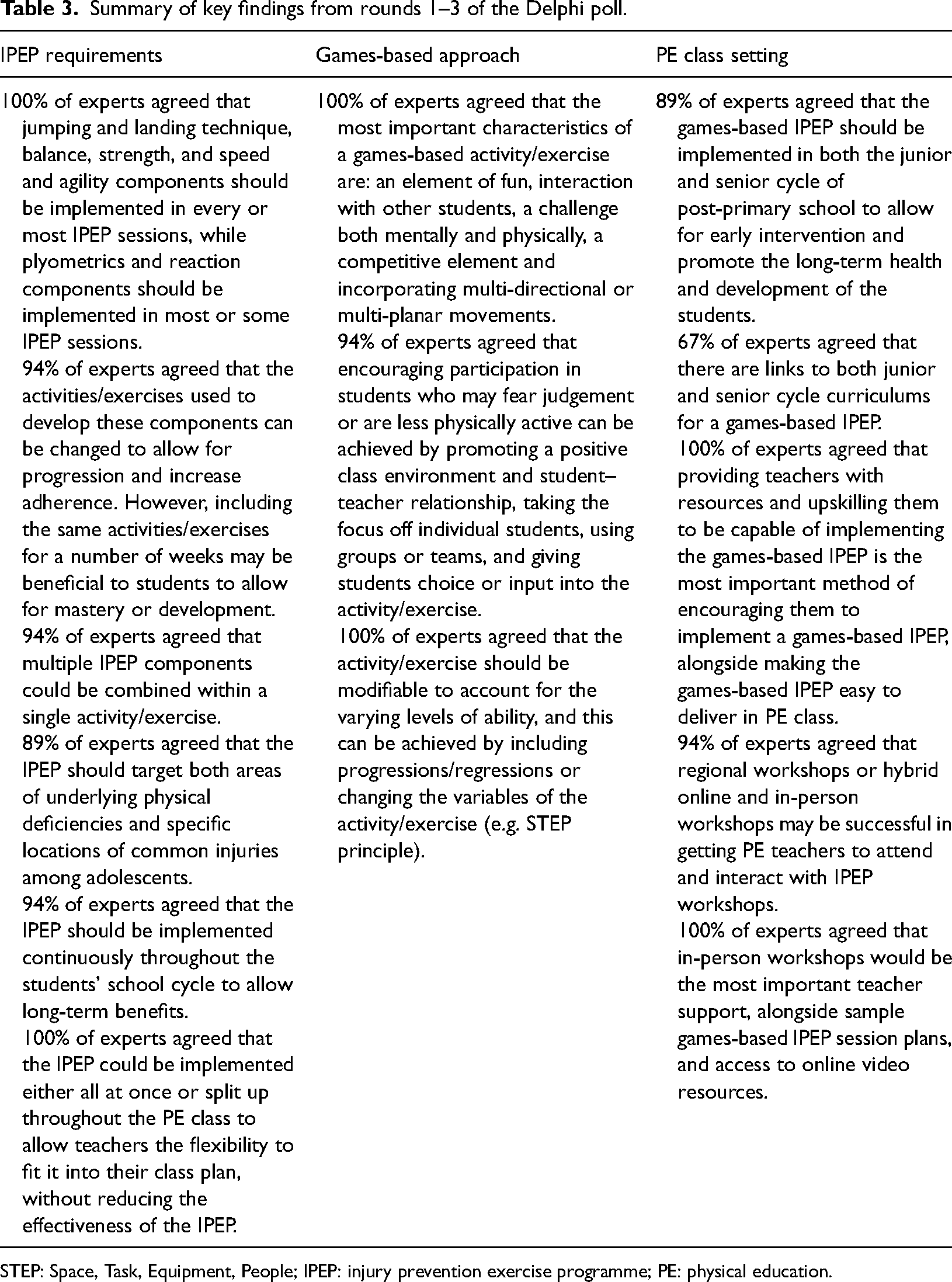
STEP: Space, Task, Equipment, People; IPEP: injury prevention exercise programme; PE: physical education.
Discussion
The aim of this study was to elicit the opinions of academic and practitioner experts in the key areas associated with the development of a games-based IPEP for PE class through the systematic approach of a Delphi poll. Namely, it aimed to define (a) IPEP requirements, (b) games-based approach requirements, and (c) PE class requirements.
IPEP requirements
According to expert consensus, the key components to include in an IPEP are: jumping and landing technique, strength, balance, plyometrics, reactions, and speed and agility. This is in keeping with existing sport-specific and school-based IPEPs, which have demonstrated a preventative effect in adolescent sport and among female adolescents (Al Attar et al., 2017; Brunner et al., 2019; Emery et al., 2020; Hübscher et al., 2010; Rössler et al., 2014; Weeks et al., 2008). Considering the heterogeneous nature of the student population, the ability to adapt exercises within an IPEP was deemed crucial. Experts agreed that the inclusion of progressions and regressions or changing the variables of the activity are appropriate methods of doing this. This included the STEP principle, which can be used to ensure that people of different abilities can be included in physical activities. It achieves this through providing a framework to change how an activity is delivered in one or more of the ‘STEP’ domains (e.g. decreasing the playing area for people who are less mobile, reducing the difficulty of the task for those who are less physically able, or zoning people with others of similar ability to provide more opportunity to participate and develop (Kiuppis, 2018)). Interestingly, 58% of experts said that an IPEP should be completed weekly. This is in contrast with the existing literature that currently recommends an arrangement of 10–15 minutes, two to three times per week to achieve an optimal preventative effect (Steib et al., 2017). In Ireland, PE class typically takes place once per week, and experts may have felt it impractical to suggest more frequently than that.
While reducing injury rates has traditionally been seen as a key outcome measure for IPEPs, the experts in this study agreed that there are more important outcome measures that indicate a successful programme. Increasing enjoyment and sustained participation with activity/exercise were considered the two most important measures of a games-based IPEP in the adolescent population. Reducing injury rates only ranked third most important, with increased active participation and increased knowledge on the importance of injury prevention both being perceived as more important than reduced risk factors for future injuries by the experts. This broader spectrum of benefits of an IPEP is referred to even in sports settings, where greater health of the athlete, longevity in the activity, reduced costs to the individual and sport, and improved performance were all seen as benefits to performing an IPEP (Bahr and Engebretsen, 2011). Considering the more obvious benefits of an IPEP, that is, reduced risk of injury, may not be fully appreciated by the general adolescent population, the other benefits accrued as a result of a decrease in injury risk should be emphasised for both implementors and the target population.
When considering an IPEP for the general adolescent population, placing emphasis on engagement and participation in activity is imperative as there is a significant drop in the number of adolescents meeting the recommended physical activity guidelines in Ireland during these key developmental years. This number reduces from 17% of primary school pupils meeting the recommended guidelines to 10% of post-primary school pupils (Woods et al., 2019). This is further highlighted in sports settings across Europe, where there is a significant decrease in participation in males between the ages of 14 and 18 and females between 14 and 16 (Emmonds et al., 2021). The benefits of physical activity can only be achieved if participation is maintained (Jekauc, 2015); therefore, any programme involving physical activity should have engagement and participation as a core outcome measure. Moreover, one of the key reasons for dropout has been attributed to injury (Witt and Dangi, 2018), highlighting the need for injury prevention strategies.
Games-based approach
The exploration of a games-based approach to IPEPs is a novel feature of this study. A lack of engagement or enjoyment has been described as a key barrier to IPEP implementation in sport settings (Donaldson et al., 2019). It has also been reported as the biggest reason for dropout among adolescents, and keeping participation as fun as possible was touted as a key recommendation for increasing engagement in sport (Witt and Dangi, 2018). Methods of promoting enjoyment in physical activity include: emphasising the use of groups instead of individual activities, including participants in the decision-making regarding exercises, regulation of the intensity of the activity depending on the participants’ ability, and increasing the diversity of the training (Jekauc, 2015). This is supported in this current study as experts agreed that having an ‘element of fun’ included in the activity/exercise was the most important games-based characteristic, while using teams, adapting activities, giving students input into the activities/exercises, and positive student–teacher relationships were all seen as important for encouraging participation among students. This is in keeping with the findings from Richmond et al. (2020), who noted that in a PE class setting, the adaptability of the programme alongside the individual's knowledge, beliefs, and self-efficacy were all deemed to be important factors to facilitating the programme. The use of these methods for increasing enjoyment was shown to increase the affective state of adult participants in an eight-week training programme, while also contributing to increased adherence to the programme compared to a control (Jekauc, 2015). While these changes were seen in adults, interventions designed to increase enjoyment of physical activity in children and adolescents have also been effective in increasing activity levels (Fairclough et al., 2016; Gao et al., 2013; Smith et al., 2015). However, the promotion of a games-based approach may influence exercise fidelity during an IPEP, which has been shown to range between 48% and 67% in traditional IPEPs (Fortington et al., 2015; Ljunggren et al., 2019; Owoeye et al., 2020; Perera and Hägglund, 2020). While further research is required to understand why fidelity remains low, it may be that a lack of enjoyment or participant interest is a contributing factor to this (Donaldson et al., 2018; Owoeye et al., 2020). Considering this, increasing enjoyment during exercise/activities through a games-based approach may increase engagement with an IPEP and improve exercise fidelity, mitigating a key barrier to IPEP implementation.
The experts agreed that multiple components of an IPEP could be included in a single activity/exercise and should be encouraged to allow for more time efficient delivery. This makes a games-based approach for programme design more feasible as incorporating multiple elements within an activity can allow for more diversity of the exercises, enable more adaptations to the exercises, and provide students with more input into activity selection.
PE class setting
Despite PE class being proposed as a potential setting for an IPEP and willingness for PE teachers to implement one in their PE class, the specific details of its place within PE class were still unknown (Devereux et al., 2023). Experts agreed that an IPEP should be designed so as to be suitable for both the junior (12–15 years) and senior (15–18 years) cycle. The implementation of IPEPs may be particularly important in this age group given the observed increase in musculoskeletal injury prevalence from childhood (3–9 years) into adolescence (10–17 years) (Tan et al., 2018). This increase in prevalence supports the expert consensus that IPEPs should be implemented across both school cycles to allow for early intervention and promote students’ long-term health and development. Previous injury has been reported as a key risk factor for future injuries (Fulton et al., 2014); therefore, attempts to mitigate the initial injury through early intervention may be hugely beneficial for the long-term health of the population.
Experts agreed that an IPEP may be implemented at any stage during the PE class, including warm-up. This further supports the inclusion of an IPEP in PE class as the majority of existing sport-specific IPEPs have been designed to replace traditional warm-ups (e.g. FIFA11, GAA15, and Activate), while warm-ups are considered a crucial part of PE lessons according to teachers (Barney and Leavitt, 2019). An interesting finding from this study shows that the experts could not agree on the optimal duration for an IPEP, with 50% recommending 5–10 minutes and 50% recommending 10–15 minutes. The reasons for these choices were multi-faceted but centred around striking a balance between allowing enough time for an effective programme, and not taking too much time out of an already busy PE curriculum schedule. One possible solution to this issue is, as suggested by the experts, the potential for a games-based approach to enable multiple IPEP components to be combined within a single activity/exercise. This may facilitate a time efficient programme, while still ensuring each component is addressed. Another potential solution lies in the expert consensus that the IPEP may be delivered at stages throughout PE class. Autonomy of choice and freedom for an intervention implementer to carry out the programme where they see fit within their environment has been shown to be an important factor in successful implementation of school-based interventions (Shoesmith et al., 2021) and noted as a key consideration in the advancement of IPEP implementation (Whalan et al., 2021).
To ensure programme sustainability, it is imperative for PE teachers themselves to buy into the programme. While PE teachers are willing to implement IPEPs, many lack the perceived ability and confidence to implement them (Devereux et al., 2023). This is highlighted in this current study as upskilling of PE teachers and providing resources is the most important method of encouraging PE teachers to implement the programme, while in-person workshops, sample lesson plans, and access to online resources were seen as the biggest supports for PE teachers. In-person workshops have been previously shown to improve coaches’ self-perceived ability to implement IPEPs in adolescent soccer (Owoeye et al., 2020) and camogie 1 (O’Connor and Lacey, 2020). This would provide PE teachers with the knowledge and confidence to provide feedback and instruction to participants, to promote development and maintain exercise fidelity. In school settings, a multi-faceted approach including continued technical support, implementation blueprints, distribution of educational resources, and provision of equipment were seen to increase and sustain the implementation of physical activity programmes (Nathan et al., 2022).
Limitations
Due to the nature of this Delphi study attempting to combine multiple fields, experts were included from several domains, including PE teachers, medical professionals, academics, and coaches. Accordingly, while all were experts in their related field, some may not have been as knowledgeable in other areas of the survey but would have been required to contribute their opinion. For example, medical professionals such as Certified Athletic Therapists may not have been as familiar with PE curriculum details as PE teachers or academics, or some PE teachers may not have had a thorough understanding of IPEP key components, yet their opinion carried the same weight as the experts in that particular field. To minimise the impacts of this, special consideration was given in the recruitment phase for experts with knowledge in multiple fields. While attempts were made to recruit as high a level of expertise as possible, it must be noted that these recommendations were developed and agreed upon by a sample of 19 experts across multiple fields. It is possible that the inclusion of other experts may have yielded different findings; therefore, people intending to use this framework may feel it appropriate to consult additional experts in one or more fields associated with this study.
Another potential limitation is the absence of recommendations for assessment of the IPEP. This study focused solely on the development of a framework for the creation of a novel IPEP. However, once created, this IPEP may be evaluated in a similar fashion to existing IPEPs, that is, injury incidence and neuromuscular function (Collard et al., 2010; Richmond et al., 2020; Sommerfield et al., 2021a, 2021b; Steffen et al., 2013).
Additionally, it should be noted that students, one of the key stakeholders in this intervention, were not represented in the Delphi poll. This was deliberate as it was felt that they may not have had the experience or expertise required in the areas of injury prevention, games-based approach, or PE class settings, and so their contribution may be better served at a later stage in programme development.
Conclusion
This Delphi study provides a framework for the development of a novel games-based IPEP for PE class settings. Experts provided consensus that while the programme should incorporate several key components for injury prevention, the focus of the programme should be tailored to promote long-term enjoyment and engagement with activity. This may be achieved through a games-based approach, which can be facilitated through the inclusion of modifiable and adaptable activities/exercises within the IPEP to include students of all abilities and promote participation. PE class is a suitable setting for the programme; however, efforts should be made to upskill teachers and provide supporting resources to encourage implementation and sustainability of the programme. This study paves the way for further research in this area and the creation of a games-based IPEP, which needs to have its efficacy and effectiveness investigated.
Supplemental Material
sj-doc-1-epe-10.1177_1356336X231206245 - Supplemental material for Developing a framework for a games-based injury prevention exercise programme for post-primary (12–18 years) physical education class: A Delphi poll study
Supplemental material, sj-doc-1-epe-10.1177_1356336X231206245 for Developing a framework for a games-based injury prevention exercise programme for post-primary (12–18 years) physical education class: A Delphi poll study by Frank Devereux, Enda Whyte, Nathan Gavigan and Siobhan O’Connor in European Physical Education Review
Footnotes
Declaration of conflicting interests
The authors declared no potential conflicts of interest with respect to the research, authorship, and/or publication of this article.
Funding
The authors received no financial support for the research, authorship, and/or publication of this article.

Supplemental material
Supplemental material for this article is available online.
Notes
Author biographies
References
Supplementary Material
Please find the following supplemental material available below.
For Open Access articles published under a Creative Commons License, all supplemental material carries the same license as the article it is associated with.
For non-Open Access articles published, all supplemental material carries a non-exclusive license, and permission requests for re-use of supplemental material or any part of supplemental material shall be sent directly to the copyright owner as specified in the copyright notice associated with the article.
