



Abstract
Some students find engaging in physical education (PE) problematic or undesirable to the extent that it makes them adopt strategies to avoid taking part, also known as hiding techniques. There is a need to get a deeper understanding of hiding techniques as a behavioral strategy in PE, especially the underlying causes as to why students choose to engage in them. Hence, the purpose of the current study was two-fold: (a) to investigate the situations and activities in which students engage in hiding techniques in PE and (b) to elucidate students’ motives for engaging in these hiding techniques. 10 Norwegian ninth-grade students (six girls and four boys, all aged 14 years) participated in in-depth interviews using vignettes. Reflexive thematic analysis of the data revealed that hiding techniques can be characterized into active and passive hiding techniques. Active hiding techniques were divided into: “avoiding the ball,” “reducing effort,” and “social dizziness.” Passive hiding techniques were divided into: “forgetting gym clothing,” “faking soreness,” and “warming the bench.” Furthermore, the use of different hiding techniques was found to be situationally related and activity specific. The findings also revealed the following motives for using hiding techniques: low perceived competence, fear of failure, too high expectations, and exposure of perceived low athletic skills. The findings of the current study allow us to reflect on possible ways to organize PE to prevent the use of hiding techniques.
Introduction
Physical education (PE) is (potentially) the most effective educative forum for providing the skills, attitudes, knowledge, and understanding for a lifelong physically active lifestyle and good health (Casey et al., 2021; Doll-Tepper and Scoretz, 2001). Hence, meaningful experiences in PE are of key value to ensure students’ engagement (Beni et al., 2017; Røset et al., 2020) and several components (e.g. motor/athletic competence) have been identified as central in students’ meaningful experiences (Aggerholm et al., 2018; Beni et al., 2017). However, not all students find engaging in PE meaningful (Säfvenbom et al., 2015; Walseth et al., 2017). Certain students even find it problematic or undesirable to the extent that it makes them adopt strategies to avoid taking part in PE to hide from the unpleasantness they experience (Lyngstad et al., 2016; Ommundsen, 2004). Lyngstad et al. (2016) refer to these strategies as hiding techniques.
Hiding techniques appear in different ways and some students may adopt a passive action, pretending to have an injury or be in pain to avoid taking part in PE (Lamb, 2014; Lyngstad et al., 2016; Ntoumanis et al., 2010; Ommundsen, 2004). Some may take part to the extent that is expected of them, but not put much effort into the activity (Lamb, 2014). According to Fisette (2011), students may even express that they are enjoying PE when in fact they are disliking it to cover up their true feelings toward the situation or activity. Students may take on an active role as a class clown, where they fool around and do not seem to take the class seriously and some may act tough, noisy, and even violent (Lyngstad et al., 2016). Others may practice so-called reverse actions such as queue jumping or deliberately seeking blind zones of the teacher and co-students to manage what appears to be a difficult or problematic situation (Dweck, 2019; Lyngstad et al., 2016), while some may make up excuses not to take part in PE (Lyngstad et al., 2016) or use excuse notes (Lamb, 2014). The different hiding techniques students use are either created individually or collectively, together with other students in a strategic manner; that is, they cooperate systematically with co-students to achieve their strategies (Fisette, 2011). Thus, the type of hiding technique used in PE seems to be dependent on the situation the students find themselves in, who they are together with, and what they want or do not want to accomplish.
The cause of such actions is likely to be multifaceted (Lyngstad et al., 2016) and the underlying reasons for some students run deep. From a motivational perspective, however, these reasons may be attributed to an approach or avoidance orientation. While an approach orientation is focused on attaining self-, task-, or normative-referential competence, an avoidance orientation is focused on avoiding normative incompetence (Elliot and Friedman, 2017). Hence, students who act on behalf of an avoidance orientation are likely to try to avoid failure (Elliot and Hulleman, 2017). Accordingly, some students may find social class environments so demanding in character that they adopt hiding techniques (Lyngstad et al., 2016). Some students take on a role or performance to protect themselves regarding self-value, self-worth, and self-perception to not lose face (Lyngstad, 2018; Ntoumanis et al., 2010; Ommundsen, 2004). Moreover, certain students are often afraid of social defeat and making a fool of themselves, concerned with damaging their self-perception rather than learning and mastering the skills relevant to PE class (Lyngstad et al., 2016). They frequently try to avoid performance pressure and the feeling of not being able to master activities or situations in class and may be afraid of activities that demand courage and/or physical effort (Lyngstad et al., 2016). Consequently, students seem to use hiding techniques in sophisticated, clever, and deliberate ways to gain control over certain settings (Lyngstad et al., 2016).
According to Lyngstad (2018), the use of hiding techniques is situation-specific; that is, they occur in certain settings and thereby are associated with environmental constraints. How a student experiences a situation may be quite different from how another student experiences the same situation (Lyngstad, 2018) and the added value of considering cultural and community values regarding physical activity in the context in which the students are situated has been emphasized as important (Beni et al., 2017; Røset et al., 2020). For instance, Erdvik et al. (2022) highlighted in their study of the Norwegian PE context that many students who take part in organized sports in their spare time perceive their participation in PE as more positive. Research in the same context has shown that students who do not participate in organized sports are less likely to perceive PE positively (Erdvik et al., 2022; Walseth et al., 2017). Furthermore, the type of activity and the level of challenge in the different activities have been highlighted as central to whether students find themselves engaging in meaningful PE (Beni et al., 2017). Thus, the use of hiding techniques may be a reaction to certain demands from an activity with the aim of reducing the feeling of low perceived athletic skills or possible failure (Lyngstad et al., 2016). These activity specific conditions are largely controlled and influenced by the teacher (Beni et al., 2017; Lyngstad, 2018). Therefore, the teacher's ability to manipulate the task constraints may be of great importance to whether a student makes use of hiding techniques (Lyngstad, 2018).
However, previous research highlighting the use of hiding techniques in PE is mostly based on teachers’ and former students’ perspectives (e.g. Lyngstad, 2018; Lyngstad et al., 2016). Thus, there is a need for research that provides a deeper understanding of hiding techniques in PE from current students’ own assumptions, expectations, and experiences, especially concerning the underlying reasons as to why they use these strategies (Lyngstad et al., 2016). Consequently, the present study focuses on current students’ experiences, with the following two-fold purpose: (a) to investigate the situations and activities in which students engage in hiding techniques in PE and (b) to elucidate students’ motives for engaging in these hiding techniques.
Methods
Participants and procedure
The participants were 10 students (six girls and four boys, all aged 14 years) from ninth grade in a secondary school in the southern part of Norway. In rural areas of Norway, students generally come from various school districts and different elementary schools before being assigned to new schools and classes at the secondary level. To avoid factors such as insecurity regarding unfamiliar school environments, new classmates, and new teachers, students from the second year of secondary school were recruited (Brinkmann and Kvale, 2018). Additionally, we aimed to recruit participants with different backgrounds to promote diversity of experience. Therefore, two head teachers were asked to recruit 10 students from two different classes using the following inclusion criteria: (a) ninth graders; (b) both genders; (c) age 14 years; (d) different levels of motor/athletic skills in PE; (e) different levels of engagement in PE lessons; (f) familiar with the content of PE; and (g) familiar with the grading system in the subject.
The study was approved by the Research Ethics Committee at the Faculty of Health and Sport Science at the University of Agder and the Norwegian National Centre for Research Data (995590). All recruited students expressed an interest in taking part and were informed verbally about the study and their rights in accordance with ethical guidelines for social science. Written consent from the participants’ parents was obtained, in accordance with the national ethical regulations.
Data collection
Individual semi-structured interviews (Brinkmann and Kvale, 2018) combined with reflexive thematic analysis (rTA; Braun and Clarke, 2019, 2020, 2021, 2023) were employed to develop an in-depth understanding of situations and types of hiding techniques the students engaged in, in addition to the students’ motives for making such decisions in PE. Semi-structured interviews can be particularly useful in interpretivist frameworks because participants can provide information about their history and the meanings they attach to their personal experiences (Creswell and Creswell, 2018).
Interviews began with a brief introduction, and then students were presented with two different vignettes inspired by the findings of Lyngstad et al. (2016) related to hiding techniques in PE. The use of “real life” vignettes in research has shown promise in time-constrained interview contexts where everyday interactions with the participants (i.e. students) are not possible (Sampson and Johannessen, 2020). Sampson and Johannessen (2020: 70) argue that: “‘Real-life’ vignettes have the potential to allow for the elicitation of rich, detailed, and frank comments because of the ways in which they allow researchers, by association, to temporarily attain the status of an ‘insider’ within a group.” Therefore, the following two vignettes, based on the PE curriculum, were chosen to guide the interviews:
Vignette 1—ball game session
Imagine that you are doing soccer or another type of ball game in the PE class. Some students are very happy, and others seem more indifferent. During the game part, the soccer boys dominate. They dribble and score more goals than others. A student in the class runs back and forth and follows the game but is not involved in the game in the same way as the soccer boys. This student rarely gets the ball but does not put much effort into getting the ball. They are mostly hidden in the blind zone where it is difficult to receive the ball and thereby the other students rather pass the ball to someone else. When the opposing team gets the ball and you must return to defense, this student runs back with the rest of the team to defend the goal. But here as well, the student chooses to stand more on the side instead of going into duels to defend the goal.
Vignette 2—dance session
Class 9B is an active class that has a lot of varied activities. Most students in the class always participate. A student in this class often has a sore knee and when the pain is at its worst, the teacher gives an alternative approach to this student. The other students in the class know that this student is not so fond of ball games or activities where you are being “measured,” and where it is visible whether you get it right or not. In a PE lesson where basketball is scheduled, the student has a very sore knee and can only participate in the warm-up where a playful activity takes place. The next day there is dancing at the time schedule. Then the student does not have so much pain in their knee anymore and joins the whole dance session.
After presenting the two different vignettes all respondents were asked: “Could this have happened in your class? Do you recognize such a situation or a similar situation?”
The guidelines set out by Rubin and Rubin (2011) were adopted to ensure that the students engaged sufficiently with the two vignettes. To accomplish this goal, students were asked questions related to different themes concerning hiding techniques as well as elaborating questions. In addition, they were asked to identify and describe the different dimensions and components that were related to the situations and activities in which students engage in hiding techniques and to elucidate students’ motives for engaging in hiding techniques in PE. Examples of questions related to different themes concerning hiding techniques are: “Do you sometimes try to hide that you do not want to participate in one or more PE activities?” or “Were there other students in your class that you can see or know who use techniques/strategies to avoid participating in various activities?” Examples of elaborating questions included: “What is the reason why you try to hide that you dislike these activities?” or “What do you think is the reason why this student can join the dance session but not the basketball session the day before?” Other elaboration questions were: “What do you do then/how do you behave and why are you doing it?” and “What are they doing and why do you think they are acting like that?”
All interviews were conducted in Norwegian on the school premises in convenient locations at a time deemed by the teachers to be least disruptive to the daily schedule. The interviews lasted between 20 and 35 minutes and the audio recordings were subsequently transcribed verbatim. All quotations used in this article were translated from Norwegian to English. To avoid possible limitations in the analysis because of language the whole analysis process was completed in the original language (van Nes et al., 2010).
Data analysis
NVivo 11 qualitative analysis software was used to categorize the raw data, consisting of single phrases or statements, into different themes related to the situations and types of activities students associated with hiding techniques, and to elucidate students’ motives for engaging in hiding techniques in PE. Consequently, the use of rTA in the present study included a combination of inductive and deductive techniques to make sense of the data (Braun and Clarke, 2019, 2023). The initial process involved an inductive approach by segmenting the data and openly coding it to allow a creation of specific codes and themes. Subsequently, specific quotes, notes, and conversations were assigned to each code to allow a wider creation of themes from the data (Nowell et al., 2017). However, the product of this process is the authors’ interpretation and perspectives of the students’ experiences intentionally deductively inspired and based on the “real-life” vignettes rooted in the research literature in the field (e.g. Lyngstad, 2018; Lyngstad et al., 2016). To achieve analytical agreement, all comments related to why the use of hiding techniques is both situation-specific and activity specific and the students’ motives and the meaning-making for engaging in hiding techniques in PE were extracted from the qualitative data pool of the project for further scrutiny. The data were interpreted beyond their semantic content, with underlying ideas, practices, and the use of rTA enabled us to identify themes that capture a meaning of what is shared by the students in PE and the telling of an interpretative story about motives for engaging in hiding techniques. This type of theme can draw together data connected to even seemingly unrelated topics, if the core idea or meaning is evident (Braun and Clarke, 2023). The analytical interest is how and why the use of hiding techniques are situation-specific and activity-related (Lyngstad et al., 2016), and the data set is all occurrences in the corpus that are relevant to this topic.
In compliance with ethical requirements, the participants have been anonymized and other identifying information has been removed. All participating students have been given pseudonyms when mentioned in the Results section.
Results
To better understand the students’ learning process in different situations and activities and their different motives for engaging in hiding techniques, we explored active and passive hiding techniques. The analysis conveyed that the students use hiding techniques in PE in these two distinct ways in different situations and different types of activities (see Figure 1).
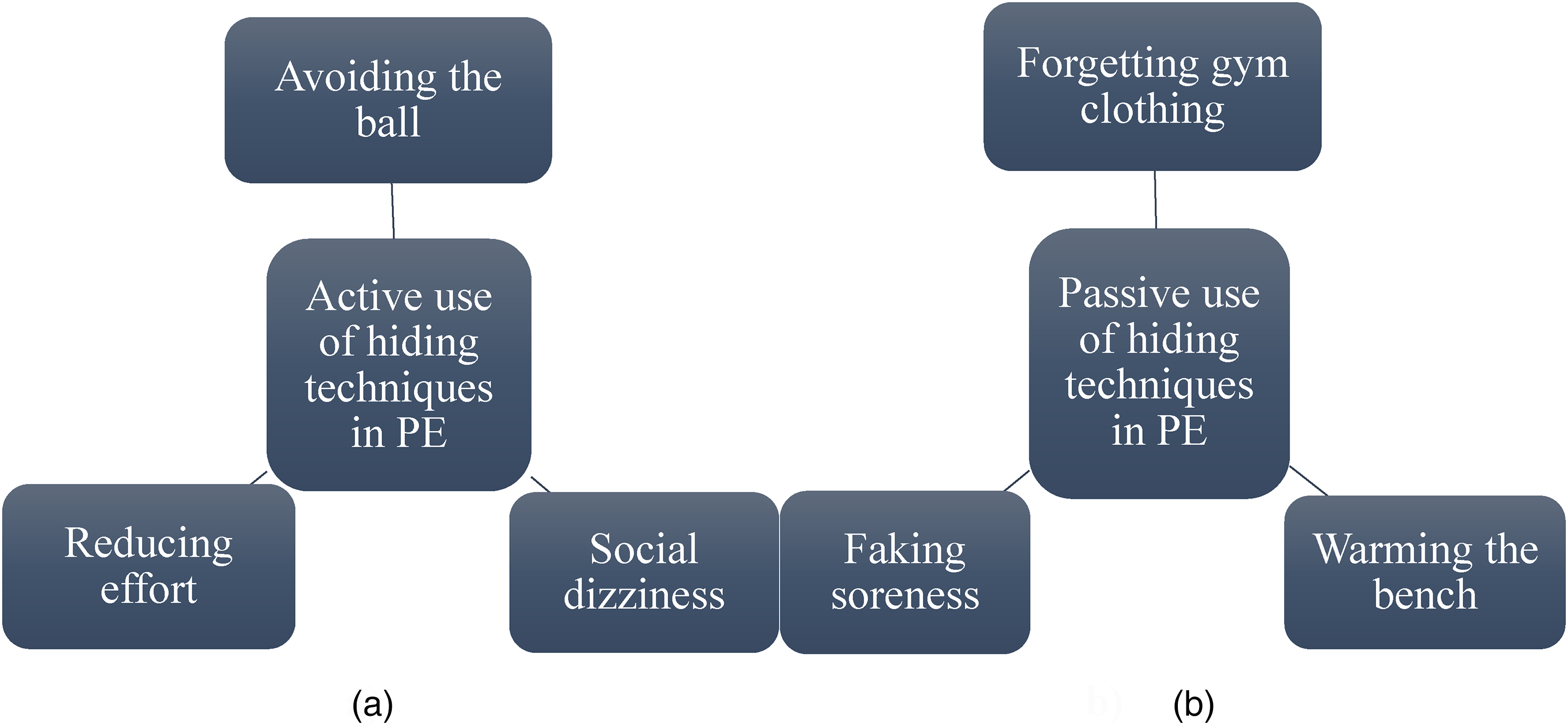
How hiding techniques in physical education (PE) occur through (a) active and (b) passive engagement in hiding techniques.
Active hiding techniques in PE
The created themes in Figure 1(a) represent hiding techniques that the students choose to engage in. An active hiding technique involves a situation where the student is a visible participant during a PE lesson, but the student does not necessarily actively participate.
Actively avoiding the ball
The hiding technique “avoiding the ball” can, in this study, be described as a continuation of the hiding technique “wallflower” (Lamb, 2014), which was identified by Lyngstad et al. (2016) as “suitably passive” in handball games. This, in turn, is also related to other techniques that are associated with avoiding the ball. David expressed himself according to this phenomenon: If I do not want to have the ball, then I just say that. During the game I say, “I do not want the ball!” Sometimes, by accident then, if someone passes me the ball in basketball, I make certain not to receive the ball. I just go backwards and the other team or someone else will handle the ball.
Both David and Samuel experienced that other students dominated when it came to ball activities, and they did not feel they were able to contribute. David explained: “It is like we just stand and wait for the ball to come to us, and then we just have to try to avoid the ball or just kick it away if the ball comes to us.”
Actively reducing effort
Anne, Mary, and Peter reported that they actively reduced effort especially when the teacher was looking away or when they felt they did not master or like the activity in question. Statements such as “cannot handle it,” “do not bother,” and “boring” were dominantly repeated by these students. Anne explained: Sometimes I feel I can relax a little bit, and I do not give it too much effort, but I do try to give some effort. Then, you get the feeling that “I do not care anymore,” and then you start to relax. One starts to walk and then it can be close to that you are not trying at all.
Karen and William reported a feeling of frustration when they deliberately reduced their effort. William elaborated: I can get very grumpy because I do not like it. And it is like, doing something you do not like is boring. I am not going to run, but, perhaps, I will jog or walk. I am still active but not as active or crazy as I could be.
Karen explained her behavior during a ball game session: I have been sitting down on the field a couple of times if I cannot stand it, and if they just run on one side then I will just catch up if they come again. It is only if I do not feel I need to help somehow. If they are up there and I am down there, I am just taking a break.
Furthermore, some of the students avoided doing an exercise or activity as soon as the teacher looked away. This was especially the case in activities and exercises that Sofie and William found difficult or boring. Sofie explained: “When the teacher is looking somewhere else, I do not do it at all. And if the teacher is watching then I pretend to do it [laughs], but not so hard.” William provided an elaboration: If the teacher is not watching, several then somehow do not bother, they also stop, and they start exercising as soon as the teacher is present again. As soon as the teacher does not watch, I stop training, because somehow, I do not see the point in it.
Actively using social dizziness
The active use of social dizziness as a hiding technique during different activities refers to students who are joking, fooling around, and talking to other classmates during the lessons, similar to the findings of Lyngstad et al. (2016). Students can often “cluster” together during an activity, and thereby feel safer from being exposed as they can camouflage themselves in a conversation with friends instead of participating in PE. Often Karen and Anne preferred to be teammates with fellow students whom they regarded as friends. Anne explained: “Because then we are just talking about all sorts of things also during and in the middle of the game and it is not even about the game itself.” When asked what they are talking about during these activities, Karen responded: “Certainly not about PE stuff at least [laughs]. No. But sort of like that if we are going to hang together after school or something about homework or something like that.” William preferred to be teammates with those who master the activity well and justified this with his perception that those who did not master the activity often just buzzed around and ganged up: “Then it is usually the case that those who somehow do not try so hard, they gather in groups, and just talk a little bit and just float around.” William further pointed to the role of the teacher in these situations, elaborating that: It depends very much on the teacher. If the teacher is very strict about it, the teacher can, for example, dissolve that group and say that they must focus, they must play football and such.
Passive hiding techniques in PE
The themes in Figure 1(b) represent hiding techniques where the students take on a passive role by not participating in PE. The most frequently used passive hiding technique was a student forgetting to bring gym clothing and using this as an excuse to avoid taking part in PE.
Forgetting gym clothing—deliberately
The students reported forgetting gym clothing on purpose and described that it had to do with what activity was scheduled. Karen elaborated: There was a time when I did not join the swimming lesson, like maybe three times because I just cannot stand the staring. I said I forgot, but I forgot it on purpose.
David told us that carrying too much to school is tiresome: “Sometimes I kind of forget it because I forget it and sometimes I kind of cannot bear to bring it with me because I cannot bear to carry that much.” When Karen was asked if she ever made any excuses not to join PE, she reported different passive hiding techniques and explained: “I sometimes say I have pain in my leg, or stomachache or I say that I have forgotten gym clothes, even though I have brought it along.”
Faking soreness—deliberately
Anne and Sofie reported that they deliberately faked soreness to prevent participation in PE. They blamed various types of pain such as menstrual pain, leg pain, and stomachache. Anne explained: “I pretended I forgot my gym clothes. Or I said that I am in pain somewhere.” And Sofie elaborated: “Sometimes I say that I have pain in the knee and have to sit down or something like that.” When asked about the teachers’ reaction in these situations Samuel explained: It depends. If I say that I am injured and have hurt my knee, then the teacher cannot exactly say that you do not have pain in your knee and you must participate. And then there are some who have pain in their knee.
Peter further elaborated: If you tell a teacher that you do not want to do the activity, then the teacher says, “yes but you have to,” because you are told that you cannot say that you do not want to, or you do not like it. But then I say I am not up to it and sometimes it helps, and you get away with it.
Warming the bench—deliberately
Some students avoided attending a lesson and observed the entire PE class from the stands or sat down on the bench when they chose not to participate in a particular exercise or activity. Sofie, David, and Eva described situations where they lacked energy and did not want to participate. Sofie explained her behavior: I am either not there at all and come to the next lesson, or I am there, sitting down and watching the others. Sometimes I like it, sometimes I do not like it, especially when we have strength training, then you will not see me in class [laughs].
David elaborated: “Then I just say that I do not feel like it, and then I sit down.” Eva reported: “Then I just went over to a bench and sat down and if the other students asked why I was not participating I just answered either I do not bother or I do not want to or something like that.”
Activity specific and situationally related motives
The students reported that in PE an individual is more physically exposed than in other subjects at school. They emphasized that it could be perceived as threatening when one did not master the given tasks, and as a result, the fear of failure was present in a larger proportion of students. The high degree of exposure in PE classes could also lead to higher expectations to perform. A problem could arise if fellow students and teachers registered that the student did not master the tasks. Different statements from the students can be linked to several motives (Figure 2).
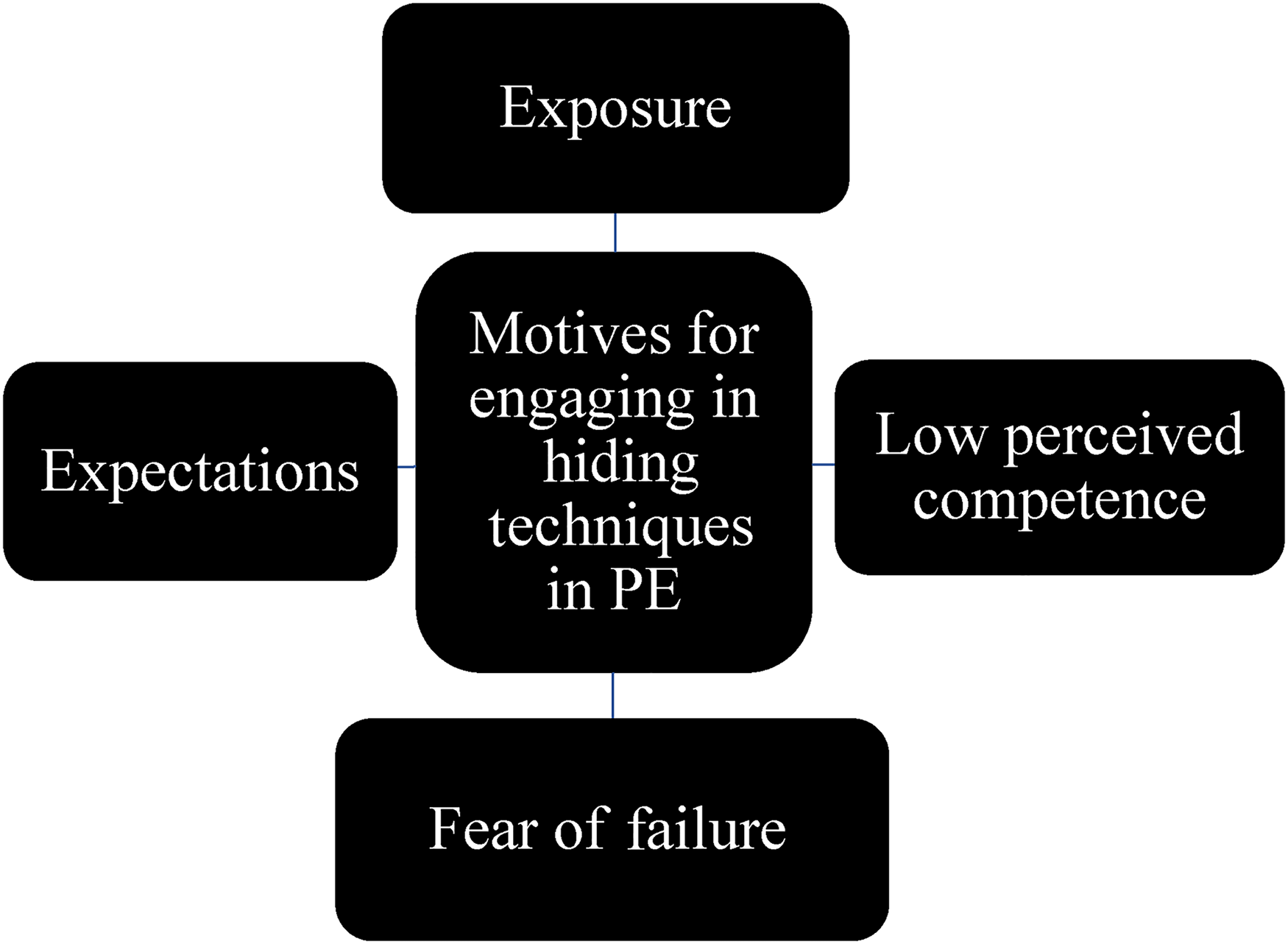
Activity specific and situationally related motives for engaging in hiding techniques in physical education (PE).
Exposure
The students in the present study expressed that PE is a subject where the body is visible and that it is about showing where one excels. For many, it can seem uncomfortable when they are in focus and others can see if they are performing well or poorly. Sofie, who mentioned physical pressure and comments from fellow students as a factor that largely contributed to how she experienced the PE context, reported: There are some who do not bother or there are some who feel that they do not care, or that they feel such body pressure or something. Because we have a lot of that at this school. Then they will not be in the gym, wearing gym clothes. Some students say they want to get thinner and all that. They do not want to be part of it and either not be there or pretend to be sick or something. When you are doing strength training you take it like that, you bend down and all that and then they start. Some say, “no you do not have an ass” or something like that kind of.
Eva described the exposure in PE as: “There are an awful lot of people around me. And then I feel there will be a lot of focus on me, I do not know why, they probably do not even notice me.” She further explained: “I get almost like that, I do not know how to say it, but I am scared somehow. I get so very uncomfortable and do not know where to turn.” When Eva was asked about different situations in PE she elaborated: “There is somewhat more pressure in the gym, to somehow show off what you are good at and such, compared to other subjects where you sort of sit by yourself and read and write.”
Low perceived competence
Samuel, William, and Ingrid reported limited experience of mastery in activities they found challenging. In team activities, some felt redundant. They felt that there was no need for them and that their skills were not good enough to be able to participate in a satisfactory way. When asked what these students did when they did not feel they were up for it, they answered that they either gave up, did not show up for class, sat on the bench, reduced their efforts, or withdrew from the activity. Samuel reported: “If there is an activity that I do not like or that I cannot manage, I do not show up.” Ingrid followed up and explained: “If it is physically demanding then it is difficult, like I am not very good at the physical stuff, I think it is hard to do push-ups.” William elaborated: And if it is complicated, no matter when it is dodgeball and stuff, maybe not dodgeball but let us say football. Then you have all the good ones at the other team while you are on the team with all the bad ones, then you get the feeling that we will lose anyway and why do we bother to try.
Expectations
David, Samuel, and Peter mentioned high expectations as a reason why they could experience PE as uncomfortable. They expressed that it was better not to show that they mastered or enjoyed the activity, because then fellow students would have lower expectations. The risk of not mastering the activity was thereby reduced. By setting lower expectations, the threshold for making mistakes would not be as high, and one could minimize the likelihood of losing self-confidence. David and Peter reported expectations and pressure when doing high jump. David explained: “It is in a way that everyone looks at you and somehow expects you to nail it, but somehow if they know you, they expect that you will not be able to nail it.” Peter elaborated: “In the gym, everyone sees you. If there is a high jump, for example, then everyone watches when you do something, there is a bit of pressure that you must do it.”
The complexity of expectations students may feel in PE was illustrated by Peter. He expressed a dissatisfaction with sports and activities toward fellow students and teachers to lower the pressure of expectations in PE lessons, although he participated in sports in his spare time. Subsequently, Peter communicated something other than what his real thoughts related to the subject and stated: I like sports but show that I do not. I feel that if I show it, that I like sports, then people will have higher expectations. So, I just thought it was easier to show that I do not like it at least. I am not scared, but I just do not want to, because, if I do it poorly, I feel that then it will be even worse. If they expect that, if I often do it well, then they expect me to do it well, and if I do it poorly then, it will just look a lot worse.
Furthermore, Samuel tended not to express interest in, or desire to appear competent, as this could lead to fellow students and teachers possibly having higher expectations of his performance skills and he elaborated: Because I do not want to be so skilled that people kind of expect things from me. Because then, kind of, if I am good and if I cannot score a goal, then they will get angry, because if you are good at it, you must manage it somehow.
Fear of failure
Anne, Sofie, and Eva experienced fear of failure and embarrassment of not being athletically skilled in the PE context. Anne mentioned that it was embarrassing when she did not master the activity or exercise. This could be experienced as unpleasant, and a fear of being commented on or ridiculed by fellow students when she did something wrong could arise: “It is mostly that if you do something wrong, then they can either laugh at you or talk about you, ‘no, he or she did such and such’, and lots of that kind of stuff.” Sofie elaborated: “Because then I know I am not going to make it.” Eva explained her feelings: “I am afraid of doing something wrong in front of the others.” In contrast, Peter and Mary, who were physically active in their spare time, pointed to possible benefits of PE concerning the fact that many of the activities in PE can be related to leisure time activities. Students who do not engage in physical activity in their spare time may therefore have a different fundamental starting point, compared to those who do. According to Peter and Mary, students who do not take part in leisure time activities are more likely to fail as the activity is new to them. Mary explained: I like the subject, so I do a lot of what we do in our spare time as well. So, I can do it in a way somehow. Surely for many it is like, where it is completely new and then they cannot do it right away and then they try to hide it. They are probably afraid and do not manage it somehow, afraid of doing it in a wrong way.
Discussion
The present study intended to get a deeper understanding of the situations and types of activities that lead students to adopt hiding techniques in PE, as well as to investigate students’ motives for using these hiding techniques. The findings lead to the suggestion that there are active and passive hiding techniques and that they are situationally related and activity specific and, as such, in accordance with previous research in this field (Lyngstad, 2018; Lyngstad et al., 2016). The current study is the first study of current students in PE that identifies low perceived competence, fear of failure, high expectations, and exposure of low perceived athletic skills as motives for engaging in hiding techniques.
Active and passive hiding techniques
The findings suggested that hiding techniques could be divided into two main themes: namely, active and passive. These findings are in line with previous research (Dwek, 2019; Lamb, 2014; Lyngstad, 2018; Lyngstad et al., 2016; Ntoumanis et al., 2010; Ommundsen, 2004). An active hiding technique can be seen as a continuation of the technique called “wallflower” or “skilled bystander” (Lamb, 2014; Tischler and McCaughtry, 2011), which has been described by Lyngstad et al. (2016) as “suitably passive.” This type of hiding technique does not see students remove themselves entirely from the activity, but they rather remove themselves from the focus of the given activity through different active strategies. In passive hiding techniques, students attend class but remove themselves entirely from the activity in question. This became apparent when, for example, students forgot their gym clothing when swimming lessons were scheduled or faked an injury during strength training lessons.
Hiding techniques as situationally related and activity specific
In accordance with Lyngstad (2018), the present study found hiding techniques to be situationally related and activity specific; that is, the motive for engaging in hiding techniques seemed to be situational, directly related to the PE activity. Situations where students felt that they were exposed and/or were being looked at regarding clothing, such as strength training classes or swimming classes, are examples of circumstances where the students engaged in hiding techniques that are thought to be situationally related. Furthermore, even though we did not explicitly investigate the teachers’ roles in students’ use of hiding techniques, our findings indicate the importance of the teachers’ choice of activities and their way of organizing them. This became evident when students reported engaging in hiding techniques that were perceived to be activity related; that is, when activities were perceived as too challenging or physically demanding, when there was a significant chance of them not mastering the activity, when students did not like the activity at hand or when the activity was perceived to be boring. Lyngstad et al. (2016) highlighted the importance of the teacher's role in facilitating a PE curriculum that emphasizes meaningful experiences such as joy of movement and gaining positive experiences of learning about movement and physical activity. Such a focus promotes enjoyment and a physically active lifestyle based on personal qualities and abilities (Ministry of Education and Research, 2019).
The findings clearly indicated that low perceived competence, fear of failure, high expectations, and exposure of low perceived athletic skills were motives for choosing to engage in hiding techniques. These findings are in accordance with previous research identifying self-value, self-worth, self-perception, fear of losing face or making a fool of themselves, and fear of not being able to master activities or situations in class as reasons for engaging in hiding techniques (Lyngstad, 2018; Lyngstad et al., 2016; Ntoumanis et al., 2010; Ommundsen, 2004). Even though some may argue that students who engage in hiding techniques are lazy, unskilled, or demotivated (Lyngstad et al., 2016), the motivation for these actions is complex and multifaceted (Lyngstad, 2018). Additionally, the different motives for engaging in hiding techniques seem to be linked to the situation in which they occur and/or the activity in question. This became apparent when the students reported engaging in hiding techniques retracting them entirely from the activity (a passive hiding technique) or reducing effort (an active hiding technique) when they worried about exposing what they perceived as low athletic skills. Furthermore, to camouflage that they did not experience joy and well-being in PE, hiding techniques can be seen as a coping strategy to protect themselves (Lyngstad, 2018).
The motives for engaging in hiding techniques are in line with Elliot and colleagues’ approach-avoidance dimensions of motivation (Elliot et al., 2006; Elliot and Friedman, 2017; Elliot and Hulleman, 2017). The motives for engaging in hiding techniques proposed by the students in the present study represent both the approach and avoidance dimensions of motivation. This became evident through some of the students reporting motives for engaging in hiding techniques, such as fear of losing face or making a fool of themselves and fear of not being able to master activities, which are in accordance with avoidance-based motivation. In line with Elliot and Friedman (2017), these motives may be linked to the approach-avoidance dimension, as the athletic skills acquired for the given activity may be perceived as too challenging; hence, mastering or attaining certain athletic skills may seem unachievable.
Methodological considerations
The main strength of the present study was the inclusion of current students. This allowed for less reliance on recall by the participants compared to interviewing former students. Furthermore, to explore this phenomenon, we used a qualitative approach, applying a deductively developed interview guide presenting two different “real-life” vignettes analyzed inductively based on thematic analysis guidelines. The use of “real-life” vignettes has been found to elicit rich, detailed, and honest responses from students as the researcher gains trust, rapport, and credibility through temporarily attaining the role of an “insider” within the group (Sampson and Johannessen, 2020). Despite these strengths, some caution should be exercised when considering these findings, as data collection was from a relatively small sample in one county in the southern part of Norway. Different counties may have different priorities, which could affect staff professional development and curriculum delivery in PE. In addition, use of more and varied vignettes of PE topics could have created qualitatively different data, and, ideally, observation of the students in PE would probably have provided us with even richer data.
Practical implications
PE is intended to be a platform for providing students with skills, attitudes, and knowledge for a physically active lifestyle (Casey et al., 2021; Doll-Tepper and Scoretz, 2001; Ministry of Education and Research, 2019). Aggerholm et al. (2018) and Beni et al. (2017) argue that several components such as motor/athletic competence, social interaction, fun, challenge, and personally relevant learning are central to students’ meaningful experiences in PE. Nonetheless, the use of hiding techniques has been associated with decreased performances in PE (Elliot et al., 2006), in addition to lower cohesion among classmates and perceived collective efficacy (Coudevylle et al., 2018, 2020). Subsequently, based on findings from the present study and Lyngstad et al.'s (2016) work, the teacher's role is thought to be central in preventing the use of hiding techniques.
It is important that the teacher is able to (a) determine each student's needs and interests and (b) manipulate the different tasks in accordance with the individual student's needs and interests to make their experience meaningful, personally relevant, and fun through facilitating choice and the right level of challenge (Beni et al., 2017; Lyngstad, 2018). Furthermore, good relationships among students in PE and a mastery-oriented climate have been highlighted as central components in fulfilling the intention of a lifelong physically active lifestyle, set forward by the Ministry of Education and Research (2019; Haugen et al., 2021). However, in Norway, but also in other countries, there seems to be an imbalance between the sports discourse and current social and political expectations for PE in schools (Erdvik et al., 2022). This incongruity is a central source of critique in today's Norwegian PE research (Aasland et al., 2017; Erdvik, 2020; Säfvenbom et al., 2015).
Conclusions
To our knowledge, this is the only study examining current students’ perspectives on and motives for using hiding techniques in PE. A better understanding of students’ motives for engaging in hiding techniques and the different roles they take when using hiding techniques, both active and passive, is warranted when seeking the meaning behind the use of hiding techniques in PE. Findings from the present study also reflect the complexity of students’ perceptions of and experiences in PE as a subject in school. Some students seem to like sports and the logic and values of competition in sports but when presented by a teacher in PE class, many students seem to choose to reduce their effort in alignment with what they perceive to be acceptable social norms in the class or out of fear of being classified as an admirer of sports, as Peter explained in the present study (see Results section). Indeed, regardless of the choice of task or activity, or the PE teachers’ way of organizing the activities, different types of hiding techniques may or may not take place. Thus, the teacher seems to play a central role in facilitating students’ perceptions of meaningful experiences, thereby preventing the use of both active and passive hiding techniques in PE.
Footnotes
Acknowledgements
We would like to say thank you to Elise Dølemo and Hanne Øyna for their contribution to the data collection, and to all the participants in this study who voluntarily gave up their time to share their personal experiences
Declaration of conflicting interests
The authors declared no potential conflicts of interest with respect to the research, authorship, and/or publication of this article.
Funding
The authors received no financial support for the research, authorship, and/or publication of this article.
