




Abstract
Whilst there is considerable research into the impact of educational leadership on pupil outcomes, less explored are the career characteristics headteachers need to effect and sustain that leadership long term. This study explores the career characteristics that underpin sustainable careers for headteachers. The sustainable career model provides the framework to identify the indicators of a sustainable career: happy, healthy, productive, and the means to analyse through the dynamic fit of person, context, and time. Twenty independent school headteachers in England were interviewed, and through reflexive thematic analysis, we developed three themes encapsulating key characteristics for a sustainable headteacher career. Discovering Headship showed how experiences prior to headship inspire and ready them for the position. Navigating Headship illustrates how headteachers navigate and orchestrate people within their contexts and identified the importance of belonging in professional networks. Sustaining a Headteacher Career identified the proactive self-management of health, recovery experiences, and a pupil-focused approach. The findings are discussed through the lens of the sustainable career model, and we offer a number of practical recommendations.
Introduction
Headteachers hold great responsibility within an increasingly challenging and complex context (Glazzard and Stones, 2021) and are critical to school success and pupil outcomes (Robinson, 2010; Robinson and Gray, 2019). Headteachers even at the most successful schools face demanding challenges, often cited in the high stakes nature of inspections, as illustrated by the suicide in 2023 of a headteacher following a school inspection (Adams, 2023). The National Professional Qualifications for school leaders have been declared inadequate to prepare educational leaders for their roles (Whittaker, 2024) as technical skills alone are insufficient to navigate the wicked problems facing them (Grint, 2010), so how then can school leaders be equipped to respond to such wide-ranging demands?
The School Leaders Union NAHT reports the school leadership supply chain is on the brink of collapse (NAHT, 2021) with the majority of those in educational leadership not aspiring to headship. This is echoed in research by the Department for Education who found the most cited reason for assistant heads’ reluctance to consider promotion was the anticipated impact on work–life balance (IFF, 2024) and calls into question the sustainability of headteacher careers.
Independent school context in England
The current political, social, cultural, and economic climate is changing the landscape for independent schools (Gu et al., 2023). Recent months have seen a substantial increase to the employer costs of the teachers’ pension scheme, the Government policy to remove the exemption of VAT on school fees from January 2025, and the removal of business rates relief (Murray, 2024) all of which have increased the vulnerability of the sector (Lenon, 2022).
Recent legislation and policies have increased the focus on compliance, spanning health and safety regulations, safeguarding, corporate and charity governance, and finance, which in turn have led to changes in inspection frameworks. As a result, headteachers increasingly need an extensive range of skills, combining both expertise in teaching and learning, comparable with the Chief Executive Officer (CEO) of a business (Gu et al., 2023).
Background
During the late 1990s and early 2000s, a body of literature focused on headteachers (e.g. James and Vince, 2001). Much of this work examined the consequences of the first statutory national curriculum introduced following the Education Reform Act of 1988 (Rutherford, 2005). This was followed by the introduction of the National Professional Qualification for Headship (NPQH) in 1997, initially voluntary but made mandatory in the state sector in 2004 (Weindling and Dimmock, 2006). Research into the independent education sector, however, remained scarce (McLay, 2008), and this gap in the literature persists. More recently the literature has highlighted the effects of the Covid-19 pandemic on headteachers and schools (e.g. McKay et al., 2023), issues related to work-related stress (e.g. Doyle Fosco et al., 2023; Scott et al., 2021) and burnout (Yusof, 2012).
Research on school leadership has predominantly focused on instructional leadership skills, often overlooking the context-specific demands of the role (Rees and Barker, 2021). Robinson (2010) shifts the conversation from instructional leadership to broader leadership capabilities. Similarly, Leithwood et al. (2020) conclude that it is not merely what headteachers do, but how they do it that is significant. They emphasise the importance of headteachers demonstrating contextual awareness at individual, organisational, and societal levels, with these factors mediating the impact of school leadership on student outcomes. Their findings further confirm that headteacher leadership plays a critical role in shaping both organisational and individual pupil success.
Research on headteacher career pathways often focuses on specific phases, such as preparation and transition into headship (James and Whiting, 1998; Saunders and Stockton, 2005), or on specific topics like gender (McLay, 2008). Professional development is consistently seen as essential across career stages, evolving as headteachers accumulate experience (Stroud, 2006; Woods et al., 2009).
Sustainable careers theory
De Vos et al.'s (2020) sustainable career model examines careers from an individual's perspective, whilst recognising the dynamic interconnections with other stakeholders and contexts. A sustainable headteacher career is one that is mutually beneficial to the individual, the school, and the wider context, considered over a long-term perspective. For example, the promotion to headteacher may in the short term appear successful, but if it comes at the cost of their home life or mental health, it is not sustainable over time. Similarly, a headteacher under pressure dealing with an exceptionally difficult legal challenge could achieve a sustainable career long term. Snapshot views in this context are unhelpful, and the model provides space for periods of uncertainty and adaptation.
The sustainable career model moves away from the assumptions of the inevitability of a linear career path, challenging the ‘consolidation’ and ‘plateau’ stages identified in Earley and Weindling's (2007) analysis of career stages and headteacher performance. As Holling (2001) identified, a sustainable career is one that builds capacity to create, test, and maintain an adaptive capacity in a way that is meaningful to the individual and the context in which they work.
De Vos et al. (2020) developed three indicators of a sustainable career: health (the ability to work), happiness (engagement), and productivity (performance). They are seen to be the building blocks for the welfare of self, family, peers, school, and the wider context within which headteachers are immersed. Each indicator is of equal importance and necessary for both the headteacher and school to thrive.
The sustainable career model offers the flexibility to evaluate a career in response to the dynamic interplay of the person, context, and time and resonates with Glazzard and Stones's research (2021) into headteacher resilience, which suggests that individual, relational, and contextual factors moderate the impact of work-related stress. It is the individual's ability to continue to learn and adapt over time through their dynamic interactions within context, which forms the foundation for the study of what makes a career sustainable. When the three dimensions – person, context, and time – are met, a strong person-career fit may be achieved and sustained, and the key characteristics of happy, healthy, and productive headteachers identified.
This study makes a contribution to the development of effective career pathways aimed at preparing teachers and middle leaders for headship, seeking to identify the types and levels of support and professional development that are most valued by current and aspiring headteachers throughout their careers. Findings could also inform recruitment and retention strategies designed to address the diminishing pool of candidates and enhance the experiences of headteachers, ultimately combining to contribute to the improvement of both headteacher and pupil outcomes.
The present study
Existing research reflects the multifaceted nature of headteacher careers but often focuses on the outcomes for the school or pupils, rather than on the headteachers. If headteachers have a crucial, direct impact on enhancing individual outcomes for pupils, the education sector needs to identify what enables school leaders to thrive throughout their careers. This research seeks to contribute a holistic, collective response to what makes for a sustainable headteacher career across the person, context, and time exploring the career characteristics of happy, healthy, and productive headteachers in independent schools in England.
Method
Research philosophy
The research adopted a critical realist epistemology, concerned with the lived experiences of headteachers in the context of real-world challenges (Lawani, 2020). The approach allows for interpretation of the dataset, recognising that insights are influenced by the participant's and researcher's perspectives (Willig, 2013). Qualitative interviews were used to generate a rich and nuanced dataset.
Participants
Headteachers of independent schools in England were recruited from the first author's professional network, the participants being current or previous colleagues. The length of service of the headteachers ranged from 6 months to having more than 10 years in one or more headships (Table 1). The headteachers represented a range of school contexts, large and small, spanning preparatory, senior and all through schools from nursery/reception to sixth form with 10 male and 10 female participants. This sample size was considered not too large that it would be difficult to carry out detailed analysis (Saunders and Townsend, 2016), nor too small for ‘information power’ (Malterud et al., 2016) or saturation (Heath and Cowley, 2004) to not be achieved.
Participant information data.
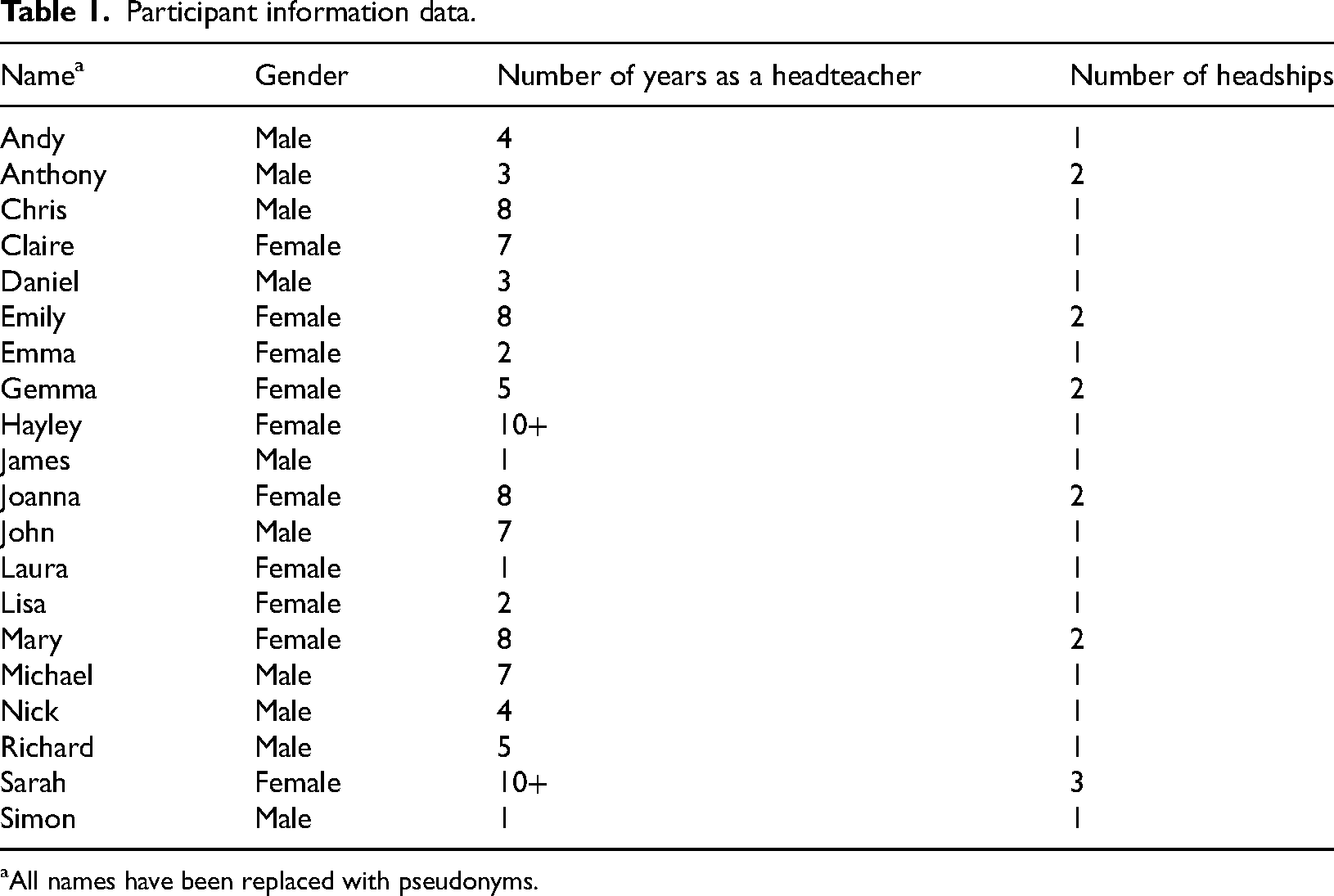
All names have been replaced with pseudonyms.
Procedure
Once ethical approval was granted from X Research Committee at Y university [blinded for review], semi-structured interviews were conducted to gather data. A framework of seven open questions, with follow-up questions, was developed to structure the conversation and to provide a degree of consistency in responses between participants. A pilot interview was conducted to check the structure and comprehension of the questions and flow of the interview (Kallio et al., 2016). Participants were asked to reflect on their journey to headship, their experiences as a headteacher, and what they may advise a new headteacher. Interview questions included ‘Tell me how you became a headteacher’ and ‘What do you think someone needs to thrive in this position?’. Follow-up questions permitted the researcher to dig deeper (McGrath et al., 2019) to generate rich, detailed, contextualised data (Levitt et al., 2018). Seven interviews were carried out in person, with the remainder virtually via Microsoft Teams. The interviews took between 30 and 75 min with a mean of 45 min. Interviews were recorded and initial transcriptions were generated using Teams and/or Otter.ai; those transcriptions were checked for accuracy against the audio recording.
Analysis
Reflexive thematic analysis (RTA) of the dataset was undertaken in response to the research question. RTA is suitable for research involving a larger group of participants, providing a flexible framework for the researcher to explore and interpret patterns and meanings across the dataset (Braun and Clarke, 2022).
The process of RTA followed Braun and Clarke's (2022) six phases, requiring the researcher to familiarise and immerse themselves in the data, a process that had already started during the transcription stage (Byrne, 2021). Having repeatedly read through the dataset, noting initial points of interest, we started to generate initial codes, adopting an inductive approach in looking for repeated patterns and beginning to organise the data into categories, before developing potential themes. Following further refinement, themes and subthemes were defined, and findings were produced.
Reflexivity
Braun and Clarke (2022) recognise it is impossible to be completely free from bias when analysing qualitative data. As such it is important to embrace the role, researchers play in shaping the process (Willig, 2013). Conscious of their subjectivity and having worked in independent education for many years, the first author attempted to mitigate any bias through keeping a reflexive journal and discussing developing themes and subthemes with the second author. Through this, the researchers were able to harness potential subjectivity as a resource (Gough and Madill, 2012) that enhanced the research in providing access to the sector, familiarity with interviewees, and an understanding of their lexicon and context, resulting in participants providing candid responses and a rich dataset.
Findings
This research explores the experiences of headteachers to identify key characteristics for a sustainable career that is happy, healthy, and productive. We developed three themes and seven subthemes.
Theme 1: discovering headship
Many participants described how they ‘never planned to be a head’ (Michael); some identified as ‘accidental heads’. For Chris, becoming head ‘emerged out of the natural career path, and things going well’. Some had always wanted to be a head, with an intended career path ‘looking at my CV there's a clear trajectory’ (Emily). Two subthemes indicate not only how teachers discover headship, but how that journey influences their sustainability as headteachers.
Experiences prior to headship
Many reflected a key career characteristic of receiving informal mentoring from headteachers and colleagues before becoming a headteacher themselves. Exposure to new experiences and encouragement to consider the next step impacted all the participants’ discovery of headship. Laura observed, ‘potentially some of the best heads are the ones that don’t necessarily think that they can or want to do it […] they need to be encouraged’ and headteachers shared how they had appreciated such validation. Emily recalled how a former head ‘was very good at making sure you had exposure to lots of different things […] a real mixture of pastoral, academic and operational bits’. Simon reflected as a deputy head, ‘being empowered to do certain things that a head would do has been the most important thing that has allowed me to be ready’.
Existing headteachers seemed to have a significant role to play in developing the next generation of headteachers. The period leading to his promotion to headteacher was a formative time for Nick as his headteacher, ‘created weekly meetings specifically around preparing me for headship’, also for Daniel, ‘having almost six months of on-the-job training, I came into this role feeling more prepared’.
Experience prior to headship builds awareness that ‘heads can have really different skill sets, but also schools require different things’ (Sarah), and aligning values increases the chances of creating a sustainable headteacher career, as Emily contemplated: ‘I knew it was the right role for me and I think your fit with the school is absolutely essential’, thereby building a sustainable headteacher career.
Training courses
The consensus is that there is a lot to learn as a new headteacher, ‘you’re not qualified in the sense of, you are a trained teacher, you’re not trained in business, HR, counselling, marketing, …’ (Claire). Michael commented, ‘it's very hard to prepare to be a head’.
Responses to the NPQH were mixed. A minority regarded it an essential career characteristic when aspiring to headship, ‘I did the NPQH … to make sure I had full awareness’ (Andy). It was perceived as external validation but once in role, the NPQH was perceived as having little impact on careers in respect of preparing or equipping for headship and could not rival the effectiveness of a ‘good role model’ (Joanna).
Leadership training, however, was pivotal: ‘seismically powerful … about who you are as a leader’ (Chris), ‘it was massive … thinking about leadership styles, ways of supporting leaders and growing people’ (Claire), and ‘it was really important in understanding about myself’ (Gemma). Leadership courses change how headteachers approach their roles, equipping them with a deeper understanding of themselves, and an appreciation of the difference between leadership and management, translating into a greater understanding as to how to approach the demands of headship.
Aspects of training provided by professional bodies such as the Independent Association of Prep Schools, The Heads’ Conference (HMC), and The Society of Heads are seen to be helpful and formative in challenging aspiring headteachers to discover headship. Several participants recalled the practically applied sessions were most inciteful, ‘they get specialist people in each area to speak to the group, so you have a bursar, marketing person, HR, and you fire questions at them. That was just invaluable in my training’ (Anthony).
It was notable that when asked about training undertaken, participants typically responded enthusiastically, referencing people they had met rather than what they had learnt, ‘you’re with a cohort, so you’ve got each other, we have a WhatsApp group’ (Laura) and ‘they put you in touch with other heads which was particularly helpful’ (Hayley). These findings indicate the connections made may be more impactful career characteristics than the qualifications.
Theme 2: navigating headship
The scope of the role caused several headteachers to liken it to that of a ‘CEO plus a whole bunch of children and safeguarding’ (Michael). Some headteachers described the diversity in role and context ‘exhilarating’ (Emily) but nonetheless shared the commonly held sentiment: ‘I don’t think anything can really prepare you for headship’ (Emily).
Professional networks
All participants cited professional networks as an essential career resource that impacted their productivity. Networks of headteachers are commonly established through professional bodies and attendance at conference and training opportunities. These connections are highly valued and needed; headteachers describe them as being ‘collaborative’ (John), ‘supportive’ (Mary), ‘trusted, non-judgmental’ (Joanna), ‘incredibly collegiate’ (Nick), and ‘sustaining’ (Sarah). For headteachers working within the same trust, these sentiments were often enhanced since their schools are not in competition with each other.
The majority of the headteachers cited no prior experience in areas such as finance, HR, facilities, and marketing and found that having a network of specialists was essential to navigating these aspects of the role. Many depended upon experts working alongside them and providing tailored coaching, specific to their context so they could learn, ‘on the job’ (Hayley). Simon advises, ‘surround yourself with people who are better at their job than you will ever be at theirs’. A great senior leadership team (SLT) was described as vital in supporting the headteachers and achieving their vision for the school and many spoke of ‘building a team you trust’ (Laura). Sarah cited a difficult time when having an excellent SLT ‘sustained’ her. Joanna expressed the challenges are ‘so much easier’ when your SLT is right.
Acceptance
Many participants described how their navigation of headship was enabled through an acceptance that headteachers will achieve through others that they do not need to know everything, and that things can be difficult or go wrong, but that is ok. There was consensus that ‘you don’t have to know everything’ (Richard), not to negate responsibility, as Emily asserts, you still need to, ‘ask the right questions … and know where to find the answers’ but achieving through others is often key to this. Acceptance that things will be difficult or go wrong, that there can be a ‘sudden accumulation of concurrent challenges’ (Chris), but this will pass, was a learnt experience of many. An acceptance that ‘there are moments when any of us, we don’t know what to do … and that's ok’ (Sarah) enables headteachers to seek the support they need.
Theme 3: sustaining a headteacher career
The role of headteacher is tough, ‘especially in the first year’ (John). It is ‘all encompassing’ (Hayley) and the ‘weight of responsibility’ (James) was clearly keenly felt by all participants. Many reported the personal toll of handling the fallout from critical incidents including the extremes of suicide, murder, and terrorism. Three subthemes were developed illustrating how headteachers not just cope with these pressures, but sustain a happy, healthy, productive career that enabled so many to declare, ‘it's the best job’.
Pupil focus
Every headteacher enthused about working with children; pupils are the heart of their vision and pupil focus generates a determined force; ‘your child gets one shot at education; it's got to be the best’ (Daniel). Several shared that pupils were ‘the best part of my job’ (Simon) and ‘joy’ was repeatedly used to describe their interactions with children. Teaching, observing lessons, and celebrating pupil achievements were frequently described as highlights. Participants often referred to spending time with children during difficult times as a means of resetting. Mary explained ‘if I’m having a bad day, my favourite place is in the nursery. A few goes up and down the slide with them and everything's fabulous!’. Maintaining regular contact with pupils is a key characteristic of a sustainable headteacher career, to provide both the drive towards productivity and happiness in the role.
Proactive steps towards well-being
There was an acceptance that ‘resilience can only take you so far’ (Joanna); maintaining personal health and happiness is recognised as an essential element to, as Michael say ‘benefit me and the school’. Sarah recalled a time where she ‘gave out too much. You’ve got a limited bucket, and I wasn’t doing things that might have filled it back up’. Well-being needs to be approached proactively because, as Richard noted, ‘you can’t operate in a crisis if you’re already maxed out before the crisis’.
That said it can often be difficult to achieve. Richard recalled how, as a new head, he felt ‘it was almost a dereliction of duty to not physically be here’, but like John, came to modify expectations of himself, ‘there's almost a conceit that says somebody expects me to be in touch all the time’ (John). Many found family, friends, governors, or a coach beneficial in helping them to rebuild energy.
Establishing boundaries is central in protecting headteachers’ well-being. This could mean holding time in the diary to work from home, leaving on time to collect their own children, or avoiding work at least 1 day over the weekend. Andy expressed that doing the job wholeheartedly included ‘occasionally saying, it's 4.30pm, I’m going home’. Words like ‘disciplined’ (Richard) and ‘protective’ (Laura) were commonly used with reference to maintaining boundaries, demonstrating the need for headteachers to be proactive and assertive in prioritising their well-being.
The data show how well-being is primarily achieved when individuals ‘recognise the things that really matter to you and make sure you do them every week’ (Sarah). Many cited hobbies or sports they regularly participate in; it does not matter what it is, just ‘find that thing and do not compromise on it’ (Nick). ‘Take care of themselves’ (Andy) was the advice most frequently cited for new headteachers, coupled with a strong appreciation of life outside the job, ‘do not on any account sacrifice your own life for the job’ (Sarah). Having a life outside work brings a sense of self and perspective, alongside rest and recovery, allowing headteachers to emotionally disconnect from the job. This must be fiercely protected to prevent the ‘creeping demands of headship’ (Chris). Trusted individuals close to the headteacher can play an important role in ensuring their well-being is sustained.
Reflecting on the positives
Many interviewees deliberately reflected on their achievements, ‘otherwise you can be overwhelmed by the challenges’ (Anthony). Words such as ‘proud’, ‘rewarding’, ‘progress’, ‘satisfaction’, and ‘joy’ were commonly used in reflecting on the positives. Several headteachers found encouragement through receiving an email of thanks from a parent or governor or great feedback from a staff survey. As Claire says, ‘it encourages you to keep going’. Sarah identified reflecting on the positives as something ‘that sustained me’. It is a healthy practice that creates space for happiness and sustains ongoing productivity.
Discussion
This study explores sustainable careers for headteachers in independent schools in England, applying De Vos et al.'s (2020) three indicators of a sustainable career: happy, healthy, and productive. Through the analysis, we developed three themes: Discovering Headship highlighted influential experiences prior to headship, including informal exposure to tasks and formal training; Navigating Headship acknowledged the vital nature of professional networks and acceptance of what is possible through self and others; and Sustaining a Headteacher Career identified three core practices: upholding a pupil focus, taking proactive steps towards well-being, and reflecting on the positives, as key characteristics in achieving the happy, healthy, and productive indicators of a sustainable career.
Links between the themes and indicators were clear, and in recognition of this, rather than adopting a thematic order for the discussion, the dimensions of sustainable careers: person, context, and time (De Vos et al., 2020) will be used as a lens through which to discuss the findings.
Person
The notion of the person as the central player in their career, acting with agency, meaning, proactivity, and control, with the ability to adapt and react to external influences (De Vos et al., 2020) was evident across the three themes. It was interesting that so many headteachers described themselves as ‘accidental heads’, with no original intention of becoming a headteacher. Discovering headship for many was a gradual development of career competencies in knowledge, skills, and abilities. This was often achieved through volunteering for additional responsibilities, being open to the suggestion that they should apply for a promotion, and having senior leaders recognise their potential and set them challenges outside of their remit. This gave them exposure to and aspirations for the next level. Those real-life experiences were highly valued in terms of the confidence and ability needed to step towards headship.
Other senior leaders seem to be key in providing guidance, opportunities, or informal career mentoring. This not only placed prospective headteachers in a stronger position for headship but also encouraged some to adapt their career path towards headship. The findings show that this has a direct impact on participant's trajectory into headship and can be highly influential in allowing teachers to secure their first headship position. It also points to a challenge for those potential headteachers who do not have access to such sponsored mobility (Ng et al., 2005). Selection for sponsored mobility was subjective and dependent upon being spotted or having a senior leader with the ability or interest in sponsorship. It raises considerations of equality, diversity, and inclusion for the profession.
Many headteachers had attended leadership courses either before or during their headships and found them to be enormously insightful where they resulted in a deeper understanding of themselves. The most useful courses did not focus on instructional management competencies – something the NPQH has been criticised for (Whittaker, 2024) – but leadership practice, developing an approach to headship that could be adapted to context and incorporated into the everyday practice of school leaders (Raelin, 2016). This supports the views of Robinson (2010) and Carroll et al. (2008), who advocate for a move away from instructional leadership and towards leadership capabilities.
Despite preparations for headship, the consensus was that nothing can really prepare you for the role of headship and much learning continues in role. All the participants, irrespective of tenure, said they were still learning and often referred to reading a lot to keep up with best practice. The majority had limited experience and appreciation of how much of the role was focused on the ‘business’ of running a school. Many had gaps in their knowledge, skills, and abilities in the fields of finance, HR, facilities, and marketing. Some sought out mentors or coaches for support and to enhance their performance, particularly during challenging times (Grant et al., 2009) creating space to reflect and implement sustainable change (van Nieuwerburgh, 2017).
There was a keen sense that each headteacher needed to be a proactive owner of their own well-being, appreciating this is beneficial to the individual and organisation (Geurts and Sonnentag, 2006). The nature of their individual coping strategies varied but all allowed them to switch off, recharge, and recover (Sonnentag and Fritz, 2007). Headteachers recognised that the demands of the job are such that rest and recovery are essential to health and psychological well-being, necessary to perform well in the role (Meijman and Mulder, 2013; Wright et al., 2007). In a sector where a headteacher's performance is often measured in hard data (such as examination results or financial progress), it perhaps presents a challenge to the sector to meaningfully value and facilitate something that is personally driven, and lacks a clear metric with which to assess the impact.
The headteachers in this study were continually mindful of the pupils in their care, and this meaning seemed to be an important element in feeding the motivation, commitment, and satisfaction in their careers. For many of them, work was described as a calling or vocation where headteachers are following a passion whilst also fulfilling a duty (Thompson and Bunderson, 2019). The pupil focus keeps them grounded in their original motivation to become a teacher and gives them an ongoing desire to make a greater impact for good in their roles. As they deal with the weight of responsibility and challenging or personally distressing situations, this meaning acts as an anchor point in their decision-making, providing a clear sense of purpose and vision even in the face of adversity or high work demands (De Vos et al., 2020; Steger et al., 2012; Wrzesniewski et al., 1997).
Context
Context is multidimensional: personal, professional, institutional, and political (De Vos et al., 2020). The uniqueness of each headship and school highlighted the importance of matching the headteacher to the right school. The professional networks provide expertise, encouragement, and an outlet for headteachers and were clearly valued as a key resource that needed to be proactively built.
Many of the headteachers described situations like a vindictive complaint, or a hostile governing body, that would take a personal toll, bringing with them a sense of vulnerability and isolation. During these times, the headteachers needed to rely on trusted members of their networks, both personal and professional. One headteacher recalled not using their network enough during a particularly hostile period and found that as a result, it took them significant time to move on from the ‘career shock’ (De Vos et al., 2020), illustrating how the dimensions of person, context, and time are inter-related.
Being able to trust in the SLT made the job and weight of responsibility easier to sustain. The headteachers recognised that it can take time to build the right SLT around them, but saw that it was essential to do so given much of what headteachers could achieve would be through their SLT. Colleagues underpinned many of the headteachers’ achievements and were described as a central resource to be invested in and protected (Hobfoll et al., 2018). Similarly, good governors, particularly the Chair, can be an enormous source of support, challenge, and encouragement. The findings concur with Bakker et al. (2023) where the need to feel trusted and work with autonomy are crucial to headteacher motivation, job satisfaction, and performance. Simultaneous demands from various stakeholders: governors, regional directors, a trust, parents and pupils could create a lack of autonomy and a sense of excessive accountability.
Some headteachers reflected on how the organisational context enabled them to balance the demands of the role. The ability to work part time or flex their working hours to accommodate school/nursery drop off for their own children or support to work from home for short periods of time enabled headteachers to be able to self-manage and sustain their careers (De Vos et al., 2020). The context of headteachers’ private lives contributes to their psychological well-being. Family and friends were frequently cited as providing emotional support and another perspective on life. Many spoke of establishing boundaries, physical or emotional, between work and home. This was seen to be more challenging for those for whom their schools were seen to be strongly associated with the identity of the local community or for those heads who lived on site.
Context influences the resources that are required or are available and leads to the same job demands being described as either exhilarating or overwhelming. Headteachers of smaller schools typically cover a greater range of demands with fewer resources, whereas in larger schools, there is the support of teams to deal with the day-to-day running of the site, for example. The headteacher's experiences indicate the availability of resources was positively linked to their health, happiness, and productivity at work (Janse van Rensburg et al., 2018). Since these fluctuate, it is important to consider the sustainability of their careers over time.
Time
Sustainable careers are not an end goal, nor a permanent state, but a career characteristic that evolves over time (De Vos et al., 2020). As with the gradual emergence of an ‘accidental head’, there was a strong sense of the headteacher role evolving over time. Most headteachers recalled experiencing a tough first year, drawing heavily on their personal coping mechanisms, often referring to needing to grow a thick skin or sharing how they had developed techniques to enhance their resilience. Acceptance of it being a tough job was common, and at times, they needed to dig deep and just cope, for example, with a safeguarding event or a complaint. Equally, there was recognition that there is no longevity in simply ‘coping’.
The headteachers reported that the role tended to get easier over time but prior experience cannot guarantee future success. Experienced headteachers shared how they were always learning, adapting to new events, people, or changing contexts, and thus increasing their sustainability as a headteacher. There was a frequently shared acceptance that there will always be times when a headteacher will not know what to do, or things will go wrong, or a bad decision will be made, but this was ok. This growth mindset (Dweck, 2006) recognises that fundamental qualities can be honed and developed, enabling headteachers when faced with a challenge to choose to respond rather than react (Pattakos and Dundon, 2017). The ability to ask for help, learn from it, and move on was identified as a necessary part of taking proactive steps towards well-being.
Goals and opportunities change over time. Experienced headteachers demonstrated ongoing adaptation of their careers and developing career competencies by becoming an inspector, a governor for another school, moving to a larger school, or undertaking an additional responsibility within a group. This illustrates career sustainability cannot be assessed by taking a snapshot but is a dynamic process as the person-career fit is redefined over a longer-term perspective (Parasuraman et al., 2000).
Theoretical implications
This study provides a practical application of the sustainable career model, which has not been applied to headteachers before, creating a better understanding of how headteachers navigate and sustain their careers. The framework places the individual as the central actor in their career and shows there is much that individual headteachers may do to proactively build a sustainable career.
The indicators of a sustainable career are illustrated by De Vos et al. (2020) as equally balanced circles. However, these findings suggest the relative size of each of the circles is fluid; so long as each is present to some extent, and they balance out over time, a career may still be considered sustainable. Observation of a prolonged imbalance between the indicators may be useful ‘red flags’ to sustainability and provide a prompt for headteachers and those supporting them to address the disparity.
Practical recommendations
The study's findings point to practical recommendations that may be implemented to support the sustainability of headteacher careers. The majority of headteachers did not aspire to headship until they were close to the point of application. The role of sponsorship mobility was central to this, and senior leaders in education should explore how this could be extended to underrepresented groups and those talented potential headteachers who may be overlooked. Furthermore, experienced headteachers could be challenged to support, inspire, and mentor future headteachers to increase the pool of ‘accidental heads’.
Courses for aspiring and new headteachers would be well advised to focus on leadership as practice (Carroll et al., 2008), developing competencies that are rooted in relational leadership perspectives and may be situated within different school contexts (Raelin, 2016), equipping headteachers for the wicked problems (Grint, 2010) they will encounter.
Given the value placed on networks, induction programmes should aim to accelerate the development of professional networks for new headteachers, particularly with other headteachers and business specialists. Mentorship within educational trusts or neighbouring schools could be developed with guidance and clear expectations for the role of mentor so the relationship can be active and beneficial, and not add to a sense of further accountability in addition to that of the governors or a trust.
Consistent with the findings of Sogunro (2012), a small yet significant number of responsibilities were found to take a personal toll on headteachers, for example, handling complex complaints. Organisations could explore support opportunities that headteachers may value for these specific situations.
Limitations
The population was not representative of the sector: the participants lacked ethnic diversity, and none of them had been a headteacher for more than 12 years. The first author's experience of working in the independent sector and the participants being known to her prevented the researcher from being a neutral observer of the findings. To mitigate against this, the authors made sure to keep their analysis closely grounded in the data at all times and met frequently to discuss the codes and themes and to identify assumptions and influences that may have affected the analysis process.
Directions for future research
Further research could be conducted with those who work closely with headteachers to deepen the perspective on sustainable careers, for example, headteacher PAs, bursars, SLT members, chairs of governors, or business specialists. A study focusing on headteachers with more extensive experience in the role could explore if there are differences in what very experienced headteachers need, whether and how their goals may change, and how they continue to evolve their careers over a longer period of time. Given the current external pressures on the independent school sector, the research was limited the study to this sector. Further research could examine whether the findings are transferable to the state sector.
Conclusion
The study provides a unique sector-specific insight into the career characteristics evident in a sustainable headteacher career, as defined by De Vos et al.'s (2020) indicators of happiness, health, and productivity. Through 20 qualitative interviews, the findings support existing sustainable career models. The three dimensions of person, context, and time illustrate the dynamic links between the career characteristics of happy, healthy, and productive headteachers. Changes in any of these areas have the scope to alter the person-career fit and impact the indicators of a sustainable career.
The research contributes practical ways in which headteachers and other senior leaders in education may look to enhanced pathways to headship and contribute to sustaining the careers of headteachers. Importantly, this work raises the profile of sustainable careers in the sector. The importance of this is not limited to individual headteachers or to their organisations; the impact extends to the life chances and opportunities for pupils.
Footnotes
Consent to participate
Participants gave written informed consent for data collection and for the publication of de-identified direct quotations before starting the interviews.
Data availability
The datasets generated during and/or analysed during the current study are available from the corresponding author on reasonable request.
Declaration of conflicting interests
The authors declared no potential conflicts of interest with respect to the research, authorship, and/or publication of this article.
Ethical approval
This research study was approved by the Ethics Committee for the Psychology Department, City St George's University of London, approval number ETH2324-2001 in April 2024.
Funding
The authors received no financial support for the research, authorship, and/or publication of this article.
