



Abstract
Although symptoms of dyslexia tend to restrict it to the school environment, it is a lifelong condition. Research has focused primarily on prevention and intervention within educational spaces; however, studies indicate that dyslexic individuals continue to face challenges and barriers also in workplaces. This study aims to explore the reflections of human resources specialists on their knowledge and beliefs about dyslexic employees and on their attitudes and practices toward dyslexic employees. Themes were developed through reflexive thematic analysis. Human resources specialists have some basic knowledge about dyslexia and its impact on employees. However, their beliefs are based on their assumptions and experience encountering dyslexic employees, which are rather rare. In general, they are open to help building more inclusive workplaces, but for now these steps to equality are based on individual approaches, which requires disclosure from the employee. Dyslexic employees may not feel psychological safety at work, leading to non-disclosure.
Lay abstract
Research has been focused primarily on prevention and intervention within educational spaces; however, studies indicate that dyslexic individuals continue to face challenges and barriers also in workplaces. This study aimed to explore human resources specialists’ reflections on their knowledge and beliefs about dyslexic employees and on their attitudes and practices toward dyslexic employees. Human resources specialists have some basic knowledge about dyslexia and its impact on employees. However, their beliefs are based on their assumptions and experience encountering dyslexic employees, which are rather rare. In general, they are open to help building more inclusive workplaces, but for now these steps to equality are based on individual approaches, which requires disclosure from the employee. To build more inclusive environments, we must raise awareness not only between human resources specialists, but also other employees (colleagues), and importantly between dyslexic employees, who might not know about their rights and possibilities provided by their companies.
Introduction
Dyslexia [also referred to as Specific Learning Disorder (SpLD_/Learning Disorder/Learning Disability) has been a topic of discussion for recent decades, while research has focused mainly on the school environment, including prevention and intervention, within the last two decades also appearing in the field of higher education (see, e.g., Černickaja & Sokolová, 2023; MacCullagh, 2014; Majumder et al., 2010). Through the medical model of dyslexia, we might define it as a condition, which manifests itself primarily in the area of writing, reading, and spelling; however, it may also affect phonological awareness, verbal memory, and verbal processing speed, and come with co-occurring difficulties, like mental calculation or motor coordination (British Dyslexia Association, 2010). These symptoms tend to restrict dyslexia to the school environment inclusively, but it is still a lifelong condition with a prevalence of approximately 10% in the overall population (British Dyslexia Association, 2010; Snowling et al., 2020). Furthermore, an individual may develop secondary conditions, such as anxiety (Carroll & Iles, 2006), while comorbidities have also been reported, mainly other neurodevelopmental conditions, such as ADHD (see, e.g., Germanò et al., 2010). Importantly within the medical model, medical conditions are viewed as individual deficits (American Psychiatric Association, 2013; Valeras, 2010). Disability is seen as a problem of the individual; hence it is their responsibility to overcome their challenges and societal barriers (Valeras, 2010).
Social model of dyslexia and neurodiversity concept
There has been a debate in the discourse on dyslexia and other conditions (Best et al., 2022; Elsherif et al., 2022; Evans, 2013; Manalili et al., 2023), which issued lenses that we are using to define them. In 2010, Sheela Bell wrote: ‘There is still no single conclusive definition of dyslexia’ (Bell, 2010, p. 216). Even 14 years later, dyslexia still belongs to highly misunderstood conditions entwined with misinformation and stigma, partly due to missing consensus. However, in addition to the medical model of dyslexia, we may define dyslexia through other lenses, such as the social model of disability or neurodiversity, which challenges the general discourse of dyslexia as a disorder. When considering the social model of disability, the dyslexic individual is disabled by society, by barriers that are constructed socially (Oliver, 2013). ‘Disability is the product of environmental and social structures that exclude those with physical, intellectual, or cognitive impairments’ (Fitzgibbon & O’Connor, 2002, p. 27). Berghs et al. (2019) challenge the traditional social model of disability by its variation, the social model of human rights. Even ‘the founder’ of the social model of disability agreed that the conception of social model of disabilities brings its own challenges and was open to critics (Oliver, 2013). All citizens ‘have rights to flourish with disability and that it is society that should enable these rights’ (Berghs et al., 2019, p. 4). This is significant, as Berghs et al. (2019) highlight the importance of a ‘stronger social tool’ for justice, which acknowledges different experiences and implements it locally or even globally for society. As all citizens have not just human rights, but the right to live and prosper even with disabilities (Berghs et al., 2019, p. 4). Linking disability studies and social practice theories, Williams et al. (2017) highlight that services, which in theory should support disabled individuals by promoting adjustments, might be in practise harmful, singling out these people, pointing to disability as a problem, instead of changing society to treating the diversity as a norm. This links us to the concept (movement) of neurodiversity. Neurodiversity acknowledges diversity among brain functions, as a natural and valuable form of human variation, with social dynamics similar to racial, cultural, sexual orientation and gender diversity (like social inequality, but also the possibility of creative potential, when embraced) (Walker, 2012). Within these variations, we can discuss neurodivergent individuals such as those with attention deficit hyperactivity disorder (ADHD), autism, dyslexia or Tourette syndrome, without emphasizing the impairments and deficits (pathology), but rather seeing them as a part of the identity of the person (Davies, 2022; Johnson, 2023; Kapp et al., 2013; Manalili et al., 2023; Walker, 2012).
Both the social model and the concept of neurodiversity have already been applied to dyslexia. One of the first works in the UK by Riddick (2001, 2003) pointed to the experience of dyslexic teachers, the challenges they encounter (e.g., fear to disclose even if the positive attributes of their own dyslexia were experienced), but also strategies they use in classrooms (e.g., extra time for preparation). She highlighted that the models of dyslexia used previously (e.g., the cognitive impairment model) helped develop effective interventions for individuals with dyslexia, however, it was a social model, which she found more beneficial in the sense of challenging people’s negative misattributions towards dyslexic children and adults and towards norms and practices within literacy standards. Tanner (2009) also highlighted the need for attitudinal change through the constructions of failure. She pointed to systemic barriers within education, but also in occupational opportunities for people with dyslexia (Tanner, 2009). Within employment, studies have been done on dyslexic employees (e.g., Macdonald, 2009; Macdonald & Cosgrove, 2019a, 2019b) or even dyslexic mothers, who work (Skinner, 2011; Skinner & MacGill, 2015) using the social model. In her autographic study, Skinner (2011) states that by ‘drawing on her impairment as an ability that helps her understand’ she might be able to concur negative attitudes associated with the diagnoses of dyslexia. This brings us to the concept of neurodiversity in the studies of dyslexia. The neurodiversity concept, mainly in higher education, has been emerging rapidly (see, e.g., Clouder et al., 2020; Dwyer et al., 2023; Griffin & Pollak, 2009; Hamilton & Petty, 2023; Pollak, 2009). As mentioned, within the concept of neurodiversity, dyslexia is not perceived as a disorder, rather as a difference. Interestingly, in Griffin and Pollak (2009) study with neurodiverse students, the ‘difference view’ was associated with greater career ambitions and academic self-esteem. As this identification with ‘difference’ brings weaknesses, but also strengths associated with it. Bell (2009, p. 74) very accurately captured the essence of dyslexia when she called it ‘Cinderella disability’, as it is invisible and dyslexic individuals are ‘easily missed and skilled at hiding their difficulties’, while general awareness of dyslexia is rather low (Bell, 2009, p. 74). Similar things can also be said about other conditions under the neurodivergence umbrella, such as ADHD, the validity of which has been questioned (Mueller et al., 2012; Reimann-Höhn, 2018) or autism, which has been seriously undiagnosed within women due to misinformation, misdiagnoses, and masking (Belcher et al., 2023; Hull & Mandy, 2017). Dyslexic individuals can be negatively stereotyped, as well as ADHDers or people on the spectrum (Lebrón-Cruz & Orvell, 2023). However, individuals identified as neurodivergent may have greater self-efficacy, which is empowering (Lebrón-Cruz & Orvell, 2023).
Dyslexia in (Slovak) workplaces
Dyslexic students eventually grow up and join the workforce as dyslexic employees. There is some literature issuing dyslexic employees reported in research databases; however, studies from Eastern European countries are rather scarce, while to our knowledge there has not been done any specifically from the Slovak Republic. Internationally, studies exploring the perspectives of human resources specialists, employers, or managers on dyslexia and dyslexic employees are rather rare (see, e.g., De Beer et al., 2014; Locke et al., 2017; O’Dwyer & Thorpe, 2013; Wissell et al., 2022a, 2022b), although dyslexic employees face challenges at work. They range from difficulties with specific work duties, such as administration or planning, to wider social problems, such as fear of loss of job, stigmatisation, discrimination, or dilemmas regarding disclosure (Locke et al., 2017; Macdonald & Cosgrove, 2019a; Madaus, 2008). On the contrary, some employees may perceive their dyslexia as an asset to their profession, which was reported mainly by dyslexic teachers (see, e.g., Glazzard & Dale, 2015; Hickman & Brens, 2014; Riddick, 2003), who might be more empathetic to their students with learning difficulties or parents of those children.
Language context of the study
There has been a debate about language use when referring to individuals who have been diagnosed with dyslexia or identify themselves as dyslexics. At this time, there is no consensus within the research community. Research exploring language preferences of neurodivergent individuals has emerged in the last decade (see, e.g., Botha et al., 2021; Taboas et al., 2022) pointing to identity-first preferences. However, there are not enough studies focused on individuals with dyslexia/dyslexic individuals (e.g., Evans, 2013) to be able to pinpoint the preferences of these people, whom we are referring to in this study. Additionally, other studies used person-first language (i.e., individual with dyslexia) to put the person first and then their disability (Best et al., 2022). It also depends on the cultural context, in which the study is carried out. In the Slovak Republic, professionals have been using terms such as a person diagnosed with dyslexia (as a specific learning disorder). In this study, we tend to use the terms an employee with dyslexia and a dyslexic employee interchangeably. This gives us the opportunity to alternate between identity-first language and person-first language (Best et al., 2022) to mirror the preferences of Slovak dyslexic employees, which are not known yet and might not be uniform.
The present study
As mentioned previously, human resource specialists as representatives of organisations may be those who have an impact on workplace practices, therefore, influencing employee well-being or even unintentionally adding to structural discrimination within the workplace. To be able to improve the workplace environment with respect to dyslexic employees, it is essential to understand the perspective of HR professionals, their understanding of dyslexia, and the lenses they use, while constructing the narrative of the employee with dyslexia.
The purpose of this qualitative study is to explore how Slovakia's human resources specialists reflect on their knowledge and beliefs about dyslexic employees and what are their practices towards dyslexic employees. The authors set two research questions:
What knowledge and beliefs do human resources specialists have about dyslexic employees and about dyslexia in general? What practices do human resource specialists use when working with dyslexic employees?
Methodology
Methodological approach
Various approaches to data collection were considered. However, due to the sensitivity of the topic and the specificity of desirable participants, as well as the exploratory nature of this study (Nathan et al., 2019), the individual interviews were found to be the most suitable. The authors lean toward the social model of disability, so it was adopted as a lens for this study, as well as acknowledgement of the concept of neurodiversity.
The study is reported in accordance with COREQ (Complete checklist of the consolidated criteria for reporting qualitative research; Tong et al., 2007).
Participants
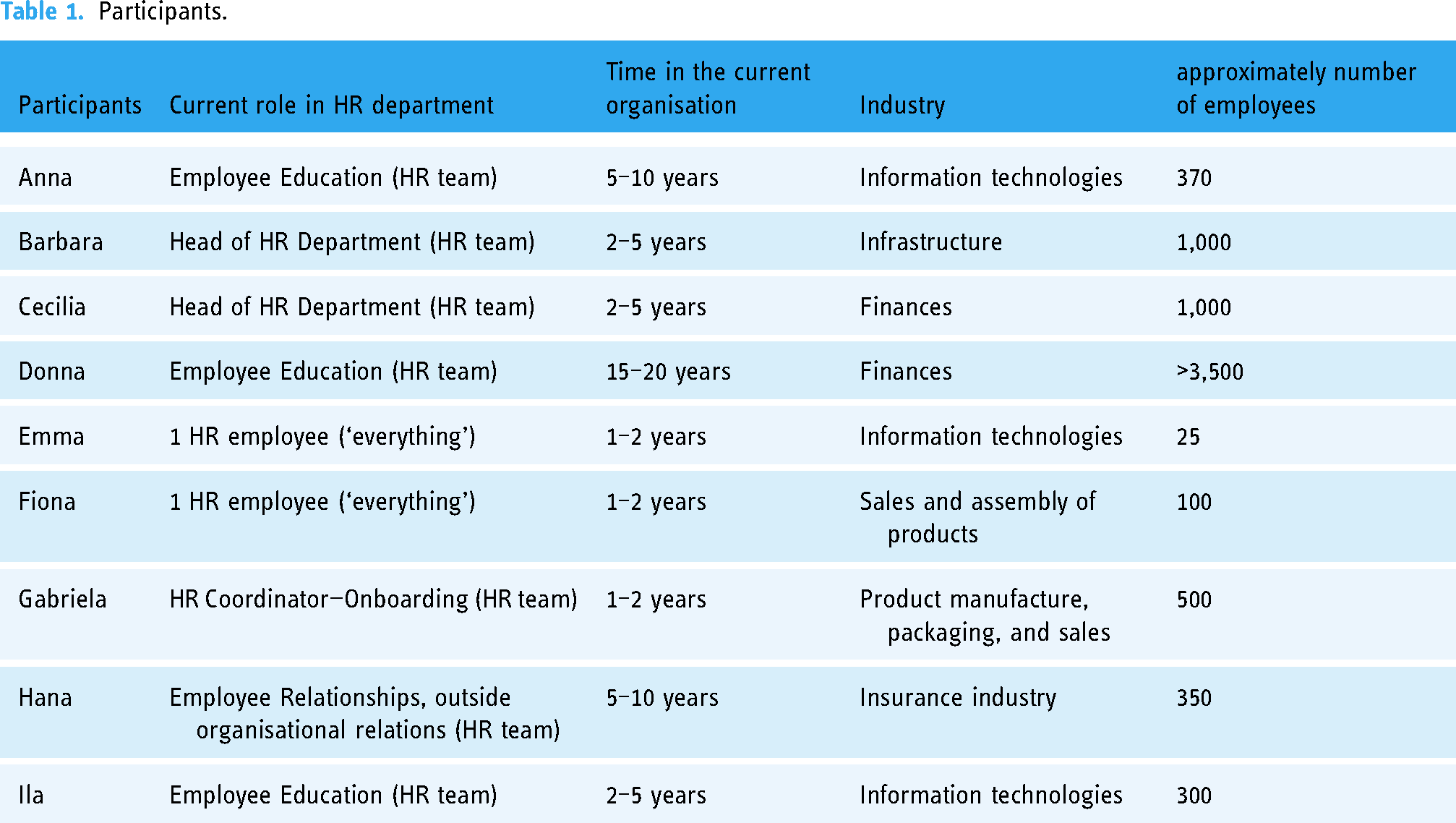
Participants were recruited through social networks where they responded to an invitation to participate in a research project focused on specific learning disorders in the workplace. The only criteria for being included in the study were specified as: working as human resources specialist (HR) – in the Human Resources Department. HRs did not have to have specific experience with dyslexic employees prior to the research project. Nine HRs responded to the invitation and all (9) agreed to participate in the study. All participants are women, with various roles within the HR department of various industries, working in the Slovak Republic, see Table 1. All names used are pseudonyms.
Participants.
Procedure
The data were obtained by the first author through semi-structured interviews. The questions were created based on the scenario of Wissell et al. (2022a) combined with the authors’ own interview guide used previously in higher education research (not published yet). The interview guide was followed to obtain answers in three areas: 1. Dyslexia/learning disorder: general awareness (e.g., What do you understand by the term dyslexia/ SpLD? What comes to your mind?); 2. Dyslexia/ diversity in the workplace (e.g., How would you describe an employee with dyslexia/ SpLD? What do you think such an employee is like?); 3. The work of HRs (e.g., Have you received any guidelines, training, etc. regarding working with employees or even employees with dyslexia?). The script was followed loosely to be able to address all topics, but also leave enough space for comments of participants. The interviewer navigated the session, from what she interpreted as meaningful for the participant, as well as for the context of this study.
The interviews were held online as the participants preferred and approximately lasted 40–60 min. Before meeting, informed consent was obtained from all participants (at the beginning of the sessions, the interviewer again explained what this consent means and gave space for questions, as well as assured the participants that their responses will be anonymized). In total, nine interviews were conducted from December 2023 to March 2024, until topics started repeating themselves (inductive saturation assessed through discussions between the authors; Sandelowski, 1995). Two participants expressed interest in reviewing the transcript of their interviews. The transcripts were sent to the participants for feedback, both did not make any changes after reviewing, and agreed that the transcripts would be used further for analysis.
The participants knew that the interviewer was a Ph.D. candidate researching dyslexia. No other characteristics were shared, while participants were not known to any of the researchers prior to the interviews. Due to the highly sensitive topic and disclosure dilemma, participants were not asked if they are neurodivergent, nor any of them disclosed this spontaneously during the interview (reported in accordance with the COREQ—Complete checklist of the consolidated criteria for reporting qualitative research; Tong et al., 2007).
Analysis
Reflexive thematic analysis was found to be the most suitable for this study, as it can respect the subjectivity of the participant's accounts of their attitudes, opinions, and experience, while acknowledging the impact of the researcher as a valuable addition, not a threat (Braun & Clarke, 2021).
The six steps of reflexive thematic analysis (RTA) (1. Data familiarization, 2. Coding, 3. Generating initial themes, 4. Reviewing and developing themes, 5. Refining, defining, and naming themes, and 6. Writing the report) were loosely followed, as they are not strict rules, and the process of RTA should be more flexible, integrative, than rigid (Braun & Clarke, 2021, 2023).
The transcripts were analysed using the Dedoose platform (Dedoose Version 9.0.17), which is a software to analyse qualitative and mixed data. It was used strictly for greater clarity and systematicity within the coding process. This software does not generate codes/ themes by itself; they were generated by researchers (authors of this study).
The first author went through codes and their application and regrouped them (e.g., code diagnose as an excuse for neglecting work duties and its excerpts were added under the code where is the line between disorder and laziness?). Some codes became subthemes (e.g., code coming out). After the coding process, themes and subthemes were developed (with the help of a white board and markers, alternating with MindMeister, MeisterLabs, n.d.).
The themes were developed mostly inductively throughout the analytic process, while some deductive input cannot be neglected, since interviews were semistructured with the goal of answering specific research questions, and the authors acknowledge the applied lens of the social model of disability and neurodiversity concept.
Positionality, reflexivity
We acknowledge that our experience influences the way we interpret the data. Both authors have an educational background in psychology, practical experience in mental health research, qualitative research, and teaching, while they have already conducted research in the field of neurodiversity, including dyslexia. The study was carried out through the lens of the social model of disability and the recognition of the concept of neurodiversity, including dyslexia. Both authors view dyslexia (SpLDs) as a naturally occurring difference in human brain function (Walker, 2012); however, it becomes disability due to barriers of environments, which are socially constructed (Oliver, 2013). This research project was created based on the previous experience of the authors in interviewing dyslexic adults who expressed concerns about employment. Since this topic is highly underresearched in the Slovak republic, we felt that it is necessary to continue with this topic, furthering it to workplaces.
For thematic analysis to truly become reflexive, reflection must take place during the study (Braun & Clarke, 2021). Although both researchers situate themselves within the views already mentioned, the goal was to reflect data, not our own predispositions. The authors challenged their assumptions through reflexive discussions throughout the duration of the project. The topics of these meetings ranged from professional statements to personal experiences and worldviews; from the point of view of the social model of dyslexia, we expected discriminatory practices within workplaces. The first author (who claims neurodivergent identity) also engaged in reflexive journaling (Olmos-Vega et al., 2023). Within equity and participatory practices, we agree with emerging statements of importance of inclusion of neurodivergent researchers in the field of neurodevelopmental research (as well as Fletcher-Watson et al., 2021; Gourdon-Kanhukamwe et al., 2023).
Results and discussion
Through reflexive thematic analysis (Braun & Clarke, 2021) two main themes (1. Neurodiversity in the workplace; 2. The job gets done. Who is responsible for that?) with two subthemes (1.1 ADHD, autism, and Tourette, where are dyslexics?; 1.2 Coming out) were developed to reflect on the perspective of HR specialists regarding employees with specific learning disorders (see Figure 1).). Data analysis is contextualised and discussed directly within the themes, as it is more congruent with the RTA method (Braun & Clarke, 2023; Byrne, 2021).

Themes and subthemes.
Neurodiversity in the workplace
ADHD, autism, and Tourette, where are dyslexics?
We must emphasise that the concept of neurodiversity was not known among the participants. However, with the discussion of the abilities of neurodivergent employees, all reflected on the “gifts” mainly of autism or ADHD. HR specialists reflected on different experiences with colleagues/employees who they think or knew are on the autism spectrum, or thought they might have ADHD, or knew they have Tourette syndrome. It is important that with these individuals they were sure they could talk about a specific person, as some behavioural/ social ‘differences’ were visible to them. This brings us back to dyslexia as the ‘Cinderella disability’ (Bell, 2009, p. 74). These HRs, from whom many have years of experience, probably encountered many dyslexic employees (as in the general population, the prevalence is approximately 10%; British Dyslexia Association, 2010), but they stayed hidden. For some HRs, it leads to creating a false belief that there are no employees with dyslexia. Valeras (2010) discusses hidden disabilities in the context of ‘passing’, which has been more associated with race, class, gender, or sexual orientation. Passing is ‘the act of presenting oneself as a member of the dominant privileged group, in this case concealing a disability and giving society the impression of able-bodiedness’ (Ginsberg, 1996, as cited in Valeras, 2010, n.p.). Compared to other neurodivergent employees, dyslexics might seem better at passing than ADHDers or autistics. Masking as a coping strategy probably manifests itself differently within neurodivergents, as dyslexic employees try to hide ‘internal struggles’ by, for example, working harder (Alexander-Passe, 2015; Riddick, 2003; Vogel & Sharoni, 2010), as for autistic, ADHDers, or employees with Tourette syndrome, this coping strategy would target more social interactions to be able to pass as neurotypical (e.g., Cook et al., 2022; Van Der Putten et al., 2024), which they may not be as successful at as dyslexics.
On top of that, most of these descriptions of neurodivergent employees bring many stereotypes, as ADHD people being creative and autistic employees very productive, but also ADHD individuals were described as ‘overly talkative’ and autistics as lacking in social communication, shy or ‘weird’. However, these stereotypes could be harmful to these individuals (Masuch et al., 2019; Treweek et al., 2018). HRs used some derogatory language to describe neurodivergent people; however, more often they ‘struggled to find the right language’ to describe neurodivergent people. I don't think I have ever seen it as a separate category (neurodiversity) or in this context. But what comes to my mind are exactly those, for example … IT people, who are such specific people, where there is also an increased incidence of various disorders of the autism spectrum … maybe they know how to use their status as a strong point, because the profession requires, let's say, a greater focus on a certain unique range of tasks,… such weirdos, loners, … But maybe it is just an umbrella term to indicate that they are special or peculiar… (Fiona)
'But what adjectives would I give?’ I would probably put hard work in the first row. From what my experience says. Striving, sometimes maybe too much (laughs) … Erm, more difficult to adapt, I would say … and sometimes maybe resistant. (Anna)
HRs listed predominantly primary symptoms of dyslexia, referring to ‘problems’ with reading/ writing/ mathematical operations, but also difficulties with auditory processing. Surprisingly, only a few of them associated these problems strictly with school environment, while some hinted at secondary difficulties, like low self-efficacy at work and low self-esteem. Others, without prompting to speak about working environment, automatically started to describe an employee with dyslexia and in which ways it can affect the employee at work: The person has difficulty with something and, at the same time, it can go inside the person. That it may still cause him other blocks that affect his quality of life. (Anna)
However, for all HRs, dyslexia was associated with difficulties, impairments, and the possibility of mistakes. Or, on the other hand, and unfortunately, some of them were convinced that there is no employee with dyslexia in their company, since they either ‘outgrew’ it or simply are in other companies, focused more on ‘manual work’. Some studies indicate that people with dyslexia may be found more in manual jobs (Breslin & Pole, 2009; Harun et al., 2019), while others show preferences in people-oriented professions (Logan, 2009; Taylor & Walter, 2003). Studies by Wissell et al. (2021, 2022b), Macdonald (2009) and Macdonald and Deacon (2019) proved that dyslexic employees can be found in all industries, while they are not concentrated in any specific sector or skill.
Coming out
… we as the employer, if the employee himself does not tell us or does not make it known in some way, then we do not even have the right to find out or identify it in any way. We cannot ask if the person can somehow document such a disadvantage … Unless he tells us himself, we basically have no way of knowing. We can only assume this by observation. And when you ask, um, have we had them? I guess we have. But rather it was based on my own evaluation. (Barbara)
Dyslexia is a hidden disability (Bell, 2009). To some extent, dyslexic people decide when or even if they want to disclose their dyslexia to others. HRs in general expressed that dyslexia is associated with a lot of stigma, which means that many employees do not disclose this specific diagnosis to the employer or even to anyone at work. That is problematic, as stigma is linked to social exclusion, as those who are stigmatised are systematically excluded from life chances, including employment opportunities (Liamputtong & Rice, 2021).
The dilemma of disclosure is well known within dyslexia research, starting from higher education and, as we see, continuing to work in workplaces. HRs think that it is better when they have the information, when it is known, disclosed; however, the employee must feel psychological safety within the workplace. Many dyslexic employees decide to not disclose for numerous reasons, including previous negative experience, fear of stigmatisation, ridicule, negative effect on career prospects, lack of understanding, and qualities of the person they would disclose to (Alexander-Passe, 2015; Burns et al., 2013; Macdonald & Cosgrove, 2019b; Morris & Turnbull, 2006; Sanderson-Mann et al., 2012; Wissell et al., 2022b; Yeowell et al., 2018). Psychological safety should be promoted by managers in general within the workplace, as it is associated with positive workplace outcomes (Newman et al., 2017). I think it is possible to work with those people, as long as they also say so. It often happens that these people are ashamed. (Gabriela) …erm, I think that sometimes they tell us that the topic is already being opened. That some come out with it. (Anna)
The job gets done: Who is responsible for that?
Clearly, participants realise that some work duties may be problematic for dyslexic employees, but ‘the job must be completed’. In general, research shows that dyslexic employees perceive dyslexia to impact their work duties to some extent (Locke et al., 2017; Macdonald & Cosgrove, 2019a; Madaus, 2008; Wissell et al., 2022b). However, a question arises here, whose responsibility it is to make it less problematic, less prone to mistakes, and more comfortable. All participants admitted that from their work position they have some power and resources to make the workplace more accessible. Some even felt that it is their responsibility to make it happen. ‘I would probably try to create that environment… well, ‘how can we help’… I will prepare an instruction for him. I don't think this is something that will take someone I don't know how long… I would definitely go ahead and try the options I have. Perhaps I would also consult an expert of some kind, if it is okay.
We will tell him that the work is not done. Hey. Unfortunately, the performance is not at the desired level. He gets feedback, he gets a plan for improvement… as soon as he says that I have such a problem, we would definitely recommend some counseling… We develop communication skills… digital skills… leadership. I cannot see an employer focussing on that, that someone has such a learning disorder and trying to help them with it. (Cecilia)
Again, this was more of a singular opinion. Most HRs, although not sure of the best universal way to accommodate the employee, were certain that something can be done and should be done from the perspective of the workplace and its barriers. But we must emphasise that even though they are ready to give a helping hand, they expect that the employee will also actively work to improve his performance. Well, I think you should definitely communicate it and tell him that there is a problem and that person needs to focus on it. Be aware of it consciously, even with the various activities and tasks that he has to do. (Emma)
Research shows that dyslexic employees are able to overcome challenges, but rather than through disclosure, many find their own individual strategies for coping (see, e.g., Burns et al., 2013; Locke et al., 2017; Madaus, 2008; Vogel & Sharoni, 2010). However, the lack of required adjustment at work is part of the problem that leads to the exclusion of neurodivergents, including dyslexic employees (Doyle & McDowall, 2021). As the Universal Declaration of Human Rights declares: ‘Everyone has the right to work, to free choice of employment, to just and favourable conditions of work and to protection against unemployment’ (United Nations, n.d.). In Slovakia, antidiscriminatory law is used to protect people with disabilities from discrimination on workplaces (Slov-Lex, n.d.), in comparison to the British Equality Act (2010). However, Slovak legislation does not recognise the definition of the term person with a disability. Disability can be defined as any mental, physical, temporary, long-term, or permanent disorder or handicap that prevents persons with disabilities from adapting to the normal demands of life (Ministerstvo Práce, Sociálnych Vecí a Rodiny Slovenskej Republiky, n.d.). Generally, HRs do not know about this, and when talking about legal acquisitions to accommodate, it was more associated with physical disabilities. Dyslexia was predominantly characterized by HRs as a psychological condition/ disorder. They avoided calling it disability or disadvantage, and they do not connect dyslexia with antidiscriminatory policies, which from a social model perspective represents practical barriers that discriminate dyslexic employees. … mostly disadvantages like health problems … Some people are cancer patients or diabetics. Also, the classic stuff. Then we have people who have ‘50% ZŤP’ (in Slovakia severe disability is recognised by law in percentages) and are celiacs, which I still don't understand, but whatever. We have the health care system we have. And it is just that they are mostly such … such diseases, not of a psychological nature. (Gabriela)
Well, it's like that, at least under the conditions of our company, these are such superstructure topics, which, frankly, are the number-billion priority … but it is not less important, it is very important. And the first, certainly the most important step, I think, is to open it up exactly. How did you come up with the topic? Otherwise, I might not even have thought about it. (Fiona)
Recommendations
This study showed a dilemma, this time from an HR perspective. How to find balance between creating the inclusive environment and at the same time ensuring that workplace performance stays put? HRs focus on developing skills and compensation strategies for dyslexic employees, which is a highly individualistic approach, mirroring the medical model of disability (Valeras, 2010). From this perspective, the individual, the employee is at fault, he is the problem, he is the only one responsible for the performance at work. From the point of view of improving coping and learning strategies, this may be crucial during education and transition to work, to prepare these individuals for the challenges they will face in workplaces. Surprisingly, HRs did not reflect on the transition period of employees with SpLDs. According to the literature, the transition from education to work could be especially stressful and challenging for these employees (Bell, 2010; Morris & Turnbull, 2006). However, within the workplace, we should focus more on the environment, workplace practices, which now seem to be discriminatory towards dyslexic employees. The atmosphere at work is also crucial. Dyslexic employees may not feel psychological safety at work, leading to non-disclosure. Interventions should focus on building psychological safety at work, in specific language and cultural contexts. To build more inclusive environments, we must raise awareness not only between human resource specialists but also between other employees (colleagues), and importantly between dyslexic employees. Employees and employers may not know about the rights of dyslexic employees and the accommodation possibilities, which should be provided by their companies (Equality Act, 2010; Slov-Lex, n.d ; United Nations, n.d.).
Limitations and future directions
The fact that the study is qualitative is not perceived as a weakness of this article, as qualitative designs are valid and epistemologically sound (Masaryk & Stainton Rogers, 2024). However, some specifics must be considered while using qualitative methodology, mainly the subjectivity and assumptions of the researchers. As authors and researchers, we were aware of this and treated it accordingly with RTA through reflexivity (Braun & Clarke, 2021; Olmos-Vega et al., 2023). As another limitation, but also a suggestion for future research, inclusion of dyslexic HRs (/HRs with disabilities) as participants would be useful, as it would bring another point of view and enrich the results, as well as participation of male HRs, since the participants in this study were only women. Participants did not have previous experience with dyslexic employees, which might seem limited. This criterion was established due to the high non-disclosure of this condition within workplaces. However, for future research, the inclusion of HRs with specific experience would enrich the knowledge in this area.
Conclusion
Human resources specialists have some basic knowledge about dyslexia and its impact on employees. However, their beliefs are based on their assumptions and experience encountering dyslexic employees, which are rather rare. In general, they are open to help building more inclusive workplaces, but for now these steps to equality are based on individual approaches, which requires disclosure from the employee. As we have mentioned, the disclosure dilemma appears to be a universal experience of dyslexic employees (Burns et al., 2013; Morris & Turnbull, 2006; Sanderson-Mann et al., 2012; Yeowell et al., 2018). Prince (2017) emphasizes that while disclosure is key to reasonable accommodation, the overall infrastructure of workplaces should be inclusive, providing psychologically safe opportunities for disclosure.
Footnotes
Authors’ contribution
Karin Černickaja and Lenka Sokolová contributed to the study conception and design. The first draft of the manuscript was written by Karin Černickaja. Lenka Sokolová critically revised the work. Both authors read and approved the final manuscript.
Data availability
The data that support the findings of this study are available from the corresponding author, Karin Černickaja (karin.cernickaja@fses.uniba.sk), upon reasonable request. Due to ethical constraints, the entire dataset cannot be publicly shared.
Declaration of conflicting interests
The authors declared no potential conflicts of interest with respect to the research, authorship, and/or publication of this article.
Ethical statement
The ethical approval was granted by the host university (Comenius University in Bratislava, Slovak Republic; the approval number given by the ethical board: 1402/2021, date: 1 December 2021; research is part of dissertation thesis). All participants received informed consent. Written informed consent was obtained from all participants prior to enrolment in the study.
Funding
This project was funded by VEGA 1/0119/21 (Vedecká grantová agentúra) ‒ Scientific Grant Agency of the Ministry of Education, Science, Research and Sport of the Slovak Republic and Slovak Academy of Sciences.
